Showing posts with label Diagram. Show all posts

2011-12-07

Hypothetigraphy

Many theories of diagrams are limited in scope to just one or two manifestations of abstract drawings. Diagrammatic representation of numerical data has been well studied since Edward Tufte's Visual Display of Quantitative Information, but stemmatic drawings like the Great Stemma are rarely well explained. I have been impressed at the theoretical work of Manfredo Massironi (1937-) of the University of Verona in Italy. Massironi has devised a concept he calls hypothetigraphy to describe drawings that present hypothetical, invisible, abstract ideas. It is presented in his 2002 book, The psychology of graphic images: seeing, drawing, communicating (Link: Google Books). (The English translation from the Italian is not perfect, and sometimes makes no sense: the term itself is sometimes spelled "hypothesigraphy" in the text, varying in orthography from one line to the next (e.g. p. 164), but "hypothetigraphy" is the form used in the headings and index.)

He says he departs from the idea that "illustrating is a way of emphasizing, by visual means, those contents that cannot be effectively conveyed by verbal expression." He proposes that hypothetigraphy has two roles: (a) a connective function (connecting into a unitary pattern a body of knowledge [which is] fragmented and apparently not well organized) and (b) a reconstructive function (reconstructing the various phases of a process for purposes of illustration and interpretation, starting from observable results).
According to my definition, hypothetigraphy defines a rather homogenenous class of drawings, which I call hypothetigraphs ....
The first feature, and one that is most easily noted, is the use of simple geometric figures.... The "true" objects and their appearance are not important in this endeavor, for the phenomena under consideration have to do with relationships and with dynamic interactions between elements.... The shape of elements per se is usually an irrelevant piece of information, which is best left out or represented simply by the most abstract of shapes, the circle.
A second and most immediately noticeable feature of hypothetigraphs is the addition of brief written text to the picture.... The inclusion of written text is always necessary in hypothetigraphy which would otherwise lose its communicative function... Verbal and visual information are inextricably and necessarily connected.
Another distinguishing feature of hypothetigraphy is the the almost exclusive use of precise marks, drawn using the ruler ... Precise, clear lines contribute in conveying the impression that the depicted forms are mental constructs, not representations of natural objects.
Typical of hypothetigraphy is ... the use of object lines ... Object lines are not used to mimic some aspect of reality but to illustrate relationships, correspondences or connections.... Relationships and connections and trajectories ... lend themselves naturally to an interpretation in terms of threads, ropes and connecting cables.
A fifth feature of hypothetigraphy is the number of represented dimensions, which tends to be as small as possible within the constraints of the logic of the representation.
Finally, hypothetigraphy tends to place the viewpoint frontally relative to the picture plane, an tends to present figures without a background.... The second of these ... contributes to focus the attention of the viewer, avoiding unwanted contextual effects.
This is all very useful. The six "features" listed above are all applicable to the Great Stemma:
  1. Its graphic elements are circles of various sizes. They do not represent heads or anything else physical but are entirely abstract, representing generations and dynasties.
  2. Text within the roundels, along the connecting lines and in the final Sicut Lucas evangelista section, is there to expand the effect of the drawn figures.
  3. Its lines are generally straight, except for the final meeting of the two fila, and the whole structure is drawn with a certain sterility to emphasize its abstract meaning.
  4. The connecting lines represent succession, and ramifications where necessary.
  5. The drawing is strictly two dimensional
  6. It has no background colour or images. My attachment of a yellow timeline band to the reconstruction is in fact out of harmony with the austerity of the original.
Massironi makes no mention of the Great Stemma. In fact he does not mention any stemmatic drawings at all. But his observations are so acute that they apply to the stemma without any modification being required of them.

Graph of Time

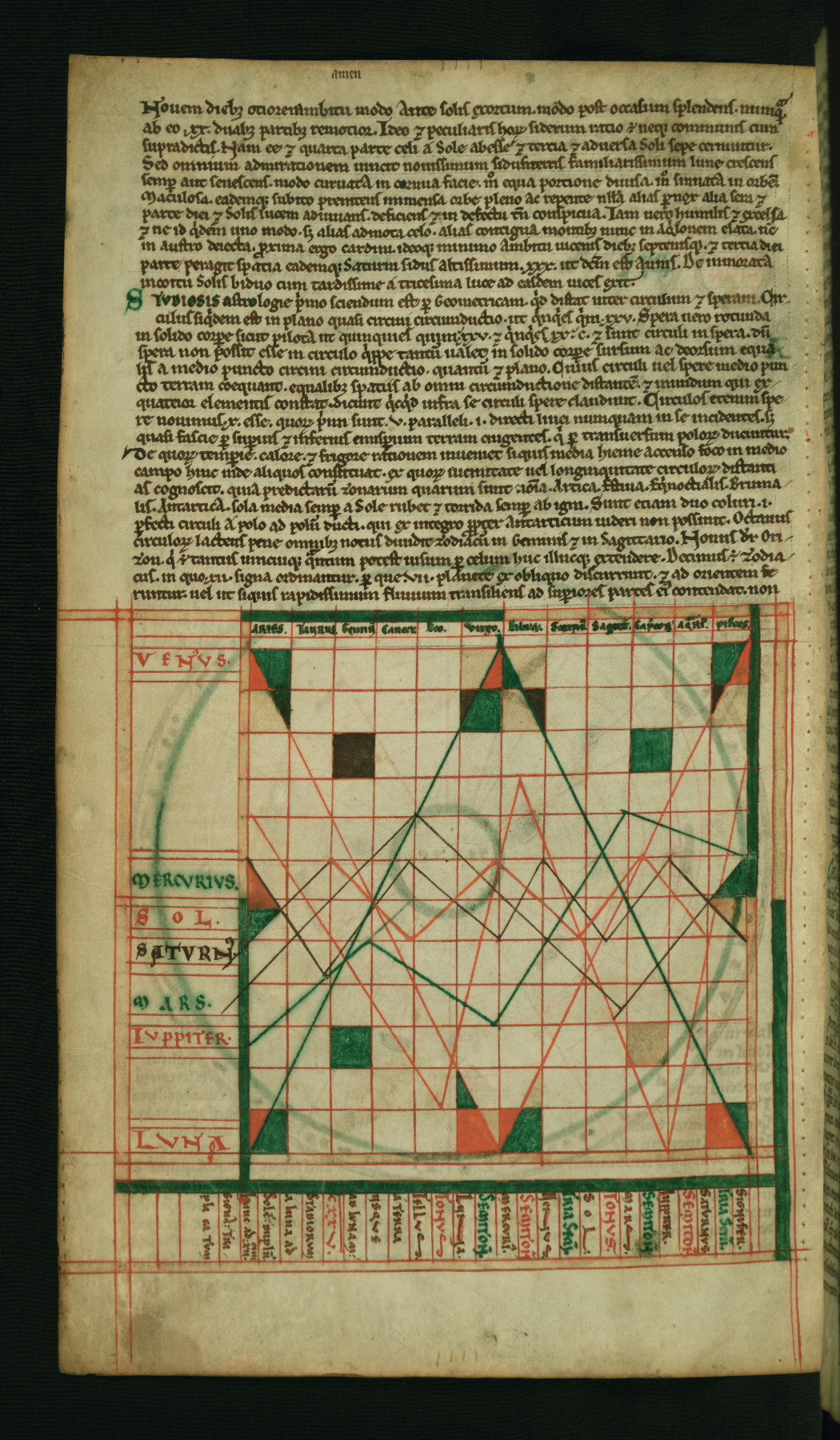
Some time ago, my attention was drawn to the graph of planetary displacement from the elliptic with respect to time that was devised for medieval schools. Until 50 years ago this was thought to be unique to a Latin manuscript in Munich, BSB Clm 14436, 61r, but it seems to in fact exist in numerous manuscripts.

Bruce Eastwood discusses it in Plinian astronomical diagrams in the early Middle Ages (1987) and returned to it in more detail in Planetary Diagrams - Descriptions, Models, Theories (2000, co-authored with Gerd Grasshoff, online) and Planetary diagrams for Roman astronomy in medieval Europe (2004, also with Grasshoff, online). If I am reading these articles correctly, the diagram is what the authors classify as "Plinian latitudes - rectangular" in their 2004 catalogue:
1 Avranches BM, 226, f.88r
8 Bern BB, 347, f.24v
10 Cambridge, St John's CL, lat. I.15, p.287
11 Cambridge, St John's CL, lat. I.15, p.353
12 Cambridge, Trinity CL, R.15.32, f.3v
13 Durham CathLibr, Hunter 100, f.66r
15 Erfurt StB, Ampl. 4°.8, f.1r
20 Genève FB, 111, f.41r
21 Glasgow UL, T.4.2, f.117r
22 Leiden UB, BPL 168, f.56r
24 London BL, Add. 11943, f.49v
27 London BL, Cott.Tib. E.IV, f.141r
32 London BL, Roy. 13.A.XI, f.143v (image in Eastwood/Grasshoff)
38 Milano BN, E.5 sup., f.1r
39 Milano BN, E.5 sup., f.53r
54 München SB, clm 6364, f.24v
57 Oxford BoL, Canon. Class. lat 279, f.34r
59 Oxford BoL, Lyell 154, f.26v
70 Paris BNF, lat. 5239, f.38v
71 Paris BNF, lat. 5239, f.39r
72 Paris BNF, lat. 6367, f.1v
79 St Gallen StiB, 250, p.2
81 Strasbourg BU, 326, f.122r
89 Vaticano BAV, Palat. lat. 1577, f.82v
94 Vaticano BAV, Regin. lat. 1573, f.53r
105 Wroclaw UB, IV.O.11, f.59r
108 Zürich ZB, Car.C. 122, f.42r

But perhaps I have not understood this correctly, since the specimen which is numbered Plin45 (clm 14436, 61v, link at the top of this blog entry) is absent from the above list, as is the specimen numbered as Plin83 in the 2004 article (Strasbourg, same codex as above, but folio 123r, reproduced in the 2000 article), along with six other references Eastwood gave in 1987:
Madrid 9605, f.12v
Zurich Car. C 176, f. 193v
Bern 265, f. 59r
London Cott.Vit. A XII, f. 9r
Baltimore Walters W, 73, f. 5v (mentioned in the note on page 11 of Eastwood's 2004 catalogue)
Oxford, St Johns, 17, f. 38r
London BL Eg. 3088, f. 83v
There is one corrigenda page in the Google Books edition, but these are not mentioned there. I do not know if further errata have been published. Perhaps I have overlooked some kind of filter that Eastwood and Grasshoff may have mentioned in their book, and I would be grateful if any reader could explain this to me.

Hans-Christoph Liess, supervised by Grasshoff and Eastwood during his doctoral studies at the University of Berne, later assembled a database of Eastwood's images, and published a description. The title page of this 2001 database project, code-named Compago, is still online, as is the diagram index page, and, perhaps most important, an interactive mind-map of the manuscripts listed above. A handbook was also published. But the back end with the actual images and the required software module, code-named Alcatraz, seems to have either been taken down or to have been put behind a wall. Google Chrome is able to open the interface, but a user name and password are required to proceed further. Liess completed his doctoral dissertation in 2002 (large file) and this is online. Both Liess and Grasshoff have since moved from Berne to Berlin.

What is curious is that all three authors are sure that the diagram is a simplification of a circular diagram of the Plinian latitudes which is found in 12 manuscripts. Pliny had presented the data as numerical data only. Then a Carolingian editor devised the circular diagram just before or following a conference on computus in 809 EC and "solved the problem of presenting to students the spatial meaning of the Plinian text" (Eastwood, 2000). Eastwood and Grasshoff continue:
Within a few decades after its creation, the circular latitude diagram was replaced by another, a rectangular diagram, which reduced the amount of theoretical content added to the relevant Plinian text and also offered a more easily produced and more quickly read image.
Edward Tufte reproduces the Munich rectangular diagram on page 28 of Visual Display of Quantitative Information, but curiously enough misses its significance for the history of simplification. He only cites an outdated 1936 article by Funkhouser on it. In fact, the diagram turns out to be exemplary of Tufte's principles of subtracting and simplifying to make graphics clearer and more communicative, and his term "reduction of data ink" to describe economy in an infographic:
A few graphics use every drop of their ink to convey measured quantities.

2011-10-31

Visions

I continue to search in vain for a scholarly exploration of data visualization in Antiquity. There is no doubt that Graeco-Roman graphics are getting far more attention these days than ever before, but so far that attention has been focussed on other areas.

1. Mathematical diagrams are getting close attention, as Reviel Netz notes in The Archimedes Codex:
The scholars who edited mathematical texts in the nineteenth century were so interested in the words that they ignored the images. If you open an edition from that era, the diagrams you find are not based upon what is actually drawn in the original manuscripts. The diagrams represent, instead, the editor's own drawing. I was shocked to realize that and began to consider: should I produce, for the first time, an edition of the diagrams? (p. 30).
2. Illustrations of texts have been re-assessed in many new ways, with the works of Kurt Weitzmann a half-century ago, Late antique and early Christian book illumination and Illustrations in roll and codex marking a starting point. I recently browsed through John Williams' Imaging the early medieval Bible (1999), which revises some of Weitzmann's ideas, and of course there are the more recent books of Jocelyn Penny Small, The Parallel Worlds of Classical Art and Text (2003), and of Michael Squire, Image and Text in Graeco-Roman Antiquity (2011), which debate whether book illustration was ever meant to depict what was in the text at all. But all of these books deal with the interplay between stories and pictures of people doing things.

3. Mental pictures of abstract matters are discussed in Mary Carruthers' books, particularly The Craft of Thought (1998), which explores the patristic and Roman Republican models of the medieval 'craft of memory' and thus casts some light on the place of visualizations in Late Antiquity:
Whereas ekphrasis always purports to be a meditative description of a painting, sculpture or the facade of a building, the initiating compositional pictura can also describe a schematized landscape in the form of a world map, or a figure like Lady Philosophy, or just about any of the formae mentis in common monastic use: a ladder, a tree, rotae, a rose-diagram. The rhetorical figures called ekphrasis and Bildeinsatz, in other words, are types of the cognitive, dispositive topos called pictura, which is the more general term. The most general terms of all for this cognitive instrument would include words like ratio and schema. (p. 200)

So visualizing things was a good way to start explaining them. However Carruthers is concerned with inner pictures, so her books yield very little about the ways that a real diagram or map could be employed for meditation or how it might be designed.

4. Small's other book, Wax Tablets of the Mind: Cognitive Studies of Memory and Literacy in Classical Antiquity (1997), explores the ways in which text could be said to visualize what was going on in people's heads, but once again does not deal with data visualization. Anna Catharina Esmeijer's Divina Quaternitas: a preliminary study in the method and application of visual exegesis tackles some of the same issues, but is of course mainly concerned with rather simple figures, not the complex abstraction of the Great Stemma.

Now obviously I have missed from this list a great many other learned books and articles. Many are listed on the further reading page of my website. But nowhere have I found a book or an article that goes to the heart of the issue. How the Latin writer could present mere words and numbers so pregnantly on the page so that the mere arrangement gave food for thought.

2010-09-20

Mappaemundi

The Digital Mappaemundi Project contains a very useful English translation of the geographical text from the Historiarum Adversum Paganos Libri VII (Seven Books of History against the Pagans) of Paulus Orosius. He was an Iberian priest (ca. 385-420) who was commissioned by St. Augustine of Hippo to write up the story of the bad old world. Digital Mappaemundi looks as if it will become a wonderful and important resource: the maps are high-quality digital images from medieval manuscripts and the plan is to completely index and cross-reference them.

2010-09-12

Diplomatic Editions of Diagrams

I've so far looked in vain for scholars' ideas on how to create what one might describe as a "diplomatic" edition of a diagram. As a 21st-century scribe, what one is looking to do is to recopy an antique or medieval diagram while:
  • preserving its original language and wording;
  • adapting its script and linework to contemporary lettering and drawing conventions;
  • unwinding physical deterioration that mars the old medium.
The last objective could perhaps be adequately met by taking a photographic image of an old document, and photoshopping away the blotches, mould, tears and distortions. There is an interesting 2008 account (pdf) in e-Perimetron of how this can be done with old maps. But this does not allow much editorial amendment, nor does it make the document readable. Since the age of print began, we expect documents to be recast with modern typographic lettering.
In the digital age, we also expect a document to be searchable, and it would be perverse nowadays to publish on paper only: one must produce a full digital edition.
The solution I have been experimenting my way towards is to use XML documents which contain the text and all the necessary instructions to draw a vector image of the original diagram and lay it out faithfully, either on the screen or on paper via a digital printer. XML files can be directly edited: every word and letter can can be checked and altered if need be without using proprietary or sophisticated software.
The images on my website have all been created using OpenOffice Draw and the master files are saved in odg format. To publish them online, they are converted to Flash files.
I have been learning ways to manipulate odg files so that they could become the definitive transcripts of original manuscript pages, or provide the basis for merged, critical, digital editions. In fact it ought to be possible to do this so one could have several languages all stored in the one file: Layer 1 would be Latin, but you could easily swap to a Layer 2 in English, Layer 3 in German and so on.
I prefer to write transcripts into Microsoft Excel, which allows you to standardize the data, mark it up, sort it, add fields and so on. An early problem was how to convert Excel data into a format that can be used by OpenOffice Draw. These are the steps I take:
  • I create an Excel spreadsheet which attaches the necessary XML tags to the left and right of the list data;
  • An odg file is in fact a zipped-together folder of files, one of which is named content.xml and contains the text within the drawing;
  • Use IZ Arc to open the odg file, and extract content.xml to another folder.
  • Open content.xml and prepare to overwrite all of its text sections as follows;
  • Copy the XML tags and data which you have generated using Excel;
  • In Windows, right click the file icon of content.xml and choose edit from the context menu. Paste the data into content.xml;
  • Save the new version of content.xml;
  • Drag the altered file back into the IZ Arc window and save the odg file;
  • OpenOffice Draw will hiccup a bit as it processes this odg, but it will open;
  • The texts may not be properly formatted. Highlight everything and choose Default style to reformat them, then save;
  • More fixing in OpenOffice Draw then includes converting background to invisible. To make the borders invisible, change "line" to invisible as well.
The Excel file that begins this process includes sequential position information so that each draw.frame element has its own position on the page and is not overwritten. It is easy to construct 10 or more columns of data this way. The first element, at the upper left, is enclosed in the following tags:
  • At the beginning of each element, these three opening tags:
    • draw:frame draw:style-name="gr1" draw:layer="Text" svg:x="-56cm" svg:y="-19cm"
    • draw:text-box
    • text:p

  • At the end of each element, these closing tags:
    • /text:p
    • /draw:text-box
    • /draw:frame

The minus 56 and minus 19 in this case mean the text begins 56 centimetres to the left and 19 centimetres above the top left corner of the virtual canvas in OpenOffice Draw.
I am still thinking about ways to make the resulting document more easily editable.

2010-05-06

A History of the Timeline

An impressive new illustrated history of timelines has just appeared in the United States. Cartographies of Time: A History of the Timeline is the work of Daniel Rosenberg, an associate professor in Oregon, with help from Anthony Grafton. I have not bought a copy yet, but can see the first 34 pages as a sample on Google Books here. Thanks to Nat Taylor for pointing out this publication. The formal launch date seems to have been May 1, but there are bibliographic references suggesting it was in circulation earlier.

Rosenberg's book deals with a topic closely related to the stemma: the long history of vertical, horizontal (and curled-up) timelines to represent history.

One gem of a story I noticed at first glance on the Google preview was the account on page 27 of the Milanese publisher Boninus Mombritius boasting that no scribe could have copied such an intricate and extensive work as accurately as he did with his printed version of Eusebius. Mombritius declared he had kept all the tables in order and put all the kings in their places.

This alludes to the muddle which hampered the diffusion of both the stemma and timeline in the medieval period, and erased almost all documentary evidence of their Late Antique models. It is challenging for any reader to grasp and to remember complex technical drawings which require careful measurement and layout. It is difficult for even a scribe with artistic skills to copy one correctly. And with fewer skills, time pressure and inadequate remuneration, it is practically impossible. Thus, the serious corruption done to the Great Stemma early in its diffusion led to it ultimately being discarded and begun all over again by medieval writers such as Peter of Poitiers.

I cannot see the index and I have not read the book yet, but on the pages I did read, Rosenberg seems to jump his history from Eusebius (who arranged his chronography in vertical columns, with the synchronous entries all carefully aligned with one another) straight to Peter of Poitiers with no mention of the Great Stemma.

The Great Stemma's arcade, which marks out the patriarchs from Adam to Abraham in a series of arches, each containing a span of years between each begetting, is incontestably the oldest left-to-right timeline extant in the West. The manuscripts date from 945 and later. If Rosenberg's valuable book were not to mention them, it would be incomplete.

It can also be argued that the Great Stemma contains a more sophisticated timeline than this simple arcade of patriarchs. I am exploring this on the latest page of the Piggin.Net website. The Great Stemma was undoubtedly created before the 8th century, perhaps in Visigothic Spain, perhaps in North Africa. It could even be that the Great Stemma pre-dates Eusebius, but those are matters that are still the subject of ongoing research.

2010-03-04

Timelines

Readers may care to look at the mounting evidence that a timeline once ran through the Great Stemma. Gotolia offered the first clue. This widow of a Judaean king managed to achieve power later in her own right. And we find that she figures in the Great Stemma twice! The duplication can only mean that she was present in her separate capacities as both a spouse and a ruler. This has provided me with the first clue that there are two different streams of information present in the layout. That has in turn prompted a fresh look at the information arranged in the arcade on plates one and two. I have realized that the series of arches is a most natural way of portraying a timeline: it represents time as grasshopper springs. Could an antique graphics draftsman have conceived the distance of such leaps as being in scale to the passage of years?

2010-02-18

Rightward Shift

After discovering in mid-January a major "wiring error" on Plate 12 of the Great Stemma that affects every extant copy of the diagram, I am now closer to understanding how this mess-up happened.

The Great Stemma appears to be a "family tree" of Christ which was compiled in late antiquity. In its section on the Judaean kings period, it includes the names of the kings' mothers. But as has already been noticed, many of the names are not those which are carefully set out in the Second Book of Kings in the Bible. A little study shows that most of the mysterious names of wives, which seem to have come out of nowhere, can in fact be found in one of the chronicles of antiquity, the Liber Genealogus, which uses slightly unfamiliar forms of the biblical names. This part of the analysis shows that a large block of names was simply shifted rightwards across the Great Stemma page to a new position. At least four wives' names were then shifted upwards to fill the gaps on the page. But what is most interesting of all is that the name of Queen Athalia, a bloodthirsty lady said to have out-heroded Herod by slaughtering children, appears twice on Plate 12.

I have made a graphic showing these corruptions here (click).

Mistakes like this are a godsend in manuscript detective work. This error offers us additional proof that there must have been a timeline originally running alongside the great stemma at mid-page height. This matters, because it reveals that the Great Stemma is not just a genealogy, but a graphic version of the universal chronicles which attempted in antiquity to cross reference the histories of different civilizations to establish an overview of Middle Eastern and Graeco-Roman history.

All this, in its turn, helps us to reconstruct how the Great Stemma looked when it was originally drawn, and indirectly proves (a) that stemma design in late antiquity was much more sophisticated than medieval copies show and (b) that the lack of proper stemma alignment in all 21 known copies of the Great Stemma is almost certainly a defect in the copying, not in the original design.

2010-01-02

Electricians

I have been using an electrical continuity tester to discover what connects where inside a standard lamp that no longer lights up. And on the same day I have been transcribing a stemma page from the 12th-century illuminated Bible of San Millán de Cogolla. I found the coincidence illuminating (sorry, I could not resist that pun). The stemma, which presents a genealogy of Christ, contains a vast array of components (persona), which are "wired" together by connecting lines. Some authors have suggested that the stemma is a mnemonic device, but I have seen no evidence for that and doubt it. No one with a normal mind could remember all the connections simply by studying a graphic with several hundred nodes, any more than one could "learn" a wiring diagram for a complex electrical device. In fact, it is far easier to memorize the biblical passages on which the San Millán stemma is based and recite them than it would be to construct this stemma from memory. Both a wiring diagram and a complex stemma have a different purpose. They provide an analytical, information-storage method in which the user can mentally crawl along the lines to consider whether the electrical assembly is complete or whether the genealogical stemma offers all the necessary connections of descent or is marred by breaks. One must keep going back to the graphic to see the different local connections. Circuit diagrams are in fact a variety of process flow chart, which, as we know, have their origins in the stemma form.

2009-11-24

Diagrams or Stemmata

A scholarly correspondent has taken me to task over the term "stemmata", saying these figures in the medieval manuscripts are properly called "diagrams" in English. That rather misses the point. Conceptually, there are three different ways of seeing the figures. One is to consider their meaning as art, contemplating the world of significance behind them. That is the focus of Christiane Klapisch-Zuber's book, L'Ombre des Ancêtres, which uses the extraordinary Arbre of Loyset Liédet as its cover illustration. The wordless Liédet image, showing various well-dressed people impossibly perched in a strangely sick tree, seems senseless unless one understands the art-historical context in which it was painted. Another aspect of stemma figures is clearly diagrammatic. Like geometrical figures (for example cubes and pyramids) or plans (such as that of the locus sanctus), they engage with our spatial intelligence and illustrate text, following the dictum, "One picture is worth a thousand words." But the third aspect of the figures is typographical, considering how text can be rearranged on the page to make its meaning clearer. The stemmata of Cassiodorus do not have to be arranged in graphical form (Mynors converted most of them back to linear text in his critical edition of the Institutiones), but, like poetry, these texts are enormously improved by a sympathetic spatial arrangement. The connecting lines support and enhance the connecting words. The stemma has a dual character: it is both art and text. The word "stemma" is the appropriate term for this special type, even if the figure can also be discussed in the wider categories of art motifs or diagrams. The Macro-Typography website focuses on how text is arranged to make its meaning clear.

2009-10-07

Web Versions of the Diagrams

Rather than offering photographs of the old manuscripts, with all the attendant permissions issues, I am posting sketches of their designs, such as this one on consanguinity. Anna Catharina Esmeijer in her authoritative book, Divina Quaternitas, did the same, but the focus here will be purely on the shapes, with English translations of the Latin to make the content more easily comprehensible to the general reader. The initial drawings have been done with OpenOffice Draw or with Autosketch, and have then been converted to Adobe Flash files, which open inside a web browser. Most browser users have the Flash plug-in installed, so these files are not only accessible, but very compact. Best of all, they can be zoomed into on screen without any loss of quality. The drawing tool of OpenOffice is free and exports simple files to Flash format in a jiffy.