Showing posts with label DigiVatLib. Show all posts

2016-07-28

Summer of Ptolemy

Until about 25 years ago, it was unreflectingly supposed that the ancients used maps. It has now gradually achieved acceptance among historians (but perhaps not yet in the wider public) that scaled maps as we use them today are a cultural invention, attributable in the West at least to the medieval and modern period.

That is not to say that the ancients did not understand the idea of a map.

The archaeological record indicates that diagrams showing land from a birds-eye perspective were normal enough, but they tended to be schematic like our urban-train-line diagrams. The Turin Papyrus Map shows gold mines in Egypt. The gromatici of Classical Rome drew scaled survey plans. The 3rd century Forma Urbis Romae was the acme of such work, amounting to a plan of all Rome. But these showed land as contiguous property, not as a surface to cross from A to B.

The use of a large-scale map as a navigation aid was either not widely understood or rejected as ridiculously complicated to set up and deploy. Sailors noted bearings and relied on them. Land travellers perused itineraries, not maps. Late Antiquity created the Peutinger Diagram, a schematic of routes in the whole known world, but it was not made to scale.

Ptolemy, who seems to have lived in the 2nd century, wrote out a method for applying scale far larger than that of the gromatici to make maps of the world, and collected the longitudes and latitudes taken by sailors and travellers in about 8,000 locations in Europe, Africa and Asia to do so. He was far ahead of his time and was not followed. From an ancient perspective, the idea must have seemed counter-intuitive: in a world where 90 per cent of the land and all of the sea was empty waste, why employ time and costly papyrus to "dwell" on it?

A millennium later, the great scholar Manuel Planudes (c. 1260 – c. 1305) created maps from Ptolemy's geographical data. We now doubt that Planudes saw any Ptolemaic originals.

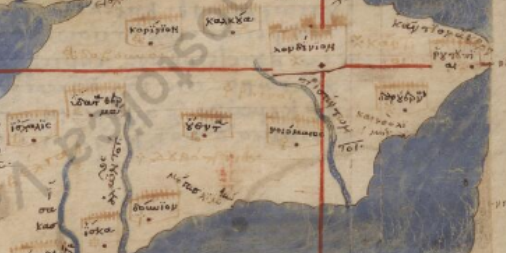
Among the most wonderful possessions of Federico da Montefeltro (1422-1482), the duke of Urbino and fabulously wealthy book collector, was a superb manuscript from about 1300, Urb.gr.82, preserving the Geography of Ptolemy (text) and the Planudes maps. It is one of the most important manuscripts of Ptolemy, preserving what is known as the Omega recension, and is known as U.

U came online as part of the digitization of the Vatican Library only a few weeks ago. Here is how it shows the region of London and the English Channel:

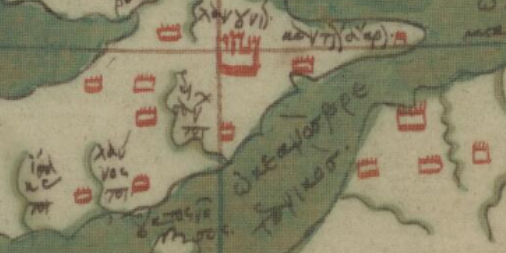
Federico owned a second copy (he was rich enough) made in the 15th century, Urb.gr.83, based on this recension, with 64 smaller regional maps and four large additional maps. This codex featured two decades ago in the Rome Reborn exhibition. It was uploaded to the online portal on July 26, 2016. Here is its take on the same region:
The Vatican is the essential place to go to recover the Geography. It also owns an essential manuscript of the Xi recension, Vat.gr.191, fols 127-172, or X, also online, but without maps, the arrival of which I covered in a blog post one year ago. The closely related A (Pal.gr 388) has not yet been digitized, nor have Z (Pal.gr. 314), V (Vat.gr. 177) or W (Vat.gr. 178).

For more details of the key manuscripts, see the Hans van Deukeren page. and also check the Daniel Mintz page. The definitive edition of the Geography was published by Stückelberger in 2006.

2016-07-27

Surpassing 5,000

With an enormous and unexpected display of energy, the Vatican Library released 253 new digitizations online on July 26, 2016 to surpass the bar of 5,000.

Only philanthropy can make this happen. The key assistance appears to be coming from NTT Data, the Japanese software company, which this month put some pepper in the fund-raising programme by announcing an attractive incentive for large donors: an ultra-close facsimile of a page from the Vatican Vergil (to be made by Canon). Contribute if you can: it will take immense resources and years of work to bring all 80,000 Vatican codices, rolls, papyri and sheafs of letters online.

Remarkable in this surge is the sudden arrival of 166 manuscripts from the great Renaissance library of Federico da Montefeltro (1422-1482), duke of Urbino, whose Italian library was perhaps the most costly cultural institution of his age. A new collection where digitization has just started is the Pergamene di Terracina.

The posted total of 5,131 continues to understate the true extent of the digitizations, as it does not include the many Pal.lat. manuscripts now online in an ancillary programme or isolated cases such as the Vatican's Bodmer Papyrus VIII. Here is the list of new arrivals:
  1. Arch.Cap.S.Pietro.B.56 - Details
  2. Arch.Cap.S.Pietro.C.116 - Details
  3. Arch.Cap.S.Pietro.G.33 - Details
  4. Arch.Cap.S.Pietro.G.41 - Details
  5. Borg.copt.109.cass.XIX.fasc.70 - Details
  6. Borg.copt.109.cass.XIX.fasc.72 - Details
  7. Borg.ebr.16 - Details
  8. Borg.ebr.17 - Details
  9. Borg.turc.6 - Details
  10. Borgh.338 - Details
  11. Cappon.131 - Details
  12. Cappon.306 - Details
  13. Ferr.562 - Details
  14. Ott.lat.1210 - Details
  15. Ott.lat.1368 - Details
  16. Ott.lat.1417 - Details
  17. Perg.Terracina.1 - Details
  18. Perg.Terracina.2 - Details
  19. Perg.Terracina.3 - Details
  20. Perg.Terracina.4 - Details
  21. Perg.Terracina.5 - Details
  22. Perg.Terracina.6 - Details
  23. Reg.lat.1500 - Details
  24. Urb.gr.83 - Geography by Ptolemy. Full discussion in my separate blog post. Details
  25. Urb.lat.29 - Details
  26. Urb.lat.34 - Details
  27. Urb.lat.55 - Details
  28. Urb.lat.69 - Details
  29. Urb.lat.77 - Details
  30. Urb.lat.78 - Details
  31. Urb.lat.89 - Details
  32. Urb.lat.94 - Details
  33. Urb.lat.114 - Details
  34. Urb.lat.118 - Details
  35. Urb.lat.125 - Details
  36. Urb.lat.142 - Details
  37. Urb.lat.144 - Details
  38. Urb.lat.163 - Details
  39. Urb.lat.166 - Details
  40. Urb.lat.181 - Details
  41. Urb.lat.211 - Details
  42. Urb.lat.222 - Details
  43. Urb.lat.223 - Details
  44. Urb.lat.233 - Details
  45. Urb.lat.249 - Details
  46. Urb.lat.284 - Details
  47. Urb.lat.290 - Details
  48. Urb.lat.296 - Details
  49. Urb.lat.303 - Details
  50. Urb.lat.304 - Details
  51. Urb.lat.337 - Details
  52. Urb.lat.341 - Details
  53. Urb.lat.351 - Details
  54. Urb.lat.354 - Details
  55. Urb.lat.372 - Details
  56. Urb.lat.407.pt.1 - Details
  57. Urb.lat.448 - Details
  58. Urb.lat.449 - Details
  59. Urb.lat.470 - Details
  60. Urb.lat.472 - Details
  61. Urb.lat.479 - Details
  62. Urb.lat.485 - Details
  63. Urb.lat.489 - Details
  64. Urb.lat.494 - Details
  65. Urb.lat.502 - Details
  66. Urb.lat.503 - Details
  67. Urb.lat.506 - Details
  68. Urb.lat.507 - Details
  69. Urb.lat.509 - Details
  70. Urb.lat.512 - Details
  71. Urb.lat.517 - Details
  72. Urb.lat.518 - Details
  73. Urb.lat.519 - Details
  74. Urb.lat.521 - Details
  75. Urb.lat.533 - Details
  76. Urb.lat.535 - Details
  77. Urb.lat.536 - Details
  78. Urb.lat.540 - Details
  79. Urb.lat.544 - Details
  80. Urb.lat.545 - Details
  81. Urb.lat.549 - Details
  82. Urb.lat.557 - Details
  83. Urb.lat.558 - Details
  84. Urb.lat.564 - Details
  85. Urb.lat.567 - Details
  86. Urb.lat.572 - Details
  87. Urb.lat.573 - Details
  88. Urb.lat.578 - Details
  89. Urb.lat.583 - Details
  90. Urb.lat.587 - Details
  91. Urb.lat.588 - Details
  92. Urb.lat.591 - Details
  93. Urb.lat.593 - Details
  94. Urb.lat.594 - Details
  95. Urb.lat.609 - Details
  96. Urb.lat.611 - Details
  97. Urb.lat.612 - Details
  98. Urb.lat.614 - Details
  99. Urb.lat.622 - Details
  100. Urb.lat.626 - Details
  101. Urb.lat.628 - Details
  102. Urb.lat.629 - Details
  103. Urb.lat.631 - Details
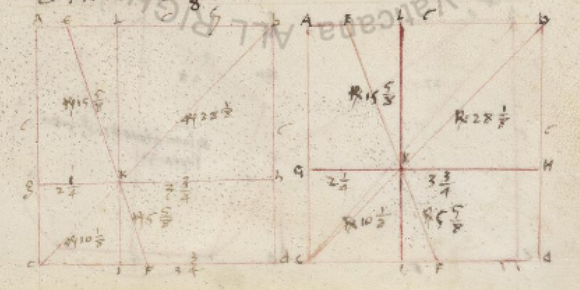
  104. Urb.lat.632 - the sole surviving copy of a treatise on 3D geometry, De quinque corporibus regularibus by Piero della Francesca, one of the card-carrying Renaissance men. Francesca is now known as a notable painter only, but in his time he was also an eminent mathematician. Here is a drawing (apparently by his own hand) from fol. 13r:
    More details in English. This featured in the Rome Reborn exhibition. More on the BAV details page.
  105. Urb.lat.634 - Details
  106. Urb.lat.635 - Details
  107. Urb.lat.636 - Details
  108. Urb.lat.637 - Details
  109. Urb.lat.640 - Details
  110. Urb.lat.641 - Details
  111. Urb.lat.642 - Details
  112. Urb.lat.643 - Details
  113. Urb.lat.646 - Details
  114. Urb.lat.647 - Details
  115. Urb.lat.648 - Details
  116. Urb.lat.649 - Details
  117. Urb.lat.650 - Details
  118. Urb.lat.651 - Details
  119. Urb.lat.652 - Details
  120. Urb.lat.653 - Details
  121. Urb.lat.654 - Details
  122. Urb.lat.655 - Details
  123. Urb.lat.658 - Details
  124. Urb.lat.659 - Details
  125. Urb.lat.660 - Details
  126. Urb.lat.661 - Details
  127. Urb.lat.664 - Details
  128. Urb.lat.665 - Details
  129. Urb.lat.667 - Details
  130. Urb.lat.668 - Details
  131. Urb.lat.670 - Details
  132. Urb.lat.671 - Details
  133. Urb.lat.672 - Details
  134. Urb.lat.675 - Details
  135. Urb.lat.676 - Details
  136. Urb.lat.681 - Details
  137. Urb.lat.683 - Details
  138. Urb.lat.684 - Details
  139. Urb.lat.685 - Details
  140. Urb.lat.686 - Details
  141. Urb.lat.690 - Details
  142. Urb.lat.691 - Details
  143. Urb.lat.692 - Details
  144. Urb.lat.693 - Details
  145. Urb.lat.694 - Details
  146. Urb.lat.696 - Details
  147. Urb.lat.697 - Details
  148. Urb.lat.698 - Details
  149. Urb.lat.699 - Details
  150. Urb.lat.701 - Details
  151. Urb.lat.702 - Details
  152. Urb.lat.703 - Details
  153. Urb.lat.704 - Details
  154. Urb.lat.705 - Details
  155. Urb.lat.708 - Details
  156. Urb.lat.709 - Details
  157. Urb.lat.710 - Details
  158. Urb.lat.713 - Details
  159. Urb.lat.714 - Details
  160. Urb.lat.716 - same content at Urb.lat.717 below - Details
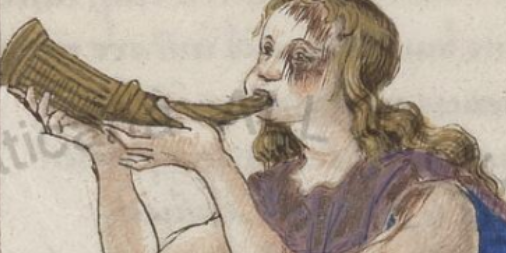
  161. Urb.lat.717 - A book of esotericist poetry, De Gentilium Deorum Imaginibus by Lodovico Lazzarelli, from about 1475. Details in English at SLU. This also featured in Rome Reborn.
    This rather stoned person is Melponeme. It contains 27 full-page miniatures of personifications, including the planets, the muses, gods and goddesses, based on an educational prints series current at the time, the Mantegna Tarocchi. See also the BAV details.
  162. Urb.lat.719 - Details
  163. Urb.lat.720 - Details
  164. Urb.lat.721 - Details
  165. Urb.lat.724 - Details
  166. Urb.lat.727 - Details
  167. Urb.lat.728 - Details
  168. Urb.lat.729 - Details
  169. Urb.lat.730 - Details
  170. Urb.lat.735 - Details
  171. Urb.lat.736 - Details
  172. Urb.lat.737 - Details
  173. Urb.lat.738 - Details
  174. Urb.lat.739 - Details
  175. Urb.lat.741 - Details
  176. Urb.lat.742 - Details
  177. Urb.lat.743 - Details
  178. Urb.lat.744 - Details
  179. Urb.lat.746 - Details
  180. Urb.lat.751 - Details
  181. Urb.lat.767 - Details
  182. Urb.lat.769 - Details
  183. Urb.lat.780 - Details
  184. Urb.lat.782 - Details
  185. Urb.lat.783 - Details
  186. Urb.lat.784 - Details
  187. Urb.lat.785 - Details
  188. Urb.lat.804.pt.2 - Details
  189. Urb.lat.815.pt.2 - Details
  190. Vat.ar.136 - Details
  191. Vat.ar.175 - Details
  192. Vat.ar.468.pt.1 - Details
  193. Vat.ar.468.pt.2 - Details
  194. Vat.ar.1614 - Details
  195. Vat.ebr.1 - Details
  196. Vat.ebr.12 - Details
  197. Vat.ebr.13 - Details
  198. Vat.ebr.19 - Details
  199. Vat.ebr.21 - Details
  200. Vat.ebr.29 - Details
  201. Vat.ebr.100 - Details
  202. Vat.ebr.101 - Details
  203. Vat.ebr.102 - Details
  204. Vat.ebr.103 - Details
  205. Vat.ebr.118 - Details
  206. Vat.ebr.126 - Details
  207. Vat.ebr.133 - Details
  208. Vat.ebr.135 - Details
  209. Vat.ebr.186 - Details
  210. Vat.ebr.190 - Details
  211. Vat.ebr.196 - Details
  212. Vat.ebr.197 - Details
  213. Vat.ebr.199 - Details
  214. Vat.ebr.200 - Details
  215. Vat.ebr.203 - Details
  216. Vat.ebr.204 - Details
  217. Vat.ebr.206 - Details
  218. Vat.ebr.207.pt.1 - Details
  219. Vat.ebr.210 - Details
  220. Vat.ebr.211 - Details
  221. Vat.ebr.212 - Details
  222. Vat.ebr.264 - Details
  223. Vat.ebr.269 - Details
  224. Vat.ebr.276 - Details
  225. Vat.ebr.278 - Details
  226. Vat.ebr.281 - Details
  227. Vat.ebr.282 - Details
  228. Vat.ebr.287 - Details
  229. Vat.ebr.300 - Details
  230. Vat.ebr.302 - Details
  231. Vat.ebr.306 - Details
  232. Vat.ebr.307 - Details
  233. Vat.ebr.530.pt.2 - Details
  234. Vat.estr.or.111 - Japanese calligraphic roll: gold ink on dark blue paper
  235. Vat.lat.180 - Details
  236. Vat.lat.278 - Details
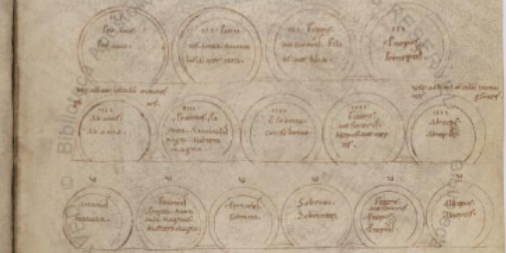
  237. Vat.lat.624 - with this extraordinary revision of a (classical?) Roman arbor juris (kinship diagram) in pyramidal form at fol. 105r:
    Note how the number of circles increases by one with each row as you follow it downwards. The scheme is a medieval revision of the so-called Type 4 arbor consanguinatis, as defined by  Hermann Schadt - see my Missing Manual (DOI: 10.13140/RG.2.1.4283.8002) for more information about this - Manuscript Details
  238. Vat.lat.795 - Details
  239. Vat.lat.797 - Details
  240. Vat.lat.803 - Details
  241. Vat.lat.809 - Details
  242. Vat.lat.823 - Details
  243. Vat.lat.838 - Details
  244. Vat.lat.845 - Details
  245. Vat.lat.848 - Details
  246. Vat.lat.853 - Details
  247. Vat.lat.854 - Details
  248. Vat.lat.863 - Details
  249. Vat.lat.884 - Details
  250. Vat.lat.13946 - Details
  251. Vat.lat.14745 - Details
  252. Vat.turc.139 - Details
  253. Vat.turc.391 - Details
This is Piggin's Unofficial List 62. If you have corrections or additions, please use the comments box below. Follow me on Twitter (@JBPiggin) for news of more additions to Digita Vaticana.

2016-07-21

Vatican Shadows

A couple of days ago, the Vatican library opened free online access to hi-res photos of what is generally believed to be one of the oldest books in the world, P75, the remains of a papyrus book of the Christian Gospels in Greek that is commonly dated to the third century. That turned out to be the story of the year on this blog, with over 900 reads, 85 retweets and 7,500 Twitter impressions.

[The next two grafs have been revised, after I realized that I had posted on the same topic in January this year, and clean forgot.] P75 got me interested in the library's other Bodmer papyrus, donated to it in 1969, the famous P72, shelved as Pap.Bodmer.VIII. The new digital site neither indexes nor mentions it on the front page of the digital manuscripts site.

The old BAV portal's link still gives you access to Pap.Bodmer.VIII, a booklet of epistles, containing all the text of 1 Peter, 2 Peter, and Jude. [This link I am giving you is not a secret, but rather one forgotten by the designers of the new portal. My apologies for overstating the case, when I first put this post up and claimed I had "discovered" the link.]

The writing on the P72 papyrus is thought to date to the 3rd or 4th century, roughly of the same period as the Codex Vaticanus, probably the world's oldest intact parchment codex.

The Wikipedia entry notes that P72 was dismembered from the "Bodmer Miscellaneous Codex," a little book dug from the sands of Egypt in which other works were: Nativity of Mary, the apocryphal correspondence of Paul to the Corinthians, the Eleventh Ode of Solomon, Melito's Homily on the Passover, a fragment of a hymn, the Apology of Phileas, and Psalm 33 and 34.

We don't know if  P72, where you can see the folds in the folios, is the oldest papyrus codex in existence, but Brent Nongbri, the Australian scholar, has recently argued: "It would seem that P.Bodm. VIII had a previous life, in which it preceded another work that was later removed when P.Bodm. VIII became part of the ‘Miscellaneous’ or ‘Composite’ codex." So it could be years or decades older than other parts of the codex.

You can read his short paper on his Academia.edu page, as well as a blog post he wrote.

As for P75 (the gospels), its date of making has long been estimated to be the 3rd century, but Nongbri published a critique this year in the Journal of Biblical Literature where he argued that this date is slapdash (my word, not his) and that the correct date is more likely to be 4th century, more or less of the same period as the Codex Vaticanus. I'll have more as the story continues.

Aside from all this excitement, the BAV has this week released an additional 34 items. Here is the full list:
  1. Vat.ebr.32,  - Details
  2. Vat.ebr.33, - Details
  3. Vat.ebr.230, - Details
  4. Vat.ebr.250, - Details
  5. Vat.ebr.270.pt.1, - Details
  6. Vat.ebr.270.pt.2 - Details
  7. Vat.ebr.271 - Details
  8. Vat.ebr.283 - Details
  9. Vat.ebr.286 - Details
  10. Vat.ebr.289 - Details
  11. Vat.ebr.296 - Details
  12. Vat.lat.276 - a 12th-century Augustine in Caroline minuscule with some Beneventan script on fols 258v-260v (my thanks to AaronM on Twitter for this info: https://twitter.com/gundormr/status/756196478452924416), Details
  13. Vat.lat.288 - Ambrose of Milan, Details
  14. Vat.lat.295 - Ambrose, Details
  15. Vat.lat.296 - a 10th-century Ambrose, Details
  16. Vat.lat.373 - made for the Renaissance bishop Pietro del Monte (c. 1400–57), from fol 111 he added the prologue to his Repertorium utriusque iuris, a major legal text - Details
  17. Vat.lat.650 - a 10th-century compilation with Alcuin and others, many very faint pages have also been scanned with what seems to be ultraviolet light. Details
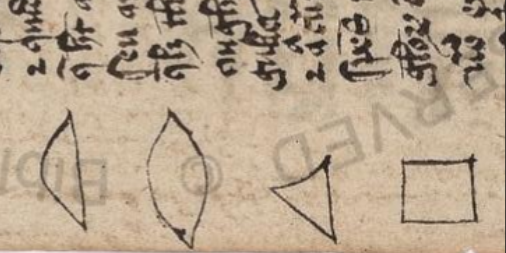
  18. Vat.lat.674 - 14th century theological and scientific: here are some shape diagrams in the margin in a geometrical piece (140v, rotated):
      second half empty, Details
  19. Vat.lat.740 - Aquinas, Details
  20. Vat.lat.773 - Details
  21. Vat.lat.775 - Details
  22. Vat.lat.778 - Details
  23. Vat.lat.779 - Details
  24. Vat.lat.786 - Details
  25. Vat.lat.789 - Details
  26. Vat.lat.813 - Details
  27. Vat.lat.819 - Details
  28. Vat.lat.834 - Giles of Rome, Quaestiones, Details
  29. Vat.lat.836 - Giles of Rome, c. 1243-1316, Commentarius in librum II Sententiarum, Details
  30. Vat.lat.837 - ditto, Details
  31. Vat.lat.852 - Details
  32. Vat.lat.866 - Details
  33. Vat.lat.875 , Details,
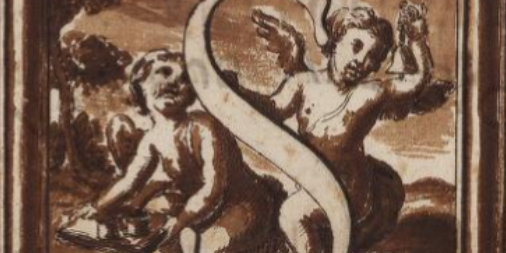
  34. Vat.lat.14747 , an 18th century fair copy cataloguing the authors in the papal collection of printed books, the seventh volume, arranged by names, S-Z. Here is the pen drawing for S:
This is Piggin's Unofficial List 61. If you have corrections or additions, please use the comments box below. Follow me on Twitter (@JBPiggin) for news of more additions to Digita Vaticana.

2016-07-18

Maybe This Is the Oldest Book

Over a year ago, we debated on this blog and on Twitter what was the oldest bound book in the work. See the first post: Is this the world's oldest bound book? and the second post: Older than the Oldest.

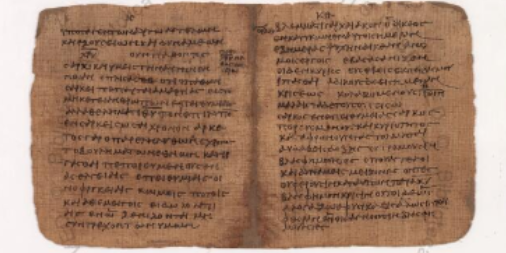
Some authoritative experts said the crown should not go to the Codex Vaticanus, a parchment bible which is still bound, but to the 102 battered and now separated pages of Pap.Hanna (the sole Hanna Papyrus), also known as P75, which is a little 3rd-century booklet containing most of the Gospels of Luke and John.


On July 18, all the extant pages of this booklet were placed online by the digitization program at the Biblioteca Apostolica Vaticana in Rome.

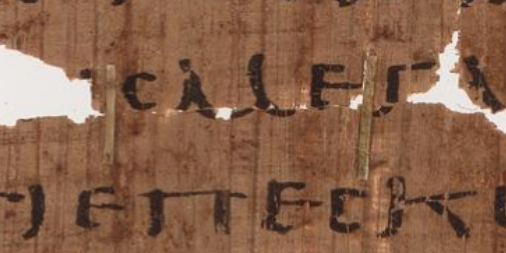
It's a battered little papyrus book from Egypt, originally sewn together in a codex and now kept between sheets of glass. This is among the most famous of the so-called Bodmer Papyri discovered in Egypt in 1952 and is an important source of the gospels within 200 years of their composition. It also contains an early Christian "brand logo", the Tau-Rho symbol or staurogram.

In all, 50 new items were placed online in this summer batch. Here is my full unofficial list:
  1. Cappon.229
  2. Cappon.297 
  3. Pap.Hanna (the bibliography page for this item still uses the former shelfmark, Pap.Bodmer.XIV-XV).
  4. Vat.ebr.25
  5. Vat.ebr.26
  6. Vat.ebr.27
  7. Vat.ebr.28
  8. Vat.ebr.30
  9. Vat.ebr.31
  10. Vat.ebr.214
  11. Vat.ebr.215
  12. Vat.ebr.220
  13. Vat.ebr.221
  14. Vat.ebr.222
  15. Vat.ebr.223
  16. Vat.ebr.225
  17. Vat.ebr.229
  18. Vat.ebr.232
  19. Vat.ebr.234
  20. Vat.ebr.235
  21. Vat.ebr.236
  22. Vat.ebr.239
  23. Vat.ebr.241
  24. Vat.ebr.242
  25. Vat.ebr.244
  26. Vat.ebr.247
  27. Vat.ebr.249
  28. Vat.ebr.252
  29. Vat.ebr.257
  30. Vat.ebr.260
  31. Vat.ebr.261
  32. Vat.ebr.262
  33. Vat.ebr.265
  34. Vat.ebr.266
  35. Vat.ebr.267
  36. Vat.ebr.268
  37. Vat.ebr.273
  38. Vat.ebr.275
  39. Vat.ebr.277
  40. Vat.ebr.279
  41. Vat.ebr.284
  42. Vat.ebr.285
  43. Vat.ebr.290
  44. Vat.ebr.292
  45. Vat.ebr.293
  46. Vat.ebr.295
  47. Vat.ebr.298
  48. Vat.ebr.299
  49. Vat.ebr.303
  50. Vat.lat.9973

This is Piggin's Unofficial List (PUL) number 60. If you have corrections or additions, please use the comments box below. Follow me on Twitter (@JBPiggin) for news of more additions to Digita Vaticana.

2016-07-07

Imperial Handbook

Among the most precious documents to survive from late antiquity is the Notitia Dignitatum, a handbook to the Roman Empire's civil government and military structures as of about 400 CE.

It survived in a book known as the Codex Spirensis which vanished before 1672, but was copied out half a dozen times by interested readers. One of those copies, the Vatican's arrived online on July 7 and this is a major event for anyone interested in this extraordinary sourcebook. Dr Ingo Maier, who has spent many years studying the handbook, has a website devoted to many of its details.

Fairley's English partial translation of the text (1899) is online at Fordham. Online, you can compare the Vatican copy, Barb.lat.157 with three other online copies: the two in clm10291 in Munich and that in BNF lat. 9961 in Paris (jump to fol. 72r to begin reading the latter). As far as I know, the Trent codex is not online and from the Oxford codex, only the pictures are on the internet.

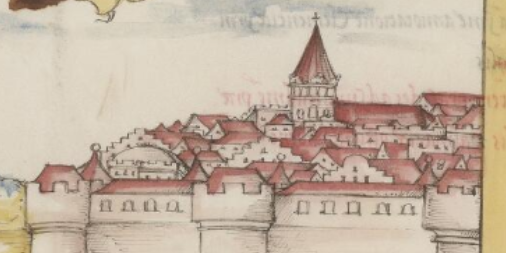
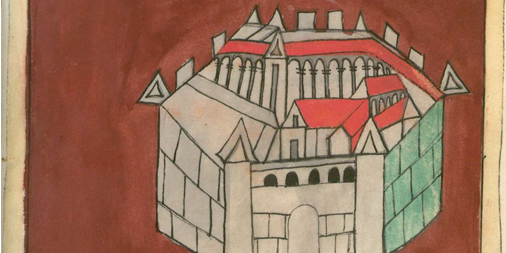
Below is the Vatican codex's copy of the Provincia Dalmatiae page, compared to the W copy (Munich) below it. It is plain that the Vatican copy is more fanciful and that the artist has willfully converted the town into an early modern one.
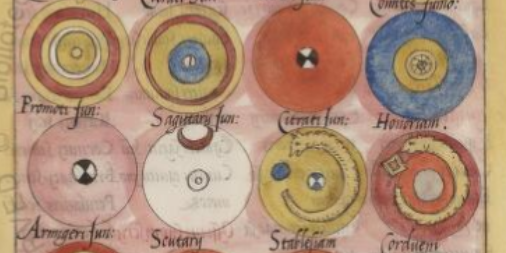
However the other manuscripts are hardly more accurate, as you will see from the Luke Ueda-Sarson Praeses Dalmatiae (i.e. Governor of Dalmatia) composite page. Many of the images, including the specific shields of the military units, require considerable expert interpretation to understand.
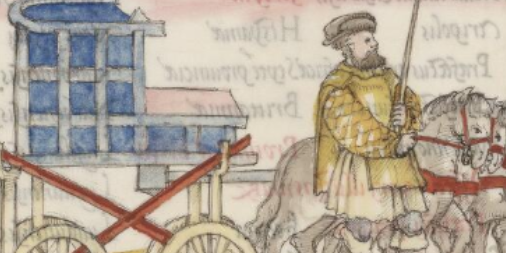
Even this figure of a coach and horses needs interpreting:


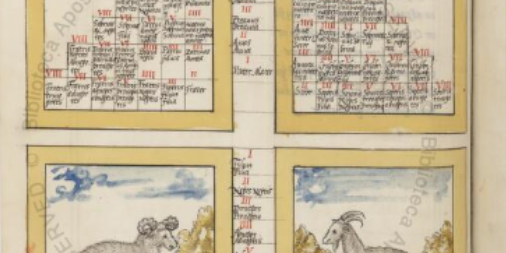
My especial personal interest in the Notitia is that the Codex Spirensis also preserved a major Roman legal diagram which acquired the medieval name arbor juris or arbor consanguinatis and which is among the important classical precursors to the invention of information visualization in late antiquity:

Here is the full list of 38 uploads by Digita Vaticana on July 7 bringing the posted total to 4,794
  1. Arch.Cap.S.Pietro.F.28 - Details
  2. Barb.lat.157 - Notitia Dignitatum (above) - Details
  3. Borg.copt.109.cass.XVIII.fasc.64 - Details
  4. Capp.Giulia.XVI.16 - Details
  5. Chig.H.VI.188 - Details
  6. Ott.lat.1190 - Details
  7. Vat.gr.186 - Details
  8. Vat.lat.401 - Details
  9. Vat.lat.424 - Details
  10. Vat.lat.466 - Details
  11. Vat.lat.534 - Details
  12. Vat.lat.724 - Details
  13. Vat.lat.751 - Details
  14. Vat.lat.762 - Details
  15. Vat.lat.764 - Details
  16. Vat.lat.769 - Details
  17. Vat.lat.774 - Details
  18. Vat.lat.777 - Details
  19. Vat.lat.798 - Details
  20. Vat.lat.799 - Details
  21. Vat.lat.800 - Details
  22. Vat.lat.801 - Details
  23. Vat.lat.802 - Details
  24. Vat.lat.805 - Details
  25. Vat.lat.806 - Details
  26. Vat.lat.810 - Details
  27. Vat.lat.811 - Details
  28. Vat.lat.816 - Details
  29. Vat.lat.817 - Details
  30. Vat.lat.824 - Details
  31. Vat.lat.825 - Details
  32. Vat.lat.830, Details,
  33. Vat.lat.839, Details,
  34. Vat.lat.842, Details,
  35. Vat.lat.843, Details,
  36. Vat.lat.11543, Details,
  37. Vat.lat.12939, Details,
This is Piggin's Unofficial List 59. If you have corrections or additions, please use the comments box below. Follow me on Twitter (@JBPiggin) for news of more additions to Digita Vaticana.

2016-07-06

Romantic Love

One might argue that western ideas of romantic love have their roots in certain ideas of the Renaissance, when the Roman poet Ovid was re-interpreted through a Christian lens and seen as a harbinger of courtly and noble love. In fact, Ovid was probably just a Boris Johnson of ancient Rome, a public school cad with a gift for words, and not a person particularly worth following.

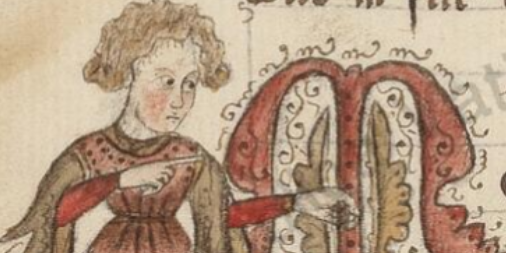
The Vatican Library has just digitized an Epistulae of Ovid drawn ca. 1430-1440, possibly in northern Italy, which depicts in its margins ten pairs of lovers framing the start of each letter (see article by Rabel).

Leaf through Ross.893 to see them. Here for example is Leander of Abydos clutching the M of "Mittit Abydenus ..." like a shield as he writes in Heroides Letter 18 of his desire to swim long distance to see his girlfriend:
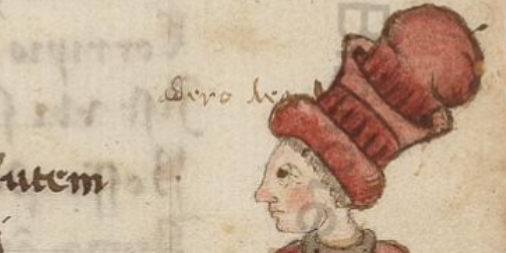
You can also admire him wearing a most extraordinary Italian Renaissance high hat as letter 19 arrives by return of post from lovely Hero:
Here is the full list of 32 digitizations uploaded on July 5, 2016:
  1. Borg.copt.109.cass.IX.fasc.29 - Details
  2. Borg.copt.109.cass.XIX.fasc.71 - Details
  3. Borg.copt.109.cass.XIX.fasc.74 - Details
  4. Borg.copt.109.cass.XVII.fasc.62 - Details
  5. Borg.copt.109.cass.XVII.fasc.63 - biblical fragments including a page of Luke's Gospel - Details
  6. Borg.copt.109.cass.XVIII.fasc.65.1 - Details
  7. Borg.copt.109.cass.XVIII.fasc.66 - Details
  8. Borg.copt.109.cass.XVIII.fasc.67 - Details
  9. Borg.copt.109.cass.XVIII.fasc.68 - Details
  10. Chig.H.VII.229 - Horace - Details
  11. Ott.lat.3382 -historical? Armenia and Persia - Details
  12. Ross.893 - Ovid, Epistulae (above) - Details
  13. Urb.lat.679 - Rambaldi's commentary on Dante's Divine Comedy Details
  14. Vat.lat.101 - glossed bible, later books Details
  15. Vat.lat.293 - Ambrose, Details
  16. Vat.lat.309 - John of Damascus, attrib. Details
  17. Vat.lat.310 - John of Damascus, Chrysostom, Anselm - Details
  18. Vat.lat.331 - Jerome on prophets, Details
  19. Vat.lat.351 - Collection of Epistulae, Details
  20. Vat.lat.652 - Johannes Scotus Eriugena and his famed exposition on the heavenly hierarchy, from which derives our modern use of "hierarchy" as a key abstraction - Details
  21. Vat.lat.669 - Bernard of Clairvaux, Details
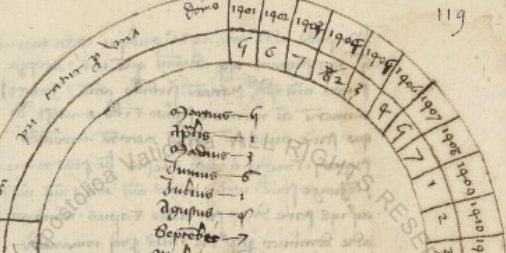
  22. Vat.lat.687 - Augustine plus bits and bobs including this nifty circular calendar for 1401 onwards,
  23. Vat.lat.690 - Peter Lombard, Sententiae Details
  24. Vat.lat.699 - Psalms commentary attributed to Innocent III - Details
  25. Vat.lat.708 - Albertus Magnus, bishop Regensburg, Summae theologiae, Details
  26. Vat.lat.753 - Details
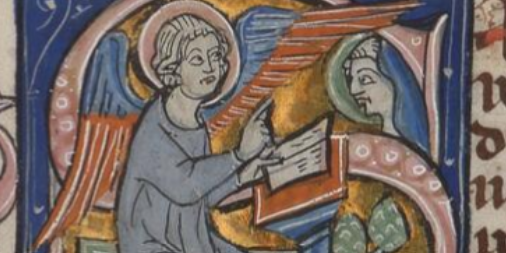
  27. Vat.lat.794 - 14th century copy of Thomas Aquinas commentary on gospels. It seems from notes in it that Bermond de Montferrier, a Montpellier law professor was involved in transferring the codex to a convent in that city. With fine initial (below) showing the angelic doctor - Details
  28. Vat.lat.812 - Franciscan sermons Details
  29. Vat.lat.828 - works of Aegidius Romanus Details
  30. Vat.lat.856 - Henry of Ghent, 15th century, first exemplar? Details
  31. Vat.lat.12504 - letters of Enea Silvio Piccolomini, humanist, diplomat and pope, Details
  32. Vat.lat.14741 - Giorgio Grippari's 1694 handwritten list of the printed books in the Biblioteca Vaticana. This is only initial letters A-B. Details
This is Piggin's Unofficial List 58. If you have corrections or additions, please use the comments box below. Follow me on Twitter (@JBPiggin) for news of more additions to Digita Vaticana.

2016-07-05

New BAV Portal

The Vatican's launch of a new portal for the Biblioteca Apostolica Vaticana reached maturity July 4 when the portal, which had been slowly filling since May, finally surpassed the old site in its posted total of content, reaching 4,724 items with the addition of thirty Hebrew manuscripts.

The numbers may still by slightly out of whack, with some subtotals not up to the old site's levels, but I would say that now is the time to change your links, begin using the new portal, and grin and bear its inadequacies. I have already built a whole new suite of searches with scripts to monitor it, and will no longer be monitoring the old site from now on.

Here is the full list of novelties, with notes taken from Malachi Beit-Arié's codicological descriptions:
  1. Neofiti.4, Details
  2. Neofiti.7, Details
  3. Neofiti.9, Details
  4. Neofiti.11, Details
  5. Neofiti.14, Details
  6. Neofiti.15, Details
  7. Neofiti.22, Details
  8. Neofiti.23, Details
  9. Neofiti.24, Details
  10. Neofiti.30, Details
  11. Neofiti.31, Details
  12. Neofiti.32, Details
  13. Neofiti.34, Details
  14. Neofiti.36, Details
  15. Neofiti.40, Details
  16. Neofiti.41, Details
  17. Neofiti.43, Details
  18. Neofiti.44, Details
  19. Neofiti.45, Details
  20. Neofiti.46, Details
  21. Ross.328, Hebrew Details
  22. Ross.359, Hebrew Details
  23. Ross.362, Hebrew Details
  24. Ross.363, Hebrew Details
  25. Ross.436, Mahzor, Roman rite. Italy, about 1400. Details
  26. Ross.477, Canon (Book II, Fens 1–2) by Avicenna, in the translation of Nathan ha-Meati. Details
  27. Ross.599, Sefer Mizvot Gadol by Moses b. Jacob of Coucy. Incomplete. Details
  28. Ross.601, Pentateuch, Former Prophets and treatises in Hebrew, written out by scribe Joseph b. Jacob ibn Janah in Huesca, Spain in 1275. Details
  29. Ross.883, Hayyim b. Joseph Vital's kabbalistic work Ozerot Hayyim in an 18th-century Italian manuscript with this concentric diagram at fol. 1v. Details
  30. Ross.1015, Genesis i:1–xxvi:32. Probably copied by a Christian hand. Details
This is Piggin's Unofficial List 57. If you have corrections or additions, please use the comments box below. Follow me on Twitter (@JBPiggin) for news of more additions to Digita Vaticana.