Showing posts with label DigiVatLib. Show all posts

2017-10-11

Their Only Plato

A beautiful 10th-century Italian manuscript containing the Latin commentary by Calcidius on the Timaeus of Plato is a star of this week's crop of digitizations at the Vatican Library.

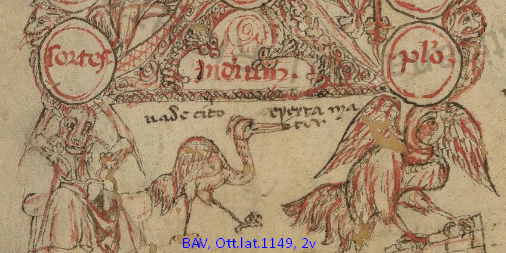
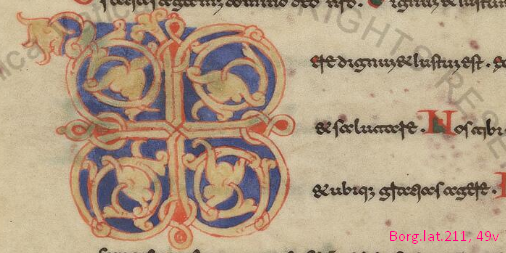
This manuscript has 62 leaves and fine artwork (see above). Folios 21v-22r were exhibited in the Rome Reborn exhibition in the United States, where Anthony Grafton commented: "Calcidius's version of Plato's cosmology was an influential source for medieval ideas about the natural world."

Calcidius translated Part One only of Plato's Timaeus from Greek into Latin around 321 and provided an extensive commentary, hence the title to this manuscript, In Platonis Timaeum commentarius. It is said this translation was the only extensive text of Plato known to scholars in the Latin West for approximately 800 years.

The full list of items found follows. As always, please click through them and post on Twitter (shout out to me as @JBPiggin) about any remarkable finds that you see.
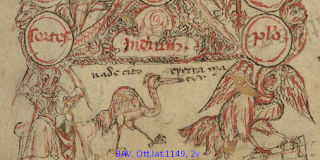
  1. Ott.lat.1149, a 15th-century manuscript of Boethius on the Isagoge of Porphyry with an unusual arbor porphyriana with a monkey in the crown, and animals in and around the branches.
    Hermann Schadt (Die Darstellungen der Arbores, p. 82) says the older arbor porphyriana drawings are simple line diagrams and this is one of the first to be made tree like. My readers know that just because something is called an arbor, it need not look like a tree. The association is simply that arbor is a medieval word for a recursive diagram (perhaps because trees preserve shape during growth). Also, as Schadt notes on page 81, this may be a pun in the Visigothic language, where arbi meant inheritance, hence the word-play arbor juris for an inheritance diagram.
  2. Ott.lat.2844
  3. Reg.lat.1133
  4. Reg.lat.1165
  5. Reg.lat.1231
  6. Reg.lat.1254
  7. Reg.lat.1255
  8. Reg.lat.1279
  9. Reg.lat.1286
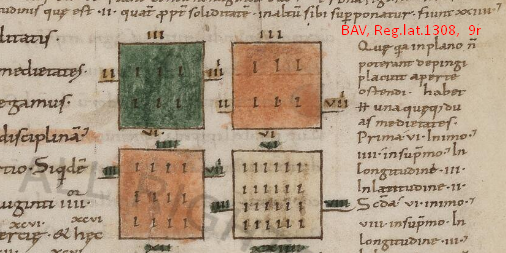
  10. Reg.lat.1308, above
  11. Reg.lat.1311
  12. Reg.lat.1317
  13. Reg.lat.1322
  14. Reg.lat.1323
  15. Reg.lat.1327
  16. Reg.lat.1333
  17. Reg.lat.1336
  18. Reg.lat.1372
  19. Reg.lat.1386
  20. Reg.lat.1414
  21. Reg.lat.1441
  22. Reg.lat.1443
  23. Sbath.586
  24. Vat.lat.1796
  25. Vat.lat.1886
  26. Vat.lat.1963
  27. Vat.lat.2025
  28. Vat.lat.2033
  29. Vat.lat.2036
  30. Vat.lat.2037
  31. Vat.lat.2039
  32. Vat.lat.2082
  33. Vat.lat.2096
  34. Vat.lat.2102
  35. Vat.lat.2105
  36. Vat.lat.2107
  37. Vat.lat.2108
  38. Vat.lat.2109
  39. Vat.lat.2111
  40. Vat.lat.2117
  41. Vat.lat.2142
  42. Vat.lat.2165
  43. Vat.lat.2176
  44. Vat.lat.2177
  45. Vat.lat.2192.pt.1
  46. Vat.lat.2192.pt.2
  47. Vat.lat.2192.pt.3
  48. Vat.lat.14926
Come back Friday for a list of the recent digitizations of Bibliotheca Palatina manuscripts at the Vatican.

This is Piggin's Unofficial List number 129. If you have corrections or additions, please use the comments box below. Follow me on Twitter (@JBPiggin) for news of more additions to DigiVatLib.

2017-10-02

Falsigrafia

Making mistakes was part of the scribe's day, so knives were always at the ready to scrape off a duff letter or word. Messing up a diagram was harder to fix.

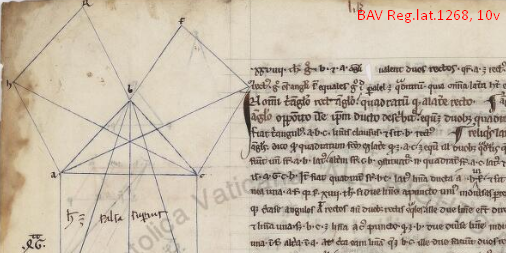
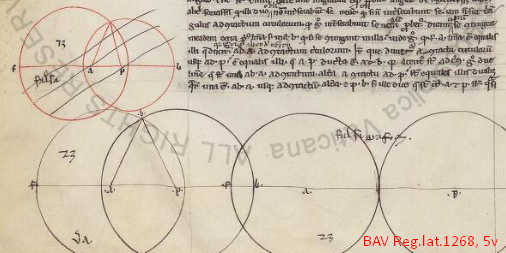
In his Album of Science I, John Murdoch highlighted corrections in a Vatican manuscript of Euclid, Reg.lat.1268, which came online in color a few days ago. Since last year it had only been available in murky black and white. Below is Murdoch's always readable discussion of these diagrams:

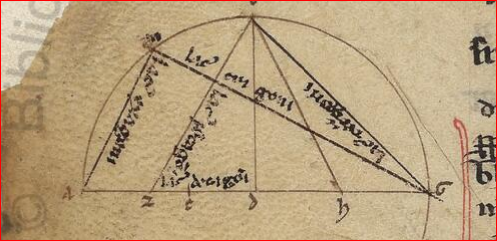
The Greek, Arabic, and especially medieval Latin manuscripts of Euclid's Elements and other geometrical works are for the most part accompanied by quite adequate figures, in some instances drawn with an accuracy and elegance—often with different colors—that rival and even surpass the best efforts of modern printing. In a few cases, however, this graphic excellence is found wanting. Two instances of such falsigrafia—a medieval term that covered not only wrongly drawn diagrams but wrongly constructed arguments as well—are given here, both from a fourteenth-century copy of an anonymous version of the Elements. That on the top [...] is the relevant figure for the Pythagorean theorem (Book I, Prop. 46; I, 47 in the Greek). Its problem is that two rhombuses have been drawn above on the legs of the right triangle in place of the requisite squares, a fact that is duly noted by the inscription written across the diagram reading: “this is false above” (hec est falsa superius). The example below (to I, 23) is more involved. Two attempts made by the scribe to provide a proper figure have proved abortive. At the lower right of this diagram we see touching instead of intersecting circles; this is appropriately labeled falsigrafium. A second attempt— scratched out and called falsa at the top left of the same diagram—erred in drawing the straight lines from the point of intersection of the circles to points A and P, which are not, as they should be, the respective centers of the two circles. They are that in the third, successful, attempt to produce a correct figure, here appearing at the bottom left. From: Murdoch, John E. Album of Science: Antiquity and the Middle Ages (New York: Scribner, 1984), illustration 115.
Murdoch also comments on two other diagrams from the same manuscript, which he presents as Illustrations 113 (how Latin translations of Euclid tended to overdo diagrams, fol 21v) and 122 (how a dodecahedron was drawn in two dimensions, fol 133r).

Here are the latest 27 manuscripts to come online for the first time at the DigiVatLib site:
  1. Barb.lat.3729 :
  2. Reg.lat.180 :
  3. Reg.lat.490 :
  4. Reg.lat.1083 :
  5. Reg.lat.1143 : eTK, a ninth-century Hippocrates, Constitutas sunt venas in corpore. See Kibre, Pearl, 1903-1985 Hippocrates Latinus: Repertorium of Hippocratic Writings in the Latin Middle Ages.
  6. Reg.lat.1149 :
  7. Reg.lat.1164 :
  8. Reg.lat.1223 :
  9. Reg.lat.1228 :
  10. Reg.lat.1230 :
  11. Reg.lat.1237 :
  12. Reg.lat.1258 :
  13. Reg.lat.1273 :
  14. Reg.lat.1274 :
  15. Reg.lat.1277 :
  16. Reg.lat.1285 :
  17. Reg.lat.1295 :
  18. Reg.lat.1299 :
  19. Reg.lat.1301 :
  20. Reg.lat.1310 :
  21. Reg.lat.1374 :
  22. Vat.lat.2064 :
  23. Vat.lat.2084 :
  24. Vat.lat.2103 :
  25. Vat.lat.2126 :
  26. Vat.lat.13391 :
  27. Vat.lat.14721: Iacobus de Marchia (1394-1476), Auctoritates doctorum de sanguine Christi.
This is Piggin's Unofficial List number 129. If you have corrections or additions, please use the comments box below. Follow me on Twitter (@JBPiggin) for news of more additions to DigiVatLib.
2017-09-25

Humanist's Astronomy Book

The personal library of the great Florentine humanist Coluccio Salutati (1331-1406) was scattered after his death. It remains a thing of fascination for every scholar. It's the definitive overview of what an early Renaissance man with the income to buy books read, with Coluccio's own notes scattered in the margins.

Coluccio's private copy of the Great Stemma formed for a while the title picture on my Twitter account. (I replaced it with the current gaudy recreation because parchmenty pictures don't work as panoramas.)

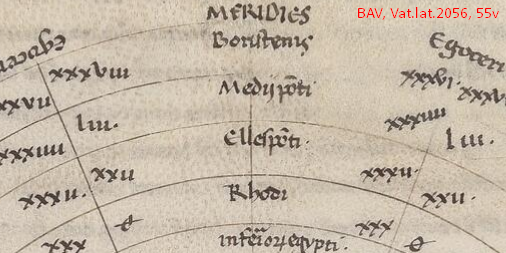
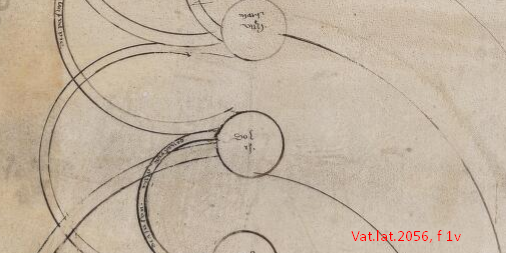
Thanks to digitization a good many of his books are now online to inspect.A real treasure among their number is Collucio's private copy (in Latin) of the Almagest by Ptolemy the Geographer, Vat.lat.2056, which has just arrived online at the Vatican Library digital portal.The diagrams are fascinating. The first image below is from a celebrated rota used by astrologers; you can read off the climates here, starting with the mouth of the Dniepr at top:

We continue to wait for Vatican's DigiVatLib to do color versions of the Florentine notary's books, such as his Seneca, Reg.lat.1391, which is still only available in black and white.
  1. Reg.lat.675
  2. Reg.lat.901
  3. Reg.lat.997
  4. Reg.lat.1072
  5. Reg.lat.1082
  6. Reg.lat.1110
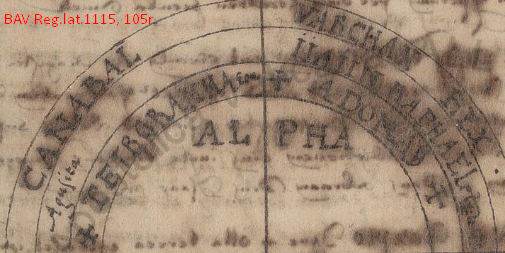
  7. Reg.lat.1115, a major compendium of magic (Jacobus Faber Stapulensis), astrology and astronomy (John of Glogau); this was on the site in murky black and white, but is new in color; a vital improvement since it is far from easily legible. See eTK for contents.
  8. Reg.lat.1119
  9. Reg.lat.1122
  10. Reg.lat.1126
  11. Reg.lat.1144
  12. Reg.lat.1152
  13. Reg.lat.1156
  14. Reg.lat.1159
  15. Reg.lat.1160
  16. Reg.lat.1161
  17. Reg.lat.1162
  18. Reg.lat.1170
  19. Reg.lat.1184
  20. Reg.lat.1196
  21. Reg.lat.1207
  22. Reg.lat.1226
  23. Reg.lat.1234
  24. Reg.lat.1246
  25. Reg.lat.1257
  26. Reg.lat.1266
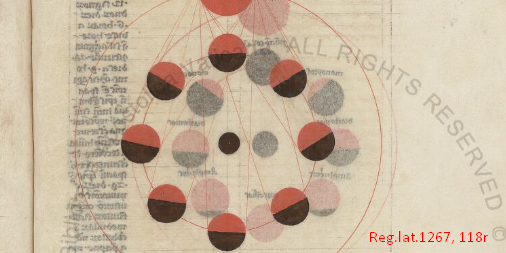
  27. Reg.lat.1267, contains the only complete text of Dracontius, the African author, and his Satisfactio. One of the Beneventan script examples compiled by Lowe (and a prime exhibit in a mistaken theory that Visigothic and Benevantan script are linked), it is composed of different parts, miniscule at first, then Beneventan from folio 139:
    1. Euclid, Boethius, ff 1-135, 13th century, including the glorious diagram below
    2. Beda, ff 136-138, 11th century
    3. Calendarial matter, ff. 139-140v and part of 143, 9th-10th century
    4. Versus Marci Poetae de S. Benedicto, ff 141v-142v, 10th century 
    5. Dracontius, Satisfactio, ff  143v-150v, 9th-10th century 
  28. Reg.lat.1269
  29. Reg.lat.1275
  30. Reg.lat.1289
  31. Vat.lat.1927
  32. Vat.lat.1944
  33. Vat.lat.1954
  34. Vat.lat.1956
  35. Vat.lat.1965
  36. Vat.lat.1980
  37. Vat.lat.1982
  38. Vat.lat.1987
  39. Vat.lat.1999
  40. Vat.lat.2006
  41. Vat.lat.2007
  42. Vat.lat.2024
  43. Vat.lat.2032
  44. Vat.lat.2042
  45. Vat.lat.2046
  46. Vat.lat.2047
  47. Vat.lat.2056, Ptolemy's Almagest, see above
  48. Vat.lat.2069
  49. Vat.lat.9484
  50. Vat.lat.15399
This is Piggin's Unofficial List number 128. If you have corrections or additions, please use the comments box below. Follow me on Twitter (@JBPiggin) for news of more additions to DigiVatLib.
2017-09-16

Old Trees

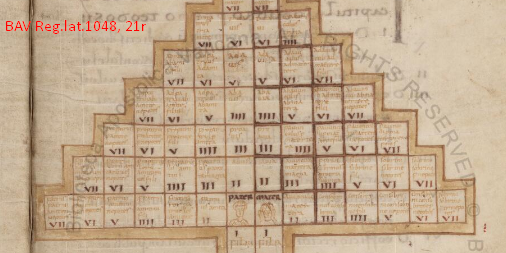
Early tree diagrams are some of the surprises in the latest batch of Vatican digitizations. One welcome arrival online is a 10th-century text of the Lex Romana Visigothorum with two elaborate kinship scheme diagrams at 20v and 21r. This has now been issued in color, after only a black and white scan had been online at the Vatican Library portal.

You'll notice this looks a bit like a Flemish building facade, not a tree. A full list of contents of this codex, Reg.lat.1048, from the Cologne Leges Database:
  • 1 - 19: Isidore, Etymologiae
  • 20 - 21r: Stemmata graduum
  • 21v - 224r: Lex Romana Visigothorum with younger explanationes titulorum and younger glosses
  • 224r - Series regum Francorum, Formula extravagans I No. 5, glossary in three languages
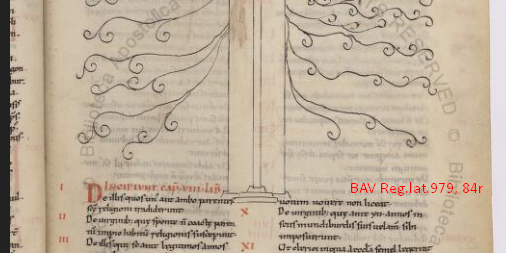
The table above had come to be called an arbor juris, a law diagram, so it was not long before the decoration began to become treelike, perhaps as a mnemonic aid to students. The completely new releases at DigiVatLib include a law book, the Decretum of Burchard of Worms, which takes the tree idea further, indicating the change in progress. Reg.lat.979 is one of the earliest codices ever to associate a tree with a table of consanguinity. Note how the Reg.lat.979 drawing below, dated about 1080, does not yet put the table in the tree. The tree simply takes root on the roof like a cheeky weed:
Here is the full list of new releases (I am reporting occasional the black and white conversions to color, but am not able to track these systematically):
  1. Chig.I.V.152, a fine Renaissance edition of Aristotle's Rhetorica translated to Latin by George of Trebizond
  2. Ferr.409, another, less lavishly executed copy of the same text, HT to @LatinAristotle
  3. Reg.lat.149, copyist Nicolò de' Ricci
  4. Reg.lat.153, sturdy old breviary with liturgical calendar, litanies, etc.
  5. Reg.lat.184
  6. Reg.lat.647, hagiography,
  7. Reg.lat.896
  8. Reg.lat.946, Gesta Francorum
  9. Reg.lat.979, Decretum of Burchard of Worms (above)
  10. Reg.lat.1034
  11. Reg.lat.1038
  12. Reg.lat.1045
  13. Reg.lat.1058
  14. Reg.lat.1059
  15. Reg.lat.1060
  16. Reg.lat.1063
  17. Reg.lat.1064
  18. Reg.lat.1068, Plato: Calcidius' translation of the Timaeus, HT to @LatinAristotle
  19. Reg.lat.1073
  20. Reg.lat.1075
  21. Reg.lat.1077
  22. Reg.lat.1086
  23. Reg.lat.1087
  24. Reg.lat.1088
  25. Reg.lat.1089
  26. Reg.lat.1093
  27. Reg.lat.1091
  28. Reg.lat.1100
  29. Reg.lat.1114, yet another Calcidius' translation of the Timaeus of Plato, HT to @LatinAristotle
  30. Reg.lat.1134
  31. Reg.lat.1141
  32. Reg.lat.1142
  33. Reg.lat.1151 the Physiognomia of Pseudo-Aristotle, translated to Latin by Bartholomew of Messina in the 13th century, HT to @LatinAristotle, who also points to a new edition and survey by Lisa Devriese, plus earlier work.
  34. Reg.lat.1154
  35. Reg.lat.1155
  36. Reg.lat.1163
  37. Reg.lat.1166
  38. Reg.lat.1167
  39. Reg.lat.1168
  40. Reg.lat.1169
  41. Reg.lat.1172
  42. Reg.lat.1175
  43. Reg.lat.1178
  44. Reg.lat.1181
  45. Reg.lat.1183
  46. Reg.lat.1193
  47. Reg.lat.1210
  48. Reg.lat.1225
  49. Reg.lat.1229
  50. Reg.lat.1244
  51. Reg.lat.1250
  52. Reg.lat.1251
  53. Reg.lat.1256
  54. Vat.gr.334, Byzantine
  55. Vat.lat.1303
  56. Vat.lat.1844
  57. Vat.lat.1863
  58. Vat.lat.1908
  59. Vat.lat.1923
  60. Vat.lat.1947
  61. Vat.lat.1983
  62. Vat.lat.1979
  63. Vat.lat.1989
  64. Vat.lat.1990
  65. Vat.lat.2003
  66. Vat.lat.2008
  67. Vat.lat.2012
  68. Vat.lat.2015
  69. Vat.lat.2016
  70. Vat.lat.2017
  71. Vat.lat.2020
  72. Vat.lat.2031
  73. Vat.lat.7697, Bindo da Siena, sermons
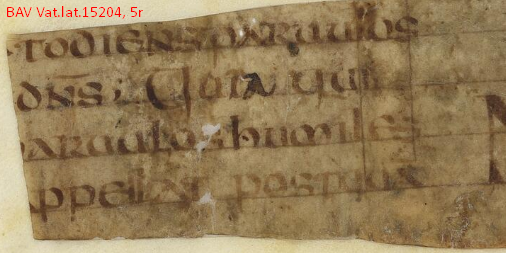
  74. Vat.lat.15204, a collection of fragments, including 3r-v, 4r-v: Canonum collectio "Concordia canonum"; 5r-v Gregorius Magnus, Homiliae in Evangelia (28.2–3) from the 7th or 8th century.
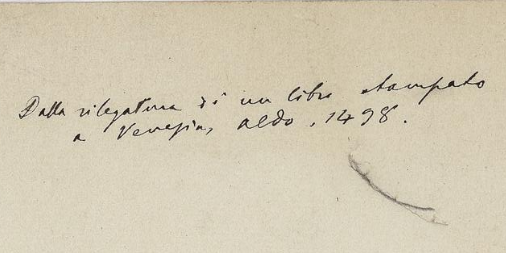
    The latter item, ELMSS number 2194, was found in the binding of a book printed 1498 at the Aldine press in Venice:
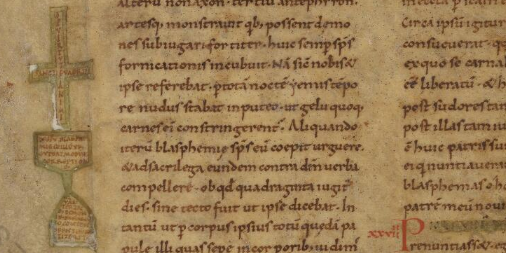
    Plus a 9th-century fragment of the Lex Ribuaria. My eye was also caught by the elaborate green cross below (folio 27v) where you can read the words Sancti Evagrii horizontally and De virtute animi vertically.
This is Piggin's Unofficial List number 127. If you have corrections or additions, please use the comments box below. Follow me on Twitter (@JBPiggin) for news of more additions to DigiVatLib.
2017-09-04

Joy of Geometry

Geometry texts are rarely models of exquisite typography, so it is special to see a truly well-laid-out Latin version of Euclid's Elements, Reg.lat.1137, in the latest set of digitizations from the Vatican Library. Menso Folkerts' introduction (on Bill Casselman's website) to the translations offers the basic details:
Euclid's Elements played an important role in the Middle Ages, rivalled in the legacy of Greek science ... perhaps only by Ptolemy's Almagest. For a long time, Euclid's text was represented only by fragments reputed to have originated in a translation by the late Roman philosopher Boethius. And during these early years it is almost certain that its true significance was not appreciated. 
But in the twelfth century it was introduced in its complete form along with other remnants of Greek science through the medium of translations from the Arabic. There seem to have been a very small number of independent translations, but the first six books of the Elements became part of the basic curriculum of that time, and copies spread throughout Europe. Many manuscripts from this period are still to be found among collections today. Most are rather drab productions when compared to the fancier manuscripts of that time ...

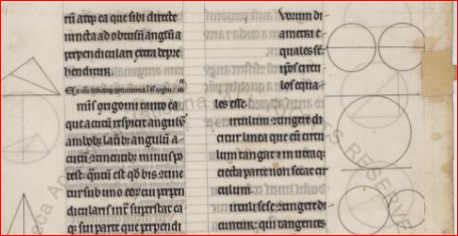
This 13th-century codex contains a translation from the Arabic commonly ascribed to Adelard of Bath. What's impressive as a matter of book history is the strict columnar layout, the variation in text size, the conscious manipulation of white space, the inviting optics of the drawings. Everything gives the impression of a well-designed modern book, though this particular one is obviously unfinished, since the space left for the illuminated initials (example above) remains empty.

Here is the full list of the digitizations of the past four weeks:
  1. Patetta.683
  2. Reg.lat.120
  3. Reg.lat.128
  4. Reg.lat.156
  5. Reg.lat.241
  6. Reg.lat.924
  7. Reg.lat.934
  8. Reg.lat.967
  9. Reg.lat.978
  10. Reg.lat.989
  11. Reg.lat.991, lawbook used at the chancery of the Carolingian court. Rosamond McKitterick argues this codex is one of the corrected masters from which copies of the legal codes were made for the use of officials and clergy in the provinces. With the Lex Ribvaria (B 16, with the best text), Alemanorum, Baiuuariorum and the Epitome Aegidiana (Charlemagne's regulations relating to the Lex Baiuuariorum). See Bibliotheca Legum.
  12. Reg.lat.1004, a general medical text of the 13th century with Hippocratic and pseudo-Hippocratic writings. From folio 94v, a text beginning: Ad compaginem membrorum ...
  13. Reg.lat.1006, De Planctu Naturae by Master Alan of Lille
  14. Reg.lat.1007
  15. Reg.lat.1009
  16. Reg.lat.1012,,The last folio is the beginning of the geometrical text De conicis (Cum continuatur inter punctum aliquod et lineam) (12c-13c) by Gerard of Cremona, translated from Apollonius of Perga. This diagram is on the first folio:
  17. Reg.lat.1017
  18. Reg.lat.1019
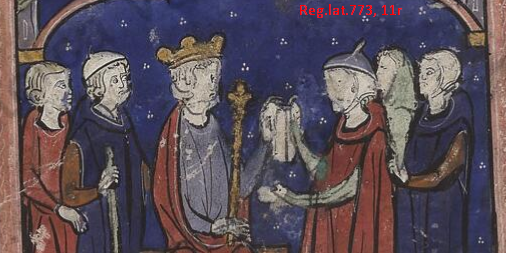
  19. Reg.lat.1022, the Mistère du Siège d’Orleans
  20. Reg.lat.1025, Rule of St Benedict begins this handbook of Geoffroy de Vendôme (1093-1132)
  21. Reg.lat.1033
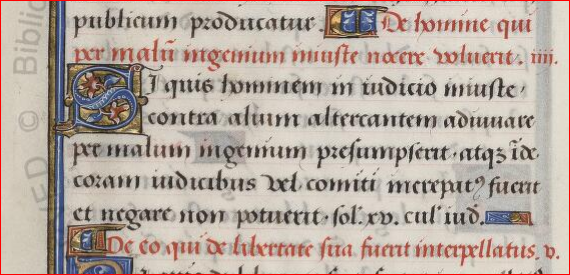
  22. Reg.lat.1036, one might term this gorgeous codex a fat-cat lawyer's handbook, where every heading and keyword is illuminated to aid memorization, rather like a hyperlinked text:
  23. Reg.lat.1037
  24. Reg.lat.1039
  25. Reg.lat.1042
  26. Reg.lat.1043
  27. Reg.lat.1076
  28. Reg.lat.1078
  29. Reg.lat.1137 , Euclid's Elements, above
  30. Reg.lat.1174
  31. Reg.lat.1215
  32. Sbath.642
  33. Urb.lat.116
  34. Urb.lat.1091
  35. Urb.lat.1258
  36. Urb.lat.1619
  37. Urb.lat.1646
  38. Urb.lat.1647
  39. Urb.lat.1648
  40. Vat.arm.11
  41. Vat.lat.277
  42. Vat.lat.713
  43. Vat.lat.1380
  44. Vat.lat.1428
  45. Vat.lat.1429
  46. Vat.lat.1456
  47. Vat.lat.1721
  48. Vat.lat.1747
  49. Vat.lat.1850
  50. Vat.lat.1852
  51. Vat.lat.1857
  52. Vat.lat.1867
  53. Vat.lat.1889
  54. Vat.lat.1891
  55. Vat.lat.1901
  56. Vat.lat.1902
  57. Vat.lat.1911
  58. Vat.lat.1913
  59. Vat.lat.1914
  60. Vat.lat.1919
  61. Vat.lat.1920
  62. Vat.lat.1921
  63. Vat.lat.1924
  64. Vat.lat.1928
  65. Vat.lat.1931
  66. Vat.lat.1933
  67. Vat.lat.1966
  68. Vat.lat.1977
  69. Vat.lat.1978
This is Piggin's Unofficial List number 126. If you have corrections or additions, please use the comments box below. Follow me on Twitter (@JBPiggin) for news of more additions to DigiVatLib.
2017-08-05

My Missal

It's not often that we know so much about an 11th-century manuscript as we do with Borg.lat.211, a missal which has been intensely studied by Francis Newton and Hartmut Hoffmann and which has just been brought online by the Vatican Library. We can even follow how it was made and where it was used.

The manuscript detectives have established that the missal, which contains the Cassinese Calendar, was written at Monte Cassino in 1098-1099, under the direction of Leo of Ostia (Leo Ostiensis or Leo Marsicanus or Leone dei Conti di Marsi, born 1046), the first chronicler of this original Benedictine monastery. Leo's hand is seen in many corrections and his taste can be deduced from the illuminations:

Being a historian and librarian himself, Leo naturally fascinates historians today. He was a nobleman and Benedictine monk who ended up a cardinal and bishop of Velletri, where he died 1115 May 22, a date known from an entry on folio 6 (see p 91 of Lowe's The Beneventan Script) of this book. Lowe is able to point from such additions that the handwriting required in the scriptorium at Monte Cassino was never adopted at places like Velletri.

Read Newton's notes about the missal. The calendar at the front, with names and dates of death of key people, is an important source of the prosaic bits of monastic history not found in Leo's chronicle. Because this codex keeps on giving, expect new discoveries as new sleuths now keep looking at it in digital form. Because the parchment has got damp at some point and is badly foxed, the photography has been repeated at another wavelength to bring out the script.

Here is my list of the 43 latest DigiVatLib digitizations.
  1. Barb.or.89
  2. Borg.lat.211, missal above.
  3. Reg.lat.92
  4. Reg.lat.112
  5. Reg.lat.168
  6. Reg.lat.754
  7. Reg.lat.769
  8. Reg.lat.772
  9. Reg.lat.816
  10. Reg.lat.875
  11. Reg.lat.939
  12. Reg.lat.972
  13. Reg.lat.974
  14. Reg.lat.976
  15. Reg.lat.995
  16. Reg.lat.1240
  17. Vat.gr.748, a Byzantine Octateuch with catenae, 13th or 14th century, no 77 in list of Septuagint Bible sources
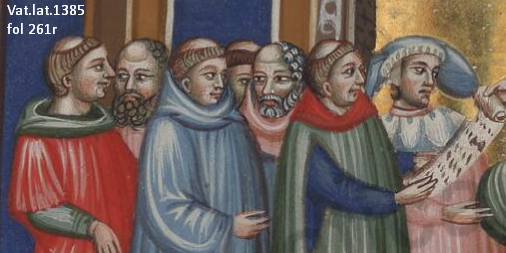
  18. Vat.lat.1385, a Renaissance copy of Bernardo Bottoni's law text (1266), Glossa ordinaria in Decretalium Gregorii PP.
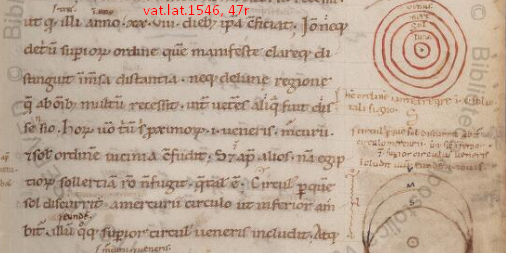
  19. Vat.lat.1546 is an 11th or 12th century manuscript of the late antique writer Macrobius which has a place in the history of diagrams with its sketches of circumsolar motion. Bruce Eastwood, the expert on pre-medieval astronomical diagrams, explains that the following diagrams are by the glossators comparing two different theories of the orbits. HT to @LatinAristotle for this.
     
  20. Vat.lat.1791
  21. Vat.lat.1845
  22. Vat.lat.1851
  23. Vat.lat.1855
  24. Vat.lat.1872
  25. Vat.lat.1874
  26. Vat.lat.1876
  27. Vat.lat.1882
  28. Vat.lat.1900
  29. Vat.lat.1909
  30. Vat.lat.1915
  31. Vat.lat.1922
  32. Vat.lat.1925
  33. Vat.lat.1926
  34. Vat.lat.1929
  35. Vat.lat.1934
  36. Vat.lat.1949
  37. Vat.lat.1975
  38. Vat.lat.2004
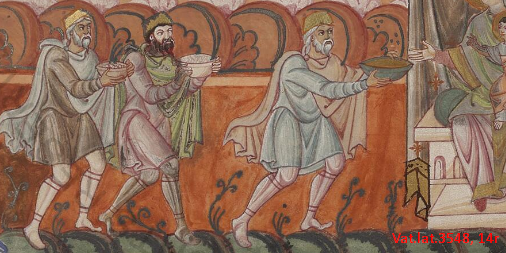
  39. Vat.lat.3548 , one of the finely illuminated Ottonian sacramentaries from Fulda (copied around 1020), HT to @ParvaVox
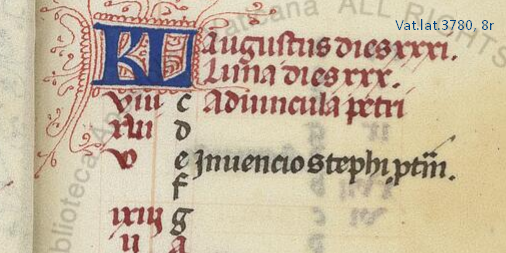
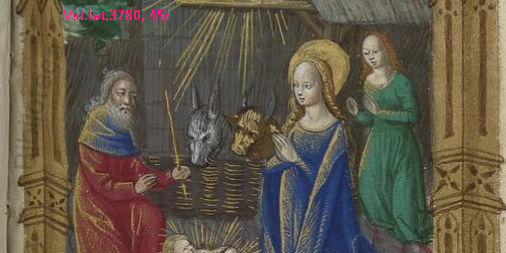
  40. Vat.lat.3780, a lovely 15th century book of hours, thought to have been made in Lyon. Here is August in its calendar:
    ... and here is the Nativity illumination:
  41. Vat.lat.13948
  42. Vat.lat.13949
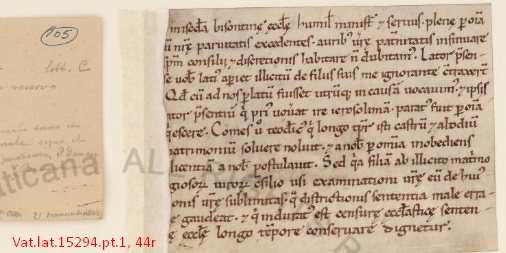
  43. Vat.lat.15294.pt.1, an album of wrapping slips from reliquaries. These were recycled from old documents in the papal offices around the period 1120-1140 and wrapped around votive objects placed in a very old altar in the pope's chapel. HT to @LatinAristotle who explained this to me and points to an article in 2000 by Bernard de Vregille on item 105, part of a letter from France.
    Curiously, the journal, Bibliothèque de l'école des chartes, complains bitterly it was not permitted to reproduce an image of the slip. Well, here it is.
This is Piggin's Unofficial List number 125. If you have corrections or additions, please use the comments box below. Follow me on Twitter (@JBPiggin) for news of more additions to DigiVatLib.
2017-07-29

What's the Time?

If you lived in the age of Chaucer and asked an educated person, "What's the time?" they might have looked at the shadow they were casting, called to mind the month of the year and come up with a pretty accurate answer. Timepieces of any nature were rare. Learning to reckon time is the purpose of John Somer's Kalendarium of 1387, which tabulates time data for the whole year.

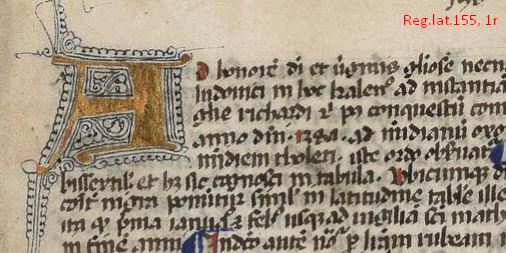
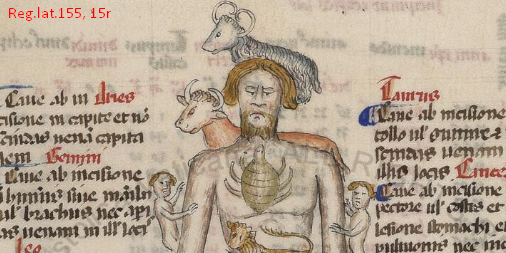
The Vatican Library digitized this week a manuscript containing this treasure of English learning, Reg.lat.144. From eTK (search) we know which of the calendaria it is (there were many), based on the prologue incipit, Ad honorem dei et virginis gloriose necnon sanctorum confessorum.


It contains a remarkable teaching diagram to learn the zodiac:


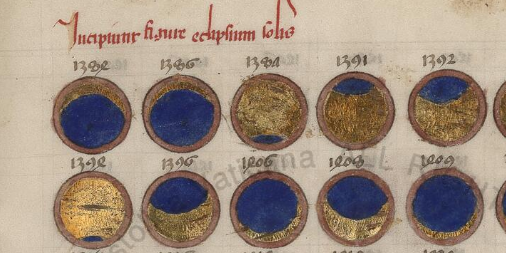
Being an expensive book, its calendar of upcoming solar eclipses for the next few years is made with real gold foil (sorry, but the #Eclipse2017 in August is not here; the list stops at 1462):


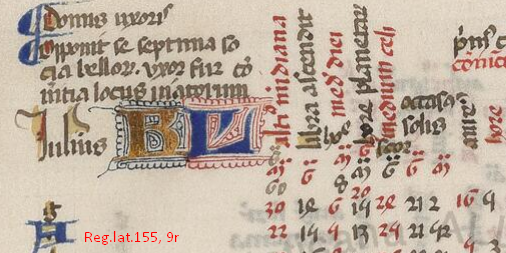
And of course the astronomical and astrological canon is beautifully tabulated. Here is July:


This codex contains:
  • fol. 2r ff: John Somers' Kalendarium
  • fol. 19r ff: The Metrificata Bibliae Capita, incipit: "A creat et tribus ordinat ...."
  • fol. 29r ff: The Summarium Biblie, a 13th-century nonsense mnemonic for remembering the books of the bible:
Sex prohibet peccant abel enoch archa fit intrant
egreditur dormit variantur turris it abram
loth reges credit fuga circumcisio risus
sulphur rex gerare parit offert sara rebecca
post geminos puteos benedicit scala sorores
virgas abscedit luctatur munera dina
benom gens esau vendunt thamar impia tres tres
preficitur veniunt redeunt post tristia norunt
omne genus quintam languet benedictio ioseph
For a translation, see an article by Lucie Dolezalova which offers a key. The codex may contain a Carolingian text too, since it is mentioned in Paolo Vaciago's Towards a Corpus of Carolingian Biblical Glossaries.

Unfortunately the library only released three items in the past week (barring its Pal.lat. catch-ups which I always reported to you from the quicker Heidelberg web portal).
  1. Reg.lat.131
  2. Reg.lat.155 (above)
  3. Reg.lat.952
This is Piggin's Unofficial List number 124. If you have corrections or additions, please use the comments box below. Follow me on Twitter (@JBPiggin) for news of more additions to DigiVatLib.
2017-07-25

City of Ladies

Christine de Pizan (1364 - c.1430) is a celebrated Italian-born writer in Middle French who is seen by some modern critics as an early feminist because of her energetic attacks on literature that stereotyped or vulgarized women. She argued that women could play a more important role within society and has become a celebrity in Renaissance studies.

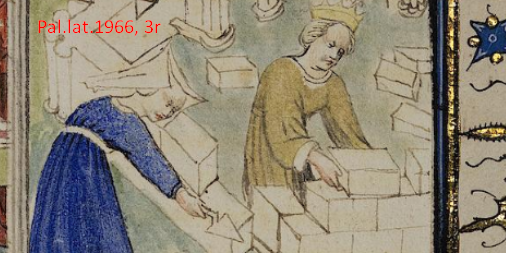
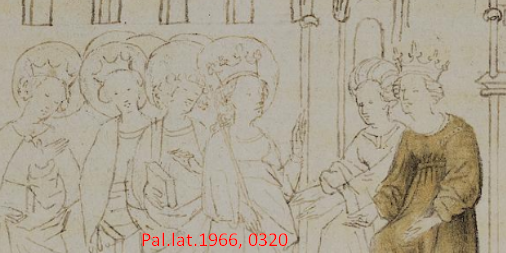
A codex of her celebrated Book of the City of Ladies at the Vatican Library, Pal. lat. 1966, was recently digitized and posted online. It is curious for its incomplete illustrations, which would be ideal material for the next international coloring-in festival in celebration of manuscripts.

The codex is part of the Palatina collection which is being independently digitized and released by the university library in Heidelberg, Germany. Here is my full list of its recent releases. I will trust to my readers' ability to divine enough of the German to read each entry. Those marked eTK are referenced in the electronic Thorndike Kiber (passim):
  1. Pal. lat. 664 Nicolai Siculi: Nicolai Sciculi (l. Siculi) episcopi panormitani tractatus in secundum librum deeretalimn: scriptus anno 1461. Lectura de 2a parte 21 libri decretalium (15. Jh.)
  2. Pal. lat. 758 Codicis Iustiniani imp. libri IX (13.-14. Jh.)
  3. Pal. lat. 1157 Gerardus ; Johannes ; Mesue Minor: Medizinische Sammelhandschrift (14. Jh.)
  4. Pal. lat. 1159 Constantinus : Pantegni siue Ars magna, nach Hali Abbas (13./14. Jh.)
  5. Pal. lat. 1168 Liber de natura rerum (14. Jh.)
  6. Pal. lat. 1169 Albertus : Sammelhandschrift (Heidelberg, 1436), eTK: Tempus autem est nunc consequenter de metallorum naturis
  7. Pal. lat. 1170 Ps.-Albertus ; Johannes Paulus; Averroes: Medizinsche Sammelhandschrift (Pavia, 1460-61); eTK: Ad lucidiorem notitiam sequentium habendam; Introduction to commentary on Albertus, De secretis mulierum
  8. Pal. lat. 1173 Petrus : Conciliator Pars II (Heidelberg, Mitte 15 Jh.), eTK: Quod crisis diei sit laudabilior ea questio noster (15c) (Petrus de Abano)
  9. Pal. lat. 1174 Bernardus : Sammelhandschrift (Südfrankreich?, 14. Jh.), eTK: Dilexi veritatis scientiam investigare credens nullum (Gordon, Bernard)
  10. Pal. lat. 1175 Arnoldus ; Rāzī, Muḥammad Ibn-Zakarīyā ar; Petrus ; Bartholomaeus ; Mundinus de Lenciis; Zacharias de Feltro; Gentilis ; Tura de Castello; Nicolaus : Medizinischer Sammelband (Handschrift mit Inkunabeldrucken) (Heidelberg, 1473-1486), eTK: Ad inveniendum dosim uniuscuiusque medicine composite
  11. Pal. lat. 1176 Palladius, Rutilius Taurus Aemilianus; Graecus, Marcus; Gentilis ; Arnaldus de Villanova: Medizinische Sammelhandschrift (Süddeutschland , Frankreich?, 14. Jh.), eTK, Alia species ignis qui comburit inimicos in montibus
  12. Pal. lat. 1177 Johannes ; Arnoldus ; Ps.-Raymundus Lullus; Godefridus Molendino; Avicenna; Johannes ; Jacoby, Johann; Johannes : Medizinisch-alchemistische Sammelhandschrift (Trier, 1447-48), eTK, Aloes est succus herbe et melius est ex eo (15c) (John de Sancto Amando)
  13. Pal. lat. 1178 Arnoldus : Breviarium (Deutschland, 15. Jh.)
  14. Pal. lat. 1179 Arnoldus ; Bernardus ; Bartholomaeus ; Lanfrancus ; Alcoatin: Medizinische Sammelhandschrift (Frankreich, 2. Hälfte 14. Jh.)
  15. Pal. lat. 1182 Arnoldus : Breviarium (Heidelberg, 1477)
  16. Pal. lat. 1184 Bernardus ; Galenus: Medizinischer Sammelband (Frankreich, 14. Jh.), eTK: Color cutis duobus modis fit aut enim habunt interiora (14c)
  17. Pal. lat. 1185 Bernardus : Lilium medicine I-VII (Heidelberg (?), 1443)
  18. Pal. lat. 1186 Bernardus : Lilium medicine I-VII (Süddeutschland, 1407)
  19. Pal. lat. 1187 Bernardus : Lilium medicine I-VII (Süddeutschland, 1412)
  20. Pal. lat. 1190 Liber medicinalis allegoricus respectu ecclesiae (Stuttgart, 1420), eTK: Homo secundum Isidorum est animal dei forme (1420); Homo quoniam sit secundum Ysidorum
  21. Pal. lat. 1191 Guilhelmus Corvi de Brescia: Practica seu aggregator Brixiensis (Italien, 15. Jh.), eTK: Oportet eum qui vult esse magister et artifex (15c) (Bartholomaeus Brixiensis)
  22. Pal. lat. 1192 Bartholomaeus ; Gualterus Agilon; Gerardus de Montepessulano: Medizinische Sammelhandschrift (Italien (?), 14. Jh.), eTK, Circa artem prognosticationis quatuor sunt notanda (15c) - Bartholomaeus (not de Bruges as in Wickersheimer 60)
  23. Pal. lat. 1193 Ambros Prechtl; Abraham Beuther: Sammelband (Amberg (I) , Sachsen (II), um 1575 ; 1586), eTK: Canones in febre pestilentiali sunt ordinatio diete (15c-16c)
  24. Pal. lat. 1195 Antonius Guainerius; Marcus de Senis; Nicolaus Falcutius; Christopherus de Honestis; Johannes de Tornamira: Medizinische Sammelhandschrift mit Inkunabeldruck (Heidelberg, 1474)
  25. Pal. lat. 1197 Ibn-Buṭlān, al-Muẖtār Ibn-al-Ḥasan (Eluchasem Elimitar); Galeatus de Sancta Sophia: Medizinische Sammelhandschrift (Heidelberg, Ende 15. Jh.)
  26. Pal. lat. 1199 Cancellarius Montispessulani; Magister Plauensis: Medizinische Sammelhandschrift (2. Hälfte 14. Jh.), eTK: De capillis et primo de tinea decoquantur folia (14c-15c)
  27. Pal. lat. 1200 Petrus ; Johannes ; Paulinus; Arnoldus : Medizinische Sammelhandschrift (Deutschland, um 1400)
  28. Pal. lat. 1201 Disputationshemen der Artisten 1537/1538 (Heidelberg, 1535-1538)
  29. Pal. lat. 1204 Hemmerlin, Felix; Johannes Egen alias Pleniger (senior): Zusammengesetzte Handschrift (Süddeutschland (I) , Heidelberg (II), um 1500 ; 16. Jh)
  30. Pal. lat. 1210 Bernardus ; Arnoldus ; Jacoby, Johann; Galenus: Medizinische Sammelhandschrift (Heidelberg, 2. Hälfte 15. Jh.), eTK: Ad honorem sancte et individue trinitatis et virginis gloriose et ad utilitatem; .Volo aliqua de pestilentia scribere
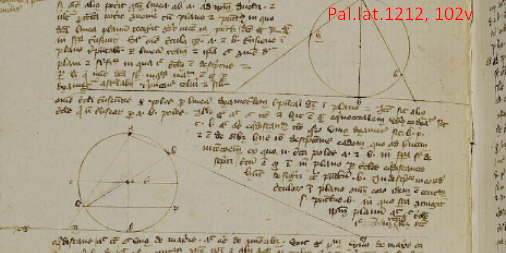
  31. Pal. lat. 1212 Guido ; Iordanus ; Johannes de Lineriis; Johannes ; Johannes Eschenden: Sammelhandschrift zum Quadrivium (Paris, 14. Jh. (um 1367)), eTK, Astrolabium dicitur quoddam instrumentum (15c); Compositio astrolabi. Gaps are left for miniatures that were never painted, and none of the astrolabes are drawn, but the simpler geometrical drawings were apparently within the ambit of the commissioned scribe, who left oblique margins around them:
  32. Pal. lat. 1213 Magninus ; Johannes Baccalaureus Bononiensis: Medizinische Sammelhandschrift (Deutschland, 1. Hälfte 15. Jh.), eTK, Aqua est corpus homogeneum ex materia et forma (15c)
  33. Pal. lat. 1214 Vindicianus; Antonius Guainerius: Medizinische Sammelhandschrift (Italien, Lombardei, 2. Hälfte 15. Jh.), eTK: Ad te principum ac ducum illustrissime (Guaineri, Antonio)
  34. Pal. lat. 1216 Vindicianus; Copho; Ps.-Hippocrates; Johannes ; Arnoldus ; Albich, Siegmund; Johannes : Miszellaneen-Sammelband (Schaffhausen (I) , Worms (II), Ende 14. Jh. (1389) ; 2. Hälfte 15. Jh.)
  35. Pal. lat. 1217 Petrus ; Antonius Guainerius: Medizinischer Sammelband (Italien, Mitte 15. Jh.)
  36. Pal. lat. 1219 Johannes Vischer: Medizinische Sammelhandschrift (Ingolstadt, 1554/1555)
  37. Pal. lat. 1220 Petrus Hispanus: Medizinische Sammelhandschrift: Collectanea Ambrosii Prechtl (Regensburg oder Freising, 16. Jh. (um 1565))
  38. Pal. lat. 1221 Avicenna; Antonius Guainerius; Bartholomaeus de Montagnana; Antonius Cermisonus; Galenus; Marsilius de Sancta Sophia: Medizinische Sammelhandschrift (Deutschland, 2. Hälfte 15. Jh.), eTK Quia amoris gratia mi Antoni Maglane ad hunc (Guaineri, Antonio)
  39. Pal. lat. 1222, Bd. 1 Galenus; Thomas del Garbo; Avicenna; Gentilis ; Albertus de Zancariis: Medizinische Sammelhandschrift in 2 Bänden (Norditalien (Bologna?), 1356)
  40. Pal. Lat. 1222, Bd. 2 Galenus; Thomas del Garbo; Avicenna; Gentilis ; Albertus de Zancariis: Medizinische Sammelhandschrift in 2 Bänden (Norditalien (Bologna?), 1356)
  41. Pal. lat. 1223 Rāzī, Muḥammad Ibn-Zakarīyā /ar-: Continens VIb-XVIIIa (Heidelberg, 2. Drittel 15. Jh.)
  42. Pal. lat. 1226 Aegidius Corbolensis; Gilbertus; Theophilus; Philaretus; Bernardus ; Alexander ; Bartholomaeus ; Ps.-Albertus; Ps.-Hippocrates: Medizinischer Sammelband (Rheinpfalz (Heidelberg?), 1424), eTK, Consequenter dicendum est de simplicibus speciebus; De contentis urinae
  43. Pal. lat. 1229 Rāzī, Muḥammad Ibn-Zakarīyā /ar-; Gerardus de Solo; Johannes ; Wilhelmus Gausberti; Jacoby, Johann; Arnoldus ; Aegidius Portugalensis; Bernardus ; Stephani, Johannes: Medizinische Sammelhandschrift (Montpellier oder Nordspanien, 2. Drittel 15. Jh.), eTK Ad honorem sancte et individue trinitatis et virginis gloriose et ad utilitatem (15c); Volo aliqua de pestilentia scribere
  44. Pal. lat. 1231 Isrāʾīlī, Isḥāq Ibn-Sulaimān /al-; Aegidius Corbolensis; Archimatthaeus; Gerardus; Hippocrates: Medizinischer Sammelband (Norddeutschland (II), 13. Jh. ; 14. Jh.)
  45. Pal. lat. 1233 Zahrāwī, Ḫalaf Ibn-Abbās /az-: Liber theoricae nec non practicae, Tractatus 1-2 (Heidelberg, 1450), eTK, Ait auctor in hoc libro congregavi modos ciborum (Alsaharavius)
  46. Pal. lat. 1234 Mundinus; Bernardus ; Stephanus Arlandi; Serapio ; Andromachus; Joannitius; Wilhelmus de Varignana: Medizinische Sammelhandschrift (Deutschland, um 1400), eTK, Ad inveniendam dosim uniuscuiusque medicine composite
  47. Pal. lat. 1235 Bernardus ; Avicenna: Medizinische Sammelhandschrift (Böhmen, 1. Hälfte 15. Jh.)
  48. Pal. lat. 1236 Alexander ; Christianus de Sancto Trudone; Theodulus ; Cato: Zusammengesetzte Handschrift (Deutschland, 13. und 14. Jh.)
  49. Pal. lat. 1237 Fries, Lorenz: Medizinische Sammelhandschrift (Amberg, 1560-1570), eTK Quoniam vero isti duodecim lapides (16c ?)
  50. Pal. lat. 1238 Medizinische Sammelhandschrift: Articella (Italien, 2. Hälfte 13. Jh. ; 14. Jh.)
  51. Pal. lat. 1239 Medizinische Sammelhandschrift: Articella (Deutschland, 15. Jh.)
  52. Pal. lat. 1240 Hugo de Siena; Jacoby, Johann; Arnoldus ; Qusṭā Ibn-Lūqā; Thaddaeus ; Guilhelmus de Brescia; Marsilius de Sancta Sophia: Medizinische Sammelhandschrift (Wien, 1463/1464), eTK, Alia sequitur practica desideratissime benedicteque artis (15c); De alchimia
  53. Pal. lat. 1241 Ambrosius Prechtl: Collectanea medica (Regensburg, 1559-1565)
  54. Pal. lat. 1243 Matthaeus ; Rāzī, Muḥammad Ibn-Zakarīyā /ar-; Jordanus de Turre; Christianus; Avicenna; Theophilus; Gerardus de Solo; Gerardus de Monte Pessulano; Guilhelmus de Saliceto: Medizinischer Sammelband (Mitteldeutschland, 1. Hälfte 15. Jh.)
  55. Pal. lat. 1244 Galenus: Ars parva seu Tegni cum commento (Heidelberg, 2. Hälfte 15. Jh. (um 1460))
  56. Pal. lat. 1245 Arnoldus ; Johannes de Toleto; Johannes ; Michael ; Hippocrates; Rāzī, Muḥammad Ibn-Zakarīyā /ar-; u.a.: Medizinische Sammelhandschrift (Süddeutschland, 2. Hälfte 14. Jh.)
  57. Pal. lat. 1248 Bartholomaeus Mettlinger; Thomas ; Rāzī, Muḥammad Ibn-Zakarīyā /ar-; Hippocrates; Albertus Magnus; Sidrach: Medizinisches Sammelhandschrift (Augsburg , Nördlingen, 1470-1511), eTK: Generaliter primo dicendum est de arboribus quibus quidem (15c) 
  58. Pal. lat. 1251 Philippus de Aretio; Guido ; Antonius Cermisonus; Petrus Hispanus; Matthaeus de Verona; Petrus ; Nazari, Giovanni Battista; Leonardus de Bertipaglia; u.a.: Medizinische Sammelhandschrift (Padua, 1463/1464), eTK: Ad tres aquas que extracte sunt ex dictis Raymundi
  59. Pal. lat. 1257 Sigismund Albicus; Ps.-Hildegardis; Bernardus : Zusammengesetzte Handschrift ; Meisterlieder (Bayern (I) , Breslau (II), 16. Jh. ; 1422), eTK: Rogatu fratrum tractatulum ad utilitatem; De plantatione arborum. Sadly this is without any illustrations.
  60. Pal. lat. 1258 Caesar Optatus; Lucius Bellantius: Medizinisch-astrologische Sammelhandschrift (Deutschland, 2. Hälfte 16. Jh.), eTK Ad tempus precisum canonice facte interrogationis (16c); .a Bellantius, Lucius
  61. Pal. lat. 1259 Alphita; Nicolaus; Arnoldus ; Johannes ; Petrus Hispanus; Gerardus de Montepessulano; u.a.: Medizinische Sammelhandschrift (Süddeutschland, Anfang 14. Jh. (1315))
  62. Pal. lat. 1268 Petrus ; Arnoldus ; Galeatus de Sancta Sophia; Johannes ; Rāzī, Muḥammad Ibn-Zakarīyā /ar-; Albuzali; Marsilius de Sancta Sophia; Benevenutus : Medizinische Sammelhandschrift (Wien, 15. Jh. (1434)), eTK Assalia fatui accidit pueris et forte accidit in facie (15c) / Assahaphati accidit pueris et forte
  63. Pal. lat. 1271 Antidotarius (Freiburg im Breisgau, 1467)
  64. Pal. lat. 1272 Meister Bartholomaeus; Johannes ; Arnoldus ; u.a.: Medizinisch-alchemistische Sammelhandschrift (Westdeutschland/ Rheinland, Ende 15. Jh.)
  65. Pal. lat. 1275 Collectanea alchemica (Südwestdeutschland, 2. Hälfte 16. Jh.)
  66. Pal. lat. 1531 Cicero, Marcus Tullius: Sammelhandschrift (Italien, 12. Jh. ; 15. Jh.)
  67. Pal. lat. 1565 Palladius, Rutilius Taurus Aemilianus: Opus agriculturae (Deutschland, Ende 14. Jh.)
  68. Pal. lat. 1671 Seneca, Lucius Annaeus : Tragoediae (Italien, 14. Jh.)
  69. Pal. lat. 1966, Christine (de Pizan): La cité des dames (15. Jh.) (above)
This is Piggin's Unofficial List number 123. If you have corrections or additions, please use the comments box below. Follow me on Twitter (@JBPiggin) for news of more additions to DigiVatLib.
2017-07-22

Strange and Wonderful

Of all the strange and wonderful books from the past, one of the quirkiest is the Kyranides, a book in vernacular Greek that describes in alphabetical order the magical healing powers of plants, animals, stones and their secret relationships. Also entitled The Book of the physical virtues, diseases and treatments or Liber medicinalis, the work is made up of two sections (the Kyranis of the Persian king Kyranus and the Liber therapeutikos of Harpokration of Alexandria), compiled by a Byzantine author only datable to somewhere from the 5th to the 8th century.


The first Kyranis, carved in Syriac characters on an iron pillar, was supposedly given by Hermes Trismegistos to men so that they could be educated on the virtues of 24 stones, plants, fish and birds. The book contains hints on alchemy and tons of lore about amulets and their powers.

Reg.lat.773 contains one of the most reliable Latin translations of the Kyranides, attributed to one Paschalis Romanus, a clergyman working in about 1169 in Constantinople. For a survey of all the manuscripts, see Mirabile.

This codex, which starts off with a "Liber Provinciale," also contains other unexpected items, such as a manual of French court procedure beginning, Li prevoz de Paris tendra cette forme a ses plaiz. Se aucuns meut question devant ... There's an image of these procedures too:


In the past week, 73 new items have arrived online in the Vatican Library's digitization program, bringing the total to date to 14,506. This does not count Pal.lat. items which I track separately. New in color (formerly only in black and white) is Vat.lat.1573, which is one of Lowe's examples of Beneventan script. This is an 11th-century book of Vergil, containing the Bucolics, Georgics, Aeneid.
  1. Reg.lat.64
  2. Reg.lat.82
  3. Reg.lat.85
  4. Reg.lat.95
  5. Reg.lat.98
  6. Reg.lat.100
  7. Reg.lat.649
  8. Reg.lat.726
  9. Reg.lat.773, Liber Provinciale, Kyranides, Li Prevoz de Paris (above).
  10. Reg.lat.794
  11. Reg.lat.797
  12. Reg.lat.814
  13. Reg.lat.815
  14. Reg.lat.841
  15. Reg.lat.874
  16. Reg.lat.876
  17. Reg.lat.878
  18. Reg.lat.879
  19. Reg.lat.884
  20. Reg.lat.885
  21. Reg.lat.887, Relatione dello Stato dell'Imperio, e della Germania per tutto l'anno 1628, on paper
  22. Reg.lat.899
  23. Reg.lat.903
  24. Reg.lat.906, Pedemontanus commentary of 1567 on 60 speeches of Tacitus, see Persee.
  25. Reg.lat.907
  26. Reg.lat.950
  27. Reg.lat.958
  28. Reg.lat.963
  29. Reg.lat.1065, French synod documents dated 1284
  30. Vat.ar.924
  31. Vat.lat.1305, Arnaldus de Vilanova
  32. Vat.lat.1414
  33. Vat.lat.1423
  34. Vat.lat.1499
  35. Vat.lat.1583
  36. Vat.lat.1637
  37. Vat.lat.1666
  38. Vat.lat.1729
  39. Vat.lat.1780
  40. Vat.lat.1797
  41. Vat.lat.1807
  42. Vat.lat.1808
  43. Vat.lat.1809
  44. Vat.lat.1813, Poggio Braccolini, 15th century ms.
  45. Vat.lat.1814
  46. Vat.lat.1817
  47. Vat.lat.1822
  48. Vat.lat.1823
  49. Vat.lat.1825
  50. Vat.lat.1830
  51. Vat.lat.1835, Bellum Catilinae, Bellum Iugurthinum (Histories) by Sallust in a luxury Renaissance manuscript. See Rome Reborn
  52. Vat.lat.1838
  53. Vat.lat.1839
  54. Vat.lat.1840
  55. Vat.lat.1849
  56. Vat.lat.1854
  57. Vat.lat.1856
  58. Vat.lat.1862
  59. Vat.lat.1864
  60. Vat.lat.1865
  61. Vat.lat.1866, Gestis Alexandri Magni, by Curtius Rufus
  62. Vat.lat.1868
  63. Vat.lat.1871
  64. Vat.lat.1879
  65. Vat.lat.1883
  66. Vat.lat.1885
  67. Vat.lat.1888
  68. Vat.lat.1892, translation by Ambrogio Traversari of Diogenes Laertius, De vitis philosophorum
  69. Vat.lat.1905
  70. Vat.lat.1906, Suetonius, The Twelve Caesars
  71. Vat.lat.1916
  72. Vat.lat.1930
  73. Vat.lat.4075, astronomy in Latin translation: Ptolemy of Alexandria and Abū Maʻšar
This is Piggin's Unofficial List number 122. If you have corrections or additions, please use the comments box below. Follow me on Twitter (@JBPiggin) for news of more additions to DigiVatLib.
2017-07-16

The Unknown Pacian

I discovered a few weeks back that I had overlooked a whole block of Vatican Library digitization releases in late May. I know that many of my readers rely on this blog for news of releases. I trust in a combination of apps, memory and eyesight to catch new arrivals. And being human and worn, I fear occasionally one of those three breaks down.

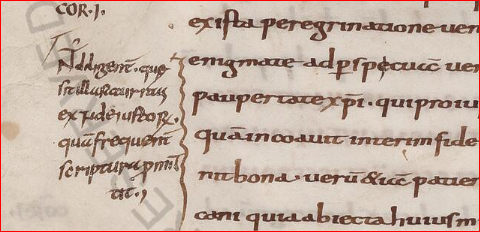
The 47 skipped items come from the Reg.lat. series, the fabled library bought from the heirs of Christina Vasa, Queen of Sweden. The omission was gently brought to my attention by Pierre Chambert-Protat (@chaprot on Twitter), who had been lying in wait for a key codex among the 47. He was in delight to finally see online a 9th-century French book of theology extracts from Augustine of Hippo and other authors. It is the working copy used by Florus of Lyon (he left his notes all over the margins):

The example above is from 14v. Notice the big difference of the two (contemporary) hands. The codex is also celebrated as the sole mediator of the writings of Pacian of Barcelona, and here I will let Pierre explain:
Pacian lived in the 4th century. But his works didn’t spread, it seems, in the five next centuries, since we preserve no manuscripts from that time, nor later copies that would descend from those older copies. Only in the 9th century the Lyonnais clerics ran into some of Pacian’s works, and they took a copy for themselves: our Reg. lat. 331. This situation explains another strange little fact: when he quotes Pacian, Florus feels obligated to say that Jerome spoke about him in good terms. He never does that for any other author — but he knew Pacian’s authority wouldn’t be acknowledged just like that, simply because no-one actually knew Pacian at the time. Lyon’s cathedral library rediscovered him, saved him from oblivion, and they were very much aware about it.
You may have heard that Pierre is one of the people working to reconstitute Florus's library virtually, using links to the different libraries that own and have digitized Florus books. Read Pierre's blog (from which I have just quoted) for the full story about this treasure, which also happens to have a key place in the history of text.

Here is my list of the shelfmarks of the missing Reginenses codices, with my apologies for the delay:
  1. Reg.lat.13, Psalterium Romanum with the Book of Canticles (psalms 1 to 26 missing). Beuron number 354, late 11th century from near Naples or Benevento. This text is the pre-Vulgate one, traditionally considered a light revision by Jerome of Stridon before he did a heavy reworking that is termed the Psalterium Gallicanum.
  2. Reg.lat.14, 10th-century evangeliary transmitting an Old Latin prologue to John's Gospel, attributed to his legendary pupil Papias of Hierapolis (HT to @ParvaVox)
  3. Reg.lat.30,
  4. Reg.lat.33,
  5. Reg.lat.34,
  6. Reg.lat.36,
  7. Reg.lat.53,
  8. Reg.lat.54, a 10th-century manuscript containing Bede's De schematibus, Cassiodorus' De Anima and Jesus' legendary letter to King Abgar (HT to @ParvaVox)
  9. Reg.lat.55,
  10. Reg.lat.127,
  11. Reg.lat.146,
  12. Reg.lat.238,
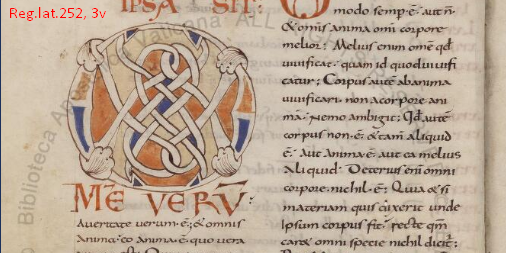
  13. Reg.lat.252, the BAV note gives only Augustine of Hippo and John Chrysostom as authors in this 10th or 11th-century (the fine initial below is rather traditional for the date), whereas the eTK points to a 13th-century incipit on folio 45v of the same shelfmark: Quia sancta evangelia dicunt factas tenebras a vi hora usque ix ..." I cannot find that. Is the latter note miscopied or mistaken?
  14. Reg.lat.254,
  15. Reg.lat.268,
  16. Reg.lat.302, if you are interested in the strange monogram in this, check out a tweet series by @ParvaVox!
  17. Reg.lat.312, HT to @LatinAristotle who points out this is the Liber de exemplis sacrae scripturae of Nicolas de Hanaps. Jean Destrez examined this in a celebrated 1958 study to distinguish datings of codices by authorial, exemplar and scribal dates, so this codex is particularly interesting as a type, on account of its note in red pointing out that the exemplar was defective.
  18. Reg.lat.325,
  19. Reg.lat.331, the 9th-century theology codex from Lyons which Pierre Chambert-Protat was waiting for
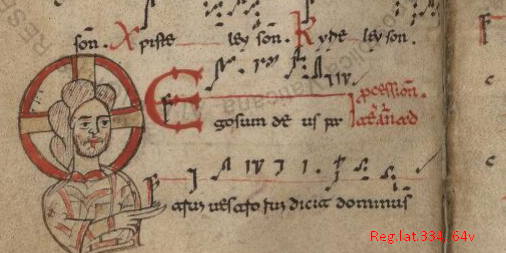
  20. Reg.lat.334, liturgical music, 11th or 12th century, from southern Italy. Admire the notation for the chant. This is one of Lowe's examples of Beneventan script: 
  21. Reg.lat.349,
  22. Reg.lat.366,
  23. Reg.lat.375,
  24. Reg.lat.390,
  25. Reg.lat.396,
  26. Reg.lat.400,
  27. Reg.lat.402,
  28. Reg.lat.406,
  29. Reg.lat.408,
  30. Reg.lat.411,
  31. Reg.lat.413.pt.1,
  32. Reg.lat.413.pt.2,
  33. Reg.lat.417, a 10th-century copy from Reims of the Carolingian Collectio Ansegisi bound with a number of capitularies issued at Worms (a. 829) (HT to @ParvaVox)
  34. Reg.lat.423,
  35. Reg.lat.425, Collectio Dacheriana, a canon-law collection, in a 10th-century manuscript (HT to @ParvaVox)
  36. Reg.lat.427,
  37. Reg.lat.433,
  38. Reg.lat.436,
  39. Reg.lat.443,
  40. Reg.lat.454,
  41. Reg.lat.460,
  42. Reg.lat.464,
  43. Reg.lat.476,
  44. Reg.lat.603,
  45. Reg.lat.622,
  46. Reg.lat.656,
  47. Reg.lat.663, Gerardi de Fracheto O.P.
Meanwhile it looks like it's Roman Holiday time in the Vatican Library's digitization workshop, with only 13 items that I can find brought online in the past week.
  1. Barb.gr.461
  2. Barb.or.7
  3. Reg.lat.71
  4. Reg.lat.109
  5. Reg.lat.702
  6. Reg.lat.724
  7. Reg.lat.783
  8. Reg.lat.872
  9. Reg.lat.1000.pt.B
  10. Reg.lat.1032
  11. Vat.gr.1973
  12. Vat.lat.1405
  13. Vat.lat.1413 
The readers are already being turned away at the gates. Look at all these empty seats in the reading room in this tweet:
This is Piggin's Unofficial List number 121. If you have corrections or additions, please use the comments box below. Follow me on Twitter (@JBPiggin) for news of more additions to DigiVatLib.