Showing posts with label DigiVatLib. Show all posts

2016-05-12

Jewish Learning

One of the priorities of the digitization programme at the Vatican Library is to release the Hebrew manuscripts, given that there is significant funding for that part of the work. These illustrate the importance of education among medieval Jewry and what works were available in Hebrew translation in Jewish schools.

A total of 26 digitizations released May 11-12 includes translations to Hebrew of Boethius and Thomas Aquinas from the Latin, of Aristotle from the Greek and of medical texts from Arabic. Here is the full list, which raises the posted total to 4,362. As usual, click or tap on the images to see the originals at Digita Vaticana.
  1. Neofiti.5, mid 15th century: commentary on Isaiah and Jeremiah by David ben Yosef Ḳimḥi, (c1160-c1235)
  2. Neofiti.6, Menahem b. Benjamin Recanati's kabbalistic commentary on the Pentateuch., dated about 1400
  3. Neofiti.8, Hebrew translation of Consolatio Philosophiae by Boethius, also homilies, mid 15th century
  4. Neofiti.10, Maḥzor, rite of Catalonia, mid 15th century
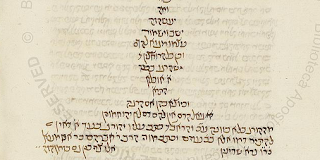
  5. Neofiti.13, Yeroḥam ben Meshulam: Toldot Adam ṿe-Ḥaṿah: this biblical genealogy features some great word-art pages where the script is lathed like this:
  6. Neofiti.16, Averroes' Middle Commentary on Aristotle's Analytica posteriora and Analytica priora, 15th century
  7. Neofiti.18, Thomas Aquinas, Commentary on Aristotle's De anima in Hebrew translation
  8. Neofiti.19, Kimhi, Sefer ha-Shorashim.
  9. Neofiti.20, Kimhi, another Sefer ha-Shorashim, mid 15th century
  10. Neofiti.21, Kimhi, Mikhlol, mid 14th century
  11. Neofiti.25, Parts of the Zohar, 16th century
  12. Neofiti.26, Yosef ben Avraham G'iḳaṭilah, b. 1248 Shaʿarei Orah, about 1400
  13. Neofiti.27, various including Midrash Ruth, early 15th century
  14. Neofiti.28, Sefer Pardes Rimmonim, by Mosheh ben Yaʿaḳov Ḳordoṿero (1522-1570) about 1600
  15. Neofiti.29, a volume of medical texts in seven parts in Hebrew, much dated to 1331, including translations from Arabic and Greek
  16. Neofiti.35, Christian sermons in Hebrew, late 16th century
  17. Neofiti.42, Yeḥiʼel Mili, Tappuḥei Zahav Tapuḥe zahav, 17th century
  18. Neofiti.47, Aristotle, Hebrew translation of Nichomachean Ethics 
  19. Neofiti.48, Poema di Yosef
  20. Ott.lat.15, legal texts, compiled by Capuchins
  21. Ross.356, early 15th century book of Hebrew personal prayers for many occasions including circumcision, for charms and amulets and so on.
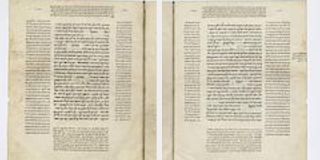
  22. Vat.ebr.106, Avraham ben Meʾir (1089-1164) Commentary on the Torah with supercommentaries by other authors above, below and left and right, each by different authors: the layout is really impressive:
  23. Vat.lat.267, Ambrose of Milan, De fide ad Gratianum Augustum libri I-V and other
    works in a 9th or 10th century manuscript
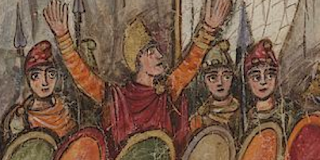
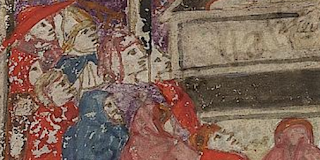
  24. Vat.lat.616, homilies of Gregory the Great, with this illumination of a rapt audience listening to him as he preaches:
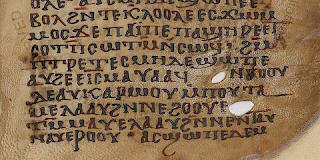
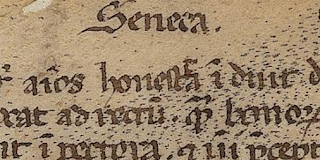
    Note the front flyleaf containing fragments on Seneca from an old dismembered manuscript:
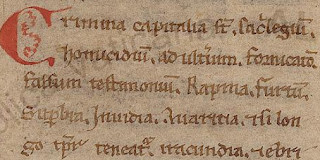
  25. Vat.lat.689, Liber Sententiarum of Peter Lombard, including this handy list of capital crimes that would get you your head chopped off:
    Sacrilege,  homicide, adultery, fornication, false testimony.... Cut it out to and keep it as a warning, in case you're ever tempted to misbehave.
  26. Vat.lat.705, Alexander Halensis, (c1185-1245): Summae theologicae liber III praeposito quaestionum indice, 13th century ms

This is Piggin's Unofficial List number 49 of digitizations conducted at the Biblioteca Apostolica Vaticana. If you have corrections or additions, please use the comments box below. Follow me on Twitter (@JBPiggin) for news of more additions to Digita Vaticana.
2016-05-03

Seneca and Paul

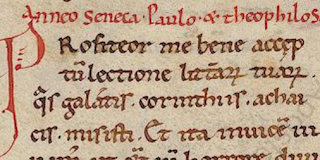
Among the most intriguing Vatican items to be digitized this week is Vat. lat. 251, an 11th-century manuscript containing an entirely bogus correspondence between the Classical Roman writer Seneca and the Christian apostle Paul of Tarsus. Claude W Barlow, who published a translation of it to English in 1938, suggests the letters were really composed by a student of rhetoric in about 390 CE. 

Alcuin ( -804), the great English scholar, prepared an edition of the Correspondence. Whether he believed it to be genuine cannot really be divined, but in the high Middle Ages, this fiction was universally believed to be fact, and it was only the early humanists who dared point out that it was surely absurd to suppose the letters to be anything but a creative literary work.

The translation by Barlow, who denotes this manuscript as A in his 1938 edition of the correspondence, can be read at Archive.org.

The Latin letters are found at ff. 223v-225v of the newly digitized codex. Here is Seneca allegedly writing: "I must admit I loved reading your letters to the Galatians, to the Corinthians and to the Achaeans."
The complete list of digitizations on May 2, 2016 is below:
  1. Barb.gr.243,
  2. Barb.lat.1670, a 17th-century deed
  3. Borg.ebr.2,
  4. Borg.ebr.5,
  5. Borg.ebr.6,
  6. Borg.ebr.8,
  7. Borg.ebr.15,
  8. Ross.325, Torah, 15th century
  9. Ross.360, Mahzor, Sephardic rite, 15th century
  10. Ross.478, Haftarot, Italian rite, late 13th century
  11. Ross.533, Hebrew commentary on prophets, date about 1325
  12. Ross.1188, Hebrew Esther scroll, 18th century
  13. Ross.1189, early 18th century Esther scroll
  14. Vat.lat.91, Peter Lombard, Glossae continuae in Psalmos?
  15. Vat.lat.251, ff. 1-1v: Leo Magnus, a fragment of Ep. 16; 2-223v: Hilarius, Tractatus super Psalmos; 223v-225v Epistolae Senecae ad apostolum Paulum et Pauli ad eundem (the fictitious Correspondence between Seneca and St Paul); Barlow: XI cent., mm. 306 x 216, ff. I + 226. The entire manuscript was copied by a single scribe in two columns of thirty lines to the page.
    A note in a different hand on f. 226v claims this codex was one of the books acquired for the monastery of Avellana by Petrus Damianus while he was abbot 1041-1058, but Erik Kwakkel says that given the script of the codex (his book on the evolution of book hands), this date cannot be true:
  16. Vat.lat.352,
  17. Vat.lat.622,
  18. Vat.lat.625,
  19. Vat.lat.626,
  20. Vat.lat.627,
  21. Vat.lat.630.pt.1, Isidorus Mercator Decretalium collectio
  22. Vat.lat.638, Venerable Bede, 11th century ms, In Lucae Evangelium expositio, praeviis litteris
  23. Vat.lat.661, mainly Bernard of Clairvaux, 15th century manuscript
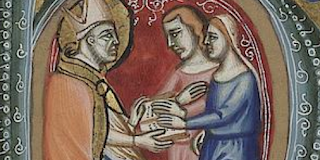
  24. Vat.lat.681, Sentences of Peter Lombard, with this couple (she is in a blue wedding dress, note her short veil) making their marriage vows, both left hands on the bible:
    Baschet notes that it is very rare to find a 12th century depiction of the vows being recited.
This is Piggin's Unofficial List number 48 of Vatican digitizations. If you have corrections or additions, please use the comments box below. Follow me on Twitter (@JBPiggin) for news of more additions to Digita Vaticana.
2016-04-23

Earth Day

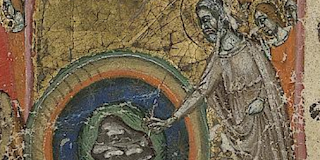
Around 1340, an artist in the Kingdom of Naples visualized God creating the world: first a shapeless lump of rock floating in space, then its greening. That image in the Bible of Gaulle, also known as the the Bible of Robert of Taranto, is a surprisingly modern take on the world that we should maybe dig out again next Earth Day.

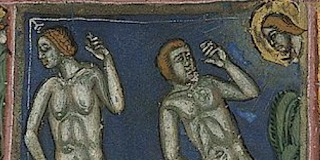
The Vatican has just digitized this bible, shelfmark Vat.lat.14430, which is now bound in two volumes, A and B. The Genesis sequence is painted in a cartoon-like series that surprisingly is meant to be read from right to left. Here is the expulsion of Adam and Eve from the Garden of Eden:

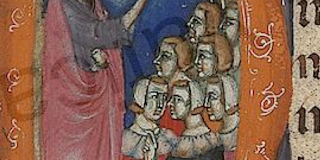
Smaller scenes later in this bible are also fascinating. Note these two ladies chatting in the front row while Jesus preaches (as always, click on my screen grab to go straight to the manuscript page):

The digitizations of 64 manuscripts by Digita Vaticana on April 22 came only a day after 33 were uploaded (see my earlier post). Here is the latest list:
  1. Reg.lat.1527, Giovanni Pontano's Lyra, the autograph, in a high, narrow codex
  2. Vat.gr.103,
  3. Vat.gr.109,
  4. Vat.gr.184,
  5. Vat.gr.1170,
  6. Vat.gr.1374,
  7. Vat.gr.1843,
  8. Vat.gr.1876,
  9. Vat.gr.1882,
  10. Vat.gr.2079,
  11. Vat.gr.2591,
  12. Vat.gr.2615.pt.B,
  13. Vat.lat.21,
  14. Vat.lat.47,
  15. Vat.lat.68,
  16. Vat.lat.118,
  17. Vat.lat.129,
  18. Vat.lat.139,
  19. Vat.lat.176,
  20. Vat.lat.177,
  21. Vat.lat.178,
  22. Vat.lat.179,
  23. Vat.lat.187,
  24. Vat.lat.190,
  25. Vat.lat.193,
  26. Vat.lat.224,
  27. Vat.lat.244,
  28. Vat.lat.266,
  29. Vat.lat.274,
  30. Vat.lat.292,
  31. Vat.lat.305,
  32. Vat.lat.322,
  33. Vat.lat.327,
  34. Vat.lat.330,
  35. Vat.lat.337,
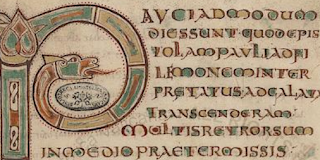
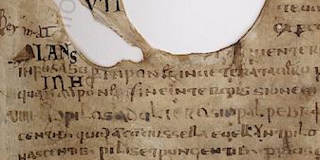
  36. Vat.lat.340, an 8th or 9th century manuscript from Corbie with Jerome's Commentaries on Epistles. Lowe says (CLA 1 4 or 5 4, Trismegistos) the front flyleaf is from another Corbie codex, the same as  fragments in Paris (lat. 17177). Nifty how the Vatican librarian has popped an ownership stamp under the snake's chin:
  37. Vat.lat.341,
  38. Vat.lat.343,
  39. Vat.lat.545,
  40. Vat.lat.555,
  41. Vat.lat.556,
  42. Vat.lat.584,
  43. Vat.lat.600, a life of Gregory the Great and other materials, 14th century
  44. Vat.lat.604,
  45. Vat.lat.610,
  46. Vat.lat.679,
  47. Vat.lat.1322, Latin translation of the Acts of Chalcedon. Probably from Verona, late 6th or early 7th century. Lowe CLA 1 8, Trismegistos. See a discussion by Nicholas Everett who notes marginal comments in a 9th-century hand.
  48. Vat.lat.1342, Lowe CLA 1 9, Trismegistos, 8th century. On Twitter GiorgiaV, notes its record of the excommunication of Anastasius Bibliothecarius in 853 by a Roman synod, while NSCM notes some playful descenders by a scribe with space to spare. If they give you the space, enjoy it.
  49. Vat.lat.1391,
  50. Vat.lat.1801, the first-ever translation to Latin of Thucydides' History of the Peloponnesian War by Lorenzo Valla. This is Valla's archetypus. Jeremy Norman has a long page discussing this manuscript and its special history.
  51. Vat.lat.1991,
  52. Vat.lat.1993,
  53. Vat.lat.1996,
  54. Vat.lat.2113,
  55. Vat.lat.3361, work of Sannazzaro
  56. Vat.lat.5642,
  57. Vat.lat.7225, Gospels, GiorgiaV noticed on Twitter a fine pairing of Luke with calf and John with eagle on the openings 
  58. Vat.lat.7794,
  59. Vat.lat.8892,
  60. Vat.lat.9495, a book of hours, with St Laurence (right, and holding his grate) in conversation, probably with St Stephen (holding stones)
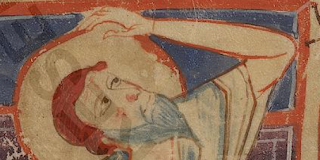
  61. Vat.lat.10405, the 12th-century Todi Bible, closely related to another giant bible from Rome, the Pantheon Bible. The frontispiece to the Acts of the Apostles shows an ascended Christ, and at the bottom is this a bearded apostle trying to adjust his halo:
  62. Vat.lat.14430.pt.A, the Bible of Robert of Taranto, also known as Bible of Gaulle (above), second quarter of the 14th century.
  63. Vat.lat.14430.pt.B, ditto
  64. Vat.turc.73,

This is Piggin's Unoffficial List Number 47. If you have corrections or additions, please use the comments box below. Follow me on Twitter (@JBPiggin) for news of more additions to Digita Vaticana.
2016-04-22

Monument in China

An engraved stone monument erected in 781 in a Nestorian Christian graveyard in Xi`an, China commemorated the arrival of Christianity 150 years before that in China. You can see this extraordinary historical treasure today inside the Forest of Steles at Bēilín Museum.

An ink rubbing was made from the stele in the 1630s and sent to Rome, and the discovery caused a sensation in Europe, where Chinese adoption of Christianity in 631 had been entirely unknown, as Anthony Grafton's Rome Reborn page (with a false callmark) notes.

The rubbing, now part of the bundle Barb.or.151, is one of the oriental treasures that has just been digitized by the Biblioteca Apostolica Vaticana, posted online on April 21.
The monument is about 2.5 metres tall and capped by a carved cross. The heading, as translated in the Wikipedia entry reads, "A Monument Commemorating the Propagation of the Ta-Chin Luminous Religion in the Middle Kingdom". Ta-Chin is an old Chinese term for the Roman Empire.

Another item in this package of digitizations is an abridgement printed in the 1620s of the famed map of the world that Matteo Ricci, the first Jesuit missionary to become adept in Chinese, had produced in 1574. The hand-tinted print was made at the orders of Giulio Aleni, whose name is marked on it, as Grafton notes. Here is North America:
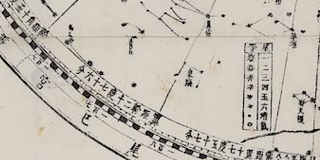
Also in the bundle is the printed astronomy, Chien-chien tsung-hsing-t'u by Adam Schall von Bell, of which Grafton notes: von Bell introduced the new astronomy of Galileo, including the telescope, to China. This single-sheet printed map with explanatory text shows the stars visible in the sky of northern China.
  1. Barb.or.151.pt.1, bundle of Chinese materials (above)
  2. Borg.cin.497,
  3. Borg.cin.537,
  4. Borg.cin.538,
  5. Borg.gr.27,
  6. Ott.lat.1252,
  7. Ott.lat.2358,
  8. Reg.lat.165,
  9. Reg.lat.179,
  10. Reg.lat.1935,
  11. Reg.lat.1995, the autobiography of Pope Pius II, the former Enea Silvio Piccolomini. This book, the Commentarii, is a remarkably frank autobiography and the only book he wrote after his election, in which he put his passions and prejudices on full view, Anthony Grafton notes in the Rome Reborn catalog. Enea Silvio was the first humanist to be elected to the papacy.
  12. Reg.lat.2039,
  13. Ross.184,
  14. Ross.254,
  15. Ross.276,
  16. Ross.616,
  17. Ross.701,
  18. Ross.977,
  19. Ross.1165,
  20. Urb.lat.252,
  21. Urb.lat.293, a nicely written 11th or 12th century manuscript of Vitruvius on Architecture notable for its two flyleaves, now folios 96 and 97, which date from the first half of the 8th century and contain important material from the late antique Greek medical writer Oribasius: This contains words glossed in Old German, indicating it has a German provenance: Lowe number CLA 1 116, see Trismegistos
  22. Urb.lat.367,
  23. Urb.lat.378,
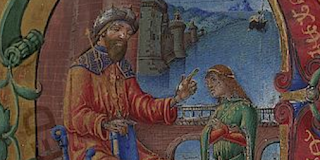
  24. Urb.lat.548, a very fine Renaissance part-bible transcribed by Mattheus de Contugiis, here the start of Proverbs, showing Solomon learning wisdom from father David:
  25. Urb.lat.597,
  26. Urb.lat.644,
  27. Urb.lat.1030, a Pietro Bembo autograph
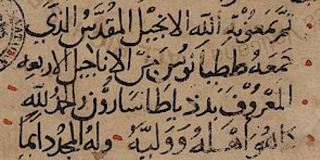
  28. Vat.ar.14, a 12th-century Arabic translation of the Diatessaron of Tatian, a combination of all four gospels into a single narrative. Thanks to Adam Carter McCollum in Vienna for pointing out this one on Twitter. Here is the colophon:
  29. Vat.ar.503,
  30. Vat.ar.581,
  31. Vat.ar.1606, a tiny and very ancient book in Arabic, apparently selections from Koran
  32. Vat.ebr.123,
  33. Vat.ebr.142.pt.2,
The Vatican scanners have also been hard at work for their Heidelberg sponsors, producing 10 new digitizations, which have just appeared on the Heidelberg RSS and are only visible on the German site:
  1. Pal. lat. 381 Ovidius Naso, Publius; Cicero, Marcus Tullius: Sammelhandschrift (Deutschland (Heidelberg?), 15. Jh.)
  2. Pal. lat. 733 Digestum vetus (14. Jh.)
  3. Pal. lat. 734 Digestum vetus (14. Jh.)
  4. Pal. lat. 735 Digestum vetus (13. Jh.)
  5. Pal. lat. 736 Digestum vetus (14. Jh.)
  6. Pal. lat. 687 Egidii (de Foscariis) ordo iudiciarius editus secundum consuetudinem bononiensem in foro ecclesiastico approbatam ; Mag. Bartholomei Brixiensis questiones dominicales et venales de iure canonico (15. Jh.)  
  7. Pal. lat. 691 Monaldi (Iustinopolitani ord. fr. minorum) summa iuris canonici (15. Jh.)
  8. Pal. lat. 695 Fratris Monaldi summa de iure canonico secundum ordinem alphabeti (14. Jh.)
  9. Pal. lat. 1525 Cicero, Marcus Tullius: Opera ; Orationes (Deutschland (?), 15. Jh.)
  10. Pal. lat. 1834 Melanchthon, Philipp; Luther, Martin; Erasmus, Desiderius: Epistolae (Wittenberg, 1536-1543 (?))
This is Piggin's Unofficial List number 46. I will fill in other details later. If you have corrections or additions, please use the comments box below. Follow me on Twitter (@JBPiggin) for news of more additions to Digita Vaticana.

2016-04-12

Trio of Vergils

The Roman Vergil is among the world's most celebrated old books: a 5th-century illustrated manuscript of the works of the Latin writer Virgil with the Vatican library shelfmark Vat. lat. 3867.

It has just entered the internet, marking a fresh historic moment in the Vatican digitization program. On the same day, the Vatican's leaves of a non-illuminated Virgil from the same period, the Vergilius Augusteus (Vat. lat. 3256), arrived online.

The even older Vatican Vergil, Vat. lat. 3225, another Late Antique illustrated book with which these two are commonly compared, has been online for over a year. These two additions make the set complete. Now you can compare all three at high resolution, in colour.

Classical Rome did not have illustrated codex books. Late Antiquity invented them in one of its major advances in media and public education. The rest as they say is history.

Here is the Roman Vergil's treatment of a shipbound Aeneas enduring a storm released by the goddess Juno against him. It is often said that the style seems like a precursor to medieval art:

The Wikipedia article Vergilius Romanus notes a theory that the Roman Vergil was made in Britain. Robert Vermaat accessibly sums up the argumentation for this. If true, the Roman Vergil is the oldest of any book from England in existence.

Here is the full list of 143 digitizations on April 11, bringing the posted total to 4,215. Click (tap) on the images to go straight to the pages. I want to rush this major news to you now, and will continue to mark the list up, with more of the goodies to be described in the next few days, so do come back.

The Bibioteca in Rome has no RSS feed, no running announcements, nothing. If you want news on what they put out, you'll have to come to my unofficial site, the only news stream on the internet covering the subject. Follow me on Twitter: there's a one-click button at right to make it easy.
  1. Borg.copt.109.cass.XVI.fasc.59, fragments, Gospel of Luke 8:36-9:41 and 12:39-14:9, looking extremely old even to my untrained eye
  2. Chig.C.IV.100,
  3. Urb.lat.603, the Breviary of Blanche of France, a major art treasure
  4. Vat.lat.29 ,
  5. Vat.lat.268,
  6. Vat.lat.284,
  7. Vat.lat.287,
  8. Vat.lat.303,
  9. Vat.lat.317,
  10. Vat.lat.326,
  11. Vat.lat.333,
  12. Vat.lat.335,
  13. Vat.lat.357,
  14. Vat.lat.358,
  15. Vat.lat.359,
  16. Vat.lat.361,
  17. Vat.lat.363,
  18. Vat.lat.365,
  19. Vat.lat.367,
  20. Vat.lat.370,
  21. Vat.lat.374,
  22. Vat.lat.379,
  23. Vat.lat.383,
  24. Vat.lat.386,
  25. Vat.lat.387,
  26. Vat.lat.388,
  27. Vat.lat.390,
  28. Vat.lat.391,
  29. Vat.lat.394,
  30. Vat.lat.395,
  31. Vat.lat.402,
  32. Vat.lat.403,
  33. Vat.lat.404,
  34. Vat.lat.406,
  35. Vat.lat.408,
  36. Vat.lat.411,
  37. Vat.lat.417,
  38. Vat.lat.419,
  39. Vat.lat.420,
  40. Vat.lat.421,
  41. Vat.lat.422,
  42. Vat.lat.423,
  43. Vat.lat.426,
  44. Vat.lat.429,
  45. Vat.lat.431,
  46. Vat.lat.432,
  47. Vat.lat.437,
  48. Vat.lat.442,
  49. Vat.lat.443,
  50. Vat.lat.447,
  51. Vat.lat.448,
  52. Vat.lat.455,
  53. Vat.lat.456,
  54. Vat.lat.457,
  55. Vat.lat.460,
  56. Vat.lat.462,
  57. Vat.lat.464,
  58. Vat.lat.469,
  59. Vat.lat.470,
  60. Vat.lat.473,
  61. Vat.lat.477,
  62. Vat.lat.482,
  63. Vat.lat.488,
  64. Vat.lat.492,
  65. Vat.lat.493,
  66. Vat.lat.497,
  67. Vat.lat.499,
  68. Vat.lat.502,
  69. Vat.lat.503,
  70. Vat.lat.504,
  71. Vat.lat.506,
  72. Vat.lat.508,
  73. Vat.lat.509,
  74. Vat.lat.511,
  75. Vat.lat.512,
  76. Vat.lat.515,
  77. Vat.lat.517,
  78. Vat.lat.520,
  79. Vat.lat.522,
  80. Vat.lat.523,
  81. Vat.lat.524,
  82. Vat.lat.526,
  83. Vat.lat.528,
  84. Vat.lat.529,
  85. Vat.lat.530,
  86. Vat.lat.531,
  87. Vat.lat.532,
  88. Vat.lat.536,
  89. Vat.lat.537,
  90. Vat.lat.538,
  91. Vat.lat.541,
  92. Vat.lat.542,
  93. Vat.lat.547,
  94. Vat.lat.548,
  95. Vat.lat.551,
  96. Vat.lat.553, Eucherius of Lyon, a 9th-century manuscript possibly originating from Germany. Lowe number, CLA 1 6  
  97. Vat.lat.554,
  98. Vat.lat.559,
  99. Vat.lat.562,
  100. Vat.lat.570,
  101. Vat.lat.574,
  102. Vat.lat.579,
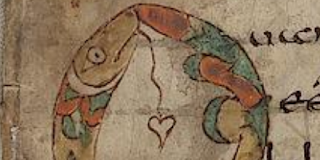
  103. Vat.lat.583, Gregory the Great in an 8th-century manuscript, Lowe number CLA 1 7, with this fine fishy Q:
  104. Vat.lat.589,
  105. Vat.lat.590,
  106. Vat.lat.591,
  107. Vat.lat.595,
  108. Vat.lat.605,
  109. Vat.lat.607,
  110. Vat.lat.608,
  111. Vat.lat.613,
  112. Vat.lat.614,
  113. Vat.lat.621,
  114. Vat.lat.643,
  115. Vat.lat.1112, commentary on the Sententiae 
  116. Vat.lat.1164, theological including Giacomo da Pesaro
  117. Vat.lat.1165, theological, first half is a Spanish printed book of 1548
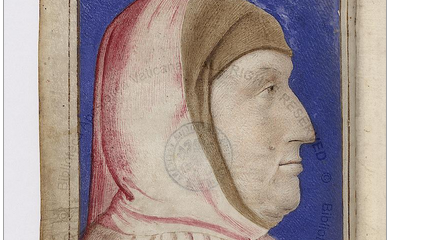
  118. Vat.lat.3198, Petrarch with portrait:
  119. Vat.lat.3212, Italian poetry of Antonio del Alberti, etc.
  120. Vat.lat.3256, the Vergilius Augusteus (see the Wikipedia article)
  121. Vat.lat.3305,
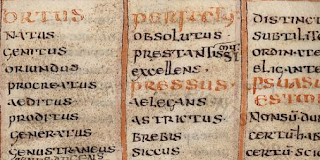
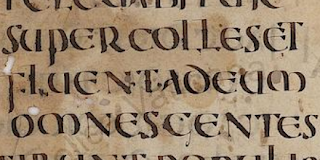
  122. Vat.lat.3321, a late antique glossary, in an 8th-century central Italian manuscript, Lowe CLA 1 15: a sort of dictionary and Roget's Thesauraus combined. I originally marked this as Isidore of Seville, Differentiae (Isidore was a bit of a plagiarist and fond of substituting new words in quotes to make them his own) but it seems that this is a source used by Isidore. The manuscript has been edited (see the 1834 Rome edition on Google Books) and there is a huge bibliography suggesting this is an important source for Latin lexicography and linguistics.
  123. Vat.lat.3357,
  124. Vat.lat.3437,
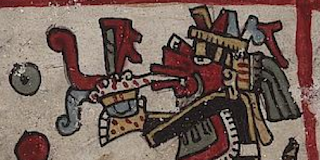
  125. Vat.lat.3773: Thanks to ParvaVox who was quick to point out this is an old pictorial Mexican Nahua manuscript, and to @carolinepennock, who adds that it's a tonalamatl (divinatory calendar), probably from Tlaxcala. She says it is one of only a handful believed to be pre-conquest, and another digital reproduction is available at www.famsi.org. It was probably made in the 16th century, but the manuscript's history previous to the Vatican cataloguing of 1596-1600 is unknown. She says it part of what is called the Borgia group. Here's one of the hundreds of figures in it:
  126. Vat.lat.3797,
  127. Vat.lat.3867, the Roman Vergil, in rustic half-uncial script with many illustrations (see above)
  128. Vat.lat.3869, Hippocrates' Iusiurandum translated to Greek: ETNG
  129. Vat.lat.3886, Enea Silvio Piccolomini's 1458 autograph manuscript of Germania, a famed humanist review praising the orderliness and prosperity of the new Germany. It was to appear in print in Leipzig in 1496. This second part is marked Aeneas Cardinalis Sancte Sabine ad objectiones Germanorum in a 16th-century hand on the front flyleaf. See Gernot Michael Müller
  130. Vat.lat.4104, 16th-century letters to Angelo Colocci, Fulvio Orsini and others
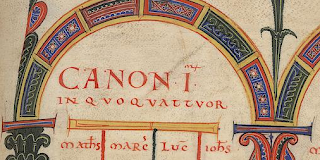
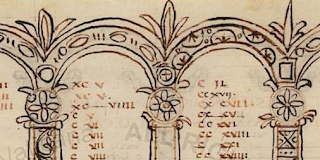
  131. Vat.lat.4221, 11th-century three-column bible, possibly with some Vetus Latina readings, with fine canon tables:
  132. Vat.lat.4329, folio 87, a flyleaf, is a recycled 7th- or 8th-century page with Liber Comitis on it, Lowe number CLA 1 20:
  133. Vat.lat.4777, Dante? incomplete
  134. Vat.lat.4782, Dante, two-column ms
  135. Vat.lat.4965, the 9th-century report/translation from the Greek concerning the 8th Ecumenical Council in Constantinople for Pope Hadrian II by Anastasius Bibliotecarius: he seems to have got scribes in the papal scriptorium to write up this fair copy 870-871, then wrote his corrections on it. With these remarkable alterations, this manuscript offers insights into a first-millennium translation bureau (link to Berschin). HT as well to @LatinAristotle who flags a major article by Réka Forrai about this papal translator and diplomat.
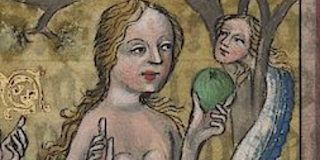
  136. Vat.lat.5697, Peter Comestor's Historia Scholastica , early 15th century, one of the masterpieces of Gothic illumination, with wonderful images such as this scene:
    This is a charming Eve about to bite the apple as the Devil tells her it's sooo good:
    Notice the selfie-like distortion? Please, somebody, post this on Instagram.
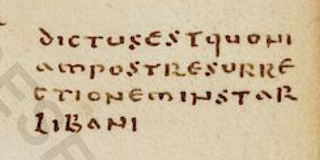
  137. Vat.lat.5704, a 6th-century Latin translation of Cassidorus's Historia Tripartita almost certainly made in his own scriptorium at Vivarium, Italy. Lowe number CLA 1 25. It has been argued by some scholars that marginal notes to the Enarratio in Canticum Canticorum of Philo Carpasianus may be by the hand of the great Cassiodorus himself:
    If we had not had the Vergils, I would certainly have headlined this week's post with this treasure.
  138. Vat.lat.5759, Ambrose of Milan on Genesis and the Evangeliorum Libri of Juvencus, late 10th century, written over the top of an 8th-century gospels probably from Bobbio, Italy. The final pages have not been refilled, so you can see clearly how a palimpsest was prepared. Lowe number CLA 1 37
  139. Vat.lat.7016, an 8th-century gospels from Italy intact, Lowe number CLA 1 51 with canon tables:
  140. Vat.lat.7189, commentary on canon law by Johannes de Turrecremata (died 1468): the missing volume of an autograph series Vat. lat. 2572-2576 (Gero Dolezalek). 
  141. Vat.lat.11258.pt.B, a book of designs and plans for baroque Rome.
    Anthony Grafton notes in the Rome Reborn catalogue that this architectural drawing (folio 200r) for the centrepiece of the Piazza Navona by Francesco Borromini was not implemented.
  142. Vat.sir.598, an 1871 copy of records of 19 oriental synods
  143. Vat.turc.150,
This is Piggin's Unofficial List 45 and not the last. Follow me on Twitter (@JBPiggin) for news of more additions to Digita Vaticana, and join this site with Google Friend Connect (right) or you'll miss out on the next releases. If you have corrections or additions, please use the comments box below.