Showing posts with label Italy. Show all posts

2012-05-19

New-Found Manuscript

Does a publication 10 years ago describing a new-found manuscript count as news? Not for a journalist. Nor ought it to be news when the author of the publication personally drew my attention to the article two years ago. But somehow I was too busy with other things, and only discovered today that the Biblioteca Malatestiana in Cesena, Italy possesses a previously unknown 11th-century manuscript of the Liber Genealogus. So it is news ... to me.

Readers may recall that I published online last year the ur-text of the Liber Genealogus of 427 (link). It is not a critical edition, but it is the first to present the archetypal text of the year 427 without clutter. Those who follow this blog will know that the Liber Genealogus is a strange chronological and genealogical tract which can only be understood if one realizes it was a learned commentary on a wondrous drawing: the Great Stemma.

In 2002, the eminent Italy-based historian-philologist Dr Michael Gorman published an article in the journal Scriptorium on 11th-century manuscripts from the monastery at Monte Amiato, a Benedictine community which was closed in 1782. He argued that three very similar codices had all been drafted in the scriptorium there in the 11th century. His article was re-published in Italian with some revisions in 2007.

The third of the manuscripts which he highlighted was one that had escaped the notice of Theodor Mommsen when he published his edition of the Liber Genealogus at the end of the 19th century. This manuscript at Cesena doubtless contains a copy of the F recension. Giuseppe Maria Muccioli writes in that library's printed catalogue that the text begins: Genealogia totius Sacra Scripturae, cum persecutionibus Christianorum, which echoes the Madrid incipit, Genealogiae totius bibliothecae ex omnibus libris veteris novique testamenti. I discussed the Madrid version in a post in February.

Here is a tabulation of the parallel contents of the three codices, based on the publications of Dr Gorman, Mommsen and Professor José Carlos Martín. The three columns at right represent the folio numbers in:
  • Plutei 20.54 
  • Conv. soppr. 364 
  • Cesena D.XXIV.I (Catalog)

Isidori Hispalensis Etymologiae (ed. Lindsay) lost 1- 100v 1- 183
Junilius Africanus De partibus divinae legis = Instituta regularia divinae legis (CPL 872) (Collins) 1ra - 8rb 100v- 107 183- 193v
Bede (thus identified by Gorman) Glose per totum alphabetum (Gorman reference: De ortographia, ed. CCSL 123A.7-57) 8rb – 15rb 107- 111v 193v- 201v
Anon Glossa super Octateuchum et Librum Regum (Glossa Rz: see Holtzmann) omit 111v- 116 202- 209v
Anon Divisiones temporum XIII (unpublished) 15rb – 21ra 116- 120 209v- 217
Isidori Hispalensis Ety. 6.3.2: ''Bibliothecam ... Esdras scriba ...." 21ra 120 217
Isidori Hispalensis Ety. 7.1.2-37 and 7.2.11-49  21ra – 22va 120- 121v 217- 219
Anon De litteris (grammatical tract on syllables, vowels, consonants: Qui primum interrogandum est his qui scientiam divinarum scripturarum scire desiderant...) 22va – 24ra 121v 219- 220v
Anon Liber Genealogus (CPL 2254) (ed. Mommsen MGH chron. min I, pp 160-196; ed. Piggin) 24ra – 30ra 122- 125v 220v- 228r
Isidori Hispalensis Chronographia, cum prologo; (ed. Martin) 30ra – 34ra lost lost
Anon Catalogus regum Langobardorum et Italicorum Lombardus  (ed. Waitz MGH scr. rer Lang.) ends with last Italian kings Lothair II and Berengar II and the crowning in 961 of Otto II as overlord of Italy  36va – 37ra lost lost
Anon Great Stemma (ed. Piggin) 38r – 45r lost lost
Pseudo-Julianus Ordo annorum mundi (ed. forthcoming, Martín) 45r lost lost

It will be obvious from this that the first three-quarters of the Plutei 20.54 manuscript has been lost, whereas the other two manuscripts are lacking their final quarter or third. The folios which we now see numbered 1-45 in the online digital version of Plutei 20.54 were numbered 143-187 when the codex was intact. Possessing all three codices allows us to reconstruct the lost model at Monte Amiato from which they must have been copied.

Gorman notes that the Divisiones temporum XIII above is a text with an annus praesens of 745 CE, matching the legendary date of foundation of the monastery, and argues that this, along with other formal criteria, establishes a clear link between this miscellany and the presumed 11th-century Monte Amiata scriptorium.

Gorman's article is also of interest for its discussion of a medieval diagram which is based on the Great Stemma but adds new content. It was probably made in the same scriptorium. This is found in another Florence manuscript, Cod. Amiatinus 3, ff 169-172v (not online). He notes that this diagram's list of popes finishes with Agapetus (papacy 946-955), and conjectures that this information was drawn from yet another extant manuscript that had been made and kept at Monte Amiata, plut. 65.35, f 3r. (online) which contains a Liber pontificalis.

Note added in 2013:  The latter manuscript is discussed in a later post.

Gorman, Michael. ‘Codici manoscritti dalla Badia amiatina nel secolo XI’. In La Tuscia nell’alto e pieno medioevo. Fonti e temi storiografici ‘territoriali’ e ‘generali’, edited by Mario Marrocchi and Carlo Prezzolini, 15–102. Florence: Sismel - Edizioni del Galluzzo, 2007.

------. ‘Manuscript Books at Monte Amiata in the Eleventh Century’. Scriptorium 56 (2002): 225–293: 268–271.

Martín, José Carlos. Isidori Hispalensis Chronica. Turnhout: Brepols, 2003.*67
Mommsen, Theodor, ed. ‘[Liber Genealogus:] Additamentum II [to the] Chronographus anni CCCLIIII’. In Chronicorum minororum saec. IV. V. VI. VII. Vol. 1. Monumenta Germaniae Historica (MGH), Auctores Antiquissimi (AA) 9. Berlin: Weidmann, 1892.

2012-05-12

Co-Owners of Isola

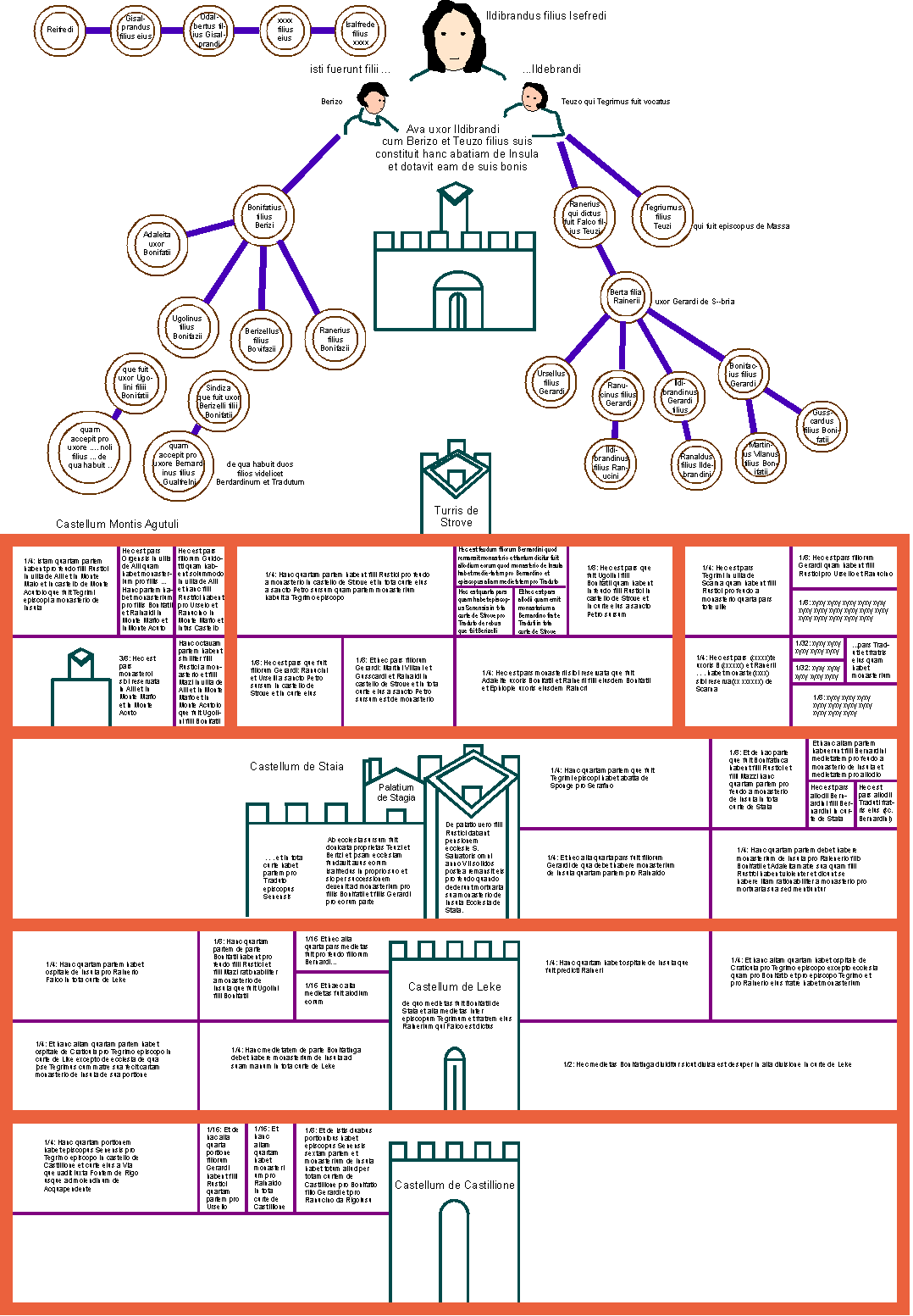
A remarkable infographic in the Vatican Library describes the co-ownership of nobles and Benedictine monks of the former Abbey of Isola near Siena in Tuscany, Italy. The document, which I first read about in Christiane Klapisch-Zuber's L'Ombre des Ancêtres, comprises a stemma of Hildebrand, whose widow Ava founded the monastery, along with a detailed scheme of property division. It was drawn up in or shortly after 1160.

I have created a digital sketch of the document (PNG below, zoomable detailed version on my website). The colours were arbitrarily chosen, since this version was made from black and white photographs. For a better idea of how Hildebrand and his two sons, Berizo and Teuzo, are supposed to have looked, see the original (link below, with caveat). The orange-bordered panels represent the ownership shares in six blocks of property:
  • the Castellum Montis Agutuli
  • the Turris de Strove (Strove is the next village)
  • the Villa de Scarna (just to the west)
  • the Castellum de Staia (the small town of Staggia to the north (map))
  • the Castellum de Leke (further north, at Lecchi (map))
  • the Castellem de Castillione

Hildebrand (Ildibrandus) was a Lombard, which explains the Germanic names of his ancestors and his descendants all the way through the document. The six semi-monastic properties (five of which are illustrated with a little sketch that probably summed up salient architectural features of the principal building) were progressively divided into half-shares, quarters and so on. The most extreme divisions are 1/32 of a whole. The rectangle area indicates the degree of division. The transcription is based on that published by the late Wilhelm Kurze, and I have preserved his fractions where space allows. There are of course no Arabic numbers or fractions on the document, but including them here makes the divisions more understandable.

The affinity of the stemma at the top of the document to the Great Stemma is unmistakeable: the roundels are all composed of two rings, and the names in them are generally written in the form Y filius X. The lines can either proceed left to right or top to bottom. An especially interesting feature here is the graphic separation of Adelheid, wife of Ugolinus, and of Sindiza, wife of Berizellus, from the rest of the stemma. They are not joined to it by the usual lines. The children of their second marriages were not connected by blood to Hildebrand, but did inherit property rights through the mothers. I have moved these into better alignment to make this aspect of the infographic clearer, but this reconstruction is as close as possible to the original in every other way.

Kurze gives the following manuscript reference: S. Eugenio - Rome, Bibl. Vat. Cod. Vat. Lat. 8052 (Galetti) Cop. saec. XVIII. In dorso: Descriptio et pictura fundatorum abbatie Insule et eorum descendentium que predia relinquerunt predicte Abbatie.

As far as I know, there is only one image of it online, on the Portale di Archeologia Medievale, but this is something of a disappointment. This image seems to have been digitally altered: not only are important areas at the edges cropped away, but the top three property blocks have been seamlessly edited out of the middle of it, without any explanation. (If you find a more faithful image of the document on the web, particularly one at higher resolution, please tell me by writing a comment below!)

Kurze mentions one facsimile edition. The document is reproduced in low-resolution black and white in Violante's article and at an even smaller scale in Klapisch-Zuber's book. In my view, text-only publications cannot adequately convey how the infographic works: a technical drawing is needed. Violante's crude sketch only adds to the confusion and from Klapisch-Zuber's account I mistakenly thought at first that a kind of treemap was in prospect. The property-division part of the infographic, which maps the legal concept of sharing onto two-dimensional space, is in fact a much simpler concept, but nevertheless quite clever. I do not know of any earlier documentary examples of the technique. Please comment if you can suggest any.

This is the only medieval document I have transcribed so far where the place of origin is absolutely clear. The monastic institution where this document was drawn up after 1160 no longer exists, but many of the buildings are still there and can be visited, a short drive away from Siena (tourist description, location, video). The structure depicted at the top of the chart, below Hildebrand's face, is the abbey itself, which was much rebuilt but partly survives. The castle of Staggia has a battlemented tower just like those in the document. I recommend you follow these links and enjoy the images which Google Panoramio pulls up.

Kurze, Wilhelm. “Der Adel und das Kloster San Salvatore all’Isola im 11. und 12. Jahrhundert.” Quellen und Forschungen aus Italienischen Archiven und Bibliotheken 47 (1967): 446–573.
Violante, Cinzio. “Quelques Caractéristiques des Structures Familiales en Lombardie, Émilie et Toscane aux XIe et XIIe Siècles.” In Famille et Parenté dans l’occident médiéval, edited by Georges Duby and Jacques Le Goff, 87–148. Rome: École Française de Rome, 1977.
Klapisch-Zuber, Christiane. L’Ombre des Ancêtres. Paris: Fayard, 2000: 98-101.
Cammarosano, Paolo. “Gli Antenato di Paolo Diacono.” In Nobiltà e chiese nel medieoevo e altri saggi. Scritti in onore di Gerd D. Tellenbach, edited by Cinzio Violante, 37-45. Rome, 1993.

2012-02-18

Peter's Compendium

So far this blog has not directed much attention to the Compendium historiae in genealogia Christi, a 12th-century work by Peter of Poitiers which presents a completely new stemmatic diagram. Peter was a believer in the Trinubium, the three marriages of St Anne, and his vast genealogical infographic went into wide circulation in medieval Europe. There is no evidence the Compendium is adapted from the Great Stemma, though it seems plausible that Peter would have known of the Great Stemma and would have been inspired by it to design his own diagram ab initio.

In his 1943 article in Estudios Biblicos on the Great Stemma, Teófilo Ayuso claims that one of the codices where it is reproduced is a 14th- or 15th-century bible at the University of Barcelona, which his 1943 article terms Barc1, though it later becomes Barc3 in his peculiar numbering. This is online: I found a digital version yesterday. Its call number is Sig. Ms. 762. (There is another fine Barcelona University bible online, Sig. Ms. 856, but this does not contain any stemmata.) Sig. Ms. 762 is described at volume 2, page 308 of Miquel Rosell's printed catalog as follows: Ff. 2-7. Genealogias. Inc.: De Cain. Cain agricola dolens ... Expl.: De Tiberio ..., sub quo Dominus est passus. It also contains an Interpretationes Hebraicorum Nominum.

It is clear from only superficial examination that including this bible in the Great Stemma camp is another of Ayuso's blunders. The Barcelona bible very clearly contains the Compendium diagram, not the Great Stemma.

This can be readily seen by comparing it to other codices. There are several good online presentations of the Compendium. An impressive one is Ms Typ 216 at the Houghton Library of Harvard University, a roll-manuscript (probably intended for use as a wall-chart). It can be viewed in sections here.

There is a finely drawn 12th-century (?) version in codex form in the Biblioteca Medicea Laurenziana in Florence, spread over 10 pages in an anonymous seven-folio document, Plut.20.56 (5v is the final page of the diagram). An early 13th-century manuscript from England now in Paris, Lat. 15254, contains the same chart. I expect there are many others, but this is what some searching today turned up. [An excellent starting point is Nathaniel Taylor's survey, and I see the Met Museum also has a damaged scroll which is online in low resolution.]

As far as I know, there has been no printed version since the rather inaccurate editio princeps of the Compendium published by Zwingli in 1592, which differs in signal ways from the manuscripts above. MDZ offers it digitized. I have not done a bibliography on the Compendium yet, but it is discussed at length by Christiane Klapisch-Zuber in chapter 6 of L'Ombre des Ancêtres and there are some articles mentioned in a footnote by Stork.

2011-12-07

Hypothetigraphy

Many theories of diagrams are limited in scope to just one or two manifestations of abstract drawings. Diagrammatic representation of numerical data has been well studied since Edward Tufte's Visual Display of Quantitative Information, but stemmatic drawings like the Great Stemma are rarely well explained. I have been impressed at the theoretical work of Manfredo Massironi (1937-) of the University of Verona in Italy. Massironi has devised a concept he calls hypothetigraphy to describe drawings that present hypothetical, invisible, abstract ideas. It is presented in his 2002 book, The psychology of graphic images: seeing, drawing, communicating (Link: Google Books). (The English translation from the Italian is not perfect, and sometimes makes no sense: the term itself is sometimes spelled "hypothesigraphy" in the text, varying in orthography from one line to the next (e.g. p. 164), but "hypothetigraphy" is the form used in the headings and index.)

He says he departs from the idea that "illustrating is a way of emphasizing, by visual means, those contents that cannot be effectively conveyed by verbal expression." He proposes that hypothetigraphy has two roles: (a) a connective function (connecting into a unitary pattern a body of knowledge [which is] fragmented and apparently not well organized) and (b) a reconstructive function (reconstructing the various phases of a process for purposes of illustration and interpretation, starting from observable results).
According to my definition, hypothetigraphy defines a rather homogenenous class of drawings, which I call hypothetigraphs ....
The first feature, and one that is most easily noted, is the use of simple geometric figures.... The "true" objects and their appearance are not important in this endeavor, for the phenomena under consideration have to do with relationships and with dynamic interactions between elements.... The shape of elements per se is usually an irrelevant piece of information, which is best left out or represented simply by the most abstract of shapes, the circle.
A second and most immediately noticeable feature of hypothetigraphs is the addition of brief written text to the picture.... The inclusion of written text is always necessary in hypothetigraphy which would otherwise lose its communicative function... Verbal and visual information are inextricably and necessarily connected.
Another distinguishing feature of hypothetigraphy is the the almost exclusive use of precise marks, drawn using the ruler ... Precise, clear lines contribute in conveying the impression that the depicted forms are mental constructs, not representations of natural objects.
Typical of hypothetigraphy is ... the use of object lines ... Object lines are not used to mimic some aspect of reality but to illustrate relationships, correspondences or connections.... Relationships and connections and trajectories ... lend themselves naturally to an interpretation in terms of threads, ropes and connecting cables.
A fifth feature of hypothetigraphy is the number of represented dimensions, which tends to be as small as possible within the constraints of the logic of the representation.
Finally, hypothetigraphy tends to place the viewpoint frontally relative to the picture plane, an tends to present figures without a background.... The second of these ... contributes to focus the attention of the viewer, avoiding unwanted contextual effects.
This is all very useful. The six "features" listed above are all applicable to the Great Stemma:
  1. Its graphic elements are circles of various sizes. They do not represent heads or anything else physical but are entirely abstract, representing generations and dynasties.
  2. Text within the roundels, along the connecting lines and in the final Sicut Lucas evangelista section, is there to expand the effect of the drawn figures.
  3. Its lines are generally straight, except for the final meeting of the two fila, and the whole structure is drawn with a certain sterility to emphasize its abstract meaning.
  4. The connecting lines represent succession, and ramifications where necessary.
  5. The drawing is strictly two dimensional
  6. It has no background colour or images. My attachment of a yellow timeline band to the reconstruction is in fact out of harmony with the austerity of the original.
Massironi makes no mention of the Great Stemma. In fact he does not mention any stemmatic drawings at all. But his observations are so acute that they apply to the stemma without any modification being required of them.

2010-09-11

Old Vellum and Bookselling

A learned article by Richard Rouse and Charles McNelis appeared a decade ago. North African literary activity is subtitled "A Cyprian fragment, the stichometric lists and a Donatist compendium" and incredibly it rounds up four utterly diverse topics in one discussion: the unlikely discovery of a very worn piece of old vellum in a codex binding, Late Antique bookselling, a North African Christian sect and how 19th-century philologists could not see the wood for the trees. The article comes to the conclusion that a lot of the Late Antique bible-handbook and chronographic material we now have was saved for posterity in a single compendium.
Rouse, who is now emeritus professor at UCLA, and McNelis, now associate professor at Georgetown University, suggest a way by which the Great Stemma (that is not of course their name for it) might derive from the Liber Genealogus. It would be nice if this fitted the facts, but we have three signal differences between these works:
  • they use different versions of the Table of Nations from Genesis 10
  • they use different chronologies of the kings of Rome
  • the Great Stemma has none of the Liber's etymological content
Of course the overall structure of the documents is similar, and both evince a fascination with the Twelve Minor Prophets of the Old Testament. It looks as if the latter topic is going to need some further research...

2010-03-31

Plutei Online

It's time to offer a brief review of the online access to the splendid Plutei Collection at the Biblioteca Medicea Laurenziana in Florence. I've found this a boon, since it not only offers images of the manuscripts, but also bibliographies which seem to be generated from a database. An interesting feature is that it offers a history spanning more than 100 years, showing which scholars have worked with each document.

When I look at Plut.20.54 for example, I can click on "MOVIMENTI RECENTI and see recent users. Under MOVIMENTI PASSATI, I can trace back its uses for scholarship to Bernhard Bischoff, and go all the way back to WM Lindsay when he consulted this Isidore manuscript in 1896 while preparing his critical edition. I am sure that here in Germany the publication of library lending records would probably be interpreted as a scandalous invasion of individual privacy and lead to the sacking of all the
high officials and possibly prison terms for the librarians. At the Plutei I find it rather touching. The slips amount to a kind of roll of honour of great philologists.

Not everything is perfectly designed however. I found the scans were not really of a high enough resolution for close analysis. A stemma in the Real Academia in Madrid is available in a fantastic resolution where I can see the pores in the parchment, but the Florence scans are so much inferior that in a few cases I had to guess about the shape of penstrokes in the document.

Secondly, while I do not intend to grumble at the lack of an English interface on the site, I did find it a pity there was no easy way to link to specific pages or to download them for later use. The URL in the address bar of the browser always connects to the first page of a manuscript, not the page you may want to link to. However it is possible to count up the number of page turns between the first page and the page of interest, and add the same number to the pagina part of the URL. In fact one can automate this slightly by copying the URL into Microsoft Excel and then using the fill function to manufacture a complete series of page links for the entire MS.

To make a copy to study when not connected to the internet, I found I had to discover the absolute URL for each image first. This is done by right-clicking the image within the Java interface and looking at the properties. But one cannot save this URL: you have to instead copy it out by hand, character by character, and re-enter it in a browser address bar. Press enter and you now get only the image you want, and can save that as a JPEG file.

2010-03-18

Discoveries

A game-changing discovery, thanks to the launch this month of Plutei Online in Italy. It is gradually publishing digital scans online of nearly 4,000 manuscripts from the Biblioteca Medicea Laurenziana in Florence, plus Bandini's catalogs which were drawn up in the 18th century to describe them. This library possesses not just one stemma as I first thought, but three quite diverse biblical stemma documents. Two are now online. At first glance, they are so important that I will have to re-evaluate what I have already written.