Showing posts with label Manuscripts. Show all posts

2015-03-05

Nearly 100 new digitizations at the BAV


On March 4, 2015, the digital library of the BAV or Vatican Library placed online nearly 100 newly digitized manuscript codices and map folders.

As is usual, there was no public announcement of this. I have no contact with Rome, so I can only speculate as to the reasons for such a silence. It may be that the library's server has a limited capacity and could not cope with the acute surge of requests that would follow any publicity.

Or there may be no funding to conduct public relations for a project that is being mainly funded by corporate and private sponsorship. It is possible too that funding institutions such as the Polonsky Foundation, which has a key role in digitizing the Hebrew manuscripts, wish to make their own public presentations at a later date. Polonsky announced February 24 it had reached the 1-million page mark.

But perhaps there is simply a modest sense at the BAV that this is no big deal yet, given that the project started years ago and the intermediate goal of getting 3,000 manuscripts online may not be met until 2016 at this rate. To get the entire stock of 82,000 BAV manuscripts digitized may take four decades, and at the same time, the BAV has committed to separately digitizing thousands of incunables. (See the presentation of one of the world's oldest printed cookbooks.)

Nevertheless the release is quite remarkable.

Less than a year ago, the manuscripts site consisted only of clones of independent digitizations by the Heidelberg state library in Germany and a paltry 24 Roman manuscripts, as I noted at the time. Today the BAV site offers a total of 1,787 works and has surpassed the tally of digitized manuscripts offered online by the British Library (1,220 at the last tally) or by e-codices of Switzerland (1,233).

Of the 151 collections making up the Rome library (see the BAV’s own list), 50 are now represented in some way in this digital presence.

Using comparison software, I have identified the following 97 newcomers this week. I have added notes on content, which are in some cases guesses more than anything else.
  1. Barb.gr.6, Maximus Confessor, 580-662, Opere spurie e dubbie
  2. Barb.gr.372, Psalter
  3. Barb.lat.2724, Chronicon Vulturnense: Miniatures, most of them showing the handing over of donation charters to St. Vincent, like Bishop John's
    .
    This extraordinary compilation was made about 1130 and tells the history of the monastery at Volturno, Italy (Wikipedia). A monk of the monastery, Iohannes, composed the Chronicle.

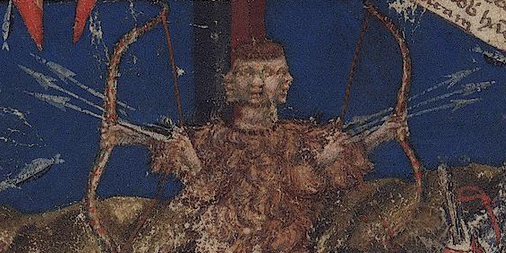
  4. Barb.lat.4076, is an autograph of Francesco da Barberino's Renaissance poem, Documenti d'Amore. Here is a cartoon-style blurred action image showing some impressive rapid-fire archery in all directions:
  5. Barb.lat.4077, More Francesco da Barberino
  6. Barb.lat.4391.pt.B, maps of Roman fortifications in 1540
  7. Barb.lat.4408, working drawings for mural restorations in 1637
  8. Borg.gr.6
  9. Borg.isl.1
  10. Borg.lat.420, Coronation of Clement VII
  11. Borg.lat.561, Life of Roderico Borgia
  12. Borgh.2, texts of Leontius and of Ephraem the Syrian
  13. Borgh.4, Gregory the Great: Moralia in Job
  14. Borgh.6, collected sermons
  15. Borgh.7, Pope Boniface, Decretales
  16. Borgh.9, Porphyry of Tyre and Boethius
  17. Borgh.10, Letters of Seneca
  18. Borgh.11, Order of Consecration
  19. Borgh.12, Works of Godefridus Tranensis
  20. Borgh.13, Works of Abū Bakr Muḥammad ibn Zakarīyā Rāzī, 865?-925?
  21. Borgh.17, Henry of Ghent’s Summa
  22. Borgh.18, Boethius
  23. Borgh.19
  24. Borgh.20
  25. Borgh.23, Italian sermons
  26. Borgh.24
  27. Borgh.25, Vulgate bible
  28. Borgh.26, 13th-century legal text, Apparatus Decretorum
  29. Borgh.27, Gerardus de Bononiensi
  30. Borgh.29, Wyclif?
  31. Borgh.30
  32. Borgh.131, Boethius, Variorum
  33. Borgh.174, 14th century sermons
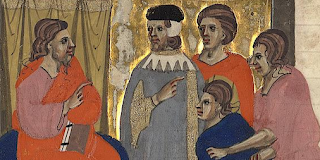
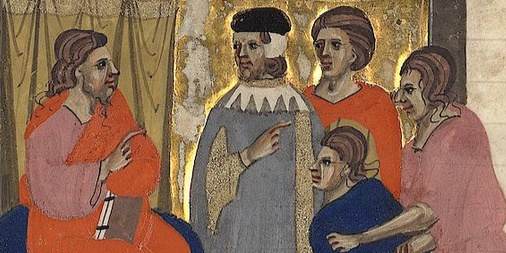
  34. Borgh.372, Glossa on Justinian. Here's a miscreant in blue hauled into court on 147r
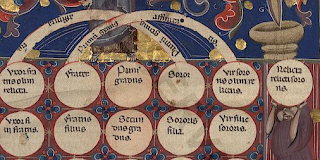
  35. Borgh.374: A 13th-century text of the Emperor Justinian's legal codifications including the Institutions, annotated by medieval lawyers. Justinian was emperor at Constantinople 527-565. Here's a widow under the heavy burden of a no-incest provision in Borgh 374 at 4r:
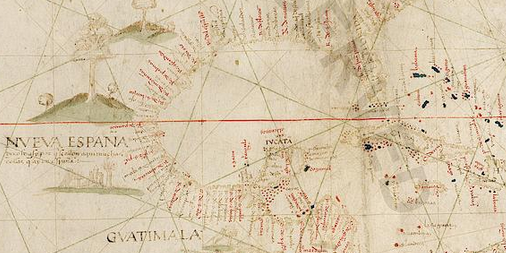
  36. Borg.Carte.naut.III. This is Diogo Ribeiro's 1529 map "in which is contained all that has been discovered in the world until now." Less than four decades after Columbus’s first voyage across the Atlantic, it shows the Americas in detail, but not New Zealand, which the Dutch explorer Abel Janszoon Tasman was not to document until l642 and which James Cook was not to circumnavigate and map until 240 years after this map was drawn. Jerry Brotton's History of the World in Twelve Maps features it.

    Unfortunately the resolution of this digitization, welcome as it is, falls short of what one would hope for. The section above is the Gulf of Mexico, and it is impossible to zoom in far enough to read the place-names. I would presume the map has been scanned at much higher resolution, and I hope @DigitaVaticana can upload this so that the fourth and closest zoom level provides legible text.
  37. Chig.B.VII.110
  38. Chig.C.VII.213
  39. Chig.C.VIII.228
  40. Chig.P.VII.10.pt.A
  41. Ferr.30, letters of Giuliano Ettorre
  42. Ott.gr.314
  43. Ott.lat.1050.pt.1
  44. Ott.lat.1050.pt.2
  45. Ott.lat.1447
  46. Ott.lat.1448
  47. Ott.lat.1458, Ovid’s Metamorphoses
  48. Ott.lat.1519
  49. Pal.gr.55
  50. Pal.gr.135
  51. Reg.gr.80
  52. Reg.lat.88, French chronicle
  53. Reg.lat.695, Life of St. Denis
  54. Reg.lat.720
  55. Reg.lat.721
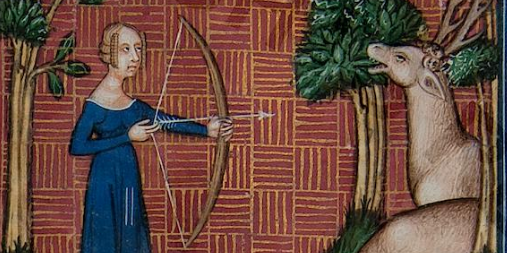
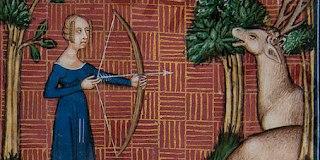
  56. Reg.lat.1480, Ovid in French, illuminated. Here's one of the fine pictures (folio 156r). I think it is Diana about to sock it to Actaeon, who will be trying desperately to explain that he is not a stag. With those feeble arms, she really ought to spend less time at home curled up on the couch and more time at the gym:
  57. Ross.61
  58. Ross.70
  59. Ross.74
  60. Ross.181, Missal from St Peter's Monastery, Erfurt, Germany, datable to about 1200: see the post on this by Klaus Graf (reproduced below as comment) with a search that points to comparable missals in German archives and the influence of Conrad of Hirsau, a Benedictine author, on the German scriptoria.
  61. Ross.186, Gilbert of Hoyland
  62. Ross.198
  63. Ross.206, Psalter
  64. Ross.292
  65. Ross.553, Hebrew Ms.
  66. Ross.554, illuminated Hebrew Bible
  67. Ross.556, Hebrew Psalter
  68. Ross.733
  69. Ross.817, Gilles Bellemère
  70. Urb.ebr.2, Kennicott-Rossi 225 according to @RickBrannan
  71. Urb.ebr.4
  72. Urb.ebr.5
  73. Urb.ebr.6
  74. Urb.ebr.7
  75. Urb.ebr.8
  76. Urb.ebr.10
  77. Urb.ebr.11
  78. Urb.ebr.12
  79. Urb.ebr.14
  80. Urb.ebr.15
  81. Urb.ebr.17
  82. Urb.ebr.18
  83. Urb.ebr.19
  84. Urb.ebr.21
  85. Urb.ebr.22
  86. Urb.ebr.23
  87. Urb.ebr.24
  88. Urb.ebr.26
  89. Urb.ebr.28
  90. Urb.ebr.29
  91. Urb.ebr.30
  92. Urb.ebr.31
  93. Urb.ebr.37
  94. Urb.ebr.38
  95. Urb.ebr.39
  96. Urb.ebr.40
  97.  Vat.ebr.71, Ḳimḥi, David ben Yosef, c.1160-c.1235, Commentary on Latter Prophets
There is so much here that it will take some time to trawl through all the digitizations. If any codex which I have listed is of especial interest to you, why not use the comment box below this post to briefly introduce it and explain its importance to other readers.

Follow me on Twitter (@JBPiggin) for more news of these digitizations. [This is Piggin's Unofficial List 4.]

2015-02-28

Hungary's Week in Rome

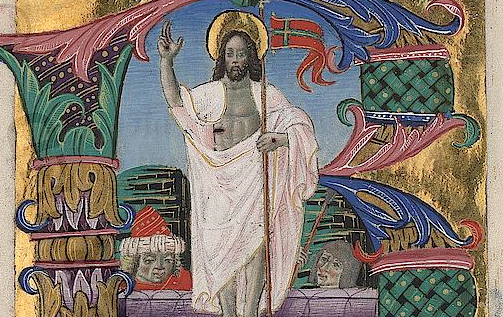
This was a special week for Renaissance studies in Hungary. An extraordinary book of art, the Hungarian Angevin Legendary, Vat. lat. 8541, arrived on the web, as I pointed out in an earlier post. With it were two important illuminated missals associated with the lost Bibliotheca Corviniana, the library of Hungarian King Matthias Corvinus (1458-1490). One, Urb. lat. 110, was made for the king in 1488 and is known as the Missal of Matthias Corvinus. The other, Ross. 1164, was pointed out by and is known as the Franciscan Missal. Below is an image from Urb. lat. 110 of a silver-skinned Christ at the resurrection.
has written a blog post introducing the two missals and I am grateful to him for the information about this group.

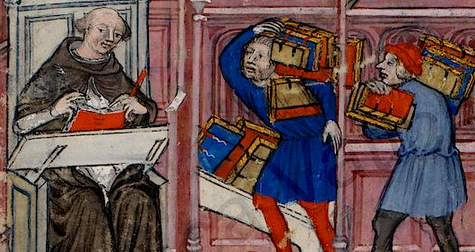
Two fine French Renaissance manuscripts were also brought online, both of them French translations of Latin works. One is Reg. lat. 538, a translation of the Speculum Historiale, a medieval history of the world, by Vincent of Beauvais, and there is a wonderful image in it where the artist imagines Vincent calmly writing while research assistants or socciii struggle to keep up with his demands for more books. There's a bit more about it here. There is a similar codex at the British Library.
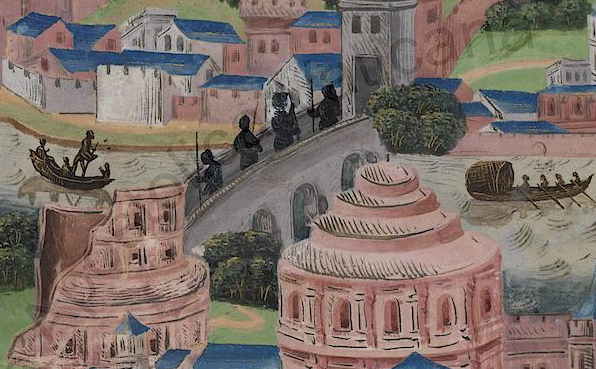
Also newly digitised is Reg. lat. 719, a translation by Pierre Bersuire from the Latin of Livy's History of Rome. The Bersuire book has a wonderful imaginary landscape of ancient Rome (below) as a medieval artist might imagine it with a river through a paradise of green that looks most un-Roman. Both these codices are principally of interest for their illuminations rather than their text.
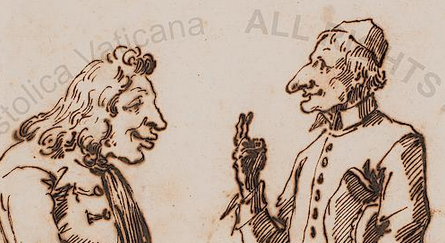
Finally, I took note of a couple of more modern documents from Italy. A book of caricatures by Pier Leone Ghezzi (1674-1755), Ott. lat. 3113, marks out Ghezzi's extraordinary talent as a cartoonist. Look at the fleshy marchese at left in this image and you see his whole life of over-indulgence.
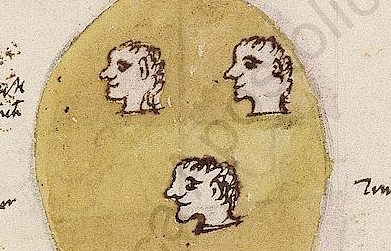
Also in my pick is a curious compilation, Reg. lat. 1468, of Italian family coats of arms (a thing which happens, by the way, to be called a "stemma" in Italian, which is not very logical, but that is the way it is). Here is an escutcheon which has three men's heads looking left on a mustard field. The different chin shapes are doubtless just a fancy of the artist.
In all, 64 new codices were digitized and published online on Digita Vaticana this week. Something else I sighted in this rush was a pair of large sheets from Vat. lat. 9848. It is no more than a wild guess, but these folios seems to be either sketches or tracings of monumental art, possibly from a Rome church. All that's online are these two sheets, recto and verso. Also new, but merely noted, is Ott. lat. 2919, a book of hours. [This is Piggin's Unofficial List 3.]

Portolan Charts of Pietro Vesconte

Among the finest things to be made available online this week from the Biblioteca Apostolica Vaticana (BAV) digitization programme in Rome is a codex, Vat. lat. 2972, which contains portolan charts which though unsigned can be reliably attributed to the remarkable mapmaker Pietro Vesconte and dated to about 1320.

Portolan charts are, for all intents and purposes, the first true western maps. Everything that precedes them, ought, in my view, to be classed as geographical diagrams.

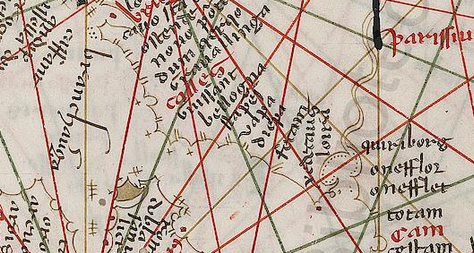
A portolan chart was something novel and unprecedented, showing the world deskewed and to scale. Geographical diagrams like the BL's Psalter Map of 1265 (see this flash version) showed the human world as mentally represented. By contrast, portolan charts, with compass lines superimposed, show the physical world as one navigates it, with the entire coastline of a sea fully labelled without regard for the social standing of the places on the coast. When a vessel is trapped by a landward wind, any of the places here offers a potential haven on a lee shore. The Vat. lat. 2972 codex contains an atlas of five sheets and is part of Marino Sanudo's Liber secretorum, a book devoted to a mad plot to destroy the Muslim world. Here is the atlas version of the English Channel (folio 110v):
In the middle you see Dumqerqo (Dunkirk), Gravallinga (Gravelines), Calles (Calais) and Bellogna (Boulogne), and at right Parissius (Paris) and Cam (Caen).

Tony Campbell, former map librarian of the British Library, wrote a fine descriptive summary about portolan charts earlier in February on the Pelagios blog while presenting the portolan component of the Pelagios project. He tells us at least one portolan chart from the very end of the 13th century survives. The BAV's, from just two decades later in 1320, will likely become a prime reference on the internet. Yale has a later chart from 1403 online.

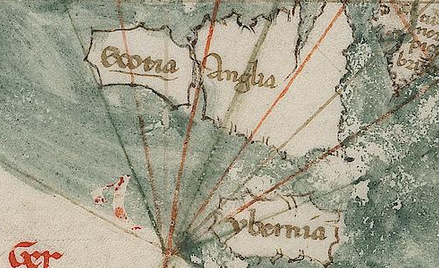
Curiously, Genoa-born Vesconte also did mappaemundi similar to that in the Psalter Map. He was on the cusp of the transition from old to new. Here are the British Isles in his Vat. lat. 2972 mappamundi. Since this map (112v) has east at its top, Ireland (Ybernia) is at the bottom of this grouping:

Update

I have tried to tag all the places on the continental coast in the portolan chart above, but some defeat me. Here is what I have resolved, after consulting Campbell's general toponymic listing:
#Bruges
? (Cavo Sta Catalina identified as Pointe de Zand by Campbell. Not clear what St Catherine's; the source document would have been Portuguese.)
#Oostende
#Nieuwpoort
#Dunkerque
#Gravelines
#Calais
#Wissant
#Boulogne
#Étaples
? (vapa identified by Campbell as Port St. Quentin or Eu.)
#Dieppe
#Fécamp
? (no port marked; Campbell proposes Chef de Caux)
? (no port marked, so "loira" may be an inland place)
#Quillebeuf
#Harfleur (on wrong side of Seine!)
#Honfleur
#Touques
#Caen
#Ouistreham

Some of these ports no longer exist, the rivers having later silted up and become unnavigable, leaving coastal areas that today are mainly a zone of holiday beaches.

Tony Campbell published a major new article on March 2, 2015 on the Carte Pisane, which is traditionally regarded as the oldest portolan chart, but is now the focus of controversy. He sets out arguments as to why it should be dated to the very end of the 13th century.

2015-02-17

Is this the world's oldest bound book?

This was the week when the Vatican's library, the BAV, made available online digital images of what is perhaps the world's oldest intact, large, bound book, the Codex Vaticanus. It contains a handwritten text on 759 vellum leaves and is generally estimated to have been made in the second quarter of the fourth century (325–350 CE).

That it survives is amazing. That no one noticed what the Vatican was doing is almost more amazing. But more about that later.

During the 19th century, the BAV customarily only allowed visitors to touch this treasure under guard, so great was the fear that it would be stolen or damaged by a religious fanatic. Scholars grumbled at this, but the librarian's suspicions were not ill-founded. That anybody with web access can now read it without a couple of muscular young clergymen staring at the back of their neck as if they were a terrorist is a wonderful transformation.

The codex contains the Christian Old and New Testament in Greek and is comparable in age and significance with the Codex Sinaiticus, which got its own lush online presentation five years ago.

One can toss up as to whether the Vaticanus or the Sinaiticus is the oldest substantial bound book in existence, but the Vaticanus is the one in better shape, since it is still in one binding. The Sinaiticus got dismembered in the 19th century by the sort of scholar that the Vatican wisely never trusted (see above) and is now divided between four countries.

Neither book has a production date on it, so their ages can only be guessed from palaeographic evidence. Wikipedia's substantial description argues Vaticanus contains more antiquated features and is the older of the two, although one scholar, T.C. Skeat, propounded a theory that the two codices are contemporary and both come from the Late Antique scriptorium of Eusebius of Caesarea.

At the start of this post, I said the codex may be the oldest bound book. The qualification is important since books as we now know can come in three forms: scroll, codex and e-book.

I would have seen my first e-book at the Frankfurt Book Fair about 30 years ago and thought it a strange new thing, and the first owner of the Codex Vaticanus might have seen his first codex used for a scholarly purpose and thought it was a strange thing 30 years before he commissioned this very special codex for himself.

It is generally suggested that codices -- that is, books made of flat pages between two boards, bound at a spine -- began to outnumber the earlier technology, the scroll, in about 300 CE.

So "books" older than the Codex Vaticanus do survive: in scroll form, or as isolated pages torn from codices, among them the Chester Beatty papyri. But if you were to ask me where to find the world's oldest book -- meaning a thing between two covers, which is what most of us would mean -- I would point you to Rome, BAV, Vat. gr. 1209. Look at it and marvel.

On February 16, 2015, the BAV added 31 new items to its stock of online digitizations, raising the total volumes so far to 1,626. The collections added to were Arch. Cap. S. Pietro (10), Borgh. (5), Ott. lat. (1), Sbath. (1), Vat. ebr. (6), Vat. gr. (1, the Codex Vaticanus), Vat. lat. (4) and Vat. turc. (3).

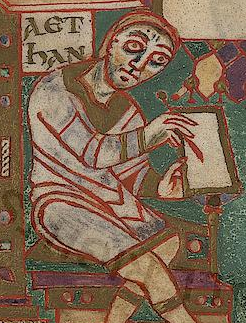
Items in the enormous Vat. lat. series which are newly available are Vat. lat. 83, which is a fine collation of hymns and psalms from the 11th century. It has a wonderful illumination in it of David with harp and the other supposed writers of the psalms, among them Ethan in a sailor suit (right), each with quill and ink-horn and a nifty little mobile desk of the sort that court writers must have used in the 11th century.

Tracking down the psalm authors had always been a matter of interest to Jewish and Christian scholars as we know from my edition of the fifth-century Liber Genealogus.

Also online for the first time are a book catalogue (Vat. lat. 3970) by Cardinal Sirleto (1514-85), a biography of Saint Gerard (Vat. lat. 7660), and a wonderful scrapbook of fragments (Vat. lat. 13501) presumably extracted from old bindings where we see a great variety of writing styles, a palimpsest or two, bits of sheet music and everything else that would have been hurled out in library spring cleanings and landed in this or that medieval book binder's recycling bin.

Sadly, the Vatican Library does not have the time or resources to promote this amazing release. To get in the news nowadays, you need a mass murder, a scandal or PR hype. The sole publicity for the release of the Codex Vaticanus was one modest tweet. Yes, a twiddling, tiny tweet. I suppose that all of the digital project's funds must go into actually scanning the books and getting the files into the servers.

I will keep a continuing watch on what they are digitizing in such honorable secrecy and present an occasional summary on this blog or on my Twitter feed. [This is Piggin's Unofficial List 1.] If you know of anyone else tracking the BAV digitization project, I would be happy to contact them.  Follow this blog, or follow me on Twitter @JBPiggin and I will keep you up to date.

This post originally ended with some debate on the "oldest bound book" hypothesis, but since that material grew so long, I have moved it to a separate blog post.

2014-11-02

Floreffe Bible now Online

The only way that we know that a graphic artist – or studio – in the fifth century CE drew a magnificent chart of biblical history and genealogy is from the later copying of that work onto parchment manuscripts during the medieval period. Fortunately, 24 such copies are still in existence.

Since I began studying the Great Stemma in 2009, there have been constant advances by museums, archives and libraries in bringing digital versions of this chart online. The British Library has now added the Bible of Floreffe Abbey to its collection of over 1,000 online manuscript digitizations. This must have happened rather quietly, as I have not seen it mentioned in the BL blog yet.

For the study of the Great Stemma, this is a rather important development. Until now, just seven of the manuscripts had been issued online, but nowhere on the internet could one study a peculiar evolution of the Great Stemma into what I call the "School Stemma," a revision of the graphic to bring it in line with orthodox, 12th-century doctrine about the ancestry of Christ.

The Floreffe Bible contains a beautifully coloured version of the School Stemma, with exquisite script that faithfully reproduces all the defects and nonsenses of whatever text it was modelled on. Check it out and page through its glories.

We do not yet know where the revision took place. I call it the School Stemma because I guess that it was "cleaned up" so it could be safely taught to impressionable young monks. Charts containing this version also come from Parc (now Belgium), Foigny in France and Burgos in Spain. The chart may also have been copied at Arnstein, Germany as well.

As a result, I have revised my table of Great Stemma manuscripts, doing a good deal of re-arranging to make the layout more user friendly. It will be clear after consulting the table that not only are eight of the 24 manuscripts now available online and readable in their entirety, but that these neatly cover six of the seven recensions (alpha, beta, delta, gamma, epsilon and School). Additionally, the sigma recension is online at the BNF, though the resolution there is too low for a visitor to read the script.

As a result, the Great Stemma can now be seen on the internet in its complete range of forms. By the greatest of good luck, the four manuscripts which offer the best evidence about the fifth-century ur-form (Plutei, Roda, San Millàn and one of the School group) are now all accessible. One could hardly wish for more.

My table tabulates all these online witnesses. The amber-gold squares in the table mark all the high-resolution images where you can click through to each archive's website. The paler yellow squares mark low-resolution images and snippets.

Happy clicking.

2014-02-15

Lost Leet Records Rediscovered

Mostly I post here about medieval documents and what they reveal about the history of information design, but I will stretch the ambit today to tell you about the remarkable rediscovery last month of a set of early modern documents, the records of the court leets of the three manors of Elvaston, Thurlston and Ambaston in England for 1687-1697. Documentary preservation anywhere is something worth celebrating.

A court leet was an organ of local government, meeting twice yearly to re-appoint officials such as the parish constable and farmland regulators, enact temporary by-laws and punish those who did not repair the fences, clear drains or take part in the common work of a rural economy.

Their records only rarely survive but give us an extraordinary insight into real-life social relationships. What behaviour annoyed the villagers? Did they have the courage to punish rich, powerful people who flouted the rules?The minutes of these meetings, written in various handwriting that suggests the recorders had only limited education, give us some fascinating answers.

It was regarded as cheating to put your cows out to grass on the common before sunrise (your cattle would eat the best grass before your neighbours got up). People were annoyed if they had fixed their allocated sections of fences and gates, or cleaned silt from drains, but neighbours did not do their own share of the task. Letting your animals create trouble on common land was bad, and freeing your livestock after it had been impounded was even worse. The villagers did penalize the most powerful family, the Stanhopes, just as freely as they punished wrongdoers of humble status, so the idea of cowering, subservient, ignorant peasant farmers is not an accurate picture of English rural freeholding.

We know all this, because the papers record the decisions and the fines imposed at community meetings that were an impressively effective form of 17th-century democracy.

The 60 documents have a rather dramatic history of their own. J. Charles Cox, an Anglican clergyman and doctor of law, had the run of the old Derbyshire record room and its priceless collection of quarter-sessions archives in the 1880s while he compiled his two-volume book (full title: Three Centuries of Derbyshire Annals as illustrated by the Records of the Quarter Sessions of the County of Derby from Queen Elizabeth to Queen Victoria, London and Derby: Bemrose and Sons, 1890).

Cox states that the court-leet records were left among the papers of a criminal court, the quarter-sessions, by John Adderley, a contemporary official, although communal farmland administration had nothing to do with criminal justice. The quarter-sessions collection is now in the custody of the Derbyshire Record Office at Matlock. In March 2008, a Record Office archivist, Mark Smith (I'll give you a link below to his blog), undertook a search for the leet records for me, and advised that they were lost.

This led to a very plausible fear, which I wrote about on my family history website, that the papers had been destroyed, lost or stolen during one of the record collection's various relocations:
We can only speculate on the reasons for this. Cox conserved and catalogued many ancient documents, but other people were not so careful. Until the 1950s or 1960s, the archives were not well cared for, and the legacy of the great antiquarians like Cox was neglected. It would seem today as if the Elvaston court-leet records have vanished.
Last month— six years later— Mark contacted me out of the blue with some welcome news: the series of manorial records had been rediscovered. They were in fact still where Cox had found them: among the quarter-sessions records, but it turned out they had been given what Mark called a "rather unhelpful" archival location reference. His colleague Neil Bettridge, who had been working on the Manorial Documents Register for Derbyshire— part of a national project— and had come across them. Mark writes:
Cox was quite right in saying the papers did not belong among the Quarter Sessions records. With that in mind, I have created a new collection number for it, D7687.
A reference to the records can now be found in the Record Office's online catalogue. Liz Hart of England's National Archives tells me that the revision of the Derbyshire section of the Manorial Documents Register is due for completion in late 2014 and will then be made available as an online MDR. I hope the Elvaston court-leets page there will link to my account of the papers on the Piggin.org website.

This lucky find is excellent news for anyone interested in European social history. The court leet records are unusually valuable for their insight into how people 300 years ago conducted collective farming, probably more effectively than in many a Soviet kolkhoz of the 20th century.

The rediscovery also brings a major addition to the documentary record for the charming English village of Elvaston (where there is currently a major dispute going on over the use of a stately home).

And amid the drumbeat of depressing news about archives burning or rotting, it is important news to hear that anything lost for so long has been found again. Mark Smith writes a blog: perhaps he will tell us more about such finds.

And since you are reading about this on a history-of-information-design blog, what do the papers tell us about that topic? Although Cox sneers at the "uncouthness of the handwriting" (John Adderley merely signed them in his capacity as steward and kept them), they seem to be drawn up by "uncouth" people with a solid sense of good layout.

Everything is set out on a neat grid. Wide indentation from the left is employed in consistent fashion (useful to guide the eye). The amounts of the fines imposed are set flush right and connected to the offences by leader dashes (both as guides to the eye and to prevent fraudulent alteration). From all of this, we see that even recorders of modest education in the late 17th century understood perfectly the need to employ modular design and "waste" some blank space to make a document easy to read.

2013-09-08

Road Trip

Lisa Fagin Davis has begun a blog, the Manuscript Road Trip, exploring US manuscript collections, east to west. It has begun excitingly, and who knows, she may turn up a Petrus Pictaviensis Compendium (my current tabulation) or some other treasure as she proceeds.

Lisa is the author of a new book appearing this year, La Chronique Anonyme Universelle, which explores one of the post-Petrus diagrammatic chronicles, compiled around the year 1410 in a French noble library. I'll have to look at her study, since the Compendium, and before that the Great Stemma, are clear roots of this tradition. I'm also curious about what the publisher calls "an innovative image-annotation platform" that allows this roll to be published digitally along with the book.

2013-07-09

Vetus Latina at St Gallen

A highlight of this week's visit to the Stiftsbibliothek in St Gallen in Switzerland was to see in a glass case one of the leaves from the library's early fifth-century manuscript of the Vulgate translation of the Gospels. This manuscript, Cod. Sang. 1395, comprises parchment fragments recovered from St Gallen bindings. The digitized pages can be viewed online.

As the guide noted, the existence of the manuscript, estimated to have been penned in 410 or 420 CE in Verona, Italy when Jerome of Stridon was still alive in Bethlehem, is one of the great sensations of book history. That date is so old that it precedes by about a decade the compilation of the Great Stemma (which of course employs Vetus Latina, not Vulgate terms in its genealogical and chronicle material). Vetus Latina materials were also shown as part of the special exhibition, Im Anfang War das Wort.

I was very interested to leaf through the recently published Die Vetus Latina-Fragmente aus dem Kloster St. Gallen, a book of facsimile pages and commentary edited by Rudolf Gamper.

A striking feature of the permanent exhibition was an image of the so-called Verbrüderungsbuch, Cod. Fab. 1, which is digitized and available online. This contains lists of deceased monks of St Gallen and up to 60 other monasteries for whom the community prayed. As the online catalog notes, "starting in 830 the names of monks who joined the monastic community were listed in the empty canonical table frames."

Presumably the decorative arches were originally drawn on the 31 pages following a model devised by Eusebius of Caesarea. The neatness of the entries seems to decline with time. This use appears to be opportunistic, but elsewhere arches were an intentional meta-informational element. I have not yet got an overview of what range of significances such frames could bring to their content.

Gamper, Rudolf, Ph. Lenz, A Nievergelt, P Erhart, and E Schulz-Fluegel. Die Vetus Latina-Fragmente aus dem Kloster St. Gallen. Dietikon-Zürich: Graf, 2012.

2013-06-23

Pliny Manuscript

Roger Pearse's post also points us to the principal manuscript of Book 35 of Pliny's Natural History where the practice of placing a "stemma" in the entrance area of a patrician Roman home is mentioned at 35.2. The best manuscript of Book 35 is preserved in a very cleanly penned and well preserved codex in Bamberg, Germany.

A digitization can be consulted online. The text on stemmata can be consulted at Perseus, where there is also an English translation. The matching page of the Bamberg codex is 78v, first column.

New Eusebius Tables Coming Out This Year

Roger Pearse mentioned yesterday how "F. Mone" discovered in Austria in 1853 a key palimpsest containing books 11-15 of Pliny the Elder's Natural History. Roger links to a digitization where you can experience for yourself the frustration of trying to read a lower level of writing on an overwritten page.

I think this must be Fridegar Mone (1829-1900), since that is the name on the edition of 1855.  I wondered for a while if it was not the father, Franz Mone (1796-1871). Both men had fascinating, conflict-dogged lives. The elder was a religious controversialist who received manuscript-research commissions. The younger was essentially a manuscript hunter and dealer who was sacked at age 50 and had his "private" manuscript collection (which did not of course include the Pliny palimpsest) seized by the government from his Karlsruhe home in 1886.

Similar discoveries during the 21st century of miraculously surviving manuscripts of lost or semi-lost Latin or Greek works of Antiquity are likely to be the rarest events. The archives of Europe and the Middle East have been scoured so many times by so many generations of scholars that the pickings are now slim.

More likely is the reconnection of unlabelled manuscripts to their Antique authors, such as the discovery a year ago that an anonymous Greek-script manuscript in Munich contains Origen's Homilies on the Psalms, or my own proof that the "medieval" graphic genealogies in Spanish bibles are in fact a 5th-century Latin work.

I mentioned in a previous post that Martin Wallraff's paper revealing his attribution of a section of an Oxford manuscript to Eusebius would soon appear in print. The article will lay bare an Antique work, the Canon Tables of the Psalms, which no one had known about for the past 1,000 years. Professor Wallraff made his remarkable discovery public at the Oxford Patristics Conference in 2011.

Harvard University Press has now announced a publication date for this editio princeps. It will appear as an article in the next issue of the Dumbarton Oaks Papers. This ground-breaking paper will be available from December 16 this year and will be entitled "The Canon Tables of the Psalms: An Unknown Work of Eusebius of Caesarea", the announcement says. Presumably it will be on open access from 2024 under the periodical's web release policy.

2012-12-22

The Amiata Stemma

We can be quite certain that a copy of the Great Stemma was at the Benedictine Monastery of San Salvatore on Monte Amiata in Italy in the eleventh century, because it inspired an author-artist on the mountain to attempt his own adaptation of it, "correcting" it, abridging it and extending its content up to "modern" times.

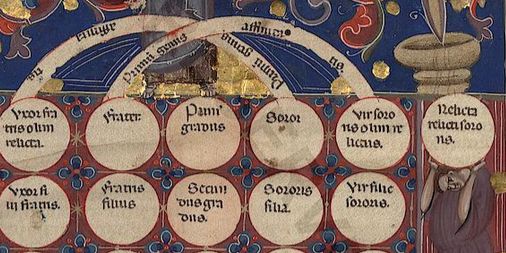
In this update, the structure and essential text of the diagram were retained, but most of the stemmata that fill its central space were discarded and replaced by a vast tableau of successive rulers of the western world in 128 roundels, spanning fifteen centuries from Darius the Great to Henry III. The latter name allows us to date this document, because Henry III must have been the current Holy Roman Emperor when this remix was laboriously copied by the scribes onto four blank folios at the back of a book of commentaries by great theologians on books of the Old Testament. Henry III ruled Germany and Italy between 1039 and 1056. His year of death is added in another hand to a list of kings elsewhere in the same codex.

This graphic adaptation of the Great Stemma scheme for a new age must have existed in multiple copies, but we only possess one of them,which has been penned into a codex which was made and kept at Monte Amiata and is preserved today in the Laurentian Library in Florence under the name Codex Amiatinus 3. The diagram spanning eight pages (ff. 169r-172v) in Amiatinus 3 is demonstrably not the original, because the artist evidently laid out his first draft on a wide scroll, and that is how I have sketched it here:

It is not too difficult to prove that the drawing now spread over eight pages must have once occupied a single sheet. The tableau of 128 kings, which is designed to be read left-to-right in eight rows of sixteen roundels, has been split and placed on two sides of a folio. This obliges a reader who wants to read it in historical order to continuously turn the page back and forth: a situation which would never have been intended by the artist. The split is merely the consequence of sectioning the overall diagram into frames so that it would fit in a codex.

In the above plot, I have drawn a black rectangle around the 128 historic rulers of the west. The succession (it makes many wild jumps) comprises Achaemenid rulers, emperors of Rome, kings of Italy and Holy Roman Emperors. Some of the authors below perceive this as a documentary forerunner to the translatio imperii doctrine.

It is conceivable that this remix (which dispenses with most of the stemmata except for the families of Adam and Isaac) was compiled before Henry III came to power, and was merely updated to keep up to date with changes in political control. The revision contains a list of popes which the scribe has not bothered to update. This roll-call of the papacy ends with Agapitus (pontificate 946-955), so it is conceivable that the re-drawing took place in the middle of the tenth century.

Very little has been published about this document, although a plot of it, not quite as accurate as mine, appeared some years ago in an article by Gert Melville. The latter two authors below appear not to have realized that the abbey possessed a copy of the Great Stemma from Spain which mentions the Visigothic King Wamba. None of them explore the theological position of the Amiata drawing, which rejects the Joachimite account of Jesus's ancestry and restores an orthodox genealogy that exactly follows the text of the Luke Gospel with 42 generations from David to Christ via Nathan.

Gorman, Michael. ‘Manuscript Books at Monte Amiata in the Eleventh Century’. Scriptorium 56 (2002): 225–293: 268–271. Lists the contents of Amiatinus 3 and discusses the Amiata scriptorium. See my earlier discussion of this article in respect of the Liber Genealogus.

Klapisch-Zuber, Christiane. L’ombre des ancêtres. Paris: Fayard, 2000. Discusses the Amiata Stemma at pp. 72-73.

Melville, Gert. ‘Geschichte in graphischer Gestalt. Beobachtungen zu einer spätmittelalterlichen Darstellungsweise’. In Geschichtsschreibung und Geschichtesbewusstsein im späten Mittelalter, edited by Hans Patze, 57–154. Vorträge und Forschungen / Konstanzer Arbeitskreis für Mittelalterliche Geschichte 31. Sigmaringen [Germany]: Thorbecke, 1987. Contains a drawing of the Amiata Stemma on a fold-out, making clear that Melville also interpreted it as a single-page diagram. Given the work that went into the plot, one is surprised by the brevity of the discussion at pp. 66-67.

2012-11-11

An Ideological Kernel

A new article on the Great Stemma was published last year in Spanish, as I see from a new web search. In it, Helena de Carlos Villamarín seeks the reason for the inclusion of the diagram in the Codex of Roda. She argues that the diagram is the "ideological kernel of the Codex" and "points to the typological meaning of the textual ensemble, showing one of its interpretative clues to be the opposition between the Old and New Testament."

Perhaps. She says she is discussing all this "sin entrar a profundizar en el posible origen de estos textos o en sus avatares de transmisión". I would think that ignoring the possible origin of the genealogical diagram and its transmission history might make her interpretative argument rather vulnerable.

There is nothing wrong with speculating about the theological intentions of the Codex compiler, and de Carlos certainly knows the Codex as well as anyone today (this is her third published scholarly article about it), but surely one needs to also discuss what customers of the 10th-century book trade wanted (this was an expensive book to make), what was available for inclusion and why an illustrative frieze like the diagram was esteemed.

If the Christians of 10th century northern Spain knew that the diagram was of patristic origin, were aware that it had once existed in roll form and where it had been displayed, or even regarded it as an authoritative source, they might have used the diagram as a core document of their belief. If it was little known or obscure, it might have been taken up merely because of its decorative value. The errors in the diagram as copied leave the question open: did it go uncorrected because it was too authoritative to alter, or because the editors had a cavalier attitude to it?

The article is: "El Códice de Roda (Madrid, BRAH 78) como compilación de voluntad historiográfica". Edad Media: revista de historia, ISSN 1138-9621, 12 (2011), pp 119-142. Accessible here from Dialnet (which is an academic digitization portal, not a mobile-phone provider). (De Carlos's and other recent articles on the Codex by various authors are listed on Regesta Imperii.)

While I would not have expected de Carlos to have discovered my own Great Stemma research, which did not began to arrive online in bulk until 2010, I think she ought to have cited Christiane Klapisch-Zuber's L'ombre des ancêtres (2000) rather than an exploratory article published in 1991 by that author after her 1985-1986 Villa I Tatti stay in Florence. Klapisch-Zuber does not include the 1991 article any longer in her selected publications.

Admittedly my Spanish is too basic to go beyond the broad lines of argument of de Carlos, who teaches philology at the University of Santiago and edits an annual journal, Troianalexandrina, I find her re-interpretation of the genesis of the Codex an interesting contribution to the debate about the Great Stemma. In essence, she argues that the Codex contains two elements in tension: worldly history and biblical history, with a monastic editor trying to align them in a kind of harmony.

What I would have liked to see included would be some analysis of the diagram's history in Spain, including the known sightings of it in 772 and 672. Whether the Great Stemma in its 10th-century form really had kept its purely biblical character could also be debated. The Eusebian chronology and its synchronisms had long been introduced into the diagram by this stage via the Ordo Annorum Mundi. The version of the Great Stemma in the Codex of Roda is the closest in Spain to the lost original, and second only to the Florence version of the diagram as a witness, but we should not lose sight of the fact that the work was already at least 550 years old when the parchment for the Codex of Roda was still lying blank on a scriptorium shelf.

2012-06-15

A List of Peter Manuscripts

I have previously briefly mentioned the Compendium genealogiae of Peter of Poitiers. This roll, probably designed to hang on walls, shows the genealogy of Christ, with Adam at the very top and Holy Family at the bottom, linked by stemmatic lines.

As far as I know, the biggest recent listing of available manuscripts was compiled by Laura Alidori in 2002, before many of them had been digitized. I decided to update the list, and at the same time found that the digitized catalogs of German archives identified a good many more manuscripts which appeared to belong on the list. So far the total number is running at 185, and I suspect this is not exhaustive.

The list is on a new page of the piggin.net website, and as always, I welcome corrections or additions. The most impressive digitized version is that at the Houghton Collection in Harvard, Massachusetts.

I have not yet explored the differences between Peter's original and the roll-form Chronique universelle d'Orléans or the Histoire sainte abrégée. There are some interesting online images of the latter at Lyons (enter 863 as the search term).

A comparison with Dan Embree's list at Repertorium Chronicarum may help to weed out what does not belong. On the positive side, Embree allocates the various chronicles to authors. On the negative side, his list does not appear to be so all-embracing.