Showing posts with label Maps. Show all posts

2016-07-28

Summer of Ptolemy

Until about 25 years ago, it was unreflectingly supposed that the ancients used maps. It has now gradually achieved acceptance among historians (but perhaps not yet in the wider public) that scaled maps as we use them today are a cultural invention, attributable in the West at least to the medieval and modern period.

That is not to say that the ancients did not understand the idea of a map.

The archaeological record indicates that diagrams showing land from a birds-eye perspective were normal enough, but they tended to be schematic like our urban-train-line diagrams. The Turin Papyrus Map shows gold mines in Egypt. The gromatici of Classical Rome drew scaled survey plans. The 3rd century Forma Urbis Romae was the acme of such work, amounting to a plan of all Rome. But these showed land as contiguous property, not as a surface to cross from A to B.

The use of a large-scale map as a navigation aid was either not widely understood or rejected as ridiculously complicated to set up and deploy. Sailors noted bearings and relied on them. Land travellers perused itineraries, not maps. Late Antiquity created the Peutinger Diagram, a schematic of routes in the whole known world, but it was not made to scale.

Ptolemy, who seems to have lived in the 2nd century, wrote out a method for applying scale far larger than that of the gromatici to make maps of the world, and collected the longitudes and latitudes taken by sailors and travellers in about 8,000 locations in Europe, Africa and Asia to do so. He was far ahead of his time and was not followed. From an ancient perspective, the idea must have seemed counter-intuitive: in a world where 90 per cent of the land and all of the sea was empty waste, why employ time and costly papyrus to "dwell" on it?

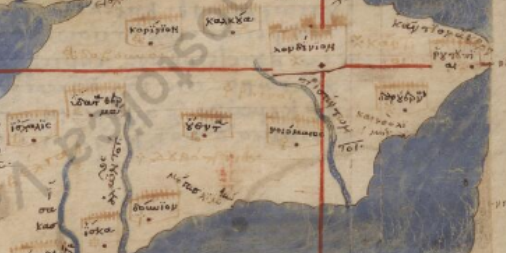
A millennium later, the great scholar Manuel Planudes (c. 1260 – c. 1305) created maps from Ptolemy's geographical data. We now doubt that Planudes saw any Ptolemaic originals.

Among the most wonderful possessions of Federico da Montefeltro (1422-1482), the duke of Urbino and fabulously wealthy book collector, was a superb manuscript from about 1300, Urb.gr.82, preserving the Geography of Ptolemy (text) and the Planudes maps. It is one of the most important manuscripts of Ptolemy, preserving what is known as the Omega recension, and is known as U.

U came online as part of the digitization of the Vatican Library only a few weeks ago. Here is how it shows the region of London and the English Channel:

Federico owned a second copy (he was rich enough) made in the 15th century, Urb.gr.83, based on this recension, with 64 smaller regional maps and four large additional maps. This codex featured two decades ago in the Rome Reborn exhibition. It was uploaded to the online portal on July 26, 2016. Here is its take on the same region:
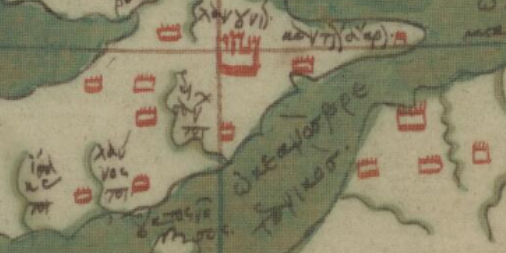
The Vatican is the essential place to go to recover the Geography. It also owns an essential manuscript of the Xi recension, Vat.gr.191, fols 127-172, or X, also online, but without maps, the arrival of which I covered in a blog post one year ago. The closely related A (Pal.gr 388) has not yet been digitized, nor have Z (Pal.gr. 314), V (Vat.gr. 177) or W (Vat.gr. 178).

For more details of the key manuscripts, see the Hans van Deukeren page. and also check the Daniel Mintz page. The definitive edition of the Geography was published by Stückelberger in 2006.

2016-07-27

Surpassing 5,000

With an enormous and unexpected display of energy, the Vatican Library released 253 new digitizations online on July 26, 2016 to surpass the bar of 5,000.

Only philanthropy can make this happen. The key assistance appears to be coming from NTT Data, the Japanese software company, which this month put some pepper in the fund-raising programme by announcing an attractive incentive for large donors: an ultra-close facsimile of a page from the Vatican Vergil (to be made by Canon). Contribute if you can: it will take immense resources and years of work to bring all 80,000 Vatican codices, rolls, papyri and sheafs of letters online.

Remarkable in this surge is the sudden arrival of 166 manuscripts from the great Renaissance library of Federico da Montefeltro (1422-1482), duke of Urbino, whose Italian library was perhaps the most costly cultural institution of his age. A new collection where digitization has just started is the Pergamene di Terracina.

The posted total of 5,131 continues to understate the true extent of the digitizations, as it does not include the many Pal.lat. manuscripts now online in an ancillary programme or isolated cases such as the Vatican's Bodmer Papyrus VIII. Here is the list of new arrivals:
  1. Arch.Cap.S.Pietro.B.56 - Details
  2. Arch.Cap.S.Pietro.C.116 - Details
  3. Arch.Cap.S.Pietro.G.33 - Details
  4. Arch.Cap.S.Pietro.G.41 - Details
  5. Borg.copt.109.cass.XIX.fasc.70 - Details
  6. Borg.copt.109.cass.XIX.fasc.72 - Details
  7. Borg.ebr.16 - Details
  8. Borg.ebr.17 - Details
  9. Borg.turc.6 - Details
  10. Borgh.338 - Details
  11. Cappon.131 - Details
  12. Cappon.306 - Details
  13. Ferr.562 - Details
  14. Ott.lat.1210 - Details
  15. Ott.lat.1368 - Details
  16. Ott.lat.1417 - Details
  17. Perg.Terracina.1 - Details
  18. Perg.Terracina.2 - Details
  19. Perg.Terracina.3 - Details
  20. Perg.Terracina.4 - Details
  21. Perg.Terracina.5 - Details
  22. Perg.Terracina.6 - Details
  23. Reg.lat.1500 - Details
  24. Urb.gr.83 - Geography by Ptolemy. Full discussion in my separate blog post. Details
  25. Urb.lat.29 - Details
  26. Urb.lat.34 - Details
  27. Urb.lat.55 - Details
  28. Urb.lat.69 - Details
  29. Urb.lat.77 - Details
  30. Urb.lat.78 - Details
  31. Urb.lat.89 - Details
  32. Urb.lat.94 - Details
  33. Urb.lat.114 - Details
  34. Urb.lat.118 - Details
  35. Urb.lat.125 - Details
  36. Urb.lat.142 - Details
  37. Urb.lat.144 - Details
  38. Urb.lat.163 - Details
  39. Urb.lat.166 - Details
  40. Urb.lat.181 - Details
  41. Urb.lat.211 - Details
  42. Urb.lat.222 - Details
  43. Urb.lat.223 - Details
  44. Urb.lat.233 - Details
  45. Urb.lat.249 - Details
  46. Urb.lat.284 - Details
  47. Urb.lat.290 - Details
  48. Urb.lat.296 - Details
  49. Urb.lat.303 - Details
  50. Urb.lat.304 - Details
  51. Urb.lat.337 - Details
  52. Urb.lat.341 - Details
  53. Urb.lat.351 - Details
  54. Urb.lat.354 - Details
  55. Urb.lat.372 - Details
  56. Urb.lat.407.pt.1 - Details
  57. Urb.lat.448 - Details
  58. Urb.lat.449 - Details
  59. Urb.lat.470 - Details
  60. Urb.lat.472 - Details
  61. Urb.lat.479 - Details
  62. Urb.lat.485 - Details
  63. Urb.lat.489 - Details
  64. Urb.lat.494 - Details
  65. Urb.lat.502 - Details
  66. Urb.lat.503 - Details
  67. Urb.lat.506 - Details
  68. Urb.lat.507 - Details
  69. Urb.lat.509 - Details
  70. Urb.lat.512 - Details
  71. Urb.lat.517 - Details
  72. Urb.lat.518 - Details
  73. Urb.lat.519 - Details
  74. Urb.lat.521 - Details
  75. Urb.lat.533 - Details
  76. Urb.lat.535 - Details
  77. Urb.lat.536 - Details
  78. Urb.lat.540 - Details
  79. Urb.lat.544 - Details
  80. Urb.lat.545 - Details
  81. Urb.lat.549 - Details
  82. Urb.lat.557 - Details
  83. Urb.lat.558 - Details
  84. Urb.lat.564 - Details
  85. Urb.lat.567 - Details
  86. Urb.lat.572 - Details
  87. Urb.lat.573 - Details
  88. Urb.lat.578 - Details
  89. Urb.lat.583 - Details
  90. Urb.lat.587 - Details
  91. Urb.lat.588 - Details
  92. Urb.lat.591 - Details
  93. Urb.lat.593 - Details
  94. Urb.lat.594 - Details
  95. Urb.lat.609 - Details
  96. Urb.lat.611 - Details
  97. Urb.lat.612 - Details
  98. Urb.lat.614 - Details
  99. Urb.lat.622 - Details
  100. Urb.lat.626 - Details
  101. Urb.lat.628 - Details
  102. Urb.lat.629 - Details
  103. Urb.lat.631 - Details
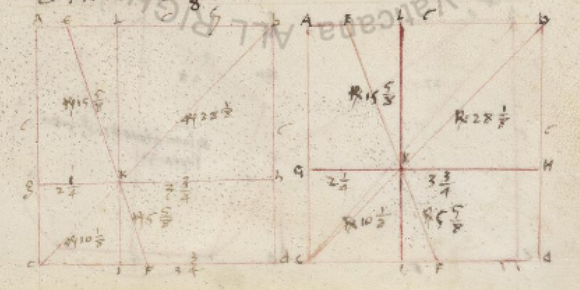
  104. Urb.lat.632 - the sole surviving copy of a treatise on 3D geometry, De quinque corporibus regularibus by Piero della Francesca, one of the card-carrying Renaissance men. Francesca is now known as a notable painter only, but in his time he was also an eminent mathematician. Here is a drawing (apparently by his own hand) from fol. 13r:
    More details in English. This featured in the Rome Reborn exhibition. More on the BAV details page.
  105. Urb.lat.634 - Details
  106. Urb.lat.635 - Details
  107. Urb.lat.636 - Details
  108. Urb.lat.637 - Details
  109. Urb.lat.640 - Details
  110. Urb.lat.641 - Details
  111. Urb.lat.642 - Details
  112. Urb.lat.643 - Details
  113. Urb.lat.646 - Details
  114. Urb.lat.647 - Details
  115. Urb.lat.648 - Details
  116. Urb.lat.649 - Details
  117. Urb.lat.650 - Details
  118. Urb.lat.651 - Details
  119. Urb.lat.652 - Details
  120. Urb.lat.653 - Details
  121. Urb.lat.654 - Details
  122. Urb.lat.655 - Details
  123. Urb.lat.658 - Details
  124. Urb.lat.659 - Details
  125. Urb.lat.660 - Details
  126. Urb.lat.661 - Details
  127. Urb.lat.664 - Details
  128. Urb.lat.665 - Details
  129. Urb.lat.667 - Details
  130. Urb.lat.668 - Details
  131. Urb.lat.670 - Details
  132. Urb.lat.671 - Details
  133. Urb.lat.672 - Details
  134. Urb.lat.675 - Details
  135. Urb.lat.676 - Details
  136. Urb.lat.681 - Details
  137. Urb.lat.683 - Details
  138. Urb.lat.684 - Details
  139. Urb.lat.685 - Details
  140. Urb.lat.686 - Details
  141. Urb.lat.690 - Details
  142. Urb.lat.691 - Details
  143. Urb.lat.692 - Details
  144. Urb.lat.693 - Details
  145. Urb.lat.694 - Details
  146. Urb.lat.696 - Details
  147. Urb.lat.697 - Details
  148. Urb.lat.698 - Details
  149. Urb.lat.699 - Details
  150. Urb.lat.701 - Details
  151. Urb.lat.702 - Details
  152. Urb.lat.703 - Details
  153. Urb.lat.704 - Details
  154. Urb.lat.705 - Details
  155. Urb.lat.708 - Details
  156. Urb.lat.709 - Details
  157. Urb.lat.710 - Details
  158. Urb.lat.713 - Details
  159. Urb.lat.714 - Details
  160. Urb.lat.716 - same content at Urb.lat.717 below - Details
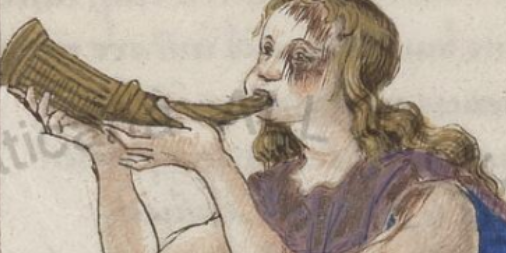
  161. Urb.lat.717 - A book of esotericist poetry, De Gentilium Deorum Imaginibus by Lodovico Lazzarelli, from about 1475. Details in English at SLU. This also featured in Rome Reborn.
    This rather stoned person is Melponeme. It contains 27 full-page miniatures of personifications, including the planets, the muses, gods and goddesses, based on an educational prints series current at the time, the Mantegna Tarocchi. See also the BAV details.
  162. Urb.lat.719 - Details
  163. Urb.lat.720 - Details
  164. Urb.lat.721 - Details
  165. Urb.lat.724 - Details
  166. Urb.lat.727 - Details
  167. Urb.lat.728 - Details
  168. Urb.lat.729 - Details
  169. Urb.lat.730 - Details
  170. Urb.lat.735 - Details
  171. Urb.lat.736 - Details
  172. Urb.lat.737 - Details
  173. Urb.lat.738 - Details
  174. Urb.lat.739 - Details
  175. Urb.lat.741 - Details
  176. Urb.lat.742 - Details
  177. Urb.lat.743 - Details
  178. Urb.lat.744 - Details
  179. Urb.lat.746 - Details
  180. Urb.lat.751 - Details
  181. Urb.lat.767 - Details
  182. Urb.lat.769 - Details
  183. Urb.lat.780 - Details
  184. Urb.lat.782 - Details
  185. Urb.lat.783 - Details
  186. Urb.lat.784 - Details
  187. Urb.lat.785 - Details
  188. Urb.lat.804.pt.2 - Details
  189. Urb.lat.815.pt.2 - Details
  190. Vat.ar.136 - Details
  191. Vat.ar.175 - Details
  192. Vat.ar.468.pt.1 - Details
  193. Vat.ar.468.pt.2 - Details
  194. Vat.ar.1614 - Details
  195. Vat.ebr.1 - Details
  196. Vat.ebr.12 - Details
  197. Vat.ebr.13 - Details
  198. Vat.ebr.19 - Details
  199. Vat.ebr.21 - Details
  200. Vat.ebr.29 - Details
  201. Vat.ebr.100 - Details
  202. Vat.ebr.101 - Details
  203. Vat.ebr.102 - Details
  204. Vat.ebr.103 - Details
  205. Vat.ebr.118 - Details
  206. Vat.ebr.126 - Details
  207. Vat.ebr.133 - Details
  208. Vat.ebr.135 - Details
  209. Vat.ebr.186 - Details
  210. Vat.ebr.190 - Details
  211. Vat.ebr.196 - Details
  212. Vat.ebr.197 - Details
  213. Vat.ebr.199 - Details
  214. Vat.ebr.200 - Details
  215. Vat.ebr.203 - Details
  216. Vat.ebr.204 - Details
  217. Vat.ebr.206 - Details
  218. Vat.ebr.207.pt.1 - Details
  219. Vat.ebr.210 - Details
  220. Vat.ebr.211 - Details
  221. Vat.ebr.212 - Details
  222. Vat.ebr.264 - Details
  223. Vat.ebr.269 - Details
  224. Vat.ebr.276 - Details
  225. Vat.ebr.278 - Details
  226. Vat.ebr.281 - Details
  227. Vat.ebr.282 - Details
  228. Vat.ebr.287 - Details
  229. Vat.ebr.300 - Details
  230. Vat.ebr.302 - Details
  231. Vat.ebr.306 - Details
  232. Vat.ebr.307 - Details
  233. Vat.ebr.530.pt.2 - Details
  234. Vat.estr.or.111 - Japanese calligraphic roll: gold ink on dark blue paper
  235. Vat.lat.180 - Details
  236. Vat.lat.278 - Details
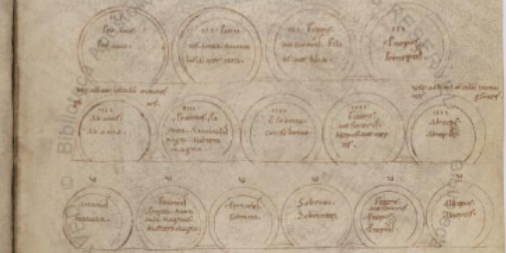
  237. Vat.lat.624 - with this extraordinary revision of a (classical?) Roman arbor juris (kinship diagram) in pyramidal form at fol. 105r:
    Note how the number of circles increases by one with each row as you follow it downwards. The scheme is a medieval revision of the so-called Type 4 arbor consanguinatis, as defined by  Hermann Schadt - see my Missing Manual (DOI: 10.13140/RG.2.1.4283.8002) for more information about this - Manuscript Details
  238. Vat.lat.795 - Details
  239. Vat.lat.797 - Details
  240. Vat.lat.803 - Details
  241. Vat.lat.809 - Details
  242. Vat.lat.823 - Details
  243. Vat.lat.838 - Details
  244. Vat.lat.845 - Details
  245. Vat.lat.848 - Details
  246. Vat.lat.853 - Details
  247. Vat.lat.854 - Details
  248. Vat.lat.863 - Details
  249. Vat.lat.884 - Details
  250. Vat.lat.13946 - Details
  251. Vat.lat.14745 - Details
  252. Vat.turc.139 - Details
  253. Vat.turc.391 - Details
This is Piggin's Unofficial List 62. If you have corrections or additions, please use the comments box below. Follow me on Twitter (@JBPiggin) for news of more additions to Digita Vaticana.

2015-06-23

Ancient Science

Ancient science was kept alive through the Middle Ages by constant copying and anthologizing. One compilation that has come down to us was gathered at Constantinople at the end of the 13th century and contains the soundest text we possess of the Geography of Ptolemy of Alexandria. His work is one of the greatest scientific achievements of the ancient world.

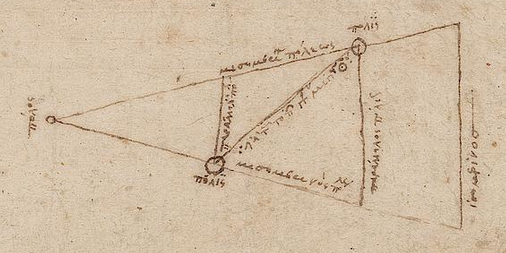
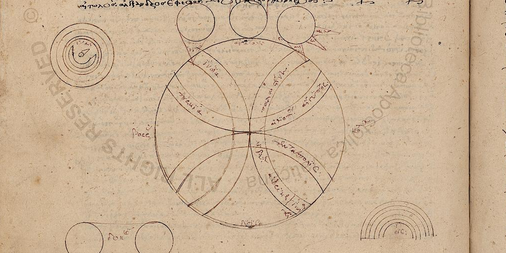
Here is a Ptolemy diagram from the introductory book, How to Draw a Map of the World, with a simple trig lesson showing how to transfer arcs relative to your standpoint (at left). It's at 129r. One can read the text explaining the concept in part 1.2 of the Berggren-Jones translation at Google Books.

This codex contains Ptolemy's coordinates, but not the world maps attributed to him or his late antique editors.

Ptolemy's geography was famously wrong in certain key ways. Some of the most exciting research of the past decade has examined the possibility that Ptolemy was hit by a garbage-in-garbage-out situation whereby he unwittingly relied on false experimental data (the earth's circumference), leading to some spectacular failures in his essentially brilliant compilation.

Klaus Geus and Irina Tupikova argued in 2013 that mystery locations on Ptolemy's map are none other than the Gulf of Finland and Poland's Vistula River if one adjusts the false data. We now stand a better chance of identifying all 6,400 places for which Ptolemy gives coordinates in the Geography.

Various other scientific texts by authors as diverse as Euclid and Abu Ma'shar of Baghdad are all bound into the Vatican's massive 397-folio volume. Here is an unidentified diagram from folio 209v.

This codex, which is a kind of album of the best of ancient science, was brought to Rome by Isidoros, (c. 1385 to 1463), metropolitan of Kiev and later a Roman cardinal, and it thus ended up in the Vatican collection of Greek manuscripts as Vat.gr.191. It is one of the treasures that has finally entered our modern album of science, the internet. Digita Vaticana placed it online on June 22.

Renate Burri's description (in German) of this codex (designated X in the stemma) can be consulted on Google Books. A stemma showing the place of X as a key source has been published recently by Florian Mittenhuber. Burri has argued that the first diagram above is by a Byzantine editor, Manuel Chrysoloras, not by Ptolemy. Her book on the manuscripts of The Geography was recently reviewed on BMCR. [For a later blog post on Ptolemy by me with more manuscripts, jump here.]

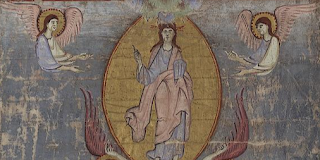
Also new in the uploads this week is one of the books that is known as a Barberini Codex, this one being an evangeliary made at one of the two main centres of monasticism on Lake Constance, either Reichenau or St Gallen, just a few years before 1000 CE. Here is its illumination of the Ascension (folio 84v):

Below is my own list of the 64 new items uploaded June 22, which take the posted total to 2,264. As always, I have compiled this in haste, using web searches to grab keywords, so this is subject to correction. The materials below with the shelfmark Borg. copt. are a variety of biblical and other materials, some of them only single leaves or papyri. For more information about the materials from the Capponi collection, Cozzo's 1897 printed catalog can be consulted at Archive.org.
  1. Arch.Cap.S.Pietro.C.152, contains a text of Aristophanes' Plutus (Pinakes)
  2. Arch.Cap.S.Pietro.D.182, Hilary of Poitiers
  3. Arch.Cap.S.Pietro.E.25,
  4. Barb.lat.711, great evangeliary made at Reichenau or St Gallen about 990 CE
  5. Barb.lat.4424, architectural sketchbook of Giuliano da Sangallo (1443-1516) (see article by Nicholas Temple)
  6. Barb.lat.5692, Pietro Bembo, letters
  7. Barb.lat.6481,
  8. Borg.ar.221,
  9. Borg.copt.109.cass.XXVII.fasc.138,
  10. Borg.copt.109.cass.XXVII.fasc.139,
  11. Borg.copt.109.cass.XXVII.fasc.140,
  12. Borg.copt.109.cass.XXVII.fasc.141,
  13. Borg.copt.109.cass.XXVII.fasc.142,
  14. Borg.copt.109.cass.XXVII.fasc.143,
  15. Borg.copt.109.cass.XXVII.fasc.144,
  16. Borg.copt.109.cass.XXVII.fasc.145,
  17. Borg.et.24,
  18. Borg.sir.16,
  19. Borgh.204, Johannes de Fonte, Parvi flores,
  20. Borgh.212, Maurus Salemitanus,
  21. Borgh.214, Opera quaedam de re iuridica, 14th century,
  22. Borgh.231, Abbas Antiquus,
  23. Borgh.320, Thomas Aquinas,
  24. Borgh.335, Cyprian of Carthage (c.200-258), a 15th-century compilation of his writings ,
  25. Borgh.368, a fine 15th-century manuscript of Livy's Roman history Ab urbe condita,
  26. Cappon.75, describes Medici celebrations
  27. Cappon.149.pt.1, letters to popes 1643
  28. Cappon.149.pt.2, speeches
  29. Cappon.152, obituary verse
  30. Cappon.153, Bologna university rules
  31. Cappon.155, epigrammata
  32. Cappon.157, Matthari Palmerii
  33. Cappon.158, from papacy of Paul IV 
  34.  Cappon.159, on council of Trent
  35. Cappon.162, letter by Magalotti
  36. Cappon.164, documents from Prague, Hungarian affairs
  37. Cappon.167, letters and notes from Paris
  38. Cappon.175,
  39. Cappon.177,
  40. Cappon.188, Northumberland's account of Anne Boleyn
  41. Cappon.189, accounts of judicial executions
  42. Cappon.191, Petrarch's I Trionfi (see below for a Renaissance manuscript)
  43. Cappon.192, diplomacy in France
  44. Cappon.202,
  45. Cappon.205,
  46. Cappon.206,
  47. Cappon.208,
  48. Cappon.212,
  49. Cappon.215,
  50. Cappon.222,
  51. Cappon.232, Pecorone
  52. Cappon.237.pt.C,
  53. Cappon.241, life of Cola di Rienzo
  54. Cappon.242, ditto
  55. Cappon.246, correspondence of dukes of Modena
  56. Cappon.250, vita de beato Johanne Bactista
  57. Cappon.254, alchemy and occult
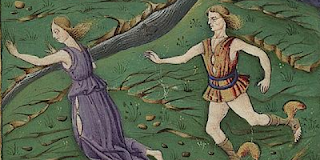
  58. Ott.lat.2998, Francesco Petrarch's I Trionfi (The Triumphs) with illuminations for a noble Renaissance library (See Guerrini on a similar manuscript at the Morgan): here's a Greek god in thrall to infatuation, in hot pursuit of his love object (fol. 51r):
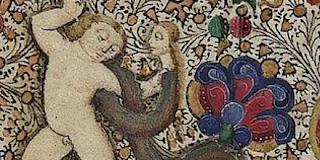
    The narrator is taken to a garden, sat down and shown a vast succession of mythological, biblical and historical figures making fools of themselves for love. This god's winged sandals suggest he may be Hermes, but the text implies the god may be "blond Apollo" chasing Daphne. In the margin of the same page is this odd couple:
  59. Reg.lat.1395, verse, Matteo Bandello
  60. Vat.ar.368, a hugely important and almost unique manuscript from Moorish Spain, The Tale of Bayad and Riyad
  61. Vat.estr.or.110,
  62. Vat.estr.or.147.pt.23,
  63. Vat.estr.or.147.pt.25,
  64. Vat.gr.191, 14th-century compilation of scientific texts with Euclid, Ptolemy's geography and astronomy (Pinakes),
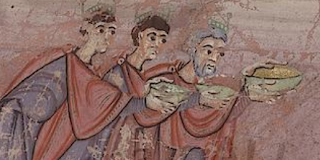
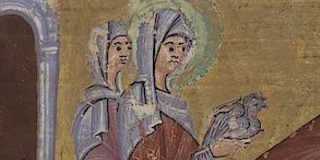
Two more images from the Barberini Codex show the Three Magi (fol. 18v) and the Presentation at the Temple (fol. 24v)

As always, if you can add any information about any item, write in the comments box below, or tweet to me at @JBPiggin. [This is Piggin's Unofficial List 17.]

2015-05-04

Bath Time at Pozzuoli

Among the 21 manuscripts uploaded May 4 to the Digita Vaticana library portal is a codex, Ross. 379, with images of group visits to the various thermal baths at Pozzuoli in southern Italy.

These illustrate a didactic poem, De Balneis Puteolanis by Peter of Eboli. This was a widely read guidebook in Latin verse to medicinal bathing written in about 1220. The information about the alleged health benefits of the various waters in the volcanic zone is probably Late Antique and the poem continues to be of interest to historians of medicine.

The pictures supposedly describe the experience of visiting a spa in the High Middle Ages (replete with ribald scenes of men who have somehow managed to gatecrash ladies' pools). I have no prior knowledge of this, but presume De Balneis was often purchased by the wealthy on account of its explicit images of nude people rather than for its scientific knowledge.


A rapid web search informs me that Ross. 379 is one of ten or more extant illuminated manuscripts of this poem. Gallica has a Parisian manuscript, BNF Lat. 8161, of the same, while e-Codices has the Bodmer's. Raymond J. Clark's 1989 article in Traditio on the poem is unfortunately behind a firewall. Of interest to mystery fans: there has been a claim that bathing images in the Voynich Manuscript, a strange fantasy book which no one has ever managed to decode, resemble those in De Balneis.

Here is the full list of releases:
  1. Borg.pers.12
  2. Borg.turc.34
  3. Ross.379, De Balneis Puteolanis, on medieval thermal baths
  4. Urb.lat.1, a magnificently illuminated Renaissance Old Testament of the Bible
  5. Urb.lat.2, another outstanding 15th-century Bible
  6. Vat.ar.351
  7. Vat.lat.841, De Regimine Principum, a guide book for princes, by Giles of Rome (Aegidius Romanus)
  8. Vat.lat.869, philosophical miscellany, with various works by Duns Scotus (c. 1265-1308), plus a few folios of Peter Abelard
  9. Vat.pers.27
  10. Vat.pers.32
  11. Vat.pers.85
  12. Vat.slav.4
  13. Vat.slav.5
  14. Vat.slav.9
  15. Vat.slav.10
  16. Vat.slav.13
  17. Vat.slav.49
  18. Vat.slav.63
  19. Vat.turc.4
  20. Vat.turc.428
  21. Vat.turc.431
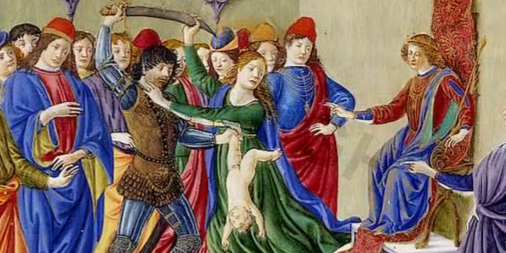
From Urb.lat.2, a fine Florentine painting of Solomon pretending to have a baby chopped in half as a way to determine a dispute between two mothers:


The BAV site now has 1,980 manuscripts online. There are often no descriptions at all. As always, if you can contribute information about any of these manuscripts, use the comments pane below. [This is Piggin's Unofficial List 10.]

2015-04-29

Pliny's Natural History

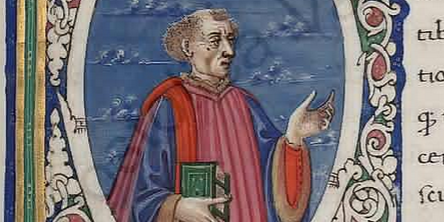
Among the new arrivals online at the Biblioteca Apostolica Vaticana on April 29 is a fine Renaissance copy of Pliny's Natural History, Borgh. 369. This fifteenth-century copy is not one of the ancient manuscripts used to establish the critical editions of Pliny (see a list by Roger Pearse), but it is evidence of the humanist enthusiasm to rediscover the great classical Latin authors.

Here is how the artist fancied Pliny in expository mode:
Also new is Vatican Vat. lat. 3375, a late sixth-century Neapolitan codex excerpting the works of Augustine of Hippo. It is acopy in half-uncial of an anthology that had been composed just a generation earlier by Eugippius of Naples and is an important link to Christian culture at the end of late antiquity.

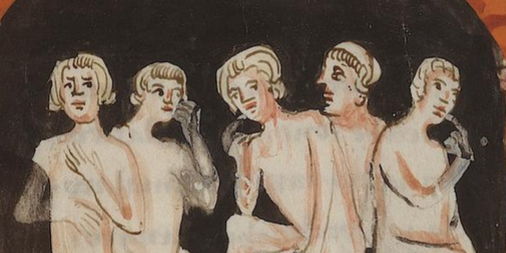
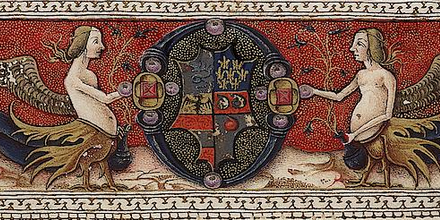
We also have what looks like a couple of chaps with paunches, receding hippie hairlines, and glass steins in the hand. But I am guessing they are actually sirens. They appear in Barb.lat.409, which is a liturgical office for the feast day of King Louis of France (1214-1270), after he had been made a saint.

A further portolan chart, Borg. Carte. naut. V, is in this batch, but sadly the resolution is so low that it is impossible to read the text. Reader Jens Finke points out that a just-about-readable black-and-white image of this appeared in Heinrich Winter, "The Fra Mauro Portolan chart in the Vatican" (Imago Mundi, 16 (1962), pp. 17-28, http://www.jstor.org/stable/1150299.)

Here is the full list:
  1. Arch.Cap.S.Pietro.A.32
  2. Arch.Cap.S.Pietro.C.98
  3. Arch.Cap.S.Pietro.D.157
  4. Arch.Cap.S.Pietro.D.169
  5. Arch.Cap.S.Pietro.D.193
  6. Arch.Cap.S.Pietro.E.33
  7. Arch.Cap.S.Pietro.F.27
  8. Arch.Cap.S.Pietro.G.3
  9. Arch.Cap.S.Pietro.G.54
  10. Arch.Cap.S.Pietro.H.52
  11. Arch.Cap.S.Pietro.K.1
  12. Arch.Cap.S.Pietro.K.2
  13. Barb.lat.409, liturgical office for feast of Louis IX of France, image above
  14. Barb.lat.679, a compilation of canon law, with a folio about the Council of Carthage of 390 CE  (summary)
  15. Borg.Carte.naut.V, illegibly digitized portolan chart, see above
  16. Borgh.22
  17. Borgh.43
  18. Borgh.53
  19. Borgh.91
  20. Borgh.93
  21. Borgh.99
  22. Borgh.104, 14th century codex of Petrus de Ilperinis, Tractatus de praedestinatione
  23. Borgh.113
  24. Borgh.127
  25. Borgh.143.pt.1
  26. Borgh.145
  27. Borgh.155
  28. Borgh.168
  29. Borgh.176
  30. Borgh.180
  31. Borgh.201
  32. Borgh.207
  33. Borgh.215
  34. Borgh.238
  35. Borgh.251
  36. Borgh.257
  37. Borgh.281
  38. Borgh.301
  39. Borgh.305
  40. Borgh.310
  41. Borgh.313
  42. Borgh.334
  43. Borgh.369, Pliny's Natural History
  44. Borgh.384
  45. Borgh.387, anonymous compilation of rules and figures of geometry (ff. 1-27)
  46. Cappon.1
  47. Cappon.2
  48. Cappon.3
  49. Cappon.8
  50. Cappon.10
  51. Cappon.11
  52. Cappon.16
  53. Cappon.19
  54. Cappon.20
  55. Cappon.21
  56. Cappon.22
  57. Cappon.23
  58. Cappon.25
  59. Cappon.36
  60. Cappon.37
  61. Cappon.38
  62. Cappon.40
  63. Cappon.49
  64. Ott.lat.356
  65. Reg.lat.1484
  66. Vat.ebr.119
  67. Vat.ebr.130
  68. Vat.ebr.143
  69. Vat.estr.or.4, Latin-Chinese dictionary
  70. Vat.estr.or.8,
  71. Vat.estr.or.40, panorama painting of qinqming festival
  72. Vat.estr.or.64.pt.2,waterfall drawing
  73. Vat.estr.or.83,
  74. Vat.estr.or.85, Sinhalese
  75. Vat.estr.or.86,
  76. Vat.estr.or.97,
  77. Vat.estr.or.99,
  78. Vat.estr.or.101,
  79. Vat.estr.or.114,
  80. Vat.estr.or.117,"Cahier siamois", only the container!
  81. Vat.estr.or.118, ditto
  82. Vat.estr.or.147.pt.1.2,
  83. Vat.estr.or.147.pt.6,
  84. Vat.estr.or.156, folder of ink sketches, whereby Twitter user @MareNostrum2 points out that Digita Vaticana has (inadvertently) digitized a page from a 1909 Japanese newspaper with it: was this used as wrapping material to send the item to Rome?
  85. Vat.estr.or.159, 19th century (?) Japanese drawings
  86. Vat.gr.180
  87. Vat.lat.3375, excerpts from Augustine (see above)
  88. Vat.turc.50
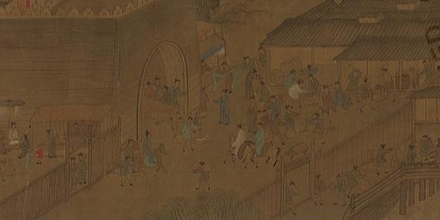
Here is a detail, sadly darkened, from the qingming festival scroll above. It might reveal more with some photoshopping:

That makes 88 in all. Please add any contributions by way of the comments pane below. [This is Piggin's Unofficial List 9.]