Showing posts with label Medieval. Show all posts

2012-05-12

Co-Owners of Isola

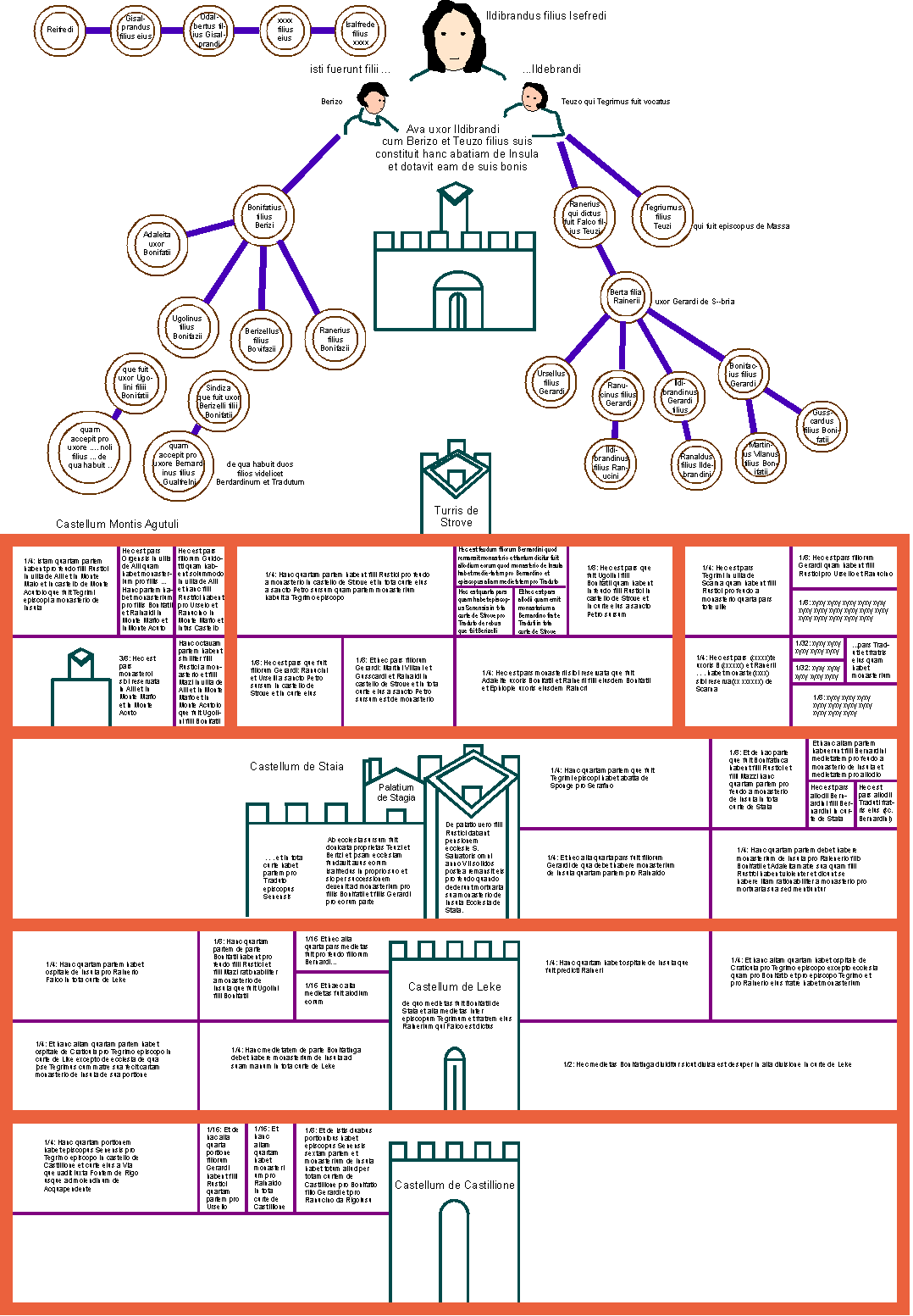
A remarkable infographic in the Vatican Library describes the co-ownership of nobles and Benedictine monks of the former Abbey of Isola near Siena in Tuscany, Italy. The document, which I first read about in Christiane Klapisch-Zuber's L'Ombre des Ancêtres, comprises a stemma of Hildebrand, whose widow Ava founded the monastery, along with a detailed scheme of property division. It was drawn up in or shortly after 1160.

I have created a digital sketch of the document (PNG below, zoomable detailed version on my website). The colours were arbitrarily chosen, since this version was made from black and white photographs. For a better idea of how Hildebrand and his two sons, Berizo and Teuzo, are supposed to have looked, see the original (link below, with caveat). The orange-bordered panels represent the ownership shares in six blocks of property:
  • the Castellum Montis Agutuli
  • the Turris de Strove (Strove is the next village)
  • the Villa de Scarna (just to the west)
  • the Castellum de Staia (the small town of Staggia to the north (map))
  • the Castellum de Leke (further north, at Lecchi (map))
  • the Castellem de Castillione

Hildebrand (Ildibrandus) was a Lombard, which explains the Germanic names of his ancestors and his descendants all the way through the document. The six semi-monastic properties (five of which are illustrated with a little sketch that probably summed up salient architectural features of the principal building) were progressively divided into half-shares, quarters and so on. The most extreme divisions are 1/32 of a whole. The rectangle area indicates the degree of division. The transcription is based on that published by the late Wilhelm Kurze, and I have preserved his fractions where space allows. There are of course no Arabic numbers or fractions on the document, but including them here makes the divisions more understandable.

The affinity of the stemma at the top of the document to the Great Stemma is unmistakeable: the roundels are all composed of two rings, and the names in them are generally written in the form Y filius X. The lines can either proceed left to right or top to bottom. An especially interesting feature here is the graphic separation of Adelheid, wife of Ugolinus, and of Sindiza, wife of Berizellus, from the rest of the stemma. They are not joined to it by the usual lines. The children of their second marriages were not connected by blood to Hildebrand, but did inherit property rights through the mothers. I have moved these into better alignment to make this aspect of the infographic clearer, but this reconstruction is as close as possible to the original in every other way.

Kurze gives the following manuscript reference: S. Eugenio - Rome, Bibl. Vat. Cod. Vat. Lat. 8052 (Galetti) Cop. saec. XVIII. In dorso: Descriptio et pictura fundatorum abbatie Insule et eorum descendentium que predia relinquerunt predicte Abbatie.

As far as I know, there is only one image of it online, on the Portale di Archeologia Medievale, but this is something of a disappointment. This image seems to have been digitally altered: not only are important areas at the edges cropped away, but the top three property blocks have been seamlessly edited out of the middle of it, without any explanation. (If you find a more faithful image of the document on the web, particularly one at higher resolution, please tell me by writing a comment below!)

Kurze mentions one facsimile edition. The document is reproduced in low-resolution black and white in Violante's article and at an even smaller scale in Klapisch-Zuber's book. In my view, text-only publications cannot adequately convey how the infographic works: a technical drawing is needed. Violante's crude sketch only adds to the confusion and from Klapisch-Zuber's account I mistakenly thought at first that a kind of treemap was in prospect. The property-division part of the infographic, which maps the legal concept of sharing onto two-dimensional space, is in fact a much simpler concept, but nevertheless quite clever. I do not know of any earlier documentary examples of the technique. Please comment if you can suggest any.

This is the only medieval document I have transcribed so far where the place of origin is absolutely clear. The monastic institution where this document was drawn up after 1160 no longer exists, but many of the buildings are still there and can be visited, a short drive away from Siena (tourist description, location, video). The structure depicted at the top of the chart, below Hildebrand's face, is the abbey itself, which was much rebuilt but partly survives. The castle of Staggia has a battlemented tower just like those in the document. I recommend you follow these links and enjoy the images which Google Panoramio pulls up.

Kurze, Wilhelm. “Der Adel und das Kloster San Salvatore all’Isola im 11. und 12. Jahrhundert.” Quellen und Forschungen aus Italienischen Archiven und Bibliotheken 47 (1967): 446–573.
Violante, Cinzio. “Quelques Caractéristiques des Structures Familiales en Lombardie, Émilie et Toscane aux XIe et XIIe Siècles.” In Famille et Parenté dans l’occident médiéval, edited by Georges Duby and Jacques Le Goff, 87–148. Rome: École Française de Rome, 1977.
Klapisch-Zuber, Christiane. L’Ombre des Ancêtres. Paris: Fayard, 2000: 98-101.
Cammarosano, Paolo. “Gli Antenato di Paolo Diacono.” In Nobiltà e chiese nel medieoevo e altri saggi. Scritti in onore di Gerd D. Tellenbach, edited by Cinzio Violante, 37-45. Rome, 1993.

2012-04-14

Lambert's Liber Floridus

In what is now the far corner of north-west France, Lambert, a canon of the city Church of Our Lady in St Omer, completed in 1122 a richly illustrated compendium of mythical biology, history and religious knowledge. The Liber Floridus (book of flowers) belongs to the same genre as the Etymologies of Isidore of Seville, a compilation or florilegium or encyclopaedia of many sorts of information, all intended to bring delight. Isidore’s use of graphics had been primitive, but Lambert was a superb and imaginative graphic designer. One celebrated full-page spread, the Arbor Mala and Arbor Bona, is a compilation of vices and virtues. The Liber Floridus is bursting with clever, colourful graphic ideas. Its images of imaginary plants and strange animals in the bestiary section fascinate.

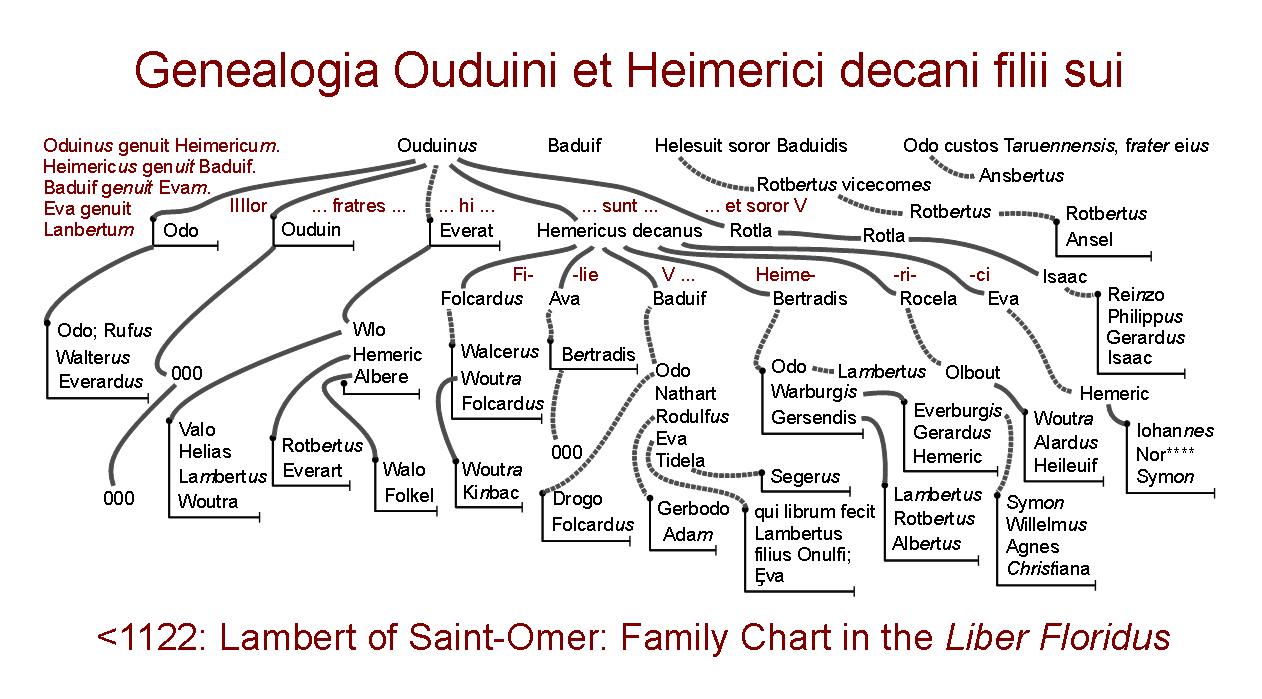
Lambert could also be conservative in his design choices. In his personal, autograph manuscript of the Liber Floridus, there is a stemma of Lambert’s maternal ancestors which goes back to his great-great-grandfather Odwin. It recalls the family names and birthdates which many British and American families wrote in the front of their family bibles in the 19th century, but Lambert decided to draw it in semi-stemmatic form, not as a simple list. As with the German imperial stemmata compiled in the previous century, Odwin is shown at the top, with the descendants splayed out below. Unlike the Great Stemma, there are no roundels. The individuals are grouped in short vertical lists of siblings. These tabulations of their forenames form family blocks. These tiny tables are connected by smooth or squiggly lines back to their parents and ultimately to Odwin. It is crowded and untidy, but it is striking that the designer of the Arbor Bona and Arbor Mala has presented his family with a simple stemma, not a tree. It has not been inverted and is not even pretending to be a tree.

Lambert of Saint-Omer's personal autograph copy, the original manuscript of the Liber Floridus, is in the University Library at Ghent, Belgium (ms. 92). Saint-Omer is a border town and this unique codex seems to have been taken to Belgium during the French Revolution for safe-keeping. Recently scans of this great treasure were placed on the internet. The digital version is a bit difficult to use, with no option for full-screen viewing that I can discover. One cannot download complete pages because the server sends them in the form of tiny tiles.

The diagram appears on folio 154r (use the navigation to go to the 30th page of results to see a zoomable version). Folio 154r has been moved to the very end of the current binding, but Albert Derolez, who has published the manuscript (Lamberti), suggests it may have originally been at the very beginning as a front flyleaf:
The first page lacks all ruling ... Was it Lambert's intention to leave it blank? In that case the leaf or the quire should originally have been placed at the front of the codex. (Autograph Manuscript, 180)

This would explain why it was not transferred into other copies: it was not seen as part of the body of text. Christiane Klapisch-Zuber briefly discusses the diagram on pages 94-96 of her L'Ombre des Ancêtres, and refers the reader to the editio princeps by Gysseling, whose entire discussion of the stemma in 1947 was limited to a single sentence:
C'est la seule généalogie que nous connaissons pour le moyen âge (exception faite des généalogies de vices, de vertus et de  ...., qui apparaissent plus ..... ). [some words illegible in my photocopy]

Derolez rearranged the diagram into a conventional modern printed descent "tree". Klapisch-Zuber tartly remarks that Derolez's graphic version "wildly displaces the generations and ends up being a lot less intelligible than the design in the original manuscript" (note 27, page 362). This is perhaps unfair to Derolez, but I can now present what I believe is the first ever graphic version which is faithful to the original layout, and which is machine readable to boot.

It can be better studied as a Flash page on my main website. I have followed the Derolez transcription, which as far as I know is actually the work of Gysseling. The italic letters are his readings of the scribal contractions. The dotted lines represent Lambert's squiggly lines, which I could not reproduce with OpenOffice Draw.

One oddity is that Lambert states there should be five "Heimerici" siblings but in fact shows six. There are two unidentified descendants at left (000 in my diagram) who are foreshadowed by lines but not given any names. At right is a name beginning Nor**** that was illegible. I am not sure if Drogo and Folcardus in the bottom row really are brothers: Lambert's diagram seems to suggest they are cousins. The awkward layout suggests the group at right might have been an afterthought or have been entered after much later family research, but perhaps the main design influence was a lack of space. Derolez, who seems to have found evidence that earlier script was scraped away, writes: "The lower part of the pedigree was afterwards rearranged in order to create more space for a text."

However the details of Lambert's genealogy are not the topic that interests us here, and I have left the genealogy as Gysseling and Derolez preferred it. It is the concept of the diagram that matters. It is practical, straight out of life, a little clumsy and unclear, but ultimately an intelligent presentation of 80 names in the most compact space.

I see no evidence for Klapisch-Zuber's speculation that Lambert may have been the inventor of this graphic design:
Toutes ces particularités laissent penser que Lambert a réinventé, ou interpreté de facon autonome, un type de schéma généalogique peut-être entrevue ice ou là... on est tenté de voir dans un schéma qu'il couche sur un page de son livre une invention autonome et sauve de toute influence immédiate. (L'Ombre, 96)

The more plausible view is that Lambert imitated other diagrams of "normal" families which he had seen, and that such diagrams were in relatively common use in the 12th century. Unfortunately, Lambert's is one of the few, perhaps the only surviving witness of this genre of document to remain in our archives from so early.
  • Derolez, Albert. Lamberti S. Audomari Canonici Liber Floridus. Ghent: Story-Scientia, 1968.
  • Derolez, Albert. The Autograph Manuscript of the Liber Floridus. Corpvs Christianorvm. Autographa Medii Aevi 4. Turnholt: Brepols, 1998.
  • Gysseling, Maurits. “Les plus anciennes Généalogies de Gens du Peuple dans les Pays-Bas Méridionaux.” Bulletin de la Commission Royale de Toponymie de Dialectologie 21 (1947): 212–215.

2012-03-31

Two Medieval Drawings

I have constructed vector diagrams of the two earliest known charts to describe the ancestry of living people and have converted these to Flash format and published them on the www.piggin.net website. Both of these medieval diagrams use the roundels and lines format which is familiar to us from the Great Stemma.
The first (follow the link) is a remarkable drawing with the shelfmark M 29880(6 in the Bavarian State Library in Munich. The original has been digitized, but my drawing is easier to read. The old MGH transcription has been deprived of the authentic graphic characteristics and converted into a standardized 19th-century stemma instead.
From the content and the script of this manuscript, it appears to have been drawn during the period when Cunigunde of Luxembourg was either queen of Germany or Roman empress, that is to say between 1002 and 1024. It displays her descent from Charlemagne, a fact which was evidently used by her as an argument to claim the office of empress.
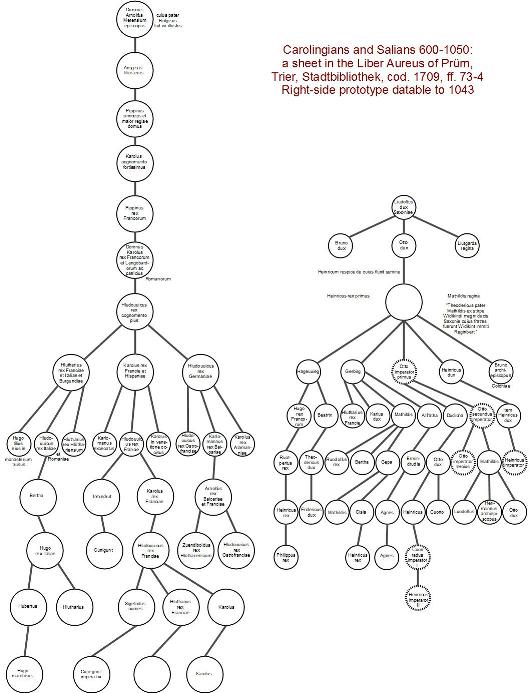
The second (below, but follow the link for my zoomable version) was drawn between 1101 and 1111 at the monastery of Pruem and bound into the Liber Aureus, a book of important Pruem documents. It is now in the city library of Trier, Germany, shelfmark 1709, folios 73-74, but is not online. In its left panel, it contains a variation of the first diagram described above. The diagram in the right panel contains a legal argument about consanguinity and has been dated by Nora Gädeke to 1043. This right section relates to the Ottonian and Salian dynasties who took control of the Western Roman Empire after the Carolingians, who form the left panel of this composite diagram: