Showing posts with label PUL. Show all posts

2018-07-02

Leto Lecture

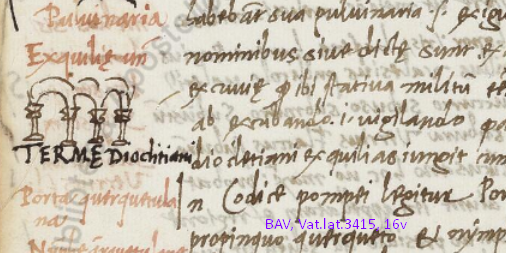
You settle into your seat and await the arrival of the lecturer, Pomponius Leto, perhaps the most famous university professor in 15th century Rome. His classics lecture today is about Varro, replete with mentions of ruined things you often see on your walks in the city.

You have been tasked with writing up the lecture for the rest of the class. Your blotted jottings will be transferred to a clean notebook after each class in the series.

How surprised you would be to hear that the notes, after you have polished them up, will be flown to the United States (where?) in the 1990s for the great Rome Reborn exhibition and will be re-digitized in color and high quality by the Vatican Library in 2018 so that even people in New Zealand (where?) will be able to see every shiver of your quill.


Anthony Grafton comments: "The student who copied this manuscript had a lively talent for drawing, seen here in his sketches of the Baths of Diocletian. As a whole the lectures show the rich way in which Roman texts and antiquities illuminated each other in the interdisciplinary scholarship of the Roman humanists."

There's a detailed online description of the notebook in the St Louis microfilm library catalog. Grafton's catalog has the wrong folio reference to the image above, but page through the digitization and enjoy the other quick sketches made in 1484 or thereabouts.

Only four Vatican manuscripts were released online last week. They were:
This is Piggin's Unofficial List number 167. Thanks to @gundormr for harvesting. If you have corrections or additions, please use the comments box below. Follow me on Twitter (@JBPiggin) for news of more additions to DigiVatLib.

2018-06-25

Peek-a-Boo

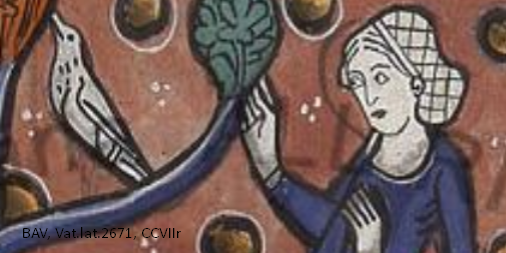
We all like peek-a-boo pictures and this one from the 13th century is quite elegant. It shows a lady shyly peeking at a suitor (out of sight past the bird) and considering the weighty question of whether they are compatible without breaking the rules of incest.
It appears at fol. CCVIIr of Vat.lat.2671, a codex of law which has just been digitized at the Vatican Library. The book is the Summa super titulis decretalium of Goffred de Trano, compiled between 1241 and 1243 and this is a copy from just a generation later, scribed 1270/80, perhaps in Puglia, Italy. The image is part of an arbor, a scheme of forbidden in-law unions.

Goffred, according to Hermann Schadt passim, is the first to propose that this diagram is a tree: "Et quia in qualibet arbore, fructifera et naturali, quattuor, attendunt, truncus, rami, fructus et frondes. Et in hac arbore scripta eadem considerari oportet." Far fetched, as these matrices don't really look anything like trees, but the artist obediently paints a bird and a big frondy leaf.

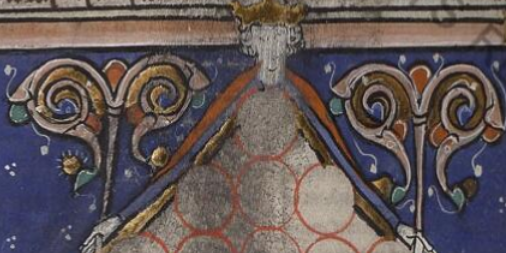
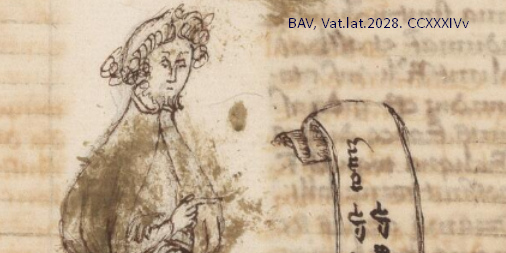
On another folio, CCIVv, is the other model for the matrix, the placard-carrying man. Here is the head:
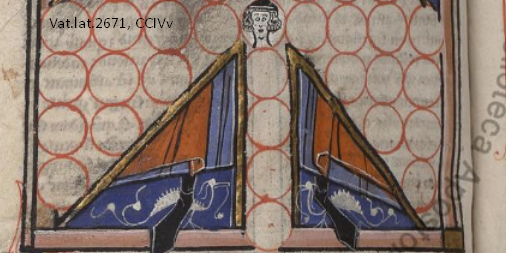
.. and here are the feet:
At first sight I thought that little face in the middle, like a joey in a kangaroo pouch, was the holder of the placard. In fact, look at for a while and you might even see a hang-glider here :-)  

 In all, 53 books were digitized last week, and here is the full list:
  1. Barb.gr.388,
  2. Barb.gr.392,
  3. Borg.ind.62,
  4. Chig.E.VIII.251 (Upgraded to HQ),
  5. Ott.lat.2048 (Upgraded to HQ),
  6. Ott.lat.3375,
  7. Vat.copt.111,
  8. Vat.lat.2247,
  9. Vat.lat.2253,
  10. Vat.lat.2285,
  11. Vat.lat.2289,
  12. Vat.lat.2290 (Upgraded to HQ),
  13. Vat.lat.2393,
  14. Vat.lat.2671 (above)
  15. Vat.lat.2804,
  16. Vat.lat.2818,
  17. Vat.lat.3175,
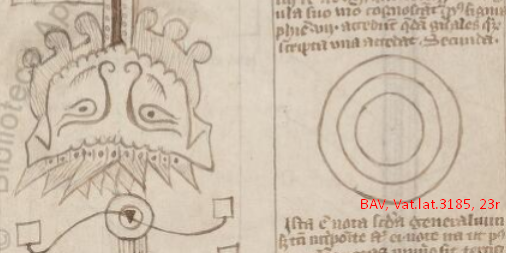
  18. Vat.lat.3185, the Ars Notoria, a book of magic, which was first mentioned by Michael Scot in 1236 and thus was written earlier. Lots of diagrams in this 14th or 15th century copy:
    See the eTK. The incipit, Ego Apollonius magister artium merito nuncupatus, apparently refers to the supposed (but most unlikely) author, Apollonius of Tyana
  19. Vat.lat.3239,
  20. Vat.lat.3243,
  21. Vat.lat.3250,
  22. Vat.lat.3268,
  23. Vat.lat.3335,
  24. Vat.lat.3338,
  25. Vat.lat.3339,
  26. Vat.lat.3343, Solinus, listed in: Milham, Mary E. 'A Handlist of the Manuscripts of C. Julius Solinus.' Scriptorium, 37 (1983), 128.
  27. Vat.lat.3346,
  28. Vat.lat.3348,
  29. Vat.lat.3349 (Upgraded to HQ),
  30. Vat.lat.3365,
  31. Vat.lat.3368 (Upgraded to HQ),
  32. Vat.lat.3371 (Upgraded to HQ),
  33. Vat.lat.3372 (Upgraded to HQ),
  34. Vat.lat.3376,
  35. Vat.lat.3377,
  36. Vat.lat.3379,
  37. Vat.lat.3381,
  38. Vat.lat.3382,
  39. Vat.lat.3385 (Upgraded to HQ),
  40. Vat.lat.3392,
  41. Vat.lat.3405,
  42. Vat.lat.3412,
  43. Vat.lat.3418,
  44. Vat.lat.3419 (Upgraded to HQ),
  45. Vat.lat.3426 (Upgraded to HQ), medical, eTK lists incipit: Ostendendum est diligenter quod humana corpora et animalium sunt;  mutabili et instabili (11th century)
  46. Vat.lat.3435,
  47. Vat.lat.3443,
  48. Vat.lat.3446,
  49. Vat.lat.3449,
  50. Vat.lat.3461,
  51. Vat.lat.3470,
  52. Vat.lat.11817,
  53. Vat.lat.13895,
This is Piggin's Unofficial List number 166. Thanks to @gundormr for harvesting. If you have corrections or additions, please use the comments box below. Follow me on Twitter (@JBPiggin) for news of more additions to DigiVatLib.

2018-06-17

The Islands

A remarkable 10th-century manuscript from southern Italy, perhaps from Monte Cassino, reveals  some of the first tender shoots of medieval illustration. Vat.lat.3342, just digitized by the Vatican Library, is a copy of Solinus's Collectanea rerum memorabilium, a compilation of marvels such as lotus-eaters, Amazons and the Blemmye with eyes in their chests and other racy bits from Pliny's Natural History.

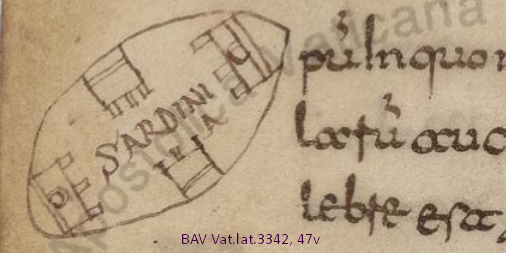
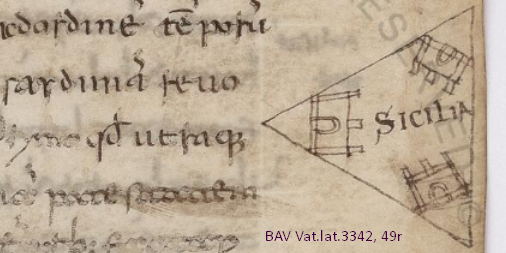
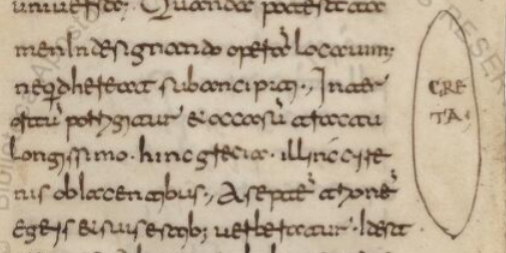
There are no monsters in this codex, but a user has added little sketches of the islands of the world and their characteristic forms, as taught in schools since antiquity. Here are Corsica, Sardinia, Sicily and Crete:


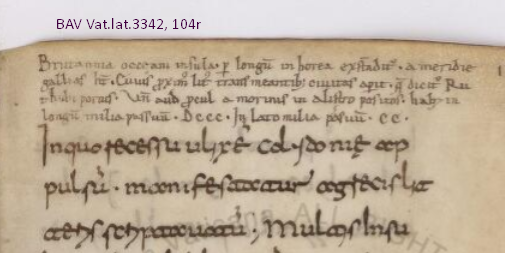
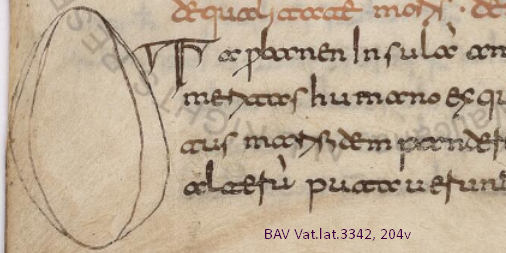
Britain has the scholiast stumped: how on earth is it shaped? Too weird. So he leaves it out, providing the gloss only in his own Carolingian-style handwriting. In the case of Taprobane (modern Sri Lanka), no one knows what is there so he shows it as an empty blob:


The main script is Beneventan according to Lowe, or as an earlier librarian called it on the flyleaf, lettera longobarda. Patrick Gautier Dalché, who notes that this the oldest extant manuscript of Mommsen's Class I of Solinus witnesses, identifies the glosses as coming from the Historiae of Orosius.

In Latin antiquity it was more or less settled that the known world comprises three continents and six main islands. The shapes were taught to help the student remember islands by their classically known outlines: much indented Corsica, four-cornered Sardinia, triangular Sicily, elongated strip-like Crete and pear-shaped Sri Lanka.

In all, 40 manuscripts have been scanned and placed online in the past week. Here is the list:
  1. Borg.ind.3 (Upgraded to HQ),
  2. Borg.ind.39,
  3. Borg.ind.42,
  4. Borg.ind.43,
  5. Borg.ind.46,
  6. Chig.R.V.33 (Upgraded to HQ),
  7. Ott.lat.3374 (Upgraded to HQ),
  8. Ott.lat.3376,
  9. Ott.lat.3378,
  10. Urb.gr.56 (Upgraded to HQ),
  11. Vat.estr.or.80,
  12. Vat.estr.or.92 (Upgraded to HQ),
  13. Vat.gr.1298.pt.2 (Upgraded to HQ),
  14. Vat.ind.29,
  15. Vat.lat.2288,
  16. Vat.lat.2410,
  17. Vat.lat.2652,
  18. Vat.lat.2834 (Upgraded to HQ),
  19. Vat.lat.2858,
  20. Vat.lat.2873,
  21. Vat.lat.3252 (Upgraded to HQ),
  22. Vat.lat.3322 (Upgraded to HQ),
  23. Vat.lat.3324 (Upgraded to HQ),
  24. Vat.lat.3331,
  25. Vat.lat.3333 (Upgraded to HQ),
  26. Vat.lat.3336,
  27. Vat.lat.3342, a 10th-century copy of Solinus's Collectanea rerum memorabilium (above)
  28. Vat.lat.3344,
  29. Vat.lat.3355 (Upgraded to HQ),
  30. Vat.lat.3356,
  31. Vat.lat.3383,
  32. Vat.lat.3390,
  33. Vat.lat.3394,
  34. Vat.lat.3398,
  35. Vat.lat.3407,
  36. Vat.lat.3410,
  37. Vat.lat.3410.pt.A,
  38. Vat.lat.3411 (Upgraded to HQ),
  39. Vat.lat.3560,
  40. Vat.lat.6150,
This is Piggin's Unofficial List number 165. Thanks to @gundormr for harvesting. If you have corrections or additions, please use the comments box below. Follow me on Twitter (@JBPiggin) for news of more additions to DigiVatLib.

2018-06-11

Lectio Brevior

It's a modest little drawing at the bottom right corner of a page, yet it's a key to the history of visualization. Last week I blogged about the little T-O map attached in late antiquity to the Jugurthine War by Sallust, but could only offer you a much padded example with lots of medieval additions.

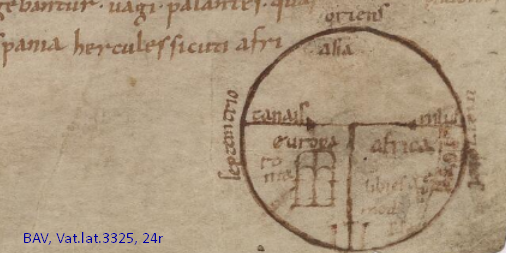
This week, the Vatican Library has digitized a purer example, one of the oldest surviving. It dates from the 10th century, is quite simple, and must be much closer to what a late-antique grammarian doodled on a Sallust text to assist students: a circle marked east at top, with half its surface marked Asia and the rest divided between Europe and Africa:


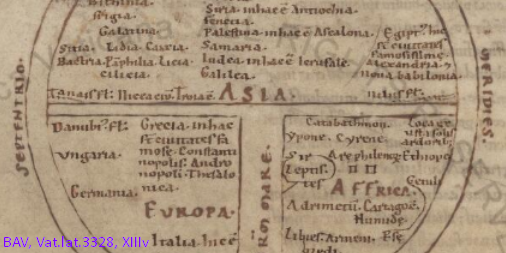
It appears in Vat.lat.3326, a Sallust codex containing the Bellum Catilinae, the Bellum Iugurthinum, and the spurious Epistulae ad Caesarem senem (Letters to Caesar in his Later Years), and as you can see, this week's diagram is less wordy than that of last week in Vat.lat.3328 (dated to the late 10th or early 11th century):

Text scholars generally apply a rule, lectio brevior praeferenda, whereby the less wordy of two versions is assumed to be the older one. Scribes and editors tended to augment texts, not to cut them.

Here is the full list of new digitizations:
  1. Chig.E.VII.215 (Upgraded to HQ), book of recovered manuscript fragments
  2. Ott.lat.3372,
  3. Ott.lat.3379,
  4. Vat.ind.39,
  5. Vat.lat.2245,
  6. Vat.lat.2264,
  7. Vat.lat.2283,
  8. Vat.lat.2284,
  9. Vat.lat.2303,
  10. Vat.lat.2785,
  11. Vat.lat.2917 (Upgraded to HQ),
  12. Vat.lat.2934.pt.2 (Upgraded to HQ),
  13. Vat.lat.3190 (Upgraded to HQ),
  14. Vat.lat.3223 (Upgraded to HQ),
  15. Vat.lat.3235,
  16. Vat.lat.3248,
  17. Vat.lat.3263 (Upgraded to HQ),
  18. Vat.lat.3270 (Upgraded to HQ),
  19. Vat.lat.3303,
  20. Vat.lat.3315,
  21. Vat.lat.3316,
  22. Vat.lat.3320, a ninth century manuscript, considered one of the Beneventan script examples by Lowe. Mainly glossaries, tabulated.
  23. Vat.lat.3325,
  24. Vat.lat.3326, (above). DigiVatLib scooped me:
  25. Vat.lat.3327 (Upgraded to HQ), yet another Sallust with Bellum Catilinae, Bellum Iugurthinum, this from the 12th or 13th century. Also seen as Beneventan by Lowe.
  26. Vat.lat.3329,
  27. Vat.lat.3330,
  28. Vat.lat.3332,
  29. Vat.lat.3334 (Upgraded to HQ),
  30. Vat.lat.3337,
  31. Vat.lat.3351 (Upgraded to HQ),
  32. Vat.lat.3352 (Upgraded to HQ),
  33. Vat.lat.3373,
This is Piggin's Unofficial List number 164. Thanks to @gundormr for harvesting. If you have corrections or additions, please use the comments box below. Follow me on Twitter (@JBPiggin) for news of more additions to DigiVatLib.

2018-06-03

Map of War

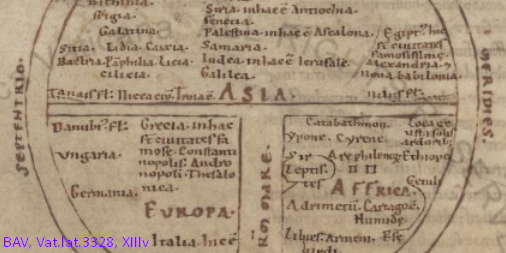
One of the more mysterious of ancient diagrams is a T-O "map" found in medieval manuscripts of the Jugurthine War by Sallust. Who drew it? I've been gathering information about this in the last few weeks, so it was a pleasant surprise to see the diagram pop up in this week's list of Vatican Library digitizations:
This version in Vat.lat.3328 which is dated to the end of the 10th or start of the 11th century is perhaps of German provenance. Curiously the codex has been rebound at some stage using strips of parchment from a newer manuscript in 13th-century Beneventan writing to strengthen the binding (noted by Lowe of both this codex and Vat.lat.3262.)

Asia, and thus the direction east, is at the top in this version of the diagram, which has been much "improved" by the scribes with extra toponyms. Other recensions of the graphic are rather bare.

Where does it come from? I would be highly sceptical of the claim that Sallust himself drafted the diagram while writing his history of a war in North Africa, since visualizations of this sort were not a part of the literary man's repertoire in the classical period. So the diagram may well be an addition by a late antique grammaticus.

Patrick Gautier Dalché has written a series of splendid syntheses about such diagrams where he argues that their models arose in education in the 4th to 6th century (see below). Whether any scholar has yet collated the Jugurtha's World diagram and constructed a stemma of its development I simply don't know yet.

Recently I added a couple of mappamundi to my Library of Latin Diagrams, and the Jugurtha T-O will join the collection later, once I have figured out what the prior recension is.

Before proceeding to the full list of 42 new items of the past week on the Vatican portal, I must recommend a series of more than 100 tweets with the tag #PolonskyProject posted on May 30 by participants at a one-day conference at the Vatican about the future of manuscript digitization. I wasn't present unfortunately, but am grateful that someone in the audience asked why the Library puts an ugly ownership watermark on its online images:
So now we know.
  1. Barb.gr.301 (Upgraded to HQ),
  2. Barb.gr.304,
  3. Barb.lat.41,
  4. Bonc.E.1,
  5. Borg.turc.5,
  6. Ott.lat.3377,
  7. Reg.lat.1686 (Upgraded to HQ),
  8. Vat.gr.1157,
  9. Vat.lat.2362,
  10. Vat.lat.2856 (Upgraded to HQ),
  11. Vat.lat.2868 (Upgraded to HQ),
  12. Vat.lat.2889,
  13. Vat.lat.2973 (Upgraded to HQ),
  14. Vat.lat.2993,
  15. Vat.lat.3023,
  16. Vat.lat.3078,
  17. Vat.lat.3091,
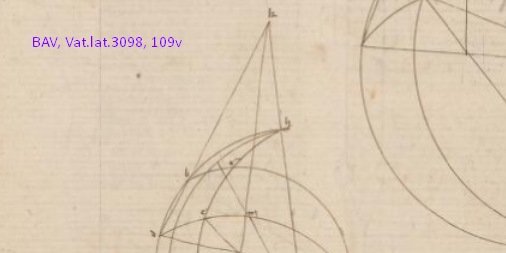
  18. Vat.lat.3098, a 14th- or 15th-century science compilation with works by Levi ben Gershom (Astronomia), Campano da Novara and Muḥammad ibn Ǧābir Battānī. Note the care with which this geometrical diagram is drawn:
  19. Vat.lat.3123 (Upgraded to HQ), a beautiful little handbook of arithmetic, computus, calendars and trick with an abacus, including diagrams, either 12th or 13th century. eTK lists incipit: "Ars ista vocatur abacus hoc nomen vero Arabicum"
  20. Vat.lat.3161,
  21. Vat.lat.3218,
  22. Vat.lat.3222 (Upgraded to HQ),
  23. Vat.lat.3233 (Upgraded to HQ),
  24. Vat.lat.3236,
  25. Vat.lat.3259,
  26. Vat.lat.3266 (Upgraded to HQ),
  27. Vat.lat.3267,
  28. Vat.lat.3269 (Upgraded to HQ),
  29. Vat.lat.3280,
  30. Vat.lat.3282,
  31. Vat.lat.3283,
  32. Vat.lat.3287,
  33. Vat.lat.3289,
  34. Vat.lat.3290,
  35. Vat.lat.3297,
  36. Vat.lat.3298 (Upgraded to HQ),
  37. Vat.lat.3300,
  38. Vat.lat.3301,
  39. Vat.lat.3311 (Upgraded to HQ), Working Notebook by Pomponio Leto. See the Rome Reborn note by Anthony Grafton: "These fragments of what seems to have been Leto's field notebook contain his notes on an inscription including an ancient Roman calendar on stone. This calendar depicted the signs of the zodiac through which the sun passed, gave the lengths of days and nights, listed the agricultural tasks and religious festivals appropriate to each month, and provided other important information, like the dates of the solstices and equinoxes."
  40. Vat.lat.3319,
  41. Vat.lat.3323 (Upgraded to HQ),
  42. Vat.lat.3328, Bellum Jugurthinum of Sallust (above).
This is Piggin's Unofficial List number 163. Thanks to @gundormr for harvesting. If you have corrections or additions, please use the comments box below. Follow me on Twitter (@JBPiggin) for news of more additions to DigiVatLib.

Gautier-Dalché, Patrick. 2002. ‘Les diagrammes topographiques dans les manuscrits des classiques latins (Lucain, Solin, Salluste)’. In La tradition vive. Mélanges d’histoire des textes en l’honneur de Louis Holtz, 291–306. https://halshs.archives-ouvertes.fr/halshs-00008331.

-------. 2014. ‘L’enseignement de la géographie dans l’antiquité tardive’. Klio 96 (1), 144–182. https://doi.org/10.1515/klio-2014-0006.
2018-05-27

Cicero's Witness

I've blogged a couple of times before (here and here) about the world's most famous unreturned library book, the unique copy of Cicero's guide to oratory in the bishop's palace at Lodi. It has not been seen since 1425, but fortunately multiple copies were made before it vanished.

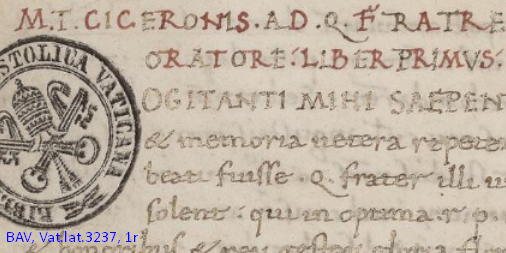
This week, the Vatican's digitization portal placed online Vat.lat.3237, a valuable secondary witness to the content of the so-called Codex Laudensis.

There's a detailed article by Paola Scarcia Piacentini, La tradizione laudense di Cicerone ed un inesplorato manoscritto della Biblioteca Vaticana (Vat. Lat. 3237), about it. De Oratore, as I have mentioned, is especially important as a source for Cicero's theories of memory and visualization, and thus a landmark in the history of cognitive science.

In the past week, the portal released 54 new digitizations:
  1. Borg.ebr.21,
  2. Urb.lat.286,
  3. Vat.gr.1155, DigiVatLib announced this Gospels on Twitter simultaneous with release:
  4. Vat.lat.2237,
  5. Vat.lat.2241,
  6. Vat.lat.2275,
  7. Vat.lat.2279,
  8. Vat.lat.2766,
  9. Vat.lat.2846,
  10. Vat.lat.3140 (Upgraded to HQ),
  11. Vat.lat.3142,
  12. Vat.lat.3144 (Upgraded to HQ),
  13. Vat.lat.3145,
  14. Vat.lat.3148,
  15. Vat.lat.3149,
  16. Vat.lat.3150 (Upgraded to HQ),
  17. Vat.lat.3153,
  18. Vat.lat.3159,
  19. Vat.lat.3171,
  20. Vat.lat.3176 (Upgraded to HQ),
  21. Vat.lat.3186 (Upgraded to HQ),
  22. Vat.lat.3188 (Upgraded to HQ),
  23. Vat.lat.3189,
  24. Vat.lat.3191,
  25. Vat.lat.3194 (Upgraded to HQ),
  26. Vat.lat.3215 (Upgraded to HQ),
  27. Vat.lat.3220,
  28. Vat.lat.3228 (Upgraded to HQ),
  29. Vat.lat.3231,
  30. Vat.lat.3232,
  31. Vat.lat.3234,
  32. Vat.lat.3237, Cicero, De Oratore, useful in recovering the Codex Laudensis (above)
  33. Vat.lat.3238 (Upgraded to HQ),
  34. Vat.lat.3241,
  35. Vat.lat.3242,
  36. Vat.lat.3244,
  37. Vat.lat.3253 (Upgraded to HQ), 11th-century Virgil, Georgics and Aeneid, one of Lowe's examples of Beneventan script.
  38. Vat.lat.3254,
  39. Vat.lat.3257,
  40. Vat.lat.3258,
  41. Vat.lat.3260,
  42. Vat.lat.3262 (Upgraded to HQ), 11th-century Ovid, Fasti. One of Lowe's examples of Beneventan script.
  43. Vat.lat.3264, yet another of the five Fabio Mazzatosta codices, this time the Fasti of Ovid
  44. Vat.lat.3271,
  45. Vat.lat.3274 (Upgraded to HQ),
  46. Vat.lat.3275,
  47. Vat.lat.3276,
  48. Vat.lat.3278 (Upgraded to HQ),
  49. Vat.lat.3288,
  50. Vat.lat.3296,
  51. Vat.lat.3308,
  52. Vat.lat.3310,
  53. Vat.lat.3341 (Upgraded to HQ),
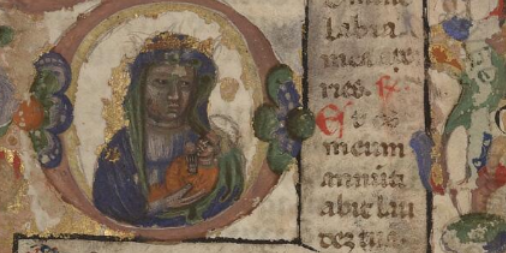
  54. Vat.lat.13985, Officium Beatae Virginis secundum consuetudinem Sanctimonialium Monasterii Sanctae Mariae de Virginibus de Venetiis, 14th-15th century
This is Piggin's Unofficial List number 162. Thanks to @gundormr for harvesting. If you have corrections or additions, please use the comments box below. Follow me on Twitter (@JBPiggin) for news of more additions to DigiVatLib.

2018-05-22

First Accounting Handbook

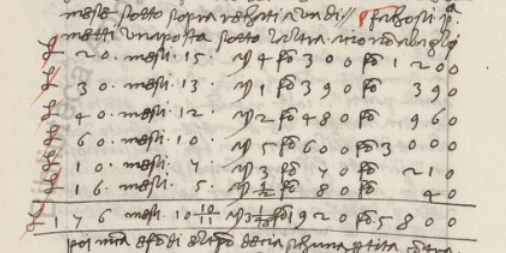
Luca Pacioli, the mathematician who instructed Leonardo da Vinci and for a time lived in the same house, hand-wrote a remarkable textbook, the Tractatus mathematicus ad discipulos perusinos, for his students at the University of Perugia, where Pacioli taught from 1477 to 1480.

This celebrated source-book of merchant arithmetic, preserved as Vat.lat.3129 at the Vatican Library, is seen as the start of the formal study of accounting. A color scan has just been presented online, replacing a murky black and white image on the library portal. It is among the most celebrated items to emerge from the digitization program in the past week. Below is the full list of 107 items:
  1. Barb.gr.283,
  2. Barb.lat.3867,
  3. Chig.L.IV.106.pt.A,
  4. Ott.lat.349,
  5. Ott.lat.3371,
  6. Vat.gr.1159,
  7. Vat.gr.1229,
  8. Vat.lat.2261,
  9. Vat.lat.2268,
  10. Vat.lat.2269,
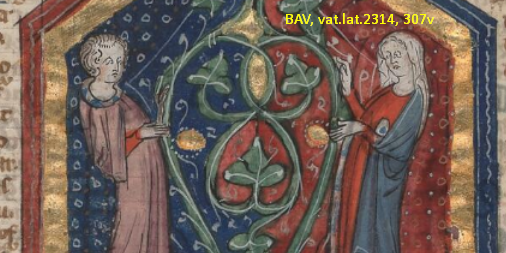
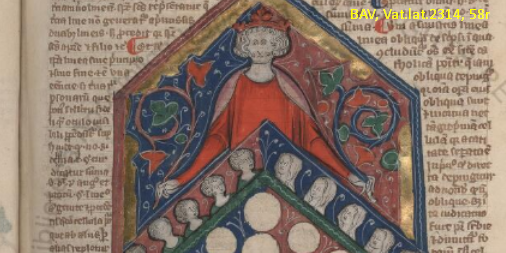
  11. Vat.lat.2314, Summa Hostiensis with notable arbor juris diagrams:
  12. Vat.lat.2321,
  13. Vat.lat.2331,
  14. Vat.lat.2352,
  15. Vat.lat.2377,
  16. Vat.lat.2402,
  17. Vat.lat.2405,
  18. Vat.lat.2409,
  19. Vat.lat.2425,
  20. Vat.lat.2451,
  21. Vat.lat.2463 (Upgraded to HQ),
  22. Vat.lat.2480,
  23. Vat.lat.2674,
  24. Vat.lat.2682,
  25. Vat.lat.2684,
  26. Vat.lat.2702,
  27. Vat.lat.2745,
  28. Vat.lat.2830,
  29. Vat.lat.2840,
  30. Vat.lat.2848,
  31. Vat.lat.2849,
  32. Vat.lat.2857,
  33. Vat.lat.2895,
  34. Vat.lat.2902,
  35. Vat.lat.2945,
  36. Vat.lat.2990,
  37. Vat.lat.2995,
  38. Vat.lat.3028,
  39. Vat.lat.3048 (Upgraded to HQ),
  40. Vat.lat.3051,
  41. Vat.lat.3053,
  42. Vat.lat.3058 (Upgraded to HQ),
  43. Vat.lat.3059,
  44. Vat.lat.3062,
  45. Vat.lat.3067,
  46. Vat.lat.3068,
  47. Vat.lat.3069,
  48. Vat.lat.3070, See eTK
  49. Vat.lat.3076 (Upgraded to HQ),
  50. Vat.lat.3079,
  51. Vat.lat.3080,
  52. Vat.lat.3082 (Upgraded to HQ),
  53. Vat.lat.3084,
  54. Vat.lat.3086,
  55. Vat.lat.3088, See eTK
  56. Vat.lat.3089,
  57. Vat.lat.3095,
  58. Vat.lat.3099, See eTK
  59. Vat.lat.3101 (Upgraded to HQ), See eTK
  60. Vat.lat.3103, See eTK
  61. Vat.lat.3104,
  62. Vat.lat.3105,
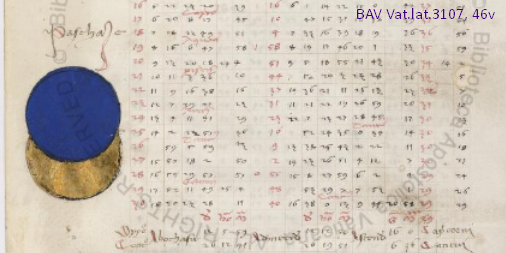
  63. Vat.lat.3107, an almanac for Pope Paul II by Nicholas Germanus. See eTK. This was exhibited in the Rome Reborn show, and Anthony Grafton's catalog calls it an "uncommonly beautiful example of an almanac, computed for the years 1466 to 1484". Here is the partial solar eclipse on April 26, 1473 predicted and illustrated:
  64. Vat.lat.3109,
  65. Vat.lat.3111,
  66. Vat.lat.3112 (Upgraded to HQ),
  67. Vat.lat.3113,
  68. Vat.lat.3114,
  69. Vat.lat.3116,
  70. Vat.lat.3117,
  71. Vat.lat.3118 (Upgraded to HQ),
  72. Vat.lat.3119,
  73. Vat.lat.3121, See eTK
  74. Vat.lat.3122 (Upgraded to HQ),
  75. Vat.lat.3124 (Upgraded to HQ),
  76. Vat.lat.3126,
  77. Vat.lat.3127,
  78. Vat.lat.3129 (Upgraded to HQ), Luca Pacioli (above)
  79. Vat.lat.3130 (Upgraded to HQ),
  80. Vat.lat.3133,
  81. Vat.lat.3134 (Upgraded to HQ),
  82. Vat.lat.3135,
  83. Vat.lat.3137,
  84. Vat.lat.3141 (Upgraded to HQ),
  85. Vat.lat.3146,
  86. Vat.lat.3152,
  87. Vat.lat.3154,
  88. Vat.lat.3155,
  89. Vat.lat.3158,
  90. Vat.lat.3160,
  91. Vat.lat.3162,
  92. Vat.lat.3163,
  93. Vat.lat.3164,
  94. Vat.lat.3166, See eTK
  95. Vat.lat.3167,
  96. Vat.lat.3168 (Upgraded to HQ),
  97. Vat.lat.3172,
  98. Vat.lat.3177,
  99. Vat.lat.3178,
  100. Vat.lat.3179,
  101. Vat.lat.3182,
  102. Vat.lat.3209,
  103. Vat.lat.3211 (Upgraded to HQ),
  104. Vat.lat.3213 (Upgraded to HQ),
  105. Vat.lat.3240,
  106. Vat.lat.3769,
  107. Vat.lat.3839 (Upgraded to HQ),
This is Piggin's Unofficial List number 161. Thanks to @gundormr for harvesting. If you have corrections or additions, please use the comments box below. Follow me on Twitter (@JBPiggin) for news of more additions to DigiVatLib.

2018-05-12

Early Physics

Basic ideas of modern physics go back well beyond Isaac Newton to the English scientist Richard Swineshead, who enters the scene in about 1340 as one of the Oxford Calculators. These brilliant men were interested in velocity, force and other values, and drew on mathematical work by Thomas Bradwardine (c.1300 – 26 August 1349), who went on to become Archbishop of Canterbury.

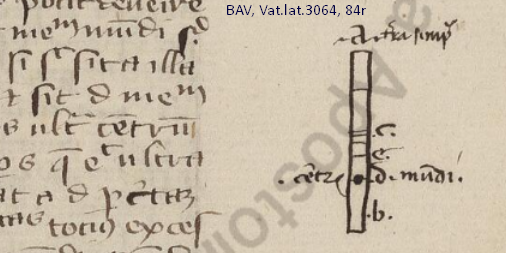
Younger scholars were hard pressed initially to make sense of their equations, and this week's batch of Vatican Library digitizations includes one codex, Vat.lat.3064, with traces of that student shock. I will let John E. Murdoch's Album of Science: Antiquity and the Middle Ages, Topic 256, (1984) take up the story:
Another tractate of Swineshead's Liber calculationum applied Bradwardine to a quite specific problem. Briefly put, the problem was whether a thin rod in free fall near the center of the universe will ever reach that center in the sense that the center of the rod will eventually coincide with the center of the universe. The problematic part of the question derived from the fact that as soon as any part of the rod passes the center of the universe, that part may be considered a resistance against the rod's continued motion.

Assuming that the rod acts as the sum of its parts and that the relevant forces and resistances determined by these parts follow Bradwardine's "law," Swineshead concludes that the center of the rod will never reach the center of the universe (which is correct, under the assumptions made, since the time intervals for each increment of distance will increase ad infinitum). The marginal sketch [...] accompanies this particular text of Swineshead in a fourteenth-century manuscript of his work. Possibly drawn by a reader trying to puzzle his way through this segment of the "Calculator," the rod (here termed terra simplex to indicate that it is a heavy body) is appropriately divided into parts, one of them depicted as already having passed the center of the universe, which is duly labeled centrum mundi.
The list of 71 new Vatican digitizations follows. This is the first issue of Piggin's Unofficial List (PUL) on the blog for three weeks, because the busy technical people on the Vatican digitization program have been busy with some other tasks in the meantime:

  1. Barb.or.109,
  2. Barb.or.151.pt.2, a printed world map in Chinese, with just a teensy bit of the northern tip of Australia, still contemplated at the time as part of the Great Southern Continent
  3. Borg.lat.677,
  4. Chig.L.IV.106.pt.B,
  5. Ott.lat.3369,
  6. Ott.lat.3370,
  7. Reg.lat.473,
  8. Reg.lat.1501 (Upgraded to HQ),
  9. Reg.lat.1716 (Upgraded to HQ),
  10. Vat.copt.61 (Upgraded to HQ),
  11. Vat.copt.68 (Upgraded to HQ),
  12. Vat.gr.1153,
  13. Vat.gr.1154,
  14. Vat.gr.1158,
  15. Vat.gr.1176,
  16. Vat.gr.2306.pt.A,
  17. Vat.lat.2028 (Upgraded to HQ), early-15th century cosmology, Laurenzo Bandini, initials and diagrams never completed. See eTK
  18. Vat.lat.2213,
  19. Vat.lat.2235,
  20. Vat.lat.2278,
  21. Vat.lat.2315,
  22. Vat.lat.2337,
  23. Vat.lat.2388 (Upgraded to HQ), 14th century copy of Albertus Magnus on physiology and medicine, also passages of Galen. See eTK
  24. Vat.lat.2406,
  25. Vat.lat.2511,
  26. Vat.lat.2735,
  27. Vat.lat.2772,
  28. Vat.lat.2774,
  29. Vat.lat.2821,
  30. Vat.lat.2879,
  31. Vat.lat.2947,
  32. Vat.lat.2950,
  33. Vat.lat.2981,
  34. Vat.lat.2989, Aristotle, De Anima, see eTK
  35. Vat.lat.2991 (Upgraded to HQ),
  36. Vat.lat.2992,
  37. Vat.lat.2996 (Upgraded to HQ),
  38. Vat.lat.2997 (Upgraded to HQ),
  39. Vat.lat.2999,
  40. Vat.lat.3000,
  41. Vat.lat.3001,
  42. Vat.lat.3002,
  43. Vat.lat.3003,
  44. Vat.lat.3005,
  45. Vat.lat.3019,
  46. Vat.lat.3025,
  47. Vat.lat.3027 (Upgraded to HQ), Nicolas Perotti's translation of Hippocrates and other medicine texts from Greek to English, see eTK
  48. Vat.lat.3031,
  49. Vat.lat.3037,
  50. Vat.lat.3038, logical and scientific texts by William Heytesbury, Richard Billingham and Petrus de Candia, see eTK
  51. Vat.lat.3041,
  52. Vat.lat.3042,
  53. Vat.lat.3046,
  54. Vat.lat.3050,
  55. Vat.lat.3052,
  56. Vat.lat.3056,
  57. Vat.lat.3060,
  58. Vat.lat.3061 (Upgraded to HQ),
  59. Vat.lat.3064, Swineshead, Liber calculationum, above.
  60. Vat.lat.3065 (Upgraded to HQ), Richard Billingham on logic, see eTK
  61. Vat.lat.3072 (Upgraded to HQ),
  62. Vat.lat.3075,
  63. Vat.lat.3081,
  64. Vat.lat.3093,
  65. Vat.lat.3094,
  66. Vat.lat.3115,
  67. Vat.lat.3181,
  68. Vat.lat.3229 (Upgraded to HQ), 15th-century Pomponius Leto work dealing with Cicero
  69. Vat.lat.3265,
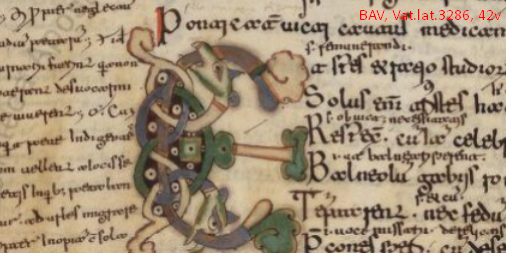
  70. Vat.lat.3286, Juvenal, with copious glosses, elaborate initials (below), one of Lowe's examples of Beneventan script, marked in "Juvenale, in lettera Langebardo" on the flyleaf
  71. Vat.lat.3309 (Upgraded to HQ), Horace, with flyleaves from older manuscript
This is Piggin's Unofficial List number 160. Thanks to @gundormr for harvesting. If you have corrections or additions, please use the comments box below. Follow me on Twitter (@JBPiggin) for news of more additions to DigiVatLib.

2018-04-23

Rich Student

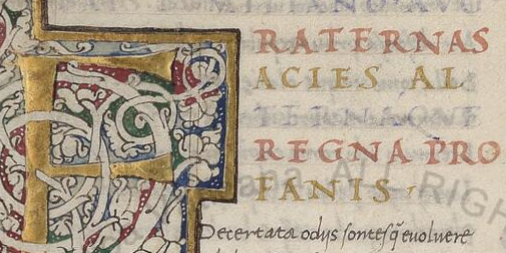
Among the most tragic figures associated with the Vatican Library is Fabio Mazzatosta, a very wealthy student at Rome in the 15th century who died before getting his first job. I have mentioned in a previous post the seven fabulous Fabio Mattatosta Codices, basically a bunch of school textbooks commissioned in the highest conceivable quality by M from his friend Pomponio Leto.

None of these was hastily copied, all had to be made with the finest script and initials. The arrival online in full color this week of Vat.lat.3279, the Thebaid by Statius (black and white version previously noted here) is fresh cause to celebrate this sad example of conspicuous consumption:

Still to come among the Vatican's five from Fabio's futile bookshelf are Vat.lat.3264 (Fasti of Ovid) and a color version of Vat.lat.3875 (Silvae and Achilleis).

The Vatican Library has been in high gear this week with 48 new digitizations online. The list:
  1. Chig.D.V.71 (Upgraded to HQ), book of hours
  2. Reg.lat.1933,
  3. Vat.lat.519.pt.1, Milleloquium Veritatis Sancti Augustini by Bartholomew of Urbino, see Bernard Peebles (1954). Part 2 came online earlier this month.
  4. Vat.lat.2188, Bernardini de Sicilia, Quaestiones de Cognitione animae conjunctae corpori; see also electronic Thorndike Kiber which lists an incipit Circa considerationem de mensuris durationis attributable to Dietrich von Freiberg.
  5. Vat.lat.2215 (Upgraded to HQ), Seneca
  6. Vat.lat.2236,
  7. Vat.lat.2238,
  8. Vat.lat.2260,
  9. Vat.lat.2271,
  10. Vat.lat.2307 (Upgraded to HQ), Durand de Champagne
  11. Vat.lat.2680,
  12. Vat.lat.2851,
  13. Vat.lat.2924,
  14. Vat.lat.2946,
  15. Vat.lat.2951 (Upgraded to HQ),
  16. Vat.lat.2954,
  17. Vat.lat.2957,
  18. Vat.lat.2962,
  19. Vat.lat.2963,
  20. Vat.lat.2970,
  21. Vat.lat.2983,
  22. Vat.lat.2985,
  23. Vat.lat.2988,
  24. Vat.lat.2998,
  25. Vat.lat.3006,
  26. Vat.lat.3007,
  27. Vat.lat.3008,
  28. Vat.lat.3009,
  29. Vat.lat.3010 (Upgraded to HQ),
  30. Vat.lat.3011 (Upgraded to HQ),
  31. Vat.lat.3013,
  32. Vat.lat.3014,
  33. Vat.lat.3015,
  34. Vat.lat.3016,
  35. Vat.lat.3017 (Upgraded to HQ),
  36. Vat.lat.3020,
  37. Vat.lat.3021,
  38. Vat.lat.3022,
  39. Vat.lat.3026, tracts by Walter Burley (1275-1345?) -  electronic Thorndike Kiber lists the incipit In hoc tractatu intendo perscrutari de causa intrinseca.
  40. Vat.lat.3034,
  41. Vat.lat.3036,
  42. Vat.lat.3043,
  43. Vat.lat.3044,
  44. Vat.lat.3092 (Upgraded to HQ),
  45. Vat.lat.3143 (Upgraded to HQ),
  46. Vat.lat.3227 (Upgraded to HQ), 12th-century manuscript in Beneventan script. Cicero, Philippics, Somnium Scipionis; O Roma nobilis, etc. Mentioned by Lowe.
  47. Vat.lat.3279 (Upgraded to HQ), Fabio Mazzatosta's Thebaid Statius (above)
  48. Vat.lat.3294 (Upgraded to HQ), Martial
This is Piggin's Unofficial List number 159. Thanks to @gundormr for harvesting. If you have corrections or additions, please use the comments box below. Follow me on Twitter (@JBPiggin) for news of more additions to DigiVatLib.