Showing posts with label PUL. Show all posts

2018-01-24

Cheery Again

After my grumble over the impractical index page for Vat.lat. manuscripts at the Vatican Library portal, two kind and very computer-savvy readers of this blog suggested solutions. That generosity cheered me (as did the removal of a post-surgery splint on my wrist). It now looks as if a nifty script will be scraping this current week's updates from the DigiVatLib website, but more on that in my next post.

Grateful, I decided to seek -- by hand -- the newly issued Vat.lat. items from the still-missing second week of January. It turns out there are 45, plus three codices newly upgraded from murky microfilm to high quality. They are listed below, only lightly commented.
  1. Vat.lat.168,
  2. Vat.lat.315,
  3. Vat.lat.427.pt.1,
  4. Vat.lat.636.pt.1,
  5. Vat.lat.636.pt.2,
  6. Vat.lat.788,
  7. Vat.lat.1316,
  8. Vat.lat.1503,
  9. Vat.lat.2057,
  10. Vat.lat.2086,
  11. Vat.lat.2087,
  12. Vat.lat.2091,
  13. Vat.lat.2187,
  14. Vat.lat.2219,
  15. Vat.lat.2227,
  16. Vat.lat.2309,
  17. Vat.lat.2312,
  18. Vat.lat.2320,
  19. Vat.lat.2323,
  20. Vat.lat.2367, Hippocrates: Ad discipulum suum Actonem longis petitionibus (14th century copy); see eTK
  21. Vat.lat.2368,
  22. Vat.lat.2374, Cornelius Celsus: Ut alimenta sanis corporibus agricultura; see eTK
  23. Vat.lat.2386,
  24. Vat.lat.2397,
  25. Vat.lat.2401,
  26. Vat.lat.2419,
  27. Vat.lat.2420,
  28. Vat.lat.2423, Acatia est sucus alchati; .te Synonyms
  29. Vat.lat.2428, Liberet te deus fili amantissime a via errorum (14c-15c); see eTK
  30. Vat.lat.2432,
  31. Vat.lat.2446, Avicenna: Medicina est conservatio sanitatis et curatio egritudinis; see eTK
  32. Vat.lat.2450,
  33. Vat.lat.2472,
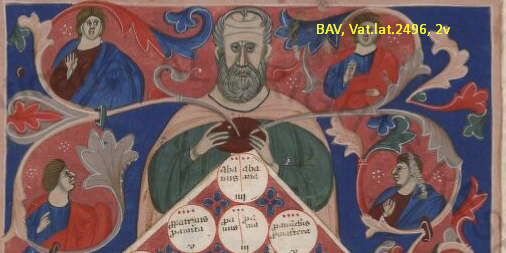
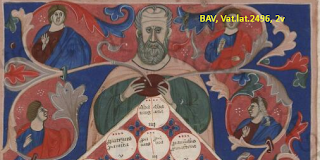
  34. Vat.lat.2496, the Liber Sextus Decretalium with Iohannis Andreae kinship diagrams. Magnificent!
  35. Vat.lat.2518,
  36. Vat.lat.2626,
  37. Vat.lat.2644,
  38. Vat.lat.2645,
  39. Vat.lat.2649,
  40. Vat.lat.2657,
  41. Vat.lat.2668,
  42. Vat.lat.2672,
  43. Vat.lat.2696,
  44. Vat.lat.2697,
  45. Vat.lat.2752,
Newly in high-quality:
  1. Vat.lat.2146, Walter Burley,  Nota quod in homine sunt quinque sensus; see eTK
  2. Vat.lat.2186, Dominicus Gundissalinus, Cum omnes homines eque constent ex anima et corpore; see eTK
  3. Vat.lat.2426 , Urina alba in colore tenuis in substantia (14th century codex); see eTK

This is Piggin's Unofficial List number 146. If you have corrections or additions, please use the comments box below. Follow me on Twitter (@JBPiggin) for news of more additions to DigiVatLib.

2018-01-21

Grumbling

This post begins with a grumble.The famous Vat.lat. collection of the pope's Latin books in Rome numbers about 15,000, of which 4,026 or well over a quarter are so far online. The Vat.lat. series forms about one sixth of the entire Vatican manuscript library. That progress in digitization would be a cause for great celebration if it were not for the architecture of the online portal.

I have now reached the state where my fairly good computer and my high-speed internet connection can no longer reliably download and compare the Vat.lat. index page with its absurdly long list of 4,026 items, even when I block the images. Loading the index page takes up to a minute.

The solution ought not to be difficult. The series needs to be listed in 1000-manuscript chunks:  1-999, 1000-1999, 2000-2999 and so on. Until our technical friends at the Vatican realize that no one on the internet nowadays serves single pages with 4,026 images and reorganizes the indices in a more rational fashion, I am not going to be able to monitor for updates.

As a result, all that I have this week for you are 10 items from the other Vatican sub-collections:
  1. Reg.lat.101 contains keys to bible study, including Brito de vocabulis byblie secundum ordinem alphabeti
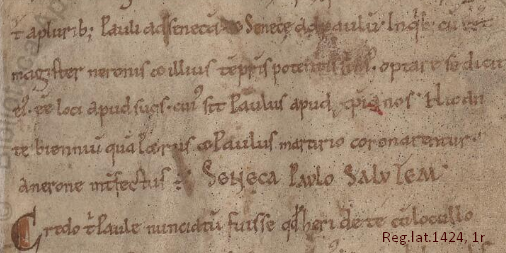
  2. Reg.lat.1424, an 8th or 9th century compilation of the classics starting with the famous forged exchange of letters between Seneca and St Paul, and including a poetic bit of the De Consolatione Philosophiae of Boethius
    Check out the tweet by @ParvaVox with more details.
  3. Reg.lat.1464, Cicero, De Officiis and other works
  4. Reg.lat.1643, Solinus, De mirabilibus mundi
  5. Reg.lat.1660, poetry, Italian
  6. Reg.lat.1662, begins with Caecus in limine, a whodunnit from Pseudo-Quintilian
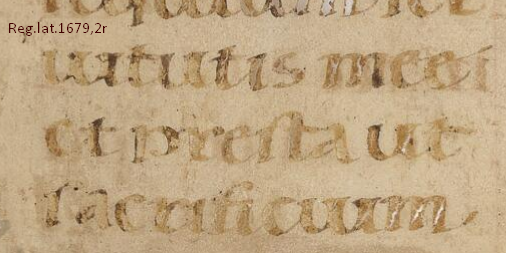
  7. Reg.lat.1679, Vergil, Eclogae, with a flyleaf reused from an old uncial missal, here the words "et presta ut sacrificium"
  8. Reg.lat.1680, Plautus, Comedies
  9. Sbath.34, an Arabic manuscript from the collection of the famed Father Paul Sbath
  10. Urb.lat.1101, letters, first date 1631, in Italian
This is Piggin's Unofficial List number 145. If you have corrections or additions, please use the comments box below. Follow me on Twitter (@JBPiggin) for news of more additions to DigiVatLib.
2018-01-14

Felice Squares

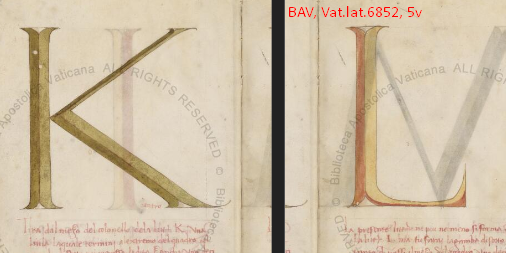
A monument in the history of typography has just arrived online: the original manuscript of the first book demonstrating how to create Roman square capital letters geometrically. This is the work of Felice Feliciano, and as you can see in this extract for K and L, the letter proportion is based on the square or half-square:
Vat.lat.6852 is the original copy of Alphabetum Romanum, his treatise on the geometrical construction of Roman capital letters using the square and circle. It was digitized and issued online a few days ago. It is part of the Renaissance movement that created Antiqua, the new lettering based on Roman models.

Of course we do not now like to see a square K as wide as it is high, but it is part of the slow process of experimentation that brought microtypography to where it is today. Enjoy.

Here is my full list of new releases. eTK refers you to the Thorndike and Kibre index. I must remain brief, as my left hand is still in a cast after surgery, and typing is difficult.
  1. S.Maria.in.Via.Lata.I.45, the Evangeliary of S. Maria in Via Lata, battered, mouldy and a thousand years old. The canon tables pages are classic in style.
  2. S.Maria.in.Via.Lata.I.45.pt.A, jewelled cover and bookmarks of above, some items seemingly even older
  3. Vat.lat.168
  4. Vat.lat.207 homilies of Origen in Latin translation; NB: error in Trismegistos: not TM 67902 = Lowe, CLA Suppl. 1769 = Rome, "Vatican, Biblioteca del Vaticano Lat. 207" which is in fact Pal.lat.207 (Lorsch; 750-825).
  5. Vat.lat.339
  6. Vat.lat.434.pt.1
  7. Vat.lat.434.pt.2
  8. Vat.lat.435.pt.1
  9. Vat.lat.454.pt.2
  10. Vat.lat.527.pt.1
  11. Vat.lat.527.pt.2
  12. Vat.lat.618
  13. Vat.lat.765
  14. Vat.lat.771
  15. Vat.lat.788
  16. Vat.lat.790
  17. Vat.lat.791
  18. Vat.lat.851
  19. Vat.lat.1008.pt.1
  20. Vat.lat.1008.pt.2
  21. Vat.lat.1101
  22. Vat.lat.1162.pt.1
  23. Vat.lat.1162.pt.2
  24. Vat.lat.1162.pt.3
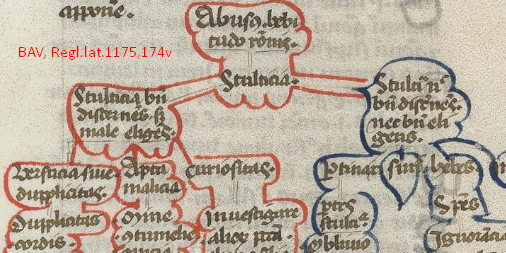
  25. Vat.lat.1175.pt.1, a great 12th-century work that uses stemmata to organize the teaching material: Radulfus Ardens, Speculum universale
  26. Vat.lat.1232
  27. Vat.lat.1250.pt.2
  28. Vat.lat.1304
  29. Vat.lat.1306
  30. Vat.lat.1314
  31. Vat.lat.1315
  32. Vat.lat.1568
  33. Vat.lat.1626
  34. Vat.lat.1898
  35. Vat.lat.1951.pt.1
  36. Vat.lat.1953
  37. Vat.lat.1961
  38. Vat.lat.1973
  39. Vat.lat.1985
  40. Vat.lat.1988
  41. Vat.lat.2009
  42. Vat.lat.2051
  43. Vat.lat.2053
  44. Vat.lat.2061
  45. Vat.lat.2076
  46. Vat.lat.2081
  47. Vat.lat.2116
  48. Vat.lat.2144
  49. Vat.lat.2156
  50. Vat.lat.2157 HT to @LatinAristotle: second copy of the above commentary by John of Jandun
  51. Vat.lat.2161 eTK
  52. Vat.lat.2164
  53. Vat.lat.2174
  54. Vat.lat.2197
  55. Vat.lat.2200
  56. Vat.lat.2220
  57. Vat.lat.2223
  58. Vat.lat.2270
  59. Vat.lat.2301
  60. Vat.lat.2310
  61. Vat.lat.2327
  62. Vat.lat.2329
  63. Vat.lat.2371 eTK
  64. Vat.lat.2372 eTK
  65. Vat.lat.2373 eTK
  66. Vat.lat.2387
  67. Vat.lat.2391
  68. Vat.lat.2404
  69. Vat.lat.2457, Constantine the African: Pantegni
  70. Vat.lat.5309
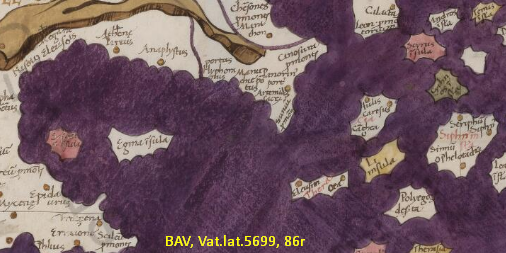
  71. Vat.lat.5699, a de luxe version of Ptolemy's Cosmography, dated 1469, translated from Greek to Latin by Iacobo Angelo. In the maps section, here is the Gulf of Athens. Note how each of the islands is a different colour, like confetti:
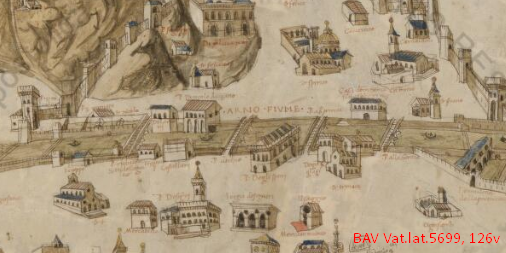
    There are wonderful idealized town views, like this of Florence: pick out the Ponte Vecchio and try to find the Duomo: in fact it is marked in historicizing fashion as Santa Reparata:
    Anthony Grafton noted for the Rome Reborn exhibition how the view on the next page showed Rome with the Castel Sant'Angelo, the Borgo and Saint Peter's at bottom right, separated from the city by the Tiber: "Within the city proper, the ancient monuments rise, without modern buildings and urban sprawl. The Pantheon, the Forum, the Capitoline and Palatine hills, and the Colosseum dominate the central space."
  72. Vat.lat.5845, the late antique Collectio Dionysiana and Collection of Cresconius in an important 10th-century South Italian composite manuscript in a Beneventan hand
  73. Vat.lat.6852, the original copy of the Alphabetum Romanum (above).
  74. Vat.lat.13152.pt.2
  75. Vat.lat.14936
  76. Vat.lat.14937
  77. Vat.lat.15294.pt.2
This is Piggin's Unofficial List number 144. If you have corrections or additions, please use the comments box below. Follow me on Twitter (@JBPiggin) for news of more additions to DigiVatLib.
2018-01-06

All the Palatine

The digitization of the Palatine Latin collection at the Vatican Library seems to now be as good as complete. But wait for the official announcement.

This is a pretty big deal, because it means the former Latin section of the University of Heidelberg Library as of 1622 has been recreated as an online avatar at Bibliotheca Palatina. The prestigious library was hauled off to Rome as war booty and only the German and Greek books later returned.

The 2,030-book collection will also constitute the first complete large collection or sublibrary at the 80,000-codex Vatican Library to be available online. (Though not at the Vatican itself, where only half of the items are so far available in the Pal.lat. online collection.)

The collection is being digitized at the University in Germany with funding from the benefactor Manfred Lautenschläger. Presumably for contractual reasons the Vatican itself can only show the digital images online after a certain delay. Here are the last 11 items I have logged:
  1. Pal. lat. 1819 [Juristische Sammelhandschrift]
  2. Pal. lat. 2006 Schreibkalender, Tagebuch Pfalzgraf Johann Kasimirs; Abschussliste 1582 (1582)
  3. Pal. lat. 2020 Schreibkalender, Desiderata der Palatina
  4. Pal. lat. 2021 Indices zu Handschriften und Drucken der Palatina
  5. Pal. lat. 2022 Gebetbuch in deutscher Sprache, genealogische Notizen (16. Jh.)
  6. Pal. lat. 2023 Schreibkalender, Tagebuch Kf. Friedrichs III. von der Pfalz/Pfalzgraf Johann Casimirs (1569)
  7. Pal. lat. 2024 Schreibkalender, Tagebuch Kf. Ludwigs VI. von der Pfalz (1581)
  8. Pal. lat. 2027 Schreibkalender, Tagebuch Kf. Ludwigs VI. von der Pfalz (1579)
  9. Pal. lat. 2028 Mappe mit Einbandfragmenten (14./ 15. Jh.) (14./ 15. Jh.)
  10. Pal. lat. 2029 Inventarium manuscriptorum Latinorum Bibliothecae Palatinae (17. Jh.)
  11. Pal. lat. 2030 Codicum manuscriptorum Latinorum Vaticanae Palatinae Bibliothecae Index (Vatikanstadt, 1678)
Meanwhile work continues to digitize the other Vatican collections, with these 11 items arriving online in the past week:
  1. Reg.lat.1521: La Bugia, Rime del Marchese M. Palombara
  2. Reg.lat.1646: classics, signed by scribe William in 1270 on the last page
  3. Reg.lat.1648
  4. Reg.lat.1657, Cicero, Ad Familiares
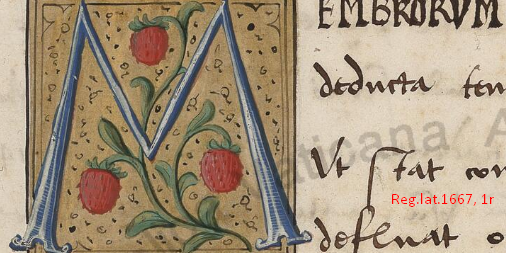
  5. Reg.lat.1667, Quintus Serenus Sammonicus (died 212): De medicina praecepta saluberrima, a didactic medical poem, with this lovely opening initial:
  6. Reg.lat.1690, genealogy in German
  7. Reg.lat.1694, Evrard de Bethune's Latin grammar, Graecismus
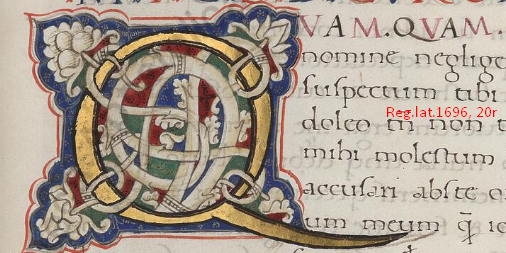
  8. Reg.lat.1696, Cicero, fine Renaissance initials like this:
  9. Urb.lat.371, Sebastiani Maccii Durantini ... Soteridos
  10. Urb.lat.1061, letters and reports of 1593
  11. Urb.lat.1108, letters and reports of 1639-40
This is Piggin's Unofficial List number 143. If you have corrections or additions, please use the comments box below. Follow me on Twitter (@JBPiggin) for news of more additions to DigiVatLib.
2017-12-27

Quick Click

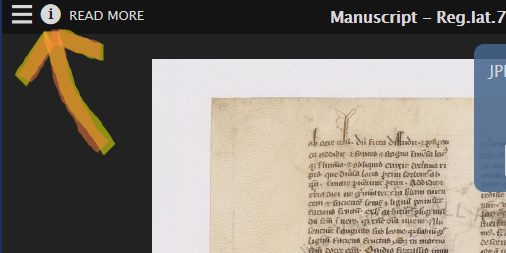
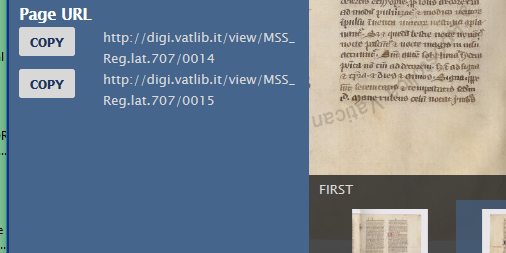
Before I list the latest 26 manuscripts digitized at the Vatican Library, I want to draw your attention to one of the helpful new features added this year to the digital portal. It is a means, omitted in the early days of the new portal, to link to individual pages. Here is how the feature works.

If you are looking at a codex page and need to quote it, click on the "i" in a white circle in the left navigation pane:

Scroll down to and down to "Page URL":

From here you only need to click the "COPY" button to get a usable link in your clipboard.

And now, the list of 26 new additions:
  1. Borg.copt.109.cass.XXV.fasc.123, page of a gospel?
  2. Borg.copt.109.cass.XXV.fasc.124,
  3. Borg.copt.109.cass.XXV.fasc.125,
  4. Borg.copt.109.cass.XXVI.fasc.126,
  5. Borg.copt.109.cass.XXVI.fasc.127,
  6. Borg.copt.109.cass.XXVI.fasc.128,
  7. Borg.copt.109.cass.XXVI.fasc.129,
  8. Reg.lat.203,
  9. Reg.lat.1120, Justinian Code, glossed, 13th century
  10. Reg.lat.1271, commentary on Avicenna's canon (HT to @monicaMedHist)
  11. Reg.lat.1291, Renaissance commentary on Aristotelean mechanics
  12. Reg.lat.1410, 10th-century classics manuscript with Virgil, Horace, Juvenal
  13. Reg.lat.1454, Seneca, Letters to Lucillium
  14. Reg.lat.1489, Lancelot du Lac, French
  15. Reg.lat.1559, early Renaissance compilation of Latin classics
  16. Reg.lat.1608,
  17. Reg.lat.1645.pt.1,
  18. Reg.lat.1645.pt.2,
  19. Reg.lat.1647,
  20. Reg.lat.1655, early Priscian, Institutiones grammaticae
  21. Reg.lat.1656,
  22. Reg.lat.1661,
  23. Reg.lat.1663,
  24. Reg.lat.1668,
  25. Reg.lat.1675, Horace, 11th-century?
  26. Urb.lat.1402, Fiore delle medicine, 15th-century Italian medical treatise (HT to @monicaMedHist)
This is Piggin's Unofficial List number 142. If you have corrections or additions, please use the comments box below. Follow me on Twitter (@JBPiggin) for news of more additions to DigiVatLib.
2017-12-18

Divorce Manual

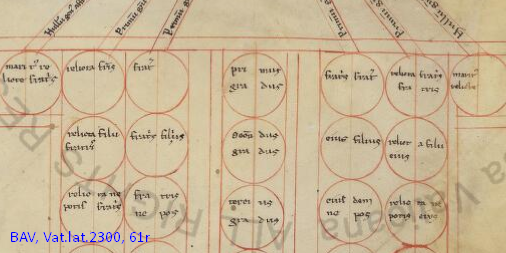
A handbook of marriage and divorce by Raymundus de Pennaforte (1175/85-1275) is one of the stars of the latest swathe of Vatican manuscript digitizations. The Summa Matrimonio is the classic remix, lightly adapted by Ramon from a previous textbook and itself modified soon enough.

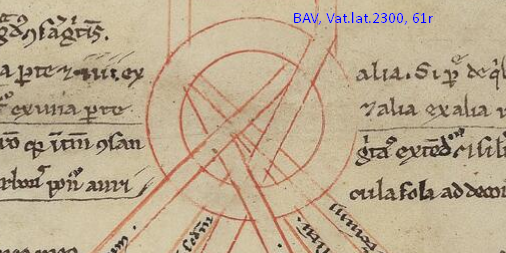
Vincentius Hispanus of Bologna University is apparently the professor who contributed a compound diagram of incestuous marriages at 61r, introducing it as: "Hec conpositio arboris sanguitatis ..."
Of course it does not look like a wood-and-leaves tree. The top part looks like an arrow, the bottom part (glimpse it above) like a plinth, and the mid part (below) designed to somehow connect everything into one big confusing infographic, resembles too many stir-spoons spoiling a pot of broth:

As I have pointed out in the past: arbor should be taken simply as a medieval term for a recursive diagram.

Here is my list of digitizations noticed in the past seven days.
  1. Borg.arm.10
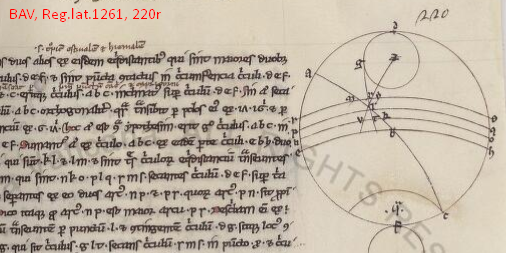
  2. Reg.lat.1261, 14th-century science and maths with Jordanus de Nemore, De Ponderis, and other authors. eTK lists De cometis, incipit: Occasione comete que nuper apparuit
  3. Reg.lat.1351
  4. Reg.lat.1482
  5. Reg.lat.1544
  6. Reg.lat.1567
  7. Reg.lat.1601
  8. Reg.lat.1607
  9. Reg.lat.1626
  10. Reg.lat.1627
  11. Reg.lat.1683
  12. Reg.lat.1697
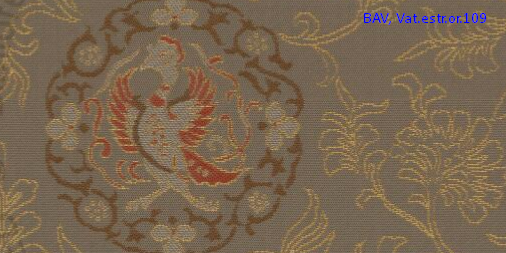
  13. Vat.estr.or.109, in Japanese. Look at this spectacular binding cloth:
  14. Vat.lat.640.pt.1
  15. Vat.lat.640.pt.2
  16. Vat.lat.780
  17. Vat.lat.1250.pt.1
  18. Vat.lat.1262
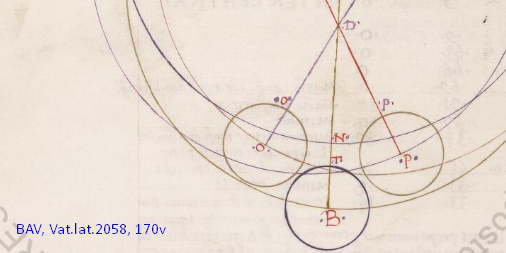
  19. Vat.lat.2058, Commentary on the Almagest by George Trebizond. Anthony Grafton notes in his Rome Reborn catalog: Trebizond wrote a commentary as long as [his own Latin translation of the Almagest]. The commentary was severely criticized, which resulted in a falling out with Pope Nicholas V. This opulent manuscript was dedicated to Pope Sixtus IV along with Vat.lat.2055 of the translation. [Below is] a large figure of the model for the planet Mercury, shown at its least distance from the earth, with a list of Mercury's parameters and distances:
  20. Vat.lat.2229
  21. Vat.lat.2300 (above)
  22. Vat.lat.7228
This is Piggin's Unofficial List number 141. If you have corrections or additions, please use the comments box below. Follow me on Twitter (@JBPiggin) for news of more additions to DigiVatLib.
2017-12-10

Marshal GT

I've often wondered how many medieval people actually introduced themselves by their place of origin, for example: "Hello, I'm John of Auckland."

One of the Vatican Library manuscripts which I spotted this week newly digitized in color is Vat.lat.933 containing works by Gervase of Tilbury (c. 1150s–c. 1222) and marked up by the great man himself with corrections. On the opening page he is described as Gervasius Tilberiensis (the obscure West Tilbury in Essex).

So it does appear he went by that name in his lifetime, even when he held titles like Marshal of the Kingdom of Arles or Provost of Ebstorf. Gervase is famed for writing the Otia Imperialia ("Recreation for an Emperor") for his patron, Holy Roman Emperor Otto IV. It describes many wonders of the distant world such as headless men (also known as akephaloi or blemmyes).

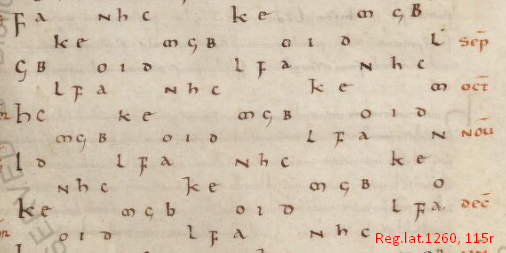
Also new in color is Reg.lat.1260, a binding of two manuscripts believed to be associated with the monastery of Fleury-sur-Loire in France (HT to @monicaMedHist for pointing this out and imaging Beccaria's description). A 10th-century manuscript includes scientific texts such as a glossary of Greek disease names (Incipit: Antrax id est rubor in superficie cutis (see eTK)). And here is its handy tabulation of phases of the moon:

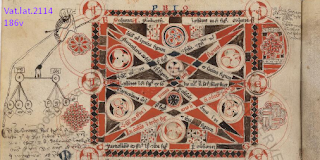
Additionally now available in color is a 14th-century scientific manuscript with works of Boethius, Vat.lat.2114 with Categoriae 12v-32r; De Interpretatione 42r-53r; translation of Aristotle, Prior Analytics 162r-218v; of Aristotle, De Sophisticis Elenchis 53r-81v; of Aristotle, Topica 81v-162r. It also contains a commentary on Euclid, a great many marginal glosses, and diagrams:

Here is the list of completely new digitizations I have detected in the past week:
  1. Ott.lat.3384
  2. Reg.lat.1321
  3. Reg.lat.1542
  4. Reg.lat.1562
  5. Reg.lat.1564
  6. Reg.lat.1565
  7. Reg.lat.1566
  8. Reg.lat.1578
  9. Reg.lat.1590
  10. Reg.lat.1635
  11. Ross.40
  12. Vat.lat.1967
  13. Vat.lat.2114
  14. Vat.lat.2120
  15. Vat.lat.2195, a 14th-century manuscript of the Latin novel Metamorphoses by the 2nd-century Numidian writer Apuleius.
  16. Vat.lat.2221
  17. Vat.lat.2265
  18. Vat.lat.2281
  19. Vat.lat.3360
This is Piggin's Unofficial List number 140. If you have corrections or additions, please use the comments box below. Follow me on Twitter (@JBPiggin) for news of more additions to DigiVatLib.
2017-12-02

Riddle me ree

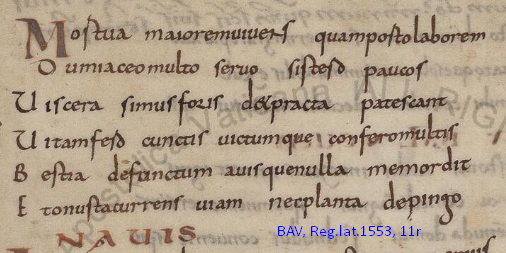
At long last, the Vatican Library has digitized in color Reg.lat.1553, a fine Carolingian manuscript containing the late antique riddle collection known as the Berne Riddles. Previously only a murky grey scan was online.

Here's a sample:

Glorie edits this to:
Mortua maiorem uiuens quam porto laborem.
Dum iaceo, multos seruo; sistetero, paucos.
Viscera si [mihi] foris detracta patescant,
Vitam fero cunctis uictumque confero multis.
Bestia defunctam auisque nulla me mordit,
Et onusta currens uiam nec planta depingo
The translation quoted by Paul Sorrell:
Dead, I bear a greater labor than when living. When I lie dead, I preserve many; if I remain standing, few. If my insides are exposed, pulled away outside, I bring life to all and collect sustenance for many.  No beast or bird bites me when I am dead, and running along loaded down, I do  not mark the way with my foot.
The answer is: an oak made into a ship. This collection's only connection to Berne, Switzerland is that that is the current location of a slightly older manuscript. The compilation was apparently made in northern Italy, based on far older riddle books, perhaps the work of an insular (Irish) monk at Bobbio. This early-9th-century codex also contains music. For a discussion, see Chauncey E Finch (below).

Here are the manuscripts that have just arrived online for the very first time.
  1. Legat.Pal.lat.930, an ornate binding (without the book) of 1548
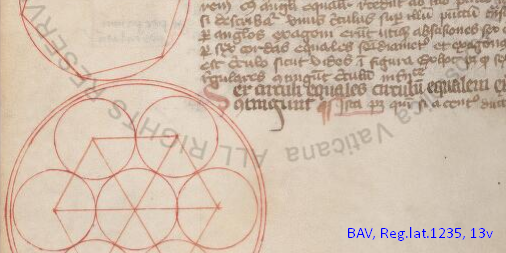
  2. Reg.lat.1235, geometry and arithmetic
  3. Reg.lat.1270
  4. Reg.lat.1280
  5. Reg.lat.1284
  6. Reg.lat.1303
  7. Reg.lat.1328, Vitruvius, On Architecture, HT to @gundormr
  8. Reg.lat.1404
  9. Reg.lat.1568
  10. Reg.lat.1574
  11. Reg.lat.1587
  12. Reg.lat.1625
  13. Reg.lat.1674, Servius' commentary on the Aeneid, book 6, HT to @gundormr
  14. Vat.lat.1824
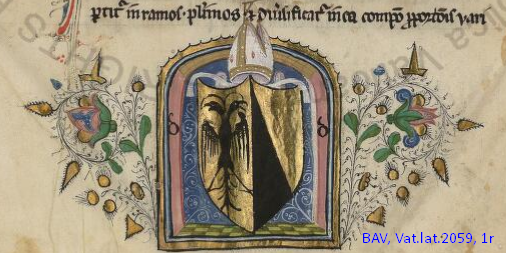
  15. Vat.lat.2059, with the episcopal coat of arms of Domenico Dominici
  16. Vat.lat.2189
  17. Vat.lat.2196
  18. Vat.lat.2209
  19. Vat.lat.2226
  20. Vat.lat.3964, a list of library borrowings from the 1470s
Additionally, the Pal.lat. collection at the Vatican seems to within weeks of loud and merry celebration as the first complete section online. It is being digitized by Heidelberg University Library and will be fully in place when all 2,030 items are digitized. Still missing are 2,018-24 and 2,027-30 as well as earlier items which I have not had time to survey. Here are the new additions:
  1. Pal. lat. 1960 Doctrines des Pères, französisch nach den Vitae patrum
  2. Pal. lat. 1961 Legrand, Jacques (?): Jacques le Grant, Livre des bonnes meours (15. Jh.)
  3. Pal. lat. 1968 Martin : Le champion des dames (2. Hälfte 15. Jh.)
  4. Pal. lat. 1973 Seuse, Heinrich: Horloge de sapience (15. Jh.)
  5. Pal. lat. 1974 Historiographische Notizen, Briefabschriften (1505-1520)
  6. Pal. lat. 1984 Französische Gedichte des 16. Jhs. (16. Jh.)
  7. Pal. lat. 1985 Allegorische Darstellungen, Nachzeichnungen (?) zu Tapisserien (?) (16. Jh.)
  8. Pal. lat. 1987 Johannes a Breda (?): Lateinische Psalmenkommentare
  9. Pal. lat. 1991 Seuse, Heinrich: Vertu de la messe ; Horloge de sapience (15. Jh.)
  10. Pal. lat. 1992 Jehan Dupin: Livre de Mandevie (15. Jh.)
  11. Pal. lat. 1996 Schreibkalender, Tagebuch Pfalzgraf Johann Casimirs (1567)
  12. Pal. lat. 1997 Schreibkalender, Tagebuch Pfalzgraf Johann Casimirs (1570)
  13. Pal. lat. 1998 Schreibkalender, Eintragungen Friedrichs III. (1571)
  14. Pal. lat. 1999 Schreibkalender, Tagebuch Pfalzgraf Johann Casimirs (1571)
  15. Pal. lat. 2001 Schreibkalender, Tagebuch Pfalzgraf Johann Casimirs (1577)
  16. Pal. lat. 2003 Schreibkalender, keine Eintragungen (1579)
  17. Pal. lat. 2007 Schreibkalender, Tagebuch Pfalzgraf Johann Casimirs (1583)
  18. Pal. lat. 2008 Schreibkalender, Tagebuch Pfalzgraf Johann Casimirs (1584)
  19. Pal. lat. 2009 Schreibkalender, Tagebuch Pfalzgraf Johann Casimirs (1585)
  20. Pal. lat. 2010 Schreibkalender, Tagebuch Pfalzgraf Johann Casimirs (1586)
  21. Pal. lat. 2011 Schreibkalender, Tagebuch Pfalzgraf Johann Casimirs (1587)
  22. Pal. lat. 2012 Schreibkalender, Tagebuch Pfalzgraf Johann Casimirs (1588)
  23. Pal. lat. 2013 Schreibkalender mit handschriftlichen Notizen (Friedrich IV.?) (1606)
  24. Pal. lat. 2014 Schreibkalender, Tagebuch Kf. Ludwigs VI. von der Pfalz (1572)

This is Piggin's Unofficial List number 139. If you have corrections or additions, please use the comments box below. Follow me on Twitter (@JBPiggin) for news of more additions to DigiVatLib.
Finch, Chauncey E. "The Bern Riddles in Codex Vat. Reg. Lat. 1553." Transactions and Proceedings of the American Philological Association 92 (1961): 145-55. doi:10.2307/283806.

2017-11-26

Charlemagne's Daughter

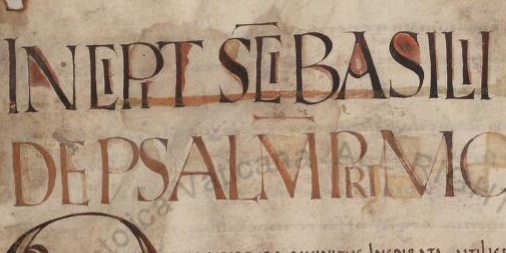
The Vatican Library continues to re-scan codices in color to replace the dire black and white microfilms it previously had online. I just noticed the arrival of a fine old 9th-century codex from Faremoutiers Abbey where at one point Ruothild, an illegitimate daughter of Charlemagne, was abbess. Reg.lat.141 begins with a Latin translation from Basil the Great, apparently with some unique glosses:
Esteemed @ParvaVox points out in response on Twitter that it's a "quite extraordinary #Carolingian witness of a late antique doctrinal controversy ... containing glosses dating back to the fight against Pelagianism and Julian of Eclanum".

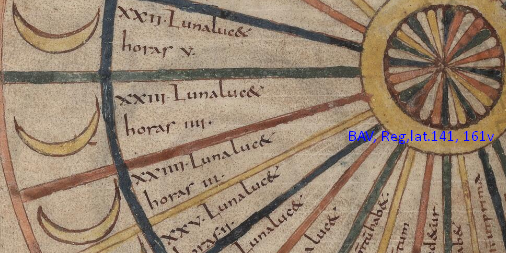
For those interested in Carolingian science, the eTK lists a tract in the codex beginning De mundi principio quomodo factus est ... At the back are paschal tables from 804 to 873 (a note marks Ruothild's death), as well as fine diagrams including this one of the phases of the moon:


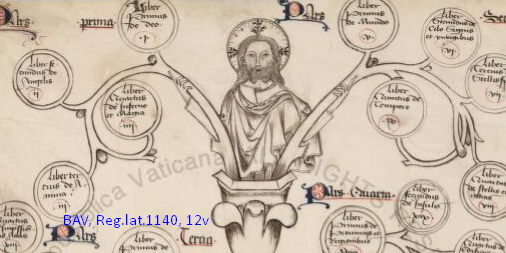
Also new in color is Reg.lat.1140, a packed tome of 557 folios containing Fons memorabilium universi of Domenico Bandini of Arezzo, but what caught my eye was this amazing diagrammatic table of contents:

The last new color item of note is Vat.lat.2190, a 14th-century text by the Spanish Franciscan philosophy teacher and early Scotist, Peter Thomae (c.1280-c.1350), Ista convertuntur proprie videlicet esse et reytas, ens et res, entale et reale, entalitas et realitas, also listed in eTK.

There are of course completely new items online, of which I have spotted 26:
  1. Pal.gr.205
  2. Reg.lat.196
  3. Reg.lat.1206
  4. Reg.lat.1227
  5. Reg.lat.1239
  6. Reg.lat.1247
  7. Reg.lat.1293
  8. Reg.lat.1330, eTK: Astrologia est beneficio deorum nobis revelata
  9. Reg.lat.1548
  10. Reg.lat.1576
  11. Reg.lat.1614
  12. Reg.lat.1628
  13. Reg.lat.1629
  14. Reg.lat.1634, HT to @LatinAristotle, who points out this is Lucan's Civil War with a diagram laying out the topographical situation
  15. Reg.lat.1639
  16. Reg.lat.1651
  17. Reg.lat.1862
  18. Vat.lat.1417
  19. Vat.lat.2022
  20. Vat.lat.2049
  21. Vat.lat.2099
  22. Vat.lat.2172
  23. Vat.lat.2181
  24. Vat.lat.2184, a 14th-century collection on Aristotlean philosophy: the catalog lists commentators Averroes, Michael Scot and Étienne de Provins. eTK says contents include De Intensione et Remissione Formarum, an essay on the philosophy of Aristotle by Walter Burley: Incipit: In hoc tractatu intendo perscrutari de causa intrinseca.
  25. Vat.lat.2199
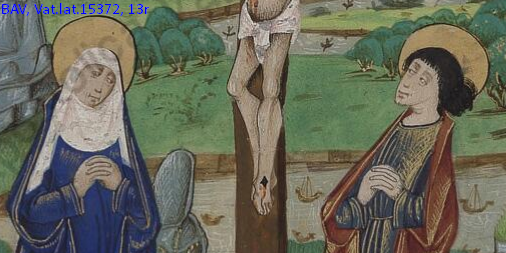
  26. Vat.lat.15372 seems to be a Renaissance book of hours, which according to notes on the endpapers was an heirloom and repeated family gift by legacy until it entered the Vatican collection in 2008. Browse it for the delicate images:
This is Piggin's Unofficial List number 138. If you have corrections or additions, please use the comments box below. Follow me on Twitter (@JBPiggin) for news of more additions to DigiVatLib.
2017-11-19

Troubadours

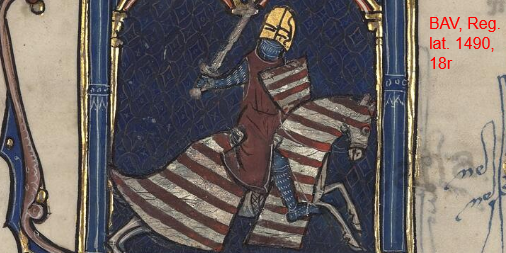
The Vatican's copy of a treasured book of old French troubadour love songs has just been re-scanned in color and high resolution and placed online. Reg.lat.1490 contains the collection known as the Chansonnier cangé and is of especial interest because some of the works in it are by trobairises, the female troubadours of the 12th and 13th centuries in the Occitan region.

From the Wikipedia article Trobairitz, which I recommend you read, it would seem only four manuscripts of this work survive. The Vatican version was previously only online in a murky black and white copy.

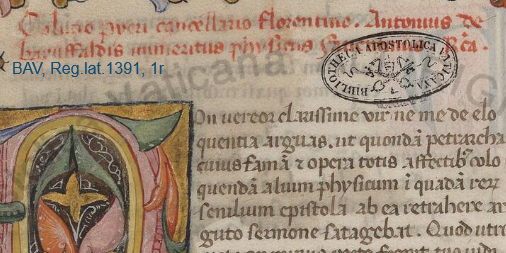
Another fascinating manuscript just out in color is Reg.lat.1391 containing De Verecundia by one of the most famous humanists of the early Renaissance, Coluccio Salutati (1331-1406). Transcript. Read Mirabile for a summary. This was scribed by the Fifth Scribe in the tabulation of Ullman and Ceccherini, possibly in Coluccio's lifetime.

Also new online in color is Reg.lat.1446, dated about 1300, a collection of works on falconry and keeping birds healthy. eTK lists it as containing a translation of the Arabic-speaking falconer Moamyn's Sollicitudo nature gubernans.

Aside from these, 21 other manuscripts arrived online in the past week for the first time.
  1. Reg.lat.1136,
  2. Reg.lat.1491,
  3. Reg.lat.1533,
  4. Reg.lat.1539,
  5. Reg.lat.1586,
  6. Reg.lat.1594,
  7. Reg.lat.1597,
  8. Reg.lat.1609,
  9. Reg.lat.1619,
  10. Reg.lat.1632,
  11. Vat.lat.1412,
  12. Vat.lat.2060
  13. Vat.lat.2182,
  14. Vat.lat.2203,
  15. Vat.lat.2204,
  16. Vat.lat.2205,
  17. Vat.lat.2206,
  18. Vat.lat.2208,
  19. Vat.lat.2210,
  20. Vat.lat.2211, Seneca and Cicero
  21. Vat.lat.2272,
This list nearly failed to appear after Firefox 56 and its handy extensions, including Distill, essentially disappeared from the face of the earth late in the week. The browser has been reincarnated as Firefox Quantum and most old extensions don't work with this new generation or cannot automatically import their settings and logs.

As a temporary fix I have installed a time-lagged version, Firefox ESR, which recovered last week's state of the DigiVatLib portal. These snapshots of the past are logged in Distill, an extension which monitors DigiVatiLib for changes, and are of course essential in figuring out what changes every seven days.


Extension writers worldwide are going through hell this month as they attempt to migrate their software to meet Mozilla's ridiculous demands or just retire defeated.

Lightshot which used to have a lovely workflow for manuscript scholars is now buggy (and no longer does snips outside the Firefox window). Alpheios, a super-dictionary of Latin and Greek which every scholar should have installed and which was developed with grant money, is not compatible with Quantum. There must be a special place in hell for the Mozilla Foundation software developers who have taken down these solid running systems in the name of self-aggrandizing innovation.

This is Piggin's Unofficial List number 137. If you have corrections or additions, please use the comments box below. Follow me on Twitter (@JBPiggin) for news of more additions to DigiVatLib.
2017-11-12

Panorama of Rome in 1457

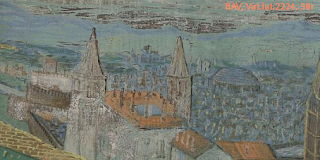
Postcards of Rome are two a penny, but panoramic views of the city in the early Renaissance are special. This week's surprise digitization at the Vatican Library is a miniature painted from near the Vatican in or just before 1457. Arnold Esch captions it as below (my translation):
An unusual perspective on Rome, more or less the view that would be seen from Pope Pius II's apartment. Until this period, it had been usual to do landscapes from Monte Mario, and these tended to be idealized rather than actual views. This is the first realistic panorama of Rome, a miniature for a manuscript of Euclid completed in 1457 that had been commissioned by Francesco del Borgo, Pius II's architect.

The view is from the Vatican garden above the papal palace, with, at center, the Cortile del Maresciallo (with the Capella Magna in front, the small tower of the east facade behind) and the Campanile of St Peter's, towards the city in the curve of the Tiber River. At left is a footpath to the Castell San Angelo and the Tiber, in the center the dome of the Pantheon, with the trees of the Capitol on both sides and St Maria in Ara Coeli and the Senatorial Palace; at right in foreground the northern slope of the Gianicolo.
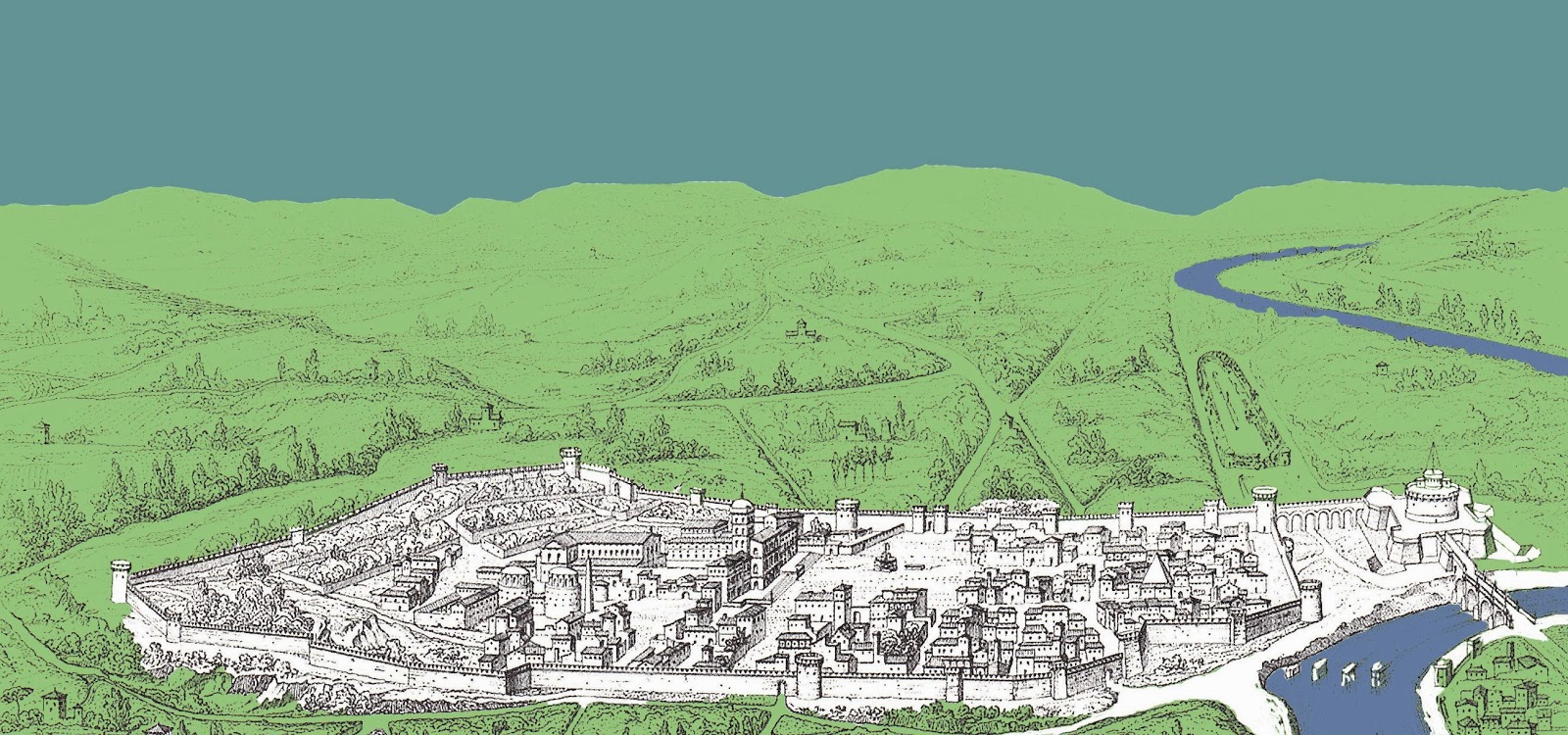
Anthony Grafton adds in the Rome Reborn catalog that the image may have been the first view of Rome to use new methods by Leon Battista Alberti to plot positions of buildings accurately. For a comparison, check out this reconstruction on Tomaso Paynim's blog: I think the miniature is from a standpoint on the high ground at left. San Angelo is at right.

Here are the newly digitized manuscripts, including tweeted annotations from the eagle-eyed @LatinAristotle
  1. Ott.lat.3385.pt.1
  2. Reg.lat.1452, eTK incipits: A philosophis astronomiam sic diffinitam accepimus (14C); Philosophis astronomiam sic diffinitam accepimus
  3. Reg.lat.1494
  4. Reg.lat.1508
  5. Reg.lat.1514
  6. Reg.lat.1518
  7. Reg.lat.1534
  8. Reg.lat.1536
  9. Reg.lat.1538
  10. Reg.lat.1543
  11. Reg.lat.1615 ,
  12. Reg.lat.1640
  13. Urb.lat.1104
  14. Urb.lat.1106
  15. Vat.lat.1420
  16. Vat.lat.1884
  17. Vat.lat.1950
  18. Vat.lat.2019
  19. Vat.lat.2112 , Aristotle, Problemata (tr. Bartholomew of Messina), HT to @LatinAristotle
  20. Vat.lat.2155
  21. Vat.lat.2178 ,
  22. Vat.lat.2180
  23. Vat.lat.2207
  24. Vat.lat.2218
  25. Vat.lat.2224, panoramic view of Rome (above) in Euclid Geometry
  26. Vat.lat.2225, eTK incipit: Circa dictum Campani in quo dicitur quod magnitudo (15C) (Nicole Oresme)
  27. Vat.lat.2230, HT to @gundormr: Vitruvius, On Architecture
  28. Vat.lat.10293
New in color (previously online in black and white only): Vat.lat.2185, eTK incipit: Cum in singulis scientiis secundum by 14th century author English mathematician Richard Suiseth, also known as The Calculator. Another manuscript of the same work arrived online last week.

In Heidelberg eight Vatican manuscripts of the Pal.lat. series are newly online:
  1.  Vatikan, Biblioteca Apostolica Vaticana, Pal. lat. 1947 Katalog der Privatbibliothek Ludwigs VI. (1584)
  2. Vatikan, Biblioteca Apostolica Vaticana, Pal. lat. 1948 Katalog der Palatina in Rom, lateinische (sowie griech., hebr. und arabische) Handschriften
  3. Vatikan, Biblioteca Apostolica Vaticana, Pal. lat. 1952 Sammelband: Verzeichnis lat. und griech. Autoren, Alexander de Villa Dei, Pflanzenglossar, Rezepte, Metrik (Fragm.), de iure naturali, tituli decretalium (12.-16. Jh.)
  4. Vatikan, Biblioteca Apostolica Vaticana, Pal. lat. 1953 Luther, Martin: Apophtegmata etc. (Johannes Aurifaber?)
  5. Vatikan, Biblioteca Apostolica Vaticana, Pal. lat. 1954 Luther, Martin: Opera diversa (Schülerabschrift?)
  6. Vatikan, Biblioteca Apostolica Vaticana, Pal. lat. 1955 Luther, Martin: Diverses lat. und deutsch ; Briefabschriften
  7. Vatikan, Biblioteca Apostolica Vaticana, Pal. lat. 1956 Katalog der Palatina (1581). Geschichte (1581)
  8. Vatikan, Biblioteca Apostolica Vaticana, Pal. lat. 1959 Theologische Sammelhandschrift (1. Hälfte 15. Jh.)
This is Piggin's Unofficial List number 136. If you have corrections or additions, please use the comments box below. Follow me on Twitter (@JBPiggin) for news of more additions to DigiVatLib.
2017-11-04

Soothe the Eyes

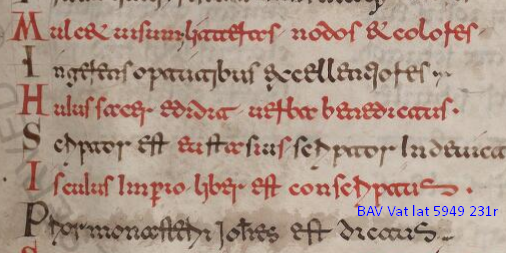
A great book should soothe the eyes, or that's what a subscription in one of this week's codices digitized at the Vatican Library suggests.

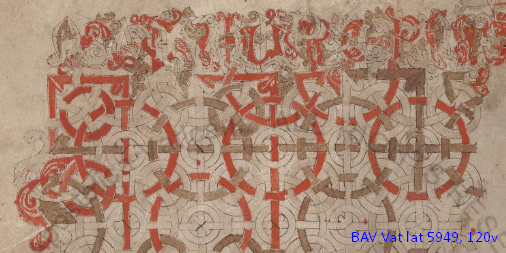
Vat.lat.5949, a 12th century martyrology from the Abbey of Monte Cassino (see also last week's post), contains two lines (above) transcribed and translated by Francis Newton:
Mulcet visum litteras / nodos et colores
Ingerens optutibus excellentiores

It (the book) soothes the eye, setting before the gaze
Letters, knots and colors quite outstanding
The Martyrdom of Eustasius with Regula S. Benedicti, Kalendarium and Homiliae Capitulares is one of 22 items placed newly online, and this book is indeed full of wonderful colored knot patterns:
  1. Ott.lat.3385.pt.2, listed in eTK with these two incipits: Cum a primo tanquam ab optimo (14c); Hec sunt verba que
  2. Reg.lat.198
  3. Reg.lat.1107
  4. Reg.lat.1377
  5. Reg.lat.1393 Vergil's Aeneid, HT to @LatinAristotle
  6. Reg.lat.1402
  7. Reg.lat.1420
  8. Reg.lat.1423
  9. Reg.lat.1437
  10. Reg.lat.1440
  11. Reg.lat.1458
  12. Reg.lat.1470
  13. Reg.lat.1473
  14. Reg.lat.1488
  15. Reg.lat.1499
  16. Reg.lat.1612
  17. Vat.lat.2129
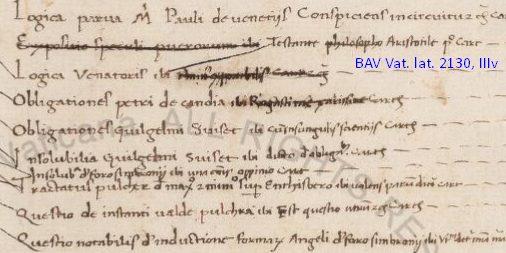
  18. Vat.lat.2130, logic and mathematics. eTK lists: Cum in singulis scientiis secundum by 14th century author English mathematician Richard Suiseth, also known as The Calculator. Here is the librarian's contents list:
  19. Vat.lat.2152
  20. Vat.lat.5949, see above and Lowe p. 68.
  21. Vat.lat.11253
  22. Vat.lat.13152.pt.1
This is Piggin's Unofficial List number 135. If you have corrections or additions, please use the comments box below. Follow me on Twitter (@JBPiggin) for news of more additions to DigiVatLib.