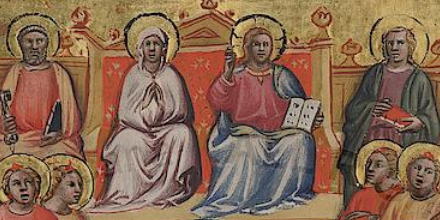
Showing posts with label PUL. Show all posts

2015-11-04

Digita Vaticana Exceeds 3,000

Digita Vaticana, the manuscript digitization programme at the Biblioteca Apostolica Vaticana (BAV) in Rome, exceeded 3,000 items on its main index page on November 3, 2015, meaning that it is now the biggest digitization program in Italy, having overtaken the Biblioteca Medicea Laurenziana in Florence, where the Teca Digitale stalled at 3,000 after using up its grant four or five years ago.

I posted back in May with some metrics, when the BAV program passed the 2,000 point, and will not repeat the main points I made then about double-counting. They still stand and are worth rereading.

Comparing this achievement with other major European programs is not easy. To simplify, I will use numbers for documents created before the year 1600. The BAV tally under-represents its digital content, while including a whole swathe of 18th-century materials, particularly from the Capponi collection. Let us assume that these effects cancel one another out.

A blank search of Biblioteca Digital Hispanica pulls up a remarkable 10,008 pre-1600 hits. I hope somebody in Madrid is blogging about this, because BDH must have crashed through the 10,000 ribbon in the last few days and it deserves to spray around a few magnums of cava to celebrate.

Some probing two weeks back at Gallica in Paris returned a report that it held a whopping 14,975 documents from the same pre-1600 period, but this includes a huge number of single-sheet documents since Gallica scoops up not just library but archival material. I cannot see a way to filter their total for codices only.

A few weeks ago it was possible to get Germany's biggest digitization programme, at the MDZ in Munich to tell you via the search interface that it housed 3,700 pre-1600 manuscripts, but some officious engineer has spiked this. The national German search site, Manuscripta Mediaevalia, which has often been unreliable in the past, returns the number 4,748 if you search for digitized pre-1600 items. I suspect that is too low.

Then there is the excellent e-codices of Switzerland, with 1,404 manuscripts in high quality. They generously encourage you to download them. The British Library, which mean-mindedly thwarts downloading, claims almost 2,000 items digitized from among those curated by its ancient, medieval and early modern manuscripts section, judging by a blog post in late October.

Given these numbers, the BAV can now claim to be a serious player on a European scale. They still have a lot to fix, including poor quality control, a ridiculous watermarks policy and a precautionary copyright statement that hasn't been well thought through. But it's a good start. And remember, they still have 80,000 more items to come.
 
Here is the November 3 list of 76 items, plus the single item from last week, bringing the total to 3,003. This listing is going to be a work in progress, as I am busy with other things right now. If you can tell me what treasures the unmarked shelfmarks below represent, I will fill in the details later.
  1. Arch.Cap.S.Pietro.E.29,
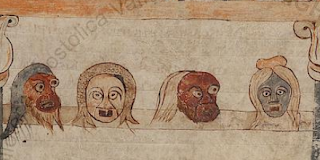
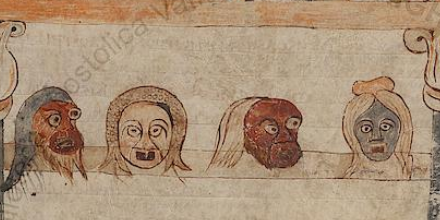
  2. Arch.Cap.S.Pietro.H.19, a celebrated 10th-century codex of Terence, possibly made at Corbie and thought to derive from the even more famous Vatican Terence, Vat.lat.3838 (which is not yet online). Its illuminations include this shelf of masks on fol 10r.
  3. Arch.Cap.S.Pietro.H.25,
  4. Borg.copt.109.cass.III.fasc.6,
  5. Borg.copt.109.cass.III.fasc.7,
  6. Borg.copt.109.cass.VI.fasc.22,
  7. Borg.copt.109.cass.VI.fasc.22,
  8. Borg.copt.109.cass.X.fasc.30,
  9. Borg.copt.109.cass.XII.fasc.38,
  10. Borg.copt.109.cass.XII.fasc.39,
  11. Borg.copt.109.cass.XII.fasc.40,
  12. Borg.lat.338,
  13. Cappon.237.pt.B,
  14. Chig.M.VIII.164, (pseudo) Roberto Re di Ierusalem, Le Virtu Morali. The true author is apparently unknown, according to M. Dykmans.
  15. Pal.lat.50, the famed Codex Aureus of Lorsch, which was added to @DigitaVaticana Oct 26 though it had already been online in Heidelberg for a long time previously (I saw it there in the summer). Klaus Graf points out an extensive November 13 discussion (in German) of the digitization by Johannes Waldschütz.
  16. Pal.lat.60,
  17. Pal.lat.95,
  18. Pal.lat.142,
  19. Pal.lat.145,
  20. Pal.lat.149,
  21. Pal.lat.165,
  22. Pal.lat.204,
  23. Pal.lat.208,
  24. Pal.lat.212,
  25. Pal.lat.221,
  26. Pal.lat.222,
  27. Pal.lat.226,
  28. Pal.lat.259,
  29. Pal.lat.262,
  30. Pal.lat.265,
  31. Reg.lat.762,
  32. Sbath.235,
  33. Sbath.457,
  34. Urb.lat.45,
  35. Urb.lat.73,
  36. Urb.lat.129,
  37. Urb.lat.196,
  38. Urb.lat.212,
  39. Urb.lat.226,
  40. Urb.lat.228,
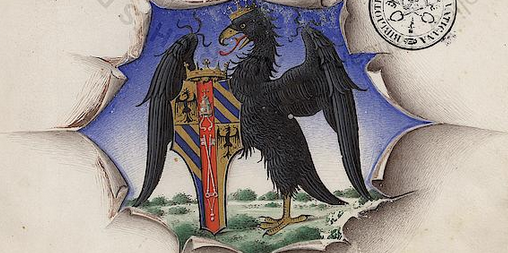
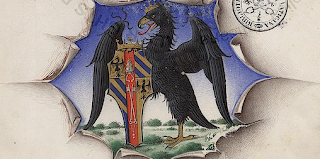
  41. Urb.lat.264, 1483, De re aedificatoria by Leon Battista Alberti (1404-1472). Grafton's Rome Reborn catalog notes, "This book offered a wealth of information, practical instruction, and aesthetic principles to the patrons and architects who would rear the city palaces, country villas, and domed churches of the 16th century." 'This copy has a magnificent trick on folio 1r where the artist pretends the paper has been punched through:
  42. Urb.lat.678 ,
  43. Vat.gr.2615,
  44. Vat.lat.19,
  45. Vat.lat.24,
  46. Vat.lat.43,
  47. Vat.lat.60,
  48. Vat.lat.63,
  49. Vat.lat.70,
  50. Vat.lat.94,
  51. Vat.lat.104,
  52. Vat.lat.113,
  53. Vat.lat.114,
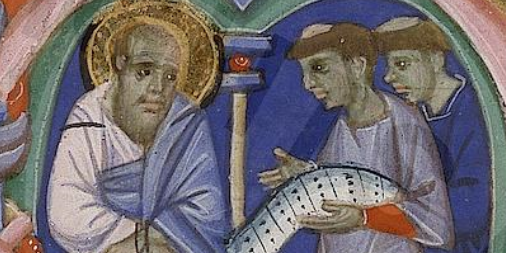
  54. Vat.lat.117, glossed Four Gospels
  55. Vat.lat.125, glossed Gospel of Matthew (Anselm of Laon)
  56. Vat.lat.126, glossed Gospel of Matthew
  57. Vat.lat.130, glossed Gospel of Mark
  58. Vat.lat.142, glossed Epistles to Romans and Corinthians
  59. Vat.lat.145, Pauline Epistles with commentary
  60. Vat.lat.150, Pauline Epistles with commentary
  61. Vat.lat.166, Nicholas of Lyra, Postillae, 14th century
  62. Vat.lat.188, Irenaeus of Lyon, Against Heresies, dated 1576
  63. Vat.lat.189, Tertullian, various works, 15th century copy
  64. Vat.lat.225, Lactantius, Divinarum Institutionum
  65. Vat.lat.227, Tres Dialogi in Lactantium by Antonio da Rho, O.F.M., dating from about 1450. Grafton's Rome Reborn catalogue notes: "The humanists found many opponents among contemporary scholastics, one of whom was Antonio da Rho. Antonio tries to discredit the automatic humanist equation of earlier with better by showing that one of the early Christian writers, Lactantius had made numerous theological errors to which later scholastic writers had not been subject. This dedication copy for Pope Eugene IV has a colorful decorative border with a miniature showing the Franciscan friar presenting his work to the pope."
  66. Vat.lat.261, Athanasius
  67. Vat.lat.262,15th century, mainly Prosper of Aquitaine
  68. Vat.lat.350, Epistula
  69. Vat.lat.353, Renaissance manuscript of Jerome's letters to Paulinus, illuminated capitals
  70. Vat.lat.378, theological, mainly Venerable Bede
  71. Vat.lat.397, John Chrysostom, 15th century
  72. Vat.lat.398, John Chrysostom, Homilies on Epistle to Hebrews
  73. Vat.lat.1286, 15th century sermons
  74. Vat.lat.3197, Pietro Bembo's Dante: Divine Comedy
  75. Vat.lat.3834, 9th-century theological miscellany
  76. Vat.lat.7566, Dante's Inferno, scribe Bartolomeo da Colle 1421-84
  77. Vat.lat.14189, Pietro Bembo? miscellaneous letters
If you have any corrections, please use the comments box below. follow me on Twitter (@JBPiggin) for more news. [This is Piggin's Unofficial List 29.]

2015-10-24

Poggio Portrait

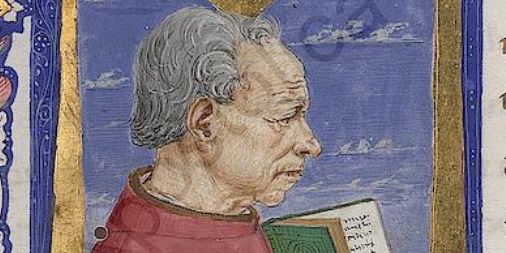
The great Poggio Bracciolini (1380-1459) is famed for rediscovering a large number of classical Latin manuscripts that were decaying in German, Swiss, and French monastic libraries. The latest bunch of uploads at Digita Vaticana, on October 21, 2015, includes a manuscript, Urb.lat.224, made in his lifetime (but not by his pen) of his literary work De varietate fortunae (1447).

This is a first-hand survey of the ruins of Rome which Poggio had plenty of time to write as the chief papal scribe (alas he  made no drawings or maps). This codex, apparently made about 1450, begins with an image of Poggio in his sixties, which is probably from a portrait from life. Poggio had waited until age 56 to marry, wedding a girl not yet 18, Selvaggia dei Buondelmonti. He was not handsome, but he was one of the great intellectuals of his day in Florence.

His most celebrated find (described in Stephen Greenblatt's much over-rated best-seller The Swerve) was De rerum natura, the only surviving work by Lucretius.

Between 1414 and 1418 Poggio also dug up (and probably stole) in Fulda, Germany the De re rustica of Columella, an ancient handbook of farming written in the first century CE: a manuscript of De re rusticaUrb.lat.260, featured on this blog a few weeks ago. Columella's work had only been known of indirectly at that point through the Ruralia commoda, the most celebrated medieval handbook of farming. The latter book had been completed some time between 1304 and 1309 by Pietro de' Crescenzi, who could only find fragments of the ancient work. I mention this, because a manuscript of the Ruralia, dated 1424, Urb.lat.266, is in the current batch of uploads below.

Also in the new batch is a book by Poggio's Florentine mentor, Coluccio Salutati (1331-1406), De fato, fortuna et casu (written 1396-1399), here in a presentation edition that is almost certainly posthumous. Coluccio is one of my great heroes, since he purchased and preserved the only accurate copy, Plut. 20.54, of the sole large abstract diagram known from antiquity, the Great Stemma.

The full list of uploads follows:
  1. Arch.Cap.S.Pietro.D.184, Gospels with a fine illumination of Matthew (below)
  2. Arch.Cap.S.Pietro.D.201, Nicholas of Lyra, Postillae
  3. Arch.Cap.S.Pietro.E.12, liturgical calendar
  4. Arch.Cap.S.Pietro.E.21, De excidio urbis Hierosolymitanae (On the ruin of the city of Jerusalem) by Pseudo-Hegesippus (see the Roger Pearse summary on Pseudo-Hegesippus with rough translation)
  5. Arch.Cap.S.Pietro.F.11.pt.B, the blackened flyleaf of liturgical codex Arch.Cap.S.Pietro.F.11 which contains music and prayers for votive and other masses
  6. Arch.Cap.S.Pietro.I.6, 1781 catalogue
  7. Barb.lat.1396, a consilium of Baldus de Ubaldis
  8. Barb.lat.1808, collection of orations
  9. Borgh.286, Geoffrey of Trani, 1245? Summa super rubricis decretalium
  10. Borgh.295, Peter Lombard, Sententiae
  11. Borgh.296, theological and philosophical miscellany
  12. Borgh.336, Iacobus de Voragine, c.1229-1298, Sermones de sanctis, 16th century
  13. Borgh.378, 18th-century catalog of Borghesiani Library, Pars altera.
  14. Cappon.44, estates list? 1648
  15. Cappon.72,  notes from Avicenna
  16. Cappon.76, Italian translation of Quinto Curcio Rufo
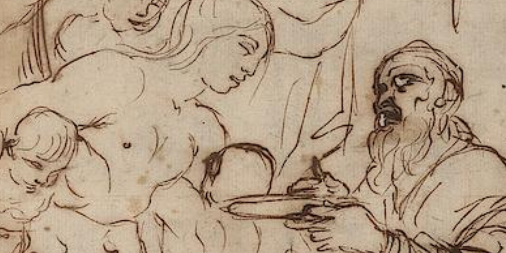
  17. Cappon.237.pt.A, collection of 16th and 17th-century drawings and watercolours, including this sketch from 25v
  18. Chig.L.VI.212, Dante, Divine Comedy
  19. Ott.lat.2863, Dante, Divine Comedy
  20. Urb.lat.41, Ambrose of Milan, various, 15th century
  21. Urb.lat.82, Augustine, Prosperus, Vigilius, 15th century
  22. Urb.lat.86, Aymon of Halberstadt on Pauline Epistles, 15th century
  23. Urb.lat.124, Alexander of Ales, OFM, 15th century
  24. Urb.lat.128, Thomas Aquinas, 15th century
  25. Urb.lat.131, Thomas Aquinas, 15th century, copy owned by Pius VI
  26. Urb.lat.135, Thomas Aquinas, 15th century
  27. Urb.lat.138, Thomas Aquinas, dated 1474
  28. Urb.lat.141, Bonaventure, 15th century (Urb. lat. Catalog on Archive.org)
  29. Urb.lat.145, Antoninius of Florence, Summa, 15th century, copy owned by Alexander VII
  30. Urb.lat.153, Pelagius, dated 1482
  31. Urb.lat.201, Coluccio Salutati, De Fato, Fortuna et Casu, 15th century
  32. Urb.lat.216, Aristotle, Metaphysics, with commentary by Thomas Aquinas, 14th-15th century
  33. Urb.lat.217, ditto, 15th century
  34. Urb.lat.224, De varietate fortunae (1447) by Poggio Bracciolini (image above), a detailed first-hand survey of Rome's ruins, which was an exhibit in Rome Reborn. Also various orations by Poggio. See the detailed listing of the codex's contents at Saint Louis, plus the Latin Catalog on Archive.org. Apparently made about 1450.
  35. Urb.lat.235, Galenius and Thomas Aquinas, 16th century
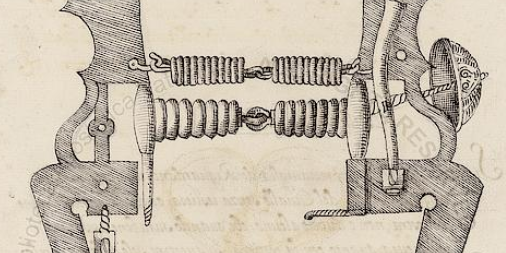
  36. Urb.lat.255, technical handbook on brakes for horse-drawn vehicles, 17th century:
  37. Urb.lat.266, Pietro de' Crescenzi, a key medieval handbook on agriculture, Ruralia commoda, this copy dated 1424 lacks illuminations
  38. Vat.gr.2421, 1647, on paper, no entry yet in Pinakes
  39. Vat.lat.257, Ephrem the Syrian, 15th century
  40. Vat.lat.338, Venerable Bede on Esdras, Nehemiah, Tobit, 15th century
  41. Vat.lat.10678, Dante Divine Comedy with copious additions on margins of first 15 folios

Here is the evangelist Matthew at work from Arch.Cap.S.Pietro.D.184
This raises the posted number of manuscripts to 2,926, an increase of 41. As I noted recently, the presence of some digitized manuscripts is not declared in the Digita Vaticana index of postings, so the true total of digitizations is actually somewhat higher.

Follow me on Twitter (@JBPiggin) for more news. Post comments or correction in the box below this blog post.  [This is Piggin's Unofficial List 28.]

2015-10-13

Imaginary Jerusalem

Elements of the medieval world were far geekier than even today's Lord of the Rings cosplayers, Twilight pilgrims or Star Wars obsessives. The imaginary Jerusalem of Nicholas of Lyra, with its maps and building plans of places that never existed, made the writer's commentary on Ezekiel immensely popular in its day.

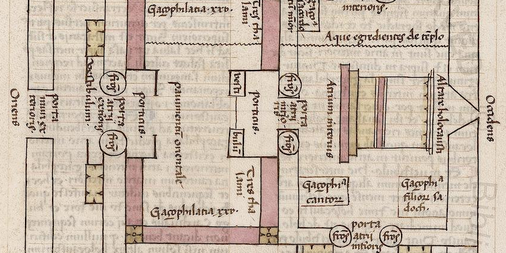
A fine 15th-century manuscript of Nicholas's Postillae has just come online at Digita Vaticana and you can feast your eyes on all these drawings. The codex is Urb.lat.15 and among its elaborate drawings is the sanctuary with east and west entrances and the altare holocaust site in the temple at folio 201v:
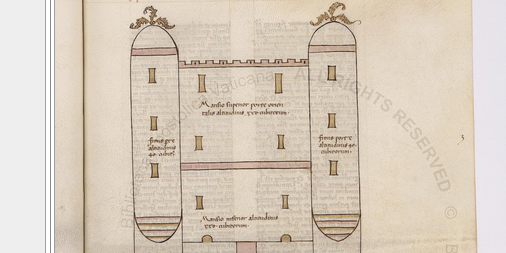
There's a fine Renaissance palace imagined in Jerusalem at folio 198r
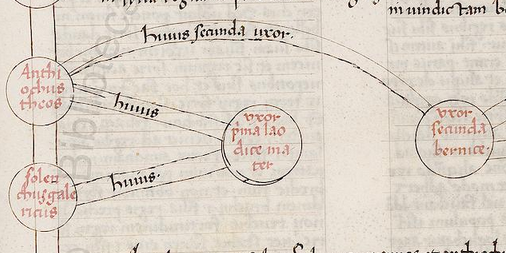
Look through the book and you will find all sorts of oddities. Here's Antiochus II, given the epithet Theos, and his successive wives Laodice and Berenice in a not entirely reliable family tree at folio 259r. Observe how this top-down stemma has got little roots growing at the bottom. Very odd.
The origins of the diagrams are discussed in a 2012 paper by Lesley Smith.

Also new online in the batch of just two items uploaded October 12, 2015 is Borg.copt.65.

As always, if you can add notes, use the comments box below. Follow me on Twitter (@JBPiggin) for more news. [This is Piggin's Unofficial List 27.]

2015-10-04

French Picture Bible

One of the greatest graphic-arts innovations of medieval Europe is the Bible Moralisée, a thirteenth-century reconception of the Christian Bible as thousands of short "comic strips" that each compare one topic from the Old and the New Testament with an explanation in ordinary French.

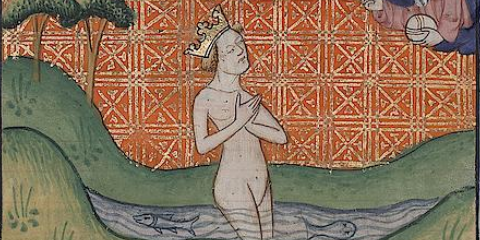
The Biblioteca Apostolica Vaticana in Rome possesses just one Bible Moralisée (BM), which was made in Paris in about 1410 and is a later evolution of this work with just 76 images (vastly fewer than the 5,112 of the greatest of them all, BNF fr. 167). The appearance online of the Vatican BM, Reg.lat.25, on October 2, 2015 is major news. It has many fine illuminations including this scene of  David in a running stream listening to the word of God:


A BM is not to be confused with a Biblia Pauperum (which I discussed a couple of years ago on this blog), nor is it the same as an Angevin Legendary (BAV released one online this year), although both those latter types are also bibles in pictures. The great expert on BMs, John Lowden, published an article in 2005 that explores the place of Reg.lat.25 in the BM tradition: "The Bible Moralisée in the Fifteenth Century and the Challenge of the Bible Historiale," Journal of the Warburg and Courtauld Institutes, 68 (2005) pp. 73-136 (click the link or go to Jstor to read it).

There were 147 new releases on October 2. Here is the full list:
  1. Arch.Cap.S.Pietro.D.179,
  2. Arch.Cap.S.Pietro.D.188,
  3. Arch.Cap.S.Pietro.D.191,
  4. Arch.Cap.S.Pietro.D.195,
  5. Arch.Cap.S.Pietro.D.196,
  6. Barb.lat.4030,
  7. Barb.lat.4037,
  8. Barb.lat.4092,
  9. Barb.lat.4113,
  10. Barb.lat.5695 ,
  11. Borg.copt.109.cass.VII.fasc.23,
  12. Borg.copt.109.cass.VII.fasc.65.2,
  13. Borg.copt.109.cass.VIII.fasc.26,
  14. Borg.copt.109.cass.VIII.fasc.27,
  15. Borg.copt.109.cass.VIII.fasc.28,
  16. Borg.copt.109.cass.X.fasc.31,
  17. Borg.copt.109.cass.X.fasc.32,
  18. Borg.copt.109.cass.XI.fasc.33,
  19. Borg.copt.109.cass.XI.fasc.34,
  20. Borg.copt.109.cass.XI.fasc.36,
  21. Borg.copt.109.cass.XI.fasc.37, Gospel of Matthew, chapters 10-12 (thanks @TuomasLevanen)
  22. Borg.lat.384, Antonio Pucci, various works
  23. Borgh.236, Aristotle, Metaphysics and Physics
  24. Borgh.248, Rottfried: civil law, canon law
  25. Borgh.321, Bonaventure
  26. Borgh.347, Henry of Ghent, Quaestiones
  27. Cappon.86,
  28. Cappon.106,
  29. Cappon.194,
  30. Cappon.252.pt.A,
  31. Cappon.252.pt.C,
  32. Cappon.288,
  33. Cappon.309,
  34. Chig.G.VIII.222,
  35. Chig.L.VIII.294,
  36. Ferr.698,
  37. Ott.gr.472,
  38. Ott.lat.2229,
  39. Ott.lat.2373,
  40. Ott.lat.2865, Dante, Divine Comedy
  41. Patetta.1769,
  42. Reg.lat.25, 15th-century Bible Moralisée, a French-language commentary on the bible (discussed above)
  43. Reg.lat.352, a collection of miscellaneous orations, notes on historical antiquities of Rome and medical prescriptions
  44. Reg.lat.1945, Livy, Ab Urbe Condita
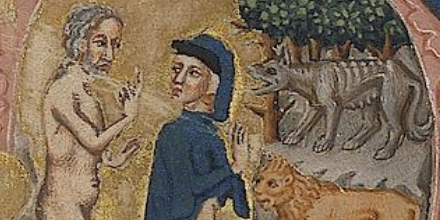
  45. Ross.487, Dante, with this fine opening illumination:
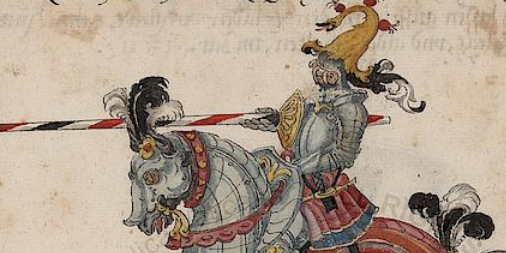
  46. Ross.711, many fine pageantry/heraldry images in the German-language Stamm- und Turnierbuch aus der Kraichgauer Ritterschaft um 1615:
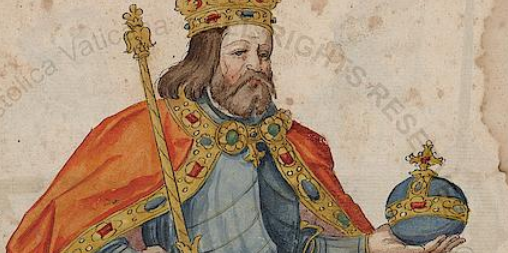
    This is Heinrich of Saxony:
  47. Sbath.723,
  48. Urb.lat.3, Four Gospels, 10th century (catalog)
  49. Urb.lat.9, Psalter (Vulgate)
  50. Urb.lat.12, Job, Catholic Epistles, etc, glossed by Walafried Strabo and Anselm of Laon
  51. Urb.lat.23, Thomas Aquinas, On Job
  52. Urb.lat.25, Thomas Aquinas, On Isaiah and On Matthew
  53. Urb.lat.28, Thomas Aquinas, On Luke
  54. Urb.lat.30, Origen of Alexandria, various in Rufinus's Latin
  55. Urb.lat.32, John Chrysostom, some Basil the Great (catalog)
  56. Urb.lat.36, John Chrysostom, Damasus
  57. Urb.lat.37, Hilary of Poitiers
  58. Urb.lat.38, ditto
  59. Urb.lat.40, Ambrose of Milan, letters, other works
  60. Urb.lat.49, Martyrdom of Jerome and of Adonis (catalog)
  61. Urb.lat.54, Pseudo-Jerome, Breviarium in Psalmos
  62. Urb.lat.58, Lactantius and Pseudo-Lactantius, 15th century
  63. Urb.lat.60, Gregory of Nazianz, John Chrysostom
  64. Urb.lat.62, Pseudo-Dionysius and John of Damascus
  65. Urb.lat.63, Cyprian, Letters, and Pontius (catalog)
  66. Urb.lat.64, Tertullian
  67. Urb.lat.66, Augustine, Vigilius
  68. Urb.lat.68, Augustine on Gospel of John
  69. Urb.lat.70, Augustine, Vigilius
  70. Urb.lat.71, Augustine
  71. Urb.lat.72, Augustine
  72. Urb.lat.74, Augustine on Psalms
  73. Urb.lat.75, ditto
  74. Urb.lat.79, Augustine, De Trinitate, etc
  75. Urb.lat.80, Augustine, Letters, Pelagius
  76. Urb.lat.83, Augustine, Contra Faustum Manichaem
  77. Urb.lat.84, Augustine, Cyprian, Alcuin, Pope Innocent I
  78. Urb.lat.88, Haymo of Halberstadt, Bede, Hugh of Folieto, etc. (catalog)
  79. Urb.lat.91, Bernard of Clairvaux, various
  80. Urb.lat.95, Peter Damian, Peter Chrysologus
  81. Urb.lat.98, Gregory the Great, Ambrose
  82. Urb.lat.100, Bede, Leo the Great
  83. Urb.lat.104, Birgitta, Revelations (catalog)
  84. Urb.lat.106, Hugh on heresy, Isidore
  85. Urb.lat.107, Hugh of St Victor, Anselm, John of Damascus
  86. Urb.lat.108, Hugh of St Victor and others, sermons, etc
  87. Urb.lat.111, Franciscan Breviarium Romanum
  88. Urb.lat.113, William Durant, Rationale of the Divine Offices (Rationale divinorum officiorum) (1286), an exhaustive interpretation of the symbolism of ecclesiastical liturgy and architecture
  89. Urb.lat.117, Duns Scotus and Peter Lombard (catalog)
  90. Urb.lat.121, Francis of Mayron
  91. Urb.lat.127, Thomas Aquinas
  92. Urb.lat.130, ditto
  93. Urb.lat.132, ditto, from Summa
  94. Urb.lat.134, ditto, De Veritate
  95. Urb.lat.137, Thomas Aquinas
  96. Urb.lat.139, ditto
  97. Urb.lat.152, Alvarius Pelagius
  98. Urb.lat.154, Giannozzo Manetti (1396-1459), Italian hebraist who collected many of the Hebrew manuscripts now at the Vatican, Against the Jews. See the Jewish Encyclopaedia.
  99. Urb.lat.179, letters etc of Pseudo-Isidore (and the real Isidore?)
  100. Urb.lat.188, philosophical commentaries of Boethius, a 14th-15th century manuscript. Sadly, the Commentary on the Isagogue of Porphyry seems to lack the famous arbor porphyriana diagram. I had this manuscript listed on my arbor page as a potential source of the diagram, but will now have to scratch it from the list.
  101. Urb.lat.199, Apuleius, fine Renaissance manuscript with floral illuminated initials
  102. Vat.ebr.110, three tracts of Talmud B (thanks @TuomasLevanen)
  103. Vat.ebr.122,
  104. Vat.et.260,
  105. Vat.gr.316, with Septuagint text, Rahlfs 667, 10th century, reportedly containing material from prophets and Ezekiel (thanks to Rick Brannan (his blog) for these notes)
  106. Vat.gr.2066,
  107. Vat.gr.2442,
  108. Vat.lat.1, a 15th-century Vulgate Latin bible
  109. Vat.lat.20, the Bologna Bible, one of the major illuminated bibles. Here is a detail from the Letter to the Colossians:
  110. Vat.lat.31, a 16th-century Latin bible
  111. Vat.lat.71, Glosses on Paralipomenon (Chronicles)
  112. Vat.lat.73, Glosses on Tobias, Esther, Judith, Ruth
  113. Vat.lat.81, a 12th-century graeco-latin Psalter Gallicanum with Canticles, Beuron number 264 on account of this text containing many Vetus Latina elements. In Septuagint studies, this is Rahlfs 1297, notes Rick Brannan (his blog)  
  114. Vat.lat.89, commentary on psalms Gilbert of Poitiers, palimpsest layer Pliny the Younger
  115. Vat.lat.98, Augustine of Hippo on psalms
  116. Vat.lat.109, Anselm of Laon, commentary on Jeremiah and Daniel. Particularly interesting is the appended biblical chronicle manuscript, from fol. 218v onwards
  117. Vat.lat.161, Nicholas of Lyra on Job, Proverbs, etc.
  118. Vat.lat.170, Dionysius Areopagita, Epistulae etc, 15th-century manuscript
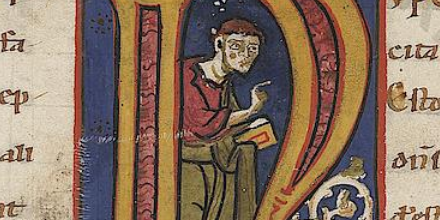
  119. Vat.lat.209, Origen of Alexandria, homilies on Leviticus, Rufinus translation, 12th century, fine figural initials including this:
  120. Vat.lat.229, Eusebius of Caesarea, Praeparatio Evangelica
  121. Vat.lat.264, Ambrose of Milan, c.340-397, on Luke, plus sermons
  122. Vat.lat.271, Ambrose of Milan, On Hexaemeron (creation)
  123. Vat.lat.272, ditto
  124. Vat.lat.280, Ambrose of Milan, 83 letters

  125. Vat.lat.282, Ambrose of Milan, various essays
  126. Vat.lat.283, Ambrosiaster commentary, plus Augustine letters
  127. Vat.lat.285, Ambrose of Milan, letters
  128. Vat.lat.289, Ambrose of Milan, letters, essays, homilies
  129. Vat.lat.290, Ambrose of Milan, various
  130. Vat.lat.294, Ambrose of Milan, De officiis ministrorum libri I-III
  131. Vat.lat.297, Ambrose of Milan, De excessu fratris sui Satyri
  132. Vat.lat.301, Basil the Great, On Hexaemeron
  133. Vat.lat.302, ditto
  134. Vat.lat.304, Basil the Great, various
  135. Vat.lat.306, John Chrysostom
  136. Vat.lat.307, Gregory of Nazianz, in Rufinus translation
  137. Vat.lat.313, John of Damascus, On Orthodox Faith
  138. Vat.lat.314, Ambrose of Milan, diverse
  139. Vat.lat.319, Jerome of Stridon, letter to Eustochium on Isaiah
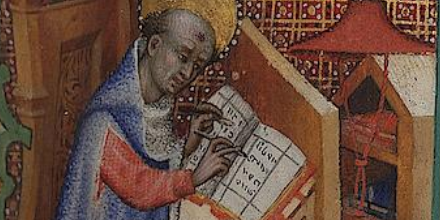
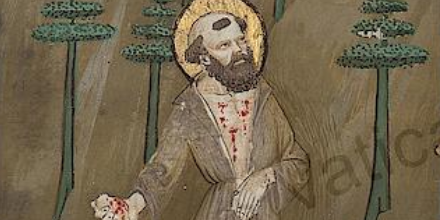
  140. Vat.lat.320, Jerome, Commentationum in Isaiam, libri I-XVIII, with fine opening illumination of Jerome with stigmata (spoiled by the watermark: will that go away some day?)
  141. Vat.lat.321, Jerome, exposition on Isaiah
  142. Vat.lat.336, Rabanus Maurus (and Jerome?) on epistles
  143. Vat.lat.2835, poetry by Antonius Thebaldeus 1463-1537
  144. Vat.lat.3205, troubador songs, from Provence
  145. Vat.lat.3214, Dante
  146. Vat.lat.3389, autograph, poetry by Antonius Thebaldeus 1463-1537
  147. Vat.slav.8, psalms, canticles, Marian hymns
As always, if you can add or correct details, use the comments box below. Follow me on Twitter (@JBPiggin) for more news on digitizations. [This is Piggin's Unofficial List 26.]

2015-09-22

Wonders in China

Some time between 1620 and 1640, a Chinese book publisher issued an extraordinary illustrated compendium about the exotic creatures and travel opportunities of the far western world. The project was overseen by Giulio Aleni, the Italian leader of the Jesuit community in China. The wood-block printing was entitled K`un-yü t`u-shuo (An Illustrated Explanation of Geography).

Its especial charm resides in the unknown artist's conceptions of sea monsters and the Wonders of the Ancient World. To the fanciful western pictures of the wonders which he would have used as his model, he added his own perspective. Neither he nor we know what most of these monuments really looked like, so it is interesting to see how an Asian sensibility envisaged these fabled places.

Digita Vaticana has just digitized the book, which it stocks as Borg. cin. 350, fasc. 30. I have no idea how rare this printing was. The wood-block engraving is not of a very high quality, suggesting the book was priced for the mass market in China. Here are the seven wonders, to which an eighth was of course added in the time-honoured fashion at the discretion of the compiler.

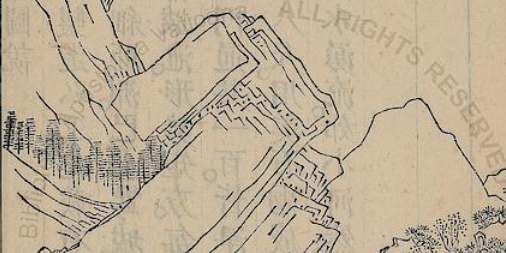
The Hanging Gardens of Babylon are depicted as great blocks of inclined stone leaning alarmingly off a pine-clad mountainside over an architectural garden with a bridge as a walkway. Full page.

The Colossus of Rhodes, with a contemporary European merchant ship sailing between its knees, guards the entrance to its Mediterranean harbour and is shown with boylike, notably Asian facial features. Full page.

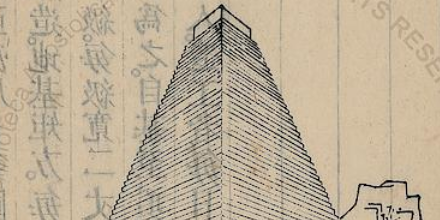
The Great Pyramid of Giza, which was the only one of the wonders to still exist in 1620, is greatly heightened and shown amid mountains. Full page.


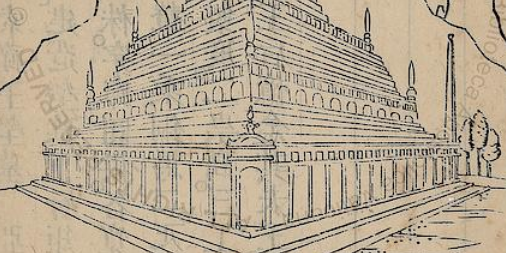
The Mausoleum at Halicarnassus is visualized as a ziggurat. Full page.


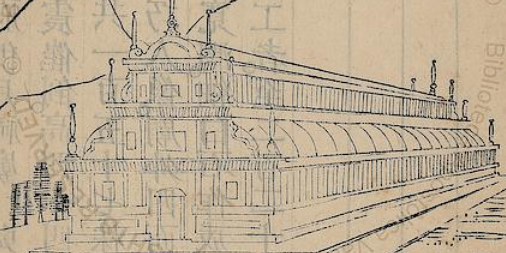
The Temple of Artemis at Ephesus is depicted as a long hall in a style that is more Renaissance than classical. Full page.


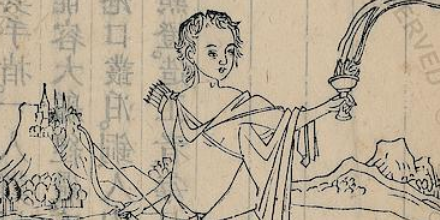
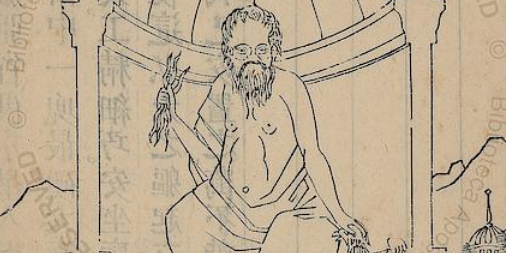
The Statue of Zeus at Olympia is a round-shouldered senior clutching some rather limp looking thunderbolts. The artist may have puzzled over what on earth these were meant to be. With his left hand, Zeus pats his eagle. Full page.


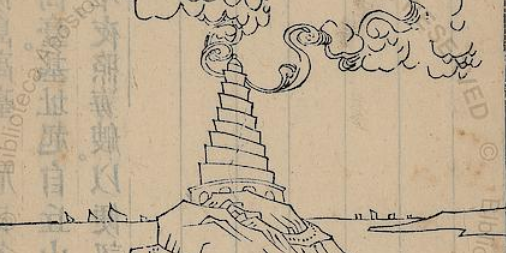
The Lighthouse of Alexandria has a very smoky fire going on top. Full page.

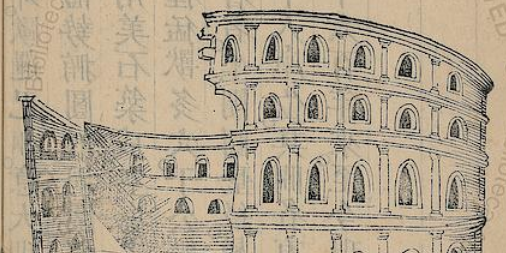
The eighth wonder is the Roman Colosseum, for which the artist clearly had a fairly accurate model to draw from. Full page.

There are more details about this book in the catalog to the Rome Reborn exhibition held 20 years ago in the United States.

This is one of 19 items brought online on September 21, bringing the published Digita Vaticana tally to 2,744. Here is the full list:
  1. Barb.gr.350, 12th/13th century. Aristotle? Pinakes
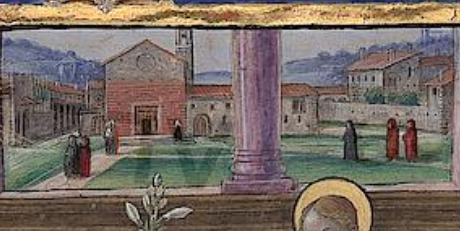
  2. Barb.lat.610, missal of the Baptistery in Florence, an ornately decorated Renaissance prayerbook, illuminated by Monte in 1507. Here's a detail showing a Florentine garden:
  3. Barb.lat.671, in 8th-century uncial, a wide variety of patristic writings, comprehensively listed by Hill
  4. Barb.lat.3695, Anonymous, L'alta divina maiestate eterna
  5. Barb.lat.3974, Dante
  6. Barb.lat.4096, with a commentary on Dante's Divine Comedy
  7. Barb.lat.4112, illuminated Divine Comedy, detail below from 141r
  8. Borg.cin.350, multiple Chinese printed books, some by Aleni, bound into a single codex
  9. Borg.copt.109.cass.XIII.fasc.42, Gospel of Matthew, ch. 16-20
  10. Borg.copt.109.cass.XIII.fasc.43, Gospels of Matthew 18-19, 25-26 and Mark 2-9
  11. Cappon.269
  12. Cappon.281.pt.1,
  13. Cappon.283.pt.2,
  14. Urb.lat.26, Thomas Aquinas, catena aurea, Gospels of Mark and John, 15th century, ornate initials
  15. Urb.lat.35, John Chrysostom, Catalog
  16. Urb.lat.47, Athanasius and John Climacus, Catalog
  17. Urb.lat.50, Jerome on Jeremias, Catalog
  18. Urb.lat.53, Jerome on Isaiah, Catalog
  19. Urb.lat.65, Leo the Great, sermons and letters, Catalog
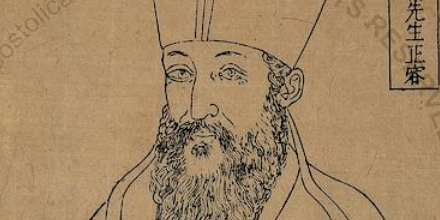
There is also a remarkable Chinese line drawing of Matteo Ricci here in another book (fasc. 3) bound into Borg.cin.350, Ta-hsi Hsi-t'ai Li hsien-sheng hsing-chi. This is a 1616 biography of Ricci (1552 – 1610), the greatest of all the Jesuit scholars studying Chinese culture, by Aleni, a successor. The Rome Reborn exhibition catalog describes the drawing as follows:
This rare and beautifully executed portrait of Matteo Ricci reveals how European and Chinese pictorial methods contrast. Chinese portraits developed out of centuries of brushed calligraphy and the subdued treatment of human figures, on one hand, and Buddhist and Taoist depictions of humans and divinities on the other.
I wonder do wonder if the line drawing it is not drawn directly from the 1610 painting of Ricci by Yu Wen-hui (later Emmanuel Pereira) that has been in Rome since 1616.

Follow me on Twitter (@JBPiggin) for more news. Write comments in the box below if you can add details, or correct my notes. Thanks to @TuomasLevanen for filling in Coptic collection details! [This is Piggin's Unofficial List 25.]