Showing posts with label PUL. Show all posts

2015-07-01

Strange Beasts

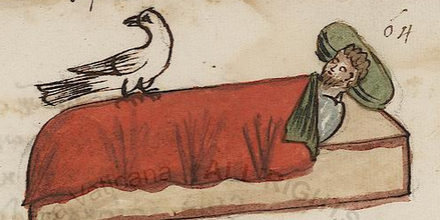
The caladrius was an all-white bird, which, when placed on the bed of a sick person, supposedly foretold if they would live or die. If the person were not going to recover, the caladrius looked away from them, but if they were to live, the bird looked directly into their face and drew the sickness into itself.

Medieval bestiaries, of which the digitized Aberdeen Bestiary is a fine example from the 12th century, were based on the Physiologus, an anonymous Greek-language book dating back to perhaps the 2nd century. On June 30, the BAV in Rome digitized and published online a 17th-century Greek manuscript of it, Ott.gr.354. Here is its caladrius giving a bearded man his doom on folio 64r:

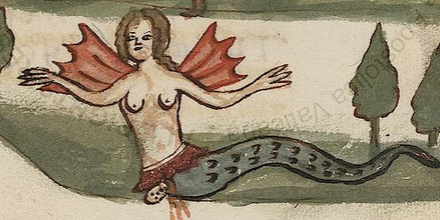
All of the images in the Ottoboniani Physiologus are of great interest. Here is one of the sirens, from folio 45r:
This early Christian compendium contains 48 stories about the nature of real and mythical animals, plants and stones. In its mixture of fact and fiction, it is no more reproachable than the infotainment and "science documentaries" with half-truths, portentous voices and dramatic music which air on daytime television.

A Physiologus for TV with similar self-important commentary would be a great satire. Imagine the stock film clips which could be dug up for the elephant (folio 13r), of which we are told it cannot bend its legs, rarely has the desire to mate and practices water birth.
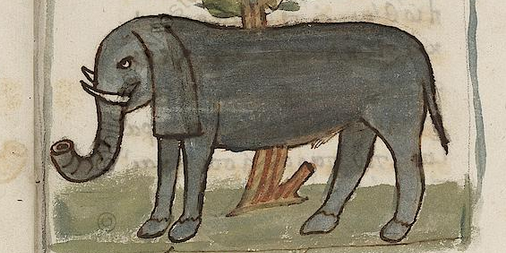

The Physiologus was once as well known as any TV series is today. It was translated into Latin and had enormous influence in the medieval world. Translations and adaptations from the Latin introduced the Physiologus into most languages of western Europe. Its magnificently bogus science shows up in most European literatures including the works of Shakespeare.

Below is the full list of 44 digitizations on June 30. For the Ottoboniani group, you can consult Pinakes or the old printed catalog at Archive.org for more details.
  1. Barb.gr.105, Aesop's Fables, 6th century, Pinakes
  2. Barb.gr.109, Epitome logica, Pinakes
  3. Barb.gr.113, Manuel Chrysoloras, Pinakes
  4. Ott.gr.174, Narrationes monachorum,
  5. Ott.gr.219, Gregorius, etc: homiliae, apologia, etc., 
  6. Ott.gr.223, Athanasius: vita, epistulae, etc. 
  7. Ott.gr.242, Michaelis Glycae Capita Theologica ad varios directa, praemisso indice, 
  8. Ott.gr.268, Miscellanea praesertim Patrum Graecorum incl. Gregorii Nazianzeni, 
  9. Ott.gr.279, Alexandri Aphrodisiensis In Aristotelis Meteorologica, 
  10. Ott.gr.281, Miscellanea homiletica, incl. Gregorii Nysseni, 
  11. Ott.gr.282, Ioanis Tzetzi, 
  12. Ott.gr.283, Andreae Caesariensis Commentarius in Apocalypsin, 
  13. Ott.gr.296, Speculum beatitudinis humanae of 1581, 
  14. Ott.gr.302, Porphyrii In Aristotelis Categorias Commentarium, 
  15. Ott.gr.305, Miscellanea praesertim Patrum Graecorum, incl. Eusebii Pamphili in Cantica Canticorum, 
  16. Ott.gr.320, Anatomia hominis, a.k.a. De partibus hominis, anon., 
  17. Ott.gr.327, Pindari Odae / Carmina, 
  18. Ott.gr.329, Arrianus super Epictetum, 
  19. Ott.gr.331, Theodori Gazae Grammatica
  20. Ott.gr.332, Platonis operae, plus Basilius Caesarensis, ad juvenes, 
  21. Ott.gr.333, Miscellanea praesertim Patrum Graecorum, incl. Gregrorii Nysseni, etc, 
  22. Ott.gr.334, Theoremata in Odyssaeam Homeri (on Homer), 
  23. Ott.gr.337, Opuscula varia diversorum, 
  24. Ott.gr.339, Miscellanea, 
  25. Ott.gr.341, Isidori Pelusiotae, letters, 
  26. Ott.gr.342, Homeri Ilias,  
  27. Ott.gr.345, Maximi Planudi, notationes variae, 
  28. Ott.gr.346, Miscellanea poetarum scaenicorum Graecorum, incl. Aristophanes, 
  29. Ott.gr.347, Theodori Gazae introductionis grammaticae libri quattuor, 
  30. Ott.gr.348, Ignatii et Polycarpi epistolae, 
  31. Ott.gr.349, Didymi Alexandrini De Trinitate, 
  32. Ott.gr.350, Niconis canones et decreta et constitutiones ad monachos spectantes 22, incl. Basilii canones poenitentiales, 
  33. Ott.gr.351, Euripidis opera, 
  34. Ott.gr.353, Gemini introductio in meteora, 
  35. Ott.gr.354, the Physiologus, an Alexandrian work of Christian allegory attributed to Epiphanius; this is one of the H manuscripts in Sbordone's edition. I haven't yet recognized the unicorn in this manuscript. (Who can help me?)
  36. Ott.gr.355, Miscellanea, incl. Aristophanes, 
  37. Ott.gr.357, Expositio in III librum Regnorum et in loca quaedam biblica, incl. catena, 
  38. Ott.gr.358, Miscellanea praesertim hagiographica, incl. Vita d. Theodori Studitae, 
  39. Ott.gr.364, Polyaeni militaria, 
  40. Ott.gr.368, Basilius in Isaiam, 
  41. Ott.gr.369, Isaaci Tzetzae opera (poetry), 
  42. Ott.gr.383, Isidori epistularum, 
  43. Ott.gr.386, Aristotelis Analytica priora, 
  44. Vat.ebr.16, a Targum Onkelos of the early 14th century, the translation of the Bible to Babylonian Aramaic (many thanks to Tuomas Levänen for pointing this out). This manuscript was used for variants in A. Berliner's edition of Targum Onkelos (Berlin 1884).
Below is a second rush of material digitized and placed online on July 1, which I will not blog about separately. The posted total on the Digita Vatica portal now stands at 2,321 items.
  1. Arch.Cap.S.Pietro.H.57,
  2. Barb.gr.443,
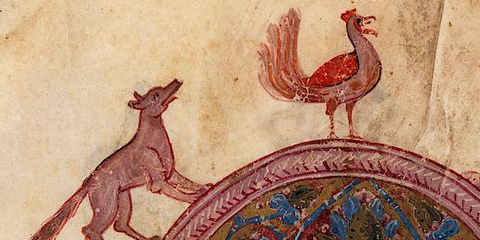
  3. Barb.gr.449, four gospels, 12th century, probably Cypriot, includes the dog and rooster at 5r (below) (Pinakes)
  4. Barb.gr.475, New Testament?
  5. Barb.lat.366, Jacobus de Cessolis (hat tip to Tuomas Levänen for pointing this out): The Book of Chess (Liber de moribus hominum et officiis nobilium ac popularium super ludo scacchorum) was a Renaissance best-seller with its discussion of chess moves combined with moral commentary. A thesis by Alexander Bataller (big PDF) lists the main manuscripts at page 100 ff. This BAV manuscript in Latin (where some Philistine has sliced out all the miniatures) seems to date from 1418. There's also a translation to Italian online (Cappon.52) (see the earlier release). Wikipedia notes: The work was the basis for William Caxton's The Game and Playe of the Chesse (1474), one of the first books printed in English. Check Google Books for an 1879 German edition. Link here to a blogger on Spanish versions.
  6. Barb.lat.663, includes material on Four Articles of Prague, relevant to current commemorations of Jan Hus and Bohemian wars 600 years ago
  7. Borgh.219,14th-century Collationes sanctorales
  8. Cappon.80, Italian poetry (catalog)
  9. Cappon.144, on papal elections (catalog)
  10. Cappon.160,
  11. Cappon.217,
  12. Cappon.244,
  13. Cappon.248, burchiello poems (see catalog for numbered list)
If you can correct any of these entries, tell me via the comments box below. This is not an official or expert list and I simply copy what I can find online about these manuscripts. I do so as a public service. The best way to thank me is to follow me on Twitter (@JBPiggin), where I will keep providing news of manuscript digitizations. [This is Piggin's Unofficial List 18.]

2015-06-23

Ancient Science

Ancient science was kept alive through the Middle Ages by constant copying and anthologizing. One compilation that has come down to us was gathered at Constantinople at the end of the 13th century and contains the soundest text we possess of the Geography of Ptolemy of Alexandria. His work is one of the greatest scientific achievements of the ancient world.

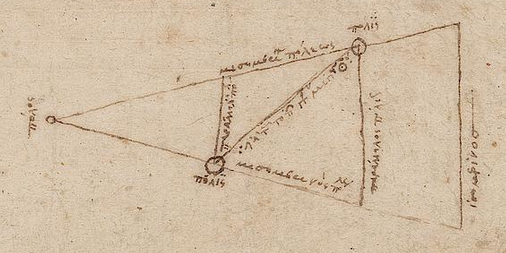
Here is a Ptolemy diagram from the introductory book, How to Draw a Map of the World, with a simple trig lesson showing how to transfer arcs relative to your standpoint (at left). It's at 129r. One can read the text explaining the concept in part 1.2 of the Berggren-Jones translation at Google Books.

This codex contains Ptolemy's coordinates, but not the world maps attributed to him or his late antique editors.

Ptolemy's geography was famously wrong in certain key ways. Some of the most exciting research of the past decade has examined the possibility that Ptolemy was hit by a garbage-in-garbage-out situation whereby he unwittingly relied on false experimental data (the earth's circumference), leading to some spectacular failures in his essentially brilliant compilation.

Klaus Geus and Irina Tupikova argued in 2013 that mystery locations on Ptolemy's map are none other than the Gulf of Finland and Poland's Vistula River if one adjusts the false data. We now stand a better chance of identifying all 6,400 places for which Ptolemy gives coordinates in the Geography.

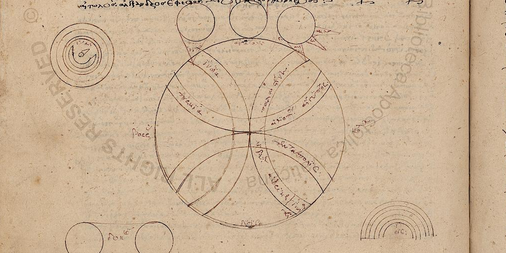
Various other scientific texts by authors as diverse as Euclid and Abu Ma'shar of Baghdad are all bound into the Vatican's massive 397-folio volume. Here is an unidentified diagram from folio 209v.

This codex, which is a kind of album of the best of ancient science, was brought to Rome by Isidoros, (c. 1385 to 1463), metropolitan of Kiev and later a Roman cardinal, and it thus ended up in the Vatican collection of Greek manuscripts as Vat.gr.191. It is one of the treasures that has finally entered our modern album of science, the internet. Digita Vaticana placed it online on June 22.

Renate Burri's description (in German) of this codex (designated X in the stemma) can be consulted on Google Books. A stemma showing the place of X as a key source has been published recently by Florian Mittenhuber. Burri has argued that the first diagram above is by a Byzantine editor, Manuel Chrysoloras, not by Ptolemy. Her book on the manuscripts of The Geography was recently reviewed on BMCR. [For a later blog post on Ptolemy by me with more manuscripts, jump here.]

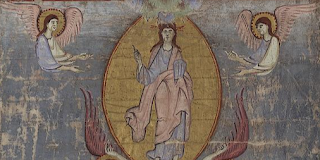
Also new in the uploads this week is one of the books that is known as a Barberini Codex, this one being an evangeliary made at one of the two main centres of monasticism on Lake Constance, either Reichenau or St Gallen, just a few years before 1000 CE. Here is its illumination of the Ascension (folio 84v):

Below is my own list of the 64 new items uploaded June 22, which take the posted total to 2,264. As always, I have compiled this in haste, using web searches to grab keywords, so this is subject to correction. The materials below with the shelfmark Borg. copt. are a variety of biblical and other materials, some of them only single leaves or papyri. For more information about the materials from the Capponi collection, Cozzo's 1897 printed catalog can be consulted at Archive.org.
  1. Arch.Cap.S.Pietro.C.152, contains a text of Aristophanes' Plutus (Pinakes)
  2. Arch.Cap.S.Pietro.D.182, Hilary of Poitiers
  3. Arch.Cap.S.Pietro.E.25,
  4. Barb.lat.711, great evangeliary made at Reichenau or St Gallen about 990 CE
  5. Barb.lat.4424, architectural sketchbook of Giuliano da Sangallo (1443-1516) (see article by Nicholas Temple)
  6. Barb.lat.5692, Pietro Bembo, letters
  7. Barb.lat.6481,
  8. Borg.ar.221,
  9. Borg.copt.109.cass.XXVII.fasc.138,
  10. Borg.copt.109.cass.XXVII.fasc.139,
  11. Borg.copt.109.cass.XXVII.fasc.140,
  12. Borg.copt.109.cass.XXVII.fasc.141,
  13. Borg.copt.109.cass.XXVII.fasc.142,
  14. Borg.copt.109.cass.XXVII.fasc.143,
  15. Borg.copt.109.cass.XXVII.fasc.144,
  16. Borg.copt.109.cass.XXVII.fasc.145,
  17. Borg.et.24,
  18. Borg.sir.16,
  19. Borgh.204, Johannes de Fonte, Parvi flores,
  20. Borgh.212, Maurus Salemitanus,
  21. Borgh.214, Opera quaedam de re iuridica, 14th century,
  22. Borgh.231, Abbas Antiquus,
  23. Borgh.320, Thomas Aquinas,
  24. Borgh.335, Cyprian of Carthage (c.200-258), a 15th-century compilation of his writings ,
  25. Borgh.368, a fine 15th-century manuscript of Livy's Roman history Ab urbe condita,
  26. Cappon.75, describes Medici celebrations
  27. Cappon.149.pt.1, letters to popes 1643
  28. Cappon.149.pt.2, speeches
  29. Cappon.152, obituary verse
  30. Cappon.153, Bologna university rules
  31. Cappon.155, epigrammata
  32. Cappon.157, Matthari Palmerii
  33. Cappon.158, from papacy of Paul IV 
  34.  Cappon.159, on council of Trent
  35. Cappon.162, letter by Magalotti
  36. Cappon.164, documents from Prague, Hungarian affairs
  37. Cappon.167, letters and notes from Paris
  38. Cappon.175,
  39. Cappon.177,
  40. Cappon.188, Northumberland's account of Anne Boleyn
  41. Cappon.189, accounts of judicial executions
  42. Cappon.191, Petrarch's I Trionfi (see below for a Renaissance manuscript)
  43. Cappon.192, diplomacy in France
  44. Cappon.202,
  45. Cappon.205,
  46. Cappon.206,
  47. Cappon.208,
  48. Cappon.212,
  49. Cappon.215,
  50. Cappon.222,
  51. Cappon.232, Pecorone
  52. Cappon.237.pt.C,
  53. Cappon.241, life of Cola di Rienzo
  54. Cappon.242, ditto
  55. Cappon.246, correspondence of dukes of Modena
  56. Cappon.250, vita de beato Johanne Bactista
  57. Cappon.254, alchemy and occult
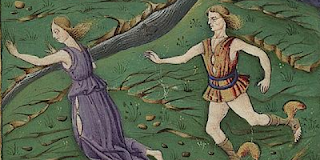
  58. Ott.lat.2998, Francesco Petrarch's I Trionfi (The Triumphs) with illuminations for a noble Renaissance library (See Guerrini on a similar manuscript at the Morgan): here's a Greek god in thrall to infatuation, in hot pursuit of his love object (fol. 51r):
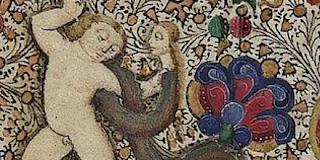
    The narrator is taken to a garden, sat down and shown a vast succession of mythological, biblical and historical figures making fools of themselves for love. This god's winged sandals suggest he may be Hermes, but the text implies the god may be "blond Apollo" chasing Daphne. In the margin of the same page is this odd couple:
  59. Reg.lat.1395, verse, Matteo Bandello
  60. Vat.ar.368, a hugely important and almost unique manuscript from Moorish Spain, The Tale of Bayad and Riyad
  61. Vat.estr.or.110,
  62. Vat.estr.or.147.pt.23,
  63. Vat.estr.or.147.pt.25,
  64. Vat.gr.191, 14th-century compilation of scientific texts with Euclid, Ptolemy's geography and astronomy (Pinakes),
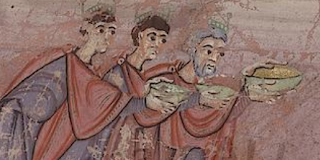
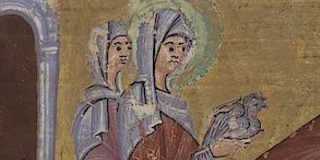
Two more images from the Barberini Codex show the Three Magi (fol. 18v) and the Presentation at the Temple (fol. 24v)

As always, if you can add any information about any item, write in the comments box below, or tweet to me at @JBPiggin. [This is Piggin's Unofficial List 17.]

2015-06-17

They Don't Make Hats Like This Any More

All 40 of the additions made on June 16 to Digita Vaticana come from the collection of Marquess Alessandro Gregorio Capponi (1683-1746), which became part of the Vatican Library at his death. Capponi did not collect classical books at all, but left many manuscript documents with a bearing on eighteenth-century Roman life, drawings from the period and archaeological notes.

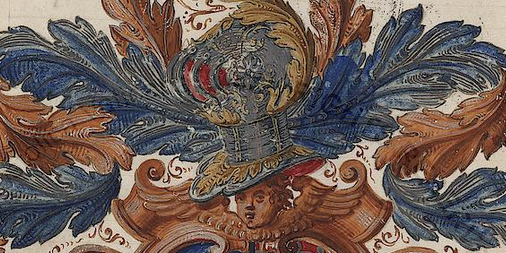
There is a very old catalogue (Christies sale) and the 1897 catalogue by Cozzo on archive.org, but very little information is attached to the manuscripts online at the BAV, making it hard to browse them. Here is a 17th-century heraldic blazon with a fanciful hat, from Cappon. 51, described in the catalog as a stemma di tipo flammingo: Look closely for the head.

Digita Vaticana seems to be bringing manuscripts online by a series of campaigns on individual collections: the Archcapitular Library of St Peters was first up, and now the Capponi collection is in focus. If you are hanging around for material in the Vat.lat. series, it may be a long wait. Here is the full June 16 list:
  1. Cappon.17
  2. Cappon.24
  3. Cappon.27.pt.1
  4. Cappon.28.pt.2
  5. Cappon.28.pt.3
  6. Cappon.29
  7. Cappon.32
  8. Cappon.41
  9. Cappon.43
  10. Cappon.51, Cicero in Italian with above blazon
  11. Cappon.52, Libellus super ludum scaccorum or the Book of Chess, here in an Italian translation. See my more comprehensive notes with Barb.lat.366, a manuscript in the original Latin. Digita Vaticana is using this one as a fund-raiser (see below).
  12. Cappon.53
  13. Cappon.54
  14. Cappon.55
  15. Cappon.56, with 16th century illustration including map below, poem by Lorenzo Bonincontri (catalog)
  16. Cappon.57
  17. Cappon.58
  18. Cappon.59
  19. Cappon.60
  20. Cappon.61
  21. Cappon.64
  22. Cappon.65
  23. Cappon.66
  24. Cappon.68
  25. Cappon.69
  26. Cappon.70
  27. Cappon.73
  28. Cappon.77, handwritten copy of typographer Ludovico Vincentino's book on italic design, more on Digita Vaticana fundraiser site
  29. Cappon.78.pt.1, description of churches of Naples, Assisi, Ancona and Osimo
  30. Cappon.78.pt.2,
  31. Cappon.79
  32. Cappon.81
  33. Cappon.83
  34. Cappon.84, La Gazeria del Cavalier Marino
  35. Cappon.85
  36. Cappon.89
  37. Cappon.90
  38. Cappon.91, description of the museum
  39. Cappon.92
  40. Cappon.93
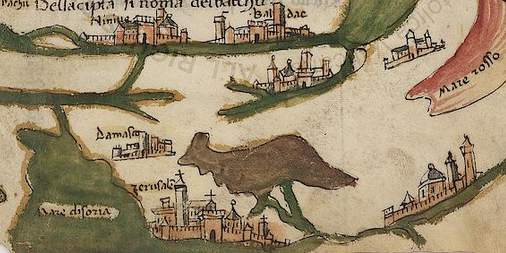
Above is a fine little borderless map (Cappon. 56) of the Near East with Damascus, Jerusalem and the Red Sea, which is satisfyingly .... red.

Still to come is one of the most interesting Capponiani items: autograph writings of Machiavelli in Cappon.107, comprising parts of his drafts of his History of Florence and his Letter to Vettori, according to Silvia Ruffo-Fiore. Cappon.52 has been chosen as a fund-raiser item, so consider donating for it:
As always, if you can tell us more about any of these items, use the comments box below. [This is Piggin's Unofficial List 16.]

2015-06-15

Byzantine Saints

The Digita Vaticana program to digitize manuscripts at the Vatican has just placed one of most noted and colourful Byzantine illuminated manucripts online. Known as the Menologion of Basil II and dating from about 1000 CE, codex Vat. gr. 1613 shows half a year of saints' feasts and depicts a great deal of blood, torture and martyrdom.

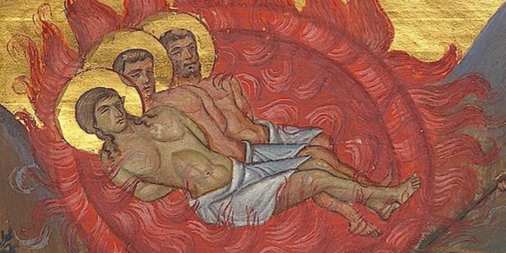
The image here shows Fausta (a 13-year-old girl), the sage Evilasius and the eparch Maximus being boiled alive in a cauldron for their faith:


Here is the full list of this most interesting batch of 83 new items uploaded on June 15. The posted total has now reached 2,160:
  1. Arch.Cap.S.Pietro.H.33, contains De Re Militari of Flavius Vegetius Renatus, the only ancient manual of Roman military institutions, unilluminated
  2. Barb.lat.358, a pocket prayerbook?
  3. Barb.lat.2132
  4. Barb.lat.3995
  5. Barb.lat.4052, Tasso's Gerusalemme liberata or Jerusalem Delivered
  6. Barb.lat.8615
  7. Borgh.198.pt.2
  8. Borgh.208, Olivetani Panegyrica et carmina in cardinalis Scipionis Caffarelli Burghesii ordinis Olivetani protectoris
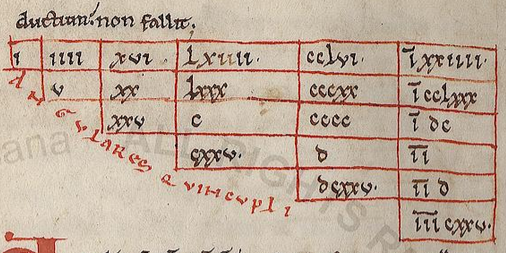
  9. Borgh.210, Boethius, De institutione arithmetica, a 12th or 13th century copy not very well used, suggesting it may have belonged to a lazy student. Here's a table of angles:
  10. Cappon.13
  11. Cappon.15
  12. Cappon.94
  13. Cappon.95
  14. Cappon.96, Ovid, Letters
  15. Cappon.97
  16. Cappon.98-100
  17. Cappon.101, Relation of the Death of Troilo Savello, decapitated in Rome on April 18, 1592
  18. Cappon.102
  19. Cappon.104
  20. Cappon.105, Frattato Cabalistico
  21. Cappon.108
  22. Cappon.109
  23. Cappon.110
  24. Cappon.111
  25. Cappon.112
  26. Cappon.113
  27. Cappon.115
  28. Cappon.116
  29. Cappon.117
  30. Cappon.118
  31. Cappon.123
  32. Cappon.125
  33. Cappon.126
  34. Cappon.128
  35. Cappon.129
  36. Cappon.130
  37. Cappon.133
  38. Cappon.134
  39. Cappon.138
  40. Cappon.142
  41. Cappon.146
  42. Cappon.147
  43. Cappon.150
  44. Cappon.151
  45. Cappon.156
  46. Cappon.170
  47. Cappon.173
  48. Cappon.174
  49. Cappon.178
  50. Cappon.180
  51. Cappon.183
  52. Cappon.184
  53. Cappon.185
  54. Cappon.187
  55. Cappon.190
  56. Cappon.196
  57. Cappon.211
  58. Cappon.213
  59. Cappon.216
  60. Chig.H.IV.135, poetry of Aeneas Sylvius Piccolomini (1405-1464, elected Pope Pius II in 1458), a figure of the Renaissance
  61. Pal.lat.1831, a student's lecture notes taken at the Protestant university of Wittenberg, Germany at the height of the Reformation; this item is new online, as it is not listed among the Heidelberg digitizations to date
  62. Pal.lat.1832, like the item above, notes from Reformation lectures by Philip Melanchthon and others
  63. Reg.lat.329, contains Aldhelm's Aenigmata
  64. Reg.lat.1709, also with a section of Ovid's Fasti [Missing: folios 34-35 which form Rome's part of the Fragmenta Floriacensia (more in BNF, Lat. 6400 B), a key source of the Chronica of Eusebius of Caesarea]
  65. Urb.lat.1154, late antique grammar by Probus, Instituta artium
  66. Vat.estr.or.19
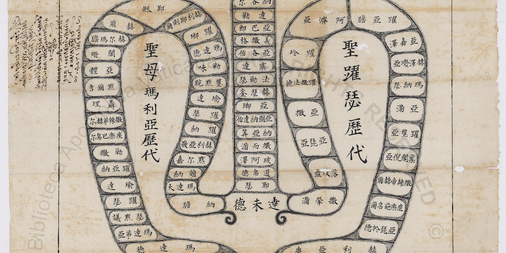
  67. Vat.estr.or.55, contains this extraordinary Christian chronology diagram in Chinese by Carlo di Orazio da Castorano (1673-1755); discussed in detail by Ad Dudink, who notes that the Septuagint chronology, not the Masoretic/Vulgate chronology is being used in it.
      
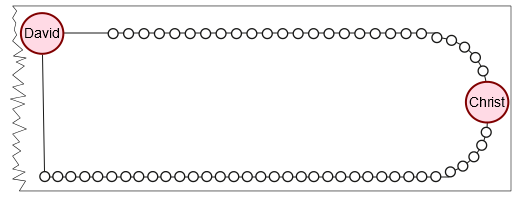
    In the tracks above, the ancestry descends from Adam to David, then divides into Luke's genealogy in the left loop and Matthew's in the right loop. This design surprised me a lot, as it is fairly similar in its basic layout idea to what the Great Stemma's designer was doing, left to right, back in the fifth century (below):
  68. Vat.estr.or.81
  69. Vat.estr.or.82
  70. Vat.estr.or.147.pt.18
  71. Vat.estr.or.147.pt.22
  72. Vat.estr.or.148, adventures of Jiraiya, according to Mare Nostrum
  73. Vat.et.264, hagiographical text from the Ethiopian collection, badly singed, discussed in detail by Alessandro Bausi
  74. Vat.gr.752.pt.1
  75. Vat.gr.1613, The Menologion of Basil II (Wikipedia)
  76. Vat.lat.40, New Testament
  77. Vat.lat.92, Peter Lombard, commentary on psalms (printed catalog at Archive.org)
  78. Vat.lat.3199, a gift copy of the Commedia sent by Boccaccio to Petrarch
  79. Vat.lat.4803, Colocci
  80. Vat.lat.6435, Opicinus de Canistris, with cosmographical diagrams
  81. Vat.lat.9850, autograph manuscript by Thomas Aquinas: Summa contra Gentiles, Super Boet. De Trin., Super Isaiam
  82. Vat.lat.11458, Orations by Cicero, a manuscript from 1417 containing eight recovered Cicero speeches
  83. Vat.lat.12895, a book of autograph letters from figures including Cardinal Angelo Mai and Pius IX
As ever, if you can identify any of these further, please add a note in the comments box below. [This is Piggin's Unofficial List 15.]