Showing posts with label PUL. Show all posts

2017-06-19

Library Crime

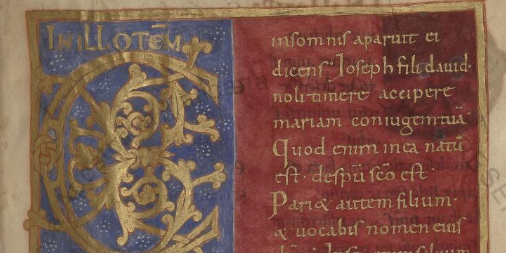
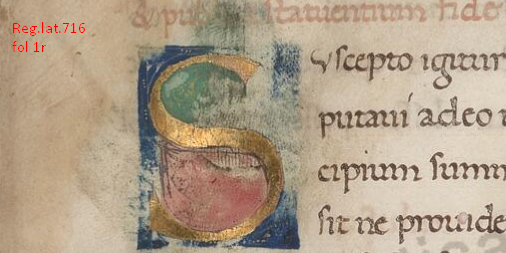
Among the codices lately digitized and issued online by the Vatican Library is a volume, Reg.lat.716, that has been defaced. The rascal ought to be identifiable, since he seems to have left his thumbprints in the damaged opening initial:

This codex contains two works by the Late Antique theologian Lactantius, the Divine Institutions, incipit "Suscepto igitur illustrande veritatis officio...", and De Opificio Dei, inscribed to Demetrianus.

It is hardly likely the scribe, Nicolò de’ Ricci, is the fat-thumbed culprit, since he would not have been paid if he delivered work like this. (We know Nicoló was the copyist because he entered "Riccius scripsit" on the final page.) So could the culprit have been an uncouth owner? Or an unruly child? Investigators, to work!

Here is my latest list, with more additions in the pipeline this week.
  1. Borg.arm.18
  2. Reg.lat.44
  3. Reg.lat.456, on Saint Benedict, an 11th-century manuscript
  4. Reg.lat.461
  5. Reg.lat.465, lives of half a dozen French saints, 11th century
  6. Reg.lat.468
  7. Reg.lat.474
  8. Reg.lat.475
  9. Reg.lat.483, Life of St Dunstan, etc, 12th century
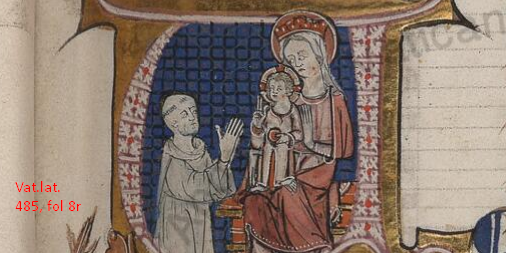
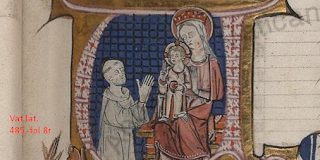
  10. Reg.lat.485, compendium (for the writing of sermons?), fully illuminated
  11. Reg.lat.491
  12. Reg.lat.492
  13. Reg.lat.573, Life of Saint Wandregisel (French: Wandrille) (c. 605–668), Frankish courtier, mon, abbot
  14. Reg.lat.574
  15. Reg.lat.609, annals
  16. Reg.lat.617, the remaining 68 folios of a 9th-century set of Frankish annals
  17. Reg.lat.618, Rudolf Glaber and Adoman
  18. Reg.lat.627, Johannes Rufus, History
  19. Reg.lat.629
  20. Reg.lat.632
  21. Reg.lat.634, church history compilation
  22. Reg.lat.643
  23. Reg.lat.645, lives of bishops Honorat and Hilarius
  24. Reg.lat.646, life of St Dunstan
  25. Reg.lat.650
  26. Reg.lat.655
  27. Reg.lat.682
  28. Reg.lat.684, Placido Raggazoni, 1574
  29. Reg.lat.716, Lactantius (above) with thumbprints.
  30. Reg.lat.718
  31. Reg.lat.723
  32. Reg.lat.732
  33. Reg.lat.747, eTK: Propter quid homines Homerus temporicanos vocavit (15c); .Alexander of Aphrodisias
  34. Reg.lat.748
  35. Reg.lat.786, eTK: Fabrica est continuata rerum trita (15c); Vitruvius
  36. Reg.lat.800
  37. Reg.lat.848
  38. Reg.lat.883
  39. Ross.847
  40. Sbath.144
  41. Urb.lat.1420
  42. Urb.lat.1427
  43. Urb.lat.1428; eTK. Cum inter seculi sapientes antiquitus (14c); also: Cum inter seculi sapientes antiquitates
  44. Urb.lat.1442
  45. Urb.lat.1455
  46. Urb.lat.1457
  47. Urb.lat.1458
  48. Urb.lat.1459
  49. Urb.lat.1462
  50. Urb.lat.1465
  51. Urb.lat.1470
  52. Urb.lat.1472
  53. Urb.lat.1473
  54. Urb.lat.1475
  55. Urb.lat.1477
  56. Urb.lat.1479
  57. Urb.lat.1483
  58. Urb.lat.1497
  59. Vat.ebr.612
  60. Vat.lat.1410; Justinian, Digest
  61. Vat.lat.1448
  62. Vat.lat.1632; Plautus compendium
  63. Vat.lat.1651; Pliny, Letters, a 15th-century manuscript
  64. Vat.lat.1689
  65. Vat.lat.1695, Cicero, De inventione
  66. Vat.lat.1698
  67. Vat.lat.1705
  68. Vat.lat.1709
  69. Vat.lat.1716
  70. Vat.lat.1717
  71. Vat.lat.1725
  72. Vat.lat.1732
  73. Vat.lat.1749
  74. Vat.lat.1770, eTK: Cum natura sublimis qui omnibus tribuit esse (15c); De mirabilibus mundi
  75. Vat.lat.1803, Poggio's Latin translation of Xenophon
  76. Vat.lat.1804
  77. Vat.lat.1841, Livy, Ab Urbe Condita
  78. Vat.lat.4651
This is Piggin's Unofficial List number 118. If you have corrections or additions, please use the comments box below. Follow me on Twitter (@JBPiggin) for news of more additions to DigiVatLib.

2017-06-05

Comix

A kind of 11th-century comic book, with cartoon-style drawings showing successive scenes in the history of the church, such as the Ascension and the first six Councils, is a highlight of the newest batch of digitizations by the Vatican Library. 
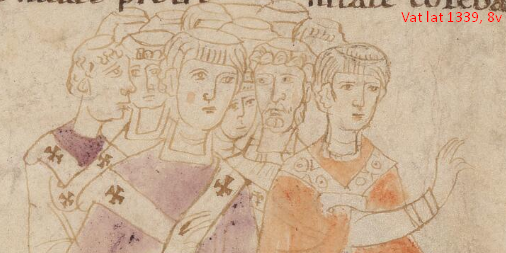
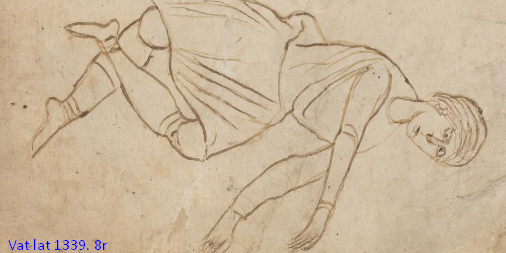
Page through these outline drawings, which are economically colored by simple ink washes. The depictions of the councils place the Roman emperor and his retinue at the top, groups of clerics at center, and images of fallen heretics below, like this:

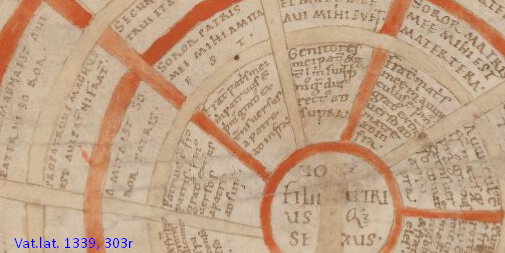
This codex contains the canon-law Collection in Five Books and other materials. At fol 303r is a remarkable arbor juris in the form of a rota:
The latest round of digitizations brings the online total to 14,128 items. Here are some of the novelties.
  1. Barb.lat.2182
  2. Ott.lat.2531 , HT to ParvaVox who notices this is another #Carolingian codex: the Annales Necrologici of Fulda kept and updated from 779 to 1065.
  3. Reg.lat.28
  4. Reg.lat.39
  5. Reg.lat.40
  6. Reg.lat.57
  7. Reg.lat.58
  8. Reg.lat.60
  9. Reg.lat.62
  10. Reg.lat.65
  11. Reg.lat.97
  12. Reg.lat.115
  13. Reg.lat.119
  14. Reg.lat.121
  15. Reg.lat.208, an 11th-century book for school use, with the Fabulae of Avian, popular for elementary Latin lessons and for classes in grammar as part of liberal arts courses. eTK lists the section beginning: "Electuarium ad omnia vitia stomachi quo utebatur Karolus rex."
  16. Reg.lat.228
  17. Reg.lat.231
  18. Reg.lat.240 , HT to @ParvaVox who notes the content of this #Carolingian treasure: the treatise by Florus of Lyons in which he attacked vs John Scotus Eriugena. @chaprot (Pierre Chambert-Protat, the expert on Florus) notes: Reg.lat.240 is a special one though because although we don't know where it comes from, it contains a letter of transmittal: 240 is the one and only witness of this letter, but it has lost the rubrica. We don't know to whom Florus wrote it! Thanks to @DigitaVaticana, every relevant witness of this work is now digitized and fully accessible on the internet.
  19. Reg.lat.242
  20. Reg.lat.249
  21. Reg.lat.259
  22. Reg.lat.262
  23. Reg.lat.264, 14th century. eTK lists section beginning, "A febribus Beneventanis que aut citissime." Fols 169r-186r contain Augustine, De opere monachorum
  24. Reg.lat.265
  25. Reg.lat.270
  26. Reg.lat.275
  27. Reg.lat.298
  28. Reg.lat.305
  29. Reg.lat.313
  30. Reg.lat.322
  31. Reg.lat.340
  32. Reg.lat.345
  33. Reg.lat.347
  34. Reg.lat.350
  35. Reg.lat.351
  36. Reg.lat.355
  37. Reg.lat.356 . HT to @ParvaVox on Twitter who recognized this is as beautiful 9th-10th-century glossed copy of Walahfrid Strabo's Visio Wettini from St Gall. HT @JBPiggin pic.twitter.com/1h2yNP0fkj
  38. Reg.lat.361
  39. Reg.lat.365
  40. Reg.lat.367
  41. Reg.lat.370
  42. Reg.lat.383
  43. Reg.lat.389
  44. Reg.lat.391
  45. Reg.lat.392, binding of several 15th century copies of philosophical works, the main one of which is Duns Scotus writing on John Sharpe, Quaestiones quodlibetales, probably in Advent 1306 or Lent 1307. eTK lists a section beginning, "Aliqui dicunt quod natura materialis se ipsa individuatur."
  46. Reg.lat.397, eTK lists a section beginning, "Cum animadverterem quamplurimos medicorum non solum iuniores."
  47. Reg.lat.401
  48. Reg.lat.403
  49. Reg.lat.409
  50. Reg.lat.414.pt.1
  51. Reg.lat.414.pt.2
  52. Reg.lat.415
  53. Reg.lat.420
  54. Reg.lat.428
  55. Reg.lat.429
  56. Reg.lat.437
  57. Reg.lat.431, 15th century, a mixed codex with penitentials, an order of the mass, some Augustine and other materials. eTK lists a section beginning, "Post naturam corpoream et incorpoream." Also: De animali
  58. Reg.lat.440
  59. Reg.lat.441
  60. Reg.lat.444
  61. Reg.lat.447
  62. Reg.lat.449
  63. Reg.lat.450
  64. Reg.lat.451
  65. Reg.lat.452
  66. Reg.lat.459
  67. Reg.lat.487
  68. Reg.lat.575
  69. Reg.lat.583
  70. Reg.lat.584
  71. Reg.lat.591
  72. Reg.lat.602
  73. Reg.lat.623
  74. Reg.lat.651
  75. Reg.lat.677
  76. Reg.lat.683
  77. Reg.lat.690
  78. Reg.lat.710
  79. Reg.lat.728
  80. Reg.lat.733
  81. Reg.lat.793
  82. Urb.lat.1007
  83. Urb.lat.1296
  84. Urb.lat.1302
  85. Urb.lat.1482
  86. Urb.lat.1679
  87. Urb.lat.1738
  88. Urb.lat.1752
  89. Urb.lat.1756
  90. Vat.lat.1301
  91. Vat.lat.1312
  92. Vat.lat.1319
  93. Vat.lat.1339, a rich 11th-century collectio canonum (see above)
  94. Vat.lat.1434
  95. Vat.lat.1441
  96. Vat.lat.1450
  97. Vat.lat.1555
  98. Vat.lat.1582
  99. Vat.lat.1584
  100. Vat.lat.1585
  101. Vat.lat.1601
  102. Vat.lat.1602
  103. Vat.lat.1603
  104. Vat.lat.1606
  105. Vat.lat.1607
  106. Vat.lat.1614
  107. Vat.lat.1616
  108. Vat.lat.1620
  109. Vat.lat.1624
  110. Vat.lat.1625
  111. Vat.lat.1629
  112. Vat.lat.1630
  113. Vat.lat.1633
  114. Vat.lat.1634
  115. Vat.lat.1635
  116. Vat.lat.1636
  117. Vat.lat.1638
  118. Vat.lat.1646
  119. Vat.lat.1648
  120. Vat.lat.1649
  121. Vat.lat.1652
  122. Vat.lat.1655
  123. Vat.lat.1656
  124. Vat.lat.1657
  125. Vat.lat.1684
  126. Vat.lat.1699
  127. Vat.lat.1700: HT to @gundormr who notes: 1700 is a nice 12th century copy (of Cicero) with some glosses. It looks as if the 1700 series below is mostly Cicero.
  128. Vat.lat.1708
  129. Vat.lat.1710
  130. Vat.lat.1711
  131. Vat.lat.1713
  132. Vat.lat.1719
  133. Vat.lat.1731
  134. Vat.lat.1736
  135. Vat.lat.1752
  136. Vat.lat.1754
  137. Vat.lat.13102
This is Piggin's Unofficial List number 117. If you have corrections or additions, please use the comments box below. Follow me on Twitter (@JBPiggin) for news of more additions to DigiVatLib.

2017-05-17

Matteo's Grotesques

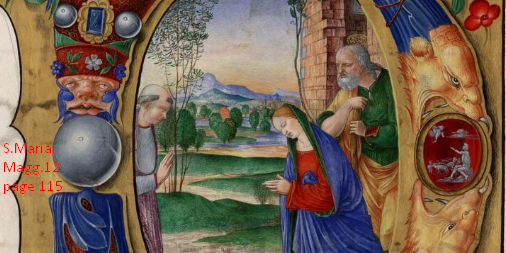
Matteo da Milano was a talented Italian illuminator working in the late 15th and early 16th centuries. Originally from Milan, he did most of his work in Rome and Ferrara for the Estes, the Medicis, the Orsini and the della Rovere families. His specialty was illustrating for the wealthy clerics from these ranking families and was noted for the borders which he decorated with grotesques, jewels, cameos and other all'antica features, carefully drawn flora and fauna (see article by Andreina Contessa).

You can see the style in S.Maria.Magg.12, a lovely music manuscript for use by the choir from Advent to Lent, made for Santa Maria Maggiore of Rome and now in the Vatican Library.

It is one of the latest codices digitized in color by the Vatican Library. My full list:
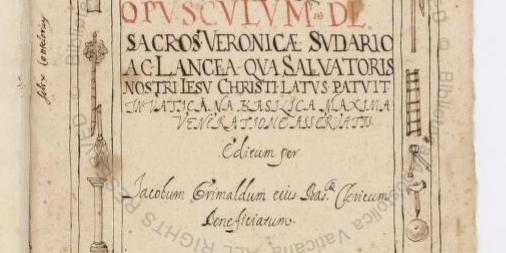
  1. Arch.Cap.S.Pietro.H.3.pt.bis, collection of materials on Shroud of Veronica. Curious because title page is got up like that of a printed book, indicating how dominant print style had become by 1616.
  2. Arch.Cap.S.Pietro.H.62, biographies. Paolo Vian has added a 2014 note at the front saying the catalog item dealing with this codex seems to be partly duff.
  3. Borg.ar.265
  4. Borgh.216
  5. Ott.lat.2862
  6. Reg.lat.243, miscellany with Augustine at ff. 1-53 (11th century)
  7. Reg.lat.261, 15th-century miscellany of Alcuin, Chrysostom and others
  8. Reg.lat.279
  9. Reg.lat.281, HT to @ParvaVox who recognizes this as a beautiful 9th-century manuscript of De vita contemplativa by Julianus Pomerius, copied by Agambaldus, monk and scribe.
  10. Reg.lat.299
  11. Reg.lat.328
  12. Reg.lat.339 : another HT to @ParvaVox who noticed a remarkable Carolingian stemma at fol. 7r in this 9th-century codex showing a funny-looking, cartoon-style Charlemagne and Louis the Pious. I will have to do some more digging to figure out where this belongs in stemma history: it's not a history book as such, but mainly a theology compilation.
  13. Reg.lat.346
  14. Reg.lat.372
  15. Reg.lat.435, Martyrologium, plus an interesting legal glossary at ff 41r-44v: Summula seu definitiones de legalibus verbis; 12th or 13th century French.
  16. S.Maria.Magg.12, magnificent 15th-century music codex (above)
  17. Urb.gr.120
  18. Urb.lat.320
  19. Urb.lat.859
  20. Urb.lat.1065.pt.1
  21. Urb.lat.1072.pt.2
  22. Urb.lat.1123
  23. Urb.lat.1225
  24. Urb.lat.1229
  25. Urb.lat.1230
  26. Urb.lat.1238
  27. Urb.lat.1222
  28. Urb.lat.1234
  29. Urb.lat.1239
  30. Urb.lat.1240
  31. Urb.lat.1246
  32. Urb.lat.1248
  33. Urb.lat.1256
  34. Urb.lat.1262
  35. Urb.lat.1772
  36. Vat.gr.86, black and white microfilm only
  37. Vat.gr.1702,
  38. Vat.lat.1040, eTK index of science manuscripts lists incipits Utrum de corpore mobili ad formam and Circa initium primi libri de generatione
  39. Vat.lat.1438, legal Bartholomew of Brixen and Bernardo Bottoni
  40. Vat.lat.2151, eTK index of science manuscripts lists incipit Prohemium huius libri continet duas of late medieval logician and metaphysician Walter Burley
  41. Vat.lat.6767
  42. Vat.sir.343
This is Piggin's Unofficial List number 116. If you have corrections or additions, please use the comments box below. Follow me on Twitter (@JBPiggin) for news of more additions to DigiVatLib.

2017-05-08

Bell Towers

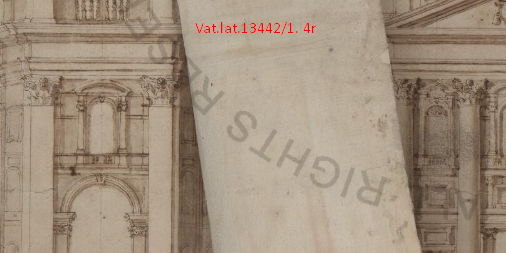
St Peter's Basilica in Rome was not built in a day. Its bell towers are additions. Pope Urban VIII decided in 1636 to adopt the architect Bernini's scheme. This can now be examined online in a book of planning drawings, Vat.lat.13442.pt.1, including a curious little lift-the-flap page with design alternatives:
Many of the drawings are overlays on an engraving by Matthias Greuter. This was printed as a kind of master drawing for the project, which lasted many years. A start was made on the south tower, but due to technical problems the work was suspended. The completed parts of Bernini's structure were dismantled in 1646.

The portfolio is one of the manuscripts placed online in the last few days by the Vatican Apostolic Library. My list:
  1. Carte.dAbbadie.18 (black and white, low-res)
  2. Carte.dAbbadie.19 (black and white, low-res), translation from Arabic by Antoine Thomson d'Abbadie, the 19th-century Franco-Irish explorer
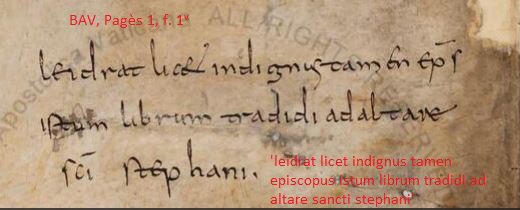
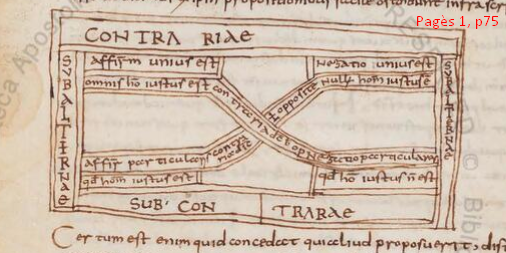
  3. Pages.1, Codex Leidradi (HT to @ParvaVox and @LatinAristotle who point out Bishop Leidrad of Lyons' autograph ex-libris in this very early (8th century) copy of Aristotle's Organon.)  Here is the inscription as transcribed by @LatinAristotle:
    The codex begins with
    Porphyry's Isagoge in the Latin translation (early 6th century CE) of Boethius. Check it out on ELMSS. @ParvaVox adds the reference CLA IV 417. Note the diagrams including this one:
  4. Reg.lat.458, a Lives of the Saints compilation (from cathedral priory of St Andrew, Rochester, Kent?) including a life of St Pol de Léon
  5. Vat.gr.463
  6. Vat.gr.758 ,
  7. Vat.lat.518.pt.1
  8. Vat.lat.752, philosophical: Bonaventura, Aquinas
  9. Vat.lat.1300
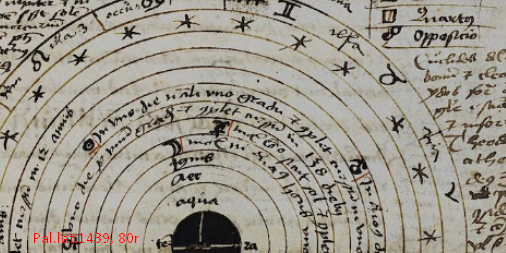
  10. Vat.lat.1439
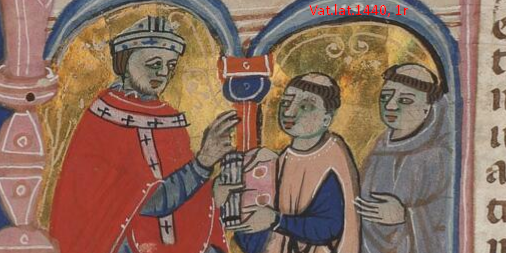
  11. Vat.lat.1440, Pope Innocent: Apparatus in Decretalium Gregorii, with this opening initial:
  12. Vat.lat.1444
  13. Vat.lat.1452
  14. Vat.lat.1457
  15. Vat.lat.1463
  16. Vat.lat.1501, Notabilia of Johannes de Soncino
  17. Vat.lat.1509
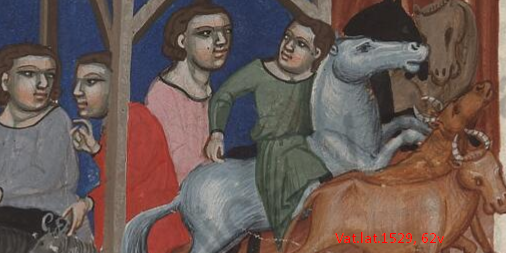
  18. Vat.lat.1529 , Pietro de Crescenzi, Ruralia commoda, 14th century
  19. Vat.lat.1535
  20. Vat.lat.1544
  21. Vat.lat.1545, Macrobius, Commentary on Cicero's Scipio's Dream, 15th century
  22. Vat.lat.1549
  23. Vat.lat.1550
  24. Vat.lat.1551
  25. Vat.lat.1553, De verborum significatu, by the 2nd-century lexicographer Festus, epitome by Paulus. Incipit: Augustus, locus sanctus, ab avium gestu. Edition: De verborum significatu quae supersunt cum Pauli epitome, ed. Wallace M. Lindsay, Leipzig: Teubner 1913.
  26. Vat.lat.1557
  27. Vat.lat.1559
  28. Vat.lat.1561, Leonardo Bruni, De Militia
  29. Vat.lat.1562
  30. Vat.lat.1563
  31. Vat.lat.1564
  32. Vat.lat.1566
  33. Vat.lat.1576
  34. Vat.lat.1578
  35. Vat.lat.1581
  36. Vat.lat.1588
  37. Vat.lat.1617
  38. Vat.lat.1619
  39. Vat.lat.1627
  40. Vat.lat.1639
  41. Vat.lat.1658
  42. Vat.lat.1665
  43. Vat.lat.1667
  44. Vat.lat.1670
  45. Vat.lat.1674
  46. Vat.lat.1676
  47. Vat.lat.1677
  48. Vat.lat.1680
  49. Vat.lat.1685, Cicero, Letters, a Renaissance manuscript
  50. Vat.lat.1691
  51. Vat.lat.1701
  52. Vat.lat.13442.pt.1, drawings of Bernini's facade for the Basilica of St Peter in Rome (above)
  53. Vat.lat.15414

Also worthy of note is the arrival online, in colour and hi-res, of Vat.lat.1528, formerly only available in black and white. This is a 14th-century copy of De Balneis Puteolanis, the medical poem on the healing benefits of thermal baths by Petrus of Eboli. This copy lacks the racy illustrations. It is listed in Thorndike-Kibre only under the prologue, Inter opes rerum deus est. See Ballester

At Heidelberg, 15 new manuscripts have arrived online, most of them scientific. Those indexed by Thorndike-Kibre are marked eTK below:
  1. Pal. lat. 1171 Petrus : Medizinsche Sammelhandschrift (Italien, 14. Jh. (nach 1310))
  2. Pal. lat. 1172 Petrus : Conciliator Pars I (Heidelberg, Mitte 15 Jh.), eTK: Quod necessarium non sit medico ceteras speculationis scientias (15c); Also: Unum in ternario ac omne
  3. Pal. lat. 1180 Arnoldus ; Gentilis ; Bacon, Rogerus: Medizinische Sammelhandschrift (Heidelberg, 2. Drittel 15. Jh.), eTK: Ad investigationem ergo scientie de gradibus medicinarum
  4. Pal. lat. 1188 Avicenna; Hippocrates; Copho; Arnoldus ; Leopoldus ; Hermes; Ps.-Vergilius; Augustinus Bathus Senensis; Antonius de Haneron: Miscellaneenband (Sachsen, Ende 15. Jh.), eTK: Debes considerare planetas hora revolutionis (15c)
  5. Pal. lat. 1196 Isaac : Medizinische Sammelhandschrift (Frankreich, 13./14. Jh.), eTK: Cum in primis coegit antiquos disputare (15c)
  6. Pal. lat. 1198 Liber medcinalis (Regensburg oder Freising, 1565)
  7. Pal. lat. 1203 Kommentare zu den Aphorismen des Hippokrates (2. Drittel 15. Jh.), eTK: Intentio Hippocratis fuit componere librum pauci (15c)
  8. Pal. lat. 1205 Arnoldus praepositus Sancti Jacobi; Arnoldus ; Maimonides, Moses; Jacoby, Johann; Gentilis ; Costofferus; Auicenna; Bernardus ; Magninus : Medizinische Sammelhandschrift (Deutschland, 2. Hälfte 15. Jh), eTK: Accidit interdum aeri qui est hic apud nos (15c)
  9. Pal. lat. 1419 Ptolemaeus, Claudius: Opus quadripartitum (Deutschland, 2. Drittel 15. Jh.)
  10. Pal. lat. 1420 Ptolemaeus, Claudius; Johannes ; Albertus ; Johannes ; Bradwardine, Thomas; Simon ; Johannes : Sammelband mit Quadriviumstexten (Italien (I) , Italien und Köln (II), Ende 13. Jh. (I) ; 14. Jh. (II))
  11. Pal. lat. 1423 Pruckner, Nicolaus; Leowitz, Cyprian: Nativitäten ; Astrologische Urteile (Heidelberg, 2. Hälfte 16. Jh.)
  12. Pal. lat. 1425 Leowitz, Cyprian: Tomus tertius nativitatum (Augsburg, Mitte 16. Jh.)
  13. Pal. lat. 1436 Leopoldus ; Johannes ; Prophatius Judaeus: Astronomisch-astrologische Sammelhandschrift (Belgien, Mitte 15. Jh. (1447))
  14. Pal. lat. 1439 Peuerbach, Georg /von; Regiomontanus, Johannes; Albertus ; Johannes ; Głogowczyk, Jan; Ps.-Hippokrates; Prosdocimus ; Hermes: Astronomisch-astrologische Sammelhandschrift (Krakau, Leipzig, 1487-1493), eTK: Aries facit calorem temperatum (15c)
  15. Pal. lat. 1446 Abū-Maʿšar Ǧaʿfar Ibn-Muḥammad; Qabīṣī, Abu-'ṣ-Ṣaqr ʿAbd-al-ʿAzīz Ibn-ʿUṯmān /al-; Māšā'allāh Ibn-Aṯarī: Astrologischer Sammelband (Deutschland, Mitte 15. Jh. (I) , letztes Drittel 14. Jh. (II)), eTK: Accipiat nomen suum
Finally, the Vatican Library is playing catch-up, having just posted some manuscripts already familiar from the Heidelberg site:
  1. Pal.lat.1357, eTK: India ulterior finitur ab oriente oceano (14c)
  2. Pal.lat.27
  3. Pal.lat.33
  4. Pal.lat.37
  5. Pal.lat.38
  6. Pal.lat.44
  7. Pal.lat.48
  8. Pal.lat.49
  9. Pal.lat.54
  10. Pal.lat.61
  11. Pal.lat.62
  12. Pal.lat.63
  13. Pal.lat.64
  14. Pal.lat.66
  15. Pal.lat.69
  16. Pal.lat.70
  17. Pal.lat.71
  18. Pal.lat.101
  19. Pal.lat.130
  20. Pal.lat.131
  21. Pal.lat.203
  22. Pal.lat.205
  23. Pal.lat.312
  24. Pal.lat.395
  25. Pal.lat.397
  26. Pal.lat.399
  27. Pal.lat.711
  28. Pal.lat.1089, eTK: Somnus corporis of Galen
  29. Pal.lat.1930
This is Piggin's Unofficial List number 115. If you have corrections or additions, please use the comments box below. Follow me on Twitter (@JBPiggin) for news of more additions to DigiVatLib.

2017-04-23

Law Professor

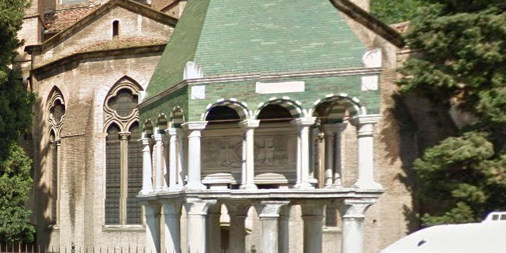
Take a trip on Google Street View to Bologna, Italy, where one of the greatest law professors, Accursius, c. 1182-1263, is entombed with his son in a curious elevated sarcophagus at the side of a busy street. The Tombe dei Glossatori is a pretty little green-roofed shrine.

Accursius senior, c. 1182-1263, was a professor in Bologna whose work became a definitive textbook through the medieval period. He is thought to have built up and revised his 2 million words of commentary on the Institutions, Code, Digest and Novels of Justinian over a lifetime of research and writing.

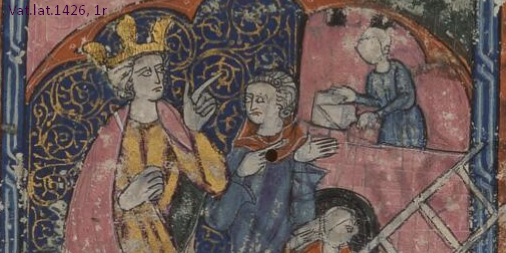
Consider now how law students for hundreds of years consulted this man's law commentaries, and take a look at a 14th-century manuscript of his Apparatus dealing with the Digest from book 39 onwards. The Vatican Library has just digitized Vat.lat.1426 and you will see that not only does the Digest occupy the centre space with the margins full of glosses, but there are also glosses on the glosses. This may not be the oldest manuscript, but Robert Figueira notes that no archetypal manuscript has ever been identified.

The Vatican copy is interesting for its idiosyncratic illuminations, which would be delightful subjects for Make Up the Caption competitions. What are they saying here about the faceless bricklayer at right?[The true answer, by the way, is that this is the section De operis novi nuntiatione, illustrated by a king giving orders for a building campaign. HT to @Glossaeluris.]

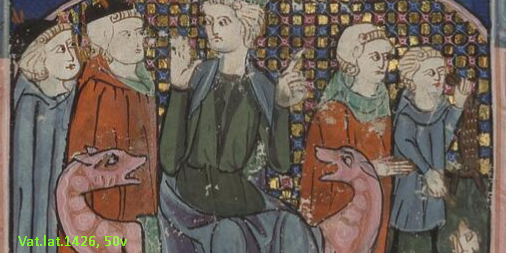
The whimsical artist also shows us a comical curule chair below with the carved arms shaped like heads of surprised hounds emerging from one body. The gaze directions of the humans seem to suggest something odd is happening off-stage at right. But what?

Here is my full list of digitizations recorded in the past week, whereby I will exceptionally include Palatina items that were previously online at Heidelberg:
  1. Borg.et.23
  2. Pal.lat.8
  3. Pal.lat.26
  4. Pal.lat.28
  5. Pal.lat.29
  6. Pal.lat.30, Diurnale Benedictinum with Psalter Romanum, 13th century, Tuscany or perhaps Piedmont, Beuron number 370. Original online release at Heidelberg has more details.
  7. Pal.lat.31
  8. Pal.lat.32
  9. Pal.lat.34
  10. Pal.lat.35
  11. Pal.lat.1908
  12. Pal.lat.1917
  13. Pal.lat.1939
  14. Pal.lat.1940
  15. Pal.lat.1941
  16. Pal.lat.1962
  17. Pal.lat.1975
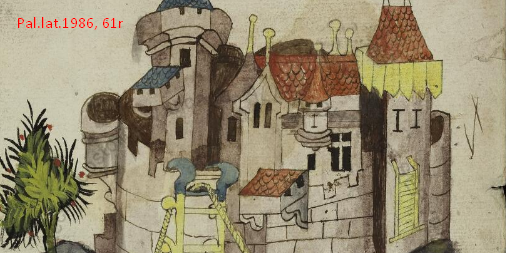
  18. Pal.lat.1986, the strange Bellifortis (c. 1405) of Konrad Kyeser (1366 – after 1405), a German military engineer. Listed on eTK (a service kindly provided by Medieval Academy of America).
    Zsombor Jékely kindly invites us to compare this to a fragmentary Bellifortis in Hungary here: http://real-ms.mtak.hu/90/
  19. Pal.lat.1990
  20. Pal.lat.1994
  21. Pal.lat.1995
  22. Vat.lat.1426, Accursius (above)
  23. Vat.lat.1538, Macrobius, Saturnalia
  24. Vat.lat.1540, an unfinished copy of Macrobius, Saturnalia, in an Italian humanistic cursive hand. Gaps left for miniatures, opening line, "[M]ultas variasque res in hac vita nobis," lacks planned illuminated M, and start of book 8, "[P]rimus mensis post epulas non remoti," (folio 165r) lacks P. A scholar has instead obtained this codex at a discount and used it to collect glosses in the margins.
  25. Vat.lat.1672
This is Piggin's Unofficial List number 114. If you have corrections or additions, please use the comments box below. Follow me on Twitter (@JBPiggin) for news of more additions to DigiVatLib.

2017-04-19

King's Breviary

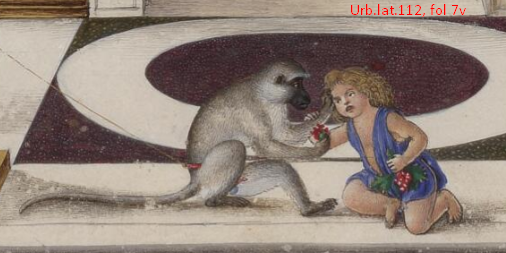
Among the world's greatest treasures of book art is the series of lavishly illuminated religious books ordered by King Matthias Corvinus of Hungary (1458-1490) to enhance his magnificent Renaissance library. What remains of this one-time royal library at Buda, estimated by Csaba Csapodi to have numbered 2,000 to 2,500 books, is now scattered round the world, but thanks to Zsombor Jékely you can browse many surviving volumes in the virtual Bibliotheca Corviniana Online, a directory of links to digitized manuscripts.

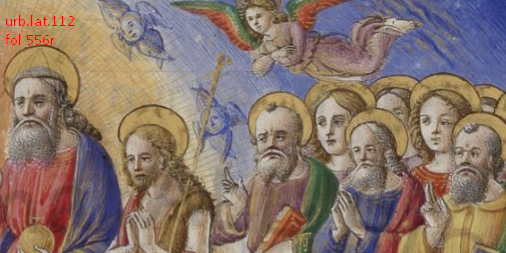
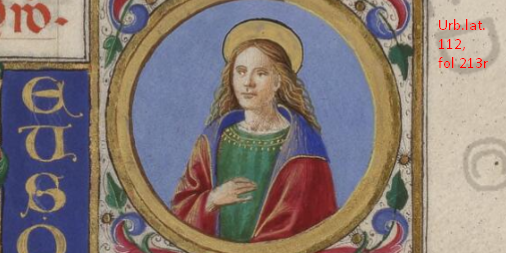
The Vatican Library owns one of the most prized items, the Breviary of Matthias Corvinus, Urb.lat.112, and has just digitized it. This volume is attributed to the Florentine master illuminator Attavante dei Attavanti, of whom Csapodi (article digitized by Roger Pearse) writes:
The work of this master and his school is easily recognizable by the delicate pattern of the classical floral design in the border decoration and its moderate use, and by the figural representations inserted into this ornamental frame. Some of these figures seem to be lifeless and conventional, but in many cases they may be portraits of contemporaries gazing at the reader from the leaves of the book.

Indeed. You would not have dared to paint a false smirk or scowl on the face of any eminent courtier in the administration of the martial Matthias. Or of any court lady in the ascendant:

For more on the Corvinian manuscripts, see my blog post two years ago, Hungary's Week, discussing Urb. lat. 110 (Missale Romanum or the Missal of Matthias Corvinus). Browse too to Rossiana 1164 (Missal of the Friars Minor); Barb.lat.168 (Livius: Historiarum decas I); and Ott.lat.501 (Pontificale).

Here is the full list of novelties from the past week or so:
  1. Barb.gr.438
  2. Barb.lat.4021
  3. Chig.P.VII.9.pt.B, part of an album of architectural drawings by Gian Lorenzo Bernini (1598-1680), with some designs by Carlo Fontana or Felice Della Greca (St Louis catalog). This section contains designs for the two-tiered altar at St. John Lateran (HT to @gundormr)
  4. Pal.lat.59
  5. Pal.lat.1747
  6. Pal.lat.1827
  7. Pal.lat.1916
  8. Pal.lat.1918
  9. Pal.lat.1920
  10. Pal.lat.1921
  11. Urb.lat.112
  12. Vat.et.208
  13. Vat.lat.518.pt.2
  14. Vat.lat.535.pt.1
  15. Vat.lat.535.pt.2
  16. Vat.lat.535.pt.3
  17. Vat.lat.1146
  18. Vat.lat.1156
  19. Vat.lat.1160
  20. Vat.lat.1243
  21. Vat.lat.1248
  22. Vat.lat.1256
  23. Vat.lat.1289
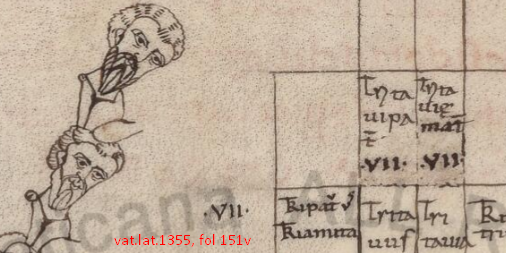
  24. Vat.lat.1355, Decretum Burchard, 11th century, notable for an arbor juris at 151v: do you think the top face in this totem looks vaguely like the young Karl Marx?
  25. Vat.lat.1363
  26. Vat.lat.1368
  27. Vat.lat.1369
  28. Vat.lat.1372
  29. Vat.lat.1376
  30. Vat.lat.1379
  31. Vat.lat.1393
  32. Vat.lat.1398
  33. Vat.lat.1407
  34. Vat.lat.1409
  35. Vat.lat.1421
  36. Vat.lat.1424
  37. Vat.lat.1425
  38. Vat.lat.1442
  39. Vat.lat.1461
  40. Vat.lat.1472
  41. Vat.lat.1475
  42. Vat.lat.1477
  43. Vat.lat.1488
  44. Vat.lat.1489
  45. Vat.lat.1493
  46. Vat.lat.1494
  47. Vat.lat.1497
  48. Vat.lat.1498
  49. Vat.lat.1500
  50. Vat.lat.1504
  51. Vat.lat.1507
  52. Vat.lat.1520
  53. Vat.lat.1524
  54. Vat.lat.1526
  55. Vat.lat.1533
  56. Vat.lat.1534
  57. Vat.lat.1536
  58. Vat.lat.1537
  59. Vat.lat.1539
  60. Vat.lat.1552
  61. Vat.lat.1556
  62. Vat.lat.1569, a copy of De rerum natura by Lucretius exhibited in Rome Reborn, where the catalog notes: This elegant manuscript of Lucretius's philosophical poem is an example of the interest in ancient accounts of nature taken by the Renaissance curia. The work, written in the first century B.C., contains one of the principal accounts of ancient atomism. This is one of numerous copies made at that time. The coat of arms of (Pope) Sixtus IV appears on it.
  63. Vat.lat.1571
  64. Vat.lat.1659
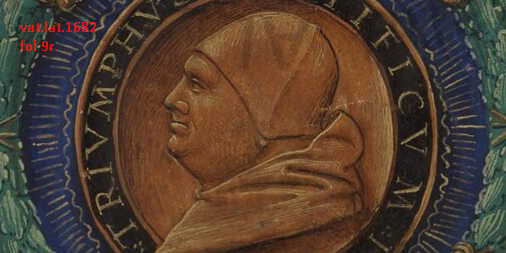
  65. Vat.lat.1682, Prognostichon Hierosolymitanum by Giovanni Michele Nagonio. The Rome Reborn catalog by Anthony Grafton notes: Nagonio, a papal functionary who wrote celebratory verses like these for many European monarchs, celebrates the triumphal entry of Julius II into Rome after his victory over the Bolognese.

    On the facing page one sees a self-satisfied pontiff, ringed by short celebratory texts. Nagonio's poems, which fill the rest of the book, reach a self-parodic level of flattery.
  66. Vat.lat.1686
This is Piggin's Unofficial List number 113. If you have corrections or additions, please use the comments box below. Follow me on Twitter (@JBPiggin) for news of more additions to DigiVatLib.

2017-04-10

Power Over Life or Death

In the bad old days, power did not come from the people, but from a warlord or king, who in turn ascribed his might to God. That is the subtext of this fine illumination from the legal commentary of the monk Gratian, digitized in the past week by the Vatican Library and placed online, where this fine illumination shows a microcephalous angel conferring power over life and death on a king while his courtiers flatter. Check the original to see his goons, just out of this screenshot, as they too look on:

Here is my list of 31 notable novelties:
  1. Barb.lat.2226
  2. Pal.lat.1772
  3. Pal.lat.1774
  4. Pal.lat.1818
  5. Pal.lat.1826
  6. Pal.lat.1829
  7. Pal.lat.1833
  8. Pal.lat.1840
  9. Pal.lat.1848
  10. Pal.lat.1856
  11. Pal.lat.1887
  12. Vat.lat.651, commentaries on the New Testament in a square-format codex. These have been bound together from 9th- and 10th-century books of varying scripts and layouts. Authors: Alcuin and Rabanus Maurus. Here's a fine three-column section:
  13. Vat.lat.1170, Manipulus florum, 14th century
  14. Vat.lat.1366, Gratian (above)
  15. Vat.lat.1370
  16. Vat.lat.1371
  17. Vat.lat.1374
  18. Vat.lat.1400, Giovanni d'Andrea, Glossaria
  19. Vat.lat.1403, another law textbook, with lawyers and even bishops showing respect to the judge:
  20. Vat.lat.1415
  21. Vat.lat.1422
  22. Vat.lat.1432
  23. Vat.lat.1433
  24. Vat.lat.1462
  25. Vat.lat.1502, 14th-century Latin grammatical compiliation, starting with Regulae grammaticales incerti auctoris, So here you go: who wants to identify the true author?
  26. Vat.lat.1508, Petrarch
  27. Vat.lat.1510
  28. Vat.lat.1518, grammarian Pomponius Porphyrio
  29. Vat.lat.1519
  30. Vat.lat.1525, Columella, Res Rusticae, with a fine Renaissance frontispiece with putti and this magpie:
  31. Vat.lat.1558 , a 16th-century manuscript of Isidore of Seville's Differentiae
If you have been following this blog, you will know that the Vatican Library began at the start of this year to digitize black and white microfilms first, then follow up with hi-res color digitizations later to replace them. It's a commendable move, but I have not found an easy way to track these transitions from monochrome to high resolution, which in many cases mark the codices real arrival online.

We know that the digitization work is proceeding sequentially, and is currently working through the shelfmark range Vat.lat. 1300-1500. So at the risk of possibly repeating notes on items I have already blogged about, I will list 13 outstanding codices from this range that I know to now be available in the better digital quality:
  1. Vat.lat.1322, Acts of the Council of Chalcedon, Latin, one of oldest books of the pope, dating from the 6th century.  TM 66106 = Lowe, CLA 1 8
  2. Vat.lat.1341, the 9th-century Collectio Hispana Gallica Augustodunensis which contains acts of Spanish and African councils. This is a unique resource, and the fact that ecclesiastical forgers (the Pseudo-Isidore gang) made the codex to build their credibility in no way reduces its enormous value as a historical record. Full list of the councils with the transcript at MGH
  3. Vat.lat.1342 another text of Chalcedon from the 8th century TM 66107 = Lowe, CLA 1 9 =
  4. Vat.lat.1345 text of the 1120 Council of Nablus where laws of the crusader Kingdom of Jerusalem were prepared
  5. Vat.lat.1346 see for the arbor juris diagram
  6. Vat.lat.1347 with the celebrated law collection Collectio canonum quadripartita 
  7. Vat.lat.1349 an 11th century Collectio Canonum et Conciliorum.  
  8. Vat.lat.1360 see for the arbor juris diagrams
  9. Vat.lat.1383 see for the arbor juris diagrams
  10. Vat.lat.1390 see for the arbor juris diagrams
  11. Vat.lat.1391 law textbook, mainly Bernardo Bottoni, but the remarkable thing in it is a blank separation page, folio III, ripped from a very early Dante with snatches of Purgatorio
  12. Vat.lat.1468 Glossarium, 11th century, see Lowe Beneventan Script, p. 15a.
  13. Vat.lat.1512 8th-century manuscript of Claudius Donatus's 4th-century Interpretationes Vergilianae from Luxeuil, France in an unusual round hand: TM 66108 = Lowe, CLA 1 10

This is Piggin's Unofficial List number 112. If you have corrections or additions, please use the comments box below. Follow me on Twitter (@JBPiggin) for news of more additions to DigiVatLib.

2017-04-02

Algorithmic Drawing

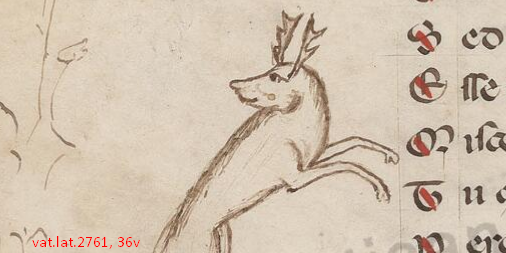
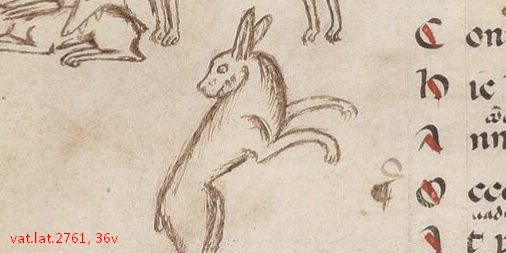
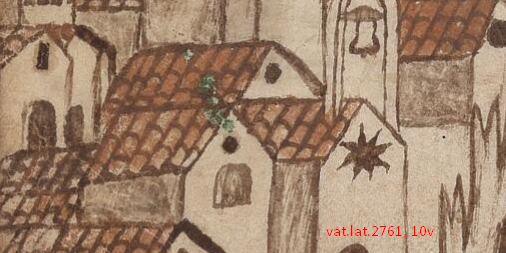
Great art is not all about channeling emotion. It's also technique and following algorithms. The artist employed for the drawings in a 14th-century Italian manuscript of Virgil's Aeneid - the codex has just been digitized by the Vatican Library - reveals all too clearly his methodical approach in two drawings on the same page:

At top of the margin on folio 36v is a deer and below is a hare, illustrating the account of the hunt of Dido and Aeneas (IV, 117). John Murdoch comments in his Album of Science volume on antiquity and the Middle Ages, 204 (Scribner, 1984):
All of the animals are drawn in standard, unpretentious profile poses. Those standing on their hind legs are quite similar in overall form. [These two] are not merely similar, but almost identical. All one needed to do to transform the deer at top into the hare below was to replace the antlers with ears. One is tempted to think that the artist employed instructions from a model book that explained how to draw any number of animals with minimal change.
The pictures are undoubtedly interesting, though, showing garments and architecture of the 14th century in great detail, for example a contemporary Italian town:

Here are the main novelties on the Vatican Library digital portal from the past week:
  1. Borg.ar.279
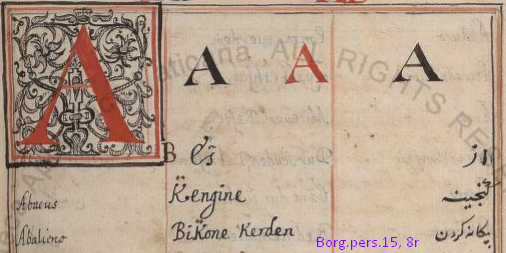
  2. Borg.pers.15, a singularity, being a Latin-Persian dictionary, which was compiled by Ignazio de Jesus, ODC, used a bastard script and never got past manuscript stage. Anthony Grafton comments on this Dictionarium latino persicum in the Rome Reborn catalog:
    The Italian missionary priest Ignazio de Jesus (died 1667) dedicated this Latin-Persian dictionary to Cardinal Antonio Barberini (1607-1681), Prefect of the Congregation for the Propagation of the Faith, the new division of the curia in charge of missionary efforts. Unlike the author's Persian grammar, this dictionary was not printed. Father Ignazio lists Latin words alphabetically in the first column, gives the Persian equivalent in a Roman script transliteration (representing sounds not in the Roman alphabet by the addition of diacritic marks derived from the Persian version of the Arabic alphabet), and finally gives the Persian written form.
    Here is abacus to start the letter A:
  3. Urb.lat.1779
  4. Vat.copt.98
  5. Vat.lat.905
  6. Vat.lat.1245
  7. Vat.lat.1246
  8. Vat.lat.1338
  9. Vat.lat.1381
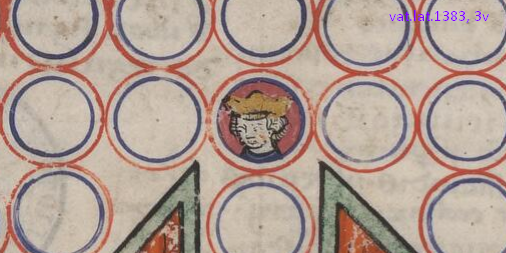
  10. Vat.lat.1383, Bernardo Bottoni's legal commentary with Juvenal interspersed. The arbor juris drawings are incomplete. The scribe never got round to writing in the kinship terms. But curiously the artist did draw the generic ego or Everyman who is the starting point of all the degrees of relationship:
  11. Vat.lat.1392
  12. Vat.lat.1399
  13. Vat.lat.1401
  14. Vat.lat.1404
  15. Vat.lat.1406
  16. Vat.lat.1446
  17. Vat.lat.1470
  18. Vat.lat.1485
  19. Vat.lat.1496
  20. Vat.lat.1523
  21. Vat.lat.1527
  22. Vat.lat.2761, see above regarding fol 36v
This is Piggin's Unofficial List number 111. If you have corrections or additions, please use the comments box below. Follow me on Twitter (@JBPiggin) for news of more additions to DigiVatLib.

2017-03-27

Ottonian Artistry

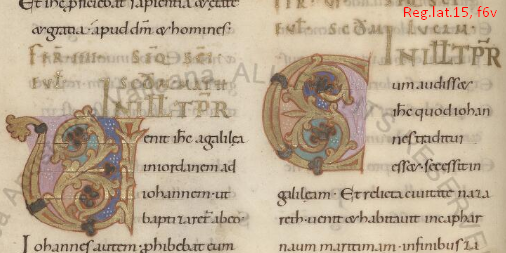
Most of the great artists of 10th-century Europe are anonymous. One of them, who goes by the name Master of the Registrum Gregorii, was a leading illuminator in Trier in Germany at some point between 977 and 993 and created the splendid Ottonian evangeliary Reg.lat.15. It was digitized by the Vatican in the past week. The book has huge and very ornate initials:

It has been copiously studied by art historians. The Trier workshop must have been superb, as a second great illuminator, perhaps a student of the Master, seems to have been put to work on folio 1r and 2v, which contain purpureus pages with gold writing based on late antique models. The latter illuminator, believed to have worked in Mainz, also created the famous Prayerbook of Otto III, now in Munich.

Here is a selection of the new codices online:
  1. Borg.et.8
  2. Reg.lat.8, psalms, Versio Gallicana (with touches of the Vetus Latina), annotated with the help of a Greek text. Incipit, beatus vir qui non abiit in consilio impiorum. This is a 12th-century manuscript from Germany or Bohemia and has the Beuron number 438 (my list). No illuminations, but rubrics throughout.
  3. Reg.lat.15, evangeliary from Trier, Germany (above)
  4. Reg.lat.137
  5. Reg.lat.144
  6. Reg.lat.157
  7. Reg.lat.181
  8. Reg.lat.192
  9. Reg.lat.217
  10. Reg.lat.221, ff. 18-33 contains the natural-history book by Hugo de Folieto (13th century), incipit "Si dormitatis inter medios cleros", according to the eTK. Also: "Desiderii tui karissime petitionibus ..." (13c) (use the eTK via the link at the Medieval Academy of America).
  11. Reg.lat.225
  12. Reg.lat.239
  13. Reg.lat.244
  14. Reg.lat.289
  15. Reg.lat.314
  16. Reg.lat.363
  17. Reg.lat.371
  18. Reg.lat.376
  19. Reg.lat.386
  20. Reg.lat.395
  21. Reg.lat.446
  22. Urb.lat.1779 
  23. Vat.copt.98
  24. Vat.lat.707 , Bartholomaeus Anglicus, De proprietatibus rerum HT to @LatinAristotle who notes: ms names fellow Dominican "Albertus [Magnus] Teutonicus":
  25. Vat.lat.1337
  26. Vat.lat.1375
  27. Vat.lat.1386
  28. Vat.lat.1419
  29. Vat.lat.1471
  30. Vat.lat.1487
  31. Vat.lat.1506
  32. Vat.lat.5748

This is Piggin's Unofficial List number 110. If you have corrections or additions, please use the comments box below. Follow me on Twitter (@JBPiggin) for news of more additions to DigiVatLib.

2017-03-18

Pretty Portolan

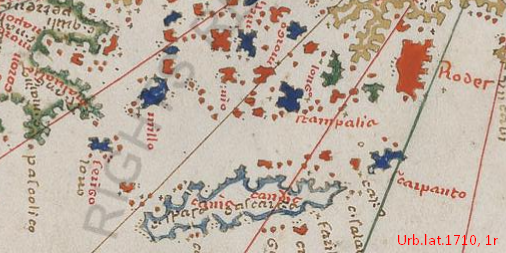
Among at least 25 new manuscripts online in the past week at the Vatican Library is a 16th-century portolan chart attributed to the Mallorcan mapmaker Joan Martines. This may not be the oldest of such charts, but in its bright colors it is a thing of beauty and it was evidently never used for actual seafaring but kept as a work of art.

Below is the Aegean Sea with Rhodes at right and Crete below. The coloration makes you want to fly there this minute:
  1. Reg.lat.83 , Gerson
  2. Reg.lat.169 , 5th Lateran Council
  3. Reg.lat.320
  4. Reg.lat.353
  5. Reg.lat.382
  6. Urb.lat.426 , Livy: Ab urbe condita, a 15th-century manuscript (upload is not working yet)
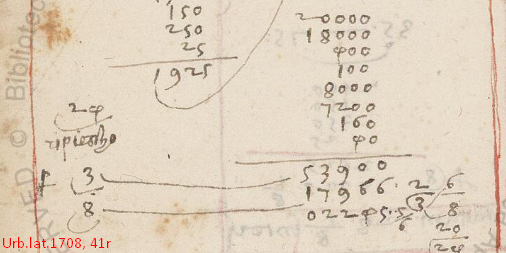
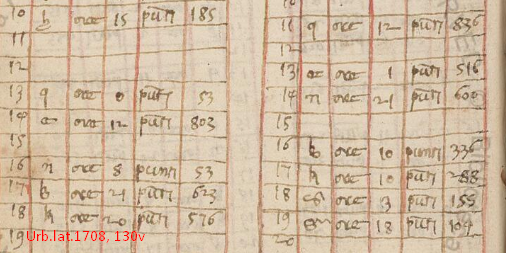
  7. Urb.lat.1708 , an arithmetic handbook (the fly-leaves are palimpsests)

  8. Urb.lat.1710 , portolan (above)
  9. Vat.gr.586 , 12th century manuscript of John Chrysostom
  10. Vat.gr.920.pt.2 , book of Greek plays, Sophocles, etc., 14th century, from fol 175r onwards
  11. Vat.gr.1007 , Plutarch, a fairly important manuscript source
  12. Vat.gr.1296.pt.1 , manuscript S of the Suda, the famed Byzantine encyclopedia, copied 1205
  13. Vat.gr.1296.pt.2
  14. Vat.gr.1296.pt.3
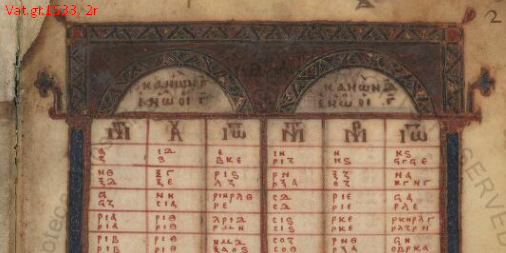
  15. Vat.gr.1533 , Four Gospels, with fine canon tables:
  16. Vat.lat.1138 , William Durand
  17. Vat.lat.1143 , ditto
  18. Vat.lat.1267 , an 11th-century grab-bag of Chrysostom, Augustine, Isidore and other authors: presumably a scholar's own anthology
  19. Vat.lat.1277 , Chrysostom and Augustine
  20. Vat.lat.1327 , texts from synods, Byzantine period, in Latin translation
  21. Vat.lat.1333 , 15th century compilation of councils
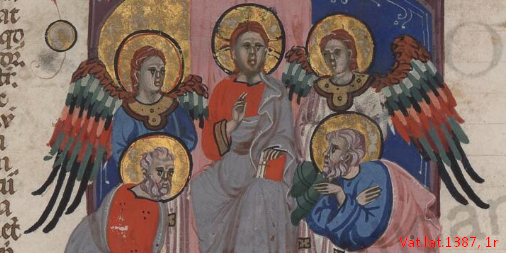
  22. Vat.lat.1387 , 14th-century Bottoni, Glossa (compare below)
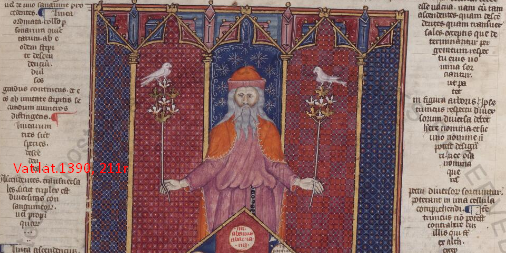
  23. Vat.lat.1390, Bernardo Bottoni's Glossa ordinaria in Decretalium Gregorii libros I-V cum glossulis (1266). A very beautiful 14th-century copy with elaborate mise-en-page. The arbor juris below (discussed by Hermann Schadt in his Darstellungen) is just one of the fine illuminations.
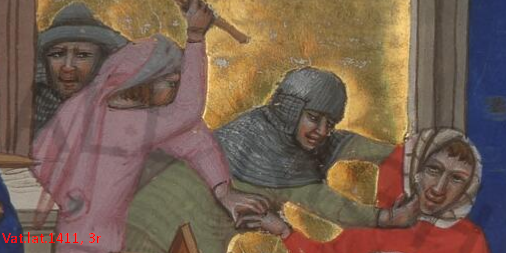
  24. Vat.lat.1411 , 14th-century manuscript of Digests of Justinian with some fantastic action filled illuminations like this:
  25. Vat.lat.11559 , Lucan, De bello civili Pharsalia
This is Piggin's Unofficial List number 109. If you have corrections or additions, please use the comments box below. Follow me on Twitter (@JBPiggin) for news of more additions to DigiVatLib.