Showing posts with label Palatina. Show all posts

2016-08-31

Men Who Wear Glasses

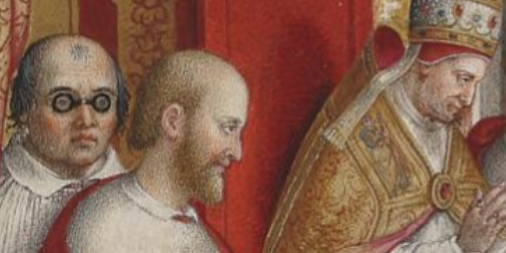
The Life of Francesco I del Rovere is a biography with a series of extraordinary illuminations depicting 16th-century court life in Italy.

Francesco Maria di Montefeltro was the fourth duke of Urbino and his life ended up being celebrated in word by Giovanni Battista Leoni and in images by Valerio Mariani da Pesaro. The manuscript, Urb.lat.1764, part of the Urbino Collection, was brought online on August 31 by the Vatican Library.

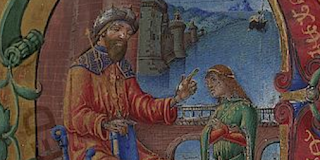
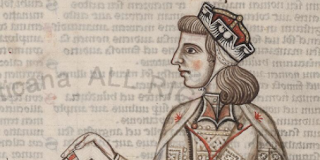
You can enjoy each of the images for a long time, and ask your own questions. Here's somebody standing behind the pope who is wearing natty black-rimmed spectacles. Explain that.
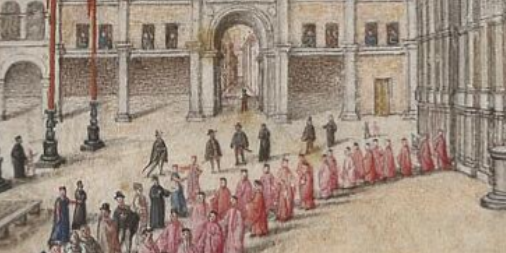
In 1524, Francesco paid a state visit to Venice and was met by the then Doge, Andrea Gritti, in the Piazzetta San Marco. Naturally there was a big procession for him:
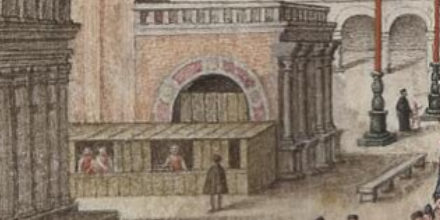
But what caught my eye was the commerce at the fringe. Even in those days, there were jerrybuilt wooden shops on the main square of Venice selling heaven knows what to the tourists:
Enjoy browsing the manuscript. It is one of 39 just brought online for a new posted total of 5,353.  Here is my unofficial list:
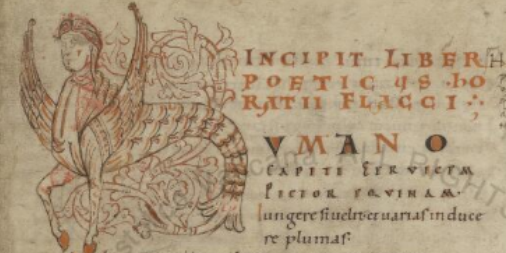
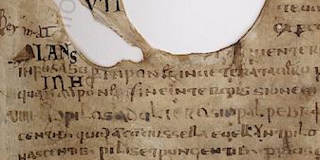
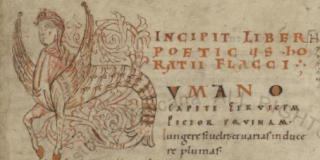
  1. Reg.lat.1701, a fine miscellany from the 11th century. Among the contents is a glossary of Old High German with definitions in Latin. Below is the incipit of the Ars Poetica of Horace:
  2. Urb.lat.1764, discussed above
  3. Vat.ebr.4
  4. Vat.ebr.40
  5. Vat.ebr.41
  6. Vat.ebr.42
  7. Vat.ebr.344
  8. Vat.ebr.356
  9. Vat.ebr.390
  10. Vat.ebr.391
  11. Vat.ebr.392
  12. Vat.ebr.393
  13. Vat.ebr.394
  14. Vat.ebr.395
  15. Vat.ebr.397
  16. Vat.ebr.398
  17. Vat.ebr.404
  18. Vat.ebr.409
  19. Vat.ebr.410
  20. Vat.ebr.412.pt.3
  21. Vat.ebr.413
  22. Vat.ebr.420
  23. Vat.ebr.423
  24. Vat.lat.181
  25. Vat.lat.329
  26. Vat.lat.360
  27. Vat.lat.368
  28. Vat.lat.783
  29. Vat.lat.873
  30. Vat.lat.878
  31. Vat.lat.888
  32. Vat.lat.898
  33. Vat.lat.935
  34. Vat.lat.953
  35. Vat.lat.959
  36. Vat.lat.969
  37. Vat.lat.987
  38. Vat.lat.8552, Josephus, The Antiquities of the Jews, in Latin: check out the Latin Josephus Project for more information. This manuscript is discussed in a 1960 codicology book by Jacques Stiennon on millennial manuscripts from the Lieges area, reviewed in Scriptorium.
  39. Vat.turc.152
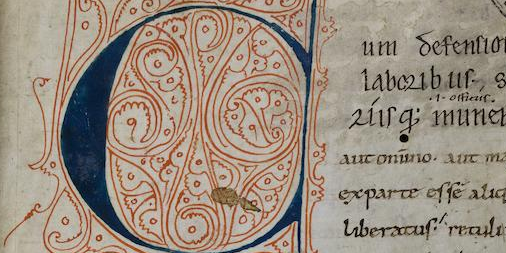
The Bibliotheca Palatina project is separately pouring on the power, and has brought the following 67 Pal.lat. manuscripts held by the Vatican online in recent weeks. The list includes a 9th- or 10th-century water-damaged Cassiodorus and a 10th-century Cicero with this fine initial C:
  1. Pal. lat. 761 Codicis Iustiniani imp. libri IX (1255)
  2. Pal. lat. 791 Iacobus de Alvarottus: Iacobi de Alvarottis patavini de feudis (15. Jh.)
  3. Pal. lat. 794 Sammelhandschrift (15. Jh.)
  4. Pal. lat. 800 (Iacobi) Gentilis (Brixiensis) repertorium iuris (Pars I) (15. Jh.)
  5. Pal. lat. 801 (Iacobi) Gentilis (Brixiensis) repertorium iuris (Pars II) (15. Jh.)
  6. Pal. lat. 802 Repertorium iuris (15. Jh.)
  7. Pal. lat. 803 Repertorium iuris canonici (15. Jh.)
  8. Pal. lat. 804 Tabula doctorum, i. e. repertorium universale iuridicum, theologicum, morale [Pars I] (15. Jh.)
  9. Pal. lat. 805 Tabula doctorum, i. e. repertorium universale iuridicum, theologicum, morale [Pars II] (15. Jh.)
  10. Pal. lat. 806 Repertorium universale iuridicum, theologicum, morale [Pars I] (15. Jh.)
  11. Pal. lat. 807 Repertorium iuris ; Conclusiones sexti libri decretalium (15. Jh.)
  12. Pal. lat. 808 Repertorium universale iuridicum, theologicum, morale [Pars III] (15. Jh.)
  13. Pal. lat. 809 Repertorium universale iuridicum, theologicum, morale [Pars VI] (15. Jh.)
  14. Pal. lat. 810 Repertorium universale iuridicum, theologicum, morale [Pars II] (15. Jh.)
  15. Pal. lat. 812 Repertorium universale iuridicum, theologicum, morale [Pars V] (15. Jh.)
  16. Pal. lat. 820 Mathey Palmery (sic) florentini de temporibus ad Petrum Cosmae filium medicem ; Eusebii (et) Hieronomi (sic) presbyteri chronica, a Prospero continuata (15. Jh.)
  17. Pal. lat. 821 Eusebii et Hieronymi chronicon, a Prospero continuatum (15. Jh.)
  18. Pal. lat. 823 Cassiodorii historia ecclesiastica tripartita (9.-10. Jh.)
  19. Pal. lat. 826 Anastasii Bibliothecarii historia ecclesiastica tripartita (11. Jh.)
  20. Pal. lat. 827 Pauli Horosii presbiteri ad Augustinum episcopum hystoriarum contra accusatores temporum christianorum, libri VII (13.-14. Jh.)
  21. Pal. lat. 828 Sammelhandschrift (11.,14., 15. Jh.)
  22. Pal. lat. 830 Mariani Scott chronicon (11. Jh.)
  23. Pal. lat. 832 Sammelhandschrift (14. Jh.)
  24. Pal. lat. 837 Ludolphi Carthusiani de uita Christi in euangelio tradita pars secunda et ultima (15. Jh.)
  25. Pal. lat. 838 (Ludolphi Carthusiani) de vita Ihesu in ewangelio (sic) tradita, pars prima (15. Jh.)
  26. Pal. lat. 844 Vitae patrum (15. Jh.)
  27. Pal. lat. 849 Jacobus : Legenda sanctorum (14. Jh.)
  28. Pal. lat. 918 Plutarchi vitae in latinum translatae (15. Jh.)
  29. Pal. lat. 928 Gesta Romanorum ; Historia septem sapientum (Süddeutschland, 14. Jh.)
  30. Pal. lat. 970 Giovanni ; Boccaccio, Giovanni: Sammelband (Italien, 1379 ; 15. Jh.)
  31. Pal. lat. 971 Honorius ; Johannes ; Petrus : Sammelhandschrift (Frankenthal, 1508)
  32. Pal. lat. 1093 Galenus: Sammelhandschrift (Italien, 14. Jh.)
  33. Pal. lat. 1095 Galenus: Sammelhandschrift (Italien (Südfrankreich), 14. Jh.)
  34. Pal. lat. 1099 Galenus; Avicenna; Albertus : Medizinische Sammelhandschrift ((Heidelberg), 2. Hälfte 15. Jh. (1475/77))
  35. Pal. lat. 1120 Avicenna; Knab, Erhardus: Fen quarta libri Canonis primi (Heidelberg, 1467)
  36. Pal. lat. 1183 Knab, Erhardus: Sammelhandschrift (Heidelberg, 1465/66)
  37. Pal. lat. 1232 Avicenna; Knab, Erhardus: Medizinischer Sammelband (Heidelberg, um 1470)
  38. Pal. lat. 1242 Ps.-Albertus Magnus; Odo ; Johannes : Medizinischer Sammelband (Südwestdeutschland , Freiburg (III), 14. Jh. (I) ; 1. Drittel 15. Jh. (II) ; 1419 (III) ; 1. Hälfte 15. Jh. (IV))
  39. Pal. lat. 1246 Avicenna; Thaddaeus; Gentilis : Medizinische Sammelhandschrift ((Heidelberg, 122ff.), letztes Drittel 15. Jh. (nach 1468))
  40. Pal. lat. 1263 Regimen sanitatis für Friedrich IV. von der Pfalz (Hedelberg, 1593)
  41. Pal. lat. 1274 Matthaeus : Circa instans seu de simplcibus medicinis (Westdeutschland, 13./14. Jh.)
  42. Pal. lat. 1310 Lanfrancus ; Ps.-Galenus: Sammelhandschrift (Montpellier, 14. Jh. (1325))
  43. Pal. lat. 1327 Laurentius Rusius; Iordanus ; Knab, Erhardus; Bartholomaeus de Montagnana; Zacharias de Feltris: Medizinische Sammelhandschrift (Heidelberg, 15. Jh. (1476-479))
  44. Pal. lat. 1334 Franciscus : Defensorium inviolatae virginitatis beatae Mariae (Blockbuch) (Regensburg, 1471)
  45. Pal. lat. 1360 Strabo: Strabonis Geographica (Deutschland, 2. Drittel 15. Jh.)
  46. Pal. lat. 1445 Leopoldus ; Yaḥya ibn Abi Manṣūr /al-Ma'mūnī; Hermes; Zael; Guido ; Albertus ; Johannes : Astrologische Sammelhandschrift: Miscellanea (Süddeutschland, Ende 15. Jh.)
  47. Pal. lat. 1480 Cicero, Marcus Tullius: Orationes (Italien, 15. Jh.)
  48. Pal. lat. 1484 Cicero, Marcus Tullius: Orationes (Italien, 15. Jh.)
  49. Pal. lat. 1497 Cicero, Marcus Tullius: Epistulae ad familiares (I-XVI) (Italien, 15. Jh.)
  50. Pal. lat. 1500 Cicero, Marcus Tullius: Epistulae ad familiares (I-XVI) (Italien, 14.-15. Jh.)
  51. Pal. lat. 1504 Cicero, Marcus Tullius: Epistulae ad familiares (I-XVI) (Italien, 14.-15. Jh.)
  52. Pal. lat. 1505 Cicero, Marcus Tullius: Epistulae ad familiares (I-VII, IX-XVI) (Italien, 15. Jh.)
  53. Pal. lat. 1506 Cicero, Marcus Tullius: Epistulae ad familiares (I-VII, IX-XVI) (Italien, 15. Jh.)
  54. Pal. lat. 1507 Cicero, Marcus Tullius: Epistulae ad familiares (I-XVI) (Italien, 15. Jh.)
  55. Pal. lat. 1514 Cicero, Marcus Tullius: Tusculanae disputationes (Italien, 10. Jh.)
  56. Pal. lat. 1566 Palladius, Rutilius Taurus Aemilianus: Opus agriculturae (Italien, 14. Jh.)
  57. Pal. lat. 1587 Sidonius, Gaius Sollius Apollinaris; Serenus, Quintus; Ps.-Crispus Mediolanensis Diaconus: Sammelhandschrift (Italien, 15. Jh.)
  58. Pal. lat. 1609 Erasmus, Desiderius: Enchiridion militis Christiani (Frankreich (?), nach 1574)
  59. Pal. lat. 1610 Oratio de natura leonis (Pfalz, um 1590-1594)
  60. Pal. lat. 1611 Guido : Sammelhandschrift (Italien, 13. Jh. ; 14. Jh.)
  61. Pal. lat. 1675 Francesco Ceccharelli: Commentum in Senecae tragoedias (Italien, um 1440)
  62. Pal. lat. 1730 Petrarca, Francesco: Sammelhandschrift (Italien (?), um 1440, 1442)
  63. Pal. lat. 1733 Gruterus, Janus: Anthologia (Heidelberg, 1602)
  64. Pal. lat. 1734 Carmina et orationes festivae (Cambridge, 1613)
  65. Pal. lat. 1744 Veit Örtel: Annotationes (Wittenberg, 1554-1557)
  66. Pal. lat. 1758 Gian Francesco Poggio Braccolini; Valla, Lorenzo (Deutschland, um 1465-1470)
  67. Pal. lat. 1823 Luther, Martin: Excerpta (Weimar (?), Mitte 16. Jh.)

This is Piggin's Unofficial List number 67. If you have corrections or additions, please use the comments box below. Follow me on Twitter (@JBPiggin) for news of more additions to Digita Vaticana.

2016-07-30

Off to the Seaside

I am guessing that the Vatican Library's digitizers are leaving Rome for summer at the seaside, and that a rush of 38 new items on the BAV digitizations portal will be the last for a few weeks. The current posted total is 5,169 codices, rolls and folders.

Of the 38 new items, 11 (Borg.Carte.naut and Pap.Bodmer) have long been available in digital form and their collections are simply being linked to for the first time. The remaining 27 items are:
  1. Chig.M.IV.l - Details
  2. Chig.M.VIII.LXVII - collection of documents starting with a project for a new sacristy at St Peter's - Details
  3. Perg.Veroli.XX - from a collection of ancient deeds and charters from St Erasmo di Veroli in Italy, like the five following items - Details
  4. Perg.Veroli.XXI - Details
  5. Perg.Veroli.XXII - Details
  6. Perg.Veroli.XXIII - Details
  7. Perg.Veroli.XXIV - Details
  8. Perg.Veroli.XXXIII - Details
  9. Vat.ebr.301 - Details
  10. Vat.ebr.305 - Details
  11. Vat.ebr.308 - Details
  12. Vat.ebr.309 - Details
  13. Vat.ebr.310 - Details
  14. Vat.ebr.311 - Details
  15. Vat.ebr.312 - Details
  16. Vat.ebr.313 - Details
  17. Vat.ebr.314 - Details
  18. Vat.ebr.315 - Details
  19. Vat.ebr.316 - Details
  20. Vat.ebr.317 - Details
  21. Vat.ebr.318 - Details
  22. Vat.ebr.319 - Details
  23. Vat.ebr.322 - Details
  24. Vat.ebr.323 - Details
  25. Vat.ebr.326 - Details
  26. Vat.turc.141 - Details
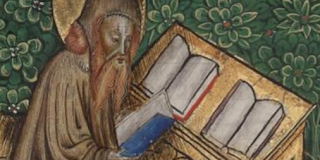
  27. Vat.lat.332 - Jerome, Commentary on Minor Prophets, with Jerome getting round-shouldered from too much reading
    (and note the tricolor bookset on his bookshelf: product placement for France?) Details
The Biblioteca Palatina's scans of the Vatican legal collection in Pal.lat. has also been expanding in the past five weeks, with the following 29 items new online:
  1. Pal. lat. 799 Iohannis Petrus de Ferarius : Dni. Iohannis Petri de Ferariis (sic) practica (15. Jh.)
  2. Pal. lat. 797 Nicolai de Messiato: Sammelhandschrift (15. Jh.)
  3. Pal. lat. 796 Bartholomaei Brixiensis: Sammelhandschrift (13. Jh.)
  4. Pal. lat. 795 Henningi a Rod. processus iudiciarius (16. Jh.)
  5. Pal. lat. 793 Durantis, Guilelmus: Guillielmi Duranti speculum iudiciale (15. Jh.)
  6. Pal. lat. 790 Baron, Éguinaire: Dictata in nonnullos librorum Pandectarum titulos a Dn. Eguinario Barone Iurecons. clariss. apud Bituriges ordinario, excepta anno salutis 1546 (16. Jh.)
  7. Pal. lat. 789 Lectura in Digestum (15.-16. Jh.)
  8. Pal. lat. 788 Franciscus de Zaberellis; Ludovicus Pontani; Petrus ; Laurentii de Rudolphis: Sammelhandschrift (15. Jh.)
  9. Pal. lat. 787 Azonis summa Codicis Iustiniani imp. (13.-14. Jh.)
  10. Pal. lat. 785 Munsteri Nurembergensis in Institutionum (Iustiniani imp.) libros adnotata (1529)
  11. Pal. lat. 784 Lectura in ius canonicum de Iudiciis Continua(ndis) ad totum librum precedentem secundum Goff(ridum) CX (1447)
  12. Pal. lat. 783 Formularium contractuum et instrumentorum (15. Jh.)
  13. Pal. lat. 780 Tractatus plenissimus iuris, libri quatuor (14. Jh.)
  14. Pal. lat. 779 Remissorium aureum iuris (15. Jh.)
  15. Pal. lat. 777 Decisiones de conciliis Rote (15. Jh.)
  16. Pal. lat. 776 Collectio inscripta (16. Jh.)
  17. Pal. lat. 775 Collectio formularum Cancellariae Imperialis (16. Jh.)
  18. Pal. lat. 772 Legis longobardorum libri tres (12. Jh.)
  19. Pal. lat. 759 Codicis Iustiniani imp. libri IX (14. Jh.)
  20. Pal. lat. 757 Codicis Iustiniani imp. libri IX (14. Jh.)
  21. Pal. lat. 754 Digestum novum (13. Jh.)
  22. Pal. lat. 753 Digestum novum (13. Jh.)
  23. Pal. lat. 752 Digestum novum (13.-14. Jh.)
  24. Pal. lat. 751 Digestum novum (13.-14. Jh.)
  25. Pal. lat. 750 Digestum novum (13.-14. Jh.)
  26. Pal. lat. 749 Digestum novum (14. Jh.)
  27. Pal. lat. 746 Infortiatum (13. Jh.)
  28. Pal. lat. 745 Infortiatum (14. Jh.)
  29. Pal. lat. 744 Infortiatum (Südfrankreich?, 14. Jh.)
This is Piggin's Unofficial List number 63. If you have corrections or additions, please use the comments box below. Follow me on Twitter (@JBPiggin) for news of more additions to Digita Vaticana.
2016-06-17

A for Andrew

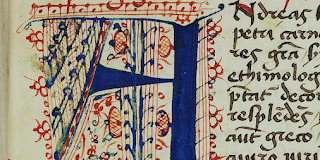
The latest round of Heidelberg digitizations of the Palatine manuscripts at the Vatican includes this fine A for Andrew initial on folio 1r. of Pal.lat.850, a 15th-century book of saints arranged by feast day:

You can see it on the Bibliotheca Palatina website, along with 15 other recent digitizations, the majority of them lawbooks.
  1. Pal. lat. 721,1 (Guilelmi de sancto Amore) collatio catholice et canonice scripture: Band 1 (1514)
  2. Pal. lat. 721,2 (Guilelmi de sancto Amore) collatio catholice et canonice scripture: Band 2 (1514)
  3. Pal. lat. 728 Tractatus inscriptus manu saec. XV: de regimine principum (14. Jh.)
  4. Pal. lat. 741 Digestum vetus (13.-14. Jh.)
  5. Pal. lat. 743 Infortiatum (14. Jh.)
  6. Pal. lat. 760 Codicis Iustiniani imp. libri IX (14. Jh.)
  7. Pal. lat. 763 Codicis Iustiniani imp. libri IX (14. Jh.)
  8. Pal. lat. 764 Codicis Iustiniani imp. libri IX (13. Jh.)
  9. Pal. lat. 765 Codicis Iustiniani imp. (14. Jh.)
  10. Pal. lat. 768 Institutiones Iustiniani imp. (14. Jh.)
  11. Pal. lat. 769 Institutiones Iustiniani imp. (13. Jh.)
  12. Pal. lat. 770 Institutiones Iustiniani imp. (15. Jh.)
  13. Pal. lat. 774 Liber statutorum et legum Venetorum illustris Iacobi Teupuli incliti ducis Venec (14. Jh.)
  14. Pal. lat. 781 Summa de edendo que dicitur Oli (12.-13. Jh.)
  15. Pal. lat. 782 Summa decretalium (13.-14. Jh.)
  16. Pal. lat. 850 Sammelband (15. und 16. Jh.)
This is Piggin's Unofficial List number 54. If you have corrections or additions, please use the comments box below. Follow me on Twitter (@JBPiggin) for news of more additions to Digita Vaticana.
2016-05-18

Upgrade at the Vatican

As the Vatican's online library, Digita Vaticana, undergoes a major server migration and interface upgrade this week, you'll have to be patient about viewing the 34 new treasures that arrived online May 16. The interface is a major step forward, with easier paging through the books, quicker zooming buttons, and adoption of the IIIF standards used by other major archival digitization portals.

There's also a new logo, DigiVatLib. It's not clear yet if this replaces the Digita Vaticana branding. There's a promise of enhanced search functions for the next release and there will be a section to highlight the latest 20 manuscripts uploaded, but that does not seem to have been implemented yet.

Some manuscripts remain accessible, but for others you encounter a "sorry" screen that says: "The migration process of digitized manuscripts in the new platform is still ongoing and it will be completed in the next two weeks." I feel like a motorist at roadworks, knowing full well that I will appreciate the improvements later, but impatient to get through now.

Today is also a special occasion for this blog: this is the 50th edition of Piggin's Unofficial Lists of the digitizations in Rome. It was a great surprise to me when Dr Otto Vervaart marked this by writing a very comprehensive review on his own blog, Rechtsgeschiedenis, describing what this blog attempts to achieve. I say to him: Thank you very much: that encourages me to keep going forward.

The highlight of this week's new arrivals is Vat.lat.623, a fascinating 13th- or 14th-century revision of the Etymologies of Isidore of Seville (-636). The great Spanish scholar Carmen Codoñer observes that because of its encyclopaedic character, the Etymologies were continually open to supplement in later centuries, and this is one of the best examples of how it evolved.

We see in this codex  all sorts of clever medieval diagrams to better elucidate what ancient Isidore had been talking about.

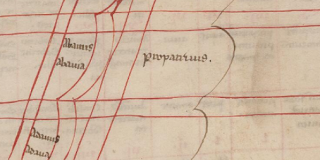
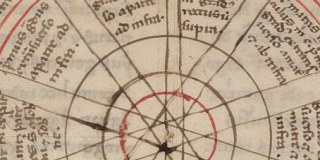
On fol. 80r is an astonishing schematic of an arbor consanguinatis - a legal diagram explaining degrees of blood relationship - which revises it to just a few abstract sketch lines. There's a matching one in Vienna, ÖNB 683, but unfortunately not yet digitized.

Hermann Schadt believed this unique diagram (he called it a "lambda schema") must have been influenced by music theory, since a similar diagram is found in contemporary books about harmony and the Anima Mundi of Plato. The medieval academy was very interdisciplinary.

The preceding page has another reinterpretation of the arbor that you will not find in my manual of classical arbores, because it was a newfangled invention: it shows the family circle.

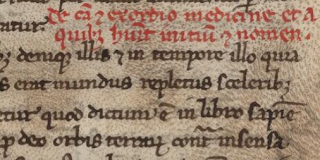
A Carmen Codoñer article that is online in French is devoted to another part of this codex where the editors added new medical material after Isidore's Book X, from fol. 39rb (de causa et exordio…) to 42ra (… et sanus efficitur). She establishes that this contains parts of Asaf’s Book of Medicines, a Hebrew encyclopedia of Greek and Jewish medicine, which is an interesting indication of how the medieval academy welcomed Jewish learning.

This week's 34 uploads take the posted total to 4,396, which is a larger number than the 2,614 posted on the new, upgraded front page (formerly the fund-raising site). It's not yet clear if these two sites are now being integrated: they have remained apart until now. With the interrupted access, it will take me more time to add images and descriptions to the list below, so come back in a week for more details.
  1. Vat.ebr.11,
  2. Vat.ebr.14,
  3. Vat.ebr.107,
  4. Vat.ebr.124,
  5. Vat.ebr.128,
  6. Vat.ebr.129,
  7. Vat.ebr.131,
  8. Vat.ebr.132,
  9. Vat.ebr.136,
  10. Vat.ebr.137,
  11. Vat.ebr.146,
  12. Vat.ebr.150,
  13. Vat.ebr.304,
  14. Vat.lat.36, Manfred Bible, sometimes thought to be 13th century, no later than 14th, see the article on these by Helene Toubert. Here is King Manfred of Sicily (fol. 522v) receiving his book:
  15. Vat.lat.171,
  16. Vat.lat.380,
  17. Vat.lat.453,
  18. Vat.lat.516,
  19. Vat.lat.546,
  20. Vat.lat.552,
  21. Vat.lat.558,
  22. Vat.lat.566, Boethius. I was hoping to find an arbor porphyriana in here, but see none, though there is an interesting branching drawing on fol 72v
  23. Vat.lat.571,
  24. Vat.lat.572,
  25. Vat.lat.588,
  26. Vat.lat.596,
  27. Vat.lat.606,
  28. Vat.lat.617,
  29. Vat.lat.623, magnificent 13th or 14th century Etymologies of Isidore (see above)
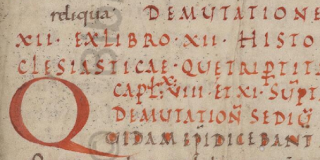
  30. Vat.lat.630.pt.2, Isidorus Mercator Decretalium collectio, a 10th-century legal manuscript with some final rubrics like this at folio 321r:
  31. Vat.lat.631.pt.2,
  32. Vat.lat.639,
  33. Vat.lat.664,
  34. Vat.lat.712,
There are also nine novelties, mainly legal manuscripts, at Bibliotheca Palatina, the German portal which separately digitizes the Pal.lat. series in Rome. These were once used by the law scholars at the ducal-cum-university library in Heidelberg:
  1. Pal. lat. 719 Sammelhandschrift (15. Jh.)
  2. Pal. lat. 747 Digestum novum (14. Jh.)
  3. Pal. lat. 738 Digestum vetus (14. Jh.)
  4. Pal. lat. 748 Digestum novum (13.-14. Jh.)
  5. Pal. lat. 740 Digestum vetus (13.-14. Jh.)
  6. Pal. lat. 737 Digestum vetus (13. Jh.)
  7. Pal. lat. 755 Digestum novum (13. Jh.)
  8. Pal. lat. 756 Digestum novum (14. Jh.)
  9. Pal. lat. 1830 Psalmos (Wittenberg, um 1547-1548)
If you have corrections or additions, please use the comments box below. Follow me on Twitter (@JBPiggin) for news of more additions to Digita Vaticana.
2016-04-22

Monument in China

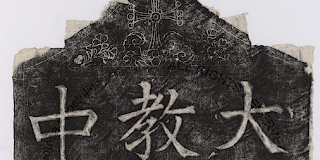
An engraved stone monument erected in 781 in a Nestorian Christian graveyard in Xi`an, China commemorated the arrival of Christianity 150 years before that in China. You can see this extraordinary historical treasure today inside the Forest of Steles at Bēilín Museum.

An ink rubbing was made from the stele in the 1630s and sent to Rome, and the discovery caused a sensation in Europe, where Chinese adoption of Christianity in 631 had been entirely unknown, as Anthony Grafton's Rome Reborn page (with a false callmark) notes.

The rubbing, now part of the bundle Barb.or.151, is one of the oriental treasures that has just been digitized by the Biblioteca Apostolica Vaticana, posted online on April 21.
The monument is about 2.5 metres tall and capped by a carved cross. The heading, as translated in the Wikipedia entry reads, "A Monument Commemorating the Propagation of the Ta-Chin Luminous Religion in the Middle Kingdom". Ta-Chin is an old Chinese term for the Roman Empire.

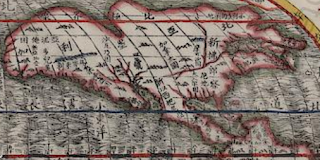
Another item in this package of digitizations is an abridgement printed in the 1620s of the famed map of the world that Matteo Ricci, the first Jesuit missionary to become adept in Chinese, had produced in 1574. The hand-tinted print was made at the orders of Giulio Aleni, whose name is marked on it, as Grafton notes. Here is North America:
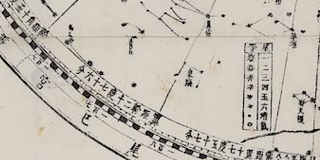
Also in the bundle is the printed astronomy, Chien-chien tsung-hsing-t'u by Adam Schall von Bell, of which Grafton notes: von Bell introduced the new astronomy of Galileo, including the telescope, to China. This single-sheet printed map with explanatory text shows the stars visible in the sky of northern China.
  1. Barb.or.151.pt.1, bundle of Chinese materials (above)
  2. Borg.cin.497,
  3. Borg.cin.537,
  4. Borg.cin.538,
  5. Borg.gr.27,
  6. Ott.lat.1252,
  7. Ott.lat.2358,
  8. Reg.lat.165,
  9. Reg.lat.179,
  10. Reg.lat.1935,
  11. Reg.lat.1995, the autobiography of Pope Pius II, the former Enea Silvio Piccolomini. This book, the Commentarii, is a remarkably frank autobiography and the only book he wrote after his election, in which he put his passions and prejudices on full view, Anthony Grafton notes in the Rome Reborn catalog. Enea Silvio was the first humanist to be elected to the papacy.
  12. Reg.lat.2039,
  13. Ross.184,
  14. Ross.254,
  15. Ross.276,
  16. Ross.616,
  17. Ross.701,
  18. Ross.977,
  19. Ross.1165,
  20. Urb.lat.252,
  21. Urb.lat.293, a nicely written 11th or 12th century manuscript of Vitruvius on Architecture notable for its two flyleaves, now folios 96 and 97, which date from the first half of the 8th century and contain important material from the late antique Greek medical writer Oribasius: This contains words glossed in Old German, indicating it has a German provenance: Lowe number CLA 1 116, see Trismegistos
  22. Urb.lat.367,
  23. Urb.lat.378,
  24. Urb.lat.548, a very fine Renaissance part-bible transcribed by Mattheus de Contugiis, here the start of Proverbs, showing Solomon learning wisdom from father David:
  25. Urb.lat.597,
  26. Urb.lat.644,
  27. Urb.lat.1030, a Pietro Bembo autograph
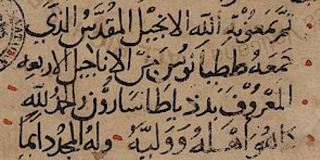
  28. Vat.ar.14, a 12th-century Arabic translation of the Diatessaron of Tatian, a combination of all four gospels into a single narrative. Thanks to Adam Carter McCollum in Vienna for pointing out this one on Twitter. Here is the colophon:
  29. Vat.ar.503,
  30. Vat.ar.581,
  31. Vat.ar.1606, a tiny and very ancient book in Arabic, apparently selections from Koran
  32. Vat.ebr.123,
  33. Vat.ebr.142.pt.2,
The Vatican scanners have also been hard at work for their Heidelberg sponsors, producing 10 new digitizations, which have just appeared on the Heidelberg RSS and are only visible on the German site:
  1. Pal. lat. 381 Ovidius Naso, Publius; Cicero, Marcus Tullius: Sammelhandschrift (Deutschland (Heidelberg?), 15. Jh.)
  2. Pal. lat. 733 Digestum vetus (14. Jh.)
  3. Pal. lat. 734 Digestum vetus (14. Jh.)
  4. Pal. lat. 735 Digestum vetus (13. Jh.)
  5. Pal. lat. 736 Digestum vetus (14. Jh.)
  6. Pal. lat. 687 Egidii (de Foscariis) ordo iudiciarius editus secundum consuetudinem bononiensem in foro ecclesiastico approbatam ; Mag. Bartholomei Brixiensis questiones dominicales et venales de iure canonico (15. Jh.)  
  7. Pal. lat. 691 Monaldi (Iustinopolitani ord. fr. minorum) summa iuris canonici (15. Jh.)
  8. Pal. lat. 695 Fratris Monaldi summa de iure canonico secundum ordinem alphabeti (14. Jh.)
  9. Pal. lat. 1525 Cicero, Marcus Tullius: Opera ; Orationes (Deutschland (?), 15. Jh.)
  10. Pal. lat. 1834 Melanchthon, Philipp; Luther, Martin; Erasmus, Desiderius: Epistolae (Wittenberg, 1536-1543 (?))
This is Piggin's Unofficial List number 46. I will fill in other details later. If you have corrections or additions, please use the comments box below. Follow me on Twitter (@JBPiggin) for news of more additions to Digita Vaticana.
2016-04-05

Touch-Pages

When the first touchscreens came out, a lot of us felt vaguely uncomfortable about touching pages. We had been inoculated by schoolteachers and librarians to feel guilty at putting our fingers on text.

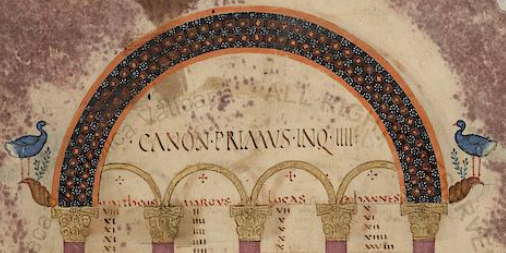
It was not always like this. Much-used old manuscripts were also much touched. Images of the Devil are usually rubbed out by thousands of tappings to abjure him with a prayer. And certain sorts of text had to be touched to be used properly. Which brings me to a great glory among this week's 85 Vatican digitizations, Vat.lat.3806, with some of the oldest Eusebian canon tables of the Gospels.

The codex is known as the Rocca Sacramentary, a liturgical book for use in Fulda, Germany. Its early 10th-century scribe was a monk in Regensburg. To stop it getting too worn, it was given a couple of flyleaves at the front ripped from a Gospels (you know how it is, there's always rubbish lying around the place) with some tables painted in or near Rome in the 6th century.

The tables tell the reader where matching scenes and quotes occur in the four gospels. You need your fingers to use them. When searching for a match, you turn back to the front of the book to this index, look up your references in the table, hold your place on the table with a finger of the left hand and leaf through to the different "targets" with your right hand.

Indexes require index fingers. If it gets really complicated, you might need to use four fingers in a pianist's straddle to hold four places in the tables at once. Hand gymnastics.

The invention of tables of concordance was a major advance in the history of information technology, the topic of learned books by Anthony Grafton, Martin Wallraff and others (see below). And now that we have learned again to touch our texts, we understand in hindsight that pages designed to be touched were not a sin, but one of the great inventions to engage our bodies in the work of thinking.

The canons in the Rocca codex are thought to be the oldest western (Latin) examples, going back nearly as far as the oldest eastern examples in the Rabbula Gospels (Plut 01.56) in Florence.

In the following list of the April 4, 2016 digitizations (these bring the posted total to 4,072), I have marked several other gospels with newer canon tables you can compare them.
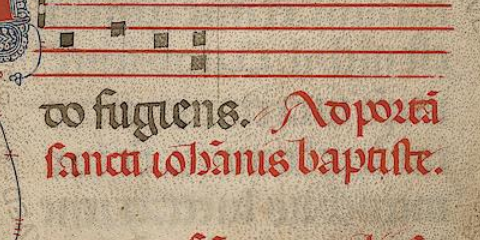
  1. Barb.lat.525, Evangeliary (gospel book) from Florence with prayers for each of its four city quarters during a procession. Here is the page for Porta San Giovanni:
  2. Barb.lat.637, Gospels, 9th century, with capitula lists but no canon tables
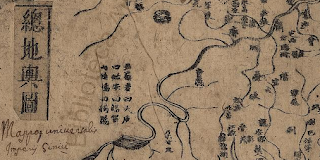
  3. Barb.or.135, printed book notable for this map of China:
  4. Borg.copt.109.cass.VI.fasc.17,
  5. Borg.copt.109.cass.VI.fasc.18,
  6. Borg.copt.109.cass.VI.fasc.20,
  7. Borg.copt.109.cass.XI.fasc.35,
  8. Borg.copt.109.cass.XVI.fasc.56,
  9. Borg.copt.109.cass.XVI.fasc.57,
  10. Borg.copt.109.cass.XVI.fasc.58,
  11. Borg.copt.109.cass.XVI.fasc.60,
  12. Borg.copt.109.cass.XVI.fasc.61,
  13. Borg.copt.136.pt.1,
  14. Borg.copt.136.pt.2,
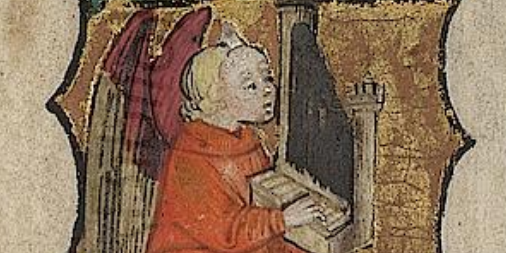
  15. Chig.C.IV.111,  a 15th-century book of hours, an illuminated prayerbook with scenes from the Virgin's life. After asking on Twitter what this peculiar harp-like instrument played with a keyboard is ....
    ... responses came from Valerie Wilhite, and Cristina Alis Raurich in Spain who actually plays one:
  16. Chig.C.VI.161,
  17. Chig.E.IV.126,
  18. Chig.L.V.167,
  19. Chig.L.V.168,
  20. Chig.L.VII.251,
  21. Chig.L.VII.253,
  22. Chig.L.VIII.292,
  23. Chig.L.VIII.302,
  24. Chig.M.VII.143,
  25. Ott.lat.84,
  26. Ott.lat.457,
  27. Ott.lat.1212,
  28. Ott.lat.1523,
  29. Ott.lat.1717,
  30. Ott.lat.2530,
  31. Ott.lat.2546,
  32. Ott.lat.2864, Dante's Divine Comedy (thanks @noah_nonsense for the tip-off)
  33. Ott.lat.2866,
  34. Reg.lat.3,
  35. Reg.lat.10, Gospels, with canon tables
  36. Reg.lat.307, Augustine of Hippo on Gospel of John, 9th century
  37. Ross.314,
  38. Ross.613,
  39. Urb.gr.99,
  40. Vat.gr.2313.pt.A,
  41. Vat.lat.50,
  42. Vat.lat.51,
  43. Vat.lat.80,
  44. Vat.lat.85,
  45. Vat.lat.235,
  46. Vat.lat.238,
  47. Vat.lat.250,
  48. Vat.lat.252,
  49. Vat.lat.255,
  50. Vat.lat.256,
  51. Vat.lat.258,
  52. Vat.lat.311,
  53. Vat.lat.323,
  54. Vat.lat.438,
  55. Vat.lat.498,
  56. Vat.lat.540,
  57. Vat.lat.573,
  58. Vat.lat.602,
  59. Vat.lat.646,
  60. Vat.lat.722,
  61. Vat.lat.785.pt.2, Thomas Aquinas: here he is with his parchment scraper and quill, hard at work with a dove (Holy Spirit) on his shoulder whispering what to write in his ear
    This is one of five Thomas codices made for Pope John XXII in the first quarter of the 14th century. Corinne Péneau suggests the iconography of the dove, taken over from past images of saints John, Peter and Gregory the Great, marks the promotion at this time of Aquinas to sainthood.
  62. Vat.lat.1995, Latin translation of Flavius Josephus, Antiquities of the Jews, etc.
  63. Vat.lat.1997, ditto
  64. Vat.lat.2376, John of Alexandria, commentary on Galen
  65. Vat.lat.3741, Gospels
  66. Vat.lat.3806, Rocca Sacramentary, for use in Fulda, scribe a monk in Regensburg, with two recycled flyleaves, fols 1-2, which are in fact 6th-century canon tables in Latin (by Eusebius): see Lowe, CLA Suppl. 1766, where the tables' origin is suggested to be the area of Rome
  67. Vat.lat.4220, Jerome, Letters to Paul etc
  68. Vat.lat.5762, from Bobbio, Letters of Jerome: note the poor, cheap parchment with holes and incomplete pages: the monks used whatever they could lay hands on, and wrote around the gaps.
  69. Vat.lat.5765, another fine old uncial manuscript from Bobbio, Italy, containing Isidore of Seville's De officiis (English translation via Google Books), dated to the beginning of the 8th century: this was made within 100 years of Isidore's lifetime. See Lowe, CLA 143   
  70. Vat.lat.5859, Ovid, Metamorphoses
  71. Vat.lat.5974, Gospels with canon tables
  72. Vat.lat.6083, more Gospels with canon tables
  73. Vat.lat.7224, 9th-century Gospels from Salzburg, Austria
  74. Vat.lat.7567, Bartolomeo da Colle (1421-1484): a manuscript of Dante
  75. Vat.lat.7795, more of the Bible of Aracoeli (see PUL 43)
  76. Vat.lat.7798, ditto
  77. Vat.lat.7801, ditto
  78. Vat.lat.8176, Pietro Bembo, letters
  79. Vat.lat.8208, Baldassar Castiglione, autograph
  80. Vat.lat.8262, scraps of book pages, handwritten notes, 17th century
  81. Vat.lat.8376, a damaged Paradiso of Dante associated with Bartolomeo da Colle (see above)
  82. Vat.lat.8700, illuminated missal, of Pius II
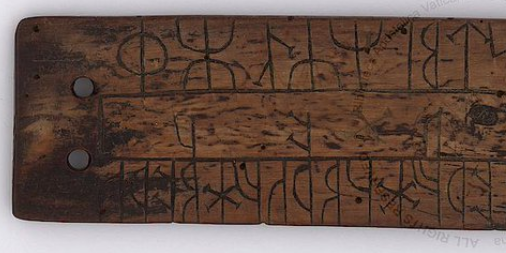
  83. Vat.lat.14613, a set of slats with writing on them:
    I didn't know what they were, but swiftly a tweet explained they were Scandinavian runes: which is the runic "alphabet" in its common order. The letters are mirrored, and some of them also upside down. We still don't know how this little treasure got to Rome.
  84. Vat.sir.51.pt.1,
  85. Vat.sir.51.pt.2,
In Heidelberg, 10 further Vatican manuscripts have arrived online in the past few days, and as usual actually come with descriptions:
  1. Pal. lat. 631, Gregorii IX decretales cum apparatu (Ioannis Andreae) (14.-15. Jh.)
  2. Pal. lat. 632, Gregorii IX decretales cum apparatu (Ioannis Andreae) (14.-15. Jh.)
  3. Pal. lat. 658 Iohannis summa super decretum (Gratiani) (14. Jh.)
  4. Pal. lat. 656 Sammelhandschrift (14. Jh.)
  5. Pal. lat. 640 Bonifatii VIII liber sextus decretalium, cum apparatu Ioannis Andreae (14. Jh.)
  6. Pal. lat. 642 Constitutiones Clementis V, cum apparatu Iohannis Andree (1460)
  7. Pal. lat. 703, Mag. Raymundi (de Pennaforti) summa de poenitentia et de matrimonio (14. Jh.)
  8. Pal. lat. 708, Ioannis (Friburgensis) Lectoris idem opus (14. Jh.)
  9. Pal. lat. 711, Sammelhandschrift (15. Jh.)
  10. Pal. lat. 732, Digestum vetus (14. Jh.)

If you have corrections or additions, please use the comments box below. Follow me on Twitter (@JBPiggin) for news of more additions to Digita Vaticana. [This is Piggin's Unofficial List (PUL) 44.]
Grafton, Anthony, and Megan Hale Williams. Christianity and the Transformation of the Book: Origen, Eusebius, and the Library of Caesarea. Harvard University Press, 2006.

Wallraff, Martin. Kodex und Kanon. Berlin: de Gruyter, 2013.

2016-02-15

Vatican Euclid Online

Probably the most famous mathematical manuscript in the world, the Vatican Euclid, arrived online on 2016 February 15, marking a major moment in the democratization of culture as well as a key milestone in the donor-funded efforts to digitize the 83,000 manuscripts at the Vatican Library in Rome.

Ivor Bulmer-Thomas argues that Euclid (who lived about 300 BCE) is the most celebrated mathematician of all time on account of the precocity and volume of his work. The 9th-century Vatican manuscript, Vat. gr. 190, is the only codex in the world containing Euclid's work without major adulteration.

Every other surviving manuscript contains alterations by the 4th-century-CE mathematician Theon of Alexandria, who altered Euclid's language, interpolated intermediate steps and supplied alternative proofs, separate cases and corollaries. As the only non-Theonian witness, Vat. gr. 190, now bound in two parts in Rome, is one of the most precious cultural treasures of humankind.

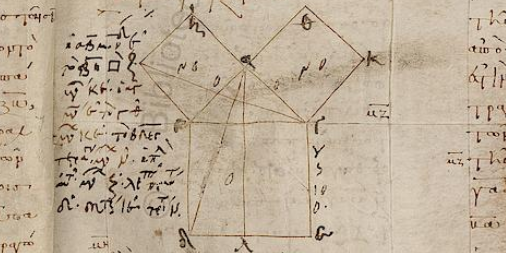
Here is its Pythagorean Theorem, Book I Proposition 47, perhaps the most famous proof in all mathematics, on folio 39r. You could understand it without knowing a word of Greek:

The purity of the Vatican Euclid was discovered by the mathematical historian Francois Peyrard in 1808 and the codex became the basis of Heiberg’s definitive edition of Euclid's Elements.

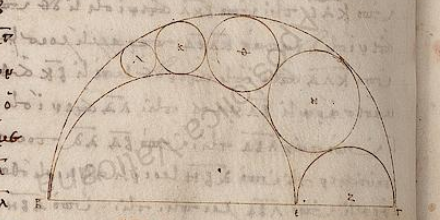
Its arrival online overshadows everything else in the following list, even the unique Vatican Pappus, Mathematical Collections Books 2-8, Vat. gr. 218, by another Greek mathematician of vast stature, the 4th-century-CE writer Pappus. Every other Pappus in the world depends on this incomplete Rome copy, and as you can see, Book 1 is forever lost. Here's a diagram from fol. 38v:

When the Pappus figured in the Rome Reborn exhibition, Anthony Grafton described it as the "last important work in Greek mathematics". As Jeremy Norman comments, it is sometimes the only source of information about Pappus's predecessors. But the thunder of even its release is stolen by the Euclid. Both were apparently sponsored by the Polonsky project.

Here is the full list of new uploads at the Biblioteca Apostolica Vaticana, which brings the posted total on Digita Vaticana to 3,852.
  1. Barb.gr.39, Cyril of Alexandria, Lexicon
  2. Barb.gr.70,
  3. Barb.gr.281,
  4. Ott.gr.85,
  5. Ott.gr.181,
  6. Ott.gr.232,
  7. Ott.gr.233,
  8. Ott.gr.237,
  9. Ott.gr.249.pt.1,
  10. Ott.gr.249.pt.2,
  11. Ott.gr.260,
  12. Ott.gr.335,
  13. Ott.gr.338,
  14. Ott.gr.352,
  15. Ott.gr.365,
  16. Ott.gr.366,
  17. Ott.gr.367,
  18. Ott.gr.373,
  19. Ott.gr.379,
  20. Ott.gr.380,
  21. Ott.gr.385,
  22. Urb.gr.15,
  23. Urb.gr.61, Theophrastus, Historia Plantarum and De Causis Plantarum
  24. Urb.gr.136,
  25. Urb.gr.137,
  26. Urb.lat.143, Bonaventura
  27. Urb.lat.203, Plato's Timaeus in Latin, translation
  28. Urb.lat.243, Medical, Joannis filii Serapionis
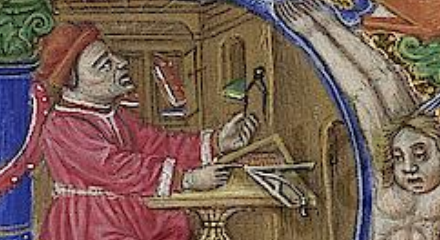
  29. Urb.lat.261, Archimedes, Sphere and Cylinder etc, in Latin, with Archimedes at his desk on folio 102r: Surely that's not an electric reading lamp he is snipping on in ancient Syracuse?
     
    But a smart historian just explained to me that he is holding up a compass, and the green "lampshade" is actually a windowsill.
  30. Urb.lat.305, Valla Laurentius, on Latin style
  31. Urb.lat.310, Attic Nights, Aulius Gellius
  32. Urb.lat.318, Cicero, Letters
  33. Urb.lat.328, Cicero, with commentary by Boethius
  34. Urb.lat.360, Constantius Antonius, commentary on Ovid
  35. Urb.lat.383, Cassiodorus
  36. Urb.lat.387, Giannozzo Manetti, works
  37. Urb.lat.400, Flavius Josephus, Antiquities of the Jews, in Latin translation
  38. Urb.lat.406, Pope Pius II, bulls
  39. Urb.lat.407.pt.2, Pius II, writings
  40. Urb.lat.433, Eutropius, De gestis romanorum
  41. Urb.lat.438, Iustini M. Iuniani
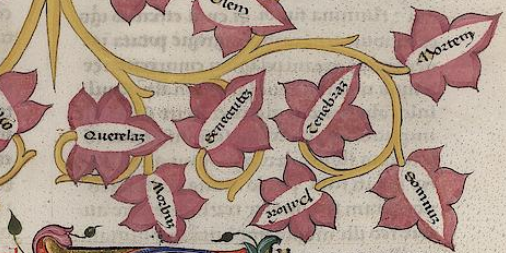
  42. Urb.lat.450, Boccaccio, Genealogia Deorum (1360), a kind of study edition, with a 60-page alphabetical index of gods which Colluccio Salutati commissioned from Domenico Bandini (c.1335-1418) (discussed 1927 by Wilkins, who uses the 1879 Hortis list of Genealogia manuscripts). Compare this to Boccaccio's second autograph of the same work, online at Florence. Urb.lat.450 features Boccaccio's famous leaf-form stemmata:
  43. Urb.lat.452, Boccaccio, etc, descriptions of Italy
  44. Urb.lat.493, Genealogies of noble families of Castille and Navarre, in Spanish, dated 1620; these are textual, not diagrammatic
  45. Urb.lat.495, Cafari de Caschifellone
  46. Urb.lat.496, Bartholomaeus Fatius, De rebus gestis ab Alfonso I neapolitanorum rege
  47. Urb.lat.501,
  48. Urb.lat.510,
  49. Urb.lat.514,
  50. Urb.lat.525,
  51. Urb.lat.556,
  52. Vat.ebr.144,
  53. Vat.gr.190.pt.1, Euclid, Elements, see above
  54. Vat.gr.190.pt.2, Euclid and Theon, see above
  55. Vat.gr.218, the Vatican Pappus, St Louis description.
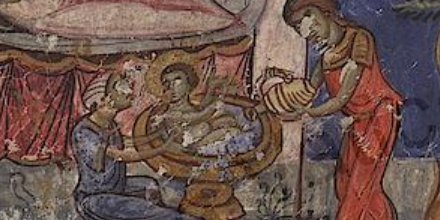
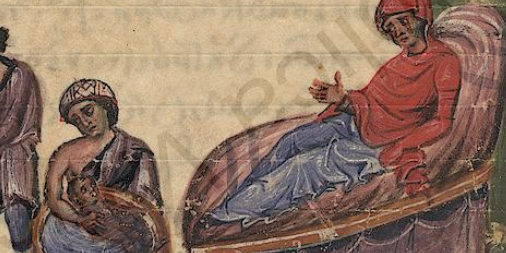
  56. Vat.gr.333, the Vatican Book of Kings, a richly illustrated 11th- or 12th-century manuscript which is often resorted to as a document of Byzantine warfare and customs. Here is the first washing of a newborn child (Solomon) (top), compared with a similar scene (not sure what baby) from Vat.gr.746, fol 59r (below):
  57. Vat.gr.351,
  58. Vat.gr.460,
  59. Vat.gr.666,
  60. Vat.gr.746.pt.2,
  61. Vat.gr.788.pt.A,
  62. Vat.gr.788.pt.B,
  63. Vat.gr.853.pt.1,
  64. Vat.gr.853.pt.2,
  65. Vat.gr.1522,
  66. Vat.gr.1594, this is the most famous and best of all the manuscripts of Ptolemy's Almagest, originally entitled "Μαθηματικὴ Σύνταξις" (Mathēmatikē Syntaxis). The work was written by the great Alexandrian scientist in the 2nd century and this is a 9th-century copy. The work describes the apparent motions of the stars and planets. See a description in the Rome Reborn exhibition.
  67. Vat.gr.1666,
  68. Vat.gr.1851,
  69. Vat.gr.2249,
  70. Vat.lat.34,
  71. Vat.lat.46,
  72. Vat.lat.131,
  73. Vat.lat.141,
  74. Vat.lat.157, Nicholas of Lyra, Postillae with fine coloured maps of temple
  75. Vat.lat.159, Nicholas of Lyra, Postillae
  76. Vat.lat.169, Dionysius Areopagita
  77. Vat.lat.191, Tertullian, Against Marcion and other works
  78. Vat.lat.208, Origen, homilies, and Gregory Nazianz
  79. Vat.lat.214, John Scotus Eriugena and Didymus
  80. Vat.lat.218, Lactantius, Divinarum Institutionum, De Ira Dei and some Augustine of Hippo
  81. Vat.lat.219, Lactantius, Divinarum Institutionum
  82. Vat.lat.231, Eusebius, Praeparatio Evangelica
  83. Vat.lat.247, Eusebius, Chronological Canons
  84. Vat.lat.4817, Angelo Colocci autograph?
It remains to note that one item was withdrawn from the site on Feb 12:
Borg.copt.109.cass.VII.fasc.65.2

At the same time, the ranks of the Palatina library online grew, not on the BAV website, but on the portal in Heidelberg, Germany which has the first right as sponsor to issue these online:
  1. Pal. lat. 712 Manuale collectum de summa confessorum (Raymundi de Pennaforti) (14. Jh.)
  2. Pal. lat. 718 Sammelhandschrift (15.-16. Jh.), important as a source of the Tractatus de usuris of Antoninus of Florence (1389-1459) See note 
  3. Pal. lat. 717 Sammelhandschrift (14.-15. Jh.)
  4. Pal. lat. 713 Fr. Baetholomei de Chaimis de Mediolano ord. minorum, Interrorogatorium siue confessionale (1477)
  5. Pal. lat. 716 Michaelis Gass: Archimusici Principis Ludovici Palatini tercii directorium omnium eorum quae per tocius anni curriculum in sacello illustrissimi Principis Palatini canuntur et aguntur (1533)
  6. Pal. lat. 707 Iohannis (Friburgensis): Lectoris idem opus integrum (14. Jh.)
  7. Pal. lat. 705 Sammelhandschrift (15. Jh.)
  8. Pal. lat. 704 Mag. Raymundi (de Pennaforti), Summa de poenitentia et de matrimonio (14. Jh.)
  9. Pal. lat. 702 Summa de vitiis (13.-14. Jh.) 
  10. Pal. lat. 724 Sammelhandschrift (15. Jh.) 
  11. Pal. lat. 731 Digestum vetus (14. Jh.)
As I noted in my previous post, interest is now growing in the original diagrams which the Greek mathematicians drew and in undoing the editorial vandalism which Heiberg and others did to these figures.

Professor Ken Saito of Osaka, the leading figure in this work of diagrammatic reconstruction, kindly sent me earlier this month an offprint of his very important and difficult-to-find 2006 article in which he launched this returning to the source for Euclid's Elements. His precise plots of the Euclidean diagrams continue to be published on his website, GreekMath.org, and each of his surveys naturally always begins with the Vatican Euclid as its prime source. If you get puzzled, the pagination in his two PDFs is as follows:
  • The Diagrams of Book II and III [and of Book IV and of Book VI] of the Elements in Greek Manuscripts: pages 39-80; 161-196 
  • The Greek Manuscript Diagrams of the Elements: Book VI, Book XI, Book XII, Book XIII: pages 71-179
Of the other five Euclids used by Heiberg (Pinakes has a much longer list), most are already online:
If you have corrections or additions, please use the comments box below. Follow me on Twitter (@JBPiggin) for news of more additions to Digita Vaticana. [This is Piggin's Unofficial List 39.]
Bulmer-Thomas, Ivor. “Euclid: Life and Works.” Dictionary of Scientific Biography, 1971. Online.
Heiberg, Johan Ludvig. Euclidis Elementa. 6 vols. Leipzig: Teubner, 1883. Online.
Murdoch, John E. “Euclid: Transmission of the Elements.” Dictionary of Scientific Biography, 1971. Online.
Saito, Ken. “A Preliminary Study in the Critical Assessment of Diagrams in Greek Mathematical Works.” SCIAMVS 7 (2006): 81-144.