Showing posts with label Peutinger Diagram. Show all posts

2016-10-01

Secret of Oldest Infographic Revealed: A Grid

Things have been quiet on this blog and my Twitter stream because I have been working on a major project: a complete reconstruction of the oldest known conceptual infographic in the world: the fifth-century Latin Great Stemma.

When I first announced its rediscovery in 2011, I presented a rather freely drawn plot of it (see this in my article in Studia Patristica or archived on my website as an swf (Flash) file):
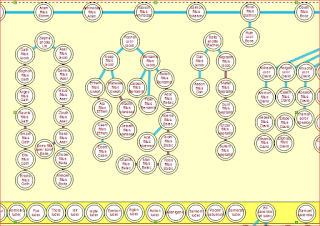
This time round, I am trying to do something much harder: to replicate the chart without any accommodations to modern assumptions, showing it precisely as it was intended by its designer.

The result (link) is the layout that the designer would have saved if the SVG mark-up language had existed in the fifth century. Not only are the lines, circles and text in the precise locations where the design called for them to be positioned. These positions also allow us to observe the design's hidden concepts and rules. This new drawing is not an impression of the late antique original: it is an encoding of the design itself.

The starting point for my revision was wise counsel from a great infographics teacher and practitioner, Raimar Heber of Germany. Raimar has just published a textbook (in German, Rheinwerk Verlag) of best practices in infographics and it looks very good indeed from the page samples.

In 2011, Raimar offered to do a retro-engineering experiment: he world accept an imaginary design brief and visualize the data of the Great Stemma as one of the world's leading professional art editors would design it today. He drew up a graphic sampler. One frame of it pitched a grid as the basis of the visualization. Chains should be laid out in the horizontal and vertical, he argued, with shoots allowed at 45-degree angles if the going got tough.

For a long time, I was sceptical about this. It sounded too 21st century to me. There is only one manuscript of the Great Stemma where straight lines and right angles stand out (Plut 20.54 in Florence), but one tends to assume that was just the obsession of an over-neat scribe.

But in spring this year I began re-analysing every substructure of the Great Stemma using a selection of the best manuscripts. This involved no less than 30 separate investigations, listed here as a "detail views".

For the first time I noticed something.

The manuscripts contain many vertical columns of roundels (the circles containing names). If one counts how many members there are in such rows, one comes up unusually often with the number 10. There might for example be a column of eight connected roundels, in a place where two others above them block the area overhead. Or there are long chains which bend to the left or the right at the 10th member in many manuscripts.

So as an experiment I worked to trim all 100 of so columns of the Great Stemma so that each was 10 elements high. If you array that many columns side by side it naturally appears gridlike.
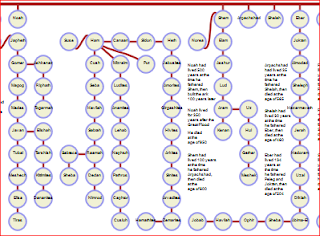

This alignment became a new paradigm. Not only is this pattern harmonious, but it also provides a simple and logical explanation for so many bulges, interlocks and elbows in the manuscripts. I am convinced it is the lost original pattern that the designer used. So Raimar's insight turned out to be spot on.

On reflection there would have been good reasons to use a grid. Firstly, it makes designs easier to read. That is an imperative of then and now.

Secondly, it makes a design much easier to hand-copy, which is no longer an imperative now, but was an important concern before the rise of printing. If you draw a grid where the written data expand neatly in two dimensions, and prescribe moreover that certain squares be left blank, you have a robust model for copyists to work from. We should study whether a similar method may have been used to copy the Peutinger Table, mappaemundi and other late antique charts by hand.

Take a look at my new reconstruction, which translates all of the 5th-century design into a (gridlike) pixel coordinate system. This design is not drawn by hand, but as output from a new database I have built, where all the crossing points in the grid have been recorded, along with the roundels, texts and connectors that pertain to those crossings. Other scholars may offer their own editions in future, but I would argue that the Piggin Stemma is the most accurate reconstruction on the available evidence.

A contemporary buzzword is digital humanities, which often is simply watered down to mean storing and searching old documents as scans in databases. True digital humanities work is something more: it means recasting historic creative work from its original analog expression to a digital expression which remains absolutely congruent with the artist's or writer's intentions, but yields more insight.

I have tried to make this chart even more accessible by translating its text into English and by supplementing it with explanatory plaques and interactive visual effects (look for radio buttons like those above). Tell me if it works like this and how you think it might be further improved.

2011-08-22

Stemma, Maps and Matrices

Now that we have the Great Stemma published online, it's a good time to consider what sort of commonalities it has with the "arbor juris" diagrams in Isidore's Etymologies and with the Peutinger Map. The most important observation is that all three are in a sense calques of the board game, where the meaning arises from traversing through the diagram, much as you jump a counter over the squares or circles of a board towards a goal.

As an itinerarium, Peutinger is all about paths and distances, and not at all about spatial arrangements. One might argue that this is an adaptation to fit its roll form, but I wonder if this isn't a kind of deliberate elaboration from what would be needed for a mere map into something more sophisticated. As it happens, today's IHT edition of the New York Times reports on an ingenious new way of representing cities that overlaps a perspective view into a bird's eye view. It was designed by London's Berg studio and is an exhibit at the NY Museum of Modern Art. The Peutinger Map may not be a broken or primitive map, but instead a highly sophisticated meta-map like the Berg one (I won't comment here on the Richard Talbert proposal that the map is more show-off than practical).

One could argue that the common feature of Peutinger, the arbor iuris, the Great Stemma and also items such as the arbor porphyriana is the invitation to the reader to discover and explore paths, usually crooked paths. That is what the fila and the hypothetical timeline of the Great Stemma are about. The open question is about how accurately the fila and timeline were aligned with one another.

One important ancillary point, to my mind, is that our knowledge of all these graphic schemes is diminished by the difficulty that every scribe, whether Antique or medieval, must have had in accurately copying technical drawings by hand. Last year, I copied the triangular version of the "arbor iuris" and found it a very tricky task, even with good graphics software to help me.

Practice at copying these ingenious graphics has been helpful in understanding their transmission. When I am looking at a poor copy of a drawing, I now assume that its predecessor was more observant of the regularities generally. The more accurate predecessors of these drawings might have had a lot more fine-scale axial information, which is the easiest feature to get out of alignment, as we also seen in the Eusebian Chronological Canons.

But we cannot even begin to reverse this degradation unless we know what equipment such a copyist used when reproducing such drawings, and there I am afraid I have not read enough research. My understanding is that desks were uncommon: according to Kurt Weitzmann, texts were commonly copied onto papyrus rolls by a scribe sitting tailor-style, wearing a tight skirt as the support for his papyrus, which was laid obliquely over the left knee. In the early codex period, the folios were also inscribed on two knees (at least that is true of the Spanish monastery depicted in one of the Beatus codices). It seems to me that big graphics like the Great Stemma could not be competently copied that way, especially if straight axes had to be preserved. I have not studied how paintings were reproduced, but would guess that this done on tables or easels, since the artist had to be at some distance from his canvas to wield his brush.

When we consider how a pen-drawing was copied, I can only speculate. My guess would be that this was a job for a specialist. A tracing through translucent "paper" of some nature? Hardly likely, as the customer would surely expect a product on a robust support. In the 19th century, technical draftsmen used technology such as pantagraphs, but I doubt if these were known in Late Antiquity.

Again, I am only guessing, but I would suppose that the most efficient method would be to stretch a net over the source, another net over the destination, and plot each square or hexagon from one to the other. If a non-specialist scribe were given the task, he might not have the equipment, or the training, or the wit, or the time to do this. If he were particularly incompetent, he would not even complete each panel left to right but might simply hurl squiggles on the page to represent his "overall impression" of the model, then fill the gaps. The Urgell Beatus version of the Great Stemma exemplifies that sort of chaotic, ill-planned copy. It is hardly surprising that we have rather little of the pen-drawings of Antiquity.

Now, I think this encourages us to contemplate the question of Antique "technical" drawing with more attention to the intelligence behind each drawing than to the deficiencies in execution of any of its copies (this was my criticism of Klapisch-Zuber). To some extent, we may be able to at least discover the right questions to ask by looking at collective memory, the practices in other periods, and even our own perceptions. The answers to those questions naturally depend on evidence, but we should try to connect to the intelligence or the intention of the Antique authors.