Showing posts with label Stemma. Show all posts

2013-05-04

Incoherent?

Some years ago, the French cultural historian Christiane Klapisch-Zuber examined the Great Stemma. Because she was in Paris, the nearest manuscript at hand was a late recension, from Gascony, which is held by the French National Library or BNF. In colour and effect, the sumptuous polychrome diagram in the Saint-Sever Beatus is a beautiful thing, but in organization it is curiously incoherent.

Among its great oddities is a fishnet pattern among the descendants of Noah that largely obliterates the careful encoding of their relationships which was characteristic of the original model. That led Christiane Klapisch-Zuber, who is the greatest scholar to have surveyed the full history of such diagrams, to dismiss the whole class of Spanish Bible diagrams as an affront to the principles of ‘graphical semiology’. She argued in her 2000 book that no coherent biblical genealogical diagram had existed before a medieval work, the Compendium, was devised by Peter of Poitiers.

Her point of view was taken up and amplified soon after by Beate Kellner, who is now deputy principal of Munich's  Ludwig Maximilians University (LMU), in her Habilitationsschrift, which was published in 2004. Kellner also focussed this part of her research solely on the Saint-Sever manuscript in Paris.

She seemed to be even more troubled by the way the diagram strung out siblings like beads on a string instead of exhibiting them in hierarchical fashion as we do in "family trees", and spotted another oddity of the Saint-Sever manuscript, its curious folding together of the descendants of Leah:
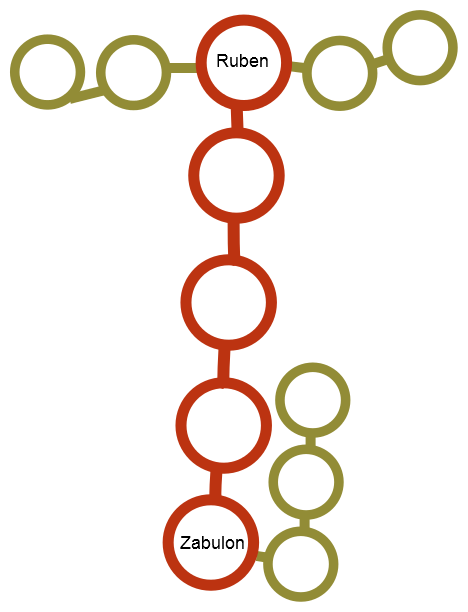
Here the organization of the panels avoids a coherent reading order as we would conceive it, from the top to bottom or from the bottom to top ... The genealogy below Jacob and Leah begins with their son Reuben ... His brothers Simeon, Levi, Issachar and Zebulun follow in a series of roundels which is open to interpretation as a genealogical line of descent since the line is graphically vertical, although in fact it links persons of a single generation. The sons of Zebulun are similarly connected by lines to one another in the vertical, and with their father, in such a way that the arrangement is effectively an ascending one. (JBP translation, hover for German original)
The sketch below shows the situation referred to, with the remainder of the environs omitted, and it must be agreed that the Saint-Sever artist took a very free attitude to his Vorlage when he arrayed Reuben's sons to both the left and right and ran Zebulon's sons up the page instead of downwards:

Now this is not the place to consider whether Kellner's overall characterization of medieval genealogy is correct or not. But the Saint-Sever treatment of the Great Stemma is so original and so untypical of its diagrammatic tradition (list of manuscripts here) that it can hardly be taken as representative of very much other than the artistic sensibility of Stephanus Garsia Placidus, the monk who seems to have been its creative director and principal artist. Yolanta Zaluska has pointed out odd inconsistencies in the diagram which suggest that something went wrong with the project and that someone other than the original director completed the diagram.

The classical arrangement of the sons of Leah in the Great Stemma is in fact severely regular, and it normally embraces all six sons, not five as in the Saint-Sever recension which omits Judah in this position. Here is a schematic of the same group from the Plutei manuscript, which contains pretty well the earliest format we can discover in the diagram's history:
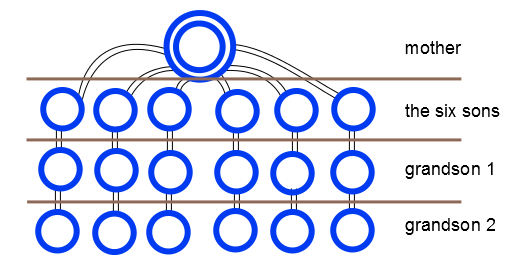
Now it is true that the reading order of grandson 1, grandson 2 and so on is not the order that we in the 21st century could conceive as proper. But it does adhere to a broad logic in the Great Stemma where certain sibling groups which are only supplementary to the broad purpose of the document are always shown in space-saving fashion as vertical series. This is perhaps surprising to our eyes, but it is not chaos.

Following this generalization, Kellner then ventures the hypothesis that the crowded design of the Saint-Sever diagram deliberately establishes a stemmatic tangle, with extensions running every which way, in order to suggest that kinship by its very nature tends to be a network,
... that genealogy is being placed before us as a tapestry of relationships, as a complex structure oriented in multiple directions and not as a unitone line of descent... My hypothesis is that graphics, which are better able to exploit the two-dimensionality of the page, enable this particular form of discourse from the first glance, unlike a purely textual listing of genealogies, which certainly can employ linguistic features to link backwards or forwards and to that extend is capable of catering for genealogical cross-connections, but is ultimately bound by the continuity of script and creates an impression of linearity from the very character of text. (JBP translation, hover for German original)
One already hears an ominous creaking in this structure of ideas, built as it is on evidence that simply does not support it. Rather than building on the august traditions of German text-critical scholarship, on the detailed analysis of the full range of manuscripts, such an interpretation employs the semiotics approach of Jacques Derrida, Roland Barthes and Co. which was popular in the late 20th century, spinning creative meaning and significance around supposed "signs", while paying too little attention to verifiable data about what one might describe as the ecology of culture - the structures of the human mind, the evolution of artefacts and the phenomenal experience of human societies.

Kellner is undoubtedly right in her observation that Saint-Sever often lacks diagrammatic coherency, but her analysis is based solely on a single, rather non-representative manuscript in Paris and a series of creative blunders when an artist outran his own talents in a single scriptorium in Gascony, leaving her vulnerable to a whole herd of counter-evidence from nearly 20 other manuscripts.

Older recensions of the Great Stemma are generally more coherent and rational in the way that they map family relationships to a consistent code using connections, alignments and orientiations.

Developing her point, Kellner correctly intuits that the genealogical diagram belongs in a tradition where the expansive roll was the more natural medium than the cramped codex page, but strays into even more unsupported territory with a suggestion that medieval historians felt a 2D visualization to be inherently freer than text in its choices of content and arrangement:
The notion of genealogy as a network of relationships could be conveyed graphically using relatively simple shapes such as lines, strips and circles on codex pages - or doubtless ideally in scroll format - because arrangements of the genealogical elements in planar space - and this is the key objective - were able to be selected and combined with greater freedom. (JBP translation, hover for German original)
Here I both agree and disagree. Planar space is a far more comfortable medium to organize one's genealogical data and snippets of evidence than linear text. Sketching and diagamming often help us to organize our ideas and evidence better. Medieval diagrams do indeed breathe a certain air of nerdish delight at being able to amass the evidence to show some new view of it.

But diagrammatics are rarely a zone of freedom. Keller perhaps extrapolates from the freedom of art in comparison with the literary discipline prevailing over poetry and prose. But the overwhelming trend throughout the history of graphic charts and displays has been to bind them as tightly as possible to the habits of human spatial perception: without such discipline, diagrams simply fail to communicate.

Diagrammers who ignore "programming" principles are not breathing the air of freedom or expressing a view about the complexity of kinship relations and the intricacy of existence. When they discard a coherent system that has been handed down to them, they end up writing bad code. The Saint-Sever diagram is an experiment, probably by Stephanus himself, that went wrong.

Kellner, Beate. Ursprung und Kontinuität: Studien zum genealogischen Wissen im Mittelalter. W. Fink, 2004. Discusses the Great Stemma pp 50-53.

Klapisch-Zuber, Christiane. L’ombre des ancêtres. Paris: Fayard, 2000.

Zaluska, Yolanta. ‘Les Feuillets Liminaires’. In El Beato de Saint-Sever, Ms. Lat. 8878 de La Bibliothèque Nationale de Paris, edited by Xavier Barral i Altet. Madrid [Spain]: Edílan, 1984.

2013-01-28

School Stemma

A couple of days ago I published a post about an adaptation of the Great Stemma that appears in the bibles of Parc, Floreffe, Foigny and Burgos. For a long time, my working name for that diagram has been the Lesser Stemma, built on the sense that it employs fewer diagrammatic features than the original 5th-century document.

It has been rightly pointed out that this is misleading, since in sheer bulk it is one of the biggest biblical stemmata ever made.

Counted in pages -- 18 -- it is bigger than the other versions. (Epsilon: 16 pages. Alpha and Beta: 14.) Counted in words, it is vast, inflated with supplementary material from Isidore's Quaestiones including the elaborate allegorical account of the Wandering in the Desert divided into 27 stages or mansio. Even counted in roundels -- Burgos has 529 of them -- it is on a par with the other versions which have an average of 540.

So I began to think about a better name for it.

One idea was to name it from its aggressive intention, which was first identified nearly three decades ago by Yolanta Zaluska. The new stemma employs the techniques of the old one, but to oppose the Great Stemma's purpose. The original explains Jesus's dual ancestries as a mother-plus-father descent. The revision explains the doubling as an effect of Jewish society's levirate marriage custom. One might therefore compare the new stemma to a ship captured by an enemy. Taken as a prize, it sails with a new crew and turns its guns against its former owners. However there is no simple, obvious word to describe this repurposing phenomenon.

One might equally well consider the uses of the new work. The original Stemma was a rather flashy infographic designed to demonstrate at a glance certain ideas about chronology and descent. The new stemma was more like a turgid textbook, loaded up with etymologies, explanations and lists (like that of the prophets). Like a textbook, it has been checked for its doctrinal orthodoxy and has clearly been approved for use by the impressionable student monk. It is not there for easy reading, but to supply information that can be learned by rote and tested.

From this more educational purpose, it might be best to describe the new version as a "school stemma". That is the working name I will employ for it in the next stage of research.

I have fixed the tabulation of "School Stemma" pages on my catalog page, and have discovered that two pages of the Foigny Bible version are online, though in low resolution: the page with Sem and Joktan, 4r, and the Incarnation page, 11r. These two links to the BNF images database work intermittently, but not always.

Zaluska, Yolanta. ‘Entre texte et image: les stemmata bibliques au Sud et au Nord des Pyrénées’. Bulletin de la Societé nationale des antiquaires de France (1986): 142–152.

2013-01-27

Window into the Past

Until now I have paid very little attention to a derivative version of the Great Stemma which is found in four bible manuscripts of the 12th and 13th centuries (described here). There are however some indications that this version may provide a window into the past, since it was probably adapted from the Great Stemma at quite an early date.

At first sight, the version that is found in the bibles of Parc, Floreffe, Foigny and Burgos seems very different from the 5th-century original: it is a frontal attack on the Great Stemma author's belief that the Virgin Mary had a father, Joachim, and a grandfather, Joseph, who were direct male-line descendants of King David. It asserts the early medieval orthodoxy, based on the idea that Mary's spouse Joseph had two separate male-line ancestries.

This assault on the Great Stemma imitates its structure while condemning its author's theology and Umfeld as erroneous. Rather like silver-tongued Edmund Burke using radical argumentation to attack radicalism itself, the revisor has appropriated the diagrammatic technique of his opponent to defend the mainstream represented by the thought of Isidore of Seville. He wished to:
  • erase the Joachimite explanation of the Gospel contradiction (it is replaced by part of Rufinus's translation of the Letter to Aristides); 
  • add the etymologies of Jerome of Stridon (as adopted by Isidore) to explain the biblical names, implicitly rejecting the counter-etymologies in the Liber Genealogus
  • adjust the content wherever possible to harmonize it with the Vulgate and suppress influences from the Vetus Latina biblical text. As an example, the order of the Minor Prophets is changed to that prescribed by Jerome.
Screeds of Isidore's Mysticorum expositiones sacramentorum also known as the Quaestiones in Vetus Testamentum have been overlaid on the diagram, presenting Old Testament events as allegories of the New. "The Old Testament is exclusively read in the Quaestiones according to the allegorical interpretation," explains Claudio Leonardi in his essay, Old Testament Interpretation ... from the Seventh to the Tenth Century. "Allegory is used by him to read every Old Testament passage and to discover in it the proclamation of Christ's own message.

Despite this revised document's hostility to the Great Stemma, it does offer a few indications of how the Great Stemma might have looked before our oldest extant manuscripts came into existence. Comparing its page divisions with the "purest" recension of the Great Stemma, that in the manuscript of Florence, we are struck by some uncanny similarities.

The section describing the Horrite and Edomite rulers from Genesis 36: 20-43 appears precisely as in the Epsilon recension under the heading, Hi sunt filii Esau qui in Monte Seir nati sunt. The Horrites from Lotan to Anah appear on one page, while Dishon, Ezer and Dishan are delayed to the next page. The Judaean kings from Rehoboam to Ahaz are neatly fitted into a single page with some zigzags, avoiding the strange muddle that afflicts the 13th page of the Florentine manuscript where this succession ends in a kind of graphic traffic jam.

In the Judges section there are two interesting amplifications. For the foreign-rule period we read Alienigene annis XL, and for the peace period in the Foigny Bible we read, Pacem habuerunt et sine lege fuerunt.

Later we read, David filius Iesse, magnus rex et propheta, regnavit super Israel annis XL, in Ebron sex, in Ierusalem XXXIIII, and Salomon pacificus filius David rex Israel regnavit annis XL. As in the Liber Genealogus, durations are given for most of the reigns after the kingdom is divided as a result of the Judaean secession. Of interest is the inclusion in the Foigny, but not in the Burgos text, of certain chronological data from after the Exile which is notably lacking in the other recensions of the diagram. Whether it comes from Isidore or from the early diagram is uncertain:
  • Regnum persarum et medorum a temporibus Cyri vel Darii usque ad extremum Darium qui ab Alexandro Magno victus occubuit fuerunt anni centum octoginta novem. 
  • Rex macedonum a temporum et Alexandri Magni usque ad Cleopatram regnam Egypti. Rex Antiochus ex Syrie qui Iudeos varia calamitate oppressit plurimos que ex ipsis ob defensionem legis mortes? fecit.
  • Iulius Cesar regnavit annum unum ex quo in regno romanorum imperatores et?? ceperunt. 
  • Octavianus augustus regnavit annis LX iste obtinuit monarchiam. 
  • Thyberius Augustus regnavit annis XXIII huius Tyberii imperatoris anno XVIII Christus passus est.

One also suspects a couple of the glosses in Foigny might pre-date Isidore, although there is nothing that verbally resembles them in the Liber Genealogus. The division into the Northern and Southern Kingdoms is explained with the words, Ab hinc regnum Israel in Roboam atque in Iheroboam divisum bipertitum est, effectum ex quo tribus Effraim principatum obtinuit, and the expiry of Samaria is explained: Osee iste est qui quondam fuit rex super X tribus Israel in Samaria qui temporum Salmanasar regis ab Assiriis captus ...

All of these passages need to be studied more closely, since they could potentially preserve lost text of the original Great Stemma. I am grateful to Dr Andrea Worm for sharing with me information and insights about the Foigny Bible which have led to these observations.

2012-12-22

The Amiata Stemma

We can be quite certain that a copy of the Great Stemma was at the Benedictine Monastery of San Salvatore on Monte Amiata in Italy in the eleventh century, because it inspired an author-artist on the mountain to attempt his own adaptation of it, "correcting" it, abridging it and extending its content up to "modern" times.

In this update, the structure and essential text of the diagram were retained, but most of the stemmata that fill its central space were discarded and replaced by a vast tableau of successive rulers of the western world in 128 roundels, spanning fifteen centuries from Darius the Great to Henry III. The latter name allows us to date this document, because Henry III must have been the current Holy Roman Emperor when this remix was laboriously copied by the scribes onto four blank folios at the back of a book of commentaries by great theologians on books of the Old Testament. Henry III ruled Germany and Italy between 1039 and 1056. His year of death is added in another hand to a list of kings elsewhere in the same codex.

This graphic adaptation of the Great Stemma scheme for a new age must have existed in multiple copies, but we only possess one of them,which has been penned into a codex which was made and kept at Monte Amiata and is preserved today in the Laurentian Library in Florence under the name Codex Amiatinus 3. The diagram spanning eight pages (ff. 169r-172v) in Amiatinus 3 is demonstrably not the original, because the artist evidently laid out his first draft on a wide scroll, and that is how I have sketched it here:

It is not too difficult to prove that the drawing now spread over eight pages must have once occupied a single sheet. The tableau of 128 kings, which is designed to be read left-to-right in eight rows of sixteen roundels, has been split and placed on two sides of a folio. This obliges a reader who wants to read it in historical order to continuously turn the page back and forth: a situation which would never have been intended by the artist. The split is merely the consequence of sectioning the overall diagram into frames so that it would fit in a codex.

In the above plot, I have drawn a black rectangle around the 128 historic rulers of the west. The succession (it makes many wild jumps) comprises Achaemenid rulers, emperors of Rome, kings of Italy and Holy Roman Emperors. Some of the authors below perceive this as a documentary forerunner to the translatio imperii doctrine.

It is conceivable that this remix (which dispenses with most of the stemmata except for the families of Adam and Isaac) was compiled before Henry III came to power, and was merely updated to keep up to date with changes in political control. The revision contains a list of popes which the scribe has not bothered to update. This roll-call of the papacy ends with Agapitus (pontificate 946-955), so it is conceivable that the re-drawing took place in the middle of the tenth century.

Very little has been published about this document, although a plot of it, not quite as accurate as mine, appeared some years ago in an article by Gert Melville. The latter two authors below appear not to have realized that the abbey possessed a copy of the Great Stemma from Spain which mentions the Visigothic King Wamba. None of them explore the theological position of the Amiata drawing, which rejects the Joachimite account of Jesus's ancestry and restores an orthodox genealogy that exactly follows the text of the Luke Gospel with 42 generations from David to Christ via Nathan.

Gorman, Michael. ‘Manuscript Books at Monte Amiata in the Eleventh Century’. Scriptorium 56 (2002): 225–293: 268–271. Lists the contents of Amiatinus 3 and discusses the Amiata scriptorium. See my earlier discussion of this article in respect of the Liber Genealogus.

Klapisch-Zuber, Christiane. L’ombre des ancêtres. Paris: Fayard, 2000. Discusses the Amiata Stemma at pp. 72-73.

Melville, Gert. ‘Geschichte in graphischer Gestalt. Beobachtungen zu einer spätmittelalterlichen Darstellungsweise’. In Geschichtsschreibung und Geschichtesbewusstsein im späten Mittelalter, edited by Hans Patze, 57–154. Vorträge und Forschungen / Konstanzer Arbeitskreis für Mittelalterliche Geschichte 31. Sigmaringen [Germany]: Thorbecke, 1987. Contains a drawing of the Amiata Stemma on a fold-out, making clear that Melville also interpreted it as a single-page diagram. Given the work that went into the plot, one is surprised by the brevity of the discussion at pp. 66-67.

2012-12-01

Books, Books, Books

I have just refreshed the bibliography on the Great Stemma which now runs to more than 180 items. The  major change is that it is now annotated, following the urging of Phoebe Acheson of the University of Georgia (Athens) Miller Learning Center, who founded the Ancient World Open Bibliographies (AWOL). She added the original bibliography to her list in May 2011, where it is tagged under both information architecture and paragraphy.

Additions include the article by Helena de Carlos which I recently posted about as well as a rather shallow discussion by Carlos Miranda in 2000 of the differences between the Great Stemma, Lesser Stemma and Compendium of Peter of Poitiers:
Miranda García, Carlos. ‘Mnemonics and Pedagogy in the Compendium Historiae in Genealogia Christi by Peter of Poitiers’. In Genealogia Christi, edited by Maria Algàs, translated by Anne Barton de Mayer, 29–89. Barcelona: Moleiro, 2000.

This appears in a very interesting volume devoted to a Rome manuscript in roll form of the Compendium. To my astonishment this is quite a rare book: there is only one copy as far as I know in any research or public library in the north of Germany (and only two in the south, at Passau and Munich). As an insert, it contains a printing of what I would guess is the first-ever digital plot of a medieval stemmatic diagram. The work on this very impressive poster-style, fold-out sheet is credited in the book (page 15) to Enrique de Castillo. I will give it a bibliographic reference of its own when I do a medieval book-list.

2012-11-11

An Ideological Kernel

A new article on the Great Stemma was published last year in Spanish, as I see from a new web search. In it, Helena de Carlos Villamarín seeks the reason for the inclusion of the diagram in the Codex of Roda. She argues that the diagram is the "ideological kernel of the Codex" and "points to the typological meaning of the textual ensemble, showing one of its interpretative clues to be the opposition between the Old and New Testament."

Perhaps. She says she is discussing all this "sin entrar a profundizar en el posible origen de estos textos o en sus avatares de transmisión". I would think that ignoring the possible origin of the genealogical diagram and its transmission history might make her interpretative argument rather vulnerable.

There is nothing wrong with speculating about the theological intentions of the Codex compiler, and de Carlos certainly knows the Codex as well as anyone today (this is her third published scholarly article about it), but surely one needs to also discuss what customers of the 10th-century book trade wanted (this was an expensive book to make), what was available for inclusion and why an illustrative frieze like the diagram was esteemed.

If the Christians of 10th century northern Spain knew that the diagram was of patristic origin, were aware that it had once existed in roll form and where it had been displayed, or even regarded it as an authoritative source, they might have used the diagram as a core document of their belief. If it was little known or obscure, it might have been taken up merely because of its decorative value. The errors in the diagram as copied leave the question open: did it go uncorrected because it was too authoritative to alter, or because the editors had a cavalier attitude to it?

The article is: "El Códice de Roda (Madrid, BRAH 78) como compilación de voluntad historiográfica". Edad Media: revista de historia, ISSN 1138-9621, 12 (2011), pp 119-142. Accessible here from Dialnet (which is an academic digitization portal, not a mobile-phone provider). (De Carlos's and other recent articles on the Codex by various authors are listed on Regesta Imperii.)

While I would not have expected de Carlos to have discovered my own Great Stemma research, which did not began to arrive online in bulk until 2010, I think she ought to have cited Christiane Klapisch-Zuber's L'ombre des ancêtres (2000) rather than an exploratory article published in 1991 by that author after her 1985-1986 Villa I Tatti stay in Florence. Klapisch-Zuber does not include the 1991 article any longer in her selected publications.

Admittedly my Spanish is too basic to go beyond the broad lines of argument of de Carlos, who teaches philology at the University of Santiago and edits an annual journal, Troianalexandrina, I find her re-interpretation of the genesis of the Codex an interesting contribution to the debate about the Great Stemma. In essence, she argues that the Codex contains two elements in tension: worldly history and biblical history, with a monastic editor trying to align them in a kind of harmony.

What I would have liked to see included would be some analysis of the diagram's history in Spain, including the known sightings of it in 772 and 672. Whether the Great Stemma in its 10th-century form really had kept its purely biblical character could also be debated. The Eusebian chronology and its synchronisms had long been introduced into the diagram by this stage via the Ordo Annorum Mundi. The version of the Great Stemma in the Codex of Roda is the closest in Spain to the lost original, and second only to the Florence version of the diagram as a witness, but we should not lose sight of the fact that the work was already at least 550 years old when the parchment for the Codex of Roda was still lying blank on a scriptorium shelf.

2012-11-07

The Tamar Storyboard

I've been studying a curious little flow-chart embedded in the Great Stemma of the Morgan Beatus that describes  Tamar's lucky-on-the-third-shot pregnancy in Genesis 38.

A revisor has added to this diagram a visualization of his own creation for one of the strangest sexual scandals in the Bible story, Tamar's seduction of Judah while pretending to be a veiled prostitute.

Tamar had been married to Judah's eldest son, Er. After she was widowed, Judah's second son Onan had sex with her but employed a crude form of contraception. Tamar then used a ruse to seduce her lecherous father in law and became pregnant. Her twin sons are either the sons or the grandsons of Judah, depending on your interpretation of this soap-opera plot.

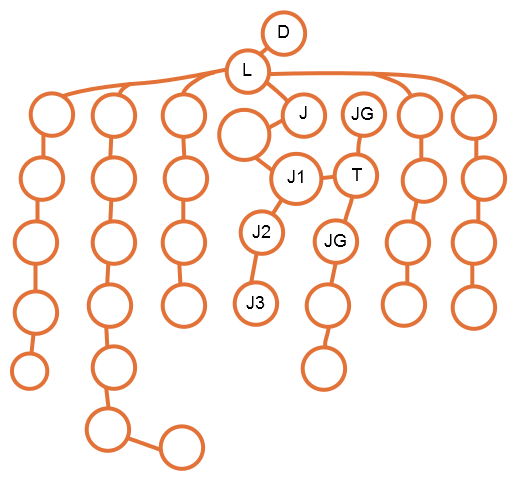
Whether Shua, the wife of Judah, accepted this unusual family constellation is not recorded in Genesis, but the revisor devised the following compact visual summary of the story which retains for Shuah the place of honour in the emotionally tangled Judah household. It appears in flow-chart fashion in the Morgan Beatus like this: 

Leah
I have left out the text and instead used letters to mark the characters. Here, J is Judah, J1 and J2 are his first and second sons Er and Onan, and T is Tamar. Her twin children are marked JG, since the text marks them as sons of Judah and ambo gemini. Having the two twins arrayed in symmetry either side of their mother is a neat trick.

Perhaps it was Maius himself, the scribe-scholar who was in charge of making M 644 at the Morgan Library in New York, who devised this little flow chart. The roundel intervening between J and J1 is Shua, Judah's wife.

This addition, thus arranged, is only found in one other manuscript of the diagram, that made 100 years later by Facundus for King Fernando and Queen Sancha of León.

The whole group in the above sketch is composed of the six sons and daughter Dinah (D) of Leah (L). Links to online views of the manuscripts can be found on my manuscripts page.

2012-04-14

Lambert's Liber Floridus

In what is now the far corner of north-west France, Lambert, a canon of the city Church of Our Lady in St Omer, completed in 1122 a richly illustrated compendium of mythical biology, history and religious knowledge. The Liber Floridus (book of flowers) belongs to the same genre as the Etymologies of Isidore of Seville, a compilation or florilegium or encyclopaedia of many sorts of information, all intended to bring delight. Isidore’s use of graphics had been primitive, but Lambert was a superb and imaginative graphic designer. One celebrated full-page spread, the Arbor Mala and Arbor Bona, is a compilation of vices and virtues. The Liber Floridus is bursting with clever, colourful graphic ideas. Its images of imaginary plants and strange animals in the bestiary section fascinate.

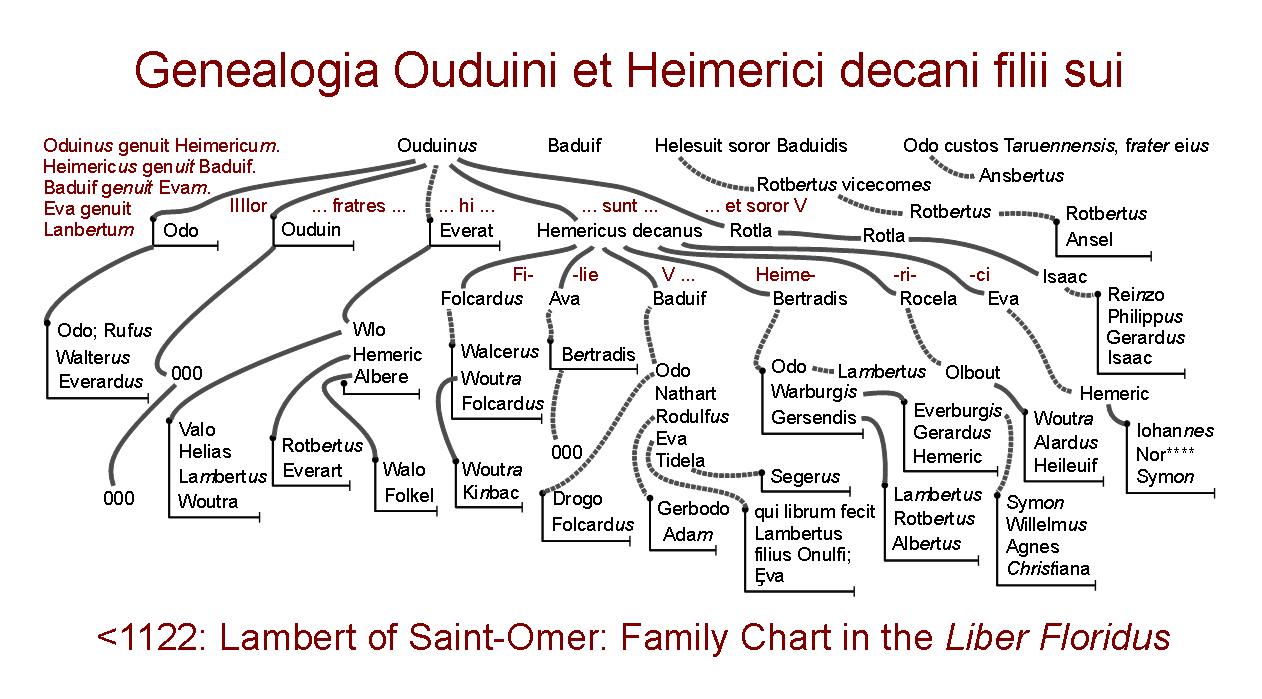
Lambert could also be conservative in his design choices. In his personal, autograph manuscript of the Liber Floridus, there is a stemma of Lambert’s maternal ancestors which goes back to his great-great-grandfather Odwin. It recalls the family names and birthdates which many British and American families wrote in the front of their family bibles in the 19th century, but Lambert decided to draw it in semi-stemmatic form, not as a simple list. As with the German imperial stemmata compiled in the previous century, Odwin is shown at the top, with the descendants splayed out below. Unlike the Great Stemma, there are no roundels. The individuals are grouped in short vertical lists of siblings. These tabulations of their forenames form family blocks. These tiny tables are connected by smooth or squiggly lines back to their parents and ultimately to Odwin. It is crowded and untidy, but it is striking that the designer of the Arbor Bona and Arbor Mala has presented his family with a simple stemma, not a tree. It has not been inverted and is not even pretending to be a tree.

Lambert of Saint-Omer's personal autograph copy, the original manuscript of the Liber Floridus, is in the University Library at Ghent, Belgium (ms. 92). Saint-Omer is a border town and this unique codex seems to have been taken to Belgium during the French Revolution for safe-keeping. Recently scans of this great treasure were placed on the internet. The digital version is a bit difficult to use, with no option for full-screen viewing that I can discover. One cannot download complete pages because the server sends them in the form of tiny tiles.

The diagram appears on folio 154r (use the navigation to go to the 30th page of results to see a zoomable version). Folio 154r has been moved to the very end of the current binding, but Albert Derolez, who has published the manuscript (Lamberti), suggests it may have originally been at the very beginning as a front flyleaf:
The first page lacks all ruling ... Was it Lambert's intention to leave it blank? In that case the leaf or the quire should originally have been placed at the front of the codex. (Autograph Manuscript, 180)

This would explain why it was not transferred into other copies: it was not seen as part of the body of text. Christiane Klapisch-Zuber briefly discusses the diagram on pages 94-96 of her L'Ombre des Ancêtres, and refers the reader to the editio princeps by Gysseling, whose entire discussion of the stemma in 1947 was limited to a single sentence:
C'est la seule généalogie que nous connaissons pour le moyen âge (exception faite des généalogies de vices, de vertus et de  ...., qui apparaissent plus ..... ). [some words illegible in my photocopy]

Derolez rearranged the diagram into a conventional modern printed descent "tree". Klapisch-Zuber tartly remarks that Derolez's graphic version "wildly displaces the generations and ends up being a lot less intelligible than the design in the original manuscript" (note 27, page 362). This is perhaps unfair to Derolez, but I can now present what I believe is the first ever graphic version which is faithful to the original layout, and which is machine readable to boot.

It can be better studied as a Flash page on my main website. I have followed the Derolez transcription, which as far as I know is actually the work of Gysseling. The italic letters are his readings of the scribal contractions. The dotted lines represent Lambert's squiggly lines, which I could not reproduce with OpenOffice Draw.

One oddity is that Lambert states there should be five "Heimerici" siblings but in fact shows six. There are two unidentified descendants at left (000 in my diagram) who are foreshadowed by lines but not given any names. At right is a name beginning Nor**** that was illegible. I am not sure if Drogo and Folcardus in the bottom row really are brothers: Lambert's diagram seems to suggest they are cousins. The awkward layout suggests the group at right might have been an afterthought or have been entered after much later family research, but perhaps the main design influence was a lack of space. Derolez, who seems to have found evidence that earlier script was scraped away, writes: "The lower part of the pedigree was afterwards rearranged in order to create more space for a text."

However the details of Lambert's genealogy are not the topic that interests us here, and I have left the genealogy as Gysseling and Derolez preferred it. It is the concept of the diagram that matters. It is practical, straight out of life, a little clumsy and unclear, but ultimately an intelligent presentation of 80 names in the most compact space.

I see no evidence for Klapisch-Zuber's speculation that Lambert may have been the inventor of this graphic design:
Toutes ces particularités laissent penser que Lambert a réinventé, ou interpreté de facon autonome, un type de schéma généalogique peut-être entrevue ice ou là... on est tenté de voir dans un schéma qu'il couche sur un page de son livre une invention autonome et sauve de toute influence immédiate. (L'Ombre, 96)

The more plausible view is that Lambert imitated other diagrams of "normal" families which he had seen, and that such diagrams were in relatively common use in the 12th century. Unfortunately, Lambert's is one of the few, perhaps the only surviving witness of this genre of document to remain in our archives from so early.
  • Derolez, Albert. Lamberti S. Audomari Canonici Liber Floridus. Ghent: Story-Scientia, 1968.
  • Derolez, Albert. The Autograph Manuscript of the Liber Floridus. Corpvs Christianorvm. Autographa Medii Aevi 4. Turnholt: Brepols, 1998.
  • Gysseling, Maurits. “Les plus anciennes Généalogies de Gens du Peuple dans les Pays-Bas Méridionaux.” Bulletin de la Commission Royale de Toponymie de Dialectologie 21 (1947): 212–215.

2012-04-05

Age of the World

At dinner tonight, my son brought up millenarian thinking, and we got onto the topic of 801 CE, which was thought (before it arrived) to be the likely date of the parousia, or beginning of the Seventh Age, or Second Coming of Christ. The author of that reckoning was of course Eusebius of Caesarea, who calculated the Incarnation as having occurred 5,199 years after the creation of the world. Eusebius disapproved of millenarians, but millenarians were happy to make use of Eusebius. Mediated through the Jerome of Stridon translation in Latin, that calculation seems to have been reproduced in Spain in the Ordo Annorum Mundi, which in its turn was reproduced in the very millenarian Apocalypse Commentary of Beatus of Liebana.

Something that has been dawning on me only this week is that the Ordo Annorum Mundi may not only have been a kind of cheat-sheet to read the Great Stemma with, but that sections of it have actually been interpolated into the Great Stemma. I had not paid much mind to this before. My Ordo Annorum Mundi page lists all the relevant text fragments. On the face of it, this may be rather dry, but it's rather like tracing Facebook likes. When you see where this reckoning shows up, you have a way of tracking what people like Beatus had been reading.

2012-03-31

Two Medieval Drawings

I have constructed vector diagrams of the two earliest known charts to describe the ancestry of living people and have converted these to Flash format and published them on the www.piggin.net website. Both of these medieval diagrams use the roundels and lines format which is familiar to us from the Great Stemma.
The first (follow the link) is a remarkable drawing with the shelfmark M 29880(6 in the Bavarian State Library in Munich. The original has been digitized, but my drawing is easier to read. The old MGH transcription has been deprived of the authentic graphic characteristics and converted into a standardized 19th-century stemma instead.
From the content and the script of this manuscript, it appears to have been drawn during the period when Cunigunde of Luxembourg was either queen of Germany or Roman empress, that is to say between 1002 and 1024. It displays her descent from Charlemagne, a fact which was evidently used by her as an argument to claim the office of empress.
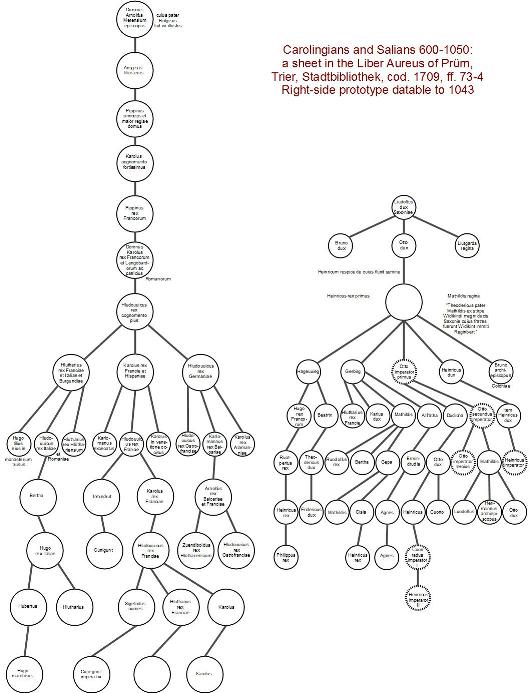
The second (below, but follow the link for my zoomable version) was drawn between 1101 and 1111 at the monastery of Pruem and bound into the Liber Aureus, a book of important Pruem documents. It is now in the city library of Trier, Germany, shelfmark 1709, folios 73-74, but is not online. In its left panel, it contains a variation of the first diagram described above. The diagram in the right panel contains a legal argument about consanguinity and has been dated by Nora Gädeke to 1043. This right section relates to the Ottonian and Salian dynasties who took control of the Western Roman Empire after the Carolingians, who form the left panel of this composite diagram:

2012-02-21

What Did Pelagius See?

Theodor Mommsen describes a paper manuscript which included the Liber Genealogus. Though he did not personally see it, he knew it was kept in the Escorial Library outside Madrid:
Ovetensis episcopus Pelagius (a. 1101 – 1129) corpori chronicorum suo, de quo in praefatione ad Isidoriana disputabimus, hunc librum inseruit inscriptum teste Ambrosio Morales (apud Florez – Risco Esp. sagr. vol. 38 p. 367): incipit genealogiae totius bibliothecae ex omnibus libris veteris novique testamenti. archetypum periit, extant apographa et in codice Matritensi bibl. nat. T 10 saec . XVII (Knust Archiv 8, 799) et in Escurialensi b I 9 chart. saec. XV teste Ewaldo (neues Archiv 6, 232), scilicet tractatus inscriptus ita: incipiunt genealogiae totius bibliothecae ex omnibus libris veteris novique testamenti descriptum; adnotatur: hic liber genealogiae fuit desumptus ex libro vetustissimo ecclesiae Ovetensis in membranis litteris goticis scripto et dicitur finire in Theodosio: videtur igitur similis fuisse nostri F.
The above is online at the digital MGH. It feels faintly irreverent to add hyperlinks to 19th-century Latin but I have done so, since the relevant page of Ambrosio Morales's account and tabulation in Espana Sagrada is online. Friedrich Heinrich Knust ( -1841) (biography) was a German scholar who visited archives in Spain, as did Ewald whose Reise nach Spanien im Winter von 1878 auf 1879 is also online.

As Mommsen says, the 12th-century original that was kept at Oviedo is gone for ever. Hardly any of the Escorial Library is online, so there is no point searching for images of this unique paper copy, but Antolín's catalogue is helpful.

This 12th-century copy of the Liber Genealogus seems to have been been inserted into Pelagius's Liber chronicorum. Rouse and McNelis think the final comment about "in membranis litteris goticis scripto" is by the 15th-century copyist in León, referring to Visigothic script. Or is it a note by Pelagius talking about a book that was old in his day?

It is not clear what manuscript is described in Knust's abstract ("einige Genealogien aus dem alten und neuen Testamente" in a 17th- or 18th-century codex at the Biblioteca Nacional in Madrid with the former call number T10). I did not find the Liber Genealogus listed in the other manuscripts there containing Pelagius's chronological work. There seem to be at least five manuscripts containing elements of Pelagius's Liber chronicorum at the library, including one that is a roundup with his Libro de los Testamentos de la catedral de Oviedo in Ms. 6957 (catalogue entry, warning, large PDF!). But in each case, the content at practically every folio is described, making it unlikely that the Liber Genealogus is in any gap and somehow overlooked.

The interest of the matter to me is of course: what else was lodged in the now-lost cathedral library at Oviedo in the days when Pelagius was in charge? We know the library contained the now-lost Gospel Book of Justus because Ambrosio de Morales saw it there. But did the library also contain a copy of the Great Stemma?

2012-02-20

Calahorra Bible

A first-ever online image of the Great Stemma in the Calahorra bible has finally shown up: it contains the opening spread only, but the polychrome array of colours is very impressive, despite the battered state of the codex. The image is for sale on Artflakes, but you'll have to click through yourself because I don't want to breach the photographer's copyright. The online sample is not in a good enough resolution to read the script, but I will be linking to it from my catalogue page. The photographer says the image also appears in a book published last December, Historia de Calahorra (Ed. Amigos de la Historia de Calahorra. December 2011. ISBN 978-84-939155-06). The 12th-century Biblia de Calahorra is kept in the Archivo Catedralicio y Diocesano de Calahorra. It's battered and it looks like it has suffered some water damage, but it's still there, a wonderful treasure. The Amigos (Facebook page) deserve all the help they can get to preserve the town's history, and of course every tourist visiting Spain helps in the economic recovery.

2012-01-22

Vetus Names

In her publication on the Great Stemma in 1984, Yolanta Zaluska asserted that all the existing recensions contained a mixture of Vetus Latina and Vulgate names:
Lé fond commun de la Vieille Latine est sensible dans tous les témoins consultés, mais à des degrés variés. Il est indiscutable que la Vulgate a été utilisée à plusieurs reprises tantôt pour corriger les lignées, tantôt pour compléter les textes explicatifs.
She characterized these differences as follows:
Recension α: ... texte mixte, en général très corrompu, disposé toujours sur quatorze tables; à partir d'Abraham (table VI), n'a presque pas été retouché sur la Vulgate.
Recension β: ... texte corrigé d'après la Vulgate, néanmoins dans l'ensemble assez corrompu, et fortement interpolé, en grande partie, semble-t-il, à l'aide des Etymologies d'Isidore; peut être commodément désigné comme une recension longue.
Recension σ transmise par le Beatus de Saint-Sever (S), apparaissant pour l'essentiel comme un texte de type α corrigé d'après la Vulgate, mais fournissant quand même des textes qui lui sont propres ...
Recension γ: ... texte ne montrant que des retouches occasionnelles d'après la Vulgate; partie caractéristique à la page des Juges; plusieurs omissions.
Recension δ: ... Le premier texte (Bible de San Millán de la Cogolla, Madrid) est probablement celui qui reflète le plus fidèlement la tradition de la Vieille Latine; le texte de [Bible de Calahorra] en revanche suit généralement la Vulgate, à partir d'Abraham; des interpolations communes dans la première partie du texte.
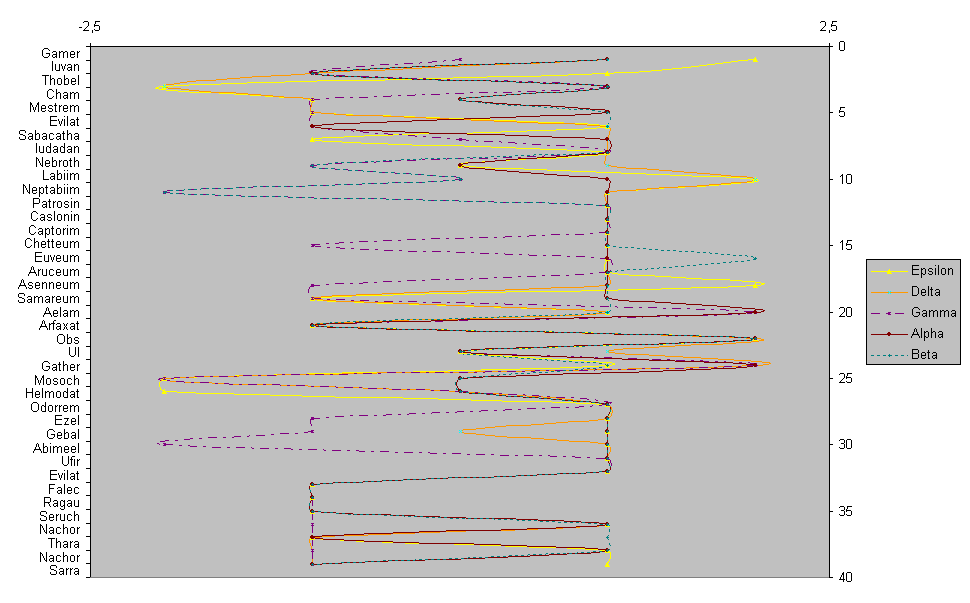
Zaluska never presented any statistical data or analysis to back up these characterizations, so I have done some sampling of my own. Below is a tabulation containing a rough scoring of 39 Genesis names from the period down to Abraham. I have included a recension, Epsilon, that Zaluska left out of account. I have not included Zaluska's Sigma in this survey.
The assessments are subjective, which is to say I judged the different spellings and rated how closely they resembled the Vetus Latina orthography (which is based on the Septuagint Greek). The scoring system offers a continuum between forms that show no influence from Jerome and forms that could only be corruptions of Jerome's orthography. This is not highly scientific, but it is a start. Here are the numerical values I employed:
  • -2 signifies an obviously LXX/Vetus form, but with extreme scribal deformation;
  • -1 is the pure LXX/Vetus type;
  • 0 means a name containing a consonant or vowel that uncertainly suggests the LXX/Vetus type;
  • +1 a name of Vulgate type;
  • +2 signified variants that are very unlike the Vetus but do resemble the Vulgate type
The columns, from left to right, represent Epsilon, Delta, Gamma, Alpha, Beta; the last three columns comprise Fischer's form of the Vetus name, the Clementine Vulgate form and the Stuttgart Vulgate form.

2 1 0 1 1 Gamer Gomer Gomer
1 -1 -1 -1 -1 Iuvan Iavan Javan
-2 -2 1 1 1 Thobel Tubal Thubal
-1 -1 -1 0 0 Cham Ham Ham
-1 -1 -1 1 1 Mestrem Mesraim Mesraim
1 1 -1 -1 1 Evilat Hevila Hevila
-1 1 0 1

Sabacatha Sabatacha Sabatacha
1 1 1 1 1 Iudadan Dadan Dadan
0 1 -1 0 -1 Nebroth Nemrod Nemrod
2 2 0 1 0 Labiim Laabim Laabim
1 1 -2 1 -2 Neptabiim Nepthuim Nephthuim
1 1 1 1 1 Patrosin Phetrusim Phetrusim
1 1 1 1 1 Caslonin Cesluim Chasluim
1 1 1 1 1 Captorim Capthurim


1 1 -1 1 1 Chetteum Ettheum Hethæum
1 1 1 1 2 Euveum Eveum Hevæum
1 1 1 1 1 Aruceum Araceum Aracæum
2 1 -1 1 1 Asenneum Sineum Sinæum
-1 -1 -1 1 1 Samareum Samariten Samaræum
1 1 2 2 1 Aelam Elam Ælam
-1 -1 -1 -1 -1 Arfaxat Arfaxad Arphaxad
2 2 2 2 2 Obs Us Us
0 1 0 0 0 Ul Hul Hul
1 2 2 2 1 Gather Gether Gether
-2 -2 -2 0 0 Mosoch Mes Mes
-2 0 0 0 0 Helmodat Helmodad Elmodad
1 1 1 1 1 Odorrem Aduram Adoram
1 1 -1 1 1 Ezel Uzal Uzal
1 0 -1 1 1 Gebal Ebal Ebal
1 1 -2 1 1 Abimeel Abimahel Abimaël
1 1 1 1 1 Ufir Ophir Ophir
1 1 1 1 1 Evilat Evila Hevila
-1 -1 -1 -1 -1 Falec Faleg Phaleg
-1 -1 -1 -1 -1 Ragau Reu Reu
-1 -1 -1 -1 -1 Seruch Sarug Sarug
1 1 -1 1 1 Nachor Nahor Nahor
-1 -1 -1 -1 1 Thara Thare Thare
1 -1 -1 1 1 Nachor Nahor Nahor
1 -1 -1 -1 -1 Sarra Sarai Sarai
This list has been filtered to only comprise 39 names in Genesis where there seems to be a distinction between the Vetus Latina and Vulgate forms.
Now it is striking that none of the five recensions above consistently follows the Vetus Latina type, which would be indicated by one of the columns consisting mostly of scores of -2 or -1.
When transcribing the manuscripts, my impression was that the concentration of Vetus Latina names was highest in Delta, but in this scoring, Delta has a median value of +0.3. In fact it is Gamma which is closest to the Vetus, with a median score of -0.2 . As for the rest, the medians are Epsilon +0.4, Alpha +0.5 and Beta +0.5.
I have converted the table to a graph below. If anyone can think of a more expressive graph, I would be glad to hear advice on how this could be presented in line with current methods.
It will be clear to the readers from both the table and from the graph that there is no obvious consistency in the way that medieval editors revised the five recensions. The variants swerve wildly to both sides. In this sample of names from Genesis, the data does not seem to support Zaluska's conclusion that Gamma contains "occasional retouchings" drawn from the Vulgate," whereas Delta is the "most faithful" to the Vetus Latina. If anything, Gamma is more faithful.
What can we say about the names from those parts of biblical history subsequent to Genesis?
We cannot expect to find any differences in the names from Christ back to the Exile, because these names only existed in the Greek manuscripts of the Gospels of Matthew and Luke and no Hebrew evidence for them exists. Jerome of Stridon did not alter their Latin transcriptions, so these names are invariant between the Vetus Latina and the Vulgate.
As for the names from the Exile back to Saul, we also cannot expect to find much significant variation. We do not yet possess scholarly editions of the Vetus Latina text of 1 Samuel, 2 Samuel, 1 Chronicles and 2 Chronicles, 1 Kings and 2 Kings (they will take several more decades to arrive). To fill the gap, I have instead collated the Septuagint forms, which were of course the basis for the Vetus Latina. The reader can construe the likely Latin transcriptions, and compare these to the Stuttgart Vulgate forms. The following selection shows that Jerome left the bulk of the pre-existing Latin forms pretty well unchanged.
Αχινααμ Ahinoem 1Sa 25:43, 2 Sa 3:2
Αβιγαιας Abigail 1Sa 25:42, 2Sa 3:3
Μααχα Maacha 2Sa 3:3
Αγγιθ Aggith 1Ch 3:2, 2Sa 3:4
Αβιταλ Abital 2Sa 3:4
Αιγλα Agla 2Sa 3:5
Βηρσαβεε Bethsabee 2Sa 11:3
Αμνων Amnon 2Sa 3:2
Δαλουια Chelaab 2Sa 3:2, 1Ch 3:1
Αβεσσαλωμ Absalom 2Sa 3:3
Ορνια Adonias 2Ch 3:4
Σαφατια Safathia 1Ch 3:3, 2Sa 3:4
Ιεθερααμ Iethraam 2Sa 3:5
Θημαρ Thamar 2Sa 13:1
Ιβααρ Ibaar 1Ch 3:6, 14:5, 2Sa 5:15
Ελισαε Elisama A 1Ch 14:5, 3:6, 2Sa 5:16
Ελιφαλετ Eliphalet / Helifeleth 1Ch 3:6, 14:5, 2Sa 5:16
Ναγε Noge 1Ch 3:7, 14:5
Ναφαγ Napheg / Nepheg 1Ch 3:7, 14:5, 2Sa 5:15
Ιανουε / Ιανουου Iaphie 1Ch 3:7, 14:5, 2Sa 5:15
Ελισαμα / Ελισαμαε Elisama B 1Ch 3:8, 14:5
Ελιαδα Helida / Heliade 1Ch 3:8, 14:5, 2Sa 5:16
Ελιφαλετ Eliphalet / Helisua 1Ch 3:8, 14:5, 2Sa 5:15
Σαμμους Samua 2Sa 5:14
Σωβαβ Sobab 2Sa 5:14
Σαλωμων Salomon Mt 1:6, 2Sa 5:14


Ιεροβοαμ / Ναβατ Hieroboam 1Kgs 11:26
Ναδαβ Nadab 1Kgs 15:25
Βαασα / Αχια Baasa filius Ahia 1Kgs 15:33
Ηλα Hela filius Baasa 1Kgs 16:8-16
Ζαμβρι Zamri 1Kgs 16:9
Θαμνι / Γωναθ Thebni filium Gineth 1Kgs 16:21
Αχααβ / Αμβρι· Ahab filius Amri 1Kgs 16:29
Ιεζαβελ Hiezabel 1Kgs 16:31
Οχοζιας Ohozias 1Kgs 22:40
Ιωραμ / Αχααβ Ioram filius Ahab 2Kgs 3:1, 1Kgs 22:50
Ιου / Ναμεσσι Hieu filius Namsi 1Kgs 19:16, 2Chr 22:7
Ιωαχας Ioachaz 2Kgs 10:35
Ιωας Ioas filius Ioachaz 2Kgs 13:10
Ιεροβοαμ Hieroboam 2Kgs 13:13
Ζαχαριας Zaccharias filius Hieroboam 2Kgs 15:8
Σελλουμ / Ιαβις Sellum filius Iabes 2Kgs 15:13
Μαναημ / Γαδδι Manahem filius Gaddi 2Kgs 15:14
Φακεϊας Phaceia filius Manahem 2Kgs 15:23
Φακεε / Ρομελιου Phacee filius Romeliae 2Kgs 15:25
Ωσηε / Ηλα Osee filius Hela 2Kgs 17:1
As luck would have it, where differences do occur in the above list, it is not always easy to see a pattern in the Great Stemma's uptake of the forms. First of all we find certain odd distortions. The first Elisama, for example, appears not as Elisae, but as Elisbe. Secondly, some of the variations completely contradict Zaluska's generalizations: Zambri with a B appears in three recensions (Epsilon, Alpha, Beta), but has been "corrected" to Jerome's Zamri without a B in Delta and Gamma, which are normally the most conservative texts.
Zaluska's assertion that the balance in Alpha swung, after Abraham, to almost pure Vetus Latina forms is therefore interesting and provocative, but needs to be treated with a certain amount of caution. My guess is that her generalization was in fact largely argued from her very perceptive analysis of the Horrite names in Genesis 36. I wrote a survey of these in 2010 where I tabulated the names and provided the proof that is missing from her article, though implied. The differences among the Horrite names between Alpha and Beta are especially striking and this section of the collation is crucial in proving that the Great Stemma is indeed drawn from a Vetus Latina tradition.
I have not yet studied the Vetus/Vulgate distribution of the names making up the Twelve Tribes of Israel: it would be interesting to follow this up at a later time.
In conclusion, I would say this. The Great Stemma and the Liber Genealogus were clearly originally written in a time and place where Jerome's Vulgate was not available and were then haphazardly modified by medieval editors. But the process of modification was not as simple or as linear as Zaluska suggests, and her conclusions are too sweeping. The Great Stemma manuscripts are anything but unambiguous evidence for the onomastics of the Vetus Latina. Bonifatius Fischer was correct to collate the Great Stemma from four Spanish bibles as a somewhat compromised source, while treating it with the greatest of caution.

Footnote: there is a further discussion of this issue a couple of years later: http://macrotypography.blogspot.com/2014/04/the-old-latin.html

2011-11-20

Rufinus

Regular readers of this blog will recall that the Great Stemma is a graphic argument that the contradictory genealogies of Christ could be reconciled if one were to introduce an extra link into the chain of Christ's maternal ancestry. This extra link, Joachim, is presented as father of the Virgin. There is a however a curious adaptation of the diagram, the Lesser Stemma, which rejects this argumentation and asserts that the better solution is the one proposed (in Greek) by Julius Africanus in his Letter to Aristides. The Africanus theory can be summarized this way: the Gospel of Matthew gives Christ's biological ancestry through Joseph, whereas the Gospel of Luke gives a legal ancestry of Joseph in consequence of a special Jewish form of adoption. Obviously Africanus was not concerned here to rule out a biological role for Joseph in the procreation of Jesus.

It has taken me some time to study the Lesser Stemma more closely. One of the critical questions in the course of this analysis was where its editor had obtained his textual commentary from. The final page, 8v, contains the familiar Great Stemma statement:
Sicut Lucas evangelista per Nathan ad Mariam originem ducit, ita et Matheus ev(an)glista per Salomonem ad Ioseph originem demonstrat. Id est de tribu Iuda, ut appareat eos de una tribu exire, et sic ad Christum secundum carnem pervenire. Ut compleatur quod scriptum est: "Ecce vicit leo de tribu Iuda radix David," leo ex Salomone, radix ex Nathan.
But in a radical reversal of meaning, the Lesser Stemma bolts on to this a core statement from Julius Africanus. The following is my transcription of this from the Burgos Bible (the layout of the pages is tabulated on my website):
Ut clarius fiat, quod dicitur: ipsarum generationum consequentias enarravimus.
A David generatio per Salomonem, quam dinumerat Matheus, tercium a fine facit Mathan, qui dicitur genuisse Iacob patrem Ioseph. Per Nathan vero Lucas generationum ordinem texens, tercium nichilominus eiusdem loci facit Melchi. Nobis imminet ostendere, quomodo Ioseph dicitur secundum Matheum quidem patrem habuisse Iacob, qui inducitur per Salomone: secundum Lucham vero Heli qui ducitur per Nathan, atque ipsi, id est Heli et Iacob, qui erant duo fratres, habentes alius quidem Mathan, alius quidem Melchi patres ex diverso genere venientes, etiam ipsi Ioseph avi esse videantur.
Est ergo modus Mathan et Melchi de una eadem que uxore Hesta nomine diversis temporibus singulos filios procrearunt, quia Mathan, qui per Salomonem descendit, uxorem eam primus acceperat et relicto uno filio Iacob nomine defunctus est. Post cuius obitum, Me[l]chi qui Nathan genus ducit. cum esset ex eadem tribu, ex eadem tribu[sic], relictam Mathan accepit uxorem ex qua et ipse suscepit filium nomine Heli per quod ex diverso patrum genere efficiuntur Iacob et Heli iterini fratres quorum alter, id est Iacob, fratris Heli sine liberis defuncti uxorem ex mandato legis accipiens genuit Ioseph natura quidem germinis suum filium, propter quod scribitur Iacob autem genuit Ioseph: secundum legis vero praeceptum Heli efficitur filius, cuius lacob qui erat filius Mathan uxorem ad suscitandum fratris semen acceperat et per hoc rata invenitur atque integra generatio et tan, quam Matheus enumerat, et tan, quam Lucas competenti [?]ione designat.

I soon found that the above Latin text comes from one of the early translations of the Letter to Aristides. This was produced in the early years of the 5th century (perhaps 402 or 403) by Rufinus of Aquileia (see Christophe Guignard, La Lettre de Julius Africanus à Aristide sur la Généalogie du Christ, 2011, p. 24 ff. for a discussion). With a good text of Rufinus (the passage is numbered 1.7.5-11), I was also able to unlock most of the manuscript abbreviations and correct my transcription at places where I had not initially been able to make out the script.
Here is George Salmon's translation of the same passage of Africanus, which has been put into first-person speech though this is not necessarily required by the Africanus text:
But in order that what I have said may be made evident, I shall explain the interchange of the generations. If we reckon the generations from David through Solomon, Matthan is found to be the third from the end, who begat Jacob the father of Joseph. But if, with Luke, we reckon them from Nathan the son of David, in like manner the third from the end is Melchi, whose son was Heli the father of Joseph. For Joseph was the son of Heli, the son of Melchi. As Joseph, therefore, is the object proposed to us, we have to show how it is that each is represented as his father, both Jacob as descending from Solomon, and Heli as descending from Nathan: first, how these two, Jacob and Heli, were brothers; and then also how the fathers of these, Matthan and Melchi, being of different families, are shown to be the grandfathers of Joseph. Well, then, Matthan and Melchi, having taken the same woman to wife in succession, begat children who were uterine brothers, as the law did not prevent a widow, whether such by divorce or by the death of her husband, from marrying another. By Estha, then—for such is her name according to tradition—Matthan first, the descendant of Solomon, begets Jacob; and on Matthan’s death, Melchi, who traces his descent back to Nathan, being of the same tribe but of another family, having married her, as has been already said, had a son Heli. Thus, then, we shall find Jacob and Heli uterine brothers, though of different families. And of these, the one Jacob having taken the wife of his brother Heli, who died childless, begat by her the third, Joseph—his son by nature and by account. Whence also it is written, “And Jacob begat Joseph.” But according to law he was the son of Heli, for Jacob his brother raised up seed to him. Wherefore also the genealogy deduced through him will not be made void, which the Evangelist Matthew in his enumeration gives thus: “And Jacob begat Joseph.” But Luke, on the other hand, says, “Who was the son, as was supposed (for this, too, he adds), of Joseph ..."
The Letter to Aristides was transported to the West as part of Rufinus's Latin translation of the Ecclesiastical History of Eusebius of Caesarea. Plainly this explanation of the gospel contradiction was popular and formerly in wide circulation. Mommsen discovered 90 extant manuscripts of this work of Rufinus in the late 19th century, according to Dr Guignard.
If the passage was already in current use in the 5th century, it would not be surprising that a partisan should have taken it up and used it to modify the Great Stemma to bring it into harmony with the contentions of Africanus, Eusebius and Rufinus, and at the same time to repel the Joachim theory, which is based on an apocryphal text, the Protevangelium of James.

The Lesser Stemma is however not completely faithful to Africanus, who omits two names (Matthat and Levi) between Joseph's father Heli and the more senior Melchi. At least as present in the Burgos Bible, the Lesser Stemma restores these names, but it does so in a non-orthodox order: it muddles the order of Melchi-Levi-Matthat and presents this as Levi-Macham-Melchi.

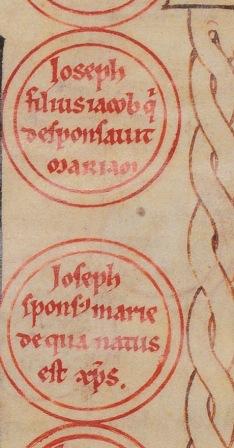
The greatest oddity of this text is that it contradicts the drawing alongside it. In the Burgos Bible, both genealogies clearly terminate at Joseph. In the image at right, the upper roundel (Joseph filius Iacob qui desponsavit Mariam) is the terminus of the Matthaean genealogy, and the lower roundel (Joseph sponsus Marie de qua natus est Christus) is the terminus of the Lucan genealogy. Yet the text retains the notion from the Great Stemma that the Lucan genealogy should end at Mary. This is an odd situation; I cannot at present see any coherent explanation for it.