Showing posts with label Stemma. Show all posts

2011-10-31

Visions

I continue to search in vain for a scholarly exploration of data visualization in Antiquity. There is no doubt that Graeco-Roman graphics are getting far more attention these days than ever before, but so far that attention has been focussed on other areas.

1. Mathematical diagrams are getting close attention, as Reviel Netz notes in The Archimedes Codex:
The scholars who edited mathematical texts in the nineteenth century were so interested in the words that they ignored the images. If you open an edition from that era, the diagrams you find are not based upon what is actually drawn in the original manuscripts. The diagrams represent, instead, the editor's own drawing. I was shocked to realize that and began to consider: should I produce, for the first time, an edition of the diagrams? (p. 30).
2. Illustrations of texts have been re-assessed in many new ways, with the works of Kurt Weitzmann a half-century ago, Late antique and early Christian book illumination and Illustrations in roll and codex marking a starting point. I recently browsed through John Williams' Imaging the early medieval Bible (1999), which revises some of Weitzmann's ideas, and of course there are the more recent books of Jocelyn Penny Small, The Parallel Worlds of Classical Art and Text (2003), and of Michael Squire, Image and Text in Graeco-Roman Antiquity (2011), which debate whether book illustration was ever meant to depict what was in the text at all. But all of these books deal with the interplay between stories and pictures of people doing things.

3. Mental pictures of abstract matters are discussed in Mary Carruthers' books, particularly The Craft of Thought (1998), which explores the patristic and Roman Republican models of the medieval 'craft of memory' and thus casts some light on the place of visualizations in Late Antiquity:
Whereas ekphrasis always purports to be a meditative description of a painting, sculpture or the facade of a building, the initiating compositional pictura can also describe a schematized landscape in the form of a world map, or a figure like Lady Philosophy, or just about any of the formae mentis in common monastic use: a ladder, a tree, rotae, a rose-diagram. The rhetorical figures called ekphrasis and Bildeinsatz, in other words, are types of the cognitive, dispositive topos called pictura, which is the more general term. The most general terms of all for this cognitive instrument would include words like ratio and schema. (p. 200)

So visualizing things was a good way to start explaining them. However Carruthers is concerned with inner pictures, so her books yield very little about the ways that a real diagram or map could be employed for meditation or how it might be designed.

4. Small's other book, Wax Tablets of the Mind: Cognitive Studies of Memory and Literacy in Classical Antiquity (1997), explores the ways in which text could be said to visualize what was going on in people's heads, but once again does not deal with data visualization. Anna Catharina Esmeijer's Divina Quaternitas: a preliminary study in the method and application of visual exegesis tackles some of the same issues, but is of course mainly concerned with rather simple figures, not the complex abstraction of the Great Stemma.

Now obviously I have missed from this list a great many other learned books and articles. Many are listed on the further reading page of my website. But nowhere have I found a book or an article that goes to the heart of the issue. How the Latin writer could present mere words and numbers so pregnantly on the page so that the mere arrangement gave food for thought.

2011-09-26

For Medievalists

Dr Nathaniel Taylor has published a very acute news summary on the RootsWeb Gen-Medieval news list of what is new in Great Stemma research as a result of the Oxford Patristics presentation. He offers this succinct summary:
Jean-Baptiste Piggin has now convincingly shown the whole to derive from a single long scroll of Late-Antique origin, likely 4th century, which he has named the 'great stemma'. All existing copies come through a (lost) early Visigothic intermediary in which the scroll was copied into a series of folio pages in codex form, but the process of reducing the scroll format to sequential pages introduced various errors and subsequent recensions degraded the logic of the original in ways Piggin has been able to trace.
Nat also wrote up my website's findings last year on the same list:
These biblical genealogical stemmata are now the subject of a fantastic set of analytical webpages by Jean-Baptiste Piggin. His page cited below is a table with links to many online images of the tables of biblical kinship found in the Beatus manuscripts and 10th-century Spanish bibles, as well as the Codice de Roda ...

2011-09-18

Miraculous Birds

Rudolf Wittkower offers the following English translation of the Bird and Serpent text which accompanies many copies of the Great Stemma. It seems worth bringing it online in a searchable, copiable format:
It is maintained that there is a bird in a country of the Orient which, armed with a large and very sharp beak, provokes the snake which he wants to fight with audacious hissing. He covers himself purposely with dirt and also covers the pearls of different colours with which nature has lavishly adorned him. Having thus given himself an insignificant appearance he surprises the enemy by this unfamiliar impression and deceives him, so to speak, by the security which the latter feels in front of his shabby appearance. Holding his tail as a shield in the manner of a warrior before his face, he boldly attacks the head of his furious adversary, pierces the brain of the surprised beast with the unexpected weapon of his beak and thus kills his monstrous enemy by his marvellous intelligence.
Christ girded himself with human weakness and enveloped himself with the dirt of our flesh to fight in the shape of man for the benefit of salvation and to deceive the godless deceiver with pious fraud, and he concealed his former shape with the latter, throwing, as it were, the tail of his humanity before the face of divinity, and extinguished as if with a strong beak the poisonous malice of the old murderer of men through the word of his mouth. Therefore the Apostle says: Through the word of his mouth he will kill the wicked.
From: Rudolph Wittkower. 'Miraculous Birds.' Journal of the Warburg Institute (1938), Volume 1, Issue 3, pages 253-257. DOI: 10.2307/750013 http://www.jstor.org/stable/750013. Wittkower probably intended the last phrase to be "the sword of his mouth," but this has been spoiled by an officious proof-reader. The biblical text referred to is Revelation 2:16.

The text has a French translation in: Bord, Lucien-Jean, and Piotr Skubiszewski. L’image de Babylone aux serpents dans les Beatus: Contribution à l’étude des influences du Proche-Orient antique dans l’art du haut Moyen Age. Paris: Cariscript, 2000.

Wittkower and Neuss located the image in five Beatus manuscripts: three of them alongside Alpha recensions of the Great Stemma (Gerona, Turin, Manchester). The others were Urgell (Gamma) and Saint-Sever (Sigma). The image, without the text, is also found near a Great Stemma, in a biblical Delta manuscript, the San Millàn Bible, spread across two pages.

The Rylands version of the image in Manchester is online. Moleiro has a watermarked version of the Gerona image online. The French website Encylopedie Universelle reproduces a detail of the same (about 975, folio 18v). It also has a relatively large image from the Saint-Sever Beatus (about 1060, folio 13). Turin and Urgell are not imaged online as far as I know.

The Latin, as transcribed by Wilhelm Neuss, is as follows:
Quedam esse avis in regione orietentalis asseritur, quae grandi et perduro armatoque rostro contra draconem quem audacibus lacessit sibilis pugnaturam coenum de industria expetit, e cuius volutabro teiro habitu infecta sordescit et diversorum gernmas colorum quibus eam indulgentiam natura depinxit. Et humili despecta vestitu ita hostem novitate deterreat et quasi vilitatis suae securitate decipiat. Caudam velut scutum ante faciem suam quadam arte bellatoris opponit audaci impetu in capud adversarii furentis adsurgit, improviso oris sui telo stupentis bestiae cerebrum fodit, et sic mirae calliditatis ingenio immanem prosternit inimicum.
Informa hominis pugnaturus ad militiam salutis publicae humana se infirmitate praecinxit ac luto se nostrae carnis involvit ut impium deceptorem pia fraude deciperet, et postremis priora celavit ac velut caudam humanitatis ante faciem divinitatis objecit, et tamquam rostro fortissimo venenatam veteris homicidae malitiam verbo sui oris extinxit. Unde et apostolus dicit: verbo oris sui interficiet impium.

2011-08-23

Office Buildings

I have already described my presentation in Berlin on August 18 to the German chapter of the Society for News Design (report).

It was curious that my host there brought along some images of extremely disciplined trees: persons represented by rectangles, each generation rigidly parked in its own storey, rather like an office building. This fierce axial character contrasts with the much looser attitude to space of the Great Stemma author. Late Antique stemmata are really about paths through space, and are not at all like grids.

2011-08-11

Oxford Patristics Conference

I've done the presentation at last of the Great Stemma, to a qualified audience at the Oxford Patristics Conference today, followed by fruitful chats with three leading professors with close knowledge of the issues it raises. There were about 50 people at the session. After all these years of speaking, it still feels a bit strange to have an audience staring at you, seemingly unresponsive, though they are actually busy mentally processing what you say. They were great, and it was a kind of out-of-nowhere topic. Conference participants who had been told about it in advance were prepared, and said encouraging things afterwards. There was even a little murmer of laughter when I suggested the Great Stemma was like a PowerPoint slide. Thanks for being a great audience!

2011-07-22

Liber Genealogus Text

Just in time for the Oxford Patristics Conference, I have completed a new, structured edition of the Liber Genealogus and published it online here: www.piggin.net/stemmahist/libertext.htm.
Last summer I wasted a couple of weeks marking up a different recension of the Liber, that of Turin, in the mistaken belief that it was the earliest. This time I seem to have tracked down the recension that is truly the first, that of St Gall. It contains a subscription indicating it was written in 427 CE. I have keyed the transcript to the pages of the St Gall manuscript (I will make these hotlinks when it comes online). The manuscript page numbers begin with 299 (this particular codex is numbered by pages, not by folios). I have placed the etymological glosses in a column of their own at the right, which helps to make clearer how the author worked as he read his data from the Great Stemma diagram. The numbering is Mommsen's. It breaks the text into sections of wildly varying size, and I find it illogical, but it has been established as authoritative. Perhaps we can devise a better numbering system in the future.

2011-07-08

Oxford Patristics Conference

Here is the Oxford Patristics Conference web announcement of my paper to be delivered August 11: The Great Stemma: A Late Antique diagram of Christ's descent from Adam. They have put me in Room 10 at the Examination Rooms among the communications taking place on the Thursday on Art. I'm looking forward to it a lot.

2011-06-06

Reconstruction

A first reconstruction of the Great Stemma is complete. This has been accomplished using OpenOffice Draw, separating the various elements into approximately 10 layers. The reconstruction will be issued at the Oxford Patristics Conference in August.

2011-05-27

At the Oxford Patristics Conference

I have been accepted to present a paper on the Great Stemma at the Oxford Patristics Conference which takes place in England August 8-12. The paper will be a short communication delivered during one of the parallel sessions when participants can divide up according to the area that interests them.

Here is my abstract (I think I am allowed to publish this, though the paper itself is under wraps until delivery):

The annotated diagram which spans eight folios of Florence Laurenziana Plutei 20.54, ff 38r-45v is demonstrably Late Antique in origin. This little-studied Latin work, partly published by Wilhelm Neuss and Bonifatius Fischer, presents a genealogy from Adam to Christ. It is also found in a cluster of Spanish bibles and the Apocalypse commentary of Beatus of Liébana. The anonymous author worked entirely from the Vetus Latina rather than from Jerome's Vulgate. We can study how a Late Antique author used complex graphics in place of prose to include a non-canonical figure, Joachim, as father of the Virgin within the genealogy of Christ. He structured the diagram around a timeline based on Eusebius's Chronological Canons. The paper will present a reconstruction of the diagram's archetype, arguing that it was originally a chart displaying synchronisms between scripture and history. It suggests that information graphics were a tool in early Christian literature.

2011-04-10

Liber Genealogus

A 9,000-word study of the links between the Liber Genealogus and the Great Stemma more or less completes my detailed research into the oldest stemma diagram known. I have just placed this new article online. I do not pretend it offers any great amusement: it is rather dry stuff. But we need the detail to assemble the case that the Liber is the textual account of someone who had read the Stemma, or something like it. I don't think many people read the Liber Genealogus: it is difficult to see what use it ever was to any reader. Mommsen's edition of the Liber does not help the contemporary reader much either. It is not particularly easy to use, given that the composite Mommsen text overlays the original G recension with material from the Origo Humani Generis and a lot of Donatist disputation. It might have almost been easier for me to just read a manuscript. Unfortunately, the best and oldest one is not online. The excellent Swiss e-codices project has not yet digitized Cod. Sang. 133, which contains the G recension dating from the late 8th or early 9th century. That is quite impressive: this codex was penned less than 400 years after the Liber Genealogus was written in 427. In the absence of this much-needed digital work, one can only consult Plutei 20.54 in Florence, which contains the inferior F recension. This is in fact the same codex that contains the most primitive form of the Great Stemma.

2011-03-08

New Revisions

So we now have two new pages on the site: one deals in more detail with Eusebius and the likely debt of the Great Stemma to his Chronological Canons. The other explores in more detail the oddities of the Ordo Romanorum Regum. I have also fully revised the bibliography to make it more comprehensive.

2011-02-17

Ordo Annorum Mundi

A new page, dealing with the Ordo Annorum Mundi, has now been placed on the Macro-Typography website. It seems to me that the OAM may be a piece of writing by the Great Stemma's author, but I am still looking for the killer evidence. The OAM seems to appear only in Iberian-origin manuscripts, but has achieved wider diffusion through its incorporation in the Commentary on the Apocalypse of Beatus of Liebana.

Note added in August 2012: No killer evidence found. It seems more than likely that the Ordo Annorum Mundi is not by the Great Stemma author, who probably worked from a chronology drafted by Hippolytus of Rome. However the OAM's history seems intimately entwined with that of the diagram. It could well be the work of someone who revised and altered the diagram at a later stage, altering it to reflect a chronology of world history computed by Eusebius of Caesarea. Professor José Carlos Martín of the University of Salamanca will soon be issuing an editio princeps of the Ordo Annorum Mundi, and we are keenly awaiting this important publication.

2010-12-27

Statistics

I've recently completed collating the fifth and last recension of the Great Stemma, found in the Urgell and San Juan manuscripts and it has gone online, along with an expanded bibliography of about 100 works. The collation of the manuscripts has been fairly tedious work and I think I'll stop here. I don't think it would achieve much if I transcribed the Saint-Sever (Sigma) manuscript, and the only other document I am at all curious about at this stage is the one in the Codex Amiatinus III. Perhaps I'll do it later.

It's time for a few statistics now that we have collated all five early recensions of the Great Stemma. Here are the tallies of genealogical roundels for the ancestry of Christ (A), other biblical figures such as Moses and Saul (B) and lone kings (C) with a subtotal of A+B+C.

All versions include about 114 sections of timeline material, of which 44 to 48 sections take the form of roundels. Adding these into the tally brings us to a grand total of roundels for each recension noted in the final row below:


EpsilonDeltaGammaAlphaBeta
A390380379396406
B8378778183
C1919181919
subtotal492477474496508
all roundels540521516542555
In general, the colums to the left tell us the most about the Great Stemma as it existed in Late Antiquity and those at the right measure what changes later editors made to the document, both losing data and adding material. These numbers are surprising in various ways.

For one thing, it turns out the Zaluska's estimated total of about 600 roundels, presumably based on her transcription of the Saint-Sever stemma, is somewhat deceptive. The Late Antique version probably only contained the 540 roundels in Epsilon. The higher tallies come from interpolated versions, of which Saint-Sever (not tallied here) is certainly the biggest.

We also see that despite the rearrangements in structure, the compressions, the many Vulgate-based alterations in the text and the extensive interpolation of material from Isidore, Jerome and others, the Great Stemma remained remarkably constant in its underlying scale during hundreds of years of copying.

Another implication is that the Urgell manuscript, which looks unfinished because of all its empty roundels, is in fact more complete than it seems: the scribe was careless and left out a dozen individuals, but he clearly also drew far more roundels than he ultimately needed. And after supplementing the Gamma collation with material from the San Juan bible, we can see that the Gamma total is only a score or so short of the full muster.

2010-11-30

Mount Seir

I have completed one of the more obscure analyses of the Great Stemma: a tabulation of the passage dealing with the chieftains of Mount Seir. These are outland people mentioned in Genesis 36 and are not part of the stated ancestry of Christ. We cannot even begin to guess why they were included in the Great Stemma. Interesting sounding names? To fill a blank area of the page? To prove that the author had read Genesis exhaustively? We just don't know. Your guess is as good as mine. Zaluska thought it was of great importance, but never published her own tabulation. I have filled the gap.
In all honesty, this tabulation is not going to make history, but as a piece of utilitarian work, it positions us for further analysis. The passage is the key proposed by Zaluska to identifying the different recensions of the Great Stemma. It is also important in demonstrating that the Epsilon version (not studied by Zaluska) is the oldest and purest that we have got.

2010-11-29

Intriguing Lead

This post has been superseded. Further investigation showed the intriguing lead led nowhere.
The Bibliotheca Belgica Manuscripta by Anton Sander, a listing of Belgian manuscripts sighted in or before 1640, contains an intriguing lead at page 215: in a codex which unites a variety of short genealogical works, there is one item described as a Genealogia ab Adam usque ad Christum, and another described as a Genealogia ab Adam usque ad Gedeonem. There is no note to say that these genealogies are in table form, but their owner must have had an interest in graphic stemmata, since another item in the volume is Boccaccio's Genealogia Deorum, which often contained Boccaccio's 14th century stemmata. *

What is particularly interesting about the second genealogy (Adam-Gedeon) is that Gedeon is neither a figure in Christ's ancestry, nor, as far I know, does he figure in the bogus medieval ancestries of the European nobility. What is he doing in a genealogy? A glance at the 10th page of Plutei 20.54 in Florence suggests a possible answer. Gedeon is the penultimate item on the fifth out of eight sheets. The Tournai codex, which seems to be a grab-bag of thieved and salvaged fragments, might have contained an incomplete Epsilon manuscript where the last three sheets that cover the period from David to Christ had been lost.

After 370 years, this codex probably no longer exists. Sander saw it in Tournai Cathedral Library.** It had been left to the library by Denis de Villers, who seems to have been chancellor of the diocese (I'm not fully clear about the ecclesiastical offices in this period).*** Tournai and its cultural treasures were bombed by the Luftwaffe in 1940, and much was lost (pictures).

How do we discover the fate of the genealogy codex? The Bibliothecae Cathedralis Ecclesiae Tornacensis now has a weblink, but this codex is not listed. I searched for "Genealogia ab Adam..." and a selection of the other partworks in In Principio, the Brepols database of incipits, but found no promising leads. Where else should I look? Has anybody analysed Sander's work and established, codex by codex, what happened to the various manuscripts?

* Sander's book was published by Insulis, Ex officina Tussani le Clercq, apparently a printer at Lille in France.
** Sander describes the legacy thus: codices Mss. qui sunt in bibliotheca reverendi Domini Hieronymi de Winghe canonici Tornacensis, nunc in bibliotheca publica eccelsiae cathedralis solerte studio et cura R.D. Ioannis Baptistae Stratii decani et donationibus clarissimorum viriorum Hieronymi Winghii, Dionysii Villerii, ac Claudii Dausqueii, eiusdem ecclesiae canonicorum inchoata et luculenta editorum voluminum supellectile instructa.
*** Samaran, Ch. 'La Chronique latine inédite', says Denis de Villers (1546-1620) was a literary man of Tournai, versed in genealogy and numismatics, who held a doctorate in canon law from Louvain University. He and canon Jerome van Winghe founded the cathedral library which is now the Tournai public library (catalog) (article in Bibliothèque de l'école des chartes (1926), 87,144, note 3). There is a more substantial 2004 article by Claude Sorgeloos on de Villers' book collecting here and note 9 says most of de Villers' books were destroyed in the bombardment in 1940. However some had been moved to Mons (catalog) and Courtrai (catalog) and were saved, and one of de Villers' books from Tournai later ended up in the hands of Sir Thomas Phillipps, so perhaps we should also check records of the Phillipps auctions.

2010-11-13

Translation Finished

Another marker passed: the translation of the Great Stemma into English is complete. Bar a few unintelligible passages where I may have messed up the transcription, the publication is now fully bilingual. Seumas Macdonald of Sydney took charge of putting 30 of the most difficult passages into English. With the text getting so long, I have now split the collation into four sections:
  1. The Genealogy of Christ
  2. Other Genealogies
  3. The Timeline
  4. The Interpolations
The latter section emerged as a separate entity during the recent research into where the many glosses had come from. It turns out that most are almost verbatim quotes from works of Isidore of Seville or from Jerome's Vulgate text. The only text where a clear attribution is not possible is the apocalyptic prediction about the defeat of evil and the coming of the Seventh Age which has been inserted into the Plutei manuscript. For the time being I am leaving out the mappamundi text, since its separate history remains unclear.

2010-11-06

Decoding the San Millán Manuscript

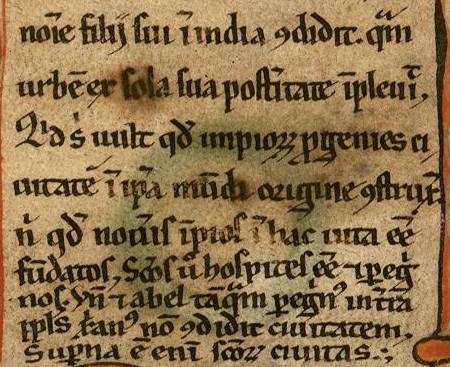
A tricky decoding job with the San Millán stemma seems almost complete, thanks to Brepols and their Library of Latin Texts (LLTA), an online database of Latin. Here is an image of the text:
My first transcription of this gloss about the secular city built by Cain turned out to be nonsense, but I was fortunate to find that the bulk of the text was simply borrowed from a theological exposition by Isidore of Seville, the Mysticorum expositiones sacramentorum seu Quaestiones in Uetus Testamentum. This is easily found in the LLTA: Quid ergo sibi per figuram vult, quod impiorum progenies civitatem in ipsa mundi origine construxit? nisi quod noveris impios in hac vita esse fundatos, sanctos vero hospites esse et peregrinos. Unde et Abel tanquam peregrinus in terris, id est, populus Christianus non condidit civitatem. Superna enim est sanctorum civitas (In Genesim, 6).
That allows us to transcribe the script as follows: Primus ante diluvium Cain civitatem Enoch nomine filii sui in India condidit quam urbem ex sola sua posteritate in plevit, quod sibi vult, quod impiorum progenies civitatem in ipsa mundi origine construxit? nisi quod noveris impios in hac vita esse fundatos, sanctos vero hospites esse et peregrinos. Unde et Abel tamquam peregrinus in terra populus Christianus non condidit civitatem; superna enim est sanctorum civitas.
As a result we can draft the following abbreviations key, which is useful for decoding the entire manuscript, including the Ordo Annorum:
2id = quid
s with a spike over it = sibi?
qd+ = quod
p with a downwards hook at the left = pro
9 = con
n with a rightwards hook above it = nisi
nov+is = noveris
ee with a downwards hook above = esse
sc+os = sanctos
u with a circle over it = vero
p with a straight stroke through the descender = per, with e = pere
g with a top right cantilever and a rightwards hook above = gri (cf. nisi)
vn with a line over the n = unde
qm with a kind of W over and between them = quam
9 on the shoulder at the right = -us
t+ra = terra
ppls = populus
xianus = Christianus
e with a line over it = est
LLTA also indicates that Isidore lifted the latter part of the text from Augustine, De Civitate Dei 15.1: scriptum est itaque de Cain, quod condiderit ciuitatem; Abel autem tamquam peregrinus non condidit; superna est enim sanctorum ciuitas.
In other parts of the same codex we have seen:
c with a spike over it = cri
p with a spike over it = pri
scdam where d ascender has a stroke throught it = secundam

2010-10-04

Mommsen's Fingerprints

The great Mommsen seems to have left his fingerprints on a copy of the Great Stemma. His edition of the Liber Genealogus (link) cursorily describes the copy in Florence. It is odd that Mommsen (or his research agent) thought the document of no further interest, since he only notes a "foreign" interpolation on it, and the text of the Ordo Annorum Mundi that has been attached to the end. His record reads as follows:
cod. 54 f. 38 index alter eorundem regum et deinceps imperatorum ad Othonem II a. 961 adscriptus postea manu diversa, editus ibidem p. 506 seq. sub littera B.
cod. 54 f. 38–45 stemmata sacra ad Christum usque adiectis interdum adnotationibus, quarum prima haec est: Adam cum esset annorum CCXXX, genuit Seth: fiunt omnes vite sue DCCCCXXX, alia haec: Gog et Magog. Canuc Ageth Acenazel (acenezel m. 1) Defarfoti Repi Libusei Pharisei Declimei Garmathei Armatiani Caconei Zamartei Agrimarcli Assophargi Cinecefali Tasbei Alanei Priorsolonici Armei Saltarei. iste autem generationes de genere Cham aiunt exortas fuisse, qui propter omnes abominationes suas, quas egerunt, quia nullam legem habuerunt, ab Alexandro Magno Macedonum rege in partibus aquilonis inclusi sunt; qui ante consummationem seculi egrediuntur quattuor angulos terre et circuibunt universa castra sanctorum et civitatem magnam Roman circumdabunt.
cod. 54 f. 45 computatio sub titulo item (exsecta quaedam) orum mundi brevi collecto. ab Adam, finiunt: ab incarnationem (m deletum) domini nostri Iesu Christi usque in presentem primum gloriosi Wambani principis annum, qui est era DCCX ann. DCLXXII, ab exordio autem mundi usque ad adventum domini ann. V̅CXCV.


The quote comes from an interpolated account of the Gog and Magog legend. That text continues (my translation): As has been said by the prophet: Come to me, beasts of the field and birds of the sky, let us congregate for the sacrifice to the greatness of God, to devour the flesh of mighty men and drink the blood of kings, on the mountains of Israel. This is based on Ezekiel 39:18.

The very final sentence in the manuscript is one I cannot decode:I make of it: a quorum iteritu omnis mundus letabitirunt et invicem re munera mittent. Any improvements?

2010-10-01

Peeling the Layers

I am picking another layer of skin off the Great Stemma at last. Yolanta Zaluska, in her study of the document, was the first to point out that large chunks of this Late Antique work have been copied from works by Isidore of Seville (c. 560 – 636). She described the longest recension, the Beta, as being fortement interpolé, en grande partie, semble-t-il, à l'aide des Etymologies d'Isidore. She was sketchy about the details, but thanks to full-text databases I have been able to track some of these borrowings down.
(1 It turns out that the Table of Nations material, which Zaluska says goes back to Josephus, is quoted practically verbatim from the 9th book of the Etymologiae. These glosses on the biblical ancestors of Mediterranean and Middle Eastern ethnic groups are uniform in both the Alpha and Beta recensions. (2) The so-called Recapitulatio comes from another book by Isidore, the Chronica Majora, a fact which Zaluska also noticed: On peut se référer par exemple à la Chronique d'Isidore, en part. n° 24, 26, 28, 30, 31a, 32a, 32; la phrase Belus pater Nini qui fecit Babiloniam n'est pas d'Isidore. The latter phrase could perhaps be a paraphrase of Isidore, who does insist that Ninus was the son of Belus. (3) Zaluska does not mention it, but a substantial passage dealing with Babylon's temples of precious stones and gold and the Tower of Babel has also been lifted from the Chronica and inserted into the chronology material of the Beta manuscript: perhaps she missed this. (4) Zaluska also considered the mappamundi in the Roda manuscript (Ro) and the Beta recension came from Isidore: Ro est très intéressant sur ce point car il interrompt le déploiement des tables à cet endroit et recopie autour de la mappemonde les textes des Étymologies d'Isidore qui s'y réfèrent: Orbis de rotunditate...; Asia ex nomine...; Post Asiam Europam...; Libia dicta... (Etym, lib. XIV, cap. II, III, IV et V), nous livrant ainsi la source principale de cette composition. She is perhaps right about this, but we will have to recheck the evidence. I will be looking for more borrowings as I go.
Naturally one should not exclude the possibility that it was Isidore who copied the material from the antecedent Great Stemma. However that seems implausible, since Isidore's material is not only much more comprehensive, but also seems to be drawn from a text-format source, perhaps the works of Jerome.
This analysis is important not only in explaining how the Great Stemma grew by accretion, but also in stripping off the accretions to get a picture of how it looked in the beginning. It is like peeling off the brown layers from an onion to get at the edible white interior.

2010-09-11

Old Vellum and Bookselling

A learned article by Richard Rouse and Charles McNelis appeared a decade ago. North African literary activity is subtitled "A Cyprian fragment, the stichometric lists and a Donatist compendium" and incredibly it rounds up four utterly diverse topics in one discussion: the unlikely discovery of a very worn piece of old vellum in a codex binding, Late Antique bookselling, a North African Christian sect and how 19th-century philologists could not see the wood for the trees. The article comes to the conclusion that a lot of the Late Antique bible-handbook and chronographic material we now have was saved for posterity in a single compendium.
Rouse, who is now emeritus professor at UCLA, and McNelis, now associate professor at Georgetown University, suggest a way by which the Great Stemma (that is not of course their name for it) might derive from the Liber Genealogus. It would be nice if this fitted the facts, but we have three signal differences between these works:
  • they use different versions of the Table of Nations from Genesis 10
  • they use different chronologies of the kings of Rome
  • the Great Stemma has none of the Liber's etymological content
Of course the overall structure of the documents is similar, and both evince a fascination with the Twelve Minor Prophets of the Old Testament. It looks as if the latter topic is going to need some further research...