2012-02-18

Peter's Compendium

So far this blog has not directed much attention to the Compendium historiae in genealogia Christi, a 12th-century work by Peter of Poitiers which presents a completely new stemmatic diagram. Peter was a believer in the Trinubium, the three marriages of St Anne, and his vast genealogical infographic went into wide circulation in medieval Europe. There is no evidence the Compendium is adapted from the Great Stemma, though it seems plausible that Peter would have known of the Great Stemma and would have been inspired by it to design his own diagram ab initio.

In his 1943 article in Estudios Biblicos on the Great Stemma, Teófilo Ayuso claims that one of the codices where it is reproduced is a 14th- or 15th-century bible at the University of Barcelona, which his 1943 article terms Barc1, though it later becomes Barc3 in his peculiar numbering. This is online: I found a digital version yesterday. Its call number is Sig. Ms. 762. (There is another fine Barcelona University bible online, Sig. Ms. 856, but this does not contain any stemmata.) Sig. Ms. 762 is described at volume 2, page 308 of Miquel Rosell's printed catalog as follows: Ff. 2-7. Genealogias. Inc.: De Cain. Cain agricola dolens ... Expl.: De Tiberio ..., sub quo Dominus est passus. It also contains an Interpretationes Hebraicorum Nominum.

It is clear from only superficial examination that including this bible in the Great Stemma camp is another of Ayuso's blunders. The Barcelona bible very clearly contains the Compendium diagram, not the Great Stemma.

This can be readily seen by comparing it to other codices. There are several good online presentations of the Compendium. An impressive one is Ms Typ 216 at the Houghton Library of Harvard University, a roll-manuscript (probably intended for use as a wall-chart). It can be viewed in sections here.

There is a finely drawn 12th-century (?) version in codex form in the Biblioteca Medicea Laurenziana in Florence, spread over 10 pages in an anonymous seven-folio document, Plut.20.56 (5v is the final page of the diagram). An early 13th-century manuscript from England now in Paris, Lat. 15254, contains the same chart. I expect there are many others, but this is what some searching today turned up. [An excellent starting point is Nathaniel Taylor's survey, and I see the Met Museum also has a damaged scroll which is online in low resolution.]

As far as I know, there has been no printed version since the rather inaccurate editio princeps of the Compendium published by Zwingli in 1592, which differs in signal ways from the manuscripts above. MDZ offers it digitized. I have not done a bibliography on the Compendium yet, but it is discussed at length by Christiane Klapisch-Zuber in chapter 6 of L'Ombre des Ancêtres and there are some articles mentioned in a footnote by Stork.

2012-02-15

Editio Princeps

As far as I know, the editio princeps of the Liber Genealogus is the edition of the Codex Taurinensis published at Paris by Christoph Pfaff in 1712. It can found on Google Books. The full title is Firmiani Lactantii Epitome Institutionum Divinarum ad Pentadium fratrem. For a German note about Pfaff, see Wikipedia.

2012-01-29

Primacy of Latin

If God had spoken Latin, western Christians believed, he would have dictated the scriptures in Jerome’s Latin words. The great Complutensian Polyglot Bible, published in Madrid 45 years before Hernando del Castillo collated Justus's Gospel Book, had placed the Greek, Latin and Hebrew texts in three parallel columns.

Its preface stated: Mediam autem inter has latinam beati Hieronymi translationem velut inter Synagogam et Orientalem Ecclesiam posuimus: tanque duos hinc et inde latrones medium autem Iesum hoc est Romanam sive latinam Ecclesiam collocantes (Prolog. II).

Here is a translation following Basil Hall (in Greenslade, E.L. ed., The Cambridge History of the Bible):
We have placed the Latin translation of blessed Jerome as though between the Synagogue and the Eastern Church, siting them like the two thieves, one on each side, and Jesus, that is the Roman or Latin Church, between them.
This sardonic statement appears at the start of the bible, a masterpiece of typography and Catholic scholarship, which was printed between 1514 and 1517 in Alcalá de Henares (Complutum in Latin). The Complutensian Bible is available as a PDF from Archive.org.

2012-01-22

Vetus Names

In her publication on the Great Stemma in 1984, Yolanta Zaluska asserted that all the existing recensions contained a mixture of Vetus Latina and Vulgate names:
Lé fond commun de la Vieille Latine est sensible dans tous les témoins consultés, mais à des degrés variés. Il est indiscutable que la Vulgate a été utilisée à plusieurs reprises tantôt pour corriger les lignées, tantôt pour compléter les textes explicatifs.
She characterized these differences as follows:
Recension α: ... texte mixte, en général très corrompu, disposé toujours sur quatorze tables; à partir d'Abraham (table VI), n'a presque pas été retouché sur la Vulgate.
Recension β: ... texte corrigé d'après la Vulgate, néanmoins dans l'ensemble assez corrompu, et fortement interpolé, en grande partie, semble-t-il, à l'aide des Etymologies d'Isidore; peut être commodément désigné comme une recension longue.
Recension σ transmise par le Beatus de Saint-Sever (S), apparaissant pour l'essentiel comme un texte de type α corrigé d'après la Vulgate, mais fournissant quand même des textes qui lui sont propres ...
Recension γ: ... texte ne montrant que des retouches occasionnelles d'après la Vulgate; partie caractéristique à la page des Juges; plusieurs omissions.
Recension δ: ... Le premier texte (Bible de San Millán de la Cogolla, Madrid) est probablement celui qui reflète le plus fidèlement la tradition de la Vieille Latine; le texte de [Bible de Calahorra] en revanche suit généralement la Vulgate, à partir d'Abraham; des interpolations communes dans la première partie du texte.
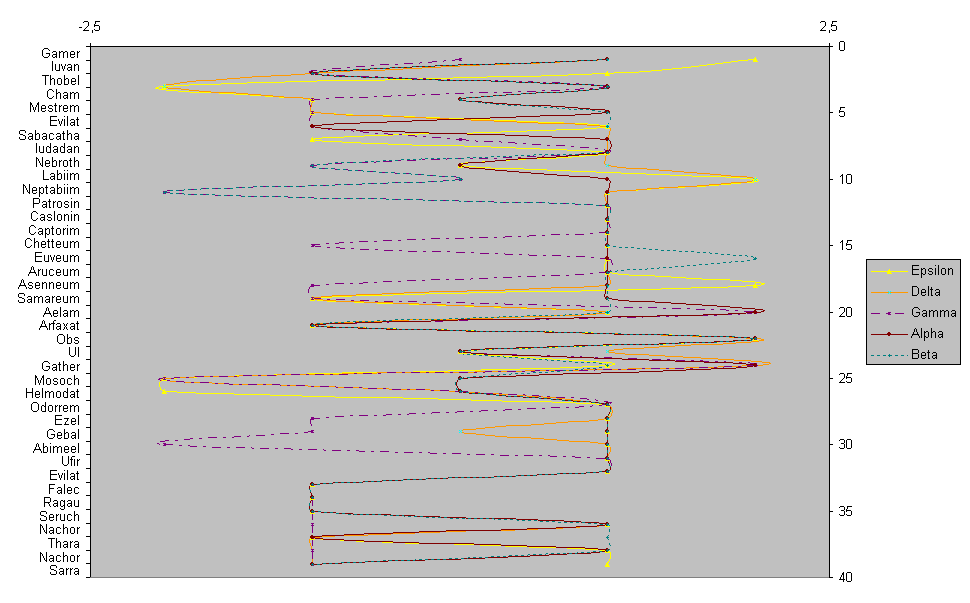
Zaluska never presented any statistical data or analysis to back up these characterizations, so I have done some sampling of my own. Below is a tabulation containing a rough scoring of 39 Genesis names from the period down to Abraham. I have included a recension, Epsilon, that Zaluska left out of account. I have not included Zaluska's Sigma in this survey.
The assessments are subjective, which is to say I judged the different spellings and rated how closely they resembled the Vetus Latina orthography (which is based on the Septuagint Greek). The scoring system offers a continuum between forms that show no influence from Jerome and forms that could only be corruptions of Jerome's orthography. This is not highly scientific, but it is a start. Here are the numerical values I employed:
  • -2 signifies an obviously LXX/Vetus form, but with extreme scribal deformation;
  • -1 is the pure LXX/Vetus type;
  • 0 means a name containing a consonant or vowel that uncertainly suggests the LXX/Vetus type;
  • +1 a name of Vulgate type;
  • +2 signified variants that are very unlike the Vetus but do resemble the Vulgate type
The columns, from left to right, represent Epsilon, Delta, Gamma, Alpha, Beta; the last three columns comprise Fischer's form of the Vetus name, the Clementine Vulgate form and the Stuttgart Vulgate form.

2 1 0 1 1 Gamer Gomer Gomer
1 -1 -1 -1 -1 Iuvan Iavan Javan
-2 -2 1 1 1 Thobel Tubal Thubal
-1 -1 -1 0 0 Cham Ham Ham
-1 -1 -1 1 1 Mestrem Mesraim Mesraim
1 1 -1 -1 1 Evilat Hevila Hevila
-1 1 0 1

Sabacatha Sabatacha Sabatacha
1 1 1 1 1 Iudadan Dadan Dadan
0 1 -1 0 -1 Nebroth Nemrod Nemrod
2 2 0 1 0 Labiim Laabim Laabim
1 1 -2 1 -2 Neptabiim Nepthuim Nephthuim
1 1 1 1 1 Patrosin Phetrusim Phetrusim
1 1 1 1 1 Caslonin Cesluim Chasluim
1 1 1 1 1 Captorim Capthurim


1 1 -1 1 1 Chetteum Ettheum Hethæum
1 1 1 1 2 Euveum Eveum Hevæum
1 1 1 1 1 Aruceum Araceum Aracæum
2 1 -1 1 1 Asenneum Sineum Sinæum
-1 -1 -1 1 1 Samareum Samariten Samaræum
1 1 2 2 1 Aelam Elam Ælam
-1 -1 -1 -1 -1 Arfaxat Arfaxad Arphaxad
2 2 2 2 2 Obs Us Us
0 1 0 0 0 Ul Hul Hul
1 2 2 2 1 Gather Gether Gether
-2 -2 -2 0 0 Mosoch Mes Mes
-2 0 0 0 0 Helmodat Helmodad Elmodad
1 1 1 1 1 Odorrem Aduram Adoram
1 1 -1 1 1 Ezel Uzal Uzal
1 0 -1 1 1 Gebal Ebal Ebal
1 1 -2 1 1 Abimeel Abimahel Abimaël
1 1 1 1 1 Ufir Ophir Ophir
1 1 1 1 1 Evilat Evila Hevila
-1 -1 -1 -1 -1 Falec Faleg Phaleg
-1 -1 -1 -1 -1 Ragau Reu Reu
-1 -1 -1 -1 -1 Seruch Sarug Sarug
1 1 -1 1 1 Nachor Nahor Nahor
-1 -1 -1 -1 1 Thara Thare Thare
1 -1 -1 1 1 Nachor Nahor Nahor
1 -1 -1 -1 -1 Sarra Sarai Sarai
This list has been filtered to only comprise 39 names in Genesis where there seems to be a distinction between the Vetus Latina and Vulgate forms.
Now it is striking that none of the five recensions above consistently follows the Vetus Latina type, which would be indicated by one of the columns consisting mostly of scores of -2 or -1.
When transcribing the manuscripts, my impression was that the concentration of Vetus Latina names was highest in Delta, but in this scoring, Delta has a median value of +0.3. In fact it is Gamma which is closest to the Vetus, with a median score of -0.2 . As for the rest, the medians are Epsilon +0.4, Alpha +0.5 and Beta +0.5.
I have converted the table to a graph below. If anyone can think of a more expressive graph, I would be glad to hear advice on how this could be presented in line with current methods.
It will be clear to the readers from both the table and from the graph that there is no obvious consistency in the way that medieval editors revised the five recensions. The variants swerve wildly to both sides. In this sample of names from Genesis, the data does not seem to support Zaluska's conclusion that Gamma contains "occasional retouchings" drawn from the Vulgate," whereas Delta is the "most faithful" to the Vetus Latina. If anything, Gamma is more faithful.
What can we say about the names from those parts of biblical history subsequent to Genesis?
We cannot expect to find any differences in the names from Christ back to the Exile, because these names only existed in the Greek manuscripts of the Gospels of Matthew and Luke and no Hebrew evidence for them exists. Jerome of Stridon did not alter their Latin transcriptions, so these names are invariant between the Vetus Latina and the Vulgate.
As for the names from the Exile back to Saul, we also cannot expect to find much significant variation. We do not yet possess scholarly editions of the Vetus Latina text of 1 Samuel, 2 Samuel, 1 Chronicles and 2 Chronicles, 1 Kings and 2 Kings (they will take several more decades to arrive). To fill the gap, I have instead collated the Septuagint forms, which were of course the basis for the Vetus Latina. The reader can construe the likely Latin transcriptions, and compare these to the Stuttgart Vulgate forms. The following selection shows that Jerome left the bulk of the pre-existing Latin forms pretty well unchanged.
Αχινααμ Ahinoem 1Sa 25:43, 2 Sa 3:2
Αβιγαιας Abigail 1Sa 25:42, 2Sa 3:3
Μααχα Maacha 2Sa 3:3
Αγγιθ Aggith 1Ch 3:2, 2Sa 3:4
Αβιταλ Abital 2Sa 3:4
Αιγλα Agla 2Sa 3:5
Βηρσαβεε Bethsabee 2Sa 11:3
Αμνων Amnon 2Sa 3:2
Δαλουια Chelaab 2Sa 3:2, 1Ch 3:1
Αβεσσαλωμ Absalom 2Sa 3:3
Ορνια Adonias 2Ch 3:4
Σαφατια Safathia 1Ch 3:3, 2Sa 3:4
Ιεθερααμ Iethraam 2Sa 3:5
Θημαρ Thamar 2Sa 13:1
Ιβααρ Ibaar 1Ch 3:6, 14:5, 2Sa 5:15
Ελισαε Elisama A 1Ch 14:5, 3:6, 2Sa 5:16
Ελιφαλετ Eliphalet / Helifeleth 1Ch 3:6, 14:5, 2Sa 5:16
Ναγε Noge 1Ch 3:7, 14:5
Ναφαγ Napheg / Nepheg 1Ch 3:7, 14:5, 2Sa 5:15
Ιανουε / Ιανουου Iaphie 1Ch 3:7, 14:5, 2Sa 5:15
Ελισαμα / Ελισαμαε Elisama B 1Ch 3:8, 14:5
Ελιαδα Helida / Heliade 1Ch 3:8, 14:5, 2Sa 5:16
Ελιφαλετ Eliphalet / Helisua 1Ch 3:8, 14:5, 2Sa 5:15
Σαμμους Samua 2Sa 5:14
Σωβαβ Sobab 2Sa 5:14
Σαλωμων Salomon Mt 1:6, 2Sa 5:14


Ιεροβοαμ / Ναβατ Hieroboam 1Kgs 11:26
Ναδαβ Nadab 1Kgs 15:25
Βαασα / Αχια Baasa filius Ahia 1Kgs 15:33
Ηλα Hela filius Baasa 1Kgs 16:8-16
Ζαμβρι Zamri 1Kgs 16:9
Θαμνι / Γωναθ Thebni filium Gineth 1Kgs 16:21
Αχααβ / Αμβρι· Ahab filius Amri 1Kgs 16:29
Ιεζαβελ Hiezabel 1Kgs 16:31
Οχοζιας Ohozias 1Kgs 22:40
Ιωραμ / Αχααβ Ioram filius Ahab 2Kgs 3:1, 1Kgs 22:50
Ιου / Ναμεσσι Hieu filius Namsi 1Kgs 19:16, 2Chr 22:7
Ιωαχας Ioachaz 2Kgs 10:35
Ιωας Ioas filius Ioachaz 2Kgs 13:10
Ιεροβοαμ Hieroboam 2Kgs 13:13
Ζαχαριας Zaccharias filius Hieroboam 2Kgs 15:8
Σελλουμ / Ιαβις Sellum filius Iabes 2Kgs 15:13
Μαναημ / Γαδδι Manahem filius Gaddi 2Kgs 15:14
Φακεϊας Phaceia filius Manahem 2Kgs 15:23
Φακεε / Ρομελιου Phacee filius Romeliae 2Kgs 15:25
Ωσηε / Ηλα Osee filius Hela 2Kgs 17:1
As luck would have it, where differences do occur in the above list, it is not always easy to see a pattern in the Great Stemma's uptake of the forms. First of all we find certain odd distortions. The first Elisama, for example, appears not as Elisae, but as Elisbe. Secondly, some of the variations completely contradict Zaluska's generalizations: Zambri with a B appears in three recensions (Epsilon, Alpha, Beta), but has been "corrected" to Jerome's Zamri without a B in Delta and Gamma, which are normally the most conservative texts.
Zaluska's assertion that the balance in Alpha swung, after Abraham, to almost pure Vetus Latina forms is therefore interesting and provocative, but needs to be treated with a certain amount of caution. My guess is that her generalization was in fact largely argued from her very perceptive analysis of the Horrite names in Genesis 36. I wrote a survey of these in 2010 where I tabulated the names and provided the proof that is missing from her article, though implied. The differences among the Horrite names between Alpha and Beta are especially striking and this section of the collation is crucial in proving that the Great Stemma is indeed drawn from a Vetus Latina tradition.
I have not yet studied the Vetus/Vulgate distribution of the names making up the Twelve Tribes of Israel: it would be interesting to follow this up at a later time.
In conclusion, I would say this. The Great Stemma and the Liber Genealogus were clearly originally written in a time and place where Jerome's Vulgate was not available and were then haphazardly modified by medieval editors. But the process of modification was not as simple or as linear as Zaluska suggests, and her conclusions are too sweeping. The Great Stemma manuscripts are anything but unambiguous evidence for the onomastics of the Vetus Latina. Bonifatius Fischer was correct to collate the Great Stemma from four Spanish bibles as a somewhat compromised source, while treating it with the greatest of caution.

Footnote: there is a further discussion of this issue a couple of years later: http://macrotypography.blogspot.com/2014/04/the-old-latin.html

2012-01-07

Marathon

I glimpsed an ARD television news report four weeks ago on the Berlin round of the Visualizing Marathon but cannot find the news clip any more. There is some coverage of the event on Vizworld.

2011-12-07

Hypothetigraphy

Many theories of diagrams are limited in scope to just one or two manifestations of abstract drawings. Diagrammatic representation of numerical data has been well studied since Edward Tufte's Visual Display of Quantitative Information, but stemmatic drawings like the Great Stemma are rarely well explained. I have been impressed at the theoretical work of Manfredo Massironi (1937-) of the University of Verona in Italy. Massironi has devised a concept he calls hypothetigraphy to describe drawings that present hypothetical, invisible, abstract ideas. It is presented in his 2002 book, The psychology of graphic images: seeing, drawing, communicating (Link: Google Books). (The English translation from the Italian is not perfect, and sometimes makes no sense: the term itself is sometimes spelled "hypothesigraphy" in the text, varying in orthography from one line to the next (e.g. p. 164), but "hypothetigraphy" is the form used in the headings and index.)

He says he departs from the idea that "illustrating is a way of emphasizing, by visual means, those contents that cannot be effectively conveyed by verbal expression." He proposes that hypothetigraphy has two roles: (a) a connective function (connecting into a unitary pattern a body of knowledge [which is] fragmented and apparently not well organized) and (b) a reconstructive function (reconstructing the various phases of a process for purposes of illustration and interpretation, starting from observable results).
According to my definition, hypothetigraphy defines a rather homogenenous class of drawings, which I call hypothetigraphs ....
The first feature, and one that is most easily noted, is the use of simple geometric figures.... The "true" objects and their appearance are not important in this endeavor, for the phenomena under consideration have to do with relationships and with dynamic interactions between elements.... The shape of elements per se is usually an irrelevant piece of information, which is best left out or represented simply by the most abstract of shapes, the circle.
A second and most immediately noticeable feature of hypothetigraphs is the addition of brief written text to the picture.... The inclusion of written text is always necessary in hypothetigraphy which would otherwise lose its communicative function... Verbal and visual information are inextricably and necessarily connected.
Another distinguishing feature of hypothetigraphy is the the almost exclusive use of precise marks, drawn using the ruler ... Precise, clear lines contribute in conveying the impression that the depicted forms are mental constructs, not representations of natural objects.
Typical of hypothetigraphy is ... the use of object lines ... Object lines are not used to mimic some aspect of reality but to illustrate relationships, correspondences or connections.... Relationships and connections and trajectories ... lend themselves naturally to an interpretation in terms of threads, ropes and connecting cables.
A fifth feature of hypothetigraphy is the number of represented dimensions, which tends to be as small as possible within the constraints of the logic of the representation.
Finally, hypothetigraphy tends to place the viewpoint frontally relative to the picture plane, an tends to present figures without a background.... The second of these ... contributes to focus the attention of the viewer, avoiding unwanted contextual effects.
This is all very useful. The six "features" listed above are all applicable to the Great Stemma:
  1. Its graphic elements are circles of various sizes. They do not represent heads or anything else physical but are entirely abstract, representing generations and dynasties.
  2. Text within the roundels, along the connecting lines and in the final Sicut Lucas evangelista section, is there to expand the effect of the drawn figures.
  3. Its lines are generally straight, except for the final meeting of the two fila, and the whole structure is drawn with a certain sterility to emphasize its abstract meaning.
  4. The connecting lines represent succession, and ramifications where necessary.
  5. The drawing is strictly two dimensional
  6. It has no background colour or images. My attachment of a yellow timeline band to the reconstruction is in fact out of harmony with the austerity of the original.
Massironi makes no mention of the Great Stemma. In fact he does not mention any stemmatic drawings at all. But his observations are so acute that they apply to the stemma without any modification being required of them.

Graph of Time

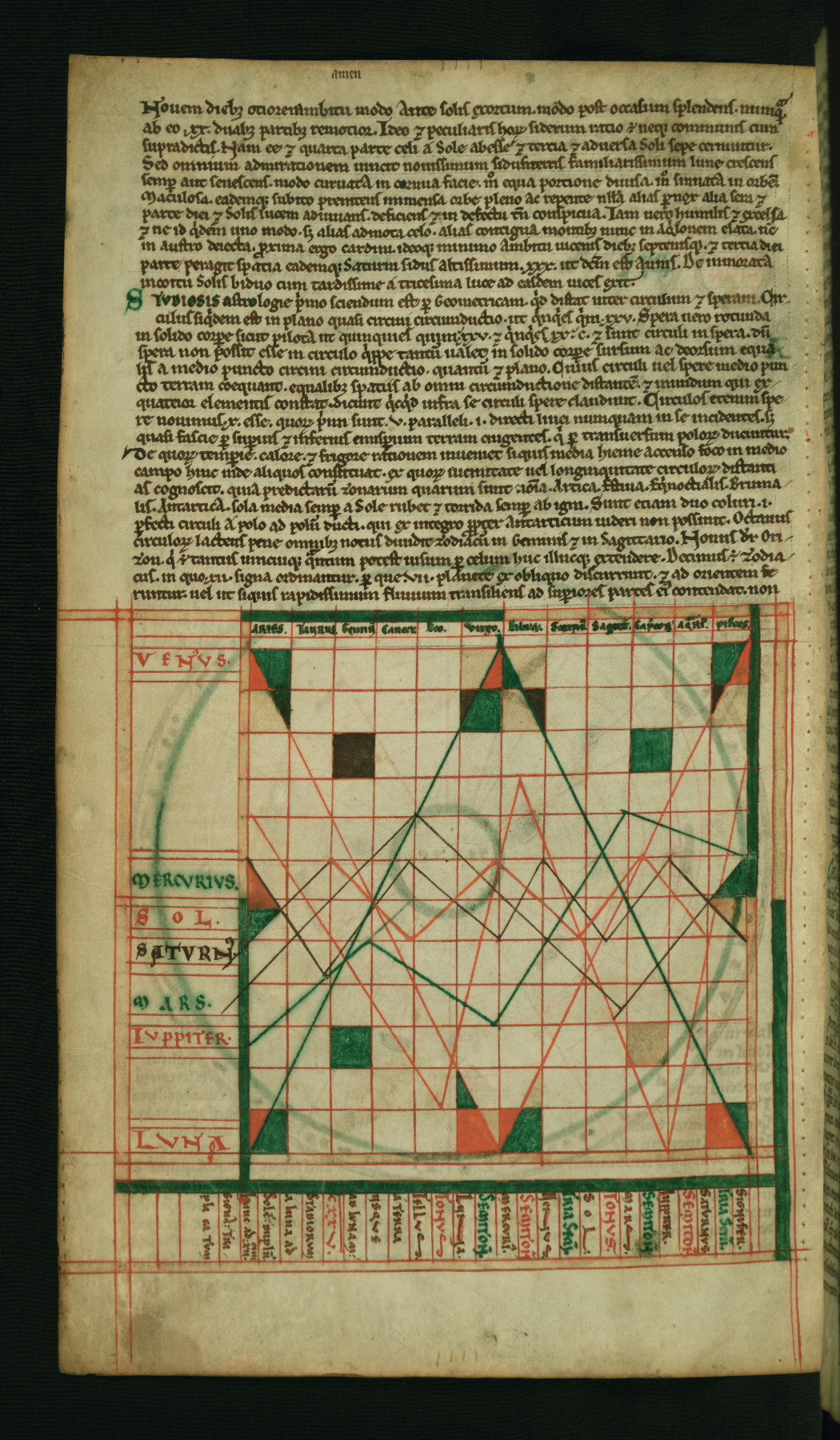
Some time ago, my attention was drawn to the graph of planetary displacement from the elliptic with respect to time that was devised for medieval schools. Until 50 years ago this was thought to be unique to a Latin manuscript in Munich, BSB Clm 14436, 61r, but it seems to in fact exist in numerous manuscripts.

Bruce Eastwood discusses it in Plinian astronomical diagrams in the early Middle Ages (1987) and returned to it in more detail in Planetary Diagrams - Descriptions, Models, Theories (2000, co-authored with Gerd Grasshoff, online) and Planetary diagrams for Roman astronomy in medieval Europe (2004, also with Grasshoff, online). If I am reading these articles correctly, the diagram is what the authors classify as "Plinian latitudes - rectangular" in their 2004 catalogue:
1 Avranches BM, 226, f.88r
8 Bern BB, 347, f.24v
10 Cambridge, St John's CL, lat. I.15, p.287
11 Cambridge, St John's CL, lat. I.15, p.353
12 Cambridge, Trinity CL, R.15.32, f.3v
13 Durham CathLibr, Hunter 100, f.66r
15 Erfurt StB, Ampl. 4°.8, f.1r
20 Genève FB, 111, f.41r
21 Glasgow UL, T.4.2, f.117r
22 Leiden UB, BPL 168, f.56r
24 London BL, Add. 11943, f.49v
27 London BL, Cott.Tib. E.IV, f.141r
32 London BL, Roy. 13.A.XI, f.143v (image in Eastwood/Grasshoff)
38 Milano BN, E.5 sup., f.1r
39 Milano BN, E.5 sup., f.53r
54 München SB, clm 6364, f.24v
57 Oxford BoL, Canon. Class. lat 279, f.34r
59 Oxford BoL, Lyell 154, f.26v
70 Paris BNF, lat. 5239, f.38v
71 Paris BNF, lat. 5239, f.39r
72 Paris BNF, lat. 6367, f.1v
79 St Gallen StiB, 250, p.2
81 Strasbourg BU, 326, f.122r
89 Vaticano BAV, Palat. lat. 1577, f.82v
94 Vaticano BAV, Regin. lat. 1573, f.53r
105 Wroclaw UB, IV.O.11, f.59r
108 Zürich ZB, Car.C. 122, f.42r

But perhaps I have not understood this correctly, since the specimen which is numbered Plin45 (clm 14436, 61v, link at the top of this blog entry) is absent from the above list, as is the specimen numbered as Plin83 in the 2004 article (Strasbourg, same codex as above, but folio 123r, reproduced in the 2000 article), along with six other references Eastwood gave in 1987:
Madrid 9605, f.12v
Zurich Car. C 176, f. 193v
Bern 265, f. 59r
London Cott.Vit. A XII, f. 9r
Baltimore Walters W, 73, f. 5v (mentioned in the note on page 11 of Eastwood's 2004 catalogue)
Oxford, St Johns, 17, f. 38r
London BL Eg. 3088, f. 83v
There is one corrigenda page in the Google Books edition, but these are not mentioned there. I do not know if further errata have been published. Perhaps I have overlooked some kind of filter that Eastwood and Grasshoff may have mentioned in their book, and I would be grateful if any reader could explain this to me.

Hans-Christoph Liess, supervised by Grasshoff and Eastwood during his doctoral studies at the University of Berne, later assembled a database of Eastwood's images, and published a description. The title page of this 2001 database project, code-named Compago, is still online, as is the diagram index page, and, perhaps most important, an interactive mind-map of the manuscripts listed above. A handbook was also published. But the back end with the actual images and the required software module, code-named Alcatraz, seems to have either been taken down or to have been put behind a wall. Google Chrome is able to open the interface, but a user name and password are required to proceed further. Liess completed his doctoral dissertation in 2002 (large file) and this is online. Both Liess and Grasshoff have since moved from Berne to Berlin.

What is curious is that all three authors are sure that the diagram is a simplification of a circular diagram of the Plinian latitudes which is found in 12 manuscripts. Pliny had presented the data as numerical data only. Then a Carolingian editor devised the circular diagram just before or following a conference on computus in 809 EC and "solved the problem of presenting to students the spatial meaning of the Plinian text" (Eastwood, 2000). Eastwood and Grasshoff continue:
Within a few decades after its creation, the circular latitude diagram was replaced by another, a rectangular diagram, which reduced the amount of theoretical content added to the relevant Plinian text and also offered a more easily produced and more quickly read image.
Edward Tufte reproduces the Munich rectangular diagram on page 28 of Visual Display of Quantitative Information, but curiously enough misses its significance for the history of simplification. He only cites an outdated 1936 article by Funkhouser on it. In fact, the diagram turns out to be exemplary of Tufte's principles of subtracting and simplifying to make graphics clearer and more communicative, and his term "reduction of data ink" to describe economy in an infographic:
A few graphics use every drop of their ink to convey measured quantities.