2019-02-09

Herb Dictionary

The Fabio Chigi collection's Greek Dioscorides, a stunning Renaissance copy of the most famous herbal reference of antiquity, is the star turn of last week's digitizations at the Vatican Library.

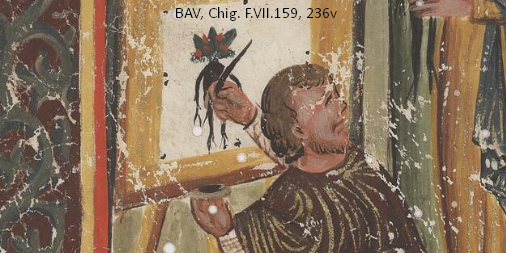
The work itself is known as De materia medica. This non-text variant is termed a herbarius alphabeticus and is a picture dictionary of the medicinal plants in Greek alphabetical order. This copy, Chig.F.VII.159, is believed to be by the scriptorium of the Monastery of St. John the Baptist in mid-15th-century Constantinople, modelled on a 6th-century Dioscorides which is now in Vienna.

One of the finest miniatures shows an artist painting the plants at the instructions of Dioscorides:
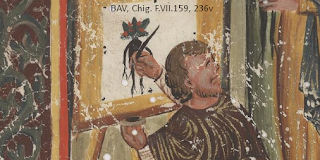
Seemingly it had no text at all when first made. Some glosses added are said to be in the hand of Isidore of Kiev (c.1385- 1463), a Greek theologian who was for a time patriarch of all Russia, unsuccessfully sought the reunion of the Orthodox and Catholic churches and escaped death by a ruse in the 1453 fall of Constantinople. Five other hands, two Greek and three Latin, added plant names.
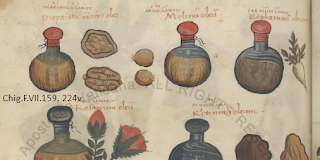
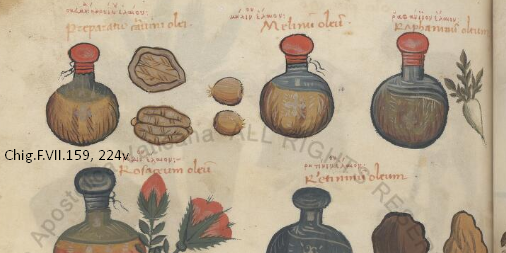
John Murdoch's Album of Science glosses 224v (above) as follows: Each flask is meant to contain the oil or balm specified, the plant from which the oil in question is derived being depicted to one side. Thus beginning at the left of the top row, we have oil of walnut (caryinum), oil of quince (melinum) and radish seed oil (raphaninum). The second row presents us with oil of roses (rosaceum) and some kind of resin oil (retininum).

Chigi's other herbal, the Dioscorides Latino, arrived online a couple of weeks ago. Chigi ended his life as pope Alexander VII. His heirs sold his books to the Vatican in 1923.

In all, 32 codices have just been digitized. The unofficial list:
  1. Barb.gr.331,
  2. Barb.lat.2158, which contains an account of the eruption of Mount Aetna on Sicily:
  3. Capp.Sist.588,
  4. Chig.F.VII.159 (Upgraded to HQ) (above)
  5. Ott.lat.352,
  6. Reg.gr.Pio.II.37 (Upgraded to HQ),
  7. Ross.289,
  8. Urb.lat.599.pt.1,
  9. Urb.lat.605,
  10. Urb.lat.759,
  11. Urb.lat.896,
  12. Urb.lat.1017,
  13. Urb.lat.1038.pt.B,
  14. Urb.lat.1122,
  15. Urb.lat.1215.pt.1,
  16. Urb.lat.1218,
  17. Vat.lat.2479,
  18. Vat.lat.2483, with incipit (see eTK): Medicina artium preclarissima hec verba ... Quoniam ut ars medicorum princeps
  19. Vat.lat.4183,
  20. Vat.lat.4332 (Upgraded to HQ),
  21. Vat.lat.4336,
  22. Vat.lat.4443,
  23. Vat.lat.4544,
  24. Vat.lat.4599,
  25. Vat.lat.4600,
  26. Vat.lat.4602,
  27. Vat.lat.4604,
  28. Vat.lat.4606 (Upgraded to HQ), see Jordanus
  29. Vat.lat.4631,
  30. Vat.lat.4633 (Upgraded to HQ),
  31. Vat.lat.15126,
  32. Vat.turc.340,
This is Piggin's Unofficial List number 195. Thanks to @gundormr for harvesting. If you have corrections or additions, please use the comments box below. Follow me on Twitter (@JBPiggin) for news of more additions to DigiVatLib.

2019-02-02

Midget Minstrels

Maximilian I, the German emperor, is famous for adopting print as a means to increase his propaganda reach. His Ehrenpforte, a monumental printed frieze to be glued together, figures as a proto family tree in my book Mind's Eye. He wrote a chivalric novel Weisskunig (about "me" of course) with his secretary between 1505 and 1516 and commissioned illustrations.

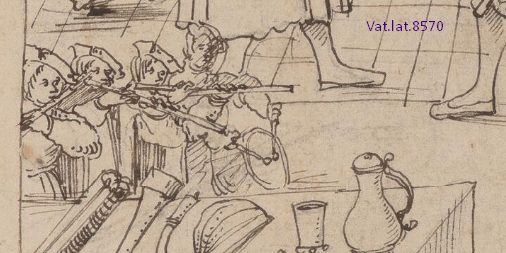
The sketchbook, Vat.lat.8570, has just been digitized by the Vatican Library and is a feast of silliness to be enjoyed page by page: here are some midget minstrels at fol. 107r:

The drawings, which served the engravers who made the wooden plates under the supervision of Konrad Peutinger in Augsburg, were later pasted into the scrapbook which ended up in the Vatican.

In all, 29 digitizations went online in the past week. My unofficial list:
  1. Ross.106, book of hours
  2. Urb.lat.148,
  3. Urb.lat.183,
  4. Urb.lat.615,
  5. Urb.lat.733,
  6. Urb.lat.760,
  7. Urb.lat.765,
  8. Urb.lat.776,
  9. Urb.lat.811,
  10. Urb.lat.846,
  11. Urb.lat.853.pt.1,
  12. Urb.lat.1088.pt.2,
  13. Urb.lat.1088.pt.3,
  14. Vat.lat.2473, commentaries on Avicenna
  15. Vat.lat.2477,
  16. Vat.lat.2481, date 1385, by the Italian surgeon Gentile da Foligno 
  17. Vat.lat.4555,
  18. Vat.lat.4575 (Upgraded to HQ), humanist historian Flavio Biondo (1392 - 1463): De verbis Romanae locutionis [ad Leonardum Brunum]
  19. Vat.lat.4576 (Upgraded to HQ),
  20. Vat.lat.4577,
  21. Vat.lat.4580,
  22. Vat.lat.4581,
  23. Vat.lat.4588,
  24. Vat.lat.4607,
  25. Vat.lat.4612 (Upgraded to HQ),
  26. Vat.lat.4615,
  27. Vat.lat.4628,
  28. Vat.lat.8570 (Upgraded to HQ),
  29. Vat.turc.314, flyleaf note in German dates this to 985, author Isqi Munsaat
This is Piggin's Unofficial List number 194. Thanks to @gundormr for harvesting. If you have corrections or additions, please use the comments box below. Follow me on Twitter (@JBPiggin) for news of more additions to DigiVatLib.

2019-01-26

Rose by any Other Name

Among the most glorious picture books in the Vatican Library is the so-called Dioscorides Latino, a bound collection of images of medicinal plants. Chig.F.VII.158 belonged to Fabio Chigi (later Pope Alexander VII) and was acquired by the Vatican in 1923.
Despite the name, it is not the complete dictionary of medicinal herbs written in Greek by Dioscorides Pedanius between 50 and 70 CE. It contains only Latin-name captions and a few lists.

The Vatican portal has just digitized this treasure for everyone to enjoy. It seems to date from the start of the 15th century, and is therefore much younger than the Vienna Dioscorides.
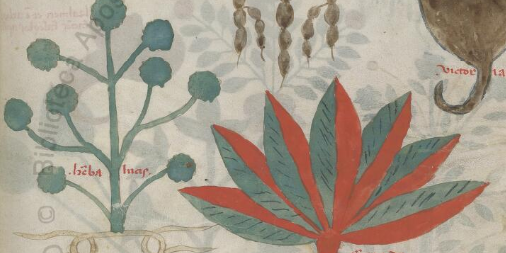
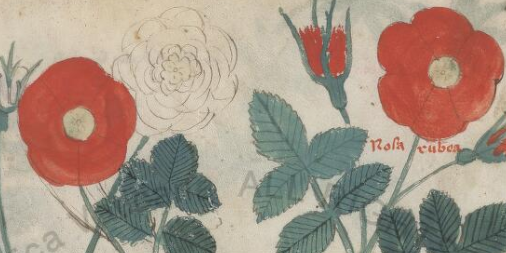
Its charm includes line drawings that let one see outlines amid the color swatches, as here with a rose:

When it was exhibited in the United States in the Rome Reborn exhibition, Anthony Grafton wrote in the catalog that it was probably associated with a Salernitan herbal known as the Circa instans, with plants, animals, and minerals arranged in alphabetical order with plant lists and captions in Latin. A BnF catalogue writer suggests the Dioscorides Latino is a misnomer for what would be better termed a Tractatus de herbis.
The connection with the Materia Medica of Dioscorides seems therefore to be doubtful. Just enjoy it for the splendour of the images. It is one of 36 items new online in the past week:
  1. Borg.sir.162,
  2. Borg.sir.24,
  3. Chig.F.VII.158, so-called Dioscorides Latino, (above). See also the description in the St Louis catalog.  
  4. Patetta.2060,
  5. Ross.73,
  6. Ross.85,
  7. Urb.lat.542,
  8. Urb.lat.575,
  9. Urb.lat.584,
  10. Urb.lat.592,
  11. Urb.lat.625,
  12. Urb.lat.700,
  13. Urb.lat.722,
  14. Urb.lat.723,
  15. Urb.lat.771,
  16. Urb.lat.792,
  17. Urb.lat.795,
  18. Urb.lat.796,
  19. Urb.lat.932,
  20. Urb.lat.962,
  21. Urb.lat.965,
  22. Urb.lat.969,
  23. Urb.lat.1088.pt.1,
  24. Vat.lat.2437,
  25. Vat.lat.2439,
  26. Vat.lat.4106 (Upgraded to HQ),
  27. Vat.lat.4280,
  28. Vat.lat.4388,
  29. Vat.lat.4438,
  30. Vat.lat.4449, 15th-century, works by Sigismundus de Polcastris, see eTK with the incipits Cum sepe me exhortatus et deprecatus and Utrum medicine dicte tales
  31. Vat.lat.4558,
  32. Vat.lat.4567 William of Moerbeke translation of Elementatio Theologica of Proclus (upgraded to HQ), translation online at Augsburg;
  33. Vat.lat.4570, Latin translation of Harmonics of Ptolemy, once owned by the Italian music theorist Franchinus Gaffurius, featured in Rome Reborn 
  34. Vat.lat.4574,
  35. Vat.lat.4584,
  36. Vat.lat.5590,
This is Piggin's Unofficial List number 193. Thanks to @gundormr for harvesting. If you have corrections or additions, please use the comments box below. Follow me on Twitter (@JBPiggin) for news of more additions to DigiVatLib.

2019-01-20

Pair of Compasses

Spare a thought for the hundred generations of people who were taught at school to draw circles with a pair of compasses. With computers to do it quicker and smarter, it's a bit pointless nowadays, but in its time it was an essential skill. Recently I noticed Calcidius, writing about 400 CE, boasting he could even draw spirals with his compasses by slowly moving the legs during the turns.

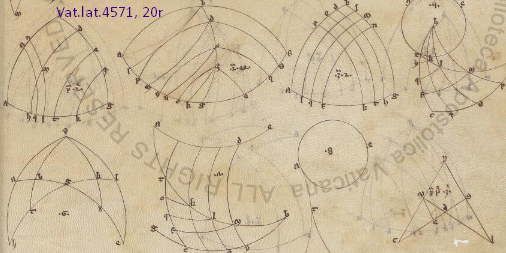
Among the codices just digitized at the Vatican Library is Vat.lat.4571, Gerard of Cremona's Latin translation from Arabic of what appears to be the lost Greek textbook on spheres by Menelaus of Alexandria. This includes several pages of very fine drawings like this, all done by see hand:

Go admire. It is one of 66 new items online in the last week:
  1. Ross.5,
  2. Ross.81,
  3. Ross.84,
  4. Ross.91 (Upgraded to HQ), book of  hours?
  5. Ross.109,
  6. Ross.113,
  7. Ross.178,
  8. Ross.257 (Upgraded to HQ),
  9. Ross.272,
  10. Ross.296,
  11. Urb.lat.339,
  12. Urb.lat.428,
  13. Urb.lat.435,
  14. Urb.lat.477, Officium Beatae Mariae Virginis
  15. Urb.lat.516,
  16. Urb.lat.522,
  17. Urb.lat.523,
  18. Urb.lat.550,
  19. Urb.lat.571,
  20. Urb.lat.576,
  21. Urb.lat.577,
  22. Urb.lat.617,
  23. Urb.lat.618,
  24. Urb.lat.620,
  25. Urb.lat.621,
  26. Urb.lat.764,
  27. Urb.lat.862,
  28. Vat.lat.2395,
  29. Vat.lat.2444.pt.1, Nicolai Florentini
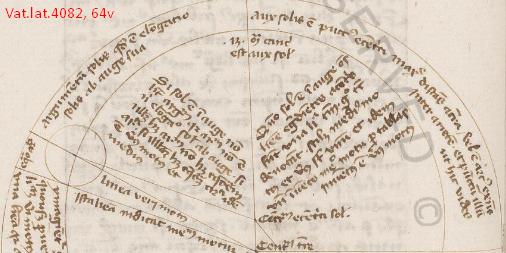
  30. Vat.lat.4082 (Upgraded to HQ), dated 1401, compilation of 23 works on mathematics and astronomy, see Jordanus and  eTK 
  31. Vat.lat.4171,
  32. Vat.lat.4435,
  33. Vat.lat.4446, medical texts including an item by Bertrucius of Bologna, see eTK
  34. Vat.lat.4456 (Upgraded to HQ), Gentile da Foligno on science, see eTK
  35. Vat.lat.4462,
  36. Vat.lat.4468,
  37. Vat.lat.4481 (Upgraded to HQ), mid 13th century, Latin translations of Avicenna (Mirabile)
  38. Vat.lat.4484,
  39. Vat.lat.4492,
  40. Vat.lat.4500,
  41. Vat.lat.4520,
  42. Vat.lat.4521,
  43. Vat.lat.4525 (Upgraded to HQ),
  44. Vat.lat.4531
  45. Vat.lat.4532,
  46. Vat.lat.4534 (Upgraded to HQ), Trabezon's translations of Aristotle, see Mirabile
  47. Vat.lat.4536 (Upgraded to HQ), 
  48. Vat.lat.4537,
  49. Vat.lat.4549 (Upgraded to HQ), Averroes on Aristotle, see Mirabile
  50. Vat.lat.4550 (Upgraded to HQ), Averroes on Aristotle's Meteorology, from Hebrew. See Mirabile
  51. Vat.lat.4551,
  52. Vat.lat.4554 (Upgraded to HQ),
  53. Vat.lat.4556,
  54. Vat.lat.4557,
  55. Vat.lat.4559,
  56. Vat.lat.4562,
  57. Vat.lat.4564 (Upgraded to HQ),
  58. Vat.lat.4565,
  59. Vat.lat.4568 (Upgraded to HQ), about 1500, William of Morebeke's translation of Proclus.
  60. Vat.lat.4571, Menelaus? (above), however Jordanus gives the work and author as  De figuris spericus by Mileus
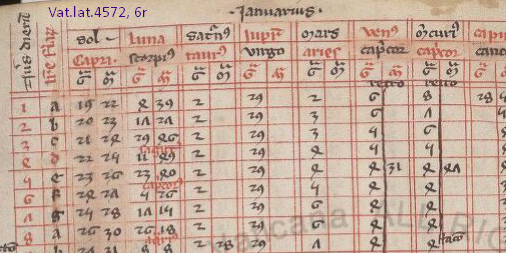
  61. Vat.lat.4572, Almanach Planetarum ab anno Domini 1243 usque ad 1303, see Jordanus 
  62. Vat.lat.4573, continuation: almanac from 1306 on, and astronomy, see Jordanus
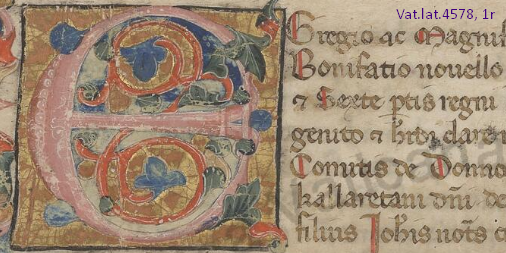
  63. Vat.lat.4578 (Upgraded to HQ), apocryphal texts, 14th century, with Evangelium Nicodemi, ff. 35v-37v Evangelium Thomae de infantia Salvatoris, ff. 37v-44r Liber de ortu beatae Mariae et infantia Salvatoris, ff. 32r-35r (see Mirabile); also includes a mathematical text, see Jordanus
  64. Vat.lat.4587 (Upgraded to HQ),
  65. Vat.lat.4589,
  66. Vat.lat.8193.pt.2 (Upgraded to HQ), notes from 1655 in Innocent X's court on papabile
This is Piggin's Unofficial List number 192. Thanks to @gundormr for harvesting. If you have corrections or additions, please use the comments box below. Follow me on Twitter (@JBPiggin) for news of more additions to DigiVatLib.

2019-01-12

I know that handwriting ...

Now that most of us have almost given up writing by hand, one's admiration grows for those who can recognize from the faults the handwriting of people long dead. It is one of the scholarship's more recherché specialities.

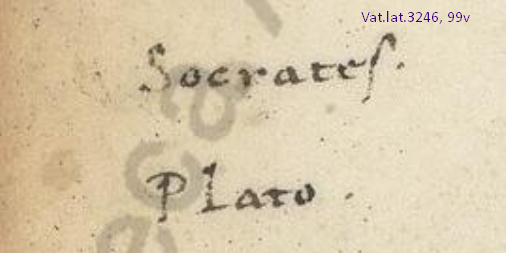
From the clever people at Autografi dei Letterati Italiani we discover that several jottings in a Vatican Library copy of Cicero, Vat.lat.3246, were put there by one Antonio Beccadelli (1394-1471), a humanist poet and diplomat. Beccadelli, nicknamed Il Panormita, had an income as a courtier that allowed him to acquire his own library.

The codex is one of six put online this week in the first working week of the library's digitizations for 2019.

Before starting the list, I'd like to announce a private achievement: This week I published The Great Stemma: A Graphic History in the Fifth Century as an open-source edition. It's the scholarly counterpart to my recently published book Mind's Eye which tells the discovery story of a neglected Latin chart of history. Spread the word: I am depending on friends to enlarge the readership of both.

And now for the list:
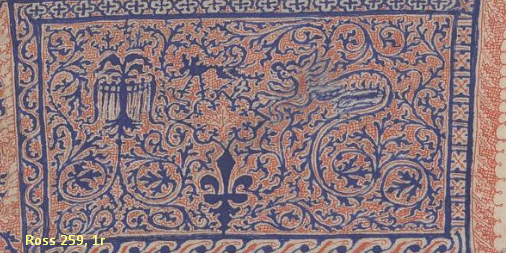
  1. Ross.259, a de luxe manuscript from Paris of Augustine of Hippo's letters. Beautiful filigree work by Jacquet Maci in the illumination (see Mirabile):
  2. Vat.lat.2476, Gentilis de Fulgineo on Avicenna's medical writings, 15th century
  3. Vat.lat.3246 (Upgraded to HQ), ninth-century copy in a Caroline hand (thanks @gundormr for correcting this) of Cicero's Tusculan Disputations, formerly owned by Antonius Beccadellus (1394-1471), and Fulvio Orsini (1529-1600), according to Mirabile. In binding paper with some Beneventan writing.
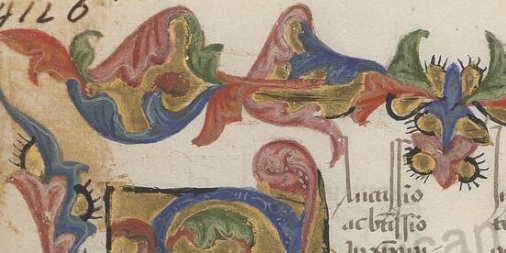
  4. Vat.lat.4116 (Upgraded to HQ), a 15th century manuscript of Defensorium ecclesiasticae potestatis by Adam de Eston (1330-1397) (thanks Mirabile) with these amazing border designs: 
  5. Vat.lat.4354, a compilation of Franciscan Order resources from about 1430, see Mirabile
  6. Vat.lat.4517, with an anonymous Latin grammar from fol 22, incipit Coelum et terra sunt plena (listing by G. L. Bursill-Hall)
This is Piggin's Unofficial List number 191. Thanks to @gundormr for harvesting. If you have corrections or additions, please use the comments box below. Follow me on Twitter (@JBPiggin) for news of more additions to DigiVatLib.

2019-01-05

All the Isidorian Bibles Online

A very special set of medieval bibles is complete at last, thanks to the recent digitization of the Foigny Bible in the French National Library, some of the best news of last year for codicologists.

These rare Vulgate bibles, one from Burgos in Spain and three from the Meuse Valley on the Franco-Belgian border, offer the sole surviving evidence of a shadowy struggle over belief in seventh-century Visigothic Spain.

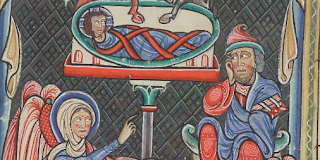
Four years ago, I celebrated the arrival online of the Floreffe Bible (now in the British Library). Now the fourth and last is there to appreciate, the Foigny Bible, thanks to the Polonsky Foundation funding a project to virtually unite treasures of London and Paris that belong together. The illuminations in the Foigny Bible (here the Nativity) are wonderful:


Here are links to the whole set of four:

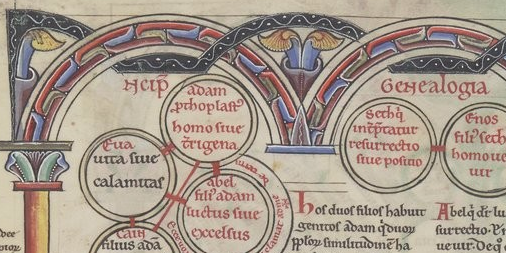
The Foigny Bible starts off with a prologue set which is found in the others too, a fairly sure sign that all these 11th and 12th century bibles derive from a much earlier model:
  • an arbor consanguinatis;
  • the Great Stemma, with a 6,000-word epitome of exegesis by Isidore in the blank spaces;
  • the Prologus Theodulfi
  • a second Prologus (Stegmüller, Rep. Biblicum, n° 284).
  • a second Prologus (Stegmüller, Rep. Biblicum, n° 285).
  • a capitula
And what were the Visigothic Christians arguing about? Whether St. Joachim, the supposed grandfather of Jesus existed! 


A late-antique "family tree" of Jesus, the Great Stemma (above), had been spreading through Iberia in the seventh century and it showed a legendary sheep-farmer, Joachim, in pride of place. Isidore of Seville thought this claim was nonsense. We don't know if Isidore himself altered the chart, but someone very smart and aligned with Isidore's thought took pen and rewired the "tree", cutting out poor Jo like a gastric bypass.

As for the 6,000 words of Isidorian Exegesis written in the gaps, you'll  have to make up your own mind who wrote it. Maybe that was Isidore too? Since it had never been identified or published previously, I edited the text some years ago.

2018-12-22

Under the Knife

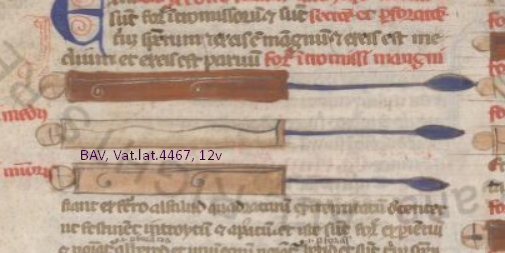
Medieval surgery was, by all accounts, painful for the patient. One of the newest Vatican manuscripts online contains Gerard of Cremona's Latin translation of the Arabic handbook of surgery by the famed Andalusian doctor Abulcasis or Albucasis (see Wikipedia). Consider these instruments:

I'm not going to tell you what they were used for. But anesthetic procedures were crude, so you felt the cut.

This manuscript of the 13th or 14th century is among more than 30 extant according to Monica H Green's count in 2011.

It seems the book was read by non-doctors too, as indicated by the luxury colors in this copy. She adds: "Whereas other surgical texts circulated quite widely in western Europe, up until the fifteenth century Albucasis's work was copied only in Italy and, to a lesser extent, in southern France." See too an earlier article online by David Trotter on the Latin mss.

In the past week, 112 manuscripts came online. The Vatican Library's newsletter adds some good news, indicating the digitization program remains open-ended.

The Japan-based company which is the main funder of the project, NTT Data, previously told media its support was limited to 3,000 manuscripts up to 2019, but the December newsletter says Katsuichi Sonoda, an NTT Data VP, offered November 30 to continue the collaboration with the Library “indefinitely”. Sounds great!
  1. Ross.47,
  2. Ross.60,
  3. Ross.67 (Upgraded to HQ),
  4. Ross.71,
  5. Ross.83,
  6. Ross.86.pt.2,
  7. Ross.102 (Upgraded to HQ),
  8. Ross.104,
  9. Ross.132 (Upgraded to HQ),
  10. Ross.133,
  11. Ross.134,
  12. Ross.139 (Upgraded to HQ),
  13. Ross.148 (Upgraded to HQ),
  14. Ross.166,
  15. Ross.169,
  16. Ross.200,
  17. Ross.205 (Upgraded to HQ),
  18. Ross.221,
  19. Ross.229 (Upgraded to HQ),
  20. Ross.233,
  21. Ross.250 (Upgraded to HQ),
  22. Ross.256,
  23. Ross.267,
  24. Ross.270 (Upgraded to HQ),
  25. Ross.271 (Upgraded to HQ),
  26. Vat.lat.2389,
  27. Vat.lat.2392, eTK incipit: Gerard of Cremona translations of Arabic medical works, and the De cibariis attributed to Petrus de Musanda
  28. Vat.lat.2403, eTK incipit: Desideranti tibi scribi a me mysteria lapidum omnium
  29. Vat.lat.2408,
  30. Vat.lat.2431,
  31. Vat.lat.2440,
  32. Vat.lat.2445.pt.2,
  33. Vat.lat.2445.pt.3,
  34. Vat.lat.2465, Jacobus de Forlivio, on the Aphorisms of Hippocrates; see Jordanus
  35. Vat.lat.2478,
  36. Vat.lat.3219 (Upgraded to HQ),
  37. Vat.lat.3367,
  38. Vat.lat.3369,
  39. Vat.lat.4020,
  40. Vat.lat.4021,
  41. Vat.lat.4022,
  42. Vat.lat.4083, eTK incipit: Interrogatio nobilis viri domini Uberti marchionis; (Gerard of Cremona)
  43. Vat.lat.4098 (Upgraded to HQ),
  44. Vat.lat.4112.pt.2,
  45. Vat.lat.4251,
  46. Vat.lat.4276,
  47. Vat.lat.4347 (Upgraded to HQ),
  48. Vat.lat.4368,
  49. Vat.lat.4375,
  50. Vat.lat.4379,
  51. Vat.lat.4389 (Upgraded to HQ),
  52. Vat.lat.4403,
  53. Vat.lat.4404,
  54. Vat.lat.4405,
  55. Vat.lat.4408
  56. Vat.lat.4420, eTK incipit: Non solum cum scripserunt rememoratores; 
  57. Vat.lat.4421,
  58. Vat.lat.4422, eTK incipit: Cum natura non minus indigeat aquis fisicalibus (14c); John of Parma
  59. Vat.lat.4428, Avicenna's Terra Pura and other works; eTK incipit: Corpora mineralia in quatuor dividuntur
  60. Vat.lat.4432, eTK incipits: Quia sentire quidem (early 14th century); De virtutibus naturalibus
  61. Vat.lat.4434, Jacobus de Forlivio, De intentione et remissione formarum, see Jordanus
  62. Vat.lat.4436,
  63. Vat.lat.4441,
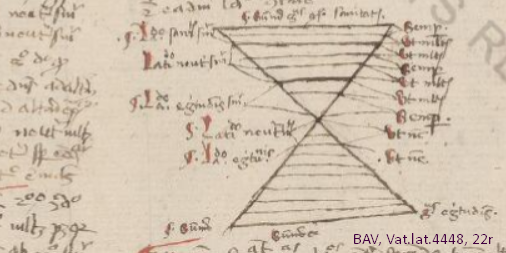
  64. Vat.lat.4448, Antonius de Scarparia, 14th century Italian physician, on Galen's Ars Parva, with a diagram discussed by John Murdoch's Album of Science showing the continuum by latitudes from completely well (at top) to completely sick (below): 
  65. Vat.lat.4451 (Upgraded to HQ), medical etc, Thadeus of Florence and others, eTK incipit: Impossibile est eundem incipere et finire (14th century)
  66. Vat.lat.4454 (Upgraded to HQ), eTK incipit: Averroes in commento xv de animalibus sicut illa; See also Jordanus
  67. Vat.lat.4455 (Upgraded to HQ), Jordanus, Arithmetic. See Jordanus database. eTK incipit: Convenerunt in hoc antiqui; by Petrus Hispanus
  68. Vat.lat.4457,
  69. Vat.lat.4463,
  70. Vat.lat.4464, eTK incipit: Consuevit dubitari de titulo huius libri; by Dino del Garbo
  71. Vat.lat.4467, Abulcasis/Albucasis (above) — Digita Vaticana (@DigitaVaticana) December 18, 2018
    — (@EgoConstantinus)
  72. Vat.lat.4469,
  73. Vat.lat.4470,
  74. Vat.lat.4471,
  75. Vat.lat.4473,
  76. Vat.lat.4474,
  77. Vat.lat.4475 (Upgraded to HQ), eTK incipit: Sciendum est quod humores quidam sunt in capite (13c-14c); also: De limphis oculorum qui dicitur paralymenon
  78. Vat.lat.4477, eTK incipit: Cum omne corpus animatum; Glossulae aphorismorum Hippocratis
  79. Vat.lat.4478, eTK incipit: Celi enarrant gloriam dei triplici via aq modo mirabili celi; author Jean Ganivet
  80. Vat.lat.4483,
  81. Vat.lat.4485,
  82. Vat.lat.4487,
  83. Vat.lat.4490 (Upgraded to HQ),
  84. Vat.lat.4493 (Upgraded to HQ),
  85. Vat.lat.4494,
  86. Vat.lat.4495,
  87. Vat.lat.4496,
  88. Vat.lat.4498 (Upgraded to HQ), Frontinus, Seneca and other classical authors, see Jordanus
  89. Vat.lat.4502 (Upgraded to HQ),
  90. Vat.lat.4503,
  91. Vat.lat.4504,
  92. Vat.lat.4505,
  93. Vat.lat.4506,
  94. Vat.lat.4507,
  95. Vat.lat.4509,
  96. Vat.lat.4513,
  97. Vat.lat.4514 (Upgraded to HQ),
  98. Vat.lat.4515,
  99. Vat.lat.4518,
  100. Vat.lat.4522 (Upgraded to HQ),
  101. Vat.lat.4523,
  102. Vat.lat.4524,
  103. Vat.lat.4526,
  104. Vat.lat.4527,
  105. Vat.lat.4528,
  106. Vat.lat.4529,
  107. Vat.lat.4530, Jamblichus, see Jordanus
  108. Vat.lat.4535,
  109. Vat.lat.4538,
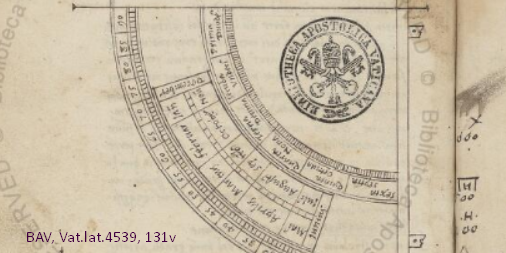
  110. Vat.lat.4539, Bernelinus, Gerbert and others on arithmetic, see Jordanus. With this bull's eye by the Dennis the Menace of the Vatican rubber stamp:
  111. Vat.lat.5754.pt.A,
  112. Vat.lat.9055,
  113. This is Piggin's Unofficial List number 190. Thanks to @gundormr for harvesting. If you have corrections or additions, please use the comments box below. Follow me on Twitter (@JBPiggin) for news of more additions to DigiVatLib.