2017-01-25

Flemish Hours

Does the world need another illuminated Book of Hours? These private prayer-books from about 500 years ago are fairly common on the art market. But some at the Vatican Library are such superb works of art that the answer has to be a resounding yes.

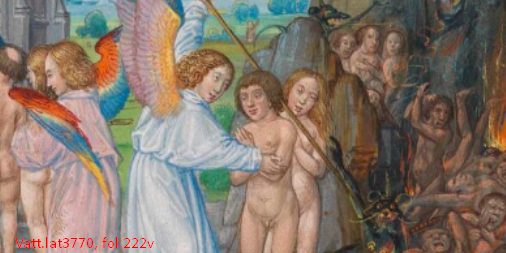
The latest batch of digitizations includes a wonderful prayer book for the use of Rome, attributed to an anonymous artist known as "the Master of James IV of Scotland". Dates between 1495 and 1520 have been suggested, and a Flemish origin seems proven. For the extraordinary quality, look at the iridescent wings on the angels here at the Last Judgement at fol. 222v:
As noted earlier this week, the Vatican Library is following a new policy of posting quick-and-dirty digital copies of its black-and-white microfilms as placeholders until it gets around to doing a proper color scan of each book.

In the upload of January 23, 2017, almost all 3,950 new items were marked "low quality", though a good number are actually proper scans. This seems have been for convenience only, since the "low quality" flag must next be replaced in many cases with a color thumbnail of a particularly pretty page from the scan.

I suppose some unfortunate individual will be given the tedious job of relabeling the scans (it would be an ideal penalty for the evil reader who spills smuggled Coca-Cola on a manuscript). Most if not all of the manuscripts listed below are in fact scans, not microfilms. I have marked all those full scans I have checked with the note "(color)".

Here is the list of 51 new items in the main Vat.lat. series:
  1. Vat.lat.1040, Thomas Bradwardine Against the Pelagians (color)
  2. Vat.lat.1113, Andredus Gonteri (color)
  3. Vat.lat.1174, Praepositinus, 13th century (color)
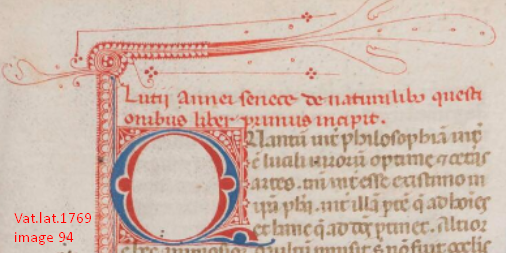
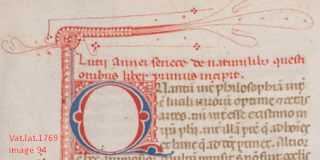
  4. Vat.lat.1769, Quintilian and Seneca in a 14th-century manuscript (color)
  5. Vat.lat.1942, Biondo Flavio (color)
  6. Vat.lat.1958, Pliny the Younger and a commentary by Leonardo Bruni, 15th century (color)
  7. Vat.lat.2151, Walter Burley's commentaries on Aristotle (color)
  8. Vat.lat.3057, Albert of Saxony (color)
  9. Vat.lat.3136, Legends of the Hospital of St John of Jerusalem: in French, 1342 (color)
  10. Vat.lat.3211, poetry, Italian (color)
  11. Vat.lat.3770, volume 1 of  a magnificent 3-volume Flemish book of hours (above) (color)
  12. Vat.lat.3781, another book of hours (color)
  13. Vat.lat.3828, homiliary (color)
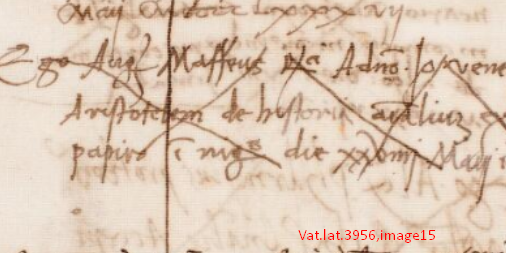
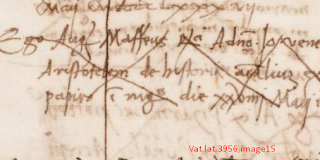
  14. Vat.lat.3966, a-15th century Register of Loans from the Vatican Library. For some time the Vatican let its library books circulate (what a dream!). Borrowers themselves entered "Ego..", their names and the titles of the books they took out in registers like this one (the second in the loans series), and the librarian criss-crossed the entry when the books came back. (color)
  15. Vat.lat.4863,
  16. Vat.lat.4962,
  17. Vat.lat.5379,
  18. Vat.lat.6767,
  19. Vat.lat.7194,
  20. Vat.lat.7260,
  21. Vat.lat.7616,
  22. Vat.lat.8193.pt.3,
  23. Vat.lat.9015,
  24. Vat.lat.9112,
  25. Vat.lat.9839.pt.1,
  26. Vat.lat.9839.pt.2,
  27. Vat.lat.9843.pt.A,
  28. Vat.lat.10191,
  29. Vat.lat.10498,
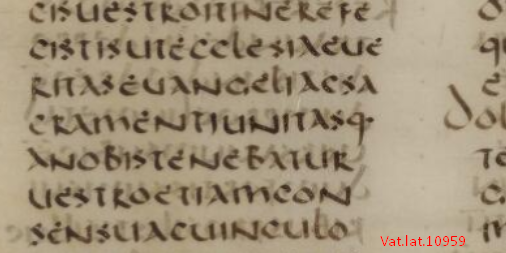
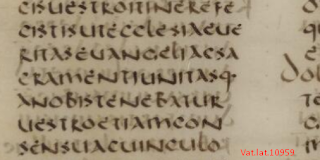
  30. Vat.lat.10959, a single leaf from a fifth-century African uncial run-together-writing manuscript of Cyprian, Epistulae. This two-column book later ended up at Bobbio, Italy, where the monks tore it up for re-use, employing this page as a fly-leaf.  TM 66155 = Lowe, CLA 4 458. The scan is in full color and includes a scholarly article by C. H. Turner about the leaf, plus the legacy whereby it came to the Vatican. (color)
  31. Vat.lat.11732,
  32. Vat.lat.12383,
  33. Vat.lat.12431,
  34. Vat.lat.12540,
  35. Vat.lat.12838,
  36. Vat.lat.13002,
  37. Vat.lat.13064,
  38. Vat.lat.13440,
  39. Vat.lat.13487,
  40. Vat.lat.13491,
  41. Vat.lat.13932,
  42. Vat.lat.14109,
  43. Vat.lat.14166,
  44. Vat.lat.14475.pt.1,
  45. Vat.lat.14475.pt.2,
  46. Vat.lat.14475.pt.3,
  47. Vat.lat.14478, old catalog of printed books at Vatican library (HT to Pieter Beullens (@LatinAristotle))
  48. Vat.lat.14586, a miscellaneous collection of papal chancery documents. Folio 7r is the original letter from abbot Egino of Augsburg, Germany complaining at the conflict Bishop Hermann of Augsburg had with him, written in 1118 to Pope Paschal II. (PND11859186X) (color)
  49. Vat.lat.14620, perspective drawings of St Peter's (color)
  50. Vat.lat.15395, handwritten catalog of the old (Palatine?) library (color)
  51. Vat.lat.15396, ditto (color)
This is Piggin's Unofficial List number 91. If you have corrections or additions, please use the comments box below. Follow me on Twitter (@JBPiggin) for news of more additions to DigiVatLib.

2017-01-24

Leonardo da Vinci

At his death in 1519, Leonardo da Vinci is said to have left 18 notebooks containing his analyses on painting and other topics. Ten of the notebooks have vanished, and we must rely on transcripts from them which Leonardo's literary executor, Francesco Melzi, compiled some time before 1542.

This compilation, the Trattato della pittura, must have existed and circulated in multiple copies, but only a single one, which once belonged to the artist-monk Matteo Zaccolini (1574–1630), survives.

This unique document is now held by the Vatican Apostolic Library as Urb.lat.1270. This week a digital version of the black-and-white microfilm of the manuscript arrived online, holding the place in the digital library for the color scan which will be made some time in the future.

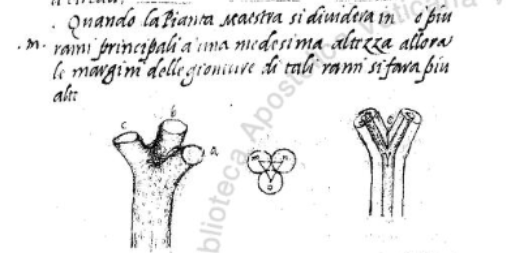
Leonardo wrote on how to draw a vast range of subjects including even the ramifications of trees (fol. 245r):


His words read: Quando la pianta maestra si dividerà in uno o piú rami principali ad una medesima altezza, allora i margini delle giunture di tali rami si faranno piú alti a riscontro l'uno dell'altro che inverso il centro dell'albero, inverso il quale rimarranno gran concavità. (Section 819 in the Italian edition of 1947).


Here is the full list of 106 Urb.lat. digitizations on January 24:
  1. Urb.lat.172
  2. Urb.lat.195
  3. Urb.lat.221
  4. Urb.lat.227
  5. Urb.lat.234, Haly Abbas, medical text, HT to Pieter Beullens (@LatinAristotle) who points out a good color photo of folio 1r at the MacKinney Collection
  6. Urb.lat.244
  7. Urb.lat.247
  8. Urb.lat.274
  9. Urb.lat.283
  10. Urb.lat.308, the Grammatica by Diomedes, the Ars Grammatica of Alcuin and other works. Written in Ferrara, Italy in about 1475-1480 (see Grafton's Rome Reborn description).
  11. Urb.lat.353
  12. Urb.lat.359
  13. Urb.lat.376
  14. Urb.lat.411
  15. Urb.lat.413
  16. Urb.lat.458
  17. Urb.lat.487
  18. Urb.lat.497
  19. Urb.lat.498.pt.1
  20. Urb.lat.498.pt.2
  21. Urb.lat.546
  22. Urb.lat.638
  23. Urb.lat.750
  24. Urb.lat.799
  25. Urb.lat.818.pt.2
  26. Urb.lat.819.pt.1
  27. Urb.lat.819.pt.2
  28. Urb.lat.844
  29. Urb.lat.852.pt.1
  30. Urb.lat.852.pt.2
  31. Urb.lat.856.pt.1
  32. Urb.lat.898
  33. Urb.lat.959
  34. Urb.lat.1012
  35. Urb.lat.1016
  36. Urb.lat.1043
  37. Urb.lat.1044
  38. Urb.lat.1046
  39. Urb.lat.1051
  40. Urb.lat.1054
  41. Urb.lat.1055
  42. Urb.lat.1067
  43. Urb.lat.1068
  44. Urb.lat.1069
  45. Urb.lat.1070
  46. Urb.lat.1077
  47. Urb.lat.1082
  48. Urb.lat.1086
  49. Urb.lat.1093
  50. Urb.lat.1100
  51. Urb.lat.1105
  52. Urb.lat.1109
  53. Urb.lat.1110
  54. Urb.lat.1111
  55. Urb.lat.1112
  56. Urb.lat.1113
  57. Urb.lat.1125
  58. Urb.lat.1203
  59. Urb.lat.1206
  60. Urb.lat.1231
  61. Urb.lat.1251
  62. Urb.lat.1252
  63. Urb.lat.1270, Trattato della pittura of Leonardo da Vinci (above). See Wikipedia.
  64. Urb.lat.1272
  65. Urb.lat.1280
  66. Urb.lat.1308
  67. Urb.lat.1319
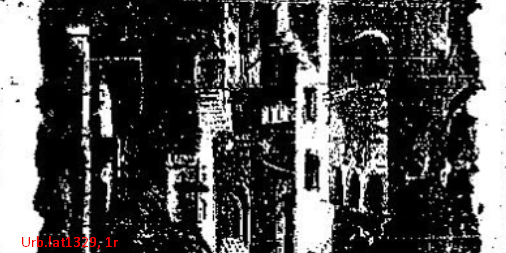
  68. Urb.lat.1329, a book of scientific works including the Optics by Euclid in Latin translation (see Grafton's Rome Reborn description) and a translation of Muḥammad ibn Mūsá Khuwārizmī's Jabr wa-al-muqābalah by Gerard of Cremona, given the Latin title "Liber algebre et almuchabala." SLUL record. Here is a perspective drawing of a street from folio 1r:
  69. Urb.lat.1357
  70. Urb.lat.1370
  71. Urb.lat.1377
  72. Urb.lat.1383
  73. Urb.lat.1384
  74. Urb.lat.1385
  75. Urb.lat.1390
  76. Urb.lat.1393
  77. Urb.lat.1396
  78. Urb.lat.1397
  79. Urb.lat.1401
  80. Urb.lat.1414
  81. Urb.lat.1439
  82. Urb.lat.1449
  83. Urb.lat.1468
  84. Urb.lat.1492
  85. Urb.lat.1516-1520
  86. Urb.lat.1568
  87. Urb.lat.1572
  88. Urb.lat.1585
  89. Urb.lat.1624
  90. Urb.lat.1626
  91. Urb.lat.1629.pt.1
  92. Urb.lat.1629.pt.2
  93. Urb.lat.1643
  94. Urb.lat.1650
  95. Urb.lat.1681
  96. Urb.lat.1690
  97. Urb.lat.1697
  98. Urb.lat.1699
  99. Urb.lat.1703
  100. Urb.lat.1704
  101. Urb.lat.1719
  102. Urb.lat.1728
  103. Urb.lat.1739
  104. Urb.lat.1757
  105. Urb.lat.1761
  106. Urb.lat.1763
This is Piggin's Unofficial List number 90. If you have corrections or additions, please use the comments box below. Follow me on Twitter (@JBPiggin) for news of more additions to DigiVatLib.

2017-01-23

Throwback to Microfilm

In an extraordinary change of policy, the Vatican Library appears to have given up its emphasis on digitally color-scanning its manuscripts for online release. Instead it is following the cheap and cheerful option of posting images of its old black-and-white microfilm online. This explains how, just after noon on January 23, 2017, it was able in one fell swoop to post images of nearly 4,000 new manuscripts.

The manuscripts portal, now boasts links to an impressive 10,338 manuscripts, probably making it from this date the biggest single online library in the the world of medieval and early modern hand-penned books.

However the retrograde step to low quality is disappointing. Microfilming of the Vatican manuscripts began in the 1950s and the quality of these grainy black and white images is far below what scholars expect nowadays. In many cases words are entirely illegible or lost in dark folds and gutters. The illuminations are often just murky patches of grey.

Color scanning was an enormous advance. The books are laid in cradles under shadowless light and photographed from two angles, with the images then post-processed. The Library is being frank about this downgrade and is marking the microfilms as "low quality", but offers no explanation of why it is changing course. [Later note: there has since been an assurance that these manuscripts will be color-scanned, and that the black-and-white versions are merely stopgaps.]


I may not be able to offer you a complete list of this massive release as the work required to collate it would simply be beyond my time and resources. But here is a small sample: the Reginense latino series, has suddenly grown from 93 items to 492. All of the 399 additions are marked  "low quality" though many really did deserve better treatment:
  1. Reg.lat.19
  2. Reg.lat.21
  3. Reg.lat.27
  4. Reg.lat.29
  5. Reg.lat.37
  6. Reg.lat.49
  7. Reg.lat.52
  8. Reg.lat.66
  9. Reg.lat.67
  10. Reg.lat.69, Carolingian? with Alcuin, John the Deacon and others.
  11. Reg.lat.75
  12. Reg.lat.91
  13. Reg.lat.93
  14. Reg.lat.96
  15. Reg.lat.99
  16. Reg.lat.106
  17. Reg.lat.107,
  18. Reg.lat.116
  19. Reg.lat.117
  20. Reg.lat.122
  21. Reg.lat.124, Rabanus Maurus: De laudibus sanctae crucis: A principal copy made in 825 or 826: read this introduction to the Liber de_laudibus_Sanctae_Crucis. On the author: Wikipedia. The reproduction of this beautiful book is in fact a color scan
  22. Reg.lat.125
  23. Reg.lat.126
  24. Reg.lat.129
  25. Reg.lat.132
  26. Reg.lat.133
  27. Reg.lat.134
  28. Reg.lat.140
  29. Reg.lat.141
  30. Reg.lat.147
  31. Reg.lat.150
  32. Reg.lat.160
  33. Reg.lat.162
  34. Reg.lat.167
  35. Reg.lat.185
  36. Reg.lat.187
  37. Reg.lat.191
  38. Reg.lat.193
  39. Reg.lat.194
  40. Reg.lat.195
  41. Reg.lat.201
  42. Reg.lat.215
  43. Reg.lat.219
  44. Reg.lat.222
  45. Reg.lat.224
  46. Reg.lat.230
  47. Reg.lat.234
  48. Reg.lat.251
  49. Reg.lat.255
  50. Reg.lat.258
  51. Reg.lat.263
  52. Reg.lat.272
  53. Reg.lat.274
  54. Reg.lat.280
  55. Reg.lat.288
  56. Reg.lat.294
  57. Reg.lat.296
  58. Reg.lat.300
  59. Reg.lat.304
  60. Reg.lat.306
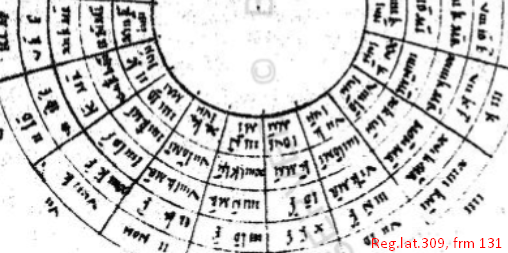
  61. Reg.lat.309, a copy of a famed Carolingian compendium of astronomy, the Handbook of 809. Horrible imaging:
  62. Reg.lat.310
  63. Reg.lat.318
  64. Reg.lat.324
  65. Reg.lat.333
  66. Reg.lat.338
  67. Reg.lat.342
  68. Reg.lat.343
  69. Reg.lat.344
  70. Reg.lat.348
  71. Reg.lat.358
  72. Reg.lat.373
  73. Reg.lat.377
  74. Reg.lat.378
  75. Reg.lat.379
  76. Reg.lat.385.pt.1
  77. Reg.lat.385.pt.2
  78. Reg.lat.388
  79. Reg.lat.399
  80. Reg.lat.407
  81. Reg.lat.424
  82. Reg.lat.426
  83. Reg.lat.430
  84. Reg.lat.432
  85. Reg.lat.453
  86. Reg.lat.455
  87. Reg.lat.457
  88. Reg.lat.463
  89. Reg.lat.467
  90. Reg.lat.469
  91. Reg.lat.470
  92. Reg.lat.471
  93. Reg.lat.477
  94. Reg.lat.479
  95. Reg.lat.480
  96. Reg.lat.481
  97. Reg.lat.482
  98. Reg.lat.484
  99. Reg.lat.486
  100. Reg.lat.489
  101. Reg.lat.497, contains a single folio of the Old English history of the Viking Ohthere of Hålogaland (Wikipedia)
  102. Reg.lat.498
  103. Reg.lat.499
  104. Reg.lat.500
  105. Reg.lat.509
  106. Reg.lat.516
  107. Reg.lat.517
  108. Reg.lat.520
  109. Reg.lat.521
  110. Reg.lat.522
  111. Reg.lat.523
  112. Reg.lat.524
  113. Reg.lat.529
  114. Reg.lat.532
  115. Reg.lat.535
  116. Reg.lat.539
  117. Reg.lat.540
  118. Reg.lat.541
  119. Reg.lat.543
  120. Reg.lat.544
  121. Reg.lat.548
  122. Reg.lat.553.pt.1
  123. Reg.lat.553.pt.2
  124. Reg.lat.556.pt.1
  125. Reg.lat.556.pt.2
  126. Reg.lat.558
  127. Reg.lat.561
  128. Reg.lat.562
  129. Reg.lat.566, the only existing manuscript of the Epitoma of Helgaud
  130. Reg.lat.568
  131. Reg.lat.571
  132. Reg.lat.572
  133. Reg.lat.576
  134. Reg.lat.577
  135. Reg.lat.578
  136. Reg.lat.579
  137. Reg.lat.580
  138. Reg.lat.582
  139. Reg.lat.585
  140. Reg.lat.592
  141. Reg.lat.593
  142. Reg.lat.596
  143. Reg.lat.598
  144. Reg.lat.605
  145. Reg.lat.606
  146. Reg.lat.610
  147. Reg.lat.612
  148. Reg.lat.616
  149. Reg.lat.620
  150. Reg.lat.621
  151. Reg.lat.624
  152. Reg.lat.630
  153. Reg.lat.631
  154. Reg.lat.633.pt.1
  155. Reg.lat.633.pt.2
  156. Reg.lat.641
  157. Reg.lat.644
  158. Reg.lat.648
  159. Reg.lat.657
  160. Reg.lat.658
  161. Reg.lat.666
  162. Reg.lat.667
  163. Reg.lat.668
  164. Reg.lat.669
  165. Reg.lat.672
  166. Reg.lat.673
  167. Reg.lat.681
  168. Reg.lat.692
  169. Reg.lat.694
  170. Reg.lat.703.pt.1
  171. Reg.lat.703.pt.2
  172. Reg.lat.712
  173. Reg.lat.722
  174. Reg.lat.727
  175. Reg.lat.729
  176. Reg.lat.736
  177. Reg.lat.738
  178. Reg.lat.744.pt.1
  179. Reg.lat.744.pt.2
  180. Reg.lat.745
  181. Reg.lat.750
  182. Reg.lat.755
  183. Reg.lat.760
  184. Reg.lat.763
  185. Reg.lat.767
  186. Reg.lat.768
  187. Reg.lat.774
  188. Reg.lat.776
  189. Reg.lat.777
  190. Reg.lat.781
  191. Reg.lat.787
  192. Reg.lat.791
  193. Reg.lat.807
  194. Reg.lat.827
  195. Reg.lat.830
  196. Reg.lat.832
  197. Reg.lat.833
  198. Reg.lat.834
  199. Reg.lat.835
  200. Reg.lat.838
  201. Reg.lat.846
  202. Reg.lat.849
  203. Reg.lat.852
  204. Reg.lat.857
  205. Reg.lat.859
  206. Reg.lat.863
  207. Reg.lat.868
  208. Reg.lat.902
  209. Reg.lat.920
  210. Reg.lat.921
  211. Reg.lat.923
  212. Reg.lat.931
  213. Reg.lat.936
  214. Reg.lat.937
  215. Reg.lat.944
  216. Reg.lat.951
  217. Reg.lat.971
  218. Reg.lat.973
  219. Reg.lat.977
  220. Reg.lat.982
  221. Reg.lat.992
  222. Reg.lat.1003
  223. Reg.lat.1010
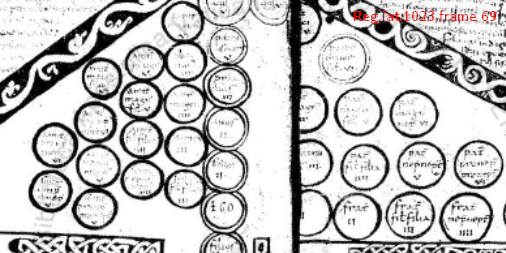
  224. Reg.lat.1023, this is one of the most important Roman law texts with various arbor juris schemata. Most are semi-illegible:
  225. Reg.lat.1048
  226. Reg.lat.1050
  227. Reg.lat.1054
  228. Reg.lat.1061
  229. Reg.lat.1099
  230. Reg.lat.1104
  231. Reg.lat.1115
  232. Reg.lat.1123
  233. Reg.lat.1127
  234. Reg.lat.1128
  235. Reg.lat.1131
  236. Reg.lat.1140
  237. Reg.lat.1145
  238. Reg.lat.1148
  239. Reg.lat.1171
  240. Reg.lat.1177
  241. Reg.lat.1205
  242. Reg.lat.1209
  243. Reg.lat.1220
  244. Reg.lat.1238
  245. Reg.lat.1241
  246. Reg.lat.1245
  247. Reg.lat.1253
  248. Reg.lat.1260
  249. Reg.lat.1263
  250. Reg.lat.1268
  251. Reg.lat.1272
  252. Reg.lat.1276
  253. Reg.lat.1281
  254. Reg.lat.1282
  255. Reg.lat.1290
  256. Reg.lat.1294
  257. Reg.lat.1297.pt.1
  258. Reg.lat.1297.pt.2
  259. Reg.lat.1315
  260. Reg.lat.1352
  261. Reg.lat.1354
  262. Reg.lat.1357
  263. Reg.lat.1364
  264. Reg.lat.1370, the earliest grammar (1437 – 1441) of a Romance language (Tuscan). See HistoryofInformation.com and Cecil Grayson.
  265. Reg.lat.1385
  266. Reg.lat.1388
  267. Reg.lat.1389
  268. Reg.lat.1391
  269. Reg.lat.1418
  270. Reg.lat.1421
  271. Reg.lat.1429
  272. Reg.lat.1431
  273. Reg.lat.1442
  274. Reg.lat.1446
  275. Reg.lat.1456
  276. Reg.lat.1461
  277. Reg.lat.1479
  278. Reg.lat.1481
  279. Reg.lat.1486
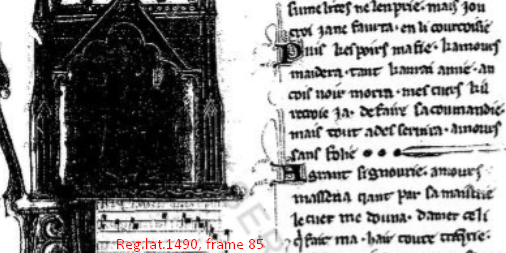
  280. Reg.lat.1490, Chansonnier cangé: see an account of the trobairitz female troubadours.
  281. Reg.lat.1495
  282. Reg.lat.1496
  283. Reg.lat.1501
  284. Reg.lat.1505
  285. Reg.lat.1511
  286. Reg.lat.1513
  287. Reg.lat.1516
  288. Reg.lat.1517
  289. Reg.lat.1519
  290. Reg.lat.1531
  291. Reg.lat.1541
  292. Reg.lat.1549
  293. Reg.lat.1553, an early 9th-century copy of the Bern Riddles
  294. Reg.lat.1555
  295. Reg.lat.1556
  296. Reg.lat.1557
  297. Reg.lat.1560
  298. Reg.lat.1569
  299. Reg.lat.1570
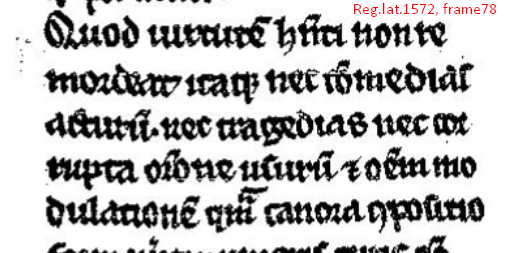
  300. Reg.lat.1572, this is a most remarkable manuscript, uniquely containing a previously lost Latin philosophical text dating from antiquity, the missing part 3 of De Platone by the 2nd-century writer Apuleius. Justin Stover points out this discovery was made in 1949 by the historian of philosophy Raymond Klibansky, who neither disclosed the location nor published any edition by the time of his death in 2005. [Justin Stover kindly points out (comment below) that Klibansky did reveal the shelfmark in 1993, in his catalogue of the manuscripts of Apuleius' philosophical works, with Frank Regen, Die Handschriften der philosophischen Werke des Apuleius.] Here is the book's start at fol. 77r (frame 78): 
    Stover's edition, A New Work by Apuleius: The Lost Third Book of the De Platone, has since appeared with OUP. (HT to Pieter Buellens (@LatinAristotle).)
  301. Reg.lat.1573
  302. Reg.lat.1575
  303. Reg.lat.1583
  304. Reg.lat.1584
  305. Reg.lat.1591
  306. Reg.lat.1592
  307. Reg.lat.1593
  308. Reg.lat.1595
  309. Reg.lat.1598
  310. Reg.lat.1602
  311. Reg.lat.1603
  312. Reg.lat.1616
  313. Reg.lat.1624
  314. Reg.lat.1630
  315. Reg.lat.1637.pt.1
  316. Reg.lat.1637.pt.2
  317. Reg.lat.1638
  318. Reg.lat.1642
  319. Reg.lat.1650
  320. Reg.lat.1652
  321. Reg.lat.1659
  322. Reg.lat.1666
  323. Reg.lat.1669
  324. Reg.lat.1670
  325. Reg.lat.1671
  326. Reg.lat.1672
  327. Reg.lat.1673
  328. Reg.lat.1676
  329. Reg.lat.1682
  330. Reg.lat.1684
  331. Reg.lat.1686
  332. Reg.lat.1691
  333. Reg.lat.1708
  334. Reg.lat.1716
  335. Reg.lat.1719
  336. Reg.lat.1721
  337. Reg.lat.1722
  338. Reg.lat.1723
  339. Reg.lat.1725
  340. Reg.lat.1731
  341. Reg.lat.1738
  342. Reg.lat.1758
  343. Reg.lat.1762
  344. Reg.lat.1773
  345. Reg.lat.1801
  346. Reg.lat.1803
  347. Reg.lat.1805
  348. Reg.lat.1806
  349. Reg.lat.1809
  350. Reg.lat.1818
  351. Reg.lat.1824
  352. Reg.lat.1825
  353. Reg.lat.1830
  354. Reg.lat.1832
  355. Reg.lat.1834
  356. Reg.lat.1837
  357. Reg.lat.1840
  358. Reg.lat.1841
  359. Reg.lat.1845
  360. Reg.lat.1848
  361. Reg.lat.1849
  362. Reg.lat.1852
  363. Reg.lat.1853
  364. Reg.lat.1863
  365. Reg.lat.1867
  366. Reg.lat.1870
  367. Reg.lat.1875
  368. Reg.lat.1884
  369. Reg.lat.1894
  370. Reg.lat.1909
  371. Reg.lat.1910
  372. Reg.lat.1911
  373. Reg.lat.1914
  374. Reg.lat.1958
  375. Reg.lat.1964
  376. Reg.lat.1970
  377. Reg.lat.1971
  378. Reg.lat.1973
  379. Reg.lat.1987
  380. Reg.lat.2000
  381. Reg.lat.2001
  382. Reg.lat.2018
  383. Reg.lat.2021, with Girolamo Mei, Letter to Vincenzo Galilei
  384. Reg.lat.2023
  385. Reg.lat.2043
  386. Reg.lat.2049
  387. Reg.lat.2052
  388. Reg.lat.2061
  389. Reg.lat.2062
  390. Reg.lat.2071
  391. Reg.lat.2077, Palimpsest, Lowe CLA 1 114 and 115
  392. Reg.lat.2079
  393. Reg.lat.2082
  394. Reg.lat.2090
  395. Reg.lat.2099
  396. Reg.lat.2102
  397. Reg.lat.2103
  398. Reg.lat.2120
  399. Reg.lat.???: item missed in my haste
This is Piggin's Unofficial List number 89. If you have corrections or additions, please use the comments box below. Follow me on Twitter (@JBPiggin) for news of more additions to DigiVatLib.

2017-01-19

Digital Winter


The long winter of the Vatican Library's digitization program continues, with very little genuinely new this month, barring seven Pal. lat. manuscripts and a single Ott. lat. item.

Not having any contacts with the library, I cannot say why this is. We know from published information that there are up to half a dozen teams of digitizers in Rome and that a team takes about six weeks from taking a manuscript off the shelf through scanning, checking and marking up to the point where a manuscript is published in facsimile. So they must be doing something.

One evident aim of this set-up is to satisfy the foundations that fund the work. A look at the Polonsky Foundation site suggests that its commission to digitize manuscripts has been pretty much completed: all the Greek manuscripts requested have green ticks next to them (except Ott.gr.147, which is in fact online), while only eight of the Hebrew manuscripts remain to be issued. (Incidentally, if you are interested in how to show manuscripts from two libraries side by side on one screen, the Polonsky blog this week tells you how to use Mirador software.)

A contract with the Heidelberg University Library and Manfred Lautenschläger Stiftung to complete the Pal.lat. collection (which was confiscated from Germany all those years ago) is also heading for completion, which explains the brisk progress there.

It's not clear who, apart from NTT Data with 1,800 items pledged, will fund the continuation of the work, or what happens next. There may perhaps have been recent progress in digitizing incunabula, archival volumes and the old inventories, which have separate portal pages and which I have not been tracking. 

Here is a listing of the new Heidelberg items:
Here are the 20 newest postings in Rome, of which 19 are not really new, having been accessible via the German site for years:
This is Piggin's Unofficial List number 88. If you have corrections or additions, please use the comments box below. Follow me on Twitter (@JBPiggin) for news of more additions to DigiVatLib.

2017-01-09

Peter and Parker

Half a year ago, a kind reader revealed to me that the Compendium of Petrus Pictaviensis, a remarkable medieval chart of time that dates from around 1180 just kept going and going and turns up in English translation in one of the early English vernacular bibles, that edited by Matthew Parker and printed in London from 1568 onwards.

There are several copies of this famous work of 16th-century printing on Early English Books Online (which is behind a paywall). Otherwise check out Princeton's copy incomplete at archive.org.

The English text of the diagram has been usefully abstracted by the Text Creation Partnership (here is the transcript). What one notices is that this text is longer than that of Petrus, heavily interpolated and rather liberally translated from the Latin.

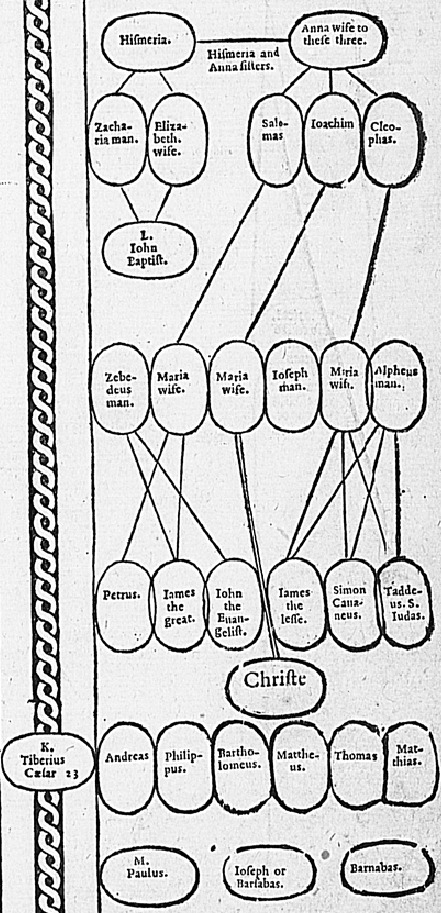
I was interested to see how the diagram shaped up graphically, and as I usually do, I looked at the end rather than the beginning of the chart, where there are several characteristic ways of laying out the Holy Family and Apostles, one of Petrus's hobby-horses. Here's how it is shown in the Parker Bible:

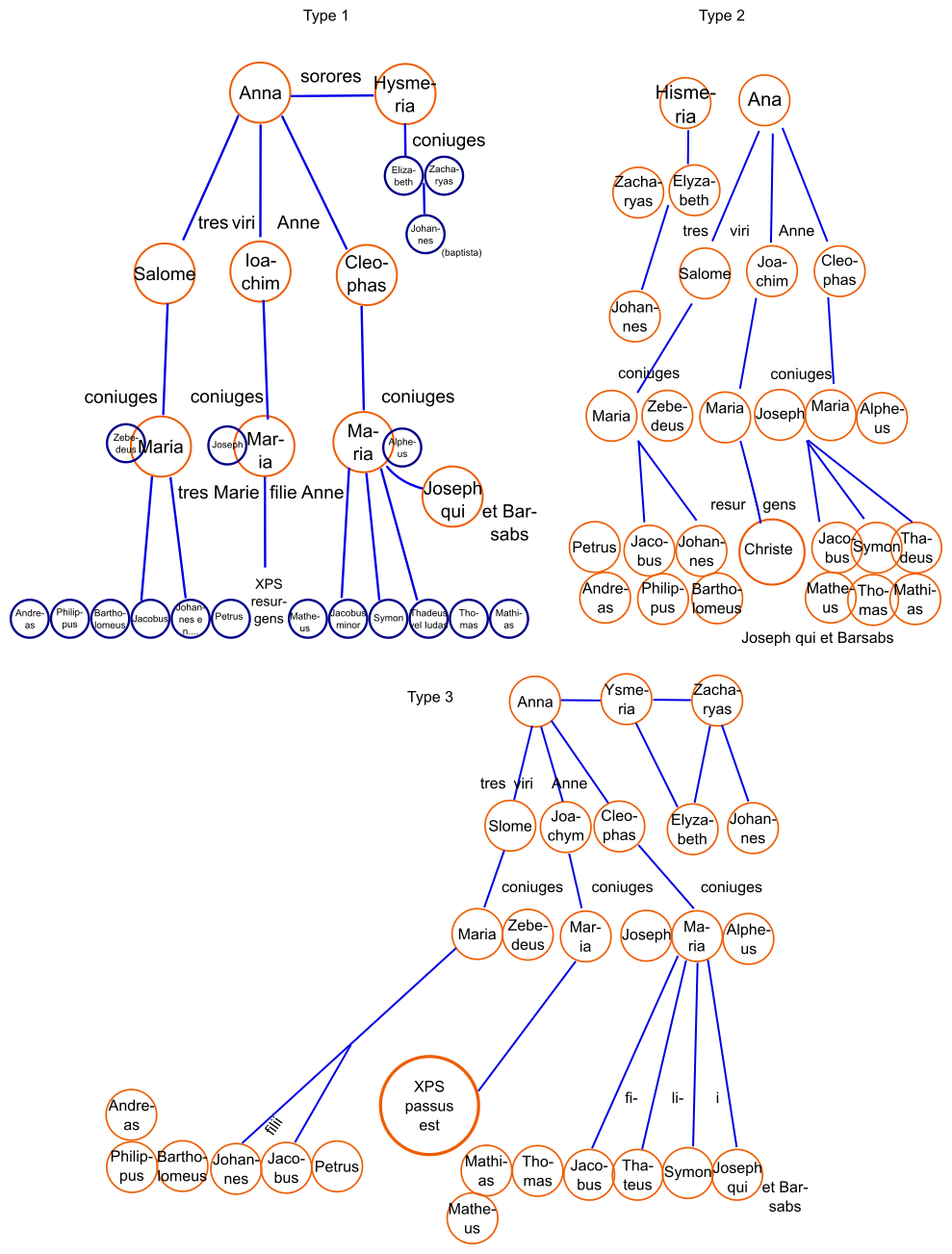
Below is my own abstract of the three most characteristic layouts to be found in the older manuscripts:

You'll see at a glance that the Parker Bible use the layout at top right. This is useful to anyone who wants to research the origins of the Parker diagram and the work involved in converting it to print. I haven't continued my research past that simple check, but knowing about this connection may be useful to others studying this diagram, so I will leave this note online.

2017-01-04

Tulliness

It's been a great week for scholars of Cicero, with a couple of key Renaissance manuscripts of his work arriving online at the Heidelberg offshoot of the Vatican digitization programme.

The Roman lawyer, politician and philosopher's celebrated book On Oratory was long thought to be substantially lost until the bishop of Lodi, Italy discovered a nearly complete and somewhat corrupt text of it in his predecessors' library in 1421 or 1422.

Scholars converged on Lodi to copy it, but incredibly this so-called Codex Laudensis got lost by 1428. Perhaps it will show up one day as the world's oldest overdue library book. We are therefore forced to rely on the copies, of which two went to Germany and finally ended in Rome: P and R, or Pal.lat.1469 and Pal.lat.1470 below. Here is the full list of 27 new digitizations:
  1. Pal. lat. 1399 Walter Lud; Johannes de Monteregio; Martin Waldseemüller; Alkindus: Mathematisch-astrologischer Sammelband (Süddeutschland, 1. Viertel 16. Jh.)
  2. Pal. lat. 1401 Beda; Thebit ben Corat; Albumasar; Hali Imrani; Roger Herfordensis; Ps.-Hippokrates; Messahalla; Alkindi; Ps.-Ptolemaeus: Zusammengesetzte Handschrift: astronomische und astrologische Texte (Schlesien (I) , Magdeburg (III), 1. Hälfte 15. Jh. (I) ; um 1200 (II) ; 14. Jh. (III))
  3. Pal. lat. 1402 Guido Bonatus: Liber astronomicus (Deutschland, Anfang 15. Jh.)
  4. Pal. lat. 1403 Johannes de Lineriis; Johannes de Sancto Amando: Sammelhandschrift zur Astronomie und Medizin (Frankreich, 1. Hälfte 14. Jh.)
  5. Pal. lat. 1404 Johannes Pastor Coloniensis: Viaticus astrologiae (Westdeutschland, 2. Hälfte 15. Jh.)
  6. Pal. lat. 1405 Alfonsus rex; Johannes Dank; Adamus; Ps.-Boethius; Wolfram de Bertholdi Villa; Petrus Hispanus-Thydericus: Zusammengesetzte Handschrift (Deutschland (I), 14. Jh. (I) ; 2. Hälfte 13. Jh.(II))
  7. Pal. lat. 1407 Albumasar; Zahel; Alkindus; Guido Bonatus: Astrologische Sammelhandschrift (Deutschland, um 1400)
  8. Pal. lat. 1408 Albumasar; Alkabitius; Hali Imrani: Astrologische Sammelhandschrift (Deutschland, 14. Jh.)
  9. Pal. lat. 1409 Johannes Dank: Astronomische Sammelhandschrift (Deutschland, 2. Hälfte 14. Jh.)
  10. Pal. lat. 1411 Johannes: Tabulae cum canonibus ; Algorismus de minutiis ; De compositione et usu cylndri (Wien, 1. Drittel 15. Jh.)
  11. Pal. lat. 1412 Gerardus ; Johannes a; Johannes ; Alfonso: Astronomische Sammelhandschrift (Paris, 1453/54)
  12. Pal. lat. 1413 Johannes ; Johannes Schwab de Butzbach; Petrus Lufft de Monaco; Johannes Plunderlin de Straubing; Nicolaus Rysch: Astronomische Sammelhandschrift (Bayern und Österreich, 2. Dritttel 15. Jh.)
  13. Pal. lat. 1414 Qabīṣī, Abu-'ṣ-Ṣaqr ʿAbd-al-ʿAzīz Ibn-ʿUṯmān /al-; Thebit ben Corat; Johannes ; Robertus Grosseteste; Arzachel; Gerardus ; Robertus ; Māšā'allāh Ibn-Aṯarī: Astrologisch-astronomische Sammelhandschrift (Frankreich (Paris), 13./14. Jh.)
  14. Pal. lat. 1415 Robertus ; Albumasar; Petrus: Sammelhandschrift (14. Jh.)
  15. Pal. lat. 1438 Astronomisch-astrologischer Miszellaneenband mit Inkunabeldruck (Franken, Heidelberg, Ende 14. Jh. - zweites Drittel 15. Jh.)
  16. Pal. lat. 1462 Cicero, Marcus Tullius: De innuentione (Italien, 15. Jh.)
  17. Pal. lat. 1466 Cicero, Marcus Tullius: De Oratore (Italien, 15. Jh.)
  18. Pal. lat. 1467 Cicero, Marcus Tullius: Opera (Italien, 15. Jh.)
  19. Pal. lat. 1468 Cicero, Marcus Tullius: De oratore (Italien (Venedig), 15. Jh.)
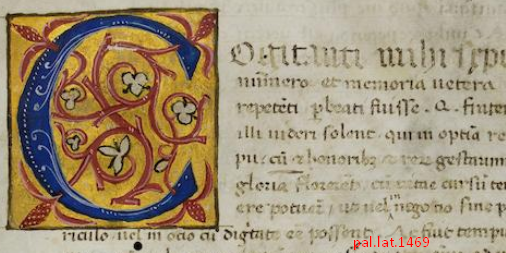
  20. Pal. lat. 1469 Cicero, Marcus Tullius: Opera (Italien, 15. Jh.), the P witness:
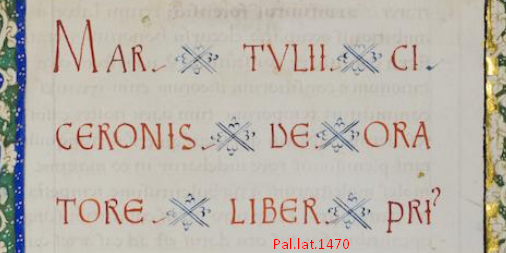
  21. Pal. lat. 1470 Cicero, Marcus Tullius: De oratore (Italien, 15. Jh.), the R witness:
  22. Pal. lat. 1473 Cicero, Marcus Tullius: Opera (Italien, 15. Jh.)
  23. Pal. lat. 1474 Cicero, Marcus Tullius: De oratore (Italien, 15. Jh.)
  24. Pal. lat. 1477 Cicero, Marcus Tullius: Orationes (Italien, Ende 14. Jh.)
  25. Pal. lat. 1478 Cicero, Marcus Tullius; Antonius Luschus; Sicco Polentonus: Orationes (Italien, 15. Jh.)
  26. Pal. lat. 1481 Cicero, Marcus Tullius: Orationes (Italien, 15. Jh.)
  27. Pal. lat. 1482 Cicero, Marcus Tullius: Orationes (Italien, 15. Jh.)
Of the other most reliable copies of the Codex Laudensis at the Vatican, the one usually referred to as O, Ott.lat.2057, is already online (see PUL in October), but Vat.lat.3237 is still  on the waiting list. A lesser copy above, Pal.lat.1469, made on paper in Venice, has its own interesting history related by Jeannine Fohlen. This entire group is referred to as the integri.

The only other source of Cicero's oratorical works is the so-called mutili family, of which the oldest representatives are Avranches 238 (A; c. 830–50), Erlangen 380 (olim 848; E; c. 985), and London, Harley 2736 (H; written by Lupus of Ferrierès, c. 830–40).

This is Piggin's Unofficial List number 87. The main Vatican website has been at a standstill since late November. I don't know why.  The only recent news about it was an Osservatore Romano article by Cesare Pasini in November implying there are still some free Canon reproductions left to give you if you donate quick to the fund-raiser.

If you have corrections or additions, please use the comments box below. Follow me on Twitter (@JBPiggin) for news of more additions to DigiVatLib.

2016-12-22

Wonky Meniscus

A meniscus, as we all now learn at about age 12, is caused by surface tension on a liquid. It may make it hard to measure liquid medication. Presumably the entire Pacific Ocean is a couple of millimetres higher than it would be without surface tension.

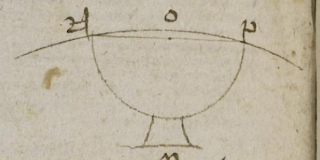
But Aristotle had a different explanation, which he employed to argue that the Earth was the centre of the universe, and this was believed in the Middle Ages. It figures in a curious scientific manuscript just digitized at the Vatican and uploaded to the Bibliotheca Palatina website.


Here I will let John E Murdoch take over the story. He says the figure:
... pictures an argument that is found in both geometrical and natural philosophical works in the Middle Ages. It is alluded to, for example, in Roger Bacon in the thirteenth century, in Thomas Bradwardine and Nicole Oresme in the fourteenth, and in the margins of various medieval manuscripts of Euclid's Elements, as well as in the present fourteenth-century codex of a geometrical work ascribed to one Gordanus (not to be identified with Jordanus de Nemore). The argument relates to the meniscus of water or any other liquid contained in a vessel (since any point on such a surface is equally distant from the center of the universe). But this means that the closer the vessel is to this center, the more liquid it can contain when "full." This is so because the circular arc determining the surface of the liquid is "more curved" when the vessel is closer to the center of the universe, that is, the meniscus then “bulges" higher over the rim of the vessel. Indeed, it was even maintained that if such a vessel were absolutely full of liquid, moving the vessel further from the center of the universe would cause some of the liquid to overflow, since the surface of the liquid would become less curved.

The passage is at folio 114v of Pal.lat. 1389, one 24 fascinating scientific manuscripts uploaded in the past week:

  1. Pal. lat. 1369 Richardus ; Johannes ; Battānī, Muḥammad Ibn-Ǧābir /al-; Abū-Maʿšar Ǧaʿfar Ibn-Muḥammad; Messahalla; Iafar; Ptolemaeus, Claudius; Hali Imrani; u.a.: Astronomisch-astrologische Sammelhandschrift (Süddeutschland, Mitte 15. Jh.)
  2. Pal. lat. 1372 Alkabitius; Zael; Abū-Maʿšar Ǧaʿfar Ibn-Muḥammad; Messahalla: Astrologische Sammelhandschrift (Italien (?), 14. und 15. Jh.)
  3. Pal. lat. 1373 Messahalla; Prosdocimus ; Johannes Dank; Johannes de Lineriis; Prophatius Judaeus; Alfonso : Astronomisch-astrologische Sammelhandschrift (Südwestdeutschland, 1. Viertel 15. Jh.)
  4. Pal. lat. 1375 Johannes ; Johannes de Lineriis; Peuerbach, Georg /von; Johannes Regiomontanus; Philo ; Hermes: Astronomische Sammelhandschrift (Krakau, Ende 15. Jh.)
  5. Pal. lat. 1376 Johannes de Lineriis; Johannes Schindel; Thebit ben Chorat; Johannes Dank de Saxonia; Johannes ; Farġānī, Aḥmad Ibn-Muḥammad /al-; Alkabitius; Messahalla; Prophatius Judaeus: Astronomisch-mathematische Sammelhandschrift (Regensburg, St. Emmeran, 1447-1458)
  6. Pal. lat. 1379 Guilelmus de Velde: Empyreale minus (Südwestdeutschland, 1498)
  7. Pal. lat. 1380 Sammelhandschrift zum Quadrivium (Bologna und Paris, 1350--1366)
  8. Pal. lat. 1382 Alkabitius; Abulcasis; Albertus Magnus; Trotula; Thomas Cantimpratensis; Nicolaus de Polonia; Arnaldus de Villanova: Sammelband zur Astrologie und Medizin (Italien (I) , Südwestdeutschland (II) , Deutschland (III) , Italien (IV) , Deutschland (V), 13./14. Jh. (I) ; 14. Jh. (II) ; 1. Hälfte 14. Jh. (III) ; 13. Jh. (IV) ; um 1400 (V) ; 15. Jh. (1458) (VI) ; Ende 14. Jh. (VII))
  9. Pal. lat. 1383 Mathematisch-komputistische Sammelhandschrift (Heidelberg, Letztes Viertel 15. Jh.)
  10. Pal. lat. 1384 Johannes Regiomontanus; Johanens von Gmunden; Messahalla; Prosdocimo de Beldemandis; Gerardus Cremonensis (Sabionetta): Mathematisch-komputistischer Sammelband (Bayern (I) , Deutschland (II), um 1500 (I) ; 15. Jh. (II))
  11. Pal. lat. 1385 Alebertus de Brudzewo; Georg Peuerbach; Albubather: Astronomisch-astrologische Sammelhandschrift (Krakau, 1488)
  12. Pal. lat. 1386 Mischband: Handschrift und Drucke (Südwestdeutschland (Rottweil) (I) , Holland (Breda) (II), 1501 (I) ; um 1550 (II))
  13. Pal. lat. 1387 Prophatius Judaeus; Jacobus Bonet: Astronomische Sammelhandschrift (Norspanien, 1. Viertel 15. Jh.)
  14. Pal. lat. 1388 Andalò di Negro; Gerardus de Feltre; Albumasar; Alkindus; Ps.-Hippokrates: Astronomische Sammelhandschrift (Italien, 1478)
  15. Pal. lat. 1389 Mathematisch-astronomische Sammelhandschrift (Deutschland, 2. Hälfte 14. Jh.)
  16. Pal. lat. 1390 Messahalla; Ptolemaeus; Almansor astrologus; Ps.-Hermes; Thebit ben Corat; Johannes de Lineriis; Johannes Danck: Astronomisch-astrologische Sammelhandschrift (Frankfurt a.M., 1391-1436)
  17. Pal. lat. 1391 Johannes de Monteregio; Richardus de Wallingford; Marx Gyerhose; Johannes Virdung: Mathematisch-astronomische Sammelhandschrift (Heidelberg, um 1500)
  18. Pal. lat. 1392 Sammelband: Miszellaneen zu Astronomie, Astrologie, Mathematik, Medizin und Manik (Deutschland (I, III, V) , Frankreich (II) , Südwestdeutschland (IV), 15. Jh. (I, III, V) ; um 1300 (II) ; 16. Jh. (IV))
  19. Pal. lat. 1394 Sammelband (Noritalien (I) , Italien (II), 1. Hälfte 15. Jh. (I) ; 16. Jh. (II))
  20. Pal. lat. 1395 Commentum in Johannis de Sacrobosco tractatum de sphaera (16. Jh.)
  21. Pal. lat. 1396 Astrologisch-astronomische Miszellaneen (Heidelberg, um 1500)
  22. Pal. lat. 1399 Walter Lud; Johannes de Monteregio; Martin Waldseemüller; Alkindus: Mathematisch-astrologischer Sammelband (Süddeutschland, 1. Viertel 16. Jh.)
  23. Pal. lat. 1401 Beda; Thebit ben Corat; Albumasar; Hali Imrani; Roger Herfordensis; Ps.-Hippokrates; Messahalla; Alkindi; Ps.-Ptolemaeus: Zusammengesetzte Handschrift: astronomische und astrologische Texte (Schlesien (I) , Magdeburg (III), 1. Hälfte 15. Jh. (I) ; um 1200 (II) ; 14. Jh. (III))
  24. Pal. lat. 1402 Guido Bonatus: Liber astronomicus (Deutschland, Anfang 15. Jh.)
This is Piggin's Unofficial List number 86. If you have corrections or additions, please use the comments box below. Follow me on Twitter (@JBPiggin) for news of more additions to DigiVatLib.

Murdoch, John E. Album of Science: Antiquity and the Middle Ages. New York: Scribner, 1984. Topic 254 (page 295).