Now that we have the Great Stemma published online, it's a good time to consider what sort of commonalities it has with the "arbor juris" diagrams in Isidore's Etymologies and with the Peutinger Map. The most important observation is that all three are in a sense calques of the board game, where the meaning arises from traversing through the diagram, much as you jump a counter over the squares or circles of a board towards a goal.
As an itinerarium, Peutinger is all about paths and distances, and not at all about spatial arrangements. One might argue that this is an adaptation to fit its roll form, but I wonder if this isn't a kind of deliberate elaboration from what would be needed for a mere map into something more sophisticated. As it happens, today's IHT edition of the New York Times reports on an ingenious new way of representing cities that overlaps a perspective view into a bird's eye view. It was designed by London's Berg studio and is an exhibit at the NY Museum of Modern Art. The Peutinger Map may not be a broken or primitive map, but instead a highly sophisticated meta-map like the Berg one (I won't comment here on the Richard Talbert proposal that the map is more show-off than practical).
One could argue that the common feature of Peutinger, the arbor iuris, the Great Stemma and also items such as the arbor porphyriana is the invitation to the reader to discover and explore paths, usually crooked paths. That is what the fila and the hypothetical timeline of the Great Stemma are about. The open question is about how accurately the fila and timeline were aligned with one another.
One important ancillary point, to my mind, is that our knowledge of all these graphic schemes is diminished by the difficulty that every scribe, whether Antique or medieval, must have had in accurately copying technical drawings by hand. Last year, I copied the triangular version of the "arbor iuris" and found it a very tricky task, even with good graphics software to help me.
Practice at copying these ingenious graphics has been helpful in understanding their transmission. When I am looking at a poor copy of a drawing, I now assume that its predecessor was more observant of the regularities generally. The more accurate predecessors of these drawings might have had a lot more fine-scale axial information, which is the easiest feature to get out of alignment, as we also seen in the Eusebian Chronological Canons.
But we cannot even begin to reverse this degradation unless we know what equipment such a copyist used when reproducing such drawings, and there I am afraid I have not read enough research. My understanding is that desks were uncommon: according to Kurt Weitzmann, texts were commonly copied onto papyrus rolls by a scribe sitting tailor-style, wearing a tight skirt as the support for his papyrus, which was laid obliquely over the left knee. In the early codex period, the folios were also inscribed on two knees (at least that is true of the Spanish monastery depicted in one of the Beatus codices). It seems to me that big graphics like the Great Stemma could not be competently copied that way, especially if straight axes had to be preserved. I have not studied how paintings were reproduced, but would guess that this done on tables or easels, since the artist had to be at some distance from his canvas to wield his brush.
When we consider how a pen-drawing was copied, I can only speculate. My guess would be that this was a job for a specialist. A tracing through translucent "paper" of some nature? Hardly likely, as the customer would surely expect a product on a robust support. In the 19th century, technical draftsmen used technology such as pantagraphs, but I doubt if these were known in Late Antiquity.
Again, I am only guessing, but I would suppose that the most efficient method would be to stretch a net over the source, another net over the destination, and plot each square or hexagon from one to the other. If a non-specialist scribe were given the task, he might not have the equipment, or the training, or the wit, or the time to do this. If he were particularly incompetent, he would not even complete each panel left to right but might simply hurl squiggles on the page to represent his "overall impression" of the model, then fill the gaps. The Urgell Beatus version of the Great Stemma exemplifies that sort of chaotic, ill-planned copy. It is hardly surprising that we have rather little of the pen-drawings of Antiquity.
Now, I think this encourages us to contemplate the question of Antique "technical" drawing with more attention to the intelligence behind each drawing than to the deficiencies in execution of any of its copies (this was my criticism of Klapisch-Zuber). To some extent, we may be able to at least discover the right questions to ask by looking at collective memory, the practices in other periods, and even our own perceptions. The answers to those questions naturally depend on evidence, but we should try to connect to the intelligence or the intention of the Antique authors.


2011-08-21
Infographics Meeting
I did a presentation on Thursday to a monthly meeting of the Society for News Design in Berlin, and there is a short note on it here by Dagmar Gehl, a PhD candidate at the University of Trier who has been completing a thesis on how adequately people understand "multimodal print clusters" (that is, graphics and text).
The questions fom the listeners as I went along were helpful in showing what audiences find surprising about this material.
One immediate question was: why there were so few daughters in the "family tree of Christ"? The answer: the Great Stemma author, working circa 420 A.D., is faithfully reproducing material that was nearly 1,000 years old in his own time. So the heavily male bias merely reflects the bias of the material he was given. The 540 names in the Great Stemma are certainly a selection from two or three times as many biblical names, but gender is not a factor in the selection.
Other questions focussed on why people wanted to construct genealogies in the first place, or how "true" they are. That is such a wide question that I usually steer away from discussing it, since I would like my audiences to focus more on the "how" of producing a flow chart, or organization chart, or dendrogram, or family tree, and why the visualization can be more useful as a communication medium than a text. But of course it can be legitimately discussed, and I do intend to broach the wider issue in the book I am writing about the research.
The questions fom the listeners as I went along were helpful in showing what audiences find surprising about this material.
One immediate question was: why there were so few daughters in the "family tree of Christ"? The answer: the Great Stemma author, working circa 420 A.D., is faithfully reproducing material that was nearly 1,000 years old in his own time. So the heavily male bias merely reflects the bias of the material he was given. The 540 names in the Great Stemma are certainly a selection from two or three times as many biblical names, but gender is not a factor in the selection.
Other questions focussed on why people wanted to construct genealogies in the first place, or how "true" they are. That is such a wide question that I usually steer away from discussing it, since I would like my audiences to focus more on the "how" of producing a flow chart, or organization chart, or dendrogram, or family tree, and why the visualization can be more useful as a communication medium than a text. But of course it can be legitimately discussed, and I do intend to broach the wider issue in the book I am writing about the research.
2011-08-11
Oxford Patristics Conference
I've done the presentation at last of the Great Stemma, to a qualified audience at the Oxford Patristics Conference today, followed by fruitful chats with three leading professors with close knowledge of the issues it raises. There were about 50 people at the session. After all these years of speaking, it still feels a bit strange to have an audience staring at you, seemingly unresponsive, though they are actually busy mentally processing what you say. They were great, and it was a kind of out-of-nowhere topic. Conference participants who had been told about it in advance were prepared, and said encouraging things afterwards. There was even a little murmer of laughter when I suggested the Great Stemma was like a PowerPoint slide. Thanks for being a great audience!
2011-07-22
Liber Genealogus Text
Just in time for the Oxford Patristics Conference, I have completed a new, structured edition of the Liber Genealogus and published it online here: www.piggin.net/stemmahist/libertext.htm.
Last summer I wasted a couple of weeks marking up a different recension of the Liber, that of Turin, in the mistaken belief that it was the earliest. This time I seem to have tracked down the recension that is truly the first, that of St Gall. It contains a subscription indicating it was written in 427 CE. I have keyed the transcript to the pages of the St Gall manuscript (I will make these hotlinks when it comes online). The manuscript page numbers begin with 299 (this particular codex is numbered by pages, not by folios). I have placed the etymological glosses in a column of their own at the right, which helps to make clearer how the author worked as he read his data from the Great Stemma diagram. The numbering is Mommsen's. It breaks the text into sections of wildly varying size, and I find it illogical, but it has been established as authoritative. Perhaps we can devise a better numbering system in the future.
Last summer I wasted a couple of weeks marking up a different recension of the Liber, that of Turin, in the mistaken belief that it was the earliest. This time I seem to have tracked down the recension that is truly the first, that of St Gall. It contains a subscription indicating it was written in 427 CE. I have keyed the transcript to the pages of the St Gall manuscript (I will make these hotlinks when it comes online). The manuscript page numbers begin with 299 (this particular codex is numbered by pages, not by folios). I have placed the etymological glosses in a column of their own at the right, which helps to make clearer how the author worked as he read his data from the Great Stemma diagram. The numbering is Mommsen's. It breaks the text into sections of wildly varying size, and I find it illogical, but it has been established as authoritative. Perhaps we can devise a better numbering system in the future.
2011-07-08
Oxford Patristics Conference
Here is the Oxford Patristics Conference web announcement of my paper to be delivered August 11: The Great Stemma: A Late Antique diagram of Christ's descent from Adam. They have put me in Room 10 at the Examination Rooms among the communications taking place on the Thursday on Art. I'm looking forward to it a lot.
2011-06-06
Reconstruction
A first reconstruction of the Great Stemma is complete. This has been accomplished using OpenOffice Draw, separating the various elements into approximately 10 layers. The reconstruction will be issued at the Oxford Patristics Conference in August.
2011-05-28
E-Codices
Some very good news from Professor Christoph Flüeler of the E-Codices manuscript digitization project in Switzerland. I asked him if Cod. Sang. 133, a little codex that is hugely important to the history of books, was likely to be released on the E-Codices website, and he replied that his team would speed this one up and make sure it is issued on the web in the next few months. This is magnificent. I am a big fan of E-Codices, which is a key source in Antiquity studies.
Cod. Sang. 133 in the Abbey Library at St. Gall in Switzerland is an important source in understanding the antique book trade, since it contains a set of more or less intact stichometric lists. These were computations of the length of books, calibrated in στιχοι or stichoi, that were used to set both the cost of transcription (the scribe's wages) and the book price (what the bookseller charged).
Cod. Sang. 133 contain fourth-century measurements of the books of the Bible and the 28 works of Cyprian. We know from the writer Galen (quoted here by Diels) that a Greek stichos or unit was 16 syllables, and this source confirms a Roman stichos, or verse, was similarly 16 Latin syllables.
Once described by Bernhard Bischoff as the "oldest document of the Christian book trade" and used by scholars such as Bruce Metzger to estimate the bulk of early bibles, this record gives us an insight into the economics of book publishing. The content is of course dry, for example:

This translates as:
The Four Gospels:
Matthew, 2700 lines
John, 1800 lines
Mark, 1700 lines
Luke, 3300 lines
All the lines make 10,000 lines.
But there are some interesting observations. The author lets fly for example at exploitative Roman booksellers for their slack and cheating ways with his beloved Cyprian:
Because the index of verses in Rome is not clearly given, and because in other places too, as a result of greed, they do not preserve it in full, I have gone through the books one by one, counting sixteen syllables per line, and have appended to each book the number of Virgilian hexameters it contains (Rouse translation).
The St. Gall manuscript, written during the late 8th or early 9th century, probably at St. Gall itself, and another manuscript, Rome, Biblioteca Nazionale Centrale Vittorio Emanuele II, Vitt. Em. 1325 (handwritten catalog entry in Italian here, formerly Cheltenham or Phillipps 12266), written at Nonantola in the 10th or early 11th century, are the key practical records we have about the stichometric method.
These North African lists, the so-called indicula, were discovered (it seems) by the great Theodor Mommsen, who wrote them up in 1886. Mommsen expanded his fame with this codex in the late 19th century, publishing the Liber Genealogus in his MGH series. It also contains a curious work, the Inventiones Nominum, which mentions a good many unusual biblical names that never made it into canonical scripture.
The St. Gall codex was revisited in 2000 by eminent US professor Richard Rouse, who argued that the 11 items discovered by Mommsen in the collection (see below) were not a random group of texts, but formed an intact North African reference book or compendium. It had travelled through the centuries together and had been put together by Donatist scholars, according to Rouse and his co-writer Charles McNelis.
The St Gall codex is of quite a small format, which explains why the Liber Genealogus, not a very long work, fills 49 of its folios: there is not that much writing on each side. The script is very clear and the parchment clean, which suggests it was probably not very heavily used in its day. This text of the Liber is the earliest recension (the direct description of the Great Stemma) and therefore the most important.
Here is Mommsen's Latin description of the compendium, interspersed with text from Scherrer's 1875 St. Gall printed catalog, with one or two additions by me (the English bits, obviously):
There is a very old Wikipedia article on stichometry, which I have just fixed a bit. Not just old in the sense of posted in 2005, but old because it was copied from a 100-year-old Encyclopaedia Britannica: it stated that one of the codices is at Cheltenham in Sir Thomas Phillipps's collection. In fact that collection was broken up and sold a century ago. This codex was purchased by the Italian state, and I have altered the Wikipedia article accordingly.
Cod. Sang. 133 in the Abbey Library at St. Gall in Switzerland is an important source in understanding the antique book trade, since it contains a set of more or less intact stichometric lists. These were computations of the length of books, calibrated in στιχοι or stichoi, that were used to set both the cost of transcription (the scribe's wages) and the book price (what the bookseller charged).
Cod. Sang. 133 contain fourth-century measurements of the books of the Bible and the 28 works of Cyprian. We know from the writer Galen (quoted here by Diels) that a Greek stichos or unit was 16 syllables, and this source confirms a Roman stichos, or verse, was similarly 16 Latin syllables.
Once described by Bernhard Bischoff as the "oldest document of the Christian book trade" and used by scholars such as Bruce Metzger to estimate the bulk of early bibles, this record gives us an insight into the economics of book publishing. The content is of course dry, for example:
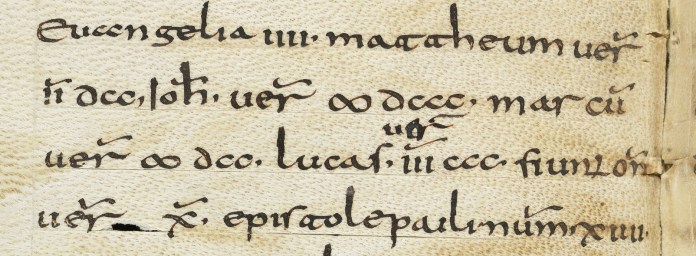
This translates as:
The Four Gospels:
Matthew, 2700 lines
John, 1800 lines
Mark, 1700 lines
Luke, 3300 lines
All the lines make 10,000 lines.
But there are some interesting observations. The author lets fly for example at exploitative Roman booksellers for their slack and cheating ways with his beloved Cyprian:
Because the index of verses in Rome is not clearly given, and because in other places too, as a result of greed, they do not preserve it in full, I have gone through the books one by one, counting sixteen syllables per line, and have appended to each book the number of Virgilian hexameters it contains (Rouse translation).
The St. Gall manuscript, written during the late 8th or early 9th century, probably at St. Gall itself, and another manuscript, Rome, Biblioteca Nazionale Centrale Vittorio Emanuele II, Vitt. Em. 1325 (handwritten catalog entry in Italian here, formerly Cheltenham or Phillipps 12266), written at Nonantola in the 10th or early 11th century, are the key practical records we have about the stichometric method.
These North African lists, the so-called indicula, were discovered (it seems) by the great Theodor Mommsen, who wrote them up in 1886. Mommsen expanded his fame with this codex in the late 19th century, publishing the Liber Genealogus in his MGH series. It also contains a curious work, the Inventiones Nominum, which mentions a good many unusual biblical names that never made it into canonical scripture.
The St. Gall codex was revisited in 2000 by eminent US professor Richard Rouse, who argued that the 11 items discovered by Mommsen in the collection (see below) were not a random group of texts, but formed an intact North African reference book or compendium. It had travelled through the centuries together and had been put together by Donatist scholars, according to Rouse and his co-writer Charles McNelis.
The St Gall codex is of quite a small format, which explains why the Liber Genealogus, not a very long work, fills 49 of its folios: there is not that much writing on each side. The script is very clear and the parchment clean, which suggests it was probably not very heavily used in its day. This text of the Liber is the earliest recension (the direct description of the Great Stemma) and therefore the most important.
Here is Mommsen's Latin description of the compendium, interspersed with text from Scherrer's 1875 St. Gall printed catalog, with one or two additions by me (the English bits, obviously):
Cod. Sang. 133
Pgm. 8° s. VIII u. IX; 657 (656) pages.
Scherrer: Drei oder vier Handschriften in einem Band. [Preceded by Eusebius/Jerome on Holy Land place-names. Followed by Isidore Chronicon pp 523-590 and 'Incipit cuius supra Goti de Magog Jafet filio orti' pp 590-597. Pages 598-601 blank.]
Mommsen: saec . IX formae octonariae praeter alia quae recenset catalogus editus p. 48 [Scherrer] a glutinatore demum cum his compacta medio loco p. 299-597 continet commentaries qui sequuntur:
1. p. 299 – 396 librum genealogum infra editum. [Scherrer: S. 299-396: 'Inc. liber genera(tio)num vel nominum patrum vel filiorum vet. test. vel novi a s. Hieronimo prbo conpraehensum etc. Incipit genilocus sci Hieronimi prb.' Am Ende: 'Explicit liber genealogus.' (Unbekannt und nicht von Hieronymus; reicht, laut p. 396, bis zum Jahr der Welt 5879 oder bis zum Consulat 'hieri et ardabii.')]
2. p. 397 – 420 incipiunt prophetiae ex omnibus libris collecte. quae prophetiae membra habent .... cecidisse in hanc voluntate perseverantes caeci a dei fide lapsi sunt ignorantes. expl . coll . prophet . veteris novique testamenti. [Scherrer: S. 397-426: 'Incip. prophetiae ex omnibus libris collecte.' (Katechese).]
3. p. 420′– 421 incipiunt virtutes Haeliae quae eius merito a domino factae sunt. prima virtus. clausit caelum . . . sublatus est in caelo.
4. p. 421 – 426 incipiunt etiam Helisei virtutes. prima virtus. de melote divisa est .... post mortem suam revixit. expl.
5. p. 427 – 454′ inc̅p̅t̅ inventi̅o̅n̅ nomi̅n̅ , duo sunt Adam , unus est protoplaustus .... et alius est Domires vir sponsor Teclae: inter ambas autem sunt an̅n̅ ferme DCCLXX. [Scherrer: S. 427-492: 'Incipt. invention. nominum.' (Aufzählung von Personen- und Völkernamen des A. T.).]
6. 454′– 484′ sequitur liber generationis cum praescriptione hac: haec sunt diutissime . . . . . . anni sunt v̅dccccxviii (vide infra p . 89), sed c . 240 – 331 ad brevem epitomam redactis et ad eius finem inserta computatione quae statim referetur adsunt rursus nostrae editionis c. 333 – 361, abest pars extrema c . 361 – 398: subscriptum expl .
7. p. 484 – 485 item interpretationes filiorum Iacob de Hebreo in Latino. amen vere. Ruben dei spiritus cet.
8. p. 485 – 488 item interpretationes Hebreas in Latin translatas . Hebrea lingua triplex .
9. p. 488 – 492 incipit indiculum veteris testamenti , item novi et Caecili Cipriani, quos indices versum numerum per singulos libros enuntiantes ex gemello libro Cheltenhamensi edidi in Hermae volumine 21 p . 142 seq. librarius iam is qui archetypum scripsit indices eos ad librum generationis non pertinentes neque ei continuatos ad titulorum eius laterculum adiunxit (v. p. 89 not.).
10. p. 492 item interpretationes Hebreas in Latinum . Maria domina cet. [Scherrer: S. 492-522: 'Interpretationes hebreas in latinum etc. Nomina locorum et interpr. nominum de hebreo in latinum. (Excerpte aus Hieron. Liber de interpr. nom. hebr. Opp. ed. Mart. II, von p. 3 bis circa p. 83.)
11. p. 493 – 522 nomina locorum et interpretatio nominum de Hebreo in Latinum. Hermon regio Hebreorum cet. similesque interpretationes aliae.
There is a very old Wikipedia article on stichometry, which I have just fixed a bit. Not just old in the sense of posted in 2005, but old because it was copied from a 100-year-old Encyclopaedia Britannica: it stated that one of the codices is at Cheltenham in Sir Thomas Phillipps's collection. In fact that collection was broken up and sold a century ago. This codex was purchased by the Italian state, and I have altered the Wikipedia article accordingly.
Subscribe to:
Posts
(
Atom
)