Chronologiekritik
7 hours ago
We have placed the Latin translation of blessed Jerome as though between the Synagogue and the Eastern Church, siting them like the two thieves, one on each side, and Jesus, that is the Roman or Latin Church, between them.This sardonic statement appears at the start of the bible, a masterpiece of typography and Catholic scholarship, which was printed between 1514 and 1517 in Alcalá de Henares (Complutum in Latin). The Complutensian Bible is available as a PDF from Archive.org.
Lé fond commun de la Vieille Latine est sensible dans tous les témoins consultés, mais à des degrés variés. Il est indiscutable que la Vulgate a été utilisée à plusieurs reprises tantôt pour corriger les lignées, tantôt pour compléter les textes explicatifs.She characterized these differences as follows:
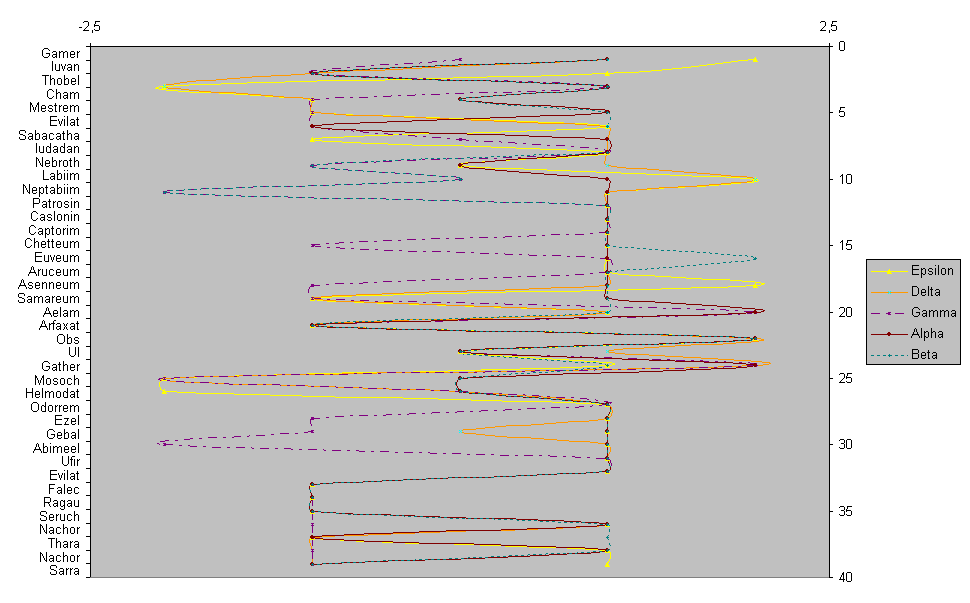
Recension α: ... texte mixte, en général très corrompu, disposé toujours sur quatorze tables; à partir d'Abraham (table VI), n'a presque pas été retouché sur la Vulgate.Zaluska never presented any statistical data or analysis to back up these characterizations, so I have done some sampling of my own. Below is a tabulation containing a rough scoring of 39 Genesis names from the period down to Abraham. I have included a recension, Epsilon, that Zaluska left out of account. I have not included Zaluska's Sigma in this survey.
Recension β: ... texte corrigé d'après la Vulgate, néanmoins dans l'ensemble assez corrompu, et fortement interpolé, en grande partie, semble-t-il, à l'aide des Etymologies d'Isidore; peut être commodément désigné comme une recension longue.
Recension σ transmise par le Beatus de Saint-Sever (S), apparaissant pour l'essentiel comme un texte de type α corrigé d'après la Vulgate, mais fournissant quand même des textes qui lui sont propres ...
Recension γ: ... texte ne montrant que des retouches occasionnelles d'après la Vulgate; partie caractéristique à la page des Juges; plusieurs omissions.
Recension δ: ... Le premier texte (Bible de San Millán de la Cogolla, Madrid) est probablement celui qui reflète le plus fidèlement la tradition de la Vieille Latine; le texte de [Bible de Calahorra] en revanche suit généralement la Vulgate, à partir d'Abraham; des interpolations communes dans la première partie du texte.
| 2 | 1 | 0 | 1 | 1 | Gamer | Gomer | Gomer |
| 1 | -1 | -1 | -1 | -1 | Iuvan | Iavan | Javan |
| -2 | -2 | 1 | 1 | 1 | Thobel | Tubal | Thubal |
| -1 | -1 | -1 | 0 | 0 | Cham | Ham | Ham |
| -1 | -1 | -1 | 1 | 1 | Mestrem | Mesraim | Mesraim |
| 1 | 1 | -1 | -1 | 1 | Evilat | Hevila | Hevila |
| -1 | 1 | 0 | 1 | Sabacatha | Sabatacha | Sabatacha | |
| 1 | 1 | 1 | 1 | 1 | Iudadan | Dadan | Dadan |
| 0 | 1 | -1 | 0 | -1 | Nebroth | Nemrod | Nemrod |
| 2 | 2 | 0 | 1 | 0 | Labiim | Laabim | Laabim |
| 1 | 1 | -2 | 1 | -2 | Neptabiim | Nepthuim | Nephthuim |
| 1 | 1 | 1 | 1 | 1 | Patrosin | Phetrusim | Phetrusim |
| 1 | 1 | 1 | 1 | 1 | Caslonin | Cesluim | Chasluim |
| 1 | 1 | 1 | 1 | 1 | Captorim | Capthurim | |
| 1 | 1 | -1 | 1 | 1 | Chetteum | Ettheum | Hethæum |
| 1 | 1 | 1 | 1 | 2 | Euveum | Eveum | Hevæum |
| 1 | 1 | 1 | 1 | 1 | Aruceum | Araceum | Aracæum |
| 2 | 1 | -1 | 1 | 1 | Asenneum | Sineum | Sinæum |
| -1 | -1 | -1 | 1 | 1 | Samareum | Samariten | Samaræum |
| 1 | 1 | 2 | 2 | 1 | Aelam | Elam | Ælam |
| -1 | -1 | -1 | -1 | -1 | Arfaxat | Arfaxad | Arphaxad |
| 2 | 2 | 2 | 2 | 2 | Obs | Us | Us |
| 0 | 1 | 0 | 0 | 0 | Ul | Hul | Hul |
| 1 | 2 | 2 | 2 | 1 | Gather | Gether | Gether |
| -2 | -2 | -2 | 0 | 0 | Mosoch | Mes | Mes |
| -2 | 0 | 0 | 0 | 0 | Helmodat | Helmodad | Elmodad |
| 1 | 1 | 1 | 1 | 1 | Odorrem | Aduram | Adoram |
| 1 | 1 | -1 | 1 | 1 | Ezel | Uzal | Uzal |
| 1 | 0 | -1 | 1 | 1 | Gebal | Ebal | Ebal |
| 1 | 1 | -2 | 1 | 1 | Abimeel | Abimahel | Abimaël |
| 1 | 1 | 1 | 1 | 1 | Ufir | Ophir | Ophir |
| 1 | 1 | 1 | 1 | 1 | Evilat | Evila | Hevila |
| -1 | -1 | -1 | -1 | -1 | Falec | Faleg | Phaleg |
| -1 | -1 | -1 | -1 | -1 | Ragau | Reu | Reu |
| -1 | -1 | -1 | -1 | -1 | Seruch | Sarug | Sarug |
| 1 | 1 | -1 | 1 | 1 | Nachor | Nahor | Nahor |
| -1 | -1 | -1 | -1 | 1 | Thara | Thare | Thare |
| 1 | -1 | -1 | 1 | 1 | Nachor | Nahor | Nahor |
| 1 | -1 | -1 | -1 | -1 | Sarra | Sarai | Sarai |
| Αχινααμ | Ahinoem | 1Sa | 25:43, 2 Sa 3:2 |
| Αβιγαιας | Abigail | 1Sa | 25:42, 2Sa 3:3 |
| Μααχα | Maacha | 2Sa | 3:3 |
| Αγγιθ | Aggith | 1Ch | 3:2, 2Sa 3:4 |
| Αβιταλ | Abital | 2Sa | 3:4 |
| Αιγλα | Agla | 2Sa | 3:5 |
| Βηρσαβεε | Bethsabee | 2Sa | 11:3 |
| Αμνων | Amnon | 2Sa | 3:2 |
| Δαλουια | Chelaab | 2Sa | 3:2, 1Ch 3:1 |
| Αβεσσαλωμ | Absalom | 2Sa | 3:3 |
| Ορνια | Adonias | 2Ch | 3:4 |
| Σαφατια | Safathia | 1Ch | 3:3, 2Sa 3:4 |
| Ιεθερααμ | Iethraam | 2Sa | 3:5 |
| Θημαρ | Thamar | 2Sa | 13:1 |
| Ιβααρ | Ibaar | 1Ch | 3:6, 14:5, 2Sa 5:15 |
| Ελισαε | Elisama A | 1Ch | 14:5, 3:6, 2Sa 5:16 |
| Ελιφαλετ | Eliphalet / Helifeleth | 1Ch | 3:6, 14:5, 2Sa 5:16 |
| Ναγε | Noge | 1Ch | 3:7, 14:5 |
| Ναφαγ | Napheg / Nepheg | 1Ch | 3:7, 14:5, 2Sa 5:15 |
| Ιανουε / Ιανουου | Iaphie | 1Ch | 3:7, 14:5, 2Sa 5:15 |
| Ελισαμα / Ελισαμαε | Elisama B | 1Ch | 3:8, 14:5 |
| Ελιαδα | Helida / Heliade | 1Ch | 3:8, 14:5, 2Sa 5:16 |
| Ελιφαλετ | Eliphalet / Helisua | 1Ch | 3:8, 14:5, 2Sa 5:15 |
| Σαμμους | Samua | 2Sa | 5:14 |
| Σωβαβ | Sobab | 2Sa | 5:14 |
| Σαλωμων | Salomon | Mt | 1:6, 2Sa 5:14 |
| Ιεροβοαμ / Ναβατ | Hieroboam | 1Kgs | 11:26 |
| Ναδαβ | Nadab | 1Kgs | 15:25 |
| Βαασα / Αχια | Baasa filius Ahia | 1Kgs | 15:33 |
| Ηλα | Hela filius Baasa | 1Kgs | 16:8-16 |
| Ζαμβρι | Zamri | 1Kgs | 16:9 |
| Θαμνι / Γωναθ | Thebni filium Gineth | 1Kgs | 16:21 |
| Αχααβ / Αμβρι· | Ahab filius Amri | 1Kgs | 16:29 |
| Ιεζαβελ | Hiezabel | 1Kgs | 16:31 |
| Οχοζιας | Ohozias | 1Kgs | 22:40 |
| Ιωραμ / Αχααβ | Ioram filius Ahab | 2Kgs | 3:1, 1Kgs 22:50 |
| Ιου / Ναμεσσι | Hieu filius Namsi | 1Kgs | 19:16, 2Chr 22:7 |
| Ιωαχας | Ioachaz | 2Kgs | 10:35 |
| Ιωας | Ioas filius Ioachaz | 2Kgs | 13:10 |
| Ιεροβοαμ | Hieroboam | 2Kgs | 13:13 |
| Ζαχαριας | Zaccharias filius Hieroboam | 2Kgs | 15:8 |
| Σελλουμ / Ιαβις | Sellum filius Iabes | 2Kgs | 15:13 |
| Μαναημ / Γαδδι | Manahem filius Gaddi | 2Kgs | 15:14 |
| Φακεϊας | Phaceia filius Manahem | 2Kgs | 15:23 |
| Φακεε / Ρομελιου | Phacee filius Romeliae | 2Kgs | 15:25 |
| Ωσηε / Ηλα | Osee filius Hela | 2Kgs | 17:1 |
According to my definition, hypothetigraphy defines a rather homogenenous class of drawings, which I call hypothetigraphs ....This is all very useful. The six "features" listed above are all applicable to the Great Stemma:
The first feature, and one that is most easily noted, is the use of simple geometric figures.... The "true" objects and their appearance are not important in this endeavor, for the phenomena under consideration have to do with relationships and with dynamic interactions between elements.... The shape of elements per se is usually an irrelevant piece of information, which is best left out or represented simply by the most abstract of shapes, the circle.
A second and most immediately noticeable feature of hypothetigraphs is the addition of brief written text to the picture.... The inclusion of written text is always necessary in hypothetigraphy which would otherwise lose its communicative function... Verbal and visual information are inextricably and necessarily connected.
Another distinguishing feature of hypothetigraphy is the the almost exclusive use of precise marks, drawn using the ruler ... Precise, clear lines contribute in conveying the impression that the depicted forms are mental constructs, not representations of natural objects.
Typical of hypothetigraphy is ... the use of object lines ... Object lines are not used to mimic some aspect of reality but to illustrate relationships, correspondences or connections.... Relationships and connections and trajectories ... lend themselves naturally to an interpretation in terms of threads, ropes and connecting cables.
A fifth feature of hypothetigraphy is the number of represented dimensions, which tends to be as small as possible within the constraints of the logic of the representation.
Finally, hypothetigraphy tends to place the viewpoint frontally relative to the picture plane, an tends to present figures without a background.... The second of these ... contributes to focus the attention of the viewer, avoiding unwanted contextual effects.
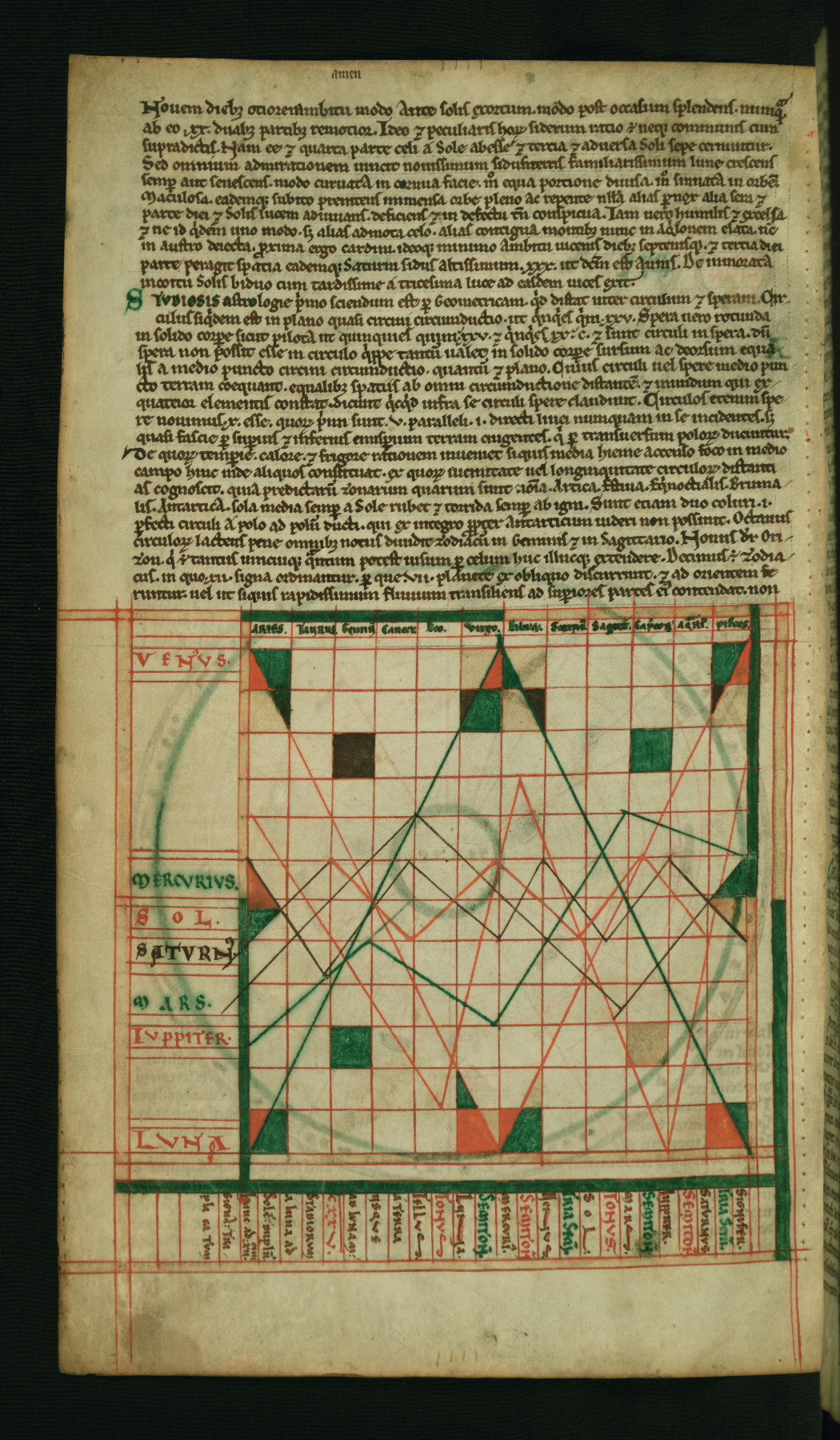
Within a few decades after its creation, the circular latitude diagram was replaced by another, a rectangular diagram, which reduced the amount of theoretical content added to the relevant Plinian text and also offered a more easily produced and more quickly read image.Edward Tufte reproduces the Munich rectangular diagram on page 28 of Visual Display of Quantitative Information, but curiously enough misses its significance for the history of simplification. He only cites an outdated 1936 article by Funkhouser on it. In fact, the diagram turns out to be exemplary of Tufte's principles of subtracting and simplifying to make graphics clearer and more communicative, and his term "reduction of data ink" to describe economy in an infographic:
A few graphics use every drop of their ink to convey measured quantities.
Sacred Bible. Slightly less than one hundred years old, printed on very fine parchment and with illuminations. Glosses have been placed with great diligence in the margins of this bible using a very ancient Gothic bible for the Old Testament and a different bible, of Oviedo, for the New Testament. [...]: On account of the diligence ... and taking account of the parchment and the illumination, valued at thirty ducats. Gilded margins. (1)(1) Memoria de los libros que se deben tomar para El Real Monesterio de San Lorencio, de los que tenía el obpo de Plasencia Don pero Ponce de León (Memorandum of books to be taken to the Royal Monastery of St Lawrence formerly owned by the bishop of Plasencia, Dr Ponce de León). Ms. Esc etc.-II-15, fol. 239v.
"To the reader, from Ferdinandus de Castillo, O.P. Dear friend and reader, this bible has been glossed in reliance on many others, of which the great part were in manuscript form, in the [oldest?] Gothic script. One book, containing only the four Gospels, was written 700 years ago and was kindly loaned to me by the church of Oviedo. Another, of venerable antiquity, containing both the Old and New Testament, came from the reserves of the fathers of the Monastery of St Mary of Valvanera (“Benedictine” added in the margin)."Although this asserts that Hernando de Castillo’s marginal variants were readings obtained from “many” examples, the great majority of the manuscripts consulted consist, if the truth be told, exclusively of the Codex Ovetensis of the Gospels and the Bible of Valvanera, as noted on folio 2r, and this was apparent to Ambrosio de Morales, since for the avoidance of doubt on this point, the same Father Hernando de Castillo states it strictly in the following note from folio 2v, written in his own hand by authority of Philip II:
"I, Hernando de Castillo of the Order of St Dominic, professor of sacred theology, preacher to King Philip II of Spain, made faithful inspection of all the holy Bible, placing variant readings of the New Testament in the margins sixteen years ago from two of the most ancient copies in Gothic script (on the one hand from the fathers of the Monastery of Our Lord of Valvanera, on the other hand from the church of Oviedo) carefully comparing the differences with the authentic Latin. In witness whereof I undersign the above by the authority of his Catholic majesty and this codex is hereby placed in the Royal Library, in the Royal Monastery of St Lawrence, in the month of July 1577. Signed: Hernando de Castillo."Lacking the original manuscripts, it seemed difficult to ascertain to what extent this was a true and accurate collation of these manuscripts by de Castillo. We have, however, quite clear evidence of his fidelity and diligence including the scrupulous preservation of the original spelling. A comparison of his spellings with the marginal notes in the Gothic Codex Legionensis of the College of San Isidoro, whose text, as we shall see, belongs to the same family, passes this test favourably. Even to the extent of his exquisite calligraphy, the illustrious Dominican manifests a rare care and attention. It seems, therefore, that his work of collation guarantees all the fidelity required by modern criticism. Thanks to him we can now add a brief chapter, perhaps not lacking in interest, to the history of the Latin versions of the Bible in Spain.
In the name of the Father and the Son and the Holy Spirit, this book of the Gospels imbued with the sacraments and arguments was assembled by me, a useless and lowly servant of Christ by the name of Justus. I am not worthy of merit and my wrongs cannot be redressed. Through the intercession of the saints, grant unto me to be acquitted and at last be reconciled to my Lord and to be freed from the bonds of all my sins. This has been the reason for my devotion, and I ask that the present book be placed on the holy altar where my body is to be buried and where I swore to fulfill my vows of office. I ask all the priests [who read from this book] to constantly pray to Our Saviour and beseech God through whose hands I came into the world for the salvation of my soul and not to weary in it. For thus it is written: he who prays for others, God commends. But if any man in the church wills harm on others, let him [...] remain in everlasting punishment with Satan and his demons. Thus I go to my judgment before Our Lord.Then follows a note, probably written shortly after the death of the notary Justus:
Justus, the servant of God, died in 810 of the Era on January 12.So according to these documents, the Oviedo codex was written around the middle of the eighth century by a scribe named Justus, whose death occurred in 810 of the Hispanic Era or 772 CE and it was bequeathed to a church where he was to be buried so that priests would remember him in their prayers and offer prayers for the repose of his soul during holy mass. Use of the Hispanic Era also makes it clear that the codex is Spanish in origin, for which we will later see additional evidence. However we do not know for certain what region this was in, though perhaps it was Asturias, of which Oviedo is the capital, since it was preserved there until the sixteenth century, as evidenced by several of the documents cited and confirmed by Ambrosio de Morales. He writes thus:
"In the Library of the Church of Oviedo is ... a New Testament, which from its parchment and lettering seems notably older than the other Gothic manuscripts. In plain script at the beginning it states: “The Book of Justus.” And at the end it says: “Justus, the notary, died in DCCCL of the Hispanic Era on January 12."(1).(1) Viage de Ambrosio de Morales, por orden del Rey D. Phelipe II, a los Reynos de León y Galicia y Principado de Asturias... Madrid, 1765, pages 93-95. Facsimile