2016-12-10

After We Die

One of the key features of humanities in the age of print was preservation of both creative works and scholarship about them by royal and university libraries and later by national libraries. The point is of course that we will all be swept away by death and only the greatest repositories maintained by the sole durable institution we know, government, can be relied on to preserve whatever scholarly progress we achieve.

In the age of digital humanities this all becomes more complicated, because the key productions are often owned by universities or commercial organizations. Who is acting to preserve those databases, or even the small local data collections in which so much scholarship is presented? It's not looking good.

Because I am a New Zealand citizen, some years ago I asked the National Library of New Zealand to preserve my scholarly website, Piggin.Net, and I have just been to see what they did about it. The web archiving unit crawled the website every 12 months until May 2015, and then seems to have stopped. I have made many changes to the site since then and this it not reassuring. Will they resume crawling?

At the same time I asked the British Library to preserve another website in which I publish English family and local history, Piggin.Org. Alarmingly, the BL crawls ceased in 2013, although I go into that site from time to time to update information, correct links and fix spellings.

[Update: the BL unit, the UK Web Archive, has promptly replied on Twitter: "We have continued archiving sites after 2013 but they are not currently visible on the website. We are working to rectify this."]

It occurred to me that the country where I pay taxes, Germany, ought to be providing this service too. There is a web archiving unit at the Deutsche Nationalbibliothek, but its performance is a disgrace for a great nation. One would assume that a Made in Germany site which does not use the top-level domain DE would need to be added to the DNB archive by hand. However if you read the basic facts page, you discover that (a) it is impossible at the present time to nominate a page for spidering, and (b) a saved page would in any case only be visible in the reading room. This absurdity is (c) justified as a legal matter. But if one wished as copyright owner to opt in and offer the DNB the express consent to put the web-archive copy online, one couldn't. See (a). A catch 22.

To add insult to injury, the link to the web archive collection, such as it is, is dead.

Some of my articles are preserved at Academia.edu and at ResearchGate.Net, but the preservation of my website in its final state after I die is only being assured by one organization, Archive.Org of the United States, with its Wayback Machine. Archive.Org operates on an opt-out basis, meaning it saves everything (including from Germany) unless you expressly ask them not to.

I am very pleased with their work, particularly the fact that they harvest my version changes every few months. (In fact I sometimes go to them to recover versions I have myself lost.) But it is alarming to know that in 2016, archival preservation of the internet is still being left to a single San Francisco foundation funded by donations. They have just announced that they will create an extraterritorial backup copy of their collections in Canada. They are asking for donations. I think it's a very worthy cause.

But I still regard it as uncertain that any university or foundation or publishing company can survive for the next 500 years. This work ought to be funded by our governments,of which most will, in the nature of things, survive the course.

2016-12-05

Palatina Uploads

In the last week, the main uploads at DigiVatLib were from its Palatina collection on November 28:
  1. Pal.lat.58
  2. Pal.lat.73
  3. Pal.lat.76
  4. Pal.lat.78
  5. Pal.lat.79
  6. Pal.lat.80
  7. Pal.lat.84
  8. Pal.lat.85
  9. Pal.lat.88
  10. Pal.lat.89
  11. Pal.lat.90
  12. Pal.lat.91
  13. Pal.lat.93
  14. Reg.lat.421
  15. Vat.lat.993
In Heidelberg, which has first right to post the Palatina digitizations, since a German foundation is funding the work, a total of 34 new items have appeared online over the past two weeks:
  1. Pal. lat. 1054 Guilelmus : De universo corporali et spirituali, Pars I-II (Frankreich, um 1400)
  2. Pal. lat. 1069 Crescentiis, Petrus /de; Rusius, Laurentius: Ruralia commoda, Libri XII ; Hippiatria sive marescalcia (Italien, 14. Jh.)
  3. Pal. lat. 1075,1 Albertus : De animalibus (Lib. I-XII) Band 1 (Würzburg (?), 1436)
  4. Pal. lat. 1521 Cicero, Marcus Tullius: Sammelhandschrift (Italien, 15. Jh.)
  5. Pal. lat. 1522 Cicero, Marcus Tullius: Sammelhandschrift (Italien , Frankreich , Italien, 15. Jh. ; 11. Jh. ; 15. Jh.)
  6. Pal. lat. 1526 Cicero, Marcus Tullius: De officiis (Italien, 14.-15. Jh.)
  7. Pal. lat. 1530 Cicero, Marcus Tullius: De officiis (Italien (Bologna), 15. Jh.)
  8. Pal. lat. 1542 Seneca, Lucius Annaeus : Sammelhandschrift (Italien (Venedig), 15. Jh.)
  9. Pal. lat. 1726 Mythographischer Sammelband (Heidelberg, 1423/ 1. Hälfte 15. Jh.)
  10. Pal. lat. 1737 Carmina (Heidelberg, 1597)
  11. Pal. lat. 1739 David Felix Reuter: Carmen gratulans (Heidelberg, 1594)
  12. Pal. lat. 1755 Compendium Doctrinalis (Heidelberg (?), um 1473)
  13. Pal. lat. 1770 Collectanea grammaticalia ; Computus (Erfurt, 1367)
  14. Pal. lat. 1866 Friedrich : Interpretationes (Heidelberg, 1608)
  15. Pal. lat. 1869 Friedrich : Interpretationes (Sedan, 1609-1610)
  16. Pal. lat. 1870 Friedrich : Interpretationes (Sedan (?), 1609)
  17. Pal. lat. 1871 Friedrich : Interpretationes (Sedan, um 1608-1609)
  18. Pal. lat. 1872 Christoph : Interpretationes (Heidelberg, 1566)
  19. Pal. lat. 1873 Christoph : Interpretationes (Heidelberg, 1566)
  20. Pal. lat. 1874 Friedrich : Exercitia italica (Heidelberg, 1613-1616)
  21. Pal. lat. 1875 Johannes Sebastian Aquila: Sammelhandschrift (Kurpfalz, 1552-1556)
  22. Pal. lat. 1876 Ambrosius Prechtl: Rezeptare (Oberpfalz (Amberg), 1574)
  23. Pal. lat. 1884 Abschrift des Stammbuches von Joachim Strupp (Heidelberg (?), 1578)
  24. Pal. lat. 1904 Vocabularius graeco-latinus (Deutschland, 2. Viertel 16. Jh.)
  25. Pal. lat. 1911 Agricola, Georg: Elegia gratulatoria ; Oratio de laude urbis Ambergae (Amberg, 1559)
  26. Pal. lat. 1915 Kopie des Bibliothekskatalogs Pal. lat. 1921 (Fuggerbibliothek)
  27. Pal. lat. 1924 Katalog der Bibliothek Achill Pirmin Gassers: Sachgruppen und Autoren
  28. Pal. lat. 1925 Martin Gerstmann Katalog der 1553 erworbenen Hss. aus dem Nachlaß von Egnatius
  29. Pal. lat. 1926 Bibliothekskataloge der Klöster Kastl, Weißenau, Walderbach, Michelfeld, Spainshart, Reichenbach und Waldsassen, 16. Jh. (16. Jh.)
  30. Pal. lat. 1958 Missale, Übersetzung in französischer Sprache (1368)
  31. Pal. lat. 1964 Tristanroman in Prosa, französisch (14. Jh.)
  32. Pal. lat. 1965 Le jeu des échecs moralisés (15. Jh.)
  33. Pal. lat. 1967 Aldobrandino : Régime du corps, Mort d'Artus (14. Jh.)
  34. Pal. lat. 1969 Gautier : Les miracles de Notre Dame (14. Jh.)
This is Piggin's Unofficial List number 84. If you have corrections or additions, please use the comments box below. Follow me on Twitter (@JBPiggin) for news of more additions to DigiVatLib.

2016-11-24

Codex Bembinus Online

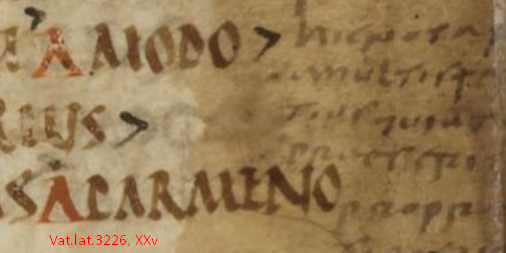
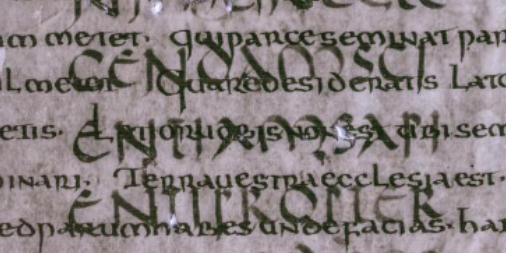
Two of the most famous codices at the Vatican Library arrived online November 24. One, the Codex Bembinus, Vat.lat.3226, was made in late antiquity and still has a first owner's handwritten notes in the margins. It contains comedies of Terence, though, unlike the renowned Vatican Terence (see my post), it is not illustrated. It is certainly the oldest Terence in existence, as Jeremy Norman stresses, dating from roughly 400 CE.
The text at left above is rustic capitals, the cursive half-uncial at right is the script of an educated person jotting things fast in Latin in that era. It is named after a former owner, Bernardo Bembo.

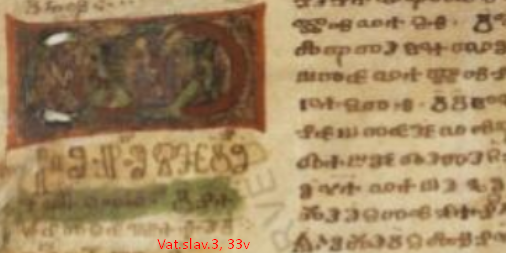
The other prominent item is extraordinarily precious to eastern Europe and Russia: the illuminated 11th-century Codex Assemanius, Vat.slav.3, one of the the world's earliest surviving books in the Old Slavonic language, written in the round Glagolitic script. This is a major resource for those interested in the history of the Slavic languages of Europe and of the Slavs' conversion to Christianity.

See the codex's entry in Wikipedia; Glagolitic is the script that probably preceded Cyrillic as the conventional way to record Old Slavonic, but fell into disuse, apart from restricted use in some areas in liturgical books. This book contains readings for mass.

Assessing how many codices are new in this Vatican round is not so easy, since the new posted total has risen 55, yet my software shows 67 additions. I caught at least one case where a codex that was already online in 2013, Vat.lat.3852 (Florus of Lyon), had come back after being missing. My scan shows cases where past duplications have been eliminated, but it all seems rather intractable. Before we make this too complicated, I will offer you the fullest list and see later if there are any false novelties in here.
  1. Arch.Cap.S.Pietro.H.87
  2. Ott.lat.259
  3. Pal.lat.13
  4. Pal.lat.15
  5. Pal.lat.22
  6. Pal.lat.53
  7. Reg.lat.1097
  8. Reg.lat.1788
  9. Urb.lat.439
  10. Urb.lat.473
  11. Urb.lat.1076.pt.2
  12. Urb.lat.1399
  13. Urb.lat.1400
  14. Urb.lat.1404
  15. Urb.lat.1406
  16. Urb.lat.1412
  17. Urb.lat.1413
  18. Urb.lat.1417
  19. Urb.lat.1421
  20. Urb.lat.1426
  21. Urb.lat.1434
  22. Urb.lat.1435
  23. Urb.lat.1445
  24. Urb.lat.1446
  25. Urb.lat.1447
  26. Urb.lat.1451
  27. Urb.lat.1474
  28. Urb.lat.1484
  29. Urb.lat.1486
  30. Urb.lat.1488
  31. Urb.lat.1491
  32. Urb.lat.1493
  33. Urb.lat.1498
  34. Urb.lat.1502
  35. Urb.lat.1510
  36. Urb.lat.1526
  37. Urb.lat.1546
  38. Urb.lat.1557
  39. Urb.lat.1588
  40. Urb.lat.1634
  41. Urb.lat.1687
  42. Urb.lat.1707
  43. Urb.lat.1711
  44. Urb.lat.1712
  45. Urb.lat.1714
  46. Urb.lat.1730
  47. Vat.lat.220
  48. Vat.lat.486
  49. Vat.lat.495
  50. Vat.lat.887
  51. Vat.lat.1021
  52. Vat.lat.1051
  53. Vat.lat.1053
  54. Vat.lat.1067
  55. Vat.lat.1070
  56. Vat.lat.1074
  57. Vat.lat.1111
  58. Vat.lat.1129
  59. Vat.lat.1141
  60. Vat.lat.1152
  61. Vat.lat.1207
  62. Vat.lat.1212
  63. Vat.lat.3226, the Codex Bembinus (above), TM 66109 = Lowe, CLA 1 12
  64. Vat.lat.3314, Pomponius Porphyrio's 3rd-century Commentary on Horace, made in the 9th century. Michael Gorman has identified this as one of the lost codices from the Abbey of Monte Amiata (see my posts passim about that library and site), speculating it was removed when Pius II held court in the abbey in 1462. Dr Gorman points out its significance in showing the literary interests of the monks, noting how accurate its Greek writing was (long before the revival of Greek scholarship in Italy). It later passed into two famous humanist libraries, those of Agostino Patrizi (died 1496) and of Fulvio Orsini (died 1600), before ending up in Rome.
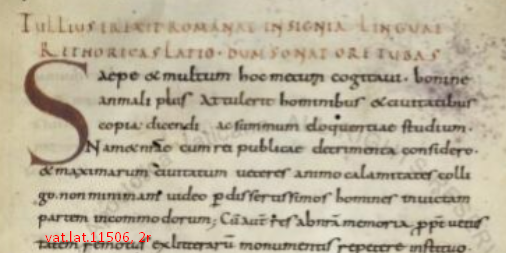
  65. Vat.lat.11506, from the same period, a witness of De inventione by Cicero, scribed when it had become rare in libraries, and Priscian's Periegesis; HT to @ParvaVox for pointing this out. Ippolito attributes it to the scriptorium at Wissenbourg at a later date. Preceded by a medieval epigram which credits Cicero with raising the banner of rhetoric along with the war-trumpets of Latium: Tullius erexit Romanae insignia linguae / rhetoricas Latio dum sonat ore tubas.

  66. Vat.lat.14614, small album of 19th-century correspondence, apparently detached from another album, Vat.lat.13391
  67. Vat.slav.3, the Codex Assemanius (above)
As noted in the past, the Pal.lat. items are not new to the internet, having been online before in Heidelberg. This is Piggin's Unofficial List number 83. If you have corrections or additions, please use the comments box below. Follow me on Twitter (@JBPiggin) for news of more additions to DigiVatLib.

2016-11-22

Digital Humanities

The introduction to my text-archaeology project has just been revised, and now I need your input on how I could make it even better. The site should be like the ruins of Pergamum, a place any literate tourist can explore unaided, enjoying the pleasures of discovery at every corner. Here's the new introductory text:
The fifth-century Great Stemma was probably drawn on a roll of papyrus of standard height (30 centimetres say) and at least as long as the bed you sleep in. My reconstruction proposal, the Piggin Stemma, obviously can't be viewed on a smartphone or any other digital device unless you move it around. So scroll left and right; zoom in to read words (and zoom out to see the full expanse); use the built-in controls.
... If the Romans had had computers, this is how they would have read their scroll-format books on them.

As an example of the digital humanities, the Piggin Stemma invites you to explore beyond first sight and enjoy the pleasures of discovery. This innovative chart was rebuilt with a coding language named SVG. It enables me to hide a guidebook in 12 overlays that remain invisible until you need them. ...

It's not a film. Once you are ready, you will have to tap some controls to make the interactive layers appear. Each right button makes a new effect visible: the corresponding left button makes the overlay go away. Try it. The overlay entitled "Damage" even includes an animation ... showing how roundels were moved. ...

A reassurance: you came here because you are attuned to graphic desígn and the psychology of visualization. You will see here hundreds of Hebrew names you may not know. I have translated them from Latin into English to make them less alien, but don't be overwhelmed by names or glosses. You are on a guided tour of an exotic place: late-antique graphics technology. Don't be sidetracked by the late-antique theology (unless that is your passion).

First up, just concentrate on how a fifth-century designer uses circles to visualize kinship and depict eras of time. The leftmost flag ... of each overlay offers you enough context to get started on your walk through this text-archaeology excavation.

If you like this new method of presentation, and I am sure you will, recommend the site to your friends. Send them [the] URL: http://piggin.net/stemmahist/envelopereconstructor.htm Don't send them a direct link to the SVG file, or they may get baffled.... Enjoy the tour.
Are my ideogram pictures above coherent? Does anything about the project puzzle you or remain unexplained? Do you have any other digital humanities examples you can point me to that present historic charts interactively with overlays? One way to reply is to use the comments box below.

2016-11-21

Eusebius Online

A 15th-century manuscript of the Chronological Canons of Eusebius of Caesarea in Jerome's Latin is the great prize in the latest round of digitizations by the Vatican Library, which takes the posted total to 6,293.

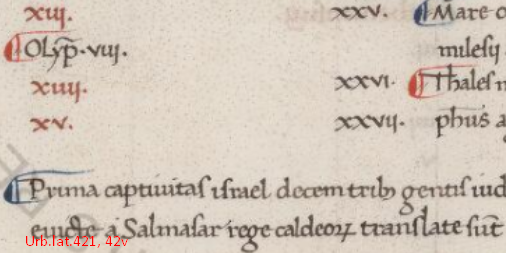
Below is the bit of Urb.lat.421 where Eusebius tabulates events of the Eighth Olympiad (left). At right is Thales of Miletus. Below is a note about the the first captivity of Israel. 
Eusebius created a vast table of ancient dates in which he sought to align Jewish, Greek, Roman and other histories. One of my ever-unfinished tasks is to convert to an MS Excel spreadsheet the famous crowd-sourced 2005 English translation of this work led by Roger Pearse.

Below is the November 21 list of the 114 new postings. The Urb.lat. series is mainly modern Italian history and lit. The Pal.lat. titles have been online for a long time previously in Heidelberg and are only new to the Rome site.
  1. Arch.Cap.S.Pietro.H.70, Opusculum de sacrosancto Veronicae Sudario et Lancea
  2. Pal.lat.7
  3. Pal.lat.9
  4. Pal.lat.10
  5. Pal.lat.11
  6. Pal.lat.12
  7. Urb.lat.210
  8. Urb.lat.345
  9. Urb.lat.361
  10. Urb.lat.370
  11. Urb.lat.416
  12. Urb.lat.418
  13. Urb.lat.421
  14. Urb.lat.842
  15. Urb.lat.858
  16. Urb.lat.902
  17. Urb.lat.909
  18. Urb.lat.917
  19. Urb.lat.997
  20. Urb.lat.1001
  21. Urb.lat.1002
  22. Urb.lat.1003
  23. Urb.lat.1019
  24. Urb.lat.1035
  25. Urb.lat.1036
  26. Urb.lat.1039
  27. Urb.lat.1040
  28. Urb.lat.1042, diplomatic reports (Avisi) for the year 1571
  29. Urb.lat.1047
  30. Urb.lat.1050
  31. Urb.lat.1064.pt.2
  32. Urb.lat.1065.pt.2
  33. Urb.lat.1071.pt.1, Notizie da Venezia e da altre località d'Italia e d'Europa
  34. Urb.lat.1071.pt.2
  35. Urb.lat.1072.pt.1
  36. Urb.lat.1124
  37. Urb.lat.1132
  38. Urb.lat.1137
  39. Urb.lat.1171
  40. Urb.lat.1172
  41. Urb.lat.1181
  42. Urb.lat.1191
  43. Urb.lat.1195
  44. Urb.lat.1196
  45. Urb.lat.1199
  46. Urb.lat.1200
  47. Urb.lat.1201
  48. Urb.lat.1202
  49. Urb.lat.1216
  50. Urb.lat.1220
  51. Urb.lat.1233
  52. Urb.lat.1235
  53. Urb.lat.1241
  54. Urb.lat.1242
  55. Urb.lat.1243
  56. Urb.lat.1253
  57. Urb.lat.1254
  58. Urb.lat.1260
  59. Urb.lat.1273
  60. Urb.lat.1294
  61. Urb.lat.1295
  62. Urb.lat.1303
  63. Urb.lat.1309
  64. Urb.lat.1311
  65. Urb.lat.1312 , Aristotelian logic translated by Boethius and others, ms "Ub" in Minio-Paluello's editon. HT to @LatinAristotle
  66. Urb.lat.1314
  67. Urb.lat.1315
  68. Urb.lat.1317
  69. Urb.lat.1320
  70. Urb.lat.1322 , contains evidence of a 15th-century feud: Georg of Trebizond's concordance to Theodore Gaza's Aristotelian Problemata (f. 138v), HT to @LatinAristotle
  71. Urb.lat.1326 , Leonardo Bruni, his Latin version of Aristotle's Politica. HT to @LatinAristotle
  72. Urb.lat.1328
  73. Urb.lat.1333
  74. Urb.lat.1336
  75. Urb.lat.1337
  76. Urb.lat.1339
  77. Urb.lat.1340
  78. Urb.lat.1342
  79. Urb.lat.1343
  80. Urb.lat.1346
  81. Urb.lat.1360
  82. Urb.lat.1374
  83. Urb.lat.1392 , Pseudo-Aristotle, Latin Economica, Magna moralia, Averroes on Poetica & Peter of Spain on Physiognomonica, HT to @LatinAristotle
  84. Urb.lat.1395
  85. Urb.lat.1398
  86. Urb.lat.1408
  87. Urb.lat.1410
  88. Urb.lat.1419
  89. Urb.lat.1422
  90. Urb.lat.1425
  91. Urb.lat.1429
  92. Urb.lat.1430
  93. Urb.lat.1431
  94. Urb.lat.1432
  95. Urb.lat.1440
  96. Urb.lat.1443
  97. Urb.lat.1456
  98. Urb.lat.1460
  99. Urb.lat.1461
  100. Urb.lat.1471
  101. Urb.lat.1478
  102. Urb.lat.1480
  103. Urb.lat.1485
  104. Urb.lat.1487
  105. Urb.lat.1489
  106. Urb.lat.1496
  107. Urb.lat.1508
  108. Urb.lat.1531
  109. Urb.lat.1533
  110. Urb.lat.1551
  111. Vat.lat.1005
  112. Vat.lat.1034
  113. Vat.lat.1037
  114. Vat.lat.5958, Festus, De verborum significatione
This is Piggin's Unofficial List number 82. If you have corrections or additions, please use the comments box below. Follow me on Twitter (@JBPiggin) for news of more additions to DigiVatLib.

2016-11-19

Fold Out the Flaps

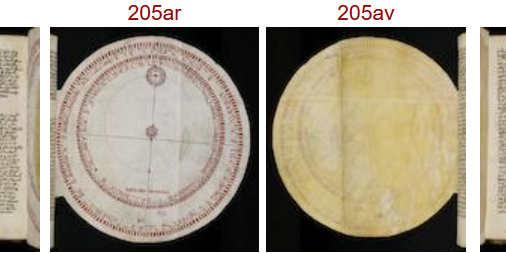
An intriguing compendium of astronomical writings dated to about 1450 and now at the Vatican includes several of these fold-out-the-flaps features. They describe the planetary orbits according to the Ptolemaic system:
Pal.lat.1416 contains works by a variety of authors, several with tables. The flaps are in the Theorica Planetarum  by Campanus of Novara c. 1220 – 1296), an Italian mathematician, astrologer and physician (Wikipedia).

The codex is one of 31 mainly scientific manuscripts digitized in the past two weeks by the Bibliotheca Palatina, the great German project to virtually re-create the Palatine library at Heidelberg by scanning all its books which are now in the Vatican Apostolic Library in Rome. These do not appear yet on the DigiVatLib website until many months later if ever. Here is the list extracted from the project's RSS feed:
  1. Pal. lat. 1056 Johannes Dumbleton ; Albertus : Sammelband (England? (I) , Deutschland (II) , Deutschland (III), 14. Jh. (I) ; 1367 (II) ; 14. Jh. (III))
  2. Pal. lat. 1083 Hippocrates; Knab, Erhardus; Bernardus : Medizinische Sammelhandschrift: Articella (Heidelberg, 1457/1458)
  3. Pal. lat. 1090 Galenus; Gessius Iatrosophista; Celsus, Aulus Cornelius; Guainerio, Antonio; Bartholomaeus ; Gentilis : Medizinische Sammelhandschrift (Deutschland, Mitte 15. Jh.)
  4. Pal. lat. 1105 Ḥunain Ibn-Isḥāq; Hippocrates; Aegidius : Medizinischer Sammelband (Heidelberg (I), 15. Jh. (I) ; Ende 13. Jh. (II))
  5. Pal. lat. 1108 Serapion, Johannes; Arnoldus : Medizinische Sammelhandschrift (Heidelberg, 1476 und 1479)
  6. Pal. lat. 1347 Motette: Alma redemptoris mater (Heidelberg, 16. Jh.)
  7. Pal. lat. 1348 Euclides: Elementa I-V (Deutschland, 14. Jh.)
  8. Pal. lat. 1352 Euclides: Elementa (Süddeutschland, 2. Hälfte 15. Jh.)
  9. Pal. lat. 1397 Sammelband (Wittenberg (I) , Süddeutschland (II), 1540 (I) ; 1446 (II))
  10. Pal. lat. 1416 Firminus ; Kindī, Ja'kûb Ibn-Ishâk al; Māšā'allāh Ibn-Aṯarī; Farġānī, Aḥmad Ibn-Muḥammad /al-; Alchandreus; Iulianus ; Yaḥyā Ibn-Abī-Manẓūr; Johannes ; Gerardus : Atsronomisch-astrologische Sammelhandschrift (Belgien, Trier, 2. Drittel 15. Jh.)
  11. Pal. lat. 1794 Poggio Bracciolini, Gian Francesco; Bruni, Leonardo; Tröster, Johannes; Antonius Barzizius; Ps.-Cyrillus; Ps.-Eusebius; Nicolaus ; Petrarca, Francesco: Humanistischer Sammelband (Deutschland, 1465-1472)
  12. Pal. lat. 1825 Luther, Martin: Sammelhandschrift (Weimar, Mitte 16. Jh.)
  13. Pal. lat. 1836 Brenz, Johannes: Sammelhandschrift (Heidelsheim (?), 1527)
  14. Pal. lat. 1837 Maior, Georg: Enarratio epistolae Pauli ad Ephesios (Wittenberg, 1546)
  15. Pal. lat. 1842 Menrad Molther: Explanatio in Ieremiam (Heilbronn, 1542-1545)
  16. Pal. lat. 1843 Menrad Molther: Sammelhandschrift (Heilbronn, 1545-1555)
  17. Pal. lat. 1844 Menrad Molther: Sammelhandschrift (Heilbronn, 1541-1542)
  18. Pal. lat. 1845 Menrad Molther: In epistolam Pauli ad Ephesios homiliae (Heilbronn, 1548-1549)
  19. Pal. lat. 1846 Menrad Molther: Sammelhandschrift (Heilbronn, 1549-1553)
  20. Pal. lat. 1847 Iodocus Kinthisius: De casto matrimonio et impuro sacerdotium coelibatu (Kurpfalz, um 1545)
  21. Pal. lat. 1865 Friedrich : Interpretationes (Heidelberg, 1606-1607)
  22. Pal. lat. 1866 Friedrich : Interpretationes (Heidelberg, 1608)
  23. Pal. lat. 1869 Friedrich : Interpretationes (Sedan, 1609-1610)
  24. Pal. lat. 1870 Friedrich : Interpretationes (Sedan (?), 1609)
  25. Pal. lat. 1871 Friedrich : Interpretationes (Sedan, um 1608-1609)
  26. Pal. lat. 1872 Christoph : Interpretationes (Heidelberg, 1566)
  27. Pal. lat. 1873 Christoph : Interpretationes (Heidelberg, 1566)
  28. Pal. lat. 1874 Friedrich : Exercitia italica (Heidelberg, 1613-1616)
  29. Pal. lat. 1875 Johannes Sebastian Aquila: Sammelhandschrift (Kurpfalz, 1552-1556)
  30. Pal. lat. 1876 Ambrosius Prechtl: Rezeptare (Oberpfalz (Amberg), 1574)
  31. Pal. lat. 1884 Abschrift des Stammbuches von Joachim Strupp (Heidelberg (?), 1578) (no diagrams, text only)
This is Piggin's Unofficial List number 81. If you have corrections or additions, please use the comments box below. Follow me on Twitter (@JBPiggin) for news of more additions to DigiVatLib.

2016-11-17

Carpeted with Notes

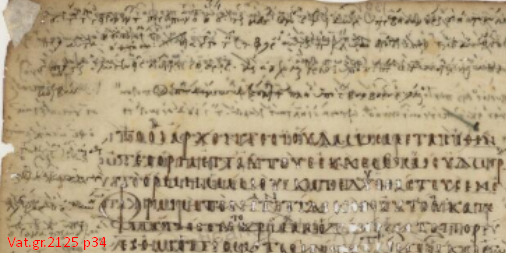
Yet another late-antique parchment book has emerged from its dark archive as an internet treasure for all to read this week: the 6th-century Codex Marchalianus, Vat.gr.2125 at the Vatican Library.

This is a 416-folio scholars' edition in Greek of part of the Bible. Its welter of annotations, mainly marginal but also interlinear, give an idea of the wealth of books available to a researcher to quote even back then in text-critical studies. These learned monkly annotations kept on being added until the 9th century, carpeting much of the thick volume.

See the Wikipedia entry, which emphasizes the importance of the Codex Marchalianus in reconstructing the Greek-language Bible used by western Jews in antiquity.

 In Septuagint studies, this codex, written in Egypt in a Greek uncial with no spaces at all between the words, has the siglum Q and is a resource in reconstructing the Hexapla, Origen's renowned six-column comparative edition of the Tanakh. In that sense, it is one of our indirect links to the famous lost library at Caesarea in Palestine which is the subject of Anthony Grafton's and Megan Hale Williams' Christianity and the Transformation of the Book.

Digitizing the codex was clearly a huge Vatican effort, with every page imaged at two wavelengths for 1,636 images. There are also 36 ancillary pages of documentation.

Here is the list of 12 items placed online November 17, for a posted total of 6,179.
  1. Chig.L.VIII.296,
  2. Pal.lat.6, Biblia: Testamentum vetus, usque ad librum Iob, French, 15th century
  3. Vat.gr.2125, the Codex Marchalianus (above)
  4. Vat.lat.210,
  5. Vat.lat.485,
  6. Vat.lat.1010,
  7. Vat.lat.1095,
  8. Vat.lat.1185,
  9. Vat.lat.1188 ,
  10. Vat.lat.1615, Statius: Argumentum dodecastichon Thebaidos, in a 14th- or 15th century codex with fine illumination
  11. Vat.lat.4958, Martyrologium (Desiderian) in Beneventan script dateable to 1087 (Lowe).
  12. Vat.lat.14175, four Vetus Latina Bible fragments from bindings. Folios 1-3 date from the 5th century and contain Isaiah 1,18-23; 26-31; 5,24-27. This is CLA S / 1767; Trismegistos 67900; more detail at ELMSS.The fourth folio, inexplicably marked 3r/3v, is an (11th-century?) Italian hand containing 2 Par 7-9. This little album has two Beuron numbers, 192 and 118 (see my list).
This is Piggin's Unofficial List number 80. If you have corrections or additions, please use the comments box below. Follow me on Twitter (@JBPiggin) for news of more additions to DigiVatLib.

2016-11-14

Now It's the Vatican Terence

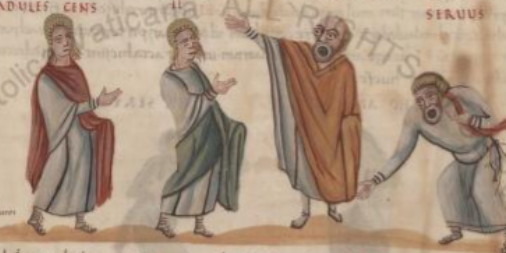
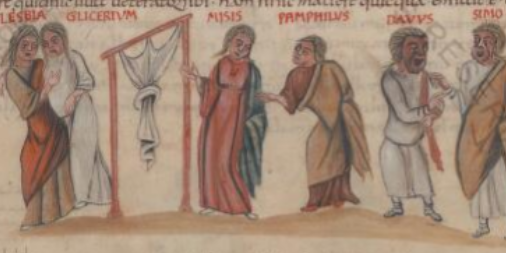
One of the most sumptuous picture books of late antiquity was handed to a team of scribes and artists under King Louis the Pious in France in the 9th century with a request to copy it faithfully.

That copy, now known as the Vatican Terence, is one of the world's most precious items of book art, since the original was lost. On November 14, the Vatican Library brought this treasure, Vat.lat.3868, online.

It contains the Latin comedies of Publius Terentius Afer, together with many wondrous illuminations. While far younger in date as an artefact, it is more sophisticated than the Vatican Vergil, a truly late antique codex that is also online (Vat.lat.3225), thanks to the variety and quantity of its pictures and the evidence they convey about the staging of classical theatre.

For an introduction, read the Wikipedia article, or Jeremy Norman 's outline which quotes extensively from a David Ganz book review.

Other copies of the late antique original do exist, and scholars have argued long and hard over their interrelationships. The Vatican owns one of these others, the 10th-century Basilicanus Terence, and it too is online as Arch.Cap.S.Pietro.H.19, but it is universally agreed that the Vatican Terence proper is the finest of them all.

A total of 67 manuscripts came online Nov 14. Here is the full list:
  1. Arch.Cap.S.Pietro.H.49
  2. Urb.lat.712
  3. Urb.lat.839
  4. Urb.lat.840
  5. Urb.lat.943
  6. Urb.lat.950
  7. Urb.lat.953
  8. Urb.lat.958
  9. Urb.lat.993
  10. Urb.lat.996
  11. Urb.lat.998
  12. Urb.lat.1006
  13. Urb.lat.1008
  14. Urb.lat.1013
  15. Urb.lat.1034
  16. Urb.lat.1037
  17. Urb.lat.1045
  18. Urb.lat.1048
  19. Urb.lat.1049
  20. Urb.lat.1059.pt.1
  21. Urb.lat.1059.pt.2
  22. Urb.lat.1060.pt.1
  23. Urb.lat.1060.pt.2
  24. Urb.lat.1062
  25. Urb.lat.1120
  26. Urb.lat.1121
  27. Urb.lat.1130
  28. Urb.lat.1138
  29. Urb.lat.1139
  30. Urb.lat.1140
  31. Urb.lat.1141
  32. Urb.lat.1145
  33. Urb.lat.1147
  34. Urb.lat.1151
  35. Urb.lat.1153
  36. Urb.lat.1155
  37. Urb.lat.1157
  38. Urb.lat.1158
  39. Urb.lat.1159
  40. Urb.lat.1160
  41. Urb.lat.1164
  42. Urb.lat.1165
  43. Urb.lat.1166
  44. Urb.lat.1169
  45. Urb.lat.1170
  46. Urb.lat.1173
  47. Urb.lat.1174
  48. Urb.lat.1175
  49. Urb.lat.1180
  50. Urb.lat.1192
  51. Urb.lat.1193
  52. Urb.lat.1194
  53. Urb.lat.1198
  54. Urb.lat.1205
  55. Urb.lat.1207
  56. Urb.lat.1219
  57. Urb.lat.1236
  58. Urb.lat.1237
  59. Urb.lat.1244
  60. Urb.lat.1245
  61. Urb.lat.1265
  62. Urb.lat.1266
  63. Urb.lat.1269
  64. Urb.lat.1275
  65. Urb.lat.1284
  66. Urb.lat.1293
  67. Vat.lat.3868
This is Piggin's Unofficial List number 79. If you have corrections or additions, please use the comments box below. Follow me on Twitter (@JBPiggin) for news of more additions to DigiVatLib.

2016-11-12

Cicero Palimpsest

Of all the world's palimpsests, probably the most famous is that at the Vatican Library which recovered for us much of the Roman political philosopher Cicero's work De republica (On the Commonwealth).

Palimpsests, of which Rome has a good number, mostly contain familiar texts which we hardly need to read yet again. Angelo Mai's discovery in 1819 that Vat.lat.5757, a 7th-century copy of Augustine's On the Psalms, was written over a lost book, a 4/5th-century uncial text of De republica, was immensely more thrilling.

The 151 leaves contain roughly a quarter of Cicero's dialogue, enabling us to at least read it in summary form. There are quotes from De republica in other works, but had it not been for this book recycling by the poor monks of Bobbio in northern Italy, the Cicero work would have stayed lost forever.

The digitization of the Cicero Palimpsest is very painstaking, with alternate natural-light and ultraviolet exposures to show up the undertext, and careful analysis of the bifolium and quire orders. The big text in this violet view is the Cicero:
Mai's discovery triggered 200 centuries of hunting for more palimpsests. Among the finds, the Archimedes Codex discovered by Heiberg has perhaps been the second greatest prize.

Check Jeremy Norman's brief account, or the Wikipedia article on De republica, or James Zetzel's very readable introduction via Google Books. The Cicero Palimpsest's digitization, completed on November 11, might perhaps be experienced as a reminder to all to keep faith with our political institutions after a week when Donald Trump won the US presidential election.

Naturally the codex is also of enormous interest to palaeolography, since it is an ultra-rare example of late fourth or early fifth-century uncial (CLA 1 35, Trismegistos 66130) and at the same time a quite rare example of seventh-century script (CLA 1 34, Trimegistos 66149). [Late add: see CLA too on the new Galway Database.]

Here is the full list of November 11 releases, which bring the posted total to exactly 6,100.
  1. Urb.lat.365
  2. Vat.gr.303.pt.3
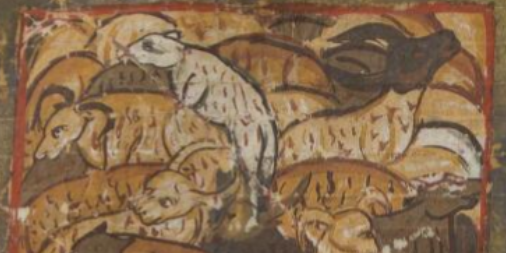
  3. Vat.gr.751, Book of Job and commentary with catenae, Apollinaris of Laodicea, variously dated 13th or 14th century, or earlier according to a Wikipedia list. With many beautiful miniatures throughout, some unfinished blanks. Leaf through and admire items such as this image of Job's early wealth:
  4. Vat.lat.230, Praeparatio evangelica of Eusebius of Caeasarea, translated to Latin by George of Trebizond, HT to @LatinAristotle who notes this is one of 51 extant manuscripts of the translation.
  5. Vat.lat.484
  6. Vat.lat.533
  7. Vat.lat.939
  8. Vat.lat.957
  9. Vat.lat.990
  10. Vat.lat.992
  11. Vat.lat.1009
  12. Vat.lat.1011
  13. Vat.lat.1022
  14. Vat.lat.1023
  15. Vat.lat.1025
  16. Vat.lat.1026
  17. Vat.lat.1027
  18. Vat.lat.1035
  19. Vat.lat.1059
  20. Vat.lat.1073
  21. Vat.lat.1124
  22. Vat.lat.1126
  23. Vat.lat.1142
  24. Vat.lat.1903, Life of Hadrian
  25. Vat.lat.3173, Horace
  26. Vat.lat.3210, Pietro Bembo autograph
  27. Vat.lat.3255, Georgics, heavily annotated
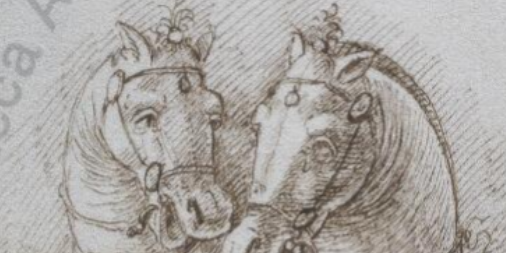
  28. Vat.lat.3302, a manuscript belonging to Fabio Mazzatosta, a very wealthy student at Rome in the 15th century who died before getting his first job. This has the Punica of Silius Italicus. At 12,000 lines this is claimed to be the longest preserved poem in Latin literature. Here, just books 1-9, 12-17. With fine illumination, plus end-paper drawings like these horses:
    This seems to be by the German artist Joachim de Gigantibus. The BAV owns five of the seven Fabio Mattatosta Codices, all commissioned by M from his pal Pomponio Leto. The others are Vat.lat.3264 (Fasti of Ovid), 3279 Thebaid Statius, 3285 (Pharsalia of Lucan) and 3875 (Silvae and Achilleis). One more is at the British Library. Source: Diz. Biografico.
  29. Vat.lat.5757 (above)
This is Piggin's Unofficial List number 78. If you have corrections or additions, please use the comments box below. Follow me on Twitter (@JBPiggin) for news of more additions to DigiVatLib.

2016-11-11

Jerome's Latin

Among the earliest Collections of the Epistles in Jerome's Vulgate is the Codex Reginensis, Reg. Lat. 9, which arrived online November 7 as part of the Vatican Library digitization program.

It has an unusual distinction: it contains attached at the front a list of liturgical readings for the mass composed not in the Vulgate, but in the Vetus Latina, the older Latin bible text previously used by western Christians. The Reginensis thus figures as a source of both bibles: as witness R to the Vulgate and as witness Beuron No. 84 to the Vetus Latina.

The codex (Lowe CLA 1 100, Trismegistos 66195) is also of course of major interest for its script, dated to the middle of the 8th century and attributed to a North Italian scriptorium, though there have, I believe, been arguments it comes from Tegernsee.

The Monday digitizations, which I can only report now after recovering from a heavy cold, took the posted total to 6,071. 
  1. Arch.Cap.S.Pietro.E.32,
  2. Ott.gr.147
  3. Pal.gr.44
  4. Reg.lat.9, Epistulary (above)
  5. Ross.1169.pt.A , old fragments recovered from bindings
  6. Ross.1169.pt.B,, ditto
  7. Ross.1217, bibliographic notes on the collection, handwritten in German on forms, presumably from the period when it was in Vienna
  8. Urb.lat.278
  9. Urb.lat.427
  10. Urb.lat.600
  11. Urb.lat.602
  12. Urb.lat.663
  13. Urb.lat.677
  14. Urb.lat.715
  15. Urb.lat.745
  16. Urb.lat.758
  17. Urb.lat.762
  18. Urb.lat.781
  19. Urb.lat.808
  20. Urb.lat.810
  21. Urb.lat.854.pt.1
  22. Urb.lat.880
  23. Urb.lat.885
  24. Urb.lat.893
  25. Urb.lat.900
  26. Urb.lat.903
  27. Urb.lat.915
  28. Urb.lat.918
  29. Urb.lat.921
  30. Urb.lat.922
  31. Urb.lat.930
  32. Urb.lat.933
  33. Urb.lat.934
  34. Urb.lat.935
  35. Urb.lat.936
  36. Urb.lat.940
  37. Urb.lat.941
  38. Urb.lat.945
  39. Urb.lat.946
  40. Urb.lat.947
  41. Urb.lat.951
  42. Urb.lat.957
  43. Urb.lat.963
  44. Urb.lat.966
  45. Urb.lat.972
  46. Urb.lat.976
  47. Urb.lat.980
  48. Urb.lat.983
  49. Urb.lat.984
  50. Urb.lat.988
  51. Urb.lat.992
  52. Urb.lat.994
  53. Urb.lat.999
  54. Urb.lat.1000
  55. Urb.lat.1009
  56. Urb.lat.1010
  57. Urb.lat.1011
  58. Urb.lat.1014
  59. Urb.lat.1015
  60. Urb.lat.1020
  61. Urb.lat.1021
  62. Urb.lat.1041.pt.1
  63. Urb.lat.1128
  64. Urb.lat.1142
  65. Urb.lat.1143
  66. Urb.lat.1148
  67. Urb.lat.1149
  68. Urb.lat.1152
  69. Urb.lat.1162
  70. Urb.lat.1163
  71. Urb.lat.1178
  72. Urb.lat.1183
  73. Urb.lat.1184
  74. Urb.lat.1185
  75. Urb.lat.1324 , a Latin translation of Aristotle's Ethics by John/Giovanni Argyropoulos (HT ot @LatinAristotle)
  76. Urb.lat.1538
  77. Vat.gr.1502.pt.1
  78. Vat.gr.1502.pt.2
  79. Vat.ebr.164
  80. Vat.ebr.329.pt.1
  81. Vat.ebr.329.pt.2
  82. Vat.lat.194
  83. Vat.lat.241
  84. Vat.lat.870
  85. Vat.lat.909
  86. Vat.lat.931
  87. Vat.lat.933
  88. Vat.lat.949
  89. Vat.lat.965
  90. Vat.lat.971
  91. Vat.lat.977
  92. Vat.lat.972
  93. Vat.lat.979
  94. Vat.lat.981
  95. Vat.lat.995
  96. Vat.lat.1004
  97. Vat.lat.1006
  98. Vat.lat.1013
  99. Vat.lat.1014
  100. Vat.lat.1020
  101. Vat.lat.1057
  102. Vat.lat.1082
  103. Vat.lat.1086
  104. Vat.lat.1090
  105. Vat.lat.1093
  106. Vat.lat.1096
  107. Vat.lat.1107
  108. Vat.lat.1121
  109. Vat.lat.1131
  110. Vat.lat.1137
  111. Vat.lat.1959
  112. Vat.lat.3285
  113. Vat.lat.3340, Paulus Orosius, Historiae adversum Paganos, 11th-century codex in Beneventan script, according to Lowe.
This is Piggin's Unofficial List number 77. If you have corrections or additions, please use the comments box below. Follow me on Twitter (@JBPiggin) for news of more additions to DigiVatLib.

2016-11-03

Italian Letters

Here are the latest 71 items digitized at the Vatican Library, most with a bearing on early modern Italian literature and history.
  1. Urb.lat.302, Orthographia of Giovanni Tortelli
  2. Urb.lat.420
  3. Urb.lat.425
  4. Urb.lat.630
  5. Urb.lat.656
  6. Urb.lat.657
  7. Urb.lat.669
  8. Urb.lat.673
  9. Urb.lat.689, Le Satire di Lodovico Ariosto
  10. Urb.lat.695
  11. Urb.lat.755
  12. Urb.lat.800
  13. Urb.lat.806
  14. Urb.lat.807
  15. Urb.lat.809
  16. Urb.lat.833
  17. Urb.lat.834
  18. Urb.lat.841
  19. Urb.lat.857
  20. Urb.lat.860, political and other discourses
  21. Urb.lat.861
  22. Urb.lat.863
  23. Urb.lat.866
  24. Urb.lat.874
  25. Urb.lat.878
  26. Urb.lat.879.pt.1, Diverse Letters, compilation dated 1612
  27. Urb.lat.879.pt.2
  28. Urb.lat.882
  29. Urb.lat.884
  30. Urb.lat.886
  31. Urb.lat.891
  32. Urb.lat.894
  33. Urb.lat.901
  34. Urb.lat.904
  35. Urb.lat.906
  36. Urb.lat.907, Cristoforo Centella, etc.
  37. Urb.lat.908
  38. Urb.lat.911
  39. Urb.lat.912
  40. Urb.lat.914
  41. Urb.lat.924
  42. Urb.lat.925
  43. Urb.lat.928
  44. Urb.lat.938
  45. Urb.lat.939
  46. Urb.lat.942
  47. Urb.lat.944, Guerriero, da Gubbio, m. 1481? Cronaca di ser Guerriero da Gubbio dall'anno MCCCL
  48. Urb.lat.948
  49. Urb.lat.949
  50. Urb.lat.952
  51. Urb.lat.955
  52. Urb.lat.956
  53. Urb.lat.961, the Ravenna Cosmography, a hugely important survey of late antique writing on geography which is preserved in three main manuscripts, all somewhat defective. Urb.lat.961 is a main source of the editions.
  54. Urb.lat.971
  55. Urb.lat.973
  56. Urb.lat.979
  57. Urb.lat.981, Cesare Nucci
  58. Urb.lat.986
  59. Urb.lat.987
  60. Urb.lat.990
  61. Urb.lat.995
  62. Urb.lat.1005
  63. Urb.lat.1022
  64. Urb.lat.1024, letters of Cardinal Alessandro Sforza
  65. Urb.lat.1031, in Spanish: 16th century, Enríquez del Castillo, Diego, 1433-1503 Cronica del rey Enrique IV
  66. Urb.lat.1032, antiquities of Crete
  67. Urb.lat.1179, Leonardo Arretino
  68. Urb.lat.1186,
  69. Urb.lat.1221, De re militari of Vegetius, 15th century, at fols 64-132v. Written (at Urbino?) by scribe Federigo Veterano.
  70. Vat.ebr.251
  71. Vat.ebr.479
This is Piggin's Unofficial List number 76. If you have corrections or additions, please use the comments box below. Follow me on Twitter (@JBPiggin) for news of more additions to DigiVatLib.

2016-10-26

Nasty Medicine

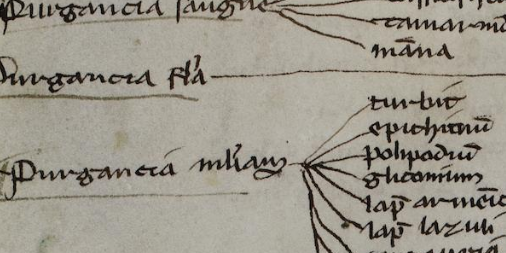
The latest big batch of online manuscripts from the Vatican Library includes medical works that list some very nasty medicines. Leafing through Pal. lat. 1084, thought to date to the 13th or 14th century, my eye was caught by a table of electuaries. In early medicine, an electuary was a mixture of powdered herbs with honey to disguise the vile taste.

Here is a purgative with 11 ingredients including lapis lazuli:
(Choke.) It would have been healthier to refuse the medicine and send the doctor away.

For the book historian, the layout demonstrates that a type of scientific stemmatic table which is found in early printed books has deep roots in medieval manuscript practice:

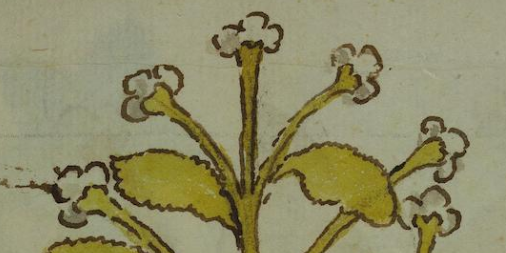
Another of the manuscripts, Pal.lat.1078, a 16th-century Italian herbal, contains fine drawings of herbs, apparently used in medicine, but also in alchemy. Here at fol. 13r is Herba Triacho (which would appear to be Tussilago farfara, a plant with small white flowers and undulate leaf margins):

The main DigiVatLib site onlined three manuscripts on October 26:
  1. Chig.G.VIII.226
  2. Urb.lat.185, Dialogues of Plato, translated to Latin, by Marsilio Ficino of Florence (thanks @LatinAristotle for correcting this)
  3. Vat.ebr.668
The Biblioteca Palatina, based in Germany, has gradually brought the 76 Vatican items below online over the past seven weeks, many medical including works by Galen. Here I summarize them from their RSS feed:
  1. Pal. lat. 762 Codicis Iustiniani imp. libri IX (13. Jh.)
  2. Pal. lat. 797 Nicolai de Messiato: Sammelhandschrift (15. Jh.)
  3. Pal. lat. 811 Repertorium universale iuridicum, theologicum, morale [Pars IV] (15. Jh.)
  4. Pal. lat. 813 Repertorium universale iuridicum, theologicum, morale [Pars VII] (15. Jh.)
  5. Pal. lat. 836 Ludolphi carthusiani liber de vita Ihesu Xpisti in ewangelio (15. Jh.)
  6. Pal. lat. 839 Ludolphi Carthusiani de vita Ihesu Xpi pars secunda a cap. I ad LVII (15. Jh.)
  7. Pal. lat. 840 Petri Trecensis (Comestoris) historia scholastica sive commentaria in Biblia (12.-13. Jh.)
  8. Pal. lat. 841 Petri Trecensis (Comestoris) historia scolastica theologice discipline (13. Jh.)
  9. Pal. lat. 843 Petri Comestoris scolastica hystoria (13. Jh.)
  10. Pal. lat. 847 Novum passionale editum a predicatore quodam, i. e. (Iacobi a Voeagine) legenda aurea sanctorum, in quatuor partes divisa (13.-14. Jh.)
  11. Pal. lat. 848 Jacobus : Iacobi a Voragine Legenda sanctorum (14. Jh.)
  12. Pal. lat. 853 Vitae patrum (14. Jh.)
  13. Pal. lat. 854 Sammelhandschrift (14. Jh.)
  14. Pal. lat. 855 Sammelhandschrift (15. Jh.)
  15. Pal. lat. 856 Sammelhandschrift (10. Jh.)
  16. Pal. lat. 857 Sammelhandschrift (1300)
  17. Pal. lat. 859 De gestis et translationibus trium Regum (15. Jh.)
  18. Pal. lat. 860 De gestis et translationibus trium Regum (15.-16. Jh.)
  19. Pal. lat. 861 Retraet(ati)o breuis et succincta perfectissime uite sanctissimeque venerabilis ac devotissime religiose gloriose memorie nomine Colete ordinis (15. Jh.)
  20. Pal. lat. 863 Sammelband (14.-15. Jh. ; 16. Jh.)
  21. Pal. lat. 865 Florenti Gregorii Turonici: Liber vitae patrum opere ; Liber in gloria confessoruni (9.-10. Jh.)
  22. Pal. lat. 866 Huberti de Romanis: Sammelhandschrift (13. Jh.)
  23. Pal. lat. 872 Livius, Titus: Ab Urbe condita (Decas III) (Italien, 15. Jh.)
  24. Pal. lat. 917 Plutarchus; Cruser, Hermann [Übers.]: Biographie des Pyrrhus und Marius, lat. (16. Jh.)
  25. Pal. lat. 967 Historia monarchiarum ;Tractatus de geographia (Deutschland, 16. Jh. (nach 1558))
  26. Pal. lat. 969 Burlaeus, Gualterus: De vita et moribus philosophorum et poetarum (Italien, 15. Jh.)
  27. Pal. lat. 987 Boethius, Anicius Manlius Severinus; Aristoteles: Sammelhandschrift (Frankreich, Ende 13. Jh.)
  28. Pal. lat. 999 Quaestiones et commentum in Logica (Deutschland, 14. Jh.)
  29. Pal. lat. 1000 Quaestiones in Logica (Deutschland, 15. Jh.)
  30. Pal. lat. 1001 Johannes (Petrus Hispanus): Summulae logicales ; Commentum in Summulas logicales Petri Hispani (Deutschland (Heidelberg?), 1491-1498)
  31. Pal. lat. 1003 Melanchthon, Philipp (Theologe); Culmann, Leonhard: Reportationes dialecticorum (IV-V) ; Disputationes seu argumentationes theologicae (Deutschland (Heidelberg?) (I) , Nürnberg (II), 16. Jh./Mitte (I) ; ca. 1545 (II))
  32. Pal. lat. 1010 Bruni, Leonardo; Aristoteles: Super Analytica posteriora Aristotelis (Deutschland, Mitte 15. Jh.)
  33. Pal. lat. 1018 Thomas : Commentum in Ethica Nicomachea Aristotelis (Deutschland, Ende 14. Jh.)
  34. Pal. lat. 1020 Aristoteles; Gerardus : Ethica Nicomachea ; Commentum in Ethica Nicomachea Aristotelis (Deutschland (Heidelberg?) (I) , Brixen (II), Mitte 15. Jh. (I) ; 1482 (II))
  35. Pal. lat. 1023 Franciscus Mediolanensis ; Ambrosius Crassus ; Leodegarius Rotomagensis: Sammelhandschrift (Nordfrankreich, 1540-1542)
  36. Pal. lat. 1028 Albertus : Commentum in Ethica Nicomachea Aristotelis (Deutschland, Ende 14. Jh.)
  37. Pal. lat. 1030 Thomas ; Burlaeus, Gualterus; Albertus : Sammelhandschrift (Paris, 1367-1370)
  38. Pal. lat. 1032 Petrus ; Aristoteles; Albertus ; Johannes : Sammelband (Deutschland, 15. Jh. (I) ; um 1387 (II))
  39. Pal. lat. 1038 Melanchthon, Philipp (Theologe): Sammelband (Wittenberg (I) , Deutschland (II), 1543 (I) ; 16. Jh. (II))
  40. Pal. lat. 1040 Johannes : Sammelhandschrift (Deutschland (Heidelberg?), 1479)
  41. Pal. lat. 1041 Johannes Egen ; Nicolaus Francus Vimacuus : In libros naturales Aristotelis (Heidelberg, 1512-1537)
  42. Pal. lat. 1043 Camerarius, Joachim (1534-1598) Centuriae viginti (Deutschland (Nürnberg?), um 1560-1584)
  43. Pal. lat. 1045 Albertus ; Johannes : Sammelband (Prag (I) , Paris? (II), 1366 (I) ; 14. Jh.)
  44. Pal. lat. 1049 Johannes ; Albertus : Sammelhandschrift (Lippspringe, 1376)
  45. Pal. lat. 1050 Petrus Nickel ; Johannes Versor: Sammelhandschrift (Leipzig (I) , Heidelberger Region (II), um 1465 (I) ; um 1530 (II))
  46. Pal. lat. 1051 Nicolaus : Compendium physicae sive de philosophia naturali (Deutschland, 15. Jh.)
  47. Pal. lat. 1052 Nicolaus : Compendium Metaphysicae (Deutschland, 15. Jh.)
  48. Pal. lat. 1053 Nicolaus ; Simon Dacus ; Johannes ; Martinus Rentz ; Johannes ; Hugo ; Luder, Petrus: Sammelband (Heidelberg, um 1469 (I) ; um 1456 (II))
  49. Pal. lat. 1055 Ovidius Naso, Publius; Aristoteles; Valerius Flaccus Setinus Balbus, Gaius; Propertius, Sextus; Cicero, Marcus Tullius; Vergilius Maro, Publius: Sammelhandschrift (Deutschland , Leipzig, um 1488)
  50. Pal. lat. 1057 Rocca, Angelo: Commentum in topica Aristotelis (Italien?, 14. Jh.)
  51. Pal. lat. 1058 Knab, Erhardus; Aegidius ; Thomas ; Ps.-Augustinus: Sammelhandschrift (Frankreich und Deutschland, 15. Jh. (1400-1427))
  52. Pal. lat. 1069 Crescentiis, Petrus /de: Ruralia commoda, Libri XII (Italien, 14. Jh.)
  53. Pal. lat. 1072 Grynäus, Simon: De ignitorum meteororum natura commentarii duo ; De cometa anni 1577 ; De planeta Veneris conspecta anno 1578 (Heidelberg, 1579-1582)
  54. Pal. lat. 1078 Herbarium (Italien, 16. Jh.)
  55. Pal. lat. 1082 Galenus; Hippocrates; Ibn-Riḍwān, ʿAlī: Medizinische Sammelhandschrift: Articella (Italien, 13./14. Jh.)
  56. Pal. lat. 1084 Galenus; Archimatthaeus; Baron, Roger; Johannes ; Trotula; Gilbertus : Medizinische Sammelhandschrift (13./14. Jh.)
  57. Pal. lat. 1085 Baron, Roger; Aegidius ; Johannes (Petrus Hispanus): Medizinische Sammelhandschrift (13./14. Jh.)
  58. Pal. lat. 1086 Johannes Calderia; Aegidius : Medizinische Sammelhandschrift (2. Hälfte 15. Jh.)
  59. Pal. lat. 1087 Johannes ; Johannes : Medizinische Sammelhandschrift (13./14.. Jh.)
  60. Pal. lat. 1089 Johanntitius; Hippocrates; Theophilus; Philaretus; Galenus: Medizinische Sammelhandschrift: Articella (1. Drittel 14. Jh.)
  61. Pal. lat. 1091 Galenus: Liber collecorii (Heidelberg, letztes Viertel 15. Jh.)
  62. Pal. lat. 1103 Galenus; Ibn-Riḍwān, ʿAlī: Medizinische Sammelhandschrift: Articella (1. Hälfte 14. Jh.)
  63. Pal. lat. 1104 Galenus; Ibn-Māsawaih, Abū-Zakarīyā Yūḥannā; Guilelmus : Medizinische Sammelhandschrift: Articella (Italien, 1. Hälfte 14. Jh.)
  64. Pal. lat. 1106 Serapio : Liber aggregationum in medicinis simplicibus (Deutschland, 15. Jh. (1439))
  65. Pal. lat. 1107 Serapio ; Petrus : Medizinische Sammelhandschrift (Bologna, 15. Jh. (1426))
  66. Pal. lat. 1132 Johannes Matthaeus de Gradibus; Bacon, Rogerus: Medizinische Sammelhandschrift (Heidelberg, 1473)
  67. Pal. lat. 1140 Isrāʾīlī, Isḥāq Ibn-Sulaimān /al-; Knab, Erhardus; Johannes Matthaeus Ferrarius de Gradi: Medizinische Sammelhandschrift (Heidelberg, 1472)
  68. Pal. lat. 1349 Euclides; Johannes Andreae; Petrus Bertrandus; Bartholomaeus ; Galenus; Rāzī, Muḥammad Ibn-Zakarīyā /ar-; Albertus ; Bonaventura: Miscellanea (Paris, Speyer, 1360-1370)
  69. Pal. lat. 1485 Cicero, Marcus Tullius: Orationes (Italien, 15. Jh.)
  70. Pal. lat. 1509 Cicero, Marcus Tullius: Epistulae (Italien (Venedig), 15. Jh.)
  71. Pal. lat. 1516 Cicero, Marcus Tullius: Opera (Italien (Toskana), 15. Jh.)
  72. Pal. lat. 1517 Cicero, Marcus Tullius: Sammelhandschrift (Frankreich , Italien, 15. Jh.)
  73. Pal. lat. 1541 Seneca, Lucius Annaeus : Sammelhandschrift (Deutschland, 15. Jh.)
  74. Pal. lat. 1583 Boethius, Anicius Manlius Severinus; Pius / Enea Silvio Piccolomini; Plutarchus; Bruni, Leonardo; Bonjohannes : Sammelhandschrift (Heidelberg, 15. Jh.)
  75. Pal. lat. 1585 Boethius, Anicius Manlius Severinus; Pius / Enea Silvio Piccolomini; Petrarca, Francesco; Seneca, Lucius Annaeus : Sammelhandschrift (Deutschland, 15. Jh.)
  76. Pal. lat. 1824 Luther, Martin: Auslegung der ersten 25 Psalmen (Weimar, 1556)
  77. Pal. lat. 1957 Französische Bibel (Nordostfrankreich, Anfang 14. Jh.)
This is Piggin's Unofficial List number 75. If you have corrections or additions, please use the comments box below. Follow me on Twitter (@JBPiggin) for news of more additions to DigiVatLib.