2015-11-11

Erlangen Tree

Until recently, a celebrated 12th-century manuscript, variously known as the Chronicle of Frutolf or the Chronicle of Ekkehard of Aura (Erlangen, Universitätsbibliothek, ms 406), was not to be found online. On November 7, German archives blogger Klaus Graf published the news on his site of its arrival and within a matter of hours, my Twitter colleague Pierre Chambert-Protat (@chaprot) went online to alert me to it. Digital social media are a wonderful boon to scholarship.

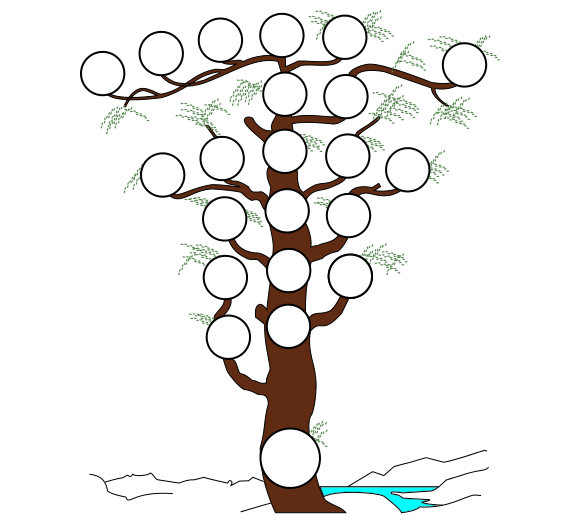
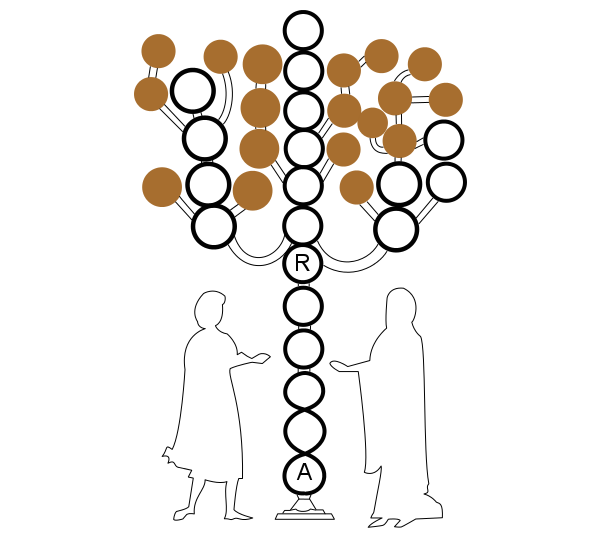
On November 4, I had published on this blog a schematic outline of a "tree" at folio 204v of the selfsame manuscript. This is a plot, which I originally prepared for my own book but later decided not to use:

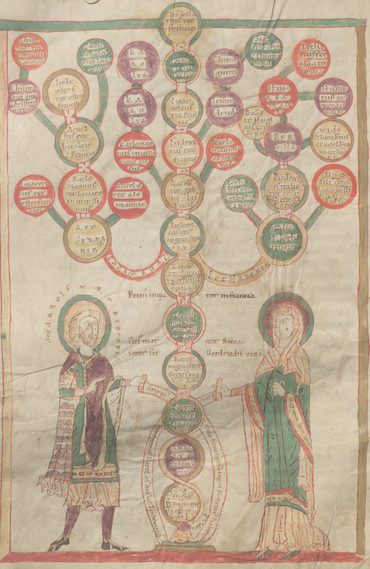
This figure, drawn in 1140 or thereabouts, is adapted from the century-old Stemma of Cunigunde, a drawing made in or shortly after 1013 when Cunigunde was anointed Holy Roman Empress. You can examine a reconstruction of that stemma on my website.

What does it show? The most important person here is R - Charlemagne - whose empire was divided among three of his grandsons by the Treaty of Verdun.

To enhance the chronicle, Ekkehard (or his predecessor editor Frutolf) repurposed the old diagram as a study in saintly ancestry by adding to it images of Arnulph and his holy mother Begga. Other manuscripts of the Ekkehard Chronicle present the Stemma of Cunigunde more or less faithfully, but the scribe-artist of the Erlangen codex decided to have some fun with it. He inverted it, and drew the figure of Arnulph at the left and Arnulph's saintly mother Begga at right. The bottom roundel (A in my plot) represents Arnulph.

Curiously, this artist omitted Cunigunde, although she had been the motive for creating the original drawing and she was revered in the entire Bamberg area, where this miniature was almost certainly made, as a holy figure and foundress of the cathedral. One must at least consider the possibility that the stemma was inverted in order to conceal her deliberate exclusion.

You can now enjoy the original at fol. 204v of the digital surrogate: 

What change in medieval culture had made this startling inversion of the stemma not just possible, but acceptable to the customer, probably the Cistercian Monastery of Heilsbronn in Germany which became the long-term owner of this codex? Is this quirky conversion on an artist's desk the precise moment when the family tree, later to become a prestigious badge of nobility, was invented?

As with all big questions, the answer is not a simple one. A long inquiry was conducted into these issues by Christiane Klapisch-Zuber. As a historian of Renaissance culture, she was curious about the roots of the craze from the 15th to the 19th centuries to depict European aristocratic genealogies by painting vast leafy trees where portraits of ancestors were pinned to a trunk and out onto the boughs. 

Researching her 2000 book, L'Ombre des Ancêtres, she cast far back into the medieval period, seeking precursors to those trees. This Heilsbronn tree of the late 12th century, as well as a couple of other painted trees made at roughly the same time at Weingarten, a monastery in the southwest of Germany, only dimly foreshadow the Renaissance craze. 

The Weingarten artist, working between the years 1185 and 1191, drew a leafy inverted stemma of the powerful Welf family with its most ancient known ancestor peeking out from inside the trunk at ground level, while a wide space was reserved in the crown of the foliage to be occupied by the Welfs' most illustrious offspring (by female descent), King Frederick Barbarossa. This is in Fulda, 100 D.11, folio 13v and is online. The other from Weingarten is now lost but an image of the tree was published by its owner, the collector and dealer Robert Forrer, in 1907. Unfortunately that book is not yet online. In Europe, it does not enter the public domain until 2018.

Klapisch-Zuber came, in effect, to the conclusion that it would involve an anachronism to call these drawings family trees or Stammbäume. There was no firm mental association between trees and the specific idea of ancestry yet.

The cultural change that took place in the 12th century with the rise of Gothic art was in fact much broader. Trees enjoyed a wide variety of uses in the graphic arts, ranging from trees of sevens as mnemonic devices to the tree manifestations of the Virga Jesse motif. Gothic cathedrals are in a certain sense trees of stone. This was what drove the experiments at Heilsbronn and Weingarten.

As I have already pointed out, inverted stemmata made to resemble trees with roots in soil are a rarity before the 16th century. It was 16th-century scholars like Scipione Ammirato who deserve the credit as the true originators of the family tree, not the medieval artists who created trees of ancestry more or less by fluke.

Forrer, Robert, ed. Unedierte Miniaturen, Federzeichnungen u. Initialen des Mittelalters. Strasbourg: Elsässische Druckerei, 1907.
Klapisch-Zuber, Christiane. L’ombre Des Ancêtres. Paris: Fayard, 2000.

2015-11-04

Digita Vaticana Exceeds 3,000

Digita Vaticana, the manuscript digitization programme at the Biblioteca Apostolica Vaticana (BAV) in Rome, exceeded 3,000 items on its main index page on November 3, 2015, meaning that it is now the biggest digitization program in Italy, having overtaken the Biblioteca Medicea Laurenziana in Florence, where the Teca Digitale stalled at 3,000 after using up its grant four or five years ago.

I posted back in May with some metrics, when the BAV program passed the 2,000 point, and will not repeat the main points I made then about double-counting. They still stand and are worth rereading.

Comparing this achievement with other major European programs is not easy. To simplify, I will use numbers for documents created before the year 1600. The BAV tally under-represents its digital content, while including a whole swathe of 18th-century materials, particularly from the Capponi collection. Let us assume that these effects cancel one another out.

A blank search of Biblioteca Digital Hispanica pulls up a remarkable 10,008 pre-1600 hits. I hope somebody in Madrid is blogging about this, because BDH must have crashed through the 10,000 ribbon in the last few days and it deserves to spray around a few magnums of cava to celebrate.

Some probing two weeks back at Gallica in Paris returned a report that it held a whopping 14,975 documents from the same pre-1600 period, but this includes a huge number of single-sheet documents since Gallica scoops up not just library but archival material. I cannot see a way to filter their total for codices only.

A few weeks ago it was possible to get Germany's biggest digitization programme, at the MDZ in Munich to tell you via the search interface that it housed 3,700 pre-1600 manuscripts, but some officious engineer has spiked this. The national German search site, Manuscripta Mediaevalia, which has often been unreliable in the past, returns the number 4,748 if you search for digitized pre-1600 items. I suspect that is too low.

Then there is the excellent e-codices of Switzerland, with 1,404 manuscripts in high quality. They generously encourage you to download them. The British Library, which mean-mindedly thwarts downloading, claims almost 2,000 items digitized from among those curated by its ancient, medieval and early modern manuscripts section, judging by a blog post in late October.

Given these numbers, the BAV can now claim to be a serious player on a European scale. They still have a lot to fix, including poor quality control, a ridiculous watermarks policy and a precautionary copyright statement that hasn't been well thought through. But it's a good start. And remember, they still have 80,000 more items to come.
 
Here is the November 3 list of 76 items, plus the single item from last week, bringing the total to 3,003. This listing is going to be a work in progress, as I am busy with other things right now. If you can tell me what treasures the unmarked shelfmarks below represent, I will fill in the details later.
  1. Arch.Cap.S.Pietro.E.29,
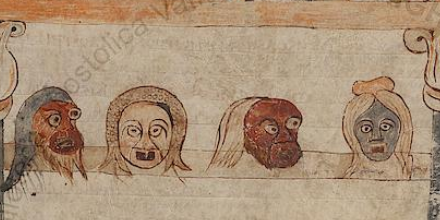
  2. Arch.Cap.S.Pietro.H.19, a celebrated 10th-century codex of Terence, possibly made at Corbie and thought to derive from the even more famous Vatican Terence, Vat.lat.3838 (which is not yet online). Its illuminations include this shelf of masks on fol 10r.
  3. Arch.Cap.S.Pietro.H.25,
  4. Borg.copt.109.cass.III.fasc.6,
  5. Borg.copt.109.cass.III.fasc.7,
  6. Borg.copt.109.cass.VI.fasc.22,
  7. Borg.copt.109.cass.VI.fasc.22,
  8. Borg.copt.109.cass.X.fasc.30,
  9. Borg.copt.109.cass.XII.fasc.38,
  10. Borg.copt.109.cass.XII.fasc.39,
  11. Borg.copt.109.cass.XII.fasc.40,
  12. Borg.lat.338,
  13. Cappon.237.pt.B,
  14. Chig.M.VIII.164, (pseudo) Roberto Re di Ierusalem, Le Virtu Morali. The true author is apparently unknown, according to M. Dykmans.
  15. Pal.lat.50, the famed Codex Aureus of Lorsch, which was added to @DigitaVaticana Oct 26 though it had already been online in Heidelberg for a long time previously (I saw it there in the summer). Klaus Graf points out an extensive November 13 discussion (in German) of the digitization by Johannes Waldschütz.
  16. Pal.lat.60,
  17. Pal.lat.95,
  18. Pal.lat.142,
  19. Pal.lat.145,
  20. Pal.lat.149,
  21. Pal.lat.165,
  22. Pal.lat.204,
  23. Pal.lat.208,
  24. Pal.lat.212,
  25. Pal.lat.221,
  26. Pal.lat.222,
  27. Pal.lat.226,
  28. Pal.lat.259,
  29. Pal.lat.262,
  30. Pal.lat.265,
  31. Reg.lat.762,
  32. Sbath.235,
  33. Sbath.457,
  34. Urb.lat.45,
  35. Urb.lat.73,
  36. Urb.lat.129,
  37. Urb.lat.196,
  38. Urb.lat.212,
  39. Urb.lat.226,
  40. Urb.lat.228,
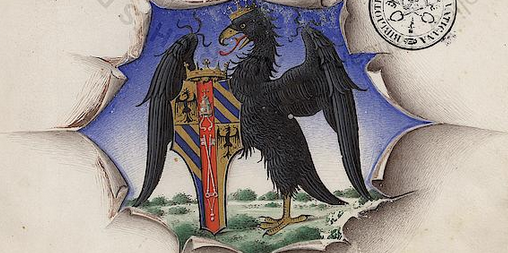
  41. Urb.lat.264, 1483, De re aedificatoria by Leon Battista Alberti (1404-1472). Grafton's Rome Reborn catalog notes, "This book offered a wealth of information, practical instruction, and aesthetic principles to the patrons and architects who would rear the city palaces, country villas, and domed churches of the 16th century." 'This copy has a magnificent trick on folio 1r where the artist pretends the paper has been punched through:
  42. Urb.lat.678 ,
  43. Vat.gr.2615,
  44. Vat.lat.19,
  45. Vat.lat.24,
  46. Vat.lat.43,
  47. Vat.lat.60,
  48. Vat.lat.63,
  49. Vat.lat.70,
  50. Vat.lat.94,
  51. Vat.lat.104,
  52. Vat.lat.113,
  53. Vat.lat.114,
  54. Vat.lat.117, glossed Four Gospels
  55. Vat.lat.125, glossed Gospel of Matthew (Anselm of Laon)
  56. Vat.lat.126, glossed Gospel of Matthew
  57. Vat.lat.130, glossed Gospel of Mark
  58. Vat.lat.142, glossed Epistles to Romans and Corinthians
  59. Vat.lat.145, Pauline Epistles with commentary
  60. Vat.lat.150, Pauline Epistles with commentary
  61. Vat.lat.166, Nicholas of Lyra, Postillae, 14th century
  62. Vat.lat.188, Irenaeus of Lyon, Against Heresies, dated 1576
  63. Vat.lat.189, Tertullian, various works, 15th century copy
  64. Vat.lat.225, Lactantius, Divinarum Institutionum
  65. Vat.lat.227, Tres Dialogi in Lactantium by Antonio da Rho, O.F.M., dating from about 1450. Grafton's Rome Reborn catalogue notes: "The humanists found many opponents among contemporary scholastics, one of whom was Antonio da Rho. Antonio tries to discredit the automatic humanist equation of earlier with better by showing that one of the early Christian writers, Lactantius had made numerous theological errors to which later scholastic writers had not been subject. This dedication copy for Pope Eugene IV has a colorful decorative border with a miniature showing the Franciscan friar presenting his work to the pope."
  66. Vat.lat.261, Athanasius
  67. Vat.lat.262,15th century, mainly Prosper of Aquitaine
  68. Vat.lat.350, Epistula
  69. Vat.lat.353, Renaissance manuscript of Jerome's letters to Paulinus, illuminated capitals
  70. Vat.lat.378, theological, mainly Venerable Bede
  71. Vat.lat.397, John Chrysostom, 15th century
  72. Vat.lat.398, John Chrysostom, Homilies on Epistle to Hebrews
  73. Vat.lat.1286, 15th century sermons
  74. Vat.lat.3197, Pietro Bembo's Dante: Divine Comedy
  75. Vat.lat.3834, 9th-century theological miscellany
  76. Vat.lat.7566, Dante's Inferno, scribe Bartolomeo da Colle 1421-84
  77. Vat.lat.14189, Pietro Bembo? miscellaneous letters
If you have any corrections, please use the comments box below. follow me on Twitter (@JBPiggin) for more news. [This is Piggin's Unofficial List 29.]

2015-11-03

Oldest Family Tree

As part of my book research, I am searching for the oldest family tree. Some time in the 16th century, the idea of dressing up the genealogies of royal and noble families to look like oak trees took hold in Europe. These were printed from copper engravings and could be distributed to regional leaderships as a kind of corporate branding and loyalty-building exercise.

As an entrepreneurial venture, this could be profitable. Scipione Ammirato, the Italian writer and historian, set up a workshop in Florence and turned out a whole series of them in cooperation with artist-engravers (Congedo, 216). On spec, he sent a family tree of Henry III to the French royal court. He received a reward of 500 gold ducats from Paris for it (Congedo, 274).

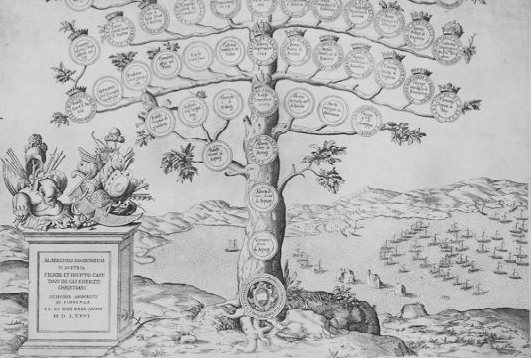
The oldest of Ammirato's trees is probably that of the Hapsburgs of Austria, engraved in 1576. It shows the tree on a high hill over a bay (probably representing Trieste) where a great naval fleet rides at anchor. The original copper plate still exists in Florence, according to the Italian register of cultural heritage, though it is not stated who owns it. An original print from it was sold by the antiquarian bookseller Gonnelli a few years ago as part of a set for 300 euros:

The type continues with Ammirato's 1580 book Delle Famiglie Nobili Napoletane. which contains eight double-page and five single-page engraved illustrations of genealogical trees. Each contains some kind of landscape in the background that can be connected with the dynasty. Here is my plot of part of the tree of Marzani, who were big shots in the Spanish-ruled Kingdom of Naples, from that book:
Now I must hasten to say that what I am looking for here is the earliest example of a thing named "family tree" or "albero genealogico" or "Stammbaum" or "arbre de famille".

We know from the great study by Christiane Klapisch-Zuber that these things had unwitting precursors in previous centuries. There were even 12th-century artists who took pre-existing stemmata and flipped them upside down to depict them as trees. A celebrated example, now at Erlangen (Universitätsbibliothek ms 406, fol. 204v), is found in one of the manuscripts of the Chronicle of Ekkehard of Aura:
But these were experiments or flukes, not genealogical trees as a general cultural phenomenon.

The conscious idea of presenting a complete family line connected by a woody trunk first shows up in southern German woodcuts in the late 15th century. [Later note: Dr Volker Bauer (see below) has kindly pointed out a magnificent early example in BSB incunable 2 Inc.s.a. 1264 from 1475-78 digitized here (seek image 18) and also at the LOC. There is also a most remarkable tree of heraldic arms in the 1492 Cronecken der Sassen, GW 4963.] This phenomenon reaches its finest flower in the Ehrenpforte engraved in 1515 by Albrecht Dürer (there's a fine reconstruction of this on Virtuelles Kupferstichkabinett). But Dürer's has no branches.

The tree as a recognizable category of art, a product where artist and customer know what to expect, only shows up later in the sixteenth century. It looks semi-natural, has a bottom root and clearly tiered generations. The oldest example I can find is Robert Peril's 1535 tree of the Hapsburgs made at Antwerp (lower half online: Boijmans Collection).

Examples later than Ammirato's include a fine 1586 tree of the Kings of Saxony by Lorenz Faust which is labelled "Stammbaum," perhaps the first documented use of that word in the German language (the link is to the MDZ in Munich). [Later: Note however a 1515 illustration title "Bawm vnnd Außlegung der Sypschafft ..." here.] The type's later development in Germany and embrace of tree shapes other than oaks has been researched by Volker Bauer of the Herzog August Bibliothek.

But I cannot find any trees of living families from the first third of the 16th century. Has anyone got suggestions?

Ammirato, Scipione. Delle Famiglie Nobili Napoletane. Firenze: Appresso Giorgio Marescotti, 1580. https://archive.org/details/gri_33125013895186.
Bauer, Volker. “Attesting to Dynasty: The Use of Images in Early Modern German Genealogy.” Rome, 2013. http://crhipa.upmf-grenoble.fr/wp-content/uploads/2015/04/Bauer.pdf.
———. “Dynastic Botany: Banyans, Cedars, and Palms as Visual Models in Seventeenth-Century Genealogy.” In Visual-Acuity-and-the-Arts-of-Communication-in-Early-Modern-Germany, edited by Jeffrey Chipps Smith. Ashgate, 2014. https://www.ashgate.com/pdf/SamplePages/Visual-Acuity-and-the-Arts-of-Communication-in-Early-Modern-Germany-Intro.pdf.
Congedo, Umberto. La vita e le opere di Scipione Ammirato (notizie e ricerche). V. Vecchi, 1904. http://archive.org/details/lavitaeleopered00conggoog.
Klapisch-Zuber, Christiane. L’Ombre des Ancetres. Paris: Fayard, 2000.
———. “The Genesis of the Family Tree.” In I Tatti Studies. Essays in the Renaissance, 4:105–29. Florence: Leo Olschki, 1991.

2015-10-24

Poggio Portrait

The great Poggio Bracciolini (1380-1459) is famed for rediscovering a large number of classical Latin manuscripts that were decaying in German, Swiss, and French monastic libraries. The latest bunch of uploads at Digita Vaticana, on October 21, 2015, includes a manuscript, Urb.lat.224, made in his lifetime (but not by his pen) of his literary work De varietate fortunae (1447).

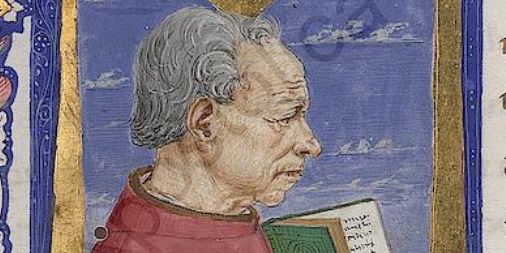
This is a first-hand survey of the ruins of Rome which Poggio had plenty of time to write as the chief papal scribe (alas he  made no drawings or maps). This codex, apparently made about 1450, begins with an image of Poggio in his sixties, which is probably from a portrait from life. Poggio had waited until age 56 to marry, wedding a girl not yet 18, Selvaggia dei Buondelmonti. He was not handsome, but he was one of the great intellectuals of his day in Florence.

His most celebrated find (described in Stephen Greenblatt's much over-rated best-seller The Swerve) was De rerum natura, the only surviving work by Lucretius.

Between 1414 and 1418 Poggio also dug up (and probably stole) in Fulda, Germany the De re rustica of Columella, an ancient handbook of farming written in the first century CE: a manuscript of De re rusticaUrb.lat.260, featured on this blog a few weeks ago. Columella's work had only been known of indirectly at that point through the Ruralia commoda, the most celebrated medieval handbook of farming. The latter book had been completed some time between 1304 and 1309 by Pietro de' Crescenzi, who could only find fragments of the ancient work. I mention this, because a manuscript of the Ruralia, dated 1424, Urb.lat.266, is in the current batch of uploads below.

Also in the new batch is a book by Poggio's Florentine mentor, Coluccio Salutati (1331-1406), De fato, fortuna et casu (written 1396-1399), here in a presentation edition that is almost certainly posthumous. Coluccio is one of my great heroes, since he purchased and preserved the only accurate copy, Plut. 20.54, of the sole large abstract diagram known from antiquity, the Great Stemma.

The full list of uploads follows:
  1. Arch.Cap.S.Pietro.D.184, Gospels with a fine illumination of Matthew (below)
  2. Arch.Cap.S.Pietro.D.201, Nicholas of Lyra, Postillae
  3. Arch.Cap.S.Pietro.E.12, liturgical calendar
  4. Arch.Cap.S.Pietro.E.21, De excidio urbis Hierosolymitanae (On the ruin of the city of Jerusalem) by Pseudo-Hegesippus (see the Roger Pearse summary on Pseudo-Hegesippus with rough translation)
  5. Arch.Cap.S.Pietro.F.11.pt.B, the blackened flyleaf of liturgical codex Arch.Cap.S.Pietro.F.11 which contains music and prayers for votive and other masses
  6. Arch.Cap.S.Pietro.I.6, 1781 catalogue
  7. Barb.lat.1396, a consilium of Baldus de Ubaldis
  8. Barb.lat.1808, collection of orations
  9. Borgh.286, Geoffrey of Trani, 1245? Summa super rubricis decretalium
  10. Borgh.295, Peter Lombard, Sententiae
  11. Borgh.296, theological and philosophical miscellany
  12. Borgh.336, Iacobus de Voragine, c.1229-1298, Sermones de sanctis, 16th century
  13. Borgh.378, 18th-century catalog of Borghesiani Library, Pars altera.
  14. Cappon.44, estates list? 1648
  15. Cappon.72,  notes from Avicenna
  16. Cappon.76, Italian translation of Quinto Curcio Rufo
  17. Cappon.237.pt.A, collection of 16th and 17th-century drawings and watercolours, including this sketch from 25v
  18. Chig.L.VI.212, Dante, Divine Comedy
  19. Ott.lat.2863, Dante, Divine Comedy
  20. Urb.lat.41, Ambrose of Milan, various, 15th century
  21. Urb.lat.82, Augustine, Prosperus, Vigilius, 15th century
  22. Urb.lat.86, Aymon of Halberstadt on Pauline Epistles, 15th century
  23. Urb.lat.124, Alexander of Ales, OFM, 15th century
  24. Urb.lat.128, Thomas Aquinas, 15th century
  25. Urb.lat.131, Thomas Aquinas, 15th century, copy owned by Pius VI
  26. Urb.lat.135, Thomas Aquinas, 15th century
  27. Urb.lat.138, Thomas Aquinas, dated 1474
  28. Urb.lat.141, Bonaventure, 15th century (Urb. lat. Catalog on Archive.org)
  29. Urb.lat.145, Antoninius of Florence, Summa, 15th century, copy owned by Alexander VII
  30. Urb.lat.153, Pelagius, dated 1482
  31. Urb.lat.201, Coluccio Salutati, De Fato, Fortuna et Casu, 15th century
  32. Urb.lat.216, Aristotle, Metaphysics, with commentary by Thomas Aquinas, 14th-15th century
  33. Urb.lat.217, ditto, 15th century
  34. Urb.lat.224, De varietate fortunae (1447) by Poggio Bracciolini (image above), a detailed first-hand survey of Rome's ruins, which was an exhibit in Rome Reborn. Also various orations by Poggio. See the detailed listing of the codex's contents at Saint Louis, plus the Latin Catalog on Archive.org. Apparently made about 1450.
  35. Urb.lat.235, Galenius and Thomas Aquinas, 16th century
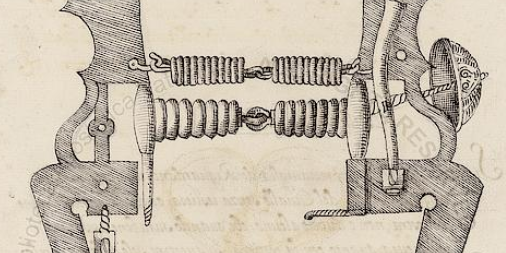
  36. Urb.lat.255, technical handbook on brakes for horse-drawn vehicles, 17th century:
  37. Urb.lat.266, Pietro de' Crescenzi, a key medieval handbook on agriculture, Ruralia commoda, this copy dated 1424 lacks illuminations
  38. Vat.gr.2421, 1647, on paper, no entry yet in Pinakes
  39. Vat.lat.257, Ephrem the Syrian, 15th century
  40. Vat.lat.338, Venerable Bede on Esdras, Nehemiah, Tobit, 15th century
  41. Vat.lat.10678, Dante Divine Comedy with copious additions on margins of first 15 folios

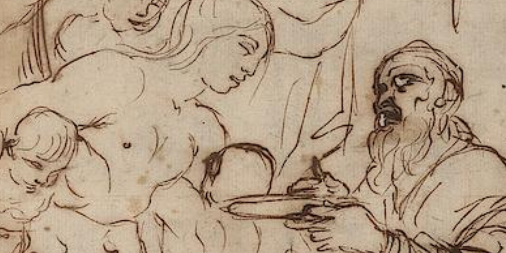
Here is the evangelist Matthew at work from Arch.Cap.S.Pietro.D.184
This raises the posted number of manuscripts to 2,926, an increase of 41. As I noted recently, the presence of some digitized manuscripts is not declared in the Digita Vaticana index of postings, so the true total of digitizations is actually somewhat higher.

Follow me on Twitter (@JBPiggin) for more news. Post comments or correction in the box below this blog post.  [This is Piggin's Unofficial List 28.]

2015-10-13

Imaginary Jerusalem

Elements of the medieval world were far geekier than even today's Lord of the Rings cosplayers, Twilight pilgrims or Star Wars obsessives. The imaginary Jerusalem of Nicholas of Lyra, with its maps and building plans of places that never existed, made the writer's commentary on Ezekiel immensely popular in its day.

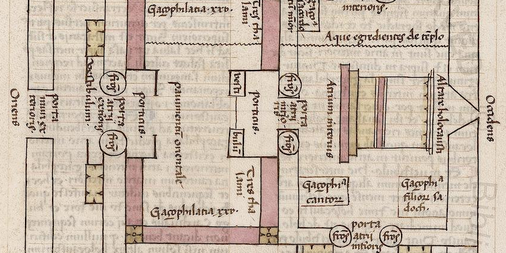
A fine 15th-century manuscript of Nicholas's Postillae has just come online at Digita Vaticana and you can feast your eyes on all these drawings. The codex is Urb.lat.15 and among its elaborate drawings is the sanctuary with east and west entrances and the altare holocaust site in the temple at folio 201v:
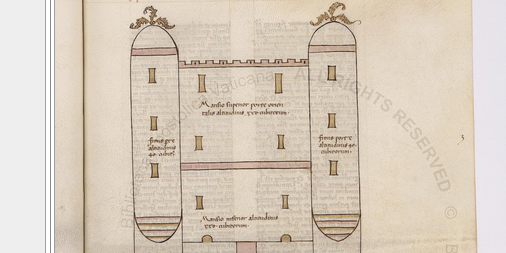
There's a fine Renaissance palace imagined in Jerusalem at folio 198r
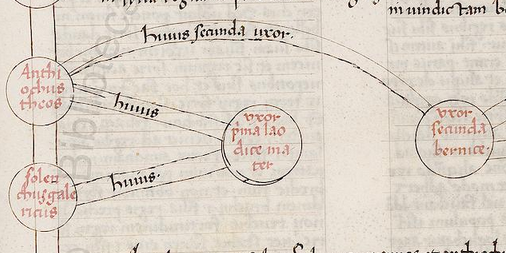
Look through the book and you will find all sorts of oddities. Here's Antiochus II, given the epithet Theos, and his successive wives Laodice and Berenice in a not entirely reliable family tree at folio 259r. Observe how this top-down stemma has got little roots growing at the bottom. Very odd.
The origins of the diagrams are discussed in a 2012 paper by Lesley Smith.

Also new online in the batch of just two items uploaded October 12, 2015 is Borg.copt.65.

As always, if you can add notes, use the comments box below. Follow me on Twitter (@JBPiggin) for more news. [This is Piggin's Unofficial List 27.]

2015-10-10

Rome and Qing Fuse in a 1704 Diagram

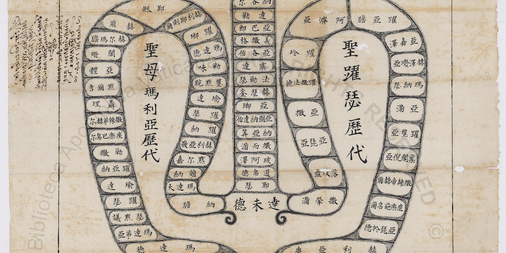
Just after 1700 CE, Chinese experts accepted an extraordinary commission: to devise a poster-sized infographic to depict the ancestry of Jesus Christ. Their help had been sought by Carlo Orazio da Castorano (1673-1755), a Franciscan missionary in Shandong, a city 400 kilometres south of Beijing.

The only known copy of the poster that the unknown Shandong designer/engraver and printer (perhaps assisted by an editor) produced is now in the Biblioteca Apostolica Vaticana in Rome.

This fusion of Latin late antique ideas and creative Qing-period design has a special place in world cognitive history. The poster is about 125 centimetres high. Several weeks ago, the Digita Vaticana, the digitization programme at the BAV in Rome, brought Vat.estr.or.55 online, as I noted at the time.

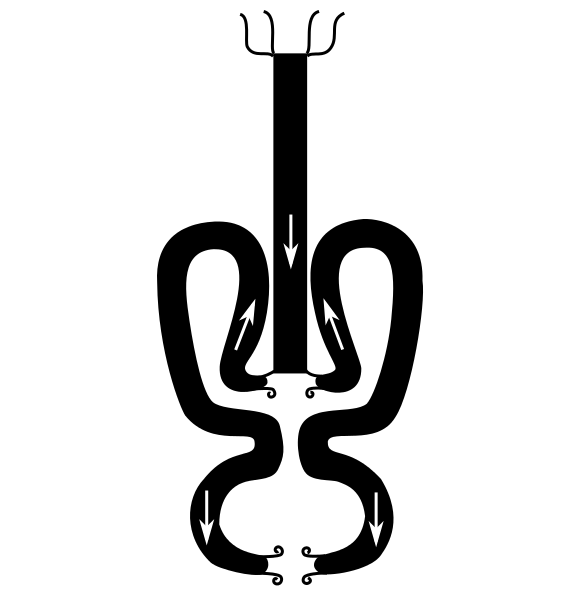
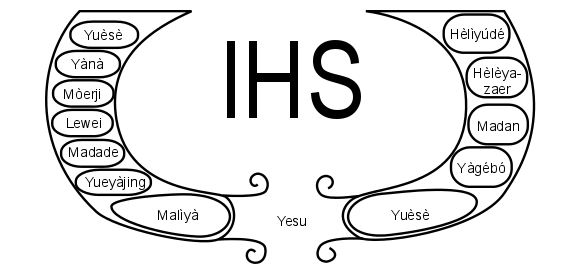
The poster published in 1704 shows a dual genealogy of Jesus, beginning as a single stream at Adam at top, dividing at David into the line of Nathan at left and the line of Solomon at right. The left loops comprise a genealogy according to the Gospel of Luke, and the right loops that in the Gospel of Matthew. The overall shape ends up looking something like a guitar. Jesus occupies the gap at the base. Here is a schematic summary of it. The white arrows show the direction of descent:
What the diagram achieves in cognitive terms is this: It visualizes the genealogy of Jesus as a combination of flow-chart and network. What began as mythic stories and oral history among Jews is here translated from the linguistic sphere of knowledge into the visual-spatial sphere, where the reader is invited to comprehend it with a different cognitive system of the mind. In addition, the chart re-imagines all this in a Chinese cultural mode.

Orazio, whose Italian surname is also spelled as Orazi and whose Chinese name was 康和子 (Kāng Hézi), was just 31 and had barely been four years in China when the Qing artists or craftsmen accepted his briefing to make this extraordinary graphic. (I rely on Michela Catto's account of him in the Dictionary of Italian National Biography, and also notes by Michael Mungello.)

Although only Kāng Hézi and none of the other creative contributors is named on the poster, a modicum of post-colonial common sense suggests that while the basic idea was the young Orazio's, the execution, probably by directly engraving a metal plate, required much Chinese artistic and technical talent. Where Orazio would have requested European-style roundels and connectors like this ...
... the designer/engraver must  have persuaded him to instead accept cells, oval in shape, fitted together in a broad band:

The cells make eminent sense in a Chinese context. Their shape makes them recognizable as analogues of ancestral tablets. Their organization into paths might have seemed a little strange to a Chinese readership. The paths make the chart akin to a map. The diagram is termed a "tú" (圖) or chart, with the full title Wúzhǔ Yēsū jí tiānxià wànmín lìdài zōngpài tú (吾主耶穌及天下萬民歷代宗派圖) (Dudink).

The advantage for Orazio and his partners in setting the cells flush was that this ensured enough space for the names to be legible, while not making the poster any bigger than the largest commercially available paper sheets for printing in China. The compression of the main lines of ancestry into such a circuitous shape assists the illusion of equality between the lines of Luke (left) and Matthew (right). These aspects too may have been the engraver/designer's own idea, not Orazio's. Considerable effort has also been applied to softening the lines by composing them of tiny brushwork and by feathering all the line ends.

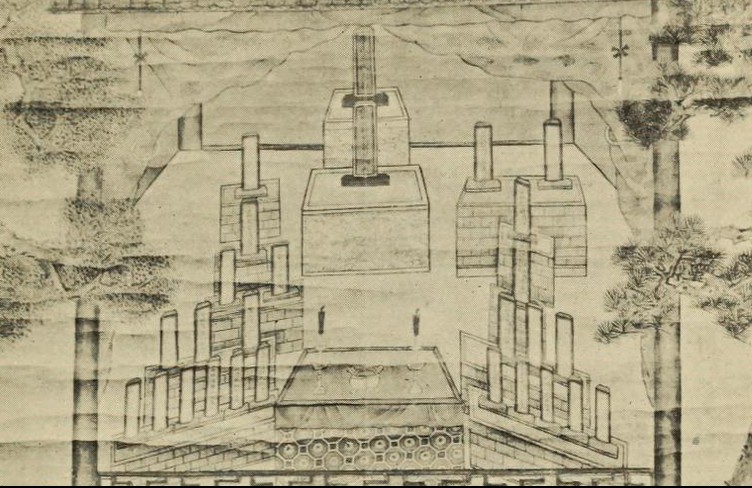
It is interesting to compare this diagram with an ancestral scroll of uncertain date collected in Shandong only 200 years after the Orazio diagram was made (quoted by Cohen from Johnston). This visualizes family as tablets arranged in a top-down stemmatic fashion, suggesting the Orazio diagram would have been readily cognizable for a northern Chinese audience as a genealogy:

Both China and the West had long histories of experiments with visualizing abstract information of hierarchical form for genealogy. A type of stemmatic chart known as a sū shì zōng tú pǔ (蘇氏宗圖譜) was invented in the Northern Song (960-1279) state while another style known as a bǎo tǎ shì tú pǔ (寶塔式圖譜) was popular in the Southern Song state (Chao).

Europe's experiments with similar graphic layouts go back somewhat further. My own research has established the date of the oldest extant graphic genealogy as before 427 CE. Like the Tú, the Great Stemma also sets out a genealogy of Christ. You see a reconstruction of it on my website along with a link to the main publication about it.

The Orazio chart is likely to have been the first occasion when these separate traditions fused into a single creative work at the highest level of expertise.

Orazio may or may not have learned during his Franciscan formation in Teramo, Italy of the late antique Great Stemma. The Franciscans were a conservative order theologically, less intellectually adventurous than the Jesuits, but with a long-standing interest in graphics as a means to evangelize, so Orazio may well have remembered and kept an abiding impression in his mind of old posters and charts, even one based on work from 1,300 years earlier.

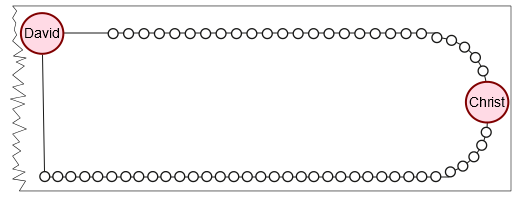
The central idea around which the Great Stemma is based is to show the Luke and Matthew genealogies as streams separating after David and then rejoining at Jesus, as follows:
The idea of presenting the two genealogies as streams or fila that part and then reunite at Christ is something so distinct, so inspired, and even so idiosyncratic that it is hard to avoid the impression that there is some kind of hidden chain of influence leading from the Great Stemma to the Tú.

I have no knowledge of Chinese, so with the help of an excellent student of medicine and Chinese, Lennard Piggin, I transliterated the confluence section of the chart to pinyin so I could read it. I have not entered all the tone marks, as they are difficult to type, but you will get the idea:

This yielded something else that surprised me. The majority Catholic view of the two gospels holds that both Matthew and Luke set out an ancestry of Joseph (phoneticized Yuèsè in Chinese).

But here, both genealogies terminate at Yēsū (Jesus) and the name to the left of Jesus is Malíyá (Maria) and to the left of that is Yueyàjing (Joachim). Neither of the latter names is given in Luke 3:23.

The insertion of both names as a bridge can be traced back to an apocryphal second-century work, the Protevangelion of James. Along with the two gospels, the Protevangelion is the hidden, third documentary source on which the chart ultimately relies for its information. To find out more about the apocryphal figure of Joachim, read my Joachim article.

In this case too, the similarity of conception leading from the Great Stemma to the Tú is startling. The anonymous Great Stemma's main motivation appears to have been to propound the Joachimite theory. It was modified in later use to bring the chart into line with the orthodox Christian position.

But in the Tú, the Joachimite theory is revived. Dudink argues that there is an intermediate influence at work here:  the writings of the forger Gianni Nanni (1432-1502), better known as Annius of Viterbo. Orazio altered the Lucan names "Eli" and "Joseph", changing them to "Joachim" and "Maria" respectively, relying on a bogus claim by Annius to have "discovered" an ancient error in Luke.

There is a third similarity between the Great Stemma and the Tú. In the text section of the Tú, Orazio set out an age-of-the-world chronology drawn from the Chronological Canons of Eusebius of Caesarea, and thus from the Septuagint and Vetus Latina version of the Old Testament, not from the Masoretic and Vulgate version which was authoritative for Catholics in 1704.

The Great Stemma is similarly based on a Vetus Latina chronology. There is however a key difference between it and the Tú: the Great Stemma omits a patriarch known as the Second Cainan or Kenan, whereas the Tú includes Cainan II (嘉宜南). You can find a full list of the names used in the Great Stemma on my Luke page. The names in the Tú have been published in full by Dudink.

The three resemblances are very striking, but I think on reflection that it is unlikely that Orazio ever actually saw the Great Stemma, let alone consciously reproduced it in a Chinese version.

What Orazio took to China is more likely to have been an undefined mental "picture" of the Jesus genealogy picked up during his formation with the help of some kind of visual teaching materials.

He must have explained to his partners in Shandong what he had seen in Italy and how he envisaged recreating this in China. During their collaboration, almost everything for the chart had to be created again from scratch. Not even a phoneticization of the biblical names into Mandarin forms existed yet. All the conversions had to be devised by Orazio and his Chinese scholarly partners. In many cases they are unique, and were not adopted by later translations of the Christian Bible to Chinese.

The chart, when finally published was therefore a vast and complex creative effort mingling advanced epistemological and communications ideas from east and west. I have very little knowledge of stemmatic graphics in China and will leave it to others to draw conclusions about that, but this story of fusion does reveal something interesting about the western side of the interaction.

There is only one copy of the Great Stemma in unadulterated form left in Italy, Florence plut. 20.54. Two others seem to have existed, but have vanished. I do not know of any post-Renaissance graphics directly based on the Great Stemma. It does however seem that despite the paucity of graphic evidence, elements of the tradition of the Great Stemma remained alive among the 17th-century Franciscan teachers who formed Orazio in the Papal States.

The idea of teaching the ancestry of Jesus by visualizing it rather than just talking about it does seem to have persisted, even though the tradition of copying the Great Stemma had by then ceased and most of the extant copies of this late antique masterwork had vanished. That China, not the West, put to paper the last trace of the tradition is one of the more remarkable paradoxes of history.

Cams, Mario. ‘Not Just a Jesuit Atlas of China: Qing Imperial Cartography and Its European Connections’. Imago Mundi 69, no. 2 (3 July 2017): 188–201. https://doi.org/10.1080/03085694.2017.1312114.
Chao, Sheau-yueh J. “Researching Your Asian Roots for Chinese-Americans.” Journal of East Asian Libraries 129, no. 1 (2003): 23–40.

Cohen, Myron L. “Lineage Organization in North China.” The Journal of Asian Studies 49, no. 03 (1990): 509–34.

Dudink, Ad. “Biblical Chronology and the Transmission of the Theory of Six ‘World Ages’ to China: Gezhi aolüe...(Outline of the Mystery [revealed Through] Natural Science; before 1723).” East Asian Science, Technology & Medicine 35 (2012): 89–138 (Online: paywall).

Johnston, Reginald F. Lion and Dragon in Northern China. New York: Dutton, 1910. Archive.org.
2015-10-06

Vanity Shelfmark

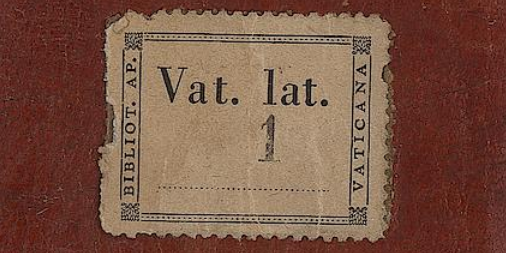
The pope's personal vehicle has the number plate SCV 1 (the letters stand for Status Civitatis Vaticanae). It's one of the world's grandest vanity plates. By analogy, the "first" book in the Vatican Library, Vat.lat.1, ought to be a very special book. It belongs to the Vatican's own collection (not the ones which the pope purchased or captured in war or otherwise took over). It's in the Vatican's own  language (not Greek or Hebrew). And the Vat.lat series is for manuscript codices, not printed books.

Vat.lat.1 arrived online in digital form on October 2. Red leather binding, somewhat scuffed, and on the spine just about the poshest of all labels a library book could ever carry. These labels were printed postage-stamp style and torn off a sheet, so this label may even carry a bit of nineteenth-century DNA in the form of a holy lick on its back:
 

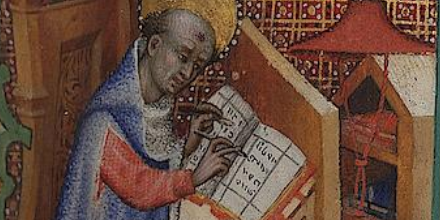
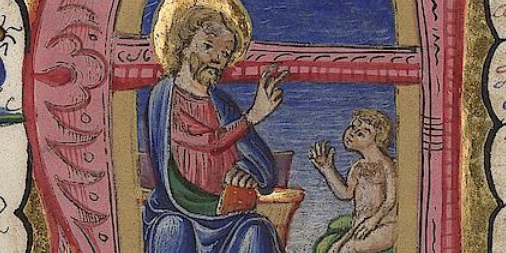
It's a Vulgate Bible, gloriously illuminated in some year between 1426 and 1475. Reader @TuomasLevanen points out this fine initial in Chronicles folio) showing teacher and student:

It would be nice to suppose this was the first book purchased from a bookseller when Pope Nicholas V set up a public library at the Vatican in 1451.

But that is not so. The early papal librarians sought order in the chaos by shelving like with like, and then attaching numbers serially to the codices, since they lacked anything sensible like the Dewey Decimal System which I assiduously learned in my youth. The bibles came first, so many of the books in the range 1-100 are study bibles.

This was not the personal bible used by popes, as far as I know. Nor is it the authoritative text of the bible, like the one-metre bar kept in Paris as the source of all measurement on the planet. The approved text of Jerome of Stridon's Latin, the Nova Vulgata (online), is a composite compiled from many far older manuscripts than this one.

But if you ever get elected pope and decide to read all the books in your library starting from number one, this is the volume to begin with. You'll need to be patient. As far as I know, there are more than 15,000 codices in the Vat.lat series alone.