2013-07-09

Vetus Latina at St Gallen

A highlight of this week's visit to the Stiftsbibliothek in St Gallen in Switzerland was to see in a glass case one of the leaves from the library's early fifth-century manuscript of the Vulgate translation of the Gospels. This manuscript, Cod. Sang. 1395, comprises parchment fragments recovered from St Gallen bindings. The digitized pages can be viewed online.

As the guide noted, the existence of the manuscript, estimated to have been penned in 410 or 420 CE in Verona, Italy when Jerome of Stridon was still alive in Bethlehem, is one of the great sensations of book history. That date is so old that it precedes by about a decade the compilation of the Great Stemma (which of course employs Vetus Latina, not Vulgate terms in its genealogical and chronicle material). Vetus Latina materials were also shown as part of the special exhibition, Im Anfang War das Wort.

I was very interested to leaf through the recently published Die Vetus Latina-Fragmente aus dem Kloster St. Gallen, a book of facsimile pages and commentary edited by Rudolf Gamper.

A striking feature of the permanent exhibition was an image of the so-called Verbrüderungsbuch, Cod. Fab. 1, which is digitized and available online. This contains lists of deceased monks of St Gallen and up to 60 other monasteries for whom the community prayed. As the online catalog notes, "starting in 830 the names of monks who joined the monastic community were listed in the empty canonical table frames."

Presumably the decorative arches were originally drawn on the 31 pages following a model devised by Eusebius of Caesarea. The neatness of the entries seems to decline with time. This use appears to be opportunistic, but elsewhere arches were an intentional meta-informational element. I have not yet got an overview of what range of significances such frames could bring to their content.

Gamper, Rudolf, Ph. Lenz, A Nievergelt, P Erhart, and E Schulz-Fluegel. Die Vetus Latina-Fragmente aus dem Kloster St. Gallen. Dietikon-Zürich: Graf, 2012.

2013-07-08

Bridge at Blumau

In a post one year ago, I described the ancient road through the Eisack gorge in the north of Italy. The other day I took a closer look at its major surviving Roman feature, the Bridge at Blumau or Prato all'Isarco. In this post I will use the German name of the town, since this community is in a German-speaking area.

As I have already explained, this road possessed enormous geopolitical importance, providing the quickest communication route to move troops, intelligence, materiel and goods between Germania and Italia through the Alps. One might argue that every bridge on this north-south route possessed equal importance, but the Blumau crossing, deep inside a narrow, obstructed gorge, was surely the most challenging and most expensive to build, maintain and defend.

Other important crossings like that at Waidbruck (Ponte Gardena) could be re-sited, or may even have had back-ups, but the Bridge at Blumau was quite simply irreplaceable: there was almost no other position at Blumau in which it could be be placed, and pontoons could not be used. Without the bridge, this all-seasons route would have been impassable. Any north-south communication, weather permitting, would have required at least an extra day via the Ritten Plateau or Völs route, or at least three extra days, via the more westerly Via Claudia Augusta over the 1,500-metre Reschen Pass. See my map.

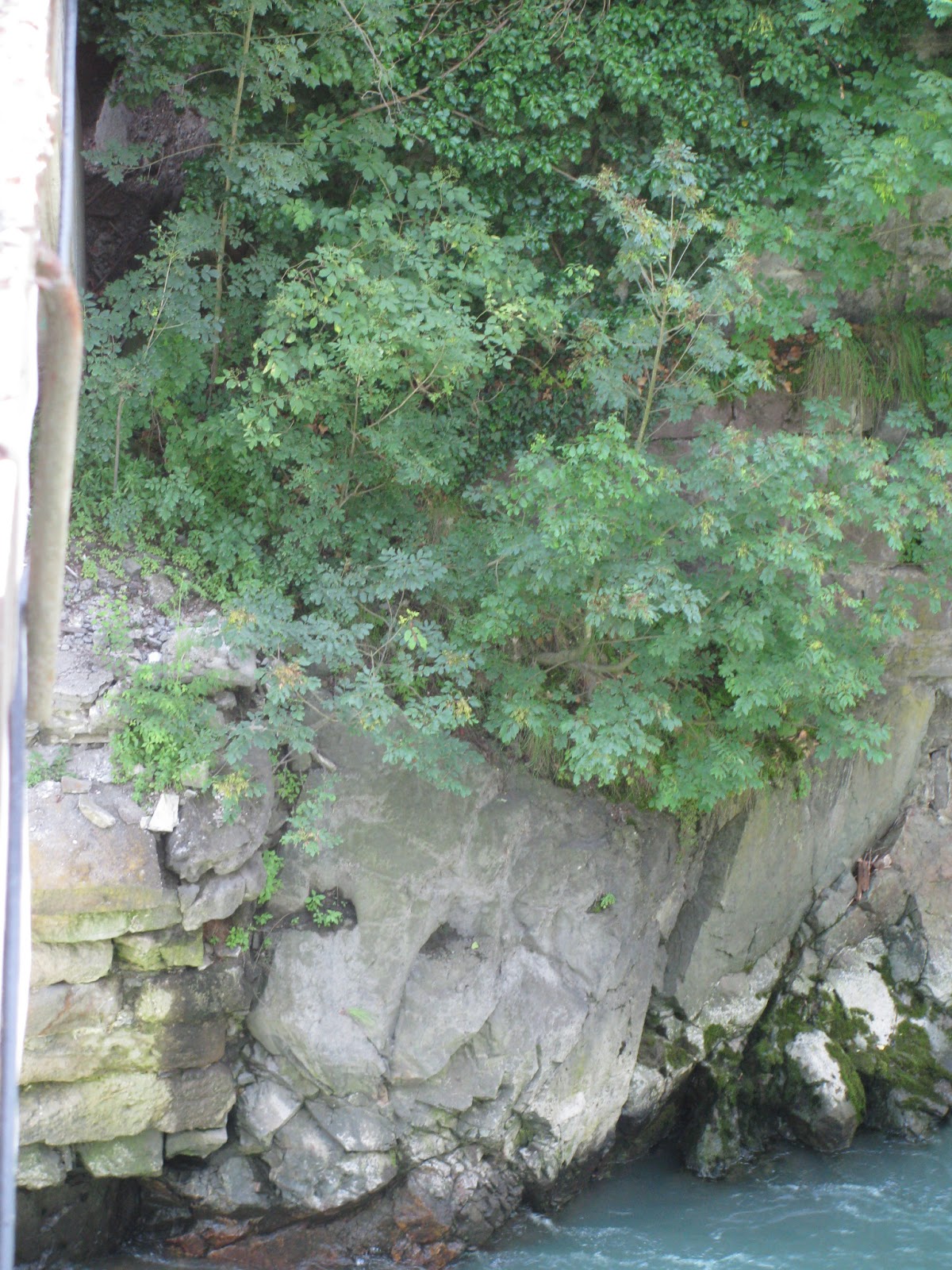
All that remains of the bridge today is a stone abutment, which stands on the left or south bank of the river. This important monument is not signposted in any way, and it is fairly difficult to get a view of. You can lean right out from the parapet of the existing concrete bridge and see at least part of the stonework from above (in the bottom left quarter of this picture, which you can enlarge by clicking):

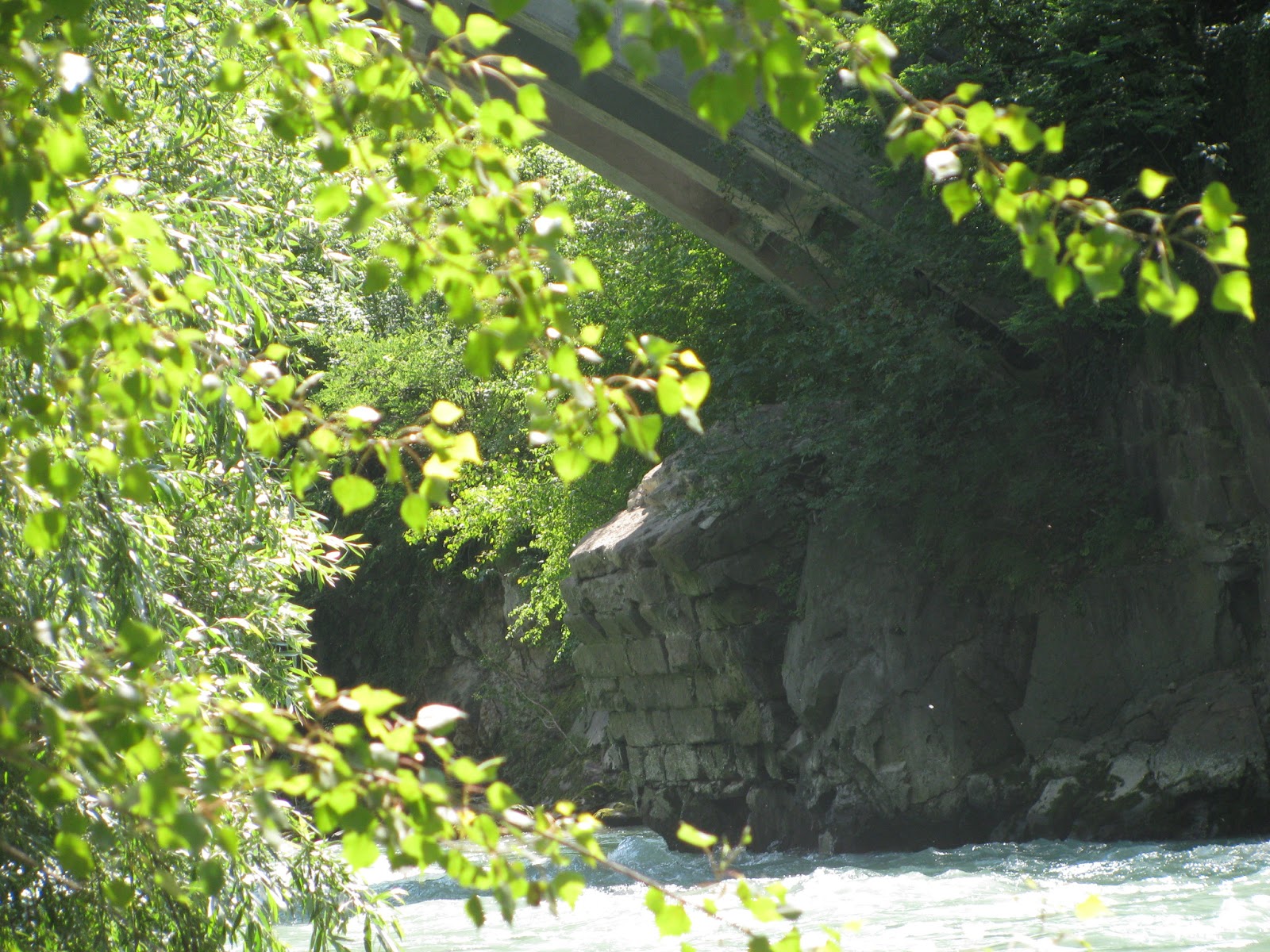
A better view is obtained by driving down an asphalted lane on the right bank, and scrambling over steep loose soil to the water's edge, down-river from the bridge. Here it is possible to stand on a sandbank and peer through fronds of trees, obtaining a view of how the abutment curves up into the beginning of an arch. Eight layers of stone remain. It may be that some of the collapsed bridge is still here in the river-bed.

The next picture shows the structure, with the arch of a 20th-century concrete bridge above it. The remains are in shadow at the centre of the picture. It might have been better to wait all day until the sunlight was not so bright and then take a picture, but my dear wife and son came along for this expedition and we had some other pleasures such as hiking to also accomplish that day, so this picture will have to do:

Probably the most recent professional description of one of Late Antiquity's most neuralgic sites is that by Vittorio Galliazzo, the great scholarly authority on Roman bridges, who examined the structure in 1999. I do not know much Italian, so I have used Bing and Google Translate to essay the following rough translation from pages 64-65 of his 2002 article, Ponti e Forme di Attraversamento di Corsi d’Acqua dell’Alto Adige in Età Romana. Please let me know if you can improve or correct the translation:
Near a site that has already yielded a milestone from the reign of Maxentius (CIL V 8054 = 463 IBR), the left abutment of an ancient bridge on the old road through the Eisack Valley, together with a section of an arch almost up to its waist, was found in 1930 about 5 kilometres east of Bolzano during reconstruction of a bridge that forms part of the Brenner Highway. Further investigation at the end of 1988 by Dr. Lorenzo Dal Ri of the Archaeological Heritage Office of Bolzano Province confirmed that these remains were probably Roman. An architect, Andrea Perin, subsequently suggested his own reconstruction in a sketch based on the scant reliable information available and a good deal of hypothesis.
From the details that follow, one understands what an engineering challenge the structure posed for its designers and builders: it  had to cross high-volume rapids that are susceptible to flash floods. Land access to the cramped site is blocked from north and south. No boats could be used. A huge wooden frame had to be assembled to hold the large number of wedgestones during construction.
No piles could be driven: the footings had to be carved out of solid rock.

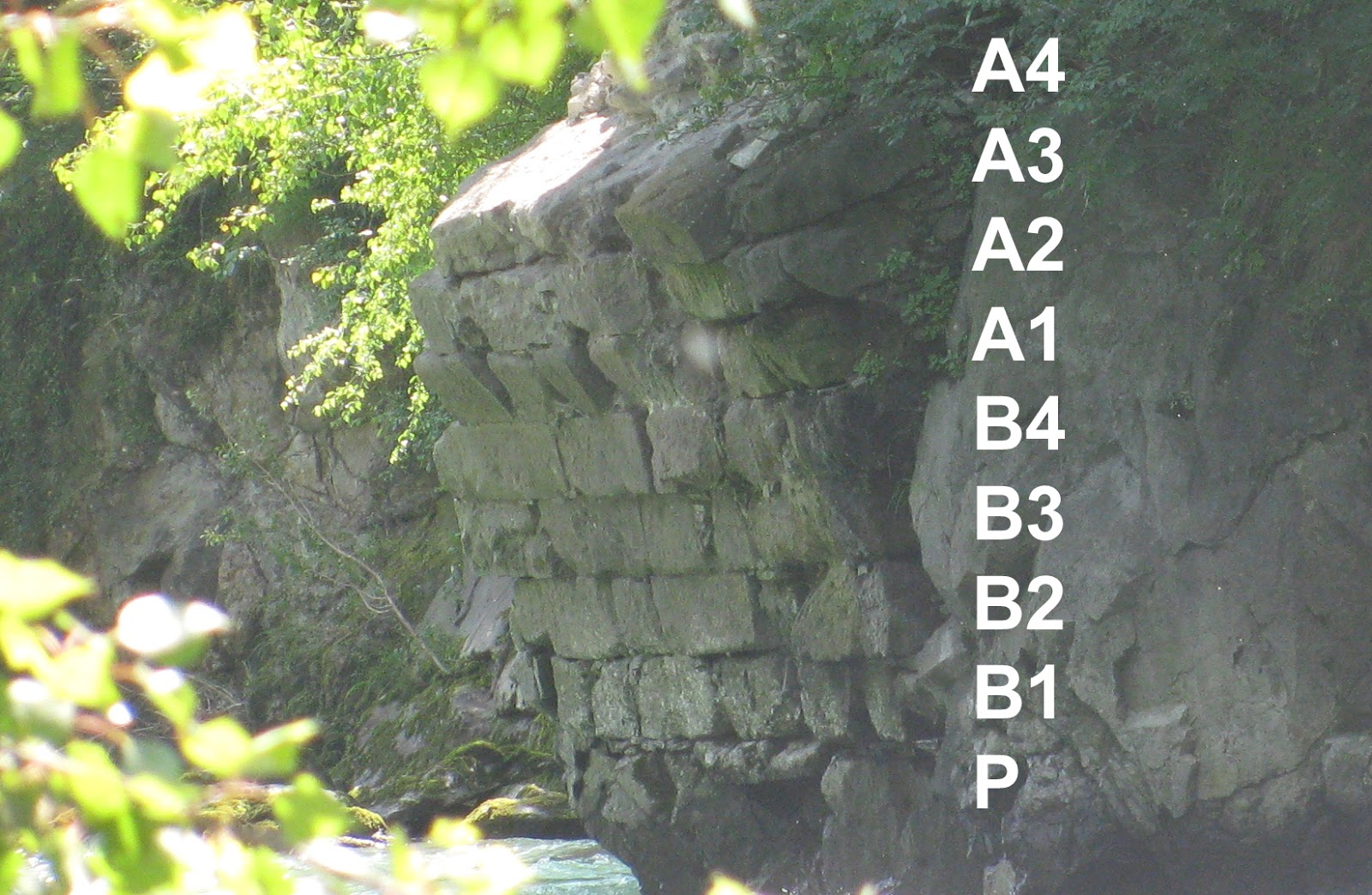
The section that follows is awkward to follow without any picture, so I have inserted letters into Galliazzo's account in square brackets, so that you can see in this detail from my photo which layers he is talking about:

The abutment is approximately 4.50 m wide at its base and consists of four rows of blocks of compact yellowish stone of modest thickness [B1, B2, B3, B4] which protrude on the upstream side, as if to form a protective flank with the aid of the carefully modelled porphyry stone of the riverbank. The abutment is fitted into a cavity specially hollowed out of the dark porphyry rock [P] on the left bank, evened out as need be with sandstone slabs. The sector of arch, which is about 4 metres wide, tops this support structure and likewise consists of yellowish blocks of porphyry. One sees four rows of wedge-stones, three of them [A1, A2, A3] nearly intact and one fragmented [A4].
All the surviving structure of the abutment is in big chiselled blocks, tied with leaded iron clamps. Several stones, especially the upstream ones in the third and fourth row [B3, B4], have rusticated faces with listello or refesso drafted margins. The arch segment appears to have had an intrados in opus vittatum consisting of rather small blocks joined with hard lime.
From what I could see directly during a first inspection in 1994 and a subsequent survey in 1999, the first row from the bottom in the remaining sector of the arch [A1], that is to say counting up from the join, comprised four quadrangular, regularly dimensioned blocks, with a fifth flanking them upstream while a sixth downstream from them was tailored to fit into the “living” rock. This layer was surely used at the time of construction to support a hoop-shaped wooden scaffold and then probably re-used as the footing for the wooden beams of the later medieval bridge, which was no longer a stone arch but probably a wooden truss (i.e. a series of vertical stays supporting a horizontal wooden superstructure). At about 10 and 21 metres respectively from this ancient abutment, you can see the remains of two piers in the bed of the Eisack River on which uprights of the scaffolding for the boxing to construct the 1928-1930 concrete bridge stood before they collapsed.
Galliazo's article includes two black and white photographs evidently taken in winter when there was less vegetation obscuring the view. He also reproduces Perin's sketch although he repudiates its veracity. Galliazzo concludes with the following general assessment of the structure:
It seems that the whole bridge, from abutment to abutment, had a length of about 33-34 metres which could be feasibly crossed not with three arches as has been proposed in the draft reconstruction, but with just two asymmetrical arches. This would result in a bridge similar to that at Merano with arches supported on sturdy abutments built into the rock of the banks and one pier of considerable proportions outside the river current: the greater of the two arches would have been on the left of the river and would have needed to have a length of about 18-20 meters to straddle the channel, while the lesser arch would have had an opening of less than 8 meters and would have probably provided an extra discharge during floods to better withstand the water pressure.
As regards the dating of the structure, the arrangement of the stone blocks and the overall impression given by the remnant of the abutment would suggest engineering of the Imperial if not of the Late Antique period, perhaps replacing an earlier bridge in wood, a material that was very abundant in the region. The collapse of this structure must have occurred by the Middle Ages, since the medieval timber replacement can be dated in all likelihood to the first half of the fourteenth century. It would seem to date from between 1314, when Count Heinrich of Tyrol commissioned the entrepreneur H. Kunter by contract to open an Eisack valley trail, the Kuntersweg, and 1390, when a document includes mention of construction of a bridge at Blumau.
It is notable that Galliazzo rejects the hypothesis that the structure could be the Pons Drusi which is marked on the Peutinger Diagram but in no other documentary source. He and other authors of the Südtirol archaeology volume consider the Pons Drusi to have been a bridge in the heart of Bolzano.

I took only rough notes from his bibliography and have not read these further materials, so I apologize that I must offer these references here with incomplete titles. The 1930 report at page 366 of Archivio per l'Alto Adige that first pointed to the existence of these remains should also be added to this reading list:

Dal Ri, Lorenzo. “?Title unknown.” In La Venetia nell’area padano-danubiana: le vie di comunicazione: Convegno internazionale: Papers, edited by Guido Rosada. Padova: CEDAM, 1990. See 620-621.

Galliazzo, Vittorio. I ponti romani. Vol. 1. 2 vols. Treviso: Canova, 1995. See 149, 249, 399.

———. “Ponti e Forme di Attraversamento di Corsi d’Acqua dell’Alto Adige in Età Romana.” In Archäologie der Römerzeit in Südtirol. Beiträge und Forschungen. Forschungen zur Denkmalpflege in Südtirol, edited by Lorenzo Dal Ri and S. Di Stefano, 57-71. 1, 2002. [The article quoted in this post.]

———. , ed. Via Claudia Augusta: un’arteria alle origini dell’Europa: ipotesi, problemi, prospettive : atti del Convegno internazionale Feltre 24-25 settembre 1999. Comune di Feltre, 2002. See 233, 236.

Olivi, M. “?Title unknown (‘Strada Romana Bolzano-Ponte Gardena’ or similar).” Archeologia Veneta 7 (1984). See 256-257.

Tabarelli, Gian Maria. Strade Romane nel Trentino e nell’Alto Adige. Trento: Temi Ed., 1994. See 122-125.

Regrettably, this very important structure is not yet included (at the time of this posting) in Wikipedia's List of Roman Bridges.

2013-06-23

Pliny Manuscript

Roger Pearse's post also points us to the principal manuscript of Book 35 of Pliny's Natural History where the practice of placing a "stemma" in the entrance area of a patrician Roman home is mentioned at 35.2. The best manuscript of Book 35 is preserved in a very cleanly penned and well preserved codex in Bamberg, Germany.

A digitization can be consulted online. The text on stemmata can be consulted at Perseus, where there is also an English translation. The matching page of the Bamberg codex is 78v, first column.

New Eusebius Tables Coming Out This Year

Roger Pearse mentioned yesterday how "F. Mone" discovered in Austria in 1853 a key palimpsest containing books 11-15 of Pliny the Elder's Natural History. Roger links to a digitization where you can experience for yourself the frustration of trying to read a lower level of writing on an overwritten page.

I think this must be Fridegar Mone (1829-1900), since that is the name on the edition of 1855.  I wondered for a while if it was not the father, Franz Mone (1796-1871). Both men had fascinating, conflict-dogged lives. The elder was a religious controversialist who received manuscript-research commissions. The younger was essentially a manuscript hunter and dealer who was sacked at age 50 and had his "private" manuscript collection (which did not of course include the Pliny palimpsest) seized by the government from his Karlsruhe home in 1886.

Similar discoveries during the 21st century of miraculously surviving manuscripts of lost or semi-lost Latin or Greek works of Antiquity are likely to be the rarest events. The archives of Europe and the Middle East have been scoured so many times by so many generations of scholars that the pickings are now slim.

More likely is the reconnection of unlabelled manuscripts to their Antique authors, such as the discovery a year ago that an anonymous Greek-script manuscript in Munich contains Origen's Homilies on the Psalms, or my own proof that the "medieval" graphic genealogies in Spanish bibles are in fact a 5th-century Latin work.

I mentioned in a previous post that Martin Wallraff's paper revealing his attribution of a section of an Oxford manuscript to Eusebius would soon appear in print. The article will lay bare an Antique work, the Canon Tables of the Psalms, which no one had known about for the past 1,000 years. Professor Wallraff made his remarkable discovery public at the Oxford Patristics Conference in 2011.

Harvard University Press has now announced a publication date for this editio princeps. It will appear as an article in the next issue of the Dumbarton Oaks Papers. This ground-breaking paper will be available from December 16 this year and will be entitled "The Canon Tables of the Psalms: An Unknown Work of Eusebius of Caesarea", the announcement says. Presumably it will be on open access from 2024 under the periodical's web release policy.

2013-06-02

Mistaken Improvements

The power of visual spatial displays often comes from their ability to simplify and abstract from reality, says Mary Hegarty in a 2011 paper.

Since figurative drawings are not so well adapted to the task of reasoning or explaining, the Late Antique inventors of node-link diagrams were careful to omit figurative elements from them.

Their successors since that time have repeatedly attempted to add figures, to regulate the distances between the nodes, to impose a standard orientation (for example, growing upwards like a tree) and to strictly align such diagrams. Those mistaken "improvements" indicate that later generations have not fully understood the genius of the original invention.

Hegarty quotes research suggesting why. We have a misplaced faith in fussily drawn diagrams,
with a strong preference for displays that emphasize high-fidelity spatio-temporal realism, even when these displays result in poor performance...  This may come from a folk fallacy that perception is simple, accurate and complete, whereas perception really is hard, flawed and sparse.

Markus Knauff's book (see my recent post) suggests an additional cause for the fallacy: if reasoning is largely spatial, and is taking place in a part of the mind that is not accessible by introspection, most of us are likely to be quite ignorant about what constitutes an effective explanatory method.

A similar point about why figurative art should be excluded from effective diagrams has been made by Manfredo Massironi in his theoretical account of Hypothetigraphy, the subject of a post on this blog in 2011. Massironi took the view that any diagram explaining abstract matters needs to be limited to what he called "precise marks" only: "Precise, clear lines contribute in conveying the impression that the depicted forms are mental constructs, not representations of natural objects."

Hegarty, Mary. ‘The Cognitive Science of Visuo-spatial Displays: Implications for Design’. Topics in Cognitive Science 3, no. 3 (2011): 446–474. doi:10.1111/j.1756-8765.2010.01113.x.
Massironi, Manfredo. The Psychology of Graphic Images: Seeing, Drawing, Communicating. Routledge, 2002.

2013-05-26

Stemma of Boethius

A new tabulation of online Boethius manuscripts which contain his famous stemma, or arbor porphyriana, has just appeared on my website. (Here.) I have not done serious work on Boethius for more than three years, so I spent a couple of days looking again at the sources.

I find it remarkable that so many of these documents can now be seen remotely via the internet: there are no fewer than eight manuscripts accessible, and three of them duplicate the stemma, so we have a total of eleven early medieval drawings to study.

A task remains for any eager reader. I have not heard that the Greek text of Porphyry, or the translations to Latin, Syriac and Arabic (list by Roger Pearse), contain such a diagram. One is reluctant to trust the critical editions, since text scholars generally leave out diagrams. If anyone would care to comb online versions of these, it would be good to have a clear yes-or-no answer about this.

2013-05-25

Our Secret Reasoning Device

A book published a couple of months ago by the German cognitive scientist Markus Knauff contains some remarkable new evidence and discussion about the seat of human reasoning. Summing up a couple of decades of experiments, he argues that a brain structure which can demonstrably be shown to analyse and reason is the so-called dorsal pathway.

This is the "where" stream which handles our awareness of space, our actions and, as a recent review article by Borst and others argues, our expectations. (All references below.) There has been some criticism in another review article by Schenk and others of the claims that this pathway is entirely distinct from the ventral or "what" pathway, but the dichotomy does seem to be holding up well.

In Space to Reason: A Spatial Theory of Human Thought, Knauff emphasizes that this dorsal pathway is not a self-aware channel, so it is easy to overlook its operations. It shows up in brain imaging, but we cannot examine it by introspection.
... people certainly have no clue about the mechanisms that work on a symbolic spatial array, and they are certainly not aware of a complexity measure that results in certain preferences. (190) [and quoting Goodale & Westwood:] ... the processing of spatial information in the dorsal stream is impenetrable to our conscious awareness. (191)
Knauff does not mention diagrams in his book at all. Most of his experiments involve reasoning about very simple problems such as:
The blue Porsche is parked to the left of the red Ferrari.
The red Ferrari is parked to the left of the green Beetle.
Is the blue Porsche parked to the left or to the right of the green Beetle? (2)

However he proposes that these yield valid data about problems such as:
If the teacher is in love, then he likes pizza.
The teacher is in love.
Does it follow that the teacher likes pizza? (95)
The cars problem is not difficult but it requires effortful thinking, whereas the if problem is instantly understandable. You will probably have guessed at the conclusion before you were conscious of reading the last line, which is said by some authors to be a characteristic of dorsal cognition.

Now there are two competing established accounts of what is going on: one is that we might pretend to see a real teacher whom we know and because we are so smart at understanding from sight, and teasing meaning from sight. we can deduce from visual indications that he is biting a slice of pizza that he must therefore be in love, just as we deduce from a distended belly that a woman is pregnant.

The rival account - propositional reasoning - maintains that we have a kind of machine language inside our brains, a computational logic. It does not use a language like English, but perhaps a language like JavaScript, and it tells us from the if what the only logical conclusion is.

Knauff argues for a third option: if I interpret this correctly, we have a black-box process in which we use the dorsal channel to simulate the problem as if we were perceiving something real. A mental model is constructed where the teacher, his state of romantic excitement and the pizza are encoded as spatial entities. Putting them in the only possible logical order allows us to grasp the conclusion.

The heart of his argument is that evidence shows the ventral stream need not be involved. One of the salient points about the spatial-thinking model is that the mental representation excludes all unnecessary information. The shape or colour of the cars or the exact distance between them does not need to be encoded, nor does the shape of the teacher's face or the flavour of the pizza.

As I have said, Knauff does not mention diagrams, let alone the Great Stemma or the Compendium of Petrus Pictaviensis. But the sense of excitement his book generates in the diagram researcher comes from the fact that the sparse, austere mental models he envisages as the bearers of human reasoning resemble the simpler sort of diagrams that are drawn on paper or on displays.

Reviel Netz suggests in The Archimedes Codex and his various articles that the Greek mathematician did not use diagrams to merely illustrate ideas that he had been thinking through in some propositional fashion. Archimedes was doing mathematics by manipulating spatial representations in his head. Since he was thinking about space, not propositions, the diagrams were the closest external representation to his raw thoughts. As far as I can guess, Netz's ideas are partly rooted in the ideas about external representations generated by externalists in philosophy of mind debates over the past 20 years.

Stemmata and diagrammatic chronicles are not direct reasoning tools in quite the way that geometrical drawings are. Geometry can yield mathematical proofs without numbers or words, whereas chronicles are not there to reason with, but usually serve to re-express histories or genealogies that have already been set down in textual form.

Their purpose is communication. I have always maintained that they are a form of direct author-to-reader communication which eschews the need to convert their content into language. An author massages his ideas into the most lucid spatial arrangement he can come up with, puts them on paper, and the reader's spatial reasoning abilities are sufficient to decode what is meant with a minimum of textual input.

The nearest that Knauff comes to this is when he suggests that there is a kind of diagrammatic substrate to reasoning, and compares this to subway or underground-rail diagrams:

I used the metaphor of a subway map to show that a qualitative representation does not display the shares and sizes of the stations or metrical distances between the stations but only represents the data that preserve spatial relations between stations and lines, for example, that one line connects with another. ... a visual image is completely different from a subway map. It is more like a topographical map ... that captures distances, streets, buildings, landform information, and so on. In contrast, spatial layout models are like schematic subway maps... (192)
His findings and his interpretation have some interesting implications for diagram studies. If the  mental model in our heads is somewhat like a diagram, it ought to be possible to devise diagrams that can inspire such mental models with a minimum of translation.

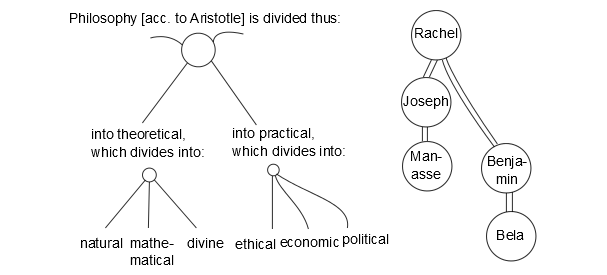
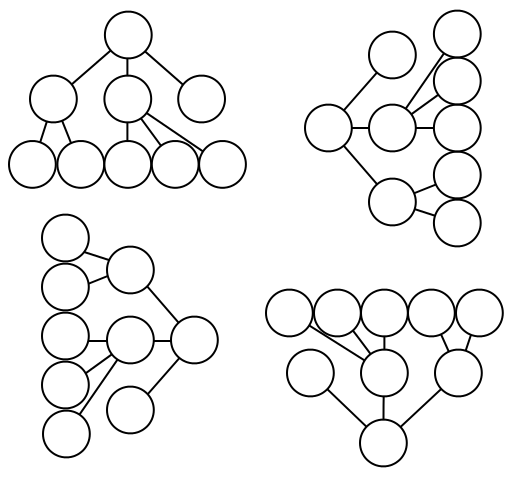
Since the precise distances between the elements, and their sizes, do not encode any information, both of the following work equally well.


The left diagram is a 6th-century classification system drawn by Cassiodorus, while the right one comes from the 5th-century Great Stemma. I have translated the text from Latin to English. Whether the circles are large, small or non-existent, or whether the text is inside them or out, does not matter. Spatial reasoning merely needs apartness.

Overall orientation does not encode information, so all of the following directions of ramification are functionally equivalent.

Spatial reasoning is also likely to be highly tolerant of defective alignment, so that curved or crooked pathways in a diagram do not make them ineffective.

If this is correct, node-link diagrams which use a spatial encoding to express hierarchical relationships are likely to be a powerful means to manipulate a complex type of data while directly engaging with human intelligence. Working pragmatically and without any scientific evidence from cognitive research, the Late Antique inventors of node-link diagrams established an effective means of simplifying information without losing its essential structure.

Borst, Grégoire, William L. Thompson, and Stephen M. Kosslyn. ‘Understanding the Dorsal and Ventral Systems of the Human Cerebral Cortex: Beyond Dichotomies.’ American Psychologist 66, no. 7 (2011): 624–632. doi:10.1037/a0024038.

Goodale, Melvyn A., and David A. Westwood. ‘An Evolving View of Duplex Vision: Separate but Interacting Cortical Pathways for Perception and Action’. Current Opinion in Neurobiology 14, no. 2 (April 2004): 203–211. doi:10.1016/j.conb.2004.03.002.

Knauff, Markus. Space to Reason: A Spatial Theory of Human Thought. MIT Press, 2013.

Netz, Reviel, and William Noel. The Archimedes Codex. Revealing the Secrets of the World’s Greatest Palimpsest. London. Orion, 2007.

Schenk, Thomas, and Robert D. McIntosh. ‘Do We Have Independent Visual Streams for Perception and Action?’ Cognitive Neuroscience 1, no. 1 (26 February 2010): 52–62. doi:10.1080/17588920903388950.