2012-04-14

Lambert's Liber Floridus

In what is now the far corner of north-west France, Lambert, a canon of the city Church of Our Lady in St Omer, completed in 1122 a richly illustrated compendium of mythical biology, history and religious knowledge. The Liber Floridus (book of flowers) belongs to the same genre as the Etymologies of Isidore of Seville, a compilation or florilegium or encyclopaedia of many sorts of information, all intended to bring delight. Isidore’s use of graphics had been primitive, but Lambert was a superb and imaginative graphic designer. One celebrated full-page spread, the Arbor Mala and Arbor Bona, is a compilation of vices and virtues. The Liber Floridus is bursting with clever, colourful graphic ideas. Its images of imaginary plants and strange animals in the bestiary section fascinate.

Lambert could also be conservative in his design choices. In his personal, autograph manuscript of the Liber Floridus, there is a stemma of Lambert’s maternal ancestors which goes back to his great-great-grandfather Odwin. It recalls the family names and birthdates which many British and American families wrote in the front of their family bibles in the 19th century, but Lambert decided to draw it in semi-stemmatic form, not as a simple list. As with the German imperial stemmata compiled in the previous century, Odwin is shown at the top, with the descendants splayed out below. Unlike the Great Stemma, there are no roundels. The individuals are grouped in short vertical lists of siblings. These tabulations of their forenames form family blocks. These tiny tables are connected by smooth or squiggly lines back to their parents and ultimately to Odwin. It is crowded and untidy, but it is striking that the designer of the Arbor Bona and Arbor Mala has presented his family with a simple stemma, not a tree. It has not been inverted and is not even pretending to be a tree.

Lambert of Saint-Omer's personal autograph copy, the original manuscript of the Liber Floridus, is in the University Library at Ghent, Belgium (ms. 92). Saint-Omer is a border town and this unique codex seems to have been taken to Belgium during the French Revolution for safe-keeping. Recently scans of this great treasure were placed on the internet. The digital version is a bit difficult to use, with no option for full-screen viewing that I can discover. One cannot download complete pages because the server sends them in the form of tiny tiles.

The diagram appears on folio 154r (use the navigation to go to the 30th page of results to see a zoomable version). Folio 154r has been moved to the very end of the current binding, but Albert Derolez, who has published the manuscript (Lamberti), suggests it may have originally been at the very beginning as a front flyleaf:
The first page lacks all ruling ... Was it Lambert's intention to leave it blank? In that case the leaf or the quire should originally have been placed at the front of the codex. (Autograph Manuscript, 180)

This would explain why it was not transferred into other copies: it was not seen as part of the body of text. Christiane Klapisch-Zuber briefly discusses the diagram on pages 94-96 of her L'Ombre des Ancêtres, and refers the reader to the editio princeps by Gysseling, whose entire discussion of the stemma in 1947 was limited to a single sentence:
C'est la seule généalogie que nous connaissons pour le moyen âge (exception faite des généalogies de vices, de vertus et de  ...., qui apparaissent plus ..... ). [some words illegible in my photocopy]

Derolez rearranged the diagram into a conventional modern printed descent "tree". Klapisch-Zuber tartly remarks that Derolez's graphic version "wildly displaces the generations and ends up being a lot less intelligible than the design in the original manuscript" (note 27, page 362). This is perhaps unfair to Derolez, but I can now present what I believe is the first ever graphic version which is faithful to the original layout, and which is machine readable to boot.
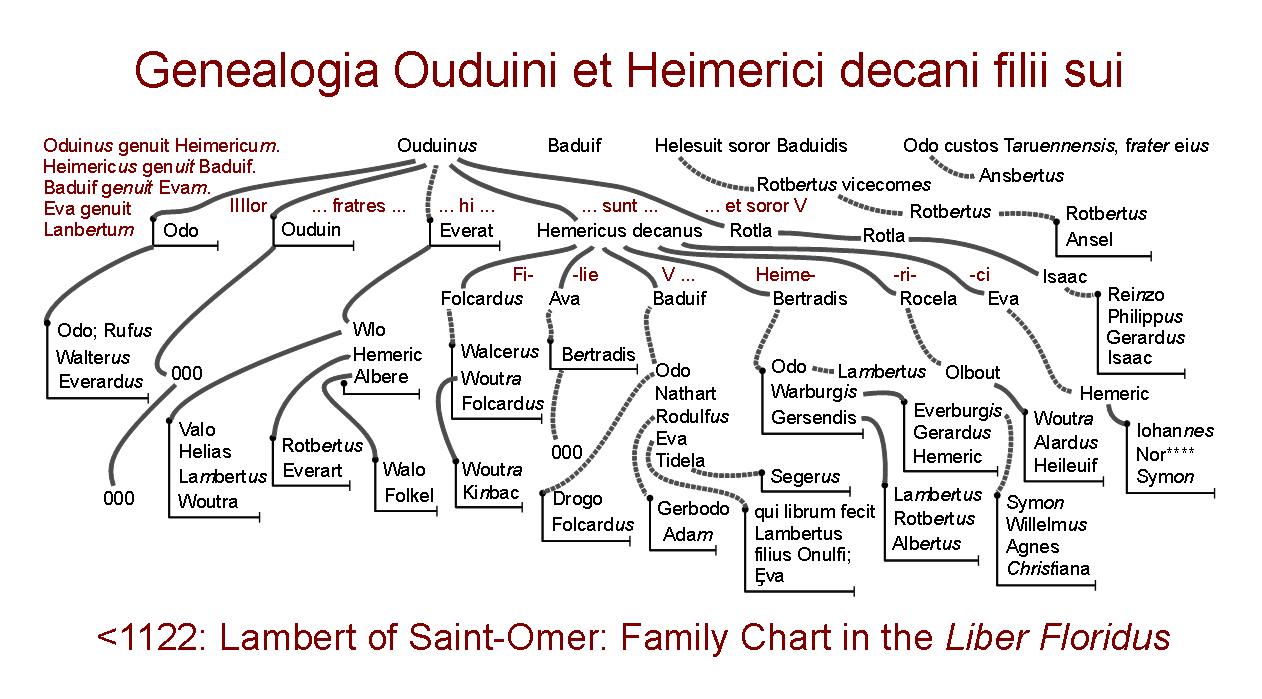
It can be better studied as a Flash page on my main website. I have followed the Derolez transcription, which as far as I know is actually the work of Gysseling. The italic letters are his readings of the scribal contractions. The dotted lines represent Lambert's squiggly lines, which I could not reproduce with OpenOffice Draw.

One oddity is that Lambert states there should be five "Heimerici" siblings but in fact shows six. There are two unidentified descendants at left (000 in my diagram) who are foreshadowed by lines but not given any names. At right is a name beginning Nor**** that was illegible. I am not sure if Drogo and Folcardus in the bottom row really are brothers: Lambert's diagram seems to suggest they are cousins. The awkward layout suggests the group at right might have been an afterthought or have been entered after much later family research, but perhaps the main design influence was a lack of space. Derolez, who seems to have found evidence that earlier script was scraped away, writes: "The lower part of the pedigree was afterwards rearranged in order to create more space for a text."

However the details of Lambert's genealogy are not the topic that interests us here, and I have left the genealogy as Gysseling and Derolez preferred it. It is the concept of the diagram that matters. It is practical, straight out of life, a little clumsy and unclear, but ultimately an intelligent presentation of 80 names in the most compact space.

I see no evidence for Klapisch-Zuber's speculation that Lambert may have been the inventor of this graphic design:
Toutes ces particularités laissent penser que Lambert a réinventé, ou interpreté de facon autonome, un type de schéma généalogique peut-être entrevue ice ou là... on est tenté de voir dans un schéma qu'il couche sur un page de son livre une invention autonome et sauve de toute influence immédiate. (L'Ombre, 96)

The more plausible view is that Lambert imitated other diagrams of "normal" families which he had seen, and that such diagrams were in relatively common use in the 12th century. Unfortunately, Lambert's is one of the few, perhaps the only surviving witness of this genre of document to remain in our archives from so early.
  • Derolez, Albert. Lamberti S. Audomari Canonici Liber Floridus. Ghent: Story-Scientia, 1968.
  • Derolez, Albert. The Autograph Manuscript of the Liber Floridus. Corpvs Christianorvm. Autographa Medii Aevi 4. Turnholt: Brepols, 1998.
  • Gysseling, Maurits. “Les plus anciennes Généalogies de Gens du Peuple dans les Pays-Bas Méridionaux.” Bulletin de la Commission Royale de Toponymie de Dialectologie 21 (1947): 212–215.

2012-04-08

Mommsen's False Trail?

Some time ago I posted about the F recension of the Liber Genealogus and the possibility that it might either have originated in Oviedo, Spain or that the lost library of the Cathedral of Oviedo might have been a bottleneck through which both existing versions of the F recension (one in Florence, one in the Escorial library in Madrid) could have passed.

Theodor Mommsen offered a hint there might be a third codex in Madrid, a 16th-century paper manuscript seen by Knust, which contains the so-called Corpus Pelagianum. In his MGH volume on chronicles, Mommsen quoted the old call number for the item, T.10. Through the kind assistance of Professor Jose Carlos Martín of Salamanca, I learn that this item is now shelved as MSS/7089.

To see the bibliographic record in the National Library of Spain manuscript catalog, do a call number search entering the search term "MSS/7089". The OPAC result refers the reader to the printed catalog (PDF cat) which shows that the codex contains a 112-folio copy of the Corpus Pelagianum. The cataloger considers it to be a copy of MSS/1513 (PDF cat) in the same library, which contains 28 items, none of them, as far as I can see from their descriptions, being the Liber Genealogus.

It seems to me that Mommsen laid a false trail here, mentioning Knust only because Knust had vaguely noted that there were genealogies in this codex. I have not checked this further, but suspect that T.10 does not contain the Liber Genealogus. It seems likely that of half a dozen codices with the Corpus Pelagianum, only the Escorial codex contains this book.

2012-04-05

Age of the World

At dinner tonight, my son brought up millenarian thinking, and we got onto the topic of 801 CE, which was thought (before it arrived) to be the likely date of the parousia, or beginning of the Seventh Age, or Second Coming of Christ. The author of that reckoning was of course Eusebius of Caesarea, who calculated the Incarnation as having occurred 5,199 years after the creation of the world. Eusebius disapproved of millenarians, but millenarians were happy to make use of Eusebius. Mediated through the Jerome of Stridon translation in Latin, that calculation seems to have been reproduced in Spain in the Ordo Annorum Mundi, which in its turn was reproduced in the very millenarian Apocalypse Commentary of Beatus of Liebana.

Something that has been dawning on me only this week is that the Ordo Annorum Mundi may not only have been a kind of cheat-sheet to read the Great Stemma with, but that sections of it have actually been interpolated into the Great Stemma. I had not paid much mind to this before. My Ordo Annorum Mundi page lists all the relevant text fragments. On the face of it, this may be rather dry, but it's rather like tracing Facebook likes. When you see where this reckoning shows up, you have a way of tracking what people like Beatus had been reading.

2012-03-31

Two Medieval Drawings

I have constructed vector diagrams of the two earliest known charts to describe the ancestry of living people and have converted these to Flash format and published them on the www.piggin.net website. Both of these medieval diagrams use the roundels and lines format which is familiar to us from the Great Stemma.
The first (follow the link) is a remarkable drawing with the shelfmark M 29880(6 in the Bavarian State Library in Munich. The original has been digitized, but my drawing is easier to read. The old MGH transcription has been deprived of the authentic graphic characteristics and converted into a standardized 19th-century stemma instead.
From the content and the script of this manuscript, it appears to have been drawn during the period when Cunigunde of Luxembourg was either queen of Germany or Roman empress, that is to say between 1002 and 1024. It displays her descent from Charlemagne, a fact which was evidently used by her as an argument to claim the office of empress.
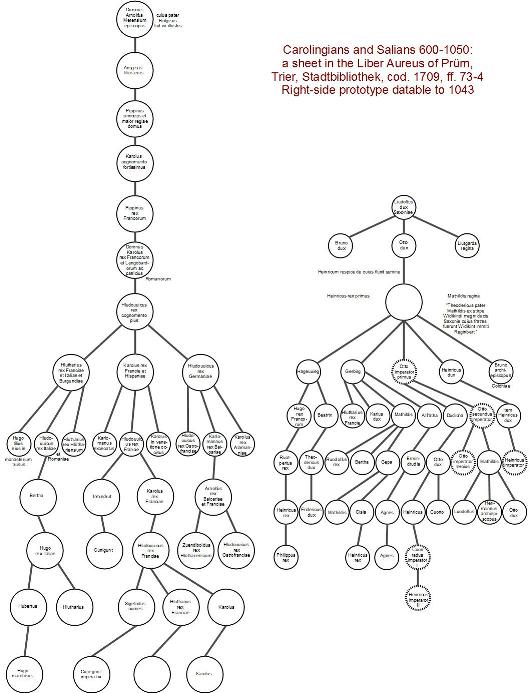
The second (below, but follow the link for my zoomable version) was drawn between 1101 and 1111 at the monastery of Pruem and bound into the Liber Aureus, a book of important Pruem documents. It is now in the city library of Trier, Germany, shelfmark 1709, folios 73-74, but is not online. In its left panel, it contains a variation of the first diagram described above. The diagram in the right panel contains a legal argument about consanguinity and has been dated by Nora Gädeke to 1043. This right section relates to the Ottonian and Salian dynasties who took control of the Western Roman Empire after the Carolingians, who form the left panel of this composite diagram:

2012-02-22

Who Was Carl Frick?

In the early stages of this study, I often used a compilation of Latin chronicles by Carl Frick, a German scholar. The standard bibliographic data as well as Franz Kössler's Personenlexikon indicate he was born in Schwerin in 1848. He published a series of books and articles, beginning with his 1872 doctoral thesis, De ephoris spartanis at the University of Goettingen, and then became interested in chronography.

Two of his articles listed in Grafton and de Jonge's 1993 Scaliger bibliography deal with the 8th-century chronicle in "barbarous" Latin, the Excerpta Latina Barbari.*

This was doubtless part of his preparations to publish volume 1 of Chronica Minora in 1892. Volume 2 never appeared and he seems to vanish from the record at the end of the 19th century. His involvement in publications for the König Wilhelm Gymnasium in Höxter, Germany makes it plain he was a secondary school teacher there, but I have not been able to find any account of his further academic career, or a date of death.

* Joseph Justus Scaliger und die Excerpta Latina Barbari, published in Rheinisches Museum, is online.

Late Add (2013-11-27): His Prussian personnel record with the last entry in 1893 is in the database Personaldaten von Lehrern und Lehrerinnen Preußens. There is a date, 1.4.10 on the front of this, which may indicate a 1910 death, but this is not certain. He is also mentioned in a history of the Höxter school library.

2012-02-21

What Did Pelagius See?

Theodor Mommsen describes a paper manuscript which included the Liber Genealogus. Though he did not personally see it, he knew it was kept in the Escorial Library outside Madrid:
Ovetensis episcopus Pelagius (a. 1101 – 1129) corpori chronicorum suo, de quo in praefatione ad Isidoriana disputabimus, hunc librum inseruit inscriptum teste Ambrosio Morales (apud Florez – Risco Esp. sagr. vol. 38 p. 367): incipit genealogiae totius bibliothecae ex omnibus libris veteris novique testamenti. archetypum periit, extant apographa et in codice Matritensi bibl. nat. T 10 saec . XVII (Knust Archiv 8, 799) et in Escurialensi b I 9 chart. saec. XV teste Ewaldo (neues Archiv 6, 232), scilicet tractatus inscriptus ita: incipiunt genealogiae totius bibliothecae ex omnibus libris veteris novique testamenti descriptum; adnotatur: hic liber genealogiae fuit desumptus ex libro vetustissimo ecclesiae Ovetensis in membranis litteris goticis scripto et dicitur finire in Theodosio: videtur igitur similis fuisse nostri F.
The above is online at the digital MGH. It feels faintly irreverent to add hyperlinks to 19th-century Latin but I have done so, since the relevant page of Ambrosio Morales's account and tabulation in Espana Sagrada is online. Friedrich Heinrich Knust ( -1841) (biography) was a German scholar who visited archives in Spain, as did Ewald whose Reise nach Spanien im Winter von 1878 auf 1879 is also online.

As Mommsen says, the 12th-century original that was kept at Oviedo is gone for ever. Hardly any of the Escorial Library is online, so there is no point searching for images of this unique paper copy, but Antolín's catalogue is helpful.

This 12th-century copy of the Liber Genealogus seems to have been been inserted into Pelagius's Liber chronicorum. Rouse and McNelis think the final comment about "in membranis litteris goticis scripto" is by the 15th-century copyist in León, referring to Visigothic script. Or is it a note by Pelagius talking about a book that was old in his day?

It is not clear what manuscript is described in Knust's abstract ("einige Genealogien aus dem alten und neuen Testamente" in a 17th- or 18th-century codex at the Biblioteca Nacional in Madrid with the former call number T10). I did not find the Liber Genealogus listed in the other manuscripts there containing Pelagius's chronological work. There seem to be at least five manuscripts containing elements of Pelagius's Liber chronicorum at the library, including one that is a roundup with his Libro de los Testamentos de la catedral de Oviedo in Ms. 6957 (catalogue entry, warning, large PDF!). But in each case, the content at practically every folio is described, making it unlikely that the Liber Genealogus is in any gap and somehow overlooked.

The interest of the matter to me is of course: what else was lodged in the now-lost cathedral library at Oviedo in the days when Pelagius was in charge? We know the library contained the now-lost Gospel Book of Justus because Ambrosio de Morales saw it there. But did the library also contain a copy of the Great Stemma?

2012-02-20

Calahorra Bible

A first-ever online image of the Great Stemma in the Calahorra bible has finally shown up: it contains the opening spread only, but the polychrome array of colours is very impressive, despite the battered state of the codex. The image is for sale on Artflakes, but you'll have to click through yourself because I don't want to breach the photographer's copyright. The online sample is not in a good enough resolution to read the script, but I will be linking to it from my catalogue page. The photographer says the image also appears in a book published last December, Historia de Calahorra (Ed. Amigos de la Historia de Calahorra. December 2011. ISBN 978-84-939155-06). The 12th-century Biblia de Calahorra is kept in the Archivo Catedralicio y Diocesano de Calahorra. It's battered and it looks like it has suffered some water damage, but it's still there, a wonderful treasure. The Amigos (Facebook page) deserve all the help they can get to preserve the town's history, and of course every tourist visiting Spain helps in the economic recovery.