2018-02-06
The Animated Tabula
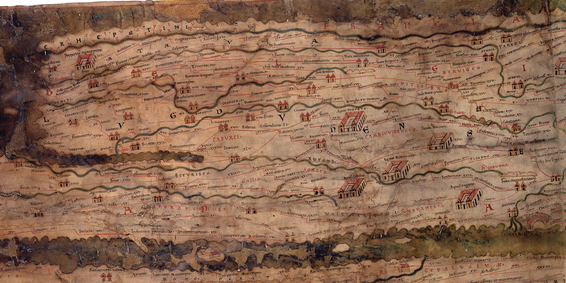
This digital version has been renamed the Tabula Peutingeriana Animated Edition to reflect these enhancements. In most of the left half of the chart you can now see color-coded routes and the emendations to them which have been proposed over the past century. The emendations are made visible by hovering on or touching the pale yellow squares which serve as triggers.
These interpretative additions make the chart a good deal less confusing. Column rules have also been added so that it will be easier to compare this digital edition with Talbert's.
Also new online is a brief article describing the Tabula in the context of diagram studies. This differs from those encyclopaedia entries which put the Tabula's clues to Roman history in the foreground or those which treat it primarily as a source of information about ancient settlements and place names.
2018-02-04
Wellness Database
It did not serve to educate doctors, but rather to inform wealthy patients who desired to second-guess their doctors. It is based on the Taqwīm as‑siḥḥah تقويم الصحة ("Maintenance of Health"), an 11th-century Arab medical treatise by a Christian doctor of Baghdad, Ibn Butlan. See Wikipedia.
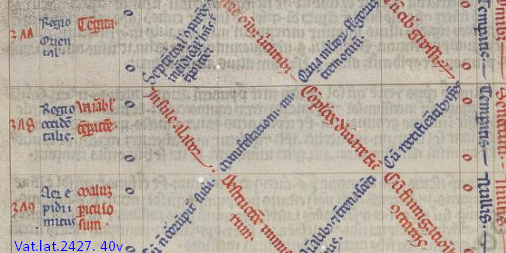
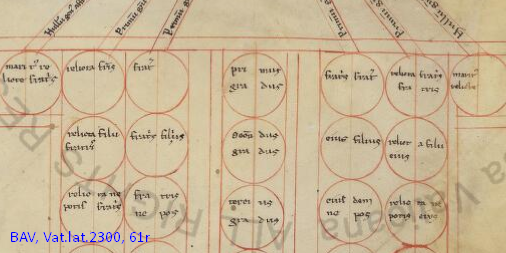
This and its companion codex Vat.lat.2426 (both date from the 14th century) arrange all this tabular material in pretty red-and-blue lattices:
This presentation seems to pre-date the absolute de-luxe versions that started coming out in Italy in about 1380 with lushly painted miniatures of country life, gardens and stately homes, the lifestyle edition so to speak.
In all there are 41 new manuscripts at the Library portal:
- Barb.lat.2653,
- Barb.lat.2814, diary 1582-89
- Reg.lat.77,
- Reg.lat.78,
- Reg.lat.104, Petrus Lombardus, Glossae continuae. eTK makes a mistake in indicating this codex contains Gynaecia, incipit Cum in Alexandria sum certatus cum auctoritatibus, at ff. 94v-99v. Reader @monicaMedHist says this is probably an error in eTK for Reg. lat. 1004, which does indeed have a text on women's medicine (Genecia) attributed to "Actius Justius."
- Reg.lat.1561,
- Reg.lat.1636,
- Urb.lat.122,
- Urb.lat.190, New in the list of @DigitaVaticana by @JBPiggin: works of the Dominican author Albert the Great. The copyist adds his own name in the colophon: "noua ec(c)l(es)ia".https://t.co/Nk3W4LbLGM pic.twitter.com/JX7XYkUqSD— Pieter Beullens (@LatinAristotle) February 5, 2018
- Vat.lat.1136,
- Vat.lat.1313,
- Vat.lat.2079,
- Vat.lat.2216,
- Vat.lat.2318,
- Vat.lat.2319,
- Vat.lat.2384 (Upgraded to HQ), medieval Latin Galen. Note the much earlier ms used for an endpaper
- Vat.lat.2390, Never particularly lovely to begin with, and now rather sad in its present state, this latest among the digitized collections of Galenica in @DigitaVaticana gives us a sense of the value of such a compendium of ancient authority. Here is the opening of @EgoConstantinus's .. 1/n pic.twitter.com/CuSRoI0CP3— Constantinus Africanus (@EgoConstantinus) February 9, 2018
- Vat.lat.2417, Creavit deus ex concavitatibus cordis sinistram; by Avicenna. See eTK
- Vat.lat.2427 (Upgraded to HQ), Tacuinum Sanitatis, popular medieval health guide (above).
- Vat.lat.2433,
- Vat.lat.2438,Another important Moerbeke MS in @JBPiggin's list: one of only three copies of his partial translation of John Philoponus' lost commentary on Aristotle's "De anima" III,4-8. (1/4)https://t.co/P0bOSvUSAf pic.twitter.com/7FpWpFYwEC— Pieter Beullens (@LatinAristotle) February 7, 2018
- Vat.lat.2447,
- Vat.lat.2449, Cum quidem iam pervenimus ad expositionem egritudinum (14c); De egritudinibus. See eTK
- Vat.lat.2495,
- Vat.lat.2548 (Upgraded to HQ), Bernardus Compostelanus, m. 1267 Apparatus in Decretales, 14th-century copy
- Vat.lat.2572,
- Vat.lat.2576,
- Vat.lat.2581,
- Vat.lat.2584,
- Vat.lat.2585,
- Vat.lat.2586,
- Vat.lat.2588,
- Vat.lat.2590,
- Vat.lat.2615,
- Vat.lat.2625 (Upgraded to HQ), Bartolus de Saxoferrato
- Vat.lat.2673,
- Vat.lat.2676,
- Vat.lat.2692, 13th-century law textbook which contains an analysis of the Iuris Canonici. For diagram history this is interesting, as fol. 50r includes a passage explaining the use of an arbor juris in working out degrees of kinship. Mentioned by Schadt in his Darstellungen der Arbores Consanguinatis.
- Vat.lat.2733,
- Vat.lat.5256 (Upgraded to HQ), Odorico da Pordonone, in Italian
- Vat.lat.13358,
2018-02-03
Backbone of Europe
Help is at hand at last with my new chart of northern France, Germany, northern Italy, Austria and Slovenia which picks out what you need to know about the part of the Tabula covering Europe's most prosperous areas today.
What is striking is that the ductus of the Tabula -- and an awareness of the geography on the ground -- points to our designer having chosen a main road leading all the way from Boulogne, France to Rimini, Italy as his centerpiece.
This backbone, colored wine-red in my analytical diagram, passes through Reims, Besançon, Lausanne, the Great St Bernard Pass and Cesena. It's not the same as the medieval Via Francigena which led from Canterbury via Florence to Rome, but both the high roads served the same traffic and had many stretches in common.
Another big takeaway: the Tabula Peutingeriana is not oriented north-south. "Up" is north-west. Use the interactive control "Landmass" to see the coasts which the late antique designer had in mind. Of course the match is not perfect: Boulogne ends up on top of London, Leiden in the North Sea and Milan perched on the bank of the Rhine. But it's remarkable that anything matches in something that initially appears so chaotic.
What we are seeing is a very different take on Europe from that we are familiar with in modern maps. This is Roman Europe, with a fortified border in the north along the valleys of the Rhine and Danube (the dark blue line at top). It's also a Europe where most long-distance travel is obstructed by the Alps. The interactive control "Passes" shows how these seal off northern Italy. You can't go round them (except by ship): you have to over them as the playground song tells us.
To prove I haven't cheated, use the interactive control "Manuscript Sections" to see how the places form columns. The vertical layout precisely matches that in the Tabula, a UNESCO Memory of the World treasure now kept in a vault in Vienna. Tell me if you spot any errors. And if you want to see a similar chart of southern Europe, check out my previous blog post, Two Frances.
2018-01-28
Exultet Roll
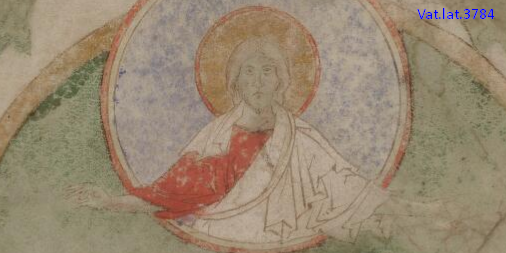
It's not the only one - half a dozen Cassinese rolls have survived - but it is celebrated for the magnificence of its text and its drawings of angels and the rising of Christ.
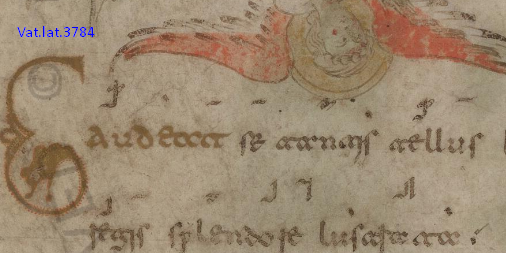
Digitization programs tend to pass over scrolls because they are difficult to scan, so I am pleased the Vatican librarians chose this one and hope they bring out more rolls for the digitizers in the next few months. You will notice that the text is inverted with respect to the pictures. The digitization shows the images right side up. I have inverted one image with "Gaudeat et tantis tellus irradiata fulgoribus..." where you can see an angel standing on his head:
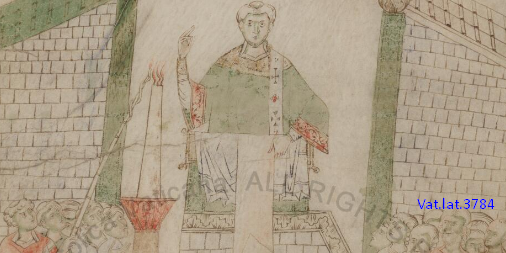
Examine the roll closely, and you'll find the explanation why. As the deacon reads from the roll, he slides its top end over the edge of the lectern to hang down for the congregation to see:
This blog post would not have been complete without heroic help from a reader, Aaron Macks (@gundormr on Twitter), who responded to my cry for help a week ago. I monitor the Vatican Library website with Distill, a simple scraper that is an extension to the Firefox ESR browser. The huge size of the Vat.lat index now defeats it, so @gundormr offered to write a script/program that would do the job.
This custom script not only works like a charm. It also picks up items that have been upgraded from low quality microfilm to high-quality (HQ) color scans. The report is generated as an HTML list. In good weeks, posts on this blog attract 1,000 readers and we all owe a big debt to @gundormr (an expert on books of hours) for keeping this service going.
- Reg.lat.37 (Upgraded to HQ),
- Reg.lat.43,
- Reg.lat.46,
- Reg.lat.47,
- Reg.lat.48,
- Reg.lat.56,
- Reg.lat.63,
- Reg.lat.102,
- Reg.lat.105,
- Reg.lat.108,
- Reg.lat.110,
- Reg.lat.143,
- Reg.lat.161,
- Reg.lat.164,
- Reg.lat.171,
- Reg.lat.176,
- Reg.lat.186,
- Reg.lat.195 (Upgraded to HQ), 9th century
- Reg.lat.666 (Upgraded to HQ),
- Reg.lat.1364 (Upgraded to HQ),
- Reg.lat.1481 (Upgraded to HQ),
- Reg.lat.1496 (Upgraded to HQ),
- Reg.lat.1573 (Upgraded to HQ),
- Reg.lat.1596,
- Reg.lat.1618,
- Reg.lat.1622,
- Reg.lat.1631,
- Reg.lat.1642 (Upgraded to HQ),
- Reg.lat.1653,
- Reg.lat.1666 (Upgraded to HQ),
- Reg.lat.1669 (Upgraded to HQ),
- Reg.lat.1685,
- Reg.lat.1689,
- Reg.lat.1692,
- Reg.lat.1695,
- Reg.lat.1699,
- Urb.lat.87,
- Urb.lat.105,
- Urb.lat.115,
- Urb.lat.146,
- Urb.lat.149,
- Vat.lat.427.pt.2,
- Vat.lat.585,
- Vat.lat.1984.pt.A,
- Vat.lat.2074 (Upgraded to HQ),
- Vat.lat.2104,
- Vat.lat.2150,
- Vat.lat.2183,
- Vat.lat.2370, Intentiones habemus in presenti conscriptione (13c-14c); see eTK
- Vat.lat.2412,
- Vat.lat.2448,
- Vat.lat.2453,
- Vat.lat.2456,
- Vat.lat.2459, Cura omnium egritudinum que accidunt a sumitate capitis; possibly by Pontius de S. Egidius; see eTK
- Vat.lat.2460, Cause difficultatis scientie pulsuum sunt; by Aegidius; see eTK
- Vat.lat.2507,
- Vat.lat.2520,
- Vat.lat.2583,
- Vat.lat.2618,
- Vat.lat.2663,
- Vat.lat.2690,
- Vat.lat.3784, Exultet Roll. See above.
2018-01-24
Cheery Again
Grateful, I decided to seek -- by hand -- the newly issued Vat.lat. items from the still-missing second week of January. It turns out there are 45, plus three codices newly upgraded from murky microfilm to high quality. They are listed below, only lightly commented.
- Vat.lat.168,
- Vat.lat.315,
- Vat.lat.427.pt.1,
- Vat.lat.636.pt.1,
- Vat.lat.636.pt.2,
- Vat.lat.788,
- Vat.lat.1316,
- Vat.lat.1503,
- Vat.lat.2057,
- Vat.lat.2086,
- Vat.lat.2087,
Aristotelian competitors from the 15th c. now back to back in the BAV.
— Pieter Beullens (@LatinAristotle) January 28, 2018
"De Anima" in the Latin versions by Argyropoulos & Trapezuntius. HT @JBPiggin https://t.co/jZQkPS31Kzhttps://t.co/1aogx3dQH3 pic.twitter.com/3S71tJiGe7 - Vat.lat.2091,
Thanks to @JBPiggin's list this MS with Aristotelian texts @DigitaVaticana. Here the end of the Parva naturalia and the beginning of the Physionomia.https://t.co/xACjs5lACP pic.twitter.com/o5Zo0cVIIg
— Pieter Beullens (@LatinAristotle) January 24, 2018 - Vat.lat.2187,
Commentary on Aristotle's "De anima" in @JBPiggin's list of MS @DigitaVaticana. Bought in 1444 in Padua for 4.5 ducats by friar Franciscus de Rovere de Saona, who later became Pope Sixtus IV. Autograph note.https://t.co/aXYRQYu1JI pic.twitter.com/YCiaLcHiCW
— Pieter Beullens (@LatinAristotle) January 25, 2018 - Vat.lat.2219,
- Vat.lat.2227,
- Vat.lat.2309,
- Vat.lat.2312,
- Vat.lat.2320,
- Vat.lat.2323,
- Vat.lat.2367, Hippocrates: Ad discipulum suum Actonem longis petitionibus (14th century copy); see eTK
- Vat.lat.2368,
- Vat.lat.2374, Cornelius Celsus: Ut alimenta sanis corporibus agricultura; see eTK
- Vat.lat.2386,
Thanks to @JBPiggin's list this MS with Aristotelian texts @DigitaVaticana. Here the end of the Parva naturalia and the beginning of the Physionomia.https://t.co/xACjs5lACP pic.twitter.com/o5Zo0cVIIg
— Pieter Beullens (@LatinAristotle) January 24, 2018 - Vat.lat.2397,
- Vat.lat.2401,
- Vat.lat.2419,
- Vat.lat.2420,
- Vat.lat.2423, Acatia est sucus alchati; .te Synonyms
- Vat.lat.2428, Liberet te deus fili amantissime a via errorum (14c-15c); see eTK
- Vat.lat.2432,
- Vat.lat.2446, Avicenna: Medicina est conservatio sanitatis et curatio egritudinis; see eTK
- Vat.lat.2450,
- Vat.lat.2472,
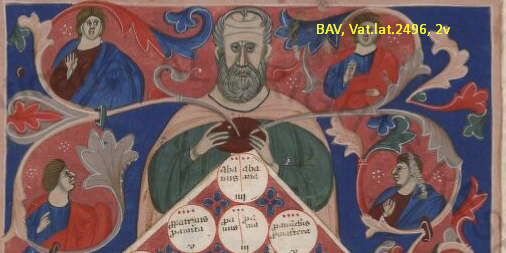
- Vat.lat.2496, the Liber Sextus Decretalium with Iohannis Andreae kinship diagrams. Magnificent!
- Vat.lat.2518,
- Vat.lat.2626,
- Vat.lat.2644,
- Vat.lat.2645,
- Vat.lat.2649,
- Vat.lat.2657,
- Vat.lat.2668,
- Vat.lat.2672,
- Vat.lat.2696,
- Vat.lat.2697,
- Vat.lat.2752,
- Vat.lat.2146, Walter Burley, Nota quod in homine sunt quinque sensus; see eTK
- Vat.lat.2186, Dominicus Gundissalinus, Cum omnes homines eque constent ex anima et corpore; see eTK
- Vat.lat.2426 , Urina alba in colore tenuis in substantia (14th century codex); see eTK
This is Piggin's Unofficial List number 146. If you have corrections or additions, please use the comments box below. Follow me on Twitter (@JBPiggin) for news of more additions to DigiVatLib.
2018-01-21
Grumbling
I have now reached the state where my fairly good computer and my high-speed internet connection can no longer reliably download and compare the Vat.lat. index page with its absurdly long list of 4,026 items, even when I block the images. Loading the index page takes up to a minute.
The solution ought not to be difficult. The series needs to be listed in 1000-manuscript chunks: 1-999, 1000-1999, 2000-2999 and so on. Until our technical friends at the Vatican realize that no one on the internet nowadays serves single pages with 4,026 images and reorganizes the indices in a more rational fashion, I am not going to be able to monitor for updates.
As a result, all that I have this week for you are 10 items from the other Vatican sub-collections:
- Reg.lat.101 contains keys to bible study, including Brito de vocabulis byblie secundum ordinem alphabeti
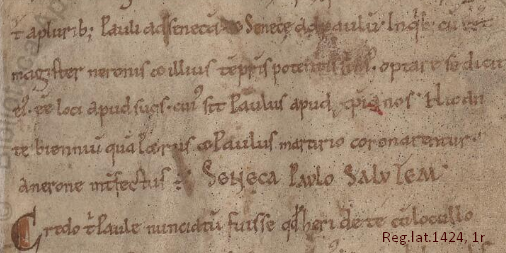
- Reg.lat.1424, an 8th or 9th century compilation of the classics starting with the famous forged exchange of letters between Seneca and St Paul, and including a poetic bit of the De Consolatione Philosophiae of Boethius Check out the tweet by @ParvaVox with more details.
- Reg.lat.1464, Cicero, De Officiis and other works
- Reg.lat.1643, Solinus, De mirabilibus mundi
- Reg.lat.1660, poetry, Italian
- Reg.lat.1662, begins with Caecus in limine, a whodunnit from Pseudo-Quintilian
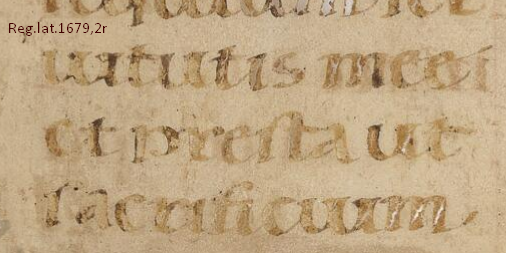
- Reg.lat.1679, Vergil, Eclogae, with a flyleaf reused from an old uncial missal, here the words "et presta ut sacrificium"
- Reg.lat.1680, Plautus, Comedies
- Sbath.34, an Arabic manuscript from the collection of the famed Father Paul Sbath
- Urb.lat.1101, letters, first date 1631, in Italian
2018-01-14
Felice Squares
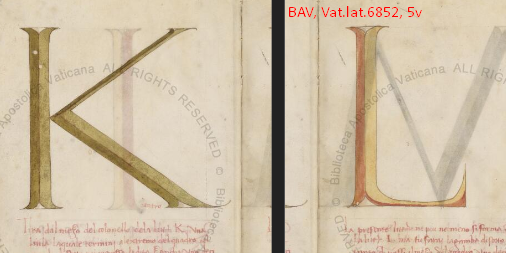
Vat.lat.6852 is the original copy of Alphabetum Romanum, his treatise on the geometrical construction of Roman capital letters using the square and circle. It was digitized and issued online a few days ago. It is part of the Renaissance movement that created Antiqua, the new lettering based on Roman models.
Of course we do not now like to see a square K as wide as it is high, but it is part of the slow process of experimentation that brought microtypography to where it is today. Enjoy.
Here is my full list of new releases. eTK refers you to the Thorndike and Kibre index. I must remain brief, as my left hand is still in a cast after surgery, and typing is difficult.
- S.Maria.in.Via.Lata.I.45, the Evangeliary of S. Maria in Via Lata, battered, mouldy and a thousand years old. The canon tables pages are classic in style. New uploads from @DigitaVaticana HT @JBPiggin and among them a true jewel: the 9thC evangeliary of Santa Maria in Via Lata is one of the very few manuscripts we can locate in early #medieval Rome and it's even more exceptional because we know it was used by a female community pic.twitter.com/Hc4s5lmhN5— GiorgiaV (@ParvaVox) January 15, 2018
- S.Maria.in.Via.Lata.I.45.pt.A, jewelled cover and bookmarks of above, some items seemingly even older
- Vat.lat.168
- Vat.lat.207 homilies of Origen in Latin translation; NB: error in Trismegistos: not TM 67902 = Lowe, CLA Suppl. 1769 = Rome, "Vatican, Biblioteca del Vaticano Lat. 207" which is in fact Pal.lat.207 (Lorsch; 750-825).
- Vat.lat.339
- Vat.lat.434.pt.1
- Vat.lat.434.pt.2
- Vat.lat.435.pt.1
- Vat.lat.454.pt.2
- Vat.lat.527.pt.1
- Vat.lat.527.pt.2
- Vat.lat.618
- Vat.lat.765
- Vat.lat.771 A less spectacular presentation of Aquinas' commentary on Aristotle's "De Anima". HT @JBPiggin as often.https://t.co/bYUv7uWUzb pic.twitter.com/KiCom7osLL— Pieter Beullens (@LatinAristotle) January 14, 2018
- Vat.lat.788 All out Thomas Aquinas in @JBPiggin latest release of MSS from @DigitaVaticana. Thread of various MSS containing the "Summa contra Gentiles"https://t.co/6LidAO73rj pic.twitter.com/CO0JzOP1ku— Pieter Beullens (@LatinAristotle) January 14, 2018
- Vat.lat.790
- Vat.lat.791
- Vat.lat.851
- Vat.lat.1008.pt.1
- Vat.lat.1008.pt.2
- Vat.lat.1101
- Vat.lat.1162.pt.1
- Vat.lat.1162.pt.2
- Vat.lat.1162.pt.3
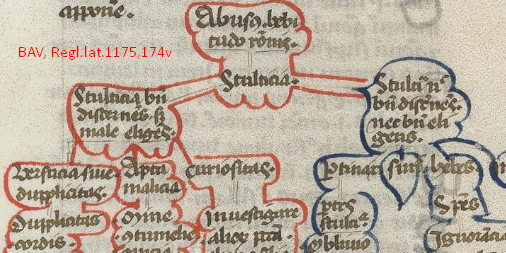
- Vat.lat.1175.pt.1, a great 12th-century work that uses stemmata to organize the teaching material: Radulfus Ardens, Speculum universale
- Vat.lat.1232
- Vat.lat.1250.pt.2
- Vat.lat.1304
- Vat.lat.1306
- Vat.lat.1314
- Vat.lat.1315
- Vat.lat.1568
- Vat.lat.1626
- Vat.lat.1898
- Vat.lat.1951.pt.1
- Vat.lat.1953
- Vat.lat.1961
- Vat.lat.1973
- Vat.lat.1985
- Vat.lat.1988
- Vat.lat.2009
- Vat.lat.2051
- Vat.lat.2053
- Vat.lat.2061
- Vat.lat.2076
- Vat.lat.2081
- Vat.lat.2116
- Vat.lat.2144
- Vat.lat.2156 Another popular medieval commentary on the same treatise "De Anima" was written in the early 14th c. by John of Jandun.https://t.co/ghr5MKzTGb pic.twitter.com/IfyDSK65X8— Pieter Beullens (@LatinAristotle) January 14, 2018
- Vat.lat.2157 HT to @LatinAristotle: second copy of the above commentary by John of Jandun
- Vat.lat.2161 eTK
- Vat.lat.2164 Also online @DigitaVaticana & in @JBPiggin's latest list. Anonymous commentary (ignore the caption in the top margin) on Aristotle's zoological books.https://t.co/MEOIhTFkHJ pic.twitter.com/68jj2ROh3n— Pieter Beullens (@LatinAristotle) January 14, 2018
- Vat.lat.2174 To conclude an afternoon on the playground of @JBPiggin's list of @DigitaVaticana MSS: Peter of Abano's commentary on the Aristotelian "Problemata".https://t.co/QejpexSgD2 pic.twitter.com/Qlf7A0Q7WM— Pieter Beullens (@LatinAristotle) January 14, 2018
- Vat.lat.2197
- Vat.lat.2200
- Vat.lat.2220
- Vat.lat.2223
- Vat.lat.2270
- Vat.lat.2301
- Vat.lat.2310
- Vat.lat.2327
- Vat.lat.2329
- Vat.lat.2371 eTK
- Vat.lat.2372 eTK
- Vat.lat.2373 eTK
- Vat.lat.2387
- Vat.lat.2391
- Vat.lat.2404
- Vat.lat.2457, Constantine the African: Pantegni Ah, this is a sight to behold: the earliest copy of @EgoConstantinus's #Pantegni in the @DigitaVaticana collection. (H/t @JBPiggin for notice: https://t.co/FZYNkMG8HM.) The #Pantegni is translation of 'Ali ibn al-'Abbas al-Majusi's 2-part encyclopedia of medicine. Here's incipit. pic.twitter.com/0EWewsYsls— Monica H Green (@monicaMedHist) January 14, 2018
- Vat.lat.5309
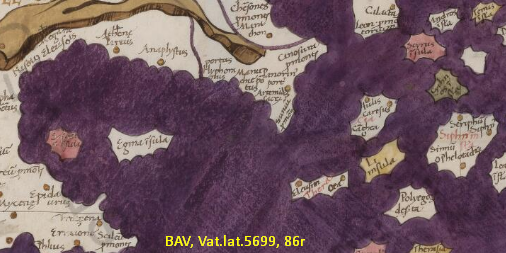
- Vat.lat.5699, a de luxe version of Ptolemy's Cosmography, dated 1469, translated from Greek to Latin by Iacobo Angelo. In the maps section, here is the Gulf of Athens. Note how each of the islands is a different colour, like confetti:
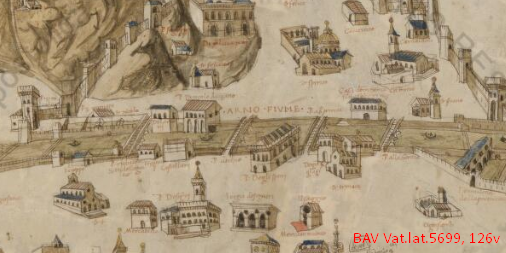
There are wonderful idealized town views, like this of Florence: pick out the Ponte Vecchio and try to find the Duomo: in fact it is marked in historicizing fashion as Santa Reparata:
Anthony Grafton noted for the Rome Reborn exhibition how the view on the next page showed Rome with the Castel Sant'Angelo, the Borgo and Saint Peter's at
bottom right, separated from the city by the Tiber: "Within the city
proper, the ancient monuments rise, without modern buildings and urban
sprawl. The Pantheon, the Forum, the Capitoline and Palatine hills, and
the Colosseum dominate the central space."
Fascinating! I was moved to see Ognisancti abbey, the church favored by the Vespucci family. Amerigo was 15 when this map was drawn, and probably still attended mass there from time to time. Thanks! pic.twitter.com/pYgtjGWgTq
— Historia y Mapas (@LRoblesMacias) January 25, 2018 - Vat.lat.5845, the late antique Collectio Dionysiana and Collection of Cresconius in an important 10th-century South Italian composite manuscript in a Beneventan hand
Another fascinating early #medieval #manuscript online thanks to @DigitaVaticana HT @JBPiggin: a canon law collection (Dionysiana&more) copied by Montecassino monks in exile (Capua 915-934) also integrating vestiges of a debate between the pope & #Carolingian missi (pic no. 4) pic.twitter.com/MVgLgCeLta
— GiorgiaV (@ParvaVox) January 16, 2018 - Vat.lat.6852, the original copy of the Alphabetum Romanum (above).
- Vat.lat.13152.pt.2
- Vat.lat.14936https://t.co/nvxFdwgGFC.14936 - Book of hours from 1561. Use of Rome and most likely Parisian calendar, it announces that it was made for Catherine de Medici on f.1v— AaronM (@gundormr) January 16, 2018
- Vat.lat.14937
- Vat.lat.15294.pt.2
2018-01-06
All the Palatine
This is a pretty big deal, because it means the former Latin section of the University of Heidelberg Library as of 1622 has been recreated as an online avatar at Bibliotheca Palatina. The prestigious library was hauled off to Rome as war booty and only the German and Greek books later returned.
The 2,030-book collection will also constitute the first complete large collection or sublibrary at the 80,000-codex Vatican Library to be available online. (Though not at the Vatican itself, where only half of the items are so far available in the Pal.lat. online collection.)
The collection is being digitized at the University in Germany with funding from the benefactor Manfred Lautenschläger. Presumably for contractual reasons the Vatican itself can only show the digital images online after a certain delay. Here are the last 11 items I have logged:
- Pal. lat. 1819 [Juristische Sammelhandschrift]
- Pal. lat. 2006 Schreibkalender, Tagebuch Pfalzgraf Johann Kasimirs; Abschussliste 1582 (1582)
- Pal. lat. 2020 Schreibkalender, Desiderata der Palatina
- Pal. lat. 2021 Indices zu Handschriften und Drucken der Palatina
- Pal. lat. 2022 Gebetbuch in deutscher Sprache, genealogische Notizen (16. Jh.)
- Pal. lat. 2023 Schreibkalender, Tagebuch Kf. Friedrichs III. von der Pfalz/Pfalzgraf Johann Casimirs (1569)
- Pal. lat. 2024 Schreibkalender, Tagebuch Kf. Ludwigs VI. von der Pfalz (1581)
- Pal. lat. 2027 Schreibkalender, Tagebuch Kf. Ludwigs VI. von der Pfalz (1579)
- Pal. lat. 2028 Mappe mit Einbandfragmenten (14./ 15. Jh.) (14./ 15. Jh.)
- Pal. lat. 2029 Inventarium manuscriptorum Latinorum Bibliothecae Palatinae (17. Jh.)
- Pal. lat. 2030 Codicum manuscriptorum Latinorum Vaticanae Palatinae Bibliothecae Index (Vatikanstadt, 1678)
- Reg.lat.1521: La Bugia, Rime del Marchese M. Palombara
- Reg.lat.1646: classics, signed by scribe William in 1270 on the last page
- Reg.lat.1648
- Reg.lat.1657, Cicero, Ad Familiares
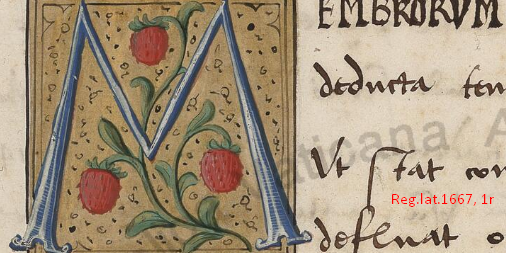
- Reg.lat.1667, Quintus Serenus Sammonicus (died 212): De medicina praecepta saluberrima, a didactic medical poem, with this lovely opening initial:
- Reg.lat.1690, genealogy in German
- Reg.lat.1694, Evrard de Bethune's Latin grammar, Graecismus
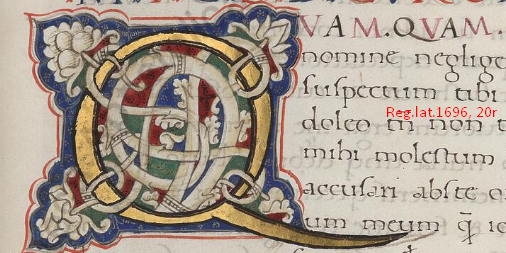
- Reg.lat.1696, Cicero, fine Renaissance initials like this:
- Urb.lat.371, Sebastiani Maccii Durantini ... Soteridos
- Urb.lat.1061, letters and reports of 1593
- Urb.lat.1108, letters and reports of 1639-40
2017-12-27
Quick Click
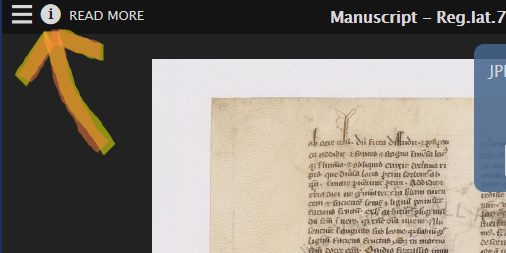
If you are looking at a codex page and need to quote it, click on the "i" in a white circle in the left navigation pane:
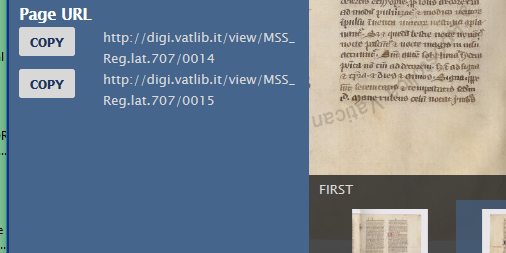
Scroll down to and down to "Page URL":
From here you only need to click the "COPY" button to get a usable link in your clipboard.
And now, the list of 26 new additions:
- Borg.copt.109.cass.XXV.fasc.123, page of a gospel?
- Borg.copt.109.cass.XXV.fasc.124,
- Borg.copt.109.cass.XXV.fasc.125,
- Borg.copt.109.cass.XXVI.fasc.126,
- Borg.copt.109.cass.XXVI.fasc.127,
- Borg.copt.109.cass.XXVI.fasc.128,
- Borg.copt.109.cass.XXVI.fasc.129,
- Reg.lat.203,
https://t.co/mSJy2B0TQo.203 is a Brevarium (Cistercian?), starting with the service for dedication of a churchhttps://t.co/mSJy2B0TQo.1647 seems to be Macrobius’ Saturnalia
— AaronM (@gundormr) December 28, 2017 - Reg.lat.1120, Justinian Code, glossed, 13th century
- Reg.lat.1271, commentary on Avicenna's canon (HT to @monicaMedHist)
- Reg.lat.1291, Renaissance commentary on Aristotelean mechanics
- Reg.lat.1410, 10th-century classics manuscript with Virgil, Horace, Juvenal
new manuscripts uploaded @DigitaVaticana among which this fascinating 10thC copy of classical poetry (Horace, Virgil, Persius & Juvenal) conceived and designed to accommodate a substantial corpus of interlinear and marginal annotations. HT @JBPiggin https://t.co/DE0if6bWV5 pic.twitter.com/JnYipjozDV
— GiorgiaV (@ParvaVox) December 28, 2017 - Reg.lat.1454, Seneca, Letters to Lucillium
- Reg.lat.1489, Lancelot du Lac, French
- Reg.lat.1559, early Renaissance compilation of Latin classics
- Reg.lat.1608,
- Reg.lat.1645.pt.1,
- Reg.lat.1645.pt.2,
- Reg.lat.1647,
- Reg.lat.1655, early Priscian, Institutiones grammaticae
- Reg.lat.1656,
- Reg.lat.1661,
- Reg.lat.1663,
- Reg.lat.1668,
- Reg.lat.1675, Horace, 11th-century?
- Urb.lat.1402, Fiore delle medicine, 15th-century Italian medical treatise (HT to @monicaMedHist)
2017-12-20
Two Frances
It's strangely formless. Definitely not a hexagon. The Atlantic coast at left seems to have gone mostly missing. The outline looks vaguely like a sperm whale. What's that strange mouth or slit in the left-hand edge? Scholars have always been astonished at the crudeness of this late-antique "map". So I wasn't expecting to find any graphic intricacy here.
But there is something clever going on, and the first clue is that slit, which is marked Sinus Aquitanicus, the Bay of Aquitaine or as would today say, of Biscay. All seas and gulfs in the Tabula Peutingeriana (TP) are compressed into river shapes, so it is in itself unremarkable that the Bay of Biscay is not being shown here as the wide bight we are familiar with from modern maps.
The area below the slit was evidently marked Aquitania in the original TP, though some letters are now missing.
What is peculiar is the way the slit separates places which we would conventionally expect to abut one another on the plains of western France. At the deepest point of the slit is the inland city of Lemuno (Poitiers), on its top flank are Dartoritum (Vannes) and Portu Namnetum (Nantes) and on its bottom flank are Audonnaco (Aulnay) and Mediolano Sancorum (Saintes), all inland.
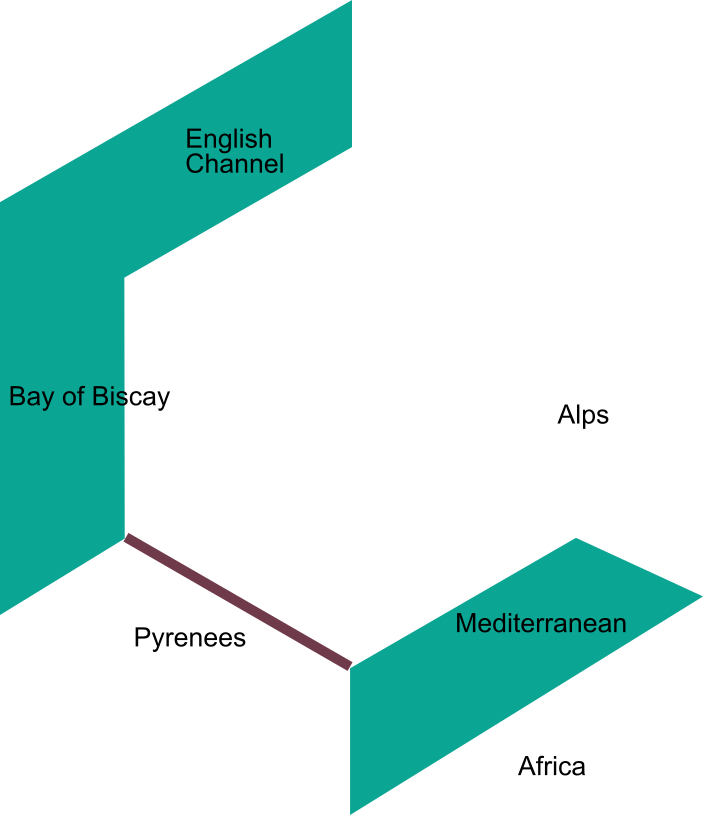
To grasp how this odd watery border has arisen, the best tool of thought is the hexagon, a meme which normally denotes the political frontiers of modern France, but which I will apply to the natural limits, mountainous and marine, of Roman-era Aquitania and transmontane Gaul as far as the left bank of the Rhine:
My method for analysing pre-medieval charts is based on the observation that there are graphic continuities and discontinuities in every large diagram. These become obscured during cumulative copying by scribes. The TP's principal continuities are its long-distance routes, probably based on recorded itineraries. As a matter of prudence, I now denote these as "courses", since it cannot be proven that the TP itself was ever intended to guide travel.
In the present state of the TP - preserved as it is in a single manuscript from late in the long 12th century - some of these courses have become obscured by crowding, but can be recovered by careful examination. Where a long horizontal series of chicanes - the vernacular of the diagram - matches a direct-line, real-world journeying route, we are likely to have found such a course.
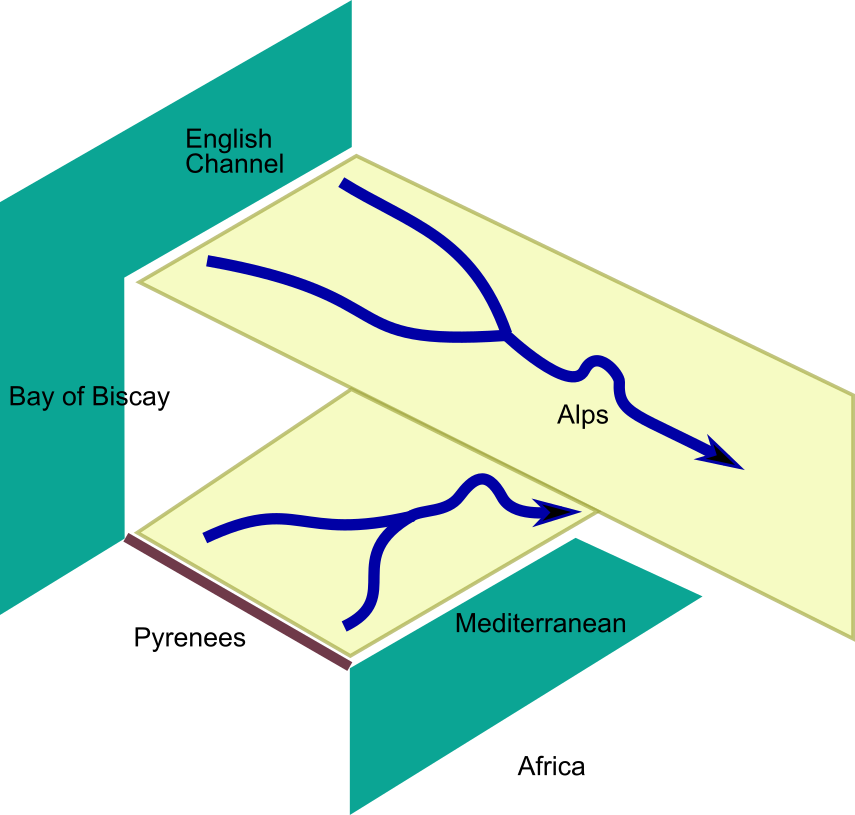
As far as I know, scholars have previously failed to notice that in Aquitania, correspond to roads running from southwest to northeast into the Alps, whereas in Gaul and the rest of the West, the TP privileges a set of courses that align with roads running northwest-southeast. Below, I have added a couple of pale yellow parallelograms to the hexagon to show these contrary orientations:
These continuities lead us in turn to discern a discontinuity. There is a break between these two sets of courses. Part of that break is formed by the Sinus Aquitanicus slit, and the rest of the break spreads to the right: a zone of transition where the courses of the two types are tangled or contorted or there are unaccountable blanks. I will develop these observations in detail further on.
The most plausible explanation for such a discontinuity would be that the TP was constructed from two separate data-sets, or perhaps even from two pre-existing charts. I have recently analysed the southernmost of these two datasets, the region abutting the Pyrenees and the Mediterranean, and established that it emphasizes seven main routes which vary in length, are more or less parallel and are connected to one another by shorter minor routes. The following transport-system diagram is the result of this analysis:
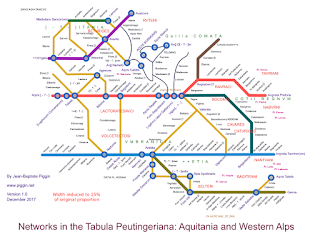
You can see here two main horizontal courses (red and blue) flanked by the dark green, purple, chocolate, chartreuse and olive green courses (five in all) that are semi-parallel to them. The 15 yellow courses are transverse connections. It is surprising that a journey which modern travellers would regard as a trunk route, the Rhone valley highway from Arles to Valence to Vienne, is treated here as a minor link. The six thin curved lines represent connections near Lyon that do not fit this context. That is because they belong to the transition zone.
I have not yet completed a similar analysis for northern Gaul, but can say already that that part of the TP emphasizes a set of courses running from Normandy and the English Channel across to the main Alpine crossings..
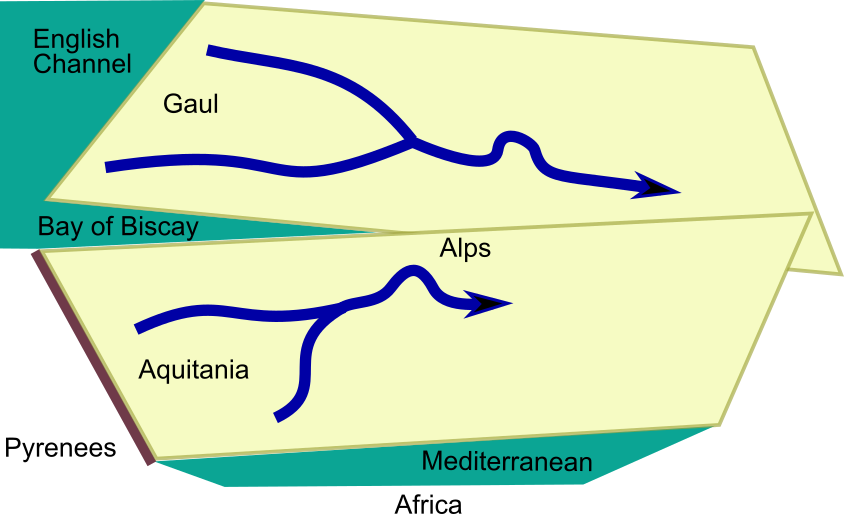
Armed with this knowledge, we can estimate with greater confidence how the TP was put together. To merge the two datasets, the sub-maps had to be rotated so that all the courses were depicted more or less in parallel. The Bay of Biscay was changed from a full side of the hexagon to a mere slit between the two sections, and the Mediterranean Sea was squeezed down to a kind of river:
Let's finish with a look at the zone of transition, depicted in my abstract above by thin black curving lines. The labels are more legible in my plot than in the manuscript, so let's use that for the discussion.
The road southwards from Cabillione (Chalon) to Lugduno (Lyon) is depicted as a vertical ladder, a rather exceptional graphic form for this chart. Augustodunum (Autun) which is at a more northerly latitude than Chalon is nevertheless shown directly below it. The principal paved Roman crossing of the Morvan uplands is that from Autun to Autessioduro (Auxerre), whereas the connections from Autun to Degetia (Decize) - just peeping above from the left margin - are of less importance.
Here there appear to be no fewer than three courses: via Aquae Nisincii (Saint-Honoré-les-Bains?); via Boxum (Bussière?); and via Aquae Bormonis (Bourbon-Lancy). (For an up-to-date discussion of these identifications and their past as sacred Celtic sites, see Nouvel (2012) and Hofeneder (2011).)
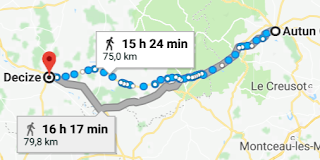
If we consult this 75-kilometre-wide space on an online map, it's noticeable that these three courses relate to a tiny geographical area, with a radius of a single day's walk. Yet the area is being given unusually detailed treatment in the TP. Its paths are circuitous, poorly aligned with the major east-west courses to the north and south and too local for long-distance travel. The chart's graphic arrangement of the small towns and spas does not even represent their real-world spatial organization very well.
I have suggested in the case of Italy that such passages in the TP are most likely to be write-ins on the chart where general consistency was no longer achievable and insufficient blank space was available to make the additions coherent. It is for this reason that I exclude them for the time being from the main analysis and treat them as if they were glosses.
My working hypothesis is that not all lines on the TP are alike: some are primary courses, offering chains of straight-line distances that stretch across regions, others are secondary or local courses, showing cross-connections between the primary courses, and others again are infillings or graphic annotations added after the chart was completed.
The zone between Decize, Chalon and Lyon may have been left blank in the earliest version of the TP, extending inland the watery blank formed by the TP's Sinus Aquitanicus
2017-12-18
Divorce Manual
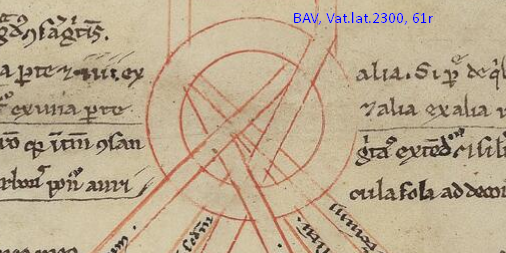
Vincentius Hispanus of Bologna University is apparently the professor who contributed a compound diagram of incestuous marriages at 61r, introducing it as: "Hec conpositio arboris sanguitatis ..."
Of course it does not look like a wood-and-leaves tree. The top part looks like an arrow, the bottom part (glimpse it above) like a plinth, and the mid part (below) designed to somehow connect everything into one big confusing infographic, resembles too many stir-spoons spoiling a pot of broth:
As I have pointed out in the past: arbor should be taken simply as a medieval term for a recursive diagram.
Here is my list of digitizations noticed in the past seven days.
- Borg.arm.10
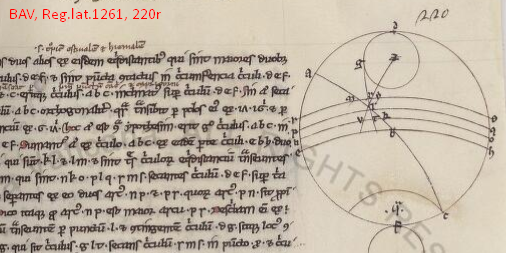
- Reg.lat.1261, 14th-century science and maths with Jordanus de Nemore, De Ponderis, and other authors. eTK lists De cometis, incipit: Occasione comete que nuper apparuit
- Reg.lat.1351
- Reg.lat.1482
- Reg.lat.1544
- Reg.lat.1567
- Reg.lat.1601
- Reg.lat.1607
- Reg.lat.1626
- Reg.lat.1627
- Reg.lat.1683
- Reg.lat.1697
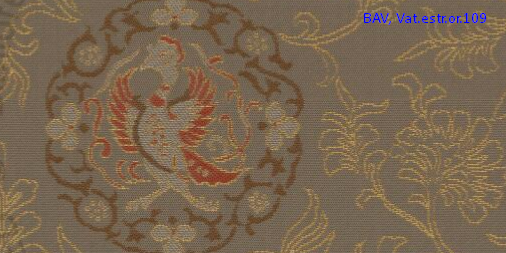
- Vat.estr.or.109, in Japanese. Look at this spectacular binding cloth:
- Vat.lat.640.pt.1
- Vat.lat.640.pt.2
- Vat.lat.780
- Vat.lat.1250.pt.1
- Vat.lat.1262
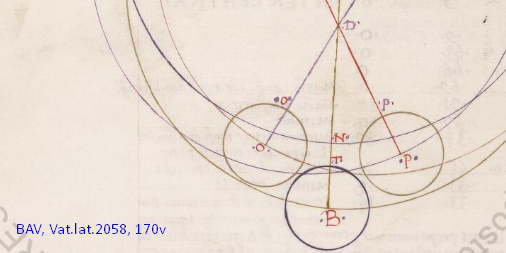
- Vat.lat.2058, Commentary on the Almagest by George Trebizond. Anthony Grafton notes in his Rome Reborn catalog: Trebizond wrote a commentary as long as [his own Latin translation of the Almagest]. The commentary was severely criticized, which resulted in a falling out with Pope Nicholas V. This opulent manuscript was dedicated to Pope Sixtus IV along with Vat.lat.2055 of the translation. [Below is] a large figure of the model for the planet Mercury, shown at its least distance from the earth, with a list of Mercury's parameters and distances:
How to be a devoted son? Andreas Trapezuntius writes a dedication to pope Sixtus IV for his father's translation of Ptolemy's Almagest. MS @DigitaVaticana https://t.co/PCdHx0j6us pic.twitter.com/Cbsbz4woF2
— Pieter Beullens (@LatinAristotle) May 10, 2018 - Vat.lat.2229
- Vat.lat.2300 (above)
- Vat.lat.7228
2017-12-10
Marshal GT
One of the Vatican Library manuscripts which I spotted this week newly digitized in color is Vat.lat.933 containing works by Gervase of Tilbury (c. 1150s–c. 1222) and marked up by the great man himself with corrections. On the opening page he is described as Gervasius Tilberiensis (the obscure West Tilbury in Essex).
So it does appear he went by that name in his lifetime, even when he held titles like Marshal of the Kingdom of Arles or Provost of Ebstorf. Gervase is famed for writing the Otia Imperialia ("Recreation for an Emperor") for his patron, Holy Roman Emperor Otto IV. It describes many wonders of the distant world such as headless men (also known as akephaloi or blemmyes).
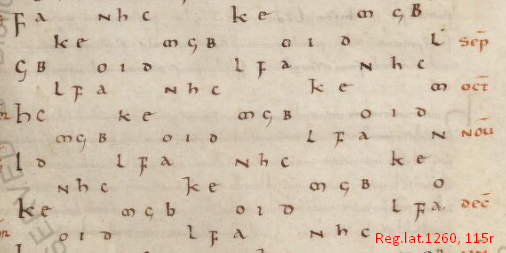
Also new in color is Reg.lat.1260, a binding of two manuscripts believed to be associated with the monastery of Fleury-sur-Loire in France (HT to @monicaMedHist for pointing this out and imaging Beccaria's description). A 10th-century manuscript includes scientific texts such as a glossary of Greek disease names (Incipit: Antrax id est rubor in superficie cutis (see eTK)). And here is its handy tabulation of phases of the moon:
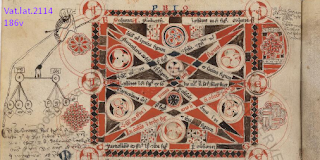
Additionally now available in color is a 14th-century scientific manuscript with works of Boethius, Vat.lat.2114 with Categoriae 12v-32r; De Interpretatione 42r-53r; translation of Aristotle, Prior Analytics 162r-218v; of Aristotle, De Sophisticis Elenchis 53r-81v; of Aristotle, Topica 81v-162r. It also contains a commentary on Euclid, a great many marginal glosses, and diagrams:
Here is the list of completely new digitizations I have detected in the past week:
- Ott.lat.3384
- Reg.lat.1321
- Reg.lat.1542
- Reg.lat.1562 A fascinating early #medieval copy of Persius's Satires among the latest digitisations @DigitaVaticana HT @JBPiggin : a late 10th/early 11thC #manuscript feat. Persius with scholia, glosses, a short life of the author and explanation of the literary genre https://t.co/Rh0FDEm4gV pic.twitter.com/1wLu7kfCXx— GiorgiaV (@ParvaVox) December 11, 2017
- Reg.lat.1564
- Reg.lat.1565
- Reg.lat.1566
- Reg.lat.1578
- Reg.lat.1590
- Reg.lat.1635
- Ross.40
- Vat.lat.1967
- Vat.lat.2114
- Vat.lat.2120
- Vat.lat.2195, a 14th-century manuscript of the Latin novel Metamorphoses by the 2nd-century Numidian writer Apuleius.
- Vat.lat.2221
- Vat.lat.2265
- Vat.lat.2281
- Vat.lat.3360
2017-12-02
Riddle me ree
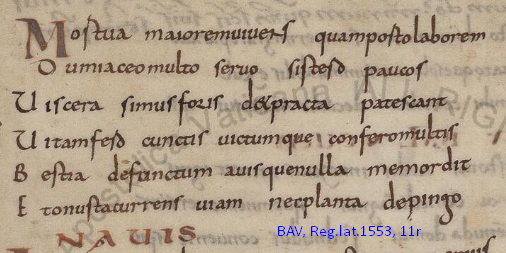
Here's a sample:
Glorie edits this to:
Mortua maiorem uiuens quam porto laborem.The translation quoted by Paul Sorrell:
Dum iaceo, multos seruo; sistetero, paucos.
Viscera si [mihi] foris detracta patescant,
Vitam fero cunctis uictumque confero multis.
Bestia defunctam auisque nulla me mordit,
Et onusta currens uiam nec planta depingo
Dead, I bear a greater labor than when living. When I lie dead, I preserve many; if I remain standing, few. If my insides are exposed, pulled away outside, I bring life to all and collect sustenance for many. No beast or bird bites me when I am dead, and running along loaded down, I do not mark the way with my foot.The answer is: an oak made into a ship. This collection's only connection to Berne, Switzerland is that that is the current location of a slightly older manuscript. The compilation was apparently made in northern Italy, based on far older riddle books, perhaps the work of an insular (Irish) monk at Bobbio. This early-9th-century codex also contains music. For a discussion, see Chauncey E Finch (below).
Here are the manuscripts that have just arrived online for the very first time.
- Legat.Pal.lat.930, an ornate binding (without the book) of 1548
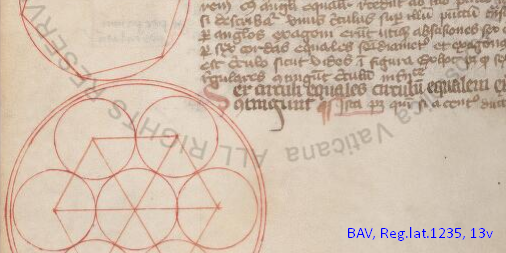
- Reg.lat.1235, geometry and arithmetic
- Reg.lat.1270
- Reg.lat.1280
- Reg.lat.1284
- Reg.lat.1303
- Reg.lat.1328, Vitruvius, On Architecture, HT to @gundormr
- Reg.lat.1404
- Reg.lat.1568
- Reg.lat.1574
- Reg.lat.1587
- Reg.lat.1625
- Reg.lat.1674, Servius' commentary on the Aeneid, book 6, HT to @gundormr
- Vat.lat.1824
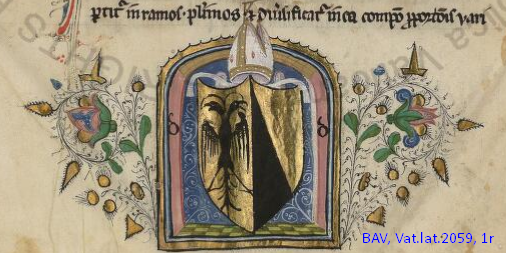
- Vat.lat.2059, with the episcopal coat of arms of Domenico Dominici
- Vat.lat.2189
- Vat.lat.2196
- Vat.lat.2209
- Vat.lat.2226
- Vat.lat.3964, a list of library borrowings from the 1470s From the Vatican Library register in 1480's: Carolus Valgulius, translator of Plutarch, Arrian and Isocrates, wrote in his own hand that he borrowed three volumes of Aristotelian commentaries... and he later even returned them! HT @JBPiggin https://t.co/lmWjRIUff1 pic.twitter.com/zB7oimHB6n— Pieter Beullens (@LatinAristotle) December 3, 2017
- Pal. lat. 1960 Doctrines des Pères, französisch nach den Vitae patrum
- Pal. lat. 1961 Legrand, Jacques (?): Jacques le Grant, Livre des bonnes meours (15. Jh.)
- Pal. lat. 1968 Martin : Le champion des dames (2. Hälfte 15. Jh.)

- Pal. lat. 1973 Seuse, Heinrich: Horloge de sapience (15. Jh.)
- Pal. lat. 1974 Historiographische Notizen, Briefabschriften (1505-1520)
- Pal. lat. 1984 Französische Gedichte des 16. Jhs. (16. Jh.)
- Pal. lat. 1985 Allegorische Darstellungen, Nachzeichnungen (?) zu Tapisserien (?) (16. Jh.)
- Pal. lat. 1987 Johannes a Breda (?): Lateinische Psalmenkommentare
- Pal. lat. 1991 Seuse, Heinrich: Vertu de la messe ; Horloge de sapience (15. Jh.)
- Pal. lat. 1992 Jehan Dupin: Livre de Mandevie (15. Jh.)
- Pal. lat. 1996 Schreibkalender, Tagebuch Pfalzgraf Johann Casimirs (1567)
- Pal. lat. 1997 Schreibkalender, Tagebuch Pfalzgraf Johann Casimirs (1570)
- Pal. lat. 1998 Schreibkalender, Eintragungen Friedrichs III. (1571)
- Pal. lat. 1999 Schreibkalender, Tagebuch Pfalzgraf Johann Casimirs (1571)
- Pal. lat. 2001 Schreibkalender, Tagebuch Pfalzgraf Johann Casimirs (1577)
- Pal. lat. 2003 Schreibkalender, keine Eintragungen (1579)
- Pal. lat. 2007 Schreibkalender, Tagebuch Pfalzgraf Johann Casimirs (1583)
- Pal. lat. 2008 Schreibkalender, Tagebuch Pfalzgraf Johann Casimirs (1584)
- Pal. lat. 2009 Schreibkalender, Tagebuch Pfalzgraf Johann Casimirs (1585)
- Pal. lat. 2010 Schreibkalender, Tagebuch Pfalzgraf Johann Casimirs (1586)
- Pal. lat. 2011 Schreibkalender, Tagebuch Pfalzgraf Johann Casimirs (1587)
- Pal. lat. 2012 Schreibkalender, Tagebuch Pfalzgraf Johann Casimirs (1588)
- Pal. lat. 2013 Schreibkalender mit handschriftlichen Notizen (Friedrich IV.?) (1606)
- Pal. lat. 2014 Schreibkalender, Tagebuch Kf. Ludwigs VI. von der Pfalz (1572)
This is Piggin's Unofficial List number 139. If you have corrections or additions, please use the comments box below. Follow me on Twitter (@JBPiggin) for news of more additions to DigiVatLib.
Finch, Chauncey E. "The Bern Riddles in Codex Vat. Reg. Lat. 1553." Transactions and Proceedings of the American Philological Association 92 (1961): 145-55. doi:10.2307/283806.