2018-09-16

By the Book

Long ago, the whole Vatican Library could be catalogued in one notebook.  Nowadays, with 82,000-plus manuscripts alone and huge numbers of printed books, it needs a database.

Among items digitized in the past week is Vat.lat.3955, an inventory of the library in 1518 by Zanobi Acciaiuoli.Though the books were sorted in those days by subject, there was no fancy numbering system. Here you can see how the inventory starts: "First bookcase on the left, in order ...."
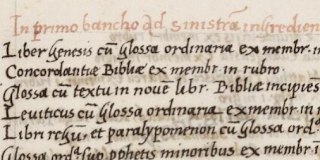

The Rome Reborn catalog reminds us that all the books were chained to the banchi, or benches. Most of the users were supposedly virtuous Catholic clergy, but that was no guarantee of propriety.

Here is the full list of 23 items:
  1. Ross.10,
  2. Vat.gr.2064 (Upgraded to HQ), from Greek-speaking Calabria
  3. Vat.lat.3055,
  4. Vat.lat.3096, Latin translation of Ptolemy of Alexandria and other scientific authors. See the full contents listed on Jordanus. This also contains a work attributed to the mathematician Thābit ibn Qurra translated into Latin by Jordanus de Nemore
  5. Vat.lat.3106,
  6. Vat.lat.3131,
  7. Vat.lat.3174 (Upgraded to HQ),
  8. Vat.lat.3529, Decretum (Gratianum?)
  9. Vat.lat.3659,
  10. Vat.lat.3675,
  11. Vat.lat.3688,
  12. Vat.lat.3703,
  13. Vat.lat.3711,
  14. Vat.lat.3718,
  15. Vat.lat.3744,
  16. Vat.lat.3788 (Upgraded to HQ),
  17. Vat.lat.3813,
  18. Vat.lat.3832 (Upgraded to HQ), penitential canon law collection
  19. Vat.lat.3863,
  20. Vat.lat.3877,
  21. Vat.lat.3941,
  22. Vat.lat.3955 (Upgraded to HQ), Inventory of the Library (above)
  23. Vat.lat.3992,
This is Piggin's Unofficial List number 177. Thanks to @gundormr for harvesting. If you have corrections or additions, please use the comments box below. Follow me on Twitter (@JBPiggin) for news of more additions to DigiVatLib.

2018-09-08

Vatican Petrus Roll

The Vatican possesses at least two scrolls containing one of the most famous medieval timelines of biblical history, that drawn up in about 1180 by a Paris university professor, Peter of Poitiers, (Latin name Petrus Pictaviensis Cancellarius).

In the past week, the first of these, Vat.lat.3782 of the late 13th century, was digitized and arrived online in the past week. The other, Vat.lat.3783, cannot be far behind.

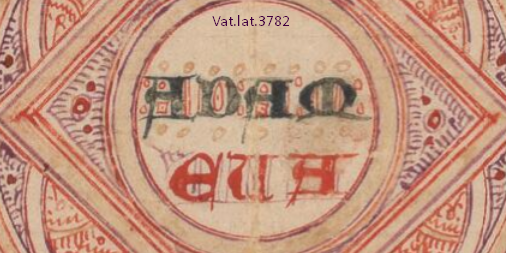
Peter's chart for the schoolroom, now commonly known as the Compendium, was drawn as a roll four or more metres in length so it could be scrolled between an upper and a lower roller like a movie reel. Fancy penmanship (see Adam - Eva above) was part of the good example it offered. It was also available sectioned up into ten or so book pages, which must be why Alberic of Trois-Fontaines sixty years later spoke of it in the plural, calling it arbores historiarum, diagrams of history.

Most books about the history of trees and timelines (for example Rosenberg and Grafton's Cartographies of Time) introduce the Compendium, although it had a little-known predecessor nearly 800 years earlier, the Great Stemma, which did much the same on a left-to-right scroll. Peter may not have known a late antique forerunner existed, as his work seems entirely original and not modelled on the Great Stemma.

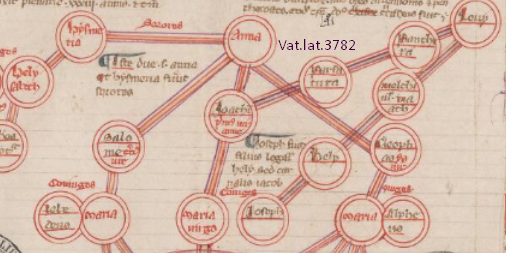
Peter placed Adam at the top end of the roll and Jesus at the bottom, connecting them by the ancestry given in Genesis and the Gospel of Matthew. He omitted the entire line given in the Gospel of Luke, while introducing additional parallel lines including high priests, Assyrian oppressers, Seleucid emperors and other figures important to Palestine, endeavouring to gather in the secular political context surrounding the biblical story. Everybody is named in roundels like this:

As might be expected with a classroom classic, the Compendium can be found all over Europe in public and private collections. There's a comprehensive overview of these, Peter's Stemma, on my website, and I have posted on the topic in the past on this blog. The Vatican possesses copies in sectional form (as alluded to above by Alberic) as well, three of which are already online:
The full list of 45 digitizations in the past week follows.

  1. Ross.1,
  2. Ross.25,
  3. Vat.gr.505,
  4. Vat.lat.2119,
  5. Vat.lat.2336,
  6. Vat.lat.2340,
  7. Vat.lat.2436,
  8. Vat.lat.2670,
  9. Vat.lat.2686,
  10. Vat.lat.2705,
  11. Vat.lat.3087 (Upgraded to HQ),
  12. Vat.lat.3479,
  13. Vat.lat.3553,
  14. Vat.lat.3581,
  15. Vat.lat.3645,
  16. Vat.lat.3712,
  17. Vat.lat.3743,
  18. Vat.lat.3750 (Upgraded to HQ),
  19. Vat.lat.3751,
  20. Vat.lat.3752,
  21. Vat.lat.3762 (Upgraded to HQ),
  22. Vat.lat.3765,
  23. Vat.lat.3782, Compendium of Petrus Pictaviensis (above)
  24. Vat.lat.3796,
  25. Vat.lat.3804,
  26. Vat.lat.3809,
  27. Vat.lat.3815,
  28. Vat.lat.3820 (Upgraded to HQ),
  29. Vat.lat.3825 (Upgraded to HQ),
  30. Vat.lat.3826,
  31. Vat.lat.3830,
  32. Vat.lat.3843,
  33. Vat.lat.3845,
  34. Vat.lat.3851,
  35. Vat.lat.3862 (Upgraded to HQ),
  36. Vat.lat.3881.pt.1,
  37. Vat.lat.3881.pt.2,
  38. Vat.lat.3885,
  39. Vat.lat.3894,
  40. Vat.lat.3907,
  41. Vat.lat.3910,
  42. Vat.lat.3921,
  43. Vat.lat.3947 (Upgraded to HQ),
  44. Vat.lat.3949 (Upgraded to HQ),
  45. Vat.lat.3989,
This is Piggin's Unofficial List number 176. Thanks to @gundormr for harvesting. If you have corrections or additions, please use the comments box below. Follow me on Twitter (@JBPiggin) for news of more additions to DigiVatLib.

2018-09-01

Deed of Lombardy

In 777 a Frankish king named Charles had just subdued most of the Lombards of Italy and was expanding his power base.

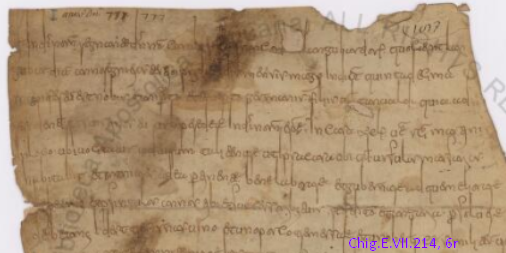
A land deed in Italy that year acknowledged the new ruler as Carulo regem Francorum et Langobardorum and was dated May 15 in anno regni euis tertio of his Lombard overlordship. This thrilling scrap of parchment, inscribed in a strange hand with exaggerated uprights, carries us back to the early days of Charlemagne before he became Holy Roman Emperor.

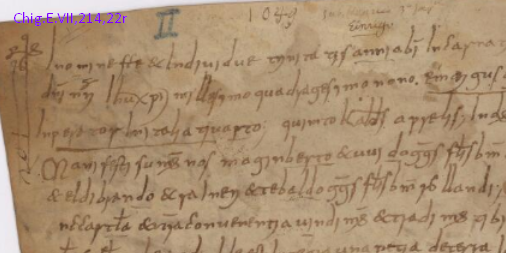
The record of the land deal by the brothers Tuniperto and Teutperto (see details by GeorgiaV below) has just been digitized at the Vatican Library. It is kept in an album, Chig.E.VII.214 which contains a miscellany of old deeds. Another dates back to 1049. Not quite a thousand years old:

The full list of 32 items follows.
  1. Chig.E.VII.214, old deeds including 777 document (above), listed TM 382978 = ChLA 22 723
  2. Ross.18,
  3. Ross.22,
  4. Ross.32,
  5. Ross.35,
  6. Vat.lat.568,
  7. Vat.lat.2287, 15th century, listed by Brendan McManus as: Bartolus, Lectura in primam partem Digesti Noui [39.1-44.7] (1ra-149ra); Bartolus, Lectura in secundam partem Digesti Noui [45.1-50.17] (151ra-383vb)
  8. Vat.lat.2308,
  9. Vat.lat.2313,
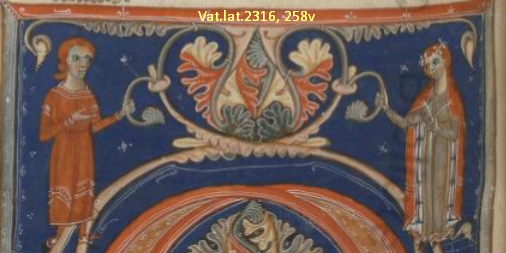
  10. Vat.lat.2316, the Summa Hostiensis, a legal compendium, with this late arbor affinitatis, empty of any script:
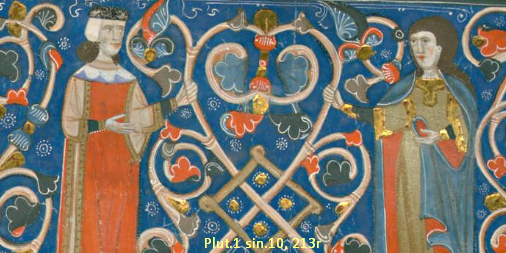
    Hermann Schadt (Die Darstellungen der Arbores, page 270) dates it to the 14th century. Notice how there are bands above, which seem to come from the people's knees. These are branches growing from the so-called arbor (Latin for tree). Compare how the branches are rounded into one another above, and drawn up into an X shape in a more ornate arbor of the same period in Florence, Plut.1 sin.10 (IT:FI0100_Plutei_01sin.10_0003):
  11. Vat.lat.2341,
  12. Vat.lat.2589,
  13. Vat.lat.2611,
  14. Vat.lat.2695,
  15. Vat.lat.2721,
  16. Vat.lat.3049,
  17. Vat.lat.3066,
  18. Vat.lat.3462,
  19. Vat.lat.3526,
  20. Vat.lat.3545,
  21. Vat.lat.3710,
  22. Vat.lat.3726,
  23. Vat.lat.3758,
  24. Vat.lat.3763,
  25. Vat.lat.3766,
  26. Vat.lat.3840 (Upgraded to HQ),
  27. Vat.lat.3842,
  28. Vat.lat.3847 (Upgraded to HQ),
  29. Vat.lat.3848 (Upgraded to HQ),
  30. Vat.lat.3859 (Upgraded to HQ),
  31. Vat.lat.3883 (Upgraded to HQ),
  32. Vat.lat.3884 (Upgraded to HQ),
This is Piggin's Unofficial List number 175. Thanks to @gundormr for harvesting. If you have corrections or additions, please use the comments box below. Follow me on Twitter (@JBPiggin) for news of more additions to DigiVatLib.

2018-08-31

Flipping Roman Charts

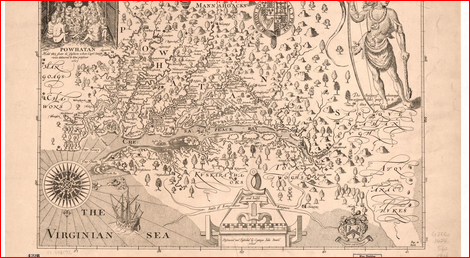
Erica Naone explores in a recent article why maps of the American colony of Virginia from 1590, 1612 and later years are drawn with west at top and the Atlantic at bottom, adopting a landwards point of view. Some of the reasons advanced by the academics Naone quotes seem a little forced. It's not to exploit the width of the sheet of paper: it's more likely that that it was once obvious that charts would naturally be drawn with the drawer's foreground at bottom.
If Naone had phoned me to ask my opinion, I would have said that the maps of Virginia followed a tradition more than 2,000 years old of the chorographic chart, a tradition we have today lost.

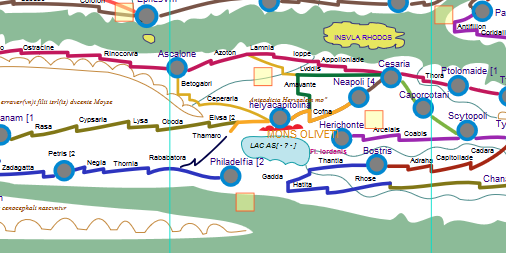
This week I have published two more network maps in my series analysing the Tabula Peutingeriana, the oldest western chart of the world, which is composed of country sections which I call cells. The latest two "cells" cover Syria and Palestine respectively. As I explained in my last post about this project, I suspect the maker of the Tabula employed a chorographic chart to design each cell.

Since introducing the cell hypothesis, I have been thinking intensively about how chorographic charts in the ancient world might have been oriented. In my view the evidence points to the sea-coast being at the bottom as a matter of course, as in the Virginia maps, whenever the coast of a continent is being drawn.

I was reminded of the same while I was recently trying to find some way to bring a compact, high-resolution version of the Madaba Mosaic Map online. That 6th-century diagram, on the floor of a church in Madaba, Jordan, has the script oriented so that the Palestinian coast is at the bottom, implying an eastwards view.

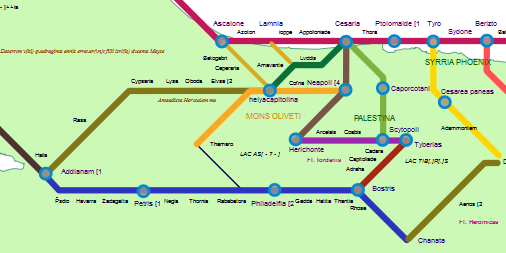
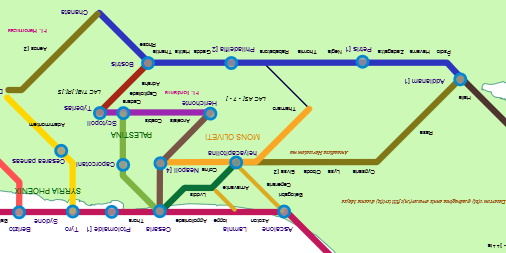
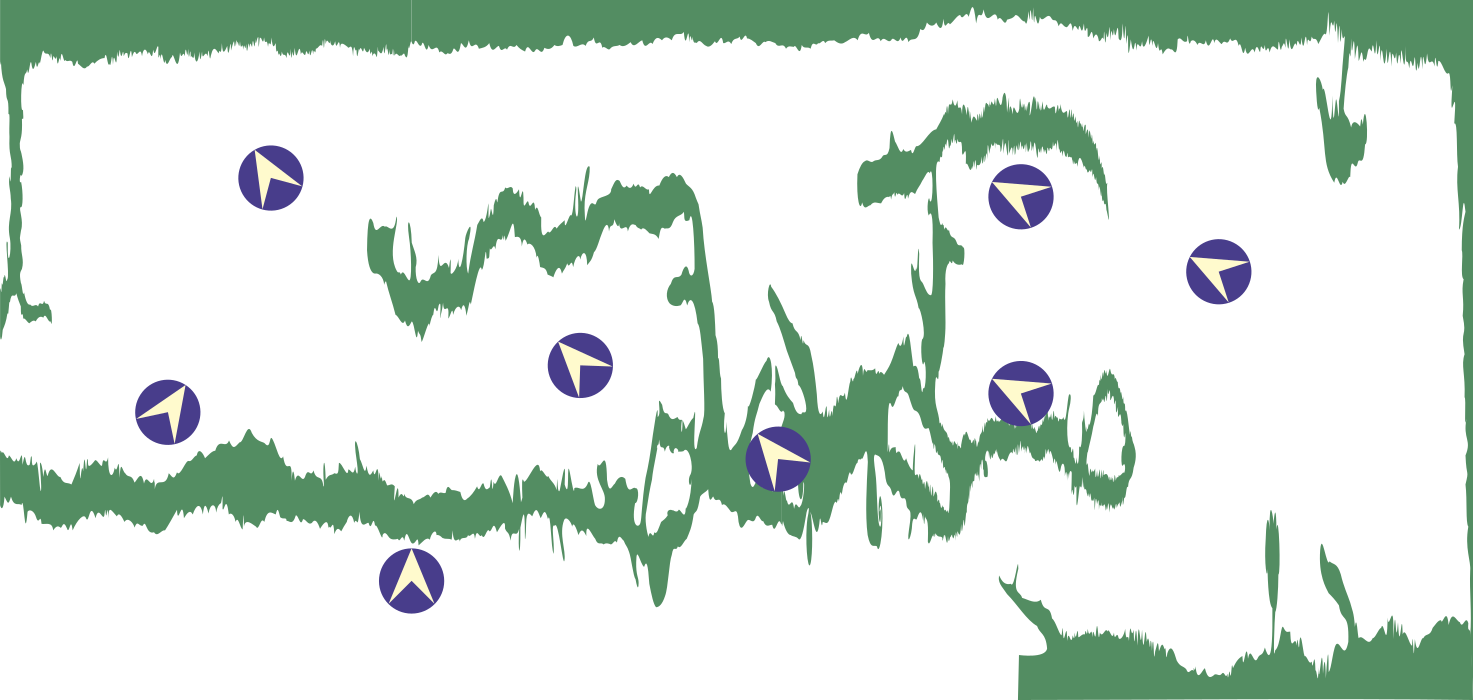
The exception (that proves the rule) is the Palestine section of the Tabula Peutingeriana, where the sea is at the top. In the abstract below, the land is green, the Mediterranean (white) is at top and the Strata Diocletiana (blue), marking the edge of the desert and the limit of the empire, is at bottom. A bit of the Gulf of Aqaba peeps in at the left side:
Compare this with the layout of the Tabula itself, where there is nothing below the Strata Diocletiana. The content immediately turns into the Red Sea and Indian Ocean (dark green, at bottom). The desert is simply not drawn.
How do I claim the rule still stands? I see it like this: from this abrupt cut-off, and from the density of detail nearest the Mediterranean coast, one might argue that the level of geographic knowledge declines in proportion to distance from the Mediterranean coast. The absence of information about the desert and the abrupt transition to the Indian Ocean indicate those are distant places, far from the observer and unknown.

This would imply the point of view of whatever chart served as the basis for this cell was from the Mediterranean. Mentally at least, the original view would be more like the following, an inversion:
The idea I am developing beyond this goes as follows: the Tabula Peutingeriana shows most of the lands of the Mediterranean north shore in a landwards perspective: for example Provence is oriented with northwest at top (and so is Syria), Italy and Greece incline northeastwards, and the "upper" limit of Asia Minor as drawn is its easternmost part.

Might one not therefore expect the mental point of view to have turned fully southwards when the ancient chorographers regarded Africa? Would not Africa naturally be drawn with south at top, the direct opposite of Provence and Liguria, and for the same reason that John Smith sketched Virginia with the Atlantic below and the Appalachians at top?

I will be interested to hear any thoughts about this, and will keep an eye out for any evidence in the Tabula Peutingeriana that might undermine, or bolster, this hypothesis.

Naone, E. (2018, July 30). In Early Maps of Virginia, West Was at the Top. Atlas Obscura. Retrieved from https://www.atlasobscura.com/articles/why-early-virginia-maps-had-west-at-the-top

2018-08-25

Keys to the Classics

The books of classical literature as we know them are mostly reconstructions, pieced together from a variety of medieval manuscripts, none of which is perfect all by itself.

Two of the 62 manuscripts released online in the past week by DigiVatLib illustrate how several versions surviving can be woven together to make a whole book which is then published as the canonical text. Both of these two manuscripts are unique in the sense that they are the sole witnesses of certain words or sections of a larger work.

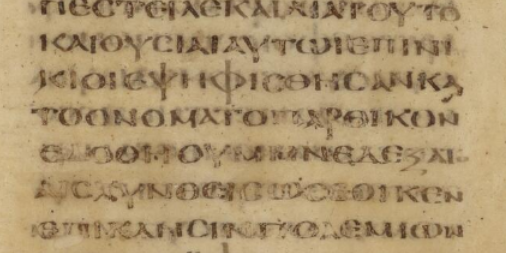
One of the codices you can newly examine for yourself, Vat.gr.1288, is essential to reconstructing Ῥωμαϊκὴ Ἱστορία, the Greek-language history of Rome by Cassius Dio.

This fifth or sixth century manuscript, which I first mentioned in a post last year when many manuscripts arrived online in murky black and white, has been upgraded to high resolution in colour. Only 13 of its folios in an uncial without word-spacing survive. Roger Pearse points out its importance as the sole source of books 78-79 of the history.

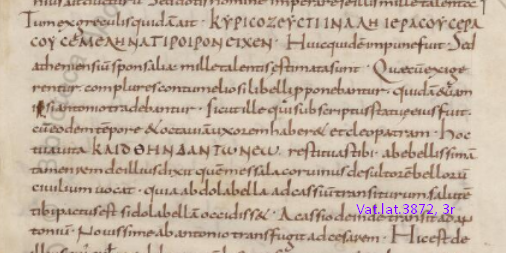
The other, Vat.lat.3872 of the ninth century, plays a major role in reconstructing the two extant works by Seneca the Elder, the Controversiae in 10 books and the Suasoriae in 2 books, both of which advise on how to persuade a Roman court. Roger Pearse explains that it resembles two other ninth-century witnesses containing verbatim text with large gaps, but is an independent recension which appears to have undergone late antique or medieval correction.

Here is the full list:
  1. Chig.E.VII.216, album of  mainly 14th and 15th century letters and bills
  2. Ross.26,
  3. Ross.39,
  4. Ross.4,
  5. Ross.6,
  6. Ross.8,
  7. Ross.42,
  8. Vat.gr.507.pt.1 (Upgraded to HQ),
  9. Vat.gr.507.pt.2,
  10. Vat.gr.1288 (Upgraded to HQ), Cassius Dio, history of Rome, with text of the otherwise missing books 78-79 (see above).
  11. Vat.ind.49,
  12. Vat.lat.2335,
  13. Vat.lat.2587,
  14. Vat.lat.2650,
  15. Vat.lat.2679,
  16. Vat.lat.2781 (Upgraded to HQ),
  17. Vat.lat.2793,
  18. Vat.lat.2976,
  19. Vat.lat.3018,
  20. Vat.lat.3029,
  21. Vat.lat.3071,
  22. Vat.lat.3090,
  23. Vat.lat.3170,
  24. Vat.lat.3192,
  25. Vat.lat.3463,
  26. Vat.lat.3476,
  27. Vat.lat.3481,
  28. Vat.lat.3501,
  29. Vat.lat.3510,
  30. Vat.lat.3518,
  31. Vat.lat.3543,
  32. Vat.lat.3558,
  33. Vat.lat.3576,
  34. Vat.lat.3580,
  35. Vat.lat.3597,
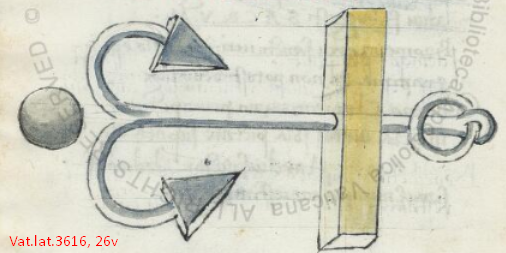
  36. Vat.lat.3616 (Upgraded to HQ), Epigrammata Romae reperta et alibi, a Renaissance notebook of inscriptions 
  37. Vat.lat.3648,
  38. Vat.lat.3658,
  39. Vat.lat.3677,
  40. Vat.lat.3682,
  41. Vat.lat.3687,
  42. Vat.lat.3694,
  43. Vat.lat.3697,
  44. Vat.lat.3713,
  45. Vat.lat.3721,
  46. Vat.lat.3727,
  47. Vat.lat.3733,
  48. Vat.lat.3736,
  49. Vat.lat.3746,
  50. Vat.lat.3753,
  51. Vat.lat.3757,
  52. Vat.lat.3759,
  53. Vat.lat.3760,
  54. Vat.lat.3761 (Upgraded to HQ), the Liber Pontificalis, or brief biographies of all the popes, scribed about 1000, probably at Farfa. Scholars term this the sole representative of type K of the "Lombard" recension.
  55. Vat.lat.3790,
  56. Vat.lat.3795,
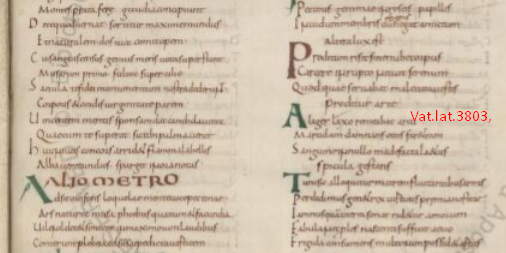
  57. Vat.lat.3803 (Upgraded to HQ), a ninth-century manuscript of the works of Ennodius of Pavia, a 6th-century bishop. Square format, two columns:
  58. Vat.lat.3814,
  59. Vat.lat.3823,
  60. Vat.lat.3858,
  61. Vat.lat.3872 (Upgraded to HQ), Seneca the Elder, copied at Corbie, 850–880 (above)
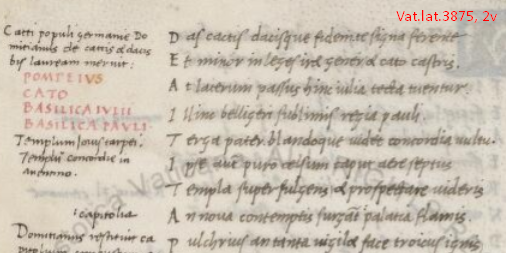
  62. Vat.lat.3875 (Upgraded to HQ), Silvae and Achilleis, the last of five de luxe manuscripts made for the super-rich Rome student Fabio Mazzatosta.
This is Piggin's Unofficial List number 174. Thanks to @gundormr for harvesting. If you have corrections or additions, please use the comments box below. Follow me on Twitter (@JBPiggin) for news of more additions to DigiVatLib.

2018-08-07

How Was the Tabula Peutingeriana Made?

In the 500 years since the rediscovery of the only extant Roman chart of the world, no one has proved how it was made. I am treating that as a challenge.

There is now progress towards a solution to report. My working method is to revisualize the manuscript, the Tabula Peutingeriana, by laying its route network over a modern map of the world. This is impossible to do with the whole TP chart, but surprisingly this works quite well with some more localized regions.

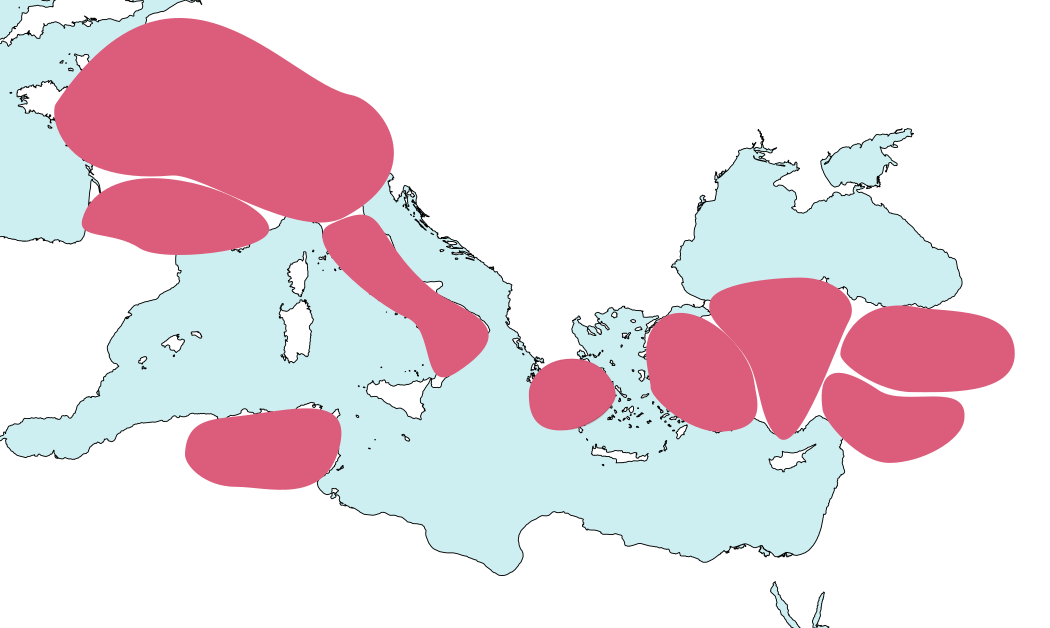
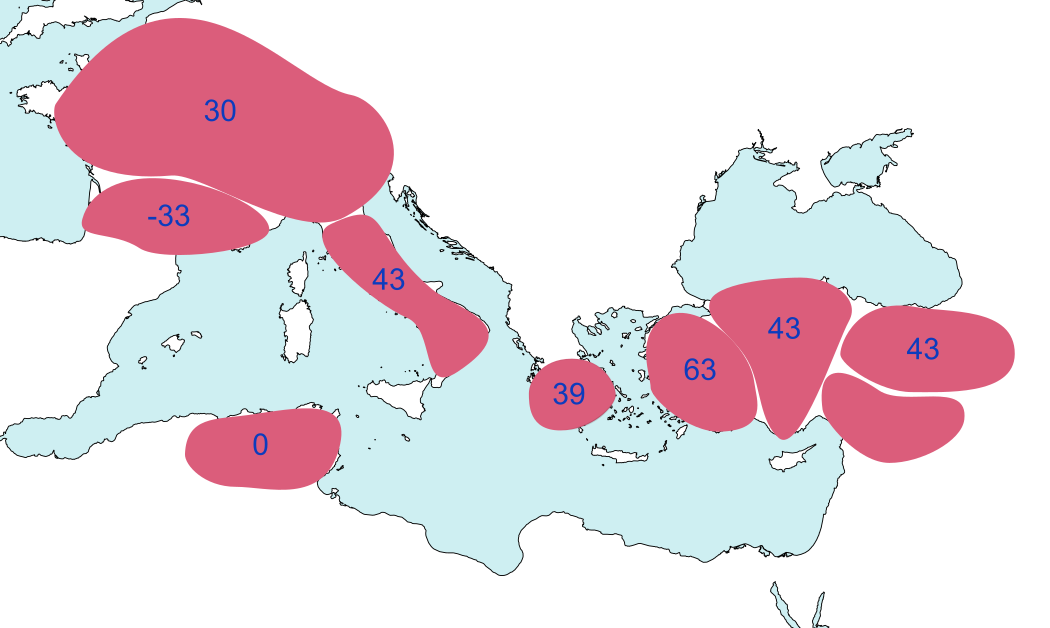
If one increases the page height of the route network, one often finds a sweet spot where the layout of a whole swatch of cities fairly closely matches their pattern on a modern map. This correspondence between overlay and underlay rarely extends beyond discrete geographical areas, for example Greece or the Italian peninsula. After surveying about 60 per cent of the Tabula, I have so far found nine of these patches. This diagram of their locations around the Mediterranean Basin shows them:

At the time when I was discovering the first three or four by trial and error (previous post), I was still sceptical. I did not even bother to note the patches' exact angles of divergence from a north orientation, and I still remained concerned that the patches might later turn out to be nothing more than a chance alignment in the data.

But by the time I moved to analysing Anatolia it was clear that alignment was a rule that was a reliable predictor of where towns were going to be found on the TP.

These patches are in some way comparable to the wireless cells of a cellular phone system extending over a landscape. Unlike a territory, the edges of the cells are not distinct, and there are some places that are outside any cell. But within each cell, an objectively measurable value prevails uniformly.

The phenomenon can alternatively be visualized by showing bearings on a horizontally compressed copy of the Tabula Peutingeriana. In the following sketch, you can see how Provence (the leftmost region) is drawn with north at the upper right, whereas Gallia Comata (top left) has north at the upper left:


The cells are distinguished from their neighbours by an objectively measurable value: an angle of difference between lines of longitude (I have the latitude/longitude data for these places) and verticality between places on the TP (I have a database of the coordinates), as shown below.

We could attach a mathematical value to every place-label on the chart, group these and analyse them statistically to find more patterns.

This is still a work in progress, and I can only speculate about where this is leading to. But I have a suspicion. The maker of the Tabula Peutingeriana may have designed his diagram with the help of a collection of "chorographic" charts which depicted different regions with varying orientations.

A majority of scholars nowadays think that the world of antiquity had little familiarity with scale maps (despite Ptolemy of Alexandria having written a book, still extant, on how to make a map of the world). A cruder type of chart, the pinax chôrographikos, was adequate to explain locations visually, and even this visualization may not have come into use among educated people until late antiquity.

The only instances of an ancient Greek/Latin pinax chôrographikos we know at present are the mappaemundi (see my previous post), the controversial sketch on the "Artemidorus Papyrus" and the Dura Europos "shield". Each of these seems to have a different compass direction at top and it may be that a varying, ad hoc orientation is the hallmark of the pinax chôrographikos.

If this hypothesis turns out to be correct, it may be that we will be able reconstruct several more pinakes using the data in the Tabula Peutingeriana, which would mark a major advance in the study of early cartography.

You can see the graphic abstracts for eight of the TP cells on my website, as listed below. On each chart, press the "landmass-on" button to see how the layout compares to the geographical situation.
The seventh and last visualization unites two cells, Bithynia-Galatia on the left and Cappadocia-Euphrates on the right. I have not yet completed a visualization for Syria, although I pre-emptively marked this as a red cell in my drawing above.

Each of these revisualizations may give at least the layout of what might have been drawn on an early pinax.

The more immediate object of this research is however to focus on the creation of the TP, which might have taken place as follows:
  1. The compiler copied pinakes of all the regions of interest;
  2. Using texts, he copied travel itineraries onto the pinakes and connected the sheets without concern for the compass orientations.
  3. His final copy of this assemblage drastically reduced the height of the chart to the TP as we see it.
This is nothing more than a proposal, and it differs in some of its details from the best hypothesis being offered today, that of Professor Michael Rathmann of Germany, who also sees the TP as a chorographic map. But the idea would at least bear further study. Use the comments box below if you wish to respond.

2018-08-05

Moerbeke Archimedes is Now Online

My friend Pieter Beullens discovered and made known that the Archimedes Codex of William of Moerbeke at the Vatican Library is online at last. Although this Latin book is one of their most historic digital publications, the coders at Digita Vaticana somehow botched the release, lodging the manuscript in the wrong area of the portal, where no one would ever look for it.

Only three witnesses in the original Greek of the works of Archimedes -- A, B, and C -- are known to have survived the Byzantine period.

C is the privately owned Archimedes Palimpsest (images) which is the famous subject of the book The Archimedes Codex by Reviel Netz and William Noel (2007).

B, not recorded since 1311. 

A was last seen in 1564, but was copied several times, foremost by Poliziano, whose apograph, imitating the writing and mise en page of the antigraph, is in Florence and online (ms. Plut.28.4)

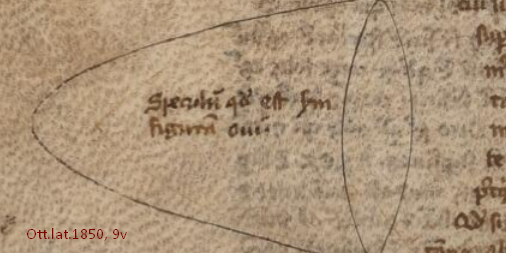
William of Moerbeke, who was a Dominican, generally taken to be Flemish, used A and B to compile a Latin version of Archimedes in or about 1269. William is a giant in the medieval transmission of the classics (see Pieter Beullens' tweets for a feeling). In 1881, it was realized that codex Ott.lat.1850 at the Vatican is the draft/original/autograph of the Archimedes part of his work.

You can now page through Ott.lat.1850. I at first thought this was a 2018 digitization, but @LatinAristotle tells me he first spotted it in 2016.

The Moerbeke pages are bound together with two extraneous parts, one of them printed Latin text.When this posting went up, the URL was https://digi.vatlib.it/view/Ott.lat.1850, which wrongly places it among the incunables and in fact should attach to Cardinal Ottoboni's own copy of the Anthologia Graeca Planudea (ia00765000). I'll message the library on Monday, and if we are right I expect they will fix it.

Why is the Moerbeke codex historic? Firstly, it was the only witness of the text of Floating Bodies until the beginning of the 20th century and the discovery of C above. Secondly it is our only means of accessing B. Thirdly, it can guide us to what copyists of A may have overlooked. And fourthly, with Moerbeke's own marginal notes, it is itself a major artefact in the history of science.

Clagett, M. (1982). William of Moerbeke: Translator of Archimedes. Proceedings of the American Philosophical Society, 126(5), 356-366. Retrieved from http://www.jstor.org/stable/986212