2015-12-01

Jesus in a Nutshell

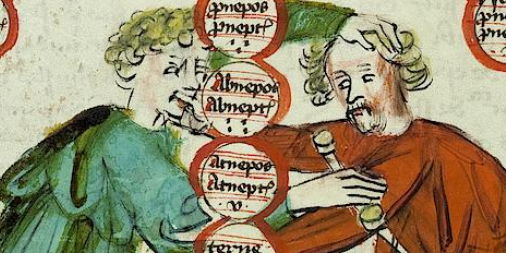
One of the peculiarities of 15th-century tree diagrams is that the humans are often shown as half-figures emerging from a kind of nutshell. Possibly this is a stylized nest. These show up in manuscripts and then appear in early printed books where the art continues in the same fashion.

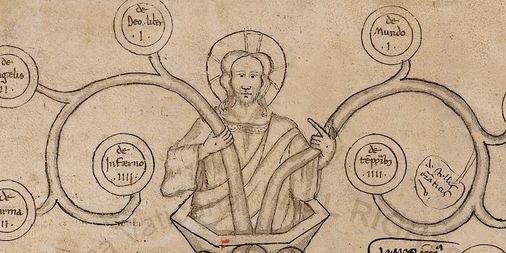
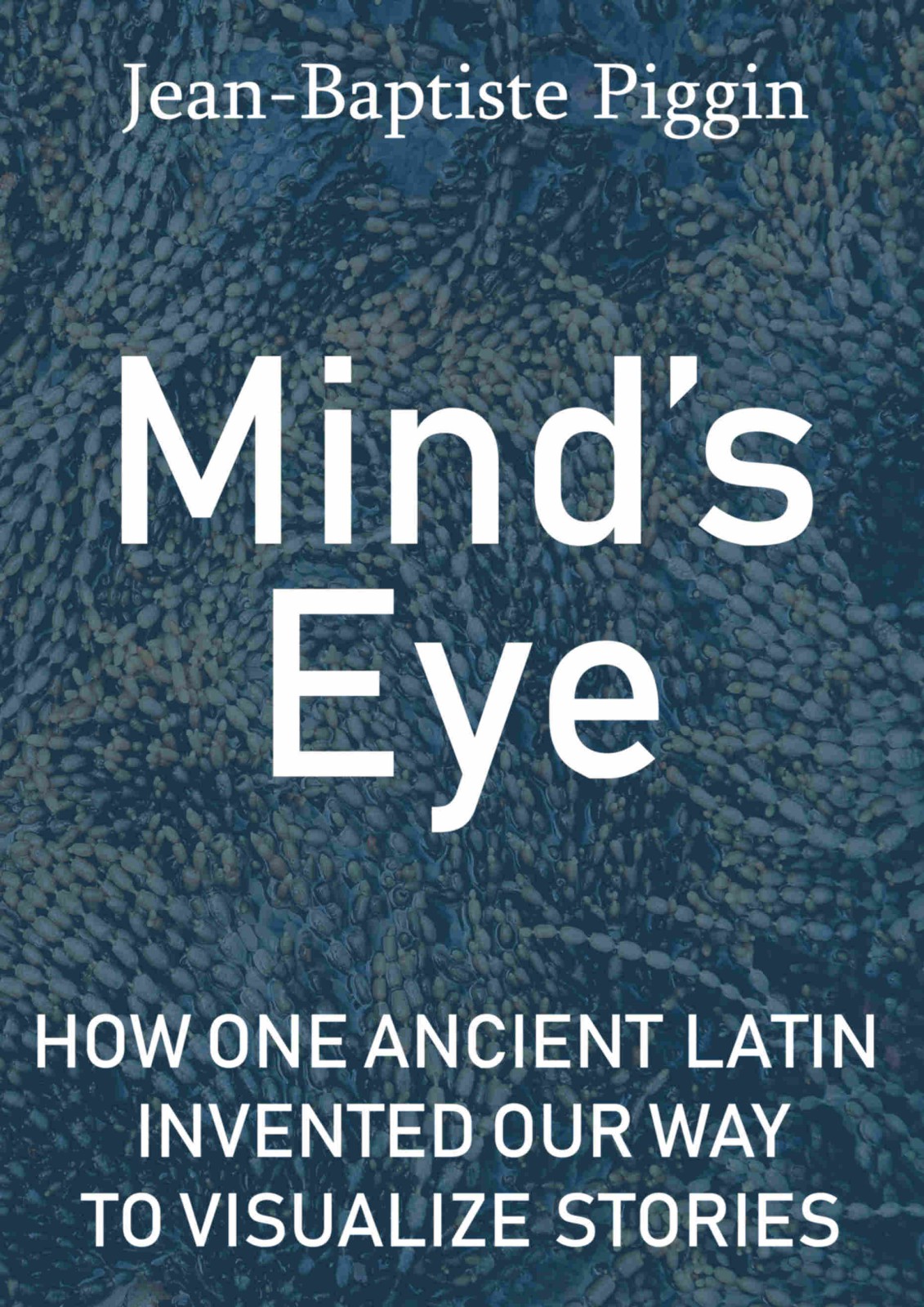
There is a remarkable instance of this in Urb.lat.300 which is the among the manuscripts uploaded Dec 1 to Digita Vaticana. This is a manuscript of the Fons memorabilium universali of Domenico Bandini d'Arezzo (c. 1335-1418), for which the catalog gives the additional title De viris claris Lexicon. It was likely copied thus during the author's lifetime.

This has a most unusual table of contents at the front which shows Christ growing out of a hexagonal fountain, with the book's topics listed in roundels at the end of branches. It is discussed in Hermann Schadt's Arbores, p 335, the reference for which you will find in a previous blog post.
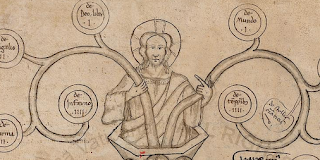
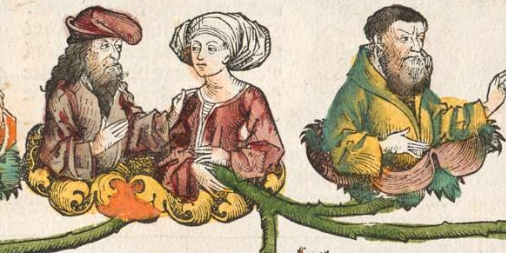
This short of thing is familiar from the Hartmann Schedel Liber Chronicarum of 1493, as in this hand-coloured copy in Munich showing Mizraim, his wife and their son Ludim:
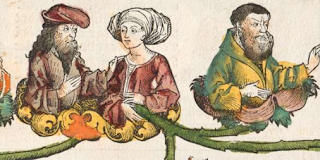
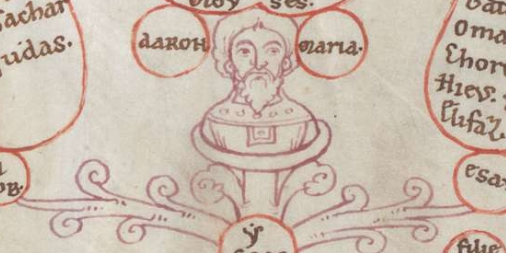
Christiane Klapisch-Zuber (L'Ombre, p 297) terms this object a corolla. These motifs in fact have a medieval past. For example, the Dialogus de laudibus sanctae crucis at Munich (BSB, clm 14159) contains a similar treatment of Isaac as a bust in a graphic that is a kind of at-a-glance diagram of how the Old Testament is organized and its themes:
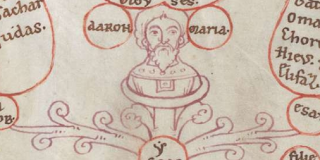

The December 1 uploads bring the posted total on Digita Vaticana to 3,361. Here is the full list, and once again I will not describe the Pal.lat. releases here, as it is likely most of them have been online before today in Heidelberg, since Rome and the German library have partnered to digitize them.
  1. Arch.Cap.S.Pietro.D.197, Nicholas of Lyra, Postillae
  2. Barb.lat.3935, a 14th/15th century Dante
  3. Barb.lat.3954, Petrarch
  4. Borg.copt.109.cass.XIV.fasc.44,
  5. Borg.copt.109.cass.XIV.fasc.45,
  6. Borg.copt.109.cass.XIV.fasc.47,
  7. Borg.copt.109.cass.XIV.fasc.48,
  8. Borg.copt.109.cass.XIV.fasc.49,
  9. Borg.copt.109.cass.XV.fasc.50,
  10. Borg.copt.109.cass.XV.fasc.51,
  11. Borg.copt.109.cass.XV.fasc.52,
  12. Borg.copt.109.cass.XV.fasc.54,
  13. Borg.copt.109.cass.XV.fasc.55,
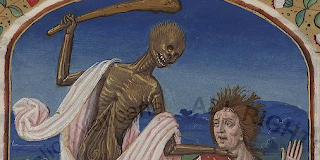
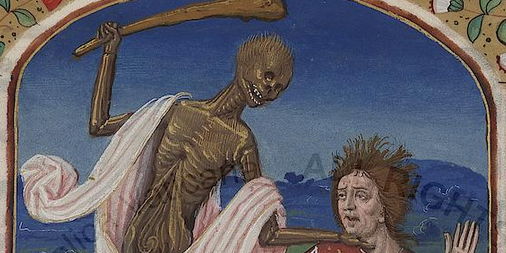
  14. Borgh.183, Book of Hours with this hair-raising visitation of death wielding a club:
  15. Cappon.199,
  16. Cappon.252.pt.B,
  17. Cappon.318,
  18. Pal.lat.537,
  19. Pal.lat.771,
  20. Pal.lat.818,
  21. Pal.lat.835,
  22. Pal.lat.884,
  23. Pal.lat.896,
  24. Pal.lat.904,
  25. Pal.lat.908,
  26. Pal.lat.911,
  27. Pal.lat.914,
  28. Pal.lat.916,
  29. Pal.lat.922,
  30. Pal.lat.924,
  31. Pal.lat.925,
  32. Pal.lat.934,
  33. Pal.lat.935,
  34. Pal.lat.936,
  35. Pal.lat.937,
  36. Pal.lat.938,
  37. Pal.lat.950,
  38. Pal.lat.951,
  39. Pal.lat.1015,
  40. Patetta.685,
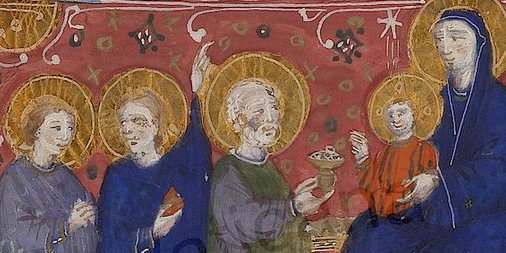
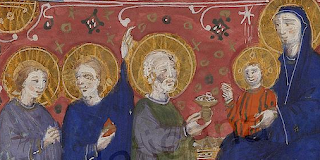
  41. Urb.lat.11, Gefroi de Pinkegni, commentarii in Evangelia etc. In French. Important supplementary source of Occitan version of bible. See Samuel Berger. This codex is celebrated for its copious miniatures by Neri da Rimini (c.1270 - c.1330), including this Three Kings with the Infant Jesus on 13v:
  42. Urb.lat.16, Nicholas of Lyra, Postillae on Psalms, Job, Minor Prophets
  43. Urb.lat.17, Nicholas of Lyra, Postillae
  44. Urb.lat.27, Thomas Aquinas on Gospel of Matthew
  45. Urb.lat.56,
  46. Urb.lat.76,
  47. Urb.lat.85,
  48. Urb.lat.101, Bede and Anselm
  49. Urb.lat.123, Alexander of Ales OFM
  50. Urb.lat.161,
  51. Urb.lat.165,
  52. Urb.lat.180, Burkhard of Worms, legal
  53. Urb.lat.182, Aristotle's Historia animalium, De partibus animalium, De generatione animalium, all penned in Florence in about 1470. Anthony Grafton's Rome Reborn catalogue noted of this codex: Pope Nicholas V was a patron of the translation of ancient scientific works from Greek into Latin. New translations of Aristotle's books on animals, which describe over five hundred different species and are the principal ancient works on the subject, played an important part in this pope's intellectual program. George Trebizond's translation was commissioned by Nicholas V. Its details are listed in the St Louis catalog. Later noticed by @LatinAristotle.
  54. Urb.lat.251,
  55. Urb.lat.253,
  56. Urb.lat.277,
  57. Urb.lat.282,
  58. Urb.lat.291,
  59. Urb.lat.299,
  60. Urb.lat.300, manuscript of the Fons memorabilium universali of Domenico Bandini d'Arezzo (above).
  61. Urb.lat.307, Nonius Marcellus, Paul the Deacon
  62. Urb.lat.309, Aulius Gelius, Attic Nights, 15th-century copy
  63. Urb.lat.313, Cicero, Epistolarum ad familiares
  64. Urb.lat.314, panegyrics by Pliny and others
  65. Urb.lat.317, Asconius on Cicero
  66. Urb.lat.323, Cicero, 15th century
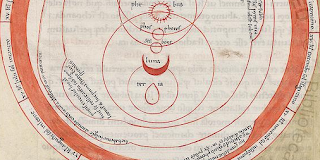
  67. Urb.lat.329, Martianus Capella, De nuptiis Philologiae et Mercurii, 15th-century copy including this fine drawing at fol. 139v and figural miniatures:
  68. Urb.lat.336, Libanius, letters etc, 15th-century copy
  69. Urb.lat.374,
  70. Vat.ar.13,
  71. Vat.gr.802,
  72. Vat.gr.1135,
  73. Vat.lat.127, commentary on Mark and Luke
  74. Vat.lat.239, Eusebius, Ecclesiastical History, 15th century copy
  75. Vat.lat.275, Ambrose on Psalms
  76. Vat.lat.298, Basil the Great and Cyril of Alexandria
  77. Vat.lat.354, a collection of 123 of Jerome's letters, 11th century
  78. Vat.lat.355, volume 1 of a 9th or 10th century manuscript in Beneventan script of the above. Important in the history of collecting the correspondence of Jerome of Stridon. The second volume, Vat.lat.356, is not yet online. Though there are about 7,000 manuscripts with Jerome letters, Andrew Cain says it took till the 9th century to assemble them all, so this codex dates back to that compilation period.
If you can add further details use the comments box or write me a tweet mentioning @JBPiggin. [This is Piggin's Unofficial List 32.]

2015-11-24

Seneca the Stoic

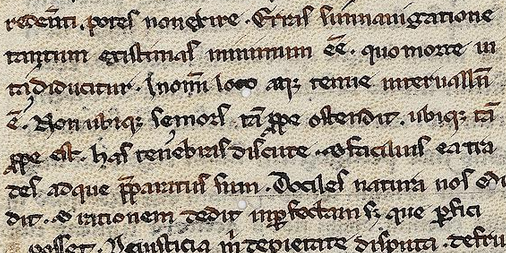
Among the 213 manuscripts uploaded November 23 by Digita Vaticana is a copy of Seneca's Epistulae ad Lucilium. I read that Seneca manuscripts are not rare: there are about 400 of them in various states of incompleteness. This one, Vat.lat.366, is termed "v" in the stemma codicum and is consulted for variants.

Seneca's "we've all got to die sometime" stoicism is a good antidote to the current nervousness. Here is the bit of Letter 49 where he tells Lucilius: "You are mistaken if you think death is at a nearer remove while you're on a sea voyage ... It is always near at hand" (adapted from Gummere). Quite.
Full text of this passage at Perseus.

The uploads, which take the tally to 3,281 (one more item, Ott.gr.61, was added Nov 24), are to the greatest extent in Greek this time round. I will leave it to Greek experts to pick out what is of importance. There are also a great many Pal. lat. items where it is likely that these have already been online for some time at Heidelberg, so it is out of time to claim them as new.

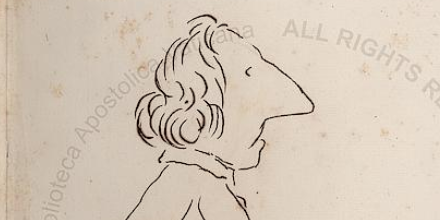
The Vatican Library is always a great repository of doodles. Here's a bit of cruel Roman caricature which doubtless amused someone amid an otherwise wasted day in the papal bureaucracy:

The full list:
  1. Barb.gr.18,
  2. Barb.gr.36,
  3. Barb.gr.46,
  4. Barb.gr.56,
  5. Barb.gr.98,
  6. Barb.gr.99,
  7. Barb.gr.101,
  8. Barb.gr.104,
  9. Barb.gr.110,
  10. Barb.gr.112,
  11. Barb.gr.121,
  12. Barb.gr.122,
  13. Barb.gr.131,
  14. Barb.gr.132,
  15. Barb.gr.137,
  16. Barb.gr.146,
  17. Barb.gr.147,
  18. Barb.gr.166,
  19. Barb.gr.167,
  20. Barb.gr.169,
  21. Barb.gr.173,
  22. Barb.gr.174,
  23. Barb.gr.175,
  24. Barb.gr.183,
  25. Barb.gr.185,
  26. Barb.gr.186,
  27. Barb.gr.190,
  28. Barb.gr.196,
  29. Barb.gr.198,
  30. Barb.gr.202,
  31. Barb.gr.203,
  32. Barb.gr.207,
  33. Barb.gr.208,
  34. Barb.gr.209,
  35. Barb.gr.211,
  36. Barb.gr.213,
  37. Barb.gr.214,
  38. Barb.gr.216,
  39. Barb.gr.217,
  40. Barb.gr.221,
  41. Barb.gr.236,
  42. Barb.gr.242,
  43. Barb.gr.279,
  44. Chig.I.VII.252,
  45. Chig.P.VI.4, caricatures in a notebook (sample above), more than half of which is empty
  46. Ott.gr.3,
  47. Ott.gr.5.pt.1,
  48. Ott.gr.5.pt.2,
  49. Ott.gr.9,
  50. Ott.gr.18,
  51. Ott.gr.20,
  52. Ott.gr.22,
  53. Ott.gr.27,
  54. Ott.gr.30,
  55. Ott.gr.32,
  56. Ott.gr.33,
  57. Ott.gr.34,
  58. Ott.gr.37.pt.1,
  59. Ott.gr.37.pt.2,
  60. Ott.gr.43,
  61. Ott.gr.46,
  62. Ott.gr.47,
  63. Ott.gr.49,
  64. Ott.gr.50,
  65. Ott.gr.51,
  66. Ott.gr.54,
  67. Ott.gr.55,
  68. Ott.gr.56,
  69. Ott.gr.57,
  70. Ott.gr.60
  71. Ott.gr.61,
  72. Ott.gr.63,
  73. Ott.gr.72,
  74. Ott.gr.75,
  75. Ott.gr.77
  76. Ott.gr.78,
  77. Ott.gr.79,
  78. Ott.gr.80,
  79. Ott.gr.81,
  80. Ott.gr.82,
  81. Ott.gr.83,
  82. Ott.gr.86,
  83. Ott.gr.87,
  84. Ott.gr.96,
  85. Ott.gr.101,
  86. Ott.gr.103,
  87. Ott.gr.104,
  88. Ott.gr.113,
  89. Ott.gr.116,
  90. Ott.gr.117,
  91. Ott.gr.119,
  92. Ott.gr.120,
  93. Ott.gr.122,
  94. Ott.gr.126,
  95. Ott.gr.129,
  96. Ott.gr.130,
  97. Ott.gr.131,
  98. Ott.gr.132,
  99. Ott.gr.135,
  100. Ott.gr.136,
  101. Ott.gr.141,
  102. Ott.gr.144,
  103. Ott.gr.145,
  104. Ott.gr.151,
  105. Ott.gr.152,
  106. Ott.gr.155,
  107. Ott.gr.157.pt.A,
  108. Ott.gr.162,
  109. Ott.gr.168,
  110. Ott.gr.169,
  111. Ott.gr.171,
  112. Ott.gr.187,
  113. Ott.gr.190,
  114. Ott.gr.196,
  115. Ott.gr.202,
  116. Ott.gr.203,
  117. Ott.gr.204.pt.1,
  118. Ott.gr.204.pt.2,
  119. Ott.gr.220,
  120. Ott.gr.222,
  121. Ott.gr.224,
  122. Ott.gr.226,
  123. Ott.gr.227,
  124. Ott.gr.229,
  125. Ott.gr.230,
  126. Ott.gr.234,
  127. Ott.gr.235,
  128. Ott.gr.236,
  129. Ott.gr.238,
  130. Ott.gr.240
  131. Ott.gr.241,
  132. Ott.gr.253,
  133. Ott.gr.254,
  134. Ott.gr.263,
  135. Ott.gr.264,
  136. Ott.gr.265,
  137. Ott.gr.290,
  138. Ott.gr.294,
  139. Ott.gr.297,
  140. Ott.gr.298,
  141. Ott.gr.309,
  142. Ott.gr.310,
  143. Ott.gr.312,
  144. Ott.gr.313,
  145. Ott.gr.316,
  146. Ott.gr.321,
  147. Ott.gr.322,
  148. Ott.gr.323,
  149. Ott.gr.324,
  150. Ott.gr.326,
  151. Ott.gr.336,
  152. Ott.gr.340,
  153. Ott.gr.356,
  154. Ott.gr.359,
  155. Ott.gr.362,
  156. Ott.gr.363,
  157. Ott.gr.370,
  158. Ott.gr.371,
  159. Ott.gr.372,
  160. Ott.gr.374,
  161. Ott.gr.375,
  162. Ott.gr.377,
  163. Ott.gr.378,
  164. Ott.gr.381,
  165. Ott.gr.382,
  166. Ott.lat.2988,
  167. Pal.lat.270,
  168. Pal.lat.274,
  169. Pal.lat.282,
  170. Pal.lat.289,
  171. Pal.lat.309,
  172. Pal.lat.311,
  173. Pal.lat.323,
  174. Pal.lat.324,
  175. Pal.lat.330,
  176. Pal.lat.361,
  177. Pal.lat.362,
  178. Pal.lat.411, a richly decorated textbook of law completed 1417 by Winandus de Stega at Heidelberg University dealing with four arbores. Here are a couple of furiously fighting heirs (fol 7v) under an arbor hereditatis (discussed by Hermann Schadt at page 309-313 of Arbores: see the previous post).
  179. Pal.lat.412,
  180. Pal.lat.413,
  181. Pal.lat.502, the Palatine Lectionary, also online at Heidelberg.
  182. Pal.lat.597,
  183. Pal.lat.598,
  184. Pal.lat.610,
  185. Pal.lat.617,
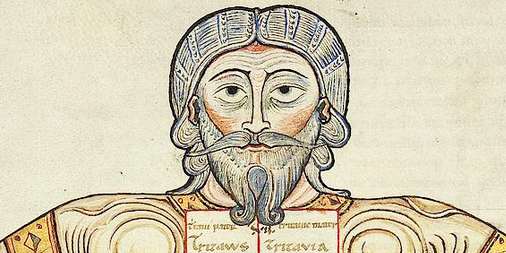
  186. Pal.lat.622, a 13th-century Decretum Gratiani text, with the sculptural figure below (fol. 240v) at the head of a Schadt Type 5A Roman-style arbor consanguinitatis. There has always been some disagreement about who the wise old figure holding the tray of prohibited marriages represents, because there are no contemporary explanations. Is he a personification of tradition? Or God the Father as judge? Or someone too old to marry? The most general position is that he is a jurist, the wise guardian of the law, and thus Gratian himself (as I noted in a blog post two weeks ago). The version by Nicolò features an old man in rich robes of authority. We know effectively nothing about Gratian, barring his evident status as a law professor of 12th-century Bologna, so even a century afterwards, artists could make of him what they liked.
  187. Pal.lat.659,
  188. Pal.lat.709,
  189. Pal.lat.710,
  190. Pal.lat.739,
  191. Pal.lat.742,
  192. Pal.lat.773,
  193. Pal.lat.792,
  194. Pal.lat.816,
  195. Pal.lat.862,
  196. Pal.lat.871,
  197. Pal.lat.891,
  198. Pal.lat.1620,
  199. Urb.lat.680, Rambaldi commentary on Dante, Divine Comedy
  200. Urb.lat.687, Dante poems
  201. Vat.ebr.66,
  202. Vat.ebr.201,
  203. Vat.ebr.205,
  204. Vat.estr.or.43,
  205. Vat.gr.2627,
  206. Vat.lat.253,
  207. Vat.lat.281, Ambrose of Milan, various
  208. Vat.lat.349,
  209. Vat.lat.366, Seneca, Epistulae ad Lucilium
  210. Vat.lat.400, John Chrysostom
  211. Vat.lat.405, John Chrysostom
  212. Vat.lat.491, Augustine of Hippo
  213. Vat.lat.782, 13th century theological commentary
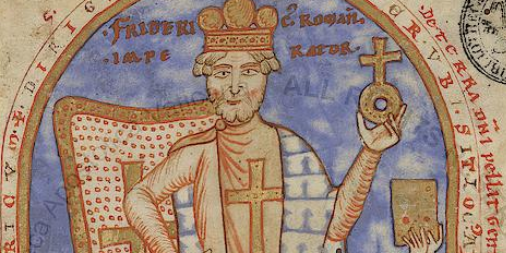
  214. Vat.lat.2001, with Emperor Frederick smiling a crooked smirk (below)

Use the comments box below to add details of anything you recognize. Follow me on Twitter (@JBPiggin) for more news. [This is Piggin's Unofficial List 31.]

2015-11-21

Curly Braces

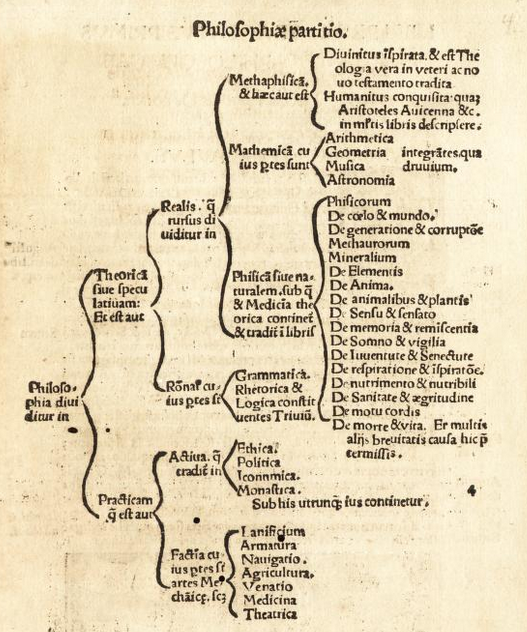
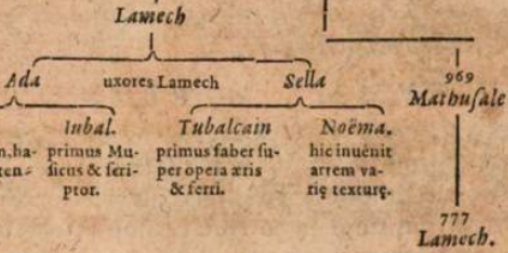
One of the great macro-typography inventions of the first 100 years of western printing was the curly brace (or bracket) as a device to organize hierarchical information. Initially the letterpress type-piece for a brace seems to have been cut ad-hoc by hand, as in this single example in the Margarita Philosophica of Gregor Reisch (1503):

In some work, such as grammar texts, the brace could soon be taken as read and simply omitted, as in a 1533 printing in Basle, Switzerland of the grammar of Donatus edited by Heinrich Loriti or "Glarean". But the normal procedure was for the typesetter to make a brace for such layouts.

Where the material in the stemma was more copious, printers laid it out with its root at the top. In a 1540 Basle printing of Livy's Decades in the edition of Glarean, the brace is still hand-cut:

Printers soon recognized it was quicker to resort to their typecases, combining the small pieces of straight rule and rounded corners supplied by their typecutters to form braces.

The first explicit explanation of this practice which I can find appears 200 years later in The Printer's Grammar by John Smith (link goes to a full edition of 1787, but the original seems to have come out 1755). It explains how a printer mainly resorts to his middle-length rules to do this:
Middle and Corners are very convenient in Genealogical Work, where they are used the flat way; and where the directing point is not always in the middle, but has its place under the name of the Parent, whose offspring stands between Corner and Corner of the bracing side, in order of primogeniture.
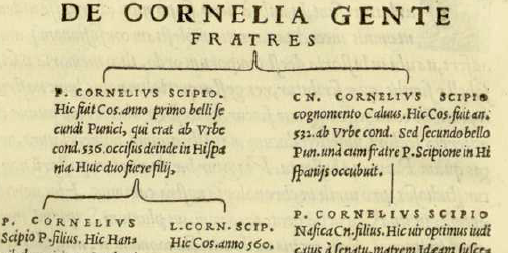
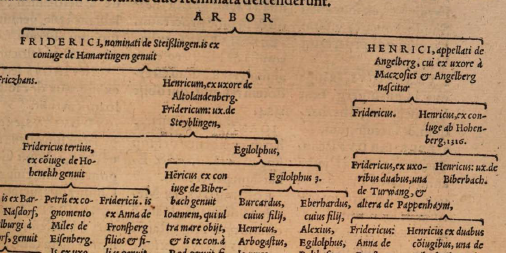
The "directing point" was a specially cut form to be found in the standard typesets in Basle. We see this in a 1557 example of a book by Wolfgang Lazius (1514-1565) (biography) in De gentium aliquot ... (online), page 589:

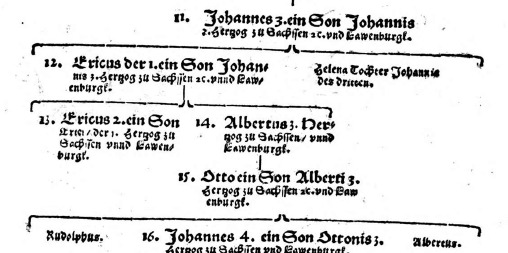
Elsewhere the point might be made from two corners, as in this 1556 book of genealogies (online) by Ernst Brotuff (1497-1565) (nasty biography) printed at Leipzig, Germany, where if one looks carefully, the joins between the rules are visible:

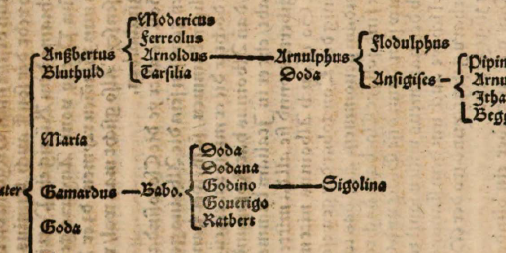
Sometimes the brace was reduced to a minimum as in a 1559 example. As another option, Johannes Herold (1514-1567), who was a publisher in Basle (biography), often preferred stemmata with the root at the left, as we see in his 1561 Churfürstliches Haus der Pfaltz an Rhein (online). Here too one can see that these braces were not hand cut, but assembled from smaller parts:

The curly brace was thus the printers' most important instrument in adapting the ancient graphic idea of the stemma to the technology of the printing press, where the need to square the forms that will be put into the type-bed presupposes that all elements fit together at 90-degree angles. When Leonhard Ostein of Basle came to print Hulderic Zwingli junior's edition of the Compendium of Petrus Pictaviensis in 1592 (previous blog post), he could hardly do otherwise:

Later tabular printing including some braces has been listed by an interesting Munich project, Historische Tabellenwerke (ended 2007), but I am not aware of any research on braced stemmata in incunables. What I am currently trying to do is take this history back beyond 1500. It is plain that the solutions then in use were not experimental, but settled practices. Can anyone help me find older examples?

2015-11-14

Arbor and Incest

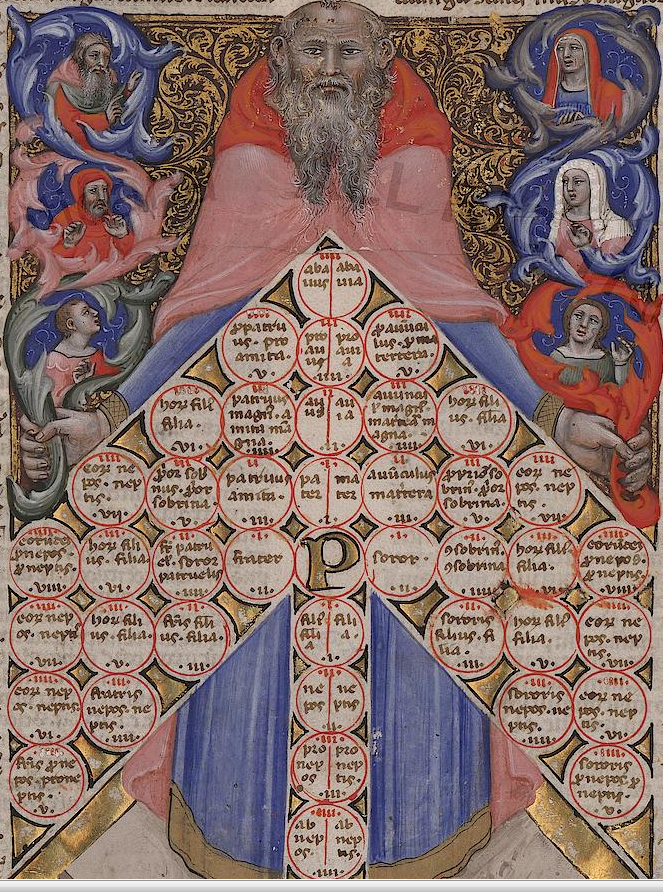
Medieval canon law built up elaborate rules prohibiting marriage within kin groups. The principles of this were taught with a diagram known as the arbor juris, the first forms of which are classical in origin. The 64 uploads to Digita Vaticana on November 11, 2015 include Urb.lat.160, a mid-14th-century manuscript of decretals or codified canon law preceded by a particularly colourful arbor juris.

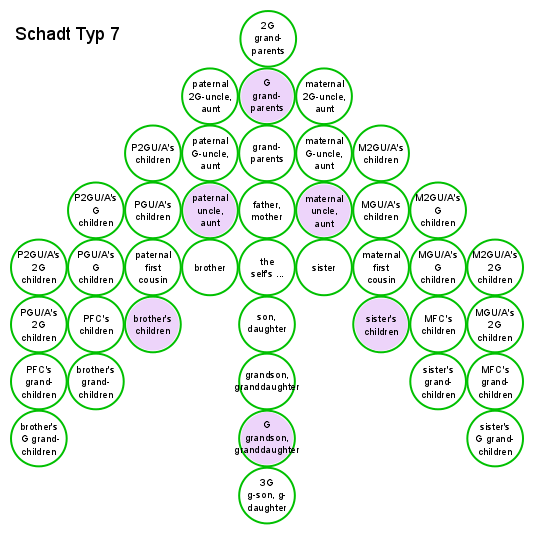
This class of diagrams was very comprehensively studied 1973-1982 by Hermann Schadt, who ordered the main group known as the arbores consanguinatis into seven main types. Urb.lat.160 contains the seventh of these types and was designed in the Decretum Gratiani (pars II, causa 35, qu. 5), a collection of canon law compiled in the 12th century by a jurist who is known as Gratian. At first it condemned a very wide range of potential marriages (some of the 14th degree by the classical Roman method of counting), but its scope was reduced in 1215.

I have compiled a "missing manual" to Schadt's  magisterial but not very reader-friendly book, and from it comes the following schematic. It shows the post-1215 form of Typ 7. Each roundel describes a relationship which was an impediment to marriage. The pink roundels in this matrix mark the kin relationships counted as third degree by the classical method:
The newly digitized manuscript contains miniatures which are probably genuine work of Nicolò da Bologna (see Italian biography). As Schadt explains, the Typ 7 diagrams developed an interesting iconography: an elderly man, perhaps representing the jurist, held the matrix in front of him as if it were a wooden placard. Tree branches grew to his left and his right, in his grasp. The Nicolò versions of these generally have six busts on the margin, male on the left, female on the right, apparently representing three generations of persons reacting with disappointment to the news that their love object is out of bounds.

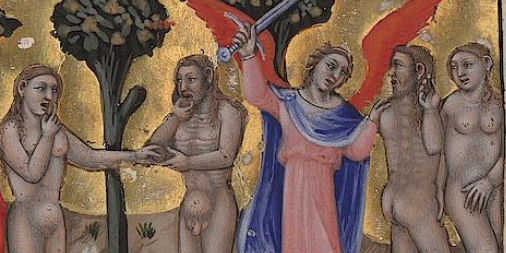
The manuscript's arbor consanguinatis is followed by an arbor affinitatis, a large invariant type, which lists the in-laws that a person was also forbidden to wed. Schadt discusses this arbor on p. 276 of his book comparing it to other manuscripts. He notes the miniature's finely drawn depiction of Adam and Eve eating the forbidden fruit and then being expelled from Paradise by an angel:

Here is the full list of the new uploads:
  1. Arch.Cap.S.Pietro.B.79, liturgical music. Aaron Macks (comment below) points out it is one of the few manuscripts of "Old Roman" chant. More details at Waterloo.
  2. Arch.Cap.S.Pietro.D.194, Postillae on Old Testament, Nicholas of Lyra
  3. Arch.Cap.S.Pietro.E.26, mould ravaged Rufinus, Historia Monachorum
  4. Arch.Cap.S.Pietro.E.28, Plutarch Lives, in Latin translation by Jacobus Angelus
  5. Arch.Cap.S.Pietro.E.30, Justinus, Universal History
  6. Barb.lat.3912, poetry of Luigi Pulci
  7. Borg.ar.95, Four Gospels in Arabic, 8th century?
  8. Borg.cin.507, a beautiful map in Italian of the Qinqhai region of China
  9. Borg.copt.109.cass.XII.fasc.41, three folios in Coptic from Matthew 16-18 with marginal illuminations
  10. Borg.pers.19, Gospels in Persian, 14th century
  11. Cappon.103,
  12. Cappon.140,
  13. Cappon.239,
  14. Cappon.281.pt.2,
  15. Cappon.291.pt.2,
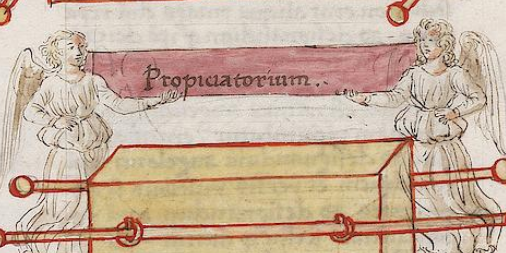
  16. Urb.lat.14, Postillae of Nicholas of Lyra on Genesis, etc. with a technical discussion of angels guarding the ark of the covenant. Compare this to William Norton's 1403 bid to classify ark styles, based on Nicholas's work. Here is one of the Urb.lat.14 images:
  17. Urb.lat.18, Peter Lombard
  18. Urb.lat.39, Ambrose of Milan, William of Canterbury, Prosper of Aquitaine
  19. Urb.lat.57, Jerome on Ezekiel
  20. Urb.lat.102, Venerable Bede,  Leo the Great,
  21. Urb.lat.103, Richard of St Victor, Hugh of St Victor including his heavenly hierarchy
  22. Urb.lat.136, Thomas Aquinas
  23. Urb.lat.140, Thomas Aquinas
  24. Urb.lat.157, Innocent IV, decretals
  25. Urb.lat.158, Azo of Bologna, decretals
  26. Urb.lat.160, Johannes Andreae, Boniface VIII, decretals dealing with marriage and other legal issues (see above)
  27. Urb.lat.198,
  28. Urb.lat.202,
  29. Urb.lat.205, Aristotle, 16th century
  30. Urb.lat.206, Thomas Aquinas on Aristotle
  31. Urb.lat.213, Thomas Aquinas on Aristotle
  32. Urb.lat.214, Thomas Aquinas and Robert Kilwardby (?)
  33. Urb.lat.215, Thomas Aquinas and Pseudo-Augustine
  34. Urb.lat.225, Pontanus Jovianus
  35. Urb.lat.229, Leon Battista Alberti
  36. Urb.lat.230, Egidius de Columna, Thomas Aquinas
  37. Urb.lat.231, Fabius Albergatus on the republic
  38. Urb.lat.246, health (urine), astrology, some by Abu-Bakr Razi
  39. Urb.lat.250, De plantis, De causis plantarum: a mid-15th-century manuscript of the works of Aristotle's pupil Theophrastus, originally owned by Pope Nicholas V (1397-1455) to whom the manuscript is dedicated on fol. 2r.: see the SLU catalog and the Rome Reborn catalog note, where Grafton points out these were both an important source of information and a stimulus to further contributions to knowledge, but notes that "despite its handsome title page, this volume contains no illustrations intended to help understandings of its scientific content."
  40. Urb.lat.256,
  41. Urb.lat.258,
  42. Urb.lat.259,
  43. Urb.lat.263,
  44. Urb.lat.268,
  45. Urb.lat.269,
  46. Urb.lat.271,
  47. Urb.lat.279,
  48. Urb.lat.292, Fibonacci, geometry, with lots of marginal figures
  49. Urb.lat.297, various; grammar, Plutarch
  50. Urb.lat.595,
  51. Urb.lat.1418,
  52. Vat.ar.71, translations of Greek Christian works into Arabic, dated 885 CE
  53. Vat.ebr.125,
  54. Vat.ebr.263,
  55. Vat.lat.97, Peter Lombard, Commentary on Psalms
  56. Vat.lat.128, 12th-century, commentary on Mark
  57. Vat.lat.152, 13th-century commentary on Catholic Epistles
  58. Vat.lat.167, Nicholas of Lyra on Four Gospels, dated 1482
  59. Vat.lat.184, Lilius Tifernas
  60. Vat.lat.198, Cyprian of Carthage, 15th century
  61. Vat.lat.199, ditto
  62. Vat.lat.200, ditto
  63. Vat.lat.294, Ambrose of Milan, De officiis ministrorum libri I-III.
  64. Vat.lat.297,Ambrose, De excessu fratris sui Satyri
Please use the comments box to contribute more details. Follow me on Twitter (@JBPiggin) for more news on Rome manuscripts. [This is Piggin's Unofficial List 30.]

Schadt, Hermann. Die Darstellungen der Arbores Consanguinitatis und der Arbores Affinitatis: Bildschemata in juristischen Handschriften. Tübingen [Germany]: Wasmuth, 1982.
Piggin, Jean-Baptiste. The Missing Manual: Schadt's Arbores. Academia.edu, 2015.