2016-11-14

Now It's the Vatican Terence

One of the most sumptuous picture books of late antiquity was handed to a team of scribes and artists under King Louis the Pious in France in the 9th century with a request to copy it faithfully.

That copy, now known as the Vatican Terence, is one of the world's most precious items of book art, since the original was lost. On November 14, the Vatican Library brought this treasure, Vat.lat.3868, online.
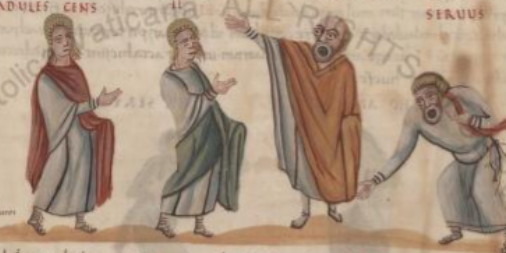
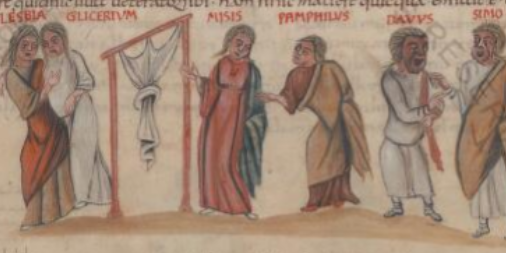
It contains the Latin comedies of Publius Terentius Afer, together with many wondrous illuminations. While far younger in date as an artefact, it is more sophisticated than the Vatican Vergil, a truly late antique codex that is also online (Vat.lat.3225), thanks to the variety and quantity of its pictures and the evidence they convey about the staging of classical theatre.

For an introduction, read the Wikipedia article, or Jeremy Norman 's outline which quotes extensively from a David Ganz book review.

Other copies of the late antique original do exist, and scholars have argued long and hard over their interrelationships. The Vatican owns one of these others, the 10th-century Basilicanus Terence, and it too is online as Arch.Cap.S.Pietro.H.19, but it is universally agreed that the Vatican Terence proper is the finest of them all.
A total of 67 manuscripts came online Nov 14. Here is the full list:
  1. Arch.Cap.S.Pietro.H.49
  2. Urb.lat.712
  3. Urb.lat.839
  4. Urb.lat.840
  5. Urb.lat.943
  6. Urb.lat.950
  7. Urb.lat.953
  8. Urb.lat.958
  9. Urb.lat.993
  10. Urb.lat.996
  11. Urb.lat.998
  12. Urb.lat.1006
  13. Urb.lat.1008
  14. Urb.lat.1013
  15. Urb.lat.1034
  16. Urb.lat.1037
  17. Urb.lat.1045
  18. Urb.lat.1048
  19. Urb.lat.1049
  20. Urb.lat.1059.pt.1
  21. Urb.lat.1059.pt.2
  22. Urb.lat.1060.pt.1
  23. Urb.lat.1060.pt.2
  24. Urb.lat.1062
  25. Urb.lat.1120
  26. Urb.lat.1121
  27. Urb.lat.1130
  28. Urb.lat.1138
  29. Urb.lat.1139
  30. Urb.lat.1140
  31. Urb.lat.1141
  32. Urb.lat.1145
  33. Urb.lat.1147
  34. Urb.lat.1151
  35. Urb.lat.1153
  36. Urb.lat.1155
  37. Urb.lat.1157
  38. Urb.lat.1158
  39. Urb.lat.1159
  40. Urb.lat.1160
  41. Urb.lat.1164
  42. Urb.lat.1165
  43. Urb.lat.1166
  44. Urb.lat.1169
  45. Urb.lat.1170
  46. Urb.lat.1173
  47. Urb.lat.1174
  48. Urb.lat.1175
  49. Urb.lat.1180
  50. Urb.lat.1192
  51. Urb.lat.1193
  52. Urb.lat.1194
  53. Urb.lat.1198
  54. Urb.lat.1205
  55. Urb.lat.1207
  56. Urb.lat.1219
  57. Urb.lat.1236
  58. Urb.lat.1237
  59. Urb.lat.1244
  60. Urb.lat.1245
  61. Urb.lat.1265
  62. Urb.lat.1266
  63. Urb.lat.1269
  64. Urb.lat.1275
  65. Urb.lat.1284
  66. Urb.lat.1293
  67. Vat.lat.3868
This is Piggin's Unofficial List number 79. If you have corrections or additions, please use the comments box below. Follow me on Twitter (@JBPiggin) for news of more additions to DigiVatLib.

2016-11-12

Cicero Palimpsest

Of all the world's palimpsests, probably the most famous is that at the Vatican Library which recovered for us much of the Roman political philosopher Cicero's work De republica (On the Commonwealth).

Palimpsests, of which Rome has a good number, mostly contain familiar texts which we hardly need to read yet again. Angelo Mai's discovery in 1819 that Vat.lat.5757, a 7th-century copy of Augustine's On the Psalms, was written over a lost book, a 4/5th-century uncial text of De republica, was immensely more thrilling.

The 151 leaves contain roughly a quarter of Cicero's dialogue, enabling us to at least read it in summary form. There are quotes from De republica in other works, but had it not been for this book recycling by the poor monks of Bobbio in northern Italy, the Cicero work would have stayed lost forever.

The digitization of the Cicero Palimpsest is very painstaking, with alternate natural-light and ultraviolet exposures to show up the undertext, and careful analysis of the bifolium and quire orders. The big text in this violet view is the Cicero:
Mai's discovery triggered 200 centuries of hunting for more palimpsests. Among the finds, the Archimedes Codex discovered by Heiberg has perhaps been the second greatest prize.

Check Jeremy Norman's brief account, or the Wikipedia article on De republica, or James Zetzel's very readable introduction via Google Books. The Cicero Palimpsest's digitization, completed on November 11, might perhaps be experienced as a reminder to all to keep faith with our political institutions after a week when Donald Trump won the US presidential election.

Naturally the codex is also of enormous interest to palaeolography, since it is an ultra-rare example of late fourth or early fifth-century uncial (CLA 1 35, Trismegistos 66130) and at the same time a quite rare example of seventh-century script (CLA 1 34, Trimegistos 66149). [Late add: see CLA too on the new Galway Database.]

Here is the full list of November 11 releases, which bring the posted total to exactly 6,100.
  1. Urb.lat.365
  2. Vat.gr.303.pt.3
  3. Vat.gr.751, Book of Job and commentary with catenae, Apollinaris of Laodicea, variously dated 13th or 14th century, or earlier according to a Wikipedia list. With many beautiful miniatures throughout, some unfinished blanks. Leaf through and admire items such as this image of Job's early wealth:
  4. Vat.lat.230, Praeparatio evangelica of Eusebius of Caeasarea, translated to Latin by George of Trebizond, HT to @LatinAristotle who notes this is one of 51 extant manuscripts of the translation.
  5. Vat.lat.484
  6. Vat.lat.533
  7. Vat.lat.939
  8. Vat.lat.957
  9. Vat.lat.990
  10. Vat.lat.992
  11. Vat.lat.1009
  12. Vat.lat.1011
  13. Vat.lat.1022
  14. Vat.lat.1023
  15. Vat.lat.1025
  16. Vat.lat.1026
  17. Vat.lat.1027
  18. Vat.lat.1035
  19. Vat.lat.1059
  20. Vat.lat.1073
  21. Vat.lat.1124
  22. Vat.lat.1126
  23. Vat.lat.1142
  24. Vat.lat.1903, Life of Hadrian
  25. Vat.lat.3173, Horace
  26. Vat.lat.3210, Pietro Bembo autograph
  27. Vat.lat.3255, Georgics, heavily annotated
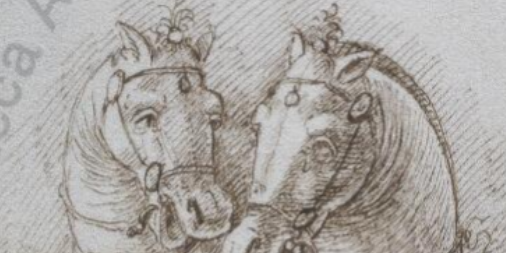
  28. Vat.lat.3302, a manuscript belonging to Fabio Mazzatosta, a very wealthy student at Rome in the 15th century who died before getting his first job. This has the Punica of Silius Italicus. At 12,000 lines this is claimed to be the longest preserved poem in Latin literature. Here, just books 1-9, 12-17. With fine illumination, plus end-paper drawings like these horses:
    This seems to be by the German artist Joachim de Gigantibus. The BAV owns five of the seven Fabio Mattatosta Codices, all commissioned by M from his pal Pomponio Leto. The others are Vat.lat.3264 (Fasti of Ovid), 3279 Thebaid Statius, 3285 (Pharsalia of Lucan) and 3875 (Silvae and Achilleis). One more is at the British Library. Source: Diz. Biografico.
  29. Vat.lat.5757 (above)
This is Piggin's Unofficial List number 78. If you have corrections or additions, please use the comments box below. Follow me on Twitter (@JBPiggin) for news of more additions to DigiVatLib.

2016-11-11

Jerome's Latin

Among the earliest Collections of the Epistles in Jerome's Vulgate is the Codex Reginensis, Reg. Lat. 9, which arrived online November 7 as part of the Vatican Library digitization program.

It has an unusual distinction: it contains attached at the front a list of liturgical readings for the mass composed not in the Vulgate, but in the Vetus Latina, the older Latin bible text previously used by western Christians. The Reginensis thus figures as a source of both bibles: as witness R to the Vulgate and as witness Beuron No. 84 to the Vetus Latina.

The codex (Lowe CLA 1 100, Trismegistos 66195) is also of course of major interest for its script, dated to the middle of the 8th century and attributed to a North Italian scriptorium, though there have, I believe, been arguments it comes from Tegernsee.

The Monday digitizations, which I can only report now after recovering from a heavy cold, took the posted total to 6,071. 
  1. Arch.Cap.S.Pietro.E.32,
  2. Ott.gr.147
  3. Pal.gr.44
  4. Reg.lat.9, Epistulary (above)
  5. Ross.1169.pt.A , old fragments recovered from bindings
  6. Ross.1169.pt.B,, ditto
  7. Ross.1217, bibliographic notes on the collection, handwritten in German on forms, presumably from the period when it was in Vienna
  8. Urb.lat.278
  9. Urb.lat.427
  10. Urb.lat.600
  11. Urb.lat.602
  12. Urb.lat.663
  13. Urb.lat.677
  14. Urb.lat.715
  15. Urb.lat.745
  16. Urb.lat.758
  17. Urb.lat.762
  18. Urb.lat.781
  19. Urb.lat.808
  20. Urb.lat.810
  21. Urb.lat.854.pt.1
  22. Urb.lat.880
  23. Urb.lat.885
  24. Urb.lat.893
  25. Urb.lat.900
  26. Urb.lat.903
  27. Urb.lat.915
  28. Urb.lat.918
  29. Urb.lat.921
  30. Urb.lat.922
  31. Urb.lat.930
  32. Urb.lat.933
  33. Urb.lat.934
  34. Urb.lat.935
  35. Urb.lat.936
  36. Urb.lat.940
  37. Urb.lat.941
  38. Urb.lat.945
  39. Urb.lat.946
  40. Urb.lat.947
  41. Urb.lat.951
  42. Urb.lat.957
  43. Urb.lat.963
  44. Urb.lat.966
  45. Urb.lat.972
  46. Urb.lat.976
  47. Urb.lat.980
  48. Urb.lat.983
  49. Urb.lat.984
  50. Urb.lat.988
  51. Urb.lat.992
  52. Urb.lat.994
  53. Urb.lat.999
  54. Urb.lat.1000
  55. Urb.lat.1009
  56. Urb.lat.1010
  57. Urb.lat.1011
  58. Urb.lat.1014
  59. Urb.lat.1015
  60. Urb.lat.1020
  61. Urb.lat.1021
  62. Urb.lat.1041.pt.1
  63. Urb.lat.1128
  64. Urb.lat.1142
  65. Urb.lat.1143
  66. Urb.lat.1148
  67. Urb.lat.1149
  68. Urb.lat.1152
  69. Urb.lat.1162
  70. Urb.lat.1163
  71. Urb.lat.1178
  72. Urb.lat.1183
  73. Urb.lat.1184
  74. Urb.lat.1185
  75. Urb.lat.1324 , a Latin translation of Aristotle's Ethics by John/Giovanni Argyropoulos (HT ot @LatinAristotle)
  76. Urb.lat.1538
  77. Vat.gr.1502.pt.1
  78. Vat.gr.1502.pt.2
  79. Vat.ebr.164
  80. Vat.ebr.329.pt.1
  81. Vat.ebr.329.pt.2
  82. Vat.lat.194
  83. Vat.lat.241
  84. Vat.lat.870
  85. Vat.lat.909
  86. Vat.lat.931
  87. Vat.lat.933
  88. Vat.lat.949
  89. Vat.lat.965
  90. Vat.lat.971
  91. Vat.lat.977
  92. Vat.lat.972
  93. Vat.lat.979
  94. Vat.lat.981
  95. Vat.lat.995
  96. Vat.lat.1004
  97. Vat.lat.1006
  98. Vat.lat.1013
  99. Vat.lat.1014
  100. Vat.lat.1020
  101. Vat.lat.1057
  102. Vat.lat.1082
  103. Vat.lat.1086
  104. Vat.lat.1090
  105. Vat.lat.1093
  106. Vat.lat.1096
  107. Vat.lat.1107
  108. Vat.lat.1121
  109. Vat.lat.1131
  110. Vat.lat.1137
  111. Vat.lat.1959
  112. Vat.lat.3285
  113. Vat.lat.3340, Paulus Orosius, Historiae adversum Paganos, 11th-century codex in Beneventan script, according to Lowe.
This is Piggin's Unofficial List number 77. If you have corrections or additions, please use the comments box below. Follow me on Twitter (@JBPiggin) for news of more additions to DigiVatLib.

2016-11-03

Italian Letters

Here are the latest 71 items digitized at the Vatican Library, most with a bearing on early modern Italian literature and history.
  1. Urb.lat.302, Orthographia of Giovanni Tortelli
  2. Urb.lat.420
  3. Urb.lat.425
  4. Urb.lat.630
  5. Urb.lat.656
  6. Urb.lat.657
  7. Urb.lat.669
  8. Urb.lat.673
  9. Urb.lat.689, Le Satire di Lodovico Ariosto
  10. Urb.lat.695
  11. Urb.lat.755
  12. Urb.lat.800
  13. Urb.lat.806
  14. Urb.lat.807
  15. Urb.lat.809
  16. Urb.lat.833
  17. Urb.lat.834
  18. Urb.lat.841
  19. Urb.lat.857
  20. Urb.lat.860, political and other discourses
  21. Urb.lat.861
  22. Urb.lat.863
  23. Urb.lat.866
  24. Urb.lat.874
  25. Urb.lat.878
  26. Urb.lat.879.pt.1, Diverse Letters, compilation dated 1612
  27. Urb.lat.879.pt.2
  28. Urb.lat.882
  29. Urb.lat.884
  30. Urb.lat.886
  31. Urb.lat.891
  32. Urb.lat.894
  33. Urb.lat.901
  34. Urb.lat.904
  35. Urb.lat.906
  36. Urb.lat.907, Cristoforo Centella, etc.
  37. Urb.lat.908
  38. Urb.lat.911
  39. Urb.lat.912
  40. Urb.lat.914
  41. Urb.lat.924
  42. Urb.lat.925
  43. Urb.lat.928
  44. Urb.lat.938
  45. Urb.lat.939
  46. Urb.lat.942
  47. Urb.lat.944, Guerriero, da Gubbio, m. 1481? Cronaca di ser Guerriero da Gubbio dall'anno MCCCL
  48. Urb.lat.948
  49. Urb.lat.949
  50. Urb.lat.952
  51. Urb.lat.955
  52. Urb.lat.956
  53. Urb.lat.961, the Ravenna Cosmography, a hugely important survey of late antique writing on geography which is preserved in three main manuscripts, all somewhat defective. Urb.lat.961 is a main source of the editions.
  54. Urb.lat.971
  55. Urb.lat.973
  56. Urb.lat.979
  57. Urb.lat.981, Cesare Nucci
  58. Urb.lat.986
  59. Urb.lat.987
  60. Urb.lat.990
  61. Urb.lat.995
  62. Urb.lat.1005
  63. Urb.lat.1022
  64. Urb.lat.1024, letters of Cardinal Alessandro Sforza
  65. Urb.lat.1031, in Spanish: 16th century, Enríquez del Castillo, Diego, 1433-1503 Cronica del rey Enrique IV
  66. Urb.lat.1032, antiquities of Crete
  67. Urb.lat.1179, Leonardo Arretino
  68. Urb.lat.1186,
  69. Urb.lat.1221, De re militari of Vegetius, 15th century, at fols 64-132v. Written (at Urbino?) by scribe Federigo Veterano.
  70. Vat.ebr.251
  71. Vat.ebr.479
This is Piggin's Unofficial List number 76. If you have corrections or additions, please use the comments box below. Follow me on Twitter (@JBPiggin) for news of more additions to DigiVatLib.

2016-10-26

Nasty Medicine

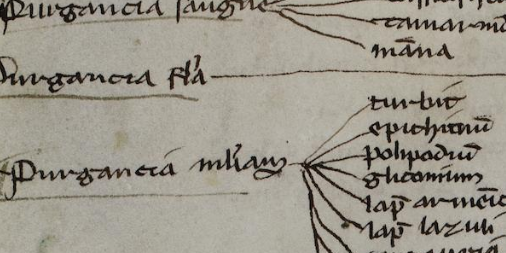
The latest big batch of online manuscripts from the Vatican Library includes medical works that list some very nasty medicines. Leafing through Pal. lat. 1084, thought to date to the 13th or 14th century, my eye was caught by a table of electuaries. In early medicine, an electuary was a mixture of powdered herbs with honey to disguise the vile taste.

Here is a purgative with 11 ingredients including lapis lazuli:
(Choke.) It would have been healthier to refuse the medicine and send the doctor away.

For the book historian, the layout demonstrates that a type of scientific stemmatic table which is found in early printed books has deep roots in medieval manuscript practice:

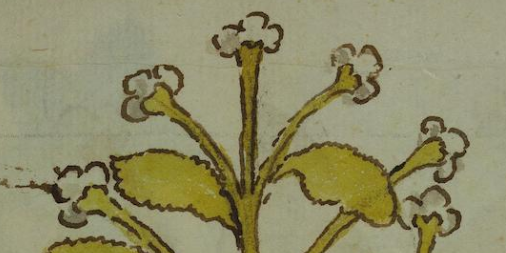
Another of the manuscripts, Pal.lat.1078, a 16th-century Italian herbal, contains fine drawings of herbs, apparently used in medicine, but also in alchemy. Here at fol. 13r is Herba Triacho (which would appear to be Tussilago farfara, a plant with small white flowers and undulate leaf margins):

The main DigiVatLib site onlined three manuscripts on October 26:
  1. Chig.G.VIII.226
  2. Urb.lat.185, Dialogues of Plato, translated to Latin, by Marsilio Ficino of Florence (thanks @LatinAristotle for correcting this)
  3. Vat.ebr.668
The Biblioteca Palatina, based in Germany, has gradually brought the 76 Vatican items below online over the past seven weeks, many medical including works by Galen. Here I summarize them from their RSS feed:
  1. Pal. lat. 762 Codicis Iustiniani imp. libri IX (13. Jh.)
  2. Pal. lat. 797 Nicolai de Messiato: Sammelhandschrift (15. Jh.)
  3. Pal. lat. 811 Repertorium universale iuridicum, theologicum, morale [Pars IV] (15. Jh.)
  4. Pal. lat. 813 Repertorium universale iuridicum, theologicum, morale [Pars VII] (15. Jh.)
  5. Pal. lat. 836 Ludolphi carthusiani liber de vita Ihesu Xpisti in ewangelio (15. Jh.)
  6. Pal. lat. 839 Ludolphi Carthusiani de vita Ihesu Xpi pars secunda a cap. I ad LVII (15. Jh.)
  7. Pal. lat. 840 Petri Trecensis (Comestoris) historia scholastica sive commentaria in Biblia (12.-13. Jh.)
  8. Pal. lat. 841 Petri Trecensis (Comestoris) historia scolastica theologice discipline (13. Jh.)
  9. Pal. lat. 843 Petri Comestoris scolastica hystoria (13. Jh.)
  10. Pal. lat. 847 Novum passionale editum a predicatore quodam, i. e. (Iacobi a Voeagine) legenda aurea sanctorum, in quatuor partes divisa (13.-14. Jh.)
  11. Pal. lat. 848 Jacobus : Iacobi a Voragine Legenda sanctorum (14. Jh.)
  12. Pal. lat. 853 Vitae patrum (14. Jh.)
  13. Pal. lat. 854 Sammelhandschrift (14. Jh.)
  14. Pal. lat. 855 Sammelhandschrift (15. Jh.)
  15. Pal. lat. 856 Sammelhandschrift (10. Jh.)
  16. Pal. lat. 857 Sammelhandschrift (1300)
  17. Pal. lat. 859 De gestis et translationibus trium Regum (15. Jh.)
  18. Pal. lat. 860 De gestis et translationibus trium Regum (15.-16. Jh.)
  19. Pal. lat. 861 Retraet(ati)o breuis et succincta perfectissime uite sanctissimeque venerabilis ac devotissime religiose gloriose memorie nomine Colete ordinis (15. Jh.)
  20. Pal. lat. 863 Sammelband (14.-15. Jh. ; 16. Jh.)
  21. Pal. lat. 865 Florenti Gregorii Turonici: Liber vitae patrum opere ; Liber in gloria confessoruni (9.-10. Jh.)
  22. Pal. lat. 866 Huberti de Romanis: Sammelhandschrift (13. Jh.)
  23. Pal. lat. 872 Livius, Titus: Ab Urbe condita (Decas III) (Italien, 15. Jh.)
  24. Pal. lat. 917 Plutarchus; Cruser, Hermann [Übers.]: Biographie des Pyrrhus und Marius, lat. (16. Jh.)
  25. Pal. lat. 967 Historia monarchiarum ;Tractatus de geographia (Deutschland, 16. Jh. (nach 1558))
  26. Pal. lat. 969 Burlaeus, Gualterus: De vita et moribus philosophorum et poetarum (Italien, 15. Jh.)
  27. Pal. lat. 987 Boethius, Anicius Manlius Severinus; Aristoteles: Sammelhandschrift (Frankreich, Ende 13. Jh.)
  28. Pal. lat. 999 Quaestiones et commentum in Logica (Deutschland, 14. Jh.)
  29. Pal. lat. 1000 Quaestiones in Logica (Deutschland, 15. Jh.)
  30. Pal. lat. 1001 Johannes (Petrus Hispanus): Summulae logicales ; Commentum in Summulas logicales Petri Hispani (Deutschland (Heidelberg?), 1491-1498)
  31. Pal. lat. 1003 Melanchthon, Philipp (Theologe); Culmann, Leonhard: Reportationes dialecticorum (IV-V) ; Disputationes seu argumentationes theologicae (Deutschland (Heidelberg?) (I) , Nürnberg (II), 16. Jh./Mitte (I) ; ca. 1545 (II))
  32. Pal. lat. 1010 Bruni, Leonardo; Aristoteles: Super Analytica posteriora Aristotelis (Deutschland, Mitte 15. Jh.)
  33. Pal. lat. 1018 Thomas : Commentum in Ethica Nicomachea Aristotelis (Deutschland, Ende 14. Jh.)
  34. Pal. lat. 1020 Aristoteles; Gerardus : Ethica Nicomachea ; Commentum in Ethica Nicomachea Aristotelis (Deutschland (Heidelberg?) (I) , Brixen (II), Mitte 15. Jh. (I) ; 1482 (II))
  35. Pal. lat. 1023 Franciscus Mediolanensis ; Ambrosius Crassus ; Leodegarius Rotomagensis: Sammelhandschrift (Nordfrankreich, 1540-1542)
  36. Pal. lat. 1028 Albertus : Commentum in Ethica Nicomachea Aristotelis (Deutschland, Ende 14. Jh.)
  37. Pal. lat. 1030 Thomas ; Burlaeus, Gualterus; Albertus : Sammelhandschrift (Paris, 1367-1370)
  38. Pal. lat. 1032 Petrus ; Aristoteles; Albertus ; Johannes : Sammelband (Deutschland, 15. Jh. (I) ; um 1387 (II))
  39. Pal. lat. 1038 Melanchthon, Philipp (Theologe): Sammelband (Wittenberg (I) , Deutschland (II), 1543 (I) ; 16. Jh. (II))
  40. Pal. lat. 1040 Johannes : Sammelhandschrift (Deutschland (Heidelberg?), 1479)
  41. Pal. lat. 1041 Johannes Egen ; Nicolaus Francus Vimacuus : In libros naturales Aristotelis (Heidelberg, 1512-1537)
  42. Pal. lat. 1043 Camerarius, Joachim (1534-1598) Centuriae viginti (Deutschland (Nürnberg?), um 1560-1584)
  43. Pal. lat. 1045 Albertus ; Johannes : Sammelband (Prag (I) , Paris? (II), 1366 (I) ; 14. Jh.)
  44. Pal. lat. 1049 Johannes ; Albertus : Sammelhandschrift (Lippspringe, 1376)
  45. Pal. lat. 1050 Petrus Nickel ; Johannes Versor: Sammelhandschrift (Leipzig (I) , Heidelberger Region (II), um 1465 (I) ; um 1530 (II))
  46. Pal. lat. 1051 Nicolaus : Compendium physicae sive de philosophia naturali (Deutschland, 15. Jh.)
  47. Pal. lat. 1052 Nicolaus : Compendium Metaphysicae (Deutschland, 15. Jh.)
  48. Pal. lat. 1053 Nicolaus ; Simon Dacus ; Johannes ; Martinus Rentz ; Johannes ; Hugo ; Luder, Petrus: Sammelband (Heidelberg, um 1469 (I) ; um 1456 (II))
  49. Pal. lat. 1055 Ovidius Naso, Publius; Aristoteles; Valerius Flaccus Setinus Balbus, Gaius; Propertius, Sextus; Cicero, Marcus Tullius; Vergilius Maro, Publius: Sammelhandschrift (Deutschland , Leipzig, um 1488)
  50. Pal. lat. 1057 Rocca, Angelo: Commentum in topica Aristotelis (Italien?, 14. Jh.)
  51. Pal. lat. 1058 Knab, Erhardus; Aegidius ; Thomas ; Ps.-Augustinus: Sammelhandschrift (Frankreich und Deutschland, 15. Jh. (1400-1427))
  52. Pal. lat. 1069 Crescentiis, Petrus /de: Ruralia commoda, Libri XII (Italien, 14. Jh.)
  53. Pal. lat. 1072 Grynäus, Simon: De ignitorum meteororum natura commentarii duo ; De cometa anni 1577 ; De planeta Veneris conspecta anno 1578 (Heidelberg, 1579-1582)
  54. Pal. lat. 1078 Herbarium (Italien, 16. Jh.)
  55. Pal. lat. 1082 Galenus; Hippocrates; Ibn-Riḍwān, ʿAlī: Medizinische Sammelhandschrift: Articella (Italien, 13./14. Jh.)
  56. Pal. lat. 1084 Galenus; Archimatthaeus; Baron, Roger; Johannes ; Trotula; Gilbertus : Medizinische Sammelhandschrift (13./14. Jh.)
  57. Pal. lat. 1085 Baron, Roger; Aegidius ; Johannes (Petrus Hispanus): Medizinische Sammelhandschrift (13./14. Jh.)
  58. Pal. lat. 1086 Johannes Calderia; Aegidius : Medizinische Sammelhandschrift (2. Hälfte 15. Jh.)
  59. Pal. lat. 1087 Johannes ; Johannes : Medizinische Sammelhandschrift (13./14.. Jh.)
  60. Pal. lat. 1089 Johanntitius; Hippocrates; Theophilus; Philaretus; Galenus: Medizinische Sammelhandschrift: Articella (1. Drittel 14. Jh.)
  61. Pal. lat. 1091 Galenus: Liber collecorii (Heidelberg, letztes Viertel 15. Jh.)
  62. Pal. lat. 1103 Galenus; Ibn-Riḍwān, ʿAlī: Medizinische Sammelhandschrift: Articella (1. Hälfte 14. Jh.)
  63. Pal. lat. 1104 Galenus; Ibn-Māsawaih, Abū-Zakarīyā Yūḥannā; Guilelmus : Medizinische Sammelhandschrift: Articella (Italien, 1. Hälfte 14. Jh.)
  64. Pal. lat. 1106 Serapio : Liber aggregationum in medicinis simplicibus (Deutschland, 15. Jh. (1439))
  65. Pal. lat. 1107 Serapio ; Petrus : Medizinische Sammelhandschrift (Bologna, 15. Jh. (1426))
  66. Pal. lat. 1132 Johannes Matthaeus de Gradibus; Bacon, Rogerus: Medizinische Sammelhandschrift (Heidelberg, 1473)
  67. Pal. lat. 1140 Isrāʾīlī, Isḥāq Ibn-Sulaimān /al-; Knab, Erhardus; Johannes Matthaeus Ferrarius de Gradi: Medizinische Sammelhandschrift (Heidelberg, 1472)
  68. Pal. lat. 1349 Euclides; Johannes Andreae; Petrus Bertrandus; Bartholomaeus ; Galenus; Rāzī, Muḥammad Ibn-Zakarīyā /ar-; Albertus ; Bonaventura: Miscellanea (Paris, Speyer, 1360-1370)
  69. Pal. lat. 1485 Cicero, Marcus Tullius: Orationes (Italien, 15. Jh.)
  70. Pal. lat. 1509 Cicero, Marcus Tullius: Epistulae (Italien (Venedig), 15. Jh.)
  71. Pal. lat. 1516 Cicero, Marcus Tullius: Opera (Italien (Toskana), 15. Jh.)
  72. Pal. lat. 1517 Cicero, Marcus Tullius: Sammelhandschrift (Frankreich , Italien, 15. Jh.)
  73. Pal. lat. 1541 Seneca, Lucius Annaeus : Sammelhandschrift (Deutschland, 15. Jh.)
  74. Pal. lat. 1583 Boethius, Anicius Manlius Severinus; Pius / Enea Silvio Piccolomini; Plutarchus; Bruni, Leonardo; Bonjohannes : Sammelhandschrift (Heidelberg, 15. Jh.)
  75. Pal. lat. 1585 Boethius, Anicius Manlius Severinus; Pius / Enea Silvio Piccolomini; Petrarca, Francesco; Seneca, Lucius Annaeus : Sammelhandschrift (Deutschland, 15. Jh.)
  76. Pal. lat. 1824 Luther, Martin: Auslegung der ersten 25 Psalmen (Weimar, 1556)
  77. Pal. lat. 1957 Französische Bibel (Nordostfrankreich, Anfang 14. Jh.)
This is Piggin's Unofficial List number 75. If you have corrections or additions, please use the comments box below. Follow me on Twitter (@JBPiggin) for news of more additions to DigiVatLib.

2016-10-24

First Handbook

If you are keen on historic warfare or the fantastical war machines created for battles in Peter Jackson's Lord of the Rings films, you'll be hooked by a 1455 book by Roberto Valturio on the military arts which is full of wonderfully creative images of military machines, real and imagined.

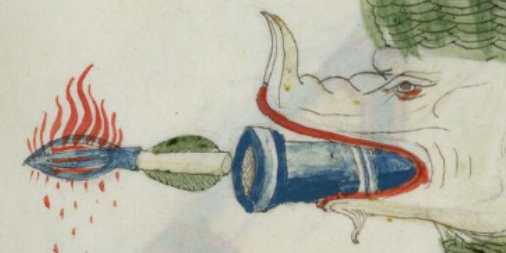
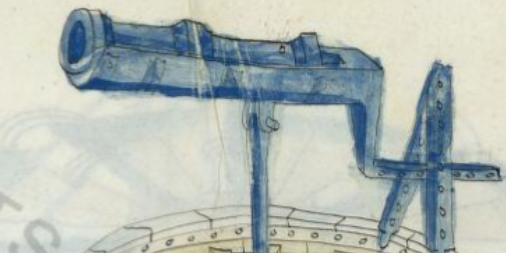
The Vatican Library's manuscript of De re militari (On matters military) arrived online October 24 and Urb.lat.281 is a real page-turner. Leonardo da Vinci is reputed to have read this and to have been inspired by it to some of his own inventions. On folio 147v we find an astonishing dragon machine with a cannon in its snout, capable of firing incendiary missiles:

That is just part of the image.This particular dragon just happens to have a basket on its head with nine commandos wearing blue helmets, ready to jump down and hack you to bits.

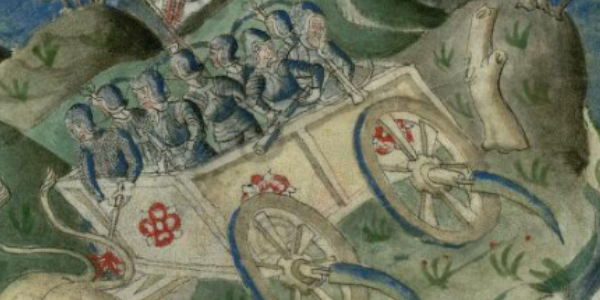
Who doesn't remember the James Bond Aston-Martin with knives that emerge from the hubcaps? In this book, it's a heavy battle-wagon drawn by oxen that does the same.

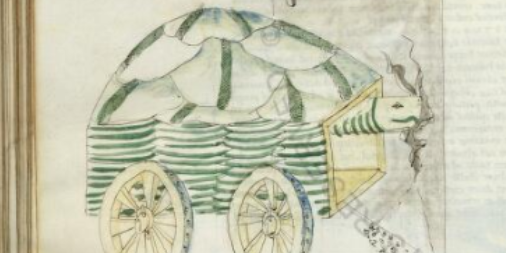
On  fol. 168v there's a tortoise, a machine for getting up close to walls and battering them down, and of course it even looks like a tortoise:

Ponder the weird raking fire weapon on fol. 166r:

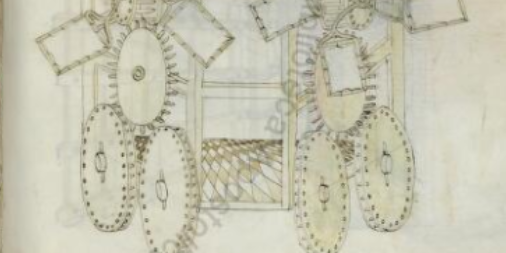
Or how about some 15th-century Meccano on fol. 144r:

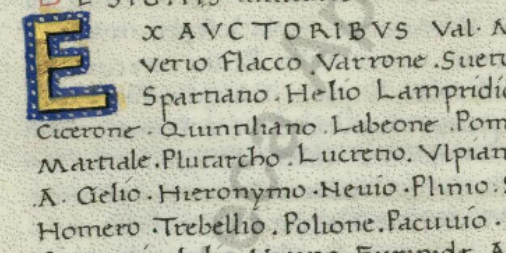
Valturio (1405–1475) (see French Wikipedia) was a man of letters rather than a proper engineer and this handbook is derivative rather than original. It even starts off with a copious list of sources:

De re militari is also remarkable in book history. A couple of dozen manuscripts were made at great cost to be presents to princes (this is Federico da Montefeltro's copy), but 17 years later a print version appeared in 1472 for the new mass market. It is regarded as the first modern handbook on any subject, dealing with the entirety of its topic in a systematic way, and integrating images and text.

A total of 72 manuscripts came online in this batch. Here is the full list:
  1. Pal.gr.14
  2. Pal.gr.265
  3. Urb.lat.81
  4. Urb.lat.96
  5. Urb.lat.248 , ‏@LatinAristotle on Twitter (Pieter Beullens) points out this is Galen, De simplicium medicamentorum facultatibus in the Latin of Niccolò da Reggio
  6. Urb.lat.281, De re militari (above). Anthony Grafton's Rome Reborn catalog calls the book the most important Renaissance forbear of Machiavelli's Art of War. The St. Louis catalog notes that this copy is dated May 11, 1462 and signed by the scribe Sigismondi Nicolai Alamani.
  7. Urb.lat.410
  8. Urb.lat.423
  9. Urb.lat.674
  10. Urb.lat.732
  11. Urb.lat.740
  12. Urb.lat.763
  13. Urb.lat.772
  14. Urb.lat.774
  15. Urb.lat.789
  16. Urb.lat.793
  17. Urb.lat.797
  18. Urb.lat.812
  19. Urb.lat.814.pt.
  20. Urb.lat.820.pt.1
  21. Urb.lat.823.pt.3
  22. Urb.lat.825.pt.2
  23. Urb.lat.827.pt.1
  24. Urb.lat.827.pt.2
  25. Urb.lat.828.pt.3
  26. Urb.lat.829.pt.1
  27. Urb.lat.829.pt.2
  28. Urb.lat.829.pt.3
  29. Urb.lat.832.pt.2
  30. Urb.lat.836
  31. Urb.lat.837
  32. Urb.lat.847
  33. Urb.lat.848
  34. Urb.lat.850
  35. Urb.lat.854.pt.2
  36. Urb.lat.855
  37. Urb.lat.868
  38. Urb.lat.870
  39. Urb.lat.873
  40. Urb.lat.881
  41. Urb.lat.883
  42. Urb.lat.887
  43. Urb.lat.889
  44. Urb.lat.890
  45. Urb.lat.892
  46. Urb.lat.897
  47. Urb.lat.910
  48. Urb.lat.916
  49. Urb.lat.923
  50. Urb.lat.926
  51. Urb.lat.927
  52. Urb.lat.931
  53. Urb.lat.960
  54. Vat.gr.303.pt.1
  55. Vat.gr.303.pt.2
  56. Vat.lat.855
  57. Vat.lat.897
  58. Vat.lat.920
  59. Vat.lat.922
  60. Vat.lat.923
  61. Vat.lat.947
  62. Vat.lat.951
  63. Vat.lat.960
  64. Vat.lat.963
  65. Vat.lat.996
  66. Vat.lat.1002
  67. Vat.lat.1028
  68. Vat.lat.1031
  69. Vat.lat.1032
  70. Vat.lat.1043.pt.2
  71. Vat.lat.1089
  72. Vat.lat.3281, a magnificent old palimpsest containing fragments from a 5th- or 6th-century Vulgate Bible, scribed in southern Italy perhaps as soon as 50 years after the death of Jerome. It was torn apart and re-used in the 12th century for the Achilleid of Statius in Beneventan script (Lowe 1 14, Trismegistos 66110).
This is Piggin's Unofficial List number 74. If you have corrections or additions, please use the comments box below. Follow me on Twitter (@JBPiggin) for news of more additions to DigiVatLib.

2016-10-23

Chart Before Jerome

Before Jerome of Stridon produced his revised Latin version of the Christian Bible in about 400 CE, the version that remains in use today, a Latin edition by translators unknown had existed and had been in wide use. The Great Stemma, the world's oldest network diagram, is product of that culture.

My new reconstruction of the Great Stemma appeared several weeks ago, initially in an English translation. Hot off the press today is an update containing the Vetus Latina or Old Biblical Latin text.

Seeing the chart reconstructed to the original shape is amazing enough. Seeing it in its original language from the time before Jerome adds to the verisimilitude. We don't know exactly when the Great Stemma was made. It was certainly before 427 CE. If it was not made before 400, its ignorance of Jerome's work is in no way surprising. It took centuries for the Jerome Bible to establish itself.

Flipping text upside-down and making it land dead centre in every circle or roundel were among the challenges in the initial reconstruction. One of my difficulties this time round was squeezing these Vetus Latina labels, which mostly take the stereotypical form of "Salomon filius David" (Solomon son of David), into the roundels.

It helped to adopt a condensed/narrow font (CSS: font-family: "Arial Narrow", "Helvetica Condensed", Arial, Helvetica, sans-serif;), but many of the labels still burst the confines of the circles. In a handwritten chart, you used to be able to vary the text size or squeeze it close together, or split words in unconventional ways. With modern, regularized, typographical text, that is hardly possible, and I did not want to make the text any smaller or it would not have given the impression the chart used to make, so I have allowed labels to spill when they are too long. Tell me what you think.