2018-04-20
Digital Mappa(emundi) is Back
The idea was to create portals where digital images of manuscripts overlaid with digital plots and transcriptions and coexist with hyperlinks to similar manuscripts so that readers could explore them with ease. In the years since DM first poked its head above the parapet, I heard of various projects of a similar nature which generally seemed to die when grants ran out or the poor student doing the donkey work graduated.
Perhaps the biggest deal in this period was the creation of IIIF, a standard to mark up manuscripts so that they can be exhibited online side by side. I still find IIIF a bit baffling, with a dearth of tutorials and models.
Let's be frank: the way the web has always grown in the 20 years I have known it is that you find a good portal and then shamelessly pirate its code and its best features for your own project. I presume my own code has babies all over the place. But I have never found any IIIF project I could clone, and will be interested to see if DM sites are capable of parthogenesis. DM says it will be IIIF-capable from next year in a planned update. The indication that you need a network admin to start a DM project already sounds off-putting: is it that hard?
For a look around, try the Virtual Mappa collection, which contains various mappaemundi from London. I haven't yet seen enough to review it, though the images seem to take forever to load. The Twitter feed takes you through some of the important features. For the time being, I am continuing to make simple SVG digital plots like that of the Albi Mappamundi which I presented earlier this week.
2018-04-18
A New Look at the Albi Mappamundi
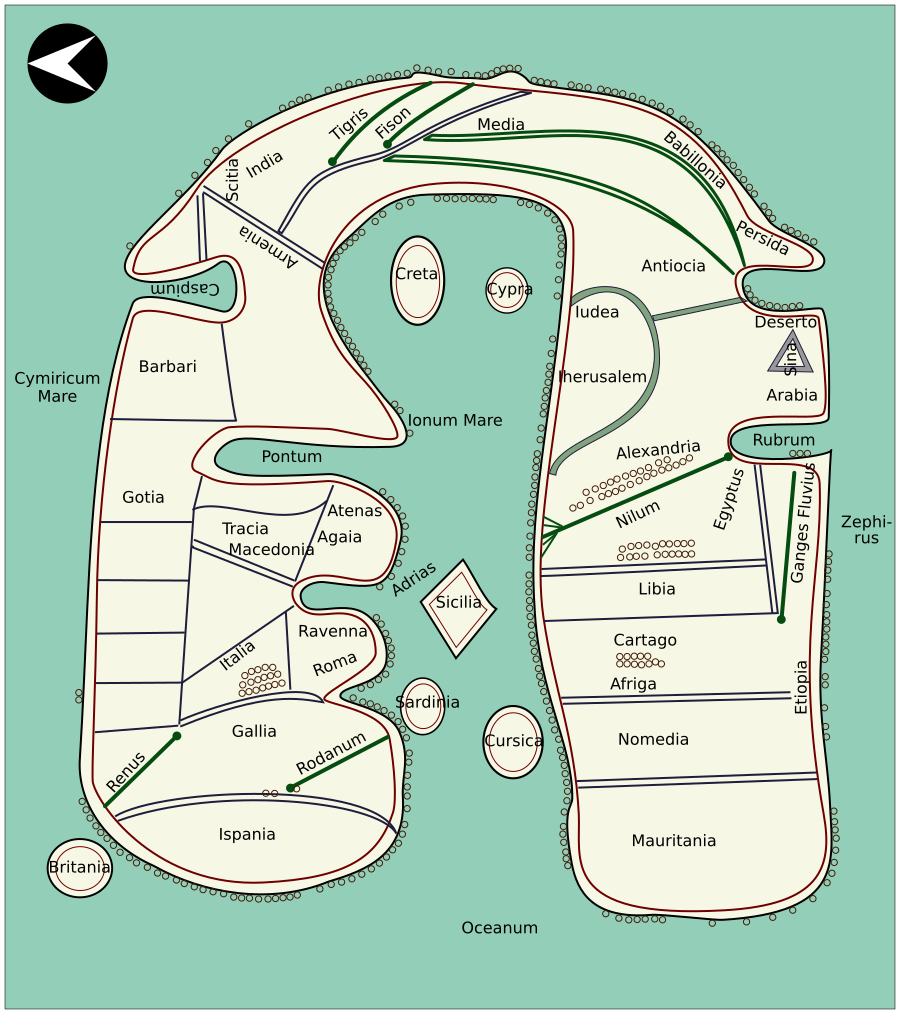
I have just digitally plotted the Albi Mappamundi with a view to adding it to my Library of Latin Diagrams:
The inspiration for this burst of activity was the appearance online of a very comprehensive, very up-to-date article about the Albi Mappamundi by Anca Dan. La mappemonde d'Albi - un pinax chôrographikos was published in December and she has just been kind enough to post a scan of the article on her Academia.edu page.
She traces this early medieval mappamundi back to a model by Eucher of Lyon, a late-antique Christian leader, based in turn on similar diagrams from his own schooling.
The article's title subtly reminds us that the word mappamundi would have drawn blank looks in antiquity. The term did not exist then. If you had however said pinax chôrographikos (based on a couple of Greek-origin words) to Eucher, he would have got your drift.
Schools in classical and late antiquity did not teach geography (too mathematical and of no practical use) but chorography (the size, accessiblity, appearance and hospitableness of places, who lived in them, what they produced). So this is a chorographic pinax (chart). Because of that human-practical focus, a mappamundi never shows the absolute positions of places like a true map, but rather their relative positions: what you have to pass by or cross to arrive at a further place.
Readers will recall that I wrote a blog post in 2016 about the arrival online of the Vatican Mappamundi, which is bound (fol. 63v-64r) in codex Vat.lat.6018. The Albi Mappamundi has been online since its Unesco recognition in 2014. Unfortunately I cannot link you directly to fol. 57v-58r of the codex which contains it. Go to the opening page of that codex, ms Albi 29, and page through to image 115.
2018-04-17
Tatty Endpapers
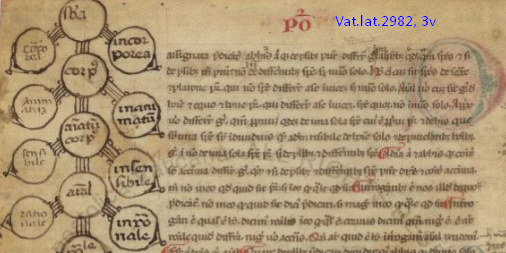
Vat.lat.2982 has annotations galore, tatty endpapers, a worn binding and looks, frankly, grubby. It not only contains Boethius, De Interpretatione, and his translations of De Sophisticis Elenchis and Topica by Aristotle, but also neat diagrams including his famous arbor porphyriana:
This is not included in my handlist of the medieval Boethius arbor manuscripts as it is apparently too modern. I wonder what model it was copied from.
Here is the full list of 38 new manuscripts:
- Reg.lat.945,
- Vat.lat.2191 (Upgraded to HQ),
- Vat.lat.2198,
- Vat.lat.2365,
- Vat.lat.2836 (Upgraded to HQ),
- Vat.lat.2837 (Upgraded to HQ),
- Vat.lat.2839, astrology (?) notes by the humanist poet Giovanni Pontano (1426–1503), hence the listing in the eTK index of science manuscripts with the incipit Aristoteles rerum nature indagator solertissimus
- Vat.lat.2844,
- Vat.lat.2855,
- Vat.lat.2864,
- Vat.lat.2867,
- Vat.lat.2896,
- Vat.lat.2898,
- Vat.lat.2899,
- Vat.lat.2906 (Upgraded to HQ), 15th-century humanist compilation with Pseudo-Cicero, Livy, Antonio Beccadelli, Leonardo Bruni, Lucio da Visso, four letters of Bartolomeo Facio, etc. With an incipit that runs right around the page,
- Vat.lat.2911,
- Vat.lat.2913,
- Vat.lat.2915 (Upgraded to HQ),
- Vat.lat.2919,
- Vat.lat.2922,
- Vat.lat.2925,
- Vat.lat.2933,
- Vat.lat.2935,
- Vat.lat.2939 (Upgraded to HQ),
- Vat.lat.2941,
- Vat.lat.2942,
- Vat.lat.2960,
- Vat.lat.2964,
- Vat.lat.2968 (Upgraded to HQ),
- Vat.lat.2969 (Upgraded to HQ),
- Vat.lat.2974 (Upgraded to HQ), Latin translation by Jacopo Angelo of Ptolemy's Cosmographia (8 books), sadly without maps
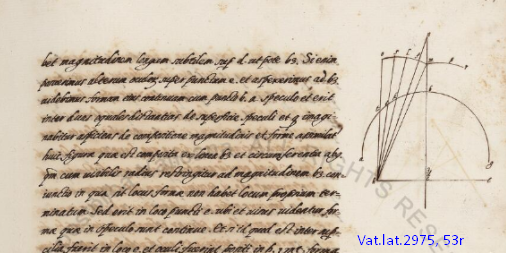
- Vat.lat.2975 (Upgraded to HQ), a 16th-century translation of works of the Arab scientist Ibn al-Haytham or Al Hazen. eTK has the incipit Ostendam quid sit crepusculum. With drawings of his optics:
- Vat.lat.2982 (Upgraded to HQ), a well-worn and much-annotated Boethius (above)
- Vat.lat.2984,Aristotle, De somno et vigilia, translatio vetus. Nice initial: she is sleeping while he lies wide awake! From the newest images @DigitaVaticana, as always listed by @JBPiggin, to whom we are truly thankful!https://t.co/XXL0LhC4oR pic.twitter.com/6n6U8Yj6Qt— Pieter Beullens (@LatinAristotle) April 17, 2018
- Vat.lat.2987,
Coming back to the Aristotelians in last week's @DigitaVaticana listed by @JBPiggin. Translation of the Physica by Andrea Biglia, Augustinian hermit (+ 1435).https://t.co/TBLHuTE0ks pic.twitter.com/eCp8GNTHus
— Pieter Beullens (@LatinAristotle) April 22, 2018 - Vat.lat.3120,
- Vat.lat.3125,
- Vat.lat.3128,
2018-04-09
The Red Hat Man
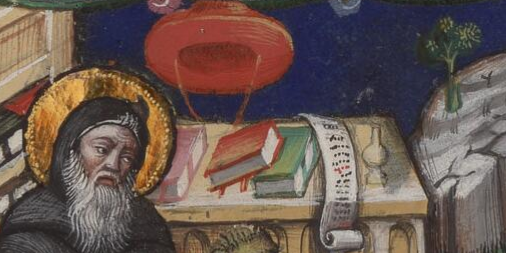
An illumination in a 15th-century (?) Vatican manuscript digitized in the past week, Vat.lat.2277, gives Jerome the full hat treatment, plus a messy desk covered with his codices and scrolls to translate the Bible into Latin, a fanciful 5th century Holy Land scene outside and a golden halo:
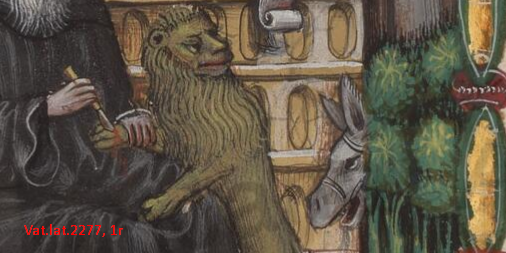
An older legend, first documented in 615 according to Reklams Lexikon, has it that Jerome helped a raging and distressed lion by removing a thorn from its paw. The illumination shows a remarkably calm lion accepting a fix from Jerome's manuscript knife, while the monastery donkey pops its head around the corner to bray. Look up the donkey's story if you haven't read it before. It's quite baroque.
There are 23 new manuscripts on the Digita Vaticana site:
- Chig.H.VIII.248, Cicero, Rhetorica de Oratore
- Vat.lat.2175, Petri de Ebano, Problemata Aristotlensis
One day after my visit to Padova, its famous son Pietro d'Abano turns up in @JBPiggin's list of MSS @DigitaVaticana. MS of his expositio of the pseudo-Aristotelian Problemata.https://t.co/vS5UwleDIj pic.twitter.com/UVwZcj2qGU
— Pieter Beullens (@LatinAristotle) April 9, 2018 - Vat.lat.2232, 14th century manuscript of Iohannes Andreae, c.1270-1348 Novella on the Decretals of Gregory
- Vat.lat.2234, ditto
- Vat.lat.2277, Johannes de Imola on the Decretals of Gregory (above)
- Vat.lat.2306 (Upgraded to HQ), Gulielmi Rayotis, Compendium Summae Confessorum
- Vat.lat.2765, Horace
- Vat.lat.2832, Andria, a comedy by Terence adapted from a Greek play by Menander. Explicit: "valete et plaudite Caliopius recensui". Bibliography (as of 2018-04-09) mistakenly points to a work dealing with Vat.lat.2382.
- Vat.lat.2838, poetry by Giovanni Pontano (1426–1503), humanist and poet from the Duchy of Spoleto: autograph from the library of Angelo Colocci
- Vat.lat.2847, Latin poetry, first item by Jacopo Sannazaro
- Vat.lat.2854 (Upgraded to HQ),
- Vat.lat.2860 (Upgraded to HQ),
- Vat.lat.2870, poetry of Antonio Flaminio, see tweet below
- Vat.lat.2886 (Upgraded to HQ), Cicero, De officiis
- Vat.lat.2888, Cicero, De officiis, heavily annotated in the 14th century. The endpapers are from a 12th or 13th century manuscript of the Institutions of Justinian
Studying can be boring... until you meet a "Smiley-Q" looking at you!
— Digita Vaticana (@DigitaVaticana) April 9, 2018
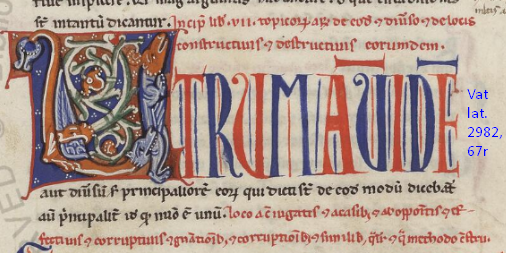
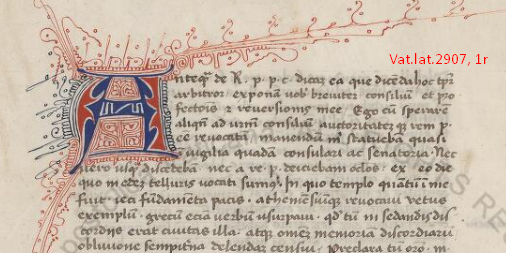
Vat. lat. 2888, 14th C., Marcus Tullius Cicero, De officiis lib. I-III; Vat. lat. 2870, 15th-16th C., Antonio Biaxander (Antonio Flaminio or Flaminio Siculo), collection of poems. #LatestDigitizedManuscripts pic.twitter.com/4kNU2pXjzy - Vat.lat.2907, Cicero, Philippic Orations, also with old lawbooks as endpapers, and this wild overblown initial A:
- Vat.lat.2914, on rhetoric
- Vat.lat.2923 (Upgraded to HQ), Juan de Segovia
- Vat.lat.2931,
- Vat.lat.2932, Philodoxeos fabulae
- Vat.lat.2965, Tacitus
- Vat.lat.2966,
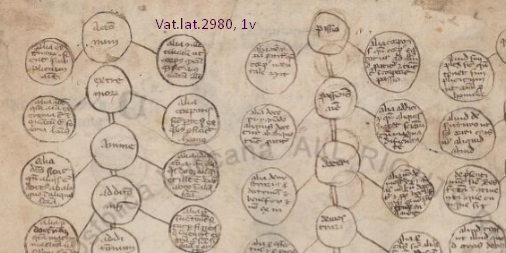
- Vat.lat.2980, Boethius: Latin translation of Aristotle's Categoriae (?), plus Boethius De Interpretatione, according to Nils Galindo-Sjöberg's list. Heavily annotated by a previous owner who also did stemmatic drawings at the front.
2018-04-02
Gore in Church
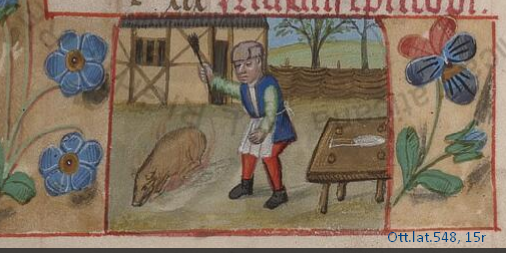
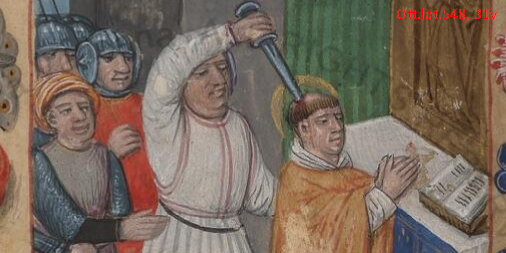
Savour its images which include a butcher about to catch and kill a pig and a scary scene where the king of England's thugs are about to kill Thomas Becket in the cathedral at Canterbury:
According to Morello, that BoH is Use of Sarum and Calendar of Lincoln, though made in Flanders
— AaronM (@gundormr) April 3, 2018
Book of Hours (end of 15th C.) illuminated in Flanders for the English trade. The illustration of the Calendar includes the signs of the zodiac arranged in medallions, and agricultural scenes depicting the activities of the individual months. #April 🌷🌼🌸 https://t.co/CKsvXLXbx1 pic.twitter.com/MDQZCGnQa2
— Digita Vaticana (@DigitaVaticana) April 4, 2018
In all, we have 23 new items to enjoy:@DigitaVaticana https://t.co/W2BGudBDck.165 is the newest BoH added, Use of Sarum but calendar for Lincoln. Messy calendar, versos of July and Sept. are wrong by a day. In Aug. Vigil but no feast for Assumption. July also missing 27th (f.10v)#medievaltwitter (h/t @JBPiggin ) pic.twitter.com/p8yoy7q2fN
— CoKL Database (@cokldb) April 4, 2018
- Ott.lat.548, a book of hours (above)
- Vat.lat.519.pt.2,
- Vat.lat.1951.pt.2, Plinii Naturalis Historiae in a Renaissance codex of high value. This part starts Liber XII. I. Animalium omnium
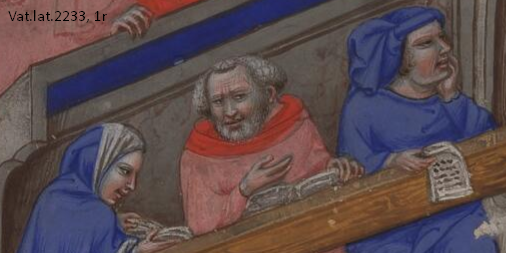
- Vat.lat.2233, 14th century, finely illuminated Apparatus in Sextum Bonifatii VIII of
Iohannes Andreae, c.1270-1348 - Vat.lat.2333,
- Vat.lat.2760,
- Vat.lat.2842, Giovanni Pontano
- Vat.lat.2861,
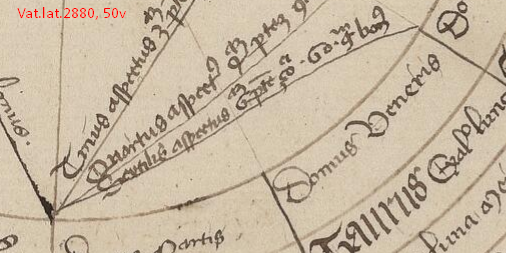
- Vat.lat.2880 (Upgraded to HQ), a 15th-century mixture of Cicero, various Quaestiones on Aristotle and a text by John of Saxony, incipit "Istam propositionem scribit Ptolomeus in sapientiis Almagesti..." Here is an astrological diagram:
Also in @JBPiggin's list of freshly digitized MSS @DigitaVaticana, this collection of commentaries on Aristotle's Parva Naturalia (here the opening of the section on the Physiognomia).https://t.co/7pqh0yk0hB pic.twitter.com/6N21sZfpN8
— Pieter Beullens (@LatinAristotle) April 3, 2018 - Vat.lat.2890, 15th century Cicero, De officiis
- Vat.lat.2900, Rhetoricam ad Herennium, heavily glossed, 14th century
- Vat.lat.2910, Cicero and Leonardi Bruni translation of Plato
- Vat.lat.2912 (Upgraded to HQ), an album of classic writers in a peculiar high-oblong format
- Vat.lat.2916,
- Vat.lat.2918 (Upgraded to HQ), Giovanni Gatti of Messina
- Vat.lat.2921 (Upgraded to HQ),
- Vat.lat.2926 (Upgraded to HQ), George of Trebizond, translations of Plato, etc.
Autograph copy of a letter by humanist scholar & translator Georges of Trebizond to Guarino Veronese. HT @JBPiggin https://t.co/z1QmRib9HV pic.twitter.com/sSdWRJc3ww
— Pieter Beullens (@LatinAristotle) April 3, 2018 - Vat.lat.2929, Marsilio Ficino, commentary on Plato
- Vat.lat.2934.pt.1, Ficino and others, Plato etc.
- Vat.lat.2944,
- Vat.lat.2959, chronica, including list of French kings on last folio
- Vat.lat.3393, LQ
- Vat.lat.8171 (Upgraded to HQ), a catalog of the Reginensis collection by Vatican librarian Lucas Holstenius (1596-1661)
2018-03-26
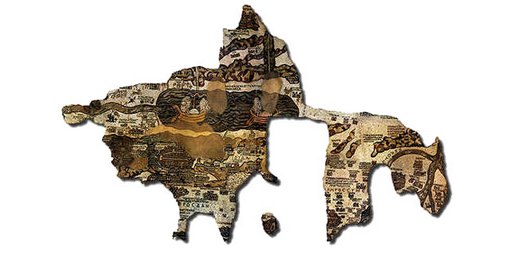
Madaba Map online at last
Four or five hundred years earlier, over-the-horizon diagrams had not been part of the culture. There is a continuing controversy about the Agrippa Survey, a public mural in Rome mentioned (once only) by Pliny the Elder which detailed the regions of the empire and their sizes. Whether it was a list or a diagram has never been conclusively proved.
Topological diagrams come into their own in late antiquity, with the Tabula Peutingeriana (preserved in one roll-form manuscript in Vienna, ÖNB cod. 324) and the Madaba "Map" as the two key examples. The fragment at Madaba is a mosaic floor in a church. It was originally much larger. But even depleted, its colorful depiction of Palestine and Jerusalem is amazing.
While the Tabula Peutingeriana is now online in the highest resolution at the Vienna library and in more convenient form at Richard Talbert's website, quality reproductions of the Madaba Mosaic are unfindable online. To my knowledge it has been published only twice: a painstaking colored drawing at 1:4 scale by Paul Palmer in 1906, and in a book of photographic plates by Herbert Donner.
A few weeks ago I decided to do something about this problem. I contacted the University of Toronto Library, where the Robarts Collection owns a printed copy of the Palmer drawing in the form of a large-format book printed at Leipzig. Palmer died in 1935, so the book is in the public domain. I suggested it be added to the library's admirable digitization program. Now, a few weeks later, it can be inspected online at the Archive.org library of books.
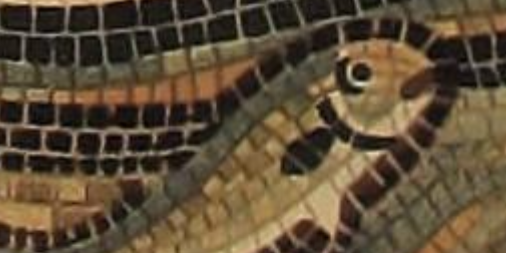
Here's a fish in the River Jordan:
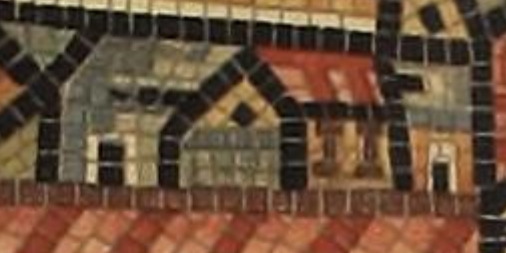
These are houses in the city of Jerusalem:
Palmer was a Jerusalem architect of German-Swiss extraction, who relates in a short autobiography online:
During our involuntary stay at the Jordan we were told by some Arabs of Madeba that a beautiful mosaic-map of Palestine had been found while they were flooring the new Greek church. We decided to ride to Madeba at the first opportunity and to inspect this mosaic-map, to sketch it or to take some photographs. But, when we got there we could not get a true picture. Later by accident, two painters were staying in Jerusalem and I rode with them to Madeba. Working for several days, I made a drawing of the mosaic-map, I painted the exact colours of each of the stones and a copy of the original painting will still be obtainable from the Society of the German League for Exploration of Palestine (Gesellschaft des deutschen Vereins zur Erforschung Palästinas).Herman Guthe (1849-1936) who wrote the book of commentary issued with the map, tells a slightly different story, in the Zeitschrift des Deutschen Palästina-Vereins, saying the board of the society commissioned the drawing and Palmer travelled to Madeba in May 1901 to make it. Guthe notes how difficult travel then was: just the horse ride from the bank of the Jordan up to Madaba took eight hours.
A summary of sorts by Aharon Yaffe appeared in the Israel Review of Arts and Letters in 1998. The Palmer drawing at half size was republished in 1954 in Professor Avi Yonah's book, The Madaba mosaic map: with introduction and commentary (not online) and on a single sheet by the same publisher, the Israel Exploration Society, but eSbírky.cz in Prague, the only digital image repository holding the latter, seems to be permanently down.
Ill-lit tourist snaps of the mosaic are of no help and UNESCO's listing of the whole Um er-Rasas World Heritage site of which the church is part does not have any image of whole floor. Göttingen University's facsimile of the mosaic is good, but individual stones are not resolved in the online image.
That is why the long-overdue appearance of the mosaic online at a resolution where you can read all its detail is such a reason for celebration. Explore it and enjoy.
2018-03-25
Cicero Codex , Key to Roman Idea of Cognition
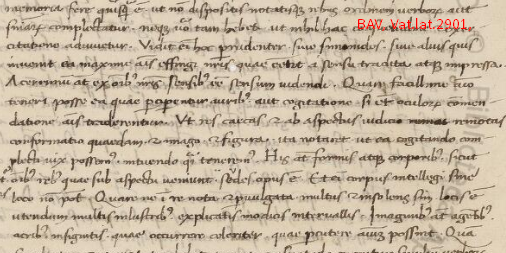
Only one direct copy of this lost Codex Laudensis (L) made during those four years exists. As our Easter present, the Vatican Library has just digitized Vat.lat.2901 (V) and placed it online.
Cicero mentions the science of visual perception while introducing the palace-of-memory method of memorizing what to say whenever you are speaking without notes. He starts by quoting the generally correct view of cognitive science of his own day that the keenest of all our senses is the sense of sight (acerrimum autem ex omnibus nostris sensibus esse sensum videndi -- Cicero, De Oratore II, 357.)
He develops from this the method to leverage your visual memory, a method of which he was not the inventor, but becomes a precious witness. It starts with the observation that:
... perceptions received by the ears or by reflection can be most easily retained in the mind if they are also conveyed to our minds by the mediation of the eyes ... (2.357: qua re facillime animo teneri posse ea, quae perciperentur auribus aut cogitatione, si etiam commendatione oculorum animis traderentur).He then describes what we would now call gist memory:
... with the result that things not seen and not lying in the field of visual discernment are earmarked by a sort of outline and image and shape so that we keep hold of (as it were by an act of sight) things that we can scarcely embrace by an act of thought. (Ut res caecas et ab aspectus iudicio remotas conformatio quaedam et imago et figura ita notaret, ut ea, quae cogitando complecti vix possemus, intuendo quasi teneremus).And then segues over to what we would call spatial perception and memory, pointing out its role in combination with the somewhat different visual memory.
But these forms and bodies, like all the things that come under our view require an abode, inasmuch as a material object without a locality is inconceivable. (2.358: His autem formis atque corporibus, sicut omnibus, quae sub aspectum veniunt, [admonetur memoria nostra atque excitatur;] sede opus est, etenim corpus intellegi sine loco non potest.The method of memorizing, which he attributes to the legendary Greek orator Simonides, is to imagine a familiar place and stock it in your imagination with visual marker tags for things you want to remember. The technique is still being taught nowadays. Here's the place, folio 53v, where it is set out:
The above text was also preserved in a lost Carolingian manuscript, known as M, but none of the copies of M existing today is a direct one, which is to say they are copies of copies (of copies).
V is one of 63 manuscripts just released online. Here is the full list:
- Barb.lat.298,
- Ott.lat.3368,
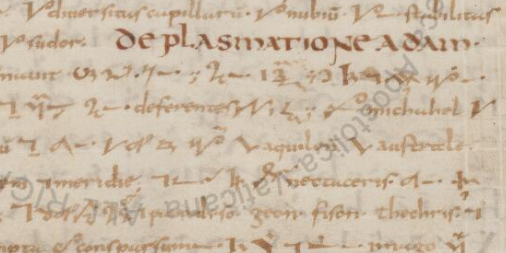
- Reg.lat.846 (Upgraded to HQ), 9th century, from France, possibly theTours region; provenance Paris, St. Sulpice. One of the codices containing (fols. 106v-107r) a fascinating little text on the origin of the name Adam: it says that Adam was created from earth brought by the four archangels from the four corners of the world, sprinkled with water from the four rivers of Paradise, inspired by the four winds, and named after the four stars. Hence the four letters of his name. Charles Wright, creator of wonderful medieval manuscript surveys, has just published an article about this in The Embroidered Bible: Studies in Biblical Apocrypha and Pseudepigrapha in Honour of Michael E. Stone, eds Lorenzo DiTommaso, Matthias Henze, William Adler (ISBN: 9789004355880).
- Reg.lat.2123,
- Urb.lat.1251 (Upgraded to HQ),
- Vat.lat.858.pt.1,
- Vat.lat.858.pt.2,
- Vat.lat.936,
- Vat.lat.1473.pt.1,
- Vat.lat.1473.pt.2,
- Vat.lat.2169, Relative drought of Aristotelian material in @JBPiggin's latest list of MS @DigitaVaticana. Sententia on the Ethics by Henry of Friemar (Henricus de Alemania), an Augustinian hermit from the first part of the 14th c.https://t.co/yuDaHlbWSK pic.twitter.com/U7dN2SbMjY— Pieter Beullens (@LatinAristotle) March 25, 2018
- Vat.lat.2212,
- Vat.lat.2231,
- Vat.lat.2244,
- Vat.lat.2325,
- Vat.lat.2330,
- Vat.lat.2413,
- Vat.lat.2517,
- Vat.lat.2666 (Upgraded to HQ),
- Vat.lat.2683,
- Vat.lat.2688,
- Vat.lat.2738,
- Vat.lat.2739,
- Vat.lat.2747,
- Vat.lat.2749,
- Vat.lat.2769,
- Vat.lat.2775,
- Vat.lat.2782 (Upgraded to HQ),
- Vat.lat.2788,
- Vat.lat.2798,
- Vat.lat.2799,
- Vat.lat.2801,
- Vat.lat.2802,
- Vat.lat.2807,
- Vat.lat.2811,
- Vat.lat.2812,
- Vat.lat.2813,
- Vat.lat.2814,
- Vat.lat.2817,
- Vat.lat.2819,
- Vat.lat.2820,
- Vat.lat.2824,
- Vat.lat.2825, Not simply is this one of the earliest copies of the pseudo-#MacerFloridus, but it has a bonus: a list of medical texts. "Hi sunt libri medicinȩ. Panthechin. M[a]gategn. Liber febrium. Liber aureus. Passionarius. Antidotarius. Liber oculorum. Liber coitus. Liber urinarum. ... pic.twitter.com/tLRj2V2P8Z— Constantinus Africanus (@EgoConstantinus) March 25, 2018
- Vat.lat.2826,
- Vat.lat.2827,
- Vat.lat.2829 (Upgraded to HQ),
- Vat.lat.2831,
- Vat.lat.2843 (Upgraded to HQ),
- Vat.lat.2845, With incipit: Plato tria arbitratur esse rerum initia; author: Laurentius Miniatensis Bonincontri. See eTK
- Vat.lat.2850 (Upgraded to HQ),
- Vat.lat.2852,
- Vat.lat.2862 (Upgraded to HQ),
- Vat.lat.2865,
- Vat.lat.2874 (Upgraded to HQ),
- Vat.lat.2875,
- Vat.lat.2881,
- Vat.lat.2885,
- Vat.lat.2892,
- Vat.lat.2897,
- Vat.lat.2901, key source of Cicero, De Oratore, manuscript V(above)
- Vat.lat.2903 (Upgraded to HQ),
- Vat.lat.2905 (Upgraded to HQ),
- Vat.lat.2937,
- Vat.lat.2943,
- Vat.lat.2948,
- Vat.lat.2949 (Upgraded to HQ),
- Vat.lat.3024 (Upgraded to HQ),
- Vat.lat.3077,