2016-07-01

Storm on a Pie Chart

Longtime German infographics company Globus has just re-released an entertaining pie-chart graphic from 1962 which harks back to the day when travelling outside your home country for a vacation was rather a foreign idea, but the economic miracle had creating this new option for middle-income Germans.

The artwork shows a German man in the inevitable Roman sandals smirking on a lounger with a Chianti wickerwork bottle next to him (Italy was the place Germans adored visiting). The graph says: "Per 100 adults in West Germany, 32 plan a holiday abroad this year," and offers a breakdown of why: better weather (8%); to meet foreigners (8%); see foreign sights (4%); it's cheaper (4%); get away from the same-old (4%); other (4%). The source of the survey data is not given.
-- dpa-infografik GmbH

Look closely for what has happened to the rest of the pie: it has vanished into a storm-cloud. Probably an allusion to the summer thunderstorms enjoyed by the stay-at-homes. Incomplete pies are not so common in infographics, but the artist took this liberty because pies were and still are common and familiar in German information visualization.

The art was released in 1962 with the ironic strapline: "Every third adult German wants to shake the dust of West Germany from their feet in the 1962 holiday season. But why? Are the attractions of Germany really used up? (Jeder dritte erwachsene Deutsche will im Urlaubsjahr 1962 den Staub der Bundesrepublik von seinen Füßen schütteln. Warum? Sind die Schönheiten Deutschlands schon allzu bekannt?)

A subtext that is not mentioned: East Germans were mostly forbidden to travel abroad. The Berlin Wall had just gone up. In later years they were able to visit Hungary and the Black Sea.

2016-06-30

A Digital Library is a Tin Box

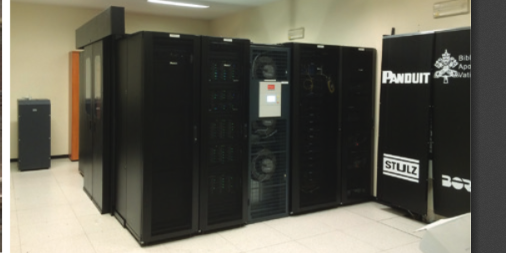
A digital library looks wonderful on screen, but did you ever wonder what the physical server looks like? A US company has published images of the servers it installed at the Bibliotheca Apostolica Vaticana for the new virtual library, and yes, they look like nothing more than a big black tin box:

Read the Panduit brochure for more information on the energy demands and cooling requirements of this installation in a secure room at the Vatican.

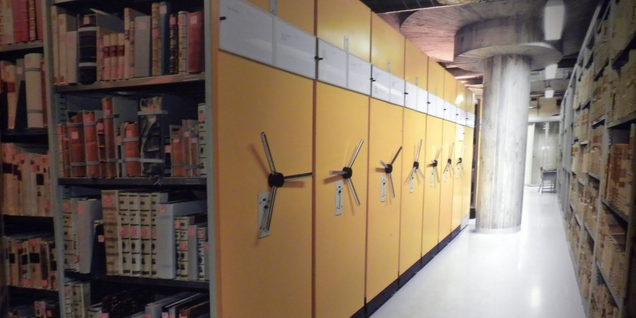
Of course the stacks of the library where the manuscripts are stored are not exactly beautiful to look at either. I have not seen them myself, but a blogger has photographed BAV posters showing them to consist of a great many rolling bookshelves under a bare concrete ceiling:
So now you know what goes on behind the scenes.

2016-06-26

Trithemius, Graphic-Minded Historian

Tabulated chronicles have a special place in the history of infographics, since they convert a story into a semi-graph. They tabulate events so that our human vision can make sense of what normally has to be handled by human aural comprehension. A timeline may look natural and obvious to the reader, but is in fact the product of a great deal of research and arranging.

Johannes Trithemius (1462-1516), the pioneering literary historian, gets a prized place as the introductory figure at the start of Anthony Grafton's and Megan Hale Williams' Christianity and the transformation of the book: Origen, Eusebius and the library of Caesarea, a book that is a favorite of every classics+graphics reader.

He is important to the evolution of infographics because he thought tables and indices were not just "back-matter" but really do matter. On his outstanding work, I will quote from a Hill exhibition catalog:
The Annales of Hirsau, finished in 1514 ... was Trithemius’ greatest achievement as an historian. The work was commissioned in 1495 by Abbot Blasius of the monastery at Hirsau but proved to be a slow and complex undertaking. [His theory of history was] embraced by the Christian humanists, among whom Trithemius was a major figure [via the Wayback Machine].
Trithemius offered his readers different views of the same material so they could literally "figure it out": a narrative, an index, and an arrangement of all the events in date order in his autograph second recension (1514) which is online at the Bavarian State Library in Munich. Grafton/Hale see it as a modern beacon pointing back to inventions by Eusebius and Origen.

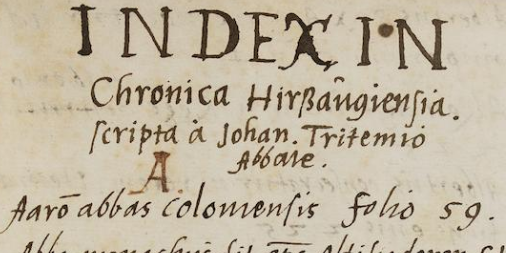
Complementing the Munich codices now is the first recension Trithemius wrote by his own hand 1495-1503, which lacks the tables, but opens with an index:


This famous first edition, Pal. lat. 929, part of the Vatican collection, has arrived online in the last few days thanks to the efforts of a program in Heidelberg, Germany to digitize the Pal. lat. collection. Here is the list of eight novelties (whereby Trithemius was on the tail of the last group, but I overlooked it at first):
  1. Pal. lat. 745 Infortiatum (14. Jh.)
  2. Pal. lat. 746 Infortiatum (13. Jh.)
  3. Pal. lat. 749 Digestum novum (14. Jh.)
  4. Pal. lat. 750 Digestum novum (13.-14. Jh.)
  5. Pal. lat. 751 Digestum novum (13.-14. Jh.)
  6. Pal. lat. 752 Digestum novum (13.-14. Jh.)
  7. Pal. lat. 753 Digestum novum (13. Jh.)
  8. Pal. lat. 929 Trithemius, Johannes: Chronicon insigne monasterii Hirsaugiensis ordinis S. Benedicti (Sponheim, 1495-1503)
This is Piggin's Unofficial List 56. If you have corrections or additions, please use the comments box below. Follow me on Twitter (@JBPiggin) for news of more additions to Digita Vaticana.

2016-06-22

Language of Jesus

Half of this week's 98 DigitaVaticana digitizations are books in various forms of Aramaic, famously the language spoken by Jesus. In scholarship and librarianship, old manuscripts in Aramaic are described as "Syriac," whereby as far as I know no especial connection to Syria or to a particular Syriac-liturgy church is intended. It's simply from the classical Latin word for Aramaic.

Aramaic was once spoken over vast swatches of the Middle East, has many dialects and has left "Syriac" liturgical and literary texts which are so antiquated as to be unintelligible to most of the dwindling number of speakers of modern colloquial Aramaic.

The latest round of digitizations (which began June 20 and was completed June 22) brings the posted total to 4,708 manuscripts. The count on the new front page of the portal is currently just 4,595. Actual availability is somewhere between those two numbers. About a third of the following list was triggering "Client Error" when I put up this post, but this can only get better.

You will notice that I am now doing extra work for you, dear reader, processing the links so that the first link leads directly to the manuscript front page while the "Details" link leads to a catalog page.

Obtaining permalinks to specific manuscript page remains a major headache, as one now has to guess them. The method involves noting the folio number, doubling it, adding 6 and converting it to a three-digit format, then writing it on the end of the URL, testing it, correcting it, etc. No fun.

[Late add: Digi has just added a JPEG download button which you can now creatively mis-use to discover the permalink with less effort. On a page you want to refer to, press the JPEG icon, then hover over the "Download" button and you will see the page number in the browser's status bar.]
  1. Borg.ar.129, Details,
  2. Borg.ebr.3, Details,
  3. Borg.ebr.4, Details,
  4. Borg.ebr.10, Details,
  5. Borg.ebr.12, Details,
  6. Borg.ebr.13, Details,
  7. Borg.ebr.20, Details,
  8. Borg.sir.28, Details,
  9. Borg.sir.67, Details,
  10. Borg.sir.74, Details,
  11. Borg.sir.93, Details,
  12. Borg.sir.112, Details,
  13. Borg.sir.117, Details,
  14. Borg.sir.160, Details,
  15. Borg.sir.169, Details,
  16. Chig.R.VI.37, an early 15th century-Hebrew bible, Details,
  17. Ott.gr.14.pt.2, Details,
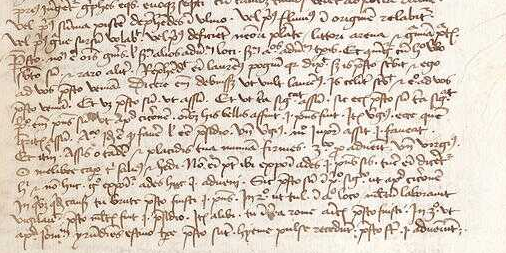
  18. Reg.lat.1988, Vergil's Georgics in a Renaissance manuscript with this opening. Details.
  19. Ross.604, Seneca, with this opening. Details
  20. Urb.ebr.59, Details,
  21. Urb.gr.82, key manuscript of Geography of Ptolemy, full blog post separately - Details,
  22. Urb.gr.149, Details,
  23. Vat.ar.32, Details,
  24. Vat.ar.158, Details,
  25. Vat.ar.317, Details,
  26. Vat.copt.1, Details,
  27. Vat.copt.6, Details,
  28. Vat.ebr.17, Details,
  29. Vat.ebr.151, Details,
  30. Vat.ebr.152, Details,
  31. Vat.ebr.153, Details,
  32. Vat.ebr.154, Details,
  33. Vat.ebr.155, Details,
  34. Vat.ebr.157, Details,
  35. Vat.ebr.159, Details,
  36. Vat.ebr.168, Details,
  37. Vat.ebr.169, Hebrew divorce bills, 15th century. Details.
  38. Vat.ebr.172, Details,
  39. Vat.ebr.174, Details,
  40. Vat.ebr.177, Details,
  41. Vat.ebr.182, Details,
  42. Vat.ebr.185, Details,
  43. Vat.gr.2220, Details,
  44. Vat.lat.428, Augustine, City of God, 11th/12th century. Details.
  45. Vat.lat.654, Details,
  46. Vat.lat.655, Details,
  47. Vat.lat.665, Details,
  48. Vat.lat.680, Details,
  49. Vat.lat.763, Details,
  50. Vat.lat.768, Details,
  51. Vat.lat.770, Details,
  52. Vat.lat.776, Details,
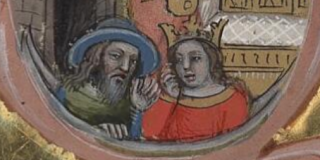
  53. Vat.lat.1645, Details, another Seneca with very beautiful scenes in the initials, like this princess on a cellphone on fol 67r:
  54. Vat.lat.2194, Details,
  55. Vat.lat.4781, Details,
  56. Vat.lat.8210, Details,
  57. Vat.lat.9967, Details,
  58. Vat.lat.9974, Details,
  59. Vat.sir.1, Details,
  60. Vat.sir.14, Details,
  61. Vat.sir.16, Details,
  62. Vat.sir.20.pt.1, Details,
  63. Vat.sir.20.pt.2, Details,
  64. Vat.sir.21, Details,
  65. Vat.sir.22, Details,
  66. Vat.sir.23, Details,
  67. Vat.sir.24, Details,
  68. Vat.sir.148, Details,
  69. Vat.sir.152, Details,
  70. Vat.sir.154.pt.1, The older parts of this date from the 8th or 9th century and contain a commentary on the Gospel of Matthew which George of Beeltan wrote while he was imprisoned in Baghdad in about the year 770. George was patriarch of Antioch 758-790 and his citations of earlier theologians such as Julius Africanus are useful in recovering that deeper past. Details,
  71. Vat.sir.154.pt.2, ditto, Details.
  72. Vat.sir.155, This contains writings of Mar George or Georgi, bishop of the Arab Tribes (died 724), a philosopher and scholar. Details,
  73. Vat.sir.156.pt.1, Details,
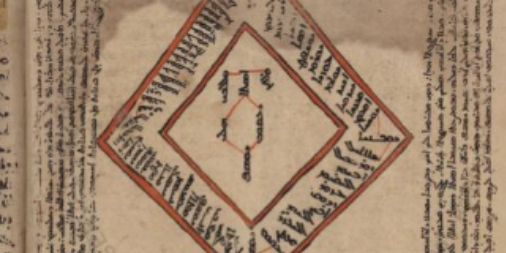
  74. Vat.sir.156.pt.2, including this structure on folio 187v: Details,
  75. Vat.sir.182, Details,
  76. Vat.sir.203, Details,
  77. Vat.sir.216, Details,
  78. Vat.sir.266, Details,
  79. Vat.sir.267, Details,
  80. Vat.sir.272, Details,
  81. Vat.sir.273, Details,
  82. Vat.sir.275, Details,
  83. Vat.sir.278, Details,
  84. Vat.sir.279, Details,
  85. Vat.sir.447, Details,
  86. Vat.sir.470, Details,
  87. Vat.sir.471, Details,
  88. Vat.sir.502, Details,
  89. Vat.sir.508, Details,
  90. Vat.sir.510, Details,
  91. Vat.sir.525, Details,
  92. Vat.sir.540, Details,
  93. Vat.sir.556, Details,
  94. Vat.sir.578, Details,
  95. Vat.sir.596, Details,
  96. Vat.sir.622, Details,
  97. Vat.turc.145, Details,
  98. Vat.turc.388, Details
This is Piggin's Unofficial List 55. If you have corrections or additions, please use the comments box below. Follow me on Twitter (@JBPiggin) for news of more additions to Digita Vaticana.

2016-06-20

12 Greatest TextArch News Stories

I posted last week on the fuss over The Gospel of Jesus's Wife, where the new evidence overwhelmingly indicates this tiny papyrus at Harvard University is a forgery.

That prompted me to look for a list of great news stories in the past few years about the archaeology of text, that is to say, recognizing by intelligent reading that a found historical text or diagram attaches to a noted author or a previously unsuspected context. There isn't any list I can find that spans ancient, medieval and modern, so I have compiled one for your reading pleasure.

In this 21st-century tally of great recent #TextArch news stories in date order: the years are of the media attention, not of the discoveries:
  1. Troyes ms. 1452 contains 113 anonymous love letters attributable to Héloïse and Abelard (2000 book reviews)
  2. BAV Vat. sir. 623 contains an unknown comedy by Menander palimpsested with Dyscolus (Harlfinger 2003; Pearse 2011)
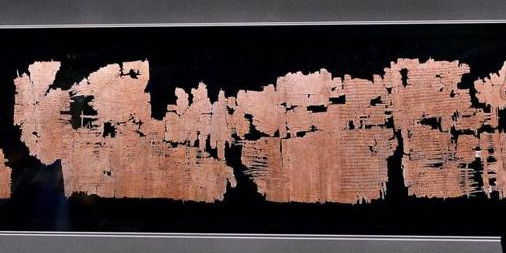
  3. Artemidorus Papyrus (below) contains only known ancient Greek topographical map (2006 exhibition)
  4. Archimedes Palimpsest found to contain lost Stomachion and The Method of Mechanical Theorems by Archimedes, Against Timandra and Against Diondas by Hyperides (2007 book)
  5. Vlatadon 14 found to contain Galen's lost On Consolation from Grief (2010 Libé; Pearse)
  6. Munich BSB cod. graec. 314 found to contain lost Homilies on Psalms of Origen (2012; edition)
  7. Papyrus lent to Harvard claimed to contain an unknown Gospel of Jesus's Wife (2012; discredited 2016)
  8. Copiale Cipher (book in private ownership?) decoded and linked to German Oculists (2012)
  9. Cod. Hierosolymitanus Sancti Sepulcri 36 found to contain a lost text of Euripides (2013)
  10. Green Collection cartonnage said to contain portions of two poems by Sappho (2014)
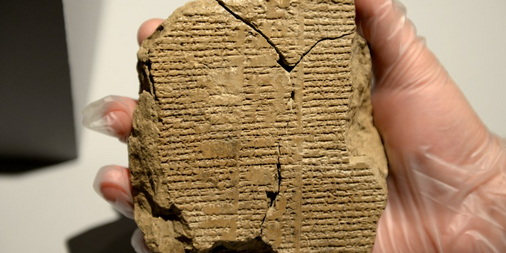
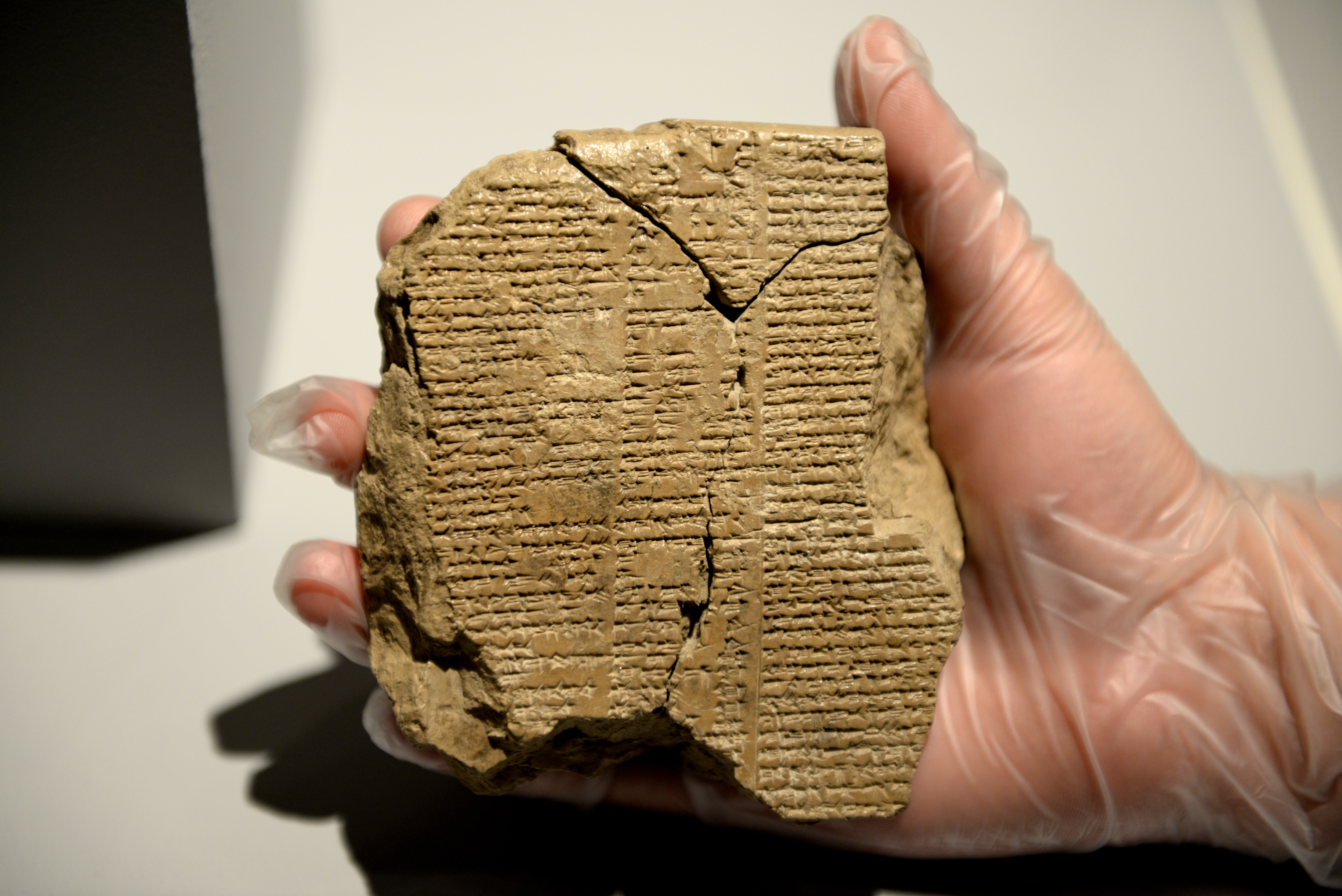
  11. Sulaymaniyah Museum Tablet T.1447 revealed to contain 20 lost lines of Gilgamesh (2015)
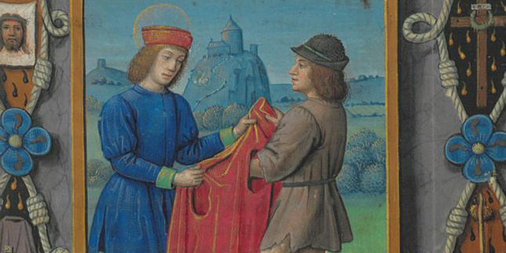
  12. Paris BNF NAL 3245 (below) identified as a lost Vita of Francis of Assisi by Thomas de Celano (2015)
And next year? Maybe the publication of my book disclosing that an unsuspected Roman-era chart of genealogies and timelines has been reconstructed from segments in medieval manuscripts and turns out to be the world's oldest information visualization. Let me know now (by comments or by Twitter) if this is a book you would want to read or spread word about!

The criteria for my list above (and these all concern the identification of a text or a diagram, not the finding of the support on which the text is written) are:
  • the text or diagram lacks any author's name or date;
  • scientifically tenable grounds are advanced for the attribution;
  • the work is famed: either lost or altering our knowledge of the past;
  • stories of it had to crop up over several days in major news media.
I suspect these bunch in years because we in the media tend to re-enact memes, then grow weary of them. A recent article in The Guardian, John Dugdale lists celebrated refindings of 20th-century works in a sudden 2015 rush, which I think tends to support my explanation. I nearly included two great media feasts of 2006:
  1. Linking of the anonymous Poetical Essay on the Existing State of Things to Percy Bysshe Shelley, but that was essentially about finding the sole surviving printed copy
  2. Launch of Antikythera Mechanism project, culminating in this year's Almagest 7/1 edition, but that is essentially an artefact story.
There's also a list at Oxford including some more obscure Graeco-Roman rediscoveries.

And what would you add to my list?

2016-06-18

Top TextArch Story of 2016

The general news media only pick up on text-archaeology stories once a year at most. The big story of 2012 was the emergence of a piece of papyrus containing what was supposedly a gnostic gospel with a saying by Jesus referring to "my wife." It looks like the huger story of 2016 will be the emergence of damning doubts about the provenance of that snippet.

Late on June 15, The Atlantic published an investigative story by Ariel Sabar linking the papyrus to Walter Fritz, a German man now living in Florida who has studied egyptology. Take the time to read this story, as it is likely to go down in history as one of the great pieces of text-archaeology journalism.

Christian Askeland writes in a comment on the usually authoritative Evangelical Text Criticism blog that Sabar was not in fact the first to identify Fritz as principal in the matter or flag his knowledge of Coptic, but adds in praise, "Sabar’s work is clearly original. The large majority of his presentation is material uniquely discovered by him."

A Google New search indicates French and Dutch media have reported this now, but the retail German news media have yet to pick up on this amazing back story, which has yet another back story behind it: the employment of Mr Fritz as director of the Stasi Museum in Berlin when he was 27 years old in 1991-92. The German freelance journalist involved, Petra Krischok, does not mention the story on her website.

What's also very striking to me as a journalist is how hugely difficult under restrictive German laws it would have been to expose this story if it had happened in Germany: the Fritz trail through company incorporations, land ownership and so on would have been unsearchable. All of this public registry data is treated as confidential under Germany's ridiculous Datenschutz laws. The new EU "right to be forgotten" law makes it even harder to track what someone did in 1991.

As a law grad I would also be interested to hear discussion of whether any of the alleged actions during the production of this papyrus to Professor Karen King of Harvard could possibly constitute a crime.

And as an observer of life, I am struck by the psychological issues here. Sabar suggests that King, so academically gifted, is perhaps a poor judge of real life. Watch Sabar on the video which is entitled "To Catch a Forger" (did The Atlantic's lawyer really okay that?) and you'll see that he is very much the writer, a bit shy. Read the quotes from Fritz and you are struck by the great emotional intelligence of such a person, able to yield slivers of truth in a patient bid to convince someone of falsity. The next step I guess is for one of the great tiger interviewers of the business to get Fritz into a TV studio.

2016-06-17

A for Andrew

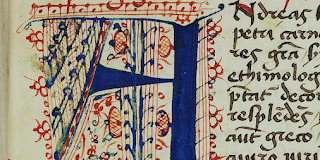
The latest round of Heidelberg digitizations of the Palatine manuscripts at the Vatican includes this fine A for Andrew initial on folio 1r. of Pal.lat.850, a 15th-century book of saints arranged by feast day:

You can see it on the Bibliotheca Palatina website, along with 15 other recent digitizations, the majority of them lawbooks.
  1. Pal. lat. 721,1 (Guilelmi de sancto Amore) collatio catholice et canonice scripture: Band 1 (1514)
  2. Pal. lat. 721,2 (Guilelmi de sancto Amore) collatio catholice et canonice scripture: Band 2 (1514)
  3. Pal. lat. 728 Tractatus inscriptus manu saec. XV: de regimine principum (14. Jh.)
  4. Pal. lat. 741 Digestum vetus (13.-14. Jh.)
  5. Pal. lat. 743 Infortiatum (14. Jh.)
  6. Pal. lat. 760 Codicis Iustiniani imp. libri IX (14. Jh.)
  7. Pal. lat. 763 Codicis Iustiniani imp. libri IX (14. Jh.)
  8. Pal. lat. 764 Codicis Iustiniani imp. libri IX (13. Jh.)
  9. Pal. lat. 765 Codicis Iustiniani imp. (14. Jh.)
  10. Pal. lat. 768 Institutiones Iustiniani imp. (14. Jh.)
  11. Pal. lat. 769 Institutiones Iustiniani imp. (13. Jh.)
  12. Pal. lat. 770 Institutiones Iustiniani imp. (15. Jh.)
  13. Pal. lat. 774 Liber statutorum et legum Venetorum illustris Iacobi Teupuli incliti ducis Venec (14. Jh.)
  14. Pal. lat. 781 Summa de edendo que dicitur Oli (12.-13. Jh.)
  15. Pal. lat. 782 Summa decretalium (13.-14. Jh.)
  16. Pal. lat. 850 Sammelband (15. und 16. Jh.)
This is Piggin's Unofficial List number 54. If you have corrections or additions, please use the comments box below. Follow me on Twitter (@JBPiggin) for news of more additions to Digita Vaticana.