Chronologiekritik
4 hours ago
We have placed the Latin translation of blessed Jerome as though between the Synagogue and the Eastern Church, siting them like the two thieves, one on each side, and Jesus, that is the Roman or Latin Church, between them.This sardonic statement appears at the start of the bible, a masterpiece of typography and Catholic scholarship, which was printed between 1514 and 1517 in Alcalá de Henares (Complutum in Latin). The Complutensian Bible is available as a PDF from Archive.org.
Lé fond commun de la Vieille Latine est sensible dans tous les témoins consultés, mais à des degrés variés. Il est indiscutable que la Vulgate a été utilisée à plusieurs reprises tantôt pour corriger les lignées, tantôt pour compléter les textes explicatifs.She characterized these differences as follows:
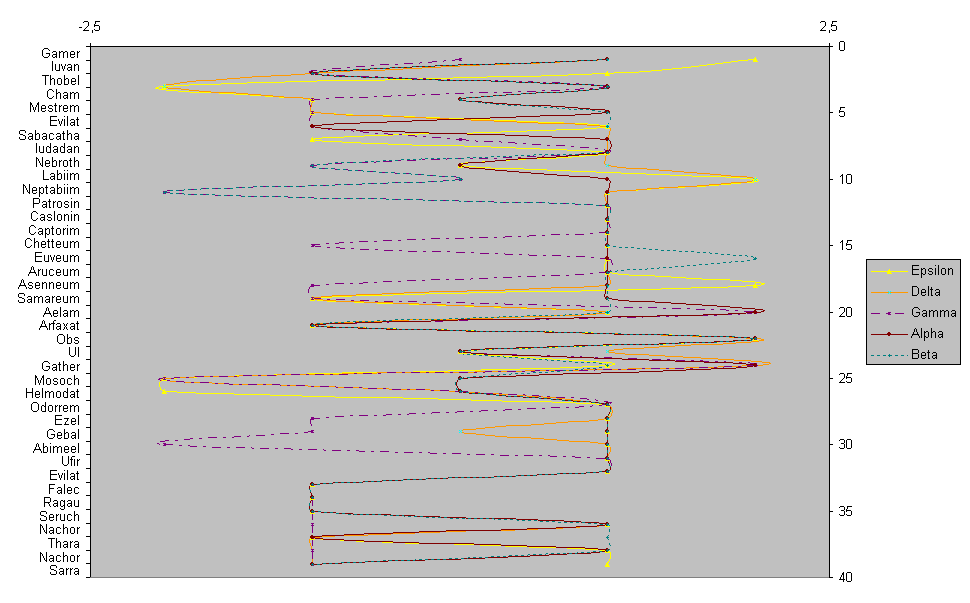
Recension α: ... texte mixte, en général très corrompu, disposé toujours sur quatorze tables; à partir d'Abraham (table VI), n'a presque pas été retouché sur la Vulgate.Zaluska never presented any statistical data or analysis to back up these characterizations, so I have done some sampling of my own. Below is a tabulation containing a rough scoring of 39 Genesis names from the period down to Abraham. I have included a recension, Epsilon, that Zaluska left out of account. I have not included Zaluska's Sigma in this survey.
Recension β: ... texte corrigé d'après la Vulgate, néanmoins dans l'ensemble assez corrompu, et fortement interpolé, en grande partie, semble-t-il, à l'aide des Etymologies d'Isidore; peut être commodément désigné comme une recension longue.
Recension σ transmise par le Beatus de Saint-Sever (S), apparaissant pour l'essentiel comme un texte de type α corrigé d'après la Vulgate, mais fournissant quand même des textes qui lui sont propres ...
Recension γ: ... texte ne montrant que des retouches occasionnelles d'après la Vulgate; partie caractéristique à la page des Juges; plusieurs omissions.
Recension δ: ... Le premier texte (Bible de San Millán de la Cogolla, Madrid) est probablement celui qui reflète le plus fidèlement la tradition de la Vieille Latine; le texte de [Bible de Calahorra] en revanche suit généralement la Vulgate, à partir d'Abraham; des interpolations communes dans la première partie du texte.
| 2 | 1 | 0 | 1 | 1 | Gamer | Gomer | Gomer |
| 1 | -1 | -1 | -1 | -1 | Iuvan | Iavan | Javan |
| -2 | -2 | 1 | 1 | 1 | Thobel | Tubal | Thubal |
| -1 | -1 | -1 | 0 | 0 | Cham | Ham | Ham |
| -1 | -1 | -1 | 1 | 1 | Mestrem | Mesraim | Mesraim |
| 1 | 1 | -1 | -1 | 1 | Evilat | Hevila | Hevila |
| -1 | 1 | 0 | 1 | Sabacatha | Sabatacha | Sabatacha | |
| 1 | 1 | 1 | 1 | 1 | Iudadan | Dadan | Dadan |
| 0 | 1 | -1 | 0 | -1 | Nebroth | Nemrod | Nemrod |
| 2 | 2 | 0 | 1 | 0 | Labiim | Laabim | Laabim |
| 1 | 1 | -2 | 1 | -2 | Neptabiim | Nepthuim | Nephthuim |
| 1 | 1 | 1 | 1 | 1 | Patrosin | Phetrusim | Phetrusim |
| 1 | 1 | 1 | 1 | 1 | Caslonin | Cesluim | Chasluim |
| 1 | 1 | 1 | 1 | 1 | Captorim | Capthurim | |
| 1 | 1 | -1 | 1 | 1 | Chetteum | Ettheum | Hethæum |
| 1 | 1 | 1 | 1 | 2 | Euveum | Eveum | Hevæum |
| 1 | 1 | 1 | 1 | 1 | Aruceum | Araceum | Aracæum |
| 2 | 1 | -1 | 1 | 1 | Asenneum | Sineum | Sinæum |
| -1 | -1 | -1 | 1 | 1 | Samareum | Samariten | Samaræum |
| 1 | 1 | 2 | 2 | 1 | Aelam | Elam | Ælam |
| -1 | -1 | -1 | -1 | -1 | Arfaxat | Arfaxad | Arphaxad |
| 2 | 2 | 2 | 2 | 2 | Obs | Us | Us |
| 0 | 1 | 0 | 0 | 0 | Ul | Hul | Hul |
| 1 | 2 | 2 | 2 | 1 | Gather | Gether | Gether |
| -2 | -2 | -2 | 0 | 0 | Mosoch | Mes | Mes |
| -2 | 0 | 0 | 0 | 0 | Helmodat | Helmodad | Elmodad |
| 1 | 1 | 1 | 1 | 1 | Odorrem | Aduram | Adoram |
| 1 | 1 | -1 | 1 | 1 | Ezel | Uzal | Uzal |
| 1 | 0 | -1 | 1 | 1 | Gebal | Ebal | Ebal |
| 1 | 1 | -2 | 1 | 1 | Abimeel | Abimahel | Abimaël |
| 1 | 1 | 1 | 1 | 1 | Ufir | Ophir | Ophir |
| 1 | 1 | 1 | 1 | 1 | Evilat | Evila | Hevila |
| -1 | -1 | -1 | -1 | -1 | Falec | Faleg | Phaleg |
| -1 | -1 | -1 | -1 | -1 | Ragau | Reu | Reu |
| -1 | -1 | -1 | -1 | -1 | Seruch | Sarug | Sarug |
| 1 | 1 | -1 | 1 | 1 | Nachor | Nahor | Nahor |
| -1 | -1 | -1 | -1 | 1 | Thara | Thare | Thare |
| 1 | -1 | -1 | 1 | 1 | Nachor | Nahor | Nahor |
| 1 | -1 | -1 | -1 | -1 | Sarra | Sarai | Sarai |
| Αχινααμ | Ahinoem | 1Sa | 25:43, 2 Sa 3:2 |
| Αβιγαιας | Abigail | 1Sa | 25:42, 2Sa 3:3 |
| Μααχα | Maacha | 2Sa | 3:3 |
| Αγγιθ | Aggith | 1Ch | 3:2, 2Sa 3:4 |
| Αβιταλ | Abital | 2Sa | 3:4 |
| Αιγλα | Agla | 2Sa | 3:5 |
| Βηρσαβεε | Bethsabee | 2Sa | 11:3 |
| Αμνων | Amnon | 2Sa | 3:2 |
| Δαλουια | Chelaab | 2Sa | 3:2, 1Ch 3:1 |
| Αβεσσαλωμ | Absalom | 2Sa | 3:3 |
| Ορνια | Adonias | 2Ch | 3:4 |
| Σαφατια | Safathia | 1Ch | 3:3, 2Sa 3:4 |
| Ιεθερααμ | Iethraam | 2Sa | 3:5 |
| Θημαρ | Thamar | 2Sa | 13:1 |
| Ιβααρ | Ibaar | 1Ch | 3:6, 14:5, 2Sa 5:15 |
| Ελισαε | Elisama A | 1Ch | 14:5, 3:6, 2Sa 5:16 |
| Ελιφαλετ | Eliphalet / Helifeleth | 1Ch | 3:6, 14:5, 2Sa 5:16 |
| Ναγε | Noge | 1Ch | 3:7, 14:5 |
| Ναφαγ | Napheg / Nepheg | 1Ch | 3:7, 14:5, 2Sa 5:15 |
| Ιανουε / Ιανουου | Iaphie | 1Ch | 3:7, 14:5, 2Sa 5:15 |
| Ελισαμα / Ελισαμαε | Elisama B | 1Ch | 3:8, 14:5 |
| Ελιαδα | Helida / Heliade | 1Ch | 3:8, 14:5, 2Sa 5:16 |
| Ελιφαλετ | Eliphalet / Helisua | 1Ch | 3:8, 14:5, 2Sa 5:15 |
| Σαμμους | Samua | 2Sa | 5:14 |
| Σωβαβ | Sobab | 2Sa | 5:14 |
| Σαλωμων | Salomon | Mt | 1:6, 2Sa 5:14 |
| Ιεροβοαμ / Ναβατ | Hieroboam | 1Kgs | 11:26 |
| Ναδαβ | Nadab | 1Kgs | 15:25 |
| Βαασα / Αχια | Baasa filius Ahia | 1Kgs | 15:33 |
| Ηλα | Hela filius Baasa | 1Kgs | 16:8-16 |
| Ζαμβρι | Zamri | 1Kgs | 16:9 |
| Θαμνι / Γωναθ | Thebni filium Gineth | 1Kgs | 16:21 |
| Αχααβ / Αμβρι· | Ahab filius Amri | 1Kgs | 16:29 |
| Ιεζαβελ | Hiezabel | 1Kgs | 16:31 |
| Οχοζιας | Ohozias | 1Kgs | 22:40 |
| Ιωραμ / Αχααβ | Ioram filius Ahab | 2Kgs | 3:1, 1Kgs 22:50 |
| Ιου / Ναμεσσι | Hieu filius Namsi | 1Kgs | 19:16, 2Chr 22:7 |
| Ιωαχας | Ioachaz | 2Kgs | 10:35 |
| Ιωας | Ioas filius Ioachaz | 2Kgs | 13:10 |
| Ιεροβοαμ | Hieroboam | 2Kgs | 13:13 |
| Ζαχαριας | Zaccharias filius Hieroboam | 2Kgs | 15:8 |
| Σελλουμ / Ιαβις | Sellum filius Iabes | 2Kgs | 15:13 |
| Μαναημ / Γαδδι | Manahem filius Gaddi | 2Kgs | 15:14 |
| Φακεϊας | Phaceia filius Manahem | 2Kgs | 15:23 |
| Φακεε / Ρομελιου | Phacee filius Romeliae | 2Kgs | 15:25 |
| Ωσηε / Ηλα | Osee filius Hela | 2Kgs | 17:1 |
According to my definition, hypothetigraphy defines a rather homogenenous class of drawings, which I call hypothetigraphs ....This is all very useful. The six "features" listed above are all applicable to the Great Stemma:
The first feature, and one that is most easily noted, is the use of simple geometric figures.... The "true" objects and their appearance are not important in this endeavor, for the phenomena under consideration have to do with relationships and with dynamic interactions between elements.... The shape of elements per se is usually an irrelevant piece of information, which is best left out or represented simply by the most abstract of shapes, the circle.
A second and most immediately noticeable feature of hypothetigraphs is the addition of brief written text to the picture.... The inclusion of written text is always necessary in hypothetigraphy which would otherwise lose its communicative function... Verbal and visual information are inextricably and necessarily connected.
Another distinguishing feature of hypothetigraphy is the the almost exclusive use of precise marks, drawn using the ruler ... Precise, clear lines contribute in conveying the impression that the depicted forms are mental constructs, not representations of natural objects.
Typical of hypothetigraphy is ... the use of object lines ... Object lines are not used to mimic some aspect of reality but to illustrate relationships, correspondences or connections.... Relationships and connections and trajectories ... lend themselves naturally to an interpretation in terms of threads, ropes and connecting cables.
A fifth feature of hypothetigraphy is the number of represented dimensions, which tends to be as small as possible within the constraints of the logic of the representation.
Finally, hypothetigraphy tends to place the viewpoint frontally relative to the picture plane, an tends to present figures without a background.... The second of these ... contributes to focus the attention of the viewer, avoiding unwanted contextual effects.