2015-06-15

Byzantine Saints

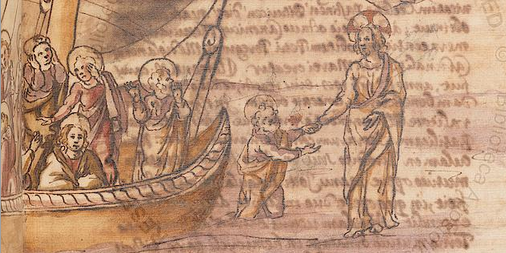
The Digita Vaticana program to digitize manuscripts at the Vatican has just placed one of most noted and colourful Byzantine illuminated manucripts online. Known as the Menologion of Basil II and dating from about 1000 CE, codex Vat. gr. 1613 shows half a year of saints' feasts and depicts a great deal of blood, torture and martyrdom.

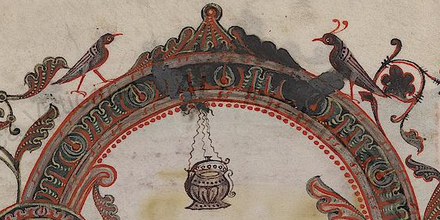
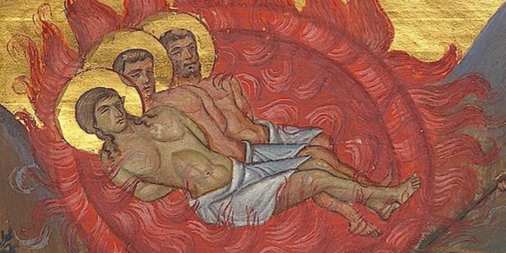
The image here shows Fausta (a 13-year-old girl), the sage Evilasius and the eparch Maximus being boiled alive in a cauldron for their faith:

Here is the full list of this most interesting batch of 83 new items uploaded on June 15. The posted total has now reached 2,160:
  1. Arch.Cap.S.Pietro.H.33, contains De Re Militari of Flavius Vegetius Renatus, the only ancient manual of Roman military institutions, unilluminated
  2. Barb.lat.358, a pocket prayerbook?
  3. Barb.lat.2132
  4. Barb.lat.3995
  5. Barb.lat.4052, Tasso's Gerusalemme liberata or Jerusalem Delivered
  6. Barb.lat.8615
  7. Borgh.198.pt.2
  8. Borgh.208, Olivetani Panegyrica et carmina in cardinalis Scipionis Caffarelli Burghesii ordinis Olivetani protectoris
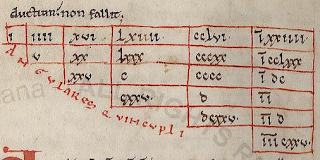
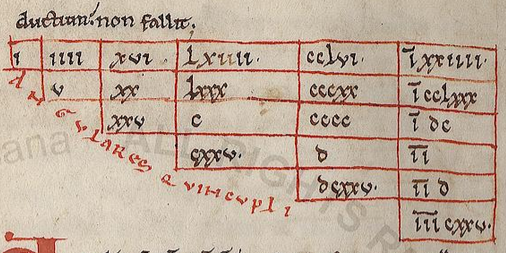
  9. Borgh.210, Boethius, De institutione arithmetica, a 12th or 13th century copy not very well used, suggesting it may have belonged to a lazy student. Here's a table of angles:
  10. Cappon.13
  11. Cappon.15
  12. Cappon.94
  13. Cappon.95
  14. Cappon.96, Ovid, Letters
  15. Cappon.97
  16. Cappon.98-100
  17. Cappon.101, Relation of the Death of Troilo Savello, decapitated in Rome on April 18, 1592
  18. Cappon.102
  19. Cappon.104
  20. Cappon.105, Frattato Cabalistico
  21. Cappon.108
  22. Cappon.109
  23. Cappon.110
  24. Cappon.111
  25. Cappon.112
  26. Cappon.113
  27. Cappon.115
  28. Cappon.116
  29. Cappon.117
  30. Cappon.118
  31. Cappon.123
  32. Cappon.125
  33. Cappon.126
  34. Cappon.128
  35. Cappon.129
  36. Cappon.130
  37. Cappon.133
  38. Cappon.134
  39. Cappon.138
  40. Cappon.142
  41. Cappon.146
  42. Cappon.147
  43. Cappon.150
  44. Cappon.151
  45. Cappon.156
  46. Cappon.170
  47. Cappon.173
  48. Cappon.174
  49. Cappon.178
  50. Cappon.180
  51. Cappon.183
  52. Cappon.184
  53. Cappon.185
  54. Cappon.187
  55. Cappon.190
  56. Cappon.196
  57. Cappon.211
  58. Cappon.213
  59. Cappon.216
  60. Chig.H.IV.135, poetry of Aeneas Sylvius Piccolomini (1405-1464, elected Pope Pius II in 1458), a figure of the Renaissance
  61. Pal.lat.1831, a student's lecture notes taken at the Protestant university of Wittenberg, Germany at the height of the Reformation; this item is new online, as it is not listed among the Heidelberg digitizations to date
  62. Pal.lat.1832, like the item above, notes from Reformation lectures by Philip Melanchthon and others
  63. Reg.lat.329, contains Aldhelm's Aenigmata
  64. Reg.lat.1709, also with a section of Ovid's Fasti [Missing: folios 34-35 which form Rome's part of the Fragmenta Floriacensia (more in BNF, Lat. 6400 B), a key source of the Chronica of Eusebius of Caesarea]
  65. Urb.lat.1154, late antique grammar by Probus, Instituta artium
  66. Vat.estr.or.19
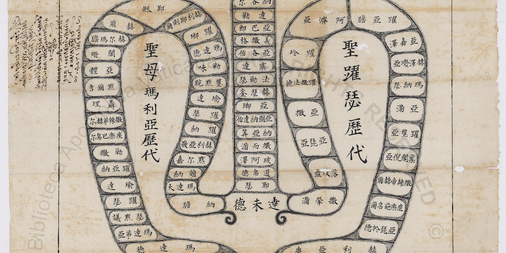
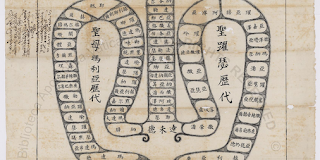
  67. Vat.estr.or.55, contains this extraordinary Christian chronology diagram in Chinese by Carlo di Orazio da Castorano (1673-1755); discussed in detail by Ad Dudink, who notes that the Septuagint chronology, not the Masoretic/Vulgate chronology is being used in it.
      
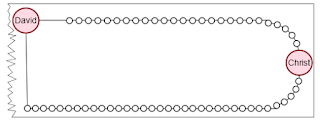
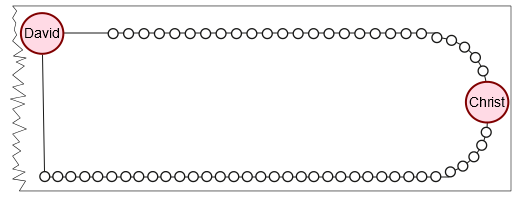
    In the tracks above, the ancestry descends from Adam to David, then divides into Luke's genealogy in the left loop and Matthew's in the right loop. This design surprised me a lot, as it is fairly similar in its basic layout idea to what the Great Stemma's designer was doing, left to right, back in the fifth century (below):
  68. Vat.estr.or.81
  69. Vat.estr.or.82
  70. Vat.estr.or.147.pt.18
  71. Vat.estr.or.147.pt.22
  72. Vat.estr.or.148, adventures of Jiraiya, according to Mare Nostrum
  73. Vat.et.264, hagiographical text from the Ethiopian collection, badly singed, discussed in detail by Alessandro Bausi
  74. Vat.gr.752.pt.1
  75. Vat.gr.1613, The Menologion of Basil II (Wikipedia)
  76. Vat.lat.40, New Testament
  77. Vat.lat.92, Peter Lombard, commentary on psalms (printed catalog at Archive.org)
  78. Vat.lat.3199, a gift copy of the Commedia sent by Boccaccio to Petrarch
  79. Vat.lat.4803, Colocci
  80. Vat.lat.6435, Opicinus de Canistris, with cosmographical diagrams
  81. Vat.lat.9850, autograph manuscript by Thomas Aquinas: Summa contra Gentiles, Super Boet. De Trin., Super Isaiam
  82. Vat.lat.11458, Orations by Cicero, a manuscript from 1417 containing eight recovered Cicero speeches
  83. Vat.lat.12895, a book of autograph letters from figures including Cardinal Angelo Mai and Pius IX
As ever, if you can identify any of these further, please add a note in the comments box below. [This is Piggin's Unofficial List 15.]

2015-06-02

Duke's Cookbook

Among the treasures of the library of the dukes of Urbino was a manuscript of the greatest cookbook of Imperial Rome, De re coquinaria ("On the Subject of Cooking"), attributed to a certain Apicius. It contains some 450 recipes, including 138 sauce recipes. The book will be familiar to the many fans of Neill George's Pass the Garum blog as our principal surviving guide to Roman epicureanism.

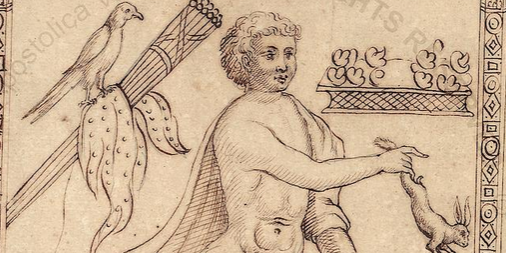
Only two manuscripts of this work exist. The other, from Fulda, is at the New York Academy of Medicine and was rebound nine years ago. The Vatican's manuscript, Urb. lat. 1146, has been reproduced by an Italian publisher as a facsimile costing 1,560 euros, but since June 1, it has been possible to read it for free at Digita Vaticana. Here is one of the illuminations, showing a couple of birds destined for the pot:


Unlike a modern cookbook, De re coquinaria skimps on essential information about ingredient quantities and cooking times. It lacks the glossy photographs of calamari balls in beds of salad which we would now consider obligatory in a cookbook. It is easiest to enjoy it in the 1926 translation to English by Joseph Dommers Vehling, which has been lovingly digitized for your tablet computer at Project Gutenberg. Vehling's edition is enriched with line drawings adapted from other Roman sources.

Apicius is refreshingly blunt in his views on food purity: taste was what mattered, not the 21st-century obsession with avoiding adulteration. Ut mel malum bonum facias (spoiled honey made good) is one of his straightforward counsels: How bad honey may be turned into a saleable article is to mix one part of the spoiled honey with two parts of good honey. Quite. Where's the problem?

The other major arrival in the June 1 batch of digitizations is the sole oldest surviving manuscript, Reg. lat. 1024, of the Liber Judiciorum, the code of laws of Visigothic Spain.

When the Goths conquered Spain, they initially barred intermarriage between their own people and their Roman subjects and maintained separate legal systems for the two populations. But in time, the legal systems were merged and the Liber is the resulting synthesis, a masterwork of jurisprudence which was drawn up in about 654 under King Recceswinth.


This copy, which once belonged to Queen Christina of Sweden, was penned in the early 8th century [probably: see comment below] in Urgell, Spain and is number 287 in Ainoa Castro's survey & blog of Visigothic-script manuscripts.

Here is the full list of 58  manuscripts added June 1, raising the posted total to 2,077:
  1. Arch.Cap.S.Pietro.D.172
  2. Arch.Cap.S.Pietro.D.178
  3. Barb.gr.310
  4. Barb.gr.549, book of hours, 1480
  5. Barb.lat.393
  6. Barb.lat.2154.pt.A, Roman antiquities, in the codex that also contains the Chronograph of 354 drawings
  7. Barb.or.136
  8. Barb.or.149, eight-part cosmological map by Adam Schall von Bell, the first European in the court bureaucracy in Beijing, featured in Rome Reborn
  9. Borgh.237
  10. Borg.ar.71
  11. Cappon.9, psalter
  12. Cappon.12, history of Florence
  13. Cappon.18
  14. Cappon.27.pt.2
  15. Cappon.27.pt.3
  16. Cappon.28.pt.1, compilation of Italian proverbs including the following: Pena patire per bella parere. Delle femmine quando per apparire belle s'acconciano, e strappano, o, sbarbano i peluzzi, che hanno pel viso, e soffrono dolori in acconciature di testa e simili frascherie. Dicesi anche Per bella parere pena convien' patire. Which translates as, "Suffering pain to look beautiful." This item is now being used as a fundraiser (see below for link)
  17. Cappon.30
  18. Cappon.31
  19. Cappon.33
  20. Cappon.34, Istoria del Sacco di Roma
  21. Cappon.42
  22. Cappon.45
  23. Cappon.46
  24. Cappon.47
  25. Cappon.50, copy (1661) of Del Reggimento e dei Costumi delle Donne by Francesco da Barberino, now featured as a fund-raiser (see below)
  26. Cappon.71, Diario: Pietro Aldobrandini
  27. Cappon.74
  28. Cappon.82
  29. Cappon.88, Geomantia di Pietro d'Abano
  30. Cappon.121
  31. Cappon.122
  32. Cappon.124
  33. Cappon.135
  34. Cappon.136
  35. Cappon.137
  36. Cappon.141
  37. Ott.gr.470
  38. Ott.lat.2453.pt.1, includes 16th-century book title pages
  39. Ott.lat.2453.pt.2
  40. Ott.lat.2867
  41. Ott.lat.2977
  42. Pal.gr.232
  43. Reg.lat.689.pt.1
  44. Reg.lat.1024, the Liber Judiciorum, an early-8th-century code of Visigothic law (probably) copied in Urgell, Spain (above)
  45. Urb.lat.585, Diurnale Benedictinum: Psalter Romanum, Beuron number 344
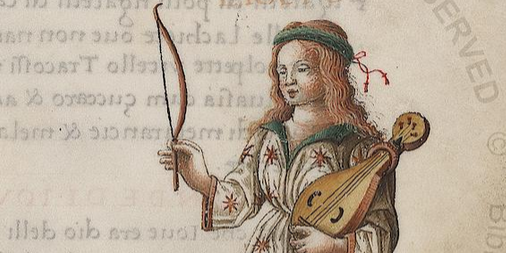
  46. Urb.lat.899, the wedding events of Costanzo Sforza and Camilla d'Aragona Sforza, 1475: relive a Renaissance wedding! The image below may be of Camilla herself. More details from its Rome Reborn file
  47. Urb.lat.1146, De re coquinaria ("On the Subject of Cooking"), a 4th-century cookbook (above)
  48. Vat.ebr.274
  49. Vat.estr.or.147.pt.13
  50. Vat.estr.or.147.pt.15
  51. Vat.estr.or.147.pt.17
  52. Vat.estr.or.147.pt.19
  53. Vat.estr.or.147.pt.20
  54. Vat.lat.49, Renaissance bible
  55. Vat.lat.55
  56. Vat.lat.76
  57. Vat.lat.90
  58. Vat.lat.93

Digita Vaticana is using Cappon.28.pt.1 and Cappon.50 above for a fundraiser project, so consider donating a few dollars for this worthy cause:
If you can add more information about any of these, please use the comments box below. [This is Piggin's Unofficial List 14.]

2015-06-01

Ancient and medieval diagrams

When John E. Murdoch published his Album of Science: Antiquity and the Middle Ages in 1984, no one could have foreseen that big picture books on high-quality paper -- reproducing images of the parchment manuscripts by means of under-sized, grey-scale screen-printing -- would soon be obsolete.


Murdoch, a US academic who died in 2010, was an outstanding figure in history-of-science studies. He employed what might be called an anthropological approach, believing that if you immersed yourself in the mind-set of old diagrams, investigating what they showed and how they worked, you would gain insight into the intelligence and research methods of early scientists.


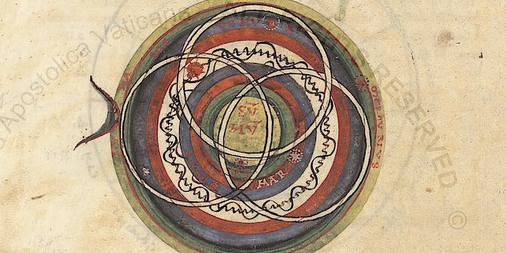
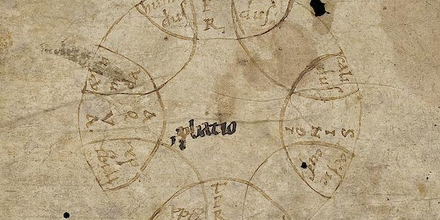
The diagrams above comprise a diagram of the planets in Reg. lat. 123 (top;  Murdoch 249) and a test drawing (probatio) in Pal. lat. 1581 (centre; Murdoch 014) at the BAV.

Today, it would be feasible to publish all Murdoch's 473 images online and in colour at a fraction of the cost of a book project. A new list which I have just begun will connect up Murdoch's out-of-print book with online databases of codices, providing links to high-colour versions of many of the album's grey examples. The list is on my website or I can share it with you on request as an MS Excel file.

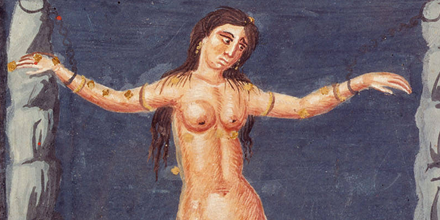
Not all the diagrams chosen by Murdoch were abstract. The third image (below, Murdoch 228) is from the Leiden Aratea, a late antique visualization of the stellar constellation Andromeda (copied in France in the ninth-century, now VLQ 79 at Leiden). The printed version in the book illustrates how unsatisfactory black and white screen-printing was to present such images:


Leiden University Library has digitized the Aratea and you can see online (folio 30v) what the book lacks:


As Murdoch notes, the artist was not particularly accurate in the positioning of the golden stars. Anatomy had priority over astronomy.

2015-05-27

Arabic Treasures

While the bulk of the manuscripts at the Biblioteca Apostolica Vaticana (BAV) are in Latin, there are also extensive collections in Arabic and other West Asian languages.

Since I do not read Arabic -- apart from having a rusty ability, obtained in journalism work 30 years ago, to transliterate from the script -- I will rely here on notes provided at Rome Reborn, an exhibition of Vatican manuscripts in 1992 at the US Library of Congress in Washington.

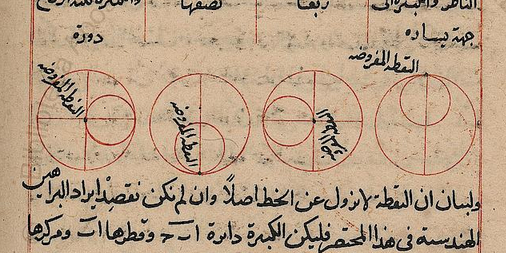
One of the great treasures highlighted at that show was the Memoir on Astronomy or Tadhkira fi'ilm al'haya written by Nasir ad-Din at-Tusi, who was among the first of several Arabic-language astronomers who modified Ptolemy's models based on mechanical principles in order to preserve the uniform rotation of spheres.


The Vatican has a 14th-century Arabic manuscript of it, Vat. ar. 319. The Rome Reborn exhibition notes (online at the St. Louis University Library) say that the figure above is his ingenious device for generating rectilinear motion along the diameter of the outer circle from two circular motions. In simple terms: the black dot goes up and down only.

This page, now digitized, to be zoomed in and enjoyed, is 28v. There is some biographical data on the astronomer at Musicologie.org.in French, and an extensive discussion of Tusi's discoveries in Frederick Starr's Lost Enlightenment, published 2013 and partly readable on Google Books.

Should you be wondering why the opening shown at Rome Reborn, fols. 29 recto and 28 verso, seems to be in backwards order, blame a long-ago Vatican librarian. Most of the BAV manuscripts seem to be numbered next-page-to-the-right regardless of language, though most oriental manuscripts are read right to left and turned next page to the left.

Vat. ar. 319 has been online for some time, and is not one of the newest batch, but it makes a suitable introduction to the May 26 uploads at Digita Vaticana comprising 14 manuscripts, all non-Latin. With their publication on the portal, the front-page total rises to 2,022. (Since reduced to 2,019, seemingly by withdrawing Ott.gr.326 and by consolidating duplicates.)
  1. Barb.or.104, poem Timurmaneh by Persian poet Hatifi (died 1522)
  2. Borg.ebr.11
  3. Vat.ar.1411
  4. Vat.ar.1551
  5. Vat.ar.1614
  6. Vat.pers.12
  7. Vat.pers.76
  8. Vat.pers.155
  9. Vat.turc.214
  10. Vat.turc.316
  11. Vat.turc.420
  12. Vat.turc.430, contains a story of the "Muslim" Jesus (also known as Prophet Isa) according to a Turkish tradition. For a translation to English (large PDF!), see a 2011 article by Delio V. Proverbio.
  13. Vat.turc.432
  14. Vat.turc.433
If you can further identify any of these, please add a comment below. [This is Piggin's Unofficial List 13.]

2015-05-22

Memories of Old St Peter's

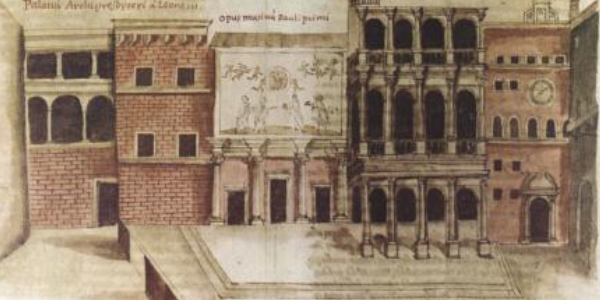
The 4th-century Old Saint Peter's Basilica in Rome and nearby buildings were gradually demolished in the 16th century to make way for the grand St. Peter's which opened in 1626 and which we know today. What had been there previously was far less grand: here is St. Peter's Square and the entrance to the old forecourt:

The Vatican archivist, Giacomo Grimaldi, was charged with recording what had been destroyed. Among the losses was a huge wall mosaic by the Renaissance artist Giotto, the Navicella (literally "little ship"), which showed Christ walking on water. Grimaldi sketched it at it was then, rather different from the restoration that now exists:


Much of his documentation, together with drawings, is to be found in a codex at the Biblioteca Apostolica Vaticana, Barb. lat. 2733, which dates from 1620. You can now leaf through it online. The St Peter's exterior is shown at folio 152v (although I screen-shotted above an enhanced composite from the Met guide to the Vatican) and the Navicella is at folio 147r.

This compendium is among the most interesting items to be digitized and uploaded on May 21. Here is the full list:
  1. Barb.lat.2154.pt.B, the important manuscript R1 of the celebrated Chronograph of 354, an illustrated late antique calendar or almanac (image below). This is one of the greatest treasures in book history: a copy of a lost copy of the lost book that is the earliest western title known to have had full-page illustrations. See Roger Pearse's online edition of the Chronograph, where the pages of R1 are transcribed. Jeremy Norman has written a brief  note on its place in book history. For more detail, read Richard W. Burgess's survey of the manuscripts, where he writes: R1 [was] made in 1620 for de Peiresc and sent to Rome to Girolamo Aleandro.
  2. Barb.lat.2733.pt.1, description with sketches of Old St Peter's in Rome, completed by Grimaldi in 1620
  3. Barb.lat.4434, Città e castella (1626): hand-coloured engravings of Italian walled towns
  4. Barb.or.157.pt.B
  5. Borgh.60
  6. Borgh.61
  7. Borgh.182, Ricceri, Muzio, Carmen de sacello Exquilino
  8. Borgh.191, Opera quaedam de pauperitate et ordine Franciscano
  9. Borgh.303, Henricus Gandavensis (1217-1293), Godefridi de Fontibus et anonymi: Scripta de re philosophica et theologica
  10. Borgh.342
  11. Chig.M.IV.l
  12. Ott.lat.3116.pt.bis, single engraving, scene with money-counter
  13. Reg.lat.189, papal register
  14. Urb.lat.1057, bound book of papal records
  15. Vat.ar.1507
  16. Vat.lat.1612, Renaissance text of the first-century Latin elegiac poet Propertius
  17. Vat.lat.10295  
  18. Vat.lat.14208, portolan chart on the verge of legibility (when will they learn to scan these at higher resolution?)
  19. Vat.turc.169
  20. Vat.turc.275
  21. Vat.turc.395
  22. Vat.turc.434
Above is October from the Chronograph of 354 (Barb.lat.2154 above).

Also released earlier in the week:
Embedded image permalink

As always, if you know more about any of these items, please add a note in the comment box below. [This is Piggin's Unofficial List 12.]

2015-05-21

Past the 2,000 mark

This week, Digita Vaticana, the project to bring the 83,000 manuscripts at the Biblioteca Apostolica Vaticana (BAV) in Rome to the internet as digital facsimiles, passed the 2,000 mark, an important milestone in democratizing a key collection that is part of the collective memory of western culture.

The digitizing project posted 22 more codices, maps and drawings on May 21, 2015 to bring the posted total on its index page to 2,008.

In reality, the effective total of BAV digitizations to date is much higher, because the Bibliotheca Palatina Digital, a German scholarly project in Heidelberg, has digitized and issued online at least 1,770 additional manuscripts from Rome which are not counted in the BAV's tally.

The Palatine Library of Heidelberg was taken to Rome from Germany as war booty in 1623 and while the German-language and most of the Greek manuscripts were ultimately returned, the Pal. Lat. series remains in Rome. The German project aims to rebuild the pre-1623 Heidelberg Library virtually, that is as a web portal which contains complete digital images of every book that was once in the German university library and is still in existence.

It would appear that 247 of the codices in the Pal. Lat. collection are simultaneously visible on both Digita Vaticana and in Heidelberg. For the rest, the German site offers the sole access.

A third organization, the Polonsky Foundation, is actively working alongside Digita Vaticana and Heidelberg, digitizing Greek and Hebrew material from the BAV. 

All the partnership projects currently running are listed on the BAV page here. Establishing a more accurate total of BAV digitizations to date is not entirely easy because the different lists do not match up.

Estimates can however be proposed, based on the three main projects.

Polonsky's published list of nearly 250 Greek digitizations conducted so far is less complete than the tally published by the BAV. For example, on May 9, Polonsky's Oxford office failed to list Barb. gr. 6 as digitized. I have not checked how current its list of the 35 Hebrew digitizations is, but we will assume the Polonsky Foundation has about 285 works to its credit.

Heidelberg's Pal. lat. numbers top out at 2,026. One can never be quite sure that one has not overseen possible gaps in its series, though a browse suggests that this is a complete sequence. So we will use that number for Heidelberg.

We must subtract from the Digita Vaticana subtotal those items that overlap with Heidelberg's collection. We will also break out those items which are the work of the Polonsky team. We thus arrive at the following sum: 

Heidelberg (estimate)2,026
Polonsky (estimate)   285
Digita Vaticana own efforts (calculated)      1,476
Total BAV items online        3,787

This raises a curious aspect to which I adverted in a earlier post (in which I was harshly critical of the BAV, and am now pleased to say that I was proved wrong.) From the very beginning, Heidelberg has been far ahead in the race to digitize the BAV's stocks. Close scrutiny shows that Rome's home-grown project with NTT Data as its main sponsor still lags behind the Heidelberg achievement. Digita Vaticana is somewhat less glorious than might appear at first glance.

Reader Jens Finke has suggested I list some of the Heidelberg manuscripts on my blog, and I will consider doing this in future as time allows.

This is, by the way, my 19th post dealing with Digita Vaticana. To see the previous posts, tap the DigitaVaticana label in the concept cloud at right. Follow me on Twitter (@JBPiggin) for more news.

2015-05-15

Dominic's Fiddle

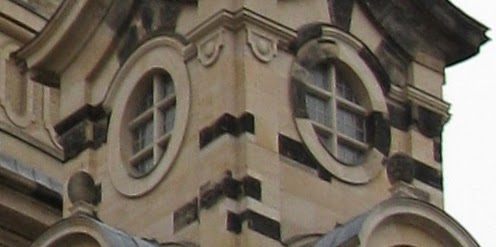
When the Frauenkirche in Dresden was raised in 2005 from the rubble, the few blackened stones left after the February 1945 fire-bombing were proudly incorporated amidst the new sandstone for all to see (2008 picture below). But when an Irish scribe named Dominic interspersed the "wrong" Latin text in a Vulgate bible, he doubtless hoped nobody would notice.


Working between 600 and 800 CE at a monastery in the godless wastes of North Italy, Dominic had been assigned to write out a bible now known as the Codex Ottobonianus and digitized a few days ago by Digita Vaticana. You can see Ott. lat. 66 here.

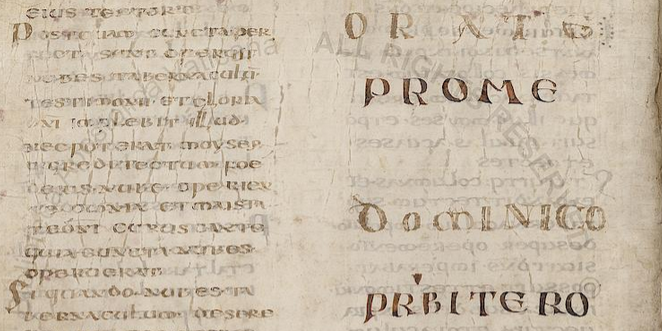
The model he was copying from must have been torn or partly illegible. Resourcefully, Dominic copied the missing bits from an Old Latin bible in his library that dated back to before the 400 CE translation by Jerome of Sidon. Naturally, he does not draw any attention to the places where he has woven in the obsolete phrasing, but after this fiddle, his autograph on folio 112v, "Pray for me, Dominic the Priest" (orate pro me Dominico Prbitero), must have been tinged with a heartfelt hope that he would never be caught:


In the end, the truth did come out. The codex is a godsend for those interested in what Latin Christians read before Jerome came along. Like the sooty stones in the Frauenkirche, its scattered old phrases are now prized as links to the far past.

In the science of Vetus Latina scripture, the Codex Ottobonianus is designated Beuron number 102 among the rare surviving witnesses to the Old Latin Genesis (see my list of Beuron numbers) and has been exhaustively analysed by biblical scholars. But it is also a key source for Jerome's text. Now everyone can see this valued book with ease.

Here is what Bonifatius Fischer's Vetus Latina edition of Genesis (Freiburg, 1950) has to say about the codex, which I am adding here since it is lacking in the BAV online bibliography:
296 ff; 32,5 x 27,5 cm; 2 Kolumnen zu 31 Zeilen; Unziale des 7./8. Jh. "Written apparently in North Italy. The scribe Dominicus signs on fol. 112v: ORATE PRO ME DOMINICO PRBITERO SCRIPTORE. The occurrence of the Insular symbol for 'autem', the use of red dots with the capitals, and the type of figures in the illustrations suggest some Insular centre in Italy." (E.A. Lowe).
Die Hs enthielt den Heptateuch oder Oktateuch in Vulgata, heute bricht sie bei Jdc 13,20 ab; außerdem fehlt zwischen fol. 6 und 7 ein Blatt mit Gn 6,9-7,11. In den Vulgata-Text sind immer wieder Stücke aus der Vetus Latina eingesprengt, und zwar:
  • Gn 37,27-35;
  • 38,6-11;
  • 41,1-4. 14-21;
  • 46,15-17. 30;
  • 48,13-14. 20-Schluß von Gn;
  • Ex 10,13-15;
  • 11,7-10;
  • 15,1-2;
  • 16,16-17,10;
  • 19,13. 22-24;
  • 20,17-18;
  • 22,30-27,5;
  • 29,44-45.
Andere Textstücke fehlen in der Hs einfach. Um eine solche Lücke auszufüllen, sind die Blätter 66 67 und 68 mit Vulgata-Text (Ex 4,19-6,27) nachträglich eingefügt worden. Weiterhin zeigen einige Fehler der Hs, daß die Vorlage der Hs alt war und noch Scriptura continua hatte: iaridesi statt iair id est, hi est amecum statt hic sta mecum, uidis eas statt ut discas usw.
Wir gehen also wohl nicht fehl mit der Annahme, daß die alte Vorlage der Hs teilweise unleserlich war, wohl auch ganze Blätter verloren hatte. Der Schreiber half sich, indem er die Lücken mit einem ihm zu Gebote stehenden altlateinischen Text von Gn und Ex ausfüllte; zu Lv scheint er einen solchen altlateinischen Text nicht mehr gehabt zu haben; deshalb sind dort die Lücken geblieben. In Gn 37,33-35 entstand ein merkwürdiges Gemisch aus Vulgata und Vetus Latina, da der Kopist hier die in seiner Vorlage noch lesbaren Wörter aus der Vulgata übernahm und den Rest aus seiner altlateinischen Bibel ergänzte.
Die Hs ist in der neuen römischen Vulgata-Ausgabe als einer der drei Hauptzeugen unter dem Sigel O benützt.
Of the principle Genesis source, cod. 403 at Lyons, France, almost nothing is online. A future project on this blog is to survey Vetus Latina material that has been digitized so far.