2018-05-03

Show Me Your Money

The Vatican Library's digital portal expanded this week to take in three new classes of document:
This takes the number of classes to seven. The manuscripts and incunabula (pre-1500 printed books) are the central treasures. The current total of manuscripts online is 15,970 items out of a total of more than 80,000. The inventories are the handwritten catalog books from the Library reading room, 270 of them, which are quite difficult to use. The archives is a collection of deeds and similar documents held by the Library proper, not in the Vatican Secret Archives. The latter four have been present online for some time.

The three new collections this week are the "Visual Materials", the "Printed Materials - Special Projects" (Materiali grafici e oggetti d'arte), and "Coins and Medals". The visual materials seem to be what an English library would call ephemera, mainly printed pamphlets or broadsheets (some scanned at dreadfully low resolution). An example is Stampe.I.96 showing St Peter's in 1655:
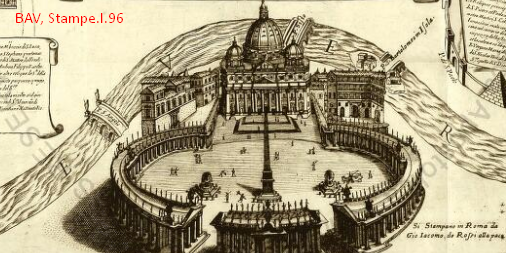
The distinction from "materiali grafici" is not quite clear to me, but as far as I can see these are single photographs of stamps and engravings found in books, presumably post 1500. At the moment this seems quite limited in scope.

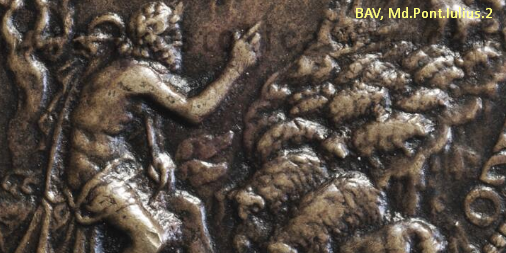
The medals are fairly well scanned, though there does not seem to be sufficient post-processing to reduce glare. The 1506 (or 1512) item below by the engraver Cristoforo Foppa shows too much light on the shepherd's right thigh (this shepherd represents Pope Julius II as a caring ruler):
I am not planning to monitor these three new classes, as they are both non-medieval and of narrower interest than the manuscripts.

More may emerge about where the digitization program is heading later this month when the Vatican Library is hosting a one-day conference. You can invite yourself on Eventbrite, and it is free. The occasion is the completion of a 2012-17 project by the Polonsky Foundation to fund the digitization of key treasures.

Luminaries speaking include Anthony Grafton (@scaliger) and top librarians including Emma Stanford (@e_stanf) and Jill Cousins (@JilCos) from Europe. It's certain to be a love-feast, though I don't see Europe's one other mega digitizer, Gallica, attending.

I would love to attend, but regret that I cannot go for health reasons. I would love it if any eager reader could attend as a reporter and blog and tweet about the presentations!


Another multi-million dollar project that has just been completed without a stumble is the Bibliotheca Palatina digitization. The press release flags an official ceremony on February 15 in Germany with Manfred Lautenschl盲ger, the German millionaire who generously stumped up the cost of scanning the 3,000 Latin codices, and at the ceremony urged wealthy people to imitate his giving.

The digitization restores to Germany in virtual form a precious library that was spirited away from Heidelberg 400 years ago. This pioneering work, which was managed by Heidelberg University Library, benefited the wider Vatican project too, because the Germans set up a proper digitization studio at the Library in Rome and developed basic technical standards which are still in use.
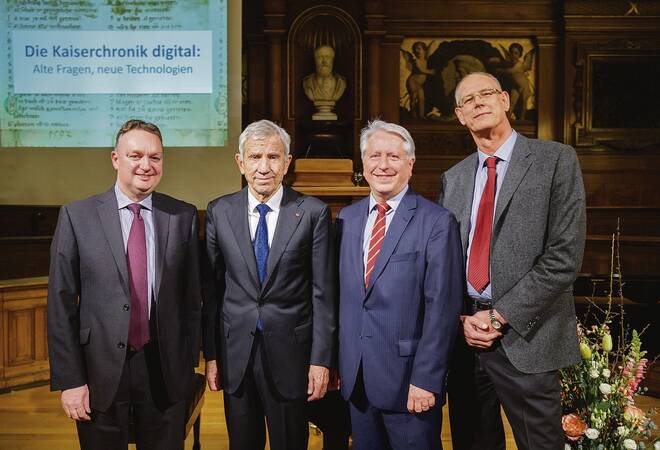
The Rhein-Neckar Zeitung news report says the work got into high gear once the Vatican Library provided a second studio, but quotes Heidelberg chief librarian Veit Probst saying 402 Greek, 430 Hebrew and maybe several hundred unidentified Oriental manuscripts originally from Heidelberg still need to be digitized.

Now that two major funders have completed their projects, the big question now is: who is going to step up with a few million euros to sustain the digitization of the remaining 60,000 manuscripts.

2018-04-23

Rich Student

Among the most tragic figures associated with the Vatican Library is Fabio Mazzatosta, a very wealthy student at Rome in the 15th century who died before getting his first job. I have mentioned in a previous post the seven fabulous Fabio Mattatosta Codices, basically a bunch of school textbooks commissioned in the highest conceivable quality by M from his friend Pomponio Leto.

None of these was hastily copied, all had to be made with the finest script and initials. The arrival online in full color this week of Vat.lat.3279, the Thebaid by Statius (black and white version previously noted here) is fresh cause to celebrate this sad example of conspicuous consumption:

Still to come among the Vatican's five from Fabio's futile bookshelf are Vat.lat.3264 (Fasti of Ovid) and a color version of Vat.lat.3875 (Silvae and Achilleis).

The Vatican Library has been in high gear this week with 48 new digitizations online. The list:
  1. Chig.D.V.71 (Upgraded to HQ), book of hours
  2. Reg.lat.1933,
  3. Vat.lat.519.pt.1, Milleloquium Veritatis Sancti Augustini by Bartholomew of Urbino, see Bernard Peebles (1954). Part 2 came online earlier this month.
  4. Vat.lat.2188, Bernardini de Sicilia, Quaestiones de Cognitione animae conjunctae corpori; see also electronic Thorndike Kiber which lists an incipit Circa considerationem de mensuris durationis attributable to Dietrich von Freiberg.
  5. Vat.lat.2215 (Upgraded to HQ), Seneca
  6. Vat.lat.2236,
  7. Vat.lat.2238,
  8. Vat.lat.2260,
  9. Vat.lat.2271,
  10. Vat.lat.2307 (Upgraded to HQ), Durand de Champagne
  11. Vat.lat.2680,
  12. Vat.lat.2851,
  13. Vat.lat.2924,
  14. Vat.lat.2946,
  15. Vat.lat.2951 (Upgraded to HQ),
  16. Vat.lat.2954,
  17. Vat.lat.2957,
  18. Vat.lat.2962,
  19. Vat.lat.2963,
  20. Vat.lat.2970,
  21. Vat.lat.2983,
  22. Vat.lat.2985,
  23. Vat.lat.2988,
  24. Vat.lat.2998,
  25. Vat.lat.3006,
  26. Vat.lat.3007,
  27. Vat.lat.3008,
  28. Vat.lat.3009,
  29. Vat.lat.3010 (Upgraded to HQ),
  30. Vat.lat.3011 (Upgraded to HQ),
  31. Vat.lat.3013,
  32. Vat.lat.3014,
  33. Vat.lat.3015,
  34. Vat.lat.3016,
  35. Vat.lat.3017 (Upgraded to HQ),
  36. Vat.lat.3020,
  37. Vat.lat.3021,
  38. Vat.lat.3022,
  39. Vat.lat.3026, tracts by Walter Burley (1275-1345?) -  electronic Thorndike Kiber lists the incipit In hoc tractatu intendo perscrutari de causa intrinseca.
  40. Vat.lat.3034,
  41. Vat.lat.3036,
  42. Vat.lat.3043,
  43. Vat.lat.3044,
  44. Vat.lat.3092 (Upgraded to HQ),
  45. Vat.lat.3143 (Upgraded to HQ),
  46. Vat.lat.3227 (Upgraded to HQ), 12th-century manuscript in Beneventan script. Cicero, Philippics, Somnium Scipionis; O Roma nobilis, etc. Mentioned by Lowe.
  47. Vat.lat.3279 (Upgraded to HQ), Fabio Mazzatosta's Thebaid Statius (above)
  48. Vat.lat.3294 (Upgraded to HQ), Martial
This is Piggin's Unofficial List number 159. Thanks to @gundormr for harvesting. If you have corrections or additions, please use the comments box below. Follow me on Twitter (@JBPiggin) for news of more additions to DigiVatLib.

2018-04-20

Digital Mappa(emundi) is Back

Long long ago (2010) on this blog, I posted about Digital Mappaemundi, a new web portal, which I said with orotund optimism "looks as if it will become a wonderful and important resource". It then more or less vanished. Reader Aaron M. (@gundormr) surprised me yesterday with the news that this one is still alive, now called Digital Mappa, with its own web domain and Twitter feed, and that DM 1.0 beta software was released as an open access product this week.

The idea was to create portals where digital images of manuscripts overlaid with digital plots and transcriptions and coexist with hyperlinks to similar manuscripts so that readers could explore them with ease. In the years since DM first poked its head above the parapet, I heard of various projects of a similar nature which generally seemed to die when grants ran out or the poor student doing the donkey work graduated.

Perhaps the biggest deal in this period was the creation of IIIF, a standard to mark up manuscripts so that they can be exhibited online side by side. I still find IIIF a bit baffling, with a dearth of tutorials and models.

Let's be frank: the way the web has always grown in the 20 years I have known it is that you find a good portal and then shamelessly pirate its code and its best features for your own project. I presume my own code has babies all over the place. But I have never found any IIIF project I could clone, and will be interested to see if DM sites are capable of parthogenesis. DM says it will be IIIF-capable from next year in a planned update. The indication that you need a network admin to start a DM project already sounds off-putting: is it that hard?


For a look around, try the Virtual Mappa collection, which contains various mappaemundi from London. I haven't yet seen enough to review it, though the images seem to take forever to load. The Twitter feed takes you through some of the important features. For the time being, I am continuing to make simple SVG digital plots like that of the Albi Mappamundi which I presented earlier this week.

2018-04-18

A New Look at the Albi Mappamundi

The two most ancient map-style manuscripts in existence are the Albi Mappamundi and the Vatican Mappamundi. Both of these western charts of the Mediterranean-centred world were made in the second half of the eighth century, let's say about 770. One or other may turn out a decade or two older, but until someone scientifically dates the sheepskin on which they are drawn, we have to treat them as equally old.

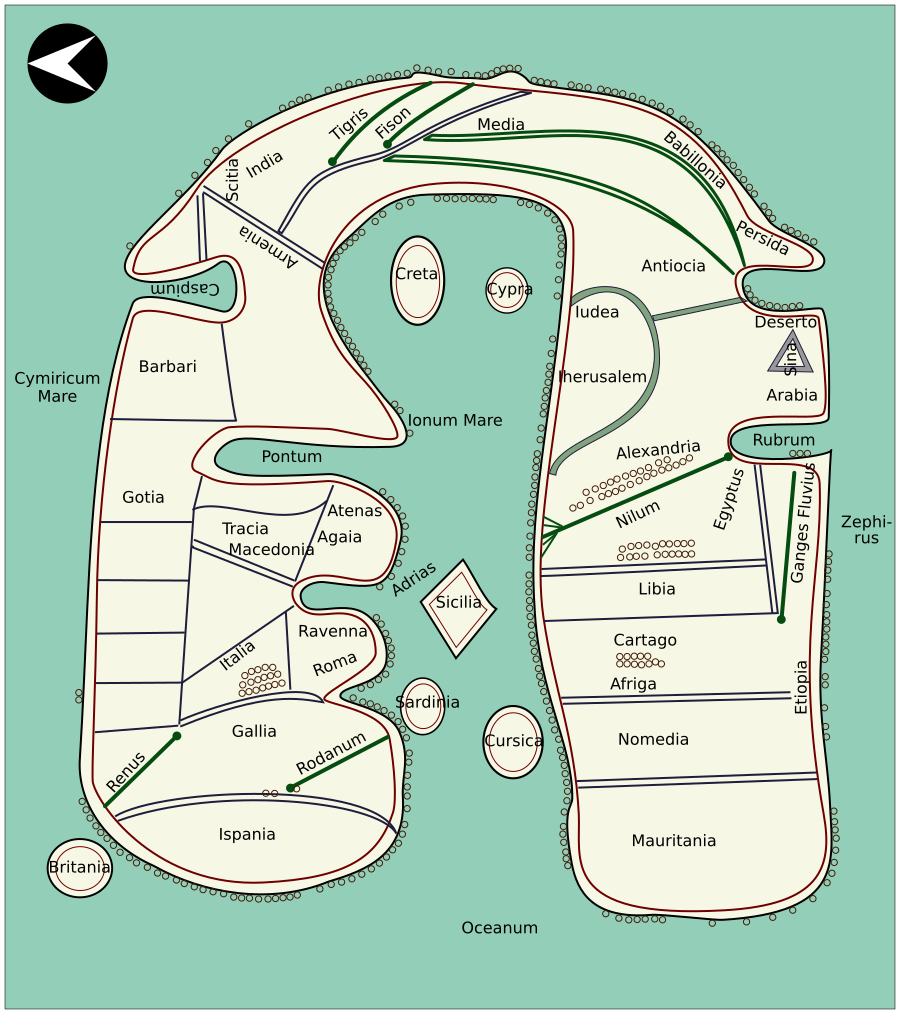
I have just digitally plotted the Albi Mappamundi with a view to adding it to my Library of Latin Diagrams:

The inspiration for this burst of activity was the appearance online of a very comprehensive, very up-to-date article about the Albi Mappamundi by Anca Dan. La mappemonde d'Albi - un pinax ch么rographikos was published in December and she has just been kind enough to post a scan of the article on her Academia.edu page.

She traces this early medieval mappamundi back to a model by Eucher of Lyon, a late-antique Christian leader, based in turn on similar diagrams from his own schooling.

The article's title subtly reminds us that the word mappamundi would have drawn blank looks in antiquity. The term did not exist then. If you had however said pinax ch么rographikos (based on a couple of Greek-origin words) to Eucher, he would have got your drift. 

Schools in classical and late antiquity did not teach geography (too mathematical and of no practical use) but chorography (the size, accessiblity, appearance and hospitableness of places, who lived in them, what they produced). So this is a chorographic pinax (chart). Because of that human-practical focus, a mappamundi never shows the absolute positions of places like a true map, but rather their relative positions: what you have to pass by or cross to arrive at a further place.

Readers will recall that I wrote a blog post in 2016 about the arrival online of the Vatican Mappamundi, which is bound (fol. 63v-64r) in codex Vat.lat.6018. The Albi Mappamundi has been online since its Unesco recognition in 2014. Unfortunately I cannot link you directly to fol. 57v-58r of the codex which contains it. Go to the opening page of that codex, ms Albi 29, and page through to image 115.

Dan, Anca. ‘La mappemonde d’Albi - un pinax ch么rographikos. Notes sur les origines antiques de la carte et du texte du ms Albi 29 fol. 57v-58r’. Cartes & G茅omatique. Revue du Comit茅 fran莽ais de cartographie, no. 234 (December 2017). Online.

2018-04-17

Tatty Endpapers

The Vatican Library contains some immaculate manuscripts in mint condition, which leaves one to wonder if they were ever opened, and some battered items that have obviously been loved half to death. The last week's new digitizations includes what started out as the former, a costly Renaissance manuscript of Boethius with fine illuminations, and ended up as the latter after going through multiple hands.

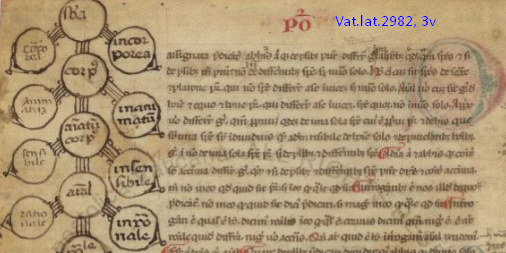
Vat.lat.2982 has annotations galore, tatty endpapers, a worn binding and looks, frankly, grubby. It not only contains Boethius, De Interpretatione, and his translations of  De Sophisticis Elenchis and Topica by Aristotle, but also neat diagrams including his famous arbor porphyriana:
This is not included in my handlist of the medieval Boethius arbor manuscripts as it is apparently too modern. I wonder what model it was copied from.

Here is the full list of 38 new manuscripts:
  1. Reg.lat.945,
  2. Vat.lat.2191 (Upgraded to HQ),
  3. Vat.lat.2198,
  4. Vat.lat.2365,
  5. Vat.lat.2836 (Upgraded to HQ),
  6. Vat.lat.2837 (Upgraded to HQ),
  7. Vat.lat.2839, astrology (?) notes by the humanist poet Giovanni Pontano (1426–1503), hence the listing in the eTK index of science manuscripts with the incipit Aristoteles rerum nature indagator solertissimus
  8. Vat.lat.2844,
  9. Vat.lat.2855,
  10. Vat.lat.2864,
  11. Vat.lat.2867,
  12. Vat.lat.2896,
  13. Vat.lat.2898,
  14. Vat.lat.2899,
  15. Vat.lat.2906 (Upgraded to HQ), 15th-century humanist compilation with Pseudo-Cicero, Livy, Antonio Beccadelli, Leonardo Bruni, Lucio da Visso, four letters of Bartolomeo Facio, etc. With an incipit that runs right around the page,
  16. Vat.lat.2911,
  17. Vat.lat.2913,
  18. Vat.lat.2915 (Upgraded to HQ),
  19. Vat.lat.2919,
  20. Vat.lat.2922,
  21. Vat.lat.2925,
  22. Vat.lat.2933,
  23. Vat.lat.2935,
  24. Vat.lat.2939 (Upgraded to HQ),
  25. Vat.lat.2941,
  26. Vat.lat.2942,
  27. Vat.lat.2960,
  28. Vat.lat.2964,
  29. Vat.lat.2968 (Upgraded to HQ),
  30. Vat.lat.2969 (Upgraded to HQ),
  31. Vat.lat.2974 (Upgraded to HQ), Latin translation by Jacopo Angelo of Ptolemy's Cosmographia (8 books), sadly without maps
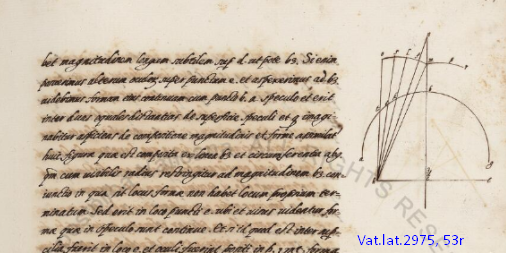
  32. Vat.lat.2975 (Upgraded to HQ), a 16th-century translation of works of the Arab scientist Ibn al-Haytham or Al Hazen. eTK has the incipit Ostendam quid sit crepusculum. With drawings of his optics:
     
  33. Vat.lat.2982 (Upgraded to HQ), a well-worn and much-annotated Boethius (above)
  34. Vat.lat.2984,
  35. Vat.lat.2987,
  36. Vat.lat.3120,
  37. Vat.lat.3125,
  38. Vat.lat.3128,
This is Piggin's Unofficial List number 158. Thanks to @gundormr for harvesting. If you have corrections or additions, please use the comments box below. Follow me on Twitter (@JBPiggin) for news of more additions to DigiVatLib.

2018-04-09

The Red Hat Man

My favourite subject of Renaissance/Early Modern painting in art museums is Jerome of Stridon, who you always recognize instantly from the red hat that he either wears or has hanging on a hat peg. Reklams Lexikon der Heiligen says it was only in the 15th century that the legend arose that Jerome had been a cardinal no less of the Holy Roman Church. From then on, that cardinal's hat was a must.

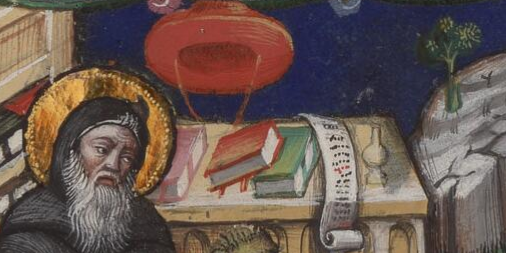
An illumination in a 15th-century (?) Vatican manuscript digitized in the past week, Vat.lat.2277, gives Jerome the full hat treatment, plus a messy desk covered with his codices and scrolls to translate the Bible into Latin, a fanciful 5th century Holy Land scene outside and a golden halo:

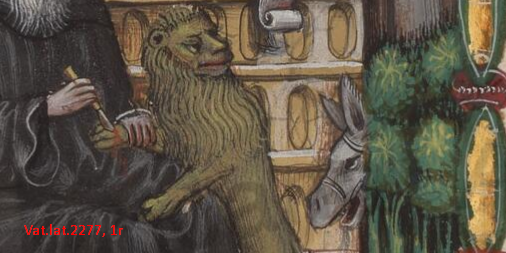
An older legend, first documented in 615 according to Reklams Lexikon, has it that Jerome helped a raging and distressed lion by removing a thorn from its paw. The illumination shows a remarkably calm lion accepting a fix from Jerome's manuscript knife, while the monastery donkey pops its head around the corner to bray. Look up the donkey's story if you haven't read it before. It's quite baroque.

There are 23 new manuscripts on the Digita Vaticana site:
  1. Chig.H.VIII.248, Cicero, Rhetorica de Oratore
  2. Vat.lat.2175, Petri de Ebano, Problemata Aristotlensis
  3. Vat.lat.2232, 14th century manuscript of Iohannes Andreae, c.1270-1348 Novella on the Decretals of Gregory
  4. Vat.lat.2234, ditto
  5. Vat.lat.2277, Johannes de Imola on the Decretals of Gregory (above)
  6. Vat.lat.2306 (Upgraded to HQ), Gulielmi Rayotis, Compendium Summae Confessorum
  7. Vat.lat.2765, Horace
  8. Vat.lat.2832, Andria, a comedy by Terence adapted from a Greek play by Menander. Explicit: "valete et plaudite Caliopius recensui". Bibliography (as of 2018-04-09) mistakenly points to a work dealing with Vat.lat.2382.
  9. Vat.lat.2838, poetry by Giovanni Pontano (1426–1503), humanist and poet from the Duchy of Spoleto: autograph from the library of Angelo Colocci
  10. Vat.lat.2847, Latin poetry, first item by Jacopo Sannazaro
  11. Vat.lat.2854 (Upgraded to HQ),
  12. Vat.lat.2860 (Upgraded to HQ),
  13. Vat.lat.2870, poetry of Antonio Flaminio, see tweet below
  14. Vat.lat.2886 (Upgraded to HQ), Cicero, De officiis
  15. Vat.lat.2888, Cicero, De officiis, heavily annotated in the 14th century. The endpapers are from a 12th or 13th century manuscript of the Institutions of Justinian
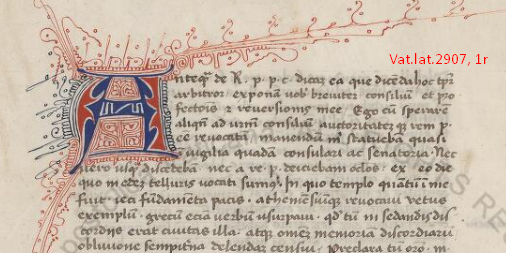
  16. Vat.lat.2907, Cicero, Philippic Orations, also with old lawbooks as endpapers, and this wild overblown initial A:
  17. Vat.lat.2914, on rhetoric
  18. Vat.lat.2923 (Upgraded to HQ), Juan de Segovia
  19. Vat.lat.2931,
  20. Vat.lat.2932, Philodoxeos fabulae
  21. Vat.lat.2965, Tacitus
  22. Vat.lat.2966,
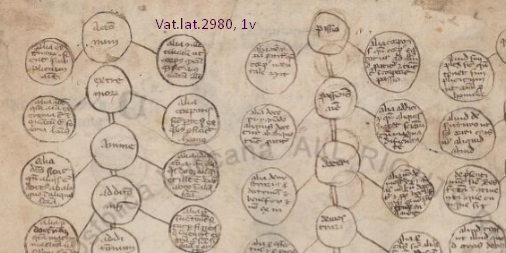
  23. Vat.lat.2980, Boethius: Latin translation of Aristotle's Categoriae (?), plus Boethius De Interpretatione, according to Nils Galindo-Sj枚berg's list. Heavily annotated by a previous owner who also did stemmatic drawings at the front.
This is Piggin's Unofficial List number 157. Thanks to @gundormr for harvesting. If you have corrections or additions, please use the comments box below. Follow me on Twitter (@JBPiggin) for news of more additions to DigiVatLib.

2018-04-02

Gore in Church

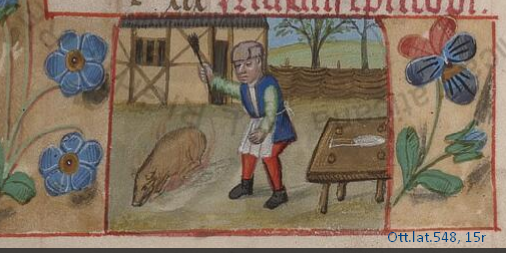
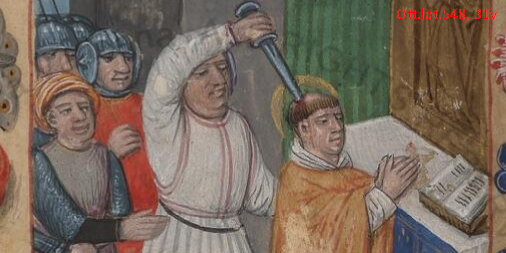
Book of hours were commercial products, where the illuminators aimed to attract buyers with miniatures of either beauty or excitement. An interesting aspect of these prayerbooks is that some contain the most gory images. This week's list of digitizations features Ott.lat.548, which is a book of hours in the Flemish style.

Savour its images which include a butcher about to catch and kill a pig and a scary scene where the king of England's thugs are about to kill Thomas Becket in the cathedral at Canterbury:

In all, we have 23 new items to enjoy:
  1. Ott.lat.548, a book of hours (above)
  2. Vat.lat.519.pt.2,
  3. Vat.lat.1951.pt.2, Plinii Naturalis Historiae in a Renaissance codex of high value. This part starts Liber XII. I. Animalium omnium
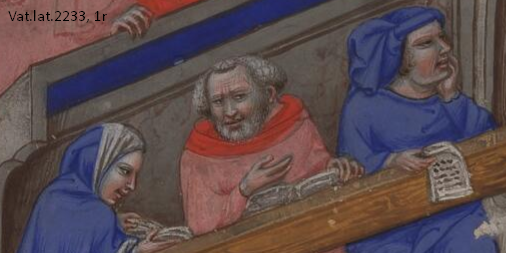
  4. Vat.lat.2233, 14th century, finely illuminated Apparatus in Sextum Bonifatii VIII of
    Iohannes Andreae, c.1270-1348
  5. Vat.lat.2333,
  6. Vat.lat.2760,
  7. Vat.lat.2842, Giovanni Pontano
  8. Vat.lat.2861,
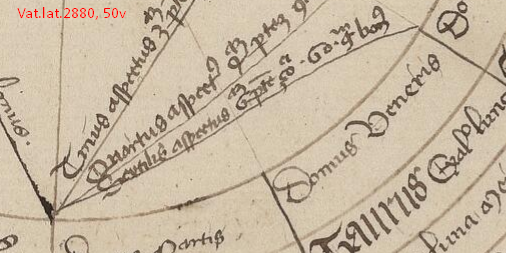
  9. Vat.lat.2880 (Upgraded to HQ), a 15th-century mixture of Cicero, various Quaestiones on Aristotle and a text by John of Saxony, incipit "Istam propositionem scribit Ptolomeus in sapientiis Almagesti..." Here is an astrological diagram:
  10. Vat.lat.2890, 15th century Cicero, De officiis
  11. Vat.lat.2900, Rhetoricam ad Herennium, heavily glossed, 14th century
  12. Vat.lat.2910, Cicero and Leonardi Bruni translation of Plato
  13. Vat.lat.2912 (Upgraded to HQ), an album of classic writers in a peculiar high-oblong format
  14. Vat.lat.2916,
  15. Vat.lat.2918 (Upgraded to HQ), Giovanni Gatti of Messina
  16. Vat.lat.2921 (Upgraded to HQ),
  17. Vat.lat.2926 (Upgraded to HQ), George of Trebizond, translations of Plato, etc.
  18. Vat.lat.2929, Marsilio Ficino, commentary on Plato
  19. Vat.lat.2934.pt.1, Ficino and others, Plato etc.
  20. Vat.lat.2944,
  21. Vat.lat.2959, chronica, including list of French kings on last folio
  22. Vat.lat.3393, LQ
  23. Vat.lat.8171 (Upgraded to HQ), a catalog of the Reginensis collection by Vatican librarian Lucas Holstenius (1596-1661)
This is Piggin's Unofficial List number 156. Thanks to @gundormr for harvesting. If you have corrections or additions, please use the comments box below. Follow me on Twitter (@JBPiggin) for news of more additions to DigiVatLib.