2011-09-18

Miraculous Birds

Rudolf Wittkower offers the following English translation of the Bird and Serpent text which accompanies many copies of the Great Stemma. It seems worth bringing it online in a searchable, copiable format:
It is maintained that there is a bird in a country of the Orient which, armed with a large and very sharp beak, provokes the snake which he wants to fight with audacious hissing. He covers himself purposely with dirt and also covers the pearls of different colours with which nature has lavishly adorned him. Having thus given himself an insignificant appearance he surprises the enemy by this unfamiliar impression and deceives him, so to speak, by the security which the latter feels in front of his shabby appearance. Holding his tail as a shield in the manner of a warrior before his face, he boldly attacks the head of his furious adversary, pierces the brain of the surprised beast with the unexpected weapon of his beak and thus kills his monstrous enemy by his marvellous intelligence.
Christ girded himself with human weakness and enveloped himself with the dirt of our flesh to fight in the shape of man for the benefit of salvation and to deceive the godless deceiver with pious fraud, and he concealed his former shape with the latter, throwing, as it were, the tail of his humanity before the face of divinity, and extinguished as if with a strong beak the poisonous malice of the old murderer of men through the word of his mouth. Therefore the Apostle says: Through the word of his mouth he will kill the wicked.
From: Rudolph Wittkower. 'Miraculous Birds.' Journal of the Warburg Institute (1938), Volume 1, Issue 3, pages 253-257. DOI: 10.2307/750013 http://www.jstor.org/stable/750013. Wittkower probably intended the last phrase to be "the sword of his mouth," but this has been spoiled by an officious proof-reader. The biblical text referred to is Revelation 2:16.

The text has a French translation in: Bord, Lucien-Jean, and Piotr Skubiszewski. L’image de Babylone aux serpents dans les Beatus: Contribution à l’étude des influences du Proche-Orient antique dans l’art du haut Moyen Age. Paris: Cariscript, 2000.

Wittkower and Neuss located the image in five Beatus manuscripts: three of them alongside Alpha recensions of the Great Stemma (Gerona, Turin, Manchester). The others were Urgell (Gamma) and Saint-Sever (Sigma). The image, without the text, is also found near a Great Stemma, in a biblical Delta manuscript, the San Millàn Bible, spread across two pages.

The Rylands version of the image in Manchester is online. Moleiro has a watermarked version of the Gerona image online. The French website Encylopedie Universelle reproduces a detail of the same (about 975, folio 18v). It also has a relatively large image from the Saint-Sever Beatus (about 1060, folio 13). Turin and Urgell are not imaged online as far as I know.

The Latin, as transcribed by Wilhelm Neuss, is as follows:
Quedam esse avis in regione orietentalis asseritur, quae grandi et perduro armatoque rostro contra draconem quem audacibus lacessit sibilis pugnaturam coenum de industria expetit, e cuius volutabro teiro habitu infecta sordescit et diversorum gernmas colorum quibus eam indulgentiam natura depinxit. Et humili despecta vestitu ita hostem novitate deterreat et quasi vilitatis suae securitate decipiat. Caudam velut scutum ante faciem suam quadam arte bellatoris opponit audaci impetu in capud adversarii furentis adsurgit, improviso oris sui telo stupentis bestiae cerebrum fodit, et sic mirae calliditatis ingenio immanem prosternit inimicum.
Informa hominis pugnaturus ad militiam salutis publicae humana se infirmitate praecinxit ac luto se nostrae carnis involvit ut impium deceptorem pia fraude deciperet, et postremis priora celavit ac velut caudam humanitatis ante faciem divinitatis objecit, et tamquam rostro fortissimo venenatam veteris homicidae malitiam verbo sui oris extinxit. Unde et apostolus dicit: verbo oris sui interficiet impium.

2011-08-23

Office Buildings

I have already described my presentation in Berlin on August 18 to the German chapter of the Society for News Design (report).

It was curious that my host there brought along some images of extremely disciplined trees: persons represented by rectangles, each generation rigidly parked in its own storey, rather like an office building. This fierce axial character contrasts with the much looser attitude to space of the Great Stemma author. Late Antique stemmata are really about paths through space, and are not at all like grids.

2011-08-22

Stemma, Maps and Matrices

Now that we have the Great Stemma published online, it's a good time to consider what sort of commonalities it has with the "arbor juris" diagrams in Isidore's Etymologies and with the Peutinger Map. The most important observation is that all three are in a sense calques of the board game, where the meaning arises from traversing through the diagram, much as you jump a counter over the squares or circles of a board towards a goal.

As an itinerarium, Peutinger is all about paths and distances, and not at all about spatial arrangements. One might argue that this is an adaptation to fit its roll form, but I wonder if this isn't a kind of deliberate elaboration from what would be needed for a mere map into something more sophisticated. As it happens, today's IHT edition of the New York Times reports on an ingenious new way of representing cities that overlaps a perspective view into a bird's eye view. It was designed by London's Berg studio and is an exhibit at the NY Museum of Modern Art. The Peutinger Map may not be a broken or primitive map, but instead a highly sophisticated meta-map like the Berg one (I won't comment here on the Richard Talbert proposal that the map is more show-off than practical).

One could argue that the common feature of Peutinger, the arbor iuris, the Great Stemma and also items such as the arbor porphyriana is the invitation to the reader to discover and explore paths, usually crooked paths. That is what the fila and the hypothetical timeline of the Great Stemma are about. The open question is about how accurately the fila and timeline were aligned with one another.

One important ancillary point, to my mind, is that our knowledge of all these graphic schemes is diminished by the difficulty that every scribe, whether Antique or medieval, must have had in accurately copying technical drawings by hand. Last year, I copied the triangular version of the "arbor iuris" and found it a very tricky task, even with good graphics software to help me.

Practice at copying these ingenious graphics has been helpful in understanding their transmission. When I am looking at a poor copy of a drawing, I now assume that its predecessor was more observant of the regularities generally. The more accurate predecessors of these drawings might have had a lot more fine-scale axial information, which is the easiest feature to get out of alignment, as we also seen in the Eusebian Chronological Canons.

But we cannot even begin to reverse this degradation unless we know what equipment such a copyist used when reproducing such drawings, and there I am afraid I have not read enough research. My understanding is that desks were uncommon: according to Kurt Weitzmann, texts were commonly copied onto papyrus rolls by a scribe sitting tailor-style, wearing a tight skirt as the support for his papyrus, which was laid obliquely over the left knee. In the early codex period, the folios were also inscribed on two knees (at least that is true of the Spanish monastery depicted in one of the Beatus codices). It seems to me that big graphics like the Great Stemma could not be competently copied that way, especially if straight axes had to be preserved. I have not studied how paintings were reproduced, but would guess that this done on tables or easels, since the artist had to be at some distance from his canvas to wield his brush.

When we consider how a pen-drawing was copied, I can only speculate. My guess would be that this was a job for a specialist. A tracing through translucent "paper" of some nature? Hardly likely, as the customer would surely expect a product on a robust support. In the 19th century, technical draftsmen used technology such as pantagraphs, but I doubt if these were known in Late Antiquity.

Again, I am only guessing, but I would suppose that the most efficient method would be to stretch a net over the source, another net over the destination, and plot each square or hexagon from one to the other. If a non-specialist scribe were given the task, he might not have the equipment, or the training, or the wit, or the time to do this. If he were particularly incompetent, he would not even complete each panel left to right but might simply hurl squiggles on the page to represent his "overall impression" of the model, then fill the gaps. The Urgell Beatus version of the Great Stemma exemplifies that sort of chaotic, ill-planned copy. It is hardly surprising that we have rather little of the pen-drawings of Antiquity.

Now, I think this encourages us to contemplate the question of Antique "technical" drawing with more attention to the intelligence behind each drawing than to the deficiencies in execution of any of its copies (this was my criticism of Klapisch-Zuber). To some extent, we may be able to at least discover the right questions to ask by looking at collective memory, the practices in other periods, and even our own perceptions. The answers to those questions naturally depend on evidence, but we should try to connect to the intelligence or the intention of the Antique authors.

2011-08-21

Infographics Meeting

I did a presentation on Thursday to a monthly meeting of the Society for News Design in Berlin, and there is a short note on it here by Dagmar Gehl, a PhD candidate at the University of Trier who has been completing a thesis on how adequately people understand "multimodal print clusters" (that is, graphics and text).
The questions fom the listeners as I went along were helpful in showing what audiences find surprising about this material.
One immediate question was: why there were so few daughters in the "family tree of Christ"? The answer: the Great Stemma author, working circa 420 A.D., is faithfully reproducing material that was nearly 1,000 years old in his own time. So the heavily male bias merely reflects the bias of the material he was given. The 540 names in the Great Stemma are certainly a selection from two or three times as many biblical names, but gender is not a factor in the selection.
Other questions focussed on why people wanted to construct genealogies in the first place, or how "true" they are. That is such a wide question that I usually steer away from discussing it, since I would like my audiences to focus more on the "how" of producing a flow chart, or organization chart, or dendrogram, or family tree, and why the visualization can be more useful as a communication medium than a text. But of course it can be legitimately discussed, and I do intend to broach the wider issue in the book I am writing about the research.

2011-08-11

Oxford Patristics Conference

I've done the presentation at last of the Great Stemma, to a qualified audience at the Oxford Patristics Conference today, followed by fruitful chats with three leading professors with close knowledge of the issues it raises. There were about 50 people at the session. After all these years of speaking, it still feels a bit strange to have an audience staring at you, seemingly unresponsive, though they are actually busy mentally processing what you say. They were great, and it was a kind of out-of-nowhere topic. Conference participants who had been told about it in advance were prepared, and said encouraging things afterwards. There was even a little murmer of laughter when I suggested the Great Stemma was like a PowerPoint slide. Thanks for being a great audience!

2011-07-22

Liber Genealogus Text

Just in time for the Oxford Patristics Conference, I have completed a new, structured edition of the Liber Genealogus and published it online here: www.piggin.net/stemmahist/libertext.htm.
Last summer I wasted a couple of weeks marking up a different recension of the Liber, that of Turin, in the mistaken belief that it was the earliest. This time I seem to have tracked down the recension that is truly the first, that of St Gall. It contains a subscription indicating it was written in 427 CE. I have keyed the transcript to the pages of the St Gall manuscript (I will make these hotlinks when it comes online). The manuscript page numbers begin with 299 (this particular codex is numbered by pages, not by folios). I have placed the etymological glosses in a column of their own at the right, which helps to make clearer how the author worked as he read his data from the Great Stemma diagram. The numbering is Mommsen's. It breaks the text into sections of wildly varying size, and I find it illogical, but it has been established as authoritative. Perhaps we can devise a better numbering system in the future.

2011-07-08

Oxford Patristics Conference

Here is the Oxford Patristics Conference web announcement of my paper to be delivered August 11: The Great Stemma: A Late Antique diagram of Christ's descent from Adam. They have put me in Room 10 at the Examination Rooms among the communications taking place on the Thursday on Art. I'm looking forward to it a lot.

2011-06-06

Reconstruction

A first reconstruction of the Great Stemma is complete. This has been accomplished using OpenOffice Draw, separating the various elements into approximately 10 layers. The reconstruction will be issued at the Oxford Patristics Conference in August.

2011-05-28

E-Codices

Some very good news from Professor Christoph Flüeler of the E-Codices manuscript digitization project in Switzerland. I asked him if Cod. Sang. 133, a little codex that is hugely important to the history of books, was likely to be released on the E-Codices website, and he replied that his team would speed this one up and make sure it is issued on the web in the next few months. This is magnificent. I am a big fan of E-Codices, which is a key source in Antiquity studies.

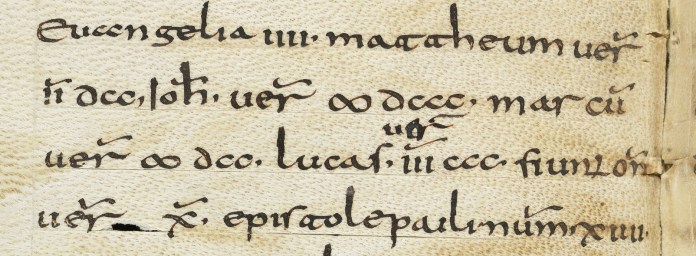
Cod. Sang. 133 in the Abbey Library at St. Gall in Switzerland is an important source in understanding the antique book trade, since it contains a set of more or less intact stichometric lists. These were computations of the length of books, calibrated in στιχοι or stichoi, that were used to set both the cost of transcription (the scribe's wages) and the book price (what the bookseller charged).

Cod. Sang. 133 contain fourth-century measurements of the books of the Bible and the 28 works of Cyprian. We know from the writer Galen (quoted here by Diels) that a Greek stichos or unit was 16 syllables, and this source confirms a Roman stichos, or verse, was similarly 16 Latin syllables.

Once described by Bernhard Bischoff as the "oldest document of the Christian book trade" and used by scholars such as Bruce Metzger to estimate the bulk of early bibles, this record gives us an insight into the economics of book publishing. The content is of course dry, for example:

This translates as:
The Four Gospels:
Matthew, 2700 lines
John, 1800 lines
Mark, 1700 lines
Luke, 3300 lines
All the lines make 10,000 lines.

But there are some interesting observations. The author lets fly for example at exploitative Roman booksellers for their slack and cheating ways with his beloved Cyprian:
Because the index of verses in Rome is not clearly given, and because in other places too, as a result of greed, they do not preserve it in full, I have gone through the books one by one, counting sixteen syllables per line, and have appended to each book the number of Virgilian hexameters it contains (Rouse translation).

The St. Gall manuscript, written during the late 8th or early 9th century, probably at St. Gall itself, and another manuscript, Rome, Biblioteca Nazionale Centrale Vittorio Emanuele II, Vitt. Em. 1325 (handwritten catalog entry in Italian here, formerly Cheltenham or Phillipps 12266), written at Nonantola in the 10th or early 11th century, are the key practical records we have about the stichometric method.

These North African lists, the so-called indicula, were discovered (it seems) by the great Theodor Mommsen, who wrote them up in 1886. Mommsen expanded his fame with this codex in the late 19th century, publishing the Liber Genealogus in his MGH series. It also contains a curious work, the Inventiones Nominum, which mentions a good many unusual biblical names that never made it into canonical scripture.

The St. Gall codex was revisited in 2000 by eminent US professor Richard Rouse, who argued that the 11 items discovered by Mommsen in the collection (see below) were not a random group of texts, but formed an intact North African reference book or compendium. It had travelled through the centuries together and had been put together by Donatist scholars, according to Rouse and his co-writer Charles McNelis.

The St Gall codex is of quite a small format, which explains why the Liber Genealogus, not a very long work, fills 49 of its folios: there is not that much writing on each side. The script is very clear and the parchment clean, which suggests it was probably not very heavily used in its day. This text of the Liber is the earliest recension (the direct description of the Great Stemma) and therefore the most important.

Here is Mommsen's Latin description of the compendium, interspersed with text from Scherrer's 1875 St. Gall printed catalog, with one or two additions by me (the English bits, obviously):

Cod. Sang. 133

Pgm. 8° s. VIII u. IX; 657 (656) pages.

Scherrer: Drei oder vier Handschriften in einem Band. [Preceded by Eusebius/Jerome on Holy Land place-names. Followed by Isidore Chronicon pp 523-590 and 'Incipit cuius supra Goti de Magog Jafet filio orti' pp 590-597. Pages 598-601 blank.]

Mommsen: saec . IX formae octonariae praeter alia quae recenset catalogus editus p. 48 [Scherrer] a glutinatore demum cum his compacta medio loco p. 299-597 continet commentaries qui sequuntur:

1. p. 299 – 396 librum genealogum infra editum. [Scherrer: S. 299-396: 'Inc. liber genera(tio)num vel nominum patrum vel filiorum vet. test. vel novi a s. Hieronimo prbo conpraehensum etc. Incipit genilocus sci Hieronimi prb.' Am Ende: 'Explicit liber genealogus.' (Unbekannt und nicht von Hieronymus; reicht, laut p. 396, bis zum Jahr der Welt 5879 oder bis zum Consulat 'hieri et ardabii.')]

2. p. 397 – 420 incipiunt prophetiae ex omnibus libris collecte. quae prophetiae membra habent .... cecidisse in hanc voluntate perseverantes caeci a dei fide lapsi sunt ignorantes. expl . coll . prophet . veteris novique testamenti.
[Scherrer: S. 397-426: 'Incip. prophetiae ex omnibus libris collecte.' (Katechese).]

3. p. 420′– 421 incipiunt virtutes Haeliae quae eius merito a domino factae sunt. prima virtus. clausit caelum . . . sublatus est in caelo.

4. p. 421 – 426 incipiunt etiam Helisei virtutes. prima virtus. de melote divisa est .... post mortem suam revixit. expl.

5. p. 427 – 454′ inc̅p̅t̅ inventi̅o̅n̅ nomi̅n̅ , duo sunt Adam , unus est protoplaustus .... et alius est Domires vir sponsor Teclae: inter ambas autem sunt an̅n̅ ferme DCCLXX. [Scherrer: S. 427-492: 'Incipt. invention. nominum.' (Aufzählung von Personen- und Völkernamen des A. T.).]

6. 454′– 484′ sequitur liber generationis cum praescriptione hac: haec sunt diutissime . . . . . . anni sunt v̅dccccxviii (vide infra p . 89), sed c . 240 – 331 ad brevem epitomam redactis et ad eius finem inserta computatione quae statim referetur adsunt rursus nostrae editionis c. 333 – 361, abest pars extrema c . 361 – 398: subscriptum expl .

7. p. 484 – 485 item interpretationes filiorum Iacob de Hebreo in Latino. amen vere. Ruben dei spiritus cet.

8. p. 485 – 488 item interpretationes Hebreas in Latin translatas . Hebrea lingua triplex .

9. p. 488 – 492 incipit indiculum veteris testamenti , item novi et Caecili Cipriani, quos indices versum numerum per singulos libros enuntiantes ex gemello libro Cheltenhamensi edidi in Hermae volumine 21 p . 142 seq. librarius iam is qui archetypum scripsit indices eos ad librum generationis non pertinentes neque ei continuatos ad titulorum eius laterculum adiunxit (v. p. 89 not.).

10. p. 492 item interpretationes Hebreas in Latinum . Maria domina cet. [Scherrer: S. 492-522: 'Interpretationes hebreas in latinum etc. Nomina locorum et interpr. nominum de hebreo in latinum. (Excerpte aus Hieron. Liber de interpr. nom. hebr. Opp. ed. Mart. II, von p. 3 bis circa p. 83.)

11. p. 493 – 522 nomina locorum et interpretatio nominum de Hebreo in Latinum. Hermon regio Hebreorum cet. similesque interpretationes aliae.


There is a very old Wikipedia article on stichometry, which I have just fixed a bit. Not just old in the sense of posted in 2005, but old because it was copied from a 100-year-old Encyclopaedia Britannica: it stated that one of the codices is at Cheltenham in Sir Thomas Phillipps's collection. In fact that collection was broken up and sold a century ago. This codex was purchased by the Italian state, and I have altered the Wikipedia article accordingly.

2011-05-27

At the Oxford Patristics Conference

I have been accepted to present a paper on the Great Stemma at the Oxford Patristics Conference which takes place in England August 8-12. The paper will be a short communication delivered during one of the parallel sessions when participants can divide up according to the area that interests them.

Here is my abstract (I think I am allowed to publish this, though the paper itself is under wraps until delivery):

The annotated diagram which spans eight folios of Florence Laurenziana Plutei 20.54, ff 38r-45v is demonstrably Late Antique in origin. This little-studied Latin work, partly published by Wilhelm Neuss and Bonifatius Fischer, presents a genealogy from Adam to Christ. It is also found in a cluster of Spanish bibles and the Apocalypse commentary of Beatus of Liébana. The anonymous author worked entirely from the Vetus Latina rather than from Jerome's Vulgate. We can study how a Late Antique author used complex graphics in place of prose to include a non-canonical figure, Joachim, as father of the Virgin within the genealogy of Christ. He structured the diagram around a timeline based on Eusebius's Chronological Canons. The paper will present a reconstruction of the diagram's archetype, arguing that it was originally a chart displaying synchronisms between scripture and history. It suggests that information graphics were a tool in early Christian literature.

2011-05-26

Ekphrasis

In the classic sense, ekphrasis means a poem that vividly describes a work of art or other physical artefact. During the Greek period, such texts might describe weapons, exceptional clothing, household items of superior craftsmanship (urns, cups, baskets) and splendid buildings.

This form of expression connects with the Roman pride in showing off one's education (paideia) at dinner parties which Michael Squire describes (p. 219) in his book Image and Text in Graeco-Roman Antiquity: Learned discussions of myths and philology were the bread and butter of the cena and convivium, and it seems to have been de rigueur to intersperse dinner with all manner of literary entertainments, he notes. Even Petronius's Trimalchio appreciates that 'one must know one's philology at dinner' (oportet etiam inter cenandum philologiam nosse: Petron. Sat. 39.3), though getting his own woefully wrong, Squire notes.

Squire traces this back to Hellenistic examples, quoting (p. 239) a passage in Greek (Dom. 2) from Lucian's On the Hall: When it comes to what we see, the same law does not apply for ordinary as for learned men. For the former, it is enough to do the usual thing: simply to gaze, look around ... But when a man of learning looks upon what is beautiful, he would not, I think, be content with harvesting his delight in looking alone, nor would he allow himself to witness their beauty in silence; instead, he will do all he can to take his time and to reciprocate the image with speech.

Lucian's speaker later says: 'Visual judgement lies not in the act of looking, but a rational eloquence also concurs with what is seen' (Dom. 6, quoted Squire p. 240). Addressing this Hellenistic 'etiquette of viewing', Squire adds (p. 243): 'The art of being an educated viewer once again becomes the art of being equipped with paideia - of having the terms, language and knowledge to articulate what is remarkable in an image.

The remainder of Squire's argument, that 'verbally mediated responses might actually force viewers to look harder at what they saw' (p. 247), need not concern us here. Instead, I am concerned with the relationship between the Great Stemma and the Liber Genealogus. The one is a very large and impressive diagram, the other an extended text which muses, in list order, on the etymology of biblical names and drops in various tendentious remarks of a Donatist nature about the Church of Rome. In the order of the material, the earliest, G recension of the Liber Genealogus closely follows the diagram. It is all but inconceivable that this order would have been independently adopted without reference to the diagram.

We are thus left with the issue of how and why the Liber Genealogus was written.

It seems to me that the practice of ekphrasis offers a plausible hypothesis to explain its creation. Much of what we read in the Liber seems to be a response to the visualization, perhaps by a Christian displaying both classical learning and biblical knowledge. It might be too fanciful to imagine three or four Christian literati going out to dine with a secretary at hand to jot down what they say and the Great Stemma pinned up on the wall of the dining room. But certainly the Liber does seem to be written with the purpose of dazzling somebody with the eloquence and resourcefulness of its etymological speculation about Hebrew names of the Bible.

2011-04-10

Liber Genealogus

A 9,000-word study of the links between the Liber Genealogus and the Great Stemma more or less completes my detailed research into the oldest stemma diagram known. I have just placed this new article online. I do not pretend it offers any great amusement: it is rather dry stuff. But we need the detail to assemble the case that the Liber is the textual account of someone who had read the Stemma, or something like it. I don't think many people read the Liber Genealogus: it is difficult to see what use it ever was to any reader. Mommsen's edition of the Liber does not help the contemporary reader much either. It is not particularly easy to use, given that the composite Mommsen text overlays the original G recension with material from the Origo Humani Generis and a lot of Donatist disputation. It might have almost been easier for me to just read a manuscript. Unfortunately, the best and oldest one is not online. The excellent Swiss e-codices project has not yet digitized Cod. Sang. 133, which contains the G recension dating from the late 8th or early 9th century. That is quite impressive: this codex was penned less than 400 years after the Liber Genealogus was written in 427. In the absence of this much-needed digital work, one can only consult Plutei 20.54 in Florence, which contains the inferior F recension. This is in fact the same codex that contains the most primitive form of the Great Stemma.

2011-03-09

Greek Place-Names

An interesting blog post from last year by Nick Nicholas on old Greek names for a stretch of coast that is much in the news at the moment. Hippolytus's Chronicon comprehensively lists places that a mariner might need to know about on the desert coast of North Africa.

2011-03-08

New Revisions

So we now have two new pages on the site: one deals in more detail with Eusebius and the likely debt of the Great Stemma to his Chronological Canons. The other explores in more detail the oddities of the Ordo Romanorum Regum. I have also fully revised the bibliography to make it more comprehensive.

2011-02-17

Ordo Annorum Mundi

A new page, dealing with the Ordo Annorum Mundi, has now been placed on the Macro-Typography website. It seems to me that the OAM may be a piece of writing by the Great Stemma's author, but I am still looking for the killer evidence. The OAM seems to appear only in Iberian-origin manuscripts, but has achieved wider diffusion through its incorporation in the Commentary on the Apocalypse of Beatus of Liebana.

Note added in August 2012: No killer evidence found. It seems more than likely that the Ordo Annorum Mundi is not by the Great Stemma author, who probably worked from a chronology drafted by Hippolytus of Rome. However the OAM's history seems intimately entwined with that of the diagram. It could well be the work of someone who revised and altered the diagram at a later stage, altering it to reflect a chronology of world history computed by Eusebius of Caesarea. Professor José Carlos Martín of the University of Salamanca will soon be issuing an editio princeps of the Ordo Annorum Mundi, and we are keenly awaiting this important publication.

2011-02-16

The Vetus Latina Hispana of Ayuso

In 1953, Teófilo Ayuso Marazuela published the first volume of his Vetus Latina Hispana. It was an ambitious project, presumably with government funding, to recover the bible texts that circulated in Iberia before the introduction of Jerome's Vulgate. It was in direct rivalry with the Vetus Latina that was being reconstructed at the Abbey of Beuron in Germany, and it was awarded a prize (marked on the title page) in the name of Spanish dictator Francisco Franco.

Ayuso devised his own numbering system for the codices and other manuscripts he used. The numbers seem to have fallen completely out of use, but are still essential in reading scholarly Spanish articles of the period, in particular Ayuso's own writing, about biblical manuscripts. Since the numbers seem to be nowhere on the internet, I am tabulating them online in the hope they can be of service to modern scholars.

The left column comprises the VLH or Ayuso numbers themselves, followed by the abbreviations commonly used and the sequence numbers for each manuscript of the same provenance. For example, Leg2 or Legionense2 is the Codex gothicus. Burgense1 is the Burgos Bible, also called Biblia de San Pedro de Cardena. The last column lists the (1953) locations of the manuscripts.


1 Guelf


Vaticano -Guelferbitano Vaticano
2 Tur


Turonense Paris
3 Fragm. To


Fragmentos toledanos Toledo
4 Freís


Fragmentos de Freising München
5 Palimps


Palimpsesto de León León
6 Ottob


Ottoboniano Vaticano
7 Lugd 1 Lugdunense Lyon
8 Lugd 2 Lugdunense Paris
9 Escu 1 Eseurialense El Escorial
10 Ov 1 Ovetense (Desaparecido) Oviedo
11 Luxeuil


Leccionario de Luxeuil Paris
12 Ov 2 Ovetense (Desaparecido) Oviedo. Escorial
13 Cav


Cavense Cava
14 Cav dpdo


Cavense duplicado Vaticano
15 To 1 Toledano Madrid
16 To dpdo


Toledano duplicado Vaticano
17 Co 1 Complutense Madrid
18 Co 2 Complutense Madrid
19 Leg 1 Legionense León
20 On


Oniense Salamanca
21 Leg 2 Legionense León
22 Leg dpdo


Legionense duplicado Vaticano
23 Leg 3 Legionense supuesto (Desaparecido) León
24 Emil 1 Emilianense Madrid
25 Burg 1 Burgense Burgos
26 Valv


Valvanerense (Desaparecido) Escorial
27 To 2 Toledano Toledo
28 Pin


Pinatense Madrid
29 Moz


Breviario Mozárabe Madrid
30 Psalt 1 Salterio Madrid
31 Psalt 2 Salterio Madrid
32 Psalt 3 Salterio Madrid
33 Psalt 4 Salterio London
34 Psalt 5 Salterio Nogent-sur-Marne
35 Psalt 6 Salterio Escorial
36 Psalt 7 Salterio Madrid
37 Psalt 8 Salterio Santiago
38 Cant


Liber Canticorum Madrid
39 Com 1 Liber Commicus Toledo
40 Com 2 Liber Commicus París
41 Com 3 Liber Commicus León
42 Com 4 Liber Commicus Madrid
43 Seg 1 Seguntino Sigüenza
44 Esc 2 Escurialense El Escorial
45 Tolos 1 Tolosano Toulouse
46 Tolos 2 Tolosano Toulouse
46* Esc


Escurialense Misceláneo (not a bible) El Escorial
47 Lugd 3 Lugdunense Lyon
48 Teod


Teodulfiano Paris
49 Anic


Aniciense Le Puy
50 Bern


Bernense Bern
51 Hub


Hubertiano London
52 Sang


Sangermanense Paris
53 Sang


Sangermanense Paris
54 Sang


Sangermanense Paris
55 Riq


Saint Riquier Paris
56 Laud


Laudiano Oxford
57 Mon


Monacense München
58 Aur


Aureo Escorial
59 Cas 1 Casinense Monte Cassino
60 Cas 2 Casinense Monte Cassino
61 Cas 3 Casinense Monte Cassino
62 Cas 4 Casinense Monte Cassino
63 To 3 Toledano Toledo
64 Matr 2 Matritense Madrid
65 Matr 3 Matritense Madrid
66 Matr 4 Matritense Madrid
67 Matr 5 Matritense Madrid
68 Matr 6 Matritense Madrid
69 Matr 7 Matritense Madrid
70 Matr 8 Matritense Madrid
71 Purp


Purpúreo (Desaparacido) Urgel
72 Urg


Urgelense Urgel
73 Rip


Ripollense Vaticano
74 Roa


Rodense Paris
75 Vic 1 Vicense Vich
76 Vic 2 Vicense Vich
77 Vic 3 Vicense Vich
78 Vic 4 Vicense Vich
79 Par 1 Parisiense Paris
80 Par 2 Parisiense Paris
81 Par 3 Parisiense Paris
82 Esc 3 Escurialense El Escorial
83 Mall


Malloricense Palma
84 Leg 3 Legionense León
85 Leg 4 Legionense León
86 Leg 5 Legionense León
87 Leg 6 Legionense León
88 Leg 7 Legionense León
89 Osc


Oscense Madrid
90 Matr 9 Matritense Madrid
91 Burg 2 Burgense Burgos
92 Burg 3 Burgense Burgos
93 Cal


Calagurritano Calahorra
94 Emil 2 Emilianense Madrid
95 Ler


llerdense Lérida
96 Co 2 Complutenses Madrid
97 Av


Avilense Madrid
98 Esc 4 Escurialense El Escorial
99 Alf


Alfonsino (Desaparacido) Barcelona?
100 Avig


Avignoniense (Desaparcido) Avignon?
101 Barc 1 Barcinonense Barcelona
102 Barc 2 Barcinonense Barcelona
103 Barc 3 Barcinonense Barcelona
104 Barc 4 Barcinonense Barcelona
105 Barc 5 Barcinonense Barcelona
106 Bil 1 Bilbilitano Calatayud
107 Bil 2 Bilbilitano Calatayud
108 Burg 4 Burgense Burgos
109 Burg 5 Burgense Burgos
110 Cal


Calagurritano Calahorra
111 Conc


Concentainense Concentaina
112 Dar


Darocense Daroca
113 Esc 5 Escurialense El Escorial
114 Esc 6 Escurialense El Escorial
115 Esc 7 Escurialense El Escorial
116 Esc 8 Escurialense El Escorial
117 Esc 9 Escurialense El Escorial
118 Esc 10 Escurialense El Escorial
119 Esc 11 Escurialense El Escorial
120 Esc 12 Escurialense El Escorial
121 Esc 13 Escurialense El Escorial
122 Esc 14 Escurialense El Escorial
123 Esc 15 Escurialense El Escorial
124 Esc 16 Escurialense El Escorial
125 Esc 17 Escurialense El Escorial
126 Esc 18 Escurialense El Escorial
127 Esc 19 Escurialense El Escorial
128 Esc 20 Escurialense El Escorial
129 Esc 21 Escurialense El Escorial
130 Esc 22 Escurialense El Escorial
131 Esc 23 Escurialense El Escorial
132 Esc 24 Escurialense El Escorial
133 Esc 25 Escurialense El Escorial
134 Esc 26 Escurialense El Escorial
135 Hisp


Hispalense Sevilla
136 Mall 2 Malloricense Palma
137 Mall 3 Malloricense Palma
138 Matr 10 Matritense Madrid
139 Matr 11 Matritense Madrid
140 Matr 12 Matritense Madrid
141 Matr 13 Matritense Madrid
142 Matr 14 Matritense Madrid
143 Matr 15 Matritense Madrid
144 Matr 16 Matritense Madrid
145 Matr 17 Matritense Madrid
146 Matr 18 Matritense Madrid
147 Matr 19 Matritense Madrid
148 Matr 20 Matritense Madrid
149 Matr 21 Matritense Madrid
150 Matr 22 Matritense Madrid
151 Matr 23 Matritense Madrid
152 Matr 24 Matritense Madrid
153 Matr 25 Matritense Madrid
154 Matr 26 Matritense Madrid
155 Matr 27 Matritense Madrid
156 Matr 28 Matritense Madrid
157 Matr 29 Matritense Madrid
158 Matr 30 Matritense Madrid
159 Matr 31 Matritense Madrid
160 Matr 32 Matritense Madrid
161 Matr 33 Matritense Madrid
162 Matr 34 Matritense Madrid
163 Matr 35 Matritense Madrid
164 Matr 36 Matritense Madrid
165 Matr 37 Matritense Madrid
166 Matr 38 Matritense Madrid
167 Oxorm


Oxomense Burgo de Osma
168 Par 4 Parisiense Paris
169 Plas 1 Plasentino Plasencia
170 Plas 2 Plasentino Plasencia
171 Salm


Salmanticense Salamanca
172 Segov


Segoviense Segovia
173 Segunt


Seguntino Sigüenza
174 Ser


Serenense Villanueva de la Serena
175 Sor


Soriano Soria
176 Tar


Tarraconense Tarragona
177 Tir


Tirasonense Tarazona
178 To 4 Toledano Toledo
179 To 5 Toledano Toledo
180 To 6 Toledano Toledo
181 To 7 Toledano Toledo
182 To 8 Toledano Toledo
183 To 9 Toledano Toledo
184 To 10 Toledano Toledo
185 To 11 Toledano Toledo
186 To 12 Toledano Toledo
187 To 13 Toledano Toledo
188 To 14 Toledano Toledo
189 To 15 Toledano Toledo
190 To 16 Toledano Toledo
191 To 17 Toledano Toledo
192 To 18 Toledano Toledo
193 To 19 Toledano Toledo
194 To 20 Toledano Toledo
195 Urg 2 Urgelitano Urgel
196 Urg 3 Urgelitano Urgel
197 Valent 1 Valentino Valencia
198 Valent 2 Valentino Valencia
199 Valent 3 Valentino Valencia
200 Valent 4 Valentino Valencia
201 Valv 2 Valvanerense Valvanera
202 Vat


Vaticano Vaticano
203 Zar 1 Zaragozano Zaragoza
204 Zar 2 Zaragozano Zaragoza

You are welcome to copy my list and reproduce it as you wish, though a credit would be appreciated. As far as I can assess, the list in the book can no longer be subject to copyright, and in any case I have modified it to present it here on the web.
There is one peculiarity, perhaps a lapse in attention by Ayuso. Pages 25-6 (IV. Lista de codices espanoles o de origen hispanico estudiados, numeros y siglas correspondientes) list 203 sources only, while pages 347-83 (Los manuscritos bíblicos espanoles) contain a list that is one element longer (204). The extra item in the latter list comes at position number 113, Escurialense5, which is inexplicably missed from the summary table, so that every item below it is displaced by one position when the two lists are compared. In the above tabulation, I have followed the numbering on pages 347-83, since this seems to be correct. Perhaps there is an errata page, or a handwritten correction, in a copy in a Spanish library, and I would be grateful to anyone willing to check this. But there is no such correction in the Hamburg State Library copy, which is kept in the city's Bergedorf stack and does not seem to have been much used down the years.
[A later note:] Ayuso's earlier articles use quite different sigla, including A2, A3, A4, A5, A6, 7-8. These are apparently the items in the Biblioteca Nacional in Madrid (lines 64-69 above). A2 for example is the Bible of San Juan de la Peña, and these are listed in the print catalog (Tomo 1) here. His earlier "Bu" is the Burgos Bible in line 25, as noted above. Ayuso renumbered the León bibles, since 3 Legionense in line 23 is a lost one, whereas the Leg3 he had referred to in 1943 was clearly the Second León Bible which is very much in continued existence. In line 12, 2 Oventense is the lost Gospel Book of Justus which I discuss in another post.

2011-01-19

A Latin Counterpart to Eusebius?

Six years ago, Roger Pearse led a magnificent distributed effort to create an English translation of the Chronological Canons of Eusebius. This was a work in Greek, now mostly lost, that we know through a Latin translation by Jerome and through Armenian translations from the Greek. The translation of the Canons is freely available as two (very large) HTML tables, beginning here on Tertullian.org or mirrored at CCEL here. They may take a while to download to your screen. The Latin of Jerome has also been tabulated on the same websites.
The chronological canons explore synchronisms in the histories of the cultures arrayed between Rome and Persia, keyed to biblical history starting at the birth of Abraham.

So what has this got to do with the Great Stemma? Well, it seems that both are essentially about the same thing, synchronisms. Eusebius created what was in a sense the world's first spreadsheet, with a patient scribe doing the autofill of dates in sequence down the left column. Eusebius then filled in events across the rows from the chronicles of the various civilizations he knew, Graeco-Roman and barbarian. Anthony Grafton in Christianity and the Transformation of the Book explores how revolutionary this method of visualizing information was. One point he might have made, but I don't think he did, is the importance of blank space in this content. The blanks are a key to reading the tabulation. There's a certain tension about it, because Eusebius obviously knew a lot of the content was rubbish, but he puts it in and lets the reader judge.

Now, the Great Stemma, in my view, must have done the same thing, but working left to right, and takes another step forward technically by eliminating the scale of years.
I've now posted a hypothetical reconstruction (link) of how the chronographical elements in the Great Stemma might have looked.

How was it progress to simplify Eusebius? The chart shows the reader the various synchronisms in the Bible: the descendants of Seth with the offspring of Cain, the offspring of Nathan with those of Solomon, the kings of Judah with those of Samaria, the founders of Rome with the Persians. But it finds a way to mix the resolution of the matches. In some cases it can state in a gloss to an exact year what is synchronous. In other cases it gives just a rough estimate of synchronicity, give or take a few hundred years. The author was probably teaching his students that the offspring of Cain were wiped out by the Great Flood, but thanks to his page design he does not need to say exactly when Lamech the Boaster lived or when Noema introduced her a capella music: he just draws them as a series of roundels crawling along the foot of the page till they stop. Big fat roundels don't need to be precisely placed. So in a sense, the Great Stemma is the first mind map: information in bubbles. If it had any kind of exactitude, this was probably confined to a separate tabulation. Perhaps the Ordo Annorum Mundi is that tabulation. We'll have to keep looking into this.

Eusebius obviously had the same issue to contend with. In fact he explains that some of his data is less exact, with a resolution in the order of decades only, not years, or at least that is one of the implications I draw from the following remark. Here is Grafton's translation (p. 140) of Chronici Canones, 14:
To prevent the long list of numbers from causing any confusion, I have cut the entire mass of years into decades. Gathering these from the histories of individual peoples, I have set them across from each other, so that anyone may easily determine in which Greek or barbarian's time the Hebrew prophets and kings and priests were, and similarly which men of the different kingdoms were falsely seem as gods, which were heroes, which cities were founded when, and, from the ranks of illustrious men, who were philosophers, poets, princes and writers.

Eusebius's thoughts on this are useful to an understanding of the Great Stemma. Understanding that Eusebius decided to simply ignore what he saw as prehistory, the time before Abraham, suggested to me that the Great Stemma author also probably decided to treat it differently, arranging it in unform arches and not bothering too closely about its possible synchronisms.
It still seems odd that the Great Stemma seems serenely unaware of Eusebius. Still, if the author worked entirely from Latin sources and did not have any of Jerome's translations to hand, neither the Vulgate nor the Chronici Canones, that would be understandable.
The Roger Pearse translation and Latin allows me to hunt and look for any resemblances and I find no matches in the proto-text of the Stemma. Something only shows up in a later recension, Urgell, where we have: Sexaginario Isaac nascuntur filii gemini: primus Esau, qui est Edom, a quo gens Iudamaeorum; secundus Jacob, qui posthea Israhel, a quo Israhelitae, qui nunc Iudaei. This matches Jerome's Latin translation of Eusebius: Sexagenario Isaac nascuntur filii gemini: primus Esau, qui et Edom, a quo gens Idumaeorum. Secundus Jacob, qui postea Israel, a quo Israelitae, qui nunc Judaei.

Now I don't wish to suggest that the Great Stemma is contemporary with the Canons, which were drawn up in the decade or so after 300 CE. The Stemma might have been drawn up 100 or even 150 years later. But in a wonderful way it is a kind of Latin counterpart to the Canons, finding new conventions to visualize a similar kind of content, preferring traditional roll form to new-fangled codex format, devising new ways to mix exactitude and vagueness, yet very successfully getting its message about synchronisms in biblical history across to the student who reads it. Or more correctly, who read it, past tense. By the time the document reached Spain, most of the careful parallelisms had probably been ruined by careless scribes, and the reader was left to guess at what episode above matched which episode in the rows below.

2011-01-02

Léon Abbreviations

The great Léon bible known as the Codex Legionensis or Leg2 (to distinguish it from Leg3, a copy made 100 years later, and Leg1, also known as ....) has never been published online as far as I know. I was able to see a facsimile of it in the summer at the Prussian State Library in Berlin: it is brought to you in a suitcase-sized wooden box, and the volume would probably not be transportable as hold baggage without paying a supplement: it weighed over 20 kilograms.

In the end I decided against transcribing its version of the Great Stemma and preferred that in the Facundus Beatus. However the Léon bible is sometimes considered the greater treasure by scholars. I have just been looking at Téofilo Ayuso's 1960-61 article in Estudios Bíblicos which comprehensively describes it. Ayuso offers some useful instructions on how to read it, summing up its abbreviations and punctuation. Most of these features are applicable in the other documents in Visigothic script, and are worth reproducing here:

Nexos y Abreviaturas
No vale la pena insistir. Son los propios de la escritura de la época, sin rarezas.
Son normales los nexos y abreviaturas de at, bis, en, er, es, et, ex, nt, per, re, rtem, rum, se, ti, ter, tre.
Normalmente usa ȩ (e con cedilla) en los diptongos ae, oe: uitȩ, suȩ, quȩ, prȩdicasse, etc. A veces la omite: celum, etc. A veces la pone en falso rȩcedent, ȩgo, ȩnim. En alguna ocasión tiene et diptongo.
Ya hemos insinuado algunas abreviaturas por suspensión:
que: usqs, negs, dixeruntqs;
y la de bus: tribs,quibs, etc.
Igualmente ius, mus, pus, etc.: huis, sums, temps, y la de bis, con una especie de cedilla: noḅ.
En cuanto a las abreviaturas por apócope, en las mayúsculas suele ser una raya horizontal gruesa ( ¯¯ ) con adornos o doble suspensión; y en las minúsculas dos o tres puntos: cü ...dṡ ..., bien para la supresión de una letra uitulü, bien para la contracción aüm.
Para e' relativo (qve, qvem), suele usar una v pequenita, volada.
A base de eso las abreviaturas suelen ser las ordinarias:


apslapostolus
aumautem
dddauid
dnsdominus
dsdeus
eplaepistola
glagloria
gragratia
frfrater
ihrslmiherusalem
ihsihesus
kmikarissimi
msmeus
nmnnomen
nsnoster
oms,omnis
pplspopulus
qmquoniam
pprpropter
ppreapropterea
scdmsecundum
spsspiritus
scssanctus
srlsrahel
usauestra
xpschristus

Signos de puntuación
Valen todas las observaciones que hicimos sobre la Biblia de Oña.
Usa con bastante regularidad los signos correspondientes al incisum o subdistinctio, media distinctio y ultima distinctio o punto final. Estos signos son ·(punto alto); · (punto en medio de linea); y ., o de .' (punto bajo, seguido de una comita un poco mayor, ya sea al mismo nivel, ya un poco mas elevada). Como es sabido, indican, poco más o menos, lo que nuestra coma, punto y coma, dos puntos y punto final.
[A note of explanation here: this is the medieval system of punctuation as developed by Aristophanes of Byzantium which we generally ignore in transcriptions, since it does not match current notions of grammatical punctuation:
media distincto: midlevel pause (≈ comma)
subdistincto: pause (≈ semicolon)
distincto: long pause (≈ period)]
Después de ., o de .' suele seguir mayúscula. Unas veces a ren­glón seguido, otras comenzando la linea siguiente.
Usa, como dijimos, una cedilla para expresar los diptongos ae, oe,
Usa un puntito sobre 'a y levantada.
Usa corrientemente un signo de interrogación, chie consiste en una pequeña espiral o rayita quebrada, sobre et espacio que signe a la última letra.
Para indicar la división de capitulos, bien en et margen, bien en medio de linea, usa un ángulo recto, alto, dentro del cual incluye los números romanos correspondientes: I, II, etc.

2010-12-27

Statistics

I've recently completed collating the fifth and last recension of the Great Stemma, found in the Urgell and San Juan manuscripts and it has gone online, along with an expanded bibliography of about 100 works. The collation of the manuscripts has been fairly tedious work and I think I'll stop here. I don't think it would achieve much if I transcribed the Saint-Sever (Sigma) manuscript, and the only other document I am at all curious about at this stage is the one in the Codex Amiatinus III. Perhaps I'll do it later.

It's time for a few statistics now that we have collated all five early recensions of the Great Stemma. Here are the tallies of genealogical roundels for the ancestry of Christ (A), other biblical figures such as Moses and Saul (B) and lone kings (C) with a subtotal of A+B+C.

All versions include about 114 sections of timeline material, of which 44 to 48 sections take the form of roundels. Adding these into the tally brings us to a grand total of roundels for each recension noted in the final row below:


EpsilonDeltaGammaAlphaBeta
A390380379396406
B8378778183
C1919181919
subtotal492477474496508
all roundels540521516542555
In general, the colums to the left tell us the most about the Great Stemma as it existed in Late Antiquity and those at the right measure what changes later editors made to the document, both losing data and adding material. These numbers are surprising in various ways.

For one thing, it turns out the Zaluska's estimated total of about 600 roundels, presumably based on her transcription of the Saint-Sever stemma, is somewhat deceptive. The Late Antique version probably only contained the 540 roundels in Epsilon. The higher tallies come from interpolated versions, of which Saint-Sever (not tallied here) is certainly the biggest.

We also see that despite the rearrangements in structure, the compressions, the many Vulgate-based alterations in the text and the extensive interpolation of material from Isidore, Jerome and others, the Great Stemma remained remarkably constant in its underlying scale during hundreds of years of copying.

Another implication is that the Urgell manuscript, which looks unfinished because of all its empty roundels, is in fact more complete than it seems: the scribe was careless and left out a dozen individuals, but he clearly also drew far more roundels than he ultimately needed. And after supplementing the Gamma collation with material from the San Juan bible, we can see that the Gamma total is only a score or so short of the full muster.

2010-12-06

False Alert

A check today in the Faider and Sint Jan catalog of pre-War Tournai manuscripts reveals that the manuscript I blogged about last week did not contain a stemma. The codex was destroyed in the Luftwaffe bombing of Tournai 1940 May 17. It was shelf-marked Ville Cod. 135 and the catalog (which does indeed survey what survived of Sander's discoveries) describes it thus:
L'ensemble du volume paraît être constitué par les cahiers de copies, de notes et d'extraits, recueillis par un seul travailleur, probablement anglais, au cours d'un séjour dans une bibliothèque déterminée (à Metz ou dans les environs de cette ville). Il se décompose en trois parties (fol. 1-28, 29-87, 88-117), accusées par des changements d'écriture, mais non nécessairement de main. -- Aucune indication explicite d'origine. -- En tête, note sur papier libre (4 ff.), de l'écriture de Franz Cumont (vers 1896), donnant une analyse du contenu du volume, avec quelques annotations supplémentaires. A fait partie de la bibliothèque du chanoine de Villers (cfr Sanderus, p. 215: uno volumine continentur sequentes tractatus 23, etc.). Le relieur du XVIIIe siècle a rogné dans les marges supérieures un certain nombre de titres qui peuvent être restitués grâce au témoignage de Sanderus. Même reliure que le cod. 134. Au dos: De situ Britan ac de re. eius.
The pages where Sander saw the name Gedeon are catalogued thus:
23 (84 v-87r). (Excerpta ex historia sacra)
Fol. 84v, col. 1: Adam prothoplastus colonus paradisi nomina creature dedit, per inobedientiam...; fol. 87r, col. 1: ...Gedeon ...mortuus est senex et sepultus in sepulchro ioas patris sui in effrata (le reste de la page en blanc). - Fol. 87v blanc (essais de plume).
Suite de paragraphes, accusés par des lettres initiales en vert (fol. 84v-85r), puis en rouge, et consacrés aux principaux personnages de l'Ancien Testament jusqu'à Gédéon. - Le fol. 87 est coupé à la moitié de sa hauteur. Les essais de plumes du verso se réfèrent au même texte (Ave Maria ad cuisis, etc.) que ceux du fol. 63 v.
So it was plainly a purely textual account. The other genealogical passage seems to be this:
18 (51r-55 r). Genealogia (seu Epitome Historiae sacrae usque ad Regnum Aristobuli).
Fol. 51r, col. 1: Considerans historiarum prolixitatem, uero unde? et difficultatem scolarium quoque circa studium sacre lectionis... temptaui seriem sanctorum patrum... sed ab adam inchoans ... ad christum finem nostrum ordinem produxi. Adam in agro damasceno formatus... ; fol. 55r, col. 2: ... decursis CCCC LXXV annis a sedechia quando regnum interruptum fuit. - Fol. 55v-56r blancs.
Here again, the 18th-century binder guillotined off the page edges and the heading seen by Sander, as the catalogers note: Résumé de l'Histoire sainte, interrompu après le règne d'Aristobule. Titre ancien coupé dans la marge supérieure du fol. 51r. On déchiffre I(nci)p(it) g(enealo)g(ia).