The State Library at Bamberg has recently digitized the stemma diagrams from its splendid codex Staatsbibliothek Bamberg Msc.Patr.61 and placed them online. The quality is excellent and this is very welcome. The library deserves to be congratulated.
The page of references to written documentation dealing with the codex includes the URLs of my catalog of Cassiodorus stemmata and my reconstruction of how Cassiodorus may have originally conceived the diagrams. There are several recent articles mentioned there which I did not know about: now to order and read them.
2010-11-17


2010-11-13
Translation Finished
Another marker passed: the translation of the Great Stemma into English is complete. Bar a few unintelligible passages where I may have messed up the transcription, the publication is now fully bilingual. Seumas Macdonald of Sydney took charge of putting 30 of the most difficult passages into English. With the text getting so long, I have now split the collation into four sections:The latter section emerged as a separate entity during the recent research into where the many glosses had come from. It turns out that most are almost verbatim quotes from works of Isidore of Seville or from Jerome's Vulgate text. The only text where a clear attribution is not possible is the apocalyptic prediction about the defeat of evil and the coming of the Seventh Age which has been inserted into the Plutei manuscript. For the time being I am leaving out the mappamundi text, since its separate history remains unclear.
2010-11-06
Decoding the San Millán Manuscript
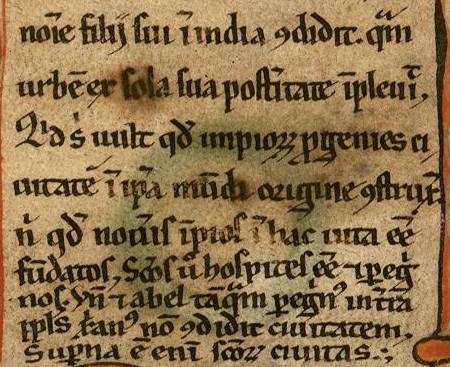
A tricky decoding job with the San Millán stemma seems almost complete, thanks to Brepols and their Library of Latin Texts (LLTA), an online database of Latin. Here is an image of the text:
My first transcription of this gloss about the secular city built by Cain turned out to be nonsense, but I was fortunate to find that the bulk of the text was simply borrowed from a theological exposition by Isidore of Seville, the Mysticorum expositiones sacramentorum seu Quaestiones in Uetus Testamentum. This is easily found in the LLTA: Quid ergo sibi per figuram vult, quod impiorum progenies civitatem in ipsa mundi origine construxit? nisi quod noveris impios in hac vita esse fundatos, sanctos vero hospites esse et peregrinos. Unde et Abel tanquam peregrinus in terris, id est, populus Christianus non condidit civitatem. Superna enim est sanctorum civitas (In Genesim, 6).
That allows us to transcribe the script as follows: Primus ante diluvium Cain civitatem Enoch nomine filii sui in India condidit quam urbem ex sola sua posteritate in plevit, quod sibi vult, quod impiorum progenies civitatem in ipsa mundi origine construxit? nisi quod noveris impios in hac vita esse fundatos, sanctos vero hospites esse et peregrinos. Unde et Abel tamquam peregrinus in terra populus Christianus non condidit civitatem; superna enim est sanctorum civitas.
As a result we can draft the following abbreviations key, which is useful for decoding the entire manuscript, including the Ordo Annorum:
2id = quid
s with a spike over it = sibi?
qd+ = quod
p with a downwards hook at the left = pro
9 = con
n with a rightwards hook above it = nisi
nov+is = noveris
ee with a downwards hook above = esse
sc+os = sanctos
u with a circle over it = vero
p with a straight stroke through the descender = per, with e = pere
g with a top right cantilever and a rightwards hook above = gri (cf. nisi)
vn with a line over the n = unde
qm with a kind of W over and between them = quam
9 on the shoulder at the right = -us
t+ra = terra
ppls = populus
xianus = Christianus
e with a line over it = est
LLTA also indicates that Isidore lifted the latter part of the text from Augustine, De Civitate Dei 15.1: scriptum est itaque de Cain, quod condiderit ciuitatem; Abel autem tamquam peregrinus non condidit; superna est enim sanctorum ciuitas.
In other parts of the same codex we have seen:
c with a spike over it = cri
p with a spike over it = pri
scdam where d ascender has a stroke throught it = secundam
My first transcription of this gloss about the secular city built by Cain turned out to be nonsense, but I was fortunate to find that the bulk of the text was simply borrowed from a theological exposition by Isidore of Seville, the Mysticorum expositiones sacramentorum seu Quaestiones in Uetus Testamentum. This is easily found in the LLTA: Quid ergo sibi per figuram vult, quod impiorum progenies civitatem in ipsa mundi origine construxit? nisi quod noveris impios in hac vita esse fundatos, sanctos vero hospites esse et peregrinos. Unde et Abel tanquam peregrinus in terris, id est, populus Christianus non condidit civitatem. Superna enim est sanctorum civitas (In Genesim, 6).
That allows us to transcribe the script as follows: Primus ante diluvium Cain civitatem Enoch nomine filii sui in India condidit quam urbem ex sola sua posteritate in plevit, quod sibi vult, quod impiorum progenies civitatem in ipsa mundi origine construxit? nisi quod noveris impios in hac vita esse fundatos, sanctos vero hospites esse et peregrinos. Unde et Abel tamquam peregrinus in terra populus Christianus non condidit civitatem; superna enim est sanctorum civitas.
As a result we can draft the following abbreviations key, which is useful for decoding the entire manuscript, including the Ordo Annorum:
2id = quid
s with a spike over it = sibi?
qd+ = quod
p with a downwards hook at the left = pro
9 = con
n with a rightwards hook above it = nisi
nov+is = noveris
ee with a downwards hook above = esse
sc+os = sanctos
u with a circle over it = vero
p with a straight stroke through the descender = per, with e = pere
g with a top right cantilever and a rightwards hook above = gri (cf. nisi)
vn with a line over the n = unde
qm with a kind of W over and between them = quam
9 on the shoulder at the right = -us
t+ra = terra
ppls = populus
xianus = Christianus
e with a line over it = est
LLTA also indicates that Isidore lifted the latter part of the text from Augustine, De Civitate Dei 15.1: scriptum est itaque de Cain, quod condiderit ciuitatem; Abel autem tamquam peregrinus non condidit; superna est enim sanctorum ciuitas.
In other parts of the same codex we have seen:
c with a spike over it = cri
p with a spike over it = pri
scdam where d ascender has a stroke throught it = secundam
2010-10-04
Mommsen's Fingerprints
The great Mommsen seems to have left his fingerprints on a copy of the Great Stemma. His edition of the Liber Genealogus (link) cursorily describes the copy in Florence. It is odd that Mommsen (or his research agent) thought the document of no further interest, since he only notes a "foreign" interpolation on it, and the text of the Ordo Annorum Mundi that has been attached to the end. His record reads as follows:
cod. 54 f. 38 index alter eorundem regum et deinceps imperatorum ad Othonem II a. 961 adscriptus postea manu diversa, editus ibidem p. 506 seq. sub littera B.
cod. 54 f. 38–45 stemmata sacra ad Christum usque adiectis interdum adnotationibus, quarum prima haec est: Adam cum esset annorum CCXXX, genuit Seth: fiunt omnes vite sue DCCCCXXX, alia haec: Gog et Magog. Canuc Ageth Acenazel (acenezel m. 1) Defarfoti Repi Libusei Pharisei Declimei Garmathei Armatiani Caconei Zamartei Agrimarcli Assophargi Cinecefali Tasbei Alanei Priorsolonici Armei Saltarei. iste autem generationes de genere Cham aiunt exortas fuisse, qui propter omnes abominationes suas, quas egerunt, quia nullam legem habuerunt, ab Alexandro Magno Macedonum rege in partibus aquilonis inclusi sunt; qui ante consummationem seculi egrediuntur quattuor angulos terre et circuibunt universa castra sanctorum et civitatem magnam Roman circumdabunt.
cod. 54 f. 45 computatio sub titulo item (exsecta quaedam) orum mundi brevi collecto. ab Adam, finiunt: ab incarnationem (m deletum) domini nostri Iesu Christi usque in presentem primum gloriosi Wambani principis annum, qui est era DCCX ann. DCLXXII, ab exordio autem mundi usque ad adventum domini ann. V̅CXCV.
The quote comes from an interpolated account of the Gog and Magog legend. That text continues (my translation): As has been said by the prophet: Come to me, beasts of the field and birds of the sky, let us congregate for the sacrifice to the greatness of God, to devour the flesh of mighty men and drink the blood of kings, on the mountains of Israel. This is based on Ezekiel 39:18.
The very final sentence in the manuscript is one I cannot decode: I make of it: a quorum iteritu omnis mundus letabitirunt et invicem re munera mittent. Any improvements?
cod. 54 f. 38 index alter eorundem regum et deinceps imperatorum ad Othonem II a. 961 adscriptus postea manu diversa, editus ibidem p. 506 seq. sub littera B.
cod. 54 f. 38–45 stemmata sacra ad Christum usque adiectis interdum adnotationibus, quarum prima haec est: Adam cum esset annorum CCXXX, genuit Seth: fiunt omnes vite sue DCCCCXXX, alia haec: Gog et Magog. Canuc Ageth Acenazel (acenezel m. 1) Defarfoti Repi Libusei Pharisei Declimei Garmathei Armatiani Caconei Zamartei Agrimarcli Assophargi Cinecefali Tasbei Alanei Priorsolonici Armei Saltarei. iste autem generationes de genere Cham aiunt exortas fuisse, qui propter omnes abominationes suas, quas egerunt, quia nullam legem habuerunt, ab Alexandro Magno Macedonum rege in partibus aquilonis inclusi sunt; qui ante consummationem seculi egrediuntur quattuor angulos terre et circuibunt universa castra sanctorum et civitatem magnam Roman circumdabunt.
cod. 54 f. 45 computatio sub titulo item (exsecta quaedam) orum mundi brevi collecto. ab Adam, finiunt: ab incarnationem (m deletum) domini nostri Iesu Christi usque in presentem primum gloriosi Wambani principis annum, qui est era DCCX ann. DCLXXII, ab exordio autem mundi usque ad adventum domini ann. V̅CXCV.
The quote comes from an interpolated account of the Gog and Magog legend. That text continues (my translation): As has been said by the prophet: Come to me, beasts of the field and birds of the sky, let us congregate for the sacrifice to the greatness of God, to devour the flesh of mighty men and drink the blood of kings, on the mountains of Israel. This is based on Ezekiel 39:18.
The very final sentence in the manuscript is one I cannot decode:
 I make of it: a quorum iteritu omnis mundus letabitirunt et invicem re munera mittent. Any improvements?
2010-10-01
Peeling the Layers
I am picking another layer of skin off the Great Stemma at last. Yolanta Zaluska, in her study of the document, was the first to point out that large chunks of this Late Antique work have been copied from works by Isidore of Seville (c. 560 – 636). She described the longest recension, the Beta, as being fortement interpolé, en grande partie, semble-t-il, à l'aide des Etymologies d'Isidore. She was sketchy about the details, but thanks to full-text databases I have been able to track some of these borrowings down.
(1 It turns out that the Table of Nations material, which Zaluska says goes back to Josephus, is quoted practically verbatim from the 9th book of the Etymologiae. These glosses on the biblical ancestors of Mediterranean and Middle Eastern ethnic groups are uniform in both the Alpha and Beta recensions. (2) The so-called Recapitulatio comes from another book by Isidore, the Chronica Majora, a fact which Zaluska also noticed: On peut se référer par exemple à la Chronique d'Isidore, en part. n° 24, 26, 28, 30, 31a, 32a, 32; la phrase Belus pater Nini qui fecit Babiloniam n'est pas d'Isidore. The latter phrase could perhaps be a paraphrase of Isidore, who does insist that Ninus was the son of Belus. (3) Zaluska does not mention it, but a substantial passage dealing with Babylon's temples of precious stones and gold and the Tower of Babel has also been lifted from the Chronica and inserted into the chronology material of the Beta manuscript: perhaps she missed this. (4) Zaluska also considered the mappamundi in the Roda manuscript (Ro) and the Beta recension came from Isidore: Ro est très intéressant sur ce point car il interrompt le déploiement des tables à cet endroit et recopie autour de la mappemonde les textes des Étymologies d'Isidore qui s'y réfèrent: Orbis de rotunditate...; Asia ex nomine...; Post Asiam Europam...; Libia dicta... (Etym, lib. XIV, cap. II, III, IV et V), nous livrant ainsi la source principale de cette composition. She is perhaps right about this, but we will have to recheck the evidence. I will be looking for more borrowings as I go.
Naturally one should not exclude the possibility that it was Isidore who copied the material from the antecedent Great Stemma. However that seems implausible, since Isidore's material is not only much more comprehensive, but also seems to be drawn from a text-format source, perhaps the works of Jerome.
This analysis is important not only in explaining how the Great Stemma grew by accretion, but also in stripping off the accretions to get a picture of how it looked in the beginning. It is like peeling off the brown layers from an onion to get at the edible white interior.
(1 It turns out that the Table of Nations material, which Zaluska says goes back to Josephus, is quoted practically verbatim from the 9th book of the Etymologiae. These glosses on the biblical ancestors of Mediterranean and Middle Eastern ethnic groups are uniform in both the Alpha and Beta recensions. (2) The so-called Recapitulatio comes from another book by Isidore, the Chronica Majora, a fact which Zaluska also noticed: On peut se référer par exemple à la Chronique d'Isidore, en part. n° 24, 26, 28, 30, 31a, 32a, 32; la phrase Belus pater Nini qui fecit Babiloniam n'est pas d'Isidore. The latter phrase could perhaps be a paraphrase of Isidore, who does insist that Ninus was the son of Belus. (3) Zaluska does not mention it, but a substantial passage dealing with Babylon's temples of precious stones and gold and the Tower of Babel has also been lifted from the Chronica and inserted into the chronology material of the Beta manuscript: perhaps she missed this. (4) Zaluska also considered the mappamundi in the Roda manuscript (Ro) and the Beta recension came from Isidore: Ro est très intéressant sur ce point car il interrompt le déploiement des tables à cet endroit et recopie autour de la mappemonde les textes des Étymologies d'Isidore qui s'y réfèrent: Orbis de rotunditate...; Asia ex nomine...; Post Asiam Europam...; Libia dicta... (Etym, lib. XIV, cap. II, III, IV et V), nous livrant ainsi la source principale de cette composition. She is perhaps right about this, but we will have to recheck the evidence. I will be looking for more borrowings as I go.
Naturally one should not exclude the possibility that it was Isidore who copied the material from the antecedent Great Stemma. However that seems implausible, since Isidore's material is not only much more comprehensive, but also seems to be drawn from a text-format source, perhaps the works of Jerome.
This analysis is important not only in explaining how the Great Stemma grew by accretion, but also in stripping off the accretions to get a picture of how it looked in the beginning. It is like peeling off the brown layers from an onion to get at the edible white interior.
2010-09-20
Mappaemundi
The Digital Mappaemundi Project contains a very useful English translation of the geographical text from the Historiarum Adversum Paganos Libri VII (Seven Books of History against the Pagans) of Paulus Orosius. He was an Iberian priest (ca. 385-420) who was commissioned by St. Augustine of Hippo to write up the story of the bad old world. Digital Mappaemundi looks as if it will become a wonderful and important resource: the maps are high-quality digital images from medieval manuscripts and the plan is to completely index and cross-reference them.
2010-09-12
Diplomatic Editions of Diagrams
I've so far looked in vain for scholars' ideas on how to create what one might describe as a "diplomatic" edition of a diagram. As a 21st-century scribe, what one is looking to do is to recopy an antique or medieval diagram while:
In the digital age, we also expect a document to be searchable, and it would be perverse nowadays to publish on paper only: one must produce a full digital edition.
The solution I have been experimenting my way towards is to use XML documents which contain the text and all the necessary instructions to draw a vector image of the original diagram and lay it out faithfully, either on the screen or on paper via a digital printer. XML files can be directly edited: every word and letter can can be checked and altered if need be without using proprietary or sophisticated software.
The images on my website have all been created using OpenOffice Draw and the master files are saved in odg format. To publish them online, they are converted to Flash files.
I have been learning ways to manipulate odg files so that they could become the definitive transcripts of original manuscript pages, or provide the basis for merged, critical, digital editions. In fact it ought to be possible to do this so one could have several languages all stored in the one file: Layer 1 would be Latin, but you could easily swap to a Layer 2 in English, Layer 3 in German and so on.
I prefer to write transcripts into Microsoft Excel, which allows you to standardize the data, mark it up, sort it, add fields and so on. An early problem was how to convert Excel data into a format that can be used by OpenOffice Draw. These are the steps I take:
The minus 56 and minus 19 in this case mean the text begins 56 centimetres to the left and 19 centimetres above the top left corner of the virtual canvas in OpenOffice Draw.
I am still thinking about ways to make the resulting document more easily editable.
- preserving its original language and wording;
- adapting its script and linework to contemporary lettering and drawing conventions;
- unwinding physical deterioration that mars the old medium.
In the digital age, we also expect a document to be searchable, and it would be perverse nowadays to publish on paper only: one must produce a full digital edition.
The solution I have been experimenting my way towards is to use XML documents which contain the text and all the necessary instructions to draw a vector image of the original diagram and lay it out faithfully, either on the screen or on paper via a digital printer. XML files can be directly edited: every word and letter can can be checked and altered if need be without using proprietary or sophisticated software.
The images on my website have all been created using OpenOffice Draw and the master files are saved in odg format. To publish them online, they are converted to Flash files.
I have been learning ways to manipulate odg files so that they could become the definitive transcripts of original manuscript pages, or provide the basis for merged, critical, digital editions. In fact it ought to be possible to do this so one could have several languages all stored in the one file: Layer 1 would be Latin, but you could easily swap to a Layer 2 in English, Layer 3 in German and so on.
I prefer to write transcripts into Microsoft Excel, which allows you to standardize the data, mark it up, sort it, add fields and so on. An early problem was how to convert Excel data into a format that can be used by OpenOffice Draw. These are the steps I take:
- I create an Excel spreadsheet which attaches the necessary XML tags to the left and right of the list data;
- An odg file is in fact a zipped-together folder of files, one of which is named content.xml and contains the text within the drawing;
- Use IZ Arc to open the odg file, and extract content.xml to another folder.
- Open content.xml and prepare to overwrite all of its text sections as follows;
- Copy the XML tags and data which you have generated using Excel;
- In Windows, right click the file icon of content.xml and choose edit from the context menu. Paste the data into content.xml;
- Save the new version of content.xml;
- Drag the altered file back into the IZ Arc window and save the odg file;
- OpenOffice Draw will hiccup a bit as it processes this odg, but it will open;
- The texts may not be properly formatted. Highlight everything and choose Default style to reformat them, then save;
- More fixing in OpenOffice Draw then includes converting background to invisible. To make the borders invisible, change "line" to invisible as well.
- At the beginning of each element, these three opening tags:
- draw:frame draw:style-name="gr1" draw:layer="Text" svg:x="-56cm" svg:y="-19cm"
- draw:text-box
- text:p
- draw:frame draw:style-name="gr1" draw:layer="Text" svg:x="-56cm" svg:y="-19cm"
- At the end of each element, these closing tags:
- /text:p
- /draw:text-box
- /draw:frame
The minus 56 and minus 19 in this case mean the text begins 56 centimetres to the left and 19 centimetres above the top left corner of the virtual canvas in OpenOffice Draw.
I am still thinking about ways to make the resulting document more easily editable.
Subscribe to:
Posts
(
Atom
)