I have completed one of the more obscure analyses of the Great Stemma: a tabulation of the passage dealing with the chieftains of Mount Seir. These are outland people mentioned in Genesis 36 and are not part of the stated ancestry of Christ. We cannot even begin to guess why they were included in the Great Stemma. Interesting sounding names? To fill a blank area of the page? To prove that the author had read Genesis exhaustively? We just don't know. Your guess is as good as mine. Zaluska thought it was of great importance, but never published her own tabulation. I have filled the gap.
In all honesty, this tabulation is not going to make history, but as a piece of utilitarian work, it positions us for further analysis. The passage is the key proposed by Zaluska to identifying the different recensions of the Great Stemma. It is also important in demonstrating that the Epsilon version (not studied by Zaluska) is the oldest and purest that we have got.
2010-11-30


2010-11-29
Intriguing Lead
This post has been superseded. Further investigation showed the intriguing lead led nowhere.
The Bibliotheca Belgica Manuscripta by Anton Sander, a listing of Belgian manuscripts sighted in or before 1640, contains an intriguing lead at page 215: in a codex which unites a variety of short genealogical works, there is one item described as a Genealogia ab Adam usque ad Christum, and another described as a Genealogia ab Adam usque ad Gedeonem. There is no note to say that these genealogies are in table form, but their owner must have had an interest in graphic stemmata, since another item in the volume is Boccaccio's Genealogia Deorum, which often contained Boccaccio's 14th century stemmata. *
What is particularly interesting about the second genealogy (Adam-Gedeon) is that Gedeon is neither a figure in Christ's ancestry, nor, as far I know, does he figure in the bogus medieval ancestries of the European nobility. What is he doing in a genealogy? A glance at the 10th page of Plutei 20.54 in Florence suggests a possible answer. Gedeon is the penultimate item on the fifth out of eight sheets. The Tournai codex, which seems to be a grab-bag of thieved and salvaged fragments, might have contained an incomplete Epsilon manuscript where the last three sheets that cover the period from David to Christ had been lost.
After 370 years, this codex probably no longer exists. Sander saw it in Tournai Cathedral Library.** It had been left to the library by Denis de Villers, who seems to have been chancellor of the diocese (I'm not fully clear about the ecclesiastical offices in this period).*** Tournai and its cultural treasures were bombed by the Luftwaffe in 1940, and much was lost (pictures).
How do we discover the fate of the genealogy codex? The Bibliothecae Cathedralis Ecclesiae Tornacensis now has a weblink, but this codex is not listed. I searched for "Genealogia ab Adam..." and a selection of the other partworks in In Principio, the Brepols database of incipits, but found no promising leads. Where else should I look? Has anybody analysed Sander's work and established, codex by codex, what happened to the various manuscripts?
* Sander's book was published by Insulis, Ex officina Tussani le Clercq, apparently a printer at Lille in France.
** Sander describes the legacy thus: codices Mss. qui sunt in bibliotheca reverendi Domini Hieronymi de Winghe canonici Tornacensis, nunc in bibliotheca publica eccelsiae cathedralis solerte studio et cura R.D. Ioannis Baptistae Stratii decani et donationibus clarissimorum viriorum Hieronymi Winghii, Dionysii Villerii, ac Claudii Dausqueii, eiusdem ecclesiae canonicorum inchoata et luculenta editorum voluminum supellectile instructa.
*** Samaran, Ch. 'La Chronique latine inédite', says Denis de Villers (1546-1620) was a literary man of Tournai, versed in genealogy and numismatics, who held a doctorate in canon law from Louvain University. He and canon Jerome van Winghe founded the cathedral library which is now the Tournai public library (catalog) (article in Bibliothèque de l'école des chartes (1926), 87,144, note 3). There is a more substantial 2004 article by Claude Sorgeloos on de Villers' book collecting here and note 9 says most of de Villers' books were destroyed in the bombardment in 1940. However some had been moved to Mons (catalog) and Courtrai (catalog) and were saved, and one of de Villers' books from Tournai later ended up in the hands of Sir Thomas Phillipps, so perhaps we should also check records of the Phillipps auctions.
The Bibliotheca Belgica Manuscripta by Anton Sander, a listing of Belgian manuscripts sighted in or before 1640, contains an intriguing lead at page 215: in a codex which unites a variety of short genealogical works, there is one item described as a Genealogia ab Adam usque ad Christum, and another described as a Genealogia ab Adam usque ad Gedeonem. There is no note to say that these genealogies are in table form, but their owner must have had an interest in graphic stemmata, since another item in the volume is Boccaccio's Genealogia Deorum, which often contained Boccaccio's 14th century stemmata. *
What is particularly interesting about the second genealogy (Adam-Gedeon) is that Gedeon is neither a figure in Christ's ancestry, nor, as far I know, does he figure in the bogus medieval ancestries of the European nobility. What is he doing in a genealogy? A glance at the 10th page of Plutei 20.54 in Florence suggests a possible answer. Gedeon is the penultimate item on the fifth out of eight sheets. The Tournai codex, which seems to be a grab-bag of thieved and salvaged fragments, might have contained an incomplete Epsilon manuscript where the last three sheets that cover the period from David to Christ had been lost.
After 370 years, this codex probably no longer exists. Sander saw it in Tournai Cathedral Library.** It had been left to the library by Denis de Villers, who seems to have been chancellor of the diocese (I'm not fully clear about the ecclesiastical offices in this period).*** Tournai and its cultural treasures were bombed by the Luftwaffe in 1940, and much was lost (pictures).
How do we discover the fate of the genealogy codex? The Bibliothecae Cathedralis Ecclesiae Tornacensis now has a weblink, but this codex is not listed. I searched for "Genealogia ab Adam..." and a selection of the other partworks in In Principio, the Brepols database of incipits, but found no promising leads. Where else should I look? Has anybody analysed Sander's work and established, codex by codex, what happened to the various manuscripts?
* Sander's book was published by Insulis, Ex officina Tussani le Clercq, apparently a printer at Lille in France.
** Sander describes the legacy thus: codices Mss. qui sunt in bibliotheca reverendi Domini Hieronymi de Winghe canonici Tornacensis, nunc in bibliotheca publica eccelsiae cathedralis solerte studio et cura R.D. Ioannis Baptistae Stratii decani et donationibus clarissimorum viriorum Hieronymi Winghii, Dionysii Villerii, ac Claudii Dausqueii, eiusdem ecclesiae canonicorum inchoata et luculenta editorum voluminum supellectile instructa.
*** Samaran, Ch. 'La Chronique latine inédite', says Denis de Villers (1546-1620) was a literary man of Tournai, versed in genealogy and numismatics, who held a doctorate in canon law from Louvain University. He and canon Jerome van Winghe founded the cathedral library which is now the Tournai public library (catalog) (article in Bibliothèque de l'école des chartes (1926), 87,144, note 3). There is a more substantial 2004 article by Claude Sorgeloos on de Villers' book collecting here and note 9 says most of de Villers' books were destroyed in the bombardment in 1940. However some had been moved to Mons (catalog) and Courtrai (catalog) and were saved, and one of de Villers' books from Tournai later ended up in the hands of Sir Thomas Phillipps, so perhaps we should also check records of the Phillipps auctions.
2010-11-17
Bamberg Cassiodorus
The State Library at Bamberg has recently digitized the stemma diagrams from its splendid codex Staatsbibliothek Bamberg Msc.Patr.61 and placed them online. The quality is excellent and this is very welcome. The library deserves to be congratulated.
The page of references to written documentation dealing with the codex includes the URLs of my catalog of Cassiodorus stemmata and my reconstruction of how Cassiodorus may have originally conceived the diagrams. There are several recent articles mentioned there which I did not know about: now to order and read them.
The page of references to written documentation dealing with the codex includes the URLs of my catalog of Cassiodorus stemmata and my reconstruction of how Cassiodorus may have originally conceived the diagrams. There are several recent articles mentioned there which I did not know about: now to order and read them.
2010-11-13
Translation Finished
Another marker passed: the translation of the Great Stemma into English is complete. Bar a few unintelligible passages where I may have messed up the transcription, the publication is now fully bilingual. Seumas Macdonald of Sydney took charge of putting 30 of the most difficult passages into English. With the text getting so long, I have now split the collation into four sections:The latter section emerged as a separate entity during the recent research into where the many glosses had come from. It turns out that most are almost verbatim quotes from works of Isidore of Seville or from Jerome's Vulgate text. The only text where a clear attribution is not possible is the apocalyptic prediction about the defeat of evil and the coming of the Seventh Age which has been inserted into the Plutei manuscript. For the time being I am leaving out the mappamundi text, since its separate history remains unclear.
2010-11-06
Decoding the San Millán Manuscript
A tricky decoding job with the San Millán stemma seems almost complete, thanks to Brepols and their Library of Latin Texts (LLTA), an online database of Latin. Here is an image of the text:
My first transcription of this gloss about the secular city built by Cain turned out to be nonsense, but I was fortunate to find that the bulk of the text was simply borrowed from a theological exposition by Isidore of Seville, the Mysticorum expositiones sacramentorum seu Quaestiones in Uetus Testamentum. This is easily found in the LLTA: Quid ergo sibi per figuram vult, quod impiorum progenies civitatem in ipsa mundi origine construxit? nisi quod noveris impios in hac vita esse fundatos, sanctos vero hospites esse et peregrinos. Unde et Abel tanquam peregrinus in terris, id est, populus Christianus non condidit civitatem. Superna enim est sanctorum civitas (In Genesim, 6).
That allows us to transcribe the script as follows: Primus ante diluvium Cain civitatem Enoch nomine filii sui in India condidit quam urbem ex sola sua posteritate in plevit, quod sibi vult, quod impiorum progenies civitatem in ipsa mundi origine construxit? nisi quod noveris impios in hac vita esse fundatos, sanctos vero hospites esse et peregrinos. Unde et Abel tamquam peregrinus in terra populus Christianus non condidit civitatem; superna enim est sanctorum civitas.
As a result we can draft the following abbreviations key, which is useful for decoding the entire manuscript, including the Ordo Annorum:
2id = quid
s with a spike over it = sibi?
qd+ = quod
p with a downwards hook at the left = pro
9 = con
n with a rightwards hook above it = nisi
nov+is = noveris
ee with a downwards hook above = esse
sc+os = sanctos
u with a circle over it = vero
p with a straight stroke through the descender = per, with e = pere
g with a top right cantilever and a rightwards hook above = gri (cf. nisi)
vn with a line over the n = unde
qm with a kind of W over and between them = quam
9 on the shoulder at the right = -us
t+ra = terra
ppls = populus
xianus = Christianus
e with a line over it = est
LLTA also indicates that Isidore lifted the latter part of the text from Augustine, De Civitate Dei 15.1: scriptum est itaque de Cain, quod condiderit ciuitatem; Abel autem tamquam peregrinus non condidit; superna est enim sanctorum ciuitas.
In other parts of the same codex we have seen:
c with a spike over it = cri
p with a spike over it = pri
scdam where d ascender has a stroke throught it = secundam
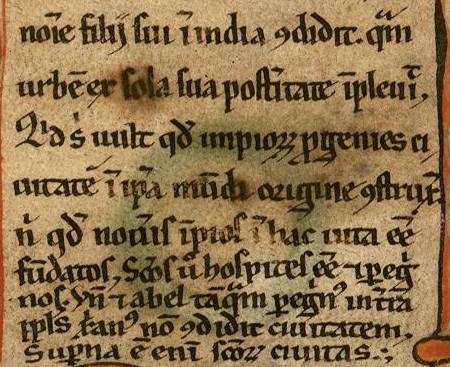
My first transcription of this gloss about the secular city built by Cain turned out to be nonsense, but I was fortunate to find that the bulk of the text was simply borrowed from a theological exposition by Isidore of Seville, the Mysticorum expositiones sacramentorum seu Quaestiones in Uetus Testamentum. This is easily found in the LLTA: Quid ergo sibi per figuram vult, quod impiorum progenies civitatem in ipsa mundi origine construxit? nisi quod noveris impios in hac vita esse fundatos, sanctos vero hospites esse et peregrinos. Unde et Abel tanquam peregrinus in terris, id est, populus Christianus non condidit civitatem. Superna enim est sanctorum civitas (In Genesim, 6).
That allows us to transcribe the script as follows: Primus ante diluvium Cain civitatem Enoch nomine filii sui in India condidit quam urbem ex sola sua posteritate in plevit, quod sibi vult, quod impiorum progenies civitatem in ipsa mundi origine construxit? nisi quod noveris impios in hac vita esse fundatos, sanctos vero hospites esse et peregrinos. Unde et Abel tamquam peregrinus in terra populus Christianus non condidit civitatem; superna enim est sanctorum civitas.
As a result we can draft the following abbreviations key, which is useful for decoding the entire manuscript, including the Ordo Annorum:
2id = quid
s with a spike over it = sibi?
qd+ = quod
p with a downwards hook at the left = pro
9 = con
n with a rightwards hook above it = nisi
nov+is = noveris
ee with a downwards hook above = esse
sc+os = sanctos
u with a circle over it = vero
p with a straight stroke through the descender = per, with e = pere
g with a top right cantilever and a rightwards hook above = gri (cf. nisi)
vn with a line over the n = unde
qm with a kind of W over and between them = quam
9 on the shoulder at the right = -us
t+ra = terra
ppls = populus
xianus = Christianus
e with a line over it = est
LLTA also indicates that Isidore lifted the latter part of the text from Augustine, De Civitate Dei 15.1: scriptum est itaque de Cain, quod condiderit ciuitatem; Abel autem tamquam peregrinus non condidit; superna est enim sanctorum ciuitas.
In other parts of the same codex we have seen:
c with a spike over it = cri
p with a spike over it = pri
scdam where d ascender has a stroke throught it = secundam
2010-10-04
Mommsen's Fingerprints
The great Mommsen seems to have left his fingerprints on a copy of the Great Stemma. His edition of the Liber Genealogus (link) cursorily describes the copy in Florence. It is odd that Mommsen (or his research agent) thought the document of no further interest, since he only notes a "foreign" interpolation on it, and the text of the Ordo Annorum Mundi that has been attached to the end. His record reads as follows:
cod. 54 f. 38 index alter eorundem regum et deinceps imperatorum ad Othonem II a. 961 adscriptus postea manu diversa, editus ibidem p. 506 seq. sub littera B.
cod. 54 f. 38–45 stemmata sacra ad Christum usque adiectis interdum adnotationibus, quarum prima haec est: Adam cum esset annorum CCXXX, genuit Seth: fiunt omnes vite sue DCCCCXXX, alia haec: Gog et Magog. Canuc Ageth Acenazel (acenezel m. 1) Defarfoti Repi Libusei Pharisei Declimei Garmathei Armatiani Caconei Zamartei Agrimarcli Assophargi Cinecefali Tasbei Alanei Priorsolonici Armei Saltarei. iste autem generationes de genere Cham aiunt exortas fuisse, qui propter omnes abominationes suas, quas egerunt, quia nullam legem habuerunt, ab Alexandro Magno Macedonum rege in partibus aquilonis inclusi sunt; qui ante consummationem seculi egrediuntur quattuor angulos terre et circuibunt universa castra sanctorum et civitatem magnam Roman circumdabunt.
cod. 54 f. 45 computatio sub titulo item (exsecta quaedam) orum mundi brevi collecto. ab Adam, finiunt: ab incarnationem (m deletum) domini nostri Iesu Christi usque in presentem primum gloriosi Wambani principis annum, qui est era DCCX ann. DCLXXII, ab exordio autem mundi usque ad adventum domini ann. V̅CXCV.
The quote comes from an interpolated account of the Gog and Magog legend. That text continues (my translation): As has been said by the prophet: Come to me, beasts of the field and birds of the sky, let us congregate for the sacrifice to the greatness of God, to devour the flesh of mighty men and drink the blood of kings, on the mountains of Israel. This is based on Ezekiel 39:18.
The very final sentence in the manuscript is one I cannot decode: I make of it: a quorum iteritu omnis mundus letabitirunt et invicem re munera mittent. Any improvements?
cod. 54 f. 38 index alter eorundem regum et deinceps imperatorum ad Othonem II a. 961 adscriptus postea manu diversa, editus ibidem p. 506 seq. sub littera B.
cod. 54 f. 38–45 stemmata sacra ad Christum usque adiectis interdum adnotationibus, quarum prima haec est: Adam cum esset annorum CCXXX, genuit Seth: fiunt omnes vite sue DCCCCXXX, alia haec: Gog et Magog. Canuc Ageth Acenazel (acenezel m. 1) Defarfoti Repi Libusei Pharisei Declimei Garmathei Armatiani Caconei Zamartei Agrimarcli Assophargi Cinecefali Tasbei Alanei Priorsolonici Armei Saltarei. iste autem generationes de genere Cham aiunt exortas fuisse, qui propter omnes abominationes suas, quas egerunt, quia nullam legem habuerunt, ab Alexandro Magno Macedonum rege in partibus aquilonis inclusi sunt; qui ante consummationem seculi egrediuntur quattuor angulos terre et circuibunt universa castra sanctorum et civitatem magnam Roman circumdabunt.
cod. 54 f. 45 computatio sub titulo item (exsecta quaedam) orum mundi brevi collecto. ab Adam, finiunt: ab incarnationem (m deletum) domini nostri Iesu Christi usque in presentem primum gloriosi Wambani principis annum, qui est era DCCX ann. DCLXXII, ab exordio autem mundi usque ad adventum domini ann. V̅CXCV.
The quote comes from an interpolated account of the Gog and Magog legend. That text continues (my translation): As has been said by the prophet: Come to me, beasts of the field and birds of the sky, let us congregate for the sacrifice to the greatness of God, to devour the flesh of mighty men and drink the blood of kings, on the mountains of Israel. This is based on Ezekiel 39:18.
The very final sentence in the manuscript is one I cannot decode:
 I make of it: a quorum iteritu omnis mundus letabitirunt et invicem re munera mittent. Any improvements?
2010-10-01
Peeling the Layers
I am picking another layer of skin off the Great Stemma at last. Yolanta Zaluska, in her study of the document, was the first to point out that large chunks of this Late Antique work have been copied from works by Isidore of Seville (c. 560 – 636). She described the longest recension, the Beta, as being fortement interpolé, en grande partie, semble-t-il, à l'aide des Etymologies d'Isidore. She was sketchy about the details, but thanks to full-text databases I have been able to track some of these borrowings down.
(1 It turns out that the Table of Nations material, which Zaluska says goes back to Josephus, is quoted practically verbatim from the 9th book of the Etymologiae. These glosses on the biblical ancestors of Mediterranean and Middle Eastern ethnic groups are uniform in both the Alpha and Beta recensions. (2) The so-called Recapitulatio comes from another book by Isidore, the Chronica Majora, a fact which Zaluska also noticed: On peut se référer par exemple à la Chronique d'Isidore, en part. n° 24, 26, 28, 30, 31a, 32a, 32; la phrase Belus pater Nini qui fecit Babiloniam n'est pas d'Isidore. The latter phrase could perhaps be a paraphrase of Isidore, who does insist that Ninus was the son of Belus. (3) Zaluska does not mention it, but a substantial passage dealing with Babylon's temples of precious stones and gold and the Tower of Babel has also been lifted from the Chronica and inserted into the chronology material of the Beta manuscript: perhaps she missed this. (4) Zaluska also considered the mappamundi in the Roda manuscript (Ro) and the Beta recension came from Isidore: Ro est très intéressant sur ce point car il interrompt le déploiement des tables à cet endroit et recopie autour de la mappemonde les textes des Étymologies d'Isidore qui s'y réfèrent: Orbis de rotunditate...; Asia ex nomine...; Post Asiam Europam...; Libia dicta... (Etym, lib. XIV, cap. II, III, IV et V), nous livrant ainsi la source principale de cette composition. She is perhaps right about this, but we will have to recheck the evidence. I will be looking for more borrowings as I go.
Naturally one should not exclude the possibility that it was Isidore who copied the material from the antecedent Great Stemma. However that seems implausible, since Isidore's material is not only much more comprehensive, but also seems to be drawn from a text-format source, perhaps the works of Jerome.
This analysis is important not only in explaining how the Great Stemma grew by accretion, but also in stripping off the accretions to get a picture of how it looked in the beginning. It is like peeling off the brown layers from an onion to get at the edible white interior.
(1 It turns out that the Table of Nations material, which Zaluska says goes back to Josephus, is quoted practically verbatim from the 9th book of the Etymologiae. These glosses on the biblical ancestors of Mediterranean and Middle Eastern ethnic groups are uniform in both the Alpha and Beta recensions. (2) The so-called Recapitulatio comes from another book by Isidore, the Chronica Majora, a fact which Zaluska also noticed: On peut se référer par exemple à la Chronique d'Isidore, en part. n° 24, 26, 28, 30, 31a, 32a, 32; la phrase Belus pater Nini qui fecit Babiloniam n'est pas d'Isidore. The latter phrase could perhaps be a paraphrase of Isidore, who does insist that Ninus was the son of Belus. (3) Zaluska does not mention it, but a substantial passage dealing with Babylon's temples of precious stones and gold and the Tower of Babel has also been lifted from the Chronica and inserted into the chronology material of the Beta manuscript: perhaps she missed this. (4) Zaluska also considered the mappamundi in the Roda manuscript (Ro) and the Beta recension came from Isidore: Ro est très intéressant sur ce point car il interrompt le déploiement des tables à cet endroit et recopie autour de la mappemonde les textes des Étymologies d'Isidore qui s'y réfèrent: Orbis de rotunditate...; Asia ex nomine...; Post Asiam Europam...; Libia dicta... (Etym, lib. XIV, cap. II, III, IV et V), nous livrant ainsi la source principale de cette composition. She is perhaps right about this, but we will have to recheck the evidence. I will be looking for more borrowings as I go.
Naturally one should not exclude the possibility that it was Isidore who copied the material from the antecedent Great Stemma. However that seems implausible, since Isidore's material is not only much more comprehensive, but also seems to be drawn from a text-format source, perhaps the works of Jerome.
This analysis is important not only in explaining how the Great Stemma grew by accretion, but also in stripping off the accretions to get a picture of how it looked in the beginning. It is like peeling off the brown layers from an onion to get at the edible white interior.
2010-09-20
Mappaemundi
The Digital Mappaemundi Project contains a very useful English translation of the geographical text from the Historiarum Adversum Paganos Libri VII (Seven Books of History against the Pagans) of Paulus Orosius. He was an Iberian priest (ca. 385-420) who was commissioned by St. Augustine of Hippo to write up the story of the bad old world. Digital Mappaemundi looks as if it will become a wonderful and important resource: the maps are high-quality digital images from medieval manuscripts and the plan is to completely index and cross-reference them.
2010-09-12
Diplomatic Editions of Diagrams
I've so far looked in vain for scholars' ideas on how to create what one might describe as a "diplomatic" edition of a diagram. As a 21st-century scribe, what one is looking to do is to recopy an antique or medieval diagram while:
In the digital age, we also expect a document to be searchable, and it would be perverse nowadays to publish on paper only: one must produce a full digital edition.
The solution I have been experimenting my way towards is to use XML documents which contain the text and all the necessary instructions to draw a vector image of the original diagram and lay it out faithfully, either on the screen or on paper via a digital printer. XML files can be directly edited: every word and letter can can be checked and altered if need be without using proprietary or sophisticated software.
The images on my website have all been created using OpenOffice Draw and the master files are saved in odg format. To publish them online, they are converted to Flash files.
I have been learning ways to manipulate odg files so that they could become the definitive transcripts of original manuscript pages, or provide the basis for merged, critical, digital editions. In fact it ought to be possible to do this so one could have several languages all stored in the one file: Layer 1 would be Latin, but you could easily swap to a Layer 2 in English, Layer 3 in German and so on.
I prefer to write transcripts into Microsoft Excel, which allows you to standardize the data, mark it up, sort it, add fields and so on. An early problem was how to convert Excel data into a format that can be used by OpenOffice Draw. These are the steps I take:
The minus 56 and minus 19 in this case mean the text begins 56 centimetres to the left and 19 centimetres above the top left corner of the virtual canvas in OpenOffice Draw.
I am still thinking about ways to make the resulting document more easily editable.
- preserving its original language and wording;
- adapting its script and linework to contemporary lettering and drawing conventions;
- unwinding physical deterioration that mars the old medium.
In the digital age, we also expect a document to be searchable, and it would be perverse nowadays to publish on paper only: one must produce a full digital edition.
The solution I have been experimenting my way towards is to use XML documents which contain the text and all the necessary instructions to draw a vector image of the original diagram and lay it out faithfully, either on the screen or on paper via a digital printer. XML files can be directly edited: every word and letter can can be checked and altered if need be without using proprietary or sophisticated software.
The images on my website have all been created using OpenOffice Draw and the master files are saved in odg format. To publish them online, they are converted to Flash files.
I have been learning ways to manipulate odg files so that they could become the definitive transcripts of original manuscript pages, or provide the basis for merged, critical, digital editions. In fact it ought to be possible to do this so one could have several languages all stored in the one file: Layer 1 would be Latin, but you could easily swap to a Layer 2 in English, Layer 3 in German and so on.
I prefer to write transcripts into Microsoft Excel, which allows you to standardize the data, mark it up, sort it, add fields and so on. An early problem was how to convert Excel data into a format that can be used by OpenOffice Draw. These are the steps I take:
- I create an Excel spreadsheet which attaches the necessary XML tags to the left and right of the list data;
- An odg file is in fact a zipped-together folder of files, one of which is named content.xml and contains the text within the drawing;
- Use IZ Arc to open the odg file, and extract content.xml to another folder.
- Open content.xml and prepare to overwrite all of its text sections as follows;
- Copy the XML tags and data which you have generated using Excel;
- In Windows, right click the file icon of content.xml and choose edit from the context menu. Paste the data into content.xml;
- Save the new version of content.xml;
- Drag the altered file back into the IZ Arc window and save the odg file;
- OpenOffice Draw will hiccup a bit as it processes this odg, but it will open;
- The texts may not be properly formatted. Highlight everything and choose Default style to reformat them, then save;
- More fixing in OpenOffice Draw then includes converting background to invisible. To make the borders invisible, change "line" to invisible as well.
- At the beginning of each element, these three opening tags:
- draw:frame draw:style-name="gr1" draw:layer="Text" svg:x="-56cm" svg:y="-19cm"
- draw:text-box
- text:p
- draw:frame draw:style-name="gr1" draw:layer="Text" svg:x="-56cm" svg:y="-19cm"
- At the end of each element, these closing tags:
- /text:p
- /draw:text-box
- /draw:frame
The minus 56 and minus 19 in this case mean the text begins 56 centimetres to the left and 19 centimetres above the top left corner of the virtual canvas in OpenOffice Draw.
I am still thinking about ways to make the resulting document more easily editable.
2010-09-11
Old Vellum and Bookselling
A learned article by Richard Rouse and Charles McNelis appeared a decade ago. North African literary activity is subtitled "A Cyprian fragment, the stichometric lists and a Donatist compendium" and incredibly it rounds up four utterly diverse topics in one discussion: the unlikely discovery of a very worn piece of old vellum in a codex binding, Late Antique bookselling, a North African Christian sect and how 19th-century philologists could not see the wood for the trees. The article comes to the conclusion that a lot of the Late Antique bible-handbook and chronographic material we now have was saved for posterity in a single compendium.
Rouse, who is now emeritus professor at UCLA, and McNelis, now associate professor at Georgetown University, suggest a way by which the Great Stemma (that is not of course their name for it) might derive from the Liber Genealogus. It would be nice if this fitted the facts, but we have three signal differences between these works:
Rouse, who is now emeritus professor at UCLA, and McNelis, now associate professor at Georgetown University, suggest a way by which the Great Stemma (that is not of course their name for it) might derive from the Liber Genealogus. It would be nice if this fitted the facts, but we have three signal differences between these works:
- they use different versions of the Table of Nations from Genesis 10
- they use different chronologies of the kings of Rome
- the Great Stemma has none of the Liber's etymological content
2010-08-24
Setback or Progress
After weeks of combing through the Liber Genealogus, including creating my own fully keyed versions of both Frick's and Mommsen's versions, I think I am barking up the wrong tree. My original idea was to hunt for any clues that the Liber Genealogus author might have had the Great Stemma open on the desk in front of him as he wrote. There are no such clues. The two works appear to be siblings, drawing on a common tradition but created in utter ignorance of one another.
The crux is the Table of Nations, the strange anthropological list in Genesis 10 which is the inspiration for two ancient works, the Antiquities of Josephus and the Chronicon of Hippolytus.
The Liber bases all its statements about the different ethnicities in the Mediterranean and Middle East on the Chronicon. In fact, when Bauer and Helm were compiling the critical edition of the Chronicon and came to its ethnicities chapter, the so-called Diamerismos, they often used the Liber Genealogus as a check (see Bauer/Helm, page 1).
The Great Stemma, on the other hand, offers an almost unalloyed reproduction of the ethnicities list in Josephus' Antiquities, a fact that Yolanda Zaluska published 25 years ago. It ought not to have surprised me, but I never appreciated what a black-and-white distinction this is and how starkly this difference in sourcing separates the Great Stemma from the Liber.
I always feel disappointed when a setback like this sinks in. But of course the finding is progress. And in fact it has exciting implications, because it implies yet another way in which the Great Stemma must predate the thinking and intellectual resources of the early 5th century. Its author can have known nothing of Jerome or Augustus. But the thought that he worked in a library where there was not one scrap of Hippolytus to read? Who is this guy? How far back should we be looking? This is tantalizing.
[Later note: the final two paragraphs above are mistaken. It is far more likely that the Table of Nations was worked into the Great Stemma by a Spanish recensor, using a copy of Isidore's Etymologiae. There is no evidence the Great Stemma author was even interested in the Table of Nations material, and why should he have been? The ethnicities material does not add any useful information on the genealogy of Christ or on the chronography which are his central concerns (October 1, 2010).]
[Much later note: I did finally discover sequential evidence. The Liber follows the order of the Great Stemma. This is the subject of my Oxford Patristics Conference paper (September 25, 2011).]
The crux is the Table of Nations, the strange anthropological list in Genesis 10 which is the inspiration for two ancient works, the Antiquities of Josephus and the Chronicon of Hippolytus.
The Liber bases all its statements about the different ethnicities in the Mediterranean and Middle East on the Chronicon. In fact, when Bauer and Helm were compiling the critical edition of the Chronicon and came to its ethnicities chapter, the so-called Diamerismos, they often used the Liber Genealogus as a check (see Bauer/Helm, page 1).
The Great Stemma, on the other hand, offers an almost unalloyed reproduction of the ethnicities list in Josephus' Antiquities, a fact that Yolanda Zaluska published 25 years ago. It ought not to have surprised me, but I never appreciated what a black-and-white distinction this is and how starkly this difference in sourcing separates the Great Stemma from the Liber.
I always feel disappointed when a setback like this sinks in. But of course the finding is progress. And in fact it has exciting implications, because it implies yet another way in which the Great Stemma must predate the thinking and intellectual resources of the early 5th century. Its author can have known nothing of Jerome or Augustus. But the thought that he worked in a library where there was not one scrap of Hippolytus to read? Who is this guy? How far back should we be looking? This is tantalizing.
[Later note: the final two paragraphs above are mistaken. It is far more likely that the Table of Nations was worked into the Great Stemma by a Spanish recensor, using a copy of Isidore's Etymologiae. There is no evidence the Great Stemma author was even interested in the Table of Nations material, and why should he have been? The ethnicities material does not add any useful information on the genealogy of Christ or on the chronography which are his central concerns (October 1, 2010).]
[Much later note: I did finally discover sequential evidence. The Liber follows the order of the Great Stemma. This is the subject of my Oxford Patristics Conference paper (September 25, 2011).]
2010-06-17
Lay Historians
A couple of inspiring accounts of lay historians have just appeared. The story of Tony Clunn, who discovered the site of the Battle of the Teutoberg Forest, is written up by Peter McDermott in the Free Library. Clunn has earned his living as a British Army officer. Adrian Murdoch's blog drew my attention to this. An account of Hershel Shanks, a US lawyer who has become a leader in the field of biblical archaeology, appears in the New York Times. With a degree of false modesty, Shanks describes himself as an outsider to the field, a person who wouldn’t have gotten into it had he known how much it was divided into specialties and subspecialties. Of course he would have! The vital quality in a lay historian today is enterprise: the ability to weld together the work of many specialists into a coherent whole and to perceive opportunities which the specialists do not notice because they are too close to the topic.
2010-05-14
Liber Genealogus
Göttingen University Library in Germany has a digital version of Paul de Lagarde's 1892 edition of the Lucca Cathedral manuscript of the Liber Genealogus. This is in a very rare printed periodical, not available on Archive.org or Google Books. I can only see two libraries in Germany which catalogue this article, entitled SeptuagintStudien, II (perhaps a rare 19th century use of so-called CamelCase). Neither Göttingen nor Mainz are willing to interloan it.
The Liber is a vital text in understanding the Great Stemma. Both works belong to the same tradition (we are not yet sure how their interdependency should be described). This edition is very useful as de Lagarde went to the trouble to link each name to its biblical place with a reference, an extra duty which the Mommsen edition does not bother with. I went to the same trouble myself, and will have to see how our results compare. There is also a Greek text for comparison.
Ayuso Marazuela quotes the de Lagarde version (omitting the "de" from the name and adding a hyphen to the CamelCase), but de Lagarde is not mentioned in the Klapisch-Zuber bibliography.
Carl Frick brought out an all-Latin critical edition of yet another version, the Turin manuscript, in 1892, and published that in his handbook Chronica Minora under the title Origo Humani Generis. The Hathi Trust has placed Frick online, but unfortunately it is only accessible from inside the United States.
Here are the links:
1. de Lagarde
2. Mommsen
3. Frick
The Liber is a vital text in understanding the Great Stemma. Both works belong to the same tradition (we are not yet sure how their interdependency should be described). This edition is very useful as de Lagarde went to the trouble to link each name to its biblical place with a reference, an extra duty which the Mommsen edition does not bother with. I went to the same trouble myself, and will have to see how our results compare. There is also a Greek text for comparison.
Ayuso Marazuela quotes the de Lagarde version (omitting the "de" from the name and adding a hyphen to the CamelCase), but de Lagarde is not mentioned in the Klapisch-Zuber bibliography.
Carl Frick brought out an all-Latin critical edition of yet another version, the Turin manuscript, in 1892, and published that in his handbook Chronica Minora under the title Origo Humani Generis. The Hathi Trust has placed Frick online, but unfortunately it is only accessible from inside the United States.
Here are the links:
1. de Lagarde
2. Mommsen
3. Frick
2010-05-06
A History of the Timeline
An impressive new illustrated history of timelines has just appeared in the United States. Cartographies of Time: A History of the Timeline is the work of Daniel Rosenberg, an associate professor in Oregon, with help from Anthony Grafton. I have not bought a copy yet, but can see the first 34 pages as a sample on Google Books here. Thanks to Nat Taylor for pointing out this publication. The formal launch date seems to have been May 1, but there are bibliographic references suggesting it was in circulation earlier.
Rosenberg's book deals with a topic closely related to the stemma: the long history of vertical, horizontal (and curled-up) timelines to represent history.
One gem of a story I noticed at first glance on the Google preview was the account on page 27 of the Milanese publisher Boninus Mombritius boasting that no scribe could have copied such an intricate and extensive work as accurately as he did with his printed version of Eusebius. Mombritius declared he had kept all the tables in order and put all the kings in their places.
This alludes to the muddle which hampered the diffusion of both the stemma and timeline in the medieval period, and erased almost all documentary evidence of their Late Antique models. It is challenging for any reader to grasp and to remember complex technical drawings which require careful measurement and layout. It is difficult for even a scribe with artistic skills to copy one correctly. And with fewer skills, time pressure and inadequate remuneration, it is practically impossible. Thus, the serious corruption done to the Great Stemma early in its diffusion led to it ultimately being discarded and begun all over again by medieval writers such as Peter of Poitiers.
I cannot see the index and I have not read the book yet, but on the pages I did read, Rosenberg seems to jump his history from Eusebius (who arranged his chronography in vertical columns, with the synchronous entries all carefully aligned with one another) straight to Peter of Poitiers with no mention of the Great Stemma.
The Great Stemma's arcade, which marks out the patriarchs from Adam to Abraham in a series of arches, each containing a span of years between each begetting, is incontestably the oldest left-to-right timeline extant in the West. The manuscripts date from 945 and later. If Rosenberg's valuable book were not to mention them, it would be incomplete.
It can also be argued that the Great Stemma contains a more sophisticated timeline than this simple arcade of patriarchs. I am exploring this on the latest page of the Piggin.Net website. The Great Stemma was undoubtedly created before the 8th century, perhaps in Visigothic Spain, perhaps in North Africa. It could even be that the Great Stemma pre-dates Eusebius, but those are matters that are still the subject of ongoing research.
Rosenberg's book deals with a topic closely related to the stemma: the long history of vertical, horizontal (and curled-up) timelines to represent history.
One gem of a story I noticed at first glance on the Google preview was the account on page 27 of the Milanese publisher Boninus Mombritius boasting that no scribe could have copied such an intricate and extensive work as accurately as he did with his printed version of Eusebius. Mombritius declared he had kept all the tables in order and put all the kings in their places.
This alludes to the muddle which hampered the diffusion of both the stemma and timeline in the medieval period, and erased almost all documentary evidence of their Late Antique models. It is challenging for any reader to grasp and to remember complex technical drawings which require careful measurement and layout. It is difficult for even a scribe with artistic skills to copy one correctly. And with fewer skills, time pressure and inadequate remuneration, it is practically impossible. Thus, the serious corruption done to the Great Stemma early in its diffusion led to it ultimately being discarded and begun all over again by medieval writers such as Peter of Poitiers.
I cannot see the index and I have not read the book yet, but on the pages I did read, Rosenberg seems to jump his history from Eusebius (who arranged his chronography in vertical columns, with the synchronous entries all carefully aligned with one another) straight to Peter of Poitiers with no mention of the Great Stemma.
The Great Stemma's arcade, which marks out the patriarchs from Adam to Abraham in a series of arches, each containing a span of years between each begetting, is incontestably the oldest left-to-right timeline extant in the West. The manuscripts date from 945 and later. If Rosenberg's valuable book were not to mention them, it would be incomplete.
It can also be argued that the Great Stemma contains a more sophisticated timeline than this simple arcade of patriarchs. I am exploring this on the latest page of the Piggin.Net website. The Great Stemma was undoubtedly created before the 8th century, perhaps in Visigothic Spain, perhaps in North Africa. It could even be that the Great Stemma pre-dates Eusebius, but those are matters that are still the subject of ongoing research.
2010-03-31
Vatican Library
It seems the Vatican Library will be digital some day. The announcement has appeared here. Interestingly, there will be a feature that will help scholars search for diagrams: Another two servers have been installed to process the data to make it possible to search for images ... by a graphic pattern, that is, by looking for similar images (graphic or figurative) in the entire digital memory. The latter instrument, truly innovative and certainly interesting for all who intend to undertake research on the Vatican's manuscripts ... was developed from the technology of the Autonomy Systems company, a leading English firm. Unfortunately the entire project is scheduled to take 10 years, and I suppose we must factor in 50-per-cent mission creep, so make that 15 years right off.
Plutei Online
It's time to offer a brief review of the online access to the splendid Plutei Collection at the Biblioteca Medicea Laurenziana in Florence. I've found this a boon, since it not only offers images of the manuscripts, but also bibliographies which seem to be generated from a database. An interesting feature is that it offers a history spanning more than 100 years, showing which scholars have worked with each document.
When I look at Plut.20.54 for example, I can click on "MOVIMENTI RECENTI and see recent users. Under MOVIMENTI PASSATI, I can trace back its uses for scholarship to Bernhard Bischoff, and go all the way back to WM Lindsay when he consulted this Isidore manuscript in 1896 while preparing his critical edition. I am sure that here in Germany the publication of library lending records would probably be interpreted as a scandalous invasion of individual privacy and lead to the sacking of all the
high officials and possibly prison terms for the librarians. At the Plutei I find it rather touching. The slips amount to a kind of roll of honour of great philologists.
Not everything is perfectly designed however. I found the scans were not really of a high enough resolution for close analysis. A stemma in the Real Academia in Madrid is available in a fantastic resolution where I can see the pores in the parchment, but the Florence scans are so much inferior that in a few cases I had to guess about the shape of penstrokes in the document.
Secondly, while I do not intend to grumble at the lack of an English interface on the site, I did find it a pity there was no easy way to link to specific pages or to download them for later use. The URL in the address bar of the browser always connects to the first page of a manuscript, not the page you may want to link to. However it is possible to count up the number of page turns between the first page and the page of interest, and add the same number to the pagina part of the URL. In fact one can automate this slightly by copying the URL into Microsoft Excel and then using the fill function to manufacture a complete series of page links for the entire MS.
To make a copy to study when not connected to the internet, I found I had to discover the absolute URL for each image first. This is done by right-clicking the image within the Java interface and looking at the properties. But one cannot save this URL: you have to instead copy it out by hand, character by character, and re-enter it in a browser address bar. Press enter and you now get only the image you want, and can save that as a JPEG file.
When I look at Plut.20.54 for example, I can click on "MOVIMENTI RECENTI and see recent users. Under MOVIMENTI PASSATI, I can trace back its uses for scholarship to Bernhard Bischoff, and go all the way back to WM Lindsay when he consulted this Isidore manuscript in 1896 while preparing his critical edition. I am sure that here in Germany the publication of library lending records would probably be interpreted as a scandalous invasion of individual privacy and lead to the sacking of all the
high officials and possibly prison terms for the librarians. At the Plutei I find it rather touching. The slips amount to a kind of roll of honour of great philologists.
Not everything is perfectly designed however. I found the scans were not really of a high enough resolution for close analysis. A stemma in the Real Academia in Madrid is available in a fantastic resolution where I can see the pores in the parchment, but the Florence scans are so much inferior that in a few cases I had to guess about the shape of penstrokes in the document.
Secondly, while I do not intend to grumble at the lack of an English interface on the site, I did find it a pity there was no easy way to link to specific pages or to download them for later use. The URL in the address bar of the browser always connects to the first page of a manuscript, not the page you may want to link to. However it is possible to count up the number of page turns between the first page and the page of interest, and add the same number to the pagina part of the URL. In fact one can automate this slightly by copying the URL into Microsoft Excel and then using the fill function to manufacture a complete series of page links for the entire MS.
To make a copy to study when not connected to the internet, I found I had to discover the absolute URL for each image first. This is done by right-clicking the image within the Java interface and looking at the properties. But one cannot save this URL: you have to instead copy it out by hand, character by character, and re-enter it in a browser address bar. Press enter and you now get only the image you want, and can save that as a JPEG file.
2010-03-26
Hippolytus Translation
Tom Schmidt has just issued a free online English translation of Hippolytus, a chronographer who was contempory with, but worked independently from, Julius Africanus. This will be hugely helpful in exploring the early origins of the timeline contained in the Great Stemma. This is also very helpful to any non-classicist who cannot read Latin and Greek. Martin Wallraff's Iulius Africanus Chronographiae finally brought the Julius Africanus chronology into a modern language (English) in 2007, and now Schmidt has overcome the chief defect of Helm's 1955 edition of Hippolytus (its lack of a continuous German translation). See Chronicon.net.
2010-03-20
Hypatia Movie
A movie about the pagan philosopher Hypatia is currently on the loose in European cinemas. Agora is the work of a Spanish director, Alejandro Amenábar. Let me admit from the start that I did not know the Hypatia story before I saw the movie in a Hamburg multiplex, and was somewhat startled by its anti-Christian storyline. The film (here is its website) features the Christians (the bad guys) seizing the Caesarion and the Library of Alexandria from Hypatia and her fellow-pagans (the good guys).
Some of the story I did not get: when the Christians capture the Caesarion, why do they worship amid what seem to be a couple of dozen outsized statues of Osirus and other gods? At the movie’s climax, a naked Hypatia, not looking a day over 30, is asphyxiated in the said Caesarion. The violence in the movie is thoroughly nasty.
The racial stereotyping is particularly disturbing: Hypatia (Rachel Weisz) and her fans Synesius (Rupert Evans) and Orestes (Oscar Isaac) are all north-of-the-Mediterranean types (white) and the villainous Cyril of Alexandria (Sami Samir) and his parabolani supporter Ammonius (Ashraf Barhom) are not only south-of-the-Mediterranean, swarthy, hook-nosed characters, but terrorists to boot.
So it is a movie that will appeal to people looking for an anti-Christian message, yet infuriate Coptic Christians in particular, annoy Christians in general and even irritate strongly committed members of other Middle Eastern religions.
You leave the cinema wondering how authentic this all is. The answer, surprisingly, is that the storyline is pretty close to the historical record, allowing for a little cinematic licence. The murder of Hypatia really did happen and this conflict really was one of those historical events where Christians not only sinned, but the whole Christian movement feared it was going sickeningly off the rails. Philip Rousseau's Ascetics, Authority and the Church in the Age of Jerome and Cassian mentions Hypatia's murder in the first few pages and illuminates the disgust that many "normal" people felt in this period towards early monks, who were indeed ragged radicals.
As I have thought more about the film, I have begun to value it more as a visual introduction, sketchy as it is, to a troubled period. At the same time, my exasperation at its retrograde historiography has grown. Contemporary research into Late Antiquity stresses not its weakness but its extraordinary intellectual vigour in the face of economic decline, its empowerment of minorities, its epic struggles between virtue and evil. Nothing and nobody in Late Antiquity is all good or all: it is a period of ferment, a very exciting time to be alive. Agora does not seem to have heard of this way of doing history or this way of doing movies, for that matter. Hypatia is so heroic and Ammonius is so vile that there just isn't any room left for nuance or ambiguity. The film website says the main historical adviser was a Mr Justin Pollard: he is not a distinguished scholar. Director Amenábar is not a historian at all. They honestly tried, but the result of their labours disappoints with its lack of genuine engagement with the period.
Some of the story I did not get: when the Christians capture the Caesarion, why do they worship amid what seem to be a couple of dozen outsized statues of Osirus and other gods? At the movie’s climax, a naked Hypatia, not looking a day over 30, is asphyxiated in the said Caesarion. The violence in the movie is thoroughly nasty.
The racial stereotyping is particularly disturbing: Hypatia (Rachel Weisz) and her fans Synesius (Rupert Evans) and Orestes (Oscar Isaac) are all north-of-the-Mediterranean types (white) and the villainous Cyril of Alexandria (Sami Samir) and his parabolani supporter Ammonius (Ashraf Barhom) are not only south-of-the-Mediterranean, swarthy, hook-nosed characters, but terrorists to boot.
So it is a movie that will appeal to people looking for an anti-Christian message, yet infuriate Coptic Christians in particular, annoy Christians in general and even irritate strongly committed members of other Middle Eastern religions.
You leave the cinema wondering how authentic this all is. The answer, surprisingly, is that the storyline is pretty close to the historical record, allowing for a little cinematic licence. The murder of Hypatia really did happen and this conflict really was one of those historical events where Christians not only sinned, but the whole Christian movement feared it was going sickeningly off the rails. Philip Rousseau's Ascetics, Authority and the Church in the Age of Jerome and Cassian mentions Hypatia's murder in the first few pages and illuminates the disgust that many "normal" people felt in this period towards early monks, who were indeed ragged radicals.
As I have thought more about the film, I have begun to value it more as a visual introduction, sketchy as it is, to a troubled period. At the same time, my exasperation at its retrograde historiography has grown. Contemporary research into Late Antiquity stresses not its weakness but its extraordinary intellectual vigour in the face of economic decline, its empowerment of minorities, its epic struggles between virtue and evil. Nothing and nobody in Late Antiquity is all good or all: it is a period of ferment, a very exciting time to be alive. Agora does not seem to have heard of this way of doing history or this way of doing movies, for that matter. Hypatia is so heroic and Ammonius is so vile that there just isn't any room left for nuance or ambiguity. The film website says the main historical adviser was a Mr Justin Pollard: he is not a distinguished scholar. Director Amenábar is not a historian at all. They honestly tried, but the result of their labours disappoints with its lack of genuine engagement with the period.
2010-03-18
Discoveries
A game-changing discovery, thanks to the launch this month of Plutei Online in Italy. It is gradually publishing digital scans online of nearly 4,000 manuscripts from the Biblioteca Medicea Laurenziana in Florence, plus Bandini's catalogs which were drawn up in the 18th century to describe them. This library possesses not just one stemma as I first thought, but three quite diverse biblical stemma documents. Two are now online. At first glance, they are so important that I will have to re-evaluate what I have already written.
2010-03-04
Timelines
Readers may care to look at the mounting evidence that a timeline once ran through the Great Stemma. Gotolia offered the first clue. This widow of a Judaean king managed to achieve power later in her own right. And we find that she figures in the Great Stemma twice! The duplication can only mean that she was present in her separate capacities as both a spouse and a ruler. This has provided me with the first clue that there are two different streams of information present in the layout. That has in turn prompted a fresh look at the information arranged in the arcade on plates one and two. I have realized that the series of arches is a most natural way of portraying a timeline: it represents time as grasshopper springs. Could an antique graphics draftsman have conceived the distance of such leaps as being in scale to the passage of years?
Subscribe to:
Posts
(
Atom
)