2018-10-23

Preacher Book

Bernardino Albizeschi was Italy's great public preacher of the 15th century, a kind of Billy Graham who travelled the country, working up the crowds to repent. This year the Vatican Library announced it had obtained his long-lost journey book, awarding it its newest shelf-number, Vat.lat.15495.

This codex, still with its old clasps, has just been digitized.

Bernardino of Siena (1380-1444), as he was known after his canonization, lingered long in folk memory, which explains why his personal planner in his own handwriting was judged so precious by its private Italian owners.

It later went abroad. The latest Vatican Newsletter says the book, evidently not recognized as a saintly relic, changed hands multiple times at Sotheby's sales and was finally recognized for what it is by Sophie Delmas and Francesco Siri of the Institut de Recherche et d’Histoire des Textes in France.

The Vatican Library then bought it with the help of a large donation of money.

The full list of 39 new digitizations:
  1. Pal.lat.321,
  2. Pal.lat.524.pt.1,
  3. Pal.lat.524.pt.2,
  4. Pal.lat.567,
  5. Pal.lat.576,
  6. Pal.lat.579 (Upgraded to HQ),
  7. Pal.lat.581,
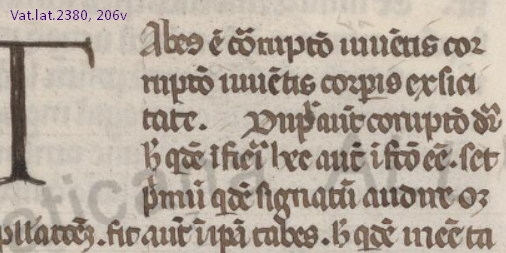
  8. Vat.lat.2380 (Upgraded to HQ), a 14th-century collection of medical works by Galen, translated into Latin by Niccolò da Reggio. See eTK, incipits: "Sicut animalium singulum unum esse dicitur" and "Quia liber Galieni de utilitate"
  9. Vat.lat.3156,
  10. Vat.lat.3157, noted already by DigitaVaticana:
  11. Vat.lat.3524.pt.1,
  12. Vat.lat.3837, Letters of Ivo of Chartres (1040-1116)
  13. Vat.lat.3959,
  14. Vat.lat.3965 (Upgraded to HQ),
  15. Vat.lat.3971 (Upgraded to HQ),
  16. Vat.lat.3972 (Upgraded to HQ),
  17. Vat.lat.3973 (Upgraded to HQ), in Beneventan script, datable to shortly after 1178: Romualdus Salernitanus, Chronicon. Listed by Lowe.
  18. Vat.lat.3980,
  19. Vat.lat.3985,
  20. Vat.lat.3998,
  21. Vat.lat.3999 (Upgraded to HQ),
  22. Vat.lat.4001 (Upgraded to HQ),
  23. Vat.lat.4003,
  24. Vat.lat.4032,
  25. Vat.lat.4053,
  26. Vat.lat.4056,
  27. Vat.lat.4063 (Upgraded to HQ),
  28. Vat.lat.4066 (Upgraded to HQ),
  29. Vat.lat.4067,
  30. Vat.lat.4081,
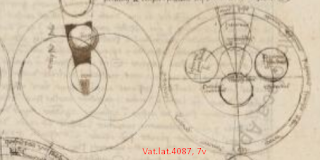
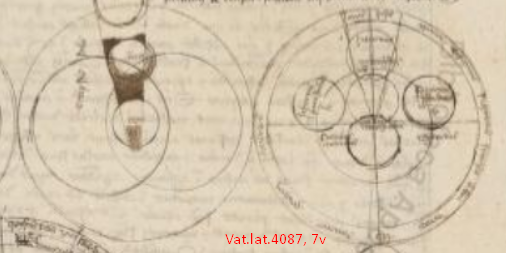
  31. Vat.lat.4087, Jordanus lists 22 scientific works in this codex datable to 1320.
    One is the short text, apparently of Arabic origin, listed by Ptolemaeus, and dealing with the projection of rays, 31r-31v. Note also the six entries (under "Biblioteca Apostolica Vaticana 4087") in eTK.
  32. Vat.lat.4092, Roger Bacon, see Jordanus
  33. Vat.lat.4109 (Upgraded to HQ),
  34. Vat.lat.4111,
  35. Vat.lat.4120,
  36. Vat.lat.4132,
  37. Vat.lat.4143,
  38. Vat.lat.4145,
  39. Vat.lat.15495, Bernardino of Siena, new acquisition (above)
This is Piggin's Unofficial List number 182. Thanks to @gundormr for harvesting. If you have corrections or additions, please use the comments box below. Follow me on Twitter (@JBPiggin) for news of more additions to DigiVatLib.

2018-10-15

Galen and Age

Galen, the leading writer on medicine in antiquity, produced a theoretical work, De Marasmus, which sets out his theory that old age and death are the result of withering like an old stick.

It begins in the translation by Theoharides:
Marasmus is the corruption of the human body due to dryness. There are two ways of using the word corruption, one being the process of corruption, while the other is the state of being corrupt ... https://doi.org/10.1093/jhmas/XXVI.4.369
The Vatican Library has just digitized a key Latin translation of this work, Vat.lat.2381. Here is where the same passage begins. (Tabes est corruptio viventis corporis ex siccitate. Duplex autem corruptio dicitur, hec quidem in fieri, hec autem in facto esse; sed primum quidem significatum audire oportet appellationem. Sic autem et ipsa tabes, hec quidem in esse tabidum utique, alia vero in tabescere, de qua nunc sermo existit. (240v))

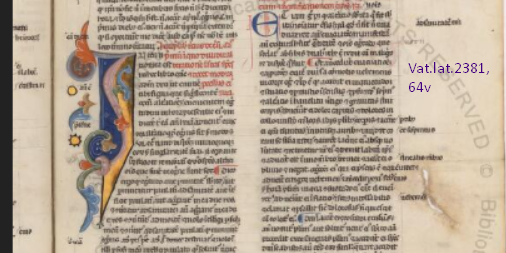
Here's a section break in De Crisi, one of the other works making up the codex.

Over the past week, 47 manuscripts were digitized. The full list:
  1. Pal.lat.1509,
  2. Pal.lat.1515 (Upgraded to HQ),
  3. Pal.lat.518,
  4. Ross.7,
  5. Ross.16, part of which would seem, from the bibliography, to contain the Sentences of Pseudo-Phocylides
  6. Ross.17,
  7. Ross.38,
  8. Ross.41,
  9. Vat.lat.2305,
  10. Vat.lat.2381 (Upgraded to HQ), Galen and Hippocrates in Latin translation, full list of content at NLM (above)
  11. Vat.lat.2411, Aries vetat non tangetur capud; 2411 (flyleaf). See eTK
  12. Vat.lat.2445.pt.1,
  13. Vat.lat.2724,
  14. Vat.lat.2863 (Upgraded to HQ),
  15. Vat.lat.2978 (Upgraded to HQ),
  16. Vat.lat.3139,
  17. Vat.lat.3203,
  18. Vat.lat.3208,
  19. Vat.lat.3514,
  20. Vat.lat.3657,
  21. Vat.lat.3878,
  22. Vat.lat.3880,
  23. Vat.lat.3889,
  24. Vat.lat.3911,
  25. Vat.lat.3922 (Upgraded to HQ), science, in Jordanus
  26. Vat.lat.3934,
  27. Vat.lat.3938,
  28. Vat.lat.3942,
  29. Vat.lat.3945 (Upgraded to HQ),
  30. Vat.lat.3950 (Upgraded to HQ),
  31. Vat.lat.3963,
  32. Vat.lat.3974,
  33. Vat.lat.3983,
  34. Vat.lat.3991,
  35. Vat.lat.4009 (Upgraded to HQ),
  36. Vat.lat.4011 (Upgraded to HQ),
  37. Vat.lat.4033,
  38. Vat.lat.4034 (Upgraded to HQ),
  39. Vat.lat.4037.pt.2 (Upgraded to HQ), science in Jordanus
  40. Vat.lat.4060,
  41. Vat.lat.4061,
  42. Vat.lat.4064,
  43. Vat.lat.4100,
  44. Vat.lat.4102,
  45. Vat.lat.4124 (Upgraded to HQ),
  46. Vat.lat.4125,
  47. Vat.lat.4136,
This is Piggin's Unofficial List number 181. Thanks to @gundormr for harvesting. If you have corrections or additions, please use the comments box below. Follow me on Twitter (@JBPiggin) for news of more additions to DigiVatLib.

2018-10-06

Magic Manuscript

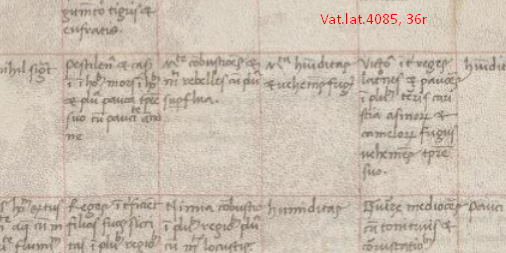
Magic fascinates. The Vatican Library has just digitized a manuscript, Vat.lat.4085, which rounds up many of the key astral magic works circulating in the late 15th century. David Juste's summary lists authors including Andalò di Negro, Haly, Sagid ibn Umail, Ali ibn al-Hatim and others including the nameless somebody denominated Pseudo Hippocrates.
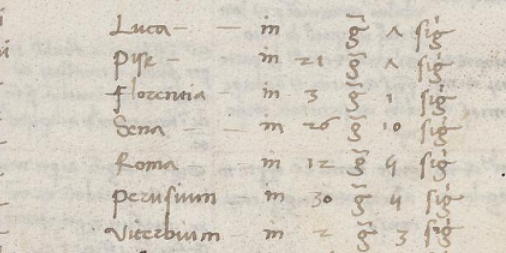
There are also handy lists of astral ascent for different cities in northern Italy, which is a clue to where the manuscript was made.

A 1988 article by Kristen Lippencott notes that it is a unique source for part of an ibn al-Hatim text. See also the listing in Jordanus.

It's one of 29 manuscripts digitized in the past week, with another major arrival the Codex Ursianus (see DigiVatLib's tweet below), an amazing book of sketches by Pirro Ligorio of the stonework surviving in 16th century Rome. The full list:
  1. Patetta.839,
  2. Ross.14,
  3. Ross.27,
  4. Ross.29,
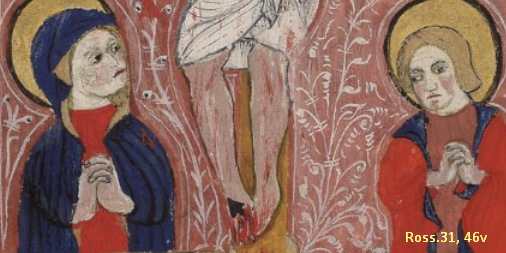
  5. Ross.31, Italian
  6. Ross.36 (Upgraded to HQ),
  7. Vat.lat.2624,
  8. Vat.lat.3147,
  9. Vat.lat.3151 (Upgraded to HQ),
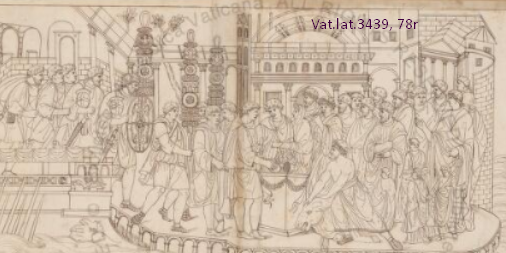
  10. Vat.lat.3439, mid-16th-century Codex Ursinianus, an album of sketches of different dates, also referred to as the Sylloge of Inscriptions by Pirro Ligorio. Among its vital records are sketches of the Severan Marble Plan of Rome. See this summary (PDF). It featured in the Rome Reborn exhibition. Anthony Grafton notes of the following: Ligorio took details from surviving classical reliefs and worked them up into a comprehensive, imaginative picture of a pagan sacrifice, consistently classical in both its style of representation and the clothing and objects shown.
  11. Vat.lat.3742 (Upgraded to HQ),
  12. Vat.lat.3748,
  13. Vat.lat.3779,
  14. Vat.lat.3849,
  15. Vat.lat.3854,
  16. Vat.lat.3855,
  17. Vat.lat.3856,
  18. Vat.lat.3882,
  19. Vat.lat.3902, arithmetrical works by Johannes de Sacrobosco and Gisbertus, see Jordanus
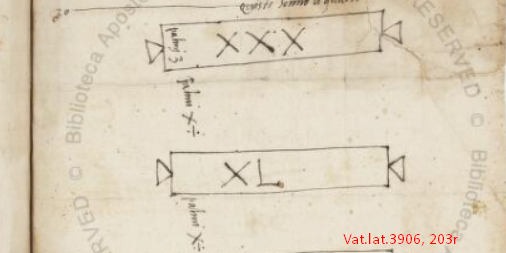
  20. Vat.lat.3906 (Upgraded to HQ), works by Varro, Pliny, Gellius, and others. See Jordanus. From the library of Angelo Colocci?
  21. Vat.lat.3914,
  22. Vat.lat.3925,
  23. Vat.lat.3927,
  24. Vat.lat.3940,
  25. Vat.lat.3957,
  26. Vat.lat.3995 (Upgraded to HQ),
  27. Vat.lat.4055,
  28. Vat.lat.4085 (Upgraded to HQ), Astral magic (see above). See eTK.
  29. Vat.lat.4088,
This is Piggin's Unofficial List number 180. Thanks to @gundormr for harvesting. If you have corrections or additions, please use the comments box below. Follow me on Twitter (@JBPiggin) for news of more additions to DigiVatLib.

2018-10-01

Baum: An Early Family Tree

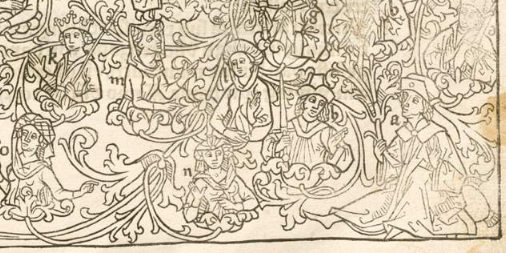
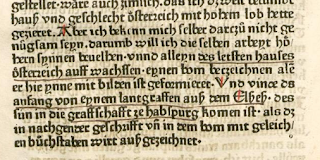
The search for the earliest use of "Baum" in German to describe a stemma continues. Currently the honour seems to reside with Heinrich Steinhöwel of Ulm who is thought to have used the term in his dedication of a book printed 1475 when introducing the following woodcut:


The male ancestor at the root, right, is designated Albrecht Hapsburg, landgrave of Alsace, Lord of Sassenburg. The main body of the book is a German translation of the Speculum Vitae Humanae of Rodrigo Sánchez de Arévalo (1404-1470). Steinhöwel's German title is Der Spiegel des Menschlichen Lebens.

It is online as BSB incunable 2 Inc.s.a. 1264 digitized here (seek image 18), also at the LOC and in Heidelberg. ISTC: ir00231000.

The text preceding the woodcut says: "darumb will ich ... alleyn desletszen hauses österreich auff wachssen eynen bom beczeichnen ale er hie ynne mit bilden ist geformieret. Und vince ds anfang von eynem lantgraffen aus dem Elses dessun in die graffschafft ze habspurg komen ist als dr in nachgenter geschrifft v[o]n in dem bom mit geleich-en büchstabben wirt ausgezeichnet. (That's why I wish to draw all of the latter house of Austria on a full-grown tree. Each is shown by pictures. And those counts of Hapsburg arising from this landgrave of Alsace are each marked in the tree with the same letter (of the alphabet) as is used in the subsequent list.)

This praise of the Hapsburgs is not part of the original Speculum Vitae Humanae itself (see the Latin version at Gallica), but an appeal for patronage from the Hapsburgs. Given that aristocrats were the principal customers for books in Steinhöwel's time, the genealogy was a crude but entirely normal attempt to secure sales.

No date or place of printing for the incunable is given, but it seems from the type-face to be settled that the printer was Günther Zainer of Augsburg, and that the year was most likely 1475. The translator's manuscript (which still exists) was completed March 19, 1474 and an entry in the genealogy on folio 10v mentions the baptism of Prince Maximilian in Augsburg "this Easter" on Maundy Thursday of 1475. It is to be assumed the printing was completed later that year. The book is overlooked by Klapisch-Zuber, who opens L'Ombre with a family tree of 1491 (see below), the earliest she could discover.

The book is prefaced by (1) a foreword and overview, (2) a dedication to Duke Siegmund of Tyrol, (3) a one-paragraph explanation of the family tree, (4) the full-page engraving, and (5) a tabular listing of the genealogy keyed to the sketch. (4) and (5) appear to be the work of Ladislaus Sunthaym (ca. 1440 – 1512).

Walther Borvitz is dismissive of (2) as fawning hack-work, which perhaps leads him to his peculiar view that (3) is a boiler-plate insertion originating with Sunthaym. Perplexingly, he refused to transcribe (3) in his edition (Archive.org) although it continues in the same first person (ich) as the paragraphs above and is almost certainly of a unity with them. It is hard to follow Borvitz's justification for this omission, since his contention that the text of (3) appears at col 1004 of Scriptores Rerum Austriacarum Veteres ac Genuini, vol 1, by Hieronymus Pez does not seem to be correct. The Latin text there is by Pez and makes no claim at all about the Steinhöwel book of 1475:
Harum Tabularum Clauftro Neoburgensium praecipuus Auctor est Ladislaus Sunthaim seu Sundheimius, Ravensburgio Sueviæ oppido oriundus, Dioecesis Constantiensis Presbyter. Quod mirum est in laudatarum Tabularum editione fuisse dissimulatum: cum in MS Claustro-Neoburgensi quod nos coram inspeximus, diserte Sunthaimii nomen, patria conditioque habeantur. Porro eas Sunthaimius condidit sub annum 1491, quo ipso Basileæ typis excusæ fuerunt in majori forma, quam vocant. Ad cuius editionis fidem & hanc nostram adornavimus, cum sæpe memoratæ Tabulæ manuscriptae vix commodum Mellicium perferri potuerint, & nos, dum in lustranda Claustro-Neoburgensi Bibliotheca versaremur, ab ipsis integris describendis angustia temporis exclusi fuerimus. In vulgatis Tabulis ad calcem, Reverendissimus Dominus Jacobus Praepositus Clastro-Neoburgensis ad eas concinnandas symbolam contulisse memoratur, qui ab anno 1485 usque ad annum 1509 Claustro-Neoburgensem praefecturam gessisse dicitur apud Adamum Scharrerum in Vita S. Leopoldi Auftriæ Marchionis. Cæterum Ladislaus Sunthaimius is præterea fuit, qui Historiam de Guelfis sub annum 1511 composuit, quam ex Caesarea Bibliotheca fecum communicatam Cl. Leibnitius Tom. I Script. Brunswic. a pag 800 ad pag 806 publico exposuit. Ex qua etiam intelligimus, Sunthaimium postea Viennensis Canonici dignitate fuissse auctum. Sed de his fatis. En ipsas Tabulas Claustro Neoburgenses.
There is thus no reason to attribute (3) to Sunthaym, and every good reason to regard Steinhöwel as the writer who chose the word "bom". Barbara Weinmayer offers a very different perspective on the section (3), seeing the dedication as a valuable source of Steinhöwel's genuine views about the science of translation, although she makes no comment on the content of our disputed final paragraph (3) and its bom.

For the time being it seems best to leave the authorship of (3) with Steinhöwel. Perhaps an expert on Renaissance German style could ponder the issue.

The woodcut employed at Basel in or after 1491 for the printing of Der löblichen Fürsten und des Landes Österreich Altherkommen und Regierung (full text on Wikisource) of Sunthaym is not the same as this one, though it is similar. Sunthaym is often treated in the literature as father of the royal "tree", but it would seem that the "tree" was already part of the vocabulary of man one generation older.

Borvitz, Walther. Die Übersetzungstechnik Heinrich Steinhöwels: dargestellt auf Grund seiner Verdeutschung des ‘Speculum vitae humanae’. Hermaea 13. Halle: Niemeyer, 1914.
Dicke, Gerd. ‘Steinhöwel, Heinrich’. Die deutsche Literatur des Mittelalters. Verfasserlexikon, 1995. vol 9, cols 269ff. http://www.mgh-bibliothek.de/cgi-bin/mgh/allegro.pl?db=opac.
Klapisch-Zuber, Christiane. L’ombre des ancêtres. Paris: Fayard, 2000.
Weinmayer, Barbara. Studien zur Gebrauchssituation früher deutscher Druckprosa. Literarische Öffentlichkeit in Vorreden zu Augsburger Frühdrucken. Munich: Artemis, 1982.

2018-09-29

The Missing Petrus Roll

The second of the Vatican's two magnificent timelines by Peter of Poitiers has just arrived online at last. This is a big deal for the history of diagrammatic chronicles, an academic field which looks at how history was taught in medieval and early modern times. I will not introduce this art category again, as one click will take you to my post two weeks on this blog.

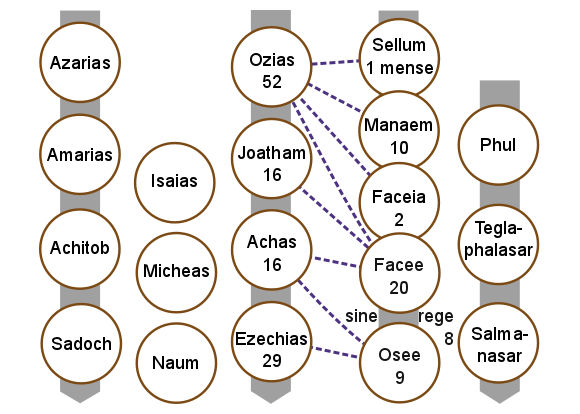
A much-delayed book on the topic, Geschichte und Weltordnung, by Andrea Worm is due out soon. She uses the term "synoptic" for the timeline layout: What happens at the same time is laid out side by side. In the abstract below by me, you see columns respectively for chief priests, prophets, kings of Judah, of Israel and of foreign powers:


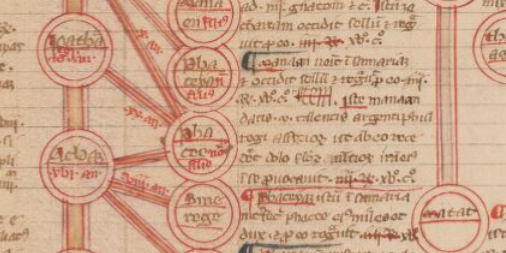
The two rolls offer a study in contrasts. Vat.lat.3782 of the late 13th century is tightly packed, more restrained in its colors, mainly black text and red figures, and has the sobriety of a 19th century architectural diagram. Here is the section matching the abstract above:

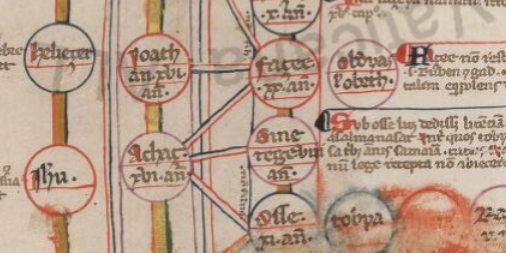
Vat.lat.3783 of the 14th century is jumpier. It generously uses blank space to order its sections, employs thinner lines, hurls more blues and golds into the diagram and presages a more 20th century style.

You'll find a long list of digitized versions of Petrus rolls (including these two) on my website, where the table can be rearranged in any order, including date, location, type and so on.

Here is the full list of  the week's 12 new releases:
  1. Ross.2,
  2. Vat.lat.2338,
  3. Vat.lat.3004,
  4. Vat.lat.3097 (Upgraded to HQ), 15th century manuscript of science, see eTK for all entries. For example, ff. 103ra-146rb contains a text beginning: Circa primum librum de generatione et corruptione notandum ...
  5. Vat.lat.3554 (Upgraded to HQ),
  6. Vat.lat.3725,
  7. Vat.lat.3735,
  8. Vat.lat.3783, Compendium of Petrus Pictaviensis (above)
  9. Vat.lat.3912 (Upgraded to HQ),
  10. Vat.lat.3935,
  11. Vat.lat.3939,
  12. Vat.lat.3946,
This is Piggin's Unofficial List number 179. Thanks to @gundormr for harvesting. If you have corrections or additions, please use the comments box below. Follow me on Twitter (@JBPiggin) for news of more additions to DigiVatLib.

2018-09-22

Hieroglyphics before Champollion

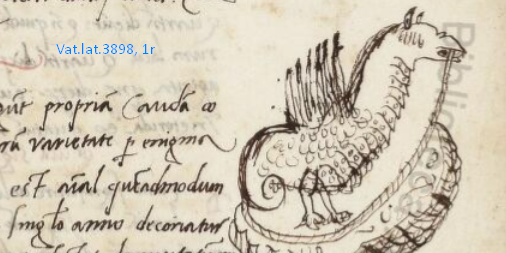
Before  Jean-François Champollion deciphered Egyptian hieroglyphics, a certain amount of very confused traditional knowledge about their meaning did exist. I only discovered this today when looking up a peculiar book, the Hieroglyphica of Horapollo, just digitized at the Vatican Libary. It is copied into the start of Vat.lat.3898 with the following fanciful creature:


Hieroglyphica professes to be a translation from an Egyptian original into Greek by a certain Philippus, and became immensely popular among humanists. Wikipedia states that modern Egyptology regards at least the first part as based on genuine late-antique knowledge of hieroglyphs, although confused, and with baroque symbolism and theological speculation.

This week, @DigiVatLib has been especially busy, posting two of the most beautiful manuscripts on Twitter before I could even get to this blog post. Here is the full list of 21 new items:
  1. Ross.13,
  2. Vat.lat.2344,
  3. Vat.lat.2363, a 15th century compendium of three specialist legal dictionaries, or repertoria in alphabetical order. Fols 65ra-107vb contain Baldus, Margarita [on the Commentaria of Innocent IV]
  4. Vat.lat.2364,
  5. Vat.lat.3054,
  6. Vat.lat.3073,
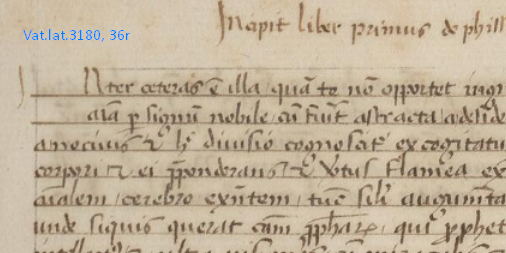
  7. Vat.lat.3180, appears to contain an Aristotle commentary listed by Lohr.  Also a three page tract on physiognomy for which eTK gives the incipit (Inter ceteras est illa quam te ...) but cannot identify the author:

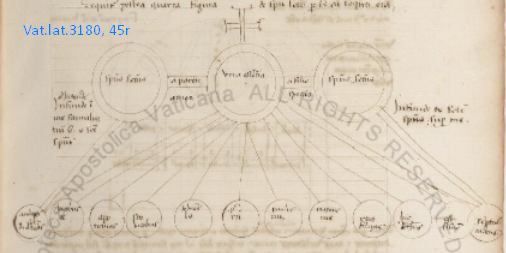
    Also with a fine stemma of Christ and the disciples:
  8. Vat.lat.3533,
  9. Vat.lat.3541,
  10. Vat.lat.3564,
  11. Vat.lat.3674,
  12. Vat.lat.3681,
  13. Vat.lat.3698 (Upgraded to HQ),
  14. Vat.lat.3720,
  15. Vat.lat.3722,
  16. Vat.lat.3734,
  17. Vat.lat.3787 (Upgraded to HQ),
  18. Vat.lat.3898 (Upgraded to HQ), a 15th-century manuscript thought to come from the library of Angelo Colocci. The first text is the Hieroglyphica of Horapollo, incipit: Quomodo seculum significant seculum significare volentes solem ... (above)
  19. Vat.lat.3901 (Upgraded to HQ),
  20. Vat.lat.3923 (Upgraded to HQ),
  21. Vat.lat.3952 (Upgraded to HQ),
This is Piggin's Unofficial List number 178. Thanks to @gundormr for harvesting. If you have corrections or additions, please use the comments box below. Follow me on Twitter (@JBPiggin) for news of more additions to DigiVatLib.

2018-09-18

Drawing the Madaba Map

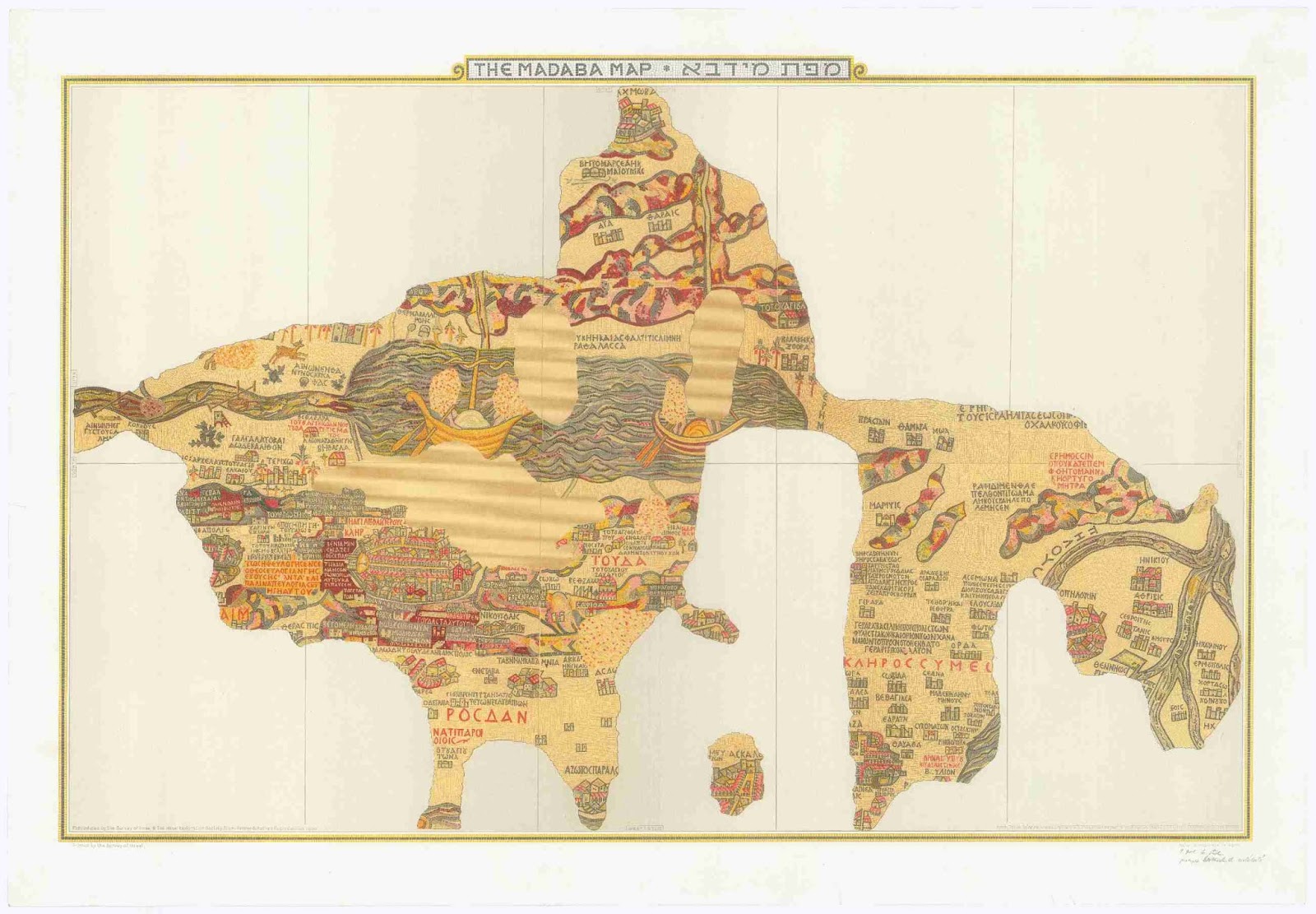
The Madaba Mosaic Map in Jordan has never, to my knowledge, been reproduced and published to modern scholarly standards, frustrating my efforts to include it in the Library of Latin Diagrams.

The first photographs, by Eugène Germer-Durand, appeared in 1897 in a thin book in Paris. The mosaic in color photographs appeared in Herbert Donner and Heinz Cüppers (1977), but the images are single, poorly lit and not coordinated.

It ought to be possible to sythnesize one composite, high-contrast, high-resolution photograph of the whole artefact in the Church of St George in Madaba (a single exposure of the entire map is impossible to take, since the mosaic flows on all four sides around a pillar).

However a photograph does not allow a diachronic approach where we can contemplate the object at different times. Parts of the mosaic have disappeared in the past century.

What is required is a highly zoomable technical drawing as a base for annotation.

Astonishingly, scholarship continues to mostly depend on a colored drawing made of the mosaic at the turn of the century by Paul Palmer, a Jerusalem architect. That drawing is employed in the still-current edition of the map by the late Mikael Avi-Yonah of 1953. At my prompting, a major library earlier this year brought the first printed book with the drawing online (see my post), but I soon realized it is neither practical nor economical to digitize the Palmer drawing at fine resolution. What other drawings exist?

As far as I know, most of the drawings date from the early years. Some 20 years ago, Yiannis Meimaris of the National Hellenic Research Foundation surveyed some of them.

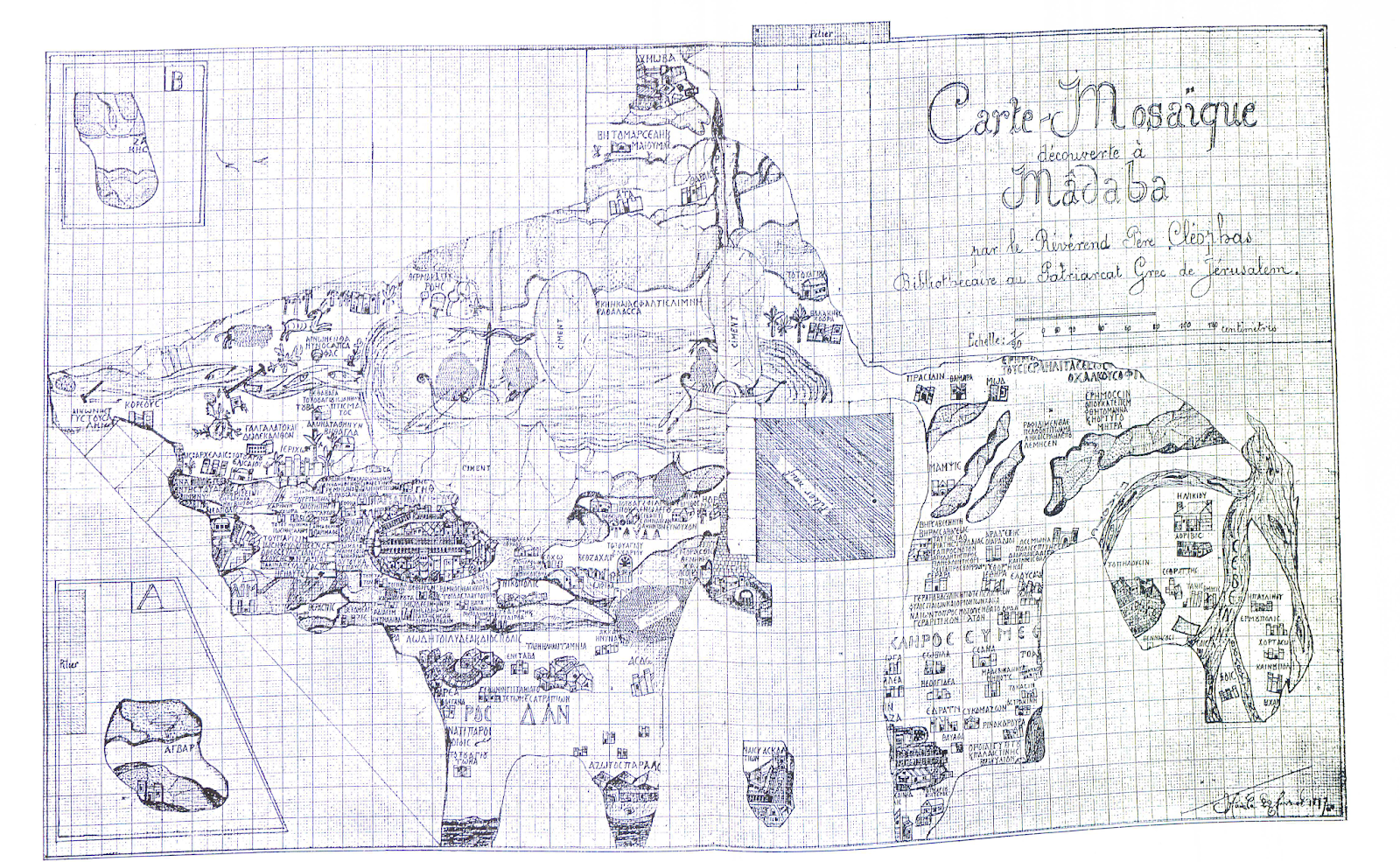
The first drawing, on graph paper, was that by Cleopas Koikylides, a scholar but not an archaeologist, of 1896 December 13.  This was published 1897 March 8 in his pamphlet printed by the Franciscan Fathers and is reproduced in the volume by Donner/Cüppers, but it is too crude to be useful.

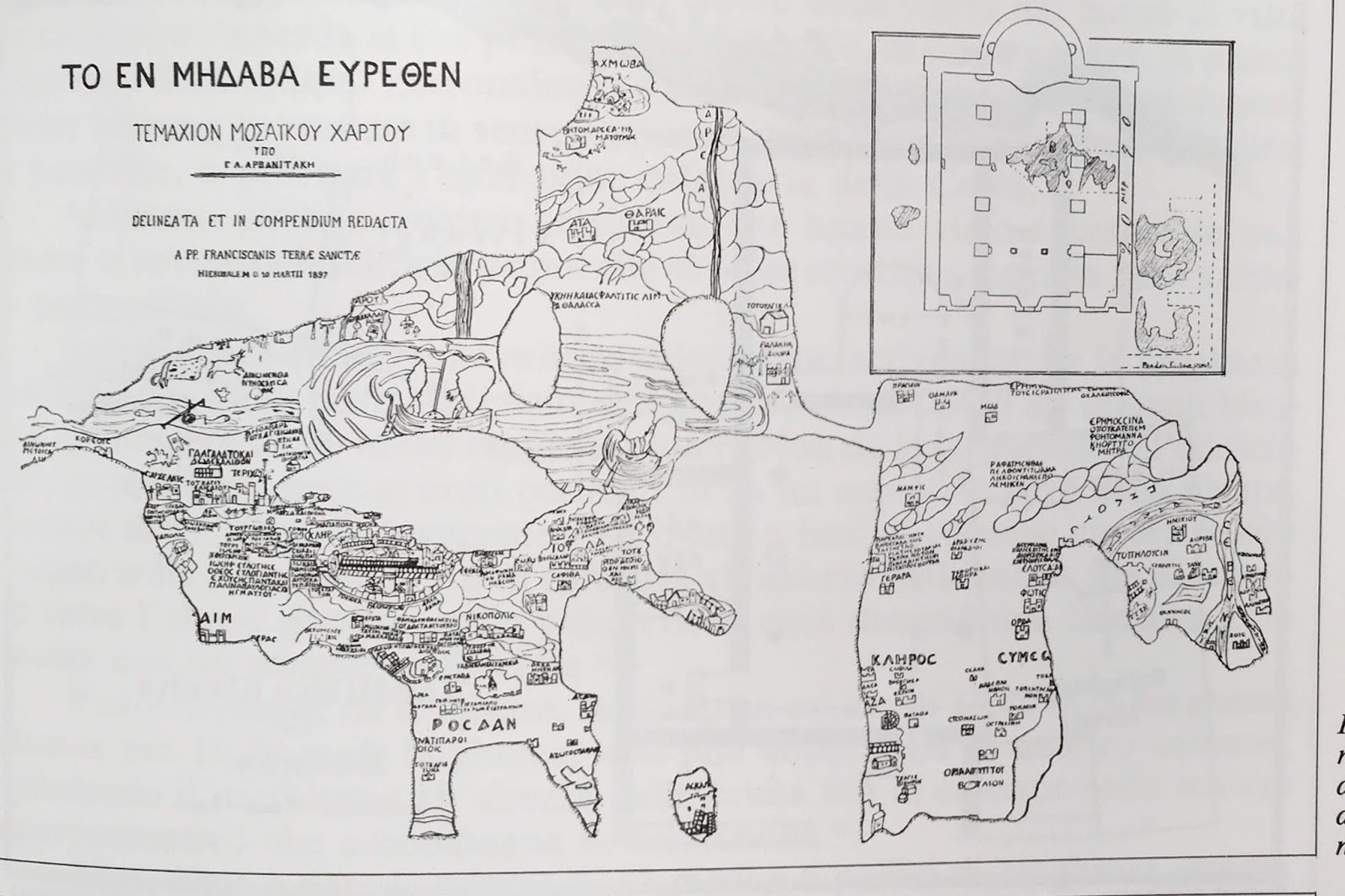
The next drawing was done by Geōrgios Arvanitakis, variously described as the Greek Orthodox patriarchal astronomer or professor of the Holy Cross School of Theology in Jerusalem, who did a more thorough version at Madaba 1897 January 9-23. Meimaris describes this as a precise copy in 12 sheets on a scale of 1/5. The same copy included an 0.80 x 0.60 m plan of the church, showing the position of the mosaic in it, but excluded the two fragments which were separated from the main part of the map and located to the north of it.

Arvanitakis tried to wring the maximum money value from his work. He photographed his own drawings and offered reproductions for 100 golden franks. This seems to be the set of 10 photos mentioned by Peter Thomsen in the other major history of the drawing period. Arvanitakis also prevailed on the Franciscans help him in a bid to sell his original to French scholarly bodies (Meimaris quotes Clermont-Ganneau PEFQSt 1897:213-214 and I have also found a report about this in Belles-Lettres). Hopping promptly on a ship to Istanbul, he gave lectures about the map. The newspaper Neologos Konstantinoupoleos reported these seances in March.

Donner/Cüppers prints a rough drawing of 1897 attributed to Enrico Stevenson and published with an article, "Nuove scoperte a Madaba nella Palestina" (NBAC 3, 325).

In 1898 a patriarchal letter of authority was issued to Mr. Salim (K)ari. From a copy of the map in the possession of the  Palestine Exploration Fund, on which is written that "it was bought from Selim el-Kary who said he copied it direct from the mosaic". I have not seen this image published anywhere.

In September 1901, the Orthodox Patriarchate seems to have engaged two German painters, F. Cornely and G. Hartmann, to paint a full-size copy on canvas of the mosaic. Thomsen wrote in 1929 that this was still hanging in the Greek School opposite the Greek Hospital. Meimaris says it was then lost for several decades and it "was found only recently (in November 1996) by me in the Patriarchate, torn into two pieces and in extremely bad condition. This copy deserves to be restored, since it is the only life-size colour reproduction of the original map." No more has been heard of it.

Palmer, who had been given authority by the Greek patriarch February 20,1897 to examine the map, may not have done a precise copy at first. Wilhelm Kubitschek, in a Vienna lecture on January 7, 1898, quotes from the newsletter, the Mittheilungen, of the Deutscher Verein zur Erforschung Palästinas (DVEP) dated April 18, 1897, stating that scaffolding was erecting the church for photographs to be taken for Palmer, but that the images turned out to be unusable.

"Die beiden genannten Herren (Palmer and Hermann Guthe from Berlin) sind nun damit beschäftigt, eine in Farben ausgeführte Zeichnung der Karte herzustellen," he added. Kubitschek's grumbling was justified.  It was not until April 1904 (according to Thomsen) that Guthe, who was to write the accompanying text, arrived in Jerusalem to inspect his accuracy.

What happened next is unclear. By Palmer's own account, he teamed up four years later with Cornely and Hartmann, but there remains a certain suspicion that he may have saved himself trouble by copying their image, at least in part. Thomsen conversely implies that the two copied from Palmer: Die weitgehende Übereinstimmung mit den Tafeln von Palmer erklärt sich daraus, daß die beiden Maler mit ihm zusammen gearbeitet haben. 

This colored drawing was finally published in ten lithographs in 1906 and presumably owes something to Cornely and Hartmann, whose first names I have not been able to discover. They are real enough people though, gaining parallel mention by Josef Strzygowski and P. J. Dashian in connection with a mosaic of Orpheus in ZDPV (1901) and by Metaxakis in Nea Sion (1906, 156). Thomsen notes several points where Palmer's accuracy is wanting:
Bei Palmer sind die Farben viel zu lebhaft für das im allgemeinen matt gehaltene Original. Die Linien der einzelnen Steinchen sind zu regelmäßig gezogen. Spätere Ausbesserungen und Schäden sind nicht erkennbar. Das Versehen an den drei Toren der Grabeskirche (gleichhoch und oben gerundet) ist in der endgültigen Ausgabe berichtigt.
Our immediate need now is for a crisp drawing which covers every detail of the mosaic, but is not overly complex. For that I intend to turn elsewhere, to a line drawing published by Adolf Jacoby in 1905. It is a simple tracing of the photographs in the Germer-Durand book by an amateur in Strasbourg, Leutnant Brix.

Jacoby does not give Brix's first name but says he had been an army munitions disposal officer, presumably Prussian. Brix probably never saw the mosaic in color let alone travelled to Madaba, but his evident training in technical drawing from black and white photographs and patient tracing at least gives us a place to start creating a scalable vector graphics image which can be modified as we go along.

Avî-Yônā, Mîḵā’ēl. The Madaba Mosaic Map: With Introduction and Commentary. Jerusalem: Israel Exploration Society, 1954.

Donner, Herbert, and Heinz Cüppers. Die Mosaikkarte von Madeba: Tafelband. Wiesbaden: Otto Harrassowitz Verlag, 1977.

Germer-Durand, Eugène. La Carte Mosaïque de Madaba: Découverte Importante, 1897. Paris: Maison de la bonne presse, 1897.

Jacoby, Adolf. Das Geographische Mosaik von Madaba: Die Älteste Karte des Heiligen Landes ; Ein Beitrag zu ihrer Erklärung. Studien über Christliche Denkmäler 3. Leipzig: Dieterich, 1905.
Kubitschek, Wilhelm. “Die Mosaikkarte Palästinas.” Mitteilungen der Österreichischen Geographischen Gesellschaft 43 (1900): 335–80. https://hdl.handle.net/2027/coo.31924094297904.

Meimaris, Yiannis. “The Discovery of the Madaba Mosaic Map. Mythology and Reality.” In The Madaba Map Centenary, 1897-1997: Travelling through the Byzantine Umayyad Period; Proceedings of the International Conference Held in Amman, 7-9 April 1997, edited by Michele Piccirillo. Publications of the Studium Biblicum Franciscanum [Collectio Maior] 40. Jerusalem: Studium Biblicum Franciscanum, 1999. https://web.archive.org/web/*/http://www.christusrex.org:80/www1/ofm/mad/articles//*.

Palmer, Paul, Hermann Guthe, and Deutscher Verein zur Erforschung Palästinas. Die Mosaikkarte von Madeba. Leipzig, Baedeker, 1906. http://archive.org/details/diemosaikkartevo00deut.
Thomsen, Peter. “Das Stadtbild Jerusalems auf der Mosaikkarte von Madeba.” Zeitschrift des Deutschen Palästina-Vereins 52, no. 2 (1929): 149–74. https://www.jstor.org/stable/27929765.