2018-04-02

Gore in Church

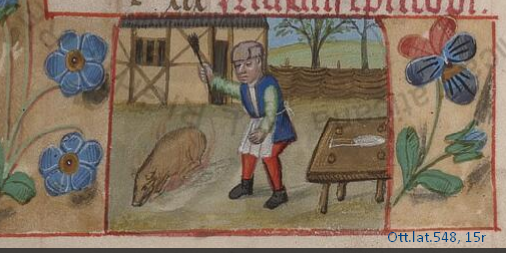
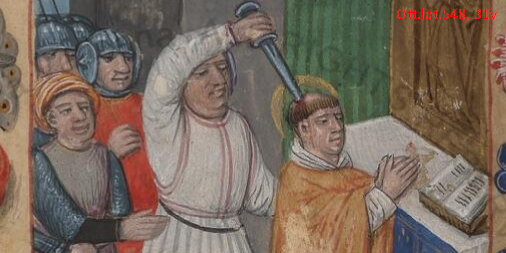
Book of hours were commercial products, where the illuminators aimed to attract buyers with miniatures of either beauty or excitement. An interesting aspect of these prayerbooks is that some contain the most gory images. This week's list of digitizations features Ott.lat.548, which is a book of hours in the Flemish style.

Savour its images which include a butcher about to catch and kill a pig and a scary scene where the king of England's thugs are about to kill Thomas Becket in the cathedral at Canterbury:
In all, we have 23 new items to enjoy:
  1. Ott.lat.548, a book of hours (above)
  2. Vat.lat.519.pt.2,
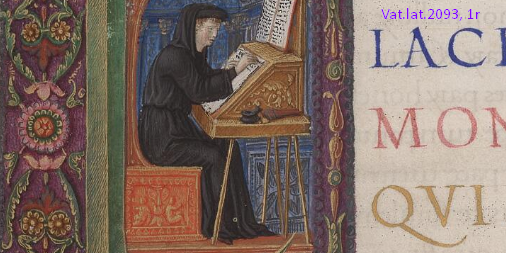
  3. Vat.lat.1951.pt.2, Plinii Naturalis Historiae in a Renaissance codex of high value. This part starts Liber XII. I. Animalium omnium
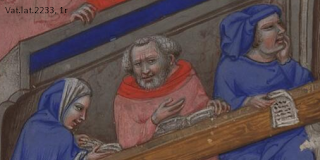
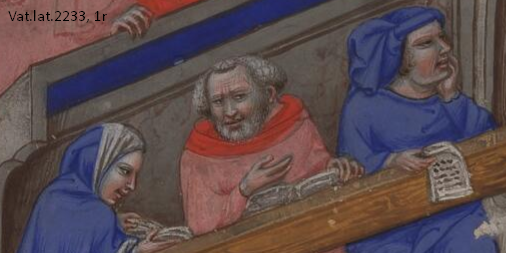
  4. Vat.lat.2233, 14th century, finely illuminated Apparatus in Sextum Bonifatii VIII of
    Iohannes Andreae, c.1270-1348
  5. Vat.lat.2333,
  6. Vat.lat.2760,
  7. Vat.lat.2842, Giovanni Pontano
  8. Vat.lat.2861,
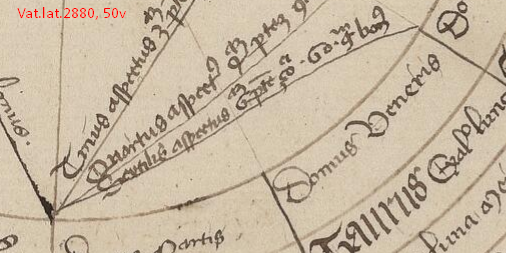
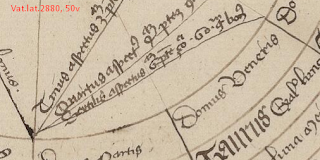
  9. Vat.lat.2880 (Upgraded to HQ), a 15th-century mixture of Cicero, various Quaestiones on Aristotle and a text by John of Saxony, incipit "Istam propositionem scribit Ptolomeus in sapientiis Almagesti..." Here is an astrological diagram:
  10. Vat.lat.2890, 15th century Cicero, De officiis
  11. Vat.lat.2900, Rhetoricam ad Herennium, heavily glossed, 14th century
  12. Vat.lat.2910, Cicero and Leonardi Bruni translation of Plato
  13. Vat.lat.2912 (Upgraded to HQ), an album of classic writers in a peculiar high-oblong format
  14. Vat.lat.2916,
  15. Vat.lat.2918 (Upgraded to HQ), Giovanni Gatti of Messina
  16. Vat.lat.2921 (Upgraded to HQ),
  17. Vat.lat.2926 (Upgraded to HQ), George of Trebizond, translations of Plato, etc.
  18. Vat.lat.2929, Marsilio Ficino, commentary on Plato
  19. Vat.lat.2934.pt.1, Ficino and others, Plato etc.
  20. Vat.lat.2944,
  21. Vat.lat.2959, chronica, including list of French kings on last folio
  22. Vat.lat.3393, LQ
  23. Vat.lat.8171 (Upgraded to HQ), a catalog of the Reginensis collection by Vatican librarian Lucas Holstenius (1596-1661)
This is Piggin's Unofficial List number 156. Thanks to @gundormr for harvesting. If you have corrections or additions, please use the comments box below. Follow me on Twitter (@JBPiggin) for news of more additions to DigiVatLib.

2018-03-26

Madaba Map online at last

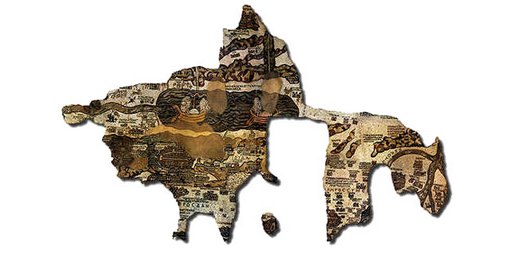
The late antique Mosaic Map (below) in Madaba, Jordan is the world's oldest detailed Greek-language topological diagram still in existence. It is both a tourist attraction of the first order and a landmark in human cognitive history, since it indicates that sophisticated topological diagrams (though not maps) were in common use and well understood by the general public in the west by about 550 CE.

Four or five hundred years earlier, over-the-horizon diagrams had not been part of the culture. There is a continuing controversy about the Agrippa Survey, a public mural in Rome mentioned (once only) by Pliny the Elder which detailed the regions of the empire and their sizes. Whether it was a list or a diagram has never been conclusively proved.

Topological diagrams come into their own in late antiquity, with the Tabula Peutingeriana (preserved in one roll-form manuscript in Vienna, ÖNB cod. 324) and the Madaba "Map" as the two key examples. The fragment at Madaba is a mosaic floor in a church. It was originally much larger. But even depleted, its colorful depiction of Palestine and Jerusalem is amazing.

While the Tabula Peutingeriana is now online in the highest resolution at the Vienna library and in more convenient form at Richard Talbert's website, quality reproductions of the Madaba Mosaic are unfindable online. To my knowledge it has been published only twice: a painstaking colored drawing at 1:4 scale by Paul Palmer in 1906, and in a book of photographic plates by Herbert Donner.

A few weeks ago I decided to do something about this problem. I contacted the University of Toronto Library, where the Robarts Collection owns a printed copy of the Palmer drawing in the form of a large-format book printed at Leipzig. Palmer died in 1935, so the book is in the public domain. I suggested it be added to the library's admirable digitization program. Now, a few weeks later, it can be inspected online at the Archive.org library of books.

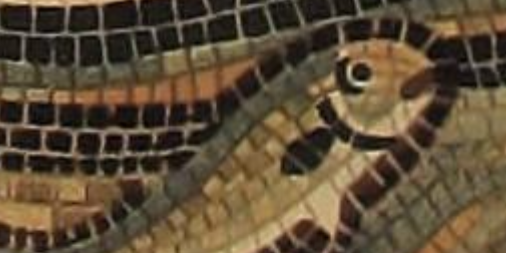
Here's a fish in the River Jordan:

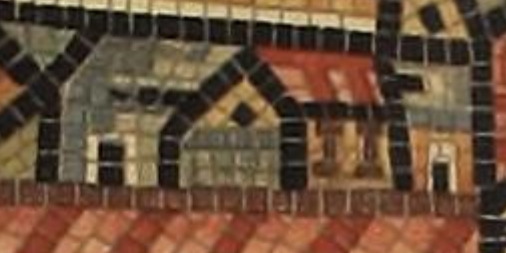
These are houses in the city of Jerusalem:

Palmer was a Jerusalem architect of German-Swiss extraction, who relates in a short autobiography online:
During our involuntary stay at the Jordan we were told by some Arabs of Madeba that a beautiful mosaic-map of Palestine had been found while they were flooring the new Greek church. We decided to ride to Madeba at the first opportunity and to inspect this mosaic-map, to sketch it or to take some photographs. But, when we got there we could not get a true picture. Later by accident, two painters were staying in Jerusalem and I rode with them to Madeba. Working for several days, I made a drawing of the mosaic-map, I painted the exact colours of each of the stones and a copy of the original painting will still be obtainable from the Society of the German League for Exploration of Palestine (Gesellschaft des deutschen Vereins zur Erforschung Palästinas).
Herman Guthe (1849-1936) who wrote the book of commentary issued with the map, tells a slightly different story, in the Zeitschrift des Deutschen Palästina-Vereins, saying the board of the society commissioned the drawing and Palmer travelled to Madeba in May 1901 to make it. Guthe notes how difficult travel then was: just the horse ride from the bank of the Jordan up to Madaba took eight hours.

A summary of sorts by Aharon Yaffe appeared in the Israel Review of Arts and Letters in 1998. The Palmer drawing at half size was republished in 1954 in Professor Avi Yonah's book, The Madaba mosaic map: with introduction and commentary (not online) and on a single sheet by the same publisher, the Israel Exploration Society, but eSbírky.cz in Prague, the only digital image repository holding the latter, seems to be permanently down.

Ill-lit tourist snaps of the mosaic are of no help and UNESCO's listing of the whole Um er-Rasas World Heritage site of which the church is part does not have any image of whole floor. Göttingen University's facsimile of the mosaic is good, but individual stones are not resolved in the online image.

That is why the long-overdue appearance of the mosaic online at a resolution where you can read all its detail is such a reason for celebration. Explore it and enjoy.

Avî-Yônā, Mîḵā’ēl. The Madaba Mosaic Map: With Introduction and Commentary. Jerusalem: Israel Exploration Society, 1954.

Donner, Herbert. The Mosaic Map of Madaba: An Introductory Guide. Peeters Publishers, 1992.

Donner, Herbert, and Heinz Cüppers. Die Mosaikkarte von Madeba: Tafelband. Wiesbaden: Otto Harrassowitz Verlag, 1977.

Palmer, Paul, Hermann Guthe, and Deutscher Verein zur Erforschung Palästinas. Die Mosaikkarte von Madeba. Leipzig, Baedeker, 1906. http://archive.org/details/diemosaikkartevo00deut.

2018-03-25

Cicero Codex , Key to Roman Idea of Cognition

Graeco-Roman science was often contrary to experimental science, but its landmark observations on visual memory were mostly right. We know this thanks to an ancient codex which contained the barely legible but complete text of De Oratore by the Roman orator Cicero and was discovered in 1421 in Lodi, Italy, lent out to humanists and-- incredibly-- had vanished forever by 1425.

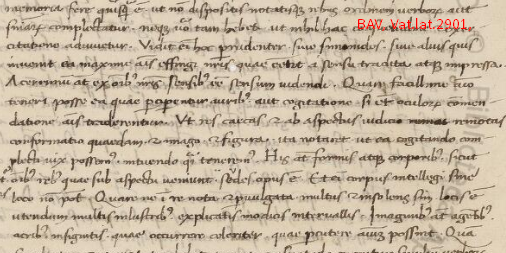
Only one direct copy of this lost Codex Laudensis (L) made during those four years exists. As our Easter present, the Vatican Library has just digitized Vat.lat.2901 (V) and placed it online.

Cicero mentions the science of visual perception while introducing the palace-of-memory method of memorizing what to say whenever you are speaking without notes. He starts by quoting the generally correct view of cognitive science of his own day that the keenest of all our senses is the sense of sight (acerrimum autem ex omnibus nostris sensibus esse sensum videndi -- Cicero, De Oratore II, 357.)

He develops from this the method to leverage your visual memory, a method of which he was not the inventor, but becomes a precious witness. It starts with the observation that:
... perceptions received by the ears or by reflection can be most easily retained in the mind if they are also conveyed to our minds by the mediation of the eyes ... (2.357: qua re facillime animo teneri posse ea, quae perciperentur auribus aut cogitatione, si etiam commendatione oculorum animis traderentur).
He then describes what we would now call gist memory:
... with the result that things not seen and not lying in the field of visual discernment are earmarked by a sort of outline and image and shape so that we keep hold of (as it were by an act of sight) things that we can scarcely embrace by an act of thought. (Ut res caecas et ab aspectus iudicio remotas conformatio quaedam et imago et figura ita notaret, ut ea, quae cogitando complecti vix possemus, intuendo quasi teneremus).
And then segues over to what we would call spatial perception and memory, pointing out its role in combination with the somewhat different visual memory.
But these forms and bodies, like all the things that come under our view require an abode, inasmuch as a material object without a locality is inconceivable. (2.358:  His autem formis atque corporibus, sicut omnibus, quae sub aspectum veniunt, [admonetur memoria nostra atque excitatur;] sede opus est, etenim corpus intellegi sine loco non potest.
The method of memorizing, which he attributes to the legendary Greek orator Simonides, is to imagine a familiar place and stock it in your imagination with visual marker tags for things you want to remember. The technique is still being taught nowadays. Here's the place, folio 53v, where it is set out:

The above text was also preserved in a lost Carolingian manuscript, known as M, but none of the copies of M existing today is a direct one, which is to say they are copies of copies (of copies).

V is one of 63 manuscripts just released online. Here is the full list:
  1. Barb.lat.298,
  2. Ott.lat.3368,
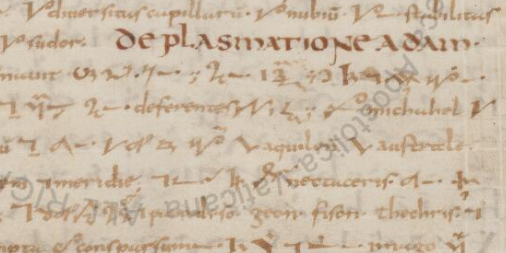
  3. Reg.lat.846 (Upgraded to HQ), 9th century, from France, possibly theTours region; provenance Paris, St. Sulpice. One of the codices containing (fols. 106v-107r) a fascinating little text on the origin of the name Adam: it says that Adam was created from earth brought by the four archangels from the four corners of the world, sprinkled with water from the four rivers of Paradise, inspired by the four winds, and named after the four stars. Hence the four letters of his name. Charles Wright, creator of wonderful medieval manuscript surveys, has just published an article about this in The Embroidered Bible: Studies in Biblical Apocrypha and Pseudepigrapha in Honour of Michael E. Stone, eds Lorenzo DiTommaso, Matthias Henze, William Adler (ISBN: 9789004355880).
  4. Reg.lat.2123,
  5. Urb.lat.1251 (Upgraded to HQ),
  6. Vat.lat.858.pt.1,
  7. Vat.lat.858.pt.2,
  8. Vat.lat.936,
  9. Vat.lat.1473.pt.1,
  10. Vat.lat.1473.pt.2,
  11. Vat.lat.2169,
  12. Vat.lat.2212,
  13. Vat.lat.2231,
  14. Vat.lat.2244,
  15. Vat.lat.2325,
  16. Vat.lat.2330,
  17. Vat.lat.2413,
  18. Vat.lat.2517,
  19. Vat.lat.2666 (Upgraded to HQ),
  20. Vat.lat.2683,
  21. Vat.lat.2688,
  22. Vat.lat.2738,
  23. Vat.lat.2739,
  24. Vat.lat.2747,
  25. Vat.lat.2749,
  26. Vat.lat.2769,
  27. Vat.lat.2775,
  28. Vat.lat.2782 (Upgraded to HQ),
  29. Vat.lat.2788,
  30. Vat.lat.2798,
  31. Vat.lat.2799,
  32. Vat.lat.2801,
  33. Vat.lat.2802,
  34. Vat.lat.2807,
  35. Vat.lat.2811,
  36. Vat.lat.2812,
  37. Vat.lat.2813,
  38. Vat.lat.2814,
  39. Vat.lat.2817,
  40. Vat.lat.2819,
  41. Vat.lat.2820,
  42. Vat.lat.2824,
  43. Vat.lat.2825,
  44. Vat.lat.2826,
  45. Vat.lat.2827,
  46. Vat.lat.2829 (Upgraded to HQ),
  47. Vat.lat.2831,
  48. Vat.lat.2843 (Upgraded to HQ),
  49. Vat.lat.2845, With incipit: Plato tria arbitratur esse rerum initia; author: Laurentius Miniatensis Bonincontri. See eTK
  50. Vat.lat.2850 (Upgraded to HQ),
  51. Vat.lat.2852,
  52. Vat.lat.2862 (Upgraded to HQ),
  53. Vat.lat.2865,
  54. Vat.lat.2874 (Upgraded to HQ),
  55. Vat.lat.2875,
  56. Vat.lat.2881,
  57. Vat.lat.2885,
  58. Vat.lat.2892,
  59. Vat.lat.2897,
  60. Vat.lat.2901, key source of Cicero, De Oratore, manuscript V(above)
  61. Vat.lat.2903 (Upgraded to HQ),
  62. Vat.lat.2905 (Upgraded to HQ),
  63. Vat.lat.2937,
  64. Vat.lat.2943,
  65. Vat.lat.2948,
  66. Vat.lat.2949 (Upgraded to HQ),
  67. Vat.lat.3024 (Upgraded to HQ),
  68. Vat.lat.3077,
This is Piggin's Unofficial List number 155. Thanks to @gundormr for harvesting. If you have corrections or additions, please use the comments box below. Follow me on Twitter (@JBPiggin) for news of more additions to DigiVatLib.

2018-03-18

Bruges Book of Hours in Color

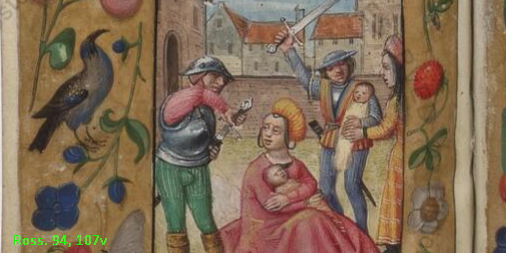
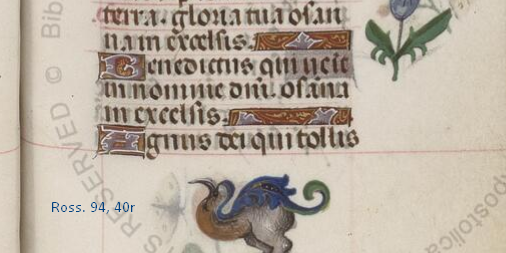
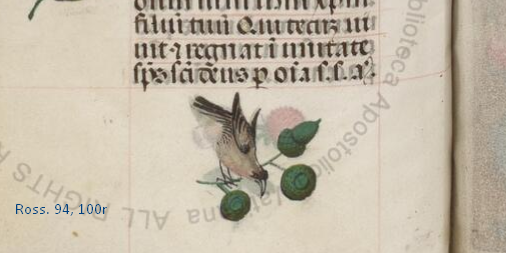
The Bruges Book of Hours, Ross. 94 at the Vatican Library, has just arrived online in color, after previously only being accessible in indistinct black and white. It is so exquisite that Belser Verlag of Zurich printed a facsimile of it in 1983. It is thought to have been illuminated by three separate artists because of stylistic differences, but neither they nor their customer have been identified.

One of the early 16th-century artists worked on the full-page miniatures. Here is an image of the Massacre of the Innocents with gold leaf in the margins:

The other two worked on the initials and on the bordures, such as the fanciful bird and the young of a wild boar snatching green acorns below:


The Vatican Library digital portal seems to have only three new items this week, all upgrades from black and white. The list:
  1. Reg.gr.107 (Upgraded to HQ), Porphyry and the philosophical works of Aristotle in the original Greek. See Pinakes
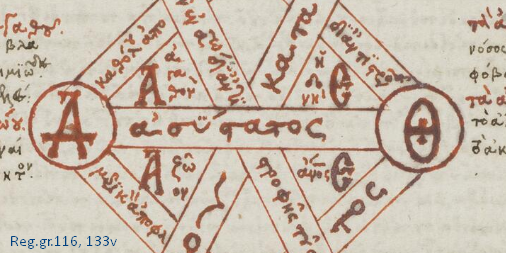
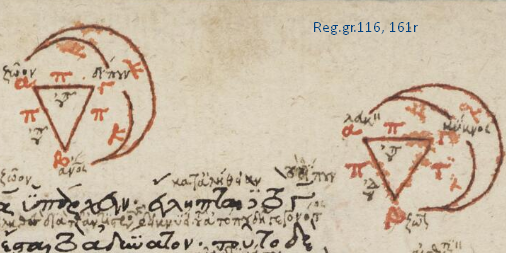
  2. Reg.gr.116 (Upgraded to HQ), see Pinakes. Contains a logical diagram in a discussion of Aristotle. The Cambridge Intellectual History of Byzantium (eds Anthony Kaldellis, Niketas Siniossoglou) says the explanation of the diagram (first below) in the Prior Analytics is attributed to an otherwise Alousianos:

  3. Ross.94 (Upgraded to HQ), above
This is Piggin's Unofficial List number 154. Thanks to @gundormr for harvesting. If you have corrections or additions, please use the comments box below. Follow me on Twitter (@JBPiggin) for news of more additions to DigiVatLib.

2018-03-11

Man is an Animal

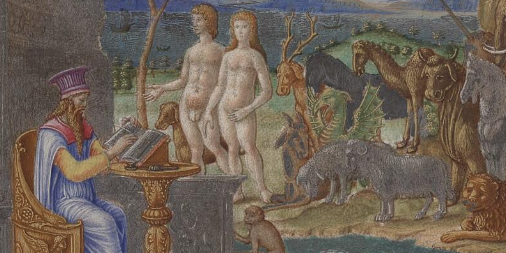
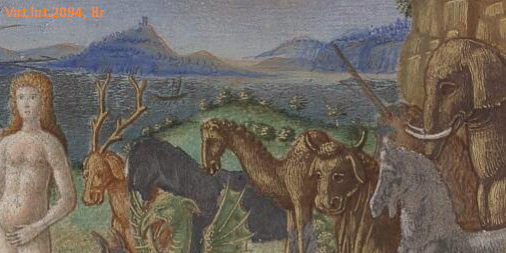
On the frontispiece of his Latin translation of Aristotle's Historia animalium, Theodore Gaza asked the miniaturist to paint Aristotle as scriba naturae, the scribe of nature.

We see the great Greek philosopher seated at a desk as many species wait to tell him their history. Foremost are a specimen man and woman, along with a monkey, dog, ass, deer, pair of sheep, dragon, bear, camel, ox, lion, horse and elephant plus sundry fish and small animals in the foreground.

The manuscript, Vat.lat.2094, was presented to Pope Sixtus IV, probably in 1473 according to John Monfasani in a wonderful article about the philosophical discord surrounding it. The codex has just arrived online in full color at the Vatican Library's digital portal after previously being only accessible in muddy grey.

Gaza was supposedly appalled to be given the miserly papal fee of 50 ducats for his translation and allegedly threw the money in the Tiber in rage, then departed to Greek-speaking Apulia to die. But (see pages 498-503) ...
[QT] ... Theodore Gaza's presentation copy of Aristotle's zoological works in Latin (Vat. lat. 2094). Allan Gotthelf [and] I wrote an article in which we showed the story of the 50 ducats to be a myth! https://t.co/3IPueJWlD2
— Pieter Beullens (@LatinAristotle) March 11, 2018
I doubt if the couple in the picture are Adam and Eve as sometimes claimed. The notion of man as an animal species goes back long before before Darwin. Aristotle had no doubt about this matter, uncomfortable as it is for some people. The History of Animals explicitly treats humans as part of the subject and the miniaturist (several candidates are mentioned by Monfasani) puts this front and centre.

The dedication shows Gaza hard at work, sitting at what looks somewhat like the prisoner-made tubular steel desks that I remember from my school days. Whether the skinny legs of desks in the Quattrocento were in fact of turned wood or wrought iron is a matter beyond my ken.

For more about this celebrated manuscript, see the Rome Reborn catalog, where Anthony Grafton draws attention to the medal depicting the Ponte Sisto, a Rome bridge to be put up as part of Sixtus's construction program. The codex also contains De partibus animalium and De generatione animalium by Aristotle. The dedication also features in John Murdoch's Album of Science as image number 159.

One more subject of interest is a unicorn lurking in the picture. It is the shaggy thing behind the horse and the elephant's tusks. For a most interesting account by a zoologist of what a unicorn might have been, read the article by Chris Lavers (PDF download at Duke), 'The Ancients' One-Horned Ass'.

A total of 53 digitizations have appeared this week. Here is the full list:
  1. Barb.lat.2711,
  2. Chig.H.VIII.250 (Upgraded to HQ),
  3. Ott.lat.441 (Upgraded to HQ),
  4. Ott.lat.1400,
  5. Ott.lat.1662 (Upgraded to HQ),
  6. Ott.lat.1777 (Upgraded to HQ),
  7. Ott.lat.1787 (Upgraded to HQ),
  8. Ott.lat.2041 (Upgraded to HQ),
  9. Ott.lat.2110 (Upgraded to HQ),
  10. Ott.lat.3091 (Upgraded to HQ),
    Also seen in @JBPiggin's list: is this a handwritten prototype of Cappelli's Dizionario? Look for the τελωσ on f. 7r! https://t.co/U0Fp8LHSuj
    — Pieter Beullens (@LatinAristotle) March 11, 2018
  11. Reg.lat.27 (Upgraded to HQ),
  12. Reg.lat.453 (Upgraded to HQ),
  13. Reg.lat.612 (Upgraded to HQ),
  14. Reg.lat.703.pt.1 (Upgraded to HQ),
  15. Reg.lat.809,
  16. Reg.lat.1249,
  17. Reg.lat.1479 (Upgraded to HQ),
  18. Reg.lat.1958 (Upgraded to HQ),
    Latin version of Avicenna's commentary on Aristotle's Physica @DigitaVaticana
    HT @JBPiggin https://t.co/BZeIe5vtzF pic.twitter.com/CpvS67S0fj
    — Pieter Beullens (@LatinAristotle) March 11, 2018
  19. Vat.lat.454.pt.1,
  20. Vat.lat.937,
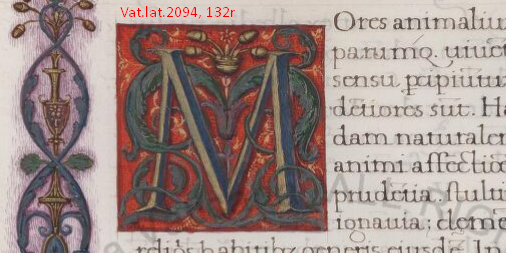
  21. Vat.lat.2094 (Upgraded to HQ), Historia animalium, De partibus animalium, De generatione animalium by Aristotle in the Theodore Gaza translation (above). Richly decorated, as in this fine initial M:
  22. Vat.lat.2274 (Upgraded to HQ),
  23. Vat.lat.2328,
  24. Vat.lat.2334,
  25. Vat.lat.2366 (Upgraded to HQ), a 15th-century medical manuscript including Avicenna: Lectura super I at ff. 94ra-132vb.
  26. Vat.lat.2434 (Upgraded to HQ),
  27. Vat.lat.2435,
  28. Vat.lat.2737,
  29. Vat.lat.2741,
  30. Vat.lat.2742 (Upgraded to HQ),
  31. Vat.lat.2744,
  32. Vat.lat.2750,
  33. Vat.lat.2753,
  34. Vat.lat.2755,
  35. Vat.lat.2756,
  36. Vat.lat.2757,
  37. Vat.lat.2758,
  38. Vat.lat.2776,
  39. Vat.lat.2792,
  40. Vat.lat.2794 (Upgraded to HQ),
  41. Vat.lat.2805,
  42. Vat.lat.2810,
  43. Vat.lat.2815,
  44. Vat.lat.2816,
  45. Vat.lat.2823,
  46. Vat.lat.2841,
  47. Vat.lat.2859,
  48. Vat.lat.2866,
  49. Vat.lat.2872,
  50. Vat.lat.2877 (Upgraded to HQ),
  51. Vat.lat.2891,
  52. Vat.lat.2894,
  53. Vat.lat.6214,
This is Piggin's Unofficial List number 153. Thanks to @gundormr for harvesting. If you have corrections or additions, please use the comments box below. Follow me on Twitter (@JBPiggin) for news of more additions to DigiVatLib.

Beullens, Pieter, and Allan Gotthelf. "Theodore Gaza’s translation of Aristotle’s De Animalibus: content, influence, and date." Greek, Roman, and Byzantine Studies 47, no. 4 (2007): 469-513. http://openpublishing.library.duke.edu/index.php/grbs/article/viewFile/761/841

Monfasani, John. "Aristotle as Scribe of Nature: The Title-Page of MS Vat. Lat. 2094." Journal of the Warburg and Courtauld Institutes 69 (2006): 193-205. http://www.jstor.org/stable/40025844.

2018-03-04

Rescue Archaeology

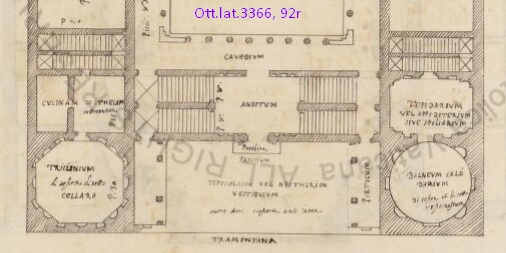
Pirro Ligorio (1512-1582), an Italian architect, painter and garden designer during the Renaissance, made a lasting contribution to history by recording what we might now call "rescue archaeology," the quick and dirty examination of earthed remains before they are scoured out for construction and dumped.

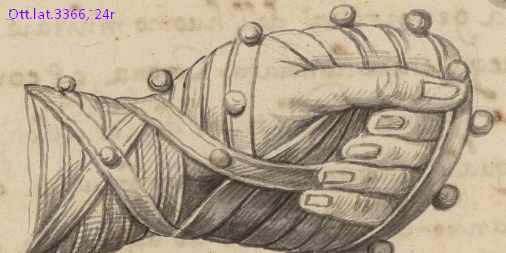
Copies of books 3 and 4 of his antiquarian notes, Ott.lat.3366 and Ott.lat.3367, have just come online at the Vatican Library portal. He was accused in his day of faking records, though controversy continues about whether this was fair. His records are hugely important, since much of what he recorded was later swept away. Here are images of how to armour a fist and of a palace:


This week there are a total of 18 new items:
  1. Ott.lat.3366, notes by Pirro Ligorio (above)
  2. Ott.lat.3367, Ligorio, book 4
  3. Vat.lat.2302, Summa of Raymond of Peñafort
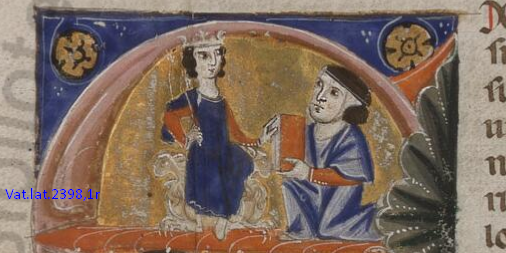
  4. Vat.lat.2398, medical, translated from the Arabic of Razi, with this fine presentation initial:
  5. Vat.lat.2714 (Upgraded to HQ), Orthographia of Gasparino Barzizza
  6. Vat.lat.2715, massively annotated Priscian
  7. Vat.lat.2754,
  8. Vat.lat.2763,
  9. Vat.lat.2764,
  10. Vat.lat.2767,
  11. Vat.lat.2787 (Upgraded to HQ), Ovid
  12. Vat.lat.2790,
  13. Vat.lat.2795 (Upgraded to HQ), Claudianus, 15th-century codex
  14. Vat.lat.2800,
  15. Vat.lat.2808,
  16. Vat.lat.2809,
  17. Vat.lat.2828,
  18. Vat.lat.2936, Leonardo Bruni
This is Piggin's Unofficial List number 152. Thanks to @gundormr for harvesting. If you have corrections or additions, please use the comments box below. Follow me on Twitter (@JBPiggin) for news of more additions to DigiVatLib.

2018-02-25

Latin and Visualization

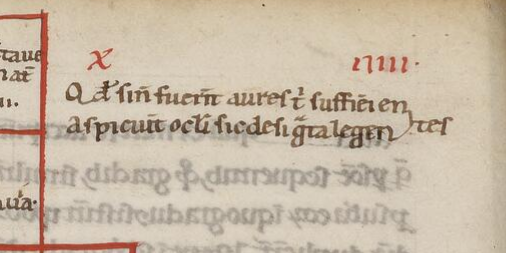
In Latin, the classic justification for visualization usually argues that verbalization may not be enough to explain complex topics. One of these texts has just shown up on the Vatican Library online portal in connection with an arbor juris diagram in a law textbook, Vat.lat.2707:
Quod si non fuerint aures tibi sufficientes
Aspiciant oculi sic designata legentes.
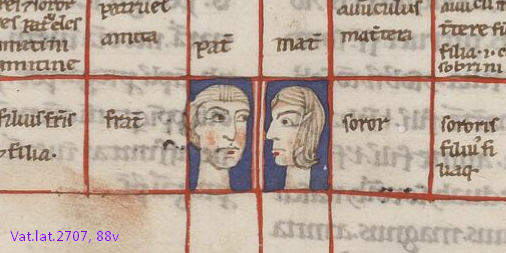
The idea on this bit of doggerel is that what won't go in your ears might well reach your understanding via your eyes. The oldest mention of this idea goes back to Cassiodorus (see my webpage about him). The verse is written in this 12th century manuscript of the Decretum abbreviatum at the head of a page to introduce a diagram of kinship:

The diagram is of considerable interest in itself. Its layout is classified as Schadt Type 5 (see my handbook to the types) and it is notable for having a double "self" (the little busts at the centre: perhaps implying the legal subject may sometimes be female) and for eliminating one degree of lateral kinship (it leaves the ultimate cousin squares blank).

In all 63 new manuscripts came online in the past week:
  1. Barb.lat.2161,
  2. Barb.lat.3981,
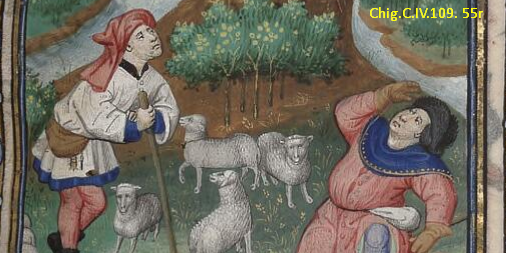
  3. Chig.C.IV.109, a beautiful book of hours
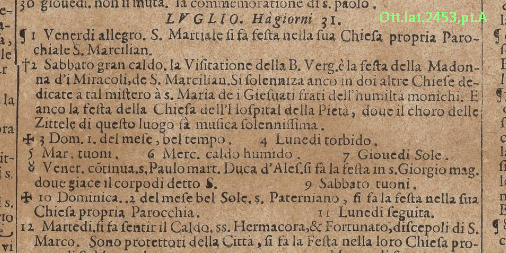
  4. Ott.lat.2453.pt.A, a newspaper-style news-of-the-past-year summary from 1644: Diario Venentiano Sopra L'Anno. Not great journalism though: the reporter often notes just the weather:
  5. Vat.lat.2179,
  6. Vat.lat.2332,
  7. Vat.lat.2396 (Upgraded to HQ),
  8. Vat.lat.2422,
  9. Vat.lat.2494 (Upgraded to HQ),
  10. Vat.lat.2501,
  11. Vat.lat.2565,
  12. Vat.lat.2575,
  13. Vat.lat.2577,
  14. Vat.lat.2614,
  15. Vat.lat.2643,
  16. Vat.lat.2647,
  17. Vat.lat.2648 (Upgraded to HQ),
  18. Vat.lat.2654,
  19. Vat.lat.2660 (Upgraded to HQ),
  20. Vat.lat.2661,
  21. Vat.lat.2665,
  22. Vat.lat.2677,
  23. Vat.lat.2685,
  24. Vat.lat.2687 (Upgraded to HQ),
  25. Vat.lat.2689,
  26. Vat.lat.2691 (Upgraded to HQ),
  27. Vat.lat.2693 (Upgraded to HQ),
  28. Vat.lat.2699,
  29. Vat.lat.2701,
  30. Vat.lat.2706,
  31. Vat.lat.2707, a law book (above). See Schadt, Hermann, Die Darstellung der Arbores Consanguinatis, pp 148, 150, 192
  32. Vat.lat.2708,
  33. Vat.lat.2709,
  34. Vat.lat.2710 (Upgraded to HQ),
  35. Vat.lat.2713 (Upgraded to HQ),
  36. Vat.lat.2716,
  37. Vat.lat.2717,
  38. Vat.lat.2718,
  39. Vat.lat.2723,
  40. Vat.lat.2727 (Upgraded to HQ),
  41. Vat.lat.2728,
  42. Vat.lat.2729,
  43. Vat.lat.2732,
  44. Vat.lat.2736,
  45. Vat.lat.2740 (Upgraded to HQ),
  46. Vat.lat.2743,
  47. Vat.lat.2746,
  48. Vat.lat.2748,
  49. Vat.lat.2751,
  50. Vat.lat.2762,
  51. Vat.lat.2768,
  52. Vat.lat.2770,
  53. Vat.lat.2771,
  54. Vat.lat.2773,
  55. Vat.lat.2778,
  56. Vat.lat.2779,
  57. Vat.lat.2786,
  58. Vat.lat.2796,
  59. Vat.lat.2797,
  60. Vat.lat.2887,
  61. Vat.lat.2938,
  62. Vat.lat.2986,
  63. Vat.turc.218,
This is Piggin's Unofficial List number 151. Thanks to @gundormr for harvesting. If you have corrections or additions, please use the comments box below. Follow me on Twitter (@JBPiggin) for news of more additions to DigiVatLib.

2018-02-17

Dead Monk Tweets

One of the more charming features of Twitter is its voices of the past, and a favorite of mine is Constantinus Africanus, who introduces himself thus: "Native Tunisian. Merchant-turned-monk. Medical translator (from Arabic) and editor. Cultural influencer. Died 22 Dec., before 1098/99."

To expand on that a little, Constantine was a Christian from Tunisia who spent the final part of his life as a Benedictine at Monte Cassino Abbey in Italy. As a translator of the medical greats, he helped change the course of primitive western medicine. So he does have an affinity with today's social media hepcats.

I can't understand how Constantine is still writing 920 years after his death, but it's possible he is getting social-media coaching from a digital humanities hero, Professor Monica H. Green of Arizona State University. So far Constantine has just 188 Twitter followers and he really needs a boost, considering all the hard work he put into making people well. So hop over to Twitter and follow him.

Incidentally, Constantine's work shows up in at least two of the seven codices digitized by the Vatican Library this week:
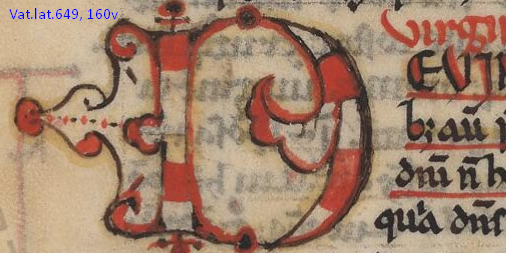
  1. Vat.lat.649, a 12th-century Haymo of Halberstadt: In Epistolas Pauli omnes on the epistles. Here's an initial for De Virginibus praeceptum:
  2. Vat.lat.2132 (Upgraded to HQ), Paul of Venice on logic
  3. Vat.lat.2416 (Upgraded to HQ), a densely written 14th-century compendium of mainly Arab medicine, including fols. 51v-55v: Constantinus Africanus, De stomachi affectionibus liber, cap. 1-25. eTK lists incipits: Abaseph id est puncti III; Alasef id est puncti rubei
  4. Vat.lat.2424, the Brevarium, a medical work, by Yahya ibn Sarafyun (9th century) a Syriac physician, known in Europe as Johannes Serapion
  5. Vat.lat.2441, medicines
  6. Vat.lat.2454, 14th-century compilation of translations by Constantine Africanus
  7. Vat.lat.2940, a 15th-century student's compendium with everything from Cicero and Pliny to Boccaccio
This is Piggin's Unofficial List number 150. Thanks to @gundormr for harvesting. If you have corrections or additions, please use the comments box below. Follow me on Twitter (@JBPiggin) for news of more additions to DigiVatLib.

2018-02-11

William of Moerbeke

William of Moerbeke (Wikipedia), a Flemish Dominican, translated many Greek classics into Latin in the 13th century. His work, essential to Europe's appreciation of Aristotle, is well represented in the Vatican Library. Reader @LatinAristotle has pointed out many of these in recent months.

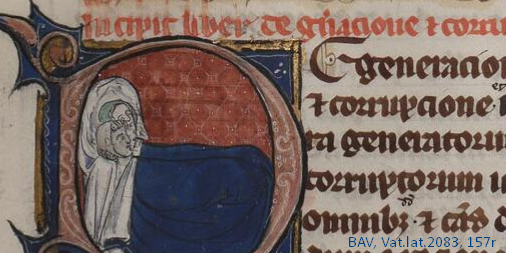
This week they have been joined by Vat lat 2083, an illuminated full-price manuscript dated 1284 and thus scribed during William's lifetime. It contains various Aristotle texts, including On Coming to Be and Passing Away, with this thoroughly appropriate couple in bed as the opening initial.

This week's digitization effort seems to have been rather feeble, with just 17 new items:
  1. Ott.lat.3364,
  2. Ott.lat.3365,
  3. Patetta.1749,
  4. Vat.lat.2083, a William of Moerbeke translation of Aristotle (above), dated 1284
  5. Vat.lat.2160,
  6. Vat.lat.2343 (Upgraded to HQ), law commentaries
  7. Vat.lat.2458,
  8. Vat.lat.2461, Galen and Hippocrates in Latin (14th century). One text inc. Intentiones habemus in presenti conscriptione; see eTK
  9. Vat.lat.2508,
  10. Vat.lat.2573,
  11. Vat.lat.2642,
  12. Vat.lat.2664,
  13. Vat.lat.2711,
  14. Vat.lat.2712 (Upgraded to HQ), Servius Grammaticus on Vergil. Odd: a page from a printed Greek book has been used to stiffen the front board of the binding.
  15. Vat.lat.2726 (Upgraded to HQ), Leonardo Bruni
  16. Vat.lat.2884,
  17. Vat.lat.2909, a 13th-century Cicero
This is Piggin's Unofficial List number 149. Thanks to @gundormr for harvesting. If you have corrections or additions, please use the comments box below. Follow me on Twitter (@JBPiggin) for news of more additions to DigiVatLib.

2018-02-06

The Animated Tabula

The latest update to the Tabula Peutingeriana Digital Plot on my website almost doubles the number of animations, and for the first time shows, using movement, how text entries were misplaced during a copying process lasting from about 350 to 1200 CE.

This digital version has been renamed the Tabula Peutingeriana Animated Edition to reflect these enhancements. In most of the left half of the chart you can now see color-coded routes and the emendations to them which have been proposed over the past century. The emendations are made visible by hovering on or touching the pale yellow squares which serve as triggers.

These interpretative additions make the chart a good deal less confusing. Column rules have also been added so that it will be easier to compare this digital edition with Talbert's.

Also new online is a brief article describing the Tabula in the context of diagram studies. This differs from those encyclopaedia entries which put the Tabula's clues to Roman history in the foreground or those which treat it primarily as a source of information about ancient settlements and place names.

2018-02-04

Wellness Database

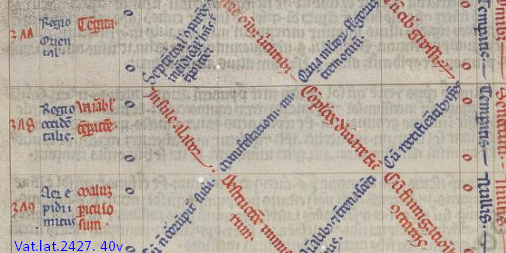
Health tips for laypeople have been one of my minor journalistic lines of business, so I was delighted to see a manuscript of the Tacuinum Sanitatis arrive online in full color this week on the Vatican Library portal. Vat.lat.2427 could be described as a wellness database, with a 380-row lookup table to check compatibility between foods and ailments.

It did not serve to educate doctors, but rather to inform wealthy patients who desired to second-guess their doctors. It is based on the Taqwīm as‑siḥḥah تقويم الصحة ("Maintenance of Health"), an 11th-century Arab medical treatise by a Christian doctor of Baghdad, Ibn Butlan. See Wikipedia.

This and its companion codex Vat.lat.2426 (both date from the 14th century) arrange all this tabular material in pretty red-and-blue lattices:

This presentation seems to pre-date the absolute de-luxe versions that started coming out in Italy in about 1380 with lushly painted miniatures of country life, gardens and stately homes, the lifestyle edition so to speak.

In all there are 41 new manuscripts at the Library portal:
  1. Barb.lat.2653,
  2. Barb.lat.2814, diary 1582-89
  3. Reg.lat.77,
  4. Reg.lat.78,
  5. Reg.lat.104, Petrus Lombardus, Glossae continuae. eTK makes a mistake in indicating this codex contains Gynaecia, incipit Cum in Alexandria sum certatus cum auctoritatibus, at ff. 94v-99v. Reader @monicaMedHist says this is probably an error in eTK for Reg. lat. 1004, which does indeed have a text on women's medicine (Genecia) attributed to "Actius Justius."
  6. Reg.lat.1561,
  7. Reg.lat.1636,
  8. Urb.lat.122,
  9. Urb.lat.190,
  10. Vat.lat.1136,
  11. Vat.lat.1313,
  12. Vat.lat.2079,
  13. Vat.lat.2216,
  14. Vat.lat.2318,
  15. Vat.lat.2319,
  16. Vat.lat.2384 (Upgraded to HQ), medieval Latin Galen. Note the much earlier ms used for an endpaper
  17. Vat.lat.2390,
  18. Vat.lat.2417, Creavit deus ex concavitatibus cordis sinistram; by Avicenna. See eTK
  19. Vat.lat.2427 (Upgraded to HQ), Tacuinum Sanitatis, popular medieval health guide (above).
  20. Vat.lat.2433,
  21. Vat.lat.2438,
  22. Vat.lat.2447,
  23. Vat.lat.2449, Cum quidem iam pervenimus ad expositionem egritudinum (14c); De egritudinibus. See eTK
  24. Vat.lat.2495,
  25. Vat.lat.2548 (Upgraded to HQ), Bernardus Compostelanus, m. 1267 Apparatus in Decretales, 14th-century copy
  26. Vat.lat.2572,
  27. Vat.lat.2576,
  28. Vat.lat.2581,
  29. Vat.lat.2584,
  30. Vat.lat.2585,
  31. Vat.lat.2586,
  32. Vat.lat.2588,
  33. Vat.lat.2590,
  34. Vat.lat.2615,
  35. Vat.lat.2625 (Upgraded to HQ), Bartolus de Saxoferrato
  36. Vat.lat.2673,
  37. Vat.lat.2676,
  38. Vat.lat.2692, 13th-century law textbook which contains an analysis of the Iuris Canonici. For diagram history this is interesting, as fol. 50r includes a passage explaining the use of an arbor juris in working out degrees of kinship. Mentioned by Schadt in his Darstellungen der Arbores Consanguinatis.
  39. Vat.lat.2733,
  40. Vat.lat.5256 (Upgraded to HQ), Odorico da Pordonone, in Italian
  41. Vat.lat.13358,
This is Piggin's Unofficial List number 148. Thanks to @gundormr for harvesting. If you have corrections or additions, please use the comments box below. Follow me on Twitter (@JBPiggin) for news of more additions to DigiVatLib.

2018-02-03

Backbone of Europe

The oldest chart of the western world, the Tabula Peutingeriana, would be better known to map enthusiasts if it were an approachable document. But on a first look, the scroll, which was designed in the Roman Empire, seems pretty incomprehensible. Of course it's in Latin, but that's not even the biggest problem. The chart is not to scale, but uses a strange squashed "projection", and it's infernally hard to guess where any of its roads go.

Help is at hand at last with my new chart of northern France, Germany, northern Italy, Austria and Slovenia which picks out what you need to know about the part of the Tabula covering Europe's most prosperous areas today.
What is striking is that the ductus of the Tabula -- and an awareness of the geography on the ground -- points to our designer having chosen a main road leading all the way from Boulogne, France to Rimini, Italy as his centerpiece.

This backbone, colored wine-red in my analytical diagram, passes through Reims, Besançon, Lausanne, the Great St Bernard Pass and Cesena. It's not the same as the medieval Via Francigena which led from Canterbury via Florence to Rome, but both the high roads served the same traffic and had many stretches in common.

Another big takeaway: the Tabula Peutingeriana is not oriented north-south. "Up" is north-west. Use the interactive control "Landmass" to see the coasts which the late antique designer had in mind. Of course the match is not perfect: Boulogne ends up on top of London, Leiden in the North Sea and Milan perched on the bank of the Rhine. But it's remarkable that anything matches in something that initially appears so chaotic.

What we are seeing is a very different take on Europe from that we are familiar with in modern maps. This is Roman Europe, with a fortified border in the north along the valleys of the Rhine and Danube (the dark blue line at top). It's also a Europe where most long-distance travel is obstructed by the Alps. The interactive control "Passes" shows how these seal off northern Italy. You can't go round them (except by ship): you have to over them as the playground song tells us.

To prove I haven't cheated, use the interactive control "Manuscript Sections" to see how the places form columns. The vertical layout precisely matches that in the Tabula, a UNESCO Memory of the World treasure now kept in a vault in Vienna. Tell me if you spot any errors. And if you want to see a similar chart of southern Europe, check out my previous blog post, Two Frances.

2018-01-28

Exultet Roll

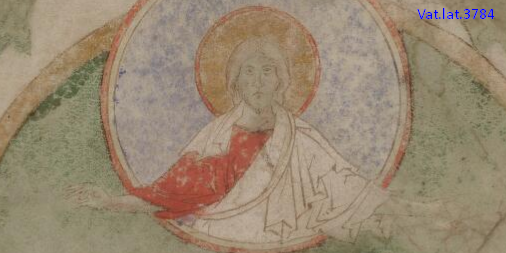
The Vatican Collection's Exultet Roll, one of the great treasures of medieval southern Italian illumination, has just been digitized and placed online. Vat.lat.3784 was made at the Abbey of Monte Cassino in the period 1058-87 for use in the Easter Vigil liturgy under Abbot Desiderius.

It's not the only one - half a dozen Cassinese rolls have survived - but it is celebrated for the magnificence of its text and its drawings of angels and the rising of Christ.

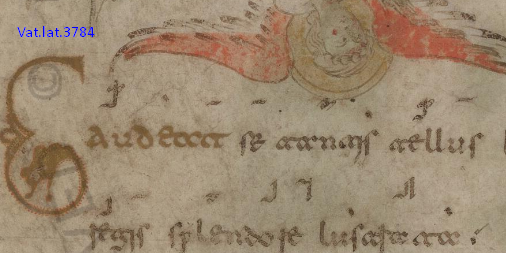
Digitization programs tend to pass over scrolls because they are difficult to scan, so I am pleased the Vatican librarians chose this one and hope they bring out more rolls for the digitizers in the next few months. You will notice that the text is inverted with respect to the pictures. The digitization shows the images right side up. I have inverted one image with "Gaudeat et tantis tellus irradiata fulgoribus..." where you can see an angel standing on his head:

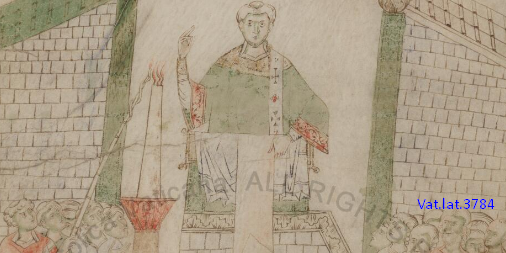
Examine the roll closely, and you'll find the explanation why. As the deacon reads from the roll, he slides its top end over the edge of the lectern to hang down for the congregation to see:

This blog post would not have been complete without heroic help from a reader, Aaron Macks (@gundormr on Twitter), who responded to my cry for help a week ago. I monitor the Vatican Library website with Distill, a simple scraper that is an extension to the Firefox ESR browser. The huge size of the Vat.lat index now defeats it, so @gundormr offered to write a script/program that would do the job.

This custom script not only works like a charm. It also picks up items that have been upgraded from low quality microfilm to high-quality (HQ) color scans. The report is generated as an HTML list. In good weeks, posts on this blog attract 1,000 readers and we all owe a big debt to @gundormr (an expert on books of hours) for keeping this service going.
  1. Reg.lat.37 (Upgraded to HQ),
  2. Reg.lat.43,
  3. Reg.lat.46,
  4. Reg.lat.47,
  5. Reg.lat.48,
  6. Reg.lat.56,
  7. Reg.lat.63,
  8. Reg.lat.102,
  9. Reg.lat.105,
  10. Reg.lat.108,
  11. Reg.lat.110,
  12. Reg.lat.143,
  13. Reg.lat.161,
  14. Reg.lat.164,
  15. Reg.lat.171,
  16. Reg.lat.176,
  17. Reg.lat.186,
  18. Reg.lat.195 (Upgraded to HQ), 9th century
  19. Reg.lat.666 (Upgraded to HQ),
  20. Reg.lat.1364 (Upgraded to HQ),
  21. Reg.lat.1481 (Upgraded to HQ),
  22. Reg.lat.1496 (Upgraded to HQ),
  23. Reg.lat.1573 (Upgraded to HQ),
  24. Reg.lat.1596,
  25. Reg.lat.1618,
  26. Reg.lat.1622,
  27. Reg.lat.1631,
  28. Reg.lat.1642 (Upgraded to HQ),
  29. Reg.lat.1653,
  30. Reg.lat.1666 (Upgraded to HQ),
  31. Reg.lat.1669 (Upgraded to HQ),
  32. Reg.lat.1685,
  33. Reg.lat.1689,
  34. Reg.lat.1692,
  35. Reg.lat.1695,
  36. Reg.lat.1699,
  37. Urb.lat.87,
  38. Urb.lat.105,
  39. Urb.lat.115,
  40. Urb.lat.146,
  41. Urb.lat.149,
  42. Vat.lat.427.pt.2,
  43. Vat.lat.585,
  44. Vat.lat.1984.pt.A,
  45. Vat.lat.2074 (Upgraded to HQ),
  46. Vat.lat.2104,
  47. Vat.lat.2150,
  48. Vat.lat.2183,
  49. Vat.lat.2370, Intentiones habemus in presenti conscriptione (13c-14c); see eTK
  50. Vat.lat.2412,
  51. Vat.lat.2448,
  52. Vat.lat.2453,
  53. Vat.lat.2456,
  54. Vat.lat.2459, Cura omnium egritudinum que accidunt a sumitate capitis; possibly by Pontius de S. Egidius; see eTK
  55. Vat.lat.2460, Cause difficultatis scientie pulsuum sunt; by Aegidius; see eTK
  56. Vat.lat.2507,
  57. Vat.lat.2520,
  58. Vat.lat.2583,
  59. Vat.lat.2618,
  60. Vat.lat.2663,
  61. Vat.lat.2690,
  62. Vat.lat.3784, Exultet Roll. See above.
This is Piggin's Unofficial List number 147. If you have corrections or additions, please use the comments box below. Follow me on Twitter (@JBPiggin) for news of more additions to DigiVatLib.