2012-02-20
Calahorra Bible
A first-ever online image of the Great Stemma in the Calahorra bible has finally shown up: it contains the opening spread only, but the polychrome array of colours is very impressive, despite the battered state of the codex. The image is for sale on Artflakes, but you'll have to click through yourself because I don't want to breach the photographer's copyright. The online sample is not in a good enough resolution to read the script, but I will be linking to it from my catalogue page. The photographer says the image also appears in a book published last December, Historia de Calahorra (Ed. Amigos de la Historia de Calahorra. December 2011. ISBN 978-84-939155-06). The 12th-century Biblia de Calahorra is kept in the Archivo Catedralicio y Diocesano de Calahorra. It's battered and it looks like it has suffered some water damage, but it's still there, a wonderful treasure. The Amigos (Facebook page) deserve all the help they can get to preserve the town's history, and of course every tourist visiting Spain helps in the economic recovery.


2012-02-18
Peter's Compendium
So far this blog has not directed much attention to the Compendium historiae in genealogia Christi, a 12th-century work by Peter of Poitiers which presents a completely new stemmatic diagram. Peter was a believer in the Trinubium, the three marriages of St Anne, and his vast genealogical infographic went into wide circulation in medieval Europe. There is no evidence the Compendium is adapted from the Great Stemma, though it seems plausible that Peter would have known of the Great Stemma and would have been inspired by it to design his own diagram ab initio.
In his 1943 article in Estudios Biblicos on the Great Stemma, Teófilo Ayuso claims that one of the codices where it is reproduced is a 14th- or 15th-century bible at the University of Barcelona, which his 1943 article terms Barc1, though it later becomes Barc3 in his peculiar numbering. This is online: I found a digital version yesterday. Its call number is Sig. Ms. 762. (There is another fine Barcelona University bible online, Sig. Ms. 856, but this does not contain any stemmata.) Sig. Ms. 762 is described at volume 2, page 308 of Miquel Rosell's printed catalog as follows: Ff. 2-7. Genealogias. Inc.: De Cain. Cain agricola dolens ... Expl.: De Tiberio ..., sub quo Dominus est passus. It also contains an Interpretationes Hebraicorum Nominum.
It is clear from only superficial examination that including this bible in the Great Stemma camp is another of Ayuso's blunders. The Barcelona bible very clearly contains the Compendium diagram, not the Great Stemma.
This can be readily seen by comparing it to other codices. There are several good online presentations of the Compendium. An impressive one is Ms Typ 216 at the Houghton Library of Harvard University, a roll-manuscript (probably intended for use as a wall-chart). It can be viewed in sections here.
There is a finely drawn 12th-century (?) version in codex form in the Biblioteca Medicea Laurenziana in Florence, spread over 10 pages in an anonymous seven-folio document, Plut.20.56 (5v is the final page of the diagram). An early 13th-century manuscript from England now in Paris, Lat. 15254, contains the same chart. I expect there are many others, but this is what some searching today turned up. [An excellent starting point is Nathaniel Taylor's survey, and I see the Met Museum also has a damaged scroll which is online in low resolution.]
As far as I know, there has been no printed version since the rather inaccurate editio princeps of the Compendium published by Zwingli in 1592, which differs in signal ways from the manuscripts above. MDZ offers it digitized. I have not done a bibliography on the Compendium yet, but it is discussed at length by Christiane Klapisch-Zuber in chapter 6 of L'Ombre des Ancêtres and there are some articles mentioned in a footnote by Stork.
In his 1943 article in Estudios Biblicos on the Great Stemma, Teófilo Ayuso claims that one of the codices where it is reproduced is a 14th- or 15th-century bible at the University of Barcelona, which his 1943 article terms Barc1, though it later becomes Barc3 in his peculiar numbering. This is online: I found a digital version yesterday. Its call number is Sig. Ms. 762. (There is another fine Barcelona University bible online, Sig. Ms. 856, but this does not contain any stemmata.) Sig. Ms. 762 is described at volume 2, page 308 of Miquel Rosell's printed catalog as follows: Ff. 2-7. Genealogias. Inc.: De Cain. Cain agricola dolens ... Expl.: De Tiberio ..., sub quo Dominus est passus. It also contains an Interpretationes Hebraicorum Nominum.
It is clear from only superficial examination that including this bible in the Great Stemma camp is another of Ayuso's blunders. The Barcelona bible very clearly contains the Compendium diagram, not the Great Stemma.
This can be readily seen by comparing it to other codices. There are several good online presentations of the Compendium. An impressive one is Ms Typ 216 at the Houghton Library of Harvard University, a roll-manuscript (probably intended for use as a wall-chart). It can be viewed in sections here.
There is a finely drawn 12th-century (?) version in codex form in the Biblioteca Medicea Laurenziana in Florence, spread over 10 pages in an anonymous seven-folio document, Plut.20.56 (5v is the final page of the diagram). An early 13th-century manuscript from England now in Paris, Lat. 15254, contains the same chart. I expect there are many others, but this is what some searching today turned up. [An excellent starting point is Nathaniel Taylor's survey, and I see the Met Museum also has a damaged scroll which is online in low resolution.]
As far as I know, there has been no printed version since the rather inaccurate editio princeps of the Compendium published by Zwingli in 1592, which differs in signal ways from the manuscripts above. MDZ offers it digitized. I have not done a bibliography on the Compendium yet, but it is discussed at length by Christiane Klapisch-Zuber in chapter 6 of L'Ombre des Ancêtres and there are some articles mentioned in a footnote by Stork.
2012-02-15
Editio Princeps
As far as I know, the editio princeps of the Liber Genealogus is the edition of the Codex Taurinensis published at Paris by Christoph Pfaff in 1712. It can found on Google Books. The full title is Firmiani Lactantii Epitome Institutionum Divinarum ad Pentadium fratrem. For a German note about Pfaff, see Wikipedia.
2012-01-29
Primacy of Latin
If God had spoken Latin, western Christians believed, he would have dictated the scriptures in Jerome’s Latin words. The great Complutensian Polyglot Bible, published in Madrid 45 years before Hernando del Castillo collated Justus's Gospel Book, had placed the Greek, Latin and Hebrew texts in three parallel columns.
Its preface stated: Mediam autem inter has latinam beati Hieronymi translationem velut inter Synagogam et Orientalem Ecclesiam posuimus: tanque duos hinc et inde latrones medium autem Iesum hoc est Romanam sive latinam Ecclesiam collocantes (Prolog. II).
Here is a translation following Basil Hall (in Greenslade, E.L. ed., The Cambridge History of the Bible):
Its preface stated: Mediam autem inter has latinam beati Hieronymi translationem velut inter Synagogam et Orientalem Ecclesiam posuimus: tanque duos hinc et inde latrones medium autem Iesum hoc est Romanam sive latinam Ecclesiam collocantes (Prolog. II).
Here is a translation following Basil Hall (in Greenslade, E.L. ed., The Cambridge History of the Bible):
We have placed the Latin translation of blessed Jerome as though between the Synagogue and the Eastern Church, siting them like the two thieves, one on each side, and Jesus, that is the Roman or Latin Church, between them.This sardonic statement appears at the start of the bible, a masterpiece of typography and Catholic scholarship, which was printed between 1514 and 1517 in Alcalá de Henares (Complutum in Latin). The Complutensian Bible is available as a PDF from Archive.org.
2012-01-22
Vetus Names
In her publication on the Great Stemma in 1984, Yolanta Zaluska asserted that all the existing recensions contained a mixture of Vetus Latina and Vulgate names:
The assessments are subjective, which is to say I judged the different spellings and rated how closely they resembled the Vetus Latina orthography (which is based on the Septuagint Greek). The scoring system offers a continuum between forms that show no influence from Jerome and forms that could only be corruptions of Jerome's orthography. This is not highly scientific, but it is a start. Here are the numerical values I employed:
Lé fond commun de la Vieille Latine est sensible dans tous les témoins consultés, mais à des degrés variés. Il est indiscutable que la Vulgate a été utilisée à plusieurs reprises tantôt pour corriger les lignées, tantôt pour compléter les textes explicatifs.She characterized these differences as follows:
Recension α: ... texte mixte, en général très corrompu, disposé toujours sur quatorze tables; à partir d'Abraham (table VI), n'a presque pas été retouché sur la Vulgate.Zaluska never presented any statistical data or analysis to back up these characterizations, so I have done some sampling of my own. Below is a tabulation containing a rough scoring of 39 Genesis names from the period down to Abraham. I have included a recension, Epsilon, that Zaluska left out of account. I have not included Zaluska's Sigma in this survey.
Recension β: ... texte corrigé d'après la Vulgate, néanmoins dans l'ensemble assez corrompu, et fortement interpolé, en grande partie, semble-t-il, à l'aide des Etymologies d'Isidore; peut être commodément désigné comme une recension longue.
Recension σ transmise par le Beatus de Saint-Sever (S), apparaissant pour l'essentiel comme un texte de type α corrigé d'après la Vulgate, mais fournissant quand même des textes qui lui sont propres ...
Recension γ: ... texte ne montrant que des retouches occasionnelles d'après la Vulgate; partie caractéristique à la page des Juges; plusieurs omissions.
Recension δ: ... Le premier texte (Bible de San Millán de la Cogolla, Madrid) est probablement celui qui reflète le plus fidèlement la tradition de la Vieille Latine; le texte de [Bible de Calahorra] en revanche suit généralement la Vulgate, à partir d'Abraham; des interpolations communes dans la première partie du texte.
The assessments are subjective, which is to say I judged the different spellings and rated how closely they resembled the Vetus Latina orthography (which is based on the Septuagint Greek). The scoring system offers a continuum between forms that show no influence from Jerome and forms that could only be corruptions of Jerome's orthography. This is not highly scientific, but it is a start. Here are the numerical values I employed:
- -2 signifies an obviously LXX/Vetus form, but with extreme scribal deformation;
- -1 is the pure LXX/Vetus type;
- 0 means a name containing a consonant or vowel that uncertainly suggests the LXX/Vetus type;
- +1 a name of Vulgate type;
- +2 signified variants that are very unlike the Vetus but do resemble the Vulgate type
The columns, from left to right, represent Epsilon, Delta, Gamma, Alpha, Beta; the last three columns comprise Fischer's form of the Vetus name, the Clementine Vulgate form and the Stuttgart Vulgate form.
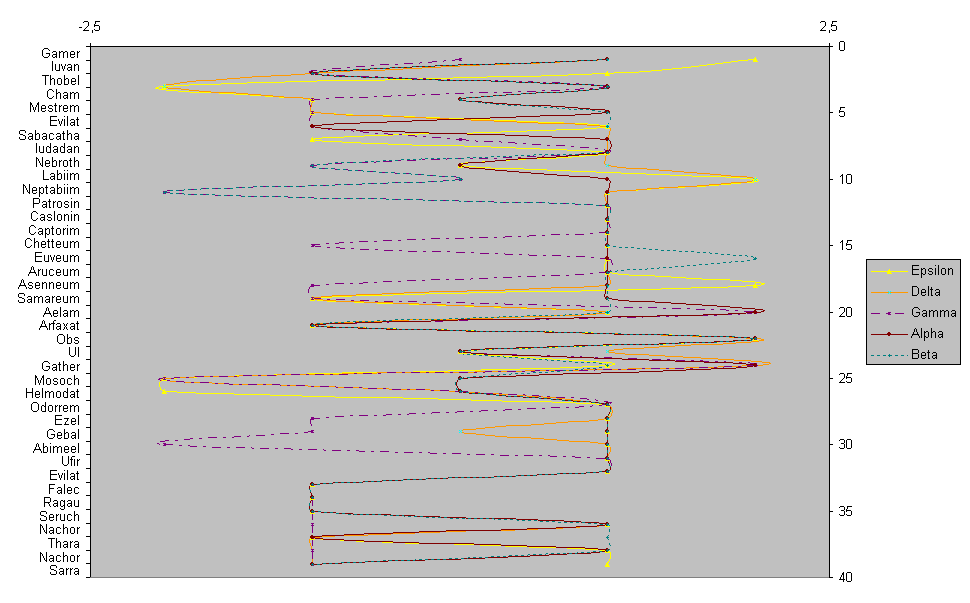
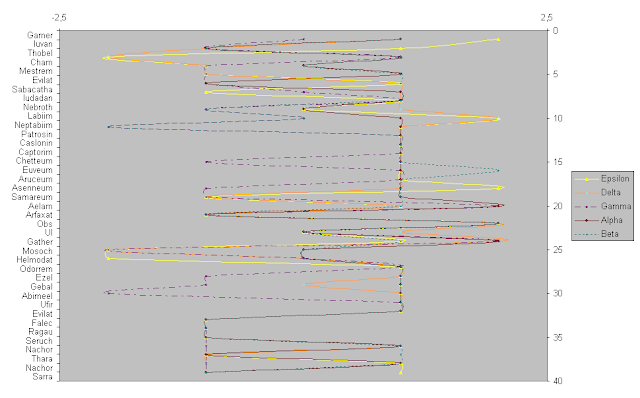 It will be clear to the readers from both the table and from the graph that there is no obvious consistency in the way that medieval editors revised the five recensions. The variants swerve wildly to both sides. In this sample of names from Genesis, the data does not seem to support Zaluska's conclusion that Gamma contains "occasional retouchings" drawn from the Vulgate," whereas Delta is the "most faithful" to the Vetus Latina. If anything, Gamma is more faithful.
| 2 | 1 | 0 | 1 | 1 | Gamer | Gomer | Gomer |
| 1 | -1 | -1 | -1 | -1 | Iuvan | Iavan | Javan |
| -2 | -2 | 1 | 1 | 1 | Thobel | Tubal | Thubal |
| -1 | -1 | -1 | 0 | 0 | Cham | Ham | Ham |
| -1 | -1 | -1 | 1 | 1 | Mestrem | Mesraim | Mesraim |
| 1 | 1 | -1 | -1 | 1 | Evilat | Hevila | Hevila |
| -1 | 1 | 0 | 1 | Sabacatha | Sabatacha | Sabatacha | |
| 1 | 1 | 1 | 1 | 1 | Iudadan | Dadan | Dadan |
| 0 | 1 | -1 | 0 | -1 | Nebroth | Nemrod | Nemrod |
| 2 | 2 | 0 | 1 | 0 | Labiim | Laabim | Laabim |
| 1 | 1 | -2 | 1 | -2 | Neptabiim | Nepthuim | Nephthuim |
| 1 | 1 | 1 | 1 | 1 | Patrosin | Phetrusim | Phetrusim |
| 1 | 1 | 1 | 1 | 1 | Caslonin | Cesluim | Chasluim |
| 1 | 1 | 1 | 1 | 1 | Captorim | Capthurim | |
| 1 | 1 | -1 | 1 | 1 | Chetteum | Ettheum | Hethæum |
| 1 | 1 | 1 | 1 | 2 | Euveum | Eveum | Hevæum |
| 1 | 1 | 1 | 1 | 1 | Aruceum | Araceum | Aracæum |
| 2 | 1 | -1 | 1 | 1 | Asenneum | Sineum | Sinæum |
| -1 | -1 | -1 | 1 | 1 | Samareum | Samariten | Samaræum |
| 1 | 1 | 2 | 2 | 1 | Aelam | Elam | Ælam |
| -1 | -1 | -1 | -1 | -1 | Arfaxat | Arfaxad | Arphaxad |
| 2 | 2 | 2 | 2 | 2 | Obs | Us | Us |
| 0 | 1 | 0 | 0 | 0 | Ul | Hul | Hul |
| 1 | 2 | 2 | 2 | 1 | Gather | Gether | Gether |
| -2 | -2 | -2 | 0 | 0 | Mosoch | Mes | Mes |
| -2 | 0 | 0 | 0 | 0 | Helmodat | Helmodad | Elmodad |
| 1 | 1 | 1 | 1 | 1 | Odorrem | Aduram | Adoram |
| 1 | 1 | -1 | 1 | 1 | Ezel | Uzal | Uzal |
| 1 | 0 | -1 | 1 | 1 | Gebal | Ebal | Ebal |
| 1 | 1 | -2 | 1 | 1 | Abimeel | Abimahel | Abimaël |
| 1 | 1 | 1 | 1 | 1 | Ufir | Ophir | Ophir |
| 1 | 1 | 1 | 1 | 1 | Evilat | Evila | Hevila |
| -1 | -1 | -1 | -1 | -1 | Falec | Faleg | Phaleg |
| -1 | -1 | -1 | -1 | -1 | Ragau | Reu | Reu |
| -1 | -1 | -1 | -1 | -1 | Seruch | Sarug | Sarug |
| 1 | 1 | -1 | 1 | 1 | Nachor | Nahor | Nahor |
| -1 | -1 | -1 | -1 | 1 | Thara | Thare | Thare |
| 1 | -1 | -1 | 1 | 1 | Nachor | Nahor | Nahor |
| 1 | -1 | -1 | -1 | -1 | Sarra | Sarai | Sarai |
This list has been filtered to only comprise 39 names in Genesis where there seems to be a distinction between the Vetus Latina and Vulgate forms.
Now it is striking that none of the five recensions above consistently follows the Vetus Latina type, which would be indicated by one of the columns consisting mostly of scores of -2 or -1.
Now it is striking that none of the five recensions above consistently follows the Vetus Latina type, which would be indicated by one of the columns consisting mostly of scores of -2 or -1.
When transcribing the manuscripts, my impression was that the concentration of Vetus Latina names was highest in Delta, but in this scoring, Delta has a median value of +0.3. In fact it is Gamma which is closest to the Vetus, with a median score of -0.2 . As for the rest, the medians are Epsilon +0.4, Alpha +0.5 and Beta +0.5.
I have converted the table to a graph below. If anyone can think of a more expressive graph, I would be glad to hear advice on how this could be presented in line with current methods.
What can we say about the names from those parts of biblical history subsequent to Genesis?
We cannot expect to find any differences in the names from Christ back to the Exile, because these names only existed in the Greek manuscripts of the Gospels of Matthew and Luke and no Hebrew evidence for them exists. Jerome of Stridon did not alter their Latin transcriptions, so these names are invariant between the Vetus Latina and the Vulgate.
As for the names from the Exile back to Saul, we also cannot expect to find much significant variation. We do not yet possess scholarly editions of the Vetus Latina text of 1 Samuel, 2 Samuel, 1 Chronicles and 2 Chronicles, 1 Kings and 2 Kings (they will take several more decades to arrive). To fill the gap, I have instead collated the Septuagint forms, which were of course the basis for the Vetus Latina. The reader can construe the likely Latin transcriptions, and compare these to the Stuttgart Vulgate forms. The following selection shows that Jerome left the bulk of the pre-existing Latin forms pretty well unchanged.
| Αχινααμ | Ahinoem | 1Sa | 25:43, 2 Sa 3:2 |
| Αβιγαιας | Abigail | 1Sa | 25:42, 2Sa 3:3 |
| Μααχα | Maacha | 2Sa | 3:3 |
| Αγγιθ | Aggith | 1Ch | 3:2, 2Sa 3:4 |
| Αβιταλ | Abital | 2Sa | 3:4 |
| Αιγλα | Agla | 2Sa | 3:5 |
| Βηρσαβεε | Bethsabee | 2Sa | 11:3 |
| Αμνων | Amnon | 2Sa | 3:2 |
| Δαλουια | Chelaab | 2Sa | 3:2, 1Ch 3:1 |
| Αβεσσαλωμ | Absalom | 2Sa | 3:3 |
| Ορνια | Adonias | 2Ch | 3:4 |
| Σαφατια | Safathia | 1Ch | 3:3, 2Sa 3:4 |
| Ιεθερααμ | Iethraam | 2Sa | 3:5 |
| Θημαρ | Thamar | 2Sa | 13:1 |
| Ιβααρ | Ibaar | 1Ch | 3:6, 14:5, 2Sa 5:15 |
| Ελισαε | Elisama A | 1Ch | 14:5, 3:6, 2Sa 5:16 |
| Ελιφαλετ | Eliphalet / Helifeleth | 1Ch | 3:6, 14:5, 2Sa 5:16 |
| Ναγε | Noge | 1Ch | 3:7, 14:5 |
| Ναφαγ | Napheg / Nepheg | 1Ch | 3:7, 14:5, 2Sa 5:15 |
| Ιανουε / Ιανουου | Iaphie | 1Ch | 3:7, 14:5, 2Sa 5:15 |
| Ελισαμα / Ελισαμαε | Elisama B | 1Ch | 3:8, 14:5 |
| Ελιαδα | Helida / Heliade | 1Ch | 3:8, 14:5, 2Sa 5:16 |
| Ελιφαλετ | Eliphalet / Helisua | 1Ch | 3:8, 14:5, 2Sa 5:15 |
| Σαμμους | Samua | 2Sa | 5:14 |
| Σωβαβ | Sobab | 2Sa | 5:14 |
| Σαλωμων | Salomon | Mt | 1:6, 2Sa 5:14 |
| Ιεροβοαμ / Ναβατ | Hieroboam | 1Kgs | 11:26 |
| Ναδαβ | Nadab | 1Kgs | 15:25 |
| Βαασα / Αχια | Baasa filius Ahia | 1Kgs | 15:33 |
| Ηλα | Hela filius Baasa | 1Kgs | 16:8-16 |
| Ζαμβρι | Zamri | 1Kgs | 16:9 |
| Θαμνι / Γωναθ | Thebni filium Gineth | 1Kgs | 16:21 |
| Αχααβ / Αμβρι· | Ahab filius Amri | 1Kgs | 16:29 |
| Ιεζαβελ | Hiezabel | 1Kgs | 16:31 |
| Οχοζιας | Ohozias | 1Kgs | 22:40 |
| Ιωραμ / Αχααβ | Ioram filius Ahab | 2Kgs | 3:1, 1Kgs 22:50 |
| Ιου / Ναμεσσι | Hieu filius Namsi | 1Kgs | 19:16, 2Chr 22:7 |
| Ιωαχας | Ioachaz | 2Kgs | 10:35 |
| Ιωας | Ioas filius Ioachaz | 2Kgs | 13:10 |
| Ιεροβοαμ | Hieroboam | 2Kgs | 13:13 |
| Ζαχαριας | Zaccharias filius Hieroboam | 2Kgs | 15:8 |
| Σελλουμ / Ιαβις | Sellum filius Iabes | 2Kgs | 15:13 |
| Μαναημ / Γαδδι | Manahem filius Gaddi | 2Kgs | 15:14 |
| Φακεϊας | Phaceia filius Manahem | 2Kgs | 15:23 |
| Φακεε / Ρομελιου | Phacee filius Romeliae | 2Kgs | 15:25 |
| Ωσηε / Ηλα | Osee filius Hela | 2Kgs | 17:1 |
As luck would have it, where differences do occur in the above list, it is not always easy to see a pattern in the Great Stemma's uptake of the forms. First of all we find certain odd distortions. The first Elisama, for example, appears not as Elisae, but as Elisbe. Secondly, some of the variations completely contradict Zaluska's generalizations: Zambri with a B appears in three recensions (Epsilon, Alpha, Beta), but has been "corrected" to Jerome's Zamri without a B in Delta and Gamma, which are normally the most conservative texts.
Zaluska's assertion that the balance in Alpha swung, after Abraham, to almost pure Vetus Latina forms is therefore interesting and provocative, but needs to be treated with a certain amount of caution. My guess is that her generalization was in fact largely argued from her very perceptive analysis of the Horrite names in Genesis 36. I wrote a survey of these in 2010 where I tabulated the names and provided the proof that is missing from her article, though implied. The differences among the Horrite names between Alpha and Beta are especially striking and this section of the collation is crucial in proving that the Great Stemma is indeed drawn from a Vetus Latina tradition.
I have not yet studied the Vetus/Vulgate distribution of the names making up the Twelve Tribes of Israel: it would be interesting to follow this up at a later time.
In conclusion, I would say this. The Great Stemma and the Liber Genealogus were clearly originally written in a time and place where Jerome's Vulgate was not available and were then haphazardly modified by medieval editors. But the process of modification was not as simple or as linear as Zaluska suggests, and her conclusions are too sweeping. The Great Stemma manuscripts are anything but unambiguous evidence for the onomastics of the Vetus Latina. Bonifatius Fischer was correct to collate the Great Stemma from four Spanish bibles as a somewhat compromised source, while treating it with the greatest of caution.
Footnote: there is a further discussion of this issue a couple of years later: http://macrotypography.blogspot.com/2014/04/the-old-latin.html
Footnote: there is a further discussion of this issue a couple of years later: http://macrotypography.blogspot.com/2014/04/the-old-latin.html
2012-01-07
Marathon
I glimpsed an ARD television news report four weeks ago on the Berlin round of the Visualizing Marathon but cannot find the news clip any more. There is some coverage of the event on Vizworld.
2011-12-07
Hypothetigraphy
Many theories of diagrams are limited in scope to just one or two manifestations of abstract drawings. Diagrammatic representation of numerical data has been well studied since Edward Tufte's Visual Display of Quantitative Information, but stemmatic drawings like the Great Stemma are rarely well explained. I have been impressed at the theoretical work of Manfredo Massironi (1937-) of the University of Verona in Italy. Massironi has devised a concept he calls hypothetigraphy to describe drawings that present hypothetical, invisible, abstract ideas. It is presented in his 2002 book, The psychology of graphic images: seeing, drawing, communicating (Link: Google Books). (The English translation from the Italian is not perfect, and sometimes makes no sense: the term itself is sometimes spelled "hypothesigraphy" in the text, varying in orthography from one line to the next (e.g. p. 164), but "hypothetigraphy" is the form used in the headings and index.)
He says he departs from the idea that "illustrating is a way of emphasizing, by visual means, those contents that cannot be effectively conveyed by verbal expression." He proposes that hypothetigraphy has two roles: (a) a connective function (connecting into a unitary pattern a body of knowledge [which is] fragmented and apparently not well organized) and (b) a reconstructive function (reconstructing the various phases of a process for purposes of illustration and interpretation, starting from observable results).
He says he departs from the idea that "illustrating is a way of emphasizing, by visual means, those contents that cannot be effectively conveyed by verbal expression." He proposes that hypothetigraphy has two roles: (a) a connective function (connecting into a unitary pattern a body of knowledge [which is] fragmented and apparently not well organized) and (b) a reconstructive function (reconstructing the various phases of a process for purposes of illustration and interpretation, starting from observable results).
According to my definition, hypothetigraphy defines a rather homogenenous class of drawings, which I call hypothetigraphs ....This is all very useful. The six "features" listed above are all applicable to the Great Stemma:
The first feature, and one that is most easily noted, is the use of simple geometric figures.... The "true" objects and their appearance are not important in this endeavor, for the phenomena under consideration have to do with relationships and with dynamic interactions between elements.... The shape of elements per se is usually an irrelevant piece of information, which is best left out or represented simply by the most abstract of shapes, the circle.
A second and most immediately noticeable feature of hypothetigraphs is the addition of brief written text to the picture.... The inclusion of written text is always necessary in hypothetigraphy which would otherwise lose its communicative function... Verbal and visual information are inextricably and necessarily connected.
Another distinguishing feature of hypothetigraphy is the the almost exclusive use of precise marks, drawn using the ruler ... Precise, clear lines contribute in conveying the impression that the depicted forms are mental constructs, not representations of natural objects.
Typical of hypothetigraphy is ... the use of object lines ... Object lines are not used to mimic some aspect of reality but to illustrate relationships, correspondences or connections.... Relationships and connections and trajectories ... lend themselves naturally to an interpretation in terms of threads, ropes and connecting cables.
A fifth feature of hypothetigraphy is the number of represented dimensions, which tends to be as small as possible within the constraints of the logic of the representation.
Finally, hypothetigraphy tends to place the viewpoint frontally relative to the picture plane, an tends to present figures without a background.... The second of these ... contributes to focus the attention of the viewer, avoiding unwanted contextual effects.
- Its graphic elements are circles of various sizes. They do not represent heads or anything else physical but are entirely abstract, representing generations and dynasties.
- Text within the roundels, along the connecting lines and in the final Sicut Lucas evangelista section, is there to expand the effect of the drawn figures.
- Its lines are generally straight, except for the final meeting of the two fila, and the whole structure is drawn with a certain sterility to emphasize its abstract meaning.
- The connecting lines represent succession, and ramifications where necessary.
- The drawing is strictly two dimensional
- It has no background colour or images. My attachment of a yellow timeline band to the reconstruction is in fact out of harmony with the austerity of the original.
Massironi makes no mention of the Great Stemma. In fact he does not mention any stemmatic drawings at all. But his observations are so acute that they apply to the stemma without any modification being required of them.
Graph of Time
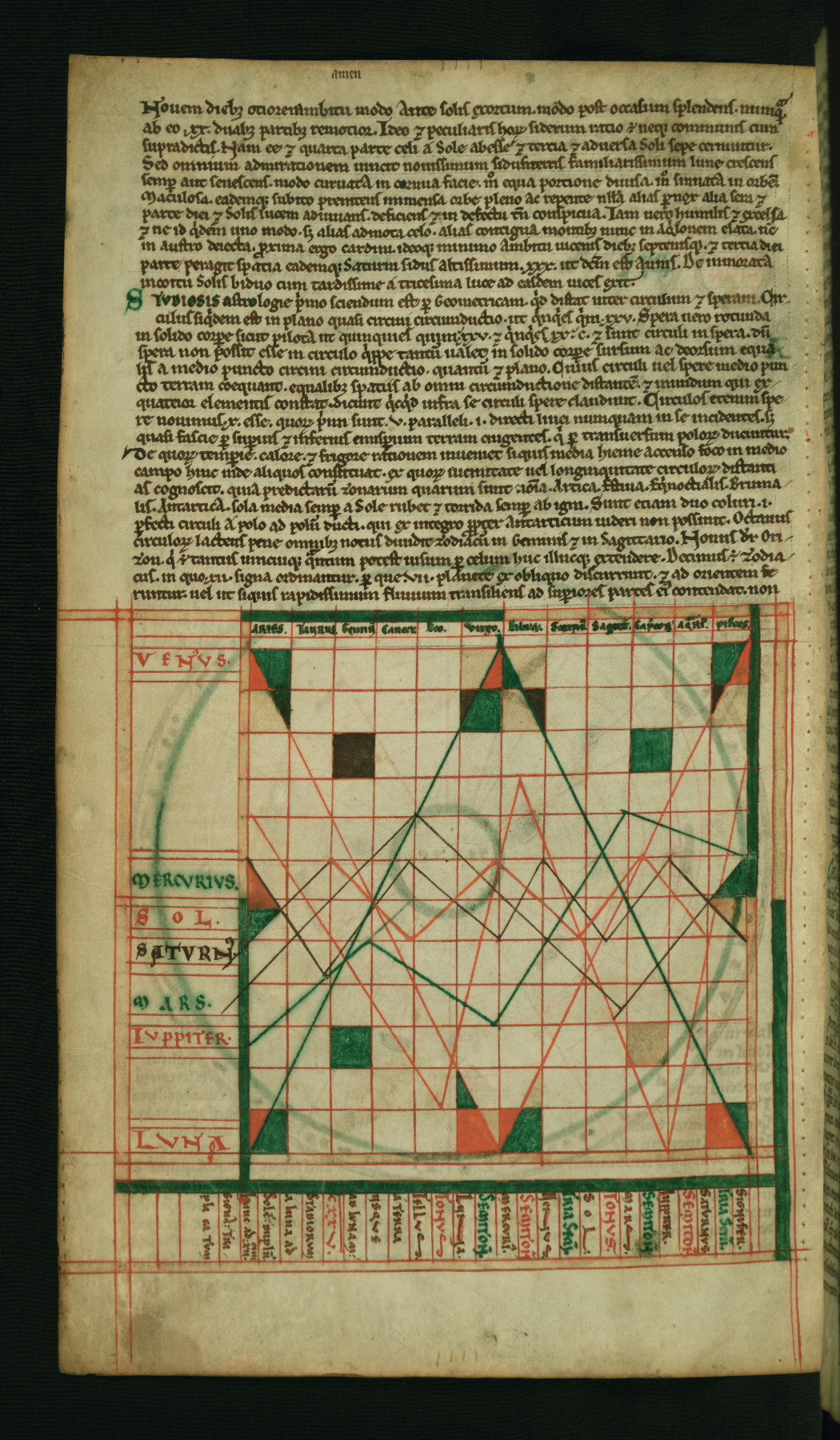
Some time ago, my attention was drawn to the graph of planetary displacement from the elliptic with respect to time that was devised for medieval schools. Until 50 years ago this was thought to be unique to a Latin manuscript in Munich, BSB Clm 14436, 61r, but it seems to in fact exist in numerous manuscripts.
Bruce Eastwood discusses it in Plinian astronomical diagrams in the early Middle Ages (1987) and returned to it in more detail in Planetary Diagrams - Descriptions, Models, Theories (2000, co-authored with Gerd Grasshoff, online) and Planetary diagrams for Roman astronomy in medieval Europe (2004, also with Grasshoff, online). If I am reading these articles correctly, the diagram is what the authors classify as "Plinian latitudes - rectangular" in their 2004 catalogue:
1 Avranches BM, 226, f.88r
8 Bern BB, 347, f.24v
10 Cambridge, St John's CL, lat. I.15, p.287
11 Cambridge, St John's CL, lat. I.15, p.353
12 Cambridge, Trinity CL, R.15.32, f.3v
13 Durham CathLibr, Hunter 100, f.66r
15 Erfurt StB, Ampl. 4°.8, f.1r
20 Genève FB, 111, f.41r
21 Glasgow UL, T.4.2, f.117r
22 Leiden UB, BPL 168, f.56r
24 London BL, Add. 11943, f.49v
27 London BL, Cott.Tib. E.IV, f.141r
32 London BL, Roy. 13.A.XI, f.143v (image in Eastwood/Grasshoff)
38 Milano BN, E.5 sup., f.1r
39 Milano BN, E.5 sup., f.53r
54 München SB, clm 6364, f.24v
57 Oxford BoL, Canon. Class. lat 279, f.34r
59 Oxford BoL, Lyell 154, f.26v
70 Paris BNF, lat. 5239, f.38v
71 Paris BNF, lat. 5239, f.39r
72 Paris BNF, lat. 6367, f.1v
79 St Gallen StiB, 250, p.2
81 Strasbourg BU, 326, f.122r
89 Vaticano BAV, Palat. lat. 1577, f.82v
94 Vaticano BAV, Regin. lat. 1573, f.53r
105 Wroclaw UB, IV.O.11, f.59r
108 Zürich ZB, Car.C. 122, f.42r
But perhaps I have not understood this correctly, since the specimen which is numbered Plin45 (clm 14436, 61v, link at the top of this blog entry) is absent from the above list, as is the specimen numbered as Plin83 in the 2004 article (Strasbourg, same codex as above, but folio 123r, reproduced in the 2000 article), along with six other references Eastwood gave in 1987:
Madrid 9605, f.12v
Zurich Car. C 176, f. 193v
Bern 265, f. 59r
London Cott.Vit. A XII, f. 9r
Baltimore Walters W, 73, f. 5v (mentioned in the note on page 11 of Eastwood's 2004 catalogue)
Oxford, St Johns, 17, f. 38r
London BL Eg. 3088, f. 83v
There is one corrigenda page in the Google Books edition, but these are not mentioned there. I do not know if further errata have been published. Perhaps I have overlooked some kind of filter that Eastwood and Grasshoff may have mentioned in their book, and I would be grateful if any reader could explain this to me.
Hans-Christoph Liess, supervised by Grasshoff and Eastwood during his doctoral studies at the University of Berne, later assembled a database of Eastwood's images, and published a description. The title page of this 2001 database project, code-named Compago, is still online, as is the diagram index page, and, perhaps most important, an interactive mind-map of the manuscripts listed above. A handbook was also published. But the back end with the actual images and the required software module, code-named Alcatraz, seems to have either been taken down or to have been put behind a wall. Google Chrome is able to open the interface, but a user name and password are required to proceed further. Liess completed his doctoral dissertation in 2002 (large file) and this is online. Both Liess and Grasshoff have since moved from Berne to Berlin.
What is curious is that all three authors are sure that the diagram is a simplification of a circular diagram of the Plinian latitudes which is found in 12 manuscripts. Pliny had presented the data as numerical data only. Then a Carolingian editor devised the circular diagram just before or following a conference on computus in 809 EC and "solved the problem of presenting to students the spatial meaning of the Plinian text" (Eastwood, 2000). Eastwood and Grasshoff continue:
Bruce Eastwood discusses it in Plinian astronomical diagrams in the early Middle Ages (1987) and returned to it in more detail in Planetary Diagrams - Descriptions, Models, Theories (2000, co-authored with Gerd Grasshoff, online) and Planetary diagrams for Roman astronomy in medieval Europe (2004, also with Grasshoff, online). If I am reading these articles correctly, the diagram is what the authors classify as "Plinian latitudes - rectangular" in their 2004 catalogue:
1 Avranches BM, 226, f.88r
8 Bern BB, 347, f.24v
10 Cambridge, St John's CL, lat. I.15, p.287
11 Cambridge, St John's CL, lat. I.15, p.353
12 Cambridge, Trinity CL, R.15.32, f.3v
13 Durham CathLibr, Hunter 100, f.66r
15 Erfurt StB, Ampl. 4°.8, f.1r
20 Genève FB, 111, f.41r
21 Glasgow UL, T.4.2, f.117r
22 Leiden UB, BPL 168, f.56r
24 London BL, Add. 11943, f.49v
27 London BL, Cott.Tib. E.IV, f.141r
32 London BL, Roy. 13.A.XI, f.143v (image in Eastwood/Grasshoff)
38 Milano BN, E.5 sup., f.1r
39 Milano BN, E.5 sup., f.53r
54 München SB, clm 6364, f.24v
57 Oxford BoL, Canon. Class. lat 279, f.34r
59 Oxford BoL, Lyell 154, f.26v
70 Paris BNF, lat. 5239, f.38v
71 Paris BNF, lat. 5239, f.39r
72 Paris BNF, lat. 6367, f.1v
79 St Gallen StiB, 250, p.2
81 Strasbourg BU, 326, f.122r
89 Vaticano BAV, Palat. lat. 1577, f.82v
94 Vaticano BAV, Regin. lat. 1573, f.53r
105 Wroclaw UB, IV.O.11, f.59r
108 Zürich ZB, Car.C. 122, f.42r
But perhaps I have not understood this correctly, since the specimen which is numbered Plin45 (clm 14436, 61v, link at the top of this blog entry) is absent from the above list, as is the specimen numbered as Plin83 in the 2004 article (Strasbourg, same codex as above, but folio 123r, reproduced in the 2000 article), along with six other references Eastwood gave in 1987:
Madrid 9605, f.12v
Zurich Car. C 176, f. 193v
Bern 265, f. 59r
London Cott.Vit. A XII, f. 9r
Baltimore Walters W, 73, f. 5v (mentioned in the note on page 11 of Eastwood's 2004 catalogue)
Oxford, St Johns, 17, f. 38r
London BL Eg. 3088, f. 83v
There is one corrigenda page in the Google Books edition, but these are not mentioned there. I do not know if further errata have been published. Perhaps I have overlooked some kind of filter that Eastwood and Grasshoff may have mentioned in their book, and I would be grateful if any reader could explain this to me.
Hans-Christoph Liess, supervised by Grasshoff and Eastwood during his doctoral studies at the University of Berne, later assembled a database of Eastwood's images, and published a description. The title page of this 2001 database project, code-named Compago, is still online, as is the diagram index page, and, perhaps most important, an interactive mind-map of the manuscripts listed above. A handbook was also published. But the back end with the actual images and the required software module, code-named Alcatraz, seems to have either been taken down or to have been put behind a wall. Google Chrome is able to open the interface, but a user name and password are required to proceed further. Liess completed his doctoral dissertation in 2002 (large file) and this is online. Both Liess and Grasshoff have since moved from Berne to Berlin.
What is curious is that all three authors are sure that the diagram is a simplification of a circular diagram of the Plinian latitudes which is found in 12 manuscripts. Pliny had presented the data as numerical data only. Then a Carolingian editor devised the circular diagram just before or following a conference on computus in 809 EC and "solved the problem of presenting to students the spatial meaning of the Plinian text" (Eastwood, 2000). Eastwood and Grasshoff continue:
Within a few decades after its creation, the circular latitude diagram was replaced by another, a rectangular diagram, which reduced the amount of theoretical content added to the relevant Plinian text and also offered a more easily produced and more quickly read image.Edward Tufte reproduces the Munich rectangular diagram on page 28 of Visual Display of Quantitative Information, but curiously enough misses its significance for the history of simplification. He only cites an outdated 1936 article by Funkhouser on it. In fact, the diagram turns out to be exemplary of Tufte's principles of subtracting and simplifying to make graphics clearer and more communicative, and his term "reduction of data ink" to describe economy in an infographic:
A few graphics use every drop of their ink to convey measured quantities.
2011-12-04
A Lost Spanish Gospel Book
A fascinating story of a vanished codex is told in an article by Mariano Revilla which was published in Spain 1918-20. As far as I know, it has never appeared in English, so I have used Google Translate to create a quick English version of the first half, and have edited this slightly, cutting parts that emerged as complete gibberish. The original can be read on Archive.org in the pages of La Ciudad de Dios, which published the article in four parts: 117, 118, 120:1 and 120:2. US readers may be able to read the re-publication in book form on Google Books.
The reason for my interest will be plain to the reader. Part of the text in the Codex Ovetensis comes from the Great Stemma.The Codex Ovetensis of the Gospels and the Bible of Valvanera
“Colligite... fragmenta, ne pereant.” (Jn, 6:12.)
Modern critics seem to completely ignore the existence of these two ancient codices, of which Ambrosio de Morales speaks with great praise in several of his writings. Did they perhaps perish in one of many unfortunate accidents that our archives and libraries have suffered, or are they hidden at the bottom of them still unexplored? The research we have done in order to clarify this point has brought us to the sad conviction that were lost in the seventeenth century, but we dare not declare it in a categorical and definitive way because the arguments that underpin our conviction, are more negative than positive and perhaps new and more lengthy investigations can give a more satisfactory and promising answer. Fortunately, our work has not been entirely barren, for we have been provided with the remarkable discovery of fragments of these two codices where least expected, to wit, in the margins of a copy of the Vulgate printed in Venice in 1478. This magnificent incunable, which by the fineness of its vellum, the precision of its typography and the daintiness of the pen illuminations which adorn it seems made for the use of a Renaissance prince, belonged to the bishop of Plasencia, Dr Pedro Ponce de León, and when he died, it was bought with many others of the same origin for the Library of the Escorial. Ambrosio de Morales, in his report on the books of the bishop to be taken to the Royal Monastery of San Lorenzo, describes the Bible as follows:
Sacred Bible. Slightly less than one hundred years old, printed on very fine parchment and with illuminations. Glosses have been placed with great diligence in the margins of this bible using a very ancient Gothic bible for the Old Testament and a different bible, of Oviedo, for the New Testament. [...]: On account of the diligence ... and taking account of the parchment and the illumination, valued at thirty ducats. Gilded margins. (1)(1) Memoria de los libros que se deben tomar para El Real Monesterio de San Lorencio, de los que tenía el obpo de Plasencia Don pero Ponce de León (Memorandum of books to be taken to the Royal Monastery of St Lawrence formerly owned by the bishop of Plasencia, Dr Ponce de León). Ms. Esc etc.-II-15, fol. 239v.
The author of the marginal notes was that famous preacher of Philip II, the no less celebrated historian of the Dominican Order, Friar Hernando de Castillo, as he states in a foreword on folio 1 of the said Escorial Bible, which reads as follows:
"To the reader, from Ferdinandus de Castillo, O.P. Dear friend and reader, this bible has been glossed in reliance on many others, of which the great part were in manuscript form, in the [oldest?] Gothic script. One book, containing only the four Gospels, was written 700 years ago and was kindly loaned to me by the church of Oviedo. Another, of venerable antiquity, containing both the Old and New Testament, came from the reserves of the fathers of the Monastery of St Mary of Valvanera (“Benedictine” added in the margin)."Although this asserts that Hernando de Castillo’s marginal variants were readings obtained from “many” examples, the great majority of the manuscripts consulted consist, if the truth be told, exclusively of the Codex Ovetensis of the Gospels and the Bible of Valvanera, as noted on folio 2r, and this was apparent to Ambrosio de Morales, since for the avoidance of doubt on this point, the same Father Hernando de Castillo states it strictly in the following note from folio 2v, written in his own hand by authority of Philip II:
"I, Hernando de Castillo of the Order of St Dominic, professor of sacred theology, preacher to King Philip II of Spain, made faithful inspection of all the holy Bible, placing variant readings of the New Testament in the margins sixteen years ago from two of the most ancient copies in Gothic script (on the one hand from the fathers of the Monastery of Our Lord of Valvanera, on the other hand from the church of Oviedo) carefully comparing the differences with the authentic Latin. In witness whereof I undersign the above by the authority of his Catholic majesty and this codex is hereby placed in the Royal Library, in the Royal Monastery of St Lawrence, in the month of July 1577. Signed: Hernando de Castillo."Lacking the original manuscripts, it seemed difficult to ascertain to what extent this was a true and accurate collation of these manuscripts by de Castillo. We have, however, quite clear evidence of his fidelity and diligence including the scrupulous preservation of the original spelling. A comparison of his spellings with the marginal notes in the Gothic Codex Legionensis of the College of San Isidoro, whose text, as we shall see, belongs to the same family, passes this test favourably. Even to the extent of his exquisite calligraphy, the illustrious Dominican manifests a rare care and attention. It seems, therefore, that his work of collation guarantees all the fidelity required by modern criticism. Thanks to him we can now add a brief chapter, perhaps not lacking in interest, to the history of the Latin versions of the Bible in Spain.
Our first proposal to discover these ancient fragments was sent to the Benedictine Fathers who form the Pontifical Commission for the revision of the Vulgate so they could study them easily and use the variant readings, but without detracting from this we believed an examination would also contribute to learning, since these Spanish codices, apart from their intrinsic merit, have a value as venerable relics of our cultural roots in the heroic early days of the Reconquista. We will say, then, what we know about the origin, vicissitudes and critical value of these manuscripts and we will publish a selection of the fragments, since we cannot publish all that was preserved by de Castillo, as we had originally hoped.
I. - The Codex Ovietensis of the Gospels
a. - History of the manuscript
We know the original source and purpose of this manuscript by an instrument of donation that the author wrote at the end of the codex which de Castillo preserved with his usual fidelity on folios 2v and 3r of the Escorial incunabula described above. Here is this interesting document:
In the name of the Father and the Son and the Holy Spirit, this book of the Gospels imbued with the sacraments and arguments was assembled by me, a useless and lowly servant of Christ by the name of Justus. I am not worthy of merit and my wrongs cannot be redressed. Through the intercession of the saints, grant unto me to be acquitted and at last be reconciled to my Lord and to be freed from the bonds of all my sins. This has been the reason for my devotion, and I ask that the present book be placed on the holy altar where my body is to be buried and where I swore to fulfill my vows of office. I ask all the priests [who read from this book] to constantly pray to Our Saviour and beseech God through whose hands I came into the world for the salvation of my soul and not to weary in it. For thus it is written: he who prays for others, God commends. But if any man in the church wills harm on others, let him [...] remain in everlasting punishment with Satan and his demons. Thus I go to my judgment before Our Lord.Then follows a note, probably written shortly after the death of the notary Justus:
Justus, the servant of God, died in 810 of the Era on January 12.So according to these documents, the Oviedo codex was written around the middle of the eighth century by a scribe named Justus, whose death occurred in 810 of the Hispanic Era or 772 CE and it was bequeathed to a church where he was to be buried so that priests would remember him in their prayers and offer prayers for the repose of his soul during holy mass. Use of the Hispanic Era also makes it clear that the codex is Spanish in origin, for which we will later see additional evidence. However we do not know for certain what region this was in, though perhaps it was Asturias, of which Oviedo is the capital, since it was preserved there until the sixteenth century, as evidenced by several of the documents cited and confirmed by Ambrosio de Morales. He writes thus:
"In the Library of the Church of Oviedo is ... a New Testament, which from its parchment and lettering seems notably older than the other Gothic manuscripts. In plain script at the beginning it states: “The Book of Justus.” And at the end it says: “Justus, the notary, died in DCCCL of the Hispanic Era on January 12."(1).(1) Viage de Ambrosio de Morales, por orden del Rey D. Phelipe II, a los Reynos de León y Galicia y Principado de Asturias... Madrid, 1765, pages 93-95. Facsimile
This codex, improperly called a New Testament here, is, without doubt, the Codex Ovetensis of the Gospels described by de Castillo, as de Morales indicates in his report on the books of the Bishop of Plasencia that I have quoted cited above, although the date of death of the notary Justus reported by de Morales (DCCCL) is forty years off the date given by de Castillo (810). Clearly, one of the two made a mistake in transcription, and given the choice, we have preferred the date indicated by the latter, who studied the codex with more attention and diligence than de Morales could have done during his rapid journey through the churches of León, Galicia and Asturias. Our codex is thus a contemporary of the famous Codex Toletano, which is the oldest biblical manuscript preserved in Spain, with the exception of palimpsest fragments of a manuscript of León dating back to the sixth or seventh century.
The history of the manuscript from the sixteenth century onwards is unknown. We made repeated inquiries of the archivist of the Cathedral of Oviedo through a friend of ours and he has responded by saying that it is not to be found in the archives entrusted to him. The news is no surprise to anyone who knows the sad fate of the Library of Oviedo, of which [Manuel] Risco has said: "What I can state though it must cause severe pain to all those interested is that of the many books which existed in the church of Oviedo, only one of those which Ambrosio de Morales reported exists, and it is in reality just a mortuary of ancient deeds." (1).
(1) España Sagrada, Madrid, 1793, t. 38, pág. 115. Facsimile
Nor is there any trace of it in the Escorial, into which library a not inconsiderable number of the manuscripts of Oviedo were brought, and we have sought it in vain in modern works dealing with biblical codices or in the bibliographies of Spain, for it is either not mentioned at all or what is said by Ambrosio de Morales is simply repeated. It is therefore to be feared that it has perished, like so many other precious manuscripts from the same source. Therefore, the fragments preserved in the Escorial Library acquire a unique value.
b. - Description of the manuscript and review of its contents.
With the data provided by de Castillo and de Morales, we arrive at the following description of the manuscript of Oviedo: an 8th-century Gothic manuscript on parchment, written continuously, i.e. without regard to chapters and verses. It contained: (1) the four Gospels, (2) some prologues or notes, (3) the instrument of donation, which we have already copied. (2)
(2) "In the aforesaid book, no distinction of chapters occurs: it flows on in the manner of perpetual prayer as in the Greek-language codices of old. There is moreover prefatory matter, which we have not transcribed, since we are not concerned here with its content."
The prologue and note matter which de Castillo does convey to us is in large part, as we will see, a simple indication of the number of miracles narrated in each of the Gospels. The only matter of some interest is the prologue to the Gospel of St. Matthew and a historical note or gloss to Chapter II thereof. In this gloss the names of the Magi who came from the East to worship Jesus in Bethlehem are stated. The names given are slightly different from those found in other medieval documents. More noteworthy is the prologue, since it sets out a special system for reconciling the genealogies of Jesus Christ, according to which that in St. Luke is the genealogy of the Virgin Mary and that in St. Matthew is the genealogy of Joseph. This prologue, written in the middle of the eighth century, gives a resounding refutation of modern critics who have maintained that such a system, already rejected by St. Hilarius, not only was not supported by any other author but had not even been known of throughout the Middle Ages until Annius of Viterbo, a writer of the late XV century, proposed it. (1)
(1) See article by Prat in Dict. de la Bible, de Vigouroux, III, p. 169.
The biblical text contained in the Codex Ovetensis was that of St. Jerome's Vulgate. The Escorial fragments could serve as a basis for reconstituting it in its entirety if we could be sure that de Castillo had glossed all the places where the codex was different from the Venice edition of 1478, but since this is not established with certainty, we will refrain from such an attempt at reconstruction.
The variants that we have printed from de Castillo closely represent the interpolated readings of a Vetus Latina character which distinguish manuscripts of the Spanish family, to which the Codex Ovetensis seems to have belonged. Text scholars divide the Spanish Latin Bible into three groups as follows: the primitive, which is represented by the Codex Toletanus, from which the other two are derived: the Leonese, to which the Codex Gothicus Legionensis and the Emilianus etc., belong; and the Castilian, including the first Bible of Alcala and the Noailles Bible. Our codex cannot, in our opinion, be classified as belonging to either the Leonese or the Castilian group, for the simple reason that the Codex Ovetensis already existed before either of these recensions had been created, nor do we see any reason to support a direct mutual dependency between it and the Codex Toletanus, since there are quite numerous differences between them (1).
(1) The readings of the Codex Ovetensis which de Castillo has preserved match up with the Toletanus in 40 passages only, with the Emilianus in 38 and with the Compl. in 46.
We also collated our ancient codex with the Liber Comicus sen Lectionarias Missae (1) of the Church of Toledo and noted some remarkable agreement as well as not inconsiderable discrepancies. All this seems to prove that the Codex Ovetensis is a Spanish text, but in a recension somewhat different from that known, which can be indirectly confirmed by the preface to the St Matthew Gospel we discussed in the previous part, which is so singular that it is not to be encountered in any of the numerous manuscripts consulted by S. Berger. (2)
(1) Liber Comicus seu Lectionarius Missae, quo Toletana Ecclesia ante annos mille et ducentos utebatur. Edidit D. Germanus Morin. Maredsoli, 1893.
(2) Les Prefaces jointes aux livres de la Bible dans les manuscrits de Vulgate. Mémoire posthume de M. Samuel Berger. Paris, 1902.
In many places (at 81, if we have not miscounted), the readings of the Codex Ovetensis agree with the text edited by Wordsworth-White, which is based, as the reader knows, mainly on the AASY Northumbrian manuscripts, according to these authors, the most faithful representatives of the Vulgate of St. Jerome. When it does not agree either with the Spanish manuscripts or with the Northumbrians, it usually agrees with Colbertinus, the Corbeyensis, the Sangermanensis I and II and other Vetus Latina manuscripts. It should not be overlooked finally, that there are in the Codex Ovetensis some variations which are new, or at least very rare. These are: Mt IV, 25 et curavit omnes, XIII, 40 colligunt, XXI, 23 docentes, XXXIII, 18 debitorem, XXVII, 9 Zachariam; the omission of part of verses 55 and 56 of chapter IX of Luke (3), and so on.
(3) This omission is also noticed in the cod. Sangerm. I and in many Greek manuscripts.
As we are far from being masters of the difficult art of textual criticism, it would be temerity to deliver our opinion on the critical value of each of these readings, some of which would be judged as certain by the textual critics and others of which would be thought doubtful.
All that we intend to do here is to narrate the story and draw attention to the nature and importance of the Codex Ovetensis. We finish our brief survey with the publication of some small fragments of it which are preserved in the Escorial Bible, omitting only that which we consider of little or no use, namely those readings that deviate from the Venice edition of 1478 (which was the base text for the collation by de Castillo) but concord with the Clementine Vulgate.
Variations and variant readings in the Codex Ovetensis
Gospel of Matthew
1. Sicut Lucas eua~gelista per Nathan marie origine~ ducit: ita et Matheus eua~gelista per Salomone~ Joseph origine~ demo~strauit idest, ex tribu Juda: vt appareat eos de vna tribu exire, et sic ad xp~m secu~du~ carne~ peruenire, vt co~pleatur quod scriptu~ est: vicit Leo de tribu Juda radix Dauid. Leo ex Salomone: radix ex Nathan.
2. Sunt in hoc libro curati. 23. signa quinque, exceptis his quae. 12. discipuli a dn~o missi in locis fecere diuersis.
3. Nomina Magorum Bater, Tagarma et Melchi.
Gospel of Mark
In hoc libro sunt curati 18. Signa quinque ex ea quae missi a dno discipuli in diuersis locis fecerunt.
Gospel of Luke
In hoc libro sunt curati. 23. signa tria ex ea quae a domino missi discipuli eius seu duodecim in locis fecere diuersis:
Gospel of John
In hoc libro sunt virtutes quatuor signa quatuor.
[Revilla gives several columns of variants, mostly single words, which the reader can easily consult in the Archive.org edition, as no Spanish is required to understand them. The additions appear with the notation + (= addit) and omissions with - (= omittit). Revilla adds that sometimes, for clarity, he also quotes in brackets the corresponding reading from the Clementine Vulgate and precedes this with the letter l (= loco). The remainder of his article is concerned solely with the Valvanera Bible and is not translated here. I would appreciate readers offering any improvements to the above translation by way of the comment box below.]
A 1990 note on Hernando de Castillo OP (-1593), giving this and further literature, can be found in Klaus Reinhardt's Bibelkommentare spanischer Autoren (1500-1700). De Castillo also played a key role as a royal minister and influenced the Inquisition. This is discussed in Spanish political histories, for example in a book by Bruce Taylor, Structures of reform: the Mercedarian Order in the Spanish Golden Age. I have used the name spelling de Castillo, rather than del Castillo, since this seems to be more common. Reinhardt suggests the lost book should be called the Codex Ovetensis secundus, and this matches Ayuso's coding, which calls it Ov2. I remain unsure what the primary Codex Ovetensis is, but it seems this may be the inventory of deeds mentioned by Manuel Risco, which survived at the Escorial.
The story of the bishop of Plasencia and his library is told by Antolín, and an abstract of Escorial &-II-1 may possibly be in Catálogo de los Manuscritos Castellanos de la Real Biblioteca de el Escorial [RBE, Catálogo], 3 vols. (San Lorenzo de el Escorial, 1929) (try 272-74). See the RBE's own introduction as well.
Mariano Revilla Rico (1887-1936), incidentally, was shot during the Spanish Civil War, and seems to have later been beatified as a martyr by the Catholic Church of Spain.
2011-11-20
Rufinus
Regular readers of this blog will recall that the Great Stemma is a graphic argument that the contradictory genealogies of Christ could be reconciled if one were to introduce an extra link into the chain of Christ's maternal ancestry. This extra link, Joachim, is presented as father of the Virgin. There is a however a curious adaptation of the diagram, the Lesser Stemma, which rejects this argumentation and asserts that the better solution is the one proposed (in Greek) by Julius Africanus in his Letter to Aristides. The Africanus theory can be summarized this way: the Gospel of Matthew gives Christ's biological ancestry through Joseph, whereas the Gospel of Luke gives a legal ancestry of Joseph in consequence of a special Jewish form of adoption. Obviously Africanus was not concerned here to rule out a biological role for Joseph in the procreation of Jesus.
It has taken me some time to study the Lesser Stemma more closely. One of the critical questions in the course of this analysis was where its editor had obtained his textual commentary from. The final page, 8v, contains the familiar Great Stemma statement:
I soon found that the above Latin text comes from one of the early translations of the Letter to Aristides. This was produced in the early years of the 5th century (perhaps 402 or 403) by Rufinus of Aquileia (see Christophe Guignard, La Lettre de Julius Africanus à Aristide sur la Généalogie du Christ, 2011, p. 24 ff. for a discussion). With a good text of Rufinus (the passage is numbered 1.7.5-11), I was also able to unlock most of the manuscript abbreviations and correct my transcription at places where I had not initially been able to make out the script.
Here is George Salmon's translation of the same passage of Africanus, which has been put into first-person speech though this is not necessarily required by the Africanus text:
If the passage was already in current use in the 5th century, it would not be surprising that a partisan should have taken it up and used it to modify the Great Stemma to bring it into harmony with the contentions of Africanus, Eusebius and Rufinus, and at the same time to repel the Joachim theory, which is based on an apocryphal text, the Protevangelium of James.
 The Lesser Stemma is however not completely faithful to Africanus, who omits two names (Matthat and Levi) between Joseph's father Heli and the more senior Melchi. At least as present in the Burgos Bible, the Lesser Stemma restores these names, but it does so in a non-orthodox order: it muddles the order of Melchi-Levi-Matthat and presents this as Levi-Macham-Melchi.
The greatest oddity of this text is that it contradicts the drawing alongside it. In the Burgos Bible, both genealogies clearly terminate at Joseph. In the image at right, the upper roundel (Joseph filius Iacob qui desponsavit Mariam) is the terminus of the Matthaean genealogy, and the lower roundel (Joseph sponsus Marie de qua natus est Christus) is the terminus of the Lucan genealogy. Yet the text retains the notion from the Great Stemma that the Lucan genealogy should end at Mary. This is an odd situation; I cannot at present see any coherent explanation for it.
It has taken me some time to study the Lesser Stemma more closely. One of the critical questions in the course of this analysis was where its editor had obtained his textual commentary from. The final page, 8v, contains the familiar Great Stemma statement:
Sicut Lucas evangelista per Nathan ad Mariam originem ducit, ita et Matheus ev(an)glista per Salomonem ad Ioseph originem demonstrat. Id est de tribu Iuda, ut appareat eos de una tribu exire, et sic ad Christum secundum carnem pervenire. Ut compleatur quod scriptum est: "Ecce vicit leo de tribu Iuda radix David," leo ex Salomone, radix ex Nathan.But in a radical reversal of meaning, the Lesser Stemma bolts on to this a core statement from Julius Africanus. The following is my transcription of this from the Burgos Bible (the layout of the pages is tabulated on my website):
Ut clarius fiat, quod dicitur: ipsarum generationum consequentias enarravimus.
A David generatio per Salomonem, quam dinumerat Matheus, tercium a fine facit Mathan, qui dicitur genuisse Iacob patrem Ioseph. Per Nathan vero Lucas generationum ordinem texens, tercium nichilominus eiusdem loci facit Melchi. Nobis imminet ostendere, quomodo Ioseph dicitur secundum Matheum quidem patrem habuisse Iacob, qui inducitur per Salomone: secundum Lucham vero Heli qui ducitur per Nathan, atque ipsi, id est Heli et Iacob, qui erant duo fratres, habentes alius quidem Mathan, alius quidem Melchi patres ex diverso genere venientes, etiam ipsi Ioseph avi esse videantur.
Est ergo modus Mathan et Melchi de una eadem que uxore Hesta nomine diversis temporibus singulos filios procrearunt, quia Mathan, qui per Salomonem descendit, uxorem eam primus acceperat et relicto uno filio Iacob nomine defunctus est. Post cuius obitum, Me[l]chi qui Nathan genus ducit. cum esset ex eadem tribu, ex eadem tribu[sic], relictam Mathan accepit uxorem ex qua et ipse suscepit filium nomine Heli per quod ex diverso patrum genere efficiuntur Iacob et Heli iterini fratres quorum alter, id est Iacob, fratris Heli sine liberis defuncti uxorem ex mandato legis accipiens genuit Ioseph natura quidem germinis suum filium, propter quod scribitur Iacob autem genuit Ioseph: secundum legis vero praeceptum Heli efficitur filius, cuius lacob qui erat filius Mathan uxorem ad suscitandum fratris semen acceperat et per hoc rata invenitur atque integra generatio et tan, quam Matheus enumerat, et tan, quam Lucas competenti [?]ione designat.
I soon found that the above Latin text comes from one of the early translations of the Letter to Aristides. This was produced in the early years of the 5th century (perhaps 402 or 403) by Rufinus of Aquileia (see Christophe Guignard, La Lettre de Julius Africanus à Aristide sur la Généalogie du Christ, 2011, p. 24 ff. for a discussion). With a good text of Rufinus (the passage is numbered 1.7.5-11), I was also able to unlock most of the manuscript abbreviations and correct my transcription at places where I had not initially been able to make out the script.
Here is George Salmon's translation of the same passage of Africanus, which has been put into first-person speech though this is not necessarily required by the Africanus text:
But in order that what I have said may be made evident, I shall explain the interchange of the generations. If we reckon the generations from David through Solomon, Matthan is found to be the third from the end, who begat Jacob the father of Joseph. But if, with Luke, we reckon them from Nathan the son of David, in like manner the third from the end is Melchi, whose son was Heli the father of Joseph. For Joseph was the son of Heli, the son of Melchi. As Joseph, therefore, is the object proposed to us, we have to show how it is that each is represented as his father, both Jacob as descending from Solomon, and Heli as descending from Nathan: first, how these two, Jacob and Heli, were brothers; and then also how the fathers of these, Matthan and Melchi, being of different families, are shown to be the grandfathers of Joseph. Well, then, Matthan and Melchi, having taken the same woman to wife in succession, begat children who were uterine brothers, as the law did not prevent a widow, whether such by divorce or by the death of her husband, from marrying another. By Estha, then—for such is her name according to tradition—Matthan first, the descendant of Solomon, begets Jacob; and on Matthan’s death, Melchi, who traces his descent back to Nathan, being of the same tribe but of another family, having married her, as has been already said, had a son Heli. Thus, then, we shall find Jacob and Heli uterine brothers, though of different families. And of these, the one Jacob having taken the wife of his brother Heli, who died childless, begat by her the third, Joseph—his son by nature and by account. Whence also it is written, “And Jacob begat Joseph.” But according to law he was the son of Heli, for Jacob his brother raised up seed to him. Wherefore also the genealogy deduced through him will not be made void, which the Evangelist Matthew in his enumeration gives thus: “And Jacob begat Joseph.” But Luke, on the other hand, says, “Who was the son, as was supposed (for this, too, he adds), of Joseph ..."The Letter to Aristides was transported to the West as part of Rufinus's Latin translation of the Ecclesiastical History of Eusebius of Caesarea. Plainly this explanation of the gospel contradiction was popular and formerly in wide circulation. Mommsen discovered 90 extant manuscripts of this work of Rufinus in the late 19th century, according to Dr Guignard.
If the passage was already in current use in the 5th century, it would not be surprising that a partisan should have taken it up and used it to modify the Great Stemma to bring it into harmony with the contentions of Africanus, Eusebius and Rufinus, and at the same time to repel the Joachim theory, which is based on an apocryphal text, the Protevangelium of James.
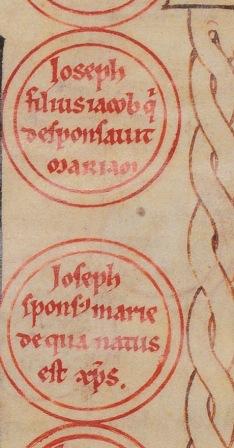
The greatest oddity of this text is that it contradicts the drawing alongside it. In the Burgos Bible, both genealogies clearly terminate at Joseph. In the image at right, the upper roundel (Joseph filius Iacob qui desponsavit Mariam) is the terminus of the Matthaean genealogy, and the lower roundel (Joseph sponsus Marie de qua natus est Christus) is the terminus of the Lucan genealogy. Yet the text retains the notion from the Great Stemma that the Lucan genealogy should end at Mary. This is an odd situation; I cannot at present see any coherent explanation for it.
Avatars of the Word
Traditional scholars tend to sniff at the idea of the uncredentialed researcher searching Latin texts without the full classical education that one supposedly needs to do this. James O'Donnell welcomes the electronic machinery in his 1998 book Avatars of the Word, but his approving description of the mind of Jerome of Stridon as the model of the perfect search machine implies to me that he was not fully ready or able to foresee the Latin database as an app for everyone:
But O'Donnell failed in 1998 to foresee a positive: the sheer mass of accessible material that the internet would throw up and the radically democratic level of access to it. He also failed to foresee a negative: the growing difficulty, once the blogosphere had established itself, of assembling an audience.
Jerome once ran across a Greek word in a text, and wrote to a friend that he remember seeing that word only twice elsewhere, once in scripture, once in an apocryphal religious work. As it happens, he was correct: the three passages he knew are the only places (still) where we know that word to have been used in the written legacy of Greek literature. Hearing that story, I marvel at the powers of Jerome's memory, knowing that as a modern scholar with some similar interests in scripture and translation, I would never dare to say such a thing (p. 4).With the advantage of hindsight, I find O'Donnell's book stimulating, but somewhat off-beam, though in a contrarian kind of way. O'Donnell did not recoil from the digital database, but under-estimated its impact by arguing that the database which could compete with Jerome's memory is not really all that new, and that libraries in recent centuries have always been on the verge of doing the same thing:
If the essential feature of the idea of the virtual library is the combination of total inclusiveness and near-instantaneous access, then the fantasy is almost coterminous with the history of the book itself (p. 32).Now of course the database is far more than just a library, because it lowers the barriers to entry: it is accessible to those who have not learned the professional codes, to those who have not paid to participate. There is at least a tangential awareness of this in Avatars, O'Donnell has some engaging thoughts about the uncredentialed (the move to do more and more teaching not only with teaching assistants (the invisibly uncredentialled whom we take for granted but with impermanent, nontenured, non-tenure-trace faculty, p. 180) and the shy (Th[e] classroom is a potentially frightening place because much of our traditional pedagogy depends on the managed infliction of humiliation ... Here is where electronic media can help innovation ... The student who now is unable to perform adequately in the face of perceived threat of embarrassment in class is the one who can be given a place to rehearse out of sight of classmates and teacher ... p. 185-6).
But O'Donnell failed in 1998 to foresee a positive: the sheer mass of accessible material that the internet would throw up and the radically democratic level of access to it. He also failed to foresee a negative: the growing difficulty, once the blogosphere had established itself, of assembling an audience.
2011-10-31
Visions
I continue to search in vain for a scholarly exploration of data visualization in Antiquity. There is no doubt that Graeco-Roman graphics are getting far more attention these days than ever before, but so far that attention has been focussed on other areas.
1. Mathematical diagrams are getting close attention, as Reviel Netz notes in The Archimedes Codex:
3. Mental pictures of abstract matters are discussed in Mary Carruthers' books, particularly The Craft of Thought (1998), which explores the patristic and Roman Republican models of the medieval 'craft of memory' and thus casts some light on the place of visualizations in Late Antiquity:
So visualizing things was a good way to start explaining them. However Carruthers is concerned with inner pictures, so her books yield very little about the ways that a real diagram or map could be employed for meditation or how it might be designed.
4. Small's other book, Wax Tablets of the Mind: Cognitive Studies of Memory and Literacy in Classical Antiquity (1997), explores the ways in which text could be said to visualize what was going on in people's heads, but once again does not deal with data visualization. Anna Catharina Esmeijer's Divina Quaternitas: a preliminary study in the method and application of visual exegesis tackles some of the same issues, but is of course mainly concerned with rather simple figures, not the complex abstraction of the Great Stemma.
Now obviously I have missed from this list a great many other learned books and articles. Many are listed on the further reading page of my website. But nowhere have I found a book or an article that goes to the heart of the issue. How the Latin writer could present mere words and numbers so pregnantly on the page so that the mere arrangement gave food for thought.
1. Mathematical diagrams are getting close attention, as Reviel Netz notes in The Archimedes Codex:
The scholars who edited mathematical texts in the nineteenth century were so interested in the words that they ignored the images. If you open an edition from that era, the diagrams you find are not based upon what is actually drawn in the original manuscripts. The diagrams represent, instead, the editor's own drawing. I was shocked to realize that and began to consider: should I produce, for the first time, an edition of the diagrams? (p. 30).2. Illustrations of texts have been re-assessed in many new ways, with the works of Kurt Weitzmann a half-century ago, Late antique and early Christian book illumination and Illustrations in roll and codex marking a starting point. I recently browsed through John Williams' Imaging the early medieval Bible (1999), which revises some of Weitzmann's ideas, and of course there are the more recent books of Jocelyn Penny Small, The Parallel Worlds of Classical Art and Text (2003), and of Michael Squire, Image and Text in Graeco-Roman Antiquity (2011), which debate whether book illustration was ever meant to depict what was in the text at all. But all of these books deal with the interplay between stories and pictures of people doing things.
3. Mental pictures of abstract matters are discussed in Mary Carruthers' books, particularly The Craft of Thought (1998), which explores the patristic and Roman Republican models of the medieval 'craft of memory' and thus casts some light on the place of visualizations in Late Antiquity:
Whereas ekphrasis always purports to be a meditative description of a painting, sculpture or the facade of a building, the initiating compositional pictura can also describe a schematized landscape in the form of a world map, or a figure like Lady Philosophy, or just about any of the formae mentis in common monastic use: a ladder, a tree, rotae, a rose-diagram. The rhetorical figures called ekphrasis and Bildeinsatz, in other words, are types of the cognitive, dispositive topos called pictura, which is the more general term. The most general terms of all for this cognitive instrument would include words like ratio and schema. (p. 200)
So visualizing things was a good way to start explaining them. However Carruthers is concerned with inner pictures, so her books yield very little about the ways that a real diagram or map could be employed for meditation or how it might be designed.
4. Small's other book, Wax Tablets of the Mind: Cognitive Studies of Memory and Literacy in Classical Antiquity (1997), explores the ways in which text could be said to visualize what was going on in people's heads, but once again does not deal with data visualization. Anna Catharina Esmeijer's Divina Quaternitas: a preliminary study in the method and application of visual exegesis tackles some of the same issues, but is of course mainly concerned with rather simple figures, not the complex abstraction of the Great Stemma.
Now obviously I have missed from this list a great many other learned books and articles. Many are listed on the further reading page of my website. But nowhere have I found a book or an article that goes to the heart of the issue. How the Latin writer could present mere words and numbers so pregnantly on the page so that the mere arrangement gave food for thought.
Karlsruhe MS
Another Cassiodorus manuscript briefly went online in May at http://www.stgallplan.org/ and now seems to have vanished again. The Karlsruhe codex is one of a group that has not represented all the stemmata correctly as Cassiodorus drew them, but has converted the simpler ones to lists. However the parts of rhetoric, for example, are correctly depicted in much the same fashion as in the Bamberg manuscript.
2011-10-07
New Issue by e-Codices
E-Codices in Switzerland this week put Cod. Sang. 133 online, and I have accordingly added hyperlinks to my edition of the Liber Genealogus of 427 on www.piggin.net so that readers can read both side by side on a computer screen. This is the codex I blogged about earlier this year. Lowe's description of the script is also provided on the e-Codices website.
As always, it is interesting to "thumb" through the other material in a volume like this. This little codex is a jewel, and I quote the manuscript summary:
As always, it is interesting to "thumb" through the other material in a volume like this. This little codex is a jewel, and I quote the manuscript summary:
This manuscript, still in its original Carolingian binding, consists of three parts and was written in Merovingian script by numerous hands, apparently in the late 8th and/or early 9th century, probably at the Abbey of St. Gall. It contains reliable versions of many onomastic texts, including copies of the work Liber de situ et nominibus locorum Hebraicorum by Jerome, the Cosmographia of Aethicus Ister, the chronicles of Isidore of Seville, Chronica maiora and Historia regum Gothorum, Vandalorum Sueborum, as well as an excellent version of the Itinerarium Antonini Placentini, an account of the pilgrimage of a citizen of Piacenza in about 560/570 to the Holy Land.The latest rush of e-codices material, placed online Tuesday, appears to comprise 65 more volumes, and includes wonderfully illuminated bibles and some magnificent compilations. A compendium of histories, Cod. Sang. 547, penned in about 1200, caught my eye. Its summary says:
This rather hefty tome (weighing nearly 17 kilograms) compiled around 1200 contains copies in Latin of major works of world-, church- and ethnic history; examples include the History of the World by Orosius, the ecclesiastical history of Eusebius of Caesarea, the Summa of Biblical history (Historica Scholastica) of the early Parisian scholastic Peter Comestor († ca. 1179), the history of the first crusade by Robert of Reims, the history of the Langobards by Paulus Diaconus, the History of the English Church and People by the Venerable Bede, and Einhard’s Life of Charlemagne.One cannot praise the work of e-codices (and the generosity of its benefactors) too highly. Christoph Flüeler, who leads the project, deserves high honour for this. I was shocked to hear that Switzerland not only has no system of honours to reward civic excellence, but also makes it an offence for its citizens to accept honours from other nations. I hope that Professor Flüeler can be assured in some other way of the high esteem in which we hold his work.
2011-09-26
For Medievalists
Dr Nathaniel Taylor has published a very acute news summary on the RootsWeb Gen-Medieval news list of what is new in Great Stemma research as a result of the Oxford Patristics presentation. He offers this succinct summary:
Jean-Baptiste Piggin has now convincingly shown the whole to derive from a single long scroll of Late-Antique origin, likely 4th century, which he has named the 'great stemma'. All existing copies come through a (lost) early Visigothic intermediary in which the scroll was copied into a series of folio pages in codex form, but the process of reducing the scroll format to sequential pages introduced various errors and subsequent recensions degraded the logic of the original in ways Piggin has been able to trace.Nat also wrote up my website's findings last year on the same list:
These biblical genealogical stemmata are now the subject of a fantastic set of analytical webpages by Jean-Baptiste Piggin. His page cited below is a table with links to many online images of the tables of biblical kinship found in the Beatus manuscripts and 10th-century Spanish bibles, as well as the Codice de Roda ...
2011-09-25
Detective Story
Does the Liber Genealogus contain work by Lactantius? A detective story is developing around this unexpected proposition. I have only just discovered that the Liber Genealogus etymologies were comprehensively studied by the German philologist and Old Testament scholar Franz Wutz in his 1914-1915 book Onomastica Sacra. Unfortunately he did not notice during his years of study that the source he was using was in fact identical with the Liber Genealogus as published by Theodor Mommsen. This is a grand example of two great ships passing one another unseen in the night which has not, as far as I know, been brought to wide attention. Without Mommsen, Wutz's broad conclusions are weakened, although his fine detail bears continued reading.
Wutz (1882-1938) (short biography) was extending the work done two generations earlier by Paul de Lagarde (1827-1891) who had published a compilation of materials on biblical onomastics with a limited critical apparatus but without commentary, also entitled Onomastica Sacra, the first edition in 1870 and the second in 1887. Lagarde had presented a paper in 1890 with complete transcriptions of the Lucca (L) and Turin (T) recensions of the Liber Genealogus, and would doubtless have used these to proceed to a third edition of his Onomastica handbook, had it not been for his early death.
It was thus left to Carl Frick (1848-?)to begin a more thorough investigation of these documents. He published an edition of T in 1892 as part of his Chronica minora, with each biblical name carefully linked to certain Greek etymologies which Lagarde had published in his Onomastica compilation. Wutz thus had coherent texts available to him in printed form and could proceed to their analysis.
Wutz arrived at a most curious conclusion. He refers throughout his book to the set of etymologies in T and L as the "Laktanzgruppe", literally, the "Lactantius Group". He also included in the Laktanzgruppe those parts of Lagarde's Greek which Frick had painstakingly linked, word by word, to T. Wutz concluded that some lost Greek work had somehow been included in a manuscript of mixed notes and was able to distinguish two coherent fragments of it (reproduced below, denominated V3 and V4). His designation of T, L, V3 and V4 as the Laktanzgruppe implies he had solved a great mystery, but as it turns out, this nomenclature may have been simply a little joke by Wutz.
Wutz appears to have realized only at the last moment that Mommsen had published a wider-ranging collation of the Latin witnesses, binding T and L to the other recensions of the Liber Genealogus, in his MGH series (note 1, page xviii: Mommsen's Ausgabe des Lib. genealogus ... ist mir leider entgangen.) Had Wutz known of the St Gall (G) and Florence (F) recensions while he was conducting his research, he would probably not have attached the name "Lactantius" to the work and might well have reached different conclusions.
He was approaching the topic from a very different perspective to our own, and it is interesting to consider the basis on which he was thinking. As far as I have been able to understand his argumentation, Wutz suspected T was a Latin translation by Lactantius from a Greek work by a now unknown author and that Lactantius had attached it as an appendix to his Epitome. T appears just after the Epitome in the sole manuscript to have transmitted that ancient work more or less entire. This 6th- or 7th-century codex is at Turin: Archivio di Stato IB. 11.27 (formerly IB. VI.28), CLA IV. 438. Charles McNelis, who examined it in 1999, provides the following useful listing of its contents:
Since the T text of the Liber Genealogus ends with the life of Christ, there is no easy way to date it. I have only recently shown that it is in fact a descendant from the Liber Genealogus of 427.
Wutz devoted considerable effort to backing up his Lactantius hypothesis, and here I summarize from his German, with page numbers in parentheses:
The Lactanzgruppe (hereafter LGr) of Greek and Latin texts is "completely new" and "completely independent of the Origen Group" (56). The names are presented in genealogical order, not the order of the biblical texts (57). The author's purpose was to present a 'stemma' of Christ and he thus limited his supplementary material to the tribes of Israel only (57). This shows the list is of purely Christian origin, and not Jewish (58). The Origen Group and LGr were created completely independently of one another. If the LGr were really the work of Lactantius, we would be well on the way to understanding how this onomastic work came to be written: Lactantius died in about 330, whereas Jerome did not translate the Philo/Origen list until 390, meaning the LGr would have existed in Latin translation 70 to 90 years earlier, only decades after Origen had completed his work (62). Supposing the Greek text is the prior one, it must therefore date from well before [the year 330] (63). Even though the Latin text is more comprehensive than the Greek fragments at many points, for example in the Exodus material, it too must derive from a Greek vorlage. The order of the Latin text we know must be that which originally prevailed in the lost Greek text, and this proves that the existing Greek fragments are not the vorlage (76). The actions of Jerome, who undoubtedly is the translator of the Origen Group, and had plainly intended to translate everything of this nature that he could lay hands on, indicate that either the LGr did not exist in Jerome's day or that it was unknown to him. The former is unlikely, since the Greek forms of certain names indicate a very early date. So the tradition that Lactantius translated this Greek Onomastica has historical plausibility behind it and should not be rejected without significant reason. Therefore Jerome did not know of the LGr. This is particularly remarkable insofar as other Origen Group lists do consult the LGr (77). Wutz's conclusion bears translating in full:
Let us now turn to the Greek texts of the Laktanzgruppe. Wutz performed a major service by re-edited these. They had earlier been printed by Lagarde and had originally been published by Jean Martianay (1647-1717) and later Dominic Vallarsi (1702-1771). Lagarde had applied the somewhat misleading heading "Onomastica Vaticana" to the pages where the two fragments are printed, although neither of them is in the Apostolic library at the Vatican. Roger Gryson in 1966 proposed fixed sigla, and possibly relying on Opelt 828 and Wutz 238, suggested that a fourth onomastic group be distinguished:
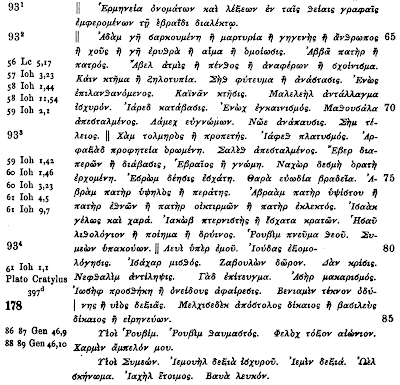
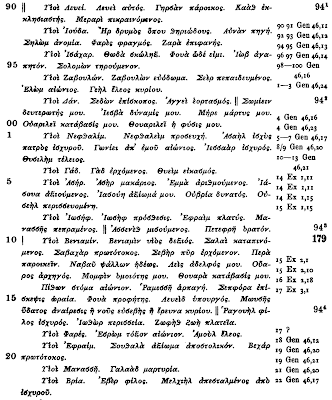

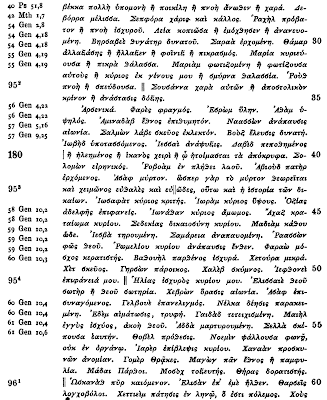
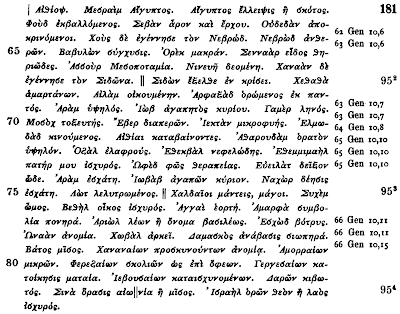
Wutz edited V3 and V4 with a more advanced apparatus than Lagarde had provided and published this at 685-703 of his book. Here is a summary of the names in English, with Lagarde's line numbers in bold, and Wutz's line numbers in italics. Some of the names I could not understand, but I have nevertheless transcribed them:
63 1 65 [Filum of Christ according to Matthew:] Adam 67 Abel 68 Cain Seth Enosh 69 9 Kenan Mahalalel 70 Jared Enoch Methuselah 71 Lamech Noe Shem 72 Ham Japheth [from Shem:] Arpachshad 73 Shelah Eber 74 Nahor 75 Esrom Thara Abram 76 Abraham 77 Isaac 78 Jacob [filum stops here] Esau 79 21 Reuben Simeon 80 Levi Judah 81 Issachar Zebulon Dan 82 Nephtali Gad Aser 83 Joseph Benjamin 84 Melchisedech 86 [Jacob's family from Gen 46:8-25:] Reuben Pallu 87 Carmi 88 31 Simeon Jemuel Jamin Ohad 89 Iachin Zohar 90 Levi Gershon Kohath 91 Merari 92 Judah Er Onan 93 Shelah Perez Zerah 94 Issachar Tola Puvah Iob? 95 Solomon? 96 Zebulun Sered 97 Elom Jahleel 98 Dan [see Wutz 66; sons of Gad:] Ziphion Haggi Shuni 99 48 Ezbon Eri 100 Areli 1 [sons of Dan:] Naphtali Jahzeel 2 Guni Jezer 3 Shillem 4 Gad 5 Asher Imnah Ishvah 6 Ishvi Beria 8 Joseph Ephraim Manasseh 9 Asenath Potiphera 10 Benjamin 11 62 Becher Ashbel Gera 12 Naaman Ehi Rosh 13 Muppim Huppim 14 [From Exodus:] Pithom Rameses Shiphrah 15 Moses 16 Reuel 17 Jethro 18 Perez Hezron Hamul 19 [Additional LXX Josephites:] Ephraim Southalaam Taam 21 Manasseh Galaad 22 Beriah Eber Melchiel 24 Ermeneia (2) 25 78 [Biblical women:] Eve Sarah 26 Agar Rebecca 27 Deborah 28 Zipporah Rachel 29 Aeia? 30 Bersabee Saraa? Tamar 31 Maria 32 Miriam 33 Ruth 34 Serah 36 [Filum of Christ according to Matthew resumed] Perez Hezron Ram 37 Amminadab Nahshon 38 Salmon* Boaz* 39 93 Jesse* David 40 Solomon 41 Rehoboam* Abijam* 42 Asa* 44 Jehoshaphat Jehoram Uzziah* 45 Jotham* Ahaz 46 100 [omissions!] Zedekiah [1st insert:] Madiam 47 Iesba (Jezebel?) Samareia Raasson 48 Romelion Pharaoh 49 Bathouel Chettoura 50 Chet Gerson [Num. 13:6:] Caleb Jephunneh 51 Elias Elissaie 52 Chebron Asaph 53 Gelbone Nelcha 54 110 Edem Gaidad Maiel 55 Adda Sella 56 Thobel Neomin 57 Iarer Chanaan 58 [Races of Japheth:] Gomer Magog 59 Medes Meshech Tiras 60 [of Gomer:] Ashkenaz [of Javan:] Elishah Tarshish 61 Kittim [Races of Ham:] Cush 62 Misraim 63 Put Seba Dedan 64 Nimrod 65 [Place-names:] Babel Erech Shinar 66 Ashur Nineveh Canaan Sidon Chethatha 68 127 [Races of Shem:] Elam Arpachshad 69 Aram Job Gamer 70 Mosoch Eber Joktan Almodad 72 Uzal Obal Abima-el 73 Ored Havilah 74 Aram? Jobab [mixed list:] Nachor 75 Aot Chaldaeans Suchem 76 Bethel Haggai (prophet?) Amarphal (Gen 14:1?) 77 Ariol Heschod 78 Onam 79 [Sinai (corr. Wutz 80-81)] batos* [peoples of Canaan:] Canaan Amorites 80 Girgashites Jebusites [2nd insert:] Daron (=Aaron) 82 143 Sinai? Israel.
The asterisks mark material that Wutz also found in the hypothetical "Lexikon" used by Ambrose of Milan. It is noticeable that the overall order of the names has some similarities to that in the Liber Genealogus, although considerable amounts of material (particularly Fila B and Fila D) are omitted.
Now the plot thickens. The Liber Genealogus has been written about by a series of scholars in the past hundred years, most notably by Paul Monceaux, Hervé Inglebert and Charles McNelis. Frick's exploration of the etymologies was known to them, but as far as I know, none mentions the very important analytical contribution a generation later by Wutz, an oversight which is understandable, since Wutz did not use the current title for the work. As a result, a century of research has proceeded along two tracks. This blog post is, as far as I know, the first time the two tracks have again met.
So the question is, did Lactantius write a glossary of biblical names that was expanded, 100 years after his death, into the Liber Genealogus of 427? Attractive as the idea is, it relies on only the weakest of supports: Wutz's modern "tradition" that associates Lactantius with the text because it is in the Turin manuscript. There does not seem to be any other evidence for such a link. But we do not have any idea who the true author of the etymologies is. One suspects that Wutz, having spent years looking at fanciful names and etymologies, smiled to himself one morning and made up a fanciful name of his own to leave to posterity. I believe that we should continue to use the term Laktanzgruppe, since it has the weight of a century of (somewhat obscure) tradition, while recognizing that it is a misnomer and misleading.
Wutz argues that the Greek text on which V3 and V4 are based is older than the Latin text of 427, and moreover that there is an Armenian branch of the Laktanzgruppe (document cited in a note by Erwin Preuschen (Wutz, 84), further study apparently conducted in 1981 by Michael E. Stone). If this is so, we are obliged to consider how the Laktanzgruppe of etymologies might have diffused. We can conceive of two paths by which it could have reached Donatist North Africa:
Wutz (1882-1938) (short biography) was extending the work done two generations earlier by Paul de Lagarde (1827-1891) who had published a compilation of materials on biblical onomastics with a limited critical apparatus but without commentary, also entitled Onomastica Sacra, the first edition in 1870 and the second in 1887. Lagarde had presented a paper in 1890 with complete transcriptions of the Lucca (L) and Turin (T) recensions of the Liber Genealogus, and would doubtless have used these to proceed to a third edition of his Onomastica handbook, had it not been for his early death.
It was thus left to Carl Frick (1848-?)to begin a more thorough investigation of these documents. He published an edition of T in 1892 as part of his Chronica minora, with each biblical name carefully linked to certain Greek etymologies which Lagarde had published in his Onomastica compilation. Wutz thus had coherent texts available to him in printed form and could proceed to their analysis.
Wutz arrived at a most curious conclusion. He refers throughout his book to the set of etymologies in T and L as the "Laktanzgruppe", literally, the "Lactantius Group". He also included in the Laktanzgruppe those parts of Lagarde's Greek which Frick had painstakingly linked, word by word, to T. Wutz concluded that some lost Greek work had somehow been included in a manuscript of mixed notes and was able to distinguish two coherent fragments of it (reproduced below, denominated V3 and V4). His designation of T, L, V3 and V4 as the Laktanzgruppe implies he had solved a great mystery, but as it turns out, this nomenclature may have been simply a little joke by Wutz.
Wutz appears to have realized only at the last moment that Mommsen had published a wider-ranging collation of the Latin witnesses, binding T and L to the other recensions of the Liber Genealogus, in his MGH series (note 1, page xviii: Mommsen's Ausgabe des Lib. genealogus ... ist mir leider entgangen.) Had Wutz known of the St Gall (G) and Florence (F) recensions while he was conducting his research, he would probably not have attached the name "Lactantius" to the work and might well have reached different conclusions.
He was approaching the topic from a very different perspective to our own, and it is interesting to consider the basis on which he was thinking. As far as I have been able to understand his argumentation, Wutz suspected T was a Latin translation by Lactantius from a Greek work by a now unknown author and that Lactantius had attached it as an appendix to his Epitome. T appears just after the Epitome in the sole manuscript to have transmitted that ancient work more or less entire. This 6th- or 7th-century codex is at Turin: Archivio di Stato IB. 11.27 (formerly IB. VI.28), CLA IV. 438. Charles McNelis, who examined it in 1999, provides the following useful listing of its contents:
- f. 2-42v, Lactantius, De opificio dei (CPL 87);
- f. 42v-61, Lactantius, Epitome divinarum institutionum (CPL 86);
- f. 61-62, extracts from the Latin translation of Hegemonius, Acta Archelai (CPG 3570);
- f. 62-71, Liber genealogus (Incipit origo generis humani and Explicit de generationibus);
- f. 71v-81, Quintus Julius Hilarianus, De ratione paschae et mentis (CPL 2279);
- f. 81 v-122v, Origenes, Omelie iv de Exodo. i. De cantico; ii. De amaritudine aquae Merhae; iii. De Decalogo; iv. De tabernaculo (CPG 1413);
- f. 122v, Augustinus, Sermo ad Caesareensis ecclesiae plebem Emerito presente habitus (CPL 284, ser. 339).
Since the T text of the Liber Genealogus ends with the life of Christ, there is no easy way to date it. I have only recently shown that it is in fact a descendant from the Liber Genealogus of 427.
Wutz devoted considerable effort to backing up his Lactantius hypothesis, and here I summarize from his German, with page numbers in parentheses:
The Lactanzgruppe (hereafter LGr) of Greek and Latin texts is "completely new" and "completely independent of the Origen Group" (56). The names are presented in genealogical order, not the order of the biblical texts (57). The author's purpose was to present a 'stemma' of Christ and he thus limited his supplementary material to the tribes of Israel only (57). This shows the list is of purely Christian origin, and not Jewish (58). The Origen Group and LGr were created completely independently of one another. If the LGr were really the work of Lactantius, we would be well on the way to understanding how this onomastic work came to be written: Lactantius died in about 330, whereas Jerome did not translate the Philo/Origen list until 390, meaning the LGr would have existed in Latin translation 70 to 90 years earlier, only decades after Origen had completed his work (62). Supposing the Greek text is the prior one, it must therefore date from well before [the year 330] (63). Even though the Latin text is more comprehensive than the Greek fragments at many points, for example in the Exodus material, it too must derive from a Greek vorlage. The order of the Latin text we know must be that which originally prevailed in the lost Greek text, and this proves that the existing Greek fragments are not the vorlage (76). The actions of Jerome, who undoubtedly is the translator of the Origen Group, and had plainly intended to translate everything of this nature that he could lay hands on, indicate that either the LGr did not exist in Jerome's day or that it was unknown to him. The former is unlikely, since the Greek forms of certain names indicate a very early date. So the tradition that Lactantius translated this Greek Onomastica has historical plausibility behind it and should not be rejected without significant reason. Therefore Jerome did not know of the LGr. This is particularly remarkable insofar as other Origen Group lists do consult the LGr (77). Wutz's conclusion bears translating in full:
This thorough examination of the LGr has yielded some remarkable conclusions: A completely independent study of biblical names was composed in Greek by a Christian. If as tradition holds, a translation [into Latin] was performed on African soil at a very early point, six to eight decades before Jerome, then the Greek work must be dated much earlier to a point before the Origen Group. This does not necessarily mean its author worked in Africa. All that we can say is that he had a very good knowledge of Syrian, most probably the Christian Palestinian [dialect]. We have found no evidence to cast doubt on tradition. Up to the time of Jerome, this Onomastica remained almost hermetically sealed off from the numerous Origen Group explanations in circulation, but thereafter it influenced one fork of the Origen Group (96).Once this false idea of Lactantius's role in the work had been placed in the world, it naturally put down roots. Ilona Opelt in her 1965 encyclopaedia article Etymologie appears to misunderstand Wutz's citation of T and L and compounds the error, describing these Latin codices as "zwei Hss. des Laktanz aus dem 6. und 7. Jh." I cannot see any material from Lactantius listed in the descriptions of codex L by Mommsen and Lagarde.
Let us now turn to the Greek texts of the Laktanzgruppe. Wutz performed a major service by re-edited these. They had earlier been printed by Lagarde and had originally been published by Jean Martianay (1647-1717) and later Dominic Vallarsi (1702-1771). Lagarde had applied the somewhat misleading heading "Onomastica Vaticana" to the pages where the two fragments are printed, although neither of them is in the Apostolic library at the Vatican. Roger Gryson in 1966 proposed fixed sigla, and possibly relying on Opelt 828 and Wutz 238, suggested that a fourth onomastic group be distinguished:
- L (Laktanzgruppe)
- O (Philo-Origen)
- V (Onomastica Vaticana)
- C (Glossae Colbertinae)
- Lag. 177,63 -- 179,23 (Martianay: fragmentum tertium) == V3
- Lag. 179,24 -- 181,83 (Martianay: fragmentum quartum) == V4
Fragmentum tertium (V3)
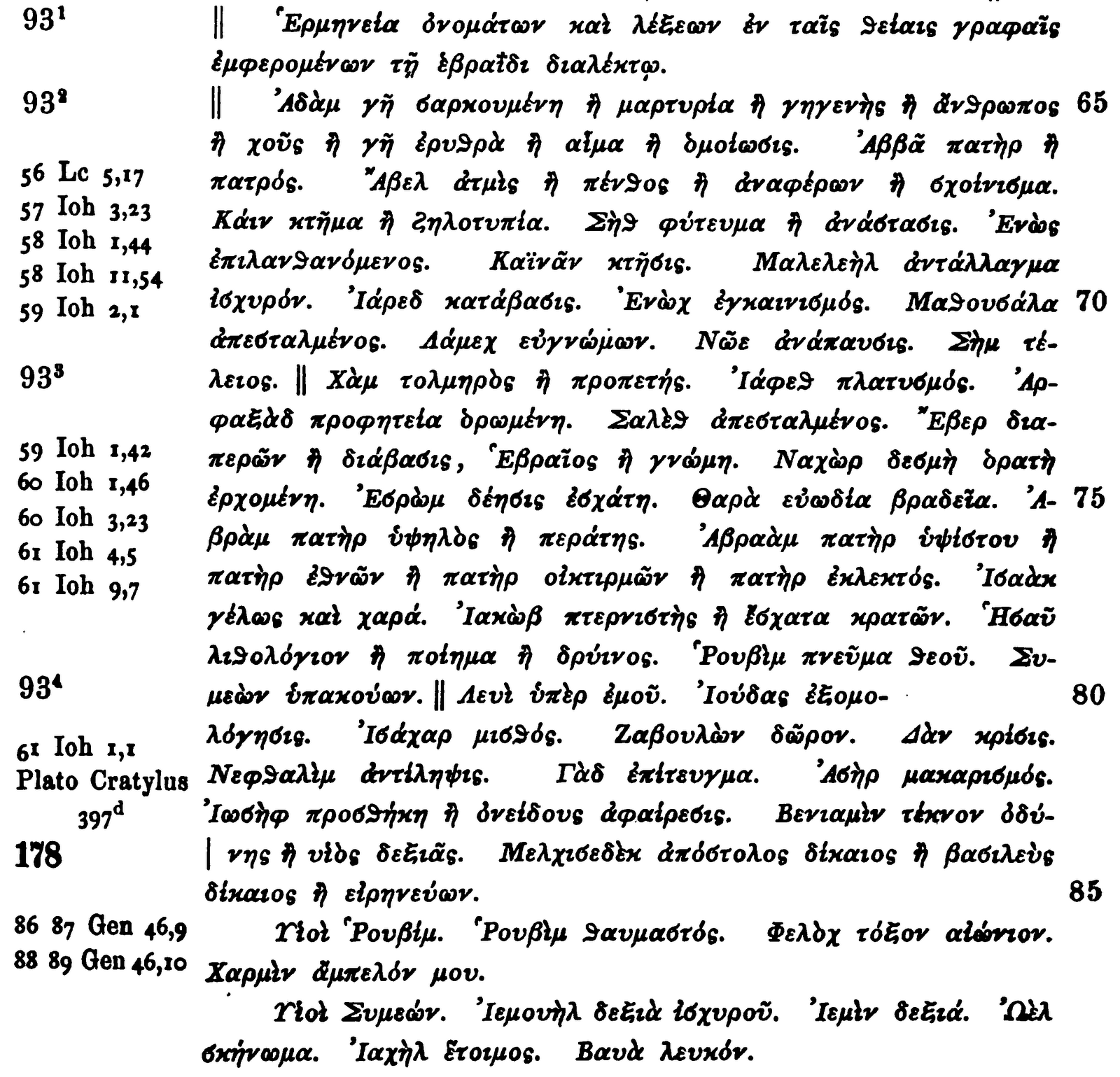
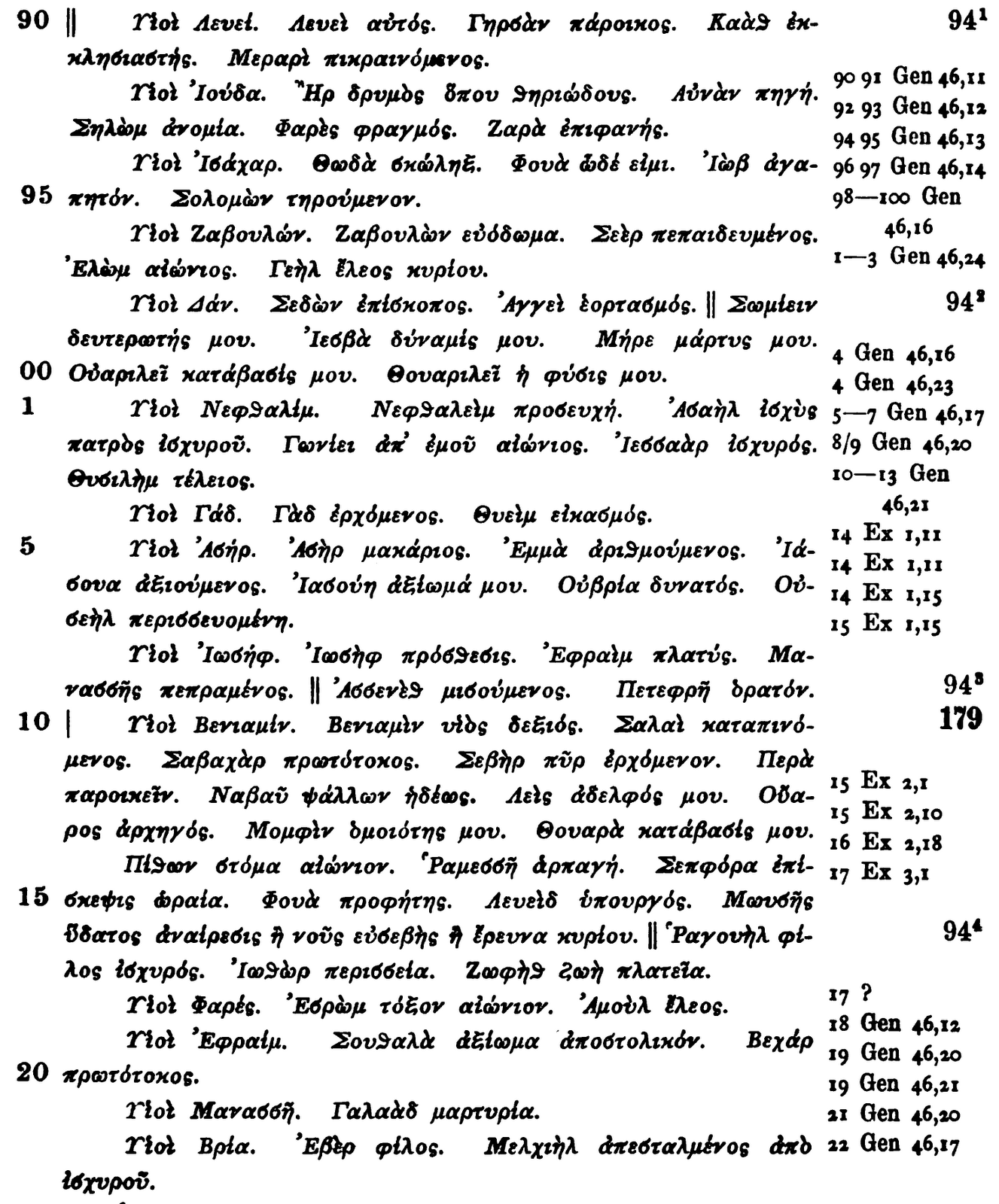
Fragmentum quartum (V4)

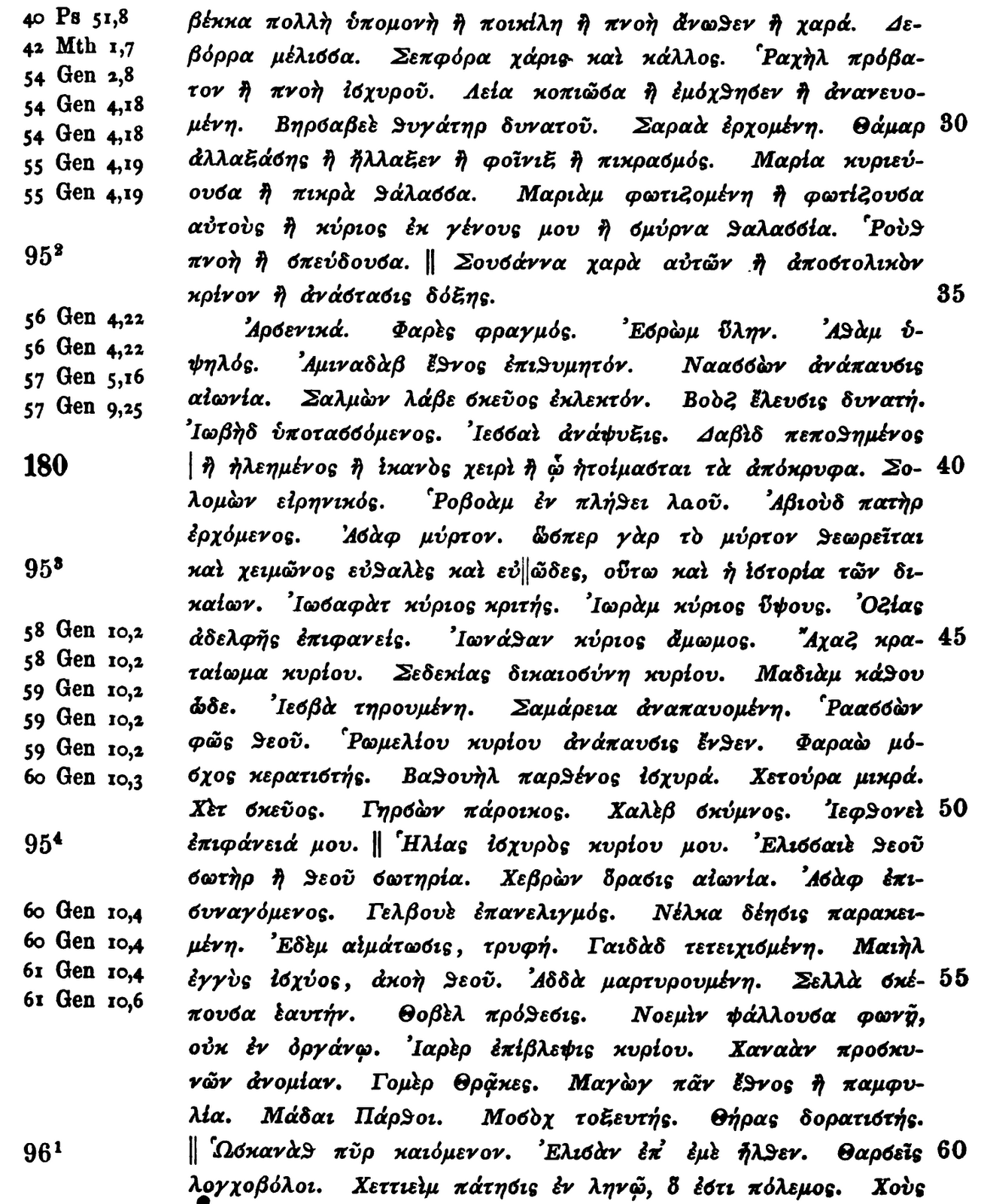
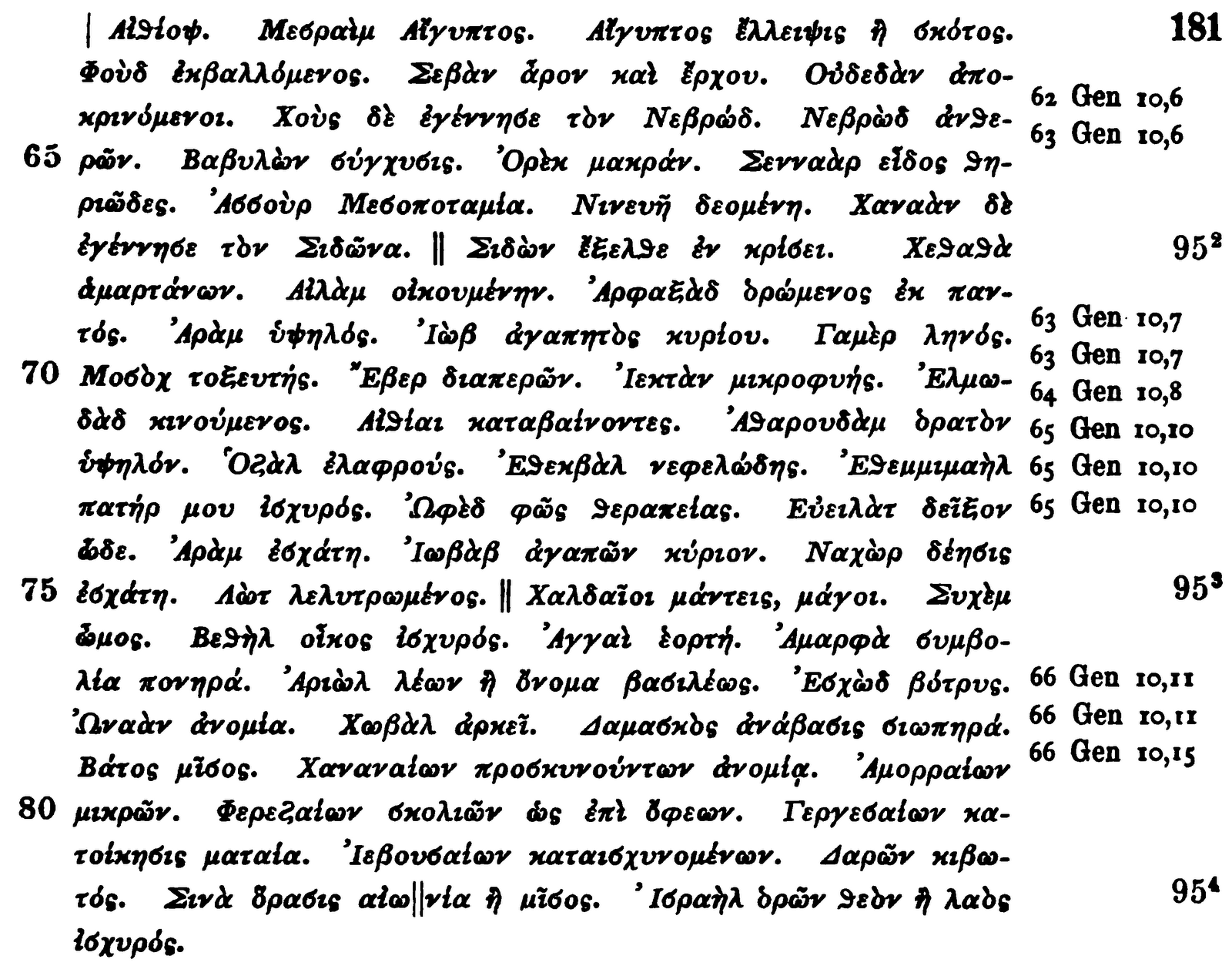
Wutz edited V3 and V4 with a more advanced apparatus than Lagarde had provided and published this at 685-703 of his book. Here is a summary of the names in English, with Lagarde's line numbers in bold, and Wutz's line numbers in italics. Some of the names I could not understand, but I have nevertheless transcribed them:
63 1 65 [Filum of Christ according to Matthew:] Adam 67 Abel 68 Cain Seth Enosh 69 9 Kenan Mahalalel 70 Jared Enoch Methuselah 71 Lamech Noe Shem 72 Ham Japheth [from Shem:] Arpachshad 73 Shelah Eber 74 Nahor 75 Esrom Thara Abram 76 Abraham 77 Isaac 78 Jacob [filum stops here] Esau 79 21 Reuben Simeon 80 Levi Judah 81 Issachar Zebulon Dan 82 Nephtali Gad Aser 83 Joseph Benjamin 84 Melchisedech 86 [Jacob's family from Gen 46:8-25:] Reuben Pallu 87 Carmi 88 31 Simeon Jemuel Jamin Ohad 89 Iachin Zohar 90 Levi Gershon Kohath 91 Merari 92 Judah Er Onan 93 Shelah Perez Zerah 94 Issachar Tola Puvah Iob? 95 Solomon? 96 Zebulun Sered 97 Elom Jahleel 98 Dan [see Wutz 66; sons of Gad:] Ziphion Haggi Shuni 99 48 Ezbon Eri 100 Areli 1 [sons of Dan:] Naphtali Jahzeel 2 Guni Jezer 3 Shillem 4 Gad 5 Asher Imnah Ishvah 6 Ishvi Beria 8 Joseph Ephraim Manasseh 9 Asenath Potiphera 10 Benjamin 11 62 Becher Ashbel Gera 12 Naaman Ehi Rosh 13 Muppim Huppim 14 [From Exodus:] Pithom Rameses Shiphrah 15 Moses 16 Reuel 17 Jethro 18 Perez Hezron Hamul 19 [Additional LXX Josephites:] Ephraim Southalaam Taam 21 Manasseh Galaad 22 Beriah Eber Melchiel 24 Ermeneia (2) 25 78 [Biblical women:] Eve Sarah 26 Agar Rebecca 27 Deborah 28 Zipporah Rachel 29 Aeia? 30 Bersabee Saraa? Tamar 31 Maria 32 Miriam 33 Ruth 34 Serah 36 [Filum of Christ according to Matthew resumed] Perez Hezron Ram 37 Amminadab Nahshon 38 Salmon* Boaz* 39 93 Jesse* David 40 Solomon 41 Rehoboam* Abijam* 42 Asa* 44 Jehoshaphat Jehoram Uzziah* 45 Jotham* Ahaz 46 100 [omissions!] Zedekiah [1st insert:] Madiam 47 Iesba (Jezebel?) Samareia Raasson 48 Romelion Pharaoh 49 Bathouel Chettoura 50 Chet Gerson [Num. 13:6:] Caleb Jephunneh 51 Elias Elissaie 52 Chebron Asaph 53 Gelbone Nelcha 54 110 Edem Gaidad Maiel 55 Adda Sella 56 Thobel Neomin 57 Iarer Chanaan 58 [Races of Japheth:] Gomer Magog 59 Medes Meshech Tiras 60 [of Gomer:] Ashkenaz [of Javan:] Elishah Tarshish 61 Kittim [Races of Ham:] Cush 62 Misraim 63 Put Seba Dedan 64 Nimrod 65 [Place-names:] Babel Erech Shinar 66 Ashur Nineveh Canaan Sidon Chethatha 68 127 [Races of Shem:] Elam Arpachshad 69 Aram Job Gamer 70 Mosoch Eber Joktan Almodad 72 Uzal Obal Abima-el 73 Ored Havilah 74 Aram? Jobab [mixed list:] Nachor 75 Aot Chaldaeans Suchem 76 Bethel Haggai (prophet?) Amarphal (Gen 14:1?) 77 Ariol Heschod 78 Onam 79 [Sinai (corr. Wutz 80-81)] batos* [peoples of Canaan:] Canaan Amorites 80 Girgashites Jebusites [2nd insert:] Daron (=Aaron) 82 143 Sinai? Israel.
The asterisks mark material that Wutz also found in the hypothetical "Lexikon" used by Ambrose of Milan. It is noticeable that the overall order of the names has some similarities to that in the Liber Genealogus, although considerable amounts of material (particularly Fila B and Fila D) are omitted.
Now the plot thickens. The Liber Genealogus has been written about by a series of scholars in the past hundred years, most notably by Paul Monceaux, Hervé Inglebert and Charles McNelis. Frick's exploration of the etymologies was known to them, but as far as I know, none mentions the very important analytical contribution a generation later by Wutz, an oversight which is understandable, since Wutz did not use the current title for the work. As a result, a century of research has proceeded along two tracks. This blog post is, as far as I know, the first time the two tracks have again met.
So the question is, did Lactantius write a glossary of biblical names that was expanded, 100 years after his death, into the Liber Genealogus of 427? Attractive as the idea is, it relies on only the weakest of supports: Wutz's modern "tradition" that associates Lactantius with the text because it is in the Turin manuscript. There does not seem to be any other evidence for such a link. But we do not have any idea who the true author of the etymologies is. One suspects that Wutz, having spent years looking at fanciful names and etymologies, smiled to himself one morning and made up a fanciful name of his own to leave to posterity. I believe that we should continue to use the term Laktanzgruppe, since it has the weight of a century of (somewhat obscure) tradition, while recognizing that it is a misnomer and misleading.
Wutz argues that the Greek text on which V3 and V4 are based is older than the Latin text of 427, and moreover that there is an Armenian branch of the Laktanzgruppe (document cited in a note by Erwin Preuschen (Wutz, 84), further study apparently conducted in 1981 by Michael E. Stone). If this is so, we are obliged to consider how the Laktanzgruppe of etymologies might have diffused. We can conceive of two paths by which it could have reached Donatist North Africa:
- A Latin translation, now lost, could have been prepared in the 4th century, and could have lain side by side on the table with the Great Stemma while the Liber Genealogus was being written.
- The manuscript may have remained in Greek, untranslated, until a Donatist scholar conceived the bold idea of translating it while using a familiar document, the Great Stemma, as a giver of structure.
References
- Gryson, Roger. "L'interprétation du nom de Lévi (Lévite) chez saint Ambroise." Sacris Erudiri 17, 2 (1966), 217-229.
- Krusch, Bruno. Studien zur christlichen-mittelalterlichen Chronik, Leipzig, 1880.
- Lagarde, Paul de. Onomastica Sacra: Pauli De Lagarde Studio Et Sumptibus Alterum Edita. Göttingen, 1887.
- Monceaux, Paul. Littérature donatiste au temps de Saint Augustin. Vol. 6. 7 vols. Histoire littéraire de l'Afrique chrétienne depuis les origines jusqu'à l'invasion arabe. Paris, 1922.
- Opelt, Ilona. "Etymologie". Reallexikon für Antike und Christentum (RAC), 6, col. 829. 1965.
- Rouse, Richard, and Charles McNelis. “North African literary activity: A Cyprian fragment, the stichometric lists and a Donatist compendium.” Revue d'histoire des textes 30 (2000): 189-238.
- Wutz, Franz. Onomastica sacra: Untersuchungen zum Liber interpretationis nominum hebraicorum des hl. Hieronymus (2 vols). Leipzig, 1914-15. Archive.org: PDF complete.
Subscribe to:
Posts
(
Atom
)