2017-10-24

Breaching the 15,000 barrier

Today, the tally of online manuscripts at the Vatican Library ticked past 15,000. It's a moment to savor, like the DAX stock index surpassing 13,000 this month, but with a difference. Investments can go down as well as up. Virtual libraries only go up.

How did we get here?

In early 2014, the years of dismal efforts at the Vatican to create an online manuscripts portal had nothing much to show. The DigiVatLib site at that time was a hand me down. It indexed a few hundred manuscripts which had in fact been scanned for Germany's Bibliotheca Palatina Project, mainly funded by the Manfred Lautenschläger Stiftung, and copied to Rome for free.

The site only offered 24 items from the Vatican Library's other collections. Bear in mind that this was the world's biggest manuscript library, with more than 82,000 handwritten books in the vaults.

On March 20, 2014, a news conference announced a new contractor for digitization, NTT Data, a Japanese software company. It was an historic decision, because this professionalized a project that had been dogged by incompetence, and made it more attractive to wealthy donors who expected to see results for their money. NTT Data Italia did even more. It put up seed money, tossing in a whopping 18 million euros of its own, nominally to digitize 3,000 named manuscripts up to 2019.

Experts could thus be hired and servers bought. The fact that the tally of digitizations on the site's front page is now 15,000 presumably means that other funding has been added to the mix, although the Vatican Library does not publish income data. We do know that the Polonsky Project came in with about 1 million euros to digitize Hebrew and Greek manuscripts at the Vatican, work that ended last month. Mellon pitched in 563,000 dollars this year, but for metadata, not digitization.

The pace has kept accelerating. In May 2015, the manuscripts portal managed to surpass 2,000 items, and on November 3, 2015, it breached the 3,000 barrier, making it the biggest digitization program in Italy, overtaking the Biblioteca Medicea Laurenziana in Florence. During 2016, the portal doubled in size.

In January of this year, the program ballooned from 6,000 to 10,338 items overnight by an expedient. Much of the manuscript collection is backed up by old-fashioned black-and-white microfilm and some of these films had been scanned at client request, so these digital scans were placed online. These low-resolution images are a stopgap while high-resolution color scans of the same codices are being carried out.

The fact that we are now at the 15,000 mark indicates the project is not only in the finest of health, but also scores as probably the biggest manuscript portal in the world, though firm comparative data is hard to come by.

A search of the French national site Gallica for "manuscripts" with dates before 1600 produces 20,475 hits, but a significant number of these are single-page items. In Spain, the Biblioteca Digital Hispánica shows 15,971 manuscripts online, but the number sinks to 10,716 if you filter out post-1600 dates. Munich's Digitale Sammlungen shows about 5,300 digitized manuscripts earlier than 1600, whereas Manuscripta Mediaevalia, a portal which consolidates many of the German and Swiss repositories (including Munich, but not other centers), shows 13,340 digitized "manuscripts" online, but only 5,954 dating before 1600. Italy's Internet Culturale claims 19,426 online pre-1600 manuscripts at Italian libraries (not the Vatican), but this is full of duplicates. Of the total, 18,284 hits represent just 3,000 codices at the Biblioteca Medicea Laurenziana in Florence.

To summarize, and this is only an informed hunch, the current size of the four biggest national virtual libraries, counting just codices (multipage books) from before 1600 only, may be:
Vatican:12,000
France:11,000
Spain:11,000
Germany:6,000

What remains to be improved? My first beef with the portal is its slowness to download. The biggest single collection, Vat.lat., now offers nearly 4,000 manuscripts with 4,000 fiddly little thumbnail pictures coming down the pipe at you in one unwieldy page. There is no URL leading to a text-only main-site index of Vat.lat. Please, DigiVatLib, break up the Vat.Lib. table of contents into several sub-collections: 1-999, 1000-1999, and so on.
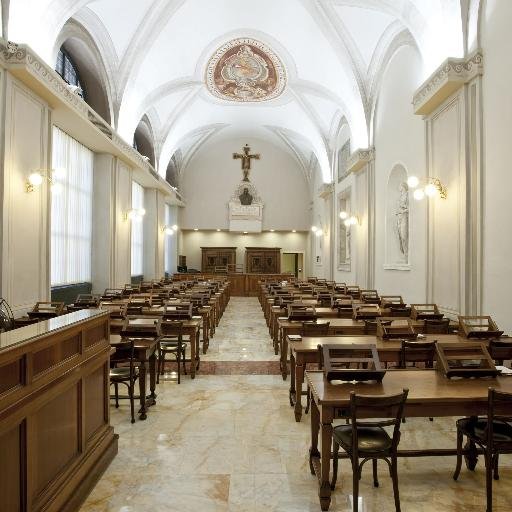
A second desideratum is to digitize the hand-written catalogs from the Vatican Library's Sala Consultatione MSS. These hand lists are not only vital as finding aids to the collections. They would provide provisional descriptions for the many manuscripts that go online with no metadata whatever. And these hand-annotated  books are historic documents of world rank in their own right. As long as these are withheld from virtual users of the library, there can be no pretence that use of the portal is as good as going to Rome in person.

2017-10-21

Defender of the Faith

This is Martin Luther year, commemorating the start of the Protestant Reformation in 1517, when the tangible news event was Martin Luther nailing up 95 theological theses on a church door in Wittenberg, Germany. Ten years later the Reformation spread to England, with King Henry VIII requesting annulment of his marriage, getting angry and seeing through acts of Parliament between 1532 and 1534 that sealed a break with Rome.

One nuance that we often forget is that Henry (1491-1547) had been a very keen Roman Catholic at first (like Luther), and had initially led the counterattack against the German revolt. His book, Assertio septem sacramentorum adversus Martinum Lutherum of 1521, led to English kings and queens being granted a papal title, "Defender of the Faith" (Fidei Defensor), which the Anglican British monarchs retain to this day (look at sterling coins).

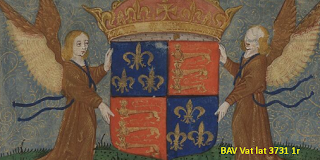
The Vatican Library has just digitized its illuminated presentation copy of the Assertio, Vat.lat.3731, an historic highlight of the 105 latest digitizations by the DigiVatLib program.


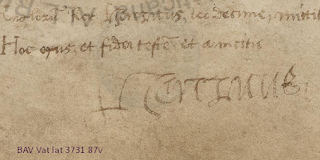
The Assertio was probably drafted by Cardinal Thomas Wolsey and scribed at Greenwich. It mightily pleased the pope, but in one of history's great unintended consequences probably seeded the idea of mutiny in Henry. Here's his autograph and dedication:
On October 31, all Germany, Catholics included, will have a public holiday in celebration of Martin. Perhaps a few Catholic households will look at this codex and wonder what might have been.

Below is my full list:
  1. Arch.Cap.S.Pietro.G.4.pt.bis ,
  2. Arch.Cap.S.Pietro.G.16.pt.bis ,
  3. Arch.Cap.S.Pietro.G.19.pt.bis ,
  4. Barb.gr.444, a palimpsest, viewable in both plain and UV light
  5. Barb.lat.3746 ,
  6. Chig.C.V.117 ,
  7. Ott.gr.14.pt.1 ,
  8. Ott.gr.393 ,
  9. Ott.gr.473 ,
  10. Ott.lat.3029 ,
  11. Ott.lat.3383 ,
  12. Reg.lat.173 ,
  13. Reg.lat.175 ,
  14. Reg.lat.595 ,
  15. Reg.lat.1135 ,
  16. Reg.lat.1173 ,
  17. Reg.lat.1189 ,
  18. Reg.lat.1190 ,
  19. Reg.lat.1211 ,
  20. Reg.lat.1222 ,
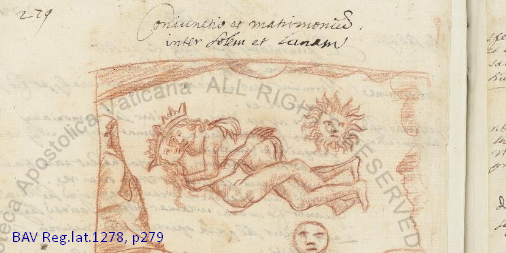
  21. Reg.lat.1278, a manuscript copy of the 16th-century alchemical treatise Rosary of the Philosophers. This codex postdates the book publication of 1550, a printing at Basle, Switzerland. The work (see Wikipedia) was a "rose garden" of wise sayings by those convinced they could manufacture gold, but its market success was undoubtedly more due to its ensemble of X-rated pictures.
    .
  22. Reg.lat.1302 ,
  23. Reg.lat.1304 ,
  24. Reg.lat.1305, Tacuinum sanitatis de sex rebus quae sunt necessarie (13c-14c) (eTK incipit). A medical manuscript. See also: Prima sanitatis cura est preparatio
  25. Reg.lat.1324 , eTK incipit: Ad boree partes arcti vertuntur; De duodecim signis
  26. Reg.lat.1325 ,
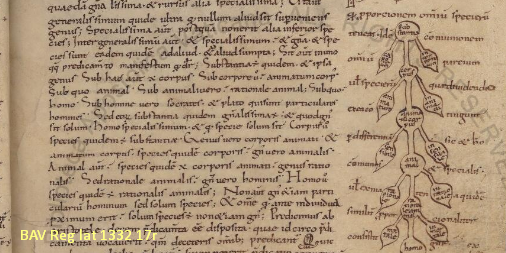
  27. Reg.lat.1332, Boethius. This is manuscript R used by Brandt for his edition of the Isagoge. It contains this unusually early arbor porphyriana diagram (see my list of these online):
  28. Reg.lat.1342 ,
  29. Reg.lat.1347 ,
  30. Reg.lat.1369 ,
  31. Reg.lat.1376 ,
  32. Reg.lat.1379 ,
  33. Reg.lat.1394 ,
  34. Reg.lat.1397 ,
  35. Reg.lat.1428 ,
  36. Reg.lat.1432 ,
  37. Reg.lat.1485 ,
  38. Reg.lat.1709.pt.B, this is an album of fragments from very old manuscripts in uncial script, among them two folios of Manuscript S of the Jerome/Eusebius Chronicle of the world. HT to @ParvaVox for noticing this. It was copied in 5th-century Italy, but was at Fleury in the 9th century. Roger Pearse lists the main manuscripts.
  39. Urb.lat.1228 ,
  40. Urb.lat.273 ,
  41. Vat.gr.2306
  42. Vat.lat.895
  43. Vat.lat.1326 ,
  44. Vat.lat.1521 ,
  45. Vat.lat.1609 ,
  46. Vat.lat.1644 ,
  47. Vat.lat.1805 ,
  48. Vat.lat.1815 ,
  49. Vat.lat.1896 ,
  50. Vat.lat.1899 ,
  51. Vat.lat.1948 ,
  52. Vat.lat.1952 ,
  53. Vat.lat.1955 ,
  54. Vat.lat.1957 ,
  55. Vat.lat.1962 ,
  56. Vat.lat.1964 ,
  57. Vat.lat.1968 ,
  58. Vat.lat.1969 ,
  59. Vat.lat.1970 ,
  60. Vat.lat.1971 ,
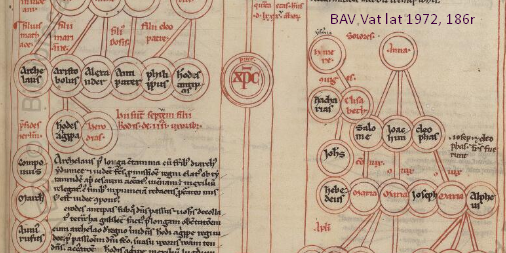
  61. Vat.lat.1972, works by 12th-century University of Paris professors Petrus Comestor (Historia Scholastica) and Petrus Pictavienis with lots of diagrams in the end papers, including PP's multi-page universal-history diagram, the Compendium:
    For more information check out my Petrus Pictaviensis page.
     
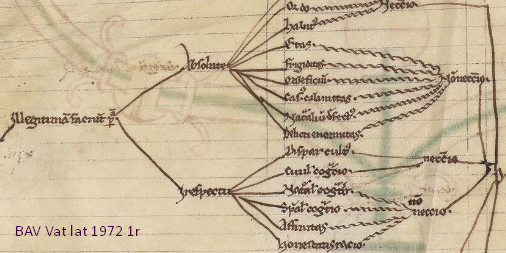
    There are also arbor juris diagrams (above) and decision flow charts (below) for what seem be annulment of marriage hearings.

    There are also some beautiful menorah (seven-armed candelabra) drawings. If you are as fascinated as I am by high medieval symbolism, you will love this codex.
  62. Vat.lat.1986 ,
  63. Vat.lat.2002 ,
  64. Vat.lat.2011 ,
  65. Vat.lat.2018 ,
  66. Vat.lat.2021 ,
  67. Vat.lat.2026 ,
  68. Vat.lat.2035 ,
  69. Vat.lat.2040 ,
  70. Vat.lat.2041 ,
  71. Vat.lat.2043 ,
  72. Vat.lat.2045 ,
  73. Vat.lat.2054 ,
  74. Vat.lat.2062 ,
  75. Vat.lat.2065 ,
  76. Vat.lat.2067 ,
  77. Vat.lat.2068 ,
  78. Vat.lat.2070 ,
  79. Vat.lat.2073 ,
  80. Vat.lat.2077 ,
  81. Vat.lat.2080 ,
  82. Vat.lat.2089 ,
  83. Vat.lat.2095 , Latin Aristotle, spotted a week ago by @LatinAristotle:
  84. Vat.lat.2097 ,
  85. Vat.lat.2098 ,
  86. Vat.lat.2100 ,
  87. Vat.lat.2101 ,
  88. Vat.lat.2110 ,
  89. Vat.lat.2125 ,
  90. Vat.lat.2127 ,
  91. Vat.lat.2131 ,
  92. Vat.lat.2133 ,
  93. Vat.lat.2134 ,
  94. Vat.lat.2141 ,
  95. Vat.lat.2147 ,
  96. Vat.lat.2149 ,
  97. Vat.lat.3550.pt.2 ,
  98. Vat.lat.3550.pt.3 ,
  99. Vat.lat.3731, Henry VIII of England (1491-1547), Assertio septem sacramentorum adversus Martinum Lutherum of 1521 (above), written at Greenwich. The Vatican used to keep Henry VIII's autograph letters to Anne Boleyn (Vat. lat. 3731A) tucked in this codex.
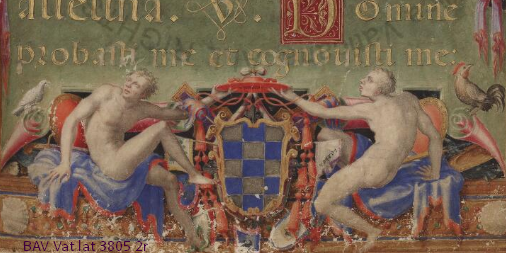
  100. Vat.lat.3805, missal with this fine Renaissance frontispiece:
  101. Vat.lat.4029 ,
  102. Vat.lat.12654, private journal of the librettist Gherardo Bevilacqua-Aldobrandini (1791-1845) begun in 1829.
  103. Vat.lat.14751, letters, apparently collected as models for use by the bureaucracy of the papal state (1250-1320),
  104. Vat.lat.14925, Pope Greg`s horoscopes. Wow. Real Dan Brown stuff
  105. Vat.sir.623.pt.1.
This is Piggin's Unofficial List number 132. If you have corrections or additions, please use the comments box below. Follow me on Twitter (@JBPiggin) for news of more additions to DigiVatLib.

2017-10-20

Italy in Color

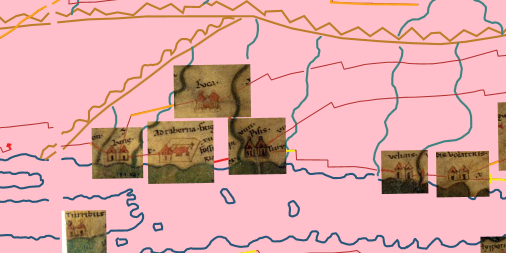
I've made some major improvements to the Tabula Peutingeriana Digital Plot. Version 0.64 is the result of several weeks' tinkering at my desk. The three most visible changes are:
  • Color coding of the routes in Italy
  • Nearly 30 new animations of emendations
  • A CC BY-SA Creative Commons licence.
Coding Italy was a precondition for a detailed analysis of how the peninsular part of the chart -- the oldest surviving detailed "map" of the world, now a UNESCO Memory of the World treasure -- was drawn. I'll have more about this analysis for you soon.

The animations help you to visualize the original design, before the scribal miscopyings which litter the surviving manuscript, penned in the (long) 12th century. Most of these re-connections were proposed by Konrad Miller and Richard Talbert and are fairly widely accepted. Visualization, in my view, is better than a textual definition when one wants to make the graphic differences clear.

The licence is important because I am urging others to continue with my line of work. You are welcome to remix and alter the SVG plot for your own research, provided you leave my name attached.

Under the hood there are some technical advances specially invented for the chart:
  • The file size was reduced by 200 KB using a script that reconstitutes Talbert Database links on the fly
  • Links are shown to be active with underlining and overlining
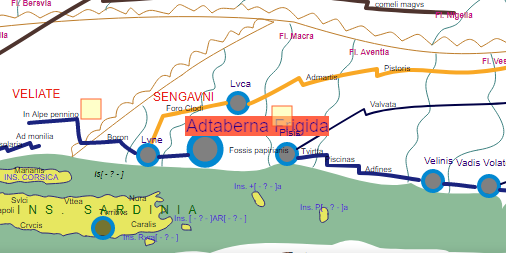
  • Targeted links such as http://piggin.net/svg/PeutingerPiggin.svg#e1087 light up the target name in red with enlarged lettering, like this:
Check my initial announcement of the project in March and my launch announcement in September for more details. My project was originally based on Talbert's SVG version (sample below), but in my view the Talbert work is in certain respects no longer adequate for contemporary research:
  • The Talbert team generously put their suite of SVG files online for free download, but the files are too large to easily manipulate on most home computers and have not as far as I know been updated in the past decade.
  • Talbert Map A (above) does not enable you to jump back and forth to place-name entries in the Talbert Database using hyperlinks.
  • Talbert's color coding mainly differentiated the characteristics of text marked alongside the route stretches, whereas my color coding distinguishes the individual itineraries making up the chart.
For my articles about the Tabula Peutingeriana, visit my Academia.edu online repository. I also have a page on ResearchGate.

2017-10-16

Science Manuscripts at Vatican

Medieval (and earlier) science dominates the recent releases by the Bibliotheca Palatina project in Heidelberg, Germany.

The old ducal and university library at Heidelberg was confiscated and given to the pope. The whole stock of books is now being reconstituted both for the DigiVatiLib project and as a standalone online digital resource in Heidelberg that is especially interesting for those studying the history of medicine and alchemy.

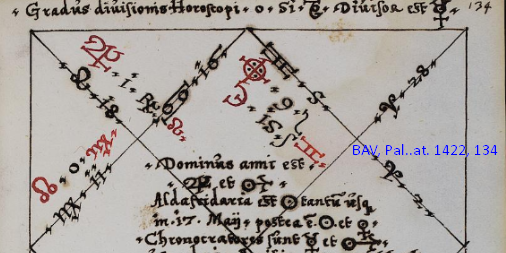
What caught my eye in this lot was an elaborate book-length horoscope prepared by astrologers and geomancers for one Erasmus von Minckwitz, chancellor of the kingdom of Saxony in the mid 16th century.

Although he had obtained a doctorate in law at Padua, Erasmus was clearly more susceptible to his stars than to science.

Below is the full list, compiled from the library's RSS feed over the past two months or so. Most of these manuscripts are late medieval, but note the 11th century Epistulae of Symmachus, Pal.lat.1576. Where codices are mentioned in the catalog of incipits by Lynn Thorndike and Pearl Kibre, I have added the incipit and a link to the electronic Thorndike-Kibre (eTK).
  1. Pal. lat. 56 Questo e il santo vangelio (14. Jh.) :
  2. Pal. lat. 1124 Arcolani, Giovanni; Johannes Michael : Medizinische Sammelhandschrift (Ferrara, 1460/61) :
  3. Pal. lat. 1194 Bartholomaeus/ Galeatus de Sancta Sophia; Antonius Guainerius; Guilhelmus de Brescia; Bartholomaeus de Montagnana: Medizinische Sammelhandschrift (Italien (Padua?), Mitte 15. Jh.) : eTK, Tibi amoris gratia mi Antoni Maglane.
  4. Pal. lat. 1224 Hermannus; Johannes de Toleto; Constantinus ; Andromachus: Medizinischer Sammelband (Ostmitteldeutschland, 15. Jh. ; Ende 14. Jh.) :
  5. Pal. lat. 1225 Knab, Erhardus; Walter Agilon; Concellarius Montespessulani; Johannes ; Petrus ; Johannes de Burgundia; Mundinus; Gentilis ; Petrus Bononiensis: Medizinischer Sammelband (Heidelberg (I) , Italien (II), 1456-1462 ; um 1408) : eTK, Actus curativus pestis est in tribus (15c), by Petrus de Tussignano
  6. Pal. lat. 1228 Bartholomaeus de Montagnana; Bernardus : Ambrosius Prechtl Collectanea (Regensburg, ca. 1560) : eTK, Cautele medicorum in iudicando urinas, by Bartholomaeus de Montagnana ?
  7. Pal. lat. 1230 Gentilis ; Galenus: Medizinische Sammelhandschrift (Italien, 2. Hälfte 14. Jh.) :
  8. Pal. lat. 1249 Bd. 1 Leopoldus de Austria; Johannes ; Alexander ; Hermannus Stilus de Norchem; Johannes ; Almansor astrologus; Thetel; Lullus, Raimundus; u.a.: Sammelhandschrift zum Quadrivium (Paris, 14. Jh. (um 1368)) :
  9. Pal. lat. 1249 Bd. 2 Leopoldus de Austria; Johannes ; Alexander ; Hermannus Stilus de Norchem; Johannes ; Almansor astrologus; Thetel; Lullus, Raimundus; u.a.: Sammelhandschrift zum Quadrivium (Paris, 14. Jh. (um 1368)) :
  10. Pal. lat. 1252 Galenus; Rāzī, Muḥammad Ibn-Zakarīyā /ar-; Avicenna; Conradus : Medizinische Sammelhandschrift (Deutschland, 1. Hälfte 15. Jh.) : eTK, Si dormitatis inter medios cleros penne columbe; De commendatione cler.
  11. Pal. lat. 1254 Hippocrates; Benevenutus : Collectanea practicae medicinalis, Vol. III (Süddeutschland, um 1400) :
  12. Pal. lat. 1255 Godefridus; Gerardus de Monte Pessulano; Johannes de Sancto Amando; Petrus Musandinus: Collectanea practicae medicinalis, Vol. I (Süddeutschland, um 1400) :
  13. Pal. lat. 1256 Matthaeus ; Bartholomaeus Pictaviensis; Richardus ; Johannes de Sancto Amando; Gualterus Agilon; Gerardus de Monte Pessulano; Petrus Hispanus: Medizinische Sammelhandschrift (Ostmitteldeutschland, 1. Hälfte 15. Jh.) : eTK, Abesa (Abela?) id est agrimonia latinus arabicus acacia
  14. Pal. lat. 1260 Gentilis ; Thomas de Garbo; Marsilius de Sancta Sophia; Petrus ; Mesue Minor; Aegidius Corbolensis; Isrāʾīlī, Isḥāq Ibn-Sulaimān /al-; Lanfrancus ; u.a.: Zusammengesetzte Handschrift (Italien (I) , Süddeutschland (II) , Montpellier (III), Anfang 15. Jh. ; 1363 (III)) : eTK, Alphita farina ordei idem (15c); .sp Presentis negotii propositum est tractare
  15. Pal. lat. 1261 Ferrarius de Gradibus, Johannes Matthaeus; Isrāʾīlī, Isḥāq Ibn-Sulaimān /al-; Avicenna; Gerardus de Solo; u.a.: Zusammengesetzte Handschrift (Hedelberg (I) , Montpellier (II), 15. Jh. (1476) ; 2. Hälfte 14. Jh. (II)) : eTK, Ad capitulum octavum huius libri primo veniamus (15c), by Petrus Blancus
  16. Pal. lat. 1264 Knab, Erhardus; Gerhard Brant; Nicolaus Salernitanus; Ps.-Albertus Magnus; Gentilis ; u.a.: Medizinische Sammelhandschrift (Heidelberg, 1450-1455) : eTK,
  17. Pal. lat. 1265 Bernardus Alberti; Antonius de Scarpariis; Maimonides, Moses; Bernardus ; Arnoldus ; Guido de Chauliaco; Petrus ; u.a.: Medizinische Sammelhandschrift (Padua und Süddeutschland, 1. Viertel 15. Jh.) : eTK , Anno domini 1345 ? magna erat pestilentia et duravit (15c)
  18. Pal. lat. 1266 Marsilius de Sancta Sophia; Bernardus : Medizinische Sammelhandschrift (Norditalien, Anfang 15. Jh. (1402)) :
  19. Pal. lat. 1267 Rāzī, Muḥammad Ibn-Zakarīyā /ar-; Elias de Assissi: Alchemistische Sammelhandschrift (Frankreich, 14. Jh.) :
  20. Pal. lat. 1269 Magenbuch, Johannes: Ärztliche Verordnungen (Nürnberg, 1525-1528) :
  21. Pal. lat. 1270 Receptarium (Heidelberg, 2. Hälfte 16. Jh.) :
  22. Pal. lat. 1277 Thessalus ; Ps.-Alexander Magnus: Herbarium pictum (Süddeutschland, 2. Hälfte 16. Jh.) :
  23. Pal. lat. 1278 Algafiqui; Algizar; Kiranides; Alexius Africanus; Johannes Paulinus: Medizinische Sammelhandschrift (2. Drittel 15. Jh.) : eTK; Non inveni aliquem de antiquis aut modernis (15c); .ix1 In dei nomine verba Abicrasar
  24. Pal. lat. 1279 Galeatius de Sancta Sophia; Kiranides; u.a.: Medizinische Sammelhandschrift (Speyer, 3. Viertel 15. Jh. (1462,1468)) : eTK, Abrotanum est planta plures habens ramusculos (1468), by Sancta Sophia, Galeatius de
  25. Pal. lat. 1280 Isrāʾīlī, Isḥāq Ibn-Sulaimān /al-; Ibn Gazla; Bartholomaeus : Medizinische Sammelhandschrift (14. Jh.) :
  26. Pal. lat. 1281 Aegidius Corbolensis; Gualterus Agilon; Bartholomaeus ; u.a.: Zusammengesetzte Handschrift (Deutschland (II) , Frankreich (III), 14. Jh. ; 13./14. Jh. ; 14. Jh.) :
  27. Pal. lat. 1282 Baverius de Baveriis: Practica medicinae (Bologna, 1469) : eTK, Antequam accedamus ad curam doloris capitis (1469), by Baverius de Baveriis
  28. Pal. lat. 1283 Ambrosius Prechtl: Sammlung lateinischer und deutscher Rezepte, Experimente und Kuren (Amberg, letztes Drittel 16. Jh.) :
  29. Pal. lat. 1284 Guilhelmus Placentinus; Arnoldus ; Jacobus de Sanatis; Nicolaus de Sancta Sophia; Innocentius ; Thaddaeus; Bernardus : Medizinische Sammelhandschrift (Mitte 15. Jh.) : eTK, Medicina est scientia cognoscendi dispositiones (14c-15c); .sp Introductiones appellantur indebite que prima
  30. Pal. lat. 1285 Guilhelmus de Varignana: Practica Sybona (Vol. I) (Augsburg, 1471) : eTK, Exsurge domine deus meus in dextra tua forti et infinita (15c)
  31. Pal. lat. 1286 Guilhelmus de Varignana: Practica Sybona (Vol. II) (Augsburg, nach 1471) : eTK, Exsurge domine deus meus in dextra tua forti et infinita
  32. Pal. lat. 1287 Guilhelmus de Saliceto Placentinus: Practica (15. Jh.) :
  33. Pal. lat. 1288 Johannes Stocker: Liber medicinalis (Süddeutschland, 1. Hälfte 16. Jh.) :
  34. Pal. lat. 1289 Johannes des Gaddesden: Rosa anglica medicinae (Süddeutschland, 1368) : eTK In viridario voluptatis et iocunditatis in mense (1368), by John of Gaddesden
  35. Pal. lat. 1290 Johannes des Gaddesden: Rosa anglica medicinae (Wien (?), 1. Hälfte 15. Jh.) : eTK, In viridario voluptatis et iocunditatis in mense (1365), by John of Gaddesden
  36. Pal. lat. 1291 Mesue Minor; Rāzī, Muḥammad Ibn-Zakarīyā /ar-; Avicenna: Medizinische Sammelhandschrift (15. Jh. (1425)) :
  37. Pal. lat. 1292 Matthaeus Silvaticus: Opus pandectarum medicinae II (15. Jh. (1472)) : eTK, A autem est mentastrum autem est species camphore (1472); Practica medicinalis
  38. Pal. lat. 1293 Collectanea practicae medicinalis, Vol. II (Süddeutschland, um 1400) :
  39. Pal. lat. 1294 Bernardus ; u.a.: Medizinische Sammelhandschrift (Süddeutschland, 15. Jh. (1452)) :
  40. Pal. lat. 1295 Antonius de Gradi; Saladinus de Esculo; Petrus ; Thomas de Garbo; Bartholomaeus de Montagnana; Thaddaeus Alderotti; Mathaeus de Verona; Antonius Cermisonus; u.a.: Medizinische Sammelhandschrift (Padua, ca. 1464) :
  41. Pal. lat. 1296 Bartholomaeus de Sancta Sophia: Commentum in nonum Almansoris Rasis (Heidelberg, 1483) :
  42. Pal. lat. 1297 Johannes Stocker: Liber medicinalis (Süddeutschland, 16. Jh. (1535)) :
  43. Pal. lat. 1298 Mundinus ; Avicenna; Maimonides, Moses; Mesue Senior; Arnoldus ; Galenus: Medizinische Sammelhandschrift (Padua, 15. Jh. (1464)) : eTK, Congregavi in divisionibus egritudinum et ostendi curas (15c); .st Inquit Rasis cum in civitate
  44. Pal. lat. 1299 Mundinus ; Dinus de Florentia; Guilhelmus de Saliceto; Guido de Chauliaco: Medizinische Sammelhandschrift (Wien, Anfang 15. Jh. (1413-1414)) :
  45. Pal. lat. 1300 Rāzī, Muḥammad Ibn-Zakarīyā /ar-: Libri XIII-XVII (Deutschland, 1. Hälfte 15. Jh.) : eTK, De libro signorum dixit squivros ? est apostema inflatum et durum (15c); .ix1 Dixit apostema appellatum squivros
  46. Pal. lat. 1301 Nicolaus Falcutius: Sermones medicinales (Deutschland, 2. Hälfte 15. Jh.) :
  47. Pal. lat. 1302 Avicenna; Knab, Erhardus; u.a.: Canon III, fen 10. 11. 13: Excerpta de morbis pectoris, cordis stomachique cum receptis et curis quorundam auctorum collecta ab Erhardo Knab (Heidelberg, 2. Drittel 15. Jh.) : eTK, Collum est membrum intraiacens inter faciem; Anatomia stomachi
  48. Pal. lat. 1303 Antonius de Gradi; Zacharias de Feltris; Platina, Bartholomaeus: Medizinische Sammelhandschrift (Heidelberg, 15. Jh. (1476)) :
  49. Pal. lat. 1305 Lanfrancus ; Rolandus de Parma; Rāzī, Muḥammad Ibn-Zakarīyā /ar-; Mundinus ; Johannitius; u.a.: Medizinische Sammelhandschrift (Süddeutschland, 15. Jh. (1422)) :
  50. Pal. lat. 1306 Guilhelmus de Saliceto; Theodericus de Cervia: Medizinische Sammelhandschrift (Heidelberg, Mitte 15. Jh.) :
  51. Pal. lat. 1307 Guilhelmus de Saliceto; Gentilis ; Johannes : Medizinische Sammelhandschrift (Padua, 15. Jh. (1403)) :
  52. Pal. lat. 1308 Guilhelmus de Saliceto; Dinus del Garbo: Medizinische Sammelhandschrift (Italien, 14. Jh.) :
  53. Pal. lat. 1309 Guilhelmus de Saliceto: Chirurgia I-V (15. Jh. (1407)) :
  54. Pal. lat. 1311 Lanfrancus ; Ps.-Galenus: Sammelhandschrift (Padua, 1. Hälfte 15. Jh. (1431)) :
  55. Pal. lat. 1312 Theodericus de Cervia: Practica chirurgiae I-III (Deutschland, Mitte 15. Jh. (1453)) :
  56. Pal. lat. 1313 Theodericus de Cervia; Richard : Medizinisch-alchemistische Sammelhandschrift (Heidelberg, 1480-1490) :
  57. Pal. lat. 1314 Bruno : Chirurgia magna I-II (Italien, 1. Hälfte 14. Jh.) :
  58. Pal. lat. 1315 Bruno ; Galenus; Nicolaus Salernitanus; Odo : Zusammengesetzte Handschrift (Italien (I) , Frankreich (II) , Deutschland (III), 14. Jh.) :
  59. Pal. lat. 1316 Guido de Chauliaco; Albertus ; Bartholomaeus de Montagnana; Hippokrates; Johannes ; Petrus Hispanus; Jacoby, Johann; Marsilius de Sancta Sophia: Medizinische Sammelhandschrift (Heidelberg, 15. Jh. (1451)) : eTK Ad faciendum ardens vinum in vase et ad faciendum flammam magnam (15c); Experimenta Alberti
  60. Pal. lat. 1317 Guido de Chauliaco; Gualterus Agilon: Medizinischer Sammelband (Montpellier, 14. Jh. (1373)) :
  61. Pal. lat. 1318 Rolandus de Parma; Nicolaus Salernitanus; Bartholomaeus; Matthaeus : Zusammengesetzte Handschrift (Italien (I) , Deutschland (III), 13./14. Jh. (I) ; 12./13. Jh. (II) ; 2. Hälfte 13. Jh. (III)) :
  62. Pal. lat. 1319 Leonardus de Bertipaglia; Johannes de Tracia; Johannitius; Arnoldus ; Aegidius Corbolensis; Ibn-Māsawaih, Abū-Zakarīyā Yūḥannā; Widmann, Johannes; Johannes May: Medizinische Sammelhandschrift (Heidelberg, 1473-1498) : eTK, Causa egritudinis huius ut placuit Avicenne; De catarro
  63. Pal. lat. 1320 Arnoldus ; Petrus de Nadilis; Bernardus Alberti; Gerardus de Solo; Jacoby, Johann; Raymundus de Moleriis; Benevenutus ; Galenus; u.a.: Medizinische Sammelhandschrift (Montpellier (?), Ende 14. Jh. (1384)) :
  64. Pal. lat. 1321 Bruno ; Ortolf ; Bartholomaeus; Arnoldus ; Petrus Hispanus; u.a.: Zusammengesetzte Handschrift (Italien (I) , Südwestdeutschland (II) , Süddeutschland (III), 15. Jh. (I) ; 1425 (II) ; 14. Jh. (III)) : eTK Ad inveniendum signum nativitatis tue et quorumlibet hominum
  65. Pal. lat. 1322 Guilhelmus de Saliceto; Nicolaus Salernitanus; Arnoldus ; Valascus de Taranta; Petrus : Medizinischer Sammelband, Handschrift und Inkunabel (Heidelberg, Ende 15. Jh.) :
  66. Pal. lat. 1323 Galenus; Bruno ; Theodericus de Cervia; Avicenna; u.a.: Medizinische Sammelhandschrift (Süddeutschland, 15. Jh. (1407)) :
  67. Pal. lat. 1325 Medizinischer Sammelband: Collectanea Ambrosii Prechtl (Regensburg (I), 1556-1560 (I) um 1500 (II)) :
  68. Pal. lat. 1326 Albertus : De animalibus, libri IX-XXVI (Vol. II) (Paris (?), Mitte 14. Jh. (1346)) : eTK, Canis animal notum est de cuius diversitate multum (1346); Capituluum de cane et de equo multum et de aquila et falconibus...
  69. Pal. lat. 1328 Hermes; Johannes ; Avicenna; Rāzī, Muḥammad Ibn-Zakarīyā /ar-; Gaelnus; Kindī, ʿAbd-al-Masīḥ Ibn-Isḥāq /al-; u.a.: Alchemistische Sammelhandschrift (2. Hälfte 14. Jh.) : eTK, Accipe aceti acerrimi de vino distillato; Perfectum magisterium
  70. Pal. lat. 1329 Khālid ibn Yazīd al-Umawī; Winandus ; Arisleus; Arnoldus ; Thomas Capellanus; Johannes Tetzenensis; u.a.: Alchemistische Sammelhandschrift (Schlesien, 1. Drittel 15. Jh. (1430)) : eTK Accipe in nomine domini de lapide minerali lb. i. et tere (15c)
  71. Pal. lat. 1330 Archilaus; Albertus ; Hermes; Arnoldus ; Johannes ; u.a.: Alchemistische Sammelhandschrift (Italien, 15. Jh. (1463/64)) : eTK Accipe aluminis iameni et zucarini et lactis pecorini ana lib. iii (15c)
  72. Pal. lat. 1331 Johannes de Tornamira; Arnoldus ; Bernardus Alberti; Gerardus de Solo; Stephanus Arlandi; Bernardus ; Magninus ; Zahrāwī, Ḫalaf Ibn-Abbās /az-; u.a.: Medizinische Sammelhandschrift (Südwestdeutschland, Anfang 15. Jh.) : eTK Cognoscuntur leprosi a quinque signis (15c); .ix1 Cognoscuntur leprosi a quinque modis
  73. Pal. lat. 1332 Ps.-Thomas de Aquino; Arnoldus ; Hortulanus; Johannes Tetzenensis; Philo ; u.a.: Alchemistische Sammelhandschrift (Südwestdeutschland, 1. Hälfte 15. Jh.) : eTK A divina magnificentia emanavit donum (15c); .ix1 Non legitur a divina munificentia
  74. Pal. lat. 1333 Johannes : De consideratione quintae essentiae seu de famulatu philosophiae (15. Jh.) :
  75. Pal. lat. 1335 Albertus ; Arnoldus ; Thaddaeus ; Magister Jacobus; Johannes ; u.a.: Alchemistische Sammelhandschrift (um 1400) : eTK, Aqua permanens coagulat argentum vivum (15c); .sp Distinctio secretorum sapientum in
  76. Pal. lat. 1336 A. Candidus: De alchymia epistolae (Neuhausen bei Worms, 1570-1571) :
  77. Pal. lat. 1338 Hieronymus Carazolus; Poll, Nicolaus: Medizinische Sammelhandschrift (Süddeutschland, 1. Drittel 16. Jh.) : eTK Dixit Morienus id translator legimus in historiis (14c); .ix1 Legimus in historiis veterum
  78. Pal. lat. 1339 Geber; Hermes; Morienus; Rāzī, Muḥammad Ibn-Zakarīyā /ar-; Archelaus; Ps.-Avicenna; u.a.: Alchemistische Sammelhandschrift (Anfang 14. Jh.) : eTK, Accipe argenti vivi libras decem (15c); Liber congelationis argenti vivi
  79. Pal. lat. 1374 Johannes de Lineriis; Nicolaus Mülhus: Tabulae astronomicae (Prag, 1407) :
  80. Pal. lat. 1377 Petrus ; Philo ; Tideus; Alhazen; Jordanus ; Ibn ʿEzra, Avraham ben Mei̇r; Johannes ; Johannes ; Philippus de Caserta: Sammelband, Miscellanea (Italien , Niederlande , Frankreich , Deutschland, 15. ; 11./12. ; 14. Jh.) : eTK De tempestatum presagiis tractaturi a sole; .ix1 Purus oriens atque non fervens
  81. Pal. lat. 1421 Nativität des Markgrafen Georg Friedrich von Brandenburg-Ansbach (Franken, Mitte 16. Jh.) :
  82. Pal. lat. 1422 Nativität des kurfürstlichen Kanzlers Erasmus von Minckwitz (Süddeutschland, Mitte 16. Jh. (um 1547)) :
  83. Pal. lat. 1426 Leowitz, Cyprian: Tabulae ad figuras caeli erigendas (Augsburg, Mitte 16. Jh.) :
  84. Pal. lat. 1427 Leowitz, Cyprian: Tabulae motus lunae (Lauingen a.d. Donau, vor 1560) :
  85. Pal. lat. 1428 Leowitz, Cyprian: Introductio tabularum novarum (Lauingen a.d. Donau, 1560) :
  86. Pal. lat. 1429 Leowitz, Cyprian: Tabulae ascensionum Vol. III (Lauingen a.d. Donau, 1560) :
  87. Pal. lat. 1431 Leowitz, Cyprian: Tabulae ascensionum Vol. I (Lauingen a.d. Donau, 1560) :
  88. Pal. lat. 1432A Leowitz, Cyprian: Tabulae ascensionum Vol. II (Lauingen a.d. Donau, 1560) :
  89. Pal. lat. 1432B Astrologische Kalender 1559 und 1560 (Augsburg/ Lauingen a.d. Donau, 1558/59) :
  90. Pal. lat. 1433 Planetentafeln 1482-1606 (Augsburg, Mitte 16. Jh.) :
  91. Pal. lat. 1434 Leowitz, Cyprian: Canon extrahendi arcum ecliptice verum ; Ratio partis proportionalis colligendae (Augsburg, Mitte 16. Jh.) :
  92. Pal. lat. 1435 Omar; Albumasar; Hali Abenragel; Messahalla; Abraham Judaeus; Johannes Dank de Saxonia: Sammelhandschrift mit Inkunabeldruck (Süddeutschland, 15. Jh. (1473-1478)) : eTK Astrolabium ita construitur accipe rotulas; .ix1 Astrolabium sic construitur accipe rotulas
  93. Pal. lat. 1437 Johannes de Erfordia; Alexander de Villae Dei; Johannes de Sacrobosco; Johannes de Polonia: Sammelband zum Komputus (Süddeutschland (I) , Ungarn (II), Drittes Drittel 15. Jh. (I) ; Ende 14. Jh. (II)) :
  94. Pal. lat. 1440 Practica geomantiae (Deutschland, 16. Jh.) :
  95. Pal. lat. 1441 Leovitius, Cyprianus: Horoskope (Franken, Mitte 16. Jh.) :
  96. Pal. lat. 1442 Leovitius, Cyprianus: Horoscopus cum prognosticis (Böhmen, Mitte 16. Jh. (nach 1547)) :
  97. Pal. lat. 1443 Johannes ; Ibn-Abī-'r-Riǧāl, Abu-'l-Ḥasan ʿAlī: Astrologisch-geomantische Sammelhandschrift (Deutschland, 2. Hälfte 14. Jh.) :
  98. Pal. lat. 1444 Ibn-Abī-'r-Riǧāl, Abu-'l-Ḥasan ʿAlī; Leopoldus ; Hermes; Battānī, Muḥammad Ibn-Ǧābir /al-: Astrologische Sammelhandschrift: Miscellanea (Süddeutschland, Ende 15. Jh.) :
  99. Pal. lat. 1450 Sammelband: Komputus ; Medizinisches Handbuch (Heidelberg, Ende 15. Jh. (I) ; um 1540 (II)) :
  100. Pal. lat. 1451 Johannes ; Qabīṣī, Abu-'ṣ-Ṣaqr ʿAbd-al-ʿAzīz Ibn-ʿUṯmān /al-; Johannes ; Ps.-Aristoteles: Miscellaneenband: Komputus ; Arithmetik ; Medizin (Bayern (I , II) , Heidelberg (III , IV), Letztes Viertel 14. Jh. (I) ; Ende 15. Jh. (II) ; Anfang 16. Jh. (III) ; Mitte 15. Jh. (IV)):
  101. Pal. lat. 1452 Johannes ; Johannes ; Gerardus ; Raimundus Lulus; Omar: Sammelhandschrift mit Quadriviumstexten (Bayern, 15. Jh.) :
  102. Pal. lat. 1453 Geomantischer Sammelband (Schwaben (I) , Italien (II), 2. Hälfte 15. Jh. (I) ; 15. Jh. (II)) :
  103. Pal. lat. 1454 Geomantischer Sammelband (Bayern, 2. Hälfte 15. Jh.) :
  104. Pal. lat. 1455 Gerardus : Geomantia (Italien, Mitte 14. Jh.) :
  105. Pal. lat. 1456 Gerardus : Sammelhandschrift: Mantische Texte (Südwestdeutschland, 15. Jh.) :
  106. Pal. lat. 1457 Hugo : Geomantia (Deutschland, Mitte 15. Jh.) :
  107. Pal. lat. 1458 Johannes : Kalendarium (Würzburg, Mitte 15. Jh. (1446)) :
  108. Pal. lat. 1543 Seneca, Lucius Annaeus : Epistulae (Frankreich, 12. Jh.) :
  109. Pal. lat. 1563 Vitruvius; Frontinus, Sextus Iulius: De architectura ; Strategemata (Italien, 15. Jh.) :
  110. Pal. lat. 1567 Mela, Pomponius: Sammelhandschrift (Italien, 15. Jh. ; 16. Jh. ; 16. Jh.) :
  111. Pal. lat. 1569 Solinus, Gaius Iulius; Einhard: Sammelhandschrift (Italien (Venedig), 15. Jh.) :
  112. Pal. lat. 1570 Solinus, Gaius Iulius: Sammelhandschrift (Deutschland, 15. Jh.) :
  113. Pal. lat. 1576 Symmachus, Quintus Aurelius: Epistulae (Deutschland, 11. Jh.) : a notably old item from this collection:
  114. Pal. lat. 1612 Plautus, Titus Maccius: Comoediae (Italien?, 15. Jh.) :
  115. Pal. lat. 1614 Plautus, Titus Maccius: Comoediae (Italien, 15. Jh.) :
  116. Pal. lat. 1616 Plautus, Titus Maccius: Comoediae (Italien, 15. Jh.) :
  117. Pal. lat. 1617 Plautus, Titus Maccius: Comoediae (Italien, 15. Jh.) :
  118. Pal. lat. 1618 Plautus, Titus Maccius: Comoediae (Deutschland, 15. Jh.) :
  119. Pal. lat. 1619 Plautus, Titus Maccius: Comoediae (Italien, 15. Jh.) :
  120. Pal. lat. 1621 Terentius Afer, Publius: Comoediae (Italien, 15. Jh.) :
  121. Pal. lat. 1622 Terentius Afer, Publius: Comoediae (Italien, 15. Jh.) :
  122. Pal. lat. 1623 Terentius Afer, Publius: Comoediae (Italien, 15. Jh.) :
  123. Pal. lat. 1624 Terentius Afer, Publius: Comoediae (Italien, 14.-15. Jh.) :
  124. Pal. lat. 1625 Terentius Afer, Publius; Adolphus Vindobonensis; Alanus ; Sallustius Crispus, Gaius; Pius / Enea Silvio Piccolomini ; Augustinus ; Petrarca, Francesco; Antonius Haneron: Sammelhandschrift (Deutschland, 15. Jh.) :
  125. Pal. lat. 1626 Terentius Afer, Publius: Comoediae (Italien, 15. Jh.) :
  126. Pal. lat. 1627 Terentius Afer, Publius: Comoediae (Italien, 15. Jh.) :
  127. Pal. lat. 1629 Donatus, Aelius: Commentum in Terentii (Italien, Deutschland, 15. Jh. (1474?)) :
  128. Pal. lat. 1630 Donatus, Aelius: Commentum in Terentii (Italien, 15. Jh.) :
  129. Pal. lat. 1633 Vergilius Maro, Publius: Opera (Deutschland, Ende 15. Jh.) :
  130. Pal. lat. 1634 Vergilius Maro, Publius: Aeneis (Italien, 14.-15. Jh.) :
  131. Pal. lat. 1636 Vergilius Maro, Publius: Aeneis (Italien, 15. Jh.) :
  132. Pal. lat. 1637 Vergilius Maro, Publius: Opera (Italien, 15. Jh.) :
  133. Pal. lat. 1638 Vergilius Maro, Publius: Opera (Pays-Bas (?), 15. Jh.) :
  134. Pal. lat. 1639 Vergilius Maro, Publius: Opera (Italien, 14. Jh.) :
  135. Pal. lat. 1640 Vergilius Maro, Publius: Opera (Italien, 15. Jh.) :
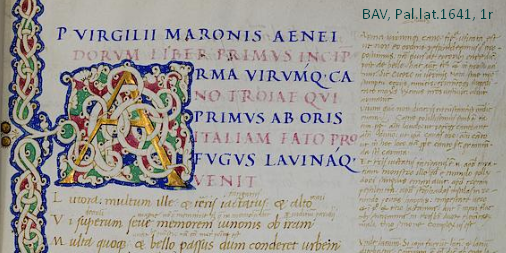
  136. Pal. lat. 1641 Vergilius Maro, Publius: Aeneis (Italien (Padua), Ende 15. Jh.) :
  137. Pal. lat. 1642 Vergilius Maro, Publius: Opera (Italien, 14.-15. Jh.) :
  138. Pal. lat. 1644 Vergilius Maro, Publius; Ovidius Naso, Publius: Sammelhandschrift (Deutschland , Italien, 15. Jh. ; 14. Jh.) :
  139. Pal. lat. 1650 Tibullus, Albius: Elegiae (Italien, 15. Jh.) :
  140. Pal. lat. 1651 Tibullus, Albius: Elegiae (Italien, 15. Jh.) :
  141. Pal. lat. 1653 Horatius Flaccus, Quintus: Carmina seu Odae (Italien, 15. Jh.) :
  142. Pal. lat. 1654 Horatius Flaccus, Quintus: Opera (Italien, 15. Jh.) :
  143. Pal. lat. 1656 Horatius Flaccus, Quintus: Opera (Italien, Ende 15. Jh.) :
  144. Pal. lat. 1658 Horatius Flaccus, Quintus: Epistulae (Frankreich, 13.-14. Jh.) :
  145. Pal. lat. 1660 Horatius Flaccus, Quintus: Opera (Italien, 14. Jh.) :
  146. Pal. lat. 1662 Ovidius Naso, Publius; Cicero, Marcus Tullius; Donatus, Aelius: Sammelhandschrift (Italien, 15. Jh.) :
  147. Pal. lat. 1665 Ovidius Naso, Publius: Heroides (Italien, 14. Jh.) :
  148. Pal. lat. 1670 Ovidius Naso, Publius: Metamorphoses (Italien, 14. Jh.) :
  149. Pal. lat. 1673 Seneca, Lucius Annaeus : Tragoediae (Italien, 14.-15. Jh.) :
  150. Pal. lat. 1674 Seneca, Lucius Annaeus : Tragoediae (Italien, 14. Jh.) :
  151. Pal. lat. 1676 Seneca, Lucius Annaeus : Tragoediae (Italien, Ende 14. Jh.) :
  152. Pal. lat. 1678 Lucanus, Marcus Annaeus: De bello ciuili (Italien, 14. Jh.) :
  153. Pal. lat. 1679 Lucanus, Marcus Annaeus: De bello ciuili (Italien, Ende 14. Jh.) :
  154. Pal. lat. 1680 Lucanus, Marcus Annaeus: De bello ciuili (Deutschland, 15. Jh.) :
  155. Pal. lat. 1681 Lucanus, Marcus Annaeus: De bello ciuili (Italien, 15. Jh.) :
  156. Pal. lat. 1688 Statius, Publius Papinius: Thebais (Italien, 14.-15. Jh.) :
  157. Pal. lat. 1690 Statius, Publius Papinius: Thebais (Italien, 14. Jh.) :
  158. Pal. lat. 1692 Statius, Publius Papinius: Thebais ; Achilleis (Italien, 15. Jh.) :
  159. Pal. lat. 1693 Statius, Publius Papinius: Thebais ; Achilleis (Italien, 15. Jh.) :
  160. Pal. lat. 1696 Martialis, Marcus Valerius: Epigrammata I-XIV (Italien, 15. Jh.) :
  161. Pal. lat. 1697 Martialis, Marcus Valerius: Epigrammata I-XII (Italien, 15. Jh.) :
  162. Pal. lat. 1698 Martialis, Marcus Valerius: Epigrammata I-XIV (Deutschland, Ende 15. Jh.) :
  163. Pal. lat. 1699 Iuvenalis, Decimus Iunius; Persius Flaccus, Aulus: Saturae (Italien (Verona?), 15. Jh.) :
  164. Pal. lat. 1700 Iuvenalis, Decimus Iunius: Saturae (Italien, 15. Jh.) :
  165. Pal. lat. 1702 Iuvenalis, Decimus Iunius: Saturae (Italien, 15. Jh.) :
  166. Pal. lat. 1704 Iuvenalis, Decimus Iunius: Saturae (Italien, 15. Jh.) :
  167. Pal. lat. 1705 Iuvenalis, Decimus Iunius: Saturae (Italien, 15. Jh.) :
  168. Pal. lat. 1707 Iuvenalis, Decimus Iunius; Horatius Flaccus, Quintus; Persius Flaccus, Aulus; Ovidius Naso, Publius; Tibullus, Albius; Sallustius Crispus, Gaius; Vergilius Maro, Publius; Cicero, Marcus Tullius: Sammelhandschrift (Deutschland, Ende 15. Jh.) :
  169. Pal. lat. 1708 Iuvenalis, Decimus Iunius; Persius Flaccus, Aulus: Saturae (Italien, 14.-15. Jh.) :
  170. Pal. lat. 1709 Persius Flaccus, Aulus; Soloneus; Boethius, Anicius Manlius Severinus; Celtis, Konrad; Sallustius Crispus, Gaius; Ovidius Naso, Publius; Fridancius; Vergilius Maro, Publius: Sammelhandschrift (Deutschland, 15.-16. Jh.) : eTK An de impressionibus metheorologicis habeatur scientia (15c); .ix1 Circa initium quatuor metheororum
  171. Pal. lat. 1711 Manilius, Marcus: Astronomica (Italien, 15. Jh.) :
  172. Pal. lat. 1727 Alanus ; Cicero, Marcus Tullius: Sammelhandschrift (Deutschland, 15. Jh.) :
  173. Pal. lat. 1776 Johannes : Catholicon (Erfurt, um 1450-1460) :
  174. Pal. lat. 1815 Frontinus, Sextus Iulius: Strategemata ; De uiris illustribus Urbis Romae (Italien, Ende 15. Jh.) :
  175. Pal. lat. 1820 Cicero, Marcus Tullius: Opera ; Orationes (Italien, 14. Jh.) :
  176. Pal. lat. 1850 Erhard Bacher: Loci communes (Wittenberg, 1562-1568) :
  177. Pal. lat. 1851 Hartmann, David: Oratiuncula de nomine Jesu (Heidelberg, 1585) :
  178. Pal. lat. 1852 Notae historicae (Heidelberg, 1560-1592) :
  179. Pal. lat. 1857 Sammelhandschrift (Deutschland, Mitte 16. Jh.) :
  180. Pal. lat. 1861 Notae in evangelia (Deutschland, Mitte 16. Jh.) :
  181. Pal. lat. 1862 Orationes scholasticae (Heidelberg, 1580-1582) :
  182. Pal. lat. 1883 Sententiae latinae (Heidelberg (?), Anfang 17. Jh.) :
This is Piggin's Unofficial List number 131. If you have corrections or additions, please use the comments box below. Follow me on Twitter (@JBPiggin) for news of more additions to DigiVatLib.

2017-10-11

Their Only Plato

A beautiful 10th-century Italian manuscript containing the Latin commentary by Calcidius on the Timaeus of Plato is a star of this week's crop of digitizations at the Vatican Library.

This manuscript has 62 leaves and fine artwork (see above). Folios 21v-22r were exhibited in the Rome Reborn exhibition in the United States, where Anthony Grafton commented: "Calcidius's version of Plato's cosmology was an influential source for medieval ideas about the natural world."

Calcidius translated Part One only of Plato's Timaeus from Greek into Latin around 321 and provided an extensive commentary, hence the title to this manuscript, In Platonis Timaeum commentarius. It is said this translation was the only extensive text of Plato known to scholars in the Latin West for approximately 800 years.

The full list of items found follows. As always, please click through them and post on Twitter (shout out to me as @JBPiggin) about any remarkable finds that you see.
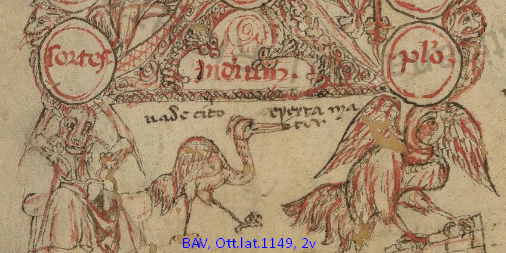
  1. Ott.lat.1149, a 15th-century manuscript of Boethius on the Isagoge of Porphyry with an unusual arbor porphyriana with a monkey in the crown, and animals in and around the branches.
    Hermann Schadt (Die Darstellungen der Arbores, p. 82) says the older arbor porphyriana drawings are simple line diagrams and this is one of the first to be made tree like. My readers know that just because something is called an arbor, it need not look like a tree. The association is simply that arbor is a medieval word for a recursive diagram (perhaps because trees preserve shape during growth). Also, as Schadt notes on page 81, this may be a pun in the Visigothic language, where arbi meant inheritance, hence the word-play arbor juris for an inheritance diagram.
  2. Ott.lat.2844
  3. Reg.lat.1133
  4. Reg.lat.1165
  5. Reg.lat.1231
  6. Reg.lat.1254
  7. Reg.lat.1255
  8. Reg.lat.1279
  9. Reg.lat.1286
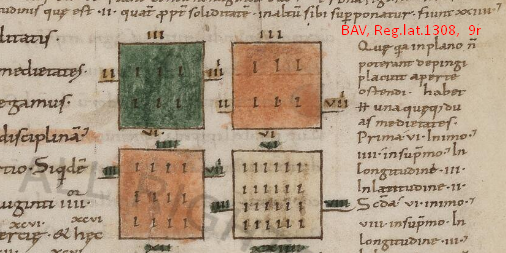
  10. Reg.lat.1308, above
  11. Reg.lat.1311
  12. Reg.lat.1317
  13. Reg.lat.1322
  14. Reg.lat.1323
  15. Reg.lat.1327
  16. Reg.lat.1333
  17. Reg.lat.1336
  18. Reg.lat.1372
  19. Reg.lat.1386
  20. Reg.lat.1414
  21. Reg.lat.1441
  22. Reg.lat.1443
  23. Sbath.586
  24. Vat.lat.1796
  25. Vat.lat.1886
  26. Vat.lat.1963
  27. Vat.lat.2025
  28. Vat.lat.2033
  29. Vat.lat.2036
  30. Vat.lat.2037
  31. Vat.lat.2039
  32. Vat.lat.2082
  33. Vat.lat.2096
  34. Vat.lat.2102
  35. Vat.lat.2105
  36. Vat.lat.2107
  37. Vat.lat.2108
  38. Vat.lat.2109
  39. Vat.lat.2111
  40. Vat.lat.2117
  41. Vat.lat.2142
  42. Vat.lat.2165
  43. Vat.lat.2176
  44. Vat.lat.2177
  45. Vat.lat.2192.pt.1
  46. Vat.lat.2192.pt.2
  47. Vat.lat.2192.pt.3
  48. Vat.lat.14926
Come back Friday for a list of the recent digitizations of Bibliotheca Palatina manuscripts at the Vatican.

This is Piggin's Unofficial List number 129. If you have corrections or additions, please use the comments box below. Follow me on Twitter (@JBPiggin) for news of more additions to DigiVatLib.

2017-10-02

Falsigrafia

Making mistakes was part of the scribe's day, so knives were always at the ready to scrape off a duff letter or word. Messing up a diagram was harder to fix.

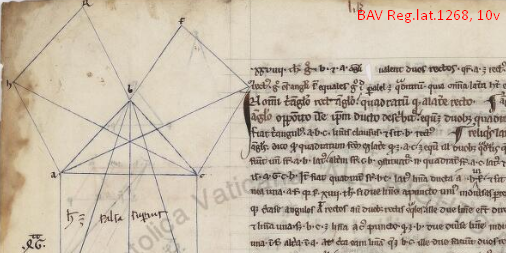
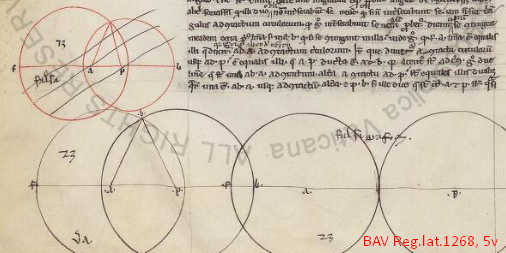
In his Album of Science I, John Murdoch highlighted corrections in a Vatican manuscript of Euclid, Reg.lat.1268, which came online in color a few days ago. Since last year it had only been available in murky black and white. Below is Murdoch's always readable discussion of these diagrams:

The Greek, Arabic, and especially medieval Latin manuscripts of Euclid's Elements and other geometrical works are for the most part accompanied by quite adequate figures, in some instances drawn with an accuracy and elegance—often with different colors—that rival and even surpass the best efforts of modern printing. In a few cases, however, this graphic excellence is found wanting. Two instances of such falsigrafia—a medieval term that covered not only wrongly drawn diagrams but wrongly constructed arguments as well—are given here, both from a fourteenth-century copy of an anonymous version of the Elements. That on the top [...] is the relevant figure for the Pythagorean theorem (Book I, Prop. 46; I, 47 in the Greek). Its problem is that two rhombuses have been drawn above on the legs of the right triangle in place of the requisite squares, a fact that is duly noted by the inscription written across the diagram reading: “this is false above” (hec est falsa superius). The example below (to I, 23) is more involved. Two attempts made by the scribe to provide a proper figure have proved abortive. At the lower right of this diagram we see touching instead of intersecting circles; this is appropriately labeled falsigrafium. A second attempt— scratched out and called falsa at the top left of the same diagram—erred in drawing the straight lines from the point of intersection of the circles to points A and P, which are not, as they should be, the respective centers of the two circles. They are that in the third, successful, attempt to produce a correct figure, here appearing at the bottom left. From: Murdoch, John E. Album of Science: Antiquity and the Middle Ages (New York: Scribner, 1984), illustration 115.
Murdoch also comments on two other diagrams from the same manuscript, which he presents as Illustrations 113 (how Latin translations of Euclid tended to overdo diagrams, fol 21v) and 122 (how a dodecahedron was drawn in two dimensions, fol 133r).

Here are the latest 27 manuscripts to come online for the first time at the DigiVatLib site:
  1. Barb.lat.3729 :
  2. Reg.lat.180 :
  3. Reg.lat.490 :
  4. Reg.lat.1083 :
  5. Reg.lat.1143 : eTK, a ninth-century Hippocrates, Constitutas sunt venas in corpore. See Kibre, Pearl, 1903-1985 Hippocrates Latinus: Repertorium of Hippocratic Writings in the Latin Middle Ages.
  6. Reg.lat.1149 :
  7. Reg.lat.1164 :
  8. Reg.lat.1223 :
  9. Reg.lat.1228 :
  10. Reg.lat.1230 :
  11. Reg.lat.1237 :
  12. Reg.lat.1258 :
  13. Reg.lat.1273 :
  14. Reg.lat.1274 :
  15. Reg.lat.1277 :
  16. Reg.lat.1285 :
  17. Reg.lat.1295 :
  18. Reg.lat.1299 :
  19. Reg.lat.1301 :
  20. Reg.lat.1310 :
  21. Reg.lat.1374 :
  22. Vat.lat.2064 :
  23. Vat.lat.2084 :
  24. Vat.lat.2103 :
  25. Vat.lat.2126 :
  26. Vat.lat.13391 :
  27. Vat.lat.14721: Iacobus de Marchia (1394-1476), Auctoritates doctorum de sanguine Christi.
This is Piggin's Unofficial List number 129. If you have corrections or additions, please use the comments box below. Follow me on Twitter (@JBPiggin) for news of more additions to DigiVatLib.

2017-09-25

Humanist's Astronomy Book

The personal library of the great Florentine humanist Coluccio Salutati (1331-1406) was scattered after his death. It remains a thing of fascination for every scholar. It's the definitive overview of what an early Renaissance man with the income to buy books read, with Coluccio's own notes scattered in the margins.

Coluccio's private copy of the Great Stemma formed for a while the title picture on my Twitter account. (I replaced it with the current gaudy recreation because parchmenty pictures don't work as panoramas.)

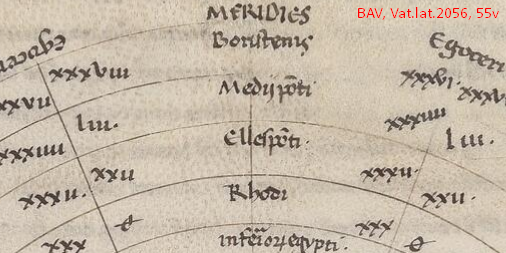
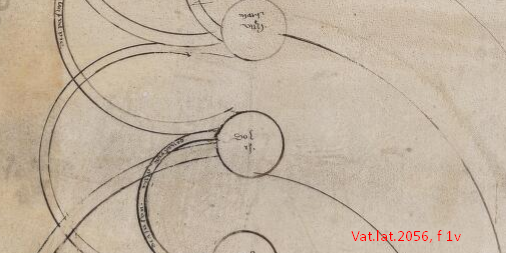
Thanks to digitization a good many of his books are now online to inspect.A real treasure among their number is Collucio's private copy (in Latin) of the Almagest by Ptolemy the Geographer, Vat.lat.2056, which has just arrived online at the Vatican Library digital portal.The diagrams are fascinating. The first image below is from a celebrated rota used by astrologers; you can read off the climates here, starting with the mouth of the Dniepr at top:

We continue to wait for Vatican's DigiVatLib to do color versions of the Florentine notary's books, such as his Seneca, Reg.lat.1391, which is still only available in black and white.
  1. Reg.lat.675
  2. Reg.lat.901
  3. Reg.lat.997
  4. Reg.lat.1072
  5. Reg.lat.1082
  6. Reg.lat.1110
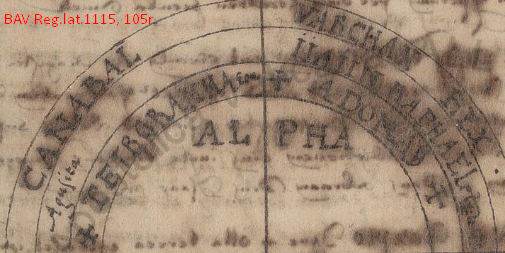
  7. Reg.lat.1115, a major compendium of magic (Jacobus Faber Stapulensis), astrology and astronomy (John of Glogau); this was on the site in murky black and white, but is new in color; a vital improvement since it is far from easily legible. See eTK for contents.
  8. Reg.lat.1119
  9. Reg.lat.1122
  10. Reg.lat.1126
  11. Reg.lat.1144
  12. Reg.lat.1152
  13. Reg.lat.1156
  14. Reg.lat.1159
  15. Reg.lat.1160
  16. Reg.lat.1161
  17. Reg.lat.1162
  18. Reg.lat.1170
  19. Reg.lat.1184
  20. Reg.lat.1196
  21. Reg.lat.1207
  22. Reg.lat.1226
  23. Reg.lat.1234
  24. Reg.lat.1246
  25. Reg.lat.1257
  26. Reg.lat.1266
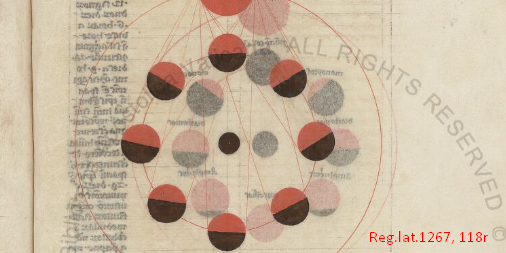
  27. Reg.lat.1267, contains the only complete text of Dracontius, the African author, and his Satisfactio. One of the Beneventan script examples compiled by Lowe (and a prime exhibit in a mistaken theory that Visigothic and Benevantan script are linked), it is composed of different parts, miniscule at first, then Beneventan from folio 139:
    1. Euclid, Boethius, ff 1-135, 13th century, including the glorious diagram below
    2. Beda, ff 136-138, 11th century
    3. Calendarial matter, ff. 139-140v and part of 143, 9th-10th century
    4. Versus Marci Poetae de S. Benedicto, ff 141v-142v, 10th century 
    5. Dracontius, Satisfactio, ff  143v-150v, 9th-10th century 
  28. Reg.lat.1269
  29. Reg.lat.1275
  30. Reg.lat.1289
  31. Vat.lat.1927
  32. Vat.lat.1944
  33. Vat.lat.1954
  34. Vat.lat.1956
  35. Vat.lat.1965
  36. Vat.lat.1980
  37. Vat.lat.1982
  38. Vat.lat.1987
  39. Vat.lat.1999
  40. Vat.lat.2006
  41. Vat.lat.2007
  42. Vat.lat.2024
  43. Vat.lat.2032
  44. Vat.lat.2042
  45. Vat.lat.2046
  46. Vat.lat.2047
  47. Vat.lat.2056, Ptolemy's Almagest, see above
  48. Vat.lat.2069
  49. Vat.lat.9484
  50. Vat.lat.15399
This is Piggin's Unofficial List number 128. If you have corrections or additions, please use the comments box below. Follow me on Twitter (@JBPiggin) for news of more additions to DigiVatLib.