2012-11-10

Wooden Horse

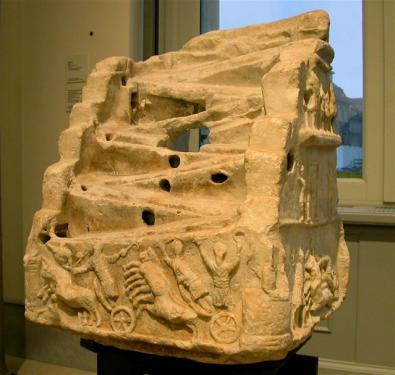
An equi lignei gaming machine (photo and original) found near the hippodrome in Constantinople (Istanbul) is one of the treasures of the Bode Museum in Berlin. It seems to be one of the class of devices outlawed in 534 by the emperor Justinian:
Prohibemus etiam, ne sint equi lignei: sed si quis ex hac occasione vincitur, hoc ipse recuperaret: domibus eorum publicatis, ubi haec reperiuntur. (Text link.) Translation: We also prohibit (the game with) wooden horses; if any one loses in it, he may recover the loss. The houses of those where these games are played shall be confiscated. (English translation by Fred Blume: link.)
Now plainly these wooden horses are not the sort used in the Greek capture of Troy, nor the sort that may have been vaulted over during Graeco-Roman gymnastic exercises. The museum has an online description of the item, which has exhibit number Ident.Nr. 1895, and a public image (bigger on the museum site):


This is a gaming machine. A commentary quoted on the museum page says the players placed four differently coloured marbles and let them run down through the holes. The marble which emerged first from the last hole produced a win for whoever had placed his bet on it. When this legal commentary was written is unclear.

The marble run or ball run in Berlin dates from about 500 and is a luxury stone-carved version of the machine. The marble is richly sculpted on the exterior with reliefs depicting the excitement of chariot racing: statues of horses, flute (aulos) players, men raising a banner, racetrack employees operating the draw for the teams and the start of a chariot race. The races appear to be conducted among teams of four horses, which was a passion among the people of Constantinople.

Jan Reichow refers to an account by the scholar Diether Roderich Reinsch and a museum guide by Arne Effenberger, quoted without page numbers or a proper bibliographic reference. The scholars appear to concur that the device was not a toy for a princeling but a capital investment for an entrepreneur in the equi lignei gambling trade, with the decoration on it conferring luxury and prestige, rather like the croupiers in casinos wearing tuxedos and bow ties to make the whole squalid experience seem as if it is high-class.

I made several marble runs from corrugated cardboard when I was about 10, and made another later as a father to amuse my sons. The frame was a cardboard carton and the tracks were strips of cardboard bent into V-cross-sections. With a box-cutter knife, I cut triangular holes in the carton to fit the tracks so that the marble could run through each track in succession. Children love marble runs, and this sort is easy to make and easy to recycle through the paper bank.

What makes a good marble run fun, until you have figured it out, is the unexpected way that the marble pops out on all sides of the block, rather like a mole showing up from a tunnel at an unexpected spot in my garden.

In my study of infographic history, the equi lignei device in Berlin firstly drew my attention because I wondered if its Late Antique users would have developed a scientific analysis of the path run through the device by the marble. An image on craft2eu.blog.de shows little holes at the side: it is not entirely clear if these are merely windows to show the players how far the marble has advanced or if these are exits for marbles that have been thrown out of the race:

Certainly some kind of mental projection of a path is a prerequisite for understanding a graph or a complex infographic like the Great Stemma.

The second aspect of interest is the illusionist potential of a marble run. Its operations are amusing because the marble can emerge, or at least be seen, where it is not expected. The marble seems to violate the rules of space by appearing magic-fashion in all sorts of unlikely places. It disrupts our sense of normal space. Some of the organization of the Great Stemma also breaks the rules of vision and is therefore slightly illusionist.

The marble run in Berlin at least confirms that the Late Antique world had a degree of experience with technical inventions that bent the rules of perception and vision when dealing with paths. This connects to the interesting technical guides by Hero of Alexandria including the one on ways to fake miracles in temples. These books were the subject of a post last year by Roger Pearse and there are links to the editions on the Wilbour Hall site.

2012-11-07

The Tamar Storyboard

I've been studying a curious little flow-chart embedded in the Great Stemma of the Morgan Beatus that describes  Tamar's lucky-on-the-third-shot pregnancy in Genesis 38.

A revisor has added to this diagram a visualization of his own creation for one of the strangest sexual scandals in the Bible story, Tamar's seduction of Judah while pretending to be a veiled prostitute.

Tamar had been married to Judah's eldest son, Er. After she was widowed, Judah's second son Onan had sex with her but employed a crude form of contraception. Tamar then used a ruse to seduce her lecherous father in law and became pregnant. Her twin sons are either the sons or the grandsons of Judah, depending on your interpretation of this soap-opera plot.

Whether Shua, the wife of Judah, accepted this unusual family constellation is not recorded in Genesis, but the revisor devised the following compact visual summary of the story which retains for Shuah the place of honour in the emotionally tangled Judah household. It appears in flow-chart fashion in the Morgan Beatus like this: 

Leah
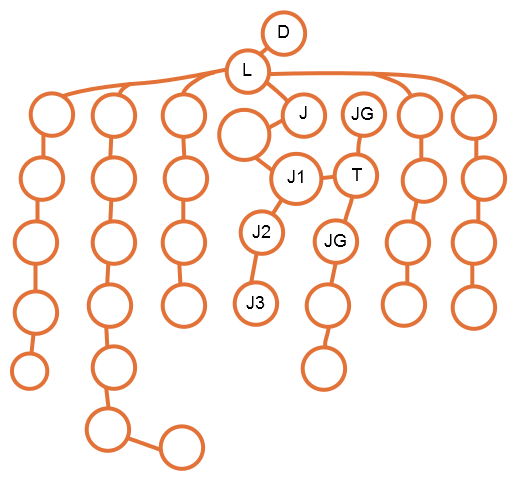
I have left out the text and instead used letters to mark the characters. Here, J is Judah, J1 and J2 are his first and second sons Er and Onan, and T is Tamar. Her twin children are marked JG, since the text marks them as sons of Judah and ambo gemini. Having the two twins arrayed in symmetry either side of their mother is a neat trick.

Perhaps it was Maius himself, the scribe-scholar who was in charge of making M 644 at the Morgan Library in New York, who devised this little flow chart. The roundel intervening between J and J1 is Shua, Judah's wife.

This addition, thus arranged, is only found in one other manuscript of the diagram, that made 100 years later by Facundus for King Fernando and Queen Sancha of León.

The whole group in the above sketch is composed of the six sons and daughter Dinah (D) of Leah (L). Links to online views of the manuscripts can be found on my manuscripts page.

2012-09-23

Farewell Hippolytus

In the past day I have been re-analysing some of the data which I examined and proceeded to describe two years ago in a blog post entitled Setback or Progress. At that time I was trying to discover the source of manuscript data which portrayed different ethnicities of the western world as tribal descendants of the biblical patriarch Noah. I was able to establish that this data was not part of the original version of the Great Stemma.

In the course of that research I took a closer look at the Chronicle (about 235 AD) of Hippolytus of Rome and formed the mistaken impression that Hippolytus had been a believer in a certain inflated and baroque chronology which had been abstracted from the biblical Book of Judges by an early Christian or Jewish chronographer.

Finding one's way among the subtle differences in Antique chronography (which is only preserved in fragmentary manuscripts based on repeated revisions of the original works) is an immensely tedious and complex affair which has never been the main focus of my research. The modern scholarly analysis of this material often employs elaborate arguments which magnify the faintest of evidence to arrive at some kind of usable conclusion.

In this case, much of the argument turns on how many phases make up the Book of Judges chronology and which phases were included. My Studia Patristica article, which is already in press, states:
Distinctively Hippolytan elements in the account can be found for example in the period from Joshua to Eli inclusive, which is divided by the Great Stemma into 22 political phases. Hippolytan features here include the rule of an apocryphal judge Shamgar (6th phase) and his alter ego Samera (21st). Both phases were witnessed as present in the Great Stemma when it was seen by the author of the Liber Genealogus in 427, whereas their existence had been firmly ruled out by Eusebius. This would suggest that the author was either hostile to or ignorant of Eusebius.
However I have now read and re-read Rudolf Helm's 1955 edition of the Hippolytus Chronicle (particularly pages 164-167) and understood that (at least in the editor Helm's view), Hippolytus divided the period (Joshua to Eli inclusive) into only 20 phases and excluded the rule of an apocryphal judge Shamgar (6th phase) and his alter ego Samera (21st). These are tiny distinctions, but are enough to derail the argument that Hippolytus was involved.

Farewell Hippolytus: you are no longer on the Great Stemma team.

I have duly changed the page on my website that deals with the matter. In the Studia Patristica article, which can no longer be altered, I would now want to say that there are elements in the diagram which clash with the theories of Eusebius and plainly come from an older, as-yet unidentified chronographer. The misidentification of that chronographer as Hippolytus is a very minor issue, and does not in any way weaken the main thrust of the article: that the Liber Genealogus is a description of an early version of the Great Stemma diagram.

The necessary conclusion after dumping Hippolytus is that some other chronological tradition influenced the Great Stemma. Perhaps the chronographer involved was Julius Africanus, perhaps not. I am not intending to research the issue further. If my error proves to be the stalking horse for a future scholarly article by a specialist, so much the better. I would welcome scholars in the history-of-chronography field taking up the matter and giving it a thorough review.

2012-08-12

Subway Map

A nice piece appeared Monday in the International Herald Tribune on the 1972-79 New York City Subway Diagram. Alice Rawsthorn tells us that that the diagram was re-activated this year on the Weekender, a page that alerts travellers to weekend construction and maintenance work on the train system:

Some diagrams fail because they do not offer any advantages over existing methods: a very small "family tree" which only covers two generations – a person and their parents – provides no benefit compared to describing the family verbally. Others fail because they over-reach themselves. 

New York City's Metropolitan Transportation Authority introduced a system diagram designed by Massimo Vignelli in 1972. It was based on Harry Beck's 1931 design for the London Underground. But New York City's rail engineers had built a system that could not be well diagrammed. The tangle of rail lines built through Lower Manhattan remained a tangle despite being schematized; the artwork was cluttered; worst of all, the design failed to connect to pre-existing mental representations of the city's bizarre geography. The MTA retired the Vignelli diagram in 1979 in the face of public criticism. 

New York City's current subway diagram, which is like a skin superimposed on a simplified map of the city, is an easier connect between its designer and its readers. Even tourists find it easier to find their way with the current map.

2012-07-27

Books of the Bible

I have chanced on a curious medieval infographic showing all the books of the Old Testament in stemmatic fashion, an idea that goes back to Cassiodorus (see my Cassiodorus abstract). The drawing, discovered with the help of Digital Scriptorium, is in the Lawrence Library at the University of Kansas and available in a high-resolution image.

It shows God as the origin node at the top, forking to the various books, for example the Pentateuch as a group of five at the top left, and employing trunk connectors below to connect the books of the prophets. The colours and style recall the Great Stemma.


The bibliographic information places the document (f. 2v of MS 9/2:29) in the 13th or 14th centuries and it is on the back of the final page of a Peter of Poitiers Compendium (see my list). It appears to be a continuation of the Compendium by the same scribe/artist. In the bibliographic description, the library considers it to be French.

2012-07-19

Finding Bernhard Pez

Bound into Heinrich Brauer's papers on the Compendium of Peter of Poitiers (the subject of my preceding blog post) is a library research report dated 1951 May 9 compiling reference-book data on this 12th-century work. It was drawn up by the Staatsbibliothek (then the Öffentliche Wissenschaftliche Bibliothek in the Soviet-controlled sector of Berlin).

It is evidence of the industrious help that could once be obtained from research library staff, back in the days before the budgets of such institutions were cut. Brauer was living and working in Celle, half a day's train ride from Berlin, but was able to save himself the trip to Berlin by simply writing and asking for an "Auskunft". We are immeasurably better off nowadays with the instant access available via the internet.

The reply from Berlin is of no great scholarly value and is defective in not containing any mention of the principal survey of Peter's work then in print, that published by Moore in 1930. The librarian also promises to inquire at other German libraries, but as there is no letter on file with any such results, this probably led nowhere. However one of its references, to Bernhard Pez, caught my eye.

The compilation duly mentions the editio princeps by Zwingli the younger published in 1592 in Basle and quotes from a series of reference works:
  • Georgi: Allgemeines europäisches Bücherlexikon
  • Jocher: Allgeneines Gelehrten-Lexikon
  • Nomenclator literarius theologiae catholicae
  • Wetzer und Welte: Kirchenlexikon
  • The Catholic Encyclopedia
  • Histoire littéraire de la France, vol 16
The last of these can be consulted on Google Books and the librarian quotes its mention of an edition by Pez based on the manuscript from "Metsen" in the diocese of Passau, Bavaria. This is a misprint or authorial error for the Benedictine house Kloster Metten.

Bernhard Pez was the librarian of the Benedictine abbey of Melk in Austria and volume 1 (published in 1721) of his Thesaurus anecdotorum novissimus notes that he found a copy of the Compendium in the monastic library during a visit to Metten. The Thesaurus has been digitized by the MDZ (click on the link and go to page 59 of the scan). A researcher has usefully added the handwritten information that the Compendium is at folio 101 of the codex, and Pez states:
Petri Pictaviensis Compendium historie veteris ac novi Testamenti, quod incipit: considerans historiae sacrae prolixitatem etc.
One presumes this manuscript is now in the state library in Munich.

2012-07-17

Study in 1951 of a Peter Roll


Heinrich Brauer, a German art historian, undertook a transcription in 1951 of a roll version of Peter of Poitiers' Compendium. As far as I know this typewritten text (the first modern edition since that by Ulrich Zwingli?)* has never been published. The only known copy is deposited at the Herzog August Bibliothek (HAB) in Wolfenbüttel, Germany. I interloaned it last week for a look.

Brauer seems to have included both rolls, Blankenburg 305 and Blank.305a, in an exhibition he organized at Celle Palace, where he was art curator and the transcription and correspondence were apparently part of his work as a public official. The letters may be of some wider interest and I am therefore providing an English translation. Both were addressed to Erhart Kästner, director of the HAB.

The first of the letters from the Kunstgutlager in Schloss Celle was dated 1951 June 18:
 

Dear Dr Kästner,
I ought to have reported back much sooner on my work on the Stemma of Christ manuscript rolls kindly loaned to me by the Wolfenbüttel Library. I would ask you to let me keep the two rolls for a little longer. I completed the transcription of the text some time ago and I am sending it to you to give you some idea, although it is obviously in need of improvement.
We are preparing to hold an exhibition on "Applied Arts and Manuscripts of the 15th century (Kunsthandwerk und Handschriften des 15. Jahrhunderts)". I had been thinking of asking you to permit the Wolfenbüttel rolls to be exhibited in this show, but did not know if a suitable placement would emerge for them. 

I now realize that both can be very well displayed as part of the overall context, which is why I have waited until today to ask for an extension of the loan. We will also be obtaining a pictorial tapestry from Wienhausen for the exhibition, and the rest will come from the stock of the Kunstgutlager, enabling us to assemble quite an impressive show. The inauguration is to take place on July 8 and I hope I will see you then here in Celle.
With best wishes, also to Dr Butzmann,
Greetings and thanks,
H. Brauer

The second is dated 1951 October 8:


Dear Dr Kästner,
When the manuscripts loaned from you were returned I was delighted to hear that my transcription of Blanc 305 ended up with Dr Butzmann. I have now been able to improve the text in many places with the help of the printed edition of 1592.
Blanc 305 and the unnumbered roll contain the same text, which begins with the word "Considerans ..." (....) and is attributed to Petrus Pictaviensis (chancellor of the University of Paris from 1192, died 1205). His works are printed in Migne PL 221 but there is no mention of the Considerans text. 

The Royal Library in Brussels has nine copies of this text, with a person called Gallus listed as the author. The British Museum catalogue names the author as Petrus Pictaviensis or Petrus Comestor without deciding the point. A manuscript (number 128) of the same text from the middle of the 13th century can be found at Admont and is entitled "Ottonis de S. Blasio Chronika prima", cf. Verzeichnis IV,1, editor Buberl (Leipzig, 1911), with two images of it. Buberl: "probably done in Salzburg".
Its script along with the characteristic initials is very similar to Blanc 305. I would therefore propose that Wolfenbüttel parchment roll Blanc 305 of the Stemma of Christ is also a product of Salzburg from the middle of the 13th century.
The paper roll without any Wolfenbüttel number is signed at the end by the scribe: "Pater Gallus presbyter ordinis Sancti Benedicti, Conventualis monasterii Sancti Galli." When I inquired to (the monastery of) Maria Laach, Rev. Dr. Volk replied:

The P. Gallus whose name is in the photo was Father Gallus Kemly of St Gall, born 1417 Nov 18, died soon after 1477. From 1465 he copied P. Comestor, Historia scholastica (i.e. Ms 605 of the St. Gall Library) as well as Excerpta ex historia scholastica et vitis patrum (i.e. Ms 607 of the St. Gall Library); cf. R. Henggeler, Professbuch der fürstl. Benediktinerabtei der Heiligen Gallus und Otmar zu St. Gallen, Zug, 1929, pages 234-236.
I understand the Considerans text circulated widely: it was translated into French, English and German (perhaps into Spanish and Czech too) and was often extended and revised. It is conceived for the education of students and is not just theological in purpose but is at the same time a tabulation of history as well, rather like our Plötz**. It employs Scripture as an historical source and its author sees no dilemma between faith and scholarship.
The text always accompanies the genealogical tables and is often employed as an introduction to the Historia scholastica of Petrus Comestor Trecensis although it contrasts strangely with that wholly theological work. A manuscript in Munich from Metten combines the Considerans text with the Biblia pauperum. Its scribe recognizes its historiographic character since he includes with it the Chronicle of Popes and Emperors of Martinus Polonus of Troppau. This may have been done in the 14th century. The Stemma of Christ precedes the Diadocheen of the Popes, with the emperors laid out in parallel, leading back via Caesar, Alexander, Darius, Cyrus, Nebuchadnezzar by a circuitous route to the archaic parents. It provides an historical vision of monumental simplicity.
We find it in the printed Universal Chronicles such as the Rudimentum of Lübeck of 1475, the Fasciculum temporum of Cologne by Rolevink of 1474 and the Chronicle of Schedel of 1493, which all derive from the Considerans text and even give it as their source. The Lübeck one names the author as Petrus Trecensis. Rolevink names Isidore, not for the entirety, but, as the context shows, as author of a short work dealing with the period of the Old Testament, which is namely our text.
Yours,
Dr. H. Brauer


Schloss Celle, a former royal palace in Celle, north of Hanover, seems to have hosted a large store of displaced art. Brauer's entry in the Katalog der Deutschen Nationalbibliothek indicates a date of birth of 1900 (data 1, data 2), while the German Archaeology Society indicates he died in 1983 (notice). He was an associate of Rudolf Wittkower (subject of a previous post), but I do not know anything else about him.

* [In fact the third: see my listing. Note added 2015]
** Der Große Ploetz, a standard reference book for German secondary schools by Karl Ploetz (1819-1881) which was in print from 1855 to 2008.