2016-06-08

Philosophical Battles

A curious 15th-century manuscript by George Trebizond, a translation of John Chrysostom's Commentary on the Gospel of Matthew, features in the latest BAV digitizations.

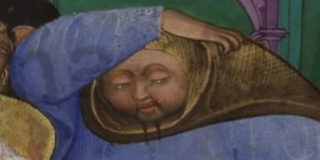
This codex featured last century in the Rome Reborn exhibition in the United States and is the dedication copy for Pope Nicolas V, actually depicting Trebizond (who was papal secretary) kneeling to present it to the pope. The bearded cardinal in pale blue in the image is Basilios Bessarion, also a Greek scholar from the city of Trebizond, who was George's arch-enemy on philosophical issues:
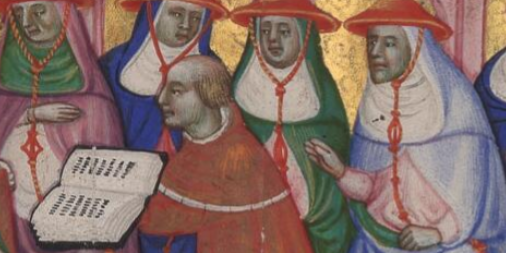
Both men had made it to the top in Rome by not being old Italian males, but minority candidates. It was a time when the papacy was eager to assert leadership over Greeks. George was an ardent Aristotelean, whereas Bessarion was a convinced Platonist. Their fierce battles and vituperation appear to have highly entertained 15th-century Rome. Check out Anthony Grafton's catalog for more.

The 64 new arrivals are documented on the old index page (which posts a total of 4,535 digitizations), but I was at first unable to actually examine them. None of the new arrivals was visible on the new public interface (which posted a total of only 4,307 as of June 8, 2016). The following full list was gradually annotated later.
  1. Borg.cin.403,
  2. Chig.R.V.29,
  3. Ott.lat.3124,
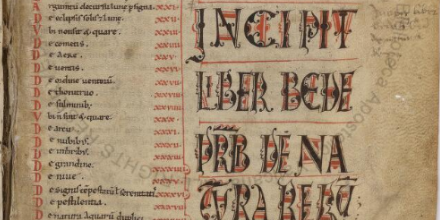
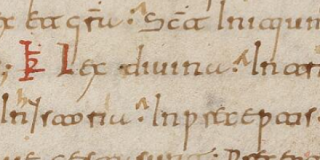
  4. Reg.lat.708, Venerable Bede, Eucherius of Lyon, Haimo of Auxerre with flyleaves containing some of Isidore, Sententiae, in Visigothic script (partly transcribed by Ullman and Brown:
  5. Ross.1169.pt.C,
  6. Vat.ebr.231,
  7. Vat.ebr.233,
  8. Vat.lat.107,
  9. Vat.lat.162,
  10. Vat.lat.364,
  11. Vat.lat.371,
  12. Vat.lat.372,
  13. Vat.lat.385, In evangelium s. Matthei commentarius by John Chrysostom, a Latin translation by George Trebizond (above).
  14. Vat.lat.472,
  15. Vat.lat.501,
  16. Vat.lat.549,
  17. Vat.lat.619,
  18. Vat.lat.620,
  19. Vat.lat.628,
  20. Vat.lat.629,
  21. Vat.lat.642, Bede, astronomy, but with no diagrams as far as I can see. This is a fairly important source of De natura rerum, De temporibus and De temporum ratione made in Lyon, France in about 1100, and includes the lunaria. Most of Bede's works are represented by many manuscripts, but this one, sometimes given the sign "V" is consulted for variations.
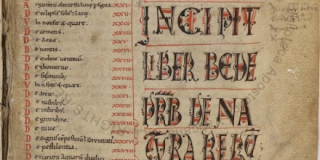
  22. Vat.lat.645, Twitter user @LitteraCarolina points out this chronicle contains entries at fol. 32v recording capture of Louis IV by (pagan) Normans and the death of Duke Heribert in 945–6.
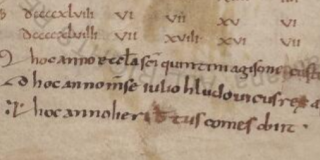
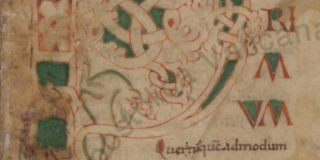
  23. Vat.lat.653, Haimo of Auxerre, commentary on the Epistles of Paul, in a hand described by Michael Gorman (2002) as romanesca (Lindsay's Farfa type). He writes: 11th century, from a monastery dedicated to Benedict and Scholastica, perhaps Subiaco. Gorman argues this was copied from a Vorlage from the Abbey of Monte Amiata in Tuscany. (Incidentally, the BAV bibliography only lists the Italian translation of Gorman's article, not the English original.) Here is part of the ornate initial P on fol. Ir:
  24. Vat.lat.657,
  25. Vat.lat.660,
  26. Vat.lat.662,
  27. Vat.lat.663,
  28. Vat.lat.666,
  29. Vat.lat.667,
  30. Vat.lat.668,
  31. Vat.lat.676,
  32. Vat.lat.677,
  33. Vat.lat.678,
  34. Vat.lat.682,
  35. Vat.lat.683,
  36. Vat.lat.688,
  37. Vat.lat.698,
  38. Vat.lat.702,
  39. Vat.lat.704,
  40. Vat.lat.710, Albertus Magnus, Summa
  41. Vat.lat.714,
  42. Vat.lat.720,
  43. Vat.lat.728,
  44. Vat.lat.734,
  45. Vat.lat.736,
  46. Vat.lat.737,
  47. Vat.lat.746.pt.1, Thomas Aquinas, Summa, part iii
  48. Vat.lat.746.pt.2,
  49. Vat.lat.750,
  50. Vat.lat.755,
  51. Vat.lat.756,
  52. Vat.lat.757,
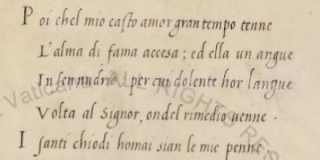
  53. Vat.lat.3195, Petrarch, incipit "amor piangena ..."
  54. Vat.lat.5029, Cristobal de Cabrera, 1513-1598: De excellentia et mirabilibus altissimi Sacramenti Eucharistiae 
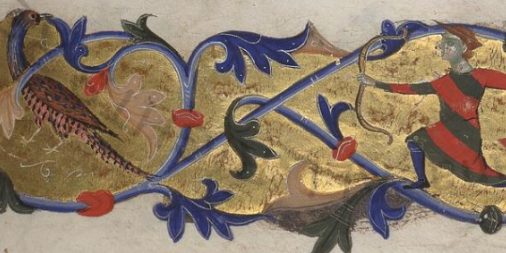
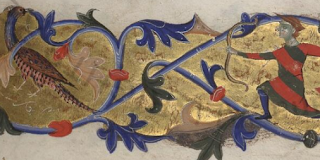
  55. Vat.lat.6069, master illuminations like this on folio 43r
  56. Vat.lat.7618,
  57. Vat.lat.8205,
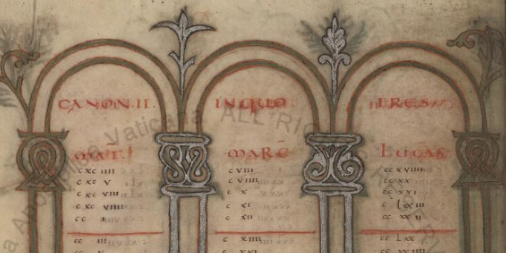
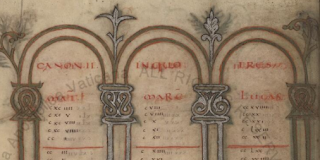
  58. Vat.lat.8523, fine gospels book with these canon tables:
  59. Vat.lat.9327,
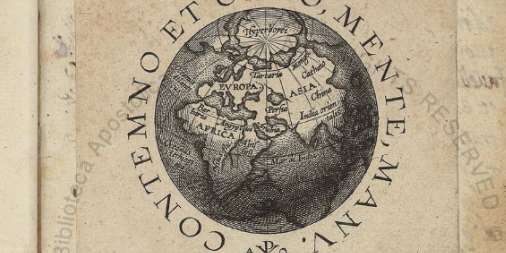
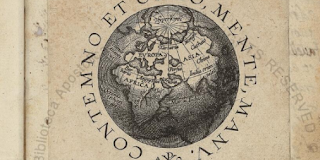
  60. Vat.lat.9385, Tasso, with this fine engraving of the globe by Abraham Ortelius at folio 18r
  61. Vat.lat.9972, heavily annotated Tasso incubable
  62. Vat.lat.10477, Catalog of the library of Pope Clement XI.
  63. Vat.lat.10485, Further listings concerned with the same library
  64. Vat.lat.10999, Lives of Saints
This is Piggin's Unofficial List number 52. If you have corrections or additions, please use the comments box below. Follow me on Twitter (@JBPiggin) for news of more additions to Digita Vaticana.

2016-06-04

The Housewife

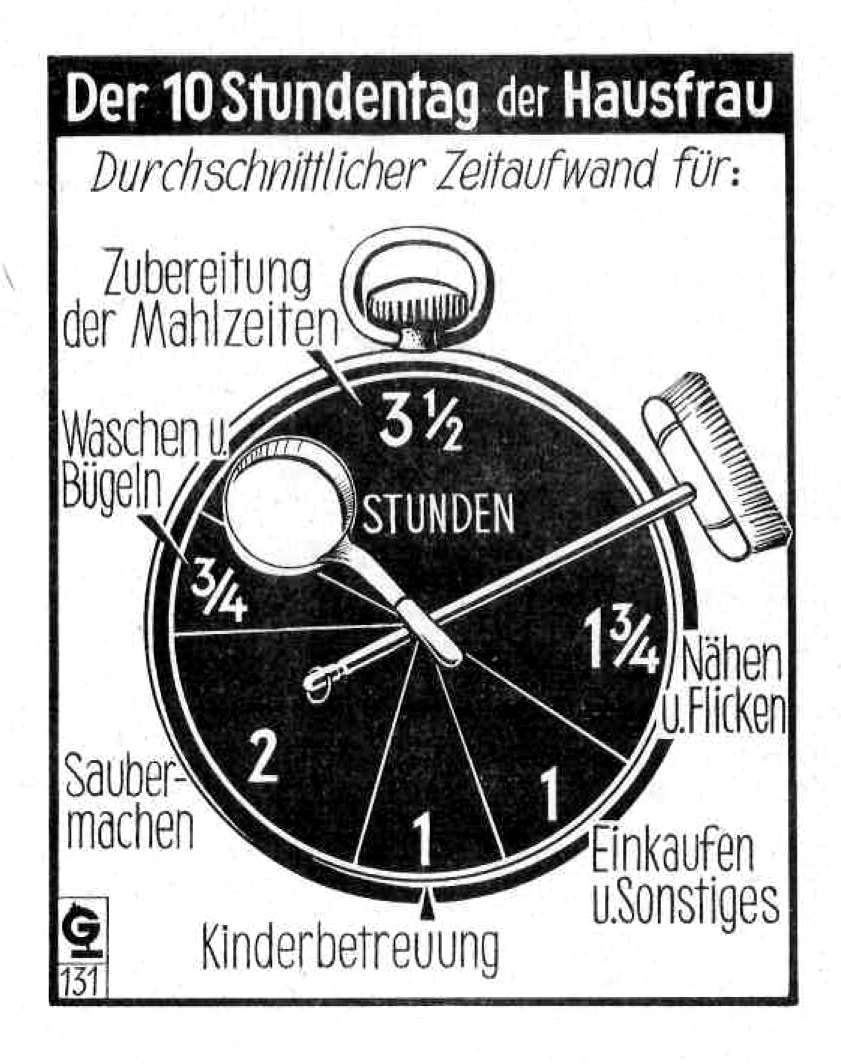
Back in 1960, Globus, the syndicated infographics agency in Germany, ran this remarkable visual analysis of what a German housewife did with her 10-hour working day.
Image: obs/dpa Deutsche Presse-Agentur GmbH
Globus, which was founded in 1946, just after the Second World War, has just republished this in a media release to mark its 70th anniversary and the design rewards some analysis. The graph is the much-aligned pie chart design, which some critics claim is misleading as a visualization of data, but here it works perfectly well.

Because Globus worked mainly for the educational market rather than news media, it was vulnerable to one of those folk fallacies which holds that narrative symbols are easier to understand than synthetic ones. That is why it converted the perfectly good pie chart into a fob watch (people still had those in 1960) and added a skillet and broom for good measure.

The data itself is intriguing. In 1960, German women as in many other nations had "returned to the home" 15 years after the war's end amid a sentiment that this made it easier for men to find work, but a patronizing, even nasty tone towards the "common housewife" was common in news broadcasts of the era. What stands out here is that there was a massive amount of work in keeping a household.

An hour and a quarter of the average day was spent sewing and repairing, an extraordinary effort in the eyes of young moderns who just discard clothing when it tears or gets a hole in it. But I grew up in that era and it was a matter of course to darn socks, fix hems and sew on buttons. We even inspected clothes while buying them to judge how solidly the factory had done the buttonholes.

The two hours spent house-cleaning and the three and a half hours spent cooking indicate the time cost before home appliances were widespread. The hour a day shopping was another inefficiency that my own New Zealand mother had no time for in the 1960s. She phoned her orders to the grocer and had them delivered, and would have been delighted with today's online food.

2016-06-02

Infographics in Germany

The history of infographics in Germany is more closely tied to education than to the news media. The country's main syndicated infographics agency, Globus, was founded on 27 June 1946, just after the Second World War and had a large business supplying both textbook publishers and schools with maps and graphics. Its early hand-drawn work merits attention by everyone interested in data visualization history.

This month, Globus (now a subsidiary of dpa-infografik GmbH, part of the dpa news group -- statement of interest: dpa is my employer) is marking its 70th anniversary by re-releasing in its weekly packages for educational subscribers some of its early work. The media release today includes samples that reward a closer look, both for their focussed design and their historical circumstances.

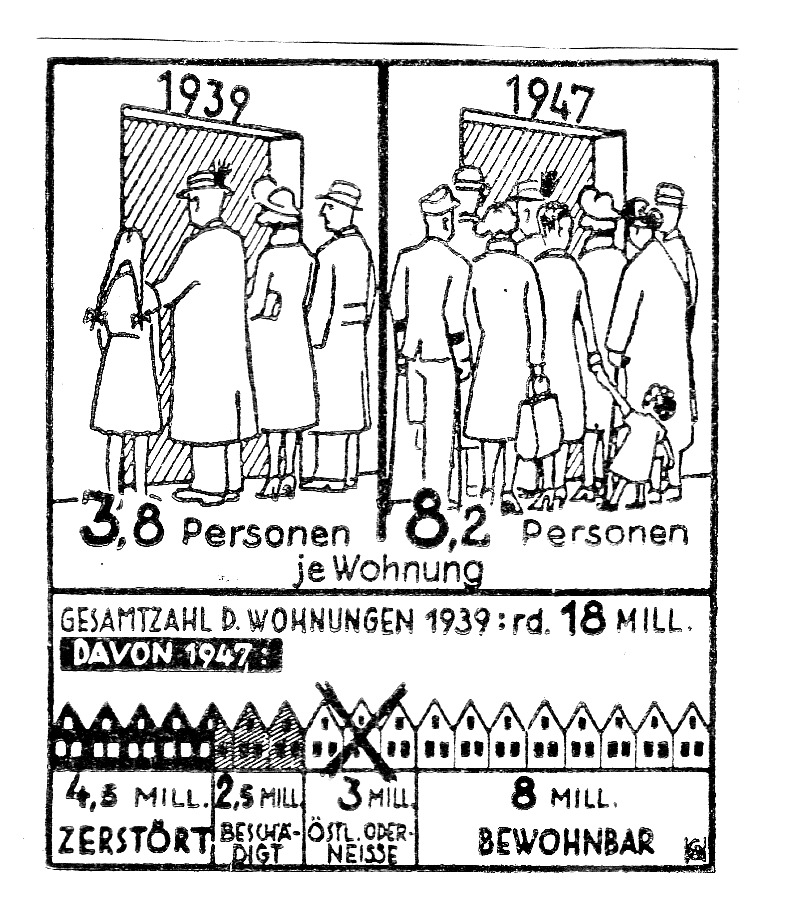
The first dates from 1947 and neatly tells you how Allied-occupied Four-Zone Germany had gone from a housing stock of 18 million units when Hitler's war started to just 8 million. This was because 4.5 million apartments and homes had been lost to bombing, fire and other war effects, 3 million were left behind in the new territory of Poland and 2.5 million were so damaged as to be uninhabitable in winter.
Image: obs/dpa Deutsche Presse-Agentur GmbH
Great graphics use seemingly simple means to index numbers visually. In this case, the increased density per home is indexed by queues of apartment-seeking renters at each door that are similar in expanse, but more dense at the right. This is graphically viscous, but a closer match to what the numbers represent in real life: overcrowding. An amusing touch is the girl at left representing 0.8 and the arm-pulling child at right for 0.2. In 1947 the people are thinner and clothes shabbier, which is the way the postwar was. A Second World War veteran has only one leg.

In the bottom half is a stacked bar chart in the horizontal, which began  in the artist's mind like this:


What he or she did was to translate it into a row of gabled houses like those you see in old German towns, or perhaps like the cottages on a German housing estate. It's a neat way of enlivening the graphic and while some would argue it breaches Edward Tufte's data ink rule, I think it's just right, and suits the black-and-white line-drawing style perfectly.

Only a Peep

This post was first published at a time when "only a peep" at the manuscripts was possible (original preface appended below). The digitizations have since trickled online. As always, click on my screen-grabs to go straight to the manuscripts.

The following lists are, first, the 35 digitizations issued June 1, and secondly, the 44 digitizations of the previous week (when I popped down to Trent, Italy for a holiday and included a look at some of its manuscript treasures (not yet digitized) in glass cases at the Diocesan Museum). The new BAV total of manuscripts digitized is 4,471, whereby four items were inexplicably dropped from the Vat. estr. or. array. These lists will continue to be fleshed out as more information becomes available.
  1. Urb.ebr.57,
  2. Vat.ebr.2,
  3. Vat.ebr.22,
  4. Vat.ebr.23,
  5. Vat.ebr.24,
  6. Vat.ebr.112,
  7. Vat.ebr.207.pt.2,
  8. Vat.ebr.208,
  9. Vat.ebr.209,
  10. Vat.ebr.216,
  11. Vat.ebr.218,
  12. Vat.ebr.219,
  13. Vat.ebr.224,
  14. Vat.ebr.238,
  15. Vat.ebr.240,
  16. Vat.lat.384,
  17. Vat.lat.451.pt.1,
  18. Vat.lat.525, Cyril of Alexandria, In Iohannis Evangelium libri I-XI in Latin, 15th century
  19. Vat.lat.565,
  20. Vat.lat.576,
  21. Vat.lat.647,
  22. Vat.lat.659,
  23. Vat.lat.684,
  24. Vat.lat.695,
  25. Vat.lat.696,
  26. Vat.lat.709,
  27. Vat.lat.727,
  28. Vat.lat.733,
  29. Vat.lat.735,
  30. Vat.lat.742,
  31. Vat.lat.743,
  32. Vat.lat.744, Thomas Aquinas
  33. Vat.lat.749,
  34. Vat.lat.9966, Tasso
  35. Vat.lat.11539, poetry by Vittoria Colonna: 103 sonnets in a manuscript of about 1540 that was made by or under the supervision of Colonna as a present to Michelangelo. Details by Antonio Corsaro. Here is the opening folio:

Uploaded in the last week of May:
  1. Arch.Cap.S.Pietro.B.52,
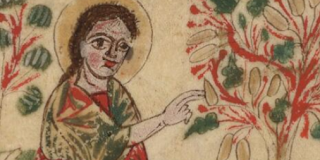
  2. Barb.lat.587, the St Cecilia Bible from Rome: 11th-century, with sections of Isidore, Etymologiae, at the end. Look at this gorgeous haloed Eve as she plucks the forbidden fruit in paradise:
    Later there is Joshua as he receives the "dogmata vitae" from a dying Moses:
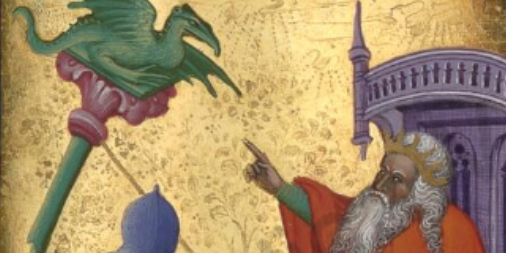
  3. Barb.lat.613, Bible of Niccolò d'Este (1434) with decoration by the amazing Belbello da Pavia, such as this figure. Here Hezekiah orders the demolition of a bronze serpent (2Ki 18:4). Just flick through the visionary paintings in this codex: it's like a whole morning in a great art museum.
  4. Barb.lat.2173,
  5. Barb.lat.4398,
  6. Borgh.246,
  7. Pal.lat.990,
  8. Reg.lat.2105,
  9. Vat.ebr.18, Torah, Haftarot, Five Scrolls and Job Solomon b. Isaac's (Rashi) commentary  
  10. Vat.ebr.20,
  11. Vat.ebr.170,
  12. Vat.ebr.179,
  13. Vat.ebr.181,
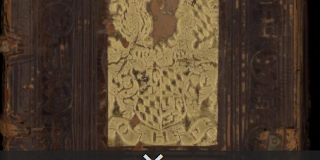
  14. Vat.ebr.183, a 14th century Tashbets, rebound in 1553 with this fine gilded inlay in the front cover:
    HT to Bodleian for this information.
  15. Vat.ebr.184,
  16. Vat.ebr.187,
  17. Vat.ebr.188,
  18. Vat.ebr.194,
  19. Vat.lat.249,
  20. Vat.lat.263, Theophylact: In epistulas s. Pauli commentarius, Latin translation of 15th century manuscript, of which Anthony Grafton's Rome Reborn catalogue writes:Theophylact, an eleventh-century Byzantine exegete, defended the Roman Catholic position against Greek intransigence on a number of key theological issues. In the 15th century his works were translated into Latin by Christoforo Persona. Persona later became the head of the Williamite order in Rome and papal librarian under Sixtus IV.
  21. Vat.lat.451.pt.2,
  22. Vat.lat.483,
  23. Vat.lat.496,
  24. Vat.lat.586,
  25. Vat.lat.593,
  26. Vat.lat.599,
  27. Vat.lat.603,
  28. Vat.lat.612,
  29. Vat.lat.615,
  30. Vat.lat.631.pt.1,
  31. Vat.lat.632,
  32. Vat.lat.635,
  33. Vat.lat.641,
  34. Vat.lat.644,
  35. Vat.lat.656,
  36. Vat.lat.658,
  37. Vat.lat.685,
  38. Vat.lat.700,
  39. Vat.lat.701,
  40. Vat.lat.715,
  41. Vat.lat.10831,
  42. Vat.lat.10834,
  43. Vat.lat.13479,
  44. Vat.lat.14953, actually an early 20th century printed book: Charles Péguy, 1873-1914: Le mystère de la charité de Jeanne d'Arc, with his autograph, postcard etc at the front.
This is Piggin's Unofficial List 51. Below is the original commencement of this post:

The transition from an old to a new portal architecture at the Vatican's digital library means many of the latest releases were marked as published but still not available at the time of this blog post.

The Biblioteca Apostolica Vaticana says on its OLD index page
that we can hope to see 4,471 manuscripts online.

But on its NEW index page
the posted number of digitized manuscripts is 4,306 as of June 2.

Apart from the lag caused by the transition, even some of the new postings are not yet available. For example the following index page offers a peep at two great treasures of illumination that have just been digitized, the Saint Cecilia Bible and the Bible of Niccolò d'Este. But when you clicked on the inviting thumbnails, there was nothing to see as of June 2, 2016. No doubt this will improve soon.

If you have corrections or additions, please use the comments box below. Follow me on Twitter (@JBPiggin) for news of more additions to Digita Vaticana.

2016-05-24

Old and New

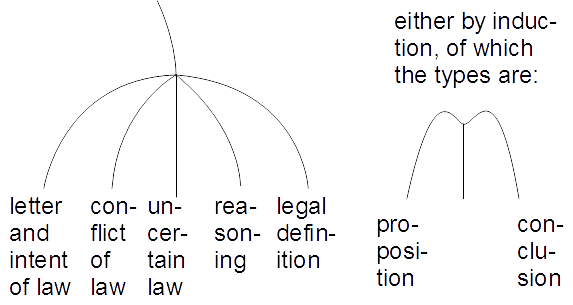
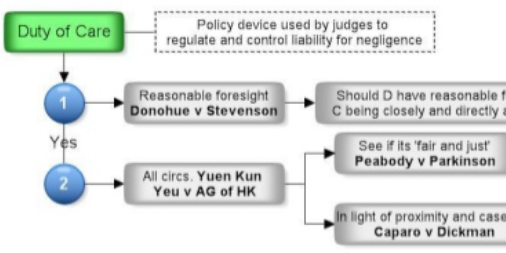
A bit of fun this week, comparing diagrams old and new in the spirit of plus ca change ...

1

Here is Cassiodorus (6th century) using a decision tree in legal reasoning. This has been translated for your reading pleasure, but you can check out the original in Latin too.


And here is Ahmad Farouq (21st century) explaining the legal doctrine of negligence in Commonwealth jurisdictions in a remarkably similar stemmatic diagram that proceeds downwards, then left to right, quoting key words and key cases:


2

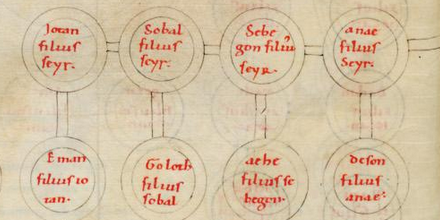
Here are the tribes of Mount Seir (in modern Jordan), who were perceived as having ancestral affiliations among one another by the authors of the Book of Genesis. They probably were tribally related, though not through eponymous ancestors as claimed here. The 5th-century author the Great Stemma diagrammed them thus:
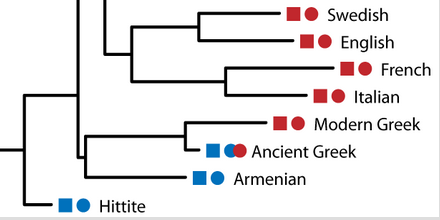
A modern scientific approach is to build phylogenies among cultures based on language characteristics. Here is a diagram by Michael Dunn et al. on language groups:

These old and new diagrams show that although the form and sophistication of infographics has advanced enormously in the past century, the principle of visualization and its uses has deep and ancient origins.

2016-05-18

Upgrade at the Vatican

As the Vatican's online library, Digita Vaticana, undergoes a major server migration and interface upgrade this week, you'll have to be patient about viewing the 34 new treasures that arrived online May 16. The interface is a major step forward, with easier paging through the books, quicker zooming buttons, and adoption of the IIIF standards used by other major archival digitization portals.

There's also a new logo, DigiVatLib. It's not clear yet if this replaces the Digita Vaticana branding. There's a promise of enhanced search functions for the next release and there will be a section to highlight the latest 20 manuscripts uploaded, but that does not seem to have been implemented yet.

Some manuscripts remain accessible, but for others you encounter a "sorry" screen that says: "The migration process of digitized manuscripts in the new platform is still ongoing and it will be completed in the next two weeks." I feel like a motorist at roadworks, knowing full well that I will appreciate the improvements later, but impatient to get through now.

Today is also a special occasion for this blog: this is the 50th edition of Piggin's Unofficial Lists of the digitizations in Rome. It was a great surprise to me when Dr Otto Vervaart marked this by writing a very comprehensive review on his own blog, Rechtsgeschiedenis, describing what this blog attempts to achieve. I say to him: Thank you very much: that encourages me to keep going forward.

The highlight of this week's new arrivals is Vat.lat.623, a fascinating 13th- or 14th-century revision of the Etymologies of Isidore of Seville (-636). The great Spanish scholar Carmen Codoñer observes that because of its encyclopaedic character, the Etymologies were continually open to supplement in later centuries, and this is one of the best examples of how it evolved.

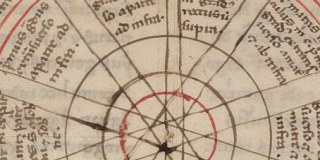
We see in this codex  all sorts of clever medieval diagrams to better elucidate what ancient Isidore had been talking about.

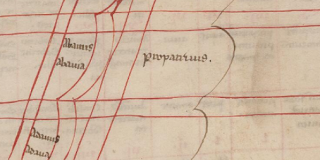
On fol. 80r is an astonishing schematic of an arbor consanguinatis - a legal diagram explaining degrees of blood relationship - which revises it to just a few abstract sketch lines. There's a matching one in Vienna, ÖNB 683, but unfortunately not yet digitized.

Hermann Schadt believed this unique diagram (he called it a "lambda schema") must have been influenced by music theory, since a similar diagram is found in contemporary books about harmony and the Anima Mundi of Plato. The medieval academy was very interdisciplinary.

The preceding page has another reinterpretation of the arbor that you will not find in my manual of classical arbores, because it was a newfangled invention: it shows the family circle.

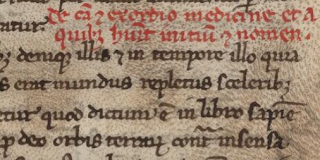
A Carmen Codoñer article that is online in French is devoted to another part of this codex where the editors added new medical material after Isidore's Book X, from fol. 39rb (de causa et exordio…) to 42ra (… et sanus efficitur). She establishes that this contains parts of Asaf’s Book of Medicines, a Hebrew encyclopedia of Greek and Jewish medicine, which is an interesting indication of how the medieval academy welcomed Jewish learning.

This week's 34 uploads take the posted total to 4,396, which is a larger number than the 2,614 posted on the new, upgraded front page (formerly the fund-raising site). It's not yet clear if these two sites are now being integrated: they have remained apart until now. With the interrupted access, it will take me more time to add images and descriptions to the list below, so come back in a week for more details.
  1. Vat.ebr.11,
  2. Vat.ebr.14,
  3. Vat.ebr.107,
  4. Vat.ebr.124,
  5. Vat.ebr.128,
  6. Vat.ebr.129,
  7. Vat.ebr.131,
  8. Vat.ebr.132,
  9. Vat.ebr.136,
  10. Vat.ebr.137,
  11. Vat.ebr.146,
  12. Vat.ebr.150,
  13. Vat.ebr.304,
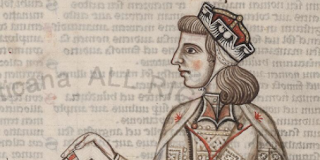
  14. Vat.lat.36, Manfred Bible, sometimes thought to be 13th century, no later than 14th, see the article on these by Helene Toubert. Here is King Manfred of Sicily (fol. 522v) receiving his book:
  15. Vat.lat.171,
  16. Vat.lat.380,
  17. Vat.lat.453,
  18. Vat.lat.516,
  19. Vat.lat.546,
  20. Vat.lat.552,
  21. Vat.lat.558,
  22. Vat.lat.566, Boethius. I was hoping to find an arbor porphyriana in here, but see none, though there is an interesting branching drawing on fol 72v
  23. Vat.lat.571,
  24. Vat.lat.572,
  25. Vat.lat.588,
  26. Vat.lat.596,
  27. Vat.lat.606,
  28. Vat.lat.617,
  29. Vat.lat.623, magnificent 13th or 14th century Etymologies of Isidore (see above)
  30. Vat.lat.630.pt.2, Isidorus Mercator Decretalium collectio, a 10th-century legal manuscript with some final rubrics like this at folio 321r:
  31. Vat.lat.631.pt.2,
  32. Vat.lat.639,
  33. Vat.lat.664,
  34. Vat.lat.712,
There are also nine novelties, mainly legal manuscripts, at Bibliotheca Palatina, the German portal which separately digitizes the Pal.lat. series in Rome. These were once used by the law scholars at the ducal-cum-university library in Heidelberg:
  1. Pal. lat. 719 Sammelhandschrift (15. Jh.)
  2. Pal. lat. 747 Digestum novum (14. Jh.)
  3. Pal. lat. 738 Digestum vetus (14. Jh.)
  4. Pal. lat. 748 Digestum novum (13.-14. Jh.)
  5. Pal. lat. 740 Digestum vetus (13.-14. Jh.)
  6. Pal. lat. 737 Digestum vetus (13. Jh.)
  7. Pal. lat. 755 Digestum novum (13. Jh.)
  8. Pal. lat. 756 Digestum novum (14. Jh.)
  9. Pal. lat. 1830 Psalmos (Wittenberg, um 1547-1548)
If you have corrections or additions, please use the comments box below. Follow me on Twitter (@JBPiggin) for news of more additions to Digita Vaticana.

2016-05-15

Medieval Diagram Commentary Rediscovered

Rediscovering a lost medieval work is the dream of many historians. It has come true for me in the last few weeks as a 6,000-word medieval commentary on a late antique diagram has emerged in my research. For 150 years, medieval manuscripts of Europe have been sifted and catalogued, but sometimes a big fat chunk of writing escapes the scholars' notice. Until now.

This little opus is not easy reading: a Latin commentary which contends that stories in the Old Testament of the Bible foreshadow the life of Christ and the history of the Christian church. What is wonderful about it is its reflections on data visualization, a topic that directly concerns web designers, educators and scientists today.

The commentary is written in gaps of the Great Stemma, a huge 5th-century diagram of biblical history and genealogy (reconstruction here), where the story proceeds from Adam at left to Jesus at right.

The commentator notes that the genealogy of the Gospel of Luke "is laid out like a builder's line in the hand of the Father", which makes sense if you look at the drawing:


The line is a string (funiculus) that a bricklayer pegs out to set a line of bricks to, and that's an interesting comment. A line of data, also described with another Latin word for a string, filum, is the fundamental unit of data visualization, whether it's a series of nodes in a network, an axis on a graph or dates in a timeline.

The commentator also quotes Gregory the Great (c.540– 604), a writer who is a pre-eminent late antique source on visualization. Gregory was interested in omnivision, the all-seeing view.

Gregory has a section (18.46) in Moralia in Iob where he disparages wisdom composed only of eloquent words (quam sunt verborum compositionibus) and contrasts surface perception (ante humanos oculos) with divine perception. The implication here is that you see things more truly in a diagram than when they are wordily explained. The commentator has quoted this passage in full in the opus.

You can read the full transcription of the rediscovered Latin document on my website (sorry, I cannot translate Latin, but the passage from Gregory can be found elsewhere in English (scroll down to [xlvi]). I have provided links from my transcription to the digitized manuscripts.

I can't yet tell you who the author is. Much of the little opus consists of quotes from the Expositio/Quaestiones in Vetus Testamentum by Gregory's contemporary, Isidore of Seville (560-636), so it could even have been composed during Isidore's lifetime.

How did the document emerge back into the light of day? Like so many good things, it was hidden in plain sight. It is copied in four well-known 12th-century grand bibles: the Bibles of Parc, Floreffe and Foigy (all from monasteries in the Meuse valley) and the Romanesque Bible of Burgos in Spain. Three of them are online, so that counts as very plain sight.
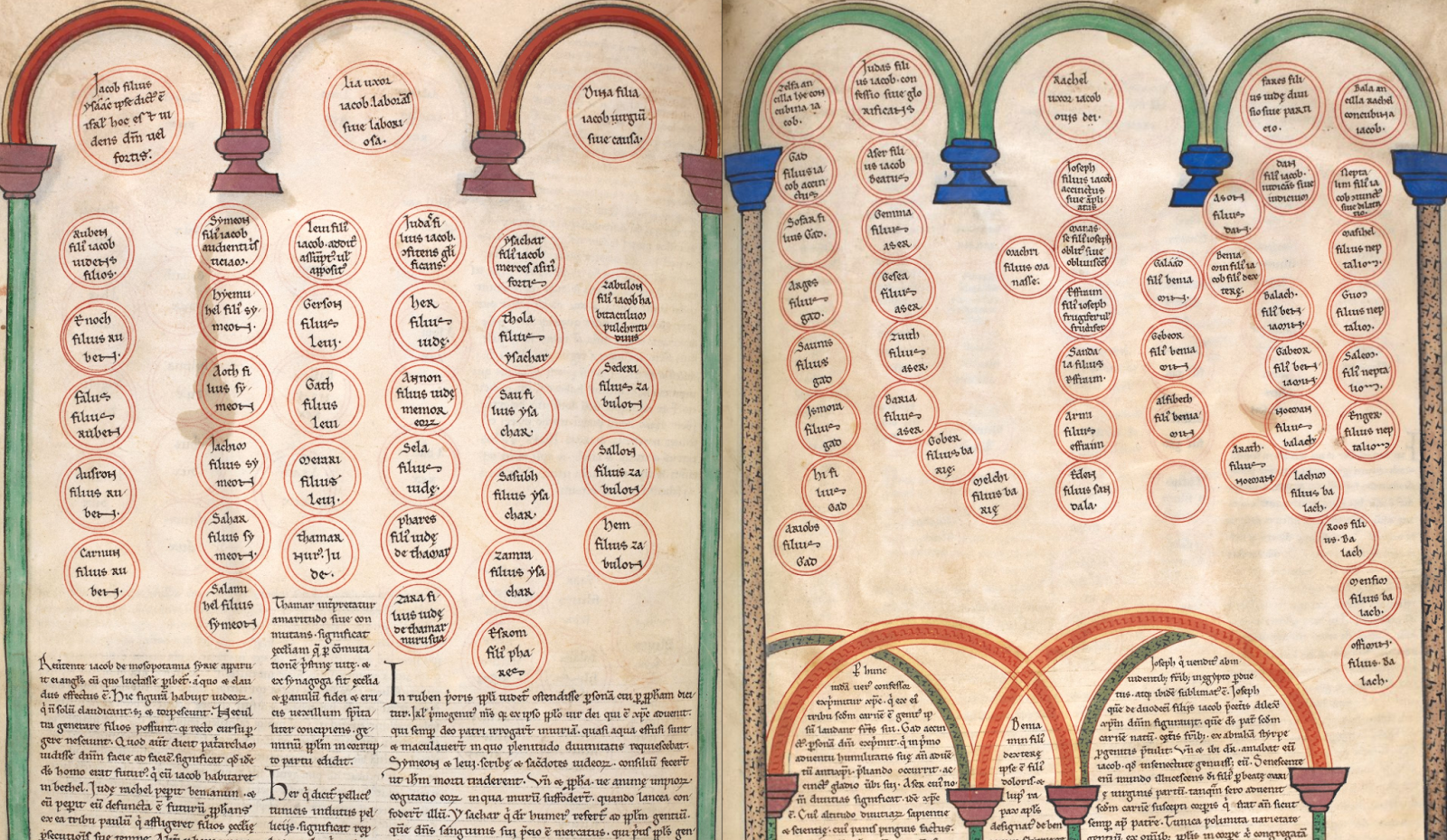
The epitome of Isidore is in the chunks of text at the bottom of this sample spread from the Parc Bible.

As a wise observer commented to me, philologists probably overlooked the work because it is written in the gaps in a drawing. Scholars generally expect a serious work to appear in a manuscript as slabs of text, not interlaced with a genealogy. The key difficulty in disentangling the text was to determine which bits are the Isidorian enthusiast's commentary and which bits have other origins.

Four strata in the development of the diagram as you see it above can be distinguished.

The underlying diagram, containing 540 names written in connected roundels and extending the length of a papyrus roll, was devised by an anonymous patristic author to demonstrate the flow of Old Testament history and to reconcile a conflict between the genealogy of Jesus offered by the Gospel of Matthew and that laid out in the Gospel of Luke.

The original state of this lowest layer is witnessed by a manuscript in Florence (Plut. 20.54, 11th century). Its date prior to 427 and its extent is documented by a text known as the Liber Genealogus. The Great Stemma, as I call it, is the only known large Patristic diagram. As evidence of data visualization in western antiquity, its importance is only surpassed by that of the Peutinger Table of highways of the Roman world.

The Christian diagram, of which 25 witnesses including the four bibles survive, is known to have initially circulated in early medieval Spain sub-sectioned into 18 codex pages.

In one fork of its development, its solution to the contradiction between the Gospel genealogies was anonymously altered to conform to a theory by Julius Africanus. The Latin translation by Rufinus of the essence of that proposal was appended. This is the second of the strata in the version we are concerned with here, and is witnessed solely by a text-only abstract in the Bible of Ripoll at the Vatican (Vat. lat. 5729, 11th century).

Imbued with the spirit of Isidore, the epitomizer later implanted the bible commentary on that surface. He or she entered many notes in the blank spaces to lay down a third stratum.

In a final development, an editor, perhaps a northern European in the mid medieval period, prefaced the main diagram with an arbor consanguinatis figure and a brief text associating the diagrams with one another as symbols of Christ's cross. This fourth stratum, seen only in the three Mosan bibles (mid 12th century), has been recently analysed by Andrea Worm and requires no discussion here.

Until we understand this stratification, we cannot recognize stratum three as a distinct entity. Only scientific investigation can extract stratum three from the matrix of words in which it has become fossilized. Scholars of Isidore will be excited at the emergence of this commentary, which contains the essence of the Expositio, at about one-twelfth of that work's length, since it illuminates the way the medieval world received and adapted the works of Isidore.

I have thought a lot about whether Isidore himself might have created this version, since it seems to me, from my own experience of a lifetime of editorial cutting, that it is easy to expand a text by inserting interlinear words and phrases while keeping its syntax, but difficult on the fly to abbreviate a handwritten text while preserving its syntax, as this epitome does.

That thought might lead one to the notion that this text could have been Isidore's own first draft. However I cannot yet see any definite evidence for that in the text. In fact, we cannot establish with any certainty where or when the commentary was written. I would tend to guess at 7th- or 8th-century Spain, but other scholars will have to take that issue on.

For links to the digitized manuscripts and literature, check out my web page.