2012-05-19

New-Found Manuscript

Does a publication 10 years ago describing a new-found manuscript count as news? Not for a journalist. Nor ought it to be news when the author of the publication personally drew my attention to the article two years ago. But somehow I was too busy with other things, and only discovered today that the Biblioteca Malatestiana in Cesena, Italy possesses a previously unknown 11th-century manuscript of the Liber Genealogus. So it is news ... to me.

Readers may recall that I published online last year the ur-text of the Liber Genealogus of 427 (link). It is not a critical edition, but it is the first to present the archetypal text of the year 427 without clutter. Those who follow this blog will know that the Liber Genealogus is a strange chronological and genealogical tract which can only be understood if one realizes it was a learned commentary on a wondrous drawing: the Great Stemma.

In 2002, the eminent Italy-based historian-philologist Dr Michael Gorman published an article in the journal Scriptorium on 11th-century manuscripts from the monastery at Monte Amiato, a Benedictine community which was closed in 1782. He argued that three very similar codices had all been drafted in the scriptorium there in the 11th century. His article was re-published in Italian with some revisions in 2007.

The third of the manuscripts which he highlighted was one that had escaped the notice of Theodor Mommsen when he published his edition of the Liber Genealogus at the end of the 19th century. This manuscript at Cesena doubtless contains a copy of the F recension. Giuseppe Maria Muccioli writes in that library's printed catalogue that the text begins: Genealogia totius Sacra Scripturae, cum persecutionibus Christianorum, which echoes the Madrid incipit, Genealogiae totius bibliothecae ex omnibus libris veteris novique testamenti. I discussed the Madrid version in a post in February.

Here is a tabulation of the parallel contents of the three codices, based on the publications of Dr Gorman, Mommsen and Professor José Carlos Martín. The three columns at right represent the folio numbers in:
  • Plutei 20.54 
  • Conv. soppr. 364 
  • Cesena D.XXIV.I (Catalog)

Isidori Hispalensis Etymologiae (ed. Lindsay) lost 1- 100v 1- 183
Junilius Africanus De partibus divinae legis = Instituta regularia divinae legis (CPL 872) (Collins) 1ra - 8rb 100v- 107 183- 193v
Bede (thus identified by Gorman) Glose per totum alphabetum (Gorman reference: De ortographia, ed. CCSL 123A.7-57) 8rb – 15rb 107- 111v 193v- 201v
Anon Glossa super Octateuchum et Librum Regum (Glossa Rz: see Holtzmann) omit 111v- 116 202- 209v
Anon Divisiones temporum XIII (unpublished) 15rb – 21ra 116- 120 209v- 217
Isidori Hispalensis Ety. 6.3.2: ''Bibliothecam ... Esdras scriba ...." 21ra 120 217
Isidori Hispalensis Ety. 7.1.2-37 and 7.2.11-49  21ra – 22va 120- 121v 217- 219
Anon De litteris (grammatical tract on syllables, vowels, consonants: Qui primum interrogandum est his qui scientiam divinarum scripturarum scire desiderant...) 22va – 24ra 121v 219- 220v
Anon Liber Genealogus (CPL 2254) (ed. Mommsen MGH chron. min I, pp 160-196; ed. Piggin) 24ra – 30ra 122- 125v 220v- 228r
Isidori Hispalensis Chronographia, cum prologo; (ed. Martin) 30ra – 34ra lost lost
Anon Catalogus regum Langobardorum et Italicorum Lombardus  (ed. Waitz MGH scr. rer Lang.) ends with last Italian kings Lothair II and Berengar II and the crowning in 961 of Otto II as overlord of Italy  36va – 37ra lost lost
Anon Great Stemma (ed. Piggin) 38r – 45r lost lost
Pseudo-Julianus Ordo annorum mundi (ed. forthcoming, Martín) 45r lost lost

It will be obvious from this that the first three-quarters of the Plutei 20.54 manuscript has been lost, whereas the other two manuscripts are lacking their final quarter or third. The folios which we now see numbered 1-45 in the online digital version of Plutei 20.54 were numbered 143-187 when the codex was intact. Possessing all three codices allows us to reconstruct the lost model at Monte Amiato from which they must have been copied.

Gorman notes that the Divisiones temporum XIII above is a text with an annus praesens of 745 CE, matching the legendary date of foundation of the monastery, and argues that this, along with other formal criteria, establishes a clear link between this miscellany and the presumed 11th-century Monte Amiata scriptorium.

Gorman's article is also of interest for its discussion of a medieval diagram which is based on the Great Stemma but adds new content. It was probably made in the same scriptorium. This is found in another Florence manuscript, Cod. Amiatinus 3, ff 169-172v (not online). He notes that this diagram's list of popes finishes with Agapetus (papacy 946-955), and conjectures that this information was drawn from yet another extant manuscript that had been made and kept at Monte Amiata, plut. 65.35, f 3r. (online) which contains a Liber pontificalis.

Note added in 2013:  The latter manuscript is discussed in a later post.

Gorman, Michael. ‘Codici manoscritti dalla Badia amiatina nel secolo XI’. In La Tuscia nell’alto e pieno medioevo. Fonti e temi storiografici ‘territoriali’ e ‘generali’, edited by Mario Marrocchi and Carlo Prezzolini, 15–102. Florence: Sismel - Edizioni del Galluzzo, 2007.

------. ‘Manuscript Books at Monte Amiata in the Eleventh Century’. Scriptorium 56 (2002): 225–293: 268–271.

Martín, José Carlos. Isidori Hispalensis Chronica. Turnhout: Brepols, 2003.*67
Mommsen, Theodor, ed. ‘[Liber Genealogus:] Additamentum II [to the] Chronographus anni CCCLIIII’. In Chronicorum minororum saec. IV. V. VI. VII. Vol. 1. Monumenta Germaniae Historica (MGH), Auctores Antiquissimi (AA) 9. Berlin: Weidmann, 1892.

2012-05-12

Co-Owners of Isola

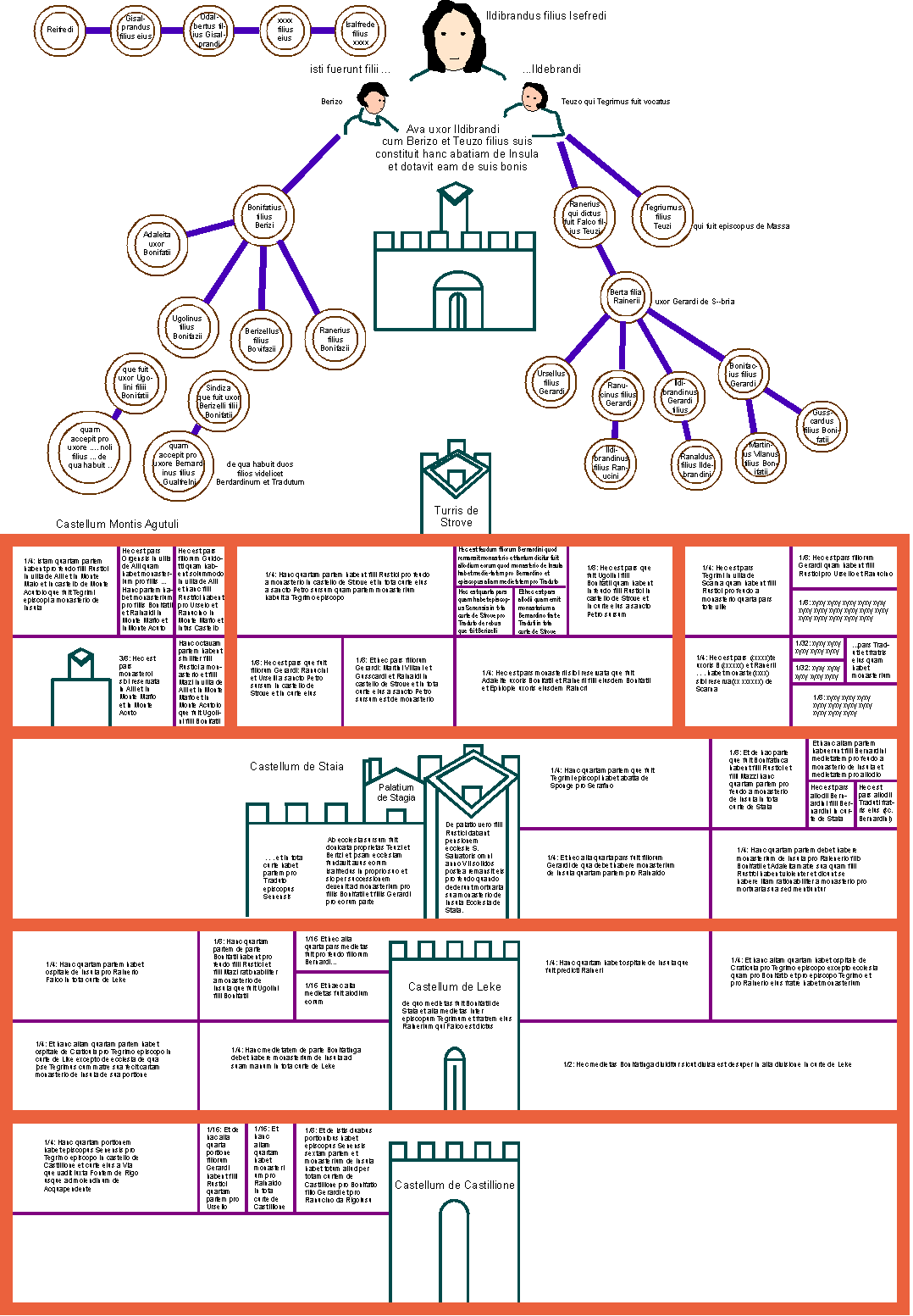
A remarkable infographic in the Vatican Library describes the co-ownership of nobles and Benedictine monks of the former Abbey of Isola near Siena in Tuscany, Italy. The document, which I first read about in Christiane Klapisch-Zuber's L'Ombre des Ancêtres, comprises a stemma of Hildebrand, whose widow Ava founded the monastery, along with a detailed scheme of property division. It was drawn up in or shortly after 1160.

I have created a digital sketch of the document (PNG below, zoomable detailed version on my website). The colours were arbitrarily chosen, since this version was made from black and white photographs. For a better idea of how Hildebrand and his two sons, Berizo and Teuzo, are supposed to have looked, see the original (link below, with caveat). The orange-bordered panels represent the ownership shares in six blocks of property:
  • the Castellum Montis Agutuli
  • the Turris de Strove (Strove is the next village)
  • the Villa de Scarna (just to the west)
  • the Castellum de Staia (the small town of Staggia to the north (map))
  • the Castellum de Leke (further north, at Lecchi (map))
  • the Castellem de Castillione

Hildebrand (Ildibrandus) was a Lombard, which explains the Germanic names of his ancestors and his descendants all the way through the document. The six semi-monastic properties (five of which are illustrated with a little sketch that probably summed up salient architectural features of the principal building) were progressively divided into half-shares, quarters and so on. The most extreme divisions are 1/32 of a whole. The rectangle area indicates the degree of division. The transcription is based on that published by the late Wilhelm Kurze, and I have preserved his fractions where space allows. There are of course no Arabic numbers or fractions on the document, but including them here makes the divisions more understandable.

The affinity of the stemma at the top of the document to the Great Stemma is unmistakeable: the roundels are all composed of two rings, and the names in them are generally written in the form Y filius X. The lines can either proceed left to right or top to bottom. An especially interesting feature here is the graphic separation of Adelheid, wife of Ugolinus, and of Sindiza, wife of Berizellus, from the rest of the stemma. They are not joined to it by the usual lines. The children of their second marriages were not connected by blood to Hildebrand, but did inherit property rights through the mothers. I have moved these into better alignment to make this aspect of the infographic clearer, but this reconstruction is as close as possible to the original in every other way.

Kurze gives the following manuscript reference: S. Eugenio - Rome, Bibl. Vat. Cod. Vat. Lat. 8052 (Galetti) Cop. saec. XVIII. In dorso: Descriptio et pictura fundatorum abbatie Insule et eorum descendentium que predia relinquerunt predicte Abbatie.

As far as I know, there is only one image of it online, on the Portale di Archeologia Medievale, but this is something of a disappointment. This image seems to have been digitally altered: not only are important areas at the edges cropped away, but the top three property blocks have been seamlessly edited out of the middle of it, without any explanation. (If you find a more faithful image of the document on the web, particularly one at higher resolution, please tell me by writing a comment below!)

Kurze mentions one facsimile edition. The document is reproduced in low-resolution black and white in Violante's article and at an even smaller scale in Klapisch-Zuber's book. In my view, text-only publications cannot adequately convey how the infographic works: a technical drawing is needed. Violante's crude sketch only adds to the confusion and from Klapisch-Zuber's account I mistakenly thought at first that a kind of treemap was in prospect. The property-division part of the infographic, which maps the legal concept of sharing onto two-dimensional space, is in fact a much simpler concept, but nevertheless quite clever. I do not know of any earlier documentary examples of the technique. Please comment if you can suggest any.

This is the only medieval document I have transcribed so far where the place of origin is absolutely clear. The monastic institution where this document was drawn up after 1160 no longer exists, but many of the buildings are still there and can be visited, a short drive away from Siena (tourist description, location, video). The structure depicted at the top of the chart, below Hildebrand's face, is the abbey itself, which was much rebuilt but partly survives. The castle of Staggia has a battlemented tower just like those in the document. I recommend you follow these links and enjoy the images which Google Panoramio pulls up.

Kurze, Wilhelm. “Der Adel und das Kloster San Salvatore all’Isola im 11. und 12. Jahrhundert.” Quellen und Forschungen aus Italienischen Archiven und Bibliotheken 47 (1967): 446–573.
Violante, Cinzio. “Quelques Caractéristiques des Structures Familiales en Lombardie, Émilie et Toscane aux XIe et XIIe Siècles.” In Famille et Parenté dans l’occident médiéval, edited by Georges Duby and Jacques Le Goff, 87–148. Rome: École Française de Rome, 1977.
Klapisch-Zuber, Christiane. L’Ombre des Ancêtres. Paris: Fayard, 2000: 98-101.
Cammarosano, Paolo. “Gli Antenato di Paolo Diacono.” In Nobiltà e chiese nel medieoevo e altri saggi. Scritti in onore di Gerd D. Tellenbach, edited by Cinzio Violante, 37-45. Rome, 1993.

2012-04-30

Vimara and Juan

A most remarkable codex at León Cathedral known as the Vimara Bible is in fact only half a bible: the first of its two original volumes has been lost. The title is also only half its preferred name. Its scribe was the presbyter Vimara, although Juan, the illuminator, was the most singular talent in its creation in the year 920, so it is more fittingly termed the Bible of Vimara and Juan. In May 2010 there was a move to have the codex declared a national treasure and I quote from the regional government bulletin:
La Biblia mozárabe de la catedral de León fue compilada por el presbítero Vimara e iluminada por el diácono Juan en el año 920. Estaba compuesta de dos volúmenes, de los que sólo se conserva uno. El principal contenido de este códice es la segunda parte de una Biblia que comienza con el libro del profeta Isaías y continúa con los de Jeremías, Ezequiel y siguientes, además de los Evangelios incluyendo sus tablas de concordancia, las genealogías de los personajes bíblicos y algunos otros escritos, uno de ellos sobre la vida de San Froilán, patrón de la diócesis. En sus páginas se añadieron múltiples comentarios al trabajo de Juan y Vimara, algunos generados por los propios autores, muchos de ellos en árabe. Es la Biblia más antigua que se conserva y está considerada como una de las obras más importantes de la iconografía altomedieval hispánica. Esta creación se incluye dentro de una larga tradición de libros miniados que se inicia con los grandes scriptoria visigodos del siglo VII y que continuó con los códices realizados en la primera mitad del siglo X.
The only images that I have seen of this bible are on the Oronez portal. I am not sure what "las genealogías de los personajes bíblicos" means: they cannot be in diagram form, or they would have attracted attention as such. [Later addition: The "genealogical" text turns out to be the Inventiones Nominum, which sometimes appears in company with the Liber Genealogus. Its presence in León is signalled by Rouse (below).]

Seventy years ago, Teófilo Ayuso Marazuela first proposed that 10th-century Spanish bibles were regular in the way that they absorbed extra-biblical material. Unfortunately there are not that many 10th-century Spanish bibles to compare. With data that Professor Jose Carlos Martín of Salamanca has very kindly shared with me, I have compiled a little table of five bibles that contain either the Great Stemma or the Ordo Annorum Mundi.

GS loc init
OAM
location
missing

Vimara (920) 146r
after OT
missing

Cardeña (9-10 C) 312v
after OT
5v front verso León (960) 395r
after OT
1v front verso Calahorra (1183) missing

1r front recto San Juan de la Peña (11c) missing

1r
recto BNE Vitrina 14-2 ff 1-5 (10C)


Loc indicates where in the codex the stemma appears. Init indicates whether it begins on a recto (right-hand) or verso (left-hand) page. The sixth item is a mysterious five-page fragment, BNE Vitrina 14-2 ff 1-5, in the National Library in Madrid which may come from a bible. The fragment dates from the second half of the 10th century and its script suggests it comes from a scriptorium in the kingdom of León. The art historian John Williams thought it had been yanked out of a Beatus Commentary on the Apocalypse. He therefore included this manuscript of the "tables" in his book, The Illuminated Beatus (which was laudable and beneficial for scholarship), but he justified this with a whimsical argument (there are more such tables in Beatus manuscripts than in bibles) which he probably did not mean to be taken very seriously.

Bonifatius Fischer suggested the opposite: that it might come from a bible:
Finalmente planteemos con esta oportunidad una cuestión: los 5 folios con genealogías que hoy van encuaderndos al comienzo del manuscrito de Beato Madrid, Bibl. Nac. B-31, que antes pertenecía a S. Isidoro en León, y de los cuales Neuss demuestra que ni provienen de un Beato sino de una biblia, ¿son restos de la segunda biblia visigótica que en otro tiempo, según diversas fuentes, existía en S. Isidoro?

Teófilo Ayuso Marazuela believed there was a pattern whereby scribes placed the OAM between the Old and New Testaments, as happens in the San Isidoro de León bible. There are four other bibles, all damaged, which might have employed the same arrangement, and I have set them out in the table. Not all are from the 10th century, but one is entitled to cast the net wider to show how this hypothesis works. My own suspicion is that the Madrid fragment could have come from such a bible, especially if it did employ the Great Stemma as a frontispiece, starting with Adam on a recto page.

If BNE Vitrina 14-2 ff 1-5 is copied from any bible, the model cannot have been the León bible, nor whatever were the models for the 12th-century Calahorra and the mid-11th-century San Juan de la Peña bibles, because these three all have peculiar, eccentric versions of the tables. The fragment is also unlikely to be copied from the 9th- or 10th-century San Pedro de Cardeña Bible at Burgos, which has a much larger page size. But it could plausibly have been copied from the Bible of Vimara: their page size is almost identical, and the dating of BNE Vitrina 14-2 ff 1-5 is estimated at only a quarter-century or half-a-century away from the Vimara Bible's date, 920. The Vimara Bible is very finely executed, whereas the fragment is clumsily drawn with fewer colours but it would be interesting to compare images and see if the Vimara bible could have inspired the fragment's decoration. Unfortunately there does not seem to be any facsimile of the Vimara Bible.

Fischer, Bonifatius. “Algunas observaciones sobre et «Codex Gothicus» de la Real Colegiata de San Isidoro en Leôn.” Archivos leoneses : revista de estudios y documentación de los reinos hispano-occidentales XV (1961): 5–47.
Rouse, Richard, and Charles McNelis. "North African literary activity: A Cyprian fragment, the stichometric lists and a Donatist compendium." Revue d'histoire des textes 30 (2000): 189-238.

2012-04-29

Number Lines Not Innate

A publication in the past week in PLoS (Núñez, Rafael, Kensy Cooperrider, and Jürg Wassmann. “Number Concepts Without Number Lines in an Indigenous Group of Papua New Guinea.” PLoS ONE 7, no. 4 (April 25, 2012): e35662. http://dx.doi.org/10.1371/journal.pone.0035662) offers some interesting new data that relates to the origin of timelines. In essence, Núñez and his fellow researchers have found a people in New Guinea who do not arrange numerical quantities in a strictly calibrated way along a line because they do not actually work with a mental number line. There is a news release by Inga Kiderra too.

A more readable account of the ideas behind the research can be found in an article published last year: Núñez, Rafael. “No Innate Number Line in the Human Brain.” Journal of Cross-Cultural Psychology 7 (2011): 651. http://www.cogsci.ucsd.edu/~nunez/web/Nunez_JCCP11.pdf.

This is highly suggestive of the environment in which the Great Stemma was written, and circles were arranged in approximate fashion in left-right space without being calibrated to a scale. Núñez argues that conceptual mappings onto space are culturally and historically determined and rejects the nativist hypothesis that they are hard-wired into the human brain.

My hypothesis is that the 5th-century Latin author of the Great Stemma mapped time onto the space of a long papyrus roll, but felt no compulsion to finely calibrate it as a number line. We have an author with a high classical education who is comparable to the Yupno people with grade-school education that Núñez and his fellow researchers encountered in New Guinea. Both the author and the Yupno are carrying out mapping operations, but have not yet entered a cultural environment where they are obliged to do this in a strict way on pain of being labelled uneducated if they do not.

2012-04-28

Another Spanish Bible Online

The San Juan de la Peña Bible at the National Library of Spain in Madrid is now available online. Unlike some of the other digitized manuscripts there, it is not displayed with a fancy plug-in viewer. The online user simply fetches this bible in three large PDF files. The Great Stemma is in the first of these, a file of 50 MB. The hi-res images can be copied from it, inserted into MS Paint and saved separately, making individual JPEG files of about 1 MB for easier reading.

Readers of my website will recall that the San Juan stemma belongs to the Gamma recension. It is distinguished by the following quote from Jerome about whether the prophet Samuel was a priest or not:
Noscendum est quod Samuel levita, non sacerdos, nec pontifex fuerit. Unde est faciebat ei mater sua efat super humerale videlicet lineum, qui abietus proprie levitarum et minoris est ordinis, unde et in psalmis non numerantur inter sacerdotes, sed inter eos qui invocant nomen domini, "Moises et Aaron in sacerdotibus eius et Samuel inter eos qui invocant nomen Domini."
This stemma has lost its final pages after the sons of David.On its last surviving page, the main filum from Judah to David, runs down the left margin instead of across the top edge as is usual in the other stemmata. This reorientation is similar to what I guess must have happened at a much earlier point in the transmission. All the stemmata as we see them today distort the timeline of the judges period: the timeline has at some point been turned from horizontal to vertical to fit the available space. Conversely, the sons of Rachel in this stemma run left to right, instead of downwards as in other stemmata.

Here is a table showing how the bible's extant pages match the layout of the only other surviving stemma which Yolanta Zaluska categorizes as Gamma, that found in the Beatus of Urgell. Their joint model was almost certainly a 10-page version. The first folio (two pages) of the Urgell copy has vanished. The last folio (equivalent to three pages?) of the San Juan stemma is missing:


Urgell San Juan
1 Adam
1r
2 Noah Ir 1v
3 Abraham Iv 2r
4 Isaac IIr 2v
5 Jacob IIv 3r
6 Rachel IIIr
7 Levi / David IIIv 3v
8 Luke filum IVr
9 Matthew filum IVv
10 Incarnation V

In the San Juan stemma, Rachel's children are shoe-horned into the bottom of the Jacob page. Otherwise, the layout of the two stemmata is very similar, and even the form of clipei (roundels or rectangles) matches closely.

Having access to the manuscript will allow me to check the transcription by Fischer which I had been using. Fischer's transcription lists variants from a wide variety of manuscripts and uses the centuries-old format of the apparatus: notes which proceed word by word through the bible text noting in linear fashion how each word has been altered. It is not user-friendly.

I discover that I have overlooked a phrase in Fischer from Gen 4:3, et Cain de fructibus terre (Cain (offered) the fruits of the soil). A 100-page linear apparatus, where a single bible verse is discussed in fine print, with abbreviations and symbols, extending 15 centimetres down a page, is not easy to read. My tabulations, if less complete, are certainly easier, and follow a better, older and more legible tradition, known since Origen's Hexapla comparative bible. Modern text-comparison software allows one to print such texts in other parallel forms.

Zaluska, Yolanta. “Les feuillets liminaires.” In El Beato de Saint-Sever, ms. lat. 8878 de la Bibliothèque nationale de Paris, edited by Xavier Barral i Altet. Madrid [Spain]: Edílan, 1984. The definitive 20th century study of the Great Stemma, providing a detailed page-by-page account.

2012-04-14

Lambert's Liber Floridus

In what is now the far corner of north-west France, Lambert, a canon of the city Church of Our Lady in St Omer, completed in 1122 a richly illustrated compendium of mythical biology, history and religious knowledge. The Liber Floridus (book of flowers) belongs to the same genre as the Etymologies of Isidore of Seville, a compilation or florilegium or encyclopaedia of many sorts of information, all intended to bring delight. Isidore’s use of graphics had been primitive, but Lambert was a superb and imaginative graphic designer. One celebrated full-page spread, the Arbor Mala and Arbor Bona, is a compilation of vices and virtues. The Liber Floridus is bursting with clever, colourful graphic ideas. Its images of imaginary plants and strange animals in the bestiary section fascinate.

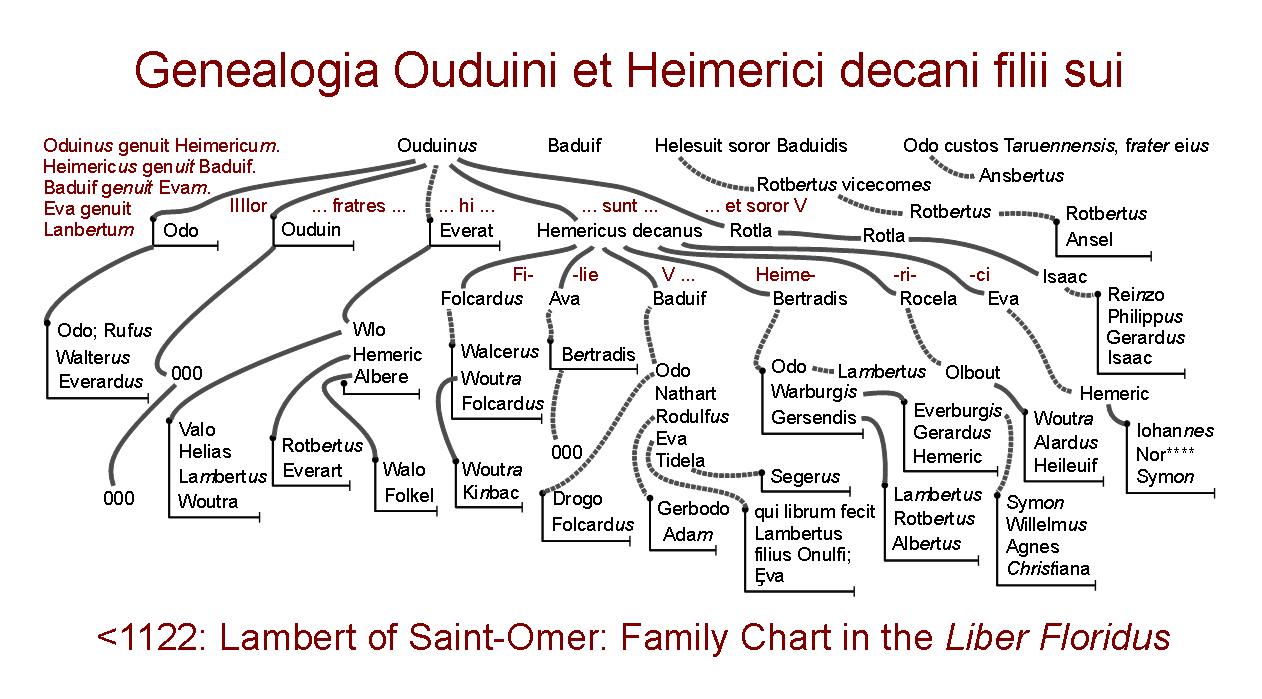
Lambert could also be conservative in his design choices. In his personal, autograph manuscript of the Liber Floridus, there is a stemma of Lambert’s maternal ancestors which goes back to his great-great-grandfather Odwin. It recalls the family names and birthdates which many British and American families wrote in the front of their family bibles in the 19th century, but Lambert decided to draw it in semi-stemmatic form, not as a simple list. As with the German imperial stemmata compiled in the previous century, Odwin is shown at the top, with the descendants splayed out below. Unlike the Great Stemma, there are no roundels. The individuals are grouped in short vertical lists of siblings. These tabulations of their forenames form family blocks. These tiny tables are connected by smooth or squiggly lines back to their parents and ultimately to Odwin. It is crowded and untidy, but it is striking that the designer of the Arbor Bona and Arbor Mala has presented his family with a simple stemma, not a tree. It has not been inverted and is not even pretending to be a tree.

Lambert of Saint-Omer's personal autograph copy, the original manuscript of the Liber Floridus, is in the University Library at Ghent, Belgium (ms. 92). Saint-Omer is a border town and this unique codex seems to have been taken to Belgium during the French Revolution for safe-keeping. Recently scans of this great treasure were placed on the internet. The digital version is a bit difficult to use, with no option for full-screen viewing that I can discover. One cannot download complete pages because the server sends them in the form of tiny tiles.

The diagram appears on folio 154r (use the navigation to go to the 30th page of results to see a zoomable version). Folio 154r has been moved to the very end of the current binding, but Albert Derolez, who has published the manuscript (Lamberti), suggests it may have originally been at the very beginning as a front flyleaf:
The first page lacks all ruling ... Was it Lambert's intention to leave it blank? In that case the leaf or the quire should originally have been placed at the front of the codex. (Autograph Manuscript, 180)

This would explain why it was not transferred into other copies: it was not seen as part of the body of text. Christiane Klapisch-Zuber briefly discusses the diagram on pages 94-96 of her L'Ombre des Ancêtres, and refers the reader to the editio princeps by Gysseling, whose entire discussion of the stemma in 1947 was limited to a single sentence:
C'est la seule généalogie que nous connaissons pour le moyen âge (exception faite des généalogies de vices, de vertus et de  ...., qui apparaissent plus ..... ). [some words illegible in my photocopy]

Derolez rearranged the diagram into a conventional modern printed descent "tree". Klapisch-Zuber tartly remarks that Derolez's graphic version "wildly displaces the generations and ends up being a lot less intelligible than the design in the original manuscript" (note 27, page 362). This is perhaps unfair to Derolez, but I can now present what I believe is the first ever graphic version which is faithful to the original layout, and which is machine readable to boot.

It can be better studied as a Flash page on my main website. I have followed the Derolez transcription, which as far as I know is actually the work of Gysseling. The italic letters are his readings of the scribal contractions. The dotted lines represent Lambert's squiggly lines, which I could not reproduce with OpenOffice Draw.

One oddity is that Lambert states there should be five "Heimerici" siblings but in fact shows six. There are two unidentified descendants at left (000 in my diagram) who are foreshadowed by lines but not given any names. At right is a name beginning Nor**** that was illegible. I am not sure if Drogo and Folcardus in the bottom row really are brothers: Lambert's diagram seems to suggest they are cousins. The awkward layout suggests the group at right might have been an afterthought or have been entered after much later family research, but perhaps the main design influence was a lack of space. Derolez, who seems to have found evidence that earlier script was scraped away, writes: "The lower part of the pedigree was afterwards rearranged in order to create more space for a text."

However the details of Lambert's genealogy are not the topic that interests us here, and I have left the genealogy as Gysseling and Derolez preferred it. It is the concept of the diagram that matters. It is practical, straight out of life, a little clumsy and unclear, but ultimately an intelligent presentation of 80 names in the most compact space.

I see no evidence for Klapisch-Zuber's speculation that Lambert may have been the inventor of this graphic design:
Toutes ces particularités laissent penser que Lambert a réinventé, ou interpreté de facon autonome, un type de schéma généalogique peut-être entrevue ice ou là... on est tenté de voir dans un schéma qu'il couche sur un page de son livre une invention autonome et sauve de toute influence immédiate. (L'Ombre, 96)

The more plausible view is that Lambert imitated other diagrams of "normal" families which he had seen, and that such diagrams were in relatively common use in the 12th century. Unfortunately, Lambert's is one of the few, perhaps the only surviving witness of this genre of document to remain in our archives from so early.
  • Derolez, Albert. Lamberti S. Audomari Canonici Liber Floridus. Ghent: Story-Scientia, 1968.
  • Derolez, Albert. The Autograph Manuscript of the Liber Floridus. Corpvs Christianorvm. Autographa Medii Aevi 4. Turnholt: Brepols, 1998.
  • Gysseling, Maurits. “Les plus anciennes Généalogies de Gens du Peuple dans les Pays-Bas Méridionaux.” Bulletin de la Commission Royale de Toponymie de Dialectologie 21 (1947): 212–215.

2012-04-08

Mommsen's False Trail?

Some time ago I posted about the F recension of the Liber Genealogus and the possibility that it might either have originated in Oviedo, Spain or that the lost library of the Cathedral of Oviedo might have been a bottleneck through which both existing versions of the F recension (one in Florence, one in the Escorial library in Madrid) could have passed.

Theodor Mommsen offered a hint there might be a third codex in Madrid, a 16th-century paper manuscript seen by Knust, which contains the so-called Corpus Pelagianum. In his MGH volume on chronicles, Mommsen quoted the old call number for the item, T.10. Through the kind assistance of Professor Jose Carlos Martín of Salamanca, I learn that this item is now shelved as MSS/7089.

To see the bibliographic record in the National Library of Spain manuscript catalog, do a call number search entering the search term "MSS/7089". The OPAC result refers the reader to the printed catalog (PDF cat) which shows that the codex contains a 112-folio copy of the Corpus Pelagianum. The cataloger considers it to be a copy of MSS/1513 (PDF cat) in the same library, which contains 28 items, none of them, as far as I can see from their descriptions, being the Liber Genealogus.

It seems to me that Mommsen laid a false trail here, mentioning Knust only because Knust had vaguely noted that there were genealogies in this codex. I have not checked this further, but suspect that T.10 does not contain the Liber Genealogus. It seems likely that of half a dozen codices with the Corpus Pelagianum, only the Escorial codex contains this book.

2012-04-05

Age of the World

At dinner tonight, my son brought up millenarian thinking, and we got onto the topic of 801 CE, which was thought (before it arrived) to be the likely date of the parousia, or beginning of the Seventh Age, or Second Coming of Christ. The author of that reckoning was of course Eusebius of Caesarea, who calculated the Incarnation as having occurred 5,199 years after the creation of the world. Eusebius disapproved of millenarians, but millenarians were happy to make use of Eusebius. Mediated through the Jerome of Stridon translation in Latin, that calculation seems to have been reproduced in Spain in the Ordo Annorum Mundi, which in its turn was reproduced in the very millenarian Apocalypse Commentary of Beatus of Liebana.

Something that has been dawning on me only this week is that the Ordo Annorum Mundi may not only have been a kind of cheat-sheet to read the Great Stemma with, but that sections of it have actually been interpolated into the Great Stemma. I had not paid much mind to this before. My Ordo Annorum Mundi page lists all the relevant text fragments. On the face of it, this may be rather dry, but it's rather like tracing Facebook likes. When you see where this reckoning shows up, you have a way of tracking what people like Beatus had been reading.

2012-03-31

Two Medieval Drawings

I have constructed vector diagrams of the two earliest known charts to describe the ancestry of living people and have converted these to Flash format and published them on the www.piggin.net website. Both of these medieval diagrams use the roundels and lines format which is familiar to us from the Great Stemma.
The first (follow the link) is a remarkable drawing with the shelfmark M 29880(6 in the Bavarian State Library in Munich. The original has been digitized, but my drawing is easier to read. The old MGH transcription has been deprived of the authentic graphic characteristics and converted into a standardized 19th-century stemma instead.
From the content and the script of this manuscript, it appears to have been drawn during the period when Cunigunde of Luxembourg was either queen of Germany or Roman empress, that is to say between 1002 and 1024. It displays her descent from Charlemagne, a fact which was evidently used by her as an argument to claim the office of empress.
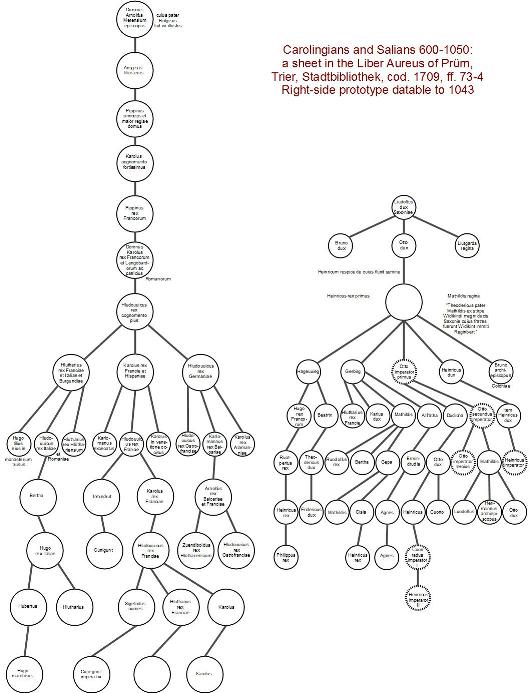
The second (below, but follow the link for my zoomable version) was drawn between 1101 and 1111 at the monastery of Pruem and bound into the Liber Aureus, a book of important Pruem documents. It is now in the city library of Trier, Germany, shelfmark 1709, folios 73-74, but is not online. In its left panel, it contains a variation of the first diagram described above. The diagram in the right panel contains a legal argument about consanguinity and has been dated by Nora Gädeke to 1043. This right section relates to the Ottonian and Salian dynasties who took control of the Western Roman Empire after the Carolingians, who form the left panel of this composite diagram:

2012-02-22

Who Was Carl Frick?

In the early stages of this study, I often used a compilation of Latin chronicles by Carl Frick, a German scholar. The standard bibliographic data as well as Franz Kössler's Personenlexikon indicate he was born in Schwerin in 1848. He published a series of books and articles, beginning with his 1872 doctoral thesis, De ephoris spartanis at the University of Goettingen, and then became interested in chronography.

Two of his articles listed in Grafton and de Jonge's 1993 Scaliger bibliography deal with the 8th-century chronicle in "barbarous" Latin, the Excerpta Latina Barbari.*

This was doubtless part of his preparations to publish volume 1 of Chronica Minora in 1892. Volume 2 never appeared and he seems to vanish from the record at the end of the 19th century. His involvement in publications for the König Wilhelm Gymnasium in Höxter, Germany makes it plain he was a secondary school teacher there, but I have not been able to find any account of his further academic career, or a date of death.

* Joseph Justus Scaliger und die Excerpta Latina Barbari, published in Rheinisches Museum, is online.

Late Add (2013-11-27): His Prussian personnel record with the last entry in 1893 is in the database Personaldaten von Lehrern und Lehrerinnen Preußens. There is a date, 1.4.10 on the front of this, which may indicate a 1910 death, but this is not certain. He is also mentioned in a history of the Höxter school library.

2012-02-21

What Did Pelagius See?

Theodor Mommsen describes a paper manuscript which included the Liber Genealogus. Though he did not personally see it, he knew it was kept in the Escorial Library outside Madrid:
Ovetensis episcopus Pelagius (a. 1101 – 1129) corpori chronicorum suo, de quo in praefatione ad Isidoriana disputabimus, hunc librum inseruit inscriptum teste Ambrosio Morales (apud Florez – Risco Esp. sagr. vol. 38 p. 367): incipit genealogiae totius bibliothecae ex omnibus libris veteris novique testamenti. archetypum periit, extant apographa et in codice Matritensi bibl. nat. T 10 saec . XVII (Knust Archiv 8, 799) et in Escurialensi b I 9 chart. saec. XV teste Ewaldo (neues Archiv 6, 232), scilicet tractatus inscriptus ita: incipiunt genealogiae totius bibliothecae ex omnibus libris veteris novique testamenti descriptum; adnotatur: hic liber genealogiae fuit desumptus ex libro vetustissimo ecclesiae Ovetensis in membranis litteris goticis scripto et dicitur finire in Theodosio: videtur igitur similis fuisse nostri F.
The above is online at the digital MGH. It feels faintly irreverent to add hyperlinks to 19th-century Latin but I have done so, since the relevant page of Ambrosio Morales's account and tabulation in Espana Sagrada is online. Friedrich Heinrich Knust ( -1841) (biography) was a German scholar who visited archives in Spain, as did Ewald whose Reise nach Spanien im Winter von 1878 auf 1879 is also online.

As Mommsen says, the 12th-century original that was kept at Oviedo is gone for ever. Hardly any of the Escorial Library is online, so there is no point searching for images of this unique paper copy, but Antolín's catalogue is helpful.

This 12th-century copy of the Liber Genealogus seems to have been been inserted into Pelagius's Liber chronicorum. Rouse and McNelis think the final comment about "in membranis litteris goticis scripto" is by the 15th-century copyist in León, referring to Visigothic script. Or is it a note by Pelagius talking about a book that was old in his day?

It is not clear what manuscript is described in Knust's abstract ("einige Genealogien aus dem alten und neuen Testamente" in a 17th- or 18th-century codex at the Biblioteca Nacional in Madrid with the former call number T10). I did not find the Liber Genealogus listed in the other manuscripts there containing Pelagius's chronological work. There seem to be at least five manuscripts containing elements of Pelagius's Liber chronicorum at the library, including one that is a roundup with his Libro de los Testamentos de la catedral de Oviedo in Ms. 6957 (catalogue entry, warning, large PDF!). But in each case, the content at practically every folio is described, making it unlikely that the Liber Genealogus is in any gap and somehow overlooked.

The interest of the matter to me is of course: what else was lodged in the now-lost cathedral library at Oviedo in the days when Pelagius was in charge? We know the library contained the now-lost Gospel Book of Justus because Ambrosio de Morales saw it there. But did the library also contain a copy of the Great Stemma?

2012-02-20

Calahorra Bible

A first-ever online image of the Great Stemma in the Calahorra bible has finally shown up: it contains the opening spread only, but the polychrome array of colours is very impressive, despite the battered state of the codex. The image is for sale on Artflakes, but you'll have to click through yourself because I don't want to breach the photographer's copyright. The online sample is not in a good enough resolution to read the script, but I will be linking to it from my catalogue page. The photographer says the image also appears in a book published last December, Historia de Calahorra (Ed. Amigos de la Historia de Calahorra. December 2011. ISBN 978-84-939155-06). The 12th-century Biblia de Calahorra is kept in the Archivo Catedralicio y Diocesano de Calahorra. It's battered and it looks like it has suffered some water damage, but it's still there, a wonderful treasure. The Amigos (Facebook page) deserve all the help they can get to preserve the town's history, and of course every tourist visiting Spain helps in the economic recovery.

2012-02-18

Peter's Compendium

So far this blog has not directed much attention to the Compendium historiae in genealogia Christi, a 12th-century work by Peter of Poitiers which presents a completely new stemmatic diagram. Peter was a believer in the Trinubium, the three marriages of St Anne, and his vast genealogical infographic went into wide circulation in medieval Europe. There is no evidence the Compendium is adapted from the Great Stemma, though it seems plausible that Peter would have known of the Great Stemma and would have been inspired by it to design his own diagram ab initio.

In his 1943 article in Estudios Biblicos on the Great Stemma, Teófilo Ayuso claims that one of the codices where it is reproduced is a 14th- or 15th-century bible at the University of Barcelona, which his 1943 article terms Barc1, though it later becomes Barc3 in his peculiar numbering. This is online: I found a digital version yesterday. Its call number is Sig. Ms. 762. (There is another fine Barcelona University bible online, Sig. Ms. 856, but this does not contain any stemmata.) Sig. Ms. 762 is described at volume 2, page 308 of Miquel Rosell's printed catalog as follows: Ff. 2-7. Genealogias. Inc.: De Cain. Cain agricola dolens ... Expl.: De Tiberio ..., sub quo Dominus est passus. It also contains an Interpretationes Hebraicorum Nominum.

It is clear from only superficial examination that including this bible in the Great Stemma camp is another of Ayuso's blunders. The Barcelona bible very clearly contains the Compendium diagram, not the Great Stemma.

This can be readily seen by comparing it to other codices. There are several good online presentations of the Compendium. An impressive one is Ms Typ 216 at the Houghton Library of Harvard University, a roll-manuscript (probably intended for use as a wall-chart). It can be viewed in sections here.

There is a finely drawn 12th-century (?) version in codex form in the Biblioteca Medicea Laurenziana in Florence, spread over 10 pages in an anonymous seven-folio document, Plut.20.56 (5v is the final page of the diagram). An early 13th-century manuscript from England now in Paris, Lat. 15254, contains the same chart. I expect there are many others, but this is what some searching today turned up. [An excellent starting point is Nathaniel Taylor's survey, and I see the Met Museum also has a damaged scroll which is online in low resolution.]

As far as I know, there has been no printed version since the rather inaccurate editio princeps of the Compendium published by Zwingli in 1592, which differs in signal ways from the manuscripts above. MDZ offers it digitized. I have not done a bibliography on the Compendium yet, but it is discussed at length by Christiane Klapisch-Zuber in chapter 6 of L'Ombre des Ancêtres and there are some articles mentioned in a footnote by Stork.

2012-02-15

Editio Princeps

As far as I know, the editio princeps of the Liber Genealogus is the edition of the Codex Taurinensis published at Paris by Christoph Pfaff in 1712. It can found on Google Books. The full title is Firmiani Lactantii Epitome Institutionum Divinarum ad Pentadium fratrem. For a German note about Pfaff, see Wikipedia.

2012-01-29

Primacy of Latin

If God had spoken Latin, western Christians believed, he would have dictated the scriptures in Jerome’s Latin words. The great Complutensian Polyglot Bible, published in Madrid 45 years before Hernando del Castillo collated Justus's Gospel Book, had placed the Greek, Latin and Hebrew texts in three parallel columns.

Its preface stated: Mediam autem inter has latinam beati Hieronymi translationem velut inter Synagogam et Orientalem Ecclesiam posuimus: tanque duos hinc et inde latrones medium autem Iesum hoc est Romanam sive latinam Ecclesiam collocantes (Prolog. II).

Here is a translation following Basil Hall (in Greenslade, E.L. ed., The Cambridge History of the Bible):
We have placed the Latin translation of blessed Jerome as though between the Synagogue and the Eastern Church, siting them like the two thieves, one on each side, and Jesus, that is the Roman or Latin Church, between them.
This sardonic statement appears at the start of the bible, a masterpiece of typography and Catholic scholarship, which was printed between 1514 and 1517 in Alcalá de Henares (Complutum in Latin). The Complutensian Bible is available as a PDF from Archive.org.

2012-01-22

Vetus Names

In her publication on the Great Stemma in 1984, Yolanta Zaluska asserted that all the existing recensions contained a mixture of Vetus Latina and Vulgate names:
Lé fond commun de la Vieille Latine est sensible dans tous les témoins consultés, mais à des degrés variés. Il est indiscutable que la Vulgate a été utilisée à plusieurs reprises tantôt pour corriger les lignées, tantôt pour compléter les textes explicatifs.
She characterized these differences as follows:
Recension α: ... texte mixte, en général très corrompu, disposé toujours sur quatorze tables; à partir d'Abraham (table VI), n'a presque pas été retouché sur la Vulgate.
Recension β: ... texte corrigé d'après la Vulgate, néanmoins dans l'ensemble assez corrompu, et fortement interpolé, en grande partie, semble-t-il, à l'aide des Etymologies d'Isidore; peut être commodément désigné comme une recension longue.
Recension σ transmise par le Beatus de Saint-Sever (S), apparaissant pour l'essentiel comme un texte de type α corrigé d'après la Vulgate, mais fournissant quand même des textes qui lui sont propres ...
Recension γ: ... texte ne montrant que des retouches occasionnelles d'après la Vulgate; partie caractéristique à la page des Juges; plusieurs omissions.
Recension δ: ... Le premier texte (Bible de San Millán de la Cogolla, Madrid) est probablement celui qui reflète le plus fidèlement la tradition de la Vieille Latine; le texte de [Bible de Calahorra] en revanche suit généralement la Vulgate, à partir d'Abraham; des interpolations communes dans la première partie du texte.
Zaluska never presented any statistical data or analysis to back up these characterizations, so I have done some sampling of my own. Below is a tabulation containing a rough scoring of 39 Genesis names from the period down to Abraham. I have included a recension, Epsilon, that Zaluska left out of account. I have not included Zaluska's Sigma in this survey.
The assessments are subjective, which is to say I judged the different spellings and rated how closely they resembled the Vetus Latina orthography (which is based on the Septuagint Greek). The scoring system offers a continuum between forms that show no influence from Jerome and forms that could only be corruptions of Jerome's orthography. This is not highly scientific, but it is a start. Here are the numerical values I employed:
  • -2 signifies an obviously LXX/Vetus form, but with extreme scribal deformation;
  • -1 is the pure LXX/Vetus type;
  • 0 means a name containing a consonant or vowel that uncertainly suggests the LXX/Vetus type;
  • +1 a name of Vulgate type;
  • +2 signified variants that are very unlike the Vetus but do resemble the Vulgate type
The columns, from left to right, represent Epsilon, Delta, Gamma, Alpha, Beta; the last three columns comprise Fischer's form of the Vetus name, the Clementine Vulgate form and the Stuttgart Vulgate form.

2 1 0 1 1 Gamer Gomer Gomer
1 -1 -1 -1 -1 Iuvan Iavan Javan
-2 -2 1 1 1 Thobel Tubal Thubal
-1 -1 -1 0 0 Cham Ham Ham
-1 -1 -1 1 1 Mestrem Mesraim Mesraim
1 1 -1 -1 1 Evilat Hevila Hevila
-1 1 0 1

Sabacatha Sabatacha Sabatacha
1 1 1 1 1 Iudadan Dadan Dadan
0 1 -1 0 -1 Nebroth Nemrod Nemrod
2 2 0 1 0 Labiim Laabim Laabim
1 1 -2 1 -2 Neptabiim Nepthuim Nephthuim
1 1 1 1 1 Patrosin Phetrusim Phetrusim
1 1 1 1 1 Caslonin Cesluim Chasluim
1 1 1 1 1 Captorim Capthurim


1 1 -1 1 1 Chetteum Ettheum Hethæum
1 1 1 1 2 Euveum Eveum Hevæum
1 1 1 1 1 Aruceum Araceum Aracæum
2 1 -1 1 1 Asenneum Sineum Sinæum
-1 -1 -1 1 1 Samareum Samariten Samaræum
1 1 2 2 1 Aelam Elam Ælam
-1 -1 -1 -1 -1 Arfaxat Arfaxad Arphaxad
2 2 2 2 2 Obs Us Us
0 1 0 0 0 Ul Hul Hul
1 2 2 2 1 Gather Gether Gether
-2 -2 -2 0 0 Mosoch Mes Mes
-2 0 0 0 0 Helmodat Helmodad Elmodad
1 1 1 1 1 Odorrem Aduram Adoram
1 1 -1 1 1 Ezel Uzal Uzal
1 0 -1 1 1 Gebal Ebal Ebal
1 1 -2 1 1 Abimeel Abimahel Abimaël
1 1 1 1 1 Ufir Ophir Ophir
1 1 1 1 1 Evilat Evila Hevila
-1 -1 -1 -1 -1 Falec Faleg Phaleg
-1 -1 -1 -1 -1 Ragau Reu Reu
-1 -1 -1 -1 -1 Seruch Sarug Sarug
1 1 -1 1 1 Nachor Nahor Nahor
-1 -1 -1 -1 1 Thara Thare Thare
1 -1 -1 1 1 Nachor Nahor Nahor
1 -1 -1 -1 -1 Sarra Sarai Sarai
This list has been filtered to only comprise 39 names in Genesis where there seems to be a distinction between the Vetus Latina and Vulgate forms.
Now it is striking that none of the five recensions above consistently follows the Vetus Latina type, which would be indicated by one of the columns consisting mostly of scores of -2 or -1.
When transcribing the manuscripts, my impression was that the concentration of Vetus Latina names was highest in Delta, but in this scoring, Delta has a median value of +0.3. In fact it is Gamma which is closest to the Vetus, with a median score of -0.2 . As for the rest, the medians are Epsilon +0.4, Alpha +0.5 and Beta +0.5.
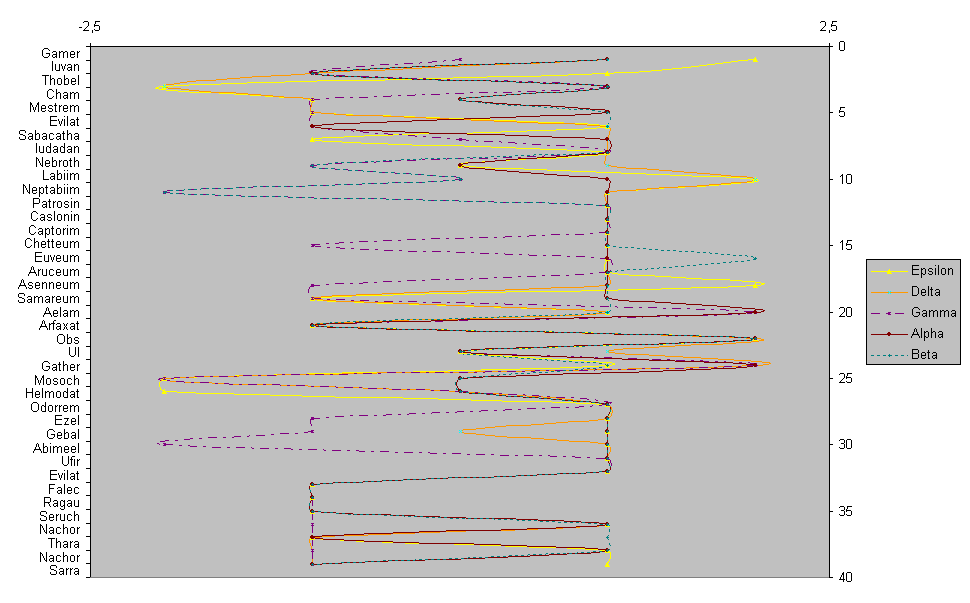
I have converted the table to a graph below. If anyone can think of a more expressive graph, I would be glad to hear advice on how this could be presented in line with current methods.
It will be clear to the readers from both the table and from the graph that there is no obvious consistency in the way that medieval editors revised the five recensions. The variants swerve wildly to both sides. In this sample of names from Genesis, the data does not seem to support Zaluska's conclusion that Gamma contains "occasional retouchings" drawn from the Vulgate," whereas Delta is the "most faithful" to the Vetus Latina. If anything, Gamma is more faithful.
What can we say about the names from those parts of biblical history subsequent to Genesis?
We cannot expect to find any differences in the names from Christ back to the Exile, because these names only existed in the Greek manuscripts of the Gospels of Matthew and Luke and no Hebrew evidence for them exists. Jerome of Stridon did not alter their Latin transcriptions, so these names are invariant between the Vetus Latina and the Vulgate.
As for the names from the Exile back to Saul, we also cannot expect to find much significant variation. We do not yet possess scholarly editions of the Vetus Latina text of 1 Samuel, 2 Samuel, 1 Chronicles and 2 Chronicles, 1 Kings and 2 Kings (they will take several more decades to arrive). To fill the gap, I have instead collated the Septuagint forms, which were of course the basis for the Vetus Latina. The reader can construe the likely Latin transcriptions, and compare these to the Stuttgart Vulgate forms. The following selection shows that Jerome left the bulk of the pre-existing Latin forms pretty well unchanged.
Αχινααμ Ahinoem 1Sa 25:43, 2 Sa 3:2
Αβιγαιας Abigail 1Sa 25:42, 2Sa 3:3
Μααχα Maacha 2Sa 3:3
Αγγιθ Aggith 1Ch 3:2, 2Sa 3:4
Αβιταλ Abital 2Sa 3:4
Αιγλα Agla 2Sa 3:5
Βηρσαβεε Bethsabee 2Sa 11:3
Αμνων Amnon 2Sa 3:2
Δαλουια Chelaab 2Sa 3:2, 1Ch 3:1
Αβεσσαλωμ Absalom 2Sa 3:3
Ορνια Adonias 2Ch 3:4
Σαφατια Safathia 1Ch 3:3, 2Sa 3:4
Ιεθερααμ Iethraam 2Sa 3:5
Θημαρ Thamar 2Sa 13:1
Ιβααρ Ibaar 1Ch 3:6, 14:5, 2Sa 5:15
Ελισαε Elisama A 1Ch 14:5, 3:6, 2Sa 5:16
Ελιφαλετ Eliphalet / Helifeleth 1Ch 3:6, 14:5, 2Sa 5:16
Ναγε Noge 1Ch 3:7, 14:5
Ναφαγ Napheg / Nepheg 1Ch 3:7, 14:5, 2Sa 5:15
Ιανουε / Ιανουου Iaphie 1Ch 3:7, 14:5, 2Sa 5:15
Ελισαμα / Ελισαμαε Elisama B 1Ch 3:8, 14:5
Ελιαδα Helida / Heliade 1Ch 3:8, 14:5, 2Sa 5:16
Ελιφαλετ Eliphalet / Helisua 1Ch 3:8, 14:5, 2Sa 5:15
Σαμμους Samua 2Sa 5:14
Σωβαβ Sobab 2Sa 5:14
Σαλωμων Salomon Mt 1:6, 2Sa 5:14


Ιεροβοαμ / Ναβατ Hieroboam 1Kgs 11:26
Ναδαβ Nadab 1Kgs 15:25
Βαασα / Αχια Baasa filius Ahia 1Kgs 15:33
Ηλα Hela filius Baasa 1Kgs 16:8-16
Ζαμβρι Zamri 1Kgs 16:9
Θαμνι / Γωναθ Thebni filium Gineth 1Kgs 16:21
Αχααβ / Αμβρι· Ahab filius Amri 1Kgs 16:29
Ιεζαβελ Hiezabel 1Kgs 16:31
Οχοζιας Ohozias 1Kgs 22:40
Ιωραμ / Αχααβ Ioram filius Ahab 2Kgs 3:1, 1Kgs 22:50
Ιου / Ναμεσσι Hieu filius Namsi 1Kgs 19:16, 2Chr 22:7
Ιωαχας Ioachaz 2Kgs 10:35
Ιωας Ioas filius Ioachaz 2Kgs 13:10
Ιεροβοαμ Hieroboam 2Kgs 13:13
Ζαχαριας Zaccharias filius Hieroboam 2Kgs 15:8
Σελλουμ / Ιαβις Sellum filius Iabes 2Kgs 15:13
Μαναημ / Γαδδι Manahem filius Gaddi 2Kgs 15:14
Φακεϊας Phaceia filius Manahem 2Kgs 15:23
Φακεε / Ρομελιου Phacee filius Romeliae 2Kgs 15:25
Ωσηε / Ηλα Osee filius Hela 2Kgs 17:1
As luck would have it, where differences do occur in the above list, it is not always easy to see a pattern in the Great Stemma's uptake of the forms. First of all we find certain odd distortions. The first Elisama, for example, appears not as Elisae, but as Elisbe. Secondly, some of the variations completely contradict Zaluska's generalizations: Zambri with a B appears in three recensions (Epsilon, Alpha, Beta), but has been "corrected" to Jerome's Zamri without a B in Delta and Gamma, which are normally the most conservative texts.
Zaluska's assertion that the balance in Alpha swung, after Abraham, to almost pure Vetus Latina forms is therefore interesting and provocative, but needs to be treated with a certain amount of caution. My guess is that her generalization was in fact largely argued from her very perceptive analysis of the Horrite names in Genesis 36. I wrote a survey of these in 2010 where I tabulated the names and provided the proof that is missing from her article, though implied. The differences among the Horrite names between Alpha and Beta are especially striking and this section of the collation is crucial in proving that the Great Stemma is indeed drawn from a Vetus Latina tradition.
I have not yet studied the Vetus/Vulgate distribution of the names making up the Twelve Tribes of Israel: it would be interesting to follow this up at a later time.
In conclusion, I would say this. The Great Stemma and the Liber Genealogus were clearly originally written in a time and place where Jerome's Vulgate was not available and were then haphazardly modified by medieval editors. But the process of modification was not as simple or as linear as Zaluska suggests, and her conclusions are too sweeping. The Great Stemma manuscripts are anything but unambiguous evidence for the onomastics of the Vetus Latina. Bonifatius Fischer was correct to collate the Great Stemma from four Spanish bibles as a somewhat compromised source, while treating it with the greatest of caution.

Footnote: there is a further discussion of this issue a couple of years later: http://macrotypography.blogspot.com/2014/04/the-old-latin.html

2012-01-07

Marathon

I glimpsed an ARD television news report four weeks ago on the Berlin round of the Visualizing Marathon but cannot find the news clip any more. There is some coverage of the event on Vizworld.