2016-04-22

Monument in China

An engraved stone monument erected in 781 in a Nestorian Christian graveyard in Xi`an, China commemorated the arrival of Christianity 150 years before that in China. You can see this extraordinary historical treasure today inside the Forest of Steles at Bēilín Museum.

An ink rubbing was made from the stele in the 1630s and sent to Rome, and the discovery caused a sensation in Europe, where Chinese adoption of Christianity in 631 had been entirely unknown, as Anthony Grafton's Rome Reborn page (with a false callmark) notes.

The rubbing, now part of the bundle Barb.or.151, is one of the oriental treasures that has just been digitized by the Biblioteca Apostolica Vaticana, posted online on April 21.
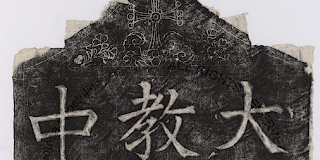
The monument is about 2.5 metres tall and capped by a carved cross. The heading, as translated in the Wikipedia entry reads, "A Monument Commemorating the Propagation of the Ta-Chin Luminous Religion in the Middle Kingdom". Ta-Chin is an old Chinese term for the Roman Empire.

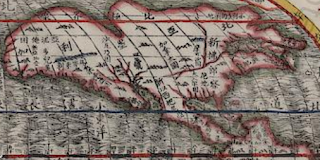
Another item in this package of digitizations is an abridgement printed in the 1620s of the famed map of the world that Matteo Ricci, the first Jesuit missionary to become adept in Chinese, had produced in 1574. The hand-tinted print was made at the orders of Giulio Aleni, whose name is marked on it, as Grafton notes. Here is North America:
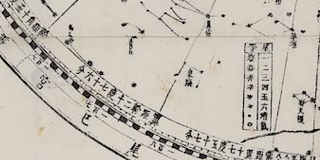
Also in the bundle is the printed astronomy, Chien-chien tsung-hsing-t'u by Adam Schall von Bell, of which Grafton notes: von Bell introduced the new astronomy of Galileo, including the telescope, to China. This single-sheet printed map with explanatory text shows the stars visible in the sky of northern China.
  1. Barb.or.151.pt.1, bundle of Chinese materials (above)
  2. Borg.cin.497,
  3. Borg.cin.537,
  4. Borg.cin.538,
  5. Borg.gr.27,
  6. Ott.lat.1252,
  7. Ott.lat.2358,
  8. Reg.lat.165,
  9. Reg.lat.179,
  10. Reg.lat.1935,
  11. Reg.lat.1995, the autobiography of Pope Pius II, the former Enea Silvio Piccolomini. This book, the Commentarii, is a remarkably frank autobiography and the only book he wrote after his election, in which he put his passions and prejudices on full view, Anthony Grafton notes in the Rome Reborn catalog. Enea Silvio was the first humanist to be elected to the papacy.
  12. Reg.lat.2039,
  13. Ross.184,
  14. Ross.254,
  15. Ross.276,
  16. Ross.616,
  17. Ross.701,
  18. Ross.977,
  19. Ross.1165,
  20. Urb.lat.252,
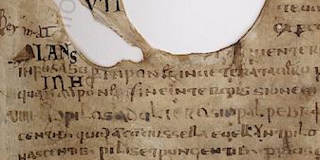
  21. Urb.lat.293, a nicely written 11th or 12th century manuscript of Vitruvius on Architecture notable for its two flyleaves, now folios 96 and 97, which date from the first half of the 8th century and contain important material from the late antique Greek medical writer Oribasius: This contains words glossed in Old German, indicating it has a German provenance: Lowe number CLA 1 116, see Trismegistos
  22. Urb.lat.367,
  23. Urb.lat.378,
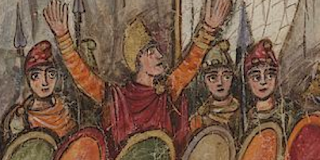
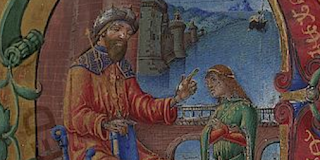
  24. Urb.lat.548, a very fine Renaissance part-bible transcribed by Mattheus de Contugiis, here the start of Proverbs, showing Solomon learning wisdom from father David:
  25. Urb.lat.597,
  26. Urb.lat.644,
  27. Urb.lat.1030, a Pietro Bembo autograph
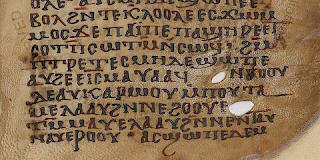
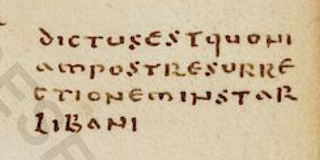
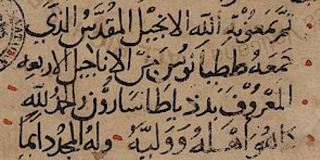
  28. Vat.ar.14, a 12th-century Arabic translation of the Diatessaron of Tatian, a combination of all four gospels into a single narrative. Thanks to Adam Carter McCollum in Vienna for pointing out this one on Twitter. Here is the colophon:
  29. Vat.ar.503,
  30. Vat.ar.581,
  31. Vat.ar.1606, a tiny and very ancient book in Arabic, apparently selections from Koran
  32. Vat.ebr.123,
  33. Vat.ebr.142.pt.2,
The Vatican scanners have also been hard at work for their Heidelberg sponsors, producing 10 new digitizations, which have just appeared on the Heidelberg RSS and are only visible on the German site:
  1. Pal. lat. 381 Ovidius Naso, Publius; Cicero, Marcus Tullius: Sammelhandschrift (Deutschland (Heidelberg?), 15. Jh.)
  2. Pal. lat. 733 Digestum vetus (14. Jh.)
  3. Pal. lat. 734 Digestum vetus (14. Jh.)
  4. Pal. lat. 735 Digestum vetus (13. Jh.)
  5. Pal. lat. 736 Digestum vetus (14. Jh.)
  6. Pal. lat. 687 Egidii (de Foscariis) ordo iudiciarius editus secundum consuetudinem bononiensem in foro ecclesiastico approbatam ; Mag. Bartholomei Brixiensis questiones dominicales et venales de iure canonico (15. Jh.)  
  7. Pal. lat. 691 Monaldi (Iustinopolitani ord. fr. minorum) summa iuris canonici (15. Jh.)
  8. Pal. lat. 695 Fratris Monaldi summa de iure canonico secundum ordinem alphabeti (14. Jh.)
  9. Pal. lat. 1525 Cicero, Marcus Tullius: Opera ; Orationes (Deutschland (?), 15. Jh.)
  10. Pal. lat. 1834 Melanchthon, Philipp; Luther, Martin; Erasmus, Desiderius: Epistolae (Wittenberg, 1536-1543 (?))
This is Piggin's Unofficial List number 46. I will fill in other details later. If you have corrections or additions, please use the comments box below. Follow me on Twitter (@JBPiggin) for news of more additions to Digita Vaticana.

2016-04-12

Trio of Vergils

The Roman Vergil is among the world's most celebrated old books: a 5th-century illustrated manuscript of the works of the Latin writer Virgil with the Vatican library shelfmark Vat. lat. 3867.

It has just entered the internet, marking a fresh historic moment in the Vatican digitization program. On the same day, the Vatican's leaves of a non-illuminated Virgil from the same period, the Vergilius Augusteus (Vat. lat. 3256), arrived online.

The even older Vatican Vergil, Vat. lat. 3225, another Late Antique illustrated book with which these two are commonly compared, has been online for over a year. These two additions make the set complete. Now you can compare all three at high resolution, in colour.

Classical Rome did not have illustrated codex books. Late Antiquity invented them in one of its major advances in media and public education. The rest as they say is history.

Here is the Roman Vergil's treatment of a shipbound Aeneas enduring a storm released by the goddess Juno against him. It is often said that the style seems like a precursor to medieval art:

The Wikipedia article Vergilius Romanus notes a theory that the Roman Vergil was made in Britain. Robert Vermaat accessibly sums up the argumentation for this. If true, the Roman Vergil is the oldest of any book from England in existence.

Here is the full list of 143 digitizations on April 11, bringing the posted total to 4,215. Click (tap) on the images to go straight to the pages. I want to rush this major news to you now, and will continue to mark the list up, with more of the goodies to be described in the next few days, so do come back.

The Bibioteca in Rome has no RSS feed, no running announcements, nothing. If you want news on what they put out, you'll have to come to my unofficial site, the only news stream on the internet covering the subject. Follow me on Twitter: there's a one-click button at right to make it easy.
  1. Borg.copt.109.cass.XVI.fasc.59, fragments, Gospel of Luke 8:36-9:41 and 12:39-14:9, looking extremely old even to my untrained eye
  2. Chig.C.IV.100,
  3. Urb.lat.603, the Breviary of Blanche of France, a major art treasure
  4. Vat.lat.29 ,
  5. Vat.lat.268,
  6. Vat.lat.284,
  7. Vat.lat.287,
  8. Vat.lat.303,
  9. Vat.lat.317,
  10. Vat.lat.326,
  11. Vat.lat.333,
  12. Vat.lat.335,
  13. Vat.lat.357,
  14. Vat.lat.358,
  15. Vat.lat.359,
  16. Vat.lat.361,
  17. Vat.lat.363,
  18. Vat.lat.365,
  19. Vat.lat.367,
  20. Vat.lat.370,
  21. Vat.lat.374,
  22. Vat.lat.379,
  23. Vat.lat.383,
  24. Vat.lat.386,
  25. Vat.lat.387,
  26. Vat.lat.388,
  27. Vat.lat.390,
  28. Vat.lat.391,
  29. Vat.lat.394,
  30. Vat.lat.395,
  31. Vat.lat.402,
  32. Vat.lat.403,
  33. Vat.lat.404,
  34. Vat.lat.406,
  35. Vat.lat.408,
  36. Vat.lat.411,
  37. Vat.lat.417,
  38. Vat.lat.419,
  39. Vat.lat.420,
  40. Vat.lat.421,
  41. Vat.lat.422,
  42. Vat.lat.423,
  43. Vat.lat.426,
  44. Vat.lat.429,
  45. Vat.lat.431,
  46. Vat.lat.432,
  47. Vat.lat.437,
  48. Vat.lat.442,
  49. Vat.lat.443,
  50. Vat.lat.447,
  51. Vat.lat.448,
  52. Vat.lat.455,
  53. Vat.lat.456,
  54. Vat.lat.457,
  55. Vat.lat.460,
  56. Vat.lat.462,
  57. Vat.lat.464,
  58. Vat.lat.469,
  59. Vat.lat.470,
  60. Vat.lat.473,
  61. Vat.lat.477,
  62. Vat.lat.482,
  63. Vat.lat.488,
  64. Vat.lat.492,
  65. Vat.lat.493,
  66. Vat.lat.497,
  67. Vat.lat.499,
  68. Vat.lat.502,
  69. Vat.lat.503,
  70. Vat.lat.504,
  71. Vat.lat.506,
  72. Vat.lat.508,
  73. Vat.lat.509,
  74. Vat.lat.511,
  75. Vat.lat.512,
  76. Vat.lat.515,
  77. Vat.lat.517,
  78. Vat.lat.520,
  79. Vat.lat.522,
  80. Vat.lat.523,
  81. Vat.lat.524,
  82. Vat.lat.526,
  83. Vat.lat.528,
  84. Vat.lat.529,
  85. Vat.lat.530,
  86. Vat.lat.531,
  87. Vat.lat.532,
  88. Vat.lat.536,
  89. Vat.lat.537,
  90. Vat.lat.538,
  91. Vat.lat.541,
  92. Vat.lat.542,
  93. Vat.lat.547,
  94. Vat.lat.548,
  95. Vat.lat.551,
  96. Vat.lat.553, Eucherius of Lyon, a 9th-century manuscript possibly originating from Germany. Lowe number, CLA 1 6  
  97. Vat.lat.554,
  98. Vat.lat.559,
  99. Vat.lat.562,
  100. Vat.lat.570,
  101. Vat.lat.574,
  102. Vat.lat.579,
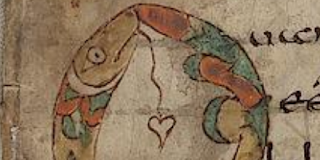
  103. Vat.lat.583, Gregory the Great in an 8th-century manuscript, Lowe number CLA 1 7, with this fine fishy Q:
  104. Vat.lat.589,
  105. Vat.lat.590,
  106. Vat.lat.591,
  107. Vat.lat.595,
  108. Vat.lat.605,
  109. Vat.lat.607,
  110. Vat.lat.608,
  111. Vat.lat.613,
  112. Vat.lat.614,
  113. Vat.lat.621,
  114. Vat.lat.643,
  115. Vat.lat.1112, commentary on the Sententiae 
  116. Vat.lat.1164, theological including Giacomo da Pesaro
  117. Vat.lat.1165, theological, first half is a Spanish printed book of 1548
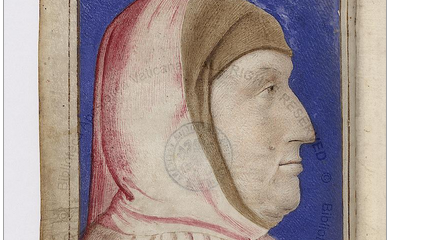
  118. Vat.lat.3198, Petrarch with portrait:
  119. Vat.lat.3212, Italian poetry of Antonio del Alberti, etc.
  120. Vat.lat.3256, the Vergilius Augusteus (see the Wikipedia article)
  121. Vat.lat.3305,
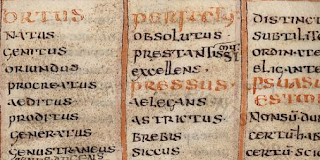
  122. Vat.lat.3321, a late antique glossary, in an 8th-century central Italian manuscript, Lowe CLA 1 15: a sort of dictionary and Roget's Thesauraus combined. I originally marked this as Isidore of Seville, Differentiae (Isidore was a bit of a plagiarist and fond of substituting new words in quotes to make them his own) but it seems that this is a source used by Isidore. The manuscript has been edited (see the 1834 Rome edition on Google Books) and there is a huge bibliography suggesting this is an important source for Latin lexicography and linguistics.
  123. Vat.lat.3357,
  124. Vat.lat.3437,
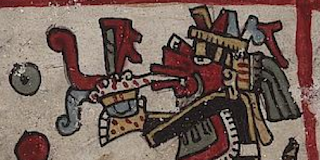
  125. Vat.lat.3773: Thanks to ParvaVox who was quick to point out this is an old pictorial Mexican Nahua manuscript, and to @carolinepennock, who adds that it's a tonalamatl (divinatory calendar), probably from Tlaxcala. She says it is one of only a handful believed to be pre-conquest, and another digital reproduction is available at www.famsi.org. It was probably made in the 16th century, but the manuscript's history previous to the Vatican cataloguing of 1596-1600 is unknown. She says it part of what is called the Borgia group. Here's one of the hundreds of figures in it:
  126. Vat.lat.3797,
  127. Vat.lat.3867, the Roman Vergil, in rustic half-uncial script with many illustrations (see above)
  128. Vat.lat.3869, Hippocrates' Iusiurandum translated to Greek: ETNG
  129. Vat.lat.3886, Enea Silvio Piccolomini's 1458 autograph manuscript of Germania, a famed humanist review praising the orderliness and prosperity of the new Germany. It was to appear in print in Leipzig in 1496. This second part is marked Aeneas Cardinalis Sancte Sabine ad objectiones Germanorum in a 16th-century hand on the front flyleaf. See Gernot Michael Müller
  130. Vat.lat.4104, 16th-century letters to Angelo Colocci, Fulvio Orsini and others
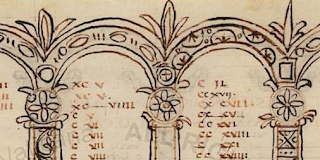
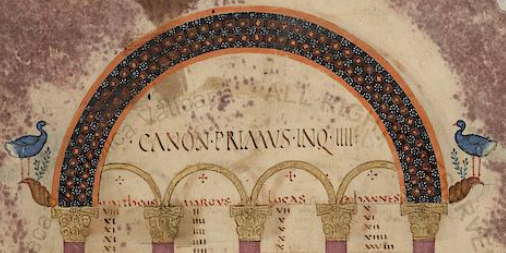
  131. Vat.lat.4221, 11th-century three-column bible, possibly with some Vetus Latina readings, with fine canon tables:
  132. Vat.lat.4329, folio 87, a flyleaf, is a recycled 7th- or 8th-century page with Liber Comitis on it, Lowe number CLA 1 20:
  133. Vat.lat.4777, Dante? incomplete
  134. Vat.lat.4782, Dante, two-column ms
  135. Vat.lat.4965, the 9th-century report/translation from the Greek concerning the 8th Ecumenical Council in Constantinople for Pope Hadrian II by Anastasius Bibliotecarius: he seems to have got scribes in the papal scriptorium to write up this fair copy 870-871, then wrote his corrections on it. With these remarkable alterations, this manuscript offers insights into a first-millennium translation bureau (link to Berschin). HT as well to @LatinAristotle who flags a major article by Réka Forrai about this papal translator and diplomat.
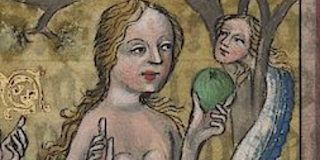
  136. Vat.lat.5697, Peter Comestor's Historia Scholastica , early 15th century, one of the masterpieces of Gothic illumination, with wonderful images such as this scene:
    This is a charming Eve about to bite the apple as the Devil tells her it's sooo good:
    Notice the selfie-like distortion? Please, somebody, post this on Instagram.
  137. Vat.lat.5704, a 6th-century Latin translation of Cassidorus's Historia Tripartita almost certainly made in his own scriptorium at Vivarium, Italy. Lowe number CLA 1 25. It has been argued by some scholars that marginal notes to the Enarratio in Canticum Canticorum of Philo Carpasianus may be by the hand of the great Cassiodorus himself:
    If we had not had the Vergils, I would certainly have headlined this week's post with this treasure.
  138. Vat.lat.5759, Ambrose of Milan on Genesis and the Evangeliorum Libri of Juvencus, late 10th century, written over the top of an 8th-century gospels probably from Bobbio, Italy. The final pages have not been refilled, so you can see clearly how a palimpsest was prepared. Lowe number CLA 1 37
  139. Vat.lat.7016, an 8th-century gospels from Italy intact, Lowe number CLA 1 51 with canon tables:
  140. Vat.lat.7189, commentary on canon law by Johannes de Turrecremata (died 1468): the missing volume of an autograph series Vat. lat. 2572-2576 (Gero Dolezalek). 
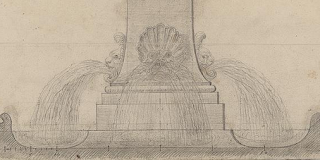
  141. Vat.lat.11258.pt.B, a book of designs and plans for baroque Rome.
    Anthony Grafton notes in the Rome Reborn catalogue that this architectural drawing (folio 200r) for the centrepiece of the Piazza Navona by Francesco Borromini was not implemented.
  142. Vat.sir.598, an 1871 copy of records of 19 oriental synods
  143. Vat.turc.150,
This is Piggin's Unofficial List 45 and not the last. Follow me on Twitter (@JBPiggin) for news of more additions to Digita Vaticana, and join this site with Google Friend Connect (right) or you'll miss out on the next releases. If you have corrections or additions, please use the comments box below.

2016-04-05

Touch-Pages

When the first touchscreens came out, a lot of us felt vaguely uncomfortable about touching pages. We had been inoculated by schoolteachers and librarians to feel guilty at putting our fingers on text.

It was not always like this. Much-used old manuscripts were also much touched. Images of the Devil are usually rubbed out by thousands of tappings to abjure him with a prayer. And certain sorts of text had to be touched to be used properly. Which brings me to a great glory among this week's 85 Vatican digitizations, Vat.lat.3806, with some of the oldest Eusebian canon tables of the Gospels.

The codex is known as the Rocca Sacramentary, a liturgical book for use in Fulda, Germany. Its early 10th-century scribe was a monk in Regensburg. To stop it getting too worn, it was given a couple of flyleaves at the front ripped from a Gospels (you know how it is, there's always rubbish lying around the place) with some tables painted in or near Rome in the 6th century.

The tables tell the reader where matching scenes and quotes occur in the four gospels. You need your fingers to use them. When searching for a match, you turn back to the front of the book to this index, look up your references in the table, hold your place on the table with a finger of the left hand and leaf through to the different "targets" with your right hand.

Indexes require index fingers. If it gets really complicated, you might need to use four fingers in a pianist's straddle to hold four places in the tables at once. Hand gymnastics.

The invention of tables of concordance was a major advance in the history of information technology, the topic of learned books by Anthony Grafton, Martin Wallraff and others (see below). And now that we have learned again to touch our texts, we understand in hindsight that pages designed to be touched were not a sin, but one of the great inventions to engage our bodies in the work of thinking.

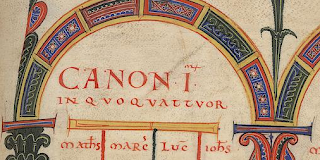
The canons in the Rocca codex are thought to be the oldest western (Latin) examples, going back nearly as far as the oldest eastern examples in the Rabbula Gospels (Plut 01.56) in Florence.

In the following list of the April 4, 2016 digitizations (these bring the posted total to 4,072), I have marked several other gospels with newer canon tables you can compare them.
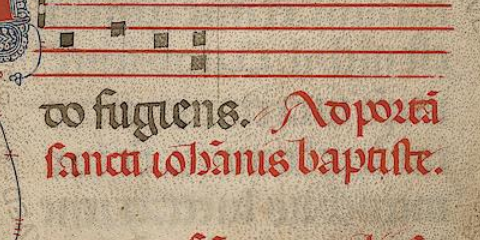
  1. Barb.lat.525, Evangeliary (gospel book) from Florence with prayers for each of its four city quarters during a procession. Here is the page for Porta San Giovanni:
  2. Barb.lat.637, Gospels, 9th century, with capitula lists but no canon tables
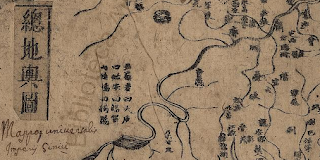
  3. Barb.or.135, printed book notable for this map of China:
  4. Borg.copt.109.cass.VI.fasc.17,
  5. Borg.copt.109.cass.VI.fasc.18,
  6. Borg.copt.109.cass.VI.fasc.20,
  7. Borg.copt.109.cass.XI.fasc.35,
  8. Borg.copt.109.cass.XVI.fasc.56,
  9. Borg.copt.109.cass.XVI.fasc.57,
  10. Borg.copt.109.cass.XVI.fasc.58,
  11. Borg.copt.109.cass.XVI.fasc.60,
  12. Borg.copt.109.cass.XVI.fasc.61,
  13. Borg.copt.136.pt.1,
  14. Borg.copt.136.pt.2,
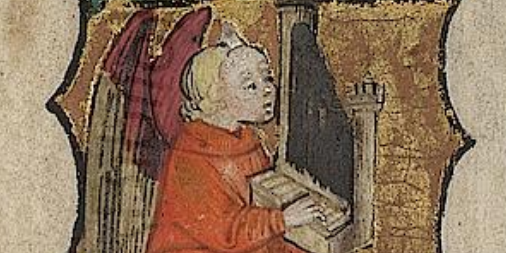
  15. Chig.C.IV.111,  a 15th-century book of hours, an illuminated prayerbook with scenes from the Virgin's life. After asking on Twitter what this peculiar harp-like instrument played with a keyboard is ....
    ... responses came from Valerie Wilhite, and Cristina Alis Raurich in Spain who actually plays one:
  16. Chig.C.VI.161,
  17. Chig.E.IV.126,
  18. Chig.L.V.167,
  19. Chig.L.V.168,
  20. Chig.L.VII.251,
  21. Chig.L.VII.253,
  22. Chig.L.VIII.292,
  23. Chig.L.VIII.302,
  24. Chig.M.VII.143,
  25. Ott.lat.84,
  26. Ott.lat.457,
  27. Ott.lat.1212,
  28. Ott.lat.1523,
  29. Ott.lat.1717,
  30. Ott.lat.2530,
  31. Ott.lat.2546,
  32. Ott.lat.2864, Dante's Divine Comedy (thanks @noah_nonsense for the tip-off)
  33. Ott.lat.2866,
  34. Reg.lat.3,
  35. Reg.lat.10, Gospels, with canon tables
  36. Reg.lat.307, Augustine of Hippo on Gospel of John, 9th century
  37. Ross.314,
  38. Ross.613,
  39. Urb.gr.99,
  40. Vat.gr.2313.pt.A,
  41. Vat.lat.50,
  42. Vat.lat.51,
  43. Vat.lat.80,
  44. Vat.lat.85,
  45. Vat.lat.235,
  46. Vat.lat.238,
  47. Vat.lat.250,
  48. Vat.lat.252,
  49. Vat.lat.255,
  50. Vat.lat.256,
  51. Vat.lat.258,
  52. Vat.lat.311,
  53. Vat.lat.323,
  54. Vat.lat.438,
  55. Vat.lat.498,
  56. Vat.lat.540,
  57. Vat.lat.573,
  58. Vat.lat.602,
  59. Vat.lat.646,
  60. Vat.lat.722,
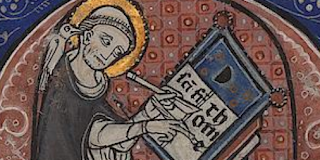
  61. Vat.lat.785.pt.2, Thomas Aquinas: here he is with his parchment scraper and quill, hard at work with a dove (Holy Spirit) on his shoulder whispering what to write in his ear
    This is one of five Thomas codices made for Pope John XXII in the first quarter of the 14th century. Corinne Péneau suggests the iconography of the dove, taken over from past images of saints John, Peter and Gregory the Great, marks the promotion at this time of Aquinas to sainthood.
  62. Vat.lat.1995, Latin translation of Flavius Josephus, Antiquities of the Jews, etc.
  63. Vat.lat.1997, ditto
  64. Vat.lat.2376, John of Alexandria, commentary on Galen
  65. Vat.lat.3741, Gospels
  66. Vat.lat.3806, Rocca Sacramentary, for use in Fulda, scribe a monk in Regensburg, with two recycled flyleaves, fols 1-2, which are in fact 6th-century canon tables in Latin (by Eusebius): see Lowe, CLA Suppl. 1766, where the tables' origin is suggested to be the area of Rome
  67. Vat.lat.4220, Jerome, Letters to Paul etc
  68. Vat.lat.5762, from Bobbio, Letters of Jerome: note the poor, cheap parchment with holes and incomplete pages: the monks used whatever they could lay hands on, and wrote around the gaps.
  69. Vat.lat.5765, another fine old uncial manuscript from Bobbio, Italy, containing Isidore of Seville's De officiis (English translation via Google Books), dated to the beginning of the 8th century: this was made within 100 years of Isidore's lifetime. See Lowe, CLA 143   
  70. Vat.lat.5859, Ovid, Metamorphoses
  71. Vat.lat.5974, Gospels with canon tables
  72. Vat.lat.6083, more Gospels with canon tables
  73. Vat.lat.7224, 9th-century Gospels from Salzburg, Austria
  74. Vat.lat.7567, Bartolomeo da Colle (1421-1484): a manuscript of Dante
  75. Vat.lat.7795, more of the Bible of Aracoeli (see PUL 43)
  76. Vat.lat.7798, ditto
  77. Vat.lat.7801, ditto
  78. Vat.lat.8176, Pietro Bembo, letters
  79. Vat.lat.8208, Baldassar Castiglione, autograph
  80. Vat.lat.8262, scraps of book pages, handwritten notes, 17th century
  81. Vat.lat.8376, a damaged Paradiso of Dante associated with Bartolomeo da Colle (see above)
  82. Vat.lat.8700, illuminated missal, of Pius II
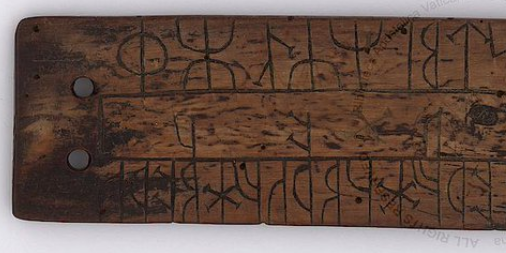
  83. Vat.lat.14613, a set of slats with writing on them:
    I didn't know what they were, but swiftly a tweet explained they were Scandinavian runes: which is the runic "alphabet" in its common order. The letters are mirrored, and some of them also upside down. We still don't know how this little treasure got to Rome.
  84. Vat.sir.51.pt.1,
  85. Vat.sir.51.pt.2,
In Heidelberg, 10 further Vatican manuscripts have arrived online in the past few days, and as usual actually come with descriptions:
  1. Pal. lat. 631, Gregorii IX decretales cum apparatu (Ioannis Andreae) (14.-15. Jh.)
  2. Pal. lat. 632, Gregorii IX decretales cum apparatu (Ioannis Andreae) (14.-15. Jh.)
  3. Pal. lat. 658 Iohannis summa super decretum (Gratiani) (14. Jh.)
  4. Pal. lat. 656 Sammelhandschrift (14. Jh.)
  5. Pal. lat. 640 Bonifatii VIII liber sextus decretalium, cum apparatu Ioannis Andreae (14. Jh.)
  6. Pal. lat. 642 Constitutiones Clementis V, cum apparatu Iohannis Andree (1460)
  7. Pal. lat. 703, Mag. Raymundi (de Pennaforti) summa de poenitentia et de matrimonio (14. Jh.)
  8. Pal. lat. 708, Ioannis (Friburgensis) Lectoris idem opus (14. Jh.)
  9. Pal. lat. 711, Sammelhandschrift (15. Jh.)
  10. Pal. lat. 732, Digestum vetus (14. Jh.)

If you have corrections or additions, please use the comments box below. Follow me on Twitter (@JBPiggin) for news of more additions to Digita Vaticana. [This is Piggin's Unofficial List (PUL) 44.]

Grafton, Anthony, and Megan Hale Williams. Christianity and the Transformation of the Book: Origen, Eusebius, and the Library of Caesarea. Harvard University Press, 2006.

Wallraff, Martin. Kodex und Kanon. Berlin: de Gruyter, 2013.

2016-04-02

Medieval scribes used HTML tags

When a video-rich website fails to load to your mobile because you drove out of cell range or your data plan maxed out, you're a victim of data bloat. To make files more portable, programmers constantly seek new ways to compress them in size. Now, it turns out, the problem was licked 1,000 years ago.

One way to compress a text file is to shorten its commonest words. Medieval scribes knew that. They had a long repertoire of abbreviations, but this only shortens a file by about 5 per cent.

A modern way is to deconstruct the document, and provide a web client with compact instructions about how to rebuild it. That's how a browser reconstitutes a page using bare-bones text in a HTML file, prettied up by the look, sizing and positioning saved in a CSS file. All the objects are instances of classes of some sort, so they don't have to be repetitively described.

The result: tiny files can create big, bright web pages.

This week I discovered evidence that medieval information technologists used the same technique, separating content from form to make a graphics file more portable.

The story starts with the Bible of Ripoll, a Latin bible illuminated in Ripoll, Spain in about 1025 CE and now kept at the Vatican. It contains a handwritten list of only the text of a late antique infographic, the Great Stemma. This huge diagram devised in about 420 CE generally needs up to 18 pages to display, but in the Ripoll Bible, the text-only version fits in a little over five pages.

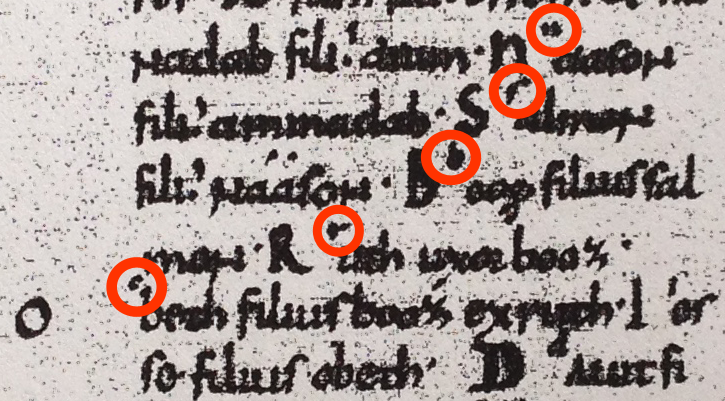
The mystery here is: why was the Ripoll list made? What use is a non-graphic version of  a diagram? No one has ever been able to solve that puzzle about this manuscript. Let's look at a sample of the Ripoll text, where it quotes the Gospel of Matthew 1:4-5 "Nahshon was father of Salmon; Salmon was father of Boaz, ... Boaz was father of Obed, whose mother was Ruth. Obed was father of Jesse."

In the following image, I have circled five puzzling extra letters in the Latin text in red. After the initial capital of each name, the same letter in miniscule has been inserted. The letter with Salmon is the normal "s" in Carolingian script, while the "o" with Obed is damaged but clear enough. To exercise your grey cells, I have not marked the "i" of Jesse and the "d" of David. Try to find them.

For reading purposes only, these added letters would be completely superfluous. I've never seen the like of them. But after some thought, I believe I can explain the insertions.

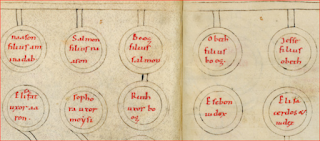
In my view, this text-only file was not originally something that stood alone, but must have been intended for use in conjunction with a positioning document. I would conjecture that the document would have looked something like this in its section with the five generations to Jesse:

The small letters here match with the keys in the text file. The text has thus been divided into snippets, just as a HTML text is marked up with tags in modern web documents. Tagging is a type of metadata to describe a document's presentation. It relies on a set of definitions held elsewhere.

For the Ripoll document, which is not explained in any way, an explanation must have existed elsewhere as to what the reconstituted document was to be: a visualization of a biblical genealogy where the persons (and historical periods) were represented by circles. This would be the equivalent of a modern "document type declaration".

Using an exemplar composed of three compact files, any smart scribe would have been able to reconstitute the original diagram like this:

In this version, dating to about 672 CE and preserved in a later Italian manuscript, Plut 20.54 in Florence, the five names of the men are in the top row. Ruth's is the centre roundel in the lower row.

Why the proper diagram was never reconstructed and inserted in the beautiful Ripoll Bible (Vat. lat. 5729, still not online) is unclear. Perhaps its positioning file was missing or damaged. Perhaps there was a misunderstanding in the scriptorium.

Now I must emphasize I am not claiming Hyper Text Markup Language was devised in medieval times: I am using that term as an approximation for meta-data markup at the phrase level. Nor have I discovered the positioning document itself. I can only guess that it once existed. But I think we now have a cogent explanation of the function of these miniscule letters, and thus of the Ripoll list itself. Other parts of it have large initials in the margins (like the big O of Obeth above) which may have also been keys. I am not aware of any medieval or ancient source that describes this method of conveying a diagram, nor do I know of any modern scholar who has suggested such a bright idea was even possible.

But the idea makes eminent sense if one considers that parchment was expensive and copying the Great Stemma accurately (it contains about 540 names and is fiendishly complicated) would have taken a scribe four or five days. To have a master copy in this very compact form (the whole Great Stemma structure could be reproduced on the equivalent of two A4 sheets) which could be taken from place to place easily and used to make local copies matches what we know about ancient and medieval book production methods: that exemplars or master copies were relied on.

The use of metadata tags to do so is a major surprise and changes what we know about the origins of modern information science. It also suggests a method that might have been used to distribute other charts such as the Late Antique Peutinger Diagram.

2016-03-22

Characteristic Handwriting

The handwriting styles of dozens of people older than me are as familiar as their faces. Of the generation younger than me, I only know the hands of my closest relatives. The world is changing as people key their messages instead of scrawling them, and there are times when I feel like a mobile starting gate at a harness race: behind me a jostling world where we knew one another by our scripts; ahead of me, a blank new era where an individual's handwriting is as private a matter as their belly button.

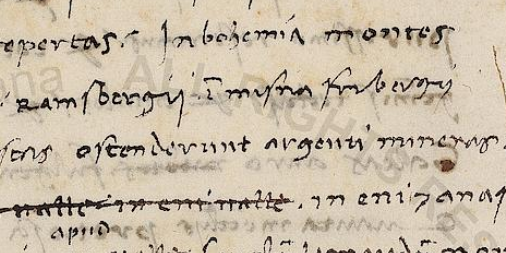
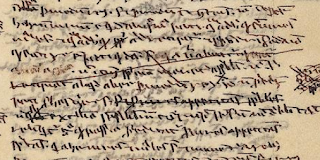
This week's digitizations by Digita Vaticana put me in mind of that change, because one of them is of a book which is generally agreed to be an author's manuscript from 750 years ago: a commentary by the Dominican philosopher-theologian Thomas Aquinas. Vat. lat. 9851 has, as one might expect, lots of crossings out, as on folio 35v:

At the back is various by-play including a letter (typewritten in 1951 - the thin end of the wedge as hand-script began to recede) by the bishop of Salamanca.

Autographs of Aquinas are quite rare. There is a codex in Naples, and this book's shelf neighbour, Vat. lat 9850 containing Super Boethium De Trinitate (fol. 1–104) and Super Isaiam (fol. 105–114).

What is extraordinary is that there were people last century not only skilled enough to decipher this Latin cuneiform, but actually able to recognize one man's own handwriting into the bargain.

Maria Burger (publication), for example, published an article some years ago, arguing that Aquinas was the person who inscribed glosses in  Cologne Cathedral Codex 30. In an age where handwriting is atrophying, for how much longer will people be able to make such an identification at a glance?

The full list of digitizations runs to 29, and brings the posted total before Easter to 3,987. Here's my unofficial list. You won't get it anywhere else: the Biblioteca does not publish any official list.
  1. Reg.lat.1, Vulgate Bible
  2. Reg.lat.4, Gospels with canon tables, Siglum Pr in Fischer tally of 490 Latin gospel manuscripts
  3. Reg.lat.1535, Martianus Capella, De Nuptiis
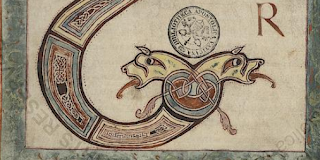
  4. Ott.lat.79, Ottoboni Gospels, northern France, 9th century, with canon tables in arches. This magnificent beast is the bottom of a letter L (for Liber, the first word of the Gospel of Matthew, and later the origin of the currency symbol £ formed in similar fashion):
    @ParvaVox responded:
  5. Ott.lat.296, Gospels
  6. Vat.gr.139, Plutarch
  7. Vat.lat.112, glossed Minor Prophets, Daniel, etc.
  8. Vat.lat.505, Augustine of Hippo, letters, various
  9. Vat.lat.513, Augustine, Against Five Heresies, various
  10. Vat.lat.514, Augustine, various
  11. Vat.lat.557, a Commentary on the Book of Epigrams of Prosper of Aquitaine (2r-27v)
  12. Vat.lat.564, Boethius, Consolation of Philosophy
  13. Vat.lat.569, no clear incipit
  14. Vat.lat.575, Gregory the Great
  15. Vat.lat.580, Gregory the Great
  16. Vat.lat.592, Gregory the Great, Regula Pastoralis
  17. Vat.lat.594, Gregory the Great, Dialogues
  18. Vat.lat.609, Augustine, Letters, etc
  19. Vat.lat.3201, the Ottimo Commento, a commentary on Dante. This was long attributed to Andrea Lancia of Florence, but a 2010 article has apparently disproved that authorship
  20. Vat.lat.4776,
  21. Vat.lat.5764, Isidore, Etymologiae (part). The flyleaves, front and back, are 8th-century uncial pages from Bobbio, Italy with the Lowe designation CLA 1 42 (TM 66138). @ParvaVox notes:
  22. Vat.lat.5776, an 11th-century manuscript of which significant parts are re-used parchment with under-layers reaching back to 7th-century Bobbio, Lowe designations CLA 1 44; 1 45; 1 46; 1 47 (TM). @ParvaVox notes:
  23. Vat.lat.7082, Piccolomini, autograph
  24. Vat.lat.7793, part of Bible of Aracoeli: Leviticus, Numbers, Deuteronomy, glossed
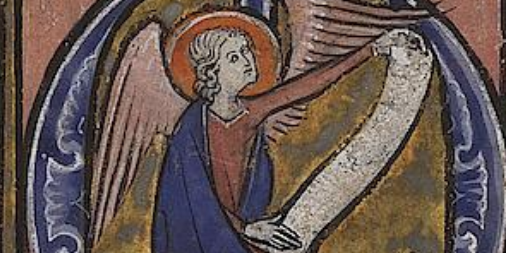
  25. Vat.lat.7797, part of Bible of Aracoeli: Gospels, glossed, with illuminations credited to Master Nicolaus. Here is a winged man holding a very long scroll to represent the Evangelist Matthew:
  26. Vat.lat.7799, part of Bible of Aracoeli: Ezekiel onwards, glossed
  27. Vat.lat.8209, letters?
  28. Vat.lat.8913, Matthias Palmerius, died 1483, see CERL
  29. Vat.lat.9851, Thomas Aquinas, his autograph of Scriptum super Sentiis, dating from about 1255. The topic is the Sentences of Peter Lombard, written 100 years earlier. A note bound inside states the codex was given to a Dominican Oratory of Aversa (see Buratti) by Charles II of Naples (in about 1300).  Auguste Pelzer in a comprehensive article states that he supervised the rebinding of this codex in 1952. The black and white page is a (printed) photograph of a folio at Coria in Spain. See also a review by Landgraf of a main work on Thomist autographs.
If you have corrections or additions, please use the comments box below. Follow me on Twitter (@JBPiggin) for news of more additions to Digita Vaticana. [This is Piggin's Unofficial List 43.]