2016-12-20

Time Trials

Regular readers of this blog will know that a big topic hereabouts is the origin of timelines generally, and in particular how humans got the idea of construing synchronous series of events graphically by picturing them on parallel horizontal tracks.

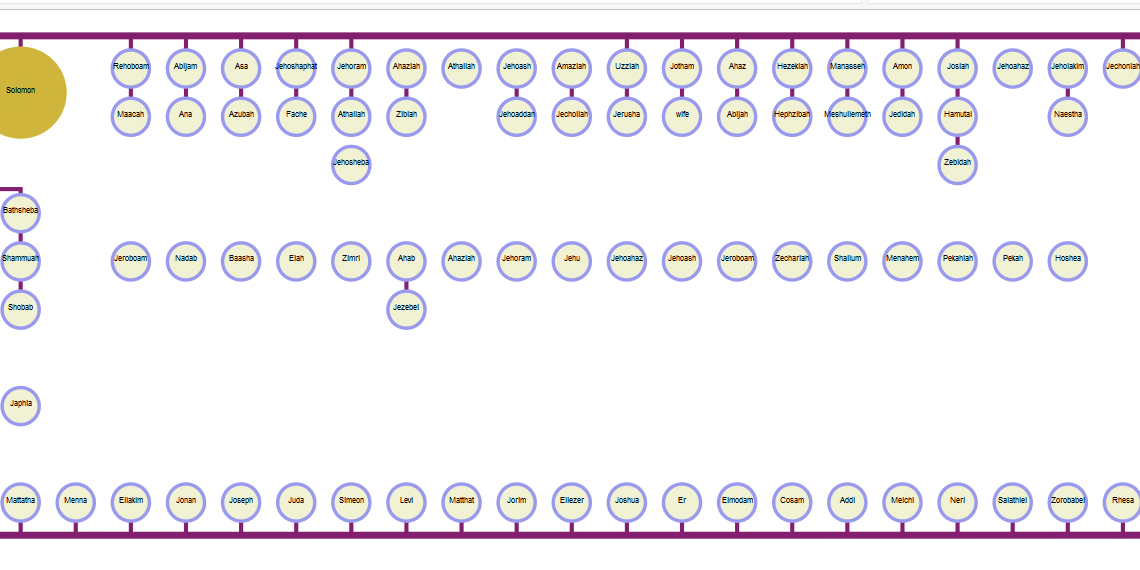
Here is how it is done in the fifth century in the Great Stemma, with a track at top representing kings of Judah, at centre kings of Samaria and below it, the ancestors listed by the Gospel of Luke:

It is helpful here to use certain fundamental cognitive distinctions laid out by Rafael Núñez and Kensy Cooperrider not long ago in a review paper.

Humans can use (abstract) space to map the passage of time in three distinct fashions in their gesture and speech: projecting deictic time (from where "I" stand), setting an order of events in sequence time (distinguishing the placement of "landmarks" in time), and comparing one or more temporal spans. Scholarly discussions of time sometimes muddle these. As two authors remark:
Philosophers, physicists, and cognitive scientists have long theorized about time –along with domains such as cause and number – as a monumental and monolithic abstraction. In fact, however, the way humans make sense of time for everyday purposes is, as in the case of biological time tracking, more patchwork.
There is no reason to suppose that this typology in the mind transfers easily to a drawing. In fact, the two authors point out that investigating space-time mappings in non-English-speaking cultures by asking people to demonstrate with cards and paper may be handicapped by the fact that this "material realization " needs to itself be learned first:
... arrangement tasks are not well-suited for use in such populations, because they presuppose familiarity with materials and practices that, in fact, require considerable cultural scaffolding.
A similar point was made 20 years ago by Mary Bouquet, who rebuked anthropologists for asking Portuguese people unfamiliar with stemmata to draw their kinship bonds this way.

So what are the tracks in the Great Stemma doing? They don't tell us anything about the Latin concept of deictic time (though that has been very expertly figured out by Maurizo Bettini, who shows the Romans faced the past with their backs to the future), whereas the three tracks seem to demonstrate a Latin tendency to set out a sequence of time from left to right, in accord with the Latin writing system, and they do indeed suggest that Latin-speakers would have compared durations of temporal spans in a spatial way when speaking of them.

It could well be argued that the invention of this type of timeline was inspired by gesture, though I have considered other origins such as game-play. The spans are not exactly calibrated with one another, but match one another in lengths more precisely than a speaker would ever intend to do in gesture.

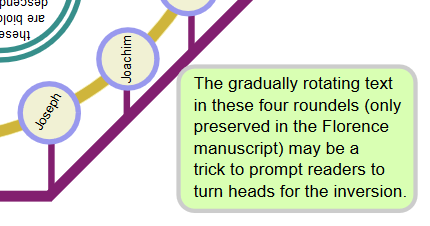
An intriguing aspect of the Núñez and Cooperrider paper is its mention of the spiral of time perceived in some cultures. The Great Stemma might have something going on in this respect where it loops up at the end and flips, with the script gradually rotating and terminating in a plaque with several upside-down sentences:

These are all aspects that require further study and analysis.

Bettini, Maurizio. Anthropology and Roman Culture: Kinship, Time, Images of the Soul. Translated by John Van Sickle. Baltimore: Johns Hopkins Univ. Press, 1991.

Bouquet, Mary. ‘Family Trees and Their Affinities: The Visual Imperative of the Genealogical Diagram’. Journal of the Royal Anthropological Institute 2, no. 1 (1996): 43–66. doi:10.2307/3034632.

Núñez, Rafael, and Kensy Cooperrider. ‘The Tangle of Space and Time in Human Cognition’. Trends in Cognitive Sciences 17, no. 5 (2013): 220–29. doi:10.1016/j.tics.2013.03.008.

2016-12-17

Dreamers of dreams

Whatever downers this year has brought, it has been an upper in the science of the mind, thanks to blockbuster proof of the efficacy of deep neural networks. For about half a century, a debate has been under way about the human mind. Is it like a computer? Or just a messy-round-the-edges semblance of such a rational machine?

The New York Times had the story this week in a long-read article by Gideon Lewis-Kraus. The faction who reject the computational view are generally termed connectionists, since they propose that the nuances in the connections joining what we have learned with what we perceive are sufficient to explain thought.

The only way to scientifically prove this is feasible would be to build a synthetic device that works the same way to achieve human-like results. This year, both Google and Baidu succeeded in doing it.

Lewis-Kraus puts this in the context of a stockmarket investment opportunity in artificial intelligence, which is rather like saying the Enlightenment was a historic opportunity to invest in dictionary publishing. What's really happening here is that we are in the midst of developing a new paradigm for understanding ourselves or "what the brain might be up to" as Geoffrey Hinton puts it in this interview.

My research has been built around the hypothesis that humans partly reason with the help of spatial mechanisms in the brain. A diagram (and good layout generally) helps us to make sense of ideas, because it harnesses spatial thought. Like many revolutionary new views of the mind, this does not fit well with the rationalist view of the mind that has risen since the Enlightenment.

We are still immensely far from understanding the mind, but the practical benefits of this year's connectionist experiment make it far less likely that the mind is like a computer, and far more likely that it is an assembly of reasoning effects that simulate pure reason. A neural network cannot shut out irrational deductions, but it could integrate a very mixed bag of inputs.

This may even make us more open to older, pre-Enlightenment ideas such as the classical concept of memory, the western medieval theory of symbols and the idea that we are not natively rational, but learn to be rational. Cognition may not even be limited to one brain, but be distributed across individuals. We are not logical machines. We are dreamers of dreams.

2016-12-14

Standstill

There have been no major releases by the digitization programme at the Biblioteca Apostolica Vaticana since November 28, with no explanation for the standstill, but items from its collection have been showing up on the Heidelberg, Germany virtual Palatina library:
  1. Pal. lat. 1075,2 Albertus : De animalibus (Lib. I-XII) Band 2 (Würzburg (?), 1436)
  2. Pal. lat. 1081 Hippocrates; Galenus; Ḥunain Ibn-Isḥāq; Avicenna; Christophorus : Medizinische Sammelhandschrift (Padua, 15. Jh. (1452))
  3. Pal. lat. 1111 Averroes; Avicenna: Medizinische Sammelhandschrift (13./14. Jh.)
  4. Pal. lat. 1115 Avicenna; Hippocrates; Isrāʾīlī, Isḥāq Ibn-Sulaimān /al-; Ibn-Māsawaih, Abū-Zakarīyā Yūḥannā; Alexander; Bernardus; Cermisonus, Antonius; Johannes Calderia; Hugo Senensis: Medizinische Sammelhandschrift (Pavia / Padua, 1430-1431)
  5. Pal. lat. 1116 Avicenna; Arnoldus; bernardus arelatensis; Mundinus; Bernardus; Balenus; Henricus : Medizinische Sammelhandschrift (Niederlande, Mitte 15. Jh.)
  6. Pal. lat. 1117 Avicenna; Gulhelmus; Nikolaus de Montpellier (Nikolaus de Polonia); Lanfrancus: Medizinische Sammelhandschrift (Prag, Mitte 15. Jh. (1446/48))
  7. Pal. lat. 1340 Prophatius Judaeus; Petrus; Thebit ben Corat; Albertus; Ps.-Hippocrates; Guilhelmus Anglicus; Leopoldus de Austria; Alkabitius; u.a.: Astronomische und astrologische Sammelhandschrift (Erfurt, Mitte 15. Jh. (1458/59))
  8. Pal. lat. 1345 Johannes de Wachenheim: Opus tripartitum chordarum (Neuhausen bei Worms, 1413)
  9. Pal. lat. 1350 Scheubel, Johann (Mathematiker): Kommentar zu Euklids Elementa (Band III) (Tübingen, 16. Jh. (1561))
  10. Pal. lat. 1353 Miscellaneen zum Quadrivium (Ostmitteldeutschland, 4. Viertel 14. Jh.)
  11. Pal. lat. 1354 Miscellaneenband. Astronomie, Astrologie, Mathematik und Medizin (Regensburg, 1463-1464)
  12. Pal. lat. 1355 Ibn-al-Haiṯam, al-Ḥasan Ibn-al-Ḥasan; Ps.-Euclides: Opticae sive de aspectibus libri septem; Catoptrica sive de speculis (Nordfrankreich (England), 13. / 14. Jh.)
  13. Pal. lat. 1358 Burchardus; John; Polo, Marco: Geographische Sammelhandschrift (Niederlande, 15. Jh.)
  14. Pal. lat. 1359 Polo, Marco: De consuetudinibus et conditionibus orientalium regionum (Deutschland, Ende 15. Jh.)
  15. Pal. lat. 1361 Johannes; John; Sibote; Poggio Bracciolini, Gian Francesco: Sammelhandschrift (Thüringen, 2. Hälfte 15. Jh.)
  16. Pal. lat. 1364 Lambertus Pithopoeus; Barbaro, Francesco: Sammelband (Heidelberg (I) , Norditalien (Padua) (II), 1587 (I); 2. Hälfte 15. Jh. (II))
  17. Pal. lat. 1366 Ptolemaeus, Claudius: Opere quadripartito (Deutschland, 1. Hälfte 16. Jh.)
  18. Pal. lat. 1367 Sammelhandschrift: Astronomie, Astrologie, Medizin (Südwestdeutschland, Mitte 15. Jh.)
  19. Pal. lat. 1487 Cicero, Marcus Tullius: Orationes (Italien (Venedig), 15. Jh.)
  20. Pal. lat. 1490 Cicero, Marcus Tullius: Orationes (Italien, 15. Jh.)
  21. Pal. lat. 1492 Cicero, Marcus Tullius: Sammelhandschrift (Italien, 15. Jh.)
  22. Pal. lat. 1498 Cicero, Marcus Tullius: Epistulae (Italien (Genua?), 15. Jh.)
  23. Pal. lat. 1499 Cicero, Marcus Tullius: Epistulae ad familiares (I-XVI) (Italien, 14.-15. Jh.)
  24. Pal. lat. 1501 Cicero, Marcus Tullius: Epistulae ad familiares (I-XVI) (Italien, 15. Jh.)
  25. Pal. lat. 1502 Cicero, Marcus Tullius: Epistulae ad familiares (I-XVI) (Italien, 15. Jh.)
  26. Pal. lat. 1503 Cicero, Marcus Tullius: Epistulae ad familiares (I-XVI) (Italien, 15. Jh.)
  27. Pal. lat. 1511 Cicero, Marcus Tullius: Opera (Frankreich, Italien, 14.-15. Jh.)
  28. Pal. lat. 1512 Cicero, Marcus Tullius: De finibus (Italien (Florenz), 15. Jh.)
  29. Pal. lat. 1515 Cicero, Marcus Tullius: Opera (Italien, 15. Jh.)
  30. Pal. lat. 1520 Cicero, Marcus Tullius: Sammelhandschrift (Italien, 14. Jh.)
  31. Pal. lat. 1765 Alexander; Donatus, Aelius : Sammelhandschrift (Landsberg, 1456)
This is Piggin's Unofficial List number 85. If you have corrections or additions, please use the comments box below. Follow me on Twitter (@JBPiggin) for news of more additions to DigiVatLib.

2016-12-10

After We Die

One of the key features of humanities in the age of print was preservation of both creative works and scholarship about them by royal and university libraries and later by national libraries. The point is of course that we will all be swept away by death and only the greatest repositories maintained by the sole durable institution we know, government, can be relied on to preserve whatever scholarly progress we achieve.

In the age of digital humanities this all becomes more complicated, because the key productions are often owned by universities or commercial organizations. Who is acting to preserve those databases, or even the small local data collections in which so much scholarship is presented? It's not looking good.

Because I am a New Zealand citizen, some years ago I asked the National Library of New Zealand to preserve my scholarly website, Piggin.Net, and I have just been to see what they did about it. The web archiving unit crawled the website every 12 months until May 2015, and then seems to have stopped. I have made many changes to the site since then and this it not reassuring. Will they resume crawling?

At the same time I asked the British Library to preserve another website in which I publish English family and local history, Piggin.Org. Alarmingly, the BL crawls ceased in 2013, although I go into that site from time to time to update information, correct links and fix spellings.

[Update: the BL unit, the UK Web Archive, has promptly replied on Twitter: "We have continued archiving sites after 2013 but they are not currently visible on the website. We are working to rectify this."]

It occurred to me that the country where I pay taxes, Germany, ought to be providing this service too. There is a web archiving unit at the Deutsche Nationalbibliothek, but its performance is a disgrace for a great nation. One would assume that a Made in Germany site which does not use the top-level domain DE would need to be added to the DNB archive by hand. However if you read the basic facts page, you discover that (a) it is impossible at the present time to nominate a page for spidering, and (b) a saved page would in any case only be visible in the reading room. This absurdity is (c) justified as a legal matter. But if one wished as copyright owner to opt in and offer the DNB the express consent to put the web-archive copy online, one couldn't. See (a). A catch 22.

To add insult to injury, the link to the web archive collection, such as it is, is dead.

Some of my articles are preserved at Academia.edu and at ResearchGate.Net, but the preservation of my website in its final state after I die is only being assured by one organization, Archive.Org of the United States, with its Wayback Machine. Archive.Org operates on an opt-out basis, meaning it saves everything (including from Germany) unless you expressly ask them not to.

I am very pleased with their work, particularly the fact that they harvest my version changes every few months. (In fact I sometimes go to them to recover versions I have myself lost.) But it is alarming to know that in 2016, archival preservation of the internet is still being left to a single San Francisco foundation funded by donations. They have just announced that they will create an extraterritorial backup copy of their collections in Canada. They are asking for donations. I think it's a very worthy cause.

But I still regard it as uncertain that any university or foundation or publishing company can survive for the next 500 years. This work ought to be funded by our governments,of which most will, in the nature of things, survive the course.

2016-12-05

Palatina Uploads

In the last week, the main uploads at DigiVatLib were from its Palatina collection on November 28:
  1. Pal.lat.58
  2. Pal.lat.73
  3. Pal.lat.76
  4. Pal.lat.78
  5. Pal.lat.79
  6. Pal.lat.80
  7. Pal.lat.84
  8. Pal.lat.85
  9. Pal.lat.88
  10. Pal.lat.89
  11. Pal.lat.90
  12. Pal.lat.91
  13. Pal.lat.93
  14. Reg.lat.421
  15. Vat.lat.993
In Heidelberg, which has first right to post the Palatina digitizations, since a German foundation is funding the work, a total of 34 new items have appeared online over the past two weeks:
  1. Pal. lat. 1054 Guilelmus : De universo corporali et spirituali, Pars I-II (Frankreich, um 1400)
  2. Pal. lat. 1069 Crescentiis, Petrus /de; Rusius, Laurentius: Ruralia commoda, Libri XII ; Hippiatria sive marescalcia (Italien, 14. Jh.)
  3. Pal. lat. 1075,1 Albertus : De animalibus (Lib. I-XII) Band 1 (Würzburg (?), 1436)
  4. Pal. lat. 1521 Cicero, Marcus Tullius: Sammelhandschrift (Italien, 15. Jh.)
  5. Pal. lat. 1522 Cicero, Marcus Tullius: Sammelhandschrift (Italien , Frankreich , Italien, 15. Jh. ; 11. Jh. ; 15. Jh.)
  6. Pal. lat. 1526 Cicero, Marcus Tullius: De officiis (Italien, 14.-15. Jh.)
  7. Pal. lat. 1530 Cicero, Marcus Tullius: De officiis (Italien (Bologna), 15. Jh.)
  8. Pal. lat. 1542 Seneca, Lucius Annaeus : Sammelhandschrift (Italien (Venedig), 15. Jh.)
  9. Pal. lat. 1726 Mythographischer Sammelband (Heidelberg, 1423/ 1. Hälfte 15. Jh.)
  10. Pal. lat. 1737 Carmina (Heidelberg, 1597)
  11. Pal. lat. 1739 David Felix Reuter: Carmen gratulans (Heidelberg, 1594)
  12. Pal. lat. 1755 Compendium Doctrinalis (Heidelberg (?), um 1473)
  13. Pal. lat. 1770 Collectanea grammaticalia ; Computus (Erfurt, 1367)
  14. Pal. lat. 1866 Friedrich : Interpretationes (Heidelberg, 1608)
  15. Pal. lat. 1869 Friedrich : Interpretationes (Sedan, 1609-1610)
  16. Pal. lat. 1870 Friedrich : Interpretationes (Sedan (?), 1609)
  17. Pal. lat. 1871 Friedrich : Interpretationes (Sedan, um 1608-1609)
  18. Pal. lat. 1872 Christoph : Interpretationes (Heidelberg, 1566)
  19. Pal. lat. 1873 Christoph : Interpretationes (Heidelberg, 1566)
  20. Pal. lat. 1874 Friedrich : Exercitia italica (Heidelberg, 1613-1616)
  21. Pal. lat. 1875 Johannes Sebastian Aquila: Sammelhandschrift (Kurpfalz, 1552-1556)
  22. Pal. lat. 1876 Ambrosius Prechtl: Rezeptare (Oberpfalz (Amberg), 1574)
  23. Pal. lat. 1884 Abschrift des Stammbuches von Joachim Strupp (Heidelberg (?), 1578)
  24. Pal. lat. 1904 Vocabularius graeco-latinus (Deutschland, 2. Viertel 16. Jh.)
  25. Pal. lat. 1911 Agricola, Georg: Elegia gratulatoria ; Oratio de laude urbis Ambergae (Amberg, 1559)
  26. Pal. lat. 1915 Kopie des Bibliothekskatalogs Pal. lat. 1921 (Fuggerbibliothek)
  27. Pal. lat. 1924 Katalog der Bibliothek Achill Pirmin Gassers: Sachgruppen und Autoren
  28. Pal. lat. 1925 Martin Gerstmann Katalog der 1553 erworbenen Hss. aus dem Nachlaß von Egnatius
  29. Pal. lat. 1926 Bibliothekskataloge der Klöster Kastl, Weißenau, Walderbach, Michelfeld, Spainshart, Reichenbach und Waldsassen, 16. Jh. (16. Jh.)
  30. Pal. lat. 1958 Missale, Übersetzung in französischer Sprache (1368)
  31. Pal. lat. 1964 Tristanroman in Prosa, französisch (14. Jh.)
  32. Pal. lat. 1965 Le jeu des échecs moralisés (15. Jh.)
  33. Pal. lat. 1967 Aldobrandino : Régime du corps, Mort d'Artus (14. Jh.)
  34. Pal. lat. 1969 Gautier : Les miracles de Notre Dame (14. Jh.)
This is Piggin's Unofficial List number 84. If you have corrections or additions, please use the comments box below. Follow me on Twitter (@JBPiggin) for news of more additions to DigiVatLib.

2016-11-24

Codex Bembinus Online

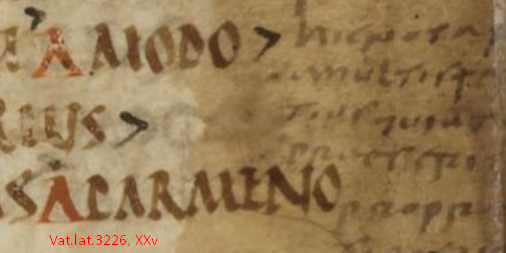
Two of the most famous codices at the Vatican Library arrived online November 24. One, the Codex Bembinus, Vat.lat.3226, was made in late antiquity and still has a first owner's handwritten notes in the margins. It contains comedies of Terence, though, unlike the renowned Vatican Terence (see my post), it is not illustrated. It is certainly the oldest Terence in existence, as Jeremy Norman stresses, dating from roughly 400 CE.
The text at left above is rustic capitals, the cursive half-uncial at right is the script of an educated person jotting things fast in Latin in that era. It is named after a former owner, Bernardo Bembo.

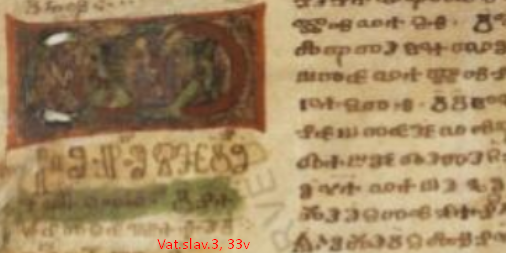
The other prominent item is extraordinarily precious to eastern Europe and Russia: the illuminated 11th-century Codex Assemanius, Vat.slav.3, one of the the world's earliest surviving books in the Old Slavonic language, written in the round Glagolitic script. This is a major resource for those interested in the history of the Slavic languages of Europe and of the Slavs' conversion to Christianity.

See the codex's entry in Wikipedia; Glagolitic is the script that probably preceded Cyrillic as the conventional way to record Old Slavonic, but fell into disuse, apart from restricted use in some areas in liturgical books. This book contains readings for mass.

Assessing how many codices are new in this Vatican round is not so easy, since the new posted total has risen 55, yet my software shows 67 additions. I caught at least one case where a codex that was already online in 2013, Vat.lat.3852 (Florus of Lyon), had come back after being missing. My scan shows cases where past duplications have been eliminated, but it all seems rather intractable. Before we make this too complicated, I will offer you the fullest list and see later if there are any false novelties in here.
  1. Arch.Cap.S.Pietro.H.87
  2. Ott.lat.259
  3. Pal.lat.13
  4. Pal.lat.15
  5. Pal.lat.22
  6. Pal.lat.53
  7. Reg.lat.1097
  8. Reg.lat.1788
  9. Urb.lat.439
  10. Urb.lat.473
  11. Urb.lat.1076.pt.2
  12. Urb.lat.1399
  13. Urb.lat.1400
  14. Urb.lat.1404
  15. Urb.lat.1406
  16. Urb.lat.1412
  17. Urb.lat.1413
  18. Urb.lat.1417
  19. Urb.lat.1421
  20. Urb.lat.1426
  21. Urb.lat.1434
  22. Urb.lat.1435
  23. Urb.lat.1445
  24. Urb.lat.1446
  25. Urb.lat.1447
  26. Urb.lat.1451
  27. Urb.lat.1474
  28. Urb.lat.1484
  29. Urb.lat.1486
  30. Urb.lat.1488
  31. Urb.lat.1491
  32. Urb.lat.1493
  33. Urb.lat.1498
  34. Urb.lat.1502
  35. Urb.lat.1510
  36. Urb.lat.1526
  37. Urb.lat.1546
  38. Urb.lat.1557
  39. Urb.lat.1588
  40. Urb.lat.1634
  41. Urb.lat.1687
  42. Urb.lat.1707
  43. Urb.lat.1711
  44. Urb.lat.1712
  45. Urb.lat.1714
  46. Urb.lat.1730
  47. Vat.lat.220
  48. Vat.lat.486
  49. Vat.lat.495
  50. Vat.lat.887
  51. Vat.lat.1021
  52. Vat.lat.1051
  53. Vat.lat.1053
  54. Vat.lat.1067
  55. Vat.lat.1070
  56. Vat.lat.1074
  57. Vat.lat.1111
  58. Vat.lat.1129
  59. Vat.lat.1141
  60. Vat.lat.1152
  61. Vat.lat.1207
  62. Vat.lat.1212
  63. Vat.lat.3226, the Codex Bembinus (above), TM 66109 = Lowe, CLA 1 12
  64. Vat.lat.3314, Pomponius Porphyrio's 3rd-century Commentary on Horace, made in the 9th century. Michael Gorman has identified this as one of the lost codices from the Abbey of Monte Amiata (see my posts passim about that library and site), speculating it was removed when Pius II held court in the abbey in 1462. Dr Gorman points out its significance in showing the literary interests of the monks, noting how accurate its Greek writing was (long before the revival of Greek scholarship in Italy). It later passed into two famous humanist libraries, those of Agostino Patrizi (died 1496) and of Fulvio Orsini (died 1600), before ending up in Rome.
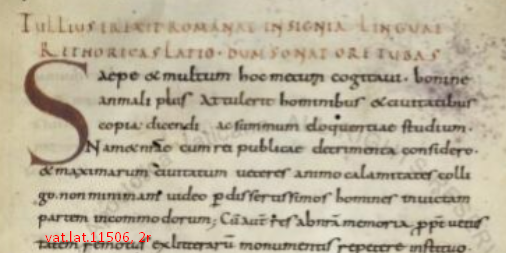
  65. Vat.lat.11506, from the same period, a witness of De inventione by Cicero, scribed when it had become rare in libraries, and Priscian's Periegesis; HT to @ParvaVox for pointing this out. Ippolito attributes it to the scriptorium at Wissenbourg at a later date. Preceded by a medieval epigram which credits Cicero with raising the banner of rhetoric along with the war-trumpets of Latium: Tullius erexit Romanae insignia linguae / rhetoricas Latio dum sonat ore tubas.

  66. Vat.lat.14614, small album of 19th-century correspondence, apparently detached from another album, Vat.lat.13391
  67. Vat.slav.3, the Codex Assemanius (above)
As noted in the past, the Pal.lat. items are not new to the internet, having been online before in Heidelberg. This is Piggin's Unofficial List number 83. If you have corrections or additions, please use the comments box below. Follow me on Twitter (@JBPiggin) for news of more additions to DigiVatLib.

2016-11-22

Digital Humanities

The introduction to my text-archaeology project has just been revised, and now I need your input on how I could make it even better. The site should be like the ruins of Pergamum, a place any literate tourist can explore unaided, enjoying the pleasures of discovery at every corner. Here's the new introductory text:
The fifth-century Great Stemma was probably drawn on a roll of papyrus of standard height (30 centimetres say) and at least as long as the bed you sleep in. My reconstruction proposal, the Piggin Stemma, obviously can't be viewed on a smartphone or any other digital device unless you move it around. So scroll left and right; zoom in to read words (and zoom out to see the full expanse); use the built-in controls.
... If the Romans had had computers, this is how they would have read their scroll-format books on them.

As an example of the digital humanities, the Piggin Stemma invites you to explore beyond first sight and enjoy the pleasures of discovery. This innovative chart was rebuilt with a coding language named SVG. It enables me to hide a guidebook in 12 overlays that remain invisible until you need them. ...

It's not a film. Once you are ready, you will have to tap some controls to make the interactive layers appear. Each right button makes a new effect visible: the corresponding left button makes the overlay go away. Try it. The overlay entitled "Damage" even includes an animation ... showing how roundels were moved. ...

A reassurance: you came here because you are attuned to graphic desígn and the psychology of visualization. You will see here hundreds of Hebrew names you may not know. I have translated them from Latin into English to make them less alien, but don't be overwhelmed by names or glosses. You are on a guided tour of an exotic place: late-antique graphics technology. Don't be sidetracked by the late-antique theology (unless that is your passion).

First up, just concentrate on how a fifth-century designer uses circles to visualize kinship and depict eras of time. The leftmost flag ... of each overlay offers you enough context to get started on your walk through this text-archaeology excavation.

If you like this new method of presentation, and I am sure you will, recommend the site to your friends. Send them [the] URL: http://piggin.net/stemmahist/envelopereconstructor.htm Don't send them a direct link to the SVG file, or they may get baffled.... Enjoy the tour.
Are my ideogram pictures above coherent? Does anything about the project puzzle you or remain unexplained? Do you have any other digital humanities examples you can point me to that present historic charts interactively with overlays? One way to reply is to use the comments box below.