2016-01-19

Codex Benedictus

A fierce conflict between the Abbey of Fleury in France and the Abbey of Montecassino in Italy over which was the genuine resting place of the bones of Benedict of Nursia, founder of western monasticism, reached a high point in 1071 with the production in Italy of an elaborate illuminated lectionary that staked Montecassino's claim in art.

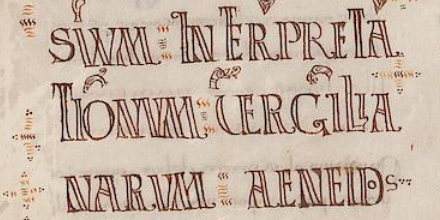
Known as the Codex Benedictus, this great work came online at Digita Vaticana on January 18. It was created for use on the feasts of saints Benedict, Maurus (Benedict's first disciple) and Scholastica (Benedict's sister). At Montecassino, they could not point to an actual tomb of Benedict, but they insisted he lay somewhere in the abbey precincts.

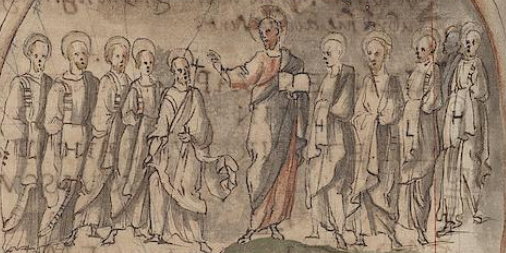
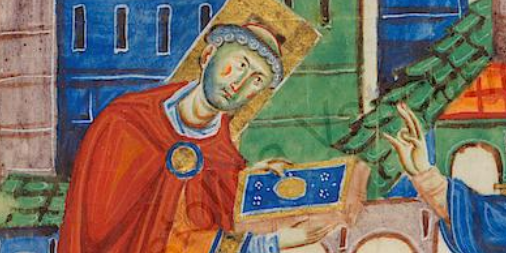
The making of the codex, which features 66 large and colourful miniatures of Benedict's life, was supervised by Abbot Desiderius (1058-1086) who composed part of the text and had himself pictured on the dedication page, folio IIr, handing over this tribute to the long-dead Benedict himself. An inscription reads: Cum domibus miros plures pater accipe libros.
Among the scenes is Benedict showing to a younger monk, Servandus, the world from a high tower as angels fly past the window carrying the soul of a bishop, Germanus (folio LXXIVv). This is a re-interpretation of Benedict's often-quoted dream of having seen the world from a heavenly perspective, which can be read in Gregory the Great's Dialogues 2.35.
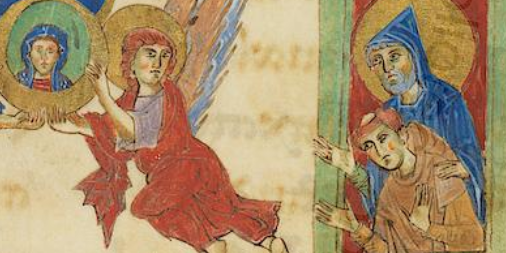
Gregory puts an interpretation on Benedict's report of viewing the "whole world" from the tower which Patrick Gautier Dalché considers tantamount to a Late Antique theory of visualization:
The soul of him who sees in this manner is above itself; for being rapt up in the light of God, it is inwardly in itself enlarged above itself, and when it is so exalted and looks downward, then it comprehends how little all that is, which before in former baseness it could not comprehend. (Gardner translation).
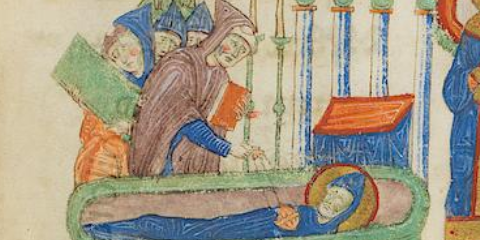
On folio LXXXr is an image of Benedict's Entombment (below). The codex, which also contains texts by Alberic of Montecassino, features many smaller details and initials.
An elaborate facsimile of it was published in 1981 as an expensive collectible. Now you can enjoy it for free. For a comprehensive and excellent introduction to the codex and these images, read John Wickstrom's 1998 article, Pope Gregory's  Life of St. Benedict and the Illustrations of Abbot Desiderius of Monte Cassino, on Academia.edu.

Digita Vaticana's new posted total of manuscripts after the 55 uploads on January 18, 2016 is 3,549. The secret list of new arrivals (which I compiled using spot-the-difference software) is below, whereby I will leave the Pal.lat. series undiscussed, as they have been public in Germany for some time.
  1. Barb.lat.4409, architectural drawings of the Vatican by Domenico Castelli
  2. Borgh.280, Anonymous: Summarium sive Breviarium super Decretum, 14th century
  3. Cappon.313.pt.A, architectural engravings of Rome
  4. Pal.lat.636,
  5. Pal.lat.697,
  6. Pal.lat.943,
  7. Pal.lat.944,
  8. Pal.lat.945,
  9. Pal.lat.947,
  10. Pal.lat.948,
  11. Pal.lat.949,
  12. Pal.lat.959,
  13. Pal.lat.960,
  14. Pal.lat.961,
  15. Pal.lat.964,
  16. Pal.lat.968,
  17. Pal.lat.981,
  18. Pal.lat.982,
  19. Pal.lat.983,
  20. Pal.lat.984,
  21. Pal.lat.985,
  22. Pal.lat.986,
  23. Pal.lat.988,
  24. Pal.lat.1060,
  25. Pal.lat.1094,
  26. Pal.lat.1098,
  27. Pal.lat.1102,
  28. Pal.lat.1112,
  29. Pal.lat.1113,
  30. Pal.lat.1136,
  31. Pal.lat.1181,
  32. Pal.lat.1202,
  33. Urb.lat.92, Bernard of Clairvaux's letter against Peter Abelard
  34. Urb.lat.155, civil law commentary by Roffredo Epiphanius and Bonaguida
  35. Urb.lat.167, William Durandus and Bartolus de Saxoferrato
  36. Urb.lat.177, Roland Passagerus
  37. Urb.lat.184, Aristotle, Physics, etc.
  38. Urb.lat.236, Galen, Avicenna, etc, in a 14th-century manuscript
  39. Urb.lat.275,
  40. Urb.lat.288,
  41. Urb.lat.301, a revision of Cornucopia, a mid-15th century commentary on Martial by Niccolò Perotti. This featured in the Rome Reborn exhibition in the mid-1990s in the United States, where Anthony Grafton's catalog notes: Later the work was revised and expanded by Perotti's son Pyrrhus.
  42. Urb.lat.311,
  43. Urb.lat.319, Cicero, 15th-century ms.
  44. Urb.lat.321, ditto
  45. Urb.lat.331, Petrarch, 15th-century ms.
  46. Urb.lat.332, ditto
  47. Urb.lat.333, ditto
  48. Urb.lat.334, Petrarch, De remediis utriusque fortunae
  49. Urb.lat.343, Plautus, comedies
  50. Urb.lat.355, Seneca, tragedies
  51. Urb.lat.356, ditto
  52. Urb.lat.368, anthology of poetry and fables, 15th century, full contents copiously listed by Stornajolo's catalog
  53. Urb.lat.373, poetry by Porcelli and others, 15th century
  54. Urb.lat.402, writings by Piccolomini before he became Pope Pius II, 15th century
  55. Vat.lat.1202, the Codex Benedictus (above)

Here's a silly monkey that thinks it can hide behind a tiny and leafless tree (detail of folio 1r of Urb. lat.373):

If you have corrections or additions, please use the comments box below. Follow me on Twitter (@JBPiggin) for news of more additions to Digita Vaticana. [This is Piggin's Unofficial List 36.]

Gautier Dalché, Patrick. “L’Héritage Antique de Cartographie Médiévale: Les Problèmes de les Acquis.” In Cartography in Antiquity and the Middle Ages: Fresh Perspectives, New Methods, edited by Richard J. A. Talbert and Richard Watson Unger. Leiden: Brill, 2008.

2016-01-08

His and Hers

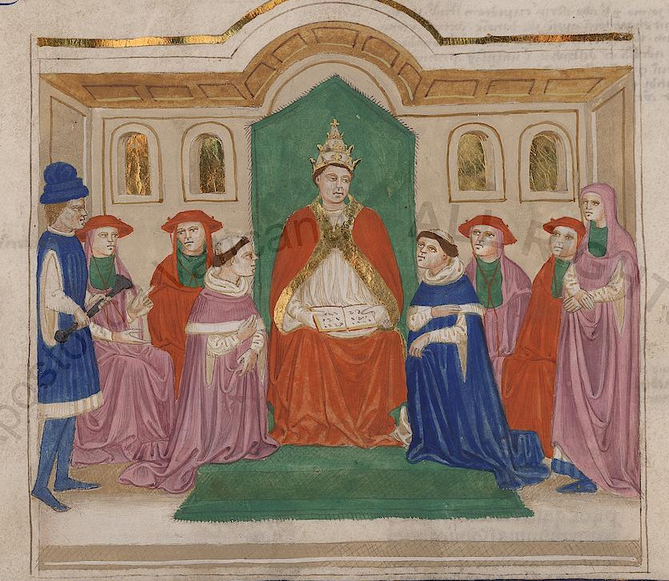
Our latest investigation concerns a curious courtroom scene possibly drawn by Nicolò da Bologna in Urb.lat.160 at folio 5r. I introduced this manuscript in November 2015 when it was brought online by Digita Vaticana. The St Louis catalog discusses the codex in some detail, as does Stornajolo's Codices Urbinates Latini, Codices 1-500, pp 166-167.

The caption under the scene says "Bonifatius". The miniature appears on the opening page of the Liber Sextus, a compilation of decretals issued under the authority of Pope Bonifatius (Boniface) VIII in 1298. The text on the two columns of this manuscript page has not been fully set up in print since 1582 but can be easily read in a reproduction in the UCLA Digital Collections here at the UCLA Library.

The manuscript dates from about 1380, but the anonymous St Louis cataloger thinks the art may be from 50 years later, noting "The Liber Sextus appears to be written around the same time, but its decoration was probably executed in the 15th century, around 1420-1440, in northern Italy, perhaps Ferrara."

Who is the man in the blue tunic on the far left of the image? My interpretation of the scene is that it shows Bonifatius at centre consulting his law book. Kneeling in front of him are two advocates. The advocate at right is pointing to the woman and is apparently speaking on her behalf. The left advocate appears to represent the man in the blue hat. The setting is Renaissance Italy.

It would be plausible to suppose the two litigants are husband and wife, as couples were frequent parties in canonical courts. The other four seated men in red hats appear to be part of the panel of judges. They are evidently listening to what is being said. The room is low and has a daytime garden visible through the four windows, but that is probably an artistic framing device only, not a real location.

What is going on? The man in blue on the left is scowling. The woman has drawn up her skirt to expose her hem, her blue-slippered foot and an ankle. Perhaps she is avowing she has nothing to hide. @zippyman818 notes that her white/blue garment is the opposite in decoration to the man's blue/white combination at the hem, which must symbolize some irreconcilable difference.

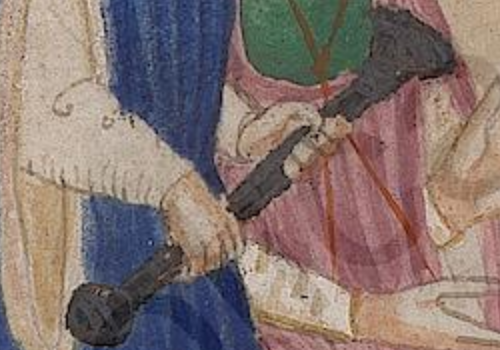
Both man and woman are wearing blue slippers. They are both clearly well-off. And here is the big question: what is the man holding?
It's black, it has a bulb at the bottom left end and it looks as if it is about 60 centimetres long. @zippyman818 and I have been having some fun in a Twitter exchange (expand from this one to see the whole conversation) trying to work out the puzzle.

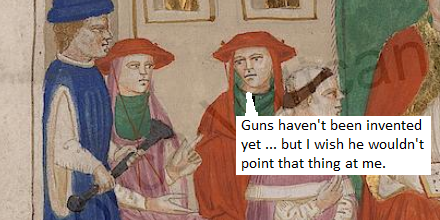
The first consideration is whether it might be a gun. The first firearm in Europe was the arquebus, and I read that it was employed in the army of Matthias Corvinus, which might get us back to a date of 1460. But this image long predates that, and in any case the object does not have a hook, which is essential to cope with gun recoil (and muzzle loading), and the bulb cannot have a function in any firearm.

Another early answer was a horn, but there is no mouthpiece on the thing. Again the bulb is the puzzle. It's not a klaxon, as rubber bulbs had not been invented. Besides why would a rich litigant take a horn to court? @zippyman818 has also suggested a long-handed chisel or a herb cutter with a mezzaluna blade, but again, why would the pope let you bring one into his courtroom?

[A completely different approach proposes that the object is ceremonial in nature. The arguments are set out in the comments below. Armin argues that it is a sconce, a kind of torch (in case the trial goes on past nightfall?) Ilya Graubart is proposing a mace (if medieval popes had armies, perhaps they had maces or sceptres as well). These arguments would suggest that Mr Blue Tunic is not a litigant, but maybe the pope's majordomo or some other papal panjandrum.]

It has been suggested the black thing might be an artistic emblem identifying some historic person who sought justice from the real-life jurist Bonifatius, or a speaking stick entitling the person to hold the floor, but Blue Tunic's mouth is shut. Or it might be a ritual object like an aspergillum or some entirely forgotten symbol.

My own tendency is believe it is an item of evidence connected to a marital lawsuit, perhaps a sword scabbard. Is the wife being accused of adultery with the sword's owner perhaps? At this point we become fanciful. But clearly, when the miniature was drawn, this object was immediately recognizable and perhaps it even elicited a laugh from the Renaissance reader.

2016-01-06

Lateran Palace

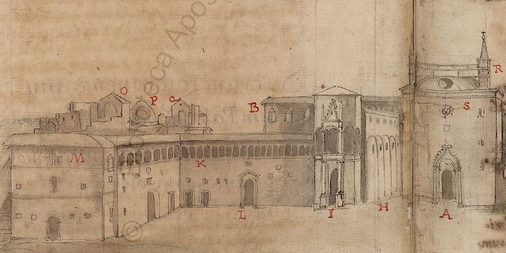
The Vatican is an independent country, the remnant of the old Papal States of Italy. It has an exclave about half an hour away by foot, the Lateran Palace. This used to be the seat of the popes and is now a museum. That palace was heavily rebuilt in the 17th century, but we have some idea of what it looked like previously from the historian-archivist Giacomo Grimaldi's manuscript description.

Last May, the first part of his survey of Old St Peter's Basilica was brought online, as I reported at the time on this blog. The second part has just been released on Digita Vaticana and is a further huge compilation of art preservation, sadly spoiled by running ink and even burns in some places.

Grimaldi's sketch of the palace before the alterations shows it thus, with numbering indexed to specific features:
This sketch is the basis for a better-known engraving by Louis Rouhier in the 1656 book by Cesare Raspono which is reproduced at the Bildarchiv Foto Marburg.

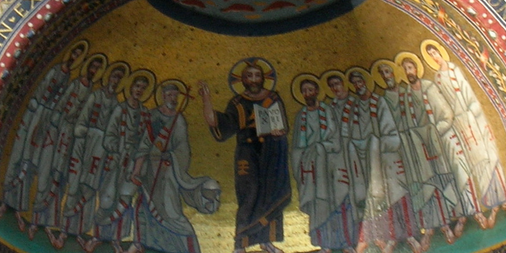
From the interior of the old palace we can see a mosaic ceiling of Byzantine style in the triclinium as Grimaldi saw it:
Compare this to the existing reconstruction which is stiffer and rather graceless:

Also in the January 4, 2016 uploads are an early medieval chronicle and very early manuscripts of Terence and Donatus. Here is the full list:
  1. Barb.gr.4,
  2. Barb.gr.265,
  3. Barb.gr.336,
  4. Barb.gr.463,
  5. Barb.gr.472,
  6. Barb.lat.74, Boccaccio’s Glosses on Statius
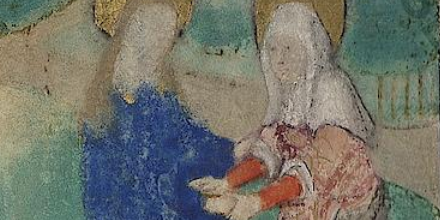
  7. Barb.lat.444, offices, masses, beautiful Renaissance illumination, but sadly it has has suffered water damage as you see in this miniature of the Visitation:
  8. Barb.lat.457, Vulgate Bible, possibly from the library of  King Matthias Corvinus, with swash initials
  9. Barb.lat.1669, folded charters with seal on outside
  10. Barb.lat.1682, Petrarch, letters? in a fine antiqua hand, unfinished illumination 
  11. Barb.lat.2048, Commentary by Tommaso Campanella (1568-1639)
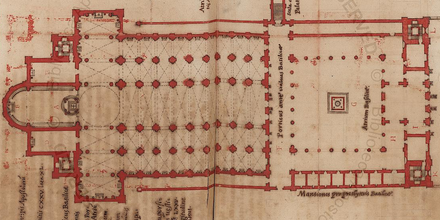
  12. Barb.lat.2733.pt.2 (above), the Instrumenta autentica translationum sanctorum corporum et sacrarum reliquiarum e veteri in novam principis apostolorum basilicam, containing notes on Old St Peters and the Old Lateran, part 1 of which was brought online last year. This codex includes an architectural plan of the new St Peter's:
  13. Barb.lat.3640, Gabriello Chiabrera (1552-1638)
  14. Barb.lat.3644, Dante, Comedy
  15. Barb.lat.3953, Italian comic poetry
  16. Barb.lat.3975, Italian poetry
  17. Barb.lat.4007, Italian
  18. Barb.lat.4015, Dante
  19. Barb.lat.4024,
  20. Barb.lat.4029, Pietro Alighieri
  21. Barb.lat.4049,
  22. Barb.lat.4071, Boccaccio
  23. Barb.or.157.pt.A, a single sheet of Arabic
  24. Borg.turc.8, poet (prince?) Mustafa: To the Glory of God Lord of the Universe
  25. Reg.lat.528, hagiographical
  26. Reg.lat.713, the Chronicle of Fredegar; this is the second half of a codex of which the other part is Voss.lat.Q.5 at Leiden in the Netherlands (digitized at Socrates.Leiden); Bischoff 2212. The usual edition is that of Bruno Krusch in the MGH, digitized here. This manuscript is there termed 3.I.
  27. Ross.12, Petrarch
  28. Vat.gr.192,
  29. Vat.gr.2556.pt.,
  30. Vat.lat.17, Vulgate Bible, 14th century
  31. Vat.lat.82, Psalter Ambrosianum with Canticles, Beuron Number 407, version with diacritic signs
  32. Vat.lat.195, Cyprian of Carthage, 15th century manuscript
  33. Vat.lat.213, Homilies of Origen in Latin translation 
  34. Vat.lat.399, John Chrystostom, On Psalms, etc.
  35. Vat.lat.414.pt.3, Augustine of Hippo, various
  36. Vat.lat.416, Augustine, De Trinitate, etc.
  37. Vat.lat.430, Augustine of Hippo, City of God
  38. Vat.lat.436, Augustine of Hippo, City of God
  39. Vat.lat.458, Augustine of Hippo, Sermons, letters, etc
  40. Vat.lat.475, Augustine of Hippo, Sermons
  41. Vat.lat.476, Augustine of Hippo, Sermons
  42. Vat.lat.1512, the oldest extant manuscript of Claudius Donatus (4th-century author), Interpretationes Vergilianae, made about 800 at monastery of Luxueil
  43. Vat.lat.1640, the so-called codex decurtatus with the sigle G of the Comedies of Terence, a  10th-century codex from Germany or Lorraine
If you have corrections or additions, please use the comments box below. Follow me on Twitter (@JBPiggin) for news of more additions to Digita Vaticana. [This is Piggin's Unofficial List 35.]

2015-12-23

Fishy Letters

A rare illuminated Merovingian codex, the Vatican Gelasian Sacramentary, is the major new addition among 31 manuscripts brought online at Digita Vaticana on December 22.

The sacramentary is a liturgical book that contains the key parts of the mass as celebrated in about 750 CE. It was superseded by a new sacramentary when Charlemagne called for standardization by Rome, and that in turn was later replaced by the Roman Missal. The attribution of this sacramentary text to poor old Pope Gelasius is as spurious as his link to the forged Gelasian Decree.

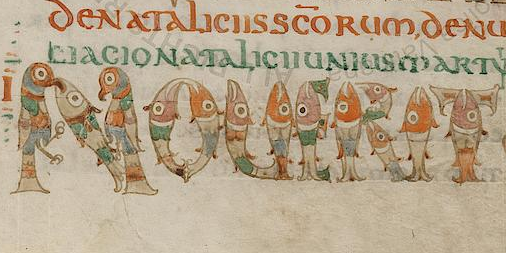
The colourful miniatures of this codex, probably made at Paris, comprise elaborate crosses and ingenious animal lettering. Most other surviving Merovingian codices are quite plain with no illumination, but the sacramentaries are something special. There's an even more elaborate one, Latin 12048, at Paris (hat tip to Mare Nostrum for alerting me to this). Here is how the Vatican codex treats the word "noverit" on folio 132r, assembling it out of birds and fish:
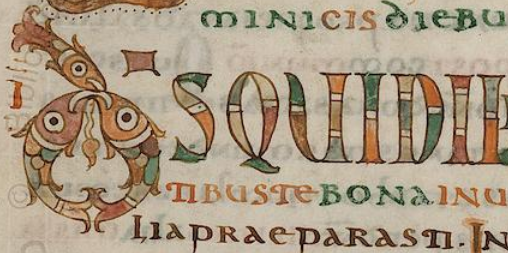
More mysterious was this fishy "Deus" at fol. 173r. This line of text begins: "Deus qui diligentibus ..." according to the Wilson edition.
But I did not get the riddle of why it means Deus. Help anyone? [Twitter always has the answers. @BillyGrammar was managing the @dpa_intl feed when he saw this and promptly replied:
@Archivalia_kg retweeted the question and in similar vein @Irizaurus answered:
So it seems settled that D-S has been compacted, perhaps as a nominum sacrum (a reverent abbreviation of a holy name) or as a pun (say D-S and it sounds like Deus, a pun also applied to the old Citroen DS car). The observation was also offered that the fishy decoration seems very Irish, so I am favouring humour as the likely reason.]

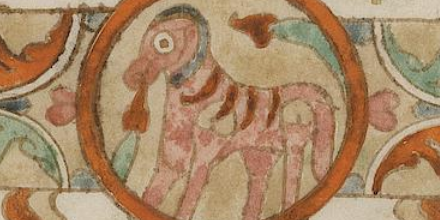
The codex also contains amazing naive-art beasts like this tiger-donkey on the previous page:

These are possibly the last uploads of 2015. These postings brings the front-page total to 3,451. The Pal.lat. series has already been placed online in Germany in the past and is not commented on here.
  1. Pal.lat.817,
  2. Pal.lat.926,
  3. Pal.lat.952,
  4. Pal.lat.953,
  5. Pal.lat.954,
  6. Pal.lat.955,
  7. Pal.lat.956,
  8. Pal.lat.957,
  9. Pal.lat.958,
  10. Pal.lat.977,
  11. Pal.lat.989,
  12. Pal.lat.991,
  13. Pal.lat.992,
  14. Pal.lat.992,
  15. Pal.lat.994,
  16. Pal.lat.995,
  17. Pal.lat.998,
  18. Pal.lat.1006,
  19. Pal.lat.1017,
  20. Pal.lat.1068,
  21. Reg.lat.316, Gelasian Sacramentary (above).
  22. Vat.lat.396, John Chrysostom, homilies
  23. Vat.lat.407, John Chrysostom, homilies
  24. Vat.lat.410, John Chrysostom, homilies
  25. Vat.lat.414.pt.1, first of a three-volume collection: Augustine, 13th century, France. Mobius 
  26. Vat.lat.414.pt.2, ditto, second of three
  27. Vat.lat.415, Augustine, De Trinitate and various
  28. Vat.lat.3200, Dante, Commedia, with this fine beard
    Contains an apparently spurious statement on the final folio placing Dante's tomb in the wrong Ravenna church. Of course, with all the skulduggery over that body, who knows if it is not right?
  29. Vat.lat.3438, Fulvio Orsini
  30. Vat.lat.4820, with a little booklet bound in at the end, by Angelo Colocci, tabulating Provencal chansons (ff 81r–104r)
  31. Vat.lat.4938, Augustine on Psalms, 8th-century uncial from northern Italy. Mobius
As always, use the comments box below to correct or comment. Follow me on Twitter, @JBPiggin, for more news, or use the RSS follow button at top right of this page. [This is Piggin's Unofficial List 34.]

2015-12-16

St George

The Codex of St George is a missal made at Avignon, France in the early 14th century for Cardinal Giacomo Gaetani Stefaneschi (c.1260 - 1341). Stefaneschi was a Roman poet and arts patron who also commissioned the Navicella (earlier post) in Old St. Peters for 2,200 florins from Giotto. Here is an image from the missal that evidently shows Stefaneschi himself, probably in about 1325 or so.

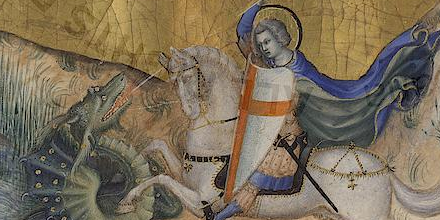
The miniature and initials are by an anonymous painter who is known only as the Master of the St George Codex and is famed for the fine expression and composition of his figures. Here is St George battling the dragon, according to the legend, and the onlookers watching fearfully (folio 85r):

The codex is one of the 44 new manuscripts uploaded Dec 14 on Digita Vaticana, taking the posted total to 3,420. The full list follows, whereby I will not comment on the Pal. lat. series which was made publicly available a couple of years ago in Heidelberg, Germany.
  1. Arch.Cap.S.Pietro.C.129, Codex of St George (above).
  2. Borg.lat.898, a copy of the Itineris ad septentrionales fructus by Johannes van Heeck, a Dutchman who was a co-founder of the Accademia dei Lincei.
  3. Cappon.114,
  4. Ott.lat.319, a 7th-century uncial manuscript of Augustine on Psalms. Notes at St. Louis.
  5. Pal.lat.931,
  6. Pal.lat.942,
  7. Pal.lat.996,
  8. Pal.lat.997,
  9. Pal.lat.1002,
  10. Pal.lat.1007,
  11. Pal.lat.1009,
  12. Pal.lat.1011,
  13. Pal.lat.1012,
  14. Pal.lat.1013,
  15. Pal.lat.1016,
  16. Pal.lat.1021,
  17. Pal.lat.1025,
  18. Pal.lat.1027,
  19. Pal.lat.1029,
  20. Pal.lat.1031,
  21. Pal.lat.1048,
  22. Pal.lat.1065,
  23. Pal.lat.1073,
  24. Pal.lat.1076,
  25. Pal.lat.1077,
  26. Pal.lat.1079,
  27. Pal.lat.1088,
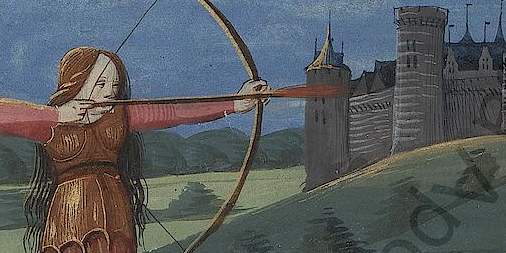
  28. Reg.lat.1492, Jean de Meun's continuation of the Roman de la Rose, his French translation of Boethius's Consolations of Philosophy, and other works. Bourges, 1470. Description at St. Louis. With fine miniatures such as this woman with a bow:
    This is Venus firing a flaming arrow at the castle, which sets vast parts of the building on fire at the climax of the story. The text reads: "Comme Venus (tirait?) au chastel un brandon de feu pour embraser ...  " and this is obviously a lot racier than older versions like Princeton Garrett MS. 126.
  29. Ross.1069,
  30. Urb.lat.7, 14th-century Bible with Jerome prologues and fine initials. Here is David fighting Goliath at folio 185r
  31. Urb.lat.21, Nicholas of Lyra, Postillae morales
  32. Urb.lat.24, Thomas Aquinas on Aristotle
  33. Urb.lat.159, finely illuminated law text by Bernardo Bottoni on Gregory's Decretals, with a 14th-century arbor consanguinatis where the tree is held in a planter by the law-giver (discussed by Hermann Schadt, Arbores, at p 259 ff.)
  34. Urb.lat.218, Gasparino Barzizza, c. 1360-1431, Commentum super epistulas Senecae Cordubensis ad Lucillum.
  35. Urb.lat.254, 1614, begun by Francesco Maria II della Rovere, duke of Urbino, 1548-1631, mostly blank
  36. Urb.lat.262, geomancy and astrology
  37. Urb.lat.270, 16th century on carriage equippage
  38. Urb.lat.285, Narciso Aurispa on fortifications
  39. Urb.lat.298, Robert Kilwardby
  40. Urb.lat.330, Petrarch
  41. Urb.lat.358, Punic Wars
  42. Vat.gr.327,
  43. Vat.gr.903,
  44. Vat.gr.1820,

As always, if you can add more information, use the comments box below. Follow me on Twitter (@JBPiggin) for more postings. [This is Piggin's Unofficial List 33.]

2015-12-08

A Costly Petrus Roll

Last week in New York, Sotheby's sold at auction for $250,000 a parchment roll containing a 13th-century copy of the Compendium of Petrus Pictaviensis, a timeline of biblical history compiled in Paris in the late 12th century for use in education. Of about 200 extant copies of this huge diagram, the auctioned item is probably the only one left in private ownership.

It is one of the items listed in my manuscript survey, which offers links to many of the digitized rolls. The sale description notes that the just-sold item, of English origin, is "inscribed with a few sixteenth-century annotations, attesting to the roll’s continued usefulness as a guide to biblical and other history."

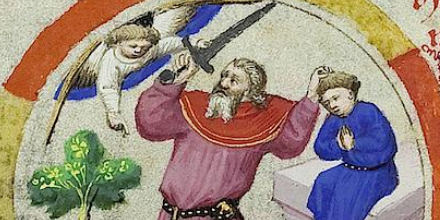
This week, Digita Vaticana added 15 new items to its posted index, including another copy of the Compendium, this one in book form. Pal.lat.963 dates from the 15th century and was made in Germany with many fine miniatures. The New York sale gives a rough idea of the immense market value of the Rome item. In Pal.lat.963 we can admire the dynamics of Abraham being stopped as he is about to sacrifice Isaac:


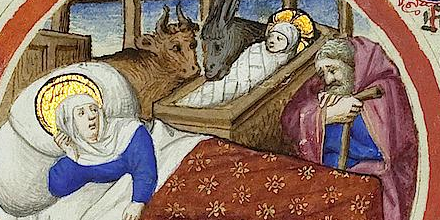
The second image is a fine little Nativity from the same book. Mary seems to have a very comfortable bed in this stable, but Joseph looks tired and cold. The manuscript is not completely fresh online. It was available last year or even earlier on Heidelberg's Biblioteca Palatina portal, but is now on the Vatican's server as well.

Here is the full list of 15 new postings:
  1. Pal.lat.939,
  2. Pal.lat.941,
  3. Pal.lat.962,
  4. Pal.lat.963, Petrus Pictaviensis, with Candelabra and Compendium
  5. Pal.lat.1014,
  6. Pal.lat.1024,
  7. Ross.884, Lucretius, De Rerum Natura, and Terence, Eununchus, now believed to have been copied out by Machiavelli himself. See Alison Brown's discussion. (And all praise to the scanner for opening up the foldouts.)
  8. Vat.lat.376, Augustine of Hippo: On Epistles of John and other extracts
  9. Vat.lat.377, Ado of Vienne, Martyrologium, etc.
  10. Vat.lat.392, John Chrysostom, in Latin
  11. Vat.lat.393, John Chrysostom, Homilae, Epistulae
  12. Vat.lat.1894, Diogenes Laertius, Latin translation by Ambrose Traversari, of De vitis philosophorum - 15th century
  13. Vat.lat.3306, a 12th-century manuscript of the Comedies of Terence (possibly with glosses from the Commentum Brunsianum)
  14. Vat.lat.3594, De regno, by Leodrisio Crivelli. Text here (PDF).
  15. Vat.lat.3833, the Collectio Canonum by Deusdedit, written between 1083 and 1087. This is the sole complete manuscript of this legal work. See Lotte Kéry. Notable for tabular material, but no diagrams. This is a palimpsest with four Vulgate gospels from the 7th or 8th century underneath (see Trismegistos).
As a later addition to this post (in January 2016), I will list the 34 most recent BAV manuscripts issued online on Biblioteca Palatina. These were all announced by its RSS feed on December 7, 2015.

  1. Pal. lat. 646 Io(annis) Mo(naehi) apparatus sexti libri decretalium (14-15th century)
  2. Pal. lat. 650 Bonifatii VIII sextus decretalium cum apparatu Ioannis Andreae (14-15th century)
  3. Pal. lat. 652 Bernardi (Circa) prepositi papiensis breuiarium decretalium (14th century)
  4. Pal. lat. 654 Nicolai (Siculi) episcopi panormitani lectura super 2a parte et sic super toto 2° libro decretalium (1460)
  5. Pal. lat. 660 Nicolai Siculi: Nicolai Siculi abbatis episcopi panormitani lectura super primo decretalium (15th century)
  6. Pal. lat. 661 Nicolai Siculi: Nicolai Siculi episcopi lectura super prima parte secundi libri decretalium (15th century)
  7. Pal. lat. 662 Nicolai Siculi: Nicolai Ciculi (l. Siculi) doctoris excellentissimi in monasterio sce. Marie de monacbis in Sicilia lectura in tertium librum decretalium (15th century)
  8. Pal. lat. 663 Nicolai Siculi: Nicolai Sciculi (l. Siculi) episcopi panormitani tractatus in secundum librum deeretalimn: Lectura de prima parte secundi libri decretalium (15th century)
  9. Pal. lat. 665 Nicolai Siculi: Dni. (Nicolai) abbatis de Scicilia (sic) famosissimi et monarchae iuris canonici doctoris lectura super quinto decretalium (15th century)
  10. Pal. lat. 666 Nicolai Siculi: Sammelhandschrift (15th century)
  11. Pal. lat. 669 Tractatus in constitutiones clementinas (15th century)
  12. Pal. lat. 670 Ioannis Andreae: Novella primi (1407)
  13. Pal. lat. 674 Iohannis Caldarini bonon. tabula auctoritatum et sententiarum biblie inductarum in compilacionibus decretor. et decretalium ; Flores ex libris sacrorum canonum et legum nec non ex libris reuerendorum doctorum dedic. Eberardo praeposito ecclesie Hoyern (15th century)
  14. Pal. lat. 677 Reinheri ord. predicatorum liber hereticorum ; Articuli mgri. lohannis Wiclef condempnati in Anglia per . XIII . episcopos et XXX . magistros in theologia . in Conuentu frm. predicatorum anno dni. 1380; Dni. Petri de ordine celestinorum inquisitoris hereticorum processus (15th century)
  15. Pal. lat. 678 Sammelhandschrift (13th century) 
  16. Pal. lat. 679 Sammelband (15th century), in two parts
  17. Pal. lat. 680 Fris. Nycolai Eymerici ord. pred. sacre theologie magistri Cappellani domini nri. pape etc. in terris domini Regis Aragonie inquisitoris liber inquisicionis (15th century)
  18. Pal. lat. 681 Fratris Nicolai Eymerici directorium inquisitionis haereticae pravitatis (15th century)
  19. Pal. lat. 682 Fratris Martini (Poloni) ord. praedicatorum tabula decretorum et decretalium ordine alphabetico (15th century)
  20. Pal. lat. 683 Sammelhandschrift (15th century)
  21. Pal. lat. 684 Egudii Bellimere (sic) decisiones in ius canonicum ; Bertrandi de Arnassana sacri palatii causarum auditoris ordinacio decisionum antiquarum (praecedentium) redacta sub congruis titulis in hoc presenti compendio (15th century)
  22. Pal. lat. 685 Sammelhandschrift (15th century)
  23. Pal. lat. 686 Sammelhandschrift (15th century)
  24. Pal. lat. 690 Martiniani (i. e. Martini Poloni) summa iuris canonici (15th century)
  25. Pal. lat. 692 Bartolomaei Pysani
  26. Pal. lat. 693 Sammelhandschrift
  27. Pal. lat. 694 Bartholomaei Pisani 
  28. Pal. lat. 696 Bern(ardi) Papi(ensis)
  29. Pal. lat. 700 Sammelhandschrift
  30. Pal. lat. 701 Liber formularum, in two parts
  31. Pal. lat. 706 Iohannis 
  32. Pal. lat. 698 Tabula super summam Beymundi (de Pennaforti) (13th century)
  33. Pal. lat. 699 Tabula iuris
  34. Pal. lat. 1906 Epigrammata et Epistolae
If you can contribute more data, please use the comments box below. Follow me on Twitter (@JBPiggin) for more information.

2015-12-05

Stemmata in Incunables

What I have been looking at in recent weeks is how early printers coped with the idea of a stemma without drawing a tree. The period I am looking at is that of the so-called incunables, books printed before 1500, and I should stress that I am not concerned here with fanciful treelike art like that of Hartmann Schedel (as in the previous post) but with the pure stemmata.

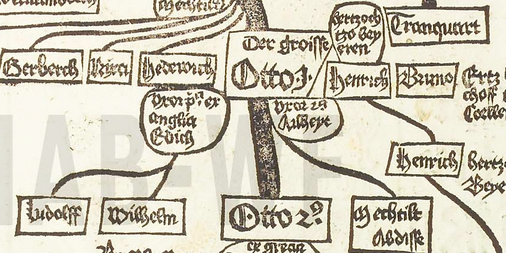
The simplest approach in this period was to cut a pre-existing graphic as a woodblock, which is what the author and publisher did in Die Cronica van der hilliger Stat va[n] Coelle[n] (The Chronicle of the Holy City of Cologne, 1499, ISTC ic00476000 GW 6688). Here, each name is placed in a rectangular clipeus with curvilinear connectors.


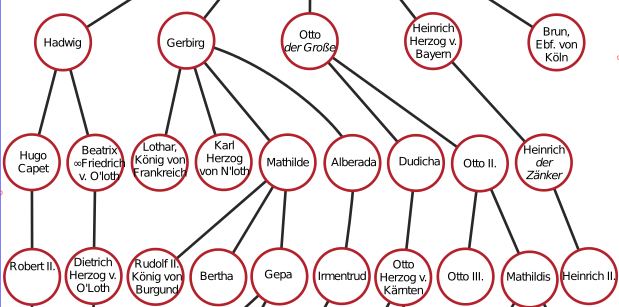
A copy of this little book printed in Cologne has been digitized by the HAB. Although headed "Der Stam ind Ursprunck der Herzogen von Sassen", the graphic is in fact nothing more than a new version of the 1043 stemma by Siegfried of Gorze, which had been drawn to argue (in vain) the irregularity of Emperor Heinrich marrying Agnes of Poitou and was endlessly repurposed for the next five centuries:

The same book contains an adaptation of the Stemma of Cunigunde of similar age. These woodcuts are innovative in form, but do not advance diagrammatic technology in any essential way.

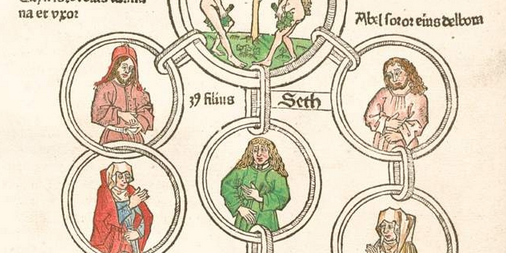
Strictly traditional stemmata could also be cut in wood, as in the 1475 Rudimentum Novitiorum where the roundel form is made chainlike:

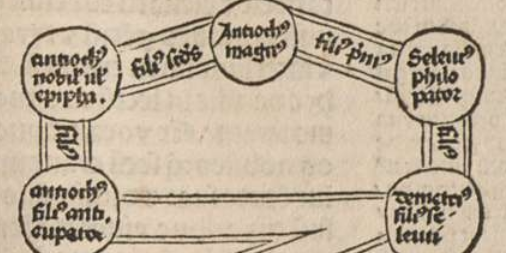
The long-familiar pattern of roundels is set up as a block in this Seleucid genealogy in a 1498 edition from Basle of Nicholas of Lyra, once again imitating forerunners in the manuscripts, but with the change in this printing that the connecting lines are almost as wide as the roundels:

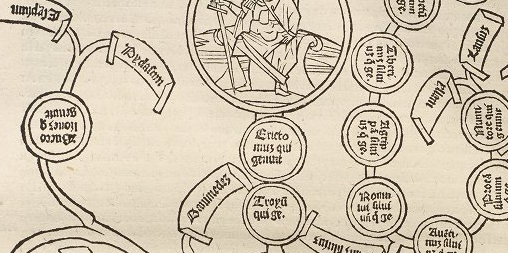
Slightly out of period is a 1511 Paris-printed Boccaccio Genealogy of the Gods (John Rylands Library copy), where the fanciful leaf-work of the Boccaccio autograph manuscript (1363-66) is dispensed with and roundels and little scrolls are used:
Much more creative and innovative is the early effort by the printers to build stemmata out of punch-cut type. These experiments had to be adapted to the type-form, the printing frame in which every element had to be rectangular so the form could be fitted and wedged before going to press.

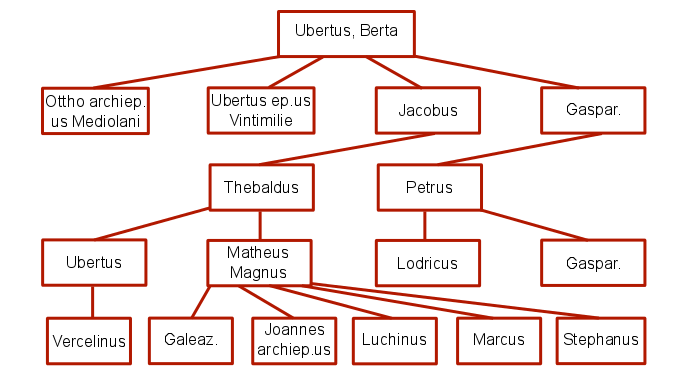
The Chronica Bossiana printed by Zarotto at Milan (or Parma) in 1492 (ISTC ib01040000 GW 4952) has an extraordinarily modern-looking stemma which employs rectangles and straight connecting lines:


For a while I found it hard to believe this Genealogy of the Visconti was truly made this way, back in 1492. It would look absolutely at home in a modern PowerPoint presentation, and apart from the Latin and the typeface, it could grace any modern digitally composed book without anyone suspecting its age.

The Italian printer produced it in red ink in a book that otherwise is in black (in my plot, the print should therefore properly be red too) and pasted it in the front. Scrutiny suggests this may not be xylographic like the Cologne stemma above, but a composed typographic page using rules, though I am not expert enough to judge how these boxes and connecting lines could have been set up.

The author of this world chronicle, Donato Bossi (biography in Italian), paid for the printing, so he may well have had a hand in the design. You can inspect the page as printed and zoom in by consulting the Chronica Bossiana copy at the HAB. The University of Cambridge has another copy which is not digitized, but is carefully described, and I will quote that description:
[Genealogical tree of the Visconti family], caption "Geneologia uicecomitum Principum Mediolani descendentium de Inuorio Ducatus Mediolani", 1v; Donatus Bossius. Chronica, dedicated to Johannes Galeatius Sforza, duke of Milan.

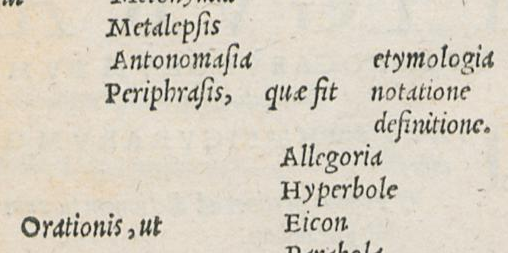
Later, printers were to develop other options, such as using blank space to build a stemma. The table of figures of speech by Georg Major printed as a preface to Philipp Melanchthon's De arte dicendi at Leipzig in 1528 (and also at Paris in 1529, digitized at HAB), contains a stemma with no connecting lines at all:

But as far as I can tell at first sight, these minimalist stemmatic arrays are not yet found in pre-1500 printing.