2015-03-05

Nearly 100 new digitizations at the BAV


On March 4, 2015, the digital library of the BAV or Vatican Library placed online nearly 100 newly digitized manuscript codices and map folders.

As is usual, there was no public announcement of this. I have no contact with Rome, so I can only speculate as to the reasons for such a silence. It may be that the library's server has a limited capacity and could not cope with the acute surge of requests that would follow any publicity.

Or there may be no funding to conduct public relations for a project that is being mainly funded by corporate and private sponsorship. It is possible too that funding institutions such as the Polonsky Foundation, which has a key role in digitizing the Hebrew manuscripts, wish to make their own public presentations at a later date. Polonsky announced February 24 it had reached the 1-million page mark.

But perhaps there is simply a modest sense at the BAV that this is no big deal yet, given that the project started years ago and the intermediate goal of getting 3,000 manuscripts online may not be met until 2016 at this rate. To get the entire stock of 82,000 BAV manuscripts digitized may take four decades, and at the same time, the BAV has committed to separately digitizing thousands of incunables. (See the presentation of one of the world's oldest printed cookbooks.)

Nevertheless the release is quite remarkable.

Less than a year ago, the manuscripts site consisted only of clones of independent digitizations by the Heidelberg state library in Germany and a paltry 24 Roman manuscripts, as I noted at the time. Today the BAV site offers a total of 1,787 works and has surpassed the tally of digitized manuscripts offered online by the British Library (1,220 at the last tally) or by e-codices of Switzerland (1,233).

Of the 151 collections making up the Rome library (see the BAV’s own list), 50 are now represented in some way in this digital presence.

Using comparison software, I have identified the following 97 newcomers this week. I have added notes on content, which are in some cases guesses more than anything else.
  1. Barb.gr.6, Maximus Confessor, 580-662, Opere spurie e dubbie
  2. Barb.gr.372, Psalter
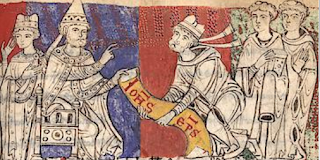
  3. Barb.lat.2724, Chronicon Vulturnense: Miniatures, most of them showing the handing over of donation charters to St. Vincent, like Bishop John's
    .
    This extraordinary compilation was made about 1130 and tells the history of the monastery at Volturno, Italy (Wikipedia). A monk of the monastery, Iohannes, composed the Chronicle.
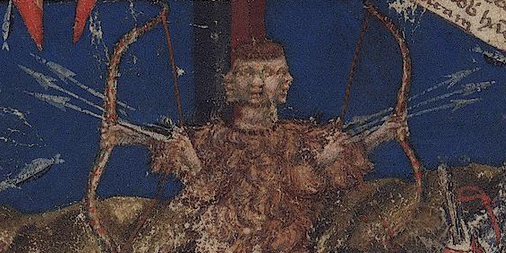
  4. Barb.lat.4076, is an autograph of Francesco da Barberino's Renaissance poem, Documenti d'Amore. Here is a cartoon-style blurred action image showing some impressive rapid-fire archery in all directions:
  5. Barb.lat.4077, More Francesco da Barberino
  6. Barb.lat.4391.pt.B, maps of Roman fortifications in 1540
  7. Barb.lat.4408, working drawings for mural restorations in 1637
  8. Borg.gr.6
  9. Borg.isl.1
  10. Borg.lat.420, Coronation of Clement VII
  11. Borg.lat.561, Life of Roderico Borgia
  12. Borgh.2, texts of Leontius and of Ephraem the Syrian
  13. Borgh.4, Gregory the Great: Moralia in Job
  14. Borgh.6, collected sermons
  15. Borgh.7, Pope Boniface, Decretales
  16. Borgh.9, Porphyry of Tyre and Boethius
  17. Borgh.10, Letters of Seneca
  18. Borgh.11, Order of Consecration
  19. Borgh.12, Works of Godefridus Tranensis
  20. Borgh.13, Works of Abū Bakr Muḥammad ibn Zakarīyā Rāzī, 865?-925?
  21. Borgh.17, Henry of Ghent’s Summa
  22. Borgh.18, Boethius
  23. Borgh.19
  24. Borgh.20
  25. Borgh.23, Italian sermons
  26. Borgh.24
  27. Borgh.25, Vulgate bible
  28. Borgh.26, 13th-century legal text, Apparatus Decretorum
  29. Borgh.27, Gerardus de Bononiensi
  30. Borgh.29, Wyclif?
  31. Borgh.30
  32. Borgh.131, Boethius, Variorum
  33. Borgh.174, 14th century sermons
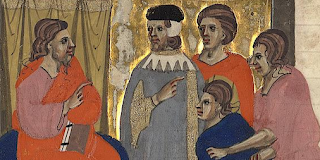
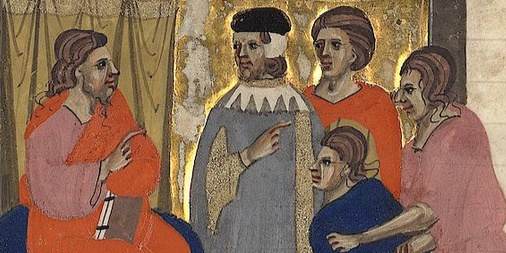
  34. Borgh.372, Glossa on Justinian. Here's a miscreant in blue hauled into court on 147r
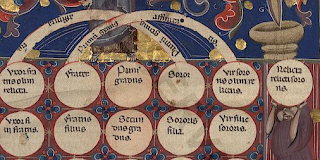
  35. Borgh.374: A 13th-century text of the Emperor Justinian's legal codifications including the Institutions, annotated by medieval lawyers. Justinian was emperor at Constantinople 527-565. Here's a widow under the heavy burden of a no-incest provision in Borgh 374 at 4r:
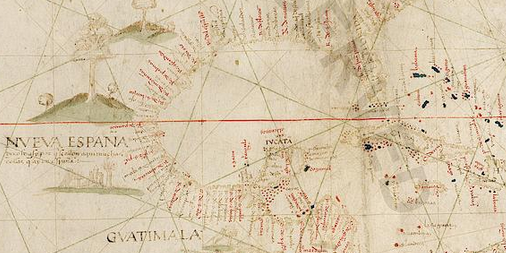
  36. Borg.Carte.naut.III. This is Diogo Ribeiro's 1529 map "in which is contained all that has been discovered in the world until now." Less than four decades after Columbus’s first voyage across the Atlantic, it shows the Americas in detail, but not New Zealand, which the Dutch explorer Abel Janszoon Tasman was not to document until l642 and which James Cook was not to circumnavigate and map until 240 years after this map was drawn. Jerry Brotton's History of the World in Twelve Maps features it.

    Unfortunately the resolution of this digitization, welcome as it is, falls short of what one would hope for. The section above is the Gulf of Mexico, and it is impossible to zoom in far enough to read the place-names. I would presume the map has been scanned at much higher resolution, and I hope @DigitaVaticana can upload this so that the fourth and closest zoom level provides legible text.
  37. Chig.B.VII.110
  38. Chig.C.VII.213
  39. Chig.C.VIII.228
  40. Chig.P.VII.10.pt.A
  41. Ferr.30, letters of Giuliano Ettorre
  42. Ott.gr.314
  43. Ott.lat.1050.pt.1
  44. Ott.lat.1050.pt.2
  45. Ott.lat.1447
  46. Ott.lat.1448
  47. Ott.lat.1458, Ovid’s Metamorphoses
  48. Ott.lat.1519
  49. Pal.gr.55
  50. Pal.gr.135
  51. Reg.gr.80
  52. Reg.lat.88, French chronicle
  53. Reg.lat.695, Life of St. Denis
  54. Reg.lat.720
  55. Reg.lat.721
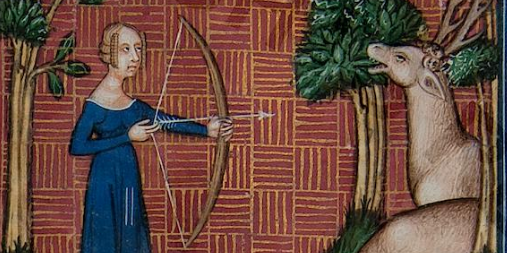
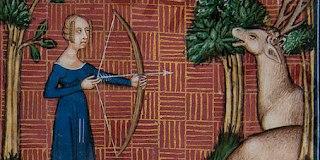
  56. Reg.lat.1480, Ovid in French, illuminated. Here's one of the fine pictures (folio 156r). I think it is Diana about to sock it to Actaeon, who will be trying desperately to explain that he is not a stag. With those feeble arms, she really ought to spend less time at home curled up on the couch and more time at the gym:
  57. Ross.61
  58. Ross.70
  59. Ross.74
  60. Ross.181, Missal from St Peter's Monastery, Erfurt, Germany, datable to about 1200: see the post on this by Klaus Graf (reproduced below as comment) with a search that points to comparable missals in German archives and the influence of Conrad of Hirsau, a Benedictine author, on the German scriptoria.
  61. Ross.186, Gilbert of Hoyland
  62. Ross.198
  63. Ross.206, Psalter
  64. Ross.292
  65. Ross.553, Hebrew Ms.
  66. Ross.554, illuminated Hebrew Bible
  67. Ross.556, Hebrew Psalter
  68. Ross.733
  69. Ross.817, Gilles Bellemère
  70. Urb.ebr.2, Kennicott-Rossi 225 according to @RickBrannan
  71. Urb.ebr.4
  72. Urb.ebr.5
  73. Urb.ebr.6
  74. Urb.ebr.7
  75. Urb.ebr.8
  76. Urb.ebr.10
  77. Urb.ebr.11
  78. Urb.ebr.12
  79. Urb.ebr.14
  80. Urb.ebr.15
  81. Urb.ebr.17
  82. Urb.ebr.18
  83. Urb.ebr.19
  84. Urb.ebr.21
  85. Urb.ebr.22
  86. Urb.ebr.23
  87. Urb.ebr.24
  88. Urb.ebr.26
  89. Urb.ebr.28
  90. Urb.ebr.29
  91. Urb.ebr.30
  92. Urb.ebr.31
  93. Urb.ebr.37
  94. Urb.ebr.38
  95. Urb.ebr.39
  96. Urb.ebr.40
  97.  Vat.ebr.71, Ḳimḥi, David ben Yosef, c.1160-c.1235, Commentary on Latter Prophets
There is so much here that it will take some time to trawl through all the digitizations. If any codex which I have listed is of especial interest to you, why not use the comment box below this post to briefly introduce it and explain its importance to other readers.

Follow me on Twitter (@JBPiggin) for more news of these digitizations. [This is Piggin's Unofficial List 4.]

2015-02-28

Hungary's Week in Rome

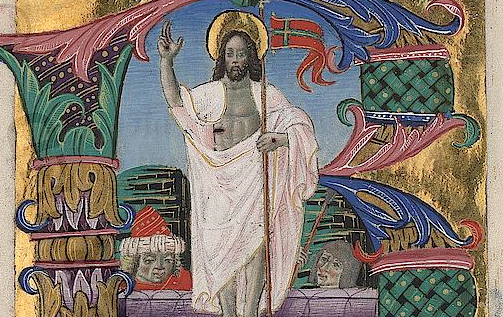
This was a special week for Renaissance studies in Hungary. An extraordinary book of art, the Hungarian Angevin Legendary, Vat. lat. 8541, arrived on the web, as I pointed out in an earlier post. With it were two important illuminated missals associated with the lost Bibliotheca Corviniana, the library of Hungarian King Matthias Corvinus (1458-1490). One, Urb. lat. 110, was made for the king in 1488 and is known as the Missal of Matthias Corvinus. The other, Ross. 1164, was pointed out by and is known as the Franciscan Missal. Below is an image from Urb. lat. 110 of a silver-skinned Christ at the resurrection.
has written a blog post introducing the two missals and I am grateful to him for the information about this group.

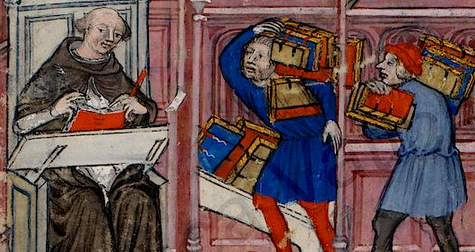
Two fine French Renaissance manuscripts were also brought online, both of them French translations of Latin works. One is Reg. lat. 538, a translation of the Speculum Historiale, a medieval history of the world, by Vincent of Beauvais, and there is a wonderful image in it where the artist imagines Vincent calmly writing while research assistants or socciii struggle to keep up with his demands for more books. There's a bit more about it here. There is a similar codex at the British Library.
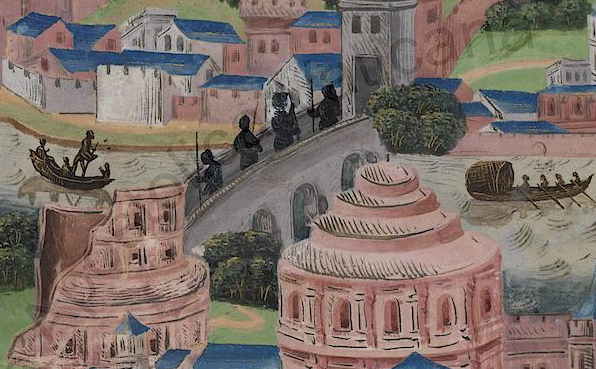
Also newly digitised is Reg. lat. 719, a translation by Pierre Bersuire from the Latin of Livy's History of Rome. The Bersuire book has a wonderful imaginary landscape of ancient Rome (below) as a medieval artist might imagine it with a river through a paradise of green that looks most un-Roman. Both these codices are principally of interest for their illuminations rather than their text.
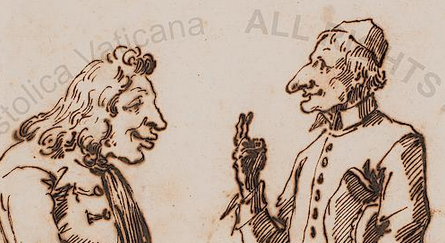
Finally, I took note of a couple of more modern documents from Italy. A book of caricatures by Pier Leone Ghezzi (1674-1755), Ott. lat. 3113, marks out Ghezzi's extraordinary talent as a cartoonist. Look at the fleshy marchese at left in this image and you see his whole life of over-indulgence.
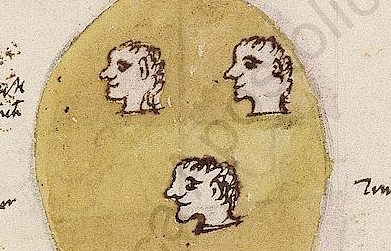
Also in my pick is a curious compilation, Reg. lat. 1468, of Italian family coats of arms (a thing which happens, by the way, to be called a "stemma" in Italian, which is not very logical, but that is the way it is). Here is an escutcheon which has three men's heads looking left on a mustard field. The different chin shapes are doubtless just a fancy of the artist.
In all, 64 new codices were digitized and published online on Digita Vaticana this week. Something else I sighted in this rush was a pair of large sheets from Vat. lat. 9848. It is no more than a wild guess, but these folios seems to be either sketches or tracings of monumental art, possibly from a Rome church. All that's online are these two sheets, recto and verso. Also new, but merely noted, is Ott. lat. 2919, a book of hours. [This is Piggin's Unofficial List 3.]

Portolan Charts of Pietro Vesconte

Among the finest things to be made available online this week from the Biblioteca Apostolica Vaticana (BAV) digitization programme in Rome is a codex, Vat. lat. 2972, which contains portolan charts which though unsigned can be reliably attributed to the remarkable mapmaker Pietro Vesconte and dated to about 1320.

Portolan charts are, for all intents and purposes, the first true western maps. Everything that precedes them, ought, in my view, to be classed as geographical diagrams.

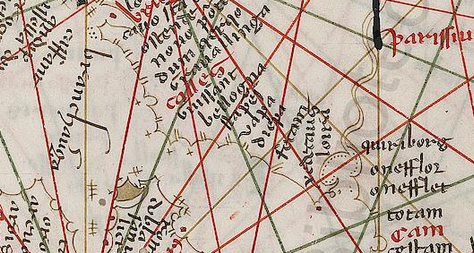
A portolan chart was something novel and unprecedented, showing the world deskewed and to scale. Geographical diagrams like the BL's Psalter Map of 1265 (see this flash version) showed the human world as mentally represented. By contrast, portolan charts, with compass lines superimposed, show the physical world as one navigates it, with the entire coastline of a sea fully labelled without regard for the social standing of the places on the coast. When a vessel is trapped by a landward wind, any of the places here offers a potential haven on a lee shore. The Vat. lat. 2972 codex contains an atlas of five sheets and is part of Marino Sanudo's Liber secretorum, a book devoted to a mad plot to destroy the Muslim world. Here is the atlas version of the English Channel (folio 110v):
In the middle you see Dumqerqo (Dunkirk), Gravallinga (Gravelines), Calles (Calais) and Bellogna (Boulogne), and at right Parissius (Paris) and Cam (Caen).

Tony Campbell, former map librarian of the British Library, wrote a fine descriptive summary about portolan charts earlier in February on the Pelagios blog while presenting the portolan component of the Pelagios project. He tells us at least one portolan chart from the very end of the 13th century survives. The BAV's, from just two decades later in 1320, will likely become a prime reference on the internet. Yale has a later chart from 1403 online.

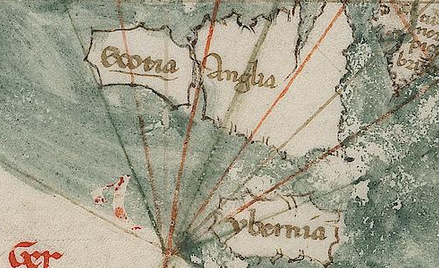
Curiously, Genoa-born Vesconte also did mappaemundi similar to that in the Psalter Map. He was on the cusp of the transition from old to new. Here are the British Isles in his Vat. lat. 2972 mappamundi. Since this map (112v) has east at its top, Ireland (Ybernia) is at the bottom of this grouping:

Update

I have tried to tag all the places on the continental coast in the portolan chart above, but some defeat me. Here is what I have resolved, after consulting Campbell's general toponymic listing:
#Bruges
? (Cavo Sta Catalina identified as Pointe de Zand by Campbell. Not clear what St Catherine's; the source document would have been Portuguese.)
#Oostende
#Nieuwpoort
#Dunkerque
#Gravelines
#Calais
#Wissant
#Boulogne
#Étaples
? (vapa identified by Campbell as Port St. Quentin or Eu.)
#Dieppe
#Fécamp
? (no port marked; Campbell proposes Chef de Caux)
? (no port marked, so "loira" may be an inland place)
#Quillebeuf
#Harfleur (on wrong side of Seine!)
#Honfleur
#Touques
#Caen
#Ouistreham

Some of these ports no longer exist, the rivers having later silted up and become unnavigable, leaving coastal areas that today are mainly a zone of holiday beaches.

Tony Campbell published a major new article on March 2, 2015 on the Carte Pisane, which is traditionally regarded as the oldest portolan chart, but is now the focus of controversy. He sets out arguments as to why it should be dated to the very end of the 13th century.

2015-02-25

Bumper book of medieval adventure in 549 full-colour frames

One of the treasures that popped out among the 64 items digitized so far this week by the BAV, the historic research library at the Vatican in Rome, is the Hungarian Angevin Legendary. It's an astonishing, comic-book style compilation of lives of saints full of gold and silver and technicolor gore. According to fellow blogger Zsombor Jékely, there are 549 known frames.

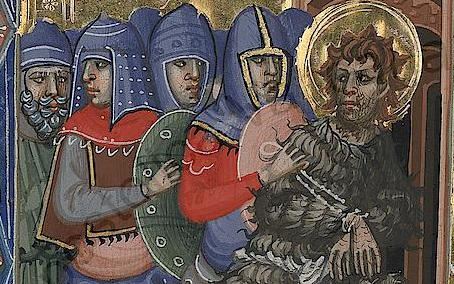
Here's my namesake John the Baptist being frogmarched by Herod's goons into the palace to have his head chopped off (folio 5r). Each of these pictures rewards many minutes of rapt attention. The Legendary was full of compelling visual storytelling techniques. Add a few speech bubbles and you would have a modern graphic novel. With some Ken Burns effects, many of the pages could easily be turned into some very impressive video.

The old story goes that this amazing book was commissioned to delight a spoiled 3-year-old Hungarian prince in about 1340, but that is probably a misconception. In all likelihood this was a strictly adult book, probably commissioned by or for the daddy king himself.

Like too many of the best codices, this one has been criminally dismembered. The BAV has the bulk of it, in the form of Vat. Lat. 8541, which you can now admire online (click the link at left). Quite a bit more is at the Morgan Library in New York (click the link and check out 22r which shows a headless body being dumped down a well). Jékely says there are also bits at New York's Metropolitan Museum of Art, MS 1994.516 (1 leaf),  Berkeley's Bancroft Library, BANC MS UCB 130:f1300:37 (1 leaf) and further leaves at the Hermitage and at the Louvre.

This is just one of the many good things to explore on the BAV website. Here is my tally of what is new: Arch. Cap. S. Pietro: 19; Barb. gr.: 2; Borgh.: 10; Chig.: 1; Ott. lat.: 2; Reg. lat.: 3; Sire.: 1; Urb. lat.: 1; Vat. ebr.: 10, Vat. estr. or.: 10; Vat. gr. 1; Vat. lat.: 3; Vat. turc.: 1. The total of manuscripts digitized now stands at 1,690. [This is Piggin's Unofficial List 2.]

2015-02-17

Is this the world's oldest bound book?

This was the week when the Vatican's library, the BAV, made available online digital images of what is perhaps the world's oldest intact, large, bound book, the Codex Vaticanus. It contains a handwritten text on 759 vellum leaves and is generally estimated to have been made in the second quarter of the fourth century (325–350 CE).

That it survives is amazing. That no one noticed what the Vatican was doing is almost more amazing. But more about that later.

During the 19th century, the BAV customarily only allowed visitors to touch this treasure under guard, so great was the fear that it would be stolen or damaged by a religious fanatic. Scholars grumbled at this, but the librarian's suspicions were not ill-founded. That anybody with web access can now read it without a couple of muscular young clergymen staring at the back of their neck as if they were a terrorist is a wonderful transformation.

The codex contains the Christian Old and New Testament in Greek and is comparable in age and significance with the Codex Sinaiticus, which got its own lush online presentation five years ago.

One can toss up as to whether the Vaticanus or the Sinaiticus is the oldest substantial bound book in existence, but the Vaticanus is the one in better shape, since it is still in one binding. The Sinaiticus got dismembered in the 19th century by the sort of scholar that the Vatican wisely never trusted (see above) and is now divided between four countries.

Neither book has a production date on it, so their ages can only be guessed from palaeographic evidence. Wikipedia's substantial description argues Vaticanus contains more antiquated features and is the older of the two, although one scholar, T.C. Skeat, propounded a theory that the two codices are contemporary and both come from the Late Antique scriptorium of Eusebius of Caesarea.

At the start of this post, I said the codex may be the oldest bound book. The qualification is important since books as we now know can come in three forms: scroll, codex and e-book.

I would have seen my first e-book at the Frankfurt Book Fair about 30 years ago and thought it a strange new thing, and the first owner of the Codex Vaticanus might have seen his first codex used for a scholarly purpose and thought it was a strange thing 30 years before he commissioned this very special codex for himself.

It is generally suggested that codices -- that is, books made of flat pages between two boards, bound at a spine -- began to outnumber the earlier technology, the scroll, in about 300 CE.

So "books" older than the Codex Vaticanus do survive: in scroll form, or as isolated pages torn from codices, among them the Chester Beatty papyri. But if you were to ask me where to find the world's oldest book -- meaning a thing between two covers, which is what most of us would mean -- I would point you to Rome, BAV, Vat. gr. 1209. Look at it and marvel.

On February 16, 2015, the BAV added 31 new items to its stock of online digitizations, raising the total volumes so far to 1,626. The collections added to were Arch. Cap. S. Pietro (10), Borgh. (5), Ott. lat. (1), Sbath. (1), Vat. ebr. (6), Vat. gr. (1, the Codex Vaticanus), Vat. lat. (4) and Vat. turc. (3).

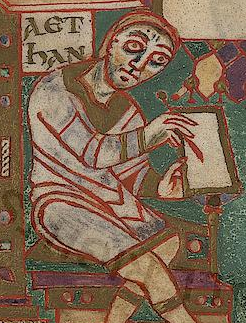
Items in the enormous Vat. lat. series which are newly available are Vat. lat. 83, which is a fine collation of hymns and psalms from the 11th century. It has a wonderful illumination in it of David with harp and the other supposed writers of the psalms, among them Ethan in a sailor suit (right), each with quill and ink-horn and a nifty little mobile desk of the sort that court writers must have used in the 11th century.

Tracking down the psalm authors had always been a matter of interest to Jewish and Christian scholars as we know from my edition of the fifth-century Liber Genealogus.

Also online for the first time are a book catalogue (Vat. lat. 3970) by Cardinal Sirleto (1514-85), a biography of Saint Gerard (Vat. lat. 7660), and a wonderful scrapbook of fragments (Vat. lat. 13501) presumably extracted from old bindings where we see a great variety of writing styles, a palimpsest or two, bits of sheet music and everything else that would have been hurled out in library spring cleanings and landed in this or that medieval book binder's recycling bin.

Sadly, the Vatican Library does not have the time or resources to promote this amazing release. To get in the news nowadays, you need a mass murder, a scandal or PR hype. The sole publicity for the release of the Codex Vaticanus was one modest tweet. Yes, a twiddling, tiny tweet. I suppose that all of the digital project's funds must go into actually scanning the books and getting the files into the servers.

I will keep a continuing watch on what they are digitizing in such honorable secrecy and present an occasional summary on this blog or on my Twitter feed. [This is Piggin's Unofficial List 1.] If you know of anyone else tracking the BAV digitization project, I would be happy to contact them.  Follow this blog, or follow me on Twitter @JBPiggin and I will keep you up to date.

This post originally ended with some debate on the "oldest bound book" hypothesis, but since that material grew so long, I have moved it to a separate blog post.

2015-01-23

Vatican Libary Making Progress

There are signs at last that the Vatican Library's manuscript digitization program is making good progress: there are now 1,549 manuscripts of the Biblioteca Apostolica Vaticana available online (up from 1,503 on January 1, a gain of 3 per cent in just 3 weeks).

The index page, which previously, listed every single digitization, has got so unwieldy that it has now been reduced to a compact, top-level, springboard page listing the collections the project has touched so far.

There's no sign yet of Vat. lat. 5729, the colorfully and richly illuminated Bible of Ripoll, which I want to see. So far only 78 of more than 15,000 medieval and modern items from that collection have been digitized. But the progress makes me optimistic.

UPDATE: After a couple more jumps (30 new items on February 4 alone), the total is 1,595. (And how do I know? Because I checked yesterday and today.)

2015-01-17

Persistence of Games

A curious example of the persistence of board games is mentioned by Irving Finkel of the British Museum in an entertaining New York lecture in 2012 which I watched a couple of years ago.

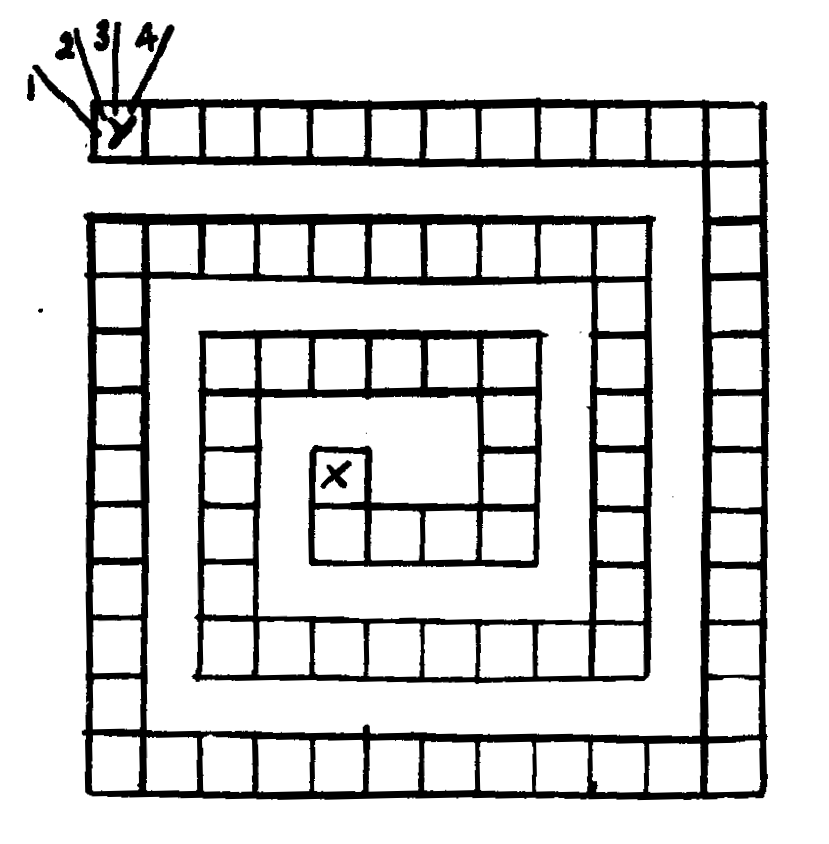
An article published in 1925 in Sudan Notes and Queries describes a "sedentary" game played on marks in the sand by Arabic speakers in Sudan. Finkel points out (from minute 35 of the video) that the game seems to be mehen, the "game of the snake," the spiral boards for which are found in tombs of Egypt's pharaonic period from around 2800 BCE.

"It seems to me that it is compelling to link the one to the other," says Finkel, overruling objections that a game could not have remained in continuous play for nearly 5,000 years.

The article's description of the game terms it Li'b El Merafib and indicates it was principally played by men during Ramadan. The author provides the schematic drawing at right. A transcript can be found at the Waterloo Games Museum, while a digitization of the magazine is offered by AlFahl.net in a large PDF. The author, R. Davies, had no idea that the game was Egyptian. The game involves a chase from Y to X and back, with "hyena" pieces pursuing on the return leg, which makes the last phase of the game very exciting.

I was curious as to the identity of the author, who patronizingly says Li'b El Merafib is more exciting than games played by English children, which makes him appear rather blinkered, although to be fair, he did consult the scholarly literature available to him
A little research establishes that the author must have been Reginald Davies (1887-1971), who left a box of his manuscript papers to Edinburgh University Library (see Archives Hub with biographical details). A printed bibliographical reference to the same papers by Sharkey appears to be entirely unreliable.

Davies became the first British Resident in Darfur in 1922 and his policy of building up a local sultan may bear some responsibility for the appalling civil wars that have rent Darfur in recent decades. Finkel terms him a "British Army officer", which he most certainly was not: He was a civilian and university man, a group who were in fact intensely jealous of army officers who snatched their salaried jobs. For all the trouble Davies created as a colonialist, one must acknowledge that he faithfully recorded one of the remarkable clues we have to one of humanity's most intriguing practices: the board game.

Davies, Reginald. “Some Arab Games and Puzzles.” Sudan Notes and Records, no. 8 (1925): 137–52.

Finkel, Irving. Like Spilt Milk: How Ancient Board Games Were Disseminated, 2012. YouTube.