Things have been quiet on this blog and my Twitter stream because I have been working on a major project: a complete reconstruction of the oldest known conceptual infographic in the world: the fifth-century Latin Great Stemma.
When I first announced its rediscovery in 2011, I presented a rather freely drawn plot of it (see this in my article in Studia Patristica or archived on my website as an swf (Flash) file):
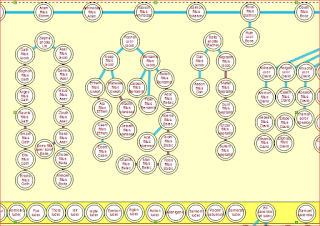
This time round, I am trying to do something much harder: to replicate the chart without any accommodations to modern assumptions, showing it precisely as it was intended by its designer.
The result (link) is the layout that the designer would have saved if the SVG mark-up language had existed in the fifth century. Not only are the lines, circles and text in the precise locations where the design called for them to be positioned. These positions also allow us to observe the design's hidden concepts and rules. This new drawing is not an impression of the late antique original: it is an encoding of the design itself.
The starting point for my revision was wise counsel from a great infographics teacher and practitioner, Raimar Heber of Germany. Raimar has just published a textbook (in German, Rheinwerk Verlag) of best practices in infographics and it looks very good indeed from the page samples.
In 2011, Raimar offered to do a retro-engineering experiment: he world accept an imaginary design brief and visualize the data of the Great Stemma as one of the world's leading professional art editors would design it today. He drew up a graphic sampler. One frame of it pitched a grid as the basis of the visualization. Chains should be laid out in the horizontal and vertical, he argued, with shoots allowed at 45-degree angles if the going got tough.
For a long time, I was sceptical about this. It sounded too 21st century to me. There is only one manuscript of the Great Stemma where straight lines and right angles stand out (Plut 20.54 in Florence), but one tends to assume that was just the obsession of an over-neat scribe.
But in spring this year I began re-analysing every substructure of the Great Stemma using a selection of the best manuscripts. This involved no less than 30 separate investigations, listed here as a "detail views".
For the first time I noticed something.
The manuscripts contain many vertical columns of roundels (the circles containing names). If one counts how many members there are in such rows, one comes up unusually often with the number 10. There might for example be a column of eight connected roundels, in a place where two others above them block the area overhead. Or there are long chains which bend to the left or the right at the 10th member in many manuscripts.
So as an experiment I worked to trim all 100 of so columns of the Great
Stemma so that each was 10 elements high. If you array that many columns side by side
it naturally appears gridlike.
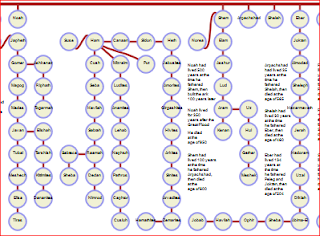
This alignment became a new paradigm. Not only is this pattern harmonious, but it also provides a simple and logical explanation for so many bulges, interlocks and elbows in the manuscripts. I am convinced it is the lost original pattern that the designer used. So Raimar's insight turned out to be spot on.
On reflection there would have been good reasons to use a grid. Firstly, it makes designs easier to read. That is an imperative of then and now.
Secondly, it makes a design much easier to hand-copy, which is no longer an imperative now, but was an important concern before the rise of printing. If you draw a grid where the written data expand neatly in two dimensions, and prescribe moreover that certain squares be left blank, you have a robust model for copyists to work from. We should study whether a similar method may have been used to copy the Peutinger Table, mappaemundi and other late antique charts by hand.
Take a look at my new reconstruction, which translates all of the 5th-century design into a (gridlike) pixel coordinate system. This design is not drawn by hand, but as output from a new database I have built, where all the crossing points in the grid have been recorded, along with the roundels, texts and connectors that pertain to those crossings. Other scholars may offer their own editions in future, but I would argue that the Piggin Stemma is the most accurate reconstruction on the available evidence.
A contemporary buzzword is digital humanities, which often is
simply watered down to mean storing and searching old documents as scans
in databases. True digital humanities work is something more: it means recasting historic creative work from its original analog expression
to a digital expression which remains absolutely congruent with the
artist's or writer's intentions, but yields more insight.

I have tried to make this chart even more accessible by translating its text
into English and by supplementing it with explanatory plaques and interactive
visual effects (look for radio buttons like those above). Tell me if it works like this and how you think it might be further improved.
2016-10-01
2016-09-24
Submission
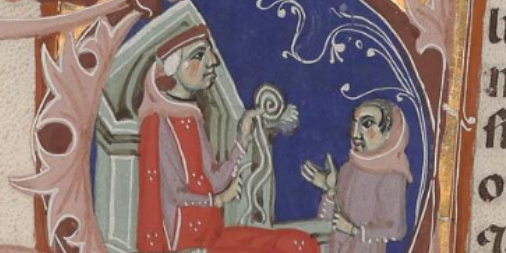
In publishing and academia, one speaks of submitting a manuscript to the editor or professor, but there was a time when submitting really was submissive. A common frontispiece in papal medieval manuscripts symbolically depicts the author kneeling before the pope and humbly holding out his book to be blessed:
This author is Laurentius Pisanus, a rather obscure author of philosophical dialogues. The codex is among 44 items placed online September 23 by the Vatican Library. Here is the full list:
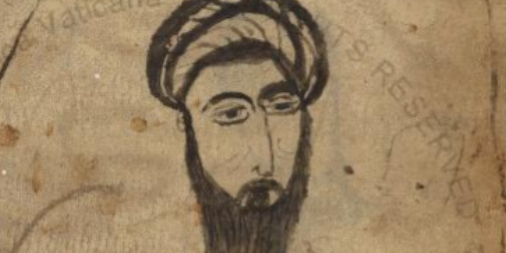
- Borg.et.3: this Ethiopian manuscript opens with some interesting sketches:
- Borg.et.24, narrow charter (previously rolled?)
- Borgh.164, Godfrey of Fontaines' Disputed Questions (1r-24r: Tabula quaestionum variarum de re theologica et philosophica), 13th-14th century ms
- Neofiti.37,
- Vat.ebr.43
- Vat.ebr.399
- Vat.ebr.400
- Vat.ebr.401
- Vat.ebr.402
- Vat.ebr.403
- Vat.ebr.406
- Vat.ebr.408
- Vat.ebr.412.pt.1
- Vat.ebr.415
- Vat.ebr.416
- Vat.ebr.417
- Vat.ebr.418
- Vat.ebr.419
- Vat.ebr.421
- Vat.ebr.422
- Vat.ebr.425
- Vat.ebr.426
- Vat.ebr.427
- Vat.ebr.434
- Vat.ebr.436
- Vat.ebr.437
- Vat.ebr.439
- Vat.ebr.441
- Vat.ebr.446
- Vat.ebr.447
- Vat.ebr.451
- Vat.ebr.451
- Vat.lat.342
- Vat.lat.808
- Vat.lat.814
- Vat.lat.879
- Vat.lat.886
- Vat.lat.894
- Vat.lat.899
- Vat.lat.908, Bonaventura, Commentary
- Vat.lat.930, Pope Innocent, 1215-76
- Vat.lat.961, Laurentius of Pisa, Dialogus Humilitatis, with a fine opening miniature (above)
- Vat.lat.986
- Vat.lat.991, Albertanus of Brescia, 13th century
2016-09-17
Cost Exorbitant
Bringing the world's most important library to the internet wasn't going to be cheap, but until now, we didn't realize just how expensive DigiVatLib would be. The Vatican Library in Rome has issued some puffy press releases, the media have printed vague predictions and pretty pictures of the reading rooms, but there haven't been any hard facts to enable some critical discussion.
My colleague Alvise Armellini, Deutsche-Presse Agentur correspondent in Rome, has done some digging and has just published what as far as I know is the first detailed, behind-the-scenes account of this globally important cultural project to scan the ancient manuscripts page by page:
There are some important revelations here.
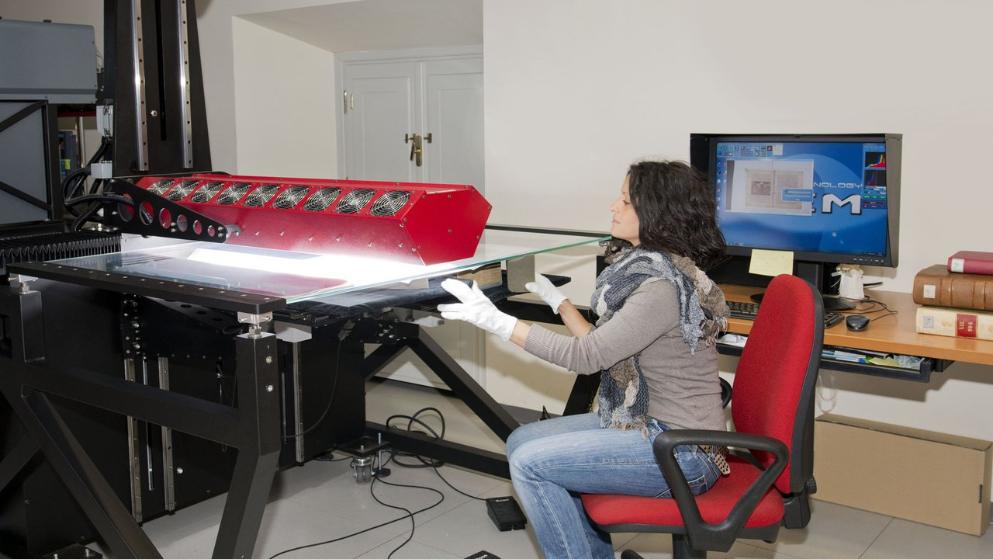
One is that the librarians decline to surrender the fragile Vatican manuscripts to digitization, presumably because the light levels, cradles and page-turning of the present scanning equipment, and perhaps the skills of the staff, are too rough for them (the cotton-gloved lady above is using a flatbed, not a cradle scanner). There's no indication of how these will be ultimately scanned, although the Vatican Library's May 17, 2016 statement says these are first priority.
For the first time we get the cash value of what NTT Data, a big Japanese systems software company, is donating: 18 million euros. Even for a multinational, and even if it's mainly their own costing of the book value of services, not cash, that's an extraordinarily large sum of charity. It makes comparable 1-million-at-a-time German government grants look paltry by comparison.
It outstrips a grant from Manfred Lautenschläger to digitize the 2,000 items of the Pal. lat. collection, the cash value of which has never been published, but must be in the range of 5 to 10 million euros. The contribution from the Polonsky Project -- about half of 2 million pounds, or 1.2 million euros -- to digitize Hebrew manuscripts in Rome is much less.
NTT Data Italia says its funding extends to 3,000 manuscripts up 2019. The portal does not say which manuscripts NTT sponsored, but this is probably in any case only a nominal figure.
From simple arithmetic, it would seem to value NTT's work at 6,000 euros per manuscript. That is surprisingly high: e-codices, the Swiss online library that is the gold standard among manuscript digitization projects, disclosed in March this year that digitizing was costing it 3,000 to 5,000 dollars per manuscript, and this includes expensive metadata research which the Vatican simply does not bother with.
What of the future? There are 82,000 manuscripts in total, so at the current rate, putting them all online would take more than 100 years, Armellini notes.
Why can't the digitization project be scaled up? Antonio Massari, the Italian software engineer in charge, reveals that he wouldn't be able to find enough staff for unlimited expansion. "If money was no object, we could feasibly scale up operations by a factor of five," Massari says. "Beyond that, we would probably not find enough experts with the right skills to supervise and carry out the project." Conversely, that would mean he has tied down about 20 per cent of skills available in Italy.
It remains entirely unclear what happens after 2019. Is it possible the entire project could crash and burn without a follow-on sponsor? Other big sponsors will have to be found. Like the widow with her mite, you can help too. There is a fund-raising arm, Digita Vaticana, and they are even offering a free goody as an incentive, a texturally perfect facsimile of a page from the Vatican Vergil.
My colleague Alvise Armellini, Deutsche-Presse Agentur correspondent in Rome, has done some digging and has just published what as far as I know is the first detailed, behind-the-scenes account of this globally important cultural project to scan the ancient manuscripts page by page:
Credit: BAV/dpa/Bild
You can read the English version online at dpa, while the German version appears in many newspapers including Bild, Sächsische Zeitung, Mannheimer Morgen and Frankenpost.There are some important revelations here.
One is that the librarians decline to surrender the fragile Vatican manuscripts to digitization, presumably because the light levels, cradles and page-turning of the present scanning equipment, and perhaps the skills of the staff, are too rough for them (the cotton-gloved lady above is using a flatbed, not a cradle scanner). There's no indication of how these will be ultimately scanned, although the Vatican Library's May 17, 2016 statement says these are first priority.
For the first time we get the cash value of what NTT Data, a big Japanese systems software company, is donating: 18 million euros. Even for a multinational, and even if it's mainly their own costing of the book value of services, not cash, that's an extraordinarily large sum of charity. It makes comparable 1-million-at-a-time German government grants look paltry by comparison.
It outstrips a grant from Manfred Lautenschläger to digitize the 2,000 items of the Pal. lat. collection, the cash value of which has never been published, but must be in the range of 5 to 10 million euros. The contribution from the Polonsky Project -- about half of 2 million pounds, or 1.2 million euros -- to digitize Hebrew manuscripts in Rome is much less.
NTT Data Italia says its funding extends to 3,000 manuscripts up 2019. The portal does not say which manuscripts NTT sponsored, but this is probably in any case only a nominal figure.
From simple arithmetic, it would seem to value NTT's work at 6,000 euros per manuscript. That is surprisingly high: e-codices, the Swiss online library that is the gold standard among manuscript digitization projects, disclosed in March this year that digitizing was costing it 3,000 to 5,000 dollars per manuscript, and this includes expensive metadata research which the Vatican simply does not bother with.
What of the future? There are 82,000 manuscripts in total, so at the current rate, putting them all online would take more than 100 years, Armellini notes.
Why can't the digitization project be scaled up? Antonio Massari, the Italian software engineer in charge, reveals that he wouldn't be able to find enough staff for unlimited expansion. "If money was no object, we could feasibly scale up operations by a factor of five," Massari says. "Beyond that, we would probably not find enough experts with the right skills to supervise and carry out the project." Conversely, that would mean he has tied down about 20 per cent of skills available in Italy.
It remains entirely unclear what happens after 2019. Is it possible the entire project could crash and burn without a follow-on sponsor? Other big sponsors will have to be found. Like the widow with her mite, you can help too. There is a fund-raising arm, Digita Vaticana, and they are even offering a free goody as an incentive, a texturally perfect facsimile of a page from the Vatican Vergil.
2016-09-12
Trigger Warning
It's not often that Vatican manuscripts have trigger warnings for extreme graphic content, but I would rather not know what some of the pictures in a copy of Avicenna's textbook of medicine depict.
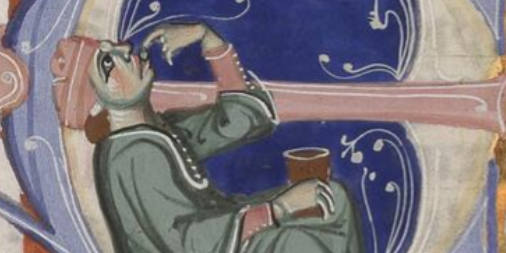
Urb.lat.241 has just been digitized by the Vatican. According to Anthony Grafton's Rome Reborn, catalog, this unfortunate man at fol 280r has haemorrhoids.
I will spare you the diarrhoea image a few pages later. Then there is a chap (left) showing a horrified onlooker at fol. 246v something from the intestines. Don't ask.
If you get into impossible contortions to gargle, spare some sympathy for this unfortunate gentleman at fol. 389v:
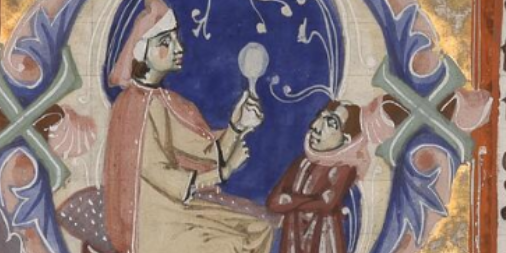
Medical students tend to gaze with arms crossed and eyes wide in fascination at organs where the rest of us would rather flee the room:
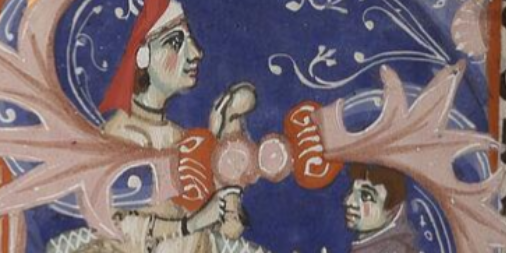
I quickly turned the page after this anatomical presentation on fol. 308v:
The book is a copy dated to 1300-1310 of Gerard of Cremona's Latin translation of the medical summa by Ibn Sīnā, Abú 'Ali Al-Husain ibn 'Abd Allah (Avicenna) (d. 1037).
The Vatican Apostolic Library released nine manuscripts online last week and 75 more on September 12 for a new total of 5,437. Here is the full list:
Urb.lat.241 has just been digitized by the Vatican. According to Anthony Grafton's Rome Reborn, catalog, this unfortunate man at fol 280r has haemorrhoids.
I will spare you the diarrhoea image a few pages later. Then there is a chap (left) showing a horrified onlooker at fol. 246v something from the intestines. Don't ask.
If you get into impossible contortions to gargle, spare some sympathy for this unfortunate gentleman at fol. 389v:
Medical students tend to gaze with arms crossed and eyes wide in fascination at organs where the rest of us would rather flee the room:
I quickly turned the page after this anatomical presentation on fol. 308v:
The book is a copy dated to 1300-1310 of Gerard of Cremona's Latin translation of the medical summa by Ibn Sīnā, Abú 'Ali Al-Husain ibn 'Abd Allah (Avicenna) (d. 1037).
The Vatican Apostolic Library released nine manuscripts online last week and 75 more on September 12 for a new total of 5,437. Here is the full list:
- Urb.lat.93
- Urb.lat.164
- Urb.lat.220
- Urb.lat.239
- Urb.lat.240
- Urb.lat.241, Avicennae Canonis libri by Avicenna (above)
- Urb.lat.267
- Urb.lat.347
- Urb.lat.401
- Urb.lat.532
- Urb.lat.547
- Urb.lat.565
- Urb.lat.566
- Urb.lat.579
- Urb.lat.582
- Urb.lat.586
- Urb.lat.596
- Urb.lat.598
- Urb.lat.662
- Urb.lat.688
- Urb.lat.706
- Urb.lat.707
- Urb.lat.718
- Urb.lat.725
- Urb.lat.731
- Urb.lat.747
- Urb.lat.748
- Urb.lat.752
- Urb.lat.753
- Urb.lat.754
- Urb.lat.756
- Urb.lat.766
- Urb.lat.768
- Urb.lat.770
- Urb.lat.777
- Urb.lat.779
- Urb.lat.786
- Urb.lat.787
- Urb.lat.788
- Urb.lat.790
- Urb.lat.794
- Urb.lat.798
- Urb.lat.803
- Urb.lat.804.pt.1
- Urb.lat.805
- Urb.lat.814.pt.2
- Urb.lat.815.pt.3
- Urb.lat.816.pt.1
- Urb.lat.816.pt.2
- Urb.lat.817.pt.1
- Urb.lat.817.pt.2
- Urb.lat.817.pt.3
- Urb.lat.820.pt.2
- Urb.lat.820.pt.3
- Urb.lat.822.pt.1
- Urb.lat.822.pt.2
- Urb.lat.823.pt.1
- Urb.lat.823.pt.2
- Urb.lat.824.pt.1
- Urb.lat.824.pt.2
- Urb.lat.825.pt.1
- Urb.lat.825.pt.3
- Urb.lat.826.pt.1
- Urb.lat.826.pt.2
- Urb.lat.828.pt.1
- Urb.lat.828.pt.2
- Urb.lat.829.pt.4
- Urb.lat.830.pt.1
- Urb.lat.830.pt.2
- Urb.lat.831.pt.1
- Urb.lat.831.pt.2
- Urb.lat.832.pt.1
- Urb.lat.835
- Urb.lat.871
- Urb.lat.872
- Vat.ebr.428
- Vat.ebr.431
- Vat.ebr.432
- Vat.ebr.433
- Vat.ebr.442
- Vat.ebr.443
- Vat.lat.577
- Vat.lat.882
- Vat.lat.826
2016-08-31
Men Who Wear Glasses
The Life of Francesco I del Rovere is a biography with a series of extraordinary illuminations depicting 16th-century court life in Italy.
Francesco Maria di Montefeltro was the fourth duke of Urbino and his life ended up being celebrated in word by Giovanni Battista Leoni and in images by Valerio Mariani da Pesaro. The manuscript, Urb.lat.1764, part of the Urbino Collection, was brought online on August 31 by the Vatican Library.
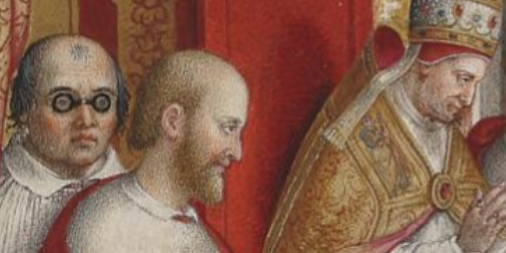
You can enjoy each of the images for a long time, and ask your own questions. Here's somebody standing behind the pope who is wearing natty black-rimmed spectacles. Explain that.
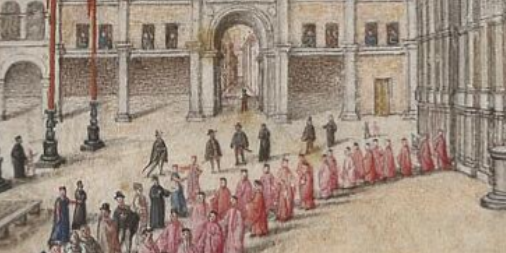
In 1524, Francesco paid a state visit to Venice and was met by the then Doge, Andrea Gritti, in the Piazzetta San Marco. Naturally there was a big procession for him:
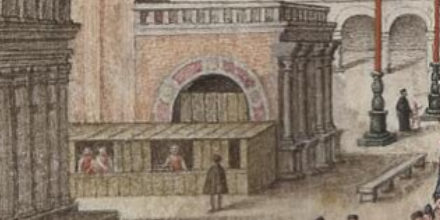
But what caught my eye was the commerce at the fringe. Even in those days, there were jerrybuilt wooden shops on the main square of Venice selling heaven knows what to the tourists:
Enjoy browsing the manuscript. It is one of 39 just brought online for a new posted total of 5,353. Here is my unofficial list:
This is Piggin's Unofficial List number 67. If you have corrections or additions, please use the comments box below. Follow me on Twitter (@JBPiggin) for news of more additions to Digita Vaticana.
Francesco Maria di Montefeltro was the fourth duke of Urbino and his life ended up being celebrated in word by Giovanni Battista Leoni and in images by Valerio Mariani da Pesaro. The manuscript, Urb.lat.1764, part of the Urbino Collection, was brought online on August 31 by the Vatican Library.
You can enjoy each of the images for a long time, and ask your own questions. Here's somebody standing behind the pope who is wearing natty black-rimmed spectacles. Explain that.
In 1524, Francesco paid a state visit to Venice and was met by the then Doge, Andrea Gritti, in the Piazzetta San Marco. Naturally there was a big procession for him:
But what caught my eye was the commerce at the fringe. Even in those days, there were jerrybuilt wooden shops on the main square of Venice selling heaven knows what to the tourists:
Enjoy browsing the manuscript. It is one of 39 just brought online for a new posted total of 5,353. Here is my unofficial list:
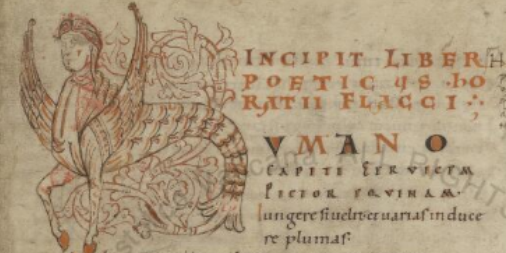
- Reg.lat.1701, a fine miscellany from the 11th century. Among the contents is a glossary of Old High German with definitions in Latin. Below is the incipit of the Ars Poetica of Horace:
- Urb.lat.1764, discussed above
- Vat.ebr.4
- Vat.ebr.40
- Vat.ebr.41
- Vat.ebr.42
- Vat.ebr.344
- Vat.ebr.356
- Vat.ebr.390
- Vat.ebr.391
- Vat.ebr.392
- Vat.ebr.393
- Vat.ebr.394
- Vat.ebr.395
- Vat.ebr.397
- Vat.ebr.398
- Vat.ebr.404
- Vat.ebr.409
- Vat.ebr.410
- Vat.ebr.412.pt.3
- Vat.ebr.413
- Vat.ebr.420
- Vat.ebr.423
- Vat.lat.181
- Vat.lat.329
- Vat.lat.360
- Vat.lat.368
- Vat.lat.783
- Vat.lat.873
- Vat.lat.878
- Vat.lat.888
- Vat.lat.898
- Vat.lat.935
- Vat.lat.953
- Vat.lat.959
- Vat.lat.969
- Vat.lat.987
- Vat.lat.8552, Josephus, The Antiquities of the Jews, in Latin: check out the Latin Josephus Project for more information. This manuscript is discussed in a 1960 codicology book by Jacques Stiennon on millennial manuscripts from the Lieges area, reviewed in Scriptorium.
- Vat.turc.152
- Pal. lat. 761 Codicis Iustiniani imp. libri IX (1255)
- Pal. lat. 791 Iacobus de Alvarottus: Iacobi de Alvarottis patavini de feudis (15. Jh.)
- Pal. lat. 794 Sammelhandschrift (15. Jh.)
- Pal. lat. 800 (Iacobi) Gentilis (Brixiensis) repertorium iuris (Pars I) (15. Jh.)
- Pal. lat. 801 (Iacobi) Gentilis (Brixiensis) repertorium iuris (Pars II) (15. Jh.)
- Pal. lat. 802 Repertorium iuris (15. Jh.)
- Pal. lat. 803 Repertorium iuris canonici (15. Jh.)
- Pal. lat. 804 Tabula doctorum, i. e. repertorium universale iuridicum, theologicum, morale [Pars I] (15. Jh.)
- Pal. lat. 805 Tabula doctorum, i. e. repertorium universale iuridicum, theologicum, morale [Pars II] (15. Jh.)
- Pal. lat. 806 Repertorium universale iuridicum, theologicum, morale [Pars I] (15. Jh.)
- Pal. lat. 807 Repertorium iuris ; Conclusiones sexti libri decretalium (15. Jh.)
- Pal. lat. 808 Repertorium universale iuridicum, theologicum, morale [Pars III] (15. Jh.)
- Pal. lat. 809 Repertorium universale iuridicum, theologicum, morale [Pars VI] (15. Jh.)
- Pal. lat. 810 Repertorium universale iuridicum, theologicum, morale [Pars II] (15. Jh.)
- Pal. lat. 812 Repertorium universale iuridicum, theologicum, morale [Pars V] (15. Jh.)
- Pal. lat. 820 Mathey Palmery (sic) florentini de temporibus ad Petrum Cosmae filium medicem ; Eusebii (et) Hieronomi (sic) presbyteri chronica, a Prospero continuata (15. Jh.)
- Pal. lat. 821 Eusebii et Hieronymi chronicon, a Prospero continuatum (15. Jh.)
- Pal. lat. 823 Cassiodorii historia ecclesiastica tripartita (9.-10. Jh.)
- Pal. lat. 826 Anastasii Bibliothecarii historia ecclesiastica tripartita (11. Jh.)
- Pal. lat. 827 Pauli Horosii presbiteri ad Augustinum episcopum hystoriarum contra accusatores temporum christianorum, libri VII (13.-14. Jh.)
- Pal. lat. 828 Sammelhandschrift (11.,14., 15. Jh.)
- Pal. lat. 830 Mariani Scott chronicon (11. Jh.)
- Pal. lat. 832 Sammelhandschrift (14. Jh.)
- Pal. lat. 837 Ludolphi Carthusiani de uita Christi in euangelio tradita pars secunda et ultima (15. Jh.)
- Pal. lat. 838 (Ludolphi Carthusiani) de vita Ihesu in ewangelio (sic) tradita, pars prima (15. Jh.)
- Pal. lat. 844 Vitae patrum (15. Jh.)
- Pal. lat. 849 Jacobus : Legenda sanctorum (14. Jh.)
- Pal. lat. 918 Plutarchi vitae in latinum translatae (15. Jh.)
- Pal. lat. 928 Gesta Romanorum ; Historia septem sapientum (Süddeutschland, 14. Jh.)
- Pal. lat. 970 Giovanni ; Boccaccio, Giovanni: Sammelband (Italien, 1379 ; 15. Jh.)
- Pal. lat. 971 Honorius ; Johannes ; Petrus : Sammelhandschrift (Frankenthal, 1508)
- Pal. lat. 1093 Galenus: Sammelhandschrift (Italien, 14. Jh.)
- Pal. lat. 1095 Galenus: Sammelhandschrift (Italien (Südfrankreich), 14. Jh.)
- Pal. lat. 1099 Galenus; Avicenna; Albertus : Medizinische Sammelhandschrift ((Heidelberg), 2. Hälfte 15. Jh. (1475/77))
- Pal. lat. 1120 Avicenna; Knab, Erhardus: Fen quarta libri Canonis primi (Heidelberg, 1467)
- Pal. lat. 1183 Knab, Erhardus: Sammelhandschrift (Heidelberg, 1465/66)
- Pal. lat. 1232 Avicenna; Knab, Erhardus: Medizinischer Sammelband (Heidelberg, um 1470)
- Pal. lat. 1242 Ps.-Albertus Magnus; Odo ; Johannes : Medizinischer Sammelband (Südwestdeutschland , Freiburg (III), 14. Jh. (I) ; 1. Drittel 15. Jh. (II) ; 1419 (III) ; 1. Hälfte 15. Jh. (IV))
- Pal. lat. 1246 Avicenna; Thaddaeus; Gentilis : Medizinische Sammelhandschrift ((Heidelberg, 122ff.), letztes Drittel 15. Jh. (nach 1468))
- Pal. lat. 1263 Regimen sanitatis für Friedrich IV. von der Pfalz (Hedelberg, 1593)
- Pal. lat. 1274 Matthaeus : Circa instans seu de simplcibus medicinis (Westdeutschland, 13./14. Jh.)
- Pal. lat. 1310 Lanfrancus ; Ps.-Galenus: Sammelhandschrift (Montpellier, 14. Jh. (1325))
- Pal. lat. 1327 Laurentius Rusius; Iordanus ; Knab, Erhardus; Bartholomaeus de Montagnana; Zacharias de Feltris: Medizinische Sammelhandschrift (Heidelberg, 15. Jh. (1476-479))
- Pal. lat. 1334 Franciscus : Defensorium inviolatae virginitatis beatae Mariae (Blockbuch) (Regensburg, 1471)
- Pal. lat. 1360 Strabo: Strabonis Geographica (Deutschland, 2. Drittel 15. Jh.)
- Pal. lat. 1445 Leopoldus ; Yaḥya ibn Abi Manṣūr /al-Ma'mūnī; Hermes; Zael; Guido ; Albertus ; Johannes : Astrologische Sammelhandschrift: Miscellanea (Süddeutschland, Ende 15. Jh.)
- Pal. lat. 1480 Cicero, Marcus Tullius: Orationes (Italien, 15. Jh.)
- Pal. lat. 1484 Cicero, Marcus Tullius: Orationes (Italien, 15. Jh.)
- Pal. lat. 1497 Cicero, Marcus Tullius: Epistulae ad familiares (I-XVI) (Italien, 15. Jh.)
- Pal. lat. 1500 Cicero, Marcus Tullius: Epistulae ad familiares (I-XVI) (Italien, 14.-15. Jh.)
- Pal. lat. 1504 Cicero, Marcus Tullius: Epistulae ad familiares (I-XVI) (Italien, 14.-15. Jh.)
- Pal. lat. 1505 Cicero, Marcus Tullius: Epistulae ad familiares (I-VII, IX-XVI) (Italien, 15. Jh.)
- Pal. lat. 1506 Cicero, Marcus Tullius: Epistulae ad familiares (I-VII, IX-XVI) (Italien, 15. Jh.)
- Pal. lat. 1507 Cicero, Marcus Tullius: Epistulae ad familiares (I-XVI) (Italien, 15. Jh.)
- Pal. lat. 1514 Cicero, Marcus Tullius: Tusculanae disputationes (Italien, 10. Jh.)
- Pal. lat. 1566 Palladius, Rutilius Taurus Aemilianus: Opus agriculturae (Italien, 14. Jh.)
- Pal. lat. 1587 Sidonius, Gaius Sollius Apollinaris; Serenus, Quintus; Ps.-Crispus Mediolanensis Diaconus: Sammelhandschrift (Italien, 15. Jh.)
- Pal. lat. 1609 Erasmus, Desiderius: Enchiridion militis Christiani (Frankreich (?), nach 1574)
- Pal. lat. 1610 Oratio de natura leonis (Pfalz, um 1590-1594)
- Pal. lat. 1611 Guido : Sammelhandschrift (Italien, 13. Jh. ; 14. Jh.)
- Pal. lat. 1675 Francesco Ceccharelli: Commentum in Senecae tragoedias (Italien, um 1440)
- Pal. lat. 1730 Petrarca, Francesco: Sammelhandschrift (Italien (?), um 1440, 1442)
- Pal. lat. 1733 Gruterus, Janus: Anthologia (Heidelberg, 1602)
- Pal. lat. 1734 Carmina et orationes festivae (Cambridge, 1613)
- Pal. lat. 1744 Veit Örtel: Annotationes (Wittenberg, 1554-1557)
- Pal. lat. 1758 Gian Francesco Poggio Braccolini; Valla, Lorenzo (Deutschland, um 1465-1470)
- Pal. lat. 1823 Luther, Martin: Excerpta (Weimar (?), Mitte 16. Jh.)
This is Piggin's Unofficial List number 67. If you have corrections or additions, please use the comments box below. Follow me on Twitter (@JBPiggin) for news of more additions to Digita Vaticana.
2016-08-26
Queen's Library
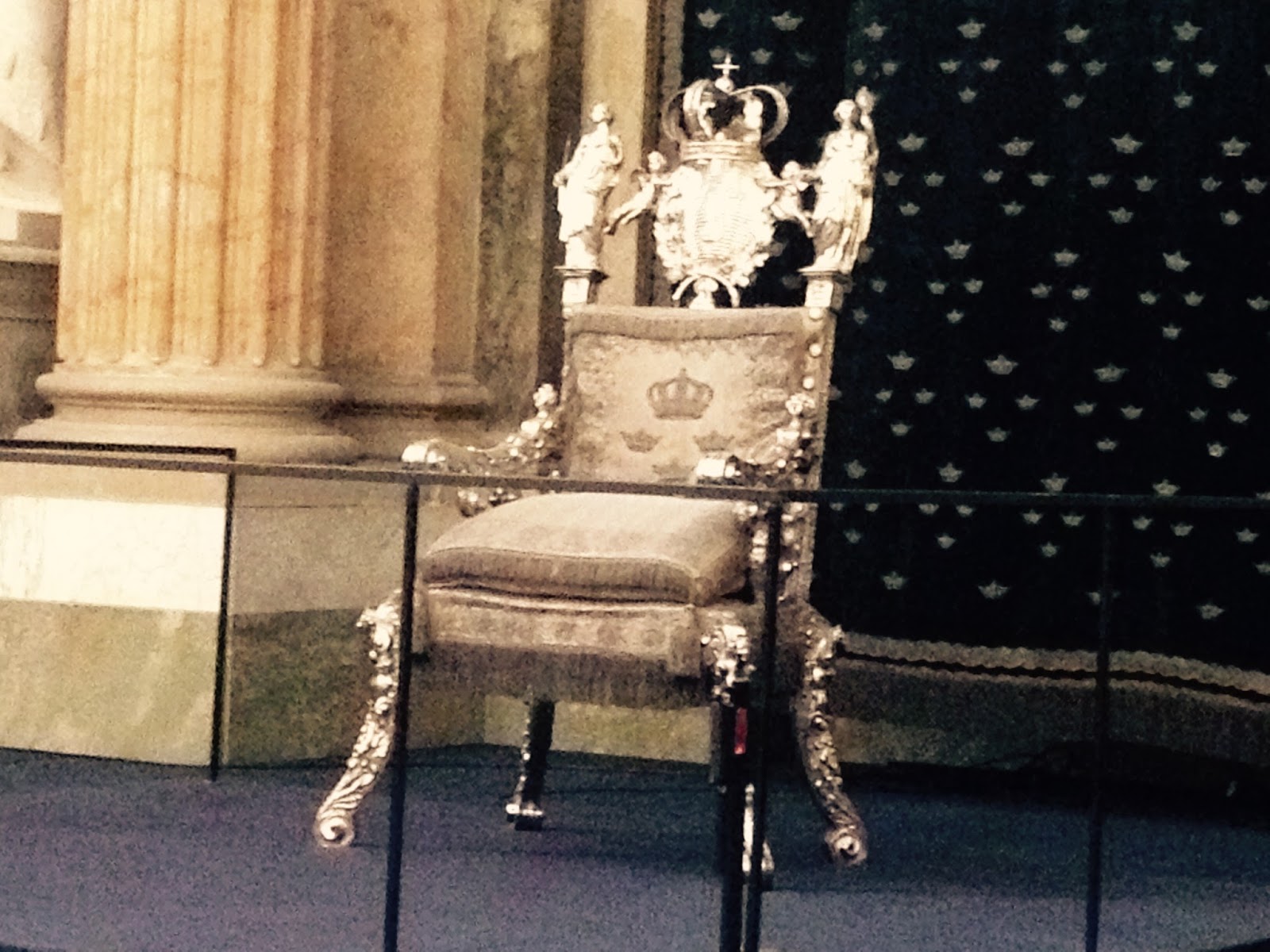
Christina Vasa was not bookish. Erudite, intellectual and knowledgeable in nine languages, she had one of the finest private libraries of old manuscripts in Europe. But power was her drug. She wore a dagger, ran wars and had people murdered for crossing her. Last year I admired her silver throne in Stockholm:
Out of boredom after 10 years as King of Sweden (the Swedes refused to call her "queen"), she abdicated, took her library with her and toured her cavalcade as if she owned all Europe (Daddy nearly did. But Gustav II Adolf of Sweden had been killed in battle in 1632 just as his conquests were advancing.)
After her death in 1689, the papacy finangled ownership of Christina's famous library, and legions of scholars have tried to unravel where she got all these prizes from. Élisabeth Pellegrin has suggested that apart from the widespread pillaging of libraries in the 17th century, a main factor was the depreciation of manuscript values after the rise of print.
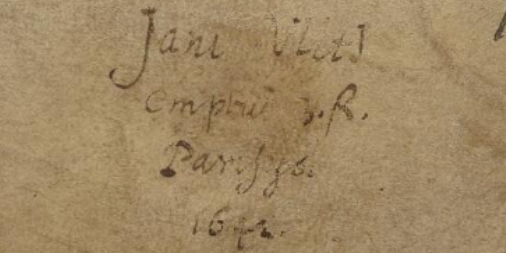
Of the two Reg.lat. items new online this week, one, Reg.lat.1705, is the Bucolica commentary of Servius Grammaticus. It may be French, though not one of the very old mss used in the edition. In a quick web search I cannot find exactly where it came from. Perhaps it was picked up by her dealers in Paris and sent to Stockholm? There is 1641 receipt written in Paris on fol. 1r:
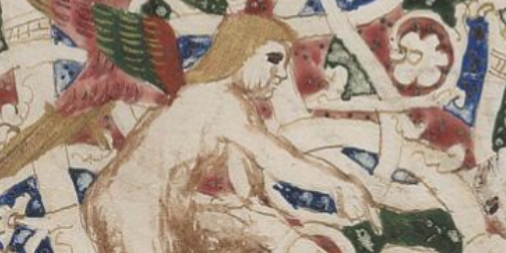
The other, Reg.lat.1881, a Renaissance Quintilian, turns out not to have been Christina's. The papal library was perhaps short of shelves, and this codex got later shoved into Reg.lat. (you know how it is when your bookcases get too full). Pellegrin says it was in fact a papal acquisition post-1690 and had once belonged to Niccolò Perotti (1429-1480), archbishop of Siponto. Here's an angel in it, dancing not on a pin but in a thicket:
One might think that 325 years later, Sweden would either demand the Fonds de la Reine back, or seize its chance to virtually recover the Vasa treasures as a digital library online, now that the technology exists to replicate it and the Vatican is willing. After all, the Swedish taxpayer paid for these fantastic manuscripts in the first place.
Germany is already replicating online the Palatine Library, a similarly sized and esteemed collection from Heidelberg seized by the papacy. Search the virtual Bibliotheca Palatatina here. But astonishingly, the Swedes do nothing. Add your opinion in the comments below if you think Sweden should wake up and act on this opportunity.
Here is the full list of 49 manuscripts brought online on August 24:
Out of boredom after 10 years as King of Sweden (the Swedes refused to call her "queen"), she abdicated, took her library with her and toured her cavalcade as if she owned all Europe (Daddy nearly did. But Gustav II Adolf of Sweden had been killed in battle in 1632 just as his conquests were advancing.)
After her death in 1689, the papacy finangled ownership of Christina's famous library, and legions of scholars have tried to unravel where she got all these prizes from. Élisabeth Pellegrin has suggested that apart from the widespread pillaging of libraries in the 17th century, a main factor was the depreciation of manuscript values after the rise of print.
Of the two Reg.lat. items new online this week, one, Reg.lat.1705, is the Bucolica commentary of Servius Grammaticus. It may be French, though not one of the very old mss used in the edition. In a quick web search I cannot find exactly where it came from. Perhaps it was picked up by her dealers in Paris and sent to Stockholm? There is 1641 receipt written in Paris on fol. 1r:
The other, Reg.lat.1881, a Renaissance Quintilian, turns out not to have been Christina's. The papal library was perhaps short of shelves, and this codex got later shoved into Reg.lat. (you know how it is when your bookcases get too full). Pellegrin says it was in fact a papal acquisition post-1690 and had once belonged to Niccolò Perotti (1429-1480), archbishop of Siponto. Here's an angel in it, dancing not on a pin but in a thicket:
One might think that 325 years later, Sweden would either demand the Fonds de la Reine back, or seize its chance to virtually recover the Vasa treasures as a digital library online, now that the technology exists to replicate it and the Vatican is willing. After all, the Swedish taxpayer paid for these fantastic manuscripts in the first place.
Germany is already replicating online the Palatine Library, a similarly sized and esteemed collection from Heidelberg seized by the papacy. Search the virtual Bibliotheca Palatatina here. But astonishingly, the Swedes do nothing. Add your opinion in the comments below if you think Sweden should wake up and act on this opportunity.
Here is the full list of 49 manuscripts brought online on August 24:
- Borg.copt.109.cass.XX.fasc.78
- Borg.copt.109.cass.XXII.fasc.89
- Reg.lat.1705
- Reg.lat.1881
- Urb.gr.33
- Vat.ebr.38
- Vat.ebr.39
- Vat.ebr.364
- Vat.ebr.371
- Vat.ebr.374
- Vat.ebr.375
- Vat.ebr.376
- Vat.ebr.378
- Vat.ebr.379
- Vat.ebr.380
- Vat.ebr.381
- Vat.ebr.382
- Vat.ebr.383
- Vat.ebr.384.pt.2
- Vat.ebr.385
- Vat.ebr.386
- Vat.ebr.387
- Vat.ebr.388
- Vat.ebr.389
- Vat.lat.135
- Vat.lat.254
- Vat.lat.634
- Vat.lat.758
- Vat.lat.796
- Vat.lat.818
- Vat.lat.820
- Vat.lat.831
- Vat.lat.833
- Vat.lat.844
- Vat.lat.846
- Vat.lat.850
- Vat.lat.860
- Vat.lat.872
- Vat.lat.874
- Vat.lat.904
- Vat.lat.925
- Vat.lat.934
- Vat.lat.942
- Vat.lat.945
- Vat.lat.950
- Vat.lat.962
- Vat.lat.964
- Pellegrin Élisabeth. "Possesseurs français et italiens de manuscrits latins du fonds de la Reine à la Bibliothèque Vaticane." In: Revue d'histoire des textes, bulletin n°3 (1973), 1974. pp. 271-297; DOI : 10.3406/rht.1974.1097 http://www.persee.fr/doc/rht_0373-6075_1974_num_3_1973_1097
2016-08-15
The 1K Moment
The biggest manuscript series in the Vatican Library, comprising at least a fifth of the overall repository volume, is the Vat. lat. collection: the codices in Latin that were not purchased in complete libraries as other collections were, but acquired one by one as gifts to or purchases by the papacy. On August 10, the digitizers brought the 1,0000th item from this series online.
The Vat.lat. page with 1,000 thumbnails has become a roadblock in the portal, since it downloads very slowly, and it will be interesting to see if the portal designers can find some way to make it less unwieldy.
Here is the full list of 65 new digitizations, which bring the current total to 5,267:
The Vat.lat. page with 1,000 thumbnails has become a roadblock in the portal, since it downloads very slowly, and it will be interesting to see if the portal designers can find some way to make it less unwieldy.
Here is the full list of 65 new digitizations, which bring the current total to 5,267:
- Barb.lat.154 - Lucretius, De Rerum Natura, a Renaissance manuscript. Below is a detail showing Hector. Details
- Borg.copt.109.cass.XX.fasc.75 - Details
- Borg.copt.109.cass.XX.fasc.76 - Details
- Borg.copt.109.cass.XX.fasc.77 - Details
- Borg.copt.109.cass.XX.fasc.79 - Details
- Borg.copt.109.cass.XXI.fasc.80 - Details
- Borg.copt.109.cass.XXII.fasc.85 - Details
- Borg.copt.109.cass.XXII.fasc.86 - Details
- Borg.copt.109.cass.XXII.fasc.87 - Details
- Borg.copt.109.cass.XXII.fasc.88 - Details
- Ott.lat.1420 - Details
- Ott.lat.1529 - Justin's Philippic Histories, whereby the illuminations include the bedroom scene below - Details
- Ott.lat.2005 - Details
- Reg.lat.16 - Details
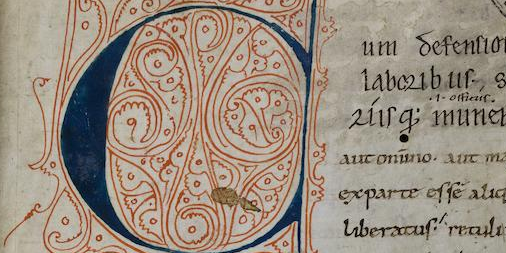
- Reg.lat.1823 - 9th-century manuscript in a Beneventan pre-Carolingian hand of Isidore's Sententiae and the Instructiones of Eucherius. In the edition of the Sentences, this is witness Q. Details
- Vat.ar.462 - Details
- Vat.ebr.34 - Details
- Vat.ebr.35 - Details
- Vat.ebr.36 - Details
- Vat.ebr.37 - Details
- Vat.ebr.325 - Details
- Vat.ebr.332 - Details
- Vat.ebr.334 - Details
- Vat.ebr.336 - Details
- Vat.ebr.338 - Details
- Vat.ebr.339 - Details
- Vat.ebr.341 - Details
- Vat.ebr.343 - Details
- Vat.ebr.346 - Details
- Vat.ebr.348 - Details
- Vat.ebr.349 - Details
- Vat.ebr.350 - Details
- Vat.ebr.351 - Details
- Vat.ebr.352 - Details
- Vat.ebr.353 - Details
- Vat.ebr.354 - Details
- Vat.ebr.355 - Details
- Vat.ebr.357 - Details
- Vat.ebr.358 - Details
- Vat.ebr.359 - Details
- Vat.ebr.360 - Details
- Vat.ebr.361 - Details
- Vat.ebr.362 - Details
- Vat.ebr.363 - Details
- Vat.ebr.365 - Details
- Vat.ebr.366 - Details
- Vat.ebr.367 - Details
- Vat.ebr.368 - Details
- Vat.ebr.369 - Details
- Vat.ebr.377 - Details
- Vat.lat.259 - Athanasius, Details
- Vat.lat.291 - Ambrose, Details
- Vat.lat.382 - 16th century miscellany including Cyril of Jerusalem, Augustine. Details
- Vat.lat.761 - Thomas Aquinas' In Aristotelis librum Analytica posteriora and another brief text in a textura hand. (St Louis catalog.) There appears to have been a flurry of (unavailing) interest in the identity of the Montpellier Dominican friar who once once owned this codex, evidenced only by a rubbed-out ex libris note on fol 57v: Iste liber est fratris...ordinis fratrum predicatorum. Conventus Montispessulani. Details
- Vat.lat.793 - Details
- Vat.lat.804 - Details
- Vat.lat.821 - Details
- Vat.lat.832 - Details
- Vat.lat.847 - Details
- Vat.lat.862 - Details
- Vat.lat.865 - Details
- Vat.lat.892 - Pope Sixtus IV, Details
- Vat.lat.914 - Bonaventura, Commentaries, Details
- Vat.lat.14596 - Details
- Vat.turc.148 - Details
Subscribe to:
Posts
(
Atom
)